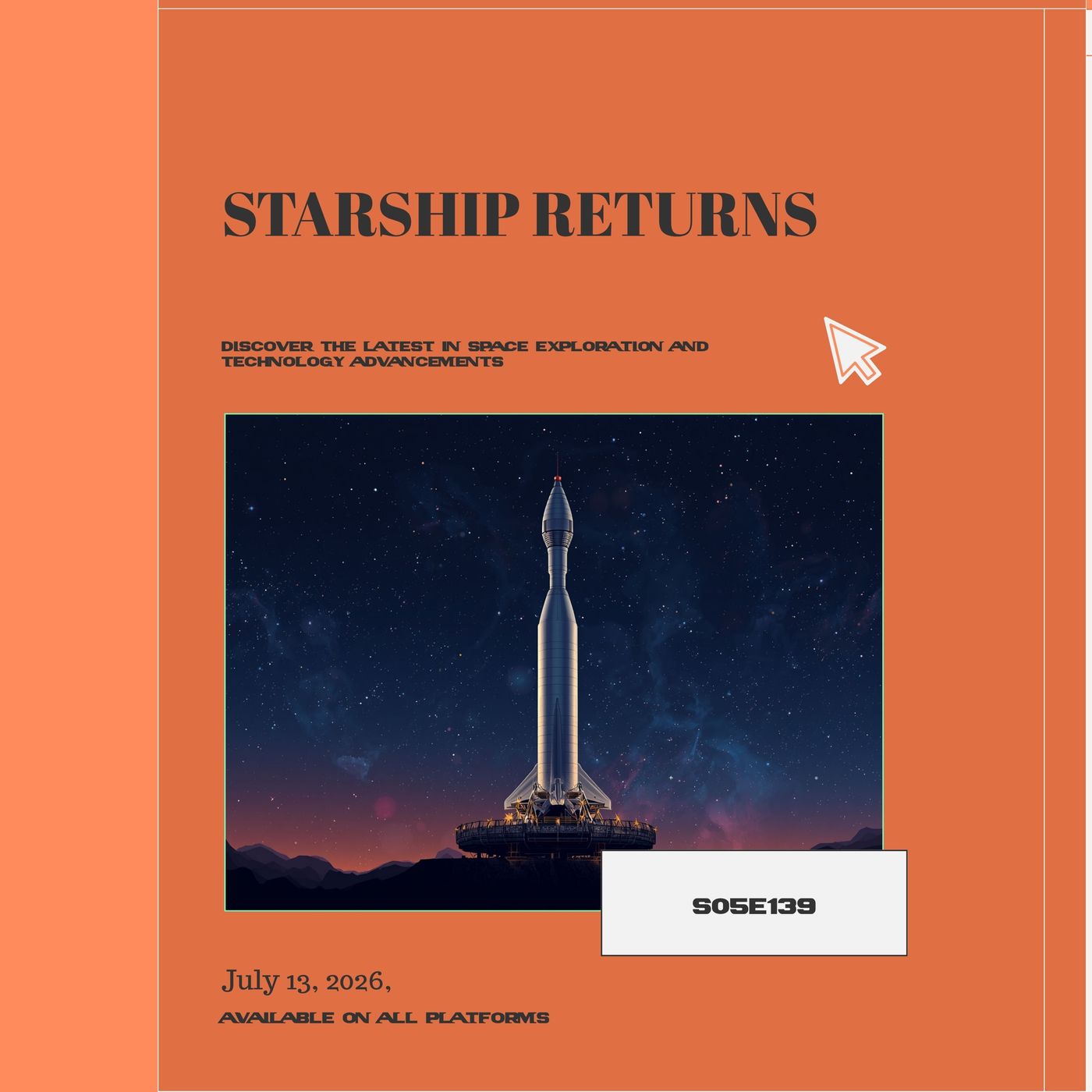
Starship Set for Flight 13, Japan's Reusable Rocket Breakthrough, and SpaceX's 100,000 Satellite Ambition
About this episode
This episode covers the upcoming Starship Flight 13, Japan's advancements in reusable rockets, and SpaceX's ambitious plans for a 100,000 satellite constellation.
Astronomy Daily S05E139 — Monday, 13 July 2026 Starship could fly again as soon as Wednesday — carrying its first-ever real payload. Japan quietly joins the reusable rocket club just a day after China. SpaceX asks regulators for a jaw-dropping 100,000 satellites. Physicists may have heard the accumulated whispers of every star that ever exploded. Isar Aerospace signs a $150 million deal to launch from Canada. And a ravenous black hole just 1.8 billion light-years away is giving astronomers — including teams from CSIRO and the University of Sydney — a window into the dawn of time. In this episode • Starship Flight 13: Booster 20's 33-engine static fire complete; launch NET Wednesday (AEST); first deployment of 20 Starlink V3 satellites; in-space Raptor relight and Indian Ocean splashdown planned. • JAXA's RV-X reusable rocket completes its first hop at Noshiro — about 40 seconds, 10–11 metres up, landing upright — one day after China's Long March 10B sea recovery. • SpaceX files with the FCC for a 100,000-satellite Gen3 constellation in very low Earth orbit, pitched at multi-gigabit AI-era connectivity — and entirely dependent on Starship. • Super-Kamiokande reports the first…
More episodes of Astronomy Daily: Space News Updates
- Postcards From Mars
- India Reaches Orbit — Privately — Today's Space News
- The Sun's Hidden Power, Atmosphere on a Nearby Planet, and Starship's Five-Act Drama
- Atmosphere Found on Rocky Exoplanet, Starship Drama Unfolds, and Meteorite Treasure Trove
- Hide and Seek - The Faintest Planet Ever Imaged, Pluto's Landslides & Starlink's 355,000 Dodges
- Starship Set for Launch, First Black Hole Found in Omega Centauri, and X-Rays in Space
Explore listener stats, chart rankings, contacts and more on the Astronomy Daily: Space News Updates podcast page.