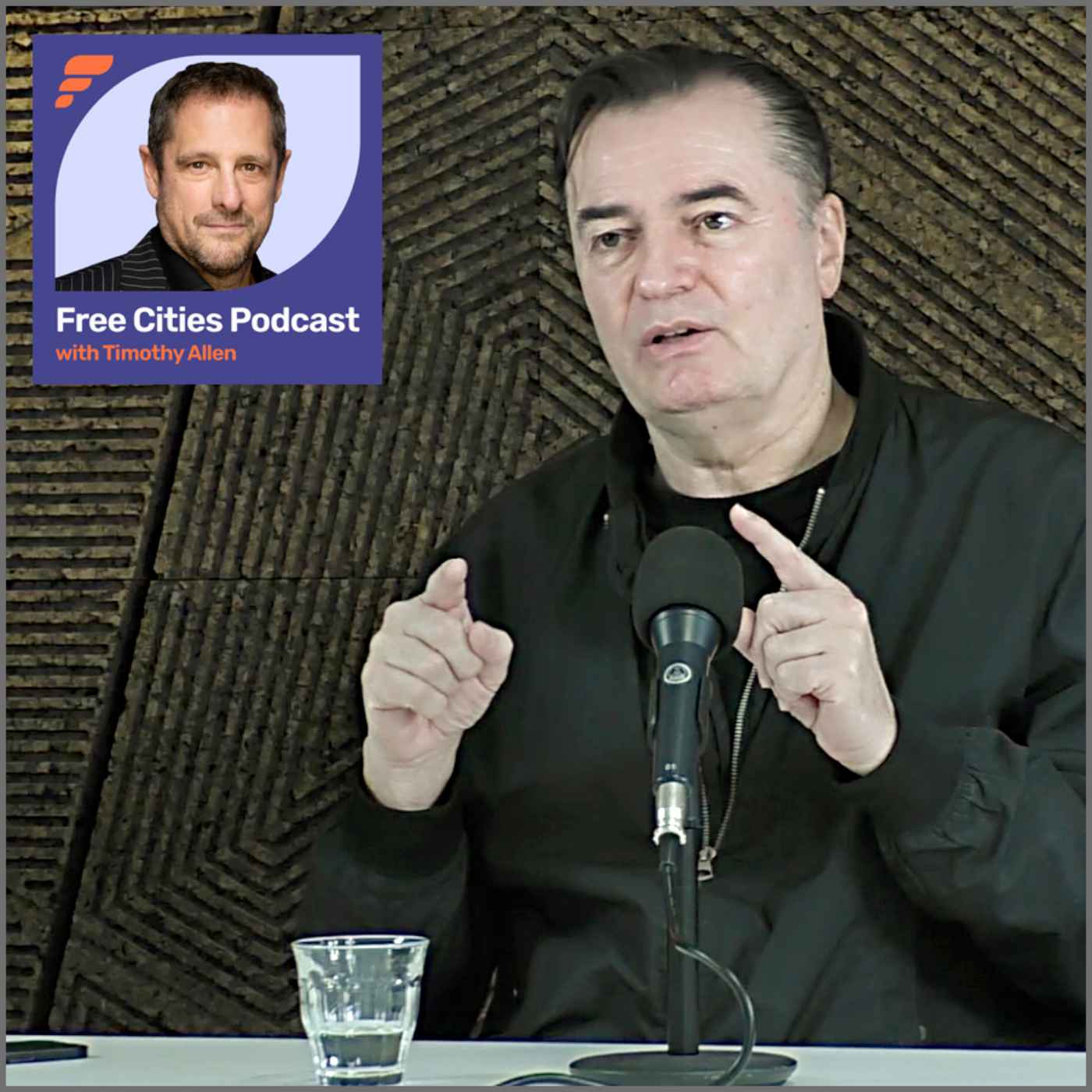
174 - The Architecture of Spontaneous Order | Patrik Schumacher
About this episode
Timothy Allen interviews Patrik Schumacher about the evolution of cities and architecture through the lens of freedom and market principles.
"Land use should not be prescribed by any planning regime. People come together into the city by seeking out very particular connections and a multitude of connections. And they have to find each other. There needs to be the degree of freedom to associate and self-organize what I call the co-location synergies." - Timothy Allen sits down with Patrik Schumacher, principal architect at Zaha Hadid Architects and the theorist behind “parametricism,” to talk about what happens when cities are allowed to evolve like markets: bottom up, adaptive, and shaped by real human purposes rather than planning committees. Starting with the 2008 crisis and Schumacher’s path into Austrian economics, the conversation moves into why he thinks the built environment is one of the most anti-market domains in the modern West, and how that shows up as paralysis, affordability problems, and “garbage spill” urbanization with no coherent identity. From there, Patrik makes the case that architecture should not impose a preconceived formal order, but should make an emerging network of relationships legible: tracing flows, affiliations, and co-location synergies the way a living ecosystem organizes itself. They…
People in this episode
Host: Timothy Allen
Guest: Patrik Schumacher
Topics covered
- urban development
- architecture
- Austrian economics
- freedom in cities
- market evolution
Keywords
- urbanism
- self-organization
- co-location synergies
- affordability
- computational tools
Mentioned in this episode
Organizations: Zaha Hadid Architects
Books & works: parametricism
More episodes of Free Cities Podcast
- 179 - My Family Owns a Country | Liam Bates
- 178 - 8 Hard Truths from 25 Years of Investing in Free Cities | Patri Friedman
- 177 - The Próspera Master Plan | Gabriel Delgado
- 176 - Why Everything Feels Broken | James Price
- 175 - The Last Free Place | Oswald Horowitz
- 173 - The Hidden Path to Tyranny | Mailyn Salabarria
Explore listener stats, chart rankings, contacts and more on the Free Cities Podcast podcast page.