Fun Facts About Claude Shannon
About this episode
This episode explores the life and contributions of Claude Shannon, the father of information theory, and his impact on modern computing and digital communication.
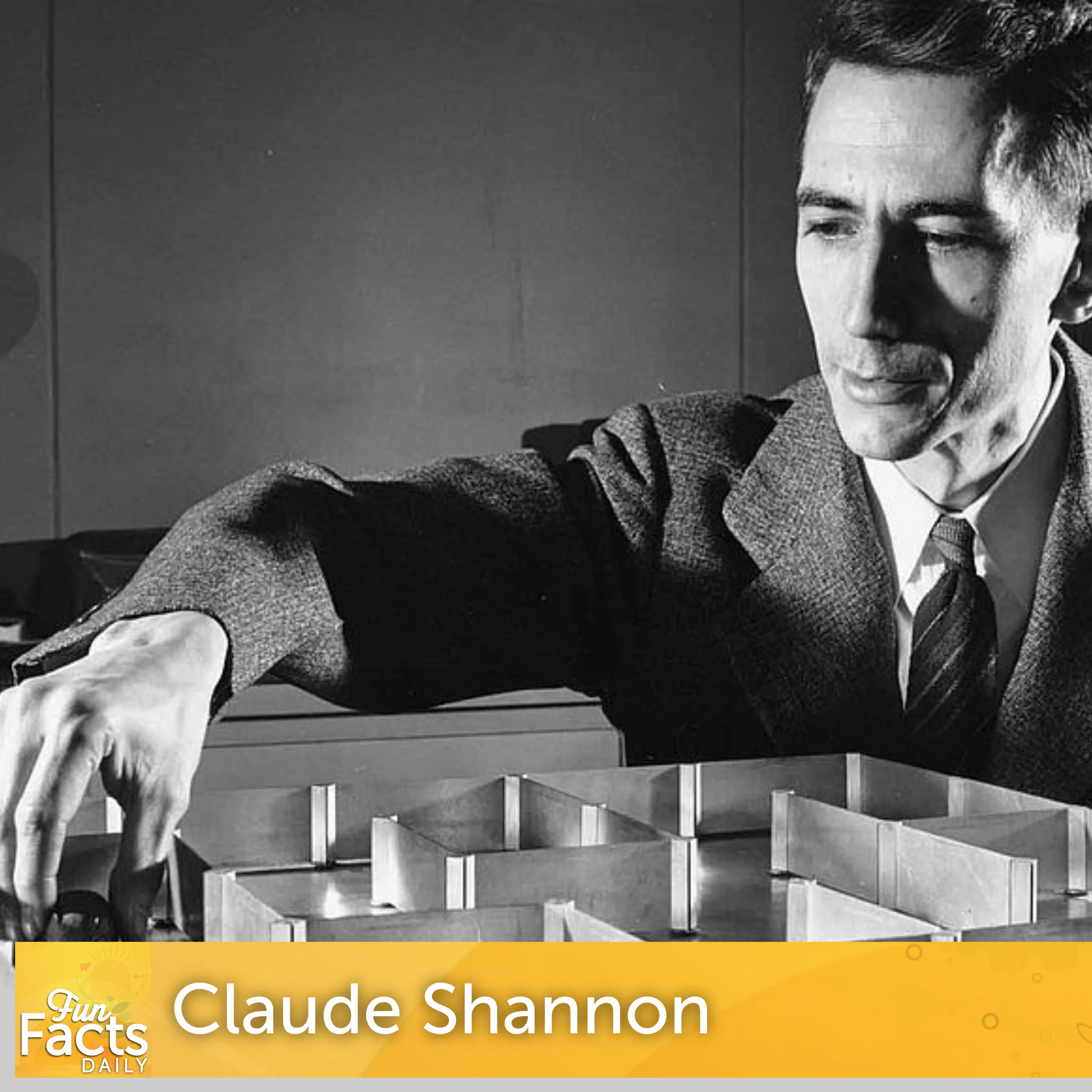
Claude Shannon, widely recognized as the father of information theory, fundamentally shaped modern computing and digital communication. In 1937, while studying at the Massachusetts Institute of Technology, Shannon authored a revolutionary master's thesis that bridged 19th-century Boolean algebra with electrical switching circuits. By mapping the binary concepts of true and false to the "on" and "off" states of electrical relays, he established the logical framework that governs every modern computer processor today. Shannon later popularized the term bit, a portmanteau of binary digit coined by statistician John Tukey in his landmark 1948 paper, A Mathematical Theory of Communication. This foundational work quantified data as a measurable physical quantity, proving that text, audio, and images could all be seamlessly reduced to sequences of ones and zeroes for transmission. Beyond his monumental theoretical contributions, Shannon was a prolific and eccentric inventor who applied his analytical mindset to playful yet pioneering mechanical devices. In 1950, he created Theseus, a magnetic mechanical mouse capable of navigating mazes and remembering its mistakes via electrical…
People in this episode
Host: Kyle Wood
Topics covered
- information theory
- computing
- digital communication
- artificial intelligence
- invention
- Boolean algebra
Keywords
- Claude Shannon
- information theory
- computing
- digital communication
- Boolean algebra
- artificial intelligence
- Theseus
- Ultimate Machine
Mentioned in this episode
Organizations: Massachusetts Institute of Technology
Products: Theseus, Ultimate Machine
Books & works: A Mathematical Theory of Communication
More episodes of Fun Facts Daily
- Fun Facts About Jelly Beans
- Fun Facts About Antigua
- Fun Facts About Units of Measurement
- Fun Facts About Manga
Explore listener stats, chart rankings, contacts and more on the Fun Facts Daily podcast page.