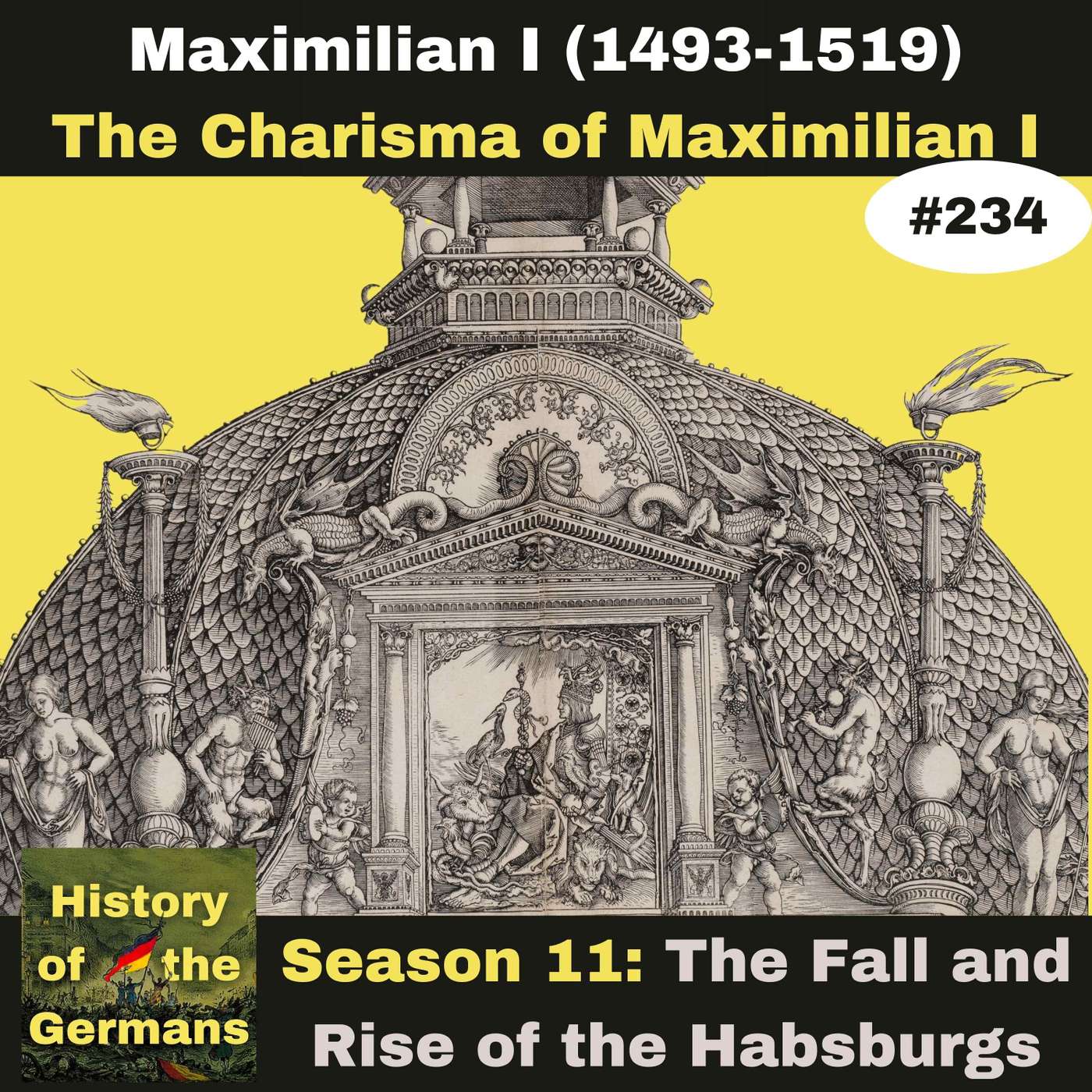
Ep. 234: The Charisma of Emperor Maximilian (1493-1519)
About this episode
This episode explores the life and legacy of Emperor Maximilian I, focusing on his extensive visual representation and the importance of commemoration.
Maximilian I died on January 12th, 1519. But his likeness is everywhere. None of his predecessors left behind as many depictions of their life, from being fed by his nurse as a toddler to the Totenbild, the picture of the emperor in death, stripped of all his paraphernalia, even his teeth broken out. If you search in google for the most reproduced image of a Holy Roman Emperor, two come up, the portrait of Maximilian that Albrecht Dürer produced in Augsburg in 1518, as shown on last weeks episode artwork and Titian’s equestrian portrait of Charles V after the battle of Mühlberg, which in turn is a composition that goes back to several equestrian portraits of Maximilian I. Basically, Maximilian I is the most visually present Holy Roman emperor of them all. And that is not by chance. As he said on several occasions, quote: "Whoever does not provide for his commemoration during his lifetime has no commemoration after his death and is forgotten with the sound of the bell that rings at his burial" The music for the show is Flute Sonata in E-flat major, H.545 by Carl Phillip Emmanuel Bach (or some claim it as BWV 1031 Johann Sebastian Bach) performed and arranged by Michel Rondeau…
More episodes of History of the Germans from the Middle Ages to Reunification
- The Reformation! The Faith of the Common People
- The Most Consequential Figure in European History?
- Ep. 238: The Habsburg Empire at its Zenith - Ferdinand I and the Siege of Vienna
- Ep. 237: How Italy Fell to the Habsburgs - From the Peace of Madrid to the Sack of Rome 1527.
- Ep. 236: Charles V (1520-1555) - The Battle of Pavia
- Ep. 235: The Youth and Election of the Emperor Charles V (1520-1555)
Explore listener stats, chart rankings, contacts and more on the History of the Germans from the Middle Ages to Reunification podcast page.