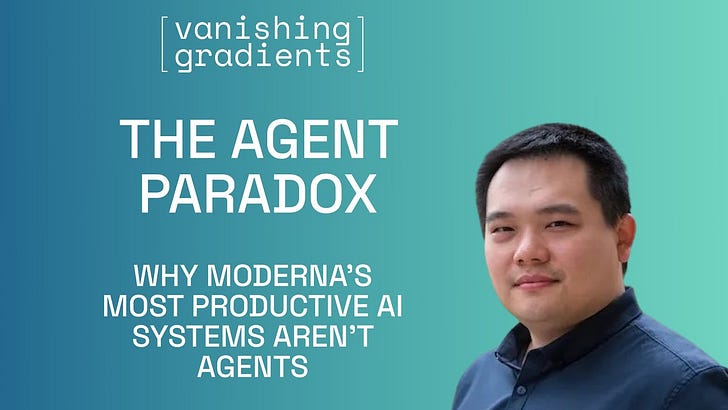
Episode 66: The Agent Paradox - Why Moderna's Most Productive AI Systems Aren't Agents
About this episode
Hugo Bowne-Anderson and Eric Ma discuss the limitations of AI agents in favor of reliable workflows in data science applications at Moderna.
Surprise. We don’t have agents . I actually went in and did an audit of all the LLM applications that we’ve developed internally. And if you were to take Anthropic’s definition of workflow versus agent , we don’t have agents. I would not classify any of our applications as agents. x Eric Ma , who leads Research Data Science in the Data Science and AI group at Moderna , joins Hugo on moving past the hype of autonomous agents to build reliable, high-value workflows . We discuss: * Reliable Workflows : Prioritize rigid workflows over dynamic AI agents to ensure reliability and minimize stochasticity in production environments; * Permission Mapping : The true challenge in regulated environments is security , specifically mapping permissions across source documents, vector stores , and model weights ; * Trace Log Risk : LLM execution traces pose a regulatory risk , inadvertently leaking restricted data like trade secrets or personal information ; * High-Value Data Work : LLMs excel at transforming archived documents and freeform forms into required formats, offloading significant “janitorial” work from scientists; * “Non-LLM” First : Solve problems with simpler tools like Python or ML…
People in this episode
Host: Hugo Bowne-Anderson
Guest: Eric Ma
Topics covered
- AI systems
- workflow
- reliability
- data science
- biotech
- LLMs
Keywords
- agents
- workflows
- LLMs
- data science
- biotech
- regulatory risk
- permission mapping
Mentioned in this episode
Organizations: Moderna, Anthropic
More episodes of Vanishing Gradients
- Next Level AI Evals for 2026
- Privacy Theater Is Not Privacy Engineering: What It Actually Takes to Ship Safe AI
- LLM Architecture in 2026: What You Need to Know with Sebastian Raschka
- Episode 72: Why Agents Solve the Wrong Problem (and What Data Scientists Do Instead)
- Episode 71: Durable Agents - How to Build AI Systems That Survive a Crash with Samuel Colvin
- Episode 70: 1,400 Production AI Deployments
Explore listener stats, chart rankings, contacts and more on the Vanishing Gradients podcast page.