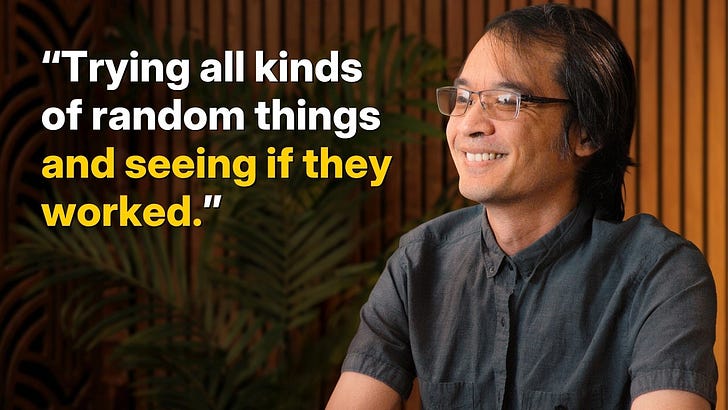
Terence Tao – Kepler, Newton, and the true nature of mathematical discovery
About this episode
The episode explores Kepler's discovery of planetary motion and the complexities of scientific verification over time.
We begin the episode with the absolutely ingenious and surprising way in which Kepler discovered the laws of planetary motion. People sometimes say that AI will make especially fast progress at scientific discovery because of tight verification loops. But the story of how we discovered the shape of our solar system shows how the verification loop for correct ideas can be decades (or even millennia) long. During this time, what we know today as the better theory can actually make worse predictions. And the reasons it survives this epistemic hell is some mixture of judgment and heuristics that we don’t even understand well enough to actually articulate, much less codify into an RL loop. Hope you enjoy! Watch on YouTube ; read the transcript . Sponsors - Jane Street loves challenging my audience with different creative puzzles. One of my listeners, Shawn, solved Jane Street’s ResNet challenge and posted a great walk-through on X . If you want to try one of these puzzles yourself, there’s one live now at janestreet.com/dwarkesh . - Labelbox can get you rubric-based evals, no matter your domain. These rubrics allow you to give your model feedback on all the dimensions you care about…
People in this episode
Host: Dwarkesh Patel
Guest: Terence Tao
Topics covered
- mathematical discovery
- planetary motion
- scientific discovery
- AI
- verification loops
Keywords
- Kepler
- Newton
- AI
- scientific discovery
- planetary motion
- verification loops
- mathematics
Sponsors
Jane Street, Labelbox
Mentioned in this episode
Organizations: Mercury
More episodes of Dwarkesh Podcast
- Jensen Huang – TPU competition, why we should sell chips to China, & Nvidia’s supply chain moat
- Michael Nielsen – How science actually progresses
- Dylan Patel — Deep dive on the 3 big bottlenecks to scaling AI compute
- The most important question nobody's asking about AI
- Why Leonardo was a saboteur, Gutenberg went broke, and Florence was weird – Ada Palmer
- Dario Amodei — "We are near the end of the exponential"
Explore listener stats, chart rankings, contacts and more on the Dwarkesh Podcast podcast page.