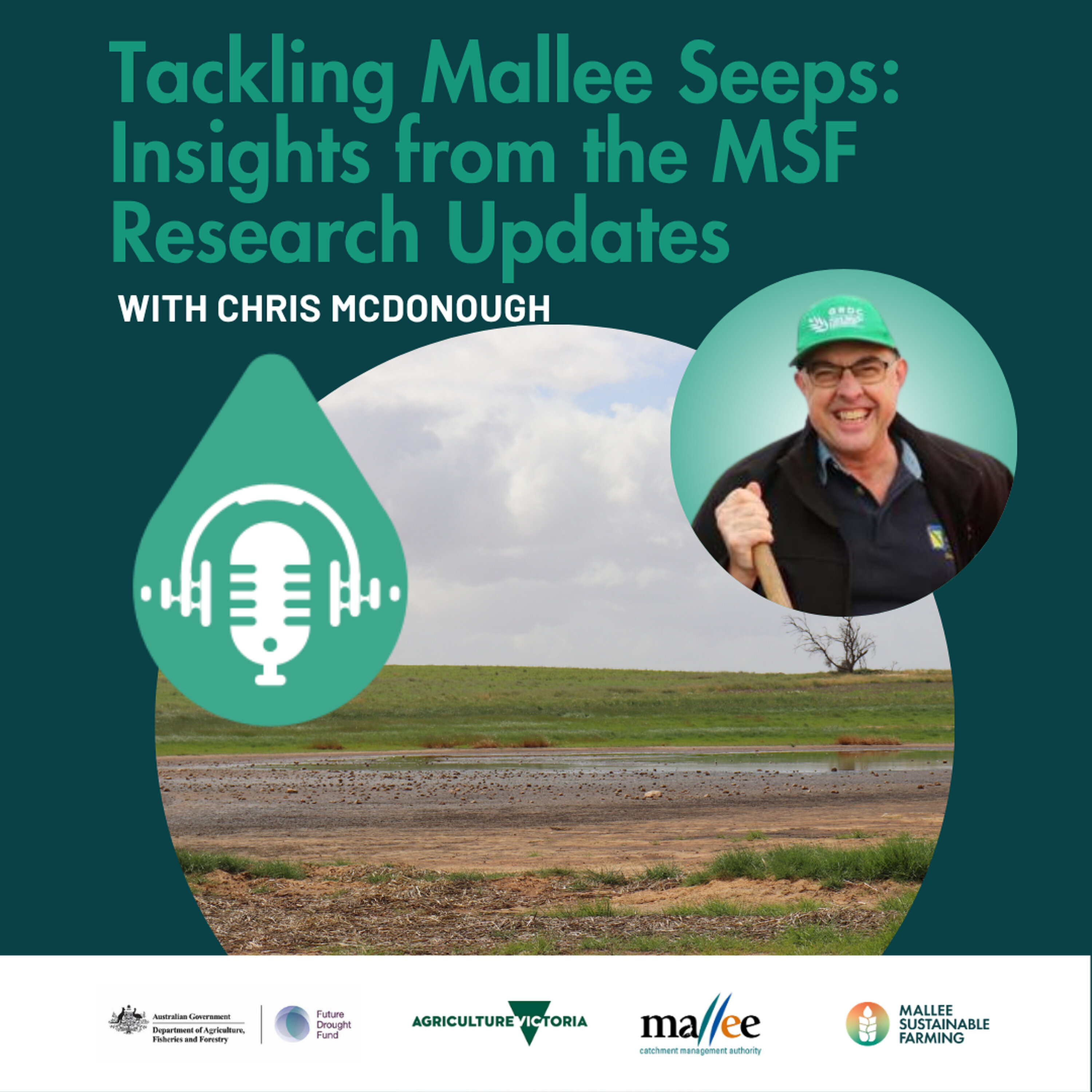
Tackling Mallee Seeps: Insights from the MSF Research Update
About this episode
Chris McDonough discusses insights on managing Mallee seeps and practical strategies for restoration.
Tackling Mallee Seeps: Insights from the MSF Research Update In this episode of the MSF Farm Talk podcast 🎙️, Chris McDonough shares insights from a Mallee Research Update in Victoria on identifying and managing Mallee seeps — areas where perched water tables bring water and salt close to the soil surface, causing ponding, crop loss and bare saline scalds. The discussion covers the importance of early detection, understanding water-table salinity, and practical management strategies to restore affected areas. These include re-establishing living groundcover with salt-tolerant species such as puccinellia and tall wheat grass, and lowering perched water tables by intercepting and utilising excess water with perennial plants like lucerne strips. Chris also highlights a range of tools and videos available on the MSF website, including a five-step decision tree to help growers assess seep type, landscape position, severity and salinity. Explore the Mallee Seeps project pages to learn more about identifying mallee seeps, best-practice management approaches, and grower case studies. Project Page, Resources and Case Studies: Mallee Seeps - Mallee Sustainable Farming Mallee…
People in this episode
Guest: Chris McDonough
Topics covered
- Mallee seeps
- water management
- salinity
- crop loss
- groundcover restoration
Keywords
- Mallee seeps
- water tables
- salinity
- crop management
- groundcover
- perennial plants
- decision tree
Mentioned in this episode
Organizations: Mallee Sustainable Farming
Places: Victoria
Explore listener stats, chart rankings, contacts and more on the MSF Farm Talk Podcast podcast page.