Insights from recent episode analysis
Audience Interest
Podcast Focus
Publishing Consistency
Platform Reach
Insights are generated by CastFox AI using publicly available data, episode content, and proprietary models.
Most discussed topics
Brands & references
Est. Listeners
Insufficient chart data. Estimates will improve as the show charts.
- Per-Episode Audience
Est. listeners per new episode within ~30 days
N/A🎙 Weekly cadence·100 episodes·Last published 1w ago - Monthly Reach
Unique listeners across all episodes (30 days)
N/A - Active Followers
Loyal subscribers who consistently listen
N/A
Market Insights
Platform Distribution
Reach across major podcast platforms, updated hourly
Total Followers
—
Total Plays
—
Total Reviews
—
* Data sourced directly from platform APIs and aggregated hourly across all major podcast directories.
On the show
From 13 epsHosts
Recent guests
Recent episodes
Exploring Crop Rotation and Legume Integration: Year 1 Insights from the Millewa - with Louise Brok
Jun 18, 2026
11m 40s
Navigating Carbon Farming and Emissions Accounting - with Ed Scott
Jun 4, 2026
17m 36s
Tackling Mallee Seeps: Insights from the MSF Research Update
May 21, 2026
9m 42s
Managing Dry Saline Land: Insights from the MSF Research Updates
May 7, 2026
11m 09s
Veris Mapping Explained: Seeing Soil pH Differently - with Jordan Ball
Apr 27, 2026
10m 39s
Social Links & Contact
Official channels & resources
Official Website
Login
RSS Feed
Login
| Date | Episode | Topics | Guests | Brands | Places | Keywords | Sponsor | Length | |
|---|---|---|---|---|---|---|---|---|---|
| 6/18/26 | ![]() Exploring Crop Rotation and Legume Integration: Year 1 Insights from the Millewa - with Louise Brok | Mallee Sustainable Farming Research Officer Louise Brok shares insights from the Millewa long-term crop rotation trial established in 2025 in the Victorian Mallee. The trial is evaluating pulse-inclusive farming systems, featuring 50% legumes across five fully phased rotations over four years. The project is investigating profitability, nitrogen fixation and fertiliser requirements, and groundcover retention. Designed for the low-organic-carbon sandy soils of the region, the work aims to test and validate farming systems that improve both productivity and resilience in high-risk environments. Despite an extremely dry 2025 season — with crops dry sown on 5 May and receiving only around 90 mm of growing-season rainfall — the trials still delivered valuable early insights. This episode explores the first-year results from the crop rotation and legume integration trial, along with additional demonstrations including wheat–vetch intercropping with varying vetch termination timings and a MAP fertiliser rate demonstration. 📄 Year 1 Results Fact Sheet: Millewa Fact Sheet Year 1📋 Legume based cropping systems project page: Legume Based Cropping Systems - Mallee Sustainable Farming This project is supported by the Australian Government through funding from the Natural Heritage Trust under the Climate-Smart Agriculture Program.Support the show: https://msfp.org.au/about/membership/See omnystudio.com/listener for privacy information. | 11m 40s | ||||||
| 6/4/26 | ![]() Navigating Carbon Farming and Emissions Accounting - with Ed Scott✨ | carbon farmingemissions accounting+4 | Ed Scott | GAF ToolAIA platform+4 | — | carbon creditsemissions intensity+7 | — | 17m 36s | |
| 5/21/26 | ![]() Tackling Mallee Seeps: Insights from the MSF Research Update✨ | Mallee seepswater management+3 | Chris McDonough | Mallee Sustainable Farming | Victoria | Mallee seepswater tables+5 | — | 9m 42s | |
| 5/7/26 | ![]() Managing Dry Saline Land: Insights from the MSF Research Updates✨ | dry saline land managementcrop establishment+4 | Chris McDonough | Mallee Sustainable FarmingDry Saline Land+1 | Victoria | dry saline landcrop management+6 | — | 11m 09s | |
| 4/27/26 | ![]() Veris Mapping Explained: Seeing Soil pH Differently - with Jordan Ball✨ | soil pHVeris mapping+3 | Jordan Ball | AgMap Soil TestingMallee Sustainable Farming | Lameroo | soil pHVeris mapping+3 | — | 10m 39s | |
| 3/26/26 | ![]() Keeping Sandy Soils in Place: Exploring dust control solutions with Shane Phillips – BioCentral Labs✨ | dust controlsandy soils+4 | Shane Phillips | DustChekAquaBoost+4 | — | dust controlsandy soils+5 | — | 8m 35s | |
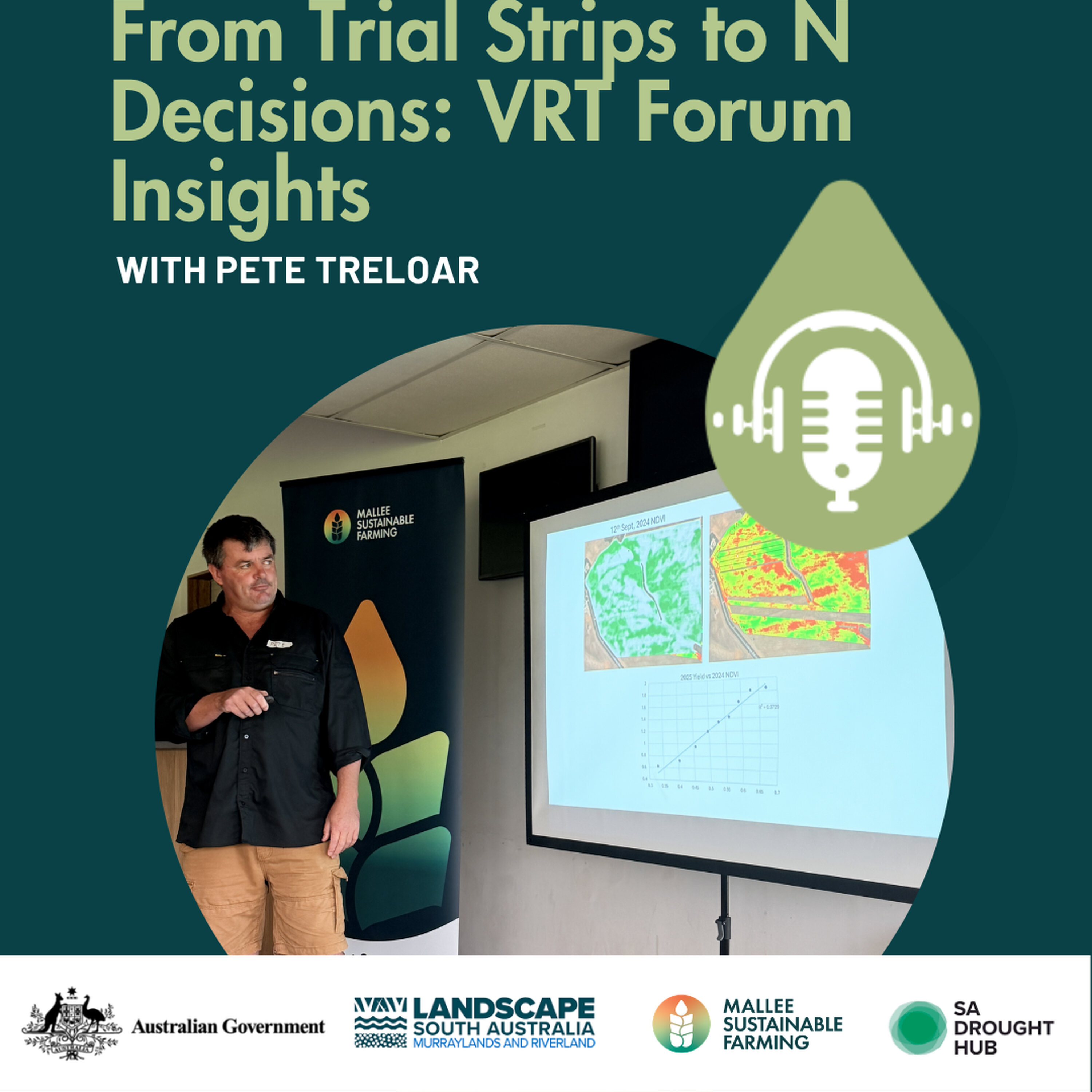
| 12/11/25 | ![]() Test Strips, Tough Seasons: What VRT Is Really Delivering✨ | variable rate technologyfarming insights+4 | David DanielAdrian Bormann+1 | Murraylands and Riverland Landscape BoardAustralian Government+2 | — | variable rate technologytest strips+5 | — | 14m 02s | |
| 11/13/25 | ![]() Part 2 Curiosity to Commitment - Farmers Navigating Ag Tech Adoption✨ | agriculturetechnology+4 | Bailey KilpatrickHarry Brown | SwarmFarm RoboticsGRDC+1 | Loxton | ag techautonomous machinery+5 | — | 11m 08s | |
| 8/14/25 | ![]() Part 1 Curiosity to Commitment - Farmers navigating ag tech adoption✨ | agriculturetechnology adoption+3 | Mick CaugheyBryson Rudiger+2 | GRDCSPAA | Loxton | ag techfarmers+3 | — | 19m 46s | |
| 7/30/25 | ![]() Salinity and Drought - What every farmer should know✨ | salinitydrought+3 | Dr Chris McDonough | Mallee Sustainable Farming | — | salinitydrought+5 | South Australian Grain Industry Trust | 15m 38s | |
Want analysis for the episodes below?Free for Pro Submit a request, we'll have your selected episodes analyzed within an hour. Free, at no cost to you, for Pro users. | |||||||||
| 7/24/25 | ![]() Tackling Compaction with Strategic Ripping✨ | soil compactionstrategic ripping+4 | Nigel Wilhelm | SAGITSARDI+2 | — | soil compactiondeep ripping+5 | South Australian Grain Industry Trust | 15m 53s | |
| 7/21/25 | ![]() Cutting through the carbon clutter✨ | soil carbonfarming practices+4 | Amanda Schapel | PIRSASoils Connect+1 | — | soil carbonfarming+6 | South Australian Grain Industry Trust | 14m 05s | |
| 7/17/25 | ![]() Feeding the Soil, Fueling the Farm✨ | soil biologymicrobial world+3 | Dr Gupta Vadakattu | CSIROSoils Connect+1 | — | soil biologymicrobes+4 | South Australian Grain Industry Trust | 11m 15s | |
| 7/14/25 | ![]() What it's really like using a SwarmBot✨ | autonomous spraying technologyon-farm adoption+4 | Brad Jones | Swarm BotGrains Research and Development Corporation | — | Swarm Botautonomous machinery+5 | — | 14m 12s | |
| 7/2/25 | ![]() A Farewell Chat with Nick Paltridge | In this special episode, we say goodbye and thank you to Nick Paltridge, who has been Mallee Sustainable Farming’s podcast host, project manager, communicator, and all-round good sport for the past three years. Nick reflects on his time with MSF, sharing memories from the paddock, what he’s learned about Mallee farming systems and community, and why he’s optimistic about the future of low rainfall agriculture. It’s a warm, honest conversation to wrap up an important chapter for MSF's FarmTalk podcast and to celebrate the work that goes on behind the scenes to connect growers with ideas, research, and each other.Support the show: https://msfp.org.au/about/membership/See omnystudio.com/listener for privacy information. | 12m 18s | ||||||
| 7/1/25 | ![]() Building a stronger pulse in the Mallee | In this episode, Nick Paltridge is joined by MSF's Research Manager, Dr Penny Roberts to explore what it takes to grow profitable, resilient lentils and other pulses in the Mallee. They discuss the drivers behind the surge in pulse production, practical agronomy tips for low rainfall zones, and a new long-term rotation trial that’s set to provide valuable insights for years to come. 🛠️ Key Topics Covered Why pulses are playing a bigger role in Mallee farming systems Choosing paddocks and planning rotations Early sowing strategies and seeding depth considerations Disease management and variety selection Inoculation and the latest guides An overview of the new long-term rotation trial and what it will measure 💡 Quote from Dr Penny Roberts “There’s always been that recognised need to have legumes in the system. It’s about getting the right fit and planning ahead.” 🔗 Resources & Links GRDC Inoculation Guide This podcast is supported by the Australian Government through funding from the Natural Heritage Trust under the Climate Smart Agriculture program. Support the show: https://msfp.org.au/about/membership/See omnystudio.com/listener for privacy information. | 10m 13s | ||||||
| 6/4/25 | ![]() Early Sowing, Legumes and Long- Term Fertility | In this episode of MSF Farm Talk, we kick off a new series inspired by the book 101 Questions about SA Cropping Soils. Host Nick Paltridge is joined by Dr. Nigel Wilhelm from the South Australian Research and Development Institute to explore how cropping systems have evolved over recent decades—especially in low rainfall environments. The discussion covers key topics such as early sowing practices, nitrogen and phosphorus management during dry seasons, and the expanding role of grain legumes in sustainable crop rotations. Dr. Wilhelm also shares his perspective on the future of farming, highlighting the importance of diversified weed and pest control strategies for long-term productivity. This practical and forward-looking episode offers valuable insights for farmers, agronomists, and anyone involved in dryland agriculture. Chapters & Time Stamps: 00:00 – Introduction to MSF Farm Talk Podcast 00:58 – Meet Dr. Nigel Wilhelm: Career and Contributions 01:35 – Evolution of Farming Systems 02:40 – Nitrogen and Phosphorus Management 03:29 – Profitable Break Crops in Mallee Farming 05:06 – Green Manure and Crop Rotation Benefits 05:50 – Challenges and Strategies for Dry Seasons 07:07 – Long-term Crop Nutrition Strategies 09:13 – Future of Farming Systems 10:17 – Conclusion and Resources This episode is supported by the South Australian Grains Industry Trust, the GRDC's RiskWi$e project, and the Mallee CMA, which funds long-term trial work in North Western Victoria. To visit the 101 Question on Soils visit the MSF website: https://msfp.org.au/projects/enhancing-farmer-knowledge-of-soil-function/Support the show: https://msfp.org.au/about/membership/See omnystudio.com/listener for privacy information. | 11m 14s | ||||||
| 5/12/25 | ![]() Reshaping Sandy Soils for Gains in the Mallee | Looking Over the FenceEpisode Title: Reshaping Sandy Soils for Crop Gains in the MalleeHosts: Tanja Morgan & Nick PaltridgeSupported by: The Australian Government’s Future Drought Fund Extension and Adoption Project In this episode, Tanja and Nick head to Bow Hill in South Australia’s Mallee region to share what Mallee Sustainable Farming learned from a one-off soil amelioration demonstration. They explore how active inclusion ripping, designed to bury topsoil and organic matter deep into the profile, compared with conventional deep ripping and untreated paddocks in a challenging dry season. With faster emergence, deeper roots, and visible changes to the soil profile, this trial showed what’s possible when you rethink how you manage sandy, compacted, and water-repellent soils. The episode also unpacks practical considerations like erosion risk, cost-benefit, and what’s next for longer-term monitoring. Full case study available at Soils Connect Disclaimer: The practices discussed are based on regional trials and may not suit all farms. Please seek independent advice before applying these approaches on your property. This project is supported by Mallee Sustainable Farming, through funding from the AustralianGovernment’s Future Drought Fund.Support the show: https://msfp.org.au/about/membership/See omnystudio.com/listener for privacy information. | 5m 51s | ||||||
| 5/12/25 | ![]() Boosting Productivity on Tough Soils | Looking Over the FenceEpisode Title: Boosting Productivity on Tough SoilsHosts: Tanja Morgan & Nick PaltridgeSupported by: The Australian Government’s Future Drought Fund Extension and Adoption Project In this episode, Tanja and Nick explore how farmers in South Australia's Northern and Yorke region are tackling soil constraints like acidity, salinity, and paddock variability using precision agriculture tools. From NDVI mapping and yield tracking to variable rate lime and gypsum applications, they highlight practical, cost-effective ways growers are reducing input waste and building soil health. With 70% savings on lime in some cases, clearer root growth in limed zones, and better decisions driven by local trials, this episode shows that small, targeted changes can lead to big gains in even the driest years. Full case study available at Soils Connect Disclaimer: The practices discussed are based on regional trials and may not suit all farms. Please seek independent advice before applying these approaches on your property. This project is supported by Mallee Sustainable Farming, through funding from the AustralianGovernment’s Future Drought Fund.Support the show: https://msfp.org.au/about/membership/See omnystudio.com/listener for privacy information. | 5m 16s | ||||||
| 5/12/25 | ![]() Precision P for Long Term Soil Health | Looking Over the FenceEpisode Title: Precision P for Long-Term Soil HealthHosts: Tanja Morgan & Nick PaltridgeSupported by: The Australian Government’s Future Drought Fund Extension and Adoption Project In this episode, Tanja and Nick visit the Northern Sustainable Soils region to dig into how growers are using strip trials and variable rate technology (VRT) to make smarter phosphorus fertiliser decisions. They share what happens when long-treated paddocks still respond to P, how simple tools and local support can make VRT accessible, and why soil testing for plant-available phosphorus matters. From building confidence through yield maps to adjusting inputs by zones, not just the season, this episode is packed with insights for improving soil health and long-term productivity. Full case study available at Soils Connect Disclaimer: The practices discussed are based on regional trials and may not suit all farms. Please seek independent advice before applying these approaches on your property. This project is supported by Mallee Sustainable Farming, through funding from the AustralianGovernment’s Future Drought Fund.Support the show: https://msfp.org.au/about/membership/See omnystudio.com/listener for privacy information. | 5m 21s | ||||||
| 5/12/25 | ![]() Soil Testing That Pays in the Hills & Fleurieu | Looking Over the FenceEpisode Title: Soil Testing That Pays in the Hills & FleurieuSupported by: The Australian Government’s Future Drought Fund Extension and Adoption Project In this episode, Tanja and Nick explore how farmers in the Hills and Fleurieu region are using regular soil testing to manage constraints like acidity, salinity, and low soil biology. They unpack lessons from the "Soil Your Undies" test, highlight the need for consistent testing methods, and explain how understanding soil pH and nutrient levels can help suppress weeds, improve pasture resilience, and support livestock. From biodiversity benefits to smart rotational grazing, this episode offers practical ideas for building healthier, more productive soils in a complex and varied landscape. Full case study available at Soils Connect Disclaimer: The practices discussed are based on regional trials and may not suit all farms. Please seek independent advice before applying these approaches on your property. This project is supported by Mallee Sustainable Farming, through funding from the AustralianGovernment’s Future Drought Fund.Support the show: https://msfp.org.au/about/membership/See omnystudio.com/listener for privacy information. | 5m 10s | ||||||
| 5/12/25 | ![]() Managing Soil Variability with VRT | Looking Over the FenceEpisode Title: Managing Soil Variability with VRTHosts: Tanja Morgan & Nick PaltridgeSupported by: The Australian Government’s Future Drought Fund Extension and Adoption Project In this episode, Tanja and Nick explore how farmers in the Mid North High Rainfall Zone are using variable rate technology (VRT) to address pH and nutrient variability, improve input efficiency, and unlock yield potential. With real examples from local paddocks, they discuss using NDVI to guide lime applications, the impact of acidity on lentil production, and how service providers are helping bridge the knowledge gap. The focus is on making precision ag tools accessible—showing that even older machinery and simple approaches can make VRT a valuable part of a farmer’s toolkit. Full case study available at Soils Connect Disclaimer: The practices discussed are based on regional trials and may not suit all farms. Please seek independent advice before applying these approaches on your property. This project is supported by Mallee Sustainable Farming, through funding from the AustralianGovernment’s Future Drought Fund.Support the show: https://msfp.org.au/about/membership/See omnystudio.com/listener for privacy information. | 6m 42s | ||||||
| 5/12/25 | ![]() Boosting Productivity on AIR EP's Sandy Soils | Looking Over the Fence Podcast SeriesEpisode Title: Boosting Productivity on AIR EP’s Sandy SoilsHosts: Tanja Morgan & Nick PaltridgeSupported by: The Australian Government’s Future Drought Fund Extension and Adoption Project In this episode, Tanja and Nick take us “over the fence” to the Eyre Peninsula to explore how AIR EP is helping farmers tackle tough sandy soils and make break crops like lentils a more viable option. They uncover practical strategies for managing compaction, salinity, and poor water retention using deep ripping, on-row sowing, and smart phosphorus management. What you’ll hear about: Why lentils struggle on sandy soils—and how to manage it Key nutrient advice: phosphorus importance, nitrogen exclusion, and copper considerations MAP vs. DAP fertiliser decisions in saline environments The benefits (and risks) of deep ripping for pulse crops How early biomass relates to yield potential Practical paddock planning for lentils The value of peer-to-peer learning and the need for long-term trials Full case study available at Soils Connect Disclaimer: The practices discussed are based on regional trials and may not suit all farms. Please seek independent advice before applying these approaches on your property. This project is supported by Mallee Sustainable Farming, through funding from the AustralianGovernment’s Future Drought Fund.Support the show: https://msfp.org.au/about/membership/See omnystudio.com/listener for privacy information. | 5m 47s | ||||||
| 5/12/25 | ![]() What to do when you think you're losing your mind! | Ever caught yourself muttering, "I'm losing my mind"—half-joking, but mostly serious? In this final episode of the Farming a Growth Mindset series, Dennis Hoiberg returns for a down-to-earth, practical conversation about mental overload. He shares clear, relatable ways to hit pause, sort through the clutter, and take small steps forward when your head and heart are at capacity. This isn’t about perfection—it’s about regaining clarity in the middle of chaos and learning how to check in with yourself before everything spins out. Whether it’s the season, the workload, or life piling up, this episode offers tools that genuinely help. 🛠️ What You’ll Hear: Why “losing your mind” doesn’t mean you’re broken How to spot when your internal load is too heavy Dennis’s top go-to strategies to reset your thinking Why “closing your mental tabs” might be the smartest thing you do today One powerful mindset shift that can stop the spiral This episode is part of the Farming a Growth Mindset series, brought to you by the South Australian Drought Resilience Adoption and Innovation Hub, through funding from the Australian Government’s Future Drought Fund.Support the show: https://msfp.org.au/about/membership/See omnystudio.com/listener for privacy information. | 19m 52s | ||||||
| 5/12/25 | ![]() Are You Bogged Mate? in the Mallee | In this powerful and practical episode, Nick Paltridge sits down with Mary O’Brien, founder of the grassroots mental health initiative Are You Bogged Mate? Mary shares her trademark no-nonsense approach to rural mental health, offering honest reflections on the pressures faced by farmers, how mental load builds quietly, and why mateship and straight talk are sometimes the best tools we've got. The conversation dives into: Why rural men often go quiet when they’re struggling How Mary uses relatable language (and a bit of humour) to cut through the stigma The signs to look for in yourself or your mates Why being available—and being real—makes a difference Simple ways to start a conversation that could save a life Whether you’re personally doing it tough or just want to be a better support to your mates, this episode is worth your time. This episode is part of our "Farming a Growth Mindset" series - practical conversations that focus on the mental and emotional wellbeing when living life on the land. 🔗 Links and Resources Visit Are You Bogged Mate? Check out TIACS for free and confidential phone or text support This episode is brought to you by the South Australian Drought Resilience Adoption and Innovation Hub, through funding from the Australian Government’s Future Drought Fund.Support the show: https://msfp.org.au/about/membership/See omnystudio.com/listener for privacy information. | 15m 11s | ||||||
Showing 25 of 100
Pitch Fit is a Pro feature
See how bookable this show is for guests, which brands already advertise, the per-episode ad value, and the best-fit guest and sponsor profile. The numbers are blurred on the free plan.
How readily this show books outside guests like you.
How proven this show is for host-read sponsorships.
For Guests
ProFor Advertisers
ProUpgrade to Pro to unlock guest cadence, sponsor categories, fit scores, and per-episode ad value for this show.