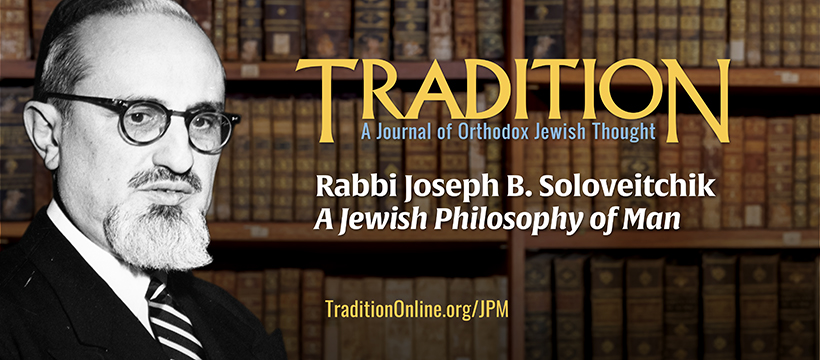
A Jewish Philosophy of Man (E8): The Content of the Covenant of Egypt – The Jewish Existential Community
About this episode
Rabbi Joseph B. Soloveitchik discusses the content of the covenant established at the Exodus from Egypt and its implications for the Jewish community.
A Lecture Series by Rabbi Joseph B. Soloveitchik Lecture 8: Delivered February 26, 1959 Jewish loneliness should be transformed into the kind of prophetic solitude that embraces the uniqueness of Jewish destiny. Jewish uniqueness is expressed by the covenant. Just as the prophets felt compelled to relay their message despite the burden involved, even to the degree that they would be harmed for doing so, we too must accept our covenant on that level of commitment, as something we are compelled to do and cannot cast off. What is the content of this covenant? God established two covenants. At the Exodus from Egypt, He calls the people an am, implying the togetherness and unity of peoplehood. At Sinai, with the giving of the Torah, He calls them a goy, referring to a political nation. These are the two covenants, but the focus of this lecture is the Egyptian covenant. Am refers to an existential community. Because it involves God, it commits the numinous side of man, compelling Man to draw himself out from his seclusion to join other people, even people he doesn’t like, in this community of I, thou, and He, i.e., God. In practical terms, the covenant of Egypt creates a community of…
People in this episode
Host: Joseph B. Soloveitchik
Topics covered
- Jewish philosophy
- covenant
- existential community
- Jewish destiny
- prophetic solitude
Keywords
- Jewish loneliness
- community
- shared history
- shared experiences
Mentioned in this episode
Books & works: Torah
Places: Sinai, Egypt
More episodes of Tradition Podcast
- A Jewish Philosophy of Man (e7): Prophetic Loneliness as the Solution to the Problem of Jewish Loneliness
- Rav Moshe’s Legacy
- A Jewish Philosophy of Man (E6): Judaism’s Glorification of the Anonymous Person
- A Jewish Philosophy of Man (E5): The Dialectical Approach to the Individual and the Community
- Understanding a Jewish Philosophy of Man
- A Jewish Philosophy of Man (E4): Judaism’s View of Man as a Lonely Being
Explore listener stats, chart rankings, contacts and more on the Tradition Podcast podcast page.