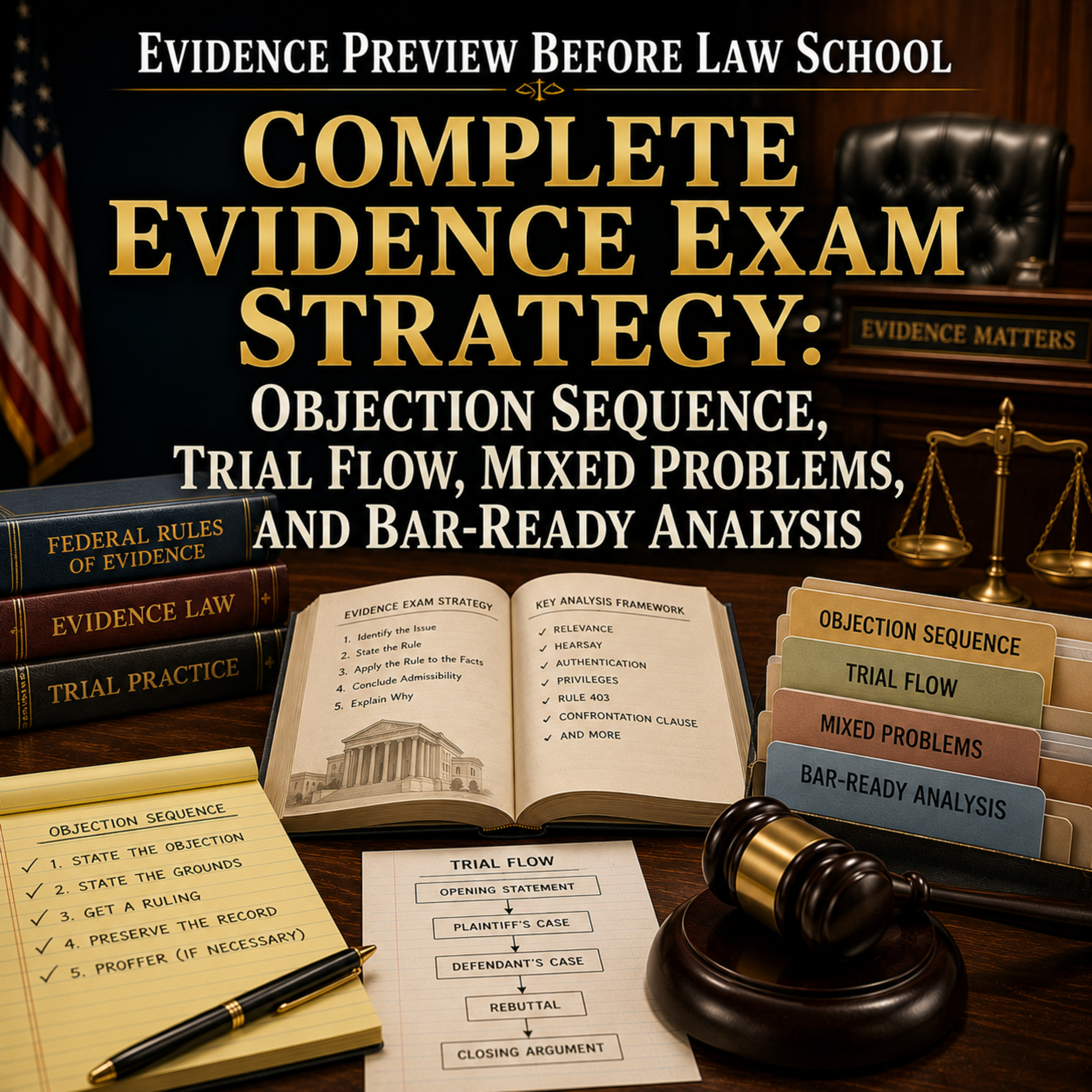
Evidence Preview: Complete Evidence Exam Strategy: Objection Sequence, Trial Flow, Mixed Problems, and Bar-Ready Analysis
About this episode
This episode discusses strategies for succeeding in evidence exams, focusing on the sequence of analyzing evidence and various related legal concepts.
▶ Click Here to Master Evidence Foundations ▬▬▬▬▬▬▬▬▬▬ EPISODE SUMMARY Evidence exam success depends on sequence. Begin by identifying the evidence, the proponent, and the purpose. Then analyze relevance, Rule 403, special exclusionary rules, witness foundation, hearsay, confrontation, privilege, authentication, and the original-writing rule. Evidence issues arise throughout trial. Motions in limine address problems before trial. Direct examination requires foundation. Cross-examination tests credibility. Redirect rehabilitates. Expert testimony requires reliability screening. Documents and digital exhibits require authentication. Closing argument must stay within the record. Appeal requires preservation, standard of review, and harmful error. Strong answers apply rules rather than merely naming them. Hearsay requires an out-of-court assertion offered for truth. Character evidence requires a propensity purpose unless an exception or nonpropensity theory applies. Rule 403 requires probative value to be substantially outweighed by a specific danger. Authentication requires enough evidence for a reasonable jury to find the item genuine. The original-writing rule applies only when…
Topics covered
- evidence exam strategy
- trial flow
- objection sequence
- mixed problems
- bar exam preparation
Keywords
- evidence
- trial
- hearsay
- authentication
- Rule 403
- cross-examination
- expert testimony
- closing argument
More episodes of Law School
- July Bar Sprint: MBE Sprint Part One — Civil Procedure, Contracts, Torts, and the Multiple-Choice Method
- July Bar Sprint: The Final Bar Map Score Strategy, Subject Triage, Timing, Rule Compression, and the Last-Week Study System
- Professional Responsibility: Complete MPRE Strategy- Must, May, Must Not; Conflicts Flowcharts; Confidentiality Traps; Litigation Ethics; Judicial Conduct; & Full Professional Responsibility Framework
- Professional Responsibility and MPRE: Money, Property, Advertising, Solicitation, Transactions with Nonclients, Lawyer Roles, Public Duties, and Judicial Conduct
- Professional Responsibility & MPRE: Litigation & Advocacy - Meritorious Claims, Candor to the Tribunal, Fairness to Opposing Counsel, Evidence, Witnesses, Prosecutors, Trial Publicity & Lawyer as Witn
- Professional Responsibility & MPRE: Conflicts of Interest - Current, Former & Prospective Clients, Consent, Business Transactions, Gifts, 3rd-Party Payment, Aggregate Settlements, Imputation, & Screen
Explore listener stats, chart rankings, contacts and more on the Law School podcast page.