Insights from recent episode analysis
Audience Interest
Podcast Focus
Publishing Consistency
Platform Reach
Insights are generated by CastFox AI using publicly available data, episode content, and proprietary models.
Most discussed topics
Brands & references
Est. Listeners
Based on iTunes & Spotify (publisher stats).
- Per-Episode Audience
Est. listeners per new episode within ~30 days
25,001 - 50,000 - Monthly Reach
Unique listeners across all episodes (30 days)
75,001 - 150,000 - Active Followers
Loyal subscribers who consistently listen
40,001 - 100,000
Market Insights
Platform Distribution
Reach across major podcast platforms, updated hourly
Total Followers
—
Total Plays
—
Total Reviews
—
* Data sourced directly from platform APIs and aggregated hourly across all major podcast directories.
On the show
From 18 epsHosts
Recent guests
No guests detected in recent episodes.
Recent episodes
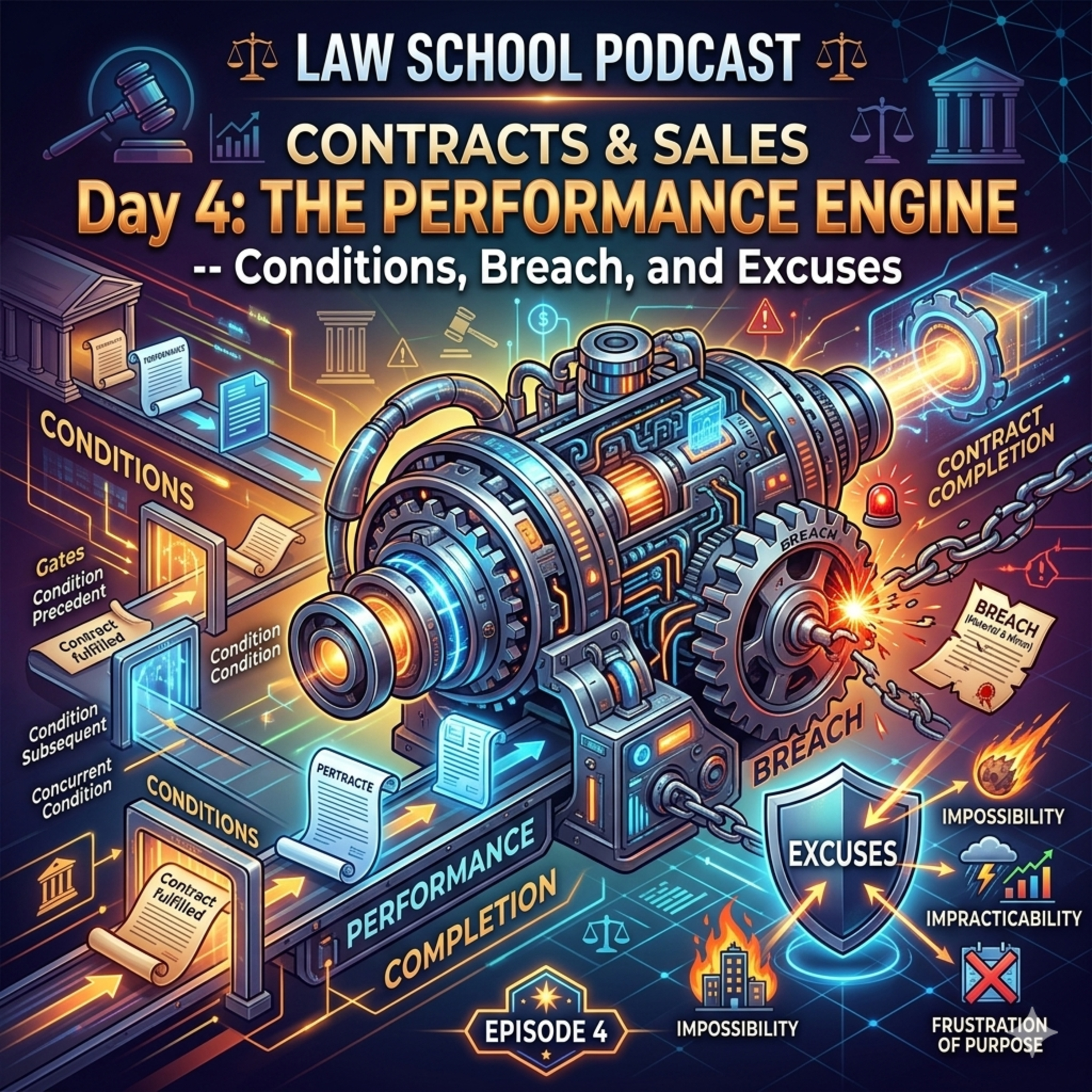
Contracts & Sales Day 4: The Performance Engine — Conditions, Breach, and Excuses
May 7, 2026
Unknown duration
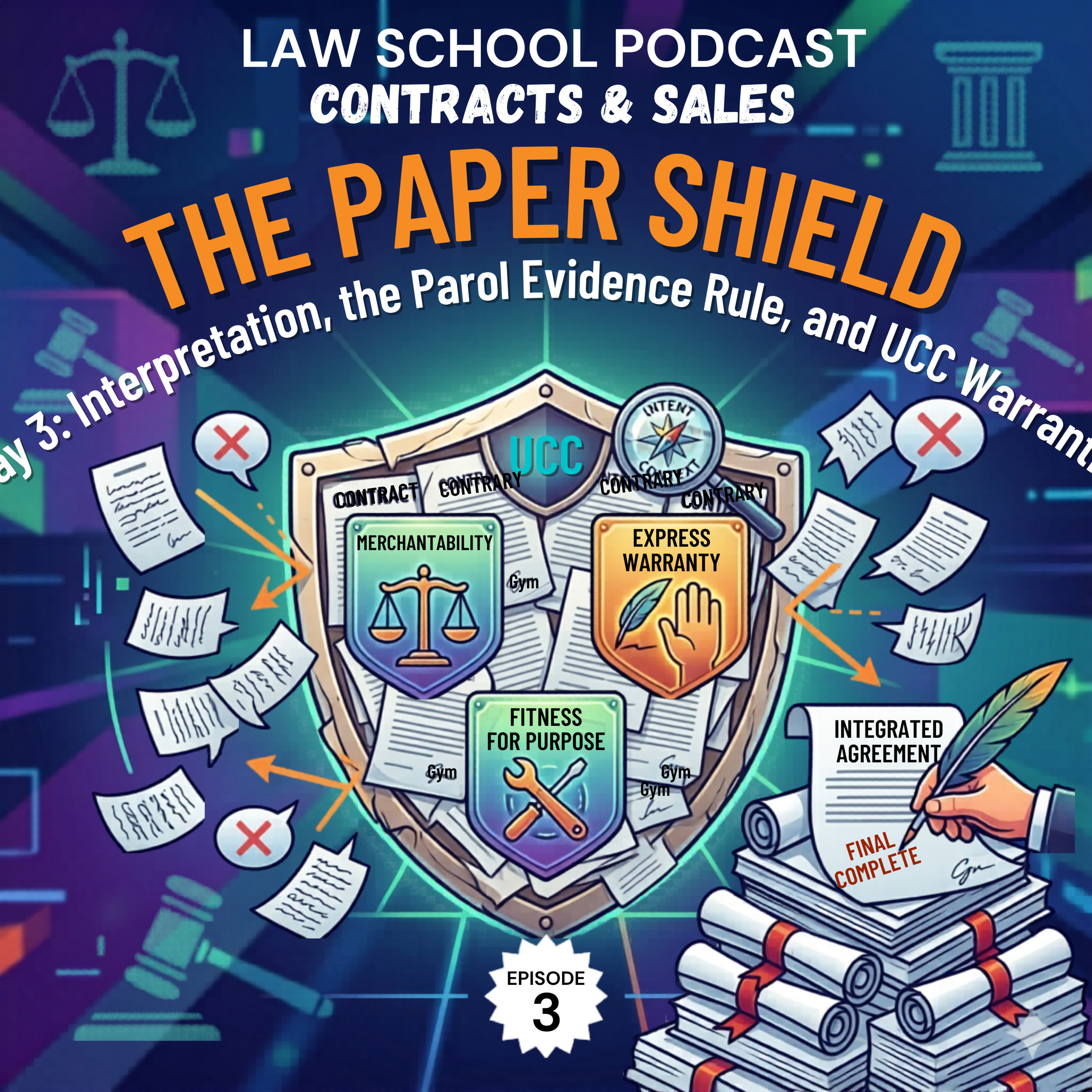
Contracts & Sales Day 3: The Paper Shield — Interpretation, the Parol Evidence Rule, and UCC Warranties
May 6, 2026
Unknown duration
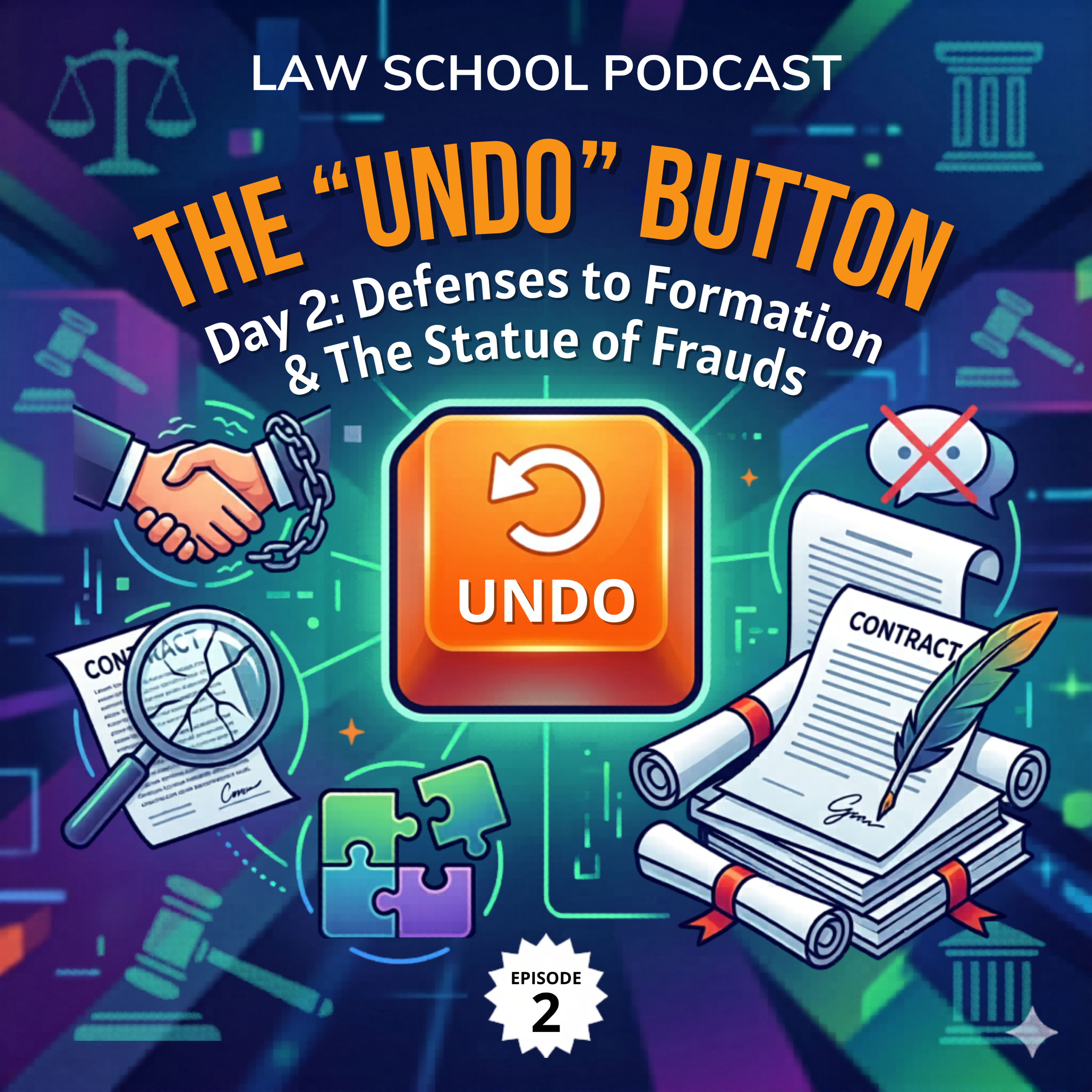
Contracts & Sales Day 2: The "Undo" Button — Defenses to Formation and the Statute of Frauds
May 5, 2026
1h 03m 49s
Contracts & Sales Part One: The Anatomy of an Agreement — Offer, Acceptance, and Consideration
May 4, 2026
1h 14m 45s
Criminal Procedure Day 7: The Trial, Double Jeopardy, and the Final Review
May 3, 2026
47m 42s
Social Links & Contact
Official channels & resources
Official Website
Login
RSS Feed
Login
| Date | Episode | Topics | Guests | Brands | Places | Keywords | Sponsor | Length | |
|---|---|---|---|---|---|---|---|---|---|
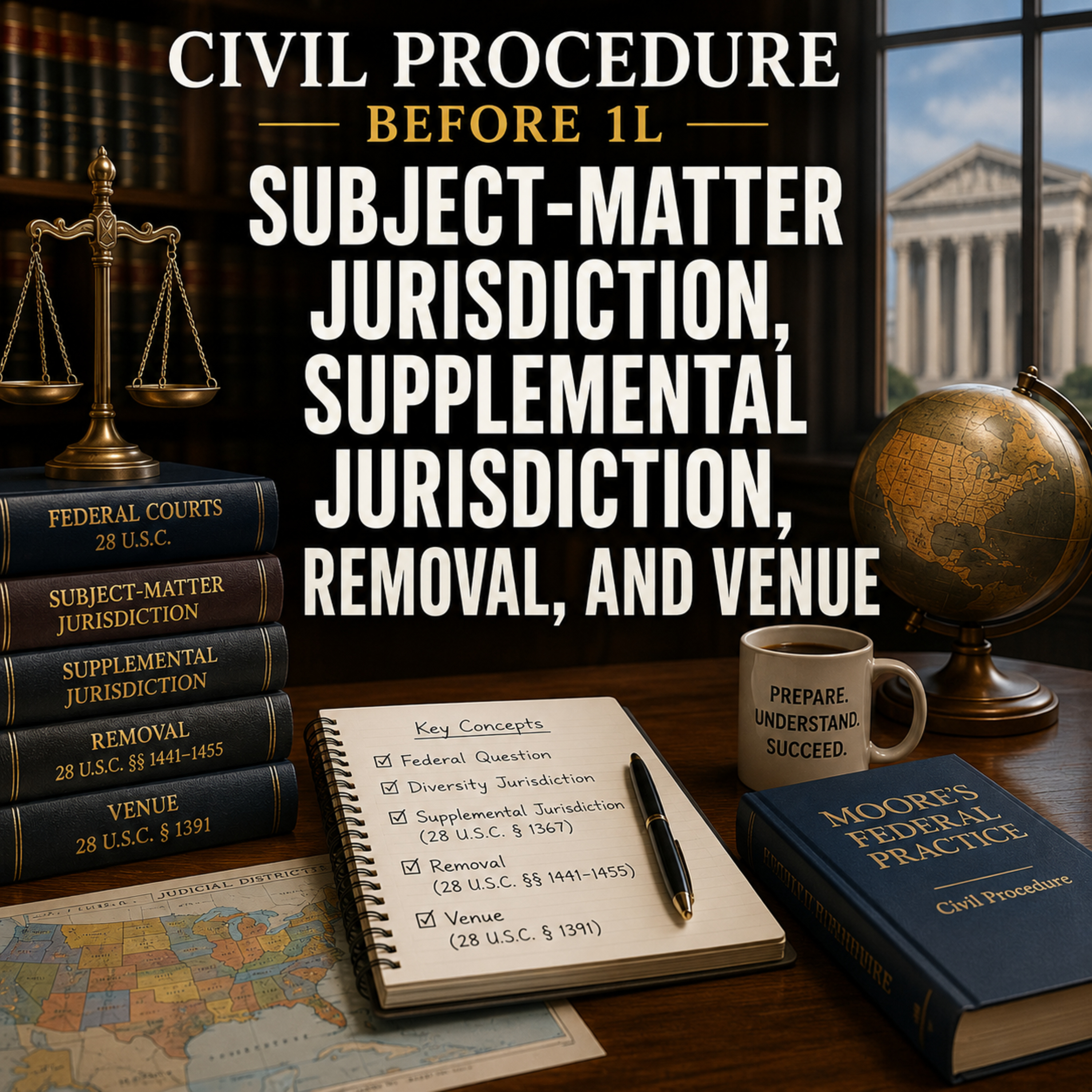
| 5/7/26 | ![]() Contracts & Sales Day 4: The Performance Engine — Conditions, Breach, and Excuses | Review Guide: The Performance Engine Mastering Contract Performance: Key Principles and PitfallsMost contract disputes come down to a single moment: performance. But what if you’re called to perform and the universe throws a curveball? Or your partner might just decide it's no longer worth it? If you’ve ever wondered how courts decide whether a party can delay, excuse, or even avoid performance altogether, this episode unpacks the mechanics behind the performance engine.Imagine a 1615 case where a man keeps a cow but still sues to get paid—an ancient absurdity that hints at the deeper truths of contractual obligations. Here, we explore how the law’s historic obsession with literal promises gives way to nuanced doctrines like conditions, standards of performance, breach, and excuse. You’ll learn how “conditions” act as legal “if-then” triggers for duties—whether they happen before, at the same time, or after performance. We break down the critical differences between express and implied conditions, illustrating why courts enforce express clauses strictly, while implied conditions fill the gaps with fairness.Then, we dive into the two main regimes—common law and the Uniform Commercial Code—that shape what quality of performance you need to meet. Under common law, substantial performance is enough—think: a few minor errors in a house build that still get the job done. In contrast, the UCC’s perfect tender rule demands exact conformance, but with powerful safety valves like the right to cure and installment contracts. You’ll discover why understanding these standards can prevent costly missteps in both law school exams and real-world negotiations.But the real magic unfolds when breaches happen. Not all breaches are created equal—minor deviations often just mean damages, while material breaches can blow up entire deals. We unpack five key factors—deprivation, forfeiture, opportunity to cure, good faith—to identify when a breach crosses into “material.” Crucially, we highlight the trap where refusing to pay over a tiny defect can turn into a huge liability. Knowing the difference between minor slip-ups and fundamental failures keeps you from shooting yourself in the foot.When unforeseen superstorms hit, the law offers emergency exits: impossibility, impracticality, and frustration of purpose. We explore how a music hall burning down in 1863 set the modern standard of impossibility—no one must be held liable for acts of God. Moving into modern risks, we analyze why only truly extraordinary circumstances—wars, natural disasters, or government bans—excuse performance, while general cost hikes or lost profits do not. We also discuss how courts narrowly apply doctrines like impracticality, emphasizing that risk-shifting clauses or simple economic hardship won’t get you out of a bad deal.A particularly tricky area is “frustration of purpose,” where a supervening event renders the entire reason for the contract impossible or pointless—think renting a balcony to watch a parade that gets canceled. We examine the precise limits of this doctrine, warning against overuse in exam scenarios or business plans. Only when both parties understand and mutually rely on a specific purpose, and that purpose is wiped out unexpectedly, can performance be excused.Finally, we layer all insights into a straightforward, step-by-step exam checklist that you can carry into the test or the boardroom. From identifying conditions, choosing the right performance standards, analyzing breach severity, to spotting legal excuses—this framework distills decades of legal doctrine into an actionable tool. We emphasize that strict rule enforcement isn’t about harshness but about fairness—ensuring both sides uphold their promises or properly excuse non-performance.This episode pushes beyond theory, asking: when does the law intervene to soften the strict rules in pursuit of justice? As courts historically developed doctrines like constructive conditions, right to cu | — | ||||||
| 5/6/26 | ![]() Contracts & Sales Day 3: The Paper Shield — Interpretation, the Parol Evidence Rule, and UCC Warranties | Review Guide: The Contracts EngineNavigating Contract Law’s Paper Shield: A Deep Dive into Evidence, Integration, and WarrantiesContracts are more than just signatures on a page; they are complex legal architectures designed to protect parties and ensure clarity. In this episode, we unravel the layered rules that courts use to interpret written agreements, focusing on the powerful paper shield of the parole evidence rule and its exceptions. Whether you're a lawyer, law student, or simply curious about how legal deals are enforced, this breakdown offers clear insights into the rules that keep commercial and personal promises predictable and fair.Most commercial contracts hold tremendous power — until human disputes, ambiguous language, or sneaky negotiations threaten to tear them apart. When the paper says one thing but human intent screams another, how do courts decide what really counts? This episode uncovers the fascinating legal mechanisms that safeguard written promises and the clever exceptions that punch through these shields when justice demands it.We dive deep into the core of contract law’s greatest safeguard: the parole evidence rule, revealing why it’s often mistaken as a rule of evidence rather than a rule that defines what a contract is. You’ll discover how “integration”—total and partial—determines whether outside words or past negotiations can rewrite your deal. Through real-world examples like Mrs. Mitchell’s farm fiasco and the peerless ships of 1864, you’ll see how courts handle ambiguous terms, trade customs, and complex negotiations, all in the quest for contractual certainty.We break down the hierarchy of interpretive tools—words, performance, past dealings, and industry customs—showing you how courts translate collective industry language into legal meaning. You’ll learn why a simple merger clause is the ultimate lock and how mistaken assumptions about “finality” can overturn entire deals. Plus, we reveal the powerful exceptions—fraud, mistake, conditions, and ambiguous terms—that carve openings in the paper shield for fairness and truth.Step into the world of UCC warranties—express, merchantability, and fitness for a particular purpose—and understand how these invisible guarantees protect consumers even when written language tries to silence them. We explain how disclaimers, complex as they are, can be crafted to either shield or expose sellers’ liabilities, and why federal laws like MagMoss are the ultimate consumer safeguard.Finally, we explore the future of contract law in the era of smart, self-executing code. If blockchain-based agreements operate without human words, how do courts interpret certainty, intent, and fairness? This mind-bending question leaves us pondering whether the paper shield will become an inhuman fortress or evolve with technology.Perfect for lawyers, students, or anyone eager to see behind the scenes of commercial deal-making, this episode unlocks the legal architecture that doesn’t just protect contracts — it shapes commerce itself. Hit play to master the rules courts use to lock or pierce the paper shield, and gain the insight to craft smarter agreements today.Key topics:The purpose and mechanics of the parole evidence rule (PER) as a substantive law—not merely evidence law.How integration clauses and the distinction between total and partial integration determine what outside evidence courts will consider.The hierarchy of contract interpretation: from express terms to industry customs, and how extrinsic evidence is used to resolve ambiguity.The significance of exceptions to the PER: fraud, mistake, conditions precedent, ambiguity, and reformation.A comprehensive look at UCC warranties: express, merchantability, and fitness for a particular purpose.How disclaimers work under the UCC and federal law, especially in consumer contracts, highlighted by the Magnuson-Moss Warranty Act.Practical impacts of risk of loss clauses like FOB shipping point vs. FOB destinati | — | ||||||
| 5/5/26 | ![]() Contracts & Sales Day 2: The "Undo" Button — Defenses to Formation and the Statute of Frauds✨ | contract lawdefenses to formation+4 | — | PeerlessThe Law School of America | Bombay | contractslegal flaws+5 | — | 1h 03m 49s | |
| 5/4/26 | ![]() Contracts & Sales Part One: The Anatomy of an Agreement — Offer, Acceptance, and Consideration✨ | contract formationlegal agreements+4 | — | PepsiThe Law School of America+1 | — | contract formationlegally binding agreements+5 | — | 1h 14m 45s | |
| 5/3/26 | ![]() Criminal Procedure Day 7: The Trial, Double Jeopardy, and the Final Review✨ | criminal proceduredouble jeopardy+4 | — | The Law School of AmericaSixth Amendment | — | criminal proceduredouble jeopardy+6 | — | 47m 42s | |
| 5/2/26 | ![]() Criminal Procedure Day 6: Pre-Trial Process, Grand Juries, and Guilty Pleas✨ | pre-trial processgrand juries+4 | — | US Criminal Justice System | — | pre-trial processgrand juries+6 | — | 1h 01m 58s | |
| 5/1/26 | ![]() Criminal Procedure Day 5: The Sixth Amendment Right to Counsel and Eyewitness Identifications✨ | Sixth AmendmentRight to Counsel+5 | — | The Law School of AmericaSixth Amendment+2 | — | Sixth AmendmentRight to Counsel+7 | — | 1h 10m 36s | |
| 4/30/26 | ![]() Criminal Procedure Day 4: The Fifth Amendment—Privilege Against Self-Incrimination✨ | Fifth Amendmentself-incrimination+4 | — | The Law School of AmericaFifth Amendment+1 | — | Fifth Amendmentself-incrimination+5 | — | 1h 07m 24s | |
| 4/29/26 | ![]() Criminal Procedure Day 3: Terry Stops, Special Needs, and the Exclusionary Rule✨ | Criminal ProcedureTerry Stops+5 | — | Fourth Amendment | — | Terry StopsExclusionary Rule+5 | — | 57m 33s | |
| 4/28/26 | ![]() Criminal Procedure Day 2: Warrants and the Warrant Exceptions✨ | Criminal ProcedureWarrants+4 | — | The Law School of America | — | warrantsFourth Amendment+6 | — | 56m 02s | |
Want analysis for the episodes below?Free for Pro Submit a request, we'll have your selected episodes analyzed within an hour. Free, at no cost to you, for Pro users. | |||||||||
| 4/27/26 | ![]() Criminal Procedure Day 1: The Fourth Amendment—Foundations of Search and Seizure✨ | Criminal ProcedureFourth Amendment+3 | — | The Law School of AmericaFourth Amendment+1 | — | Fourth Amendmentsearch and seizure+5 | — | 1h 00m 33s | |
| 4/26/26 | ![]() Criminal Law Day Seven: The Weight of Justice (Theories and Allocation of Punishment)✨ | criminal lawpunishment theories+4 | — | The Law School of America | — | criminal lawpunishment+7 | — | 50m 39s | |
| 4/25/26 | ![]() Criminal Law Day Six: The Shields of Justice (Justification and Excuse)✨ | criminal lawjustification+5 | — | The Law School of America | — | criminal lawjustification+5 | — | 1h 13m 34s | |
| 4/24/26 | ![]() Criminal Law Day Five: The Architecture of Uncompleted Crimes (Inchoate Liability)✨ | uncompleted crimesinchoate liability+5 | — | The Law School of America | — | criminal liabilityPinkerton rule+5 | — | 1h 01m 23s | |
| 4/23/26 | ![]() Criminal Law Day Four: The Foreseeable Chain (Causation)✨ | criminal lawcausation+5 | — | The Law School of America | — | causationcriminal law+5 | — | 47m 49s | |
| 4/22/26 | ![]() Criminal Law Day Three: Homicide & The Allocation Chute✨ | homicide lawmens rea+5 | — | The Law School of America | — | homicidemens rea+5 | — | 48m 57s | |
| 4/21/26 | ![]() Criminal Law Day Two: The Mind in the Machine, Mens Rea✨ | criminal lawmens rea+5 | — | Model Penal Code | — | criminal lawmens rea+8 | — | 1h 02m 33s | |
| 4/20/26 | ![]() Criminal Law Day One: The Mechanics of Actus Reus - The Voluntary Act Trigger✨ | criminal lawactus reus+5 | — | The Law School of America | — | actus reusvoluntary act+8 | — | 59m 36s | |
| 4/19/26 | ![]() Torts Day Seven: The "Final Summit" Vicarious Liability, Joint Tortfeasors, and Exam Mastery✨ | tort lawvicarious liability+4 | — | The Law School of America | — | tortsvicarious liability+5 | — | 55m 16s | |
| 4/18/26 | ![]() Torts Day Six: The Dignitary Torts✨ | free speechtort law+5 | — | The Law School of America | — | dignitary tortsdefamation+6 | — | 1h 03m 37s | |
| 4/17/26 | ![]() Torts Day Five: Liability Without Fault | This episode explores the core principles of strict liability, examining how the law assigns responsibility for inherently dangerous activities, defective products, and risky animals regardless of fault or negligence. Understanding this shift is crucial for grasping how legal policy adapts to societal needs and economic realities.Most companies inadvertently open themselves up to massive liability simply by engaging in risky activities—think handling hazardous chemicals or keeping wild animals—without realizing that certain hazards trigger strict liability from day one. In this compelling deep dive, we unravel how the law shifts the burden—charging the risk-taker for social costs regardless of fault. Whether it’s a pet dog’s bite, a factory’s explosion, or a defective product, understanding this critical legal framework transforms how you see risk, responsibility, and safety in society.You’ll discover how strict liability turns the traditional fault-based tort system on its head, focusing instead on societal policies that internalize external costs. We break down the three core pillars: animals, abnormally dangerous activities, and products liability—each a different lens for holding risky actors accountable. From the classic one-bite rule for domesticated dogs to the landmark 1868 English case of Rylans v. Fletcher, learn how history shaped today’s tough standards for wild animals and hazardous enterprises. We explore the science behind why dangerous activities like blasting with dynamite or storing hazardous waste are inherently risky, and why no amount of precautions can fully mitigate the danger—making strict liability not just fair, but essential.This episode demystifies the key elements needed to succeed on exams—building a clear mental framework for analyzing whether a product was defectively manufactured, defectively designed, or failed to warn about hidden dangers. You’ll see concrete examples like the Ford Pinto case, which exposes the deadly consequences of putting profit over safety, and understand how courts determine whether an activity is inherently ‘ultra-hazardous.’ Plus, we unravel the nuances of nuisance law—how a noisy neighbor or a foul odor can violate your right to quiet enjoyment, and how courts balance social utility against individual harm.Perfect for law students, legal professionals, or anyone eager to see the bigger picture of risk and responsibility, this episode elevates your understanding of the laws that keep society safe. Whether it’s a defective toy, a dangerous animal, or a covert environmental hazard, grasping the principles of strict liability empowers you to see risks from the perspective of both policy and justice. This is where law meets reality—more than just theory, it’s a blueprint for holding the risky actors accountable in a complex, modern world.Why this works: This episode hooks with an urgent insight about how companies are often unaware that engaging in inherently dangerous activities leads to automatic liability, regardless of care. It appeals directly to listeners’ desire to understand complex legal rules in a straightforward way, emphasizing concrete examples and frameworks that simplify exam success and practical understanding. The language balances approachability and authority, making it intensely valuable for anyone who wants to see the bigger picture of responsibility in society.Key Topics:The concept and rationale behind strict liability, emphasizing liability without fault.Classic cases and frameworks, including animals, abnormally dangerous activities, and products liability.The role of risk-shifting and societal policy in establishing liability for inherently hazardous actions.Detailed analysis of the three pillars of strict liability: animals, abnormally dangerous activities, and product defects.The categories of product defects—manufacturing, design, and information failures—and how courts assess them.Limitations on warning labels and the importance of | — | ||||||
| 4/16/26 | ![]() Torts Day Four: The "Connection" | In this episode, we explore the core principles and intricate mechanics of tort law, focusing on how courts connect careless acts to injuries and assign responsibility. From the factual causation to the nuanced doctrines like foreseeability and superseding causes, this analysis sheds light on how justice is balanced in complex scenarios.Most minor accidents could never result in catastrophic liability—unless the victim has a rare, hidden condition that turns a tiny bump into a lifelong nightmare.In this episode, we challenge your intuition about negligence, causation, and fairness, revealing how courts draw the boundary between what’s physically caused and what’s legally fair to hold liable. You'll discover how the infamous but-for test can fail in complex scenarios involving multiple negligent actors and how the substantial factor and alternative liability doctrines fix its limitations.We break down the groundbreaking case of Summers v. Tice, where the court shifted the burden of proof—an extraordinary move that still influences today’s joint and several liability. Plus, you'll learn how courts draw the line with foreseeability—the key to determining liability for bizarre, unforeseen events, like earthquakes or freak accidents.And because liability can sometimes extend far beyond what’s predictable, you’ll explore the eggshell skull rule, which holds defendants responsible for the full extent of injuries due to pre-existing vulnerabilities—like brittle bones or degenerative diseases. But beware: not all harms are connected. We dive into how courts reject liability when an unforeseeable superseding cause—such as a lightning bolt or a tornado—breaks the causal chain, shielding defendants from classic negligence.Perfectly suited for law students, practitioners, and anyone interested in the hidden logic behind those everyday accidents. This episode unpacks the delicate balance courts strike between physics and fairness—an essential framework for understanding tough liability questions. Before we finish, a provocative glimpse into strict liability, where fault itself becomes irrelevant, and defendants are held responsible regardless of precautions.If you’ve ever wondered how the law navigates an unpredictable world of carelessness and chaos, this is your deep dive into the core of tort law—where causation, fairness, and policy collide to shape responsibility.Key topicsThe importance of the but-for test and how it applies to straightforward and complex causation scenariosWhen and how the substantial factor test takes over in cases with multiple negligent actorsThe pivotal role of proximate cause and the concept of foreseeability in limiting liabilityThe landmark case Palsgraf v. Long Island Railroad and its influence on understanding legal causationIntervening vs. superseding causes: what breaks the chain of liabilityThe eggshell skull rule and its application in valuing damagesDefense strategies: contributory negligence, comparative fault, assumption of risk, and specialized doctrines like the firefighter rule | — | ||||||
| 4/15/26 | ![]() Torts Day Three: The "Mountain" of Negligence | In this episode, we explore the fundamental doctrines of negligence—the most crucial foundation of personal injury law—and decode how courts determine fault through duty and breach analysis. Whether you're a law student, practitioner, or just curious about how the legal system handles everyday accidents, this breakdown offers sharp insights into the mechanics behind liability.Most people think negligence is about bad intentions or malicious acts. In reality, it’s about carelessness—accidents that happen when you fail to meet society’s basic standard of conduct. In this episode, we dissect the core mechanics of tort law’s most important doctrine: negligence. Whether you're a law student, legal professional, or simply curious about how liability works, you'll gain clear insight into how courts determine fault in everyday chaos—like a fireworks explosion on a train platform or a slipped shopper in aisle four.We break down the foundational questions courts ask before any case proceeds: Did the defendant owe a duty of care? And did they breach it? You’ll discover how the famous foreseeability rule, rooted in the landmark Polsgraf v. Long Island Railroad case, shapes liability—whether to a foreseeable victim or everyone at large. We explore the controversial default standards, such as the reasonable prudent person, and how they serve as societal safeguards, holding even the clumsiest individuals accountable.This episode reveals the critical role of the Hand Formula, turning complex risk calculations into a straightforward check: if the cost of precautions is less than the probability times the severity of harm, failure to act is a breach. You’ll see how shortcuts like negligence per se and res ipsa loquitur operate as powerful tools in navigating evidence—allowing plaintiffs to bypass intensive math when regulatory violations or impossible-to-explain accidents occur.Why does all this matter? Because understanding negligence isn’t just academic—it's how society assigns fault, compensates victims, and deters reckless behavior. Whether it’s a homeowner ignoring an attractive nuisance or a corporate engineer overlooking a known hazard, the principles you learn here directly impact justice and fairness in everyday life.Perfect for law students, legal practitioners, or anyone interested in the hidden rules that keep society functioning. This episode arms you with a logical, strategic approach to negligence cases—demystifying the doctrines that shape our civil justice system. Get ready to see the law from a new perspective, because knowing the rules of the game is the first step to winning in the courtroom.Key topics:How the "sheer chaos" of everyday accidents is tamed by the negligence frameworkThe importance of duty: foreseeability and the landmark Polsgraf v Long Island Railroad caseThe "reasonable prudent person" standard and how it's objectively appliedThe significance of special standards of care for children, professionals, and activitiesThe role of the Hand Formula in calculating breach: B less than P times LWhen negligence per se applies and its strict gatekeeping requirementsThe doctrine of res ipsa loquitur and its use in proving breach with no direct evidenceHow the fireman's rule and assumption of risk doctrines limit liability for first respondersThe evolving landscape of landowner liability: trespassers, licensees, inviteesThe complex analysis for breach in dynamic scenarios, including recent case law | — | ||||||
| 4/14/26 | ![]() Torts Day Two: The "Yes, But" Defense | In this episode, we delve into the strategic complexity of affirmative defenses in tort law. Understanding how and when these shields apply can turn a losing case into a victory, or vice versa. We explore key defenses like consent, protective privileges, and necessity, with practical insights on applying them in exam scenarios and real-life situations.Key Topics:The importance of privileges as affirmative defenses and their burden of proofThe nuanced distinctions between express, implied, and law-implied consentHow scope, capacity, and fraud can undermine consent defensesThe core of protective privileges: self-defense, defense of others, and defense of propertyThe critical limits of proportionality and the duty to retreatWhen necessity applies: public necessity vs private necessityLegal strategies for analyzing complex fact patterns with multiple tortsThe moral and policy limits of necessity, especially regarding human lifeMost accidental injuries aren't just about bad luck—they reveal the law's complex hierarchy of values. What happens when a homeowner's defensive trap maims a thief and suddenly they're being sued for battery? The answer lies in the unseen power of affirmative defenses—legal shields like consent, self-defense, property protection, and necessity—that can turn a wrongful act into a lawful one.In this episode, we dissect a bold legal experiment: a homeowner who rigs a shotgun trap to protect their property. How does the law treat a criminal who breaks the law but is harmed by a homeowner’s risky setup? You'll uncover the nuances behind deadly force limits, the importance of scope and proportionality, and why the law always ranks human life above property—even in extreme emergencies.We break down key concepts like express, implied, and law-implied consent—showing you when these defenses stand and when they fall apart, especially under fraud or capacity issues. Plus, learn how the law handles defense of others, the duty (or lack thereof) to retreat, and the unique safeguards that apply inside your own home. We explore the boundaries of reasonable force, the devastating moral question of sacrificing one life to save another, and the infamous Katko v. Briney case that set a legal precedent for deadly property traps.Why does the law treat property differently from human life? Because it values safety above possessions, forbidding lethal defenses like spring guns—even against trespassers—outside lawful self-defense. But there’s an extraordinary twist: during genuine emergencies, property rights can be temporarily overridden to save lives, with the law forced to weigh human well-being over strict ownership rights.Whether you're a law student, legal professional, or anyone interested in the moral limits of self-preservation, this episode reveals the core strategies for navigating tort law’s murkiest situations. You'll learn the crucial “shields checklist”—a mental framework to analyze complex fact patterns confidently—arming you to spot when a seemingly wrongful act is justified under the law.Join us as we confront the haunting question: in a life-or-death emergency involving innocent lives, does tort law give you a license to sacrifice one to save another? This moral and legal puzzle is the ultimate test of fairness, and understanding it could change the way you see justice, morality, and personal safety forever.Perfectly suited for students, legal thinkers, and anyone who craves clarity in chaos, this episode turns intricate tort doctrines into practical insights that empower your next legal challenge. Hit play and master the delicate art of legal judo—where knowing the right defense can turn the tides in your favor when it matters most; | — | ||||||
| 4/13/26 | ![]() Torts Day One: The Power of Intent | This episode breaks down the core principles of intentional torts, from the foundational engine of volitional acts and intent to the nuanced doctrine of transferred intent. Whether you're preparing for law school exams or courtroom practice, understanding these concepts is essential for effective issue spotting and case analysis.Key Topics:The core engine of intentional torts: volitional acts and intentDifferentiating between specific intent and substantial certainty standardThe significance of transferred intent across five key tortsHow mental capacity, age, and mental illness impact liabilityThe boundaries of battery, assault, false imprisonment, and emotional distressThe importance of the 'missing element' framework for exam successStrategic factors influencing the pursuit of intentional tort claims, including damages and insurance exclusionsThe potential future shift toward a unified theory of intentional harms under reform proposalsMost intentional torts come down to one thing: did you mean to do it? That simple question — often overlooked in the chaos of real human behavior — is the foundation of liability in tort law. In this episode, uncover how the law draws a sharp line between accidents and deliberate wrongdoing, and why understanding this distinction changes everything in civil litigation.You’ll discover the core engine that powers all intentional torts: the two vital components of a volitional act and intent. We explore how the law defines a conscious movement, why reflexes and seizures usually don’t count, and why even sleeping victims can sue for battery. From the classic "human projectile" cases to the nuanced rule of transferred intent, this episode demystifies the legal doctrines that determine liability—no matter how clumsy or misguided the defendant.We take a close look at the difference between specific intent and general intent, how courts interpret substantial certainty, and why mental illness or age do not automatically shield a defendant. Plus, learn how modern rules around property — trespass to land and chattels — hinge on the simple act of intentionally crossing a boundary, regardless of mistaken ownership or intent to trespass.Why does the law emphasize intent in the first place? Because it unlocks the potential for punitive damages, exposes liability for reckless behavior, and strips away defenses like comparative fault. But be warned: insurance companies often block collection when it comes to intentional acts. We unpack the strategic importance of proving intent and how to navigate tricky facts and exam traps with a systematic four-step framework.Finally, we challenge the traditional silos of battery, assault, false imprisonment, and emotional distress. Could a future reform do away with these distinctions and adopt a single broad doctrine of intentional harm? Whether you’re a law student, legal professional, or just curious about the mechanics behind human conduct and accountability, this episode arms you with the insight, clarity, and strategy to master the language of intent in tort law. | — | ||||||
Showing 25 of 785
Sponsor Intelligence
Sign in to see which brands sponsor this podcast, their ad offers, and promo codes.
Chart Positions
14 placements across 14 markets.
Chart Positions
14 placements across 14 markets.