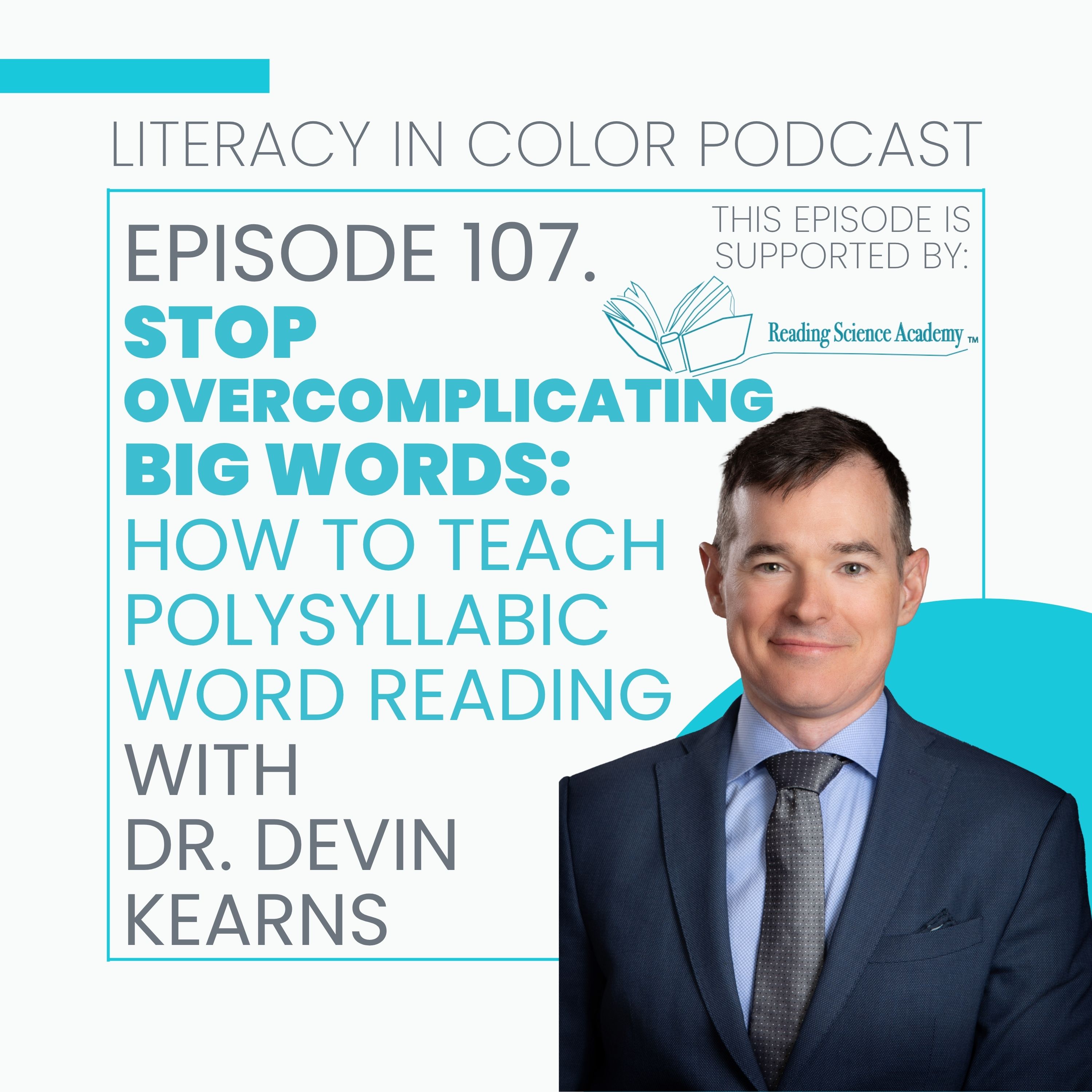
107. Stop Overcomplicating Big Words: How to Teach Polysyllabic Word Reading with Dr. Devin Kearns
About this episode
Dr. Devin Kearns discusses strategies for teaching polysyllabic word reading and the challenges students face with longer words.
What happens after students master single-syllable words in phonics, but the words in their books keep getting longer? Dr. Devin Kearns takes us for a deep dive into polysyllabic word reading and what the research tells us about helping students tackle increasingly complex words. He explains why the transition into longer words presents challenges that simply don't exist in single-syllable words, including the unpredictability of single-letter vowels, reduced vowels & schwa, and the growing prevalence of derivational suffixes. He also challenges some long-standing approaches to syllable division and explains why more rules and terminology aren't necessarily better for students. You'll learn about ESHALOV ("Every Syllable Has At Least One Vowel") as well as the “peeling-off strategy” for recognizing affixes and accessing the base of polymorphemic words. The conversation also explores lexical verification (i.e., set for variability): how readers adjust an initially decoded pronunciation until it connects with a word in their mental lexicon. Key Takeaways: What the research suggests about traditional syllable division rules How to use the strategy: ESHALOV for polysyllabic words…
People in this episode
Host: Michelle Sullivan
Guest: Dr. Devin Kearns
Topics covered
- polysyllabic word reading
- phonics
- syllable division
- decoding instruction
- affixes
- lexical verification
Keywords
- polysyllabic words
- phonics instruction
- syllable division rules
- ESHALOV
- peeling-off strategy
- lexical verification
- decoding
More episodes of Literacy in Color: A Science of Reading Aligned Podcast for Educators
- 110. Decodable Texts Done Right: How to Leverage Them for Phonics, Fluency, Vocabulary & Writing with Dr. Wiley Blevins
- 109. Phonological Awareness & the Alphabet: What the Research Says – and What We Still Don't Know with Dr. Shayne Piasta
- 108. Making Phonics Richer with Multiple Meaning Words
- 106. How New York City Is Transforming Reading Instruction with Dr. Katie Pace Miles
- 104. Building the Biliterate Reading Brain: Multi-Component Instruction & Deep Reading with Dr. Maryanne Wolf
- 103. 5 Quick Tips for b/d Letter Reversals
Explore listener stats, chart rankings, contacts and more on the Literacy in Color: A Science of Reading Aligned Podcast for Educators podcast page.