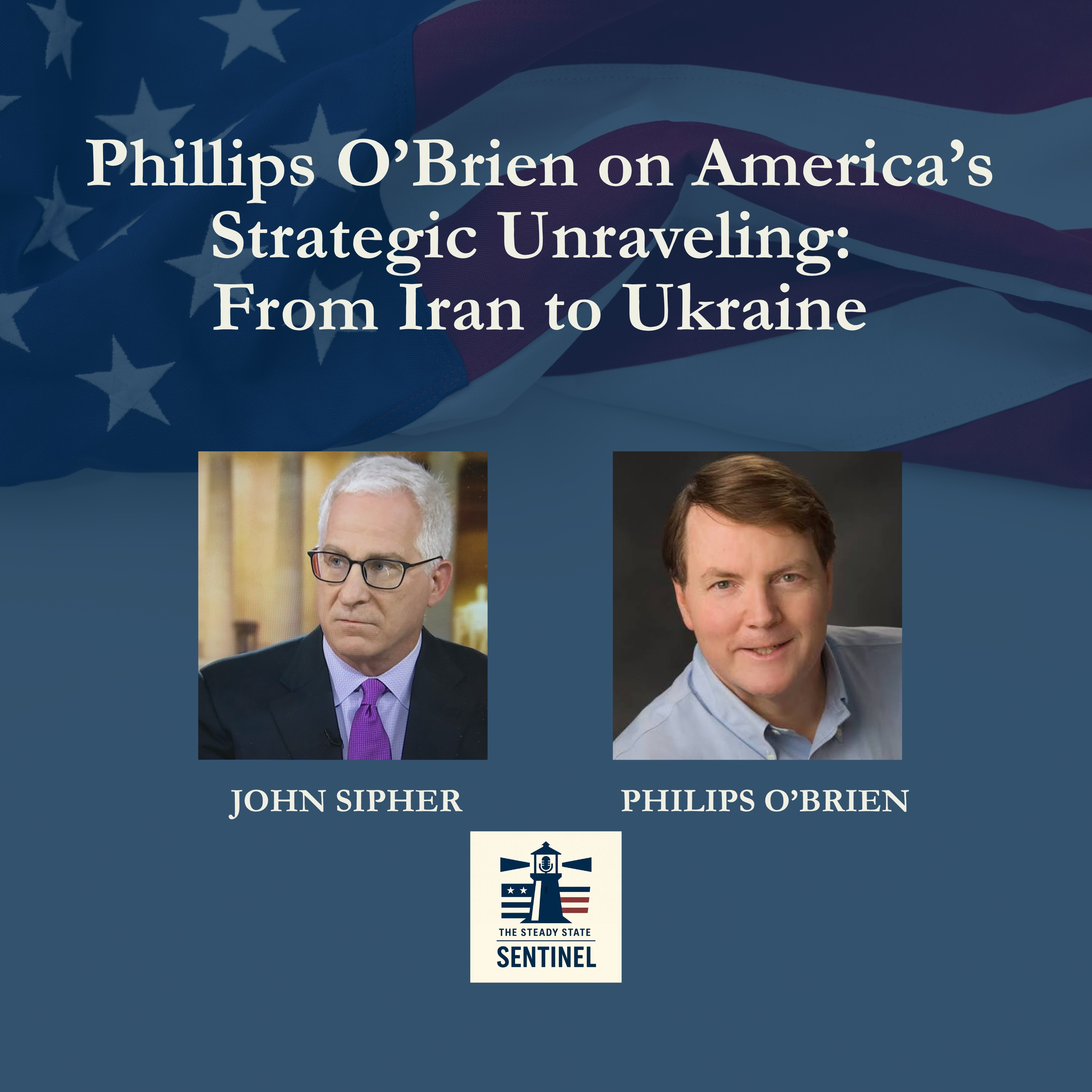
Phillips O'Brien on America's Strategic Collapse
About this episode
Phillips O'Brien discusses the implications of U.S. military strategy and alliances in light of recent conflicts and the upcoming 2026 midterm elections.
The acclaimed military historian explains why conflict in Iran, Ukraine and the erosion of alliances point to a deeper crisis in American strategy and details the critical nature of the 2026 midterm elections. In the latest episode of the Steady State Sentinel, Phillips O'Brien, Professor of Strategic Studies at the University of St. Andrews and one of the sharpest contemporary writers on war and strategy joins host John Sipher to argue the Iran War revealed two devastating truths: The U.S. government is strategically incoherent — it went to war without clear goals or an exit plan. The U.S. military is showing signs of degradation, with weaker officers promoted and critical thinking suppressed. He dissects the Memorandum of Understanding with Iran, calling it a capitulation: "Trump got nothing. Iran is in better shape at the end than it was before the bombing started." He warns that the U.S. is now deemed utterly untrustworthy by allies, in Europe and throughout Asia, and that China is now positioned to win a war with the U.S. due to America's military degradation and collapsed industrial base. He critiques the Biden administration's "Goldilocks strategy" in Ukraine — which…
People in this episode
Host: John Sipher
Guest: Phillips O'Brien
Topics covered
- American strategy
- military history
- geopolitical conflict
- U.S. alliances
- 2026 midterm elections
- military degradation
- strategic incoherence
Keywords
- military strategy
- Iran
- Ukraine
- U.S. alliances
- 2026 elections
- Trump
- Biden
- geopolitics
- strategic collapse
Mentioned in this episode
Organizations: University of St. Andrews
Places: Iran, Ukraine, U.S., Europe, Asia
More episodes of The Steady State Sentinel
- Breaking the Cockpit Barrier: One Pilot's Fight to Engineer Inclusion into the Military
- The Recruiter's Recruiter: Trust, Treason, and the Human Elements of Espionage with Jim Lawler
- The Making of a Public Servant: Lauren C. Anderson's Journey to the Senior Ranks of the FBI
- The Uncrowned King: Ambassador Charles A. Ray on America’s Authoritarian Turn
- The Bob Mueller Standard: Justice, Integrity, and Public Service
Explore listener stats, chart rankings, contacts and more on the The Steady State Sentinel podcast page.