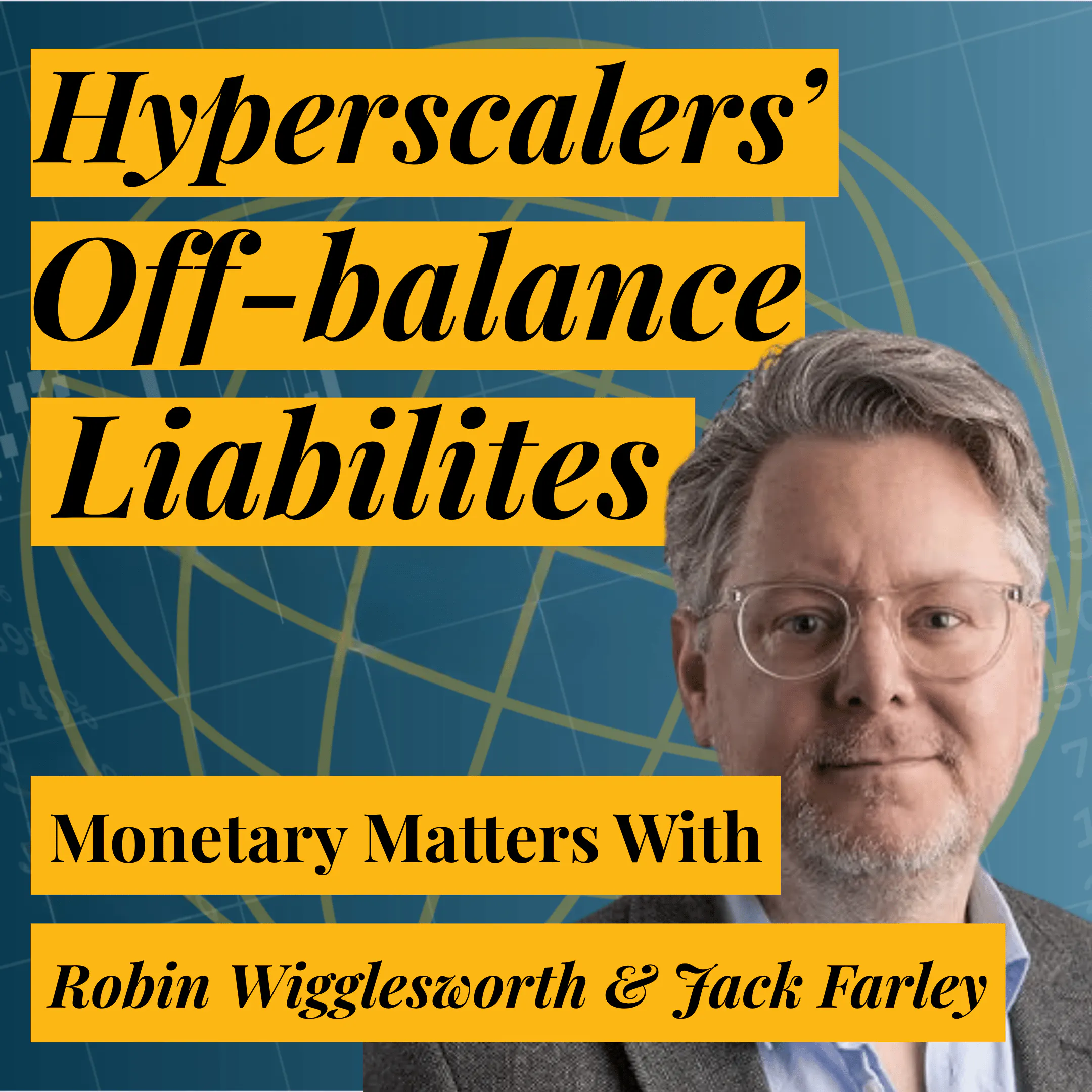
Robin Wigglesworth on Hyperscalers' 1.5 Trillion of Off-Balance Sheet Liabilities, Private Credit, and His Book "A Fabulous Debt"
About this episode
Jack Farley interviews Robin Wigglesworth about the hidden debt in the AI buildout and the implications of off-balance-sheet liabilities from hyperscalers.
Robin Wigglesworth — editor of FT Alphaville and author of A Fabulous Debt: The Epic Story of How Bonds Built the Modern World — joins Jack Farley to unpack the hidden debt fueling the AI buildout. Wigglesworth reveals that off-balance-sheet leverage from hyperscalers like Meta, Google, and Microsoft jumped from roughly $1 trillion to $1.5 trillion in a single quarter, hidden in lease structures and purchase commitments that never show up as debt — including Google's own $800 billion in disclosed obligations. He argues the NVIDIA-Blackstone-KKR financing wave marks a shift from an equity-driven boom to a debt cycle, a distinction that makes today's AI buildout riskier than the dot-com bust ever was. The conversation moves from private credit's "spray and pray" lending problem to nine centuries of financial history — the Erie Canal boom, the 1873 railway mania, and the 19th-century fraudster who invented an entire country to sell government bonds. They close on whether credit rating agencies can survive the AI era, and why "the language of credit" may outlast every model built to replace it. It's a conversation about debt, leverage, and the patterns that connect 19th-century…
People in this episode
Host: Jack Farley
Guest: Robin Wigglesworth
Topics covered
- off-balance-sheet liabilities
- private credit
- AI buildout
- debt cycles
- financial history
- credit rating agencies
Keywords
- hyperscalers
- debt
- leverage
- financial history
- private credit
- AI
- credit rating agencies
Mentioned in this episode
Organizations: FT Alphaville, Meta, Google, Microsoft, NVIDIA, Blackstone, KKR
Books & works: A Fabulous Debt: The Epic Story of How Bonds Built the Modern World
More episodes of Monetary Matters with Jack Farley
- What Actually Happens When a Life Insurer Fails (It's Worse Than a Bank) | Pranjal Drall and Andrew Granato on How Private Equity Turned Life Insurance Into a Taxpayer Backstop
- “I’m Insanely Bullish on Bonds” | Jared Dillian on Copper, Bonds, Semis, and The Awesome Portfolio
- The Certainty Premium: What’s Driving the Tech Sector Divergence? | Jeff Keller
- The Commodity Bull Market Is Broadening | Jim Wiederhold on Copper, Grains, and Bloomberg Commodity Index
- Time to Reduce Equity Risk: Why Underappreciated Macro Risks Could Derail the Bull Market | Warren Pies
- Is Private Equity Broken? Why the Buyside’s Problems Are Making 2026 “The Year of the Banker” | High Yield Harry
Explore listener stats, chart rankings, contacts and more on the Monetary Matters with Jack Farley podcast page.