

Insights from recent episode analysis
Audience Interest
Podcast Focus
Publishing Consistency
Platform Reach
Insights are generated by CastFox AI using publicly available data, episode content, and proprietary models.
Most discussed topics
Brands & references
Total monthly reach
Estimated from 1 chart position in 1 market.
By chart position
- 🇦🇺AU · How To#1785K to 30K
- Per-Episode Audience
Est. listeners per new episode within ~30 days
2.5K to 15K🎙 Weekly cadence·100 episodes·Last published 6mo ago - Monthly Reach
Unique listeners across all episodes (30 days)
5K to 30K🇦🇺100% - Active Followers
Loyal subscribers who consistently listen
1.5K to 9K
Market Insights
Platform Distribution
Reach across major podcast platforms, updated hourly
Total Followers
—
Total Plays
—
Total Reviews
—
* Data sourced directly from platform APIs and aggregated hourly across all major podcast directories.
On the show
From 10 epsHost
Recent guests
Recent episodes
Full audio: John Harvey reading Contending Perspectives: Chapter 11: Conclusions [EDITED]
Nov 24, 2025
5m 29s
Full audio: John Harvey reading Contending Perspectives: Chapter 10: Ecological economics [EDITED]
Jun 4, 2025
38m 13s
John Harvey reading Contending Perspectives: Chapter 9: Feminist economics [EDITED]
May 6, 2025
36m 30s
John Harvey reading Contending Perspectives: Chapter 8: New Institutionalism [EDITED]
Apr 8, 2025
20m 46s
John Harvey reading Contending Perspectives: Chapter 7: Institutionalism [EDITED]
Mar 6, 2025
32m 45s
Social Links & Contact
Official channels & resources
Official Website
Login
RSS Feed
Login
| Date | Episode | Topics | Guests | Brands | Places | Keywords | Sponsor | Length | |
|---|---|---|---|---|---|---|---|---|---|
| 11/24/25 | ![Full audio: John Harvey reading Contending Perspectives: Chapter 11: Conclusions [EDITED] episode artwork](https://static.libsyn.com/p/assets/0/1/4/d/014d059decddb0ee16c3140a3186d450/JH_CP_cover-cropped_with_logo-20251124-hjmh0aw0fv.jpg) Full audio: John Harvey reading Contending Perspectives: Chapter 11: Conclusions [EDITED]✨ | audiobookliterature+3 | John Harvey | Contending Perspectives | — | John HarveyContending Perspectives+3 | — | 5m 29s | |
| 6/4/25 | ![Full audio: John Harvey reading Contending Perspectives: Chapter 10: Ecological economics [EDITED] episode artwork](https://static.libsyn.com/p/assets/7/1/f/8/71f8caacb16d96cbd959afa2a1bf1c87/JH_CP_cover-cropped_with_logo.jpg) Full audio: John Harvey reading Contending Perspectives: Chapter 10: Ecological economics [EDITED]✨ | ecological economicsenvironmental economics+4 | John Harvey | Contending Perspectives | — | ecological economicsenvironmental economics+5 | — | 38m 13s | |
| 5/6/25 | ![John Harvey reading Contending Perspectives: Chapter 9: Feminist economics [EDITED] episode artwork](https://static.libsyn.com/p/assets/f/e/6/c/fe6c4c29b00c97c716c3140a3186d450/JH_CP_cover-cropped_with_logo-20250506-h95ze7flg1.jpg) John Harvey reading Contending Perspectives: Chapter 9: Feminist economics [EDITED]✨ | feminist economicseconomic paradigms+4 | John Harvey | Contending Perspectives | — | feminist economicseconomic paradigms+6 | — | 36m 30s | |
| 4/8/25 | ![John Harvey reading Contending Perspectives: Chapter 8: New Institutionalism [EDITED] episode artwork](https://static.libsyn.com/p/assets/4/3/6/9/4369f9ceb841aff716c3140a3186d450/JH_CP_cover-cropped_with_logo.jpg) John Harvey reading Contending Perspectives: Chapter 8: New Institutionalism [EDITED]✨ | New Institutionalismfinancial crises+4 | — | Contending Perspectives | — | New InstitutionalismContending Perspectives+4 | — | 20m 46s | |
| 3/6/25 | ![John Harvey reading Contending Perspectives: Chapter 7: Institutionalism [EDITED] episode artwork](https://static.libsyn.com/p/assets/6/a/9/d/6a9de5e0d8b0cf3f16c3140a3186d450/JH_CP_cover-cropped_with_logo.jpg) John Harvey reading Contending Perspectives: Chapter 7: Institutionalism [EDITED]✨ | InstitutionalismMethodology+3 | John Harvey | Contending Perspectives | — | InstitutionalismContending Perspectives+3 | — | 32m 45s | |
| 1/29/25 | ![John Harvey reading Contending Perspectives: Chapter 6: Post-Keynesian economics [EDITED] episode artwork](https://static.libsyn.com/p/assets/1/3/a/0/13a08dcd5fc9957ad959afa2a1bf1c87/JH_CP_cover-cropped_with_logo.jpg) John Harvey reading Contending Perspectives: Chapter 6: Post-Keynesian economics [EDITED]✨ | Post-Keynesian economicsThe Great Depression+3 | John Harvey | Contending PerspectivesKeynes' General Theory | — | Post-Keynesian economicsThe Great Depression+3 | — | 54m 46s | |
| 12/30/24 | ![Ep154[2/2]: Dirk Ehnts: MMT makes "I can't" (provide healthcare) impossible. Also: Who gets to decide value? episode artwork](https://static.libsyn.com/p/assets/8/a/7/6/8a76ea4b2e86383a16c3140a3186d450/Dirk_9-24-opening_screenshot-part_2.jpg) Ep154[2/2]: Dirk Ehnts: MMT makes "I can't" (provide healthcare) impossible. Also: Who gets to decide value?✨ | MMThealthcare+3 | Dirk Ehnts | — | — | MMThealthcare+3 | — | 1h 08m 00s | |
| 12/8/24 |  Ep153: Dirk Ehnts: Imposing individualism (part 1 of 2)✨ | individualismcommunity+3 | Dirk Ehnts | Torrens University | New Jersey | MMTDirk Ehnts+5 | — | 52m 17s | |
| 10/27/24 | ![John Harvey reading Contending Perspectives: Chapter 5: Austrian economics [EDITED] episode artwork](https://static.libsyn.com/p/assets/9/7/0/9/9709a5e7490233bbe55e3c100dce7605/JH_CP_cover-cropped_with_logo.jpg) John Harvey reading Contending Perspectives: Chapter 5: Austrian economics [EDITED]✨ | Austrian economicsmethodological individualism+5 | John Harvey | Contending PerspectivesAustrian economics | — | Austrian economicsmethodological individualism+6 | — | 25m 53s | |
| 9/30/24 | ![John Harvey reading Contending Perspectives: Chapter 4: Marxism [EDITED] episode artwork](https://static.libsyn.com/p/assets/e/1/b/4/e1b4f2d51ce47a68e55e3c100dce7605/JH_CP_cover-cropped_with_logo.jpg) John Harvey reading Contending Perspectives: Chapter 4: Marxism [EDITED]✨ | Marxismreading+3 | John Harvey | Contending PerspectivesContending Perspectives: Chapter 4: Marxism | — | MarxismJohn Harvey+3 | — | 37m 54s | |
Want analysis for the episodes below?Free for Pro Submit a request, we'll have your selected episodes analyzed within an hour. Free, at no cost to you, for Pro users. | |||||||||
| 8/25/24 | ![John Harvey reading Contending Perspectives: Chapter 3: Neoclassical Economics [EDITED] episode artwork](https://static.libsyn.com/p/assets/e/8/2/9/e82984d98afb1a4ee55e3c100dce7605/JH_CP_cover-cropped_with_logo.jpg) John Harvey reading Contending Perspectives: Chapter 3: Neoclassical Economics [EDITED] | John Harvey reads the next chapter of his book, Contending Perspectives. Here's the original video from where this audio came. Here's a list of links to John reading every chapter (released so far) in his 2021 book Contending Perspectives. I have edited both the video and audio to eliminate obvious mistakes, coughs, interruptions, and etc. | — | ||||||
| 7/31/24 | ![John Harvey's Contending Perspectives: Chapter 2: Economics as a scientific discipline [EDITED] episode artwork](https://static.libsyn.com/p/assets/5/6/f/b/56fb1ad55abed78527a2322813b393ee/JH_CP_cover-cropped_with_logo.jpg) John Harvey's Contending Perspectives: Chapter 2: Economics as a scientific discipline [EDITED] | John Harvey reads the next chapter of his book, Contending Perspectives. Here's the original video from where this audio came. Here's a list of links to John reading every chapter (released so far) in his 2021 book Contending Perspectives. I have edited both the video and audio to eliminate obvious mistakes, coughs, interruptions, and etc. Audio chapters Use the below timestamps to navigate to each major section and occurrence in this section: 1:35 - Page 8: Chapter 2: Economics as a scientific discipline 3:25 - Page 8: Section: What is science? 4:40 - Page 9 10:03 - Page 10: A realistic version of science 17:39 - Page 13 30:13 - Page 17: Economics: Training and apprenticeship 44:01 - Page 22 58:38 - Page 27: Economics: Schools of thought 1:06:32 - Page 30: Economics: Primary and secondary standards of behavior 1:09:30 - Summary of table 2.1 on 32 (then skipping page 31, paragraph 2 through page 34, paragraph 2 – all of which is covered in future chapters) 1:10:43 - Page 34, paragraph 2 1:13:10 - Page 35: Conclusions 1:14:55 - Final comments | — | ||||||
| 7/1/24 | ![Episode 152[2/2]: Five Torrens graduate students discuss the job guarantee episode artwork](https://static.libsyn.com/p/assets/a/1/f/9/a1f9103e33a6d42727a2322813b393ee/MML.jpg) Episode 152[2/2]: Five Torrens graduate students discuss the job guarantee | Welcome to episode 152 of Activist #MMT. Today's part two of my conversation with five of my Torrens classmates, this time about the job guarantee, from a now-much more educated point of view, given our experience at Torrens. We are also joined by John's wife, Martha, who is highly educated on topics related to the job guarantee. (Here's a link to part one.) But for now, let's get right back to our conversation. | — | ||||||
| 5/28/24 | ![Episode 151[1/2]: Five Torrens graduate students reminisce about the first year. episode artwork](https://static.libsyn.com/p/assets/e/1/5/3/e1533c1b2d7645f727a2322813b393ee/MML.jpg) Episode 151[1/2]: Five Torrens graduate students reminisce about the first year. | Welcome to episode 151 of Activist #MMT. Today I talk with five of my Torrens classmates about our first year in the new graduate program – its importance, some fond memories, and a few improvements we hope to see. In part two we discuss the job guarantee from a now-much more educated point of view. (Here's a link to part 2. A list of the audio chapters in this episode can be found right below.) My guests are Gabie Bond who, along with Professor Steven Hail is the program's administrator, and all-around wonderful person. Susan Borden is the student-matriarch who is taking classes faster than anybody else, and may very well be the first graduate of the Master's program, in a class, literally, all by herself. Tom Foster is an insightful classmate who convinced me to change a major aspect of my view of the job guarantee, as discussed in part two. John Haly is a classmate and very good friend with whom, along with Susan, I've spent many a virtual hour talking and just quietly getting work done. Jackson Winter is a longtime collaborator on many different projects, from audio production to administering the primary private social platform (Discord) for our Torrens classmates, and creating major resources for current and future classmates to take advantage of. He's also a former guest on my podcast. This episode was recorded in late July of last year. Its release was delayed by my taking a demanding course at Torrens, switching careers, and by having to prioritize the release of the Steve Keen and Maren Poitras episodes. Thanks to all my guests for their patience. And now, onto our conversation. Audio chapters 2:40 - Hellos 5:38 - Susan first impressions 8:17 - What have you taken? What will you take? starting with Tom 11:35 - John 12:20 - Conflict between microeconomics and ecological economics 16:06 - John's classes 17:31 - Jackson classes 19:49 - Susan classes and response to John 23:18 - Susan and micro response, upcoming classes 23:57 - Steven and Gabie visiting the US 25:37 - Gabie's perspective of the first year as administrator. 28:17 - When will the final class of the initial set begin? 30:22 - Considering project-oriented electives 31:32 - The extra-curricular activities taken on by Torrens students (download directory, framing discussions) 37:27 - Framing discussions 38:42 - Between-trimester ideas 40:03 - Download directory, ramping-up advice, modern money lab resource repository 42:45 - Susan: Framing, messaging, and etc. 47:29 - Susan: Integrating Mazzucato's "Mission" 48:33 - Gregory Hayden's taxonomy 53:36 - Hayden's taxonomy final point 54:00 - Tom: more interactivity with classmates 55:34 - Final thoughts 57:09 - John: final thoughts 1:01:42 - Duplicate of introduction, with no background music (for those with sensitive ears) | — | ||||||
| 5/25/24 | ![[Mostly-not MMT] 2019 interview: Keith Errol Benson: The black experience *is* the American experience. episode artwork](https://static.libsyn.com/p/assets/c/5/a/d/c5ada8c19d639438e55e3c100dce7605/Keith_Errol_Benson.jpg) [Mostly-not MMT] 2019 interview: Keith Errol Benson: The black experience *is* the American experience. | THIS IS A BACKUP OF A GREAT INTERVIEW I DID IN 2019. IT TOUCHES ON MMT, BUT IS MOSTLY NON-MMT. --- A fascinating and insightful conversation on black history, music, religion, politics, economics, and more. More here: https://citizensmedia.tv/2019/07/07/kem/ | — | ||||||
| 4/24/24 |  Ep150: Maren Poitras, creator and director of Finding the Money | Welcome to episode 150 of Activist #MMT. Today I talk with Maren Poitras, the creator and director of the MMT documentary, Finding the Money. I had the pleasure of seeing this film on October 1st, 2023, in New York City, with my Torrens professor Steven Hail, Torrens administrator Gabie Bond, and Torrens classmate Susan Borden. After the film, we all went to a nearby bar-restaurant, and I got to meet and speak with Maren at length. (A list of the audio chapters in this episode can be found below.) In today's episode, Maren and I talk about how she came to the film and how it's informed by her background in ecological economics. We talk about the trials and tribulations of film-making, including the tortures of creating the intricate and subtle graphics used in the film. We also talk about her interactions with the non-MMTers as seen in the film. At the end, she says what you as a supporter can do to help this film be seen by others. In my view, the film is the most important milestone in the MMT movement since Stephanie Kelton's 2020 book The Deficit Myth (which was the most important milestone since US Representative Alexandria Ocasio Cortez said "MMT" out loud in 2018). The film has the power to change how we talk about some major concepts. It will be available to stream in early May. And now, on to my conversation with Maren Poitras. Enjoy. Audio chapters 3:35 - Hellos, European premiere 14:47 - When did the idea for the film happen and what is your background in film-making? 20:15 - MMT is the child in the Emperor's New Clothes. MMT forces people to question many deep fundamental assumptions about their lives. 38:59 - Printing fiasco 39:17 - Did feedback from the academics result in any major changes? 43:10 - Graphics (ripping open a wound) 47:46 - Non-MMTers in the film (attempts at critique) 55:35 - The film is unfortunately US-centric, due to time and resource constraints 57:18 - What can people do to help the film be seen? 1:01:00 - You never know where secret MMT people are lurking. 1:06:57 - Duplicate of introduction, but with no background music (for listeners with sensitive ears) | — | ||||||
| 4/13/24 | 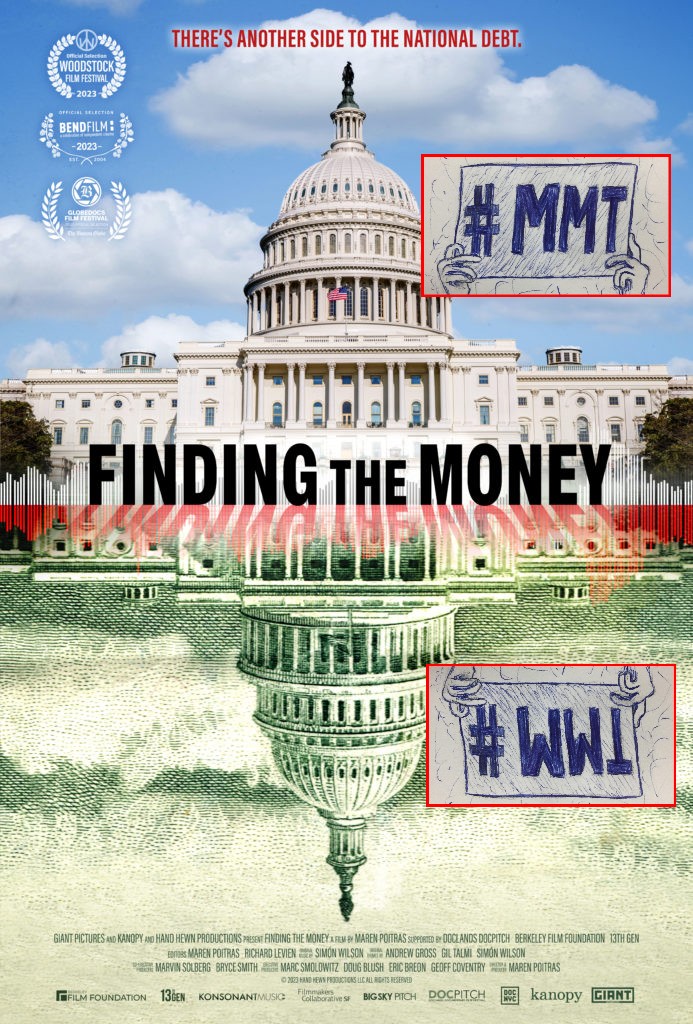 Episode 150 (preview): Maren Poitras: How can YOU help Finding the Money be seen by others? | Here's a preview of my soon-to-be-released interview with Finding the Money director, Maren Poitras. It's a four-minute segment where Maren describes what YOU can do to help Finding the Money be seen by others. The big launch is less than three weeks away. This means the most important thing is to get people to buy tickets for screenings. The documentary's website (findingmoneyfilm.com) is the best place to go for this, and especially the "where to watch" page. Here are the major upcoming screenings: This Tuesday, April 16, is the New York City premiere with "DOC NYC" at IFC Center at 7 pm. Get your tickets here./ New York City: May 3-9, each followed by a Q&A Washington, DC: May 9th at AFI Silver Theater, followed by a Q&A with Stephanie Kelton and Sara Nelson LA May 14-16 followed by a Q&A with Stephanie Kelton, Cory Doctorow, and Harry Shearer (Harry Shearer!) Other dates in Seattle, Portland, and San Francisco are coming The film will be available On Demand nationwide wherever you rent movies on May 3! (I'm going to stream it with my family as soon as it's available. I'm pretty sure my boys, 14 and 17, will sit through the whole thing, but I have carrots (homemade popcorn) and sticks (threat of no bed to sleep in) at the ready.) | — | ||||||
| 2/26/24 | ![Episode 148[1/2]: Steve Keen: MMT says government spending creates money. It's correct. episode artwork](https://static.libsyn.com/p/assets/8/8/e/3/88e39f5016a32df788c4a68c3ddbc4f2/Me_and_Steve-6-2023_Princeton-cropped-logo.jpg) Episode 148[1/2]: Steve Keen: MMT says government spending creates money. It's correct. | Welcome to episode 148 of Activist #MMT. Today I talk with post-Keynesian economist Steve Keen about his decades-long fight against mainstream economics, what MMT convinced him of, and the couple parts of MMT he still disagrees with. This first part is a half-hour long audio interview, which will be followed next month by an hour-and-a-half-long video interview, where Steve walks me through the basics of his Minsky modeling software, and why he believes it's an important tool for MMTers. (Here's a link to PART TWO. A list of the audio chapters in this episode can be found right below.) MMT and Steve are in complete agreement with how banks spend (lend money into existence). After reading Stephanie Kelton's book in 2020, Steve realized that government spending also creates money. National governments don't tax in order to spend, they spend in order to tax. Steve quickly created a Minsky model convincing himself that MMT is indeed correct regarding this. This insight is also completely compatible with his understanding of bank spending. As far as Steve's disagreements with MMT, they are important, and Steve lays them out in detail in the last ten-or-so minutes of this episode. But let it be known that they are far from core issues. In other words, the amount of agreement is far greater. It's good to understand what these disagreements are, but as Steve says, we have much bigger fish to fry. This is the first main episode of Activist #MMT since August. Although I've released three chapters from John Harvey's readings of his book Contending Perspectives (with lots more to come!), the past six months have been all consuming, starting with my third Torrens course – which was coincidentally taught by John on that very book. It was both incredibly enlightening and unbelievably exhausting. I've also become a full-time musician. I now sing several times each week at retirement communities and related facilities (independent living, assisted-living, nursing homes, etc.). Coincidentally, back in July, I met Steve in person for dinner in Princeton, New Jersey, which is about an hour north of my home. After dinner and conversation, Steve gave me an initial walk-through of Minsky. We ended the night with me singing a few songs on the sidewalk – just me, my phone, and a little Bluetooth speaker. At the very end of today's episode, after the closing theme music, you'll hear a small highlight from that experience. You can check out my singing website at seejeffsing.com. And now, onto my conversation with Steve Keen. Enjoy. Audio chapters 4:24 - Hellos, and the plan 5:53 - His journey fighting mainstream, and, in 2020, to MMT 8:19 - Marx's view of money, Steve's PhD, Minsky's financial instability hypothesis, double entry bookkeeping, thinking of government spending differently 9:43 - Modeling money properly with double entry bookkeeping 10:49 - Discovering MMT in 2020, which changed his view on government spending 12:56 - Mild criticism of MMT's consolidated view 14:29 - Money creation is the expansion of balance sheets. The same thing happens on both the asset and liability side. If it ONLY happens on the liability side, it's a liability swap it. If it ONLY happens on the asset side, it's an asset swap. 16:42 - Regarding government money creation, how does your model distinguish between money creation and the supposed recycling of collected money? 19:12 - The only insight MMT gave Steve was that government spending creates money. All his work on banking is exactly compatible. 20:09 - Steve's two disagreements with MMT 21:31 - Disagreement 1: MMT says that in general, imports are a benefit and experts are a cost. 25:48 - Disagreement 2: The JG and UBI are actually complementary 27:59 - A dangerous follow up question: danger of UBI is that it could undermine the job guarantees Price anchor. Steve's response: the UBI would need to be below the job guarantee wage 30:25 - Have you modeled these disagreements in Minsky to confirm your view? Answer: no. There are simply much bigger fish to fry. 31:16 - Goodbyes for audio portion, transitioning to video 34:38 - Singing for Steve on a sidewalk in Princeton 36:01 - Duplicate of introduction, with no background music (for those with sensitive ears) | — | ||||||
| 10/3/23 | ![John Harvey's Contending Perspectives: Chapter 1: Introduction [EDITED] episode artwork](https://static.libsyn.com/p/assets/b/e/2/d/be2dc6c17ad8709040be95ea3302a6a1/JH_CP_cover-cropped_with_logo.jpg) John Harvey's Contending Perspectives: Chapter 1: Introduction [EDITED] | John Harvey reads the next chapter of his book, Contending Perspectives. Here's the original video from where this audio came. Here's a list of links to John reading every chapter (released so far) in his 2021 book Contending Perspectives. Note the original video is unedited, but the audio has been edited to eliminate obvious mistakes, coughs, interruptions, and etc. Audio chapters Use the below timestamps to navigate to each major section and occurrence in this section: 0:00 - The Cowboy Economist's cousin, John Harvey, introduces himself 0:41 - Page 1: Introduction 8:56 - Page 4 14:35 - Page 6 | — | ||||||
| 9/17/23 | ![John Harvey's Contending Perspectives: Chapter 00: Before we begin [EDITED] episode artwork](https://static.libsyn.com/p/assets/b/2/d/9/b2d92884096ffc93d959afa2a1bf1c87/JH_CP_cover-cropped_with_logo.jpg) John Harvey's Contending Perspectives: Chapter 00: Before we begin [EDITED] | John Harvey reads the next chapter of his book, Contending Perspectives. Here's the original video from where this audio came. Here's a list of links to John reading every chapter (released so far) in his 2021 book Contending Perspectives. Note the original video is unedited, but the audio has been edited to eliminate obvious mistakes, coughs, interruptions, and etc. Audio chapters Use the below timestamps to navigate to each major section and occurrence in this section: 0:00 - Opening thoughts by John's cousin, the Cowboy Economist 6:37 - Page vi: Acknowledgements | — | ||||||
| 8/29/23 | ![Episode 147[2/2]: Brian Romanchuk: The secondary market through the eyes of a bond analyst episode artwork](https://static.libsyn.com/p/assets/9/f/1/a/9f1ac6248a4849b816c3140a3186d450/BR_with_logo.jpg) Episode 147[2/2]: Brian Romanchuk: The secondary market through the eyes of a bond analyst | Welcome to episode 147 of Activist #MMT. Today's the second in my two-part conversation with author, mathematician, and bond analyst Brian Romanchuk (Twitter/RomanchukBrian), on the basics of the secondary market and how it relates to the primary market. Today in part two, Brian continues describing the participants in the secondary market, why they do what they do, and shares several anecdotes from his many years of experience as a bond analyst for fixed income recipients in Canada. A fuller introduction can be found before part one. But for now, let's get right back to my conversation with Brian Romanchuk. Enjoy. A fuller introduction can be found at the beginning of part one, but for now, let's get right back to my conversation with Brian Romanchuk. Enjoy. Audio chapters 4:03 - The internet allows you to do a large quantity of small transactions BUT everyone can see it (it's publicly viewable) 4:47 - "Reallocation between bonds and equities." 8:19 - What is the population of who purchases bonds? 26:24 - The rich don't just buy bonds themselves, as individuals. 28:22 - Municipal bonds don't play a large role in the macro economy 30:01 - Z-1 document from the Federal Reserve 32:11 - Who exactly are the supposed bond vigilantes? (The really powerful bond purchasers would never say anything publicly. It would be a breach of their fiduciary duty! Anyone talking on the news is only talking for themselves.) 33:57 - The most important players keep their mouth shut 36:07 - Speaking publicly is marketing and manipulation 41:40 - Anthropomorphic 45:08 - What people say, when not under legal obligation to be truthful, is sometimes manipulation and marketing. 49:03 - Reasonable people know the national government isn't really going to default 55:28 - Bringing it back to the beginning: The three core reasons why the government, not the market, is in control 58:47 - How would everything we've discussed change is we lived in a ZIRP world? 1:03:12 - ZIRP is bad only in the sense that 1:15:15 - Duplicate of introduction, with no background music (for those with sensitive ears) | — | ||||||
| 7/31/23 | ![Episode 146[1/2]: Brian Romanchuk: The secondary market through the eyes of a bond analyst episode artwork](https://static.libsyn.com/p/assets/5/9/e/7/59e70c5da4043b2a40be95ea3302a6a1/BR_with_logo.jpg) Episode 146[1/2]: Brian Romanchuk: The secondary market through the eyes of a bond analyst | Welcome to episode 146 of Activist #MMT. Today I talk with author, mathematician, and bond analyst Brian Romanchuk, on the basics of the secondary market and how it relates to the primary market. Brian starts with a brief tutorial of how bonds are priced, which is seen very differently from the points of view of the primary and secondary markets. For an in-depth treatment of this topic, you can listen to episodes 30 and 31 of MMT Podcast with Steven Hail. (Here's a link to part two. A list of the audio chapters in this episode can be found right below [above the full-question list].) Brian then describes bonds (and more broadly, securities) in general, the population of who buys and sells them, some of the reasons why they are bought and sold, and several anecdotes of how it all happens. What can be said is this: rich people rarely if ever buy US treasuries on their own, as individuals. Additionally, the biggest players in securities trading never speak publicly in order to prevent jeopardizing their advantage – they keep their mouths shut. These two facts alone put a huge hole in the idea of so-called bond vigilantes. Although I'm not necessarily interested in the idea of bond vigilantes, it's one of the most obvious and common myths that comes up regarding the secondary market. Whatever the case, the idea that the market can somehow overrule the national government is clearly false. This is for at least the following three reasons: only the national government can create and delete its own bonds. Only the national government can create and delete its own money – which is required to purchase those bonds. And the national government (for countries such as the United States, UK, Australia, Japan, and Canada) have little to no foreign denominated debt, which means they do not offer to convert their money into anything else. What this means is that the national government, through the collective action of its citizens (US!), has the power to stand up to the market even if they somehow object to the actions of that government. The only way the market can overpower the national government is if the government chooses for it to be that way – such as when representatives and regulators are bought off by the biggest players in that market. This is further bolstered by the populace being sufficiently duped into believing it all to be "unfortunate, but necessary." This is a primary battle-front in the centuries-long war between rich and poor, which, unfortunately, the rich have all but won. And now, onto my conversation with Brian Romanchuk. This is part one of a two-part conversation. Enjoy. In order to preserve both my podcast and my sanity as I proceed through Torrens University and Modern Money Lab's graduate program in MMT and ecological economics (🦉🤝🌍), I've slowed my podcast from one episode a week, to once a month. For as little as a dollar a month, patrons of Activist #MMT can hear all three parts with Brian right now. You can start by going to patreon.com/activistmmt. Resources The Federal Reserve's Z1 document Brian's July 2023 Q&A with Torrens University students Audio chapters 5:33 - I don't care about bond vigilantes per es, it's just the most common (mythical!) topic discussed. 7:43 - The core reasons why the government, not the market, is in charge. 11:18 - The definition of money. Even a pizza coupon is money, but not as understood by the general public. 12:04 - A government bond is a security, governed by securities laws. 12:49 - The basics of price and yield 21:41 - Price and yield versus par value and coupon rate – terms as used in the primary versus secondary market 24:45 - Computer era versus pre-computer era 29:48 - despite lots of corruption and instability, he will always get $100 back from that. 33:14 - Primary market 36:05 - "Basis points" 44:34 - Your company benefitted fixed-income earners 47:11 - Does your company know when bonds are purchased from primary or secondary dealers? Does the distinction matter? 52:21 - John Harvey: the internet ended personal connection in trading 1:00:21 - The internet allows you to do a large quantity of small transactions BUT everyone can see it (it's publicly viewable) 1:01:06 - "Reallocation between bonds and equities." 1:04:24 - Duplicate of introduction, with no background music (for those with sensitive ears) | — | ||||||
| 6/29/23 | ![Episode 145 [3/3]: Emily Ruhl: Religiously-defensible, divinely-supported genocide episode artwork](https://static.libsyn.com/p/assets/d/1/8/a/d18a642292cff2b3e5bbc093207a2619/emily_pic-with_logo.jpg) Episode 145 [3/3]: Emily Ruhl: Religiously-defensible, divinely-supported genocide | Welcome to episode 142 of Activist #MMT. Today's the final part of my three-part conversation with Emily Ruhl, on his 2008 paper, Religiously-defensible, divinely-supported genocide. Today we discuss principles seven to ten. My full and detailed question and summary list can be found in the show notes to part one. Also, be sure to see the list "audio chapters" in all three parts (look below!) to find exactly where each topic is discussed. You can financially support this podcast by going to Patreon.com/ActivistMMT. For as little as a dollar a month, all patrons get exclusive, super-early access to several full episodes and some unique patron-only opportunities, like asking my academic guests questions (like my episodes with Dirk Ehnts, John Harvey, and Warren Mosler). In addition to this podcast, patrons also support the development of my large and growing collection of learn-MMT resources, and my journey through the Torrens graduate program. To become a patron, you can start by going to Patreon.com/ActivistMMT. Every little bit helps a little bit, and it all adds up to a lot. Thanks. And now, let's get right back to my conversation with Emily Ruhl. Enjoy. Audio chapters 3:01 - Different levels of Nazis: killing versus deciding who to kill (doctors, commandants, soldiers) 6:44 - Symbols as an expression and reminder of power (pledge of allegiance) 8:02 - Charismatization: The charisma of the individual, and of the world (institutions) around him — including reactions to him. 18:17 - Calmly stirring up the crowd into a frenzy, and further into genocide. 19:03 - The pursuit of Atlantis and the holy grail (Indians Jones) 28:10 - Nazi pseudo-religion is a tool to justify genocide. False economics is a tool to justify mass neglect and exploitation. 34:44 - Connecting false economics and Nazi Germany's pseudo-religion 38:47 - In the national context, there is no such thing as "finding money" Their decision to do something IS the the funding. 41:38 - Final question: Polanyi, "latent anti-Semetism" versus venting frustrations from a lifetime of mass neglect and exploitation 51:00 - Reality of hyperinflation, the treaty of Versailles 52:28 - Final comments 54:44 - Goodbyes | — | ||||||
| 5/28/23 | ![Episode 144 [2/3]: Emily Ruhl: Religiously-defensible, divinely-supported genocide episode artwork](https://static.libsyn.com/p/assets/6/2/9/5/629517496abe41a4e5bbc093207a2619/emily_pic-with_logo.jpg) Episode 144 [2/3]: Emily Ruhl: Religiously-defensible, divinely-supported genocide | Welcome to episode 144 of Activist #MMT. Today's part two of a three-part conversation with historian, author, and Harvard master's graduate, Emily Ruhl, on her new paper and master's thesis, In League with the Devine: How Religion Influenced Nazi Perpetrators of the Holocaust. You will find my detailed question list at the bottom of the show notes for part one. Also, be sure to see the list "audio chapters" in all three parts (look below!) to find exactly where each topic is discussed. A full introduction can be found at the beginning of part one, but for now, let's get right back to my conversation with Emily Ruhl. Enjoy. Audio chapters 2:43 - German pseudo-religion: three parts: anti-Semitism, Blut und Boden (blood and soil), and Volksgemeinschaf (the German worldview) 3:50 - Racism is an impossible concept. The only way to preserve the German Aryan theory is to exterminate anyone not "definitely" Aryan. 7:21 - The order in which you kill changes it from murder to sanctioned by God 11:12 - Religion is both coercion and a salve once what they were coerced to do is done. 20:31 - The biggest bias in sources is the power of those who created (wrote, filmed, etc.) it. 29:21 - "No punishment" for those refusing to kill, but only if they didn't threaten the regime. 30:12 - Religious symbols: pins (SS lightning bolts), belt buckles, architecture, white doctors coats. 44:28 - Symbols in architecture 48:59 - Different levels of Nazis: killing versus deciding who to kill (doctors, commandants, soldiers) 55:30 - Duplicate of introduction, with no background music (for those with sensitive ears) | — | ||||||
| 4/29/23 | ![Episode 143 [1/3]: Emily Ruhl: Religiously-defensible, divinely-supported genocide episode artwork](https://static.libsyn.com/p/assets/8/d/e/7/8de78b7e0b4d3772d959afa2a1bf1c87/emily_pic-with_logo.jpg) Episode 143 [1/3]: Emily Ruhl: Religiously-defensible, divinely-supported genocide | Welcome to episode 143 of Activist #MMT. Today I talk with historian, author, and Harvard master's graduate, Emily Ruhl, on her new paper and master's thesis, In League with the Devine: How Religion Influenced Nazi Perpetrators of the Holocaust. This is the first of a three-part episode. You will find my full and detailed question list at the bottom of today's show notes. Also, be sure to see the list "audio chapters" in all three parts to find exactly where each topic is discussed. (Here are links to parts two and three. A list of the audio chapters in this episode can be found right below [above the full-question list].) (In order to preserve both my podcast and sanity as I proceed through the Torrens graduate program, I've decided to slow my podcast from one episode a week to once a month.) The Nazi Party started by trying to resist and reject all religion, but soon, religion became a fundamental part of the Party's strategy of coercing and propagandizing everybody, from members of the public, to the highest ranking figures in both religious and political institutions, into accepting the brutal and systematic murder of eleven-million souls. The Nazi religion took elements of Christianity, Protestantism, and Paganism, to make one geared not to brotherly love, but primarily to erasing non-Aryans from the Earth. This Nazi pseudo-religion served both as coercion – you must kill the unworthy, or at least stand back while others do – and also as a salve, to come to terms with what you've just done. As you'll hear in the cool quote for part two (the first minute before the opening music), that salve can make the difference between sanity and insanity, and life and death. The Nazi's didn't want to murder eleven million people, they had to, because God said they had to. It was "unfortunate, but necessary." My primary goal for this interview is to demonstrate how this is parallel to mainstream economics, which is also a tool to justify suffering, this time in the form of austerity. Instead of a gun to the head at point blank range, austerity is mass deprivation and exploitation, resulting in a slow and torturous death by despair, starvation, exposure, and untreated sickness and injury – not to mention wasted potential. We currently have the ability to provide all with what they desperately need, including healthcare, education, decent food and shelter, un-poisoned water, and breathable air. As illuminated by Kate Raworth's doughnut, if we are to continue existing as a species, then we must provide the desperate with what they most desperately need. At the same time, we also have to stop the very few on top from using the vast majority of our precious and limited resources to needlessly lavish themselves. Unfortunately, we are instead digging ourselves into an even deeper ecological crisis, when we should be getting off fossil fuels entirely, and restructuring society so we don't require as much. On our current path, in the not-too-distant future, it may indeed become unfortunate but necessary to choose who must be deprived in order for the rest to live. Of course, given our obscene and still growing inequality, the most powerful few will be the ones to make those decisions, and the least powerful many will be the sacrificed. This is the lifeboat economics of the tragedy of the tragedy of the commons. Instead of the around eleven million murdered by the Nazi Party, mainstream economics is little more than a religion to justify what may ultimately result in the death of not millions, but billions. Austerity is genocide at a slower pace. As if riding in a bus hurtling towards a cliff, we as a species currently face a binary choice, between having a terrible accident, and plunging off into oblivion. As Mark Twain said, "History never repeats itself, but it does often rhyme." There is still time to learn from that history. We can choose another path. On a completely unrelated side note, while attending her master's program, writing her master's thesis and working full time, Emily also wrote… an entire fantasy novel. You can find out more about it, and read the entire first chapter, at her website, emilyruhlbooks.com. In order to preserve both my podcast and my sanity as I proceed through Torrens University and Modern Money Lab's graduate program in MMT and ecological economics (🦉🤝🌍), I've slowed my podcast from one episode a week, to once a month. For as little as a dollar a month, patrons of Activist #MMT can hear all three parts with Emily right now. You can start by going to patreon.com/activistmmt. And now, onto my conversation with Emily Ruhl. Enjoy. Resources Dirk Ehnts 2017 book, Modern Monetary Theory and European Macroeconomics, from the introduction: The crash of 1929 was a direct consequence of weak financial sector regulation in the US, and it had world-historical consequences. It caused the economies not only of the US and Canada to melt down, but also those of many other nations financially linked to the US – including the German economy, whose deflationary collapse in 1929 led to the election of Adolf Hitler by a desperate electorate in 1933, the same year Glass–Steagall was passed. Had Glass–Steagall been legislated ten years earlier, the Second World War would most likely never have happened. Asad Zaman 2016 lecture entitled Macroeconomics, at around the 33-minute mark, states that had the right economic theories been implemented by those in power, that the Great Depression would have never occurred. My post summarizing Polanyi's 1941 book (2001 edition), The Great Transformation My interview with Asad Zaman on Polanyi. See especially the eight-minute, 35-seconds mark in part one (see the audio chapters at the bottom of the show notes) 2016 book by Christopher Browning, Ordinary Men Daniel Goldhoggen Hitler's Willing Executioners Calvin University online archives - start with this Google search for Calvin University online archives nazi Audio chapters 7:12 - Hellos 8:49 - Overview of the paper 10:46 - Elaborating on the gap in the literature 15:30 - Harvard online masters degree 16:40 - Her experience writing the paper, the major sources, and the consequences of the pandemic 20:12 - Structuralist approach to writing the paper (interconnectness) 25:04 - The bias in even primary sources (the art of bias) 30:02 - Lebensunwertes Leben: Life unworthy of living 37:06 - Three theories why Jews are lebensunwertes leben 44:56 - Christian verses Catholic 45:45 - Nazi party desired to be non-religious. Religion became critical. 54:07 - German pseudo-religion: three parts: anti-Semitism, Blut und Boden (blood and soil), and Volksgemeinschaf (the German worldview) 59:40 - Racism is an impossible concept. The only way to preserve the German Aryan theory is to exterminate anyone not "definitely" Aryan. 1:04:30 - Duplicate of introduction, with no background music (for those with sensitive ears) Resources ...to come... My full question list META QUESTIONS Introduce yourself. Your background and interests that led you to this paper. How it applies to your masters and career goals. (Be careful with what you want reveal to protect your job.) Can you give an overview of your paper? What research already exists related to this topic and what gap does your paper fill? Describe your experience writing the paper. The sources you used, the limitations of doing much of it during the pandemic, what would have been different if there wasn't a pandemic, the fact that you read German. You used a structuralist approach in your paper. Can you define that term and how it affected your paper and approach? Your evidence was primary sources such as diaries, testimonies, journals, books, documentaries, and propaganda movies. All these things however, were written in a certain context. For example, trial testimony captures the words of someone whose primary goal is to avoid legal consequences. Propaganda videos were obviously to manipulate in favor of those on top. Even a personal journal could be written in such a way to preserve their sanity such as by avoiding suicidal thoughts and actual suicide. How do you filter through that bias and understand reality? How do you trust even primary sources? THE PAPER ITSELF Some questions to answer, some summaries and insights to elaborate on. (I'm a classically trained singer learned how to pronounce German, SOUND like I can read it/speak :) Lebensunwertes leben means "life unworthy of life." We're going to talk about Jews in the next question, but in general, what lives were deemed unworthy by Nazis, and why? Conversely, how was a worthy life defined? (Aryan, and specifically German Aryan.) Who and what defines these things? Can you also talk about the history of these concepts? These definitions weren't invented in Nazi Germany. There are three major theories of why Jews are considered unworthy of life: the Christian view was that Jews killed Christ (even though Christ was Jewish; his final supper was a Passover seder!) The protestant view is from Martin Luther who just simply said that Jews are devils and they should be killed and their homes destroyed (resulting in Kristallnacht). It was also strongly asserted that all of Germany's ills were primarily caused by Jews. Can you elaborate on this? How were three such disparate theories used in concert? The Nazi party originally intended to be secular (non-religious) but ended up having to tolerate some of it for political expediency. If they didn't, they would have alienated a large part of the population. In other words, the Party accepted what they didn't want to accept, in order to not be destroyed. Conversely, religious institutions, from churches, all the way through the Vatican, had to accept Nazi pseudo-religion, in order for the church to survive. German pseudo-religion is built on three foundations: Above all is anti-Semitism, and also blut und boden (blood and soil), and volksgemenschaft weltanschauung (the German world-view). Can you define and discuss each of these? On page 1 of the introduction, you introduce someone named Franz Stangl who was a police superintendent at the Euthanasia Institute at Hartheim (a heck of an institution!). He explained how he only shot children who were motherless, saying it was "soothing to my conscience to release children unable to live without their mothers." As you point out, the word "release" means redeem or save in a religious sense. Therefore, his killing the child made him a savior or redeemer in the eyes of God. What shocked me about this was that he only killed children after their mothers were first killed by one of his comrades. So by simply REVERSING THE ORDER in which you kill a mother and her child, it changes from an immoral act of murder to an act of mercy sanctioned by God. Stangl also talks about how a Catholic clergy advocated for this "mercy killing" of the motherless child (that Stangl and his partner MADE motherless!). Stangl said in a 1971 interview, "Here was a Catholic nun, a mother superior, and a priest. And they thought it was right. Who was I then, to doubt what was being done?" So religion, even God himself, was utilized as a tool to justify and encourage mass murder. In addition, religion was also the excuse given to the murderer so they could clear their conscience after the act. Building on the previous question and returning to biases in primary sources: One of the biggest biases of all is power. It is REQUIRED to say that killing the unworthy is necessary (and commanded by God) in order to not be killed yourself. Even saying that someone is unworthy is required in order to not become unworthy yourself! This is true for average people, all the way through highest levels in both religion and government. How much did the clergy mentioned by Stangl really believe what they were saying, and how much of it was that they were protecting themselves and the church from being destroyed by the Nazi party? How threatened did the clergy feel? In other words, the fact that Stengel felt permission from the clergy is really his being COERCED by religion, because those religious figures in turn were coerced by the most powerful figures in Germany and the Nazi party. It turns out that religion and religious symbols became a core element of its strategy to propagandize the public. Can you talk about the religious symbolism in architecture, clothing, belt buckles, pins, and how these things come from both the pagan and Christian religions. (Paganism is basically NOT Christian. NOT one of the dominant religions. This is equivalent to the term heterodox in economics, which is the economics that is NOT mainstream.) Another important religious symbol was the white outfits worn especially by concentration camp doctors, and secondarily by commandants. Before the next question: I want to say a haunting quote I'm reminded of by the white outfits and the purity and moral and religious authority it gave to doctors and commandants, by Zygmunt Bauman in his book, Modernity and the Holocaust: "It was not illiterate savages, but graduates of the finest educational systems of the West who designed the gas chambers used to burn millions of innocent men, women and children in Germany." White outfits symbolizes these people as gods, because they alone decide who lives and who dies (and who is tortured and not tortured). There were different levels, such as how doctors killed people directly AND made the decision to do so; how commandants decided who should be killed but didn't do it themselves; and soldiers killed people but only under the command of an authority figure. In footnote 75 on page 26, someone named Albert Speer said he found "Hitler to be "deeply exciting" as a result of the "intermingling of frenzy and rationality" with which he spoke. In the footnote, it says, "listening to Hitler's speeches convinced him to commit himself to the party." The speech he watched almost certainly included the crowd's responses to it. Not unlike the Beatles and their crowds of fawning women. Can you speak about the concept of charismatization, of both Hitler the individual and the party and its institutions, and how all this was an important part of manipulating and propagandizing the public, to achieve the Party's goals? A tangent but a purposeful and important tangent for the Party. A major goal of the SS was dedicated to finding places and objects that could prove "the genetic and geographic roots of Aryans." Two major examples being Atlantis and the Holy Grail. The entire Indiana Jones movie series was based on this concept, especially part three, which was precisely a race to find the Holy Grail before the Nazis could. As you say in the paper, "the Aryan race… was believed to be descended from the deities who once lived in Atlantis." This is all complete fiction (they obviously never succeeded), yet the very pursuit validated and reinforced their beliefs in the eyes of the public (surely they wouldn't waste THAT many resources and THAT much time on utter nonsense!). The Holy Grail in particular was pursued not just as justification of their beliefs but also as a weapon to "repel the darkness" of those to be considered unholy. "If the SS found the Holy Grail, it would have appeared as though God himself had guided the Nazis to its location, thus implying that the Nazis had the approval of Heaven. This, in turn, would have depicted the actions of the Nazis including the genocide they initiated--as being morally correct and aligned with the desires of God." Can you elaborate on this? Mainstream economics is, like religion, a tool to justify genocide, albeit in a much less direct and overt fashion. This is especially true as our ecological crisis looms. That's the parallel I want to draw with this interview. (Mainstream economics, really, IS a religion, and Harvard's president is one of its leading acolytes.) You did a bit of reading on MMT, I wanted to get your thoughts on MMT in general, compare that to what you believed to be true before we met, and if it relates in any way to your paper. The other connection between our two topics is that, if the New Deal were implemented in the late 1800s, then WWI and the rise of Hitler and the Nazi party would have never happened. I've heard this from two PhD economists: the first is Dirk Ehnts in his book MMT and the European Monetary Union, and the second is Asad Zaman in his macroeconomics lecture, both of which will be linked in the show notes. A point made in Karl Polanyi's 1942 book, The Great Transformation, is that fascism is not a movement unto itself. There's no "strength" in fascism or fascists. Rather, fascism only exists to fill the vacuum left by the suffering wrought by neoliberalism (and more generally, the centuries of mass neglect and exploitation by the obscenely rich). So, the hatred by regular Germans of Jews (and other "unworthy" people) is in fact largely a response to the neglect and abuse *they've* experienced at the hands of those on top. They've just been deceived into thinking that society's ills are PRIMARILY caused by those with the least money and power. This gives those on top protection, because it provides their victims with an outlet for venting their rage, but in a way that allows them to remain in power. Citizens are: deceived into hurting themselves, so those on top don't have to. I say this, because it's both suggested and directly asserted by some of the figures in your paper that hatred of Jews and other "unworthies" was always lurking in the hearts of Germans, and I don't think that's true. | — | ||||||
Showing 25 of 97
Sponsor Intelligence
Sign in to see which brands sponsor this podcast, their ad offers, and promo codes.
Chart Positions
1 placement across 1 market.
Chart Positions
1 placement across 1 market.