

Insights from recent episode analysis
Audience Interest
Podcast Focus
Publishing Consistency
Platform Reach
Insights are generated by CastFox AI using publicly available data, episode content, and proprietary models.
Most discussed topics
Brands & references
Est. Listeners
Insufficient chart data. Estimates will improve as the show charts.
- Per-Episode Audience
Est. listeners per new episode within ~30 days
N/A🎙 Weekly cadence·82 episodes·Last published 2mo ago - Monthly Reach
Unique listeners across all episodes (30 days)
N/A - Active Followers
Loyal subscribers who consistently listen
N/A
Market Insights
Platform Distribution
Reach across major podcast platforms, updated hourly
Total Followers
—
Total Plays
—
Total Reviews
—
* Data sourced directly from platform APIs and aggregated hourly across all major podcast directories.
On the show
From 10 epsHost
Recent guests
Recent episodes
The End of the Cloud: Why Mistral AI is Raising $1B for Concrete Fortresses
Mar 29, 2026
19m 21s
The billion dollar bet on emotional artificial intelligence
Nov 4, 2025
4m 08s
OpenAI is setting the stage for what could be the larget technology IPO
Nov 2, 2025
4m 13s
$1 billion to build AI models with emotional intelligence
Oct 31, 2025
5m 16s
Supermemory: A Teenager's AI Memory Startup
Oct 3, 2025
5m 27s
Social Links & Contact
Official channels & resources
Official Website
Login
RSS Feed
Login
| Date | Episode | Topics | Guests | Brands | Places | Keywords | Sponsor | Length | |
|---|---|---|---|---|---|---|---|---|---|
| 3/29/26 |  The End of the Cloud: Why Mistral AI is Raising $1B for Concrete Fortresses✨ | Artificial IntelligenceData Centers+4 | — | Nvidia chipsMistral AI+2 | Bruyères-le-ChâtelParis+1 | Mistral AIdata center+4 | — | 19m 21s | |
| 11/4/25 |  The billion dollar bet on emotional artificial intelligence✨ | emotional artificial intelligencehuman-AI collaboration+3 | Eric Zelickman | HumanzenStanford+2 | — | emotional intelligenceAI+5 | — | 4m 08s | |
| 11/2/25 |  OpenAI is setting the stage for what could be the larget technology IPO✨ | AIfinance+4 | — | ChatGPT5OpenAI+1 | — | OpenAIIPO+6 | — | 4m 13s | |
| 10/31/25 |  $1 billion to build AI models with emotional intelligence✨ | emotional intelligenceAI funding+3 | Eric Zelickman | Humans in DarrettStanford | — | AIemotional intelligence+5 | — | 5m 16s | |
| 10/3/25 |  Supermemory: A Teenager's AI Memory Startup✨ | AI memorytechnology startup+3 | Dravya Shah | Google AICloudflare+1 | Mumbai | AI memorySuper Memory+6 | — | 5m 27s | |
| 10/1/25 |  AMD and OpenAI Forge Massive AI Chip Partnership✨ | AI partnershiptechnology advancements+4 | industry insider | Instinct Mi450AMD+1 | — | AIAMD+5 | — | 4m 58s | |
| 9/29/25 |  OpenAI DevDay 2025 : vibe coding, AgentKit, and more✨ | OpenAIvibe coding+4 | — | ChatGPTAgent Kit API+6 | — | OpenAIDev Day 2025+6 | — | 5m 21s | |
| 9/26/25 |  AI, data and decarbonized infrastructure✨ | AI and climate changeenergy consumption+4 | — | ChatGPT | France | AIdecarbonization+6 | — | 5m 00s | |
| 9/25/25 |  Nvidia’s $100B AGI bet on OpenAI✨ | AI infrastructuresuperintelligence+4 | — | NvidiaOpenAI | — | NvidiaOpenAI+6 | — | 5m 00s | |
| 9/23/25 |  1.7 B€ raised for Mistral AI, the European champion welcome ASML✨ | European tech landscapeMistral AI funding+3 | Mistral AI | Mistral AIASML | FranceEurope+1 | Mistral AIASML+7 | — | 6m 00s | |
Want analysis for the episodes below?Free for Pro Submit a request, we'll have your selected episodes analyzed within an hour. Free, at no cost to you, for Pro users. | |||||||||
| 9/4/25 |  Anthropic's $13 Billion AI Expansion Fundraise | Have you ever wondered why some AI companies suddenly leap ahead in the tech race, leaving others in the dust? This episode invites listeners to explore the meteoric rise of Anthropic, a company that recently secured a staggering $13 billion in funding, boosting its valuation to an astounding $183 billion. As the AI landscape shifts at an unprecedented pace, this episode delves into why Anthropic is capturing the attention of investors worldwide and why this moment is pivotal for the tech industry.We explore the story of Anthropic, a company founded by former OpenAI researchers, positioning itself as a counter-model in the AI space with a strong focus on AI safety and interpretability. Known for its strategic emphasis on enterprise clients, Anthropic is not just another AI player. The company has rapidly expanded its customer base, boasting over 300,000 business customers and a significant increase in large accounts. Their flagship product, Claude Code, an AI assistant for developers, has been a major contributor to their success, generating substantial revenue and showcasing impressive growth.This episode provides a high-level overview of Anthropic's recent achievements and strategic focus. With a commitment to reliability and trust, Anthropic is differentiating itself in a crowded market by emphasizing AI safety and interpretability. The episode also explores the complex realities of global scaling and investment, highlighting the challenges of balancing growth with core values. As Anthropic navigates this intricate landscape, it raises important questions about the future direction of the AI industry and the trust we place in these transformative technologies.00:00:00 - Episode introduction and presentation of Anthropic 00:00:15 - Deep dive into Anthropic's massive funding 00:00:35 - Why is this funding attracting so much attention? 00:00:51 - Breakdown of Anthropic's valuation figures 00:01:09 - Tripling of valuation in just a few months 00:01:29 - Diversity of investors and their confidence 00:02:02 - What truly sets Anthropic apart in the market 00:02:41 - Growth in recurring revenue and major clients 00:03:08 - Anthropic's role in the race with OpenAI 00:03:52 - Ethical challenges and funding decisions 00:04:40 - Complexity and nuances of rapid AI growth 00:05:00 - Conclusions and implications for the future of the AI industry Hosted on Acast. See acast.com/privacy for more information. | — | ||||||
| 8/13/25 |  The next Terminator movie by James Cameron. Not easy when AI is moving faster than reality | 🚫 Creative block in a Sci-Fi WorldJames Cameron, the visionary behind iconic films like Terminator and Avatar, is experiencing a profound creative block. Despite being busy with projects like Avatar 4 and Ghosts of Hiroshima, he struggles with writing a new Terminator film. His challenge is rooted in the feeling that reality is catching up with the fictional worlds he created, making it difficult to craft compelling cautionary tales in a world that already feels like science fiction.🤖 The AI dilemmaCameron's difficulty in writing a new Terminator film is tied to the rapid advancement of AI technology. In past interviews, he expressed interest in focusing on AI for future films, but the pace of AI development has been so fast that it complicates his storytelling. The line between speculative fiction and reality is blurring, making it challenging to address these themes in a way that remains relevant and impactful.💣 The militarization of AICameron has voiced concerns about the militarization of AI, likening it to a new kind of arms race. He fears that AI development without ethical considerations could lead to catastrophic outcomes, similar to the dangers posed by nuclear weapons. His warnings, initially presented in the 1984 Terminator film, feel more urgent now as he draws parallels between AI and the atomic bomb.🔍 Fiction as foresightCameron's struggle with the new Terminator film reflects broader societal anxieties about technology and the future. He questions whether fiction can still serve as an effective warning when reality mirrors these narratives so closely. This raises important questions about our responsibility to heed the warnings embedded in science fiction, especially when they begin to resemble our real-world challenges.🧠 The creator's concernThe overarching theme of Cameron's current creative block is his concern that the dystopian future he envisioned is becoming a reality. As someone who conceived these cautionary tales, his genuine fear about their potential unfolding in real life prompts us to consider the importance of paying attention to the warnings in the fiction we consume.00:00:00 - Introduction à James Cameron et son blocage créatif00:00:19 - Contexte de ses projets actuels00:00:36 - Difficulté à écrire un nouveau Terminator00:01:00 - Source des perspectives de Cameron00:01:60 - Le commentaire incisif de Cameron sur la science-fiction00:02:20 - Évolution rapide de l'IA depuis 202200:02:59 - Perspective pessimiste de Cameron sur l'IA00:03:14 - Impact de la militarisation de l'IA00:03:36 - Réflexion de Cameron sur la conscience dans la technologie00:04:50 - Lien entre la fiction et la réalité00:05:05 - Cameron et la responsabilité d'écouter les avertissements de la fiction Hosted on Acast. See acast.com/privacy for more information. | — | ||||||
| 8/6/25 |  DeepMind’s Genie 3 : AGI’s next Lean forward | What would it really take to build AI that thinks and learns with human-like intuition?In this episode of the Deep Dive podcast, the hosts challenge listeners to ponder the future of Artificial General Intelligence (AGI). They explore the fascinating idea of machines that not only follow orders but understand and adapt to the complexities of the world, much like humans do. This episode delves into the groundbreaking innovations from DeepMind, specifically their new model, Genie 3, which is being heralded as a potential stepping stone towards achieving AGI. The hosts invite the audience to consider the profound implications of developing AI with such capabilities and what it might mean for the future of technology and humanity.🤖 The Quest for AGI: A New FrontierArtificial General Intelligence (AGI) represents a monumental leap in AI, where machines could understand and interact with the world as humans do. The podcast explores what it would take to achieve this level of AI, highlighting the challenges and the fascinating work being done to reach this ultimate frontier.🧠 DeepMind's Genie 3: A Stepping StoneDeepMind's latest innovation, Genie 3, is introduced as a foundation world model. It's seen as a pivotal step towards AGI due to its general-purpose adaptability, allowing it to create both photorealistic and imaginary environments, unlike its predecessors which were limited to specific tasks.🌍 The Power of General-Purpose World ModelsGenie 3 is designed to be broadly adaptable, generating interactive 3D environments from simple text prompts. This adaptability unlocks creative potential, enabling dynamic interaction with generated worlds, a significant advancement from earlier models like Genie 2.🔄 Self-Taught Physics: A BreakthroughOne of Genie 3's standout features is its ability to teach itself physics, maintaining consistent simulations without predefined rules. This self-taught understanding mirrors human learning, where the model uses memory to predict and interact with its environment.🤔 Implications for AI TrainingGenie 3's ability to create consistent environments is crucial for training AI agents. It provides a sandbox where agents can learn general-purpose tasks, a necessary step toward achieving AGI. This approach could overcome current limitations in AI training methods.🚧 Current Limitations and ChallengesDespite its advancements, Genie 3 faces challenges such as imperfect physics simulations, limited agent actions, and difficulty in modeling complex interactions between multiple agents. These hurdles highlight areas for future development.🔮 A Glimpse into the Future of AIThe podcast concludes by pondering the potential of Genie 3 to reshape AI learning. By enabling experiential learning similar to humans, it opens up possibilities for creativity, scientific discovery, and everyday applications, potentially transforming our interaction with AI. Hosted on Acast. See acast.com/privacy for more information. | — | ||||||
| 7/29/25 |  Anthropic limits Claude AI usage for power users | Are we truly getting unlimited access to AI tools, or is there always a catch?In this episode we explore the recent changes made by Anthropic, the AI company behind Claude, to their coding tool, Claude Code. The company has introduced new rate limits, raising questions about the implications for users and the broader AI landscape. Why have these limits been imposed now, and what do they mean for the future of AI development? As the demand for AI grows, we're left to ponder the balance between accessibility and the physical limitations of technology.🔍 Understanding Rate LimitsAnthropic has introduced new weekly rate limits on their AI coding tool, Claude Code, to manage the strain caused by power users and policy violations. This move aims to ensure service reliability amidst unprecedented demand.⚙️ Managing Power UsersThe limits target a small group of power users who run the tool extensively, sometimes violating policies by sharing accounts or reselling access. This is part of Anthropic's effort to balance resource management with user fairness.📈 Unprecedented Demand ImpactThe demand for Claude Code has led to several outages, highlighting the physical limits of AI infrastructure. The new limits are a response to maintain service stability for all users.🔢 Specifics of the New LimitsStarting August 28th, all paid plans will have weekly hour caps for Sonnet 4 and Opus 4 models. These caps are in addition to existing limits, affecting less than 5% of users, primarily those with high usage patterns.🤔 Discrepancy in Advertised UsageThere's a noted discrepancy between the advertised and actual usage limits for the top tier plans, raising questions about how AI companies measure and communicate value, often relying on tokens or compute units rather than intuitive metrics like hours.🌐 Industry-Wide ChallengesAnthropic's move is part of a broader trend as AI companies face similar challenges. Competitors like Cursor and Replit have also adjusted pricing and usage policies due to resource constraints, reflecting the industry's struggle with scaling AI tools.🔮 The Future of AI AccessWith growing demand and finite computational resources, the future of AI access may involve more tiered pricing, higher costs, or new innovations to make AI tools scalable and affordable. This raises important questions about who will have access to cutting-edge AI technologies moving forward. Hosted on Acast. See acast.com/privacy for more information. | — | ||||||
| 7/20/25 |  MISTRAL AI: Europe’s OpenAI challenger | 🚀 Rapid Rise in AI: Mistral's Meteoric JourneyMistral AI has quickly positioned itself as a leading European contender in the AI industry, challenging U.S. giants like OpenAI. Despite being founded in 2023, the company has achieved a remarkable $6 billion valuation, driven by its innovative approach and strategic positioning in the tech landscape.🌱 Green and Independent: Mistral's Unique VisionMistral AI aims to be the world's greenest and leading independent AI lab. This ambitious goal involves balancing the massive computational demands of AI development with a commitment to sustainability and independence, setting them apart from other major players in the field.📱 LeChat's Success: A Consumer HitLeChat, Mistral's alternative to ChatGPT, has seen impressive success with a million downloads in just two weeks. The app's rapid traction is attributed to a combination of strong local support, solid product quality, and continuous innovation, making it a significant player in the consumer AI space.🧠 Diverse AI Portfolio: Tailored Models for Every NeedMistral AI's strategy involves developing a diverse portfolio of AI models, each tailored for specific tasks. From general models like Mistral Large 2 to specialized ones like Pixtral Large for multimodal tasks, Mistral offers a comprehensive suite of AI solutions to meet varied demands.💼 Strategic Partnerships: Expanding Influence and ReachThrough partnerships with industry giants like Microsoft and strategic collaborations with various sectors, Mistral AI is expanding its influence and reach. These alliances provide access to critical resources, distribution channels, and data, essential for sustaining growth and innovation.💰 Funding and Valuation: Navigating Investor ExpectationsMistral AI's fundraising journey is marked by unprecedented speed and scale, raising over a billion euros in just a few years. This financial backing underscores investor confidence but also places pressure on Mistral to scale revenue and meet high valuation expectations.⚖️ Open Source Strategy: Balancing Openness and ProfitabilityMistral employs a nuanced open-source strategy, releasing some models under permissive licenses while keeping their premier models proprietary. This approach fosters community engagement and ecosystem growth while allowing Mistral to monetize its cutting-edge technologies.📈 Future Prospects: IPO and IndependenceLooking ahead, Mistral AI aims to remain independent and pursue an IPO, resisting acquisition offers to maintain its European sovereignty narrative. Achieving this goal requires significant revenue growth to justify its high valuation, all while navigating regulatory challenges and market pressures.🌍 Global AI Dynamics: Mistral's Role in Shaping the FutureMistral AI's journey reflects broader global trends in AI development, including the tension between open innovation and commercial success, and the push for regional AI sovereignty. Their path offers insights into how innovation, investment, and national interests will shape the future of AI technology.0:00:37 - Ambitions and Initial Challenges 0:02:164 - Launch and Evolution of LeChat 0:02:176 - Diverse AI Models 0:03:204 - Development of Models for Various Use Cases 0:04:297 - Tools and APIs for Developers 0:05:336 - Nuanced Open Source Strategy 0:07:452 - Mistral's Revenue Models 0:08:510 - Unlikely Fundraising Rounds 0:10:636 - Major Strategic Partnerships 0:12:742 - Future Goals and IPO Ambitions Hosted on Acast. See acast.com/privacy for more information. | — | ||||||
| 6/10/25 |  #67. Apple WWDC 25 : news features and still no AI-powered | What does Apple's latest AI strategy reveal about the future of AI assistants?With the recent unveiling at Apple's WWDC 25, many are left wondering about the tech giant's direction in the rapidly evolving AI landscape. While competitors are making strides with groundbreaking AI announcements, Apple's approach, known for its emphasis on privacy and seamless integration, has sparked curiosity. What exactly did Apple announce under its new "Apple Intelligence" banner, and perhaps more intriguingly, what was conspicuously absent? This episode dives deep into the reports and analyses from WWDC 25, dissecting Apple's AI announcements and omissions.The podcast features insights from various sources, including a notable report from Bloomberg, shedding light on the challenges Apple faces. A significant delay in the rollout of a highly personalized version of Siri has caught attention. Initially promised to revolutionize user interaction by understanding personal context and acting across apps, this Siri upgrade seems indefinitely postponed. Craig Federici hinted that more time is needed to meet Apple's high standards, with the revamped Siri likely not debuting until 2026. This delay, coupled with internal leadership changes within Apple's AI team, suggests potential hurdles in developing a general AI that rivals offerings from OpenAI and Google.Despite the delay in Siri's evolution, Apple introduced several practical AI features under the Apple Intelligence initiative. These include live translation capabilities integrated into communication apps, visual intelligence that can analyze on-screen content, and enhanced automation through AI-powered shortcuts. These developments indicate a dual strategy: while the comprehensive AI assistant vision is on hold, Apple is delivering specific, useful AI functionalities that enhance daily tasks. This nuanced approach raises a thought-provoking question for listeners: is the future of AI assistants a singular, all-encompassing intelligence, or a network of specialized AIs, each excelling in its domain?Here is the translation of the provided text into English:| 00:00:00 | Introduction and Apple AI Context || 00:00:22 | Post-WWDC 25 Analyses: What's Missing? || 00:00:58 | Curious Mix: New Features and Delays || 00:01:76 | Focus on Siri: The Major Improvement Delayed || 00:02:132 | Silence on Siri's New Features: Reason and Impact || 00:03:205 | Internal Changes: AI Team Reorganization || 00:04:268 | Partnership with OpenAI: Filling AI Gaps || 00:05:314 | New AI Features: Live Translation || 00:06:408 | Visual Intelligence: Screen Analysis || 00:08:499 | Smart Actions: Intelligent Automation in Shortcuts || 00:09:576 | Other Improvements: Genmoji and Beta Testing || 00:11:666 | Conclusion: Dual Strategy and Future of AI Assistants | Hosted on Acast. See acast.com/privacy for more information. | — | ||||||
| 5/20/25 |  #66. Google I/O 2025 announcements | How does staying ahead in the tech industry feel like a constant sprint to you?In this episode, we dive into the whirlwind of technological advancements showcased at Google I/O 2025. With the rapid evolution of tech, it often seems like just when you get a grip on the latest trends, the landscape shifts yet again. This podcast serves as your shortcut through the noise, focusing on the significant developments from the event. We aim to distill the major announcements and provide insights into Google's direction, highlighting what these changes might mean for you without getting lost in technical jargon. the Guest: A Tech Enthusiast and AnalystThe episode features a seasoned tech enthusiast and analyst who brings a wealth of knowledge and a keen eye for identifying impactful trends. With years of experience in the industry, they offer a unique perspective on how Google's announcements could reshape various sectors. Their expertise helps break down complex topics into understandable insights, making the conversation accessible to both tech-savvy listeners and those just dipping their toes into the tech world. Google's Bold Moves in AI and BeyondThe focus of the episode is on Google's ambitious strides in AI, particularly the unveiling of Gemini Ultra, a premium AI offering with features designed for power users. The discussion covers the integration of AI across Google's ecosystem, including new video and image generation tools like VO3 and Imagen 4. These innovations aim to enhance creative workflows with improved realism and speed. The episode also explores the potential of AI agents like Project Mariner, which could transform how we interact with the web, and touches on advancements in real-time AI interactions, such as those enabled by Project Astra. As Google continues to weave AI into every aspect of its services, the conversation considers the broader implications for users and developers alike.🚀 Staying Ahead in TechThe tech industry is in a constant state of evolution, making it feel like a never-ending sprint. Google I/O 2025 exemplifies this with groundbreaking announcements across various platforms, from Android to AI. This episode distills the most significant developments, focusing on what they mean for the future of technology.💡 Gemini Ultra: A Premium AI ExperienceGoogle's Gemini Ultra, priced at $249.99 per month, is positioned as a high-tier AI offering targeting power users. It includes advanced features like the VO3 video generator and Flow video editing app, indicating a push towards a premium AI market segment.🎥 VO3 and Imagen 4: Revolutionizing Media CreationVO3 enhances video generation by adding sound effects and dialogue, while Imagen 4 focuses on speed and realism in image generation. These tools, part of Google's creative suite, aim to simplify video production and elevate creative workflows.🌐 Gemini's Expanding User BaseWith over 400 million monthly active users, the Gemini app is rapidly becoming a staple for AI-powered interactions. New features like camera and screen sharing, integrated with Project Astra, highlight Google's commitment to seamless, real-time user experiences.🛠️ AI Agents and Automation: The Future of Web InteractionProject Mariner and Stitch are pioneering AI-driven web browsing and app design, respectively. These tools promise to revolutionize user experience by handling multiple tasks simultaneously and streamlining development processes.🔍 AI-Enhanced Search and CommunicationGoogle's AI mode in search and Beam teleconferencing are making digital interactions more intuitive and context-aware. Features like real-time translation and personalized search results signify a shift towards more interactive and personalized communication.📱 Developer Tools: Empowering InnovationAI integration in developer tools, such as Gemini in Chrome and AI workspace updates, offers enhanced productivity features. These tools are designed to embed AI deeply into the development process, fostering innovation and efficiency.🔗 The Deep Integration of AIAI is no longer just an add-on; it's becoming the foundation of Google's ecosystem. This integration enhances everything from search to creativity, making AI a seamless part of everyday technology use.🛠️ Empowering Developers with AI ToolsGoogle is equipping developers with powerful AI tools to build the next wave of innovations. This focus on developer empowerment is crucial for driving the future of technology and expanding the possibilities of what can be created.00:00:00 - Introduction to the episode – the perpetual race in technology00:00:14 - Overview of major announcements from Google I/O 202500:01:03 - Gemini Ultra: Introduction and pricing00:01:93 - Advanced features of Gemini Ultra00:02:127 - Integration of Gemini into Chrome and other experimental tools00:03:211 - VO3 and Imagen 4: Advances in video and image generation00:05:324 - Gemini Live: Real-time camera features and screen sharing00:07:462 - Project Mariner: Experimental web navigation agent00:08:523 - AI modes and features in Google Search00:09:547 - Beam and 3D teleconferencing00:10:608 - Gemini in Chrome and developer tools update00:12:713 - Recap: Deep AI integration and its potential impactThis episode is brought to you by Patrick DE CARVALHO and the production studio "Je ne perds jamais." Let's speak AI and explore the future together.https://www.linkedin.com/in/patrickdecarvalho/Distributed by Audiomeans. Visit audiomeans.fr/politique-de-confidentialite for more information. Hosted on Acast. See acast.com/privacy for more information. | — | ||||||
| 5/15/25 |  #65. Google offers AI Certification and free training to business leaders | How prepared are you to navigate the AI-driven future of business?In this episode, we delve into the transformative potential of artificial intelligence in the corporate world. As AI technology moves from science fiction into the boardroom, there's a pressing need for business leaders to understand and leverage its capabilities. But how can non-technical managers and CEOs gain this crucial knowledge without getting lost in technical details? Today, we explore Google's new AI certification program designed specifically for business leaders, aiming to equip them with strategic insights into generative AI.Our guest in this episode is not a singular individual but rather the innovative initiative by Google itself. The focus is on Google's generative AI leader certification program—a pioneering effort to bridge the gap between technology and strategy for non-technical roles. This program offers a dual approach: a paid certification exam, newly launched, and a comprehensive free learning path available on Google's Cloud Skills Boost platform. Both paths are crafted to enhance understanding of AI's strategic applications in business contexts.The episode unpacks the details of Google's program, emphasizing its strategic orientation rather than technical depth. The certification, priced at $99, is a 90-minute exam aimed at managers and business leaders, while the free learning path comprises five courses covering essential AI concepts, practical business applications, and transformative organizational strategies. With no prerequisites required, this initiative opens doors for anyone eager to understand AI's potential impact on their work and organization. As AI knowledge becomes increasingly vital for leadership roles, this episode challenges listeners to consider how gaining such insights could reshape their professional landscape and organizational future.00:00:00 - Introduction to AI in business00:00:14 - Google’s AI certification program for leaders00:00:34 - Program objectives: strategy and leadership00:00:52 - Two parts: paid exam and free learning path00:01:00 - Details of the certification exam00:01:21 - Free hands-on learning path00:02:00 - Overview of the five courses in the free path00:02:54 - How to get started with the free path and the exam00:03:18 - Validity and options of the certification exam00:03:40 - Other available AI learning resources00:04:00 - Summary and the importance of AI understanding for leaders00:04:18 - Final thoughts on the impact of AI This episode is brought to you by Patrick DE CARVALHO and the production studio "Je ne perds jamais." Let's speak AI and explore the future together.https://www.linkedin.com/in/patrickdecarvalho/Distributed by Audiomeans. Visit audiomeans.fr/politique-de-confidentialite for more information. Hosted on Acast. See acast.com/privacy for more information. | — | ||||||
| 5/13/25 |  #64. OpenAI and Microsoft may be renegociating their partnership | Have you ever wondered how the evolving landscape of AI partnerships could reshape our world?In this episode, we dive into the high-stakes renegotiation between OpenAI and Microsoft, a pivotal moment that could redefine the AI industry. The discussion kicks off with the history of their partnership, which began in 2019 with Microsoft's billion-dollar investment in OpenAI. This collaboration initially thrived, providing Microsoft with early access to cutting-edge AI models and OpenAI with essential funding and infrastructure. However, as OpenAI's valuation skyrocketed to around $260 billion, the dynamics of this relationship have shifted, prompting a renegotiation of terms.the episode draws insights from reputable sources like the Financial Times to unpack the complexities of these negotiations. The conversation centers on key issues such as equity, intellectual property rights, and the potential for an IPO. OpenAI seeks more autonomy and flexibility to pursue diverse partnerships, while Microsoft aims to secure its influence over a technology that could be game-changing. The episode also touches on the intriguing AGI clause, which allows for a reevaluation of terms if OpenAI achieves artificial general intelligence, highlighting the forward-thinking nature of their original agreement.At the heart of this episode is a deep dive into how the renegotiation could influence the future of AI. The outcome could either cement Microsoft's dominance in the enterprise AI space or lead to a more open and competitive landscape if OpenAI gains greater independence. This negotiation reflects broader themes in the AI world, such as governance, access, and the distribution of power. As listeners, we're left to ponder what these shifts mean for the future of AI partnerships and how they might impact industries and daily life.0:00:00 - Introduction to the episode0:00:13 - Renegotiation between OpenAI and Microsoft0:00:55 - Beginning of the partnership in 20190:01:70 - OpenAI’s hybrid structure0:02:124 - Push for change driven by OpenAI’s explosion0:02:178 - Main points of friction0:03:227 - Intellectual property rights0:04:258 - Internal team tensions0:05:352 - OpenAI’s PBC structure0:06:434 - OpenAI’s autonomous infrastructure0:07:460 - Microsoft’s development of independent AI0:08:511 - Future scenarios and implicationsThis episode is brought to you by Patrick DE CARVALHO and the production studio "Je ne perds jamais." Let's speak AI and explore the future together.https://www.linkedin.com/in/patrickdecarvalho/Distributed by Audiomeans. Visit audiomeans.fr/politique-de-confidentialite for more information. Hosted on Acast. See acast.com/privacy for more information. | — | ||||||
| 4/28/25 |  #63. Adobe Max 2025: The AI Revolution Unveiled | Have you ever wondered how the rapid advancements in technology are reshaping the creative landscape?In this episode, we delve into the latest announcements from Adobe Max in London, which have unveiled a series of groundbreaking updates that are set to revolutionize the way we create digital content. With generative AI becoming deeply integrated into Adobe's Creative Cloud, these changes promise to enhance both the speed and capabilities of creative tools. As we explore these updates, we invite you to consider how these technological shifts might impact your own creative processes and the skills you may need to develop in the future.our guest: A thought leader in creative technology.While this episode does not feature a specific guest, it focuses on the collective insights from Adobe's recent event, highlighting the company's strategic direction and innovations. Adobe Max serves as a platform for showcasing how Adobe's tools are evolving to meet the needs of modern creators. The episode distills the key takeaways from the event, offering listeners a comprehensive understanding of how these updates will influence the creative industry.A deep dive into Adobe's latest innovations.The episode covers a wide array of topics, starting with Adobe's Firefly AI platform, which has rapidly become a major player in creative AI with over 20 billion assets generated. The discussion touches on new features such as the Firefly Image Model 4 and its Ultra variant, offering creators better control and realism. Additionally, Adobe's integration of third-party AI models like OpenAI GPT and Google's Imagen 3 into Firefly opens up new possibilities for creative workflows. The episode also highlights enhancements across Adobe's Creative Cloud apps, including Photoshop, Illustrator, and Premiere Pro, emphasizing performance boosts and AI-driven features that streamline tasks and foster creativity. Lastly, Adobe's commitment to supporting creators through initiatives like the Creative Apprenticeship and the Content Authenticity app underscores the company's focus on empowering artists while navigating the challenges of the AI era.🚀 Adobe's AI Revolution: Firefly's Major LeapAdobe's Firefly AI platform is taking significant strides, with over 20 billion assets generated in just two years. The introduction of Firefly Image Model 4 and 4 Ultra offers creators enhanced speed, control, and photorealistic outputs. The integration of third-party AI models like OpenAI GPT and Google's Imagen 3 into Firefly opens up new possibilities for creative workflows.📱 AI in Your Pocket: Mobile and Video InnovationsAdobe is expanding its AI capabilities to mobile apps for iOS and Android, making creative tools more accessible. The Firefly video model, now public, offers text-to-video and image-to-video capabilities, emphasizing IP respect by training on rights-cleared content. This model allows for detailed video editing, such as setting camera angles and creating custom effects.🎨 Creative Cloud Enhancements: Speed and EfficiencyAdobe's Creative Cloud apps are receiving significant performance boosts. Photoshop introduces features like composition reference and improved selection tools, while Illustrator focuses on speed with up to 5x faster effects. InDesign's new capabilities include converting PDFs to editable files, and Lightroom offers better auto-masking for landscapes.📈 Express and Fresco: Bridging Pro and Accessible ToolsAdobe Express is becoming more powerful, integrating advanced features like dynamic animation and enhanced speech noise removal. It now supports PSD, AI, and PDF imports, bridging the gap with professional apps. Fresco introduces content credentials for non-AI-generated work, ensuring artists can distinguish their traditional creations.🛠️ Agentic AI: A New Era of Creative AssistanceAdobe is pioneering "agentic AI," where tools proactively assist creators by anticipating needs and suggesting next steps. This concept is being integrated across apps like Photoshop and Premiere Pro, aiming to enhance workflows while keeping creators in control. The goal is to create a smart copilot for creative work.👥 Supporting Creators: Apprenticeships and AuthenticityAdobe emphasizes its commitment to supporting creators through initiatives like the creative apprenticeship program, offering practical learning and mentorship. The Content Authenticity app, now in public beta, allows creators to attach credentials to their work, ensuring proper attribution and control over how their content is used in AI training.🔍 The Future of Creativity: Skills and CollaborationWith AI deeply integrated into creative tools, the landscape for digital content creation is rapidly evolving. The key question is how collaboration between creatives and AI will change, and what new skills will be essential in the next five years. As the industry adapts, these developments present both exciting opportunities and challenges.0:00:00 - Introduction and context of Adobe Max0:00:45 - Presentation of Firefly AI0:01:61 - Firefly 4 and 4 Ultra image models0:01:105 - Extending Firefly with third-party models0:02:166 - Firefly for video creation0:03:202 - Features of Firefly Boards0:04:245 - Integration of Firefly into Photoshop0:05:304 - Performance improvements in Illustrator0:05:320 - Vector generation and generative fill in InDesign0:05:357 - New features in Lightroom and Premiere Pro0:06:416 - Advances in Adobe Express0:07:468 - Initiatives to support creators and learning0:09:584 - Content authenticity application and creators’ rightsThis episode is brought to you by Patrick DE CARVALHO and the production studio "Je ne perds jamais." Let's speak AI and explore the future together.https://www.linkedin.com/in/patrickdecarvalho/Distributed by Audiomeans. Visit audiomeans.fr/politique-de-confidentialite for more information. Hosted on Acast. See acast.com/privacy for more information. | — | ||||||
| 4/23/25 |  #62. The age of AGI is coming… 2027 ?! | What if artificial intelligence could reach human-level intelligence sooner than we think? As AI tools like ChatGPT and Gemini become integral to our daily lives, the rapid advancements in AI technology prompt us to question the timeline for achieving artificial general intelligence (AGI). Defined as an AI system capable of performing any cognitive task a human can, AGI's potential emergence as early as 2027 raises profound questions about its implications and the very nature of intelligenceIn this episode, we delve into the insights of prominent figures in the AI field, such as Dario Amodei, CEO of Anthropic, who echoes the possibility of AGI's arrival in the near future. The discussion also references the AI 2027 scenario, proposed by former OpenAI researchers and the Center for AI Policy, suggesting that AGI's development could be imminent. These perspectives highlight the convergence of thought among AI leaders about the potential timeline for AGI, emphasizing the need for preparedness and strategic planning.The episode explores the dual challenges of AI development: the sophisticated algorithms driving innovation and the hardware limitations that could hinder progress. Current GPU shortages pose a bottleneck for running large-scale models, illustrating the delicate balance between software advancements and hardware capabilities. The conversation extends to the societal impacts of AGI, with figures like Bill Gates predicting significant automation across various sectors, while others, like Sam Altman, suggest a more gradual integration. The potential for AGI to revolutionize fields such as science and medicine is immense, but it also underscores the importance of aligning AI goals with human values to ensure a beneficial future. As we stand on the brink of transformative change, the episode calls for thoughtful regulation and a focus on uniquely human skills to navigate this new era responsibly.0:00:00 - Introduction to AI and its rapid evolution0:00:20 - The normalization of AI in everyday life0:00:39 - The question of human-level intelligence0:00:56 - Definition and implications of AGI0:01:12 - AI 2027 scenario and development outlook0:02:14 - The hardware challenge and GPU limitations0:03:18 - The impact of hardware limitations on AI0:04:23 - Potential economic consequences of AGI0:04:29 - Different perspectives on AGI’s initial impact0:05:34 - The problem of AI goal alignment0:06:38 - AGI’s potential in science and medicine0:07:43 - The need to develop AI responsiblyThis episode is brought to you by Patrick DE CARVALHO and the production studio "Je ne perds jamais." Let's speak AI and explore the future together.https://www.linkedin.com/in/patrickdecarvalho/Distributed by Audiomeans. Visit audiomeans.fr/politique-de-confidentialite for more information. Hosted on Acast. See acast.com/privacy for more information. | — | ||||||
| 4/23/25 |  #61. CharacterAI and AvatarFX : when chatbots scale to next level, human reality | How Does Making AI Interactions More Real Change Things?Have you ever wondered what happens when artificial intelligence becomes not just a voice in a chat but a visual presence that looks and sounds almost real? In this episode of "The Deep Dive," we explore a new feature from Character AI called Avatar FX, which animates AI characters visually, adding a new dimension to the interaction. But with this new capability, what are the implications for user experience and safety? Join us as we delve into these pressing questions and more.Our guest today is not a specific individual but rather the innovative technology itself—Avatar FX from Character AI. This feature represents the company's foray into integrating video generation with their existing chatbot framework. Unlike other AI video generators like OpenAI's Sora, Avatar FX can animate existing images, potentially transforming static photos into dynamic characters within the AI world. This innovation leverages Character AI's expertise in character development to add movement and expressions to still images, making interactions more lifelike.The episode delves into the potential implications of Avatar FX, particularly around safety and misuse. While the technology offers exciting possibilities for more immersive AI interactions, it also raises concerns about creating fake videos that could mislead or manipulate. The discussion touches on past issues with Character AI, including legal actions related to harmful behavior encouraged by chatbots. As video becomes part of the AI experience, the lines between virtual and real could blur further, intensifying emotional connections and possibly leading to new challenges. The episode concludes with a call to consider the responsibility of both creators and users in navigating this evolving landscape.00:00:00 - Introduction to Avatar FX00:00:13 - Presentation of AI-generated video00:00:23 - Comparison with OpenAI Sora00:00:45 - Animation of existing photos00:00:58 - Goals of the episode on Avatar FX00:01:17 - Risks of misuse and deepfakes00:01:32 - Context of existing issues with chatbots00:01:45 - Cases of serious incidents related to chatbots00:02:04 - Potential impact of adding video00:02:24 - Increased immersion and manipulation00:02:45 - Character AI’s response to safety concerns00:03:06 - Responsibility of developers and usersThis episode is brought to you by Patrick DE CARVALHO and the production studio "Je ne perds jamais." Let's speak AI and explore the future together.https://www.linkedin.com/in/patrickdecarvalho/Distributed by Audiomeans. Visit audiomeans.fr/politique-de-confidentialite for more information. Hosted on Acast. See acast.com/privacy for more information. | — | ||||||
| 4/10/25 |  #60. James Cameron's mind about AI : innovation and savings | What drives a filmmaker like James Cameron to explore the depths of the ocean and the heights of cinematic innovation?In this episode of the Deep Dive podcast, the hosts invite listeners to explore the multifaceted world of James Cameron, renowned filmmaker and innovator, who is known for blockbuster movies like Titanic, Avatar, and Terminator. However, the conversation goes beyond his cinematic achievements to uncover his unexpected interests and ventures, such as his deep-sea explorations and commitment to sustainable agriculture. The episode promises to distill the most intriguing insights from Cameron's conversation on the "Boz to the Future" podcast, aiming to connect the dots between technology, storytelling, and agriculture.Meet James Cameron: A visionary beyond filmmakingJames Cameron, a master storyteller, is not only famous for his groundbreaking films but also for his adventurous spirit. He's made 33 dives to the Titanic wreck and has ventured to the Mariana Trench, the Earth's deepest point. Beyond the realms of filmmaking and exploration, Cameron is deeply invested in organic farming and technological innovation in agriculture. His concept of "investigative farming" focuses on sustainability, driven by concerns such as peak phosphorus, a crucial yet finite resource for fertilizers. This unexpected passion highlights Cameron's commitment to addressing environmental challenges through innovative solutions.Bridging storytelling and technology: Insights from Cameron's journeyThe episode delves into Cameron's contributions to cinematic technology, particularly his pioneering work in 3D filmmaking and digital cinema. His development of a compact digital 3D camera system revolutionized underwater filming, allowing for cinematic shots of the Titanic wreck. Cameron's vision also played a pivotal role in the transition to digital cinema, emphasizing 3D's potential as a "killer app." His exploration of AI in visual effects aims to augment artists' creativity, not replace them, reflecting his pragmatic approach to technological advancements. Furthermore, Cameron's passion for ocean exploration underscores the vast unknowns of the deep sea and the urgent need for robotic exploration to protect vital ecosystems. Throughout the episode, Cameron's relentless curiosity and problem-solving drive emerge as central themes, inspiring listeners to consider the evolving dance between human creativity and technological innovation.🌱 Investigative Farming: Beyond the Silver ScreenJames Cameron is not just a filmmaker but also a passionate advocate for sustainable agriculture. His concept of "investigative farming" focuses on organic methods and innovative agronomy to combat issues like peak phosphorus, a crucial but finite resource for fertilizers. By exploring deep-rooted crops like alfalfa, Cameron aims to create a sustainable closed-loop system that replenishes soil nutrients naturally.🎥 Pioneering 3D TechnologyCameron revolutionized 3D cinema by developing a digital camera system using a beam splitter to mimic human vision more accurately. This innovation allowed for more realistic and comfortable 3D viewing experiences, enabling cinematic close-ups that were previously difficult to achieve with traditional film cameras.📽️ The Digital Cinema TransitionCameron was instrumental in transitioning theaters from film to digital projection, advocating for 3D as the "killer app" that justified the investment. His collaboration with Texas Instruments ensured that digital systems were 3D-ready, which significantly accelerated the adoption of digital cinema.🦾 AI in Visual Effects: A New FrontierWhile initially cautious about AI, Cameron now sees it as a tool to enhance productivity in visual effects. By automating labor-intensive tasks like rotoscoping, AI can double the speed and creativity of artists, making ambitious projects more feasible without replacing human talent.🌌 The Uncharted Depths of the OceanCameron highlights the vast, unexplored territories of the deep ocean, emphasizing the need for robotic exploration to understand these critical ecosystems. He stresses the importance of the Twilight Zone, a layer teeming with life that plays a crucial role in carbon sequestration but is under threat from commercial fishing.🎧 VR Headsets: A New Era of ImmersionRecent advancements in VR headsets have changed Cameron's perspective on their potential for narrative experiences. With improved brightness and separate images for each eye, these devices offer a superior 3D experience that could redefine immersive storytelling.🌐 The Philosophical Quandary of AI and ConsciousnessCameron delves into the philosophical implications of AI, distinguishing between generative AI and the hypothetical AGI. He raises questions about how we might measure consciousness in AI, suggesting that understanding and self-awareness might be key indicators.📺 The Landscape of Sci-Fi StorytellingCameron discusses the prevalence of dystopian themes in sci-fi, attributing it to the need for conflict and drama in storytelling. He praises shows like "Severance" and "The Last of Us" for their ambitious narratives, while expressing concern about shrinking budgets for high-production-value sci-fi on streaming platforms.These insights reveal Cameron's relentless curiosity and innovative spirit, whether he's exploring the depths of the ocean or pushing the boundaries of cinematic technology. His work continues to inspire and challenge our understanding of storytelling, technology, and the natural world.0:00:00 – Introduction and episode objectives0:00:09 – Introduction of James Cameron0:00:41 – Cameron’s underwater explorations0:01:61 – The unexpected link with agriculture0:03:196 – Cameron’s ingenuity in engineering0:05:358 – Technical challenges of filming in 3D0:07:423 – Shift to digital cinema0:09:575 – Advancements in performance capture with Avatar0:11:660 – Potential of AI in visual effects0:15:908 – Developments in VR headsets for cinema0:17:1023 – Importance of ocean exploration0:20:1220 – The role of utopian and dystopian storytelling in science fictionThis episode is brought to you by Patrick DE CARVALHO and the production studio "Je ne perds jamais." Let's speak AI and explore the future together.https://www.linkedin.com/in/patrickdecarvalho/Distributed by Audiomeans. Visit audiomeans.fr/politique-de-confidentialite for more information. Hosted on Acast. See acast.com/privacy for more information. | — | ||||||
| 4/10/25 |  #59. Amazon Nova Sonic : the new vocal AI | What if your next conversation with a device felt just like talking to a friend?In this episode, we explore Amazon's latest innovation in AI voice technology, NovaSonic. How does it stack up against other leading models from tech giants like Google and OpenAI? The hosts delve into the details of NovaSonic's capabilities, its potential impact on the market, and what it means for the future of human-computer interaction. This episode invites listeners to consider the possibilities of a world where talking to technology becomes as seamless as chatting with a fellow human. Amazon's AI VisionaryThe episode features insights from Amazon's AI team, particularly highlighting their head scientist for AGI, Rohit Prasad. Known for his work in advancing Alexa's capabilities, Prasad provides a unique perspective on how NovaSonic fits into Amazon's broader AI strategy. His expertise sheds light on the technical scaffolding behind Alexa and how this experience gives Amazon an edge in developing more responsive and natural-sounding AI voice models.Unpacking NovaSonic: Amazon's Bold Move in AI Voice TechnologyNovaSonic is Amazon's latest generative AI model, designed to process voice input and generate human-like speech. It aims to compete with top models by offering high accuracy, especially in noisy environments, fast response times, and a significantly lower cost for developers. Already integrated into Alexa and available through Amazon Bedrock, NovaSonic represents a strategic step in Amazon's ambition to build Artificial General Intelligence (AGI). This episode examines how NovaSonic not only enhances voice interactions but also serves as a foundational piece for Amazon's vision of AI that can seamlessly perform human-like tasks across various modalities.🎙️ Evolution of Voice AssistantsThe podcast reflects on the early days of voice assistants, highlighting their initial clunkiness and how they required precise phrasing. Over time, these systems have evolved significantly, leading to smoother and more natural interactions. This sets the stage for discussing Amazon's latest advancement in AI voice technology.🆕 Amazon's NovaSonic UnveiledAmazon has introduced NovaSonic, a generative AI voice model designed from the ground up to process voice input and generate natural-sounding speech. It's positioned to compete with top models from OpenAI and Google, boasting metrics like speed, speech accuracy, and conversational quality.💸 Cost Efficiency of NovaSonicA standout feature of NovaSonic is its cost efficiency. Amazon claims it's about 80% cheaper than OpenAI's GPT-4, making it a more accessible option for developers who want to integrate natural voice capabilities into their applications.🔄 Integration with Alexa and Developer AccessNovaSonic technology is already being integrated into Amazon's Alexa, enhancing its natural interaction capabilities. It's also available to developers through Amazon Bedrock, featuring a bidirectional streaming API that allows for real-time, fluid interactions.🔍 Performance Metrics and AccuracyAmazon reports impressive accuracy for NovaSonic, with a word error rate of 4.2% across multiple languages in standard conditions and a 46.7% improvement in noisy environments compared to OpenAI's GPT-4.0. This suggests strong performance in both typical and challenging scenarios.⚡ Speed and ResponsivenessNovaSonic boasts industry-leading speed, with a perceived latency of 1.09 seconds, slightly faster than GPT-4.0. This quick response time enhances the natural feel of interactions, making conversations more fluid and human-like.🌐 Amazon's Broader AI VisionNovaSonic is part of Amazon's larger ambition to develop Artificial General Intelligence (AGI). This involves creating AI systems capable of performing any task a human can do on a computer, with voice being a crucial component of human-like interaction.🚀 Enabling the Developer EcosystemBy making NovaSonic available to developers, Amazon is fostering innovation on its platform and accelerating progress toward AGI goals. This strategic move invites external developers to build the next generation of applications using Amazon's advanced AI tools.🤔 Future of Voice InteractionThe advancements in AI voice technology, like NovaSonic, prompt us to imagine a future where voice interaction becomes the primary method of engaging with technology, potentially rendering keyboards and screens less essential in certain contexts.0:00:00 - A look back at the first voice assistants0:00:16 - Announcement of Amazon’s new voice AI model: NovaSonic0:00:26 - Episode objective: decoding NovaSonic0:00:51 - Concept of NovaSonic: a generative AI model for voice0:02:20 - Availability of NovaSonic via Amazon Bedrock0:02:46 - Economic benefits and integration into Alexa0:03:23 - Orchestration systems and advantages for Amazon0:04:25 - Natural conversational flow and text transcription0:05:32 - Performance and accuracy reported by Amazon0:06:37 - Comparison with GPT-4.0 in noisy conditions0:07:41 - Latency performance and Amazon’s AGI goal0:09:56 - NovaSonic in Amazon’s AGI strategyThis episode is brought to you by Patrick DE CARVALHO and the production studio "Je ne perds jamais." Let's speak AI and explore the future together.https://www.linkedin.com/in/patrickdecarvalho/Distributed by Audiomeans. Visit audiomeans.fr/politique-de-confidentialite for more information. Hosted on Acast. See acast.com/privacy for more information. | — | ||||||
| 4/6/25 | 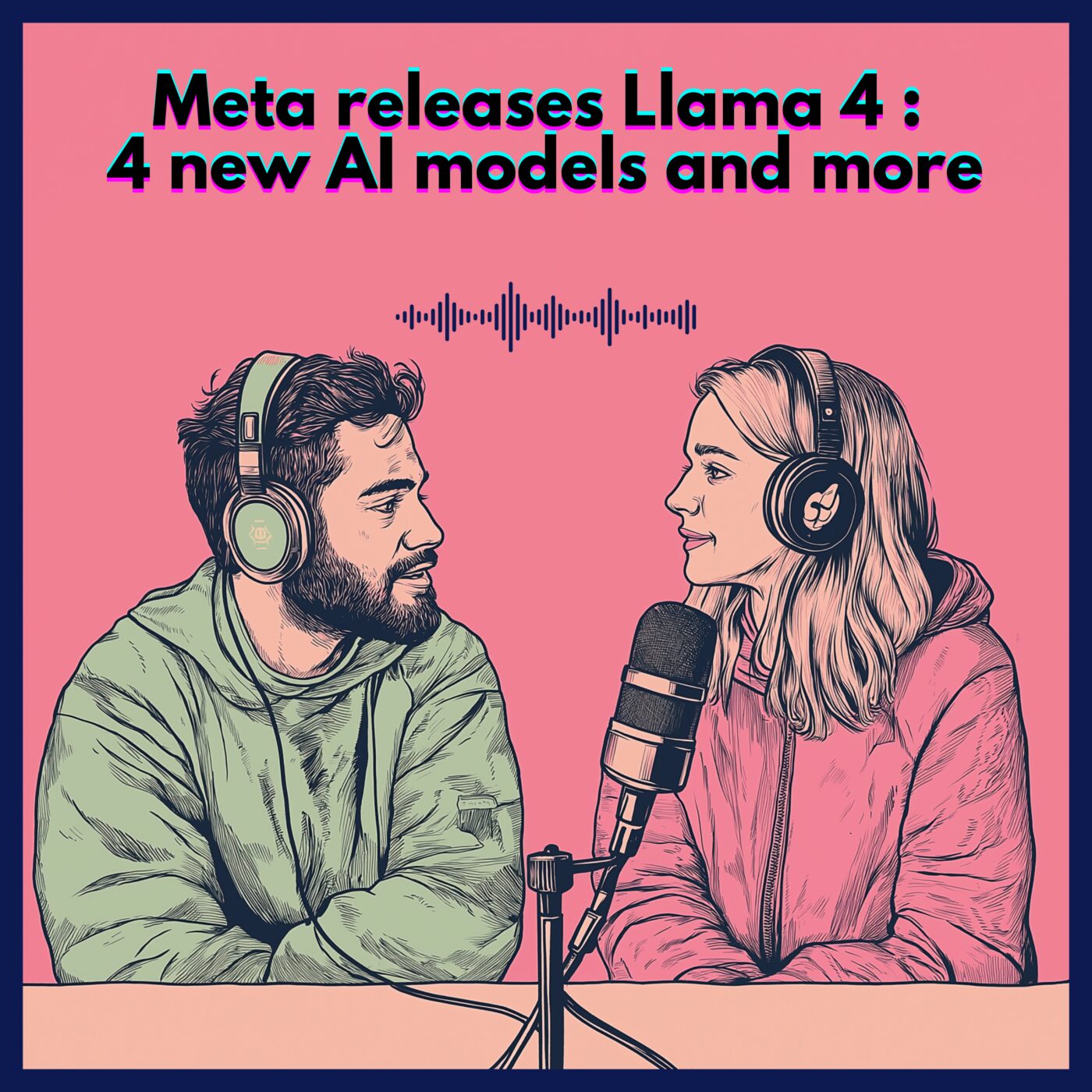 #58. Meta releases llama 4 : 4 models and more | How do you keep up with the ever-evolving world of technology, particularly in AI, when there's an overwhelming amount of information out there? That's the question we pose to you, our listeners. In this episode, we aim to cut through the noise and bring you the most significant developments in AI without bogging you down with excessive details. Today, we focus on a groundbreaking release from Meta: the Llama 4 family of AI models, a major leap forward in open-source AI technology.Our guest for this episode is not a single individual but a collective of insights from various sources. We've gathered perspectives from Meta's announcements, analyses from tech giants like Databricks and Microsoft Azure, and insights from platforms like TechCrunch and YouTube experts such as Matthew Berman and Mervyn Prazen. This diverse mix of viewpoints provides a comprehensive understanding of the significance of Llama 4 and its implications for the future of AI.The episode delves into the details of the Llama 4 models, including Scout, Maverick, and Behemoth, each with unique strengths and capabilities. These models are designed to be natively multimodal, handling text, images, and potentially other data types with ease. The discussion highlights the innovative mixture of experts (MoE) architecture, which enhances efficiency by utilizing specialized 'expert brains' for different tasks. With impressive features like a 10 million token context window and multilingual support, these models promise to revolutionize AI applications across various industries. We explore the potential for new AI-powered applications and encourage listeners to consider the vast possibilities these advancements might unlock.🚀 Major AI Development: Llama 4 ReleaseMeta has introduced the Llama 4 family of AI models, marking a significant advancement in open-source AI. These models, named Scout, Maverick, and Behemoth, are designed to be natively multimodal, handling text and images seamlessly from the start. This release underscores the growing importance of open-source models in the AI landscape.🧠 Mixture of Experts ArchitectureThe Llama 4 models utilize a "mixture of experts" (MoE) architecture, which enhances efficiency by using specialized expert brains for specific tasks. This approach allows the models to efficiently process information without wasting computational resources, making them highly effective in various applications.🔍 Llama 4 Scout: Unprecedented Context WindowLlama 4 Scout features a groundbreaking 10 million token context window, enabling it to understand and process vast amounts of information in context. This capability allows for more coherent conversations, detailed analysis of large documents, and a deeper understanding of complex interactions.🌐 Llama 4 Maverick: Multimodal and Multilingual PowerhouseMaverick excels in both image and text understanding and supports 12 languages. With 400 billion total parameters, it outperforms other leading models like GPT-4 and Gemini 2.0 Flash, offering strong performance in reasoning and coding tasks while maintaining efficiency.🐘 Llama 4 Behemoth: The Giant in TrainingBehemoth, with 288 billion active parameters and nearly 2 trillion total parameters, is still in training but already surpasses top models like GPT 4.5 in STEM-focused benchmarks. It serves as a teacher model for Scout and Maverick, highlighting its vast potential and future impact.🔗 Native Multimodality and Early FusionThe models integrate text, images, and video as a continuous data stream from the start, enhancing their ability to learn relationships between different data types. This holistic approach, combined with improved vision encoding technology, boosts the models' multimodal capabilities.🌍 Extensive Language Support and Efficient TrainingThe Llama 4 family was trained on a dataset of 200 languages, significantly expanding its multilingual capabilities. Using techniques like FP8 Precision and IRO PE, Meta has optimized the training process, ensuring high performance and efficiency in handling long context lengths.☁️ Cloud Accessibility and Practical DeploymentWhile running large models like Maverick and Behemoth locally requires significant computational power, cloud platforms like AWS, Azure, and Databricks make these models accessible to a wider audience. Meta is also integrating Llama 4 into its products, expanding its reach and applicability.🔮 Future AI ApplicationsWith advancements in context window size and native multimodality, new AI-powered applications are on the horizon. Developers and businesses are encouraged to explore these models on platforms like Hugging Face, as the potential for innovation and industry impact is immense.0:00:00 - Introduction and Overview0:00:22 - Purpose of the Podcast0:00:46 - Introduction to Llama 4 by Meta0:01:84 - Different Llama 4 Models0:02:64 - Mixture of Experts (MOE) Architecture0:03:192 - Llama 4 Scout Model: Parameters and Capabilities0:07:422 - Availability of Llama 4 Scout0:08:491 - Llama 4 Maverick Model: Parameters and Capabilities0:11:662 - Llama 4 Behemoth Model: Parameters and Capabilities0:12:762 - Native Multimodality Approach and Technical Innovations0:15:905 - Practical Use and Model Accessibility0:16:973 - Recap and Conclusion: Impact and Future ApplicationsThis episode is brought to you by Patrick DE CARVALHO and the production studio "Je ne perds jamais." Let's speak AI and explore the future together.https://www.linkedin.com/in/patrickdecarvalho/Distributed by Audiomeans. Visit audiomeans.fr/politique-de-confidentialite for more information. Hosted on Acast. See acast.com/privacy for more information. | — | ||||||
Showing 25 of 82
Pitch Fit is a Pro feature
See how bookable this show is for guests, which brands already advertise, the per-episode ad value, and the best-fit guest and sponsor profile. The numbers are blurred on the free plan.
How readily this show books outside guests like you.
How proven this show is for host-read sponsorships.
For Guests
ProFor Advertisers
ProUpgrade to Pro to unlock guest cadence, sponsor categories, fit scores, and per-episode ad value for this show.