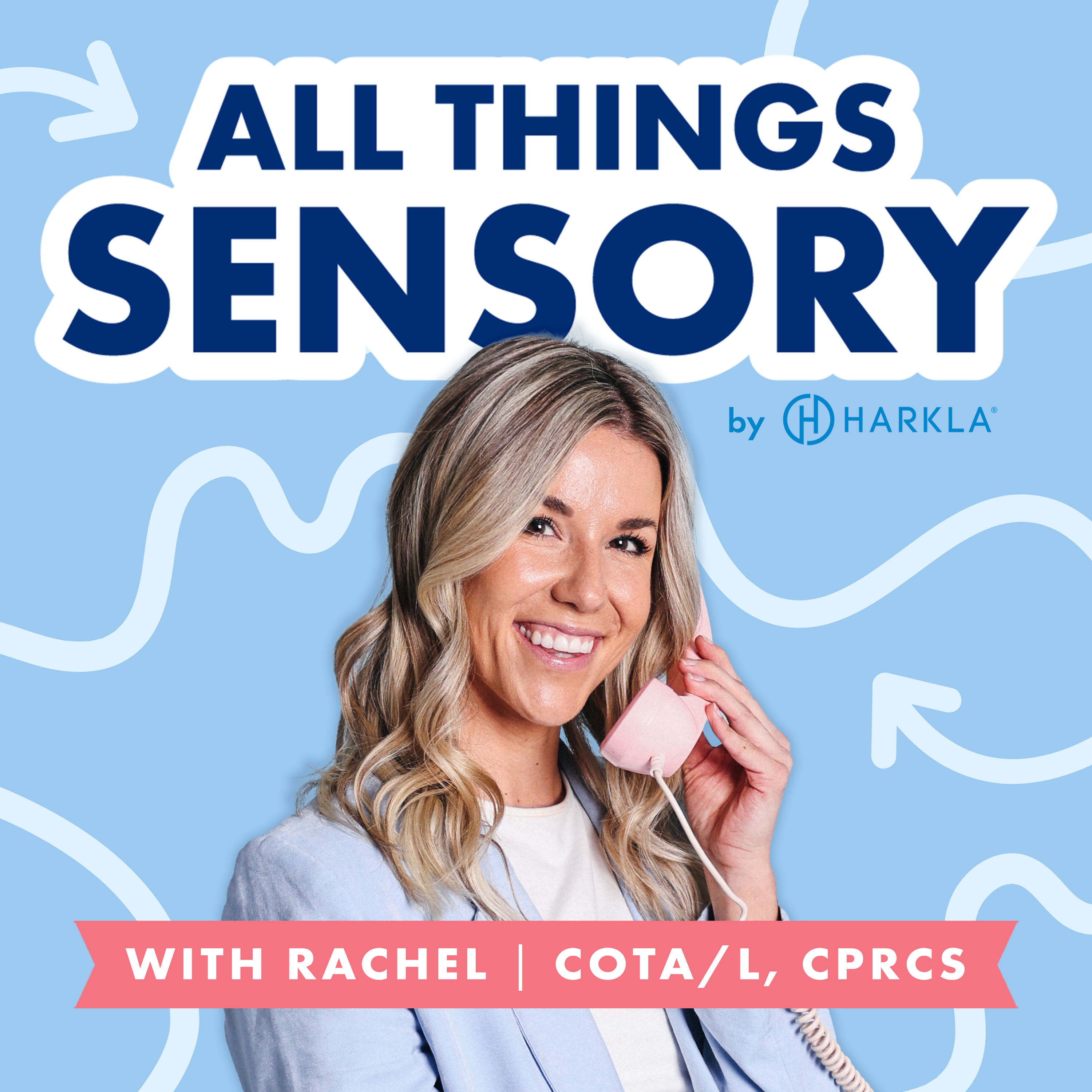
All Things Sensory by Harkla
Rachel Harrington, COTA/L, CPRCS is a passionate pediatric therapy practitioner who answers your questions related to all things sensory, occupational therapy, parenting, self-care, nutrition, and health, from a therapis...
Insights from recent episode analysis
On the show
- Dr. Tessa Grigg1 ep
- Amanda1 ep
- Kristin1 ep
Also: Maureen
Audience Interest
Podcast Focus
Publishing Consistency
Insights are generated by CastFox AI using publicly available data, episode content, and proprietary models.
Most discussed topics
Brands & references
Total monthly reach
Based on 1 signal.
Built from
By chart position
- 🇧🇷Brazil · Kids & Family#160347 to 1.8K
- 🇨🇱CL · Kids & Family#11660 to 318
- Per-Episode Audience
Est. listeners per new episode within ~30 days
407 to 2.2K🎙 Biweekly cadence·427 episodes·Last published 1w ago - Monthly Reach
Unique listeners across all episodes (30 days)
581 to 3.1K🇺🇸71%🇧🇷24%🇨🇱4% - Active Followers
Loyal subscribers who consistently listen
232 to 1.2K
Market Insights
Platform Distribution
Reach across major podcast platforms, updated hourly
Total Followers
—
Total Plays
—
Total Reviews
—
* Data sourced directly from platform APIs and aggregated hourly across all major podcast directories.
| Date | Episode | Topics | Guests | Brands | Places | Keywords | Sponsor | Length | |
|---|---|---|---|---|---|---|---|---|---|
| 10/13/26 | #422 - OTs Have Sensory Needs, Too: How to Support Yours | I spend so much time thinking about what my clients and my own kiddos need. More movement? Less noise? A sensory break? But sometimes the person who needs those supports is me. And knowing all the regulation strategies doesn’t mean I always remember to use them myself.In this episode, I’m turning the attention back to our own nervous systems. I talk about recognizing sensory overload, finding strategies that work for you, and building them into your day before you’re completely overwhelmed. For my fellow OT practitioners, that includes taking a closer look at our therapeutic use of self. How we connect, respond, and support co-regulation matters just as much as the tools we bring into a session. This is exactly why I wrote Grounded: A Nervous System Regulation Guide for Overstimulated Parents. I’m sharing the experiences behind the book and how it brings together sensory strategies, movement, and practical daily routines. Whether you’re supporting clients, raising kids, or doing both, the goal isn’t to be calm every second. It’s to understand your own needs and have tools to come back to when things feel like too much. Thanks for listening 🩷 Share this with a fellow practitioner who spends their day supporting everyone else and could use a reminder that their nervous system matters, too.LinksSPD MONTH GIVEAWAY‼️Win Over $3,000 in Sensory Support! 💙 Click below to enter!https://harkla.co/pages/spd-month-giveaway Pre-order Grounded and explore the preorder bonuseshttp://sensationalbrain.com/landing/grounded/ We’d love to answer your questions on the podcast! Fill out this form - https://harkla.typeform.com/to/ItWxQNP3 All Things Sensory Podcast Instagram https://www.instagram.com/allthingssensorypodcast/ Harkla Website https://harkla.co/ Harkla YouTubehttps://www.youtube.com/c/HarklaFamily Harkla Instagramhttps://www.instagram.com/harkla_family/ Harkla Digital Courseshttps://harkla.co/collections/courses | 19m 06s | ||||||
| 9/29/26 | #421 - Sensory Processing Disorder Explained | In honor of Sensory Processing Disorder Awareness Month, I’m going back to the basics and diving into one of my all-time favorite topics: sensory processing.In this episode, we’re talking about sensory modulation, over- and under-responsiveness, sensory craving, and all eight sensory systems. We’ll also look at how sensory differences can show up during everyday occupations like dressing, eating, toileting, learning, play, and transitions.But I don’t want to stop at understanding sensory processing, I want to talk about how we can actually support it in practice. We’ll get into proactive sensory input, movement, heavy work, sensory spaces, and helping our clients build awareness of what their own bodies need.One of my biggest reminders for therapists: instead of immediately asking, “How do I stop this behavior?” Let's get curious and ask, “What is their nervous system trying to tell me?”Whether you’re newer to pediatric OT or just need a good sensory processing refresher, this episode will help you get back to the basics and think about sensory needs through a practical OT lens. This is also a great episode to share with families if they need help understanding sensory processing more!Thanks for being here 🩷 If this episode sparked a clinical lightbulb moment, come find me at @allthingssensorypodcast and tell me what you’re noticing in your practice. LinksWe’d love to answer your questions on the podcast! Fill out this form - https://harkla.typeform.com/to/ItWxQNP3 Episode #368 - Ocular Motor Skillshttps://open.spotify.com/episode/6yGQpQ6r0NbOsOGIK2N0DEEpisode #372 - Crawling & Ocular Motor Skillshttps://open.spotify.com/episode/2zf5VSTe0fxfmP6cFzTrG5 Episode #225 - ADHD Tips, Tricks & Infohttps://open.spotify.com/episode/0qv4CsQGAXHaPaANCKNZWjEpisode #34 - What is Auditory Processing Disorder?https://open.spotify.com/episode/1M48a9mEy0IVU4bB6iJvGR Episode #367 - Auditory Processing vs Attention Issueshttps://open.spotify.com/episode/4KKYDlcOaHLonM8oagThpuSensory Preferences Checklisthttps://cdn.shopify.com/s/files/1/1380/9417/files/Copy_of_Mod_3_5_Child_Sensory_Preferences.pdf?v=1729447315 | 38m 23s | ||||||
| 8/14/26 | podcast updatehomeschooling+3 | — | My Weighted VestHarkla+2 | — | podcast updatehomeschooling+3 | — | 5m 19s | ||
| 8/5/26 | occupational therapyevidence-based practice+4 | Dr. Tessa Grigg | — | — | occupational therapyresearch articles+8 | — | 23m 15s | ||
| 7/22/26 | school-based occupational therapyIEPs+4 | Amanda | Sensory Strategies for the Classroom CourseClassroom Sensory Kits+3 | — | occupational therapyIEP meetings+4 | — | 24m 55s | ||
| 7/15/26 | Fear Paralysis Reflexchild development+4 | — | — | — | Fear Paralysis Reflexprimitive reflexes+6 | — | 18m 33s | ||
| 7/8/26 | therapy environmentoccupational therapy+4 | — | Force of Nature Cleaning ProductsHarkla | — | therapy spaceoccupational therapy+5 | — | 18m 37s | ||
| 7/1/26 | screens in classroomsearly education+3 | — | Harkla | — | screenspreschool+5 | — | 23m 41s | ||
| 6/24/26 | primitive reflex integrationgoal writing+5 | — | Harkla | — | primitive reflexesgoal writing+8 | — | 13m 40s | ||
| 6/17/26 | occupational therapyburnout+4 | — | HarklaOT+1 | — | occupational therapyburnout+5 | — | 21m 56s | ||
Want analysis for the episodes below?Free for Pro Submit a request, we'll have your selected episodes analyzed within an hour. Free, at no cost to you, for Pro users. | |||||||||
| 6/10/26 | primitive reflexesCOVID-19 impact+5 | — | Harkla | — | primitive reflexesCOVID-19+5 | — | 25m 35s | ||
| 6/3/26 | infant feedinglactation support+5 | KristinMaureen | Real Food for PregnancyWild Milk Co.+2 | — | lactationbreastfeeding+5 | — | 1h 04m 50s | ||
| 5/27/26 | #410 - Understanding Pediatric Pelvic Floor Health and Potty Training Struggles | If potty training, constipation, accidents, or stool withholding feel way harder than they should, you are not alone. In this episode, we’re talking about pediatric pelvic floor health and why many toileting struggles are actually connected to body awareness, sensory processing, nervous system regulation, and coordination.Amanda shares her perspective as an OT specializing in pediatric pelvic floor health, while Rachel brings in the sensory and regulation lens. Together, we break down why kids who struggle with toileting are not being lazy, stubborn, or defiant, and why pressure and shame often make things worse.We also talk about common signs a child may need extra support, how stress and dysregulation impact the body, and practical strategies families can use at home to make toileting feel safer and more manageable.This episode is all about helping parents better understand what’s happening beneath the surface and reminding families that their child is not broken and they are not failing.Thanks for listening 🩷 If this episode made you feel less alone, share it with another parent navigating toileting struggles right now.LINKSWe’d love to answer your questions on the podcast! Fill out this form - https://harkla.typeform.com/to/ItWxQNP3 Amanda’s Potty Training Resources https://stan.store/yourpediatricOT All Things Sensory Podcast Instagram https://www.instagram.com/allthingssensorypodcast/ Harkla Website https://harkla.co/ Harkla YouTubehttps://www.youtube.com/c/HarklaFamily Harkla Instagramhttps://www.instagram.com/harkla_family/ Harkla Digital Courseshttps://harkla.co/collections/courses | 29m 25s | ||||||
| 5/20/26 | #409 - Using Vibration Plates With Kids: Benefits, Risks & Safety | Vibration plates are everywhere right now, but how do you actually use them safely and effectively with kids? In this episode, I’m diving into one of my favorite tools and sharing how I use vibration plates in therapy, what the research is saying, and what families and therapists need to know before trying one at home.I talk about how vibration plates work, why they were originally developed, and why they can be such a powerful tool for sensory regulation, body awareness, muscle activation, and reflex integration. I also share some of the biggest safety considerations, including when to avoid using vibration plates, what signs to watch for during sessions, and why “low and slow” is always the best place to start.Throughout the episode, I walk through practical ways I incorporate vibration plates into therapy sessions using functional activities instead of just having kids stand on them. From balance work and yoga flows to games, primitive reflex activities, and sensory integration exercises, I share ideas that make this tool purposeful and engaging.I also discuss what current research is showing around toe walking, constipation, cerebral palsy, and sensory regulation, along with how I decide whether a vibration plate might be helpful for a child at home versus something better used in a clinical setting.This episode is designed to help you feel more informed, more confident, and more thoughtful about using vibration plates with kids in a way that supports the nervous system safely and intentionally.Thanks for listening 🩷If you’ve ever used a vibration plate with your child or in therapy, I’d love to hear about your experience!LINKSWe’d love to answer your questions on the podcast! Fill out this form - https://harkla.typeform.com/to/ItWxQNP3 LifePro Vibration Plateshttps://lifeprofitness.com/collections/vibration-therapy Therapeutic Use of Vibration Plates Webinarhttps://sensationalbrain.com/product/vibration-plates-pediatric-occupational-therapy/ All Things Sensory Podcast Instagram https://www.instagram.com/allthingssensorypodcast/ Harkla Website https://harkla.co/ Harkla YouTubehttps://www.youtube.com/c/HarklaFamily Harkla Instagramhttps://www.instagram.com/harkla_family/ Harkla Digital Courseshttps://harkla.co/collections/courses | 15m 31s | ||||||
| 5/13/26 | #408 - Proprioception: What It Is and Why It Matters | If your child is constantly crashing into things, squeezing you a little too tight, or always on the move, there’s a good chance they're seeking out proprioceptive input. In this episode, we’re breaking down one of the most important (and often overlooked) sensory systems and why it can feel like a “secret tool” when it comes to regulation.We talk about what proprioception actually is, how it helps with body awareness, and why so many kids need more of this type of input throughout their day. You’ll hear why this system is unique compared to other sensory systems and how it can actually help calm and organize the nervous system, especially during moments of overwhelm or anxiety.We also walk through what it can look like when a child is under-responsive in this system, from big, obvious movements like crashing and jumping to more subtle signs like leaning, slouching, or using too much force when playing or writing. We also touch on how this can show up differently from child to child and why it’s not always easy to spot.Throughout the episode, we share simple ways to start using proprioceptive input as a tool, both for your kids and for yourself. From squeezing, pushing, and pulling, to everyday activities like chewing, exercising, or even leaning against a wall, these strategies can make a big difference in helping the nervous system feel more grounded and regulated.This episode is all about helping you better understand what your child’s body might be asking for and giving you a few simple ways to start supporting it in a practical, realistic way.Thanks for listening 🩷 If this episode helped you understand your child a little better, share it with someone who might be navigating similar sensory needs.LINKSWe’d love to answer your questions on the podcast! Fill out this form - https://harkla.typeform.com/to/ItWxQNP3 All Things Sensory Podcast Instagram https://www.instagram.com/allthingssensorypodcast/ Harkla Website https://harkla.co/ Harkla YouTubehttps://www.youtube.com/c/HarklaFamily Harkla Instagramhttps://www.instagram.com/harkla_family/ Harkla Digital Courseshttps://harkla.co/collections/courses | 20m 16s | ||||||
| 5/6/26 | #407 - Why I Took My Daughter to a Developmental Eye Doctor (Part 1) | In this episode, I’m sharing a very real, very personal story about my daughter and what led me to take her to a developmental optometrist. As both a COTA and a mom, I always tell families “when in doubt, rule it out,” and this was one of those moments where I had to take my own advice.I walk through what I started noticing at home, from how she was positioning her head while writing, to her difficulty with attention during fine motor tasks, to hesitations with sports and play. At first, it was easy to brush some of it off as personality or age, but the patterns kept showing up.I share what our appointment actually looked like, what they were assessing, and the moment that really clicked for me when the doctor showed me what she might be seeing on a daily basis. It was one of those experiences where everything suddenly made more sense.I also talk about the difference between visual acuity and how the eyes actually function together. Just because a child can “see” doesn’t mean their visual system is working efficiently. That was a big takeaway for me and something I think more families need to understand.This episode is really about awareness. Ocular motor skills, accommodation, and visual processing play such a huge role in things like attention, behavior, reading, and overall development, and they’re often overlooked or mistaken for something else.I also share how to know who to go to if you’re noticing similar concerns, what a developmental optometrist actually does, and why this can be such an important piece of the puzzle.This is just the beginning of our journey, and I’ll continue to share updates as we learn more, especially if we move into vision therapy.Thanks for listening 🩷 If this made you think about your own child’s vision in a new way, share it with someone who might need to hear this too.LINKSWe’d love to answer your questions on the podcast! Fill out this form - https://harkla.typeform.com/to/ItWxQNP3 All Things Sensory Episode #75 The Power of Vision Therapy with Dr. Ryan Johnsonhttps://harkla.co/blogs/podcast/75-the-power-of-vision-therapyBest Part Multivitaminhttps://bestpartkids.com/ All Things Sensory Podcast Instagram https://www.instagram.com/allthingssensorypodcast/ Harkla Website https://harkla.co/ Harkla YouTubehttps://www.youtube.com/c/HarklaFamily Harkla Instagramhttps://www.instagram.com/harkla_family/ Harkla Digital Courseshttps://harkla.co/collections/courses | 16m 17s | ||||||
| 4/29/26 | #406 - Why Your Child Needs MORE Movement Before Bed (Sleep Tips for Sensory Seekers) | If your child seems to get a burst of energy right before bed, asks for one more hug, one more drink, or one more lap around the house, it can feel confusing and exhausting. In this episode, we’re breaking down what might really be going on, especially for kids who are sensory seekers.We talk about what it means to have a high sensory threshold and why some kids need more movement, pressure, and input throughout the day to feel regulated. For many of these kids, bedtime isn’t a behavior issue. It’s a nervous system that hasn’t met its sensory needs yet.As the day winds down and the environment gets quieter, their bodies may actually feel more dysregulated, not less. We walk through why this happens, including challenges with body awareness, recognizing tired cues, and the difference between being overtired and under-regulated.We also share some of the most common mistakes we see at bedtime, like expecting kids to go from high energy to completely calm, removing movement too early, or relying on screens to help them wind down.Most importantly, we talk about what actually helps. From adding heavy work before bed, to using deep pressure and creating a predictable wind-down routine, to giving your child a small “top-off” of sensory input right before sleep. These strategies are simple, practical, and designed to work with your child’s nervous system instead of against it.We also touch on when sleep struggles might be connected to something more, like medical or regulation-related challenges, and when it might be helpful to seek additional support.If bedtime has been a struggle in your home, this episode is here to help you understand your child in a new way and give you a few simple things to try this week.Thanks for listening 🩷 If this episode gave you a new perspective on bedtime, share it with a parent who’s in the thick of it right now.We’d love to answer your questions on the podcast! Fill out this form - https://harkla.typeform.com/to/ItWxQNP3 Calming Music Amanda Mentionshttps://www.youtube.com/watchBest Part Multivitaminhttps://bestpartkids.com/ Enter the Autism Acceptance Month Giveaway & Shop Our Sale!https://harkla.co/ All Things Sensory Podcast Instagram https://www.instagram.com/allthingssensorypodcast/ Harkla Website https://harkla.co/ Harkla YouTubehttps://www.youtube.com/c/HarklaFamily Harkla Instagramhttps://www.instagram.com/harkla_family/ Harkla Digital Courseshttps://harkla.co/collections/courses | 23m 54s | ||||||
| 4/22/26 | #405 - ADHD in Women: My Diagnosis Journey as a Mom & Pediatric Therapist | In today’s episode, I’m sharing something a little more personal. This conversation is all about ADHD in women and moms, why it’s so often missed, and what it can actually feel like in real life.For so many of us, ADHD doesn’t look like what we're taught to expect. It’s not always the hyper, can’t-sit-still version we picture in young boys. For women, it often shows up as mental overload, constant overwhelm, emotional ups and downs, and feeling like we just can’t keep up no matter how hard we try. It gets labeled as anxiety, disorganization, or just being “too much,” and we carry that for years without realizing there might be more going on.I share my own journey of starting to question things, what I experienced growing up versus now as a mom, and how masking, perfectionism, and overcompensating played a role in how I showed up. There were moments of relief, validation, and honestly a lot of emotion that came with finally understanding my brain in a different way.I’ll also talk about how ADHD can show up in motherhood. The mental load, the constant juggling, the time blindness, the sensory overwhelm, and the emotional regulation challenges that can feel so intense. Motherhood has a way of bringing all of that to the surface in a way that’s hard to ignore.But this episode isn’t just about the challenges. It’s also about reframing ADHD through a different lens. I talk about the strengths I now recognize in myself, like creativity, problem-solving, empathy, and the ability to hyperfocus. Letting go of unrealistic expectations and the “shoulds” has been a huge part of that process.I also get into what support can actually look like. Things like creating systems that work for your brain, externalizing tasks instead of trying to hold everything mentally, using sensory strategies to regulate, and giving yourself permission to ask for help without guilt.If you’ve ever wondered, “Is this me?” I want you to know that it’s okay to explore that question. You’re not broken, and you’re not failing. Understanding your brain can open the door to so much more compassion and support.Thanks for listening 🩷 If this episode made you feel seen, share it with another mom who might need to hear this too.LINKSWe’d love to answer your questions on the podcast! Fill out this form - https://harkla.typeform.com/to/ItWxQNP3 #233 ADHD in Adults with Dr. Ashleyhttps://harkla.co/blogs/podcast/233-adhd-in-adults-with-dr-ashley-houchin-clinical-psychologist#275 - Alternative Strategies for ADHD with Dr. Davidhttps://harkla.co/blogs/podcast/275-alternative-strategies-for-adhd-with-dr-david-nowell Best Part Multivitaminhttps://bestpartkids.com/ Enter the Autism Acceptance Month Giveaway & Shop Our Sale!https://harkla.co/ All Things Sensory Podcast Instagram https://www.instagram.com/allthingssensorypodcast/ Harkla Website https://harkla.co/ Harkla YouTubehttps://www.youtube.com/c/HarklaFamily Harkla Instagramhttps://www.instagram.com/harkla_family/ Harkla Digital Courseshttps://harkla.co/collections/courses | 23m 22s | ||||||
| 4/15/26 | #404 - Should Schools Take Away Recess? Why It Can Backfire | Recess is often the first thing to go when kids are struggling at school. But what if taking it away is actually making things worse?In this episode, we break down why recess is not a reward and should never be used as a punishment. From a sensory and nervous system perspective, movement is one of the most important tools kids have to regulate, focus, and learn throughout the day.We talk about what a typical school day looks like today and how different it is from previous generations. Many kids are spending hours sitting, working on computers, and getting very little movement. For some students, recess may be the only time all day they have the opportunity to run, play, socialize, and reset their nervous system.This episode walks through what’s actually happening in the brain and body during recess, including the role of movement, social play, emotional regulation, stress reduction, and even digestion. We also discuss why the kids who “struggle the most” are often the ones who need recess the most, and how removing it can create a cycle of more dysregulation, more behavior challenges, and more frustration for everyone involved.We’ll also share practical ways to think differently about discipline and motivation in the classroom, along with simple strategies that support regulation without removing movement. From adding movement into the school day to advocating for your child through an IEP or 504 plan, this conversation is all about supporting kids in a way that actually works.Thanks for listening 🩷 If this episode resonated, share it with a teacher, parent, or school team member who cares about supporting kids in a more effective way.We’d love to answer your questions on the podcast! Fill out this form - https://harkla.typeform.com/to/ItWxQNP3 Best Part Multivitaminhttps://bestpartkids.com/ Shop our OT Month Sale!https://harkla.co/pages/ot-month-saleEnter the Autism Acceptance Month Giveaway!https://harkla.co/All Things Sensory Podcast Instagram https://www.instagram.com/allthingssensorypodcast/ Harkla Website https://harkla.co/ Harkla YouTubehttps://www.youtube.com/c/HarklaFamily Harkla Instagramhttps://www.instagram.com/harkla_family/ Harkla Digital Courseshttps://harkla.co/collections/courses | 23m 14s | ||||||
| 4/8/26 | #403 - Reacting to Parenting Advice I Hear All the Time (Through a Sensory Lens) | There are a few phrases I hear over and over again from parents, usually right after they’ve tried everything and nothing worked. If you’ve ever been told things like “they just need more discipline” or “they’ll grow out of it,” this episode is for you.In this episode, I share my perspective as a certified occupational therapy assistant and primitive reflex clinical specialist, reacting to common parenting advice I hear all the time. This isn’t about calling that advice wrong. It’s about understanding what might be missing when we don’t consider a child’s sensory system and nervous system.I’ll walk through familiar phrases like “ignore it and it’ll stop,” “they just need to get used to it,” and “all kids need the same routines,” and explain why these approaches can sometimes fall short. I share how behavior is often rooted in regulation, how sensory needs shape a child’s response to everyday situations, and why the same strategy can work for one child and completely backfire for another.Throughout the episode, you’ll hear practical reframes that help shift from reacting to behavior to understanding what the nervous system actually needs. I also share how I filter parenting advice as a COTA, including the questions I ask before recommending any strategy and why trusting what you’re seeing in your own child matters more than following one-size-fits-all advice.This conversation is a reminder that most parenting advice isn’t wrong, it’s just incomplete. When you start looking at your child through a sensory lens, things begin to make a lot more sense.Thanks for listening 🩷 If this episode made you feel a little more confident in trusting your instincts, share it with someone who’s been second-guessing their parenting lately.LINKSWe’d love to answer your questions on the podcast! Fill out this form - https://harkla.typeform.com/to/ItWxQNP3 Shop our OT Month Sale!https://harkla.co/pages/ot-month-saleEnter the Autism Acceptance Month Giveaway!https://harkla.co/All Things Sensory Podcast Instagram https://www.instagram.com/allthingssensorypodcast/ Harkla Website https://harkla.co/ Harkla YouTubehttps://www.youtube.com/c/HarklaFamily Harkla Instagramhttps://www.instagram.com/harkla_family/ Harkla Digital Courseshttps://harkla.co/collections/courses | 19m 23s | ||||||
| 4/1/26 | #402 - What Is Sensory Integration? Understanding How the Brain Processes the World | Have you ever wondered why your child seems “fine” all day at school… and then completely falls apart at home? In this episode, we’re breaking down what’s really going on through a sensory lens.We walk through what sensory integration actually means in everyday life, how the brain receives, organizes, and responds to sensory input, and why this process can look very different from child to child. We talk about the difference between being over-responsive, under-responsive, and sensory seeking, and how each of those patterns can show up in behavior, emotions, and daily routines.You’ll also hear a clear, practical explanation of all eight sensory systems, including the three “hidden” senses (vestibular, proprioception, and interoception) that play a huge role in regulation, body awareness, and emotional responses.One of the most important takeaways from this episode is understanding how sensory input builds up throughout the day. Many kids are holding it together in structured environments like school, but by the time they get home, their nervous system is overwhelmed, which is why after-school meltdowns are so common.We also talk about how to tell the difference between sensory quirks and sensory challenges that are actually impacting daily life, why behavior is often communication, and how small, proactive strategies throughout the day can make a big difference in preventing dysregulation later on.This episode is all about helping you see your child and yourself through a new lens, so you can better understand what’s really driving behavior and how to support regulation in a more intentional way.Thanks for listening 🩷 If this episode gave you a new perspective, share it with someone who’s navigating after-school meltdowns or trying to better understand sensory processing.LINKSWe’d love to answer your questions on the podcast! Fill out this form - https://harkla.typeform.com/to/ItWxQNP3 Sensory Preferences Checklisthttps://cdn.shopify.com/s/files/1/1380/9417/files/Copy_of_Mod_3_5_Child_Sensory_Preferences.pdf?v=1729447315Shop our OT Month Sale!https://harkla.co/pages/ot-month-saleEnter the Autism Acceptance Month Giveaway!https://harkla.co/pages/aam-giveaway All Things Sensory Podcast Instagram https://www.instagram.com/allthingssensorypodcast/ Harkla Website https://harkla.co/ Harkla YouTubehttps://www.youtube.com/c/HarklaFamily Harkla Instagramhttps://www.instagram.com/harkla_family/ Harkla Digital Courseshttps://harkla.co/collections/courses | 36m 24s | ||||||
| 3/25/26 | #401 - What Therapists Wish More Pediatricians Talked About | In this episode, I share some honest reflections on pediatrician visits - what’s working, what could be improved, and what families truly need more of in those early appointments. This isn’t about criticizing pediatricians, but about opening up the conversation and advocating for better support for babies, kids, and their families.I walk through common phrases like “wait and see” or “they’ll grow out of it,” and why those approaches can sometimes delay important support. I'll also share my personal experience navigating torticollis with my son, feeding, and development and highlight how early intervention, referrals, and education can make a significant difference.I also share what I wish pediatric visits included more of - like education on tummy time, crawling, primitive reflexes, messy play, nutrition, lactation support, and trusted referrals to specialists like OT, PT, and lactation consultants.This episode is ultimately about empowering parents to ask questions, trust their instincts, and advocate for the support their child needs.Thanks for listening 🩷 If this episode resonated, share it with a new or expecting parent who’s navigating those early pediatrician visits.LINKSWhat To Ask Your Doctor Checklisthttps://cdn.shopify.com/s/files/1/1380/9417/files/WhatToAskYourDoctor_Checklist__EP_145_Freebie_1.pdf We’d love to answer your questions on the podcast! Fill out this form - https://harkla.typeform.com/to/ItWxQNP3 All Things Sensory Podcast Instagram https://www.instagram.com/allthingssensorypodcast/ Harkla Website https://harkla.co/ Harkla YouTubehttps://www.youtube.com/c/HarklaFamily Harkla Instagramhttps://www.instagram.com/harkla_family/ Harkla Digital Courseshttps://harkla.co/collections/courses | 15m 45s | ||||||
| 3/18/26 | #400 - Should Kindergartners Be Potty Trained Before School? What a New Kansas Bill Could Mean for Families | There has been growing conversation around proposed legislation that would require children to be toilet trained before enrolling in kindergarten. In this episode, we take a thoughtful look at what these policies mean from a developmental and occupational therapy perspective.We talk about what the proposed Kansas bill would require, how states like Utah already define “toilet trained,” and the gray area that can exist for children who may not yet have an official diagnosis but are still struggling with toileting for medical, sensory, or developmental reasons.Throughout the conversation, we discuss the many factors that can affect toileting development in young children, including pelvic floor dysfunction, constipation, encopresis, sensory processing differences, interoception challenges, anxiety, and major life changes that can lead to regression. We also look at the real-world challenges schools face when supporting young students and why toileting independence can’t always be viewed as a simple behavior or discipline issue.This episode is not about debating policy. Instead, it’s about understanding child development, recognizing how complex toileting readiness can be, and considering how families, schools, and healthcare professionals can better support kids who are still developing these skills.Thanks for listening 🩷If this conversation resonated with you, share it with a parent, teacher, or therapist navigating potty training or school readiness.LINKSWe’d love to answer your questions on the podcast! Fill out this form - https://harkla.typeform.com/to/ItWxQNP3 Read more about the Kansas bill:https://kansasreflector.com/2026/02/02/kansas-bill-would-require-kindergarteners-to-be-potty-trained-before-starting-school/ All Things Sensory Podcast Instagram https://www.instagram.com/allthingssensorypodcast/ Harkla Website https://harkla.co/ Harkla YouTubehttps://www.youtube.com/c/HarklaFamily Harkla Instagramhttps://www.instagram.com/harkla_family/ Harkla Digital Courseshttps://harkla.co/collections/courses | 23m 36s | ||||||
| 1/28/26 | #397 - The Best Nutrients to Support Sensory Processing in Kids | Can supplements actually support kids with sensory processing challenges? In this episode, we take a research-based look at supplements commonly recommended for sensory processing disorder and neurodivergent individuals. We talk honestly about what science does (and doesn’t) say.In this episode, you’ll learn:What sensory processing disorder is and how it impacts daily lifeWhy supplements are becoming more common in the sensory worldWhich nutrients show the most promise in current researchWhy quality, testing, and sourcing of supplements really matterHow to safely explore supplements without overwhelming your childThanks for listening 🩷 If this episode got you thinking, share it with a parent or therapist navigating sensory supports.LINKSWe’d love to answer your questions on the podcast! Fill out this form - https://harkla.typeform.com/to/ItWxQNP3 Article Referenced in Episode:https://sfihealth.com/news/can-supplements-help-children-with-sensory-processing-difficultiesSPD Info: 10 Facts About Sensory Processing Disorderhttps://harkla.co/blogs/podcast/277-10-facts-about-sensory-processing-disorderWhat is Sensory Processing Disorder?https://www.youtube.com/watch?v=2fE476Zlyio Navigating SPD Digital Coursehttps://harkla.co/products/navigating-sensory-processing-disorder Research:Mineral-Vitamin Treatment Linked to Sustained Remission of ADHD Symptomshttps://www.liebertpub.com/doi/10.1089/cap.2019.0036Potential Role of L-Carnitine in Autism Spectrum Disorderhttps://www.mdpi.com/2077-0383/10/6/1202Phosphatidylserine's effect on memory and ADHD symptomshttps://pubmed.ncbi.nlm.nih.gov/23495677/Association of feeding/mealtime behavior issues with internalizing/externalizing problems in children with autismhttps://pubmed.ncbi.nlm.nih.gov/30761818/Sensory processing patterns in children with ASD and ADHDhttps://mecp.springeropen.com/articles/10.1186/s43045-024-00441-6Get More Content:All Things Sensory Podcast Instagram https://www.instagram.com/allthingssensorypodcast/ Harkla Website https://harkla.co/ Harkla YouTubehttps://www.youtube.com/c/HarklaFamily Harkla Instagramhttps://www.instagram.com/harkla_family/ Harkla Digital Courseshttps://harkla.co/collections/courses | 21m 33s | ||||||
| 1/21/26 | #396 - Top Three Primitive Reflex Exercises for Emotional Regulation in the Classroom | What if movement was built into the school day instead of saved for recess? In this episode, we’re talking about how retained primitive reflexes can impact emotional regulation in the classroom and sharing three simple, powerful activities teachers can use with the entire class.In this episode, you’ll learn:What primitive reflexes are and why they matter for learning and behaviorHow retained reflexes can show up as anxiety, dysregulation, or inattentionThe connection between the Moro, STNR, and ATNR and emotional regulationThree easy, classroom-friendly movements to support regulation and focusHow short, consistent movement breaks can change the feel of the entire classroomThanks for listening 🩷 If you’re a teacher or therapist, try one of these movements with your group and tell us what you notice.LINKSWe’d love to answer your questions on the podcast! Fill out this form - https://harkla.typeform.com/to/ItWxQNP3 All Things Sensory Podcast Instagram https://www.instagram.com/allthingssensorypodcast/ Harkla Website https://harkla.co/ Harkla YouTubehttps://www.youtube.com/c/HarklaFamily Harkla Instagramhttps://www.instagram.com/harkla_family/ Harkla Digital Courseshttps://harkla.co/collections/courses | 14m 52s | ||||||
Showing 25 of 427
Pitch Fit is a Pro feature
See how bookable this show is for guests, which brands already advertise, the per-episode ad value, and the best-fit guest and sponsor profile. The numbers are blurred on the free plan.
How readily this show books outside guests like you.
How proven this show is for host-read sponsorships.
For Guests
ProFor Advertisers
ProUpgrade to Pro to unlock guest cadence, sponsor categories, fit scores, and per-episode ad value for this show.
Similar Audience Demographics
Podcasts that attract a similar listener profile

Born to Be Free: Supporting Neurodivergent Clients to Learn, Play, & Thrive
Meg Ferrell

Full-Tilt Parenting: Strategies, Insights, and Connection for Parents Raising Neurodivergent Children
Debbie Reber

Good Inside with Dr. Becky
Good Inside
Neurodiversity Podcast
Emily Kircher-Morris

The Baffling Behavior Show {Parenting after Trauma}
Robyn Gobbel

At Peace Parents Podcast
Casey

Shining With ADHD by The Childhood Collective
The Childhood Collective
Chart history for All Things Sensory by Harkla
Peaked at #116 in CL, currently #116 in CL.
| Market | Genre | Peak | Current | Trend |
|---|---|---|---|---|
| CL | — | #116 | #116 | — |
| Brazil | — | #160 | #160 | — |
Chart Positions
2 placements across 2 markets.
Chart Positions
2 placements across 2 markets.