
Insights from recent episode analysis
Audience Interest
Podcast Focus
Publishing Consistency
Platform Reach
Insights are generated by CastFox AI using publicly available data, episode content, and proprietary models.
Total monthly reach
Estimated from 7 chart positions in 7 markets.
By chart position
- 🇺🇸US · Design#18300K to 1M
- 🇨🇦CA · Design#21100K to 300K
- 🇬🇧GB · Design#1885K to 30K
- 🇰🇷KR · Design#1361K to 10K
- 🇦🇪AE · Design#112500 to 3K
- Per-Episode Audience
Est. listeners per new episode within ~30 days
122K to 405K🎙 Daily cadence·63 episodes·Last published 2d ago - Monthly Reach
Unique listeners across all episodes (30 days)
408K to 1.3M🇺🇸74%🇨🇦22%🇬🇧2%+4 more - Active Followers
Loyal subscribers who consistently listen
163K to 540K
Market Insights
Platform Distribution
Reach across major podcast platforms, updated hourly
Total Followers
—
Total Plays
—
Total Reviews
—
* Data sourced directly from platform APIs and aggregated hourly across all major podcast directories.
On the show
Recent episodes
071 - ADA Door Clearance: Why These Dimensions Exist
Jun 22, 2026
Unknown duration
070 - Seismic Irregularities: Soft Story to Shear Walls
Jun 8, 2026
Unknown duration
069 - Sealant Types, Backer Rod, and Joint Design for Buildings
Jun 1, 2026
Unknown duration
068 - Project Delivery Methods: DBB, Design-Build, CMAR, and More
May 26, 2026
Unknown duration
067 - Types of Insulation: Materials, R-Values, and Assemblies
May 22, 2026
Unknown duration
Social Links & Contact
Official channels & resources
Official Website
Login
RSS Feed
Login
| Date | Episode | Description | Length | ||||||
|---|---|---|---|---|---|---|---|---|---|
| 6/22/26 |  071 - ADA Door Clearance: Why These Dimensions Exist | ADA door clearance requires 32 inches minimum, but a 32-inch door won't get you there. Learn why 36-inch doors became the standard and what every ADA dimension is actually solving. In this episode, Emily spent an entire day in a wheelchair during college and came back with a completely different understanding of accessible design. She walks you through how people actually move through buildings, from doors to ramps to corridors, and explains the human problem behind every ADA requirement. You'll learn door clear width, the 5-pound opening force rule, why pull-side maneuvering clearance is larger, and how the Capitol Crawl changed everything. Beyond doors, this episode covers ADA ramp slopes and the 1:20 threshold that triggers handrail requirements, the guardrail vs handrail distinction that contractors get wrong constantly, the 60-inch turning diameter (not radius), protruding objects and cane detection, and reach ranges for operable controls. 📝 Key topics covered: ADA door clearance: 32-inch clear width and why 36-inch doors are standard Door opening force: the 5-pound rule for interior doors Guardrail vs handrail: 42 inches for falls, 34-38 inches for grip ADA ramp slope: the 1:12 rule and the 1:20 ramp trigger Protruding objects: the 27-80 inch cane detection danger zone Reach ranges: 15-48 inches for operable controls ⏱️ Chapters: (0:00) What Is ADA? (1:57) Free Study Notes (2:45) ADA Door Clear Width (6:06) ADA Door Opening Force (7:37) ADA Door Maneuvering Clearance (10:27) ADA History: The Capitol Crawl (11:59) ADA vs Building Code (13:50) When ADA Applies (15:11) ADA: Designing for Every Body (19:11) ADA Accessible Route (21:12) ADA Ramp Slope: The 1:12 Rule (23:39) Guardrail vs Handrail (26:42) ADA Turning Diameter (29:21) ADA Protruding Objects (32:09) ADA Reach Range Requirements (34:20) ADA Elevator Requirements (35:38) ADA Quick Reference (38:16) ADA Bathroom Layout Preview 📖 Read the full blog post 📝 Download the FREE ADA Door Clearance study notes 🎯 Get access to all ARE study materials with the ARE 101 Membership 🎯 Join our 10-week ARE Boot Camp 📚 Individual ARE Exam Courses: Building Codes 101 PA 101 (Programming and Analysis) PPD 101 (Project Planning and Design) PDD 101 (Construction Documents and Specs) CE 101 (Construction and Evaluation) PcM 101 (Practice Management) PjM 101 (Project Management) AIA Contracts 101 Mechanical Systems 101 | — | ||||||
| 6/8/26 |  070 - Seismic Irregularities: Soft Story to Shear Walls | Soft story buildings are one of the most dangerous structural conditions in seismic design, and the 1994 Northridge earthquake proved why. In this episode, we break down the seismic irregularities that cause buildings to fail during earthquakes. You will learn the difference between a soft story and a weak story, how geometric and mass irregularities create dangerous force concentrations, and why a broken load path is the most dangerous irregularity of all. We also cover re-entrant corners, torsional irregularity, rigid vs flexible diaphragms, and how collectors and drag struts keep the lateral load path connected. Then we walk through the exam strategy: red flags to watch for, common fixes including moment frames, braced frames, and seismic joints, and the one principle NCARB keeps coming back to. Eliminate the irregularity entirely rather than engineering around it. 📝 Key topics covered: Soft story buildings and the 1994 Northridge earthquake Soft story vs weak story: bending vs breaking Building drift and the 70% stiffness threshold Vertical geometric irregularity and building setbacks Mass irregularity and heavy mechanical floors Continuous load path: roof to diaphragm to shear walls to foundation In-plane discontinuity vs out-of-plane offset Collectors and drag struts Rigid vs flexible diaphragms Re-entrant corners in L-shaped and T-shaped buildings Torsional irregularity: center of mass vs center of rigidity Moment frames vs braced frames ARE exam red flags for seismic irregularities ⏱️ Chapters: 0:00) Soft Story Buildings and Northridge (1:40) Study Notes (3:26) Soft Story vs Weak Story (6:36) Geometric and Mass Irregularities (8:54) Load Path and Shear Wall Discontinuities (13:17) Re-Entrant Corners and Torsion (15:50) Seismic Irregularities on the ARE (18:32) Seismic Design Key Takeaways 📖 Read the full blog post and grab free study notes: Soft Story Building: Seismic Irregularities Explained 📝 Free study notes for this episode: youngarchitect.com/seismic 🎯 ARE 101 Membership (access all courses) 🎯 ARE Boot Camp (10-week coaching program) 📚 Individual ARE Exam Courses: PPD 101 (Project Planning and Design) PDD 101 (Construction Documents and Specs) Building Codes 101 PA 101 (Programming and Analysis) CE 101 (Construction and Evaluation) Mechanical Systems 101 PcM 101 (Practice Management) PjM 101 (Project Management) AIA Contracts 101 CDT 101 (Construction Documents Technologist) CCCA 101 (Construction Contract Administration) | — | ||||||
| 6/1/26 |  069 - Sealant Types, Backer Rod, and Joint Design for Buildings | Which sealant goes where on the building envelope? This episode covers every sealant type, backer rod, and how to design joints that actually work. We break down the five main sealant families: silicone, polyurethane, polysulfide, acrylic, and MS polymer. Each one has a personality, a best use, and a catch. You'll learn why silicone can't be painted, why polyurethane hates UV, why polysulfide smells like rotten eggs, and when MS polymer gives you the best of both worlds. Then we get into joint design, because even the best sealant fails if the joint is wrong. We cover backer rod (open cell vs. closed cell), the width-to-depth ratio that makes or breaks a sealant joint, tooling, and the number one joint design failure: three-sided adhesion. 📝 Key topics covered: Silicone sealant: acetoxy vs. neutral cure and when each one matters Polyurethane sealant for concrete expansion joints and window perimeters How backer rod controls depth and prevents three-sided adhesion The hourglass profile and why sealant joint geometry matters Adhesion failure vs. cohesion failure: two ways sealants break Sealant vs. caulk: what's the actual difference ⏱️ Chapters: (0:00) Why Sealants Matter Most (0:50) Free ARE Study Notes (1:22) Sealant vs. Caulk (2:26) Sealant Movement and Failure Modes (4:33) John Hancock Tower Sealant Failure (5:35) Silicone Sealant: The Diva (8:22) Polyurethane Sealant: The Workhorse (10:17) Polysulfide Sealant: The Hazmat Suit (11:39) Acrylic Sealant: The Weekend Warrior (12:45) MS Polymer Sealant: The Hybrid (13:48) Sealant Selection Cheat Sheet (14:26) Butyl and Acoustical Sealant (15:36) How to Design a Sealant Joint (15:57) Backer Rod (17:43) Sealant Joint Width and Depth (20:00) Three-Sided Adhesion (21:11) Sealant Speed Round (22:32) NCARB Exam Connections (23:27) Sealant Recap (24:44) Young Architect Academy 📖 Read the full blog post 📝 Download the FREE Sealant study notes 🎯 Get access to all ARE study materials with the ARE 101 Membership 🎯 Join our 10-week ARE Boot Camp 📚 Individual courses: PDD 101 (Construction Documents and Specs) PPD 101 (Project Planning and Design) Building Codes 101 CDT 101 (Construction Documents Technologist) | — | ||||||
| 5/26/26 |  068 - Project Delivery Methods: DBB, Design-Build, CMAR, and More | Project delivery methods define who holds the contracts, who carries the risk, and how the architect's role changes on every construction project. This episode breaks down all six major methods so you know exactly how each one works. Emily walks through Design-Bid-Build, Design-Build, Construction Manager at Risk (CMAR), Construction Manager as Agent (CMa), Multiple Prime, and Integrated Project Delivery (IPD). You'll learn why the architect works for the owner in some methods and for the contractor in others, what a GMP contract actually does, and how to match the right delivery method to a project scenario on the ARE. This topic shows up on three different ARE exams and the CDT exam. If you invest the time to learn it now, it pays off on every exam you take. 📝 Key topics covered: Design-bid-build: the traditional sequential method Design-build: one team, one contract, architect works for the contractor CMAR and GMP contracts: how the CM shifts from advisor to constructor CM at risk vs CM as agent: who holds the subcontracts Fast-tracking: a scheduling technique, not a delivery method Progressive design-build, design assist, and bridging ⏱️ Chapters: (0:00) What Are Project Delivery Methods (2:48) How Delivery Methods Hit the ARE (4:39) Design-Bid-Build Explained (6:16) DBB Pros and Cons (7:22) Who Holds the Risk in DBB (8:24) Design-Build Explained (9:36) Architect's Role in Design-Build (10:18) Fast-Tracking in Design-Build (12:33) DB Pros and Cons (13:32) Progressive Design-Build (14:11) Design Assist and Bridging (16:03) Construction Manager at Risk (16:55) What Is a GMP Contract (17:38) CMAR Phase Shift Explained (19:54) CMAR Pros and Cons (22:05) CM at Risk vs CM as Agent (23:11) Construction Manager as Agent (27:44) Multiple Prime Contracts (30:28) Integrated Project Delivery (IPD) (33:18) How to Choose a Delivery Method (36:12) ARE Study Resources 📖 Read the full blog post 📝 Download the FREE Project Delivery Methods study notes 🎯 Get access to all ARE study materials with the ARE 101 Membership 🎯 Join our 10-week ARE Boot Camp 📚 Individual courses: PcM 101 (Practice Management) PjM 101 (Project Management) CE 101 (Construction and Evaluation) AIA Contracts 101 CDT 101 (Construction Documents Technologist) | — | ||||||
| 5/22/26 |  067 - Types of Insulation: Materials, R-Values, and Assemblies | Types of insulation explained, from fiberglass batts to spray foam to rigid board to continuous insulation. This episode covers every major insulation type you need to know for the ARE exam and real-world practice. You'll learn how heat transfer works through buildings, then walk through each material one by one. Fiberglass vs mineral wool, open cell vs closed cell spray foam, EPS vs XPS vs polyiso, and why continuous insulation is the only way to solve thermal bridging. Every section connects back to how these materials behave in real wall assemblies, not just what their R-value is on a spec sheet. 📝 Key topics covered: Fiberglass insulation vs mineral wool insulation Open cell vs closed cell spray foam EPS vs XPS vs polyiso rigid board insulation Continuous insulation and thermal bridging Blown-in insulation and dense pack cellulose How insulation choice affects vapor management ⏱️ Chapters: (0:00) Introduction (1:48) Free Study Notes (3:07) How Heat Transfer Works (6:49) Fiberglass and Mineral Wool Batts (9:51) Blown-In Insulation (12:25) Spray Foam: Open vs Closed Cell (15.28) Rigid Board Insulation (17:58) Continuous Insulation (20:51) SIPs, ICFs, Radiant Barriers (22:54) Vapor Barriers and Insulation (24:15) Common Insulation Exam Traps (26:08) ARE Study Materials (27:14) Wrap Up 📖 Read the full blog post and grab free study notes: Types of Insulation: Materials, R-Values, and Assemblies 📝 Free 2-page insulation study notes: youngarchitect.com/insulation 🎯 ARE 101 Membership (access all ARE courses) 🎯 ARE Boot Camp (10-week coaching program) 📚 Individual courses: PPD 101 (Project Planning and Design) PDD 101 (Construction Documents and Specs) Building Codes 101 Mechanical Systems 101 CDT 101 (Construction Documents Technologist) PA 101 (Programming and Analysis) CE 101 (Construction and Evaluation) PcM 101 (Practice Management) PjM 101 (Project Management) AIA Contracts 101 | — | ||||||
| 5/18/26 |  066 - Types of HVAC Systems and How to Choose | There are a lot of different types of HVAC systems, and if you're studying for the ARE or coordinating with mechanical engineers, you need to know what each one does and when to use it. In this episode, Layla breaks down every major HVAC system type into four categories: all-air, water-based, refrigerant-based, and packaged systems. She covers VAV, fan coil units, VRF, rooftop units, PTACs, radiant floor heating, chilled beams, DOAS, split systems, and more. Then she walks through how to match each system to different building types, which is exactly how the PPD and PDD exams test this material. If mechanical system questions have been tripping you up, this one's for you. 📝 Key Topics Covered: VAV systems: the workhorse of commercial office buildings Fan coil units: individual room control for hotels and apartments VRF systems: flexible refrigerant-based zoning for mid-rise and retrofit projects Rooftop units and PTACs: simple packaged systems for retail and hotels Radiant floor heating: when forced air can't reach the occupants DOAS: why ventilation gets its own dedicated system Matching HVAC systems to building types for the ARE ⏱️ Chapters: (0:00) Introduction (2:32) How to Think About HVAC (4:17) All-Air Systems (7:47) Water-Based Systems (10:32) Packaged and Refrigerant Systems (13:13) Matching Systems to Buildings (18:22) Wrap Up 📖 Read the full blog post with diagrams and a building-type matching table: Types of HVAC Systems and How to Choose 📝 Download the free HVAC study notes: Free HVAC Study Notes 🎯 Join ARE Boot Camp, our 10-week coaching program: ARE Boot Camp 📚 Get access to all ARE courses with the ARE 101 Membership: ARE 101 Membership Individual ARE and CSI Exam Courses: Mechanical Systems 101 PPD 101 (Project Planning and Design) PDD 101 (Construction Documents and Specs) Building Codes 101 CDT 101 (Construction Documents Technologist) CCCA 101 (Construction Contract Administration) PcM 101 (Practice Management) PjM 101 (Project Management) CE 101 (Construction and Evaluation) PA 101 (Programming and Analysis) AIA Contracts 101 | — | ||||||
| 5/11/26 |  065 - How to Study for the Architect Exam - Trailer | How to study for the architect exam is the one topic I know more about than anything else. This episode is a trailer for a free 30-minute video presentation covering what actually works and how not to screw it up. I put this presentation together for an NCARB licensing advisor event, and it turned out so well that I decided to release it as a free resource on our website. It includes detailed slides that walk you through the architect exam prep strategies I've seen work over and over again with real candidates, based on 10+ years of coaching through the ARE Boot Camp. This isn't a regular Architect Exam Podcast episode. The full presentation is a video designed to be watched, not just listened to, which is why it lives on our website instead of in your podcast feed. 📝 Key topics covered in the full presentation: Why getting your architecture license is the most important project of your career The two phases of the ARE and why exam order matters Why NCARB's objectives are your only study roadmap How to use textbooks (and why video courses alone aren't enough) Realistic expectations: 700 to 1,300 hours and 3 years on average The mindset shift that separates people who finish from people who quit 📖 Watch the full free presentation or visit YoungArchitect.com/howtostudy 🎯 Get access to all ARE study materials with the ARE 101 Membership 🎯 Join our 10-week ARE Boot Camp | — | ||||||
| 5/4/26 |  064 - OFCI: Owner Furnished, Contractor Installed Simply Explained | OFCI (owner furnished, contractor installed) is one of those procurement methods that sounds simple until coordination breaks down on a real project. In this episode, Emily explains what OFCI means, how it compares to CFCI and OFOI, and why splitting the furnish-and-install responsibility creates real risks for owners, contractors, and architects. We walk through the most common OFCI items you'll see on construction projects, the coordination challenges that come with owner-furnished materials including quantity estimation errors, delivery timing, trade coordination, chain of custody, and warranty disputes. Then we break down exactly how OFCI gets documented in Division 01 specifications, individual spec sections, drawings, and contracts. If you're studying for the ARE or CDT exam, this episode covers procurement scenarios you need to understand for PcM, PjM, and CE. 📝 Key topics covered: What OFCI means and how "provide" equals furnish and install in AIA contracts OFCI vs CFCI vs OFOI procurement methods Why owners choose OFCI: cost savings, schedule, quality control, and tax benefits Common OFCI items on construction projects The 5 major OFCI risks: quantity estimation, delivery timing, trade coordination, liability and chain of custody, and warranty disputes How OFCI gets documented in Division 01, specs, drawings, and contracts OFCI scenarios on the PcM, PjM, CE, and CDT exams ⏱️ Chapters: (0:00) Introduction (3:01) What Is OFCI? (5:28) Why Owners Choose OFCI (9:19) Common OFCI Items (10:39) Risks and Coordination Challenges (17:06) How OFCI Gets Documented (20:00) OFCI on the ARE and CDT Exams (22:11) Wrap Up 📖 Read the full blog post: OFCI: Owner Furnished, Contractor Installed Simply Explained 📝 Download the FREE 2-page OFCI study guide: YoungArchitect.com/OFCI 🎯 Ready to pass the ARE? Get access to all our ARE Study Materials with the ARE 101 Membership 🎯 Join the ARE Boot Camp coaching program 📚 Individual Courses: PjM 101 (Project Management) CE 101 (Construction and Evaluation) PcM 101 (Practice Management) CDT 101 (Construction Documents Technologist) PDD 101 (Construction Documents and Specs) CCCA 101 (Construction Contract Administration) PA 101 (Programming and Analysis) PPD 101 (Project Planning and Design) Building Codes 101 Mechanical Systems 101 AIA Contracts 101 | — | ||||||
| 4/27/26 |  063 - The War of Art: Lessons for Exam Success | The War of Art by Steven Pressfield explains why you keep sabotaging your architect exam prep and how to stop. This episode is a war of art summary applied to the ARE, breaking down Resistance, self sabotage, and what it means to turn pro. If you've ever cleaned your refrigerator instead of studying, researched materials for weeks without opening one, or told yourself you'll schedule the exam "when you're ready," that's not laziness. Steven Pressfield calls it Resistance. I break down the five ways Resistance shows up for ARE candidates, the difference between discipline vs motivation, and the four principles that separate amateurs from professionals. 📝 Key Topics Covered: The War of Art summary and how Resistance works Self sabotage examples on the architect exam Perfectionism and procrastination as forms of Resistance Discipline vs motivation: why consistency beats intensity Fear of failure and fear of success Turning pro: four principles that change everything ⏱️ Chapters: (0:00) Introduction (2:15) Free Study Notes (2:46) The Book That Changed Everything (3:22) My Experience with The War of Art (6:06) What Is The War of Art? (7:18) Understanding Resistance (11:19) Turning Pro (16:25) The Bigger Picture (17:25) Call to Action (19:11) Wrap Up 📖 Read the full blog post 📕 Get The War of Art by Steven Pressfield 📝 Download the FREE Resistance study notes 🎯 Join our 10-week ARE Boot Camp 🎯 Get access to all ARE study materials with the ARE 101 Membership 📚 Individual ARE Exam Courses: PcM 101 (Practice Management) PjM 101 (Project Management) CE 101 (Construction and Evaluation) PA 101 (Programming and Analysis) PPD 101 (Project Planning and Design) PDD 101 (Project Development and Documentation) Building Codes 101 Mechanical Systems 101 AIA Contracts 101 | — | ||||||
| 4/20/26 |  062 - Fire Sprinkler Systems: Wet, Dry, Pre-Action, Deluge | Fire sprinkler systems explained: wet pipe, dry pipe, pre-action, and deluge. Learn when to use each one and how to choose the right system. Architects don't design fire sprinkler systems, but you make dozens of decisions that directly affect how they get designed, installed, and coordinated. This episode breaks down all four types of fire sprinkler systems, explains what makes each one different, and gives you a simple decision framework for choosing the right system based on occupancy, climate, and what's inside the space. We cover how wet pipe sprinkler systems work as your default starting point, when to switch to a dry pipe sprinkler system for freezing conditions, why pre-action sprinkler systems exist for museums and data centers, and when a deluge sprinkler system is the only option. We also get into the design coordination that lands on your drawings, including fire department connections, riser rooms, ceiling coordination, and sprinkler head types. This topic crosses PA, PPD, and PDD on the ARE, and understanding the decision framework will help you answer any fire sprinkler question the exam throws at you. 📝 Key topics covered: Wet pipe sprinkler system: how it works and where to use it Dry pipe sprinkler system: solving the freezing problem Pre-action sprinkler system: protecting sensitive contents Deluge sprinkler system: high-hazard flood response Fire department connection (FDC) placement and coordination Fire sprinkler head types: pendant, upright, sidewall, concealed Sprinkler system decision framework for the ARE Mixed systems in a single building NFPA 13 and the architect's coordination role Common sprinkler system mistakes on the exam ⏱️ Chapters: (0:00) Introduction (2:56) Wet Pipe Sprinkler Systems (5:26) Dry Pipe Sprinkler Systems (8:10) Pre-Action Sprinkler Systems (11:22) Deluge Sprinkler Systems (13:14) Choosing the Right System (15:48) Design Coordination (18:19) Quick-Fire Scenarios (20:03) Common Mistakes (21:16) Wrap Up 📖 Read the full blog post 📝 Download the FREE 2-page fire sprinkler systems study guide 🎯 Get access to all ARE study materials with the ARE 101 Membership 🎯 Join our 10-week ARE Boot Camp 📚 Individual ARE Exam Courses: PPD 101 (Project Planning and Design) PDD 101 (Construction Documents and Specs) Building Codes 101 PA 101 (Programming and Analysis) Mechanical Systems 101 CE 101 (Construction and Evaluation) CDT 101 (Construction Documents Technologist) CCCA 101 (Construction Contract Administration) PcM 101 (Practice Management) PjM 101 (Project Management) AIA Contracts 101 | — | ||||||
Want analysis for the episodes below?Free for Pro Submit a request, we'll have your selected episodes analyzed within an hour. Free, at no cost to you, for Pro users. | |||||||||
| 4/13/26 |  061 - Owner's Consultants: Know Where Your Liability Ends | Owner's consultants vs architect's consultants: know the difference before the ARE tests you on it. In this episode, we break down who hires who on a construction project, where the liability falls, and why getting this wrong can cost you your career. Every project has two teams of consultants. The architect's team designs what's going to be there. The owner's consultants deal with what's already there, the land, the soil, the surveys, the environmental hazards. That distinction sounds simple, but the liability implications run deep. We break down the existing versus proposed framework, the hard rules about never hiring a geotechnical engineer or surveyor as the architect, and the difference between basic coordination and supplemental coordination services. We also cover why "coordinate" and "manage" mean very different things in contract language, and how AIA B101 handles reasonable reliance on owner-provided information. 📝 Key Topics Covered: Owner's consultants vs architect's consultants The existing vs proposed framework for identifying consultant responsibility Why architects should never hire the geotech, surveyor, or hazmat consultant Basic coordination vs supplemental coordination The coordinate vs manage vocabulary distinction AIA B101 reasonable reliance on owner-provided information Professional liability insurance exclusions for ground conditions How this shows up on PcM, PjM, and CE exams ⏱️ Chapters: (0:00) Introduction (2:47) Two Types of Consultants (17:24) Owner's Responsibility for Existing Conditions (20:33) How This Shows Up on the Exam (22:41) Wrap-Up 📖 Read the full blog post and show notes: Owner's Consultants: Know Where Your Liability Ends 📝 Download the free study notes: Free Owner's Consultants Study Notes 🎯 ARE Boot Camp (10-Week Coaching Program) 🎯 ARE 101 Membership (All ARE Study Materials) 📚 Individual ARE Exam Courses: AIA Contracts 101 PcM 101 (Practice Management) PjM 101 (Project Management) CE 101 (Construction and Evaluation) PA 101 (Programming and Analysis) PPD 101 (Project Planning and Design) PDD 101 (Construction Documents and Specs) Building Codes 101 Mechanical Systems 101 CDT 101 (Construction Documents Technologist) CCCA 101 (Construction Contract Administration) | — | ||||||
| 4/6/26 |  060 - How to Become an Architect: What You Need to Know | How to become an architect in the US comes down to four steps: education, experience, exams, and fees. In this episode, Michael Riscica breaks down the full path to getting your architecture license, from choosing the right degree to passing all six ARE exams. Most people think architects sit at a drafting table sketching buildings all day. The reality is that design is maybe five to ten percent of the job. The rest is construction documents, code reviews, cost estimates, project management, and client meetings. We start with what architects actually do on a daily basis, then get into how long the whole process takes. We cover why architecture is a regulated profession, why not everyone who studies architecture needs to become licensed, and then walk through each of the four licensing steps in detail. 📝 Key topics covered: What architects actually do every day How long it takes to become a licensed architect Why you cannot legally call yourself an architect without a license The four requirements: education, experience, exams, and fees Why architecture degrees open doors beyond licensure The ARE exam process and what to expect ⏱️ Chapters: (0:00) Introduction (2:00) What Architects Actually Do (4:09) Is It Hard to Become an Architect (5:54) How Long Does It Take (10:41) Architecture Is a Regulated Profession (13:57) Architecture Is Bigger Than Buildings (16:34) 4 Steps to Getting Licensed (18:46) Wrap Up 📖 Read the full blog post: How to Become an Architect 📝 Download the FREE 2-page Podcast Notes: YoungArchitect.com/Architect 🎯 Get access to all our ARE Study Materials with the ARE 101 Membership 🎯 Join the ARE Boot Camp - Our 10-week coaching program with ongoing support until you pass all your exams. 📚 Individual ARE Exam Courses: PcM 101 (Practice Management) PjM 101 (Project Management) CE 101 (Construction and Evaluation) PA 101 (Programming and Analysis) PPD 101 (Project Planning and Design) PDD 101 (Project Development and Documentation) Building Codes 101 Mechanical Systems 101 AIA Contracts 101 | — | ||||||
| 3/23/26 |  059 - PA, PPD, and PDD: Know the Difference Before You Study | PA, PPD, and PDD share the same topics but test them from completely different perspectives. Understanding the difference between these three technical ARE exams before you start studying will save you serious time and frustration. In this episode, Layla breaks down what each exam actually covers, how they connect to each other, and why so many candidates study the wrong things for the wrong test. She walks through the "Define It, Design It, Document It" framework that shows how PA, PPD, and PDD follow the natural progression of a building project from pre-design through construction documents. Plus study strategies for the technical exams and a homework assignment to help you take this deeper. 📖 Key Topics Covered: Why candidates confuse PA, PPD, and PDD content The "Define It, Design It, Document It" framework How PA covers the pre-design and programming phase How PPD covers schematic design and system selection How PDD covers detailing, documentation, and specifications Where codes, site, and building systems overlap across all three The wall assembly test for sorting topics by exam Study strategies including exam sequencing and when to move on from PA ⏱️ Chapters: (0:00) Introduction (4:16) Why These Exams Are So Confusing (5:47) The Flip the Words Trick (7:01) One Project Three Phases (8:39) PA Programming and Analysis (11:44) PPD Project Planning and Design (13:59) PDD Project Development and Documentation (16:32) How They Flow Together (19:21) Study Strategy for the Technical Exams (22:55) Homework Assignment (24:05) Wrap Up 📝 Read the full blog post and grab free study notes: PA, PPD, and PDD: Know the Difference Before You Study 🎯 Download free study notes and the open book homework assignment: Free Study Notes and Homework 🎧 Companion episode: PcM, PjM, and CE: Know the Difference Before You Study 📚 ARE Boot Camp (10-week coaching program) 📚 ARE 101 Membership (all ARE study materials) 📚 Individual ARE Exam Courses: PA 101 (Programming and Analysis) PPD 101 (Project Planning and Design) PDD 101 (Project Development and Documentation) Building Codes 101 Mechanical Systems 101 PcM 101 (Practice Management) PjM 101 (Project Management) CE 101 (Construction and Evaluation) AIA Contracts 101 | — | ||||||
| 3/16/26 | 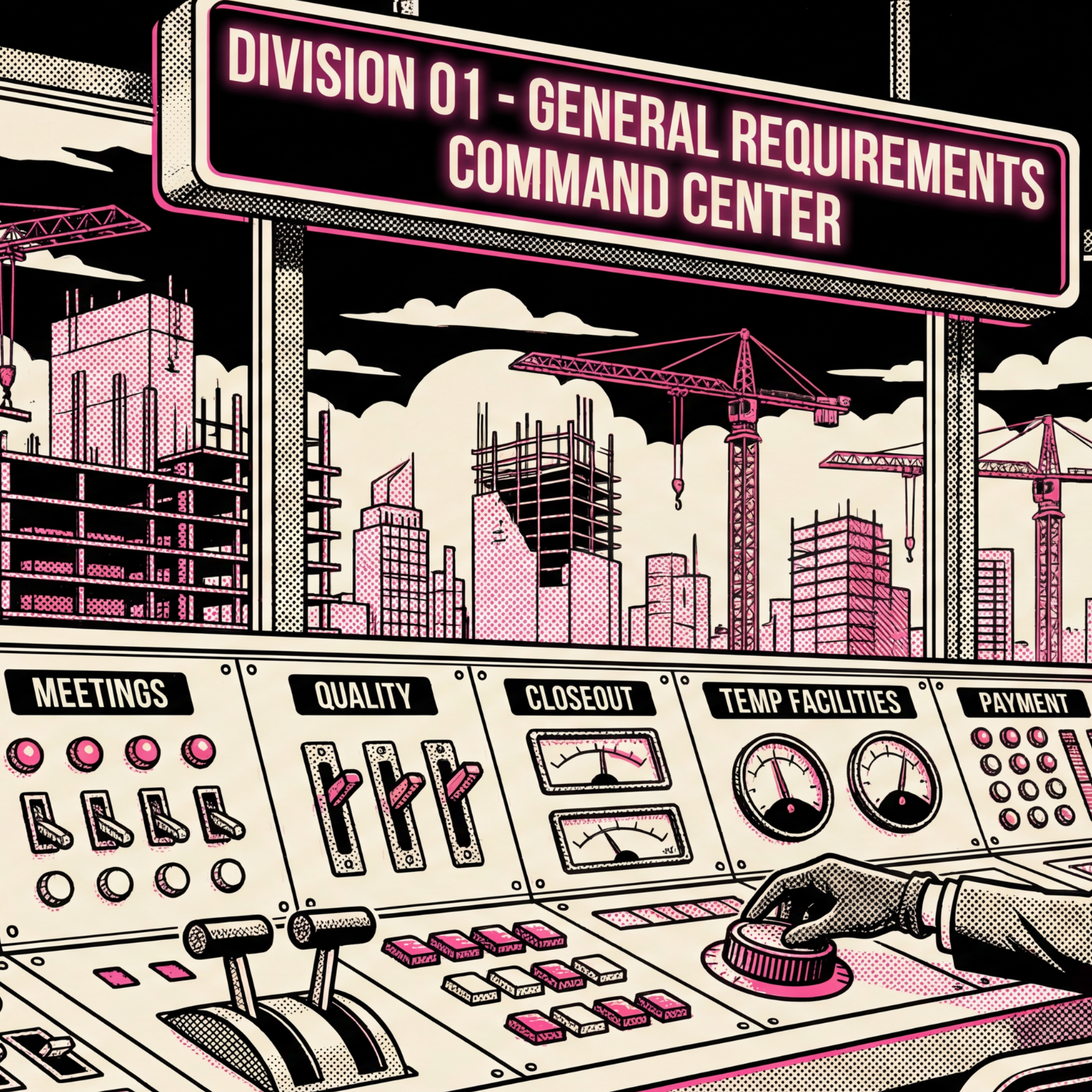 058 - Division 01 General Requirements: Running Your Project | Division 01 General Requirements is the most skipped section in the project manual. Here's what's actually inside and why every division depends on it. Division 01 is the rulebook that governs every trade on a construction project, and almost nobody reads it. We start by clearing up the number one confusion in specifications: the difference between General Conditions and General Requirements. They're both Contract Documents, but they do very different things. Then we walk through every major section from Summary (01 10 00) to Commissioning (01 91 00). Whether you're studying for the ARE, preparing for the CDT or CCCA, or just trying to write better specs, this episode gives you the full picture of why Division 01 is the global settings for your entire project. 📝 Key topics covered: General conditions vs general requirements: rights vs rules Price and payment procedures vs the actual agreement Submittal processes and administrative requirements Quality requirements, testing, and who pays for what Substitution procedures during bidding vs construction Execution, closeout, and commissioning in construction ⏱️ Chapters: (0:00) Introduction (1:22) Free Study Notes (2:20) What Are General Requirements? (4:38) General Conditions vs General Requirements (8:41) What's Inside Division 01? (18:56) Why Division 01 Matters (20:55) Wrap Up 📖 Read the full blog post 📝 Download the FREE 2-page Division 01 study guide 🎯 Get access to all ARE study materials with the ARE 101 Membership 🎯 Join our 10-week ARE Boot Camp 📚 Individual ARE Exam Courses: PDD 101 (Construction Documents and Specs) CDT 101 (Construction Documents Technologist) CCCA 101 (Construction Contract Administration) CE 101 (Construction and Evaluation) PjM 101 (Project Management) PcM 101 (Practice Management) PA 101 (Programming and Analysis) PPD 101 (Project Planning and Design) Building Codes 101 Mechanical Systems 101 AIA Contracts 101 | — | ||||||
| 3/9/26 |  057 - Plumbing Valves: Every Type You Need to Know | Plumbing valves explained - every type you need to know for the ARE exam and real-world practice. This episode covers gate valves, ball valves, butterfly valves, globe valves, check valves, backflow preventers, PRVs, pressure relief valves, angle valves, and float valves, organized by function so you understand what each one does. We break down the four categories every plumbing valve falls into: stop valves, regulating valves, one-way valves, and specialty valves. Each valve gets its own custom diagram showing how it works open and closed, plus a simple analogy to make it stick. Visit youngarchitect.com/valves to see all the diagrams and grab free study notes. 📝 Key topics covered: - Gate valve vs ball valve and when to use each - Butterfly valves for large-diameter piping - Globe valves and angle valves for flow control - Check valves vs backflow preventers - Pressure reducing valve (PRV) vs pressure relief valve - Float valves for automatic water level control - How plumbing valves appear on the PPD and PDD exams ⏱️ Chapters: 0:00 - Introduction 1:54 - Stop Valves 2:11 - Gate Valve 3:08 - Ball Valve 3:45 - Butterfly Valve 6:00 - Regulating Valves 6:35 - Globe Valve 7:37 - Angle Valve 8:31 - Pressure Reducing Valve (PRV) 9:53 - One-Way Valves 10:24 - Check Valve 11:01 - Backflow Preventer 12:31 - Specialty Valves 13:01 - Pressure Relief Valve 14:01 - Float Valve 14:51 - Come Study With Us 15:48 - ARE Study Tip 📖 Full Blog Post With Valve Diagrams: https://academy2.youngarchitect.com/plumbing-valves/ 📝 Free Plumbing Valves Study Notes: https://youngarchitect.com/valves 🎯 ARE Boot Camp - 10-week coaching program: https://youngarchitect.com/arebootcamp/ 📚 ARE 101 Membership - All ARE study materials: https://academy2.youngarchitect.com/are-study-materials/ Individual Courses: PPD 101 (Project Planning and Design): https://academy2.youngarchitect.com/are-project-planning-and-design/ PDD 101 (Construction Documents and Specs): https://academy2.youngarchitect.com/are-project-development-and-documentation/ Mechanical Systems 101: https://academy2.youngarchitect.com/are-mechanical-systems-101/ Building Codes 101: https://academy2.youngarchitect.com/are-building-codes-101/ CDT 101 (Construction Documents Technologist): https://academy2.youngarchitect.com/cdt-exam-prep/ CCCA 101 (Construction Contract Administration): https://academy2.youngarchitect.com/ccca-exam-prep/ PcM 101 (Practice Management): https://academy2.youngarchitect.com/are-practice-management/ PjM 101 (Project Management): https://academy2.youngarchitect.com/are-project-management/ CE 101 (Construction and Evaluation): https://academy2.youngarchitect.com/are-construction-and-evaluation/ PA 101 (Programming and Analysis): https://academy2.youngarchitect.com/programming-analysis-101-are-5-0-exam-prep/ AIA Contracts 101: https://academy2.youngarchitect.com/are-aia-contracts-101/ | — | ||||||
| 3/2/26 |  056 - Building Acoustics: How Sound Actually Works in Buildings | Building acoustics explained: STC, IIC, and NRC are the three rating systems every architect needs to know. This episode breaks down how sound actually works in buildings and what each rating measures. STC rates how well walls and floors block airborne sound. IIC rates how well floor assemblies block impact sounds. NRC measures how much sound a material absorbs within a room. We explain why a material can be great at absorbing sound but terrible at blocking it. You'll also learn why the IBC requires both STC 50 and IIC 50 between dwelling units, how to upgrade a basic wall assembly step by step, and the flanking paths and spec mistakes that compromise acoustic performance. 📝 Key topics covered: STC ratings: blocking airborne sound through walls IIC ratings: blocking impact sound through floors NRC ratings: absorbing sound within a room IBC Section 1207 requirements for dwelling units Wall assembly upgrades: mass, insulation, decoupling, and sealing Flanking paths and common acoustic spec mistakes ⏱️ Chapters: (0:00) Introduction (1:28) Free Study Guide (2:34) Why Sound Matters in Buildings (4:17) Decibels: Measuring Loudness (6:58) Hertz: Measuring Pitch (8:17) STC: Sound Transmission Class (16:07) IIC: Impact Insulation Class (20:34) NRC: Noise Reduction Coefficient (24:09) Bringing It All Together (26:31) Practical Tips and Scenarios (29:33) Acoustics Recap 📖 Read the full blog post 📝 Download the FREE 2-page Building Acoustics study guide 🎯 Get access to all ARE study materials with the ARE 101 Membership 🎯 Join our 10-week ARE Boot Camp 📚 Individual ARE Exam Courses: PPD 101 (Project Planning and Design) PDD 101 (Construction Documents and Specs) Building Codes 101 Mechanical Systems 101 CE 101 (Construction and Evaluation) PcM 101 (Practice Management) PjM 101 (Project Management) PA 101 (Programming and Analysis) AIA Contracts 101 | — | ||||||
| 2/23/26 |  055 - Control Joint vs Expansion Joint: Where the Cracks At? | Control joint vs expansion joint is one of those topics that trips people up because the terms sound so similar. This episode breaks down all four joint types you need to know for the ARE and the job site. We cover expansion joints, control joints, isolation joints, and construction joints. For each one, we explain what it does, where you'll see it in real construction, and how to remember the difference on exam day. We also give you the rebar test for telling isolation and construction joints apart, plus clear analogies so you're not just memorizing definitions. 📝 Key topics covered: Expansion joints and how they allow material movement Control joints and why you plan for cracks instead of preventing them Isolation joints and when complete separation is required Construction joints and how they relate to the work schedule The rebar test for telling isolation and construction joints apart Which ARE 5.0 divisions test each joint type ⏱️ Chapters: (0:00) Introduction (1:56) Free Study Guide (2:51) Expansion Joints (13:44) Isolation Joints (18:16) Control Joints (19:03) Construction Joints (24:13) Recapping Our Joints (27:35) Wrap Up 📖 Read the full blog post 📝 Download the FREE Joint Types study guide 🎯 Get access to all ARE study materials with the ARE 101 Membership 🎯 Join our 10-week ARE Boot Camp 📚 Individual ARE Exam Courses: PPD 101 (Project Planning and Design) PDD 101 (Construction Documents and Specs) CE 101 (Construction and Evaluation) PA 101 (Programming and Analysis) Building Codes 101 PcM 101 (Practice Management) PjM 101 (Project Management) Mechanical Systems 101 AIA Contracts 101 | — | ||||||
| 2/16/26 |  054 - PcM, PjM, and CE: Understanding the Difference Before You Study | PcM, PjM, and CE are three different exams, but most people study them without understanding what makes each one unique. This episode breaks down exactly what NCARB is testing on Practice Management, Project Management, and Construction and Evaluation so you can study smarter, not harder. Too many ARE candidates jump into prep materials without ever looking at what each exam actually focuses on, and that leads to wasted time and confusion. PcM zooms out to the firm level. It's about business operations, finances, risk, and how an architecture practice stays profitable. PjM zooms into one project. You've got a signed contract, a team, and a schedule to manage through the design phases. CE picks up after the documents are done and construction begins. It's about administering the construction contract and making sure what gets built matches what was designed. We also cover where these exams overlap (contracts, risk, insurance, quality control, and project delivery methods all show up on all three), and why that overlap is actually good news for your study plan. Plus, there's a free homework assignment that ties it all together. Download the free study notes and homework assignment: https://youngarchitect.com/understandingpropractice Chapters: 0:00 - Introduction 4:18 - Study Notes and We Need Your Help 5:21 - Why Start with the Pro Practice Exams? 6:30 - The Big Picture: What Ties These Three Exams Together 8:17 - PcM: Practice Management - Running the Firm 9:57 - PjM: Project Management - Managing the Project 12:13 - CE: Construction and Evaluation - On the Job Site 16:53 - How They Flow Together 18:06 - Study Strategy for the Pro Practice Exams 20:24 - Homework Assignment 21:41 - Conclusion Episode Resources: - Read the full blog post: https://academy2.youngarchitect.com/understanding-pcm-pjm-and-ce Ready to pass the ARE and become a licensed architect? Get access to all our ARE Study Materials with the ARE 101 Membership: https://academy2.youngarchitect.com/are-study-materials/ Individual ARE Exam Courses: - Practice Management (PcM 101): https://youngarchitect.com/PcM101 - Project Management (PjM 101): https://youngarchitect.com/PjM101 - Construction & Evaluation (CE 101): https://youngarchitect.com/CE101 - Programming & Analysis (PA 101): https://academy2.youngarchitect.com/programming-analysis-101-are-5-0-exam-prep/ - Project Planning & Design (PPD 101): https://academy2.youngarchitect.com/are-project-planning-and-design/ - Project Development & Documentation (PDD 101): https://academy2.youngarchitect.com/are-project-development-and-documentation/ - Building Codes 101: https://academy2.youngarchitect.com/are-building-codes-101/ - Mechanical Systems 101: https://academy2.youngarchitect.com/are-mechanical-systems-101/ - AIA Contracts 101: https://academy2.youngarchitect.com/are-aia-contracts-101/ - Join our 10-week ARE Boot Camp: https://youngarchitect.com/arebootcamp/ - Explore our CDT 101 course: https://academy2.youngarchitect.com/cdt-exam-prep/ - Pass the CCCA Certification with our course: https://academy2.youngarchitect.com/ccca-exam-prep/ Subscribe for weekly ARE exam prep content and join thousands of successful architects who've passed their exams with Young Architect! | — | ||||||
| 2/9/26 |  053 - Concrete Slab Types: A Guide to Structural Systems | Six concrete slab types explained with span ranges, load capacities, and the decision framework you need to pick the right system every single time. Every concrete slab question on the ARE comes down to two things: the shape of your bay and the loads it needs to carry. But with six different systems to choose from, it's easy to second-guess yourself when the clock is ticking. In this episode, we break down all six structural slab systems from one-way solid slabs to waffle slabs. You'll learn the span ranges for each, the load conditions that drive your selection, and the visual cues that show up in exam questions. We cover why bay geometry matters more than anything else, how to tell the difference between a one-way joist and a waffle slab, and what punching shear has to do with flat plates vs flat slabs. Key topics covered: - One-way vs two-way classification using the aspect ratio test - One-way solid slabs (6-18 ft) and one-way joist slabs (20-30 ft) - Two-way slab with beams for square bays (15-40 ft) - Flat plate vs flat slab: when drop panels matter - Waffle slabs for long spans and architectural expression (24-54 ft) - Formwork cost comparison across all six systems - A quick decision framework for exam day This content is especially relevant for the PPD and PDD divisions of the ARE 5.0. Chapters: 0:00 - Introduction 2:10 - One-Way vs Two-Way: The Shape Test 4:45 - One-Way Slab 6:02 - One-Way Joist Slab 7:56 - Two-Way Slab With Beams 9:28 - Two-Way Flat Plate 12:04 - Flat Slab With Drop Panels 14:56 - Waffle Slab 17:46 - Putting It All Together 19:26 - Wrap-Up Episode Resources: - Download the free 2-page study guide: https://youngarchitect.com/slabs Ready to pass the ARE and become a licensed architect? Get access to all our ARE Study Materials with the ARE 101 Membership: https://youngarchitect.com/ARE101 Individual ARE Exam Courses: - Practice Management (PcM 101): https://youngarchitect.com/PcM101 - Project Management (PjM 101): https://youngarchitect.com/PjM101 - Construction & Evaluation (CE 101): https://youngarchitect.com/CE101 - Programming & Analysis (PA 101): https://academy2.youngarchitect.com/programming-analysis-101-are-5-0-exam-prep/ - Project Planning & Design (PPD 101): https://academy2.youngarchitect.com/are-project-planning-and-design/ - Project Development & Documentation (PDD 101): https://academy2.youngarchitect.com/are-project-development-and-documentation/ - Building Codes 101: https://academy2.youngarchitect.com/are-building-codes-101/ - Mechanical Systems 101: https://academy2.youngarchitect.com/are-mechanical-systems-101/ - AIA Contracts 101: https://academy2.youngarchitect.com/are-aia-contracts-101/ - Join our 10-week ARE Boot Camp: https://youngarchitect.com/arebootcamp/ - Explore our CDT 101 course: https://academy2.youngarchitect.com/join/cdt-101/ Subscribe for weekly ARE exam prep content and join thousands of successful architects who've passed their exams with Young Architect! | — | ||||||
| 1/26/26 |  052 - Cast-in-Place Concrete: From Spans to Slump Tests | Cast in place concrete spans, rebar sizing, slump tests, and when to reject a pour. Everything you need for PPD, PDD, CE, and PA exam questions. Understanding cast in place concrete is essential for multiple ARE divisions. This episode breaks down how concrete and rebar work together as a structural system, why span limitations matter for your architectural design, and what you need to know for construction observation questions. We cover the key concepts that show up on PPD when selecting structural systems, PDD when detailing and sizing components, CE when identifying non-conforming work, and PA when evaluating existing buildings. You'll learn typical span ranges for standard cast in place concrete (20-25 feet), how rebar sizing works in 1/8 inch increments, and why concrete excels in hurricane zones but presents challenges in seismic areas. Key topics covered: Concrete vs. rebar responsibilities (compression vs. tension) One-way slabs versus two-way slabs Honeycombing, spalling, and 45-degree shear cracks Slump tests and Kelly Ball tests CMU block versus cast in place concrete Pre-tensioned vs. post-tensioned systems Chapters: 0:00 - Introduction 4:26 - When to Choose Concrete 7:26 - How Concrete Works 11:19 - Common Mistakes with Concrete 13:49 - Construction Observation 17:39 - Identifying Structural Failures 19:27 - CMU Block vs Cast-In-Place 21:57 - Pre-Tensioned and Post-Tensioned 26:14 - How to Use This on Exam Day 28:43 - Wrap Up Episode Resources: Full blogpost and free 2-page study notes: https://academy2.youngarchitect.com/cast-in-place-concrete/ Want to cast in place concrete and other challenging technical concepts for your ARE preparation? Get access to all our ARE Study Materials with the ARE 101 Membership: https://academy2.youngarchitect.com/are-study-materials/ 📚 Individual ARE Exam Courses: - Practice Management (PcM 101) https://academy2.youngarchitect.com/are-practice-management/ - Project Management (PjM 101) https://academy2.youngarchitect.com/are-project-management/ - Construction & Evaluation (CE 101) https://academy2.youngarchitect.com/are-construction-and-evaluation/ - Programming & Analysis (PA 101) https://academy2.youngarchitect.com/programming-analysis-101-are-5-0-exam-prep/ - Project Planning & Design (PPD 101) https://academy2.youngarchitect.com/are-project-planning-and-design/ - Project Development & Documentation (PDD 101) https://academy2.youngarchitect.com/are-project-development-and-documentation/ - Building Codes 101 https://academy2.youngarchitect.com/are-building-codes-101/ - Mechanical Systems 101 https://academy2.youngarchitect.com/are-mechanical-systems-101/ - AIA Contracts 101 https://academy2.youngarchitect.com/are-aia-contracts-101/ - Join our 10-week ARE Boot Camp: https://youngarchitect.com/arebootcamp/ - Explore our CDT 101 course: https://academy2.youngarchitect.com/join/cdt-101/ As Emily mentions, understanding technical concepts like cast in place concrete becomes much clearer when you can discuss them with other candidates and get expert guidance. 👍 Like this episode? Subscribe for weekly architecture and ARE exam prep! | — | ||||||
| 1/19/26 |  051.5 - Free Webinar: Career Advancement Hiding in Your ARE Studies | The CDT certification overlaps 80% with your ARE pro practice studies. Here's how to earn real credentials while preparing for your architect exam. If you're studying for the ARE, you're already doing most of the work needed to earn the CDT certification. Join Michael and Emily for a free webinar where they'll break down exactly how CSI certifications fit into your architecture license path, share CDT study strategies, and answer your questions live. Chapters: 0:00 - Introduction 2:28 - Quick Callback to Episode 26 3:59 - The Bigger Picture: CSI Certification Ecosystem 10:05 - Why This Matters for ARE Candidates 11:08 - The CDT Schedule Reality 12:49 - What We're Covering in the Webinar 16:12 - Call to Action Episode Resources: Register for the FREE CDT Webinar: https://youngarchitect.com/cdt-panel-discussion/ Read the full blog post: https://academy2.youngarchitect.com/free-webinar-csi-certifications/ Get CDT 101 Course: https://academy2.youngarchitect.com/join/cdt-101/ | — | ||||||
| 1/12/26 |  051 - What is an RFI in Construction? Everything You Need to Know | An RFI in construction is the formal way to get answers when something in the contract documents is unclear, missing, or conflicting. In this episode, we break down the full RFI meaning, the RFI process, when to use them, when NOT to use them, and the critical differences between RFIs and every other construction administration document. On a large project, you might see 500 to 1,000 RFIs before construction wraps up. That's 500 to 1,000 opportunities for miscommunication, delays, and finger-pointing if they're not handled properly. You'll learn why an RFI should be the "nuclear option" for getting answers, not your first step. We cover what makes a good RFI versus what I call a "Zombie RFI" that creates more problems than it solves, how the architect should respond, what happens when RFIs go unanswered, and how all of this shows up on the ARE exam. Whether you're preparing for the Construction and Evaluation exam or just trying to understand how construction administration actually works in practice, this episode gives you everything you need to know about RFIs in one place. 📝 Key topics covered: RFI meaning and definition (Request for Information) The complete RFI process from start to finish When to use an RFI vs when NOT to use one RFI vs submittal vs ASI vs change order vs CCD What makes a good RFI vs a "Zombie RFI" The architect's responsibilities, response times, and liability How RFIs show up on the ARE exam ⏱️ Chapters: (0:00) Introduction (1:46) What is an RFI? (3:23) When DO You Use an RFI? (5:32) When DON'T You Use an RFI? (7:40) RFI vs Other Documents (11:23) What Makes a Good RFI? (14:59) Timing and Architect's Responsibilities (17:03) How This Shows Up on the ARE (18:56) Conclusion 📖 Read the full blog post 📝 Download FREE RFI study notes 🎯 Get access to all ARE study materials with the ARE 101 Membership 🎯 Join our 10-week ARE Boot Camp 📚 Individual ARE Exam Courses: CE 101 (Construction and Evaluation) AIA Contracts 101 PjM 101 (Project Management) PDD 101 (Construction Documents and Specs) PcM 101 (Practice Management) PPD 101 (Project Planning and Design) PA 101 (Programming and Analysis) Building Codes 101 Mechanical Systems 101 📋 CSI Certification Courses: CDT 101 (Construction Documents Technologist) CCCA 101 (Construction Contract Administration) | — | ||||||
| 1/5/26 |  050 - AIA C401: Protecting Your Practice from Consultant Chaos | The AIA C401 Standard Form of Agreement Between Architect and Consultant is one of the most critical contract documents you need to master for ARE exam success and professional practice. In this comprehensive episode, Emily breaks down everything you need to know about consultant agreements, from relationship structures to liability protection. Learn how the C401 connects with your B101 Owner-Architect agreement and A201 General Conditions to create a complete chain of professional responsibilities. Whether you're studying for PcM, PjM, or CE exams, understanding consultant coordination will protect your practice and help you deliver better projects. Read the full blogpost for this podcast: https://academy2.youngarchitect.com/aia-c401/ 🎯 Get Your Free C401 Study Guide: Want to master the AIA C401 for your ARE exams? Download our comprehensive 2-page study guide that breaks down all the key provisions and exam concepts: https://youngarchitect.com/c401 🔗 Resources Mentioned: AIA Contracts 101 Course: https://academy2.youngarchitect.com/aia-contracts-101-are-5-0-exam-prep/ ARE Bootcamp 10-Week Program: https://youngarchitect.com/arebootcamp/ PcM 101 Practice Management: https://academy2.youngarchitect.com/practice-management-101-are-5-0-exam-prep-pcm-101/ PjM 101 Project Management: https://academy2.youngarchitect.com/project-management-101-are-5-0-exam-prep/ 👍 Found this helpful? Like this podcast and subscribe for more ARE exam prep content! | — | ||||||
| 12/29/25 |  049 - Understanding Foundation Types: From Soil to Structure | Foundation types explained: 7 systems from spread footings to pile foundations. Learn when to use each based on soil conditions and building loads. Every building you'll ever design depends on something you'll never see: the foundation. And on the ARE, understanding that invisible piece is what helps you make the right decisions early in design. This episode breaks down the 7 most popular foundation types, organized from simple to complex. We start with shallow foundations like spread footings, continuous footings, combined footings, and mat foundations. Then we move into deep foundations for when surface soil can't support your building: pile foundations, caissons, and grade beams. For each foundation type, you'll learn what it is, when to use it, real-world examples, and specific exam tips for the ARE. We also cover how foundation choice affects your structural system, construction costs, and project schedule. Whether you're studying for the PA, PPD, or PDD exam, or just want to understand foundation selection better, this episode gives you the foundation knowledge (pun intended) you need. Chapters: 0:00 - Introduction 2:22 - Foundation Type #1: Spread Footings (Isolated Footings) 4:39 - Foundation Type #2: Continuous Footings (Wall Footings) 6:49 - Foundation Type #3: Combined Footings 8:46 - Foundation Type #4: Mat Foundations (Raft Foundations) 11:25 - Transition: Moving from Shallow to Deep Foundations 12:31- Foundation Type #5: Pile Foundations 15:08 - Foundation Type #6: Caissons (Drilled Piers) 18:29 - Foundation Type #7: Grade Beams 20:59 - Wrap-Up: How Foundation Choice Affects Design Episode Resources: - Read the full blog post: https://academy2.youngarchitect.com/foundation-types/ Ready to pass the ARE and become a licensed architect? Get access to all our ARE Study Materials with the ARE 101 Membership: https://youngarchitect.com/ARE101 Individual ARE Exam Courses: - Practice Management (PcM 101): https://youngarchitect.com/PcM101 - Project Management (PjM 101): https://youngarchitect.com/PjM101 - Construction & Evaluation (CE 101): https://youngarchitect.com/CE101 - Programming & Analysis (PA 101): https://academy2.youngarchitect.com/programming-analysis-101-are-5-0-exam-prep/ - Project Planning & Design (PPD 101): https://academy2.youngarchitect.com/are-project-planning-and-design/ - Project Development & Documentation (PDD 101): https://academy2.youngarchitect.com/are-project-development-and-documentation/ - Building Codes 101: https://academy2.youngarchitect.com/are-building-codes-101/ - Mechanical Systems 101: https://academy2.youngarchitect.com/are-mechanical-systems-101/ - AIA Contracts 101: https://academy2.youngarchitect.com/are-aia-contracts-101/ - Join our 10-week ARE Boot Camp: https://youngarchitect.com/arebootcamp/ - Explore our CDT 101 course: https://academy2.youngarchitect.com/join/cdt-101/ Subscribe for weekly ARE exam prep content and join thousands of successful architects who've passed their exams with Young Architect! | — | ||||||
| 12/22/25 |  048 - Liquidated Damages: The Price Tag on Being Late | Liquidated damages are basically a prenup for construction projects. Both parties agree on a daily dollar amount before work starts, so nobody has to fight about it later if the project runs late. Without liquidated damages, an owner has to prove actual losses in court. Those numbers are nearly impossible to prove, and you'd spend years in litigation. Liquidated damages cut through all of that by establishing a fixed daily amount upfront. We cover how liquidated damages get calculated, when the clock starts at substantial completion, and where the clause appears in AIA contracts. We also break down liquidated damages vs consequential damages vs actual damages. 📝 Key topics covered: Liquidated damages definition and how they work in construction contracts Liquidated damages clause in AIA A101 and the A201 waiver of consequential damages Liquidated damages vs penalty: why the distinction matters Substantial completion as the trigger for liquidated damages Actual damages vs consequential damages vs liquidated damages How to calculate a reasonable liquidated damages amount ⏱️ Chapters: (0:00) Introduction (0:20) The Kitchen Renovation Story (2:36) What Are Liquidated Damages? (4:08) Why Do They Exist? (5:44) How Liquidated Damages Work (7:54) Liquidated vs Other Damages (9:37) AIA Contract Locations (11:50) What This Means for You (13:04) Conclusion 📖 Read the full blog post 📝 Download the FREE 2-page study guide 🎯 Get access to all ARE study materials with the ARE 101 Membership 🎯 Join our 10-week ARE Boot Camp 📚 Individual ARE Exam Courses: CE 101 (Construction and Evaluation) PcM 101 (Practice Management) PjM 101 (Project Management) AIA Contracts 101 CDT 101 (Construction Documents Technologist) CCCA 101 (Construction Contract Administration) PA 101 (Programming and Analysis) PPD 101 (Project Planning and Design) PDD 101 (Construction Documents and Specs) Building Codes 101 Mechanical Systems 101 | — | ||||||
Showing 25 of 73
Sponsor Intelligence
Sign in to see which brands sponsor this podcast, their ad offers, and promo codes.
Chart Positions
7 placements across 7 markets.
Chart Positions
7 placements across 7 markets.