
Insights from recent episode analysis
Audience Interest
Podcast Focus
Publishing Consistency
Platform Reach
Insights are generated by CastFox AI using publicly available data, episode content, and proprietary models.
Total monthly reach
Estimated from 5 chart positions in 5 markets.
By chart position
- 🇬🇧GB · Design#8530K to 100K
- 🇳🇱NL · Design#1111K to 10K
- 🇫🇮FI · Design#3110K to 30K
- 🇨🇿CZ · Design#643K to 10K
- 🇳🇿NZ · Design#773K to 10K
- Per-Episode Audience
Est. listeners per new episode within ~30 days
33K to 112K🎙 Weekly cadence·92 episodes·Last published 5d ago - Monthly Reach
Unique listeners across all episodes (30 days)
47K to 160K🇬🇧63%🇫🇮19%🇳🇱6%+2 more - Active Followers
Loyal subscribers who consistently listen
14K to 48K
Market Insights
Platform Distribution
Reach across major podcast platforms, updated hourly
Total Followers
—
Total Plays
—
Total Reviews
—
* Data sourced directly from platform APIs and aggregated hourly across all major podcast directories.
On the show
Recent episodes
AI in Architecture and Engineering — 2026 Business Benchmarks w/ Ashish Desai | EntreArchitect
May 15, 2026
35m 28s
How Should Architects + Structural Engineers Work Together? w/ Point B Design Group & A-1 Engineers
Aug 8, 2025
49m 36s
How this Architect quit corporate life to start a new firm but without all the growing pains
Aug 4, 2025
9m 02s
Hospitality Design w/ Michael Hsu, FAIA + APTUS - How Should Architects + MEP Engineers Work Together?
Aug 1, 2025
44m 22s
How this Architect became more selective with clients using Monograph
Jul 28, 2025
3m 56s
Social Links & Contact
Official channels & resources
Official Website
Login
RSS Feed
Login
| Date | Episode | Description | Length | ||||||
|---|---|---|---|---|---|---|---|---|---|
| 5/15/26 |  AI in Architecture and Engineering — 2026 Business Benchmarks w/ Ashish Desai | EntreArchitect | Architecture firms using AI are earning $20K more per employee on $5K more in cost. Ashish Desai, CEO of Monograph, breaks down the 2026 A&E Benchmark Report and what separates firms that are thriving from those that are stuck. | 35m 28s | ||||||
| 8/8/25 |  How Should Architects + Structural Engineers Work Together? w/ Point B Design Group & A-1 Engineers | Why don't Architects sketch with clients anymore? And why don't Engineers invest in teaching their Architect collaborators? These two Austin firms have revolutionized collaboration by front-loading coordination, using paper to build trust, and aligning billing phases perfectly.In this episode, you will learn:→ Why front-loading structural knowledge eliminates late-stage coordination disasters→ How paper sketching prevents "too precious" client paralysis in early phases→ The transparent billing model that forces perfect architect-engineer phase alignment→ Why trust reduces process steps and speeds project delivery→ How to break the linear design-coordinate-redline cycle that burns monthsMeet our guests:Maggie Wylie, AIA, is founder of Point B Design Group in Austin, Texas, specializing in residential and commercial projects with a focus on collaborative efficiency. Moises Cruz is principal structural engineer at A-1 Engineering, bringing military training and forensic expertise to prevent construction failures. Together, they've completed 6 projects with 4 more in progress.Ready to monitor your business health and make smarter decisions about when to hire, find work, or pull back? Join over 12,000+ Architects and Engineers on Monograph! Get started at https://monograph.com | 49m 36s | ||||||
| 8/4/25 | 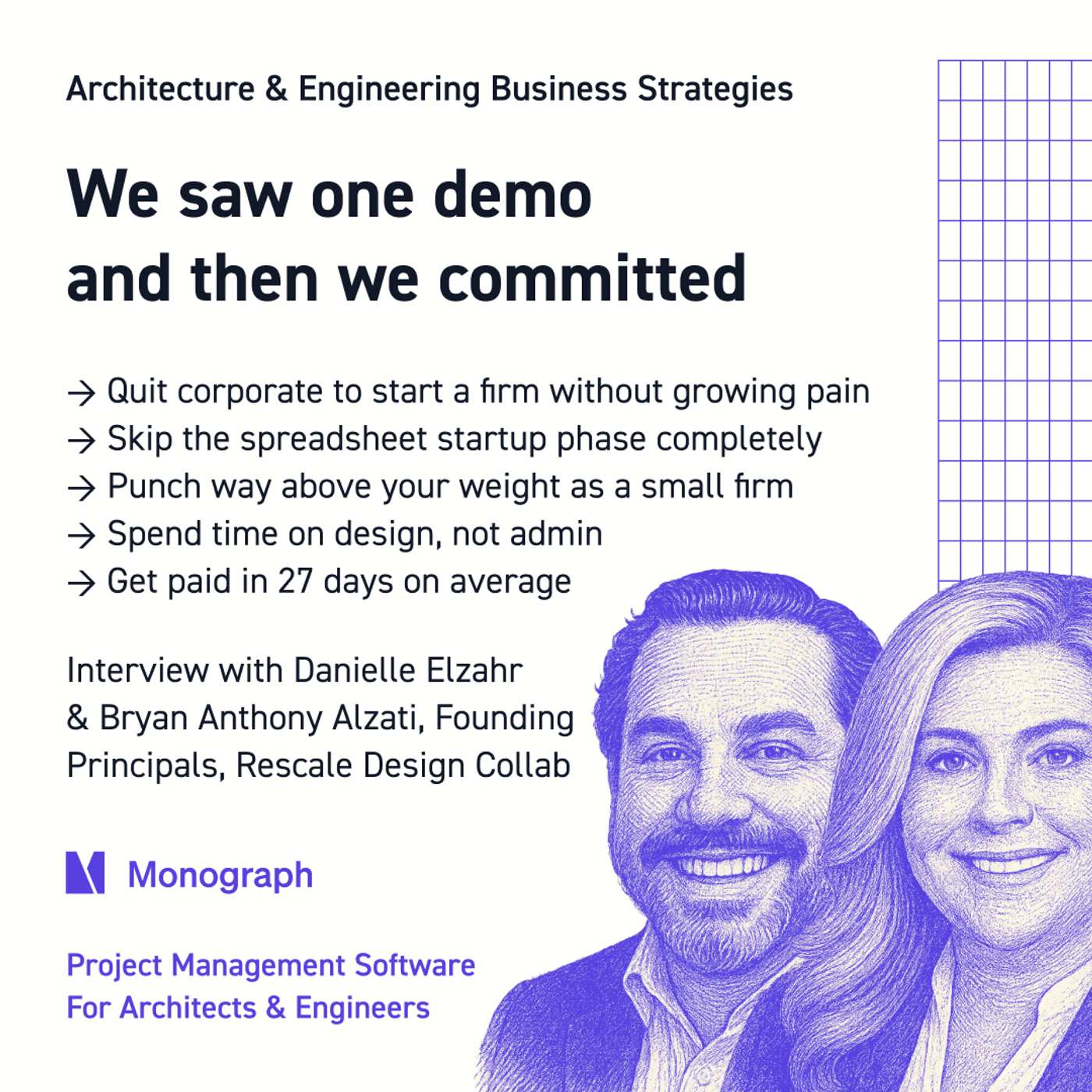 How this Architect quit corporate life to start a new firm but without all the growing pains | In this episode, two ex-corporate architects explain how running their own business actually meant less admin than being employees at a large company.What you'll learn: → Why small firms can now punch above their weight with the right tools → How to set up professional operations in 30 days instead of months → The payment processing strategy that gets you paid in 27 days → Why custom corporate tools often create more problems than they solve → How to focus on design work instead of managing business systemsDanielle Elzahr and Bryan Anthony Alzati are the founding principals of Rescale Design Collab, a boutique architecture and interiors firm in Miami. They left successful careers at a large corporate firm to build a practice that prioritizes design over administrative overhead. With three people and a network of production partners, they work with commercial clients while maintaining the personal attention only small firms can provide.Ready to build professional operations from day one? Learn more at monograph.com | 9m 02s | ||||||
| 8/1/25 | 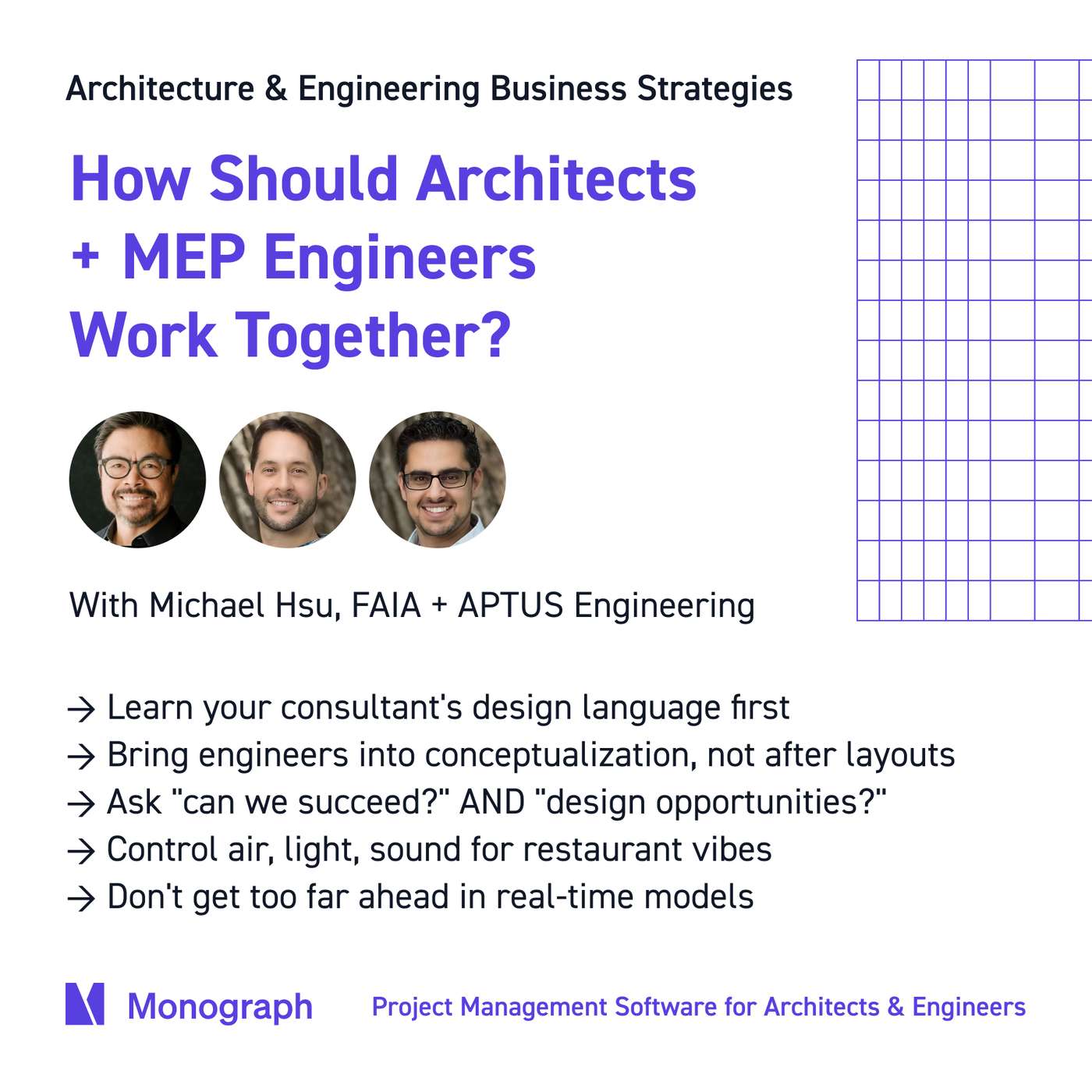 Hospitality Design w/ Michael Hsu, FAIA + APTUS - How Should Architects + MEP Engineers Work Together? | Creating the perfect restaurant vibe requires controlling air temperature, velocity, day lighting, and acoustic quality all at once, but most architect-engineer teams can't coordinate at this level.In this conversation, you'll hear how these Austin-based firms have sustained their decade-plus partnership working on everything from P. Terry's locations to the iconic Headliners Club renovation. They share their approach to early MEP integration, project selection criteria that protect both profitability and design ambition, and the trust investment required to learn each other's design language.What you'll learn:→ Framework for selecting projects that balance financial viability with design ambition→ Why bringing MEP engineers into conceptualization prevents expensive redesigns→ How to achieve precise technical coordination for hospitality experiences→ Trust investment strategies for building decade-plus consultant partnerships→ Real-time collaboration challenges and timing protocols that actually workAbout the guests:Michael Hsu, FAIA leads Michael Hsu Office of Architecture, a nationally award-winning practice in Austin focused on hospitality-driven projects. His design philosophy roots in empathy, storytelling, and aesthetic connection to culture and nature. Eric Zissman and Sujay Regmi co-founded APTUS Engineering, a performance-driven MEP firm known for service-oriented culture and collaborative approach across commercial, healthcare, and educational sectors.Ready to improve your project coordination? Monograph helps architecture and engineering firms track projects, manage resources, and collaborate more effectively. Learn more at https://monograph.com/ | 44m 22s | ||||||
| 7/28/25 | 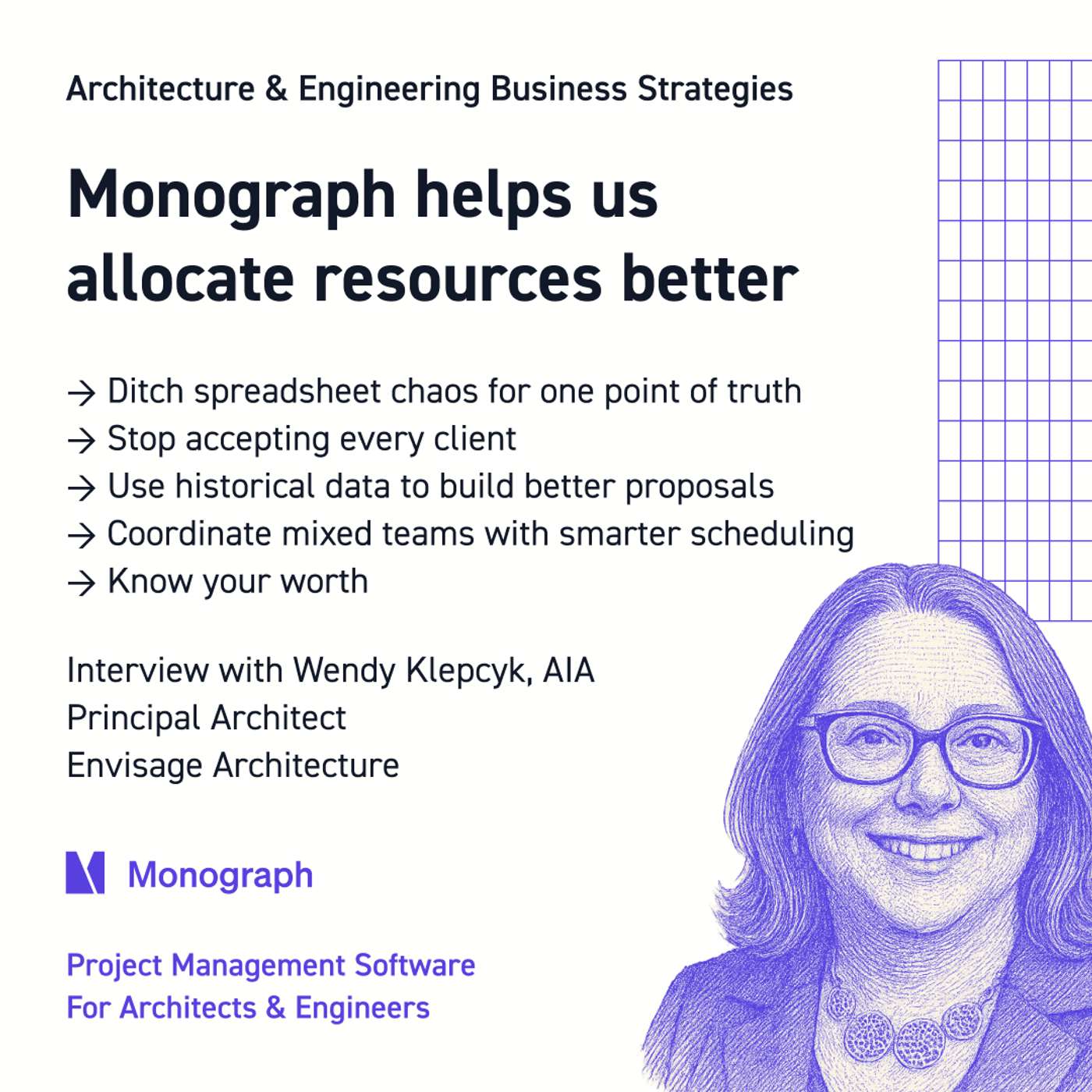 How this Architect became more selective with clients using Monograph | Architecture firms often accept any project that comes their way, but what if you could use data to choose only the clients who value your expertise?In this episode, you will learn:→ How to replace fragmented spreadsheets with unified financial tracking systems→ Why historical project data transforms proposal accuracy and profitability→ How to identify profitable vs. unprofitable project types using past performance→ Unexpected scheduling benefits for firms with mixed employment models→ How financial clarity gives you confidence to price appropriately and choose better clientsMeet Wendy Klepcyk, AIA, Principal Architect at Envisage Architecture, a 8-person Cincinnati firm that evolved from reactive project acceptance to strategic client selection through three years of data-driven decision making.Ready to gain financial clarity like this Architect? Learn more at https://monograph.com | 3m 56s | ||||||
| 7/25/25 | 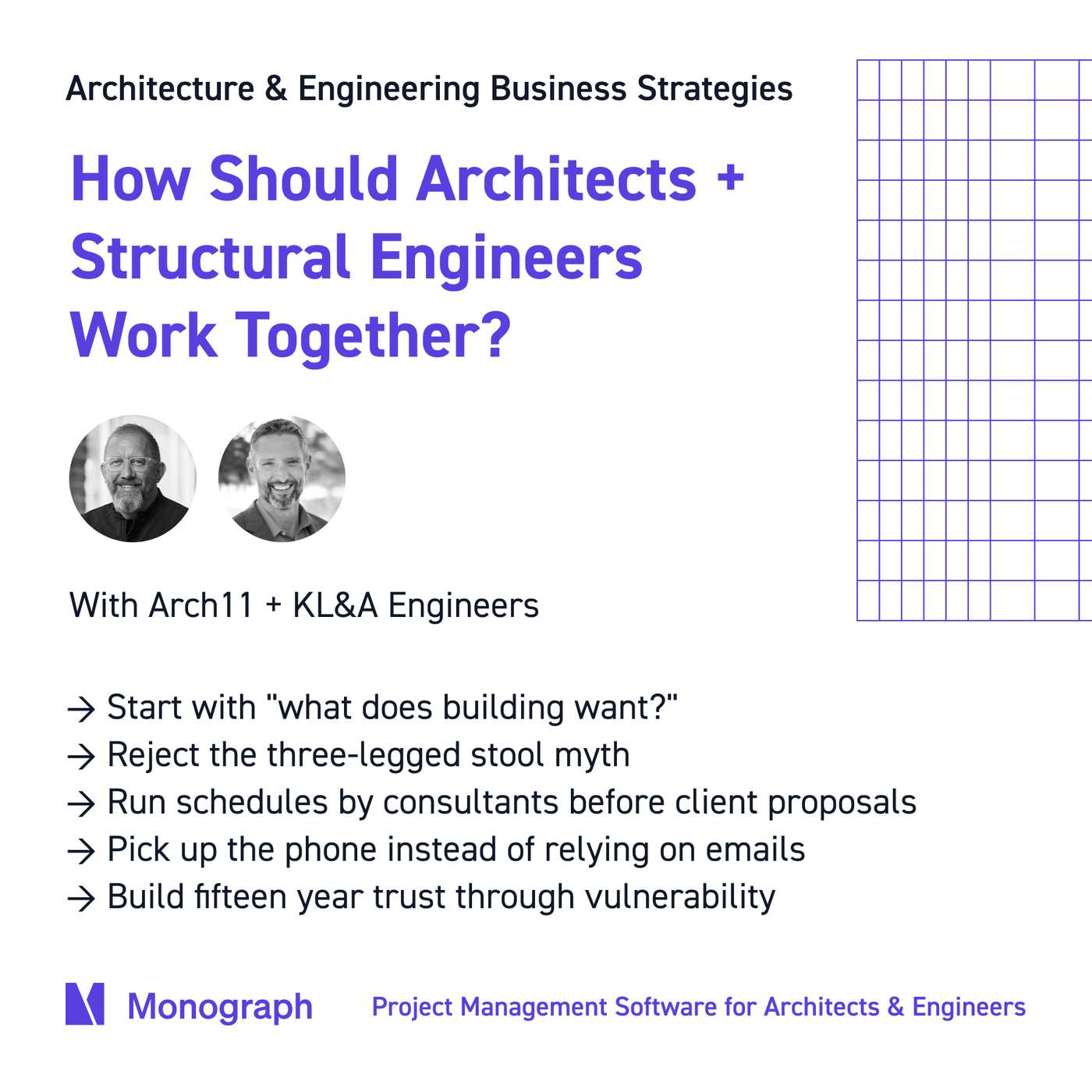 How Should Architects + Structural Engineers Work Together? (w/ Arch11 and KL&A Engineers) | Most architects treat engineers like a service you hand work to, but what if your breakthrough moments happen when you start conceptual conversations before making any structural decisions?What you'll learn:→ Why bringing consultants to the table "as quickly and early as possible" unlocks structural innovation most firms never discover→ How to reject the three-legged stool myth and achieve budget, schedule, AND quality through honest upfront planning→ The resource coordination system that prevents "everyone else's fires from becoming your fire" across multiple firms→ Why picking up the phone beats endless teams chats for solving complex design problems fast→ How fifteen-year professional partnerships enable vulnerability and breakthrough collaborationIn this episode: Ken and Jeff reveal how their fifteen-year partnership transforms projects through early integration, transparent resource planning, and maintaining human connection in an increasingly digital world. From conceptual conversations about "what the building wants to do" to weekly coordination meetings that prevent project chaos, this episode challenges every assumption about how architects and engineers should work together.Guest Bios:Ken Andrews is a principal and partner at Arch11 in Boulder and Denver, delivering artful and resilient design across residential, commercial, and institutional scales for over 20 years.Jeff Myers is an executive principal at KL&A Engineers and Builders, a 30-year-old firm generating $40-50 million annually across five Rocky Mountain offices. With 25 years of structural engineering experience and an architecture degree, he brings unique dual-discipline perspective to collaborative practice.Ready to transform your consultant relationships? Visit https://monograph.com to see how over 12,000 architects and engineers coordinate resources and manage projects. | 44m 38s | ||||||
| 7/23/25 | 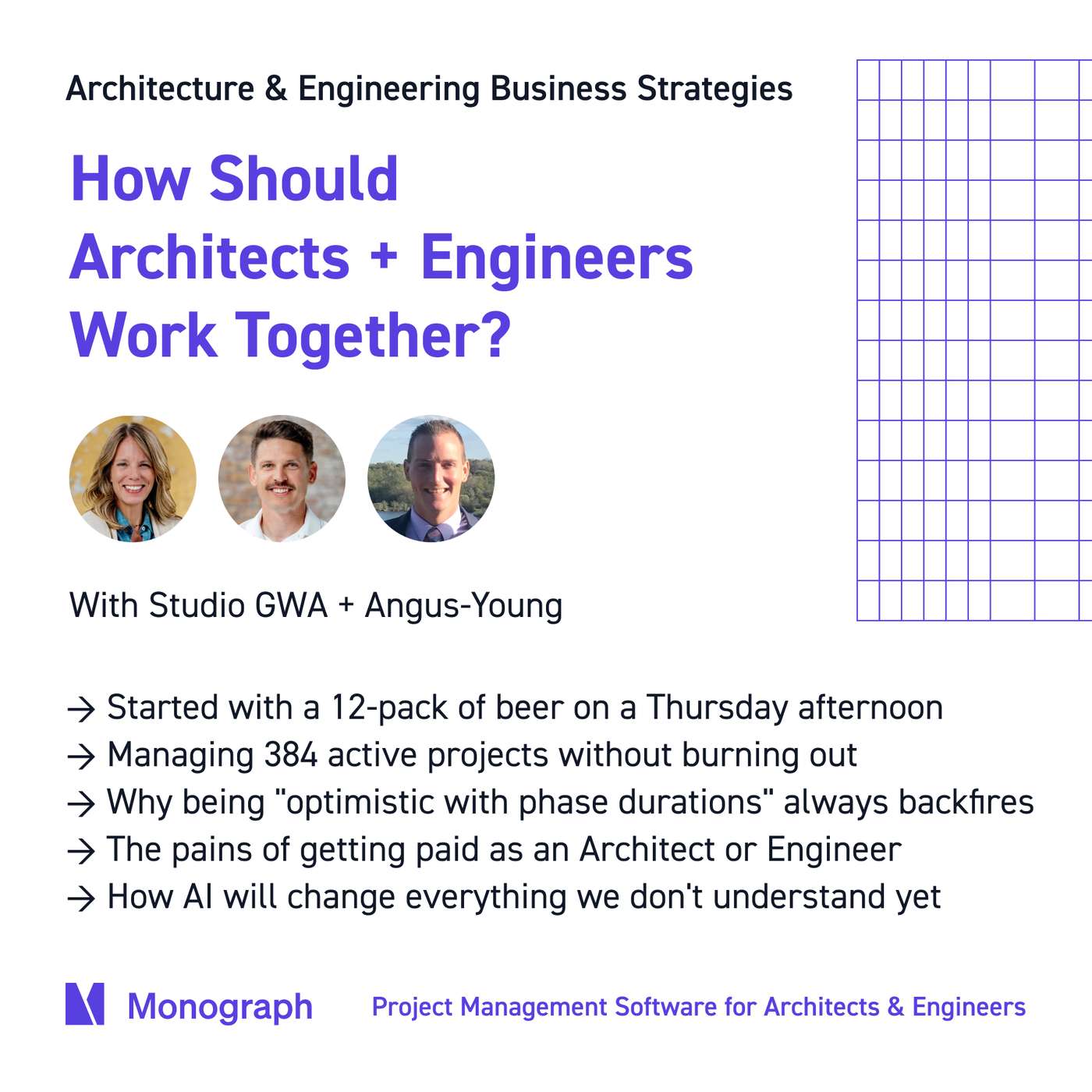 How Should Architects + Engineers Work Together? (w/ Studio GWA + Angus Young) | Architects don’t design alone. But real collaboration between firms? That’s the hard part.In this episode, you’ll learn what it actually takes to run successful projects across architecture and engineering teams, such as:→ How to build trust between teams and clients→ How to structure timelines across consultants→ How to handle late invoices, design surprises, and municipal curveballs→ The role of tools like Revit, Monograph, and Deltek→ How to manage 384 active projects without burning out→ What’s changing next in A&E collaborationBe sure to listen until the end to hear the mistakes that taught them how to work smarter together.About our guests:💜 Studio GWA: A 14-person firm focused on adaptive reuse and urban planning, led by Jennifer Spencer and Aaron Holverson.💜 Angus-Young: A 60+ person full-service architecture and engineering firm, led by a team of principals, including Steven Genin.💜 Hosted by Monograph. Project management software built for architecture and engineering teams. Curious about Monograph? Get started -> https://monograph.com/book-a-demo | 55m 22s | ||||||
| 7/21/25 | 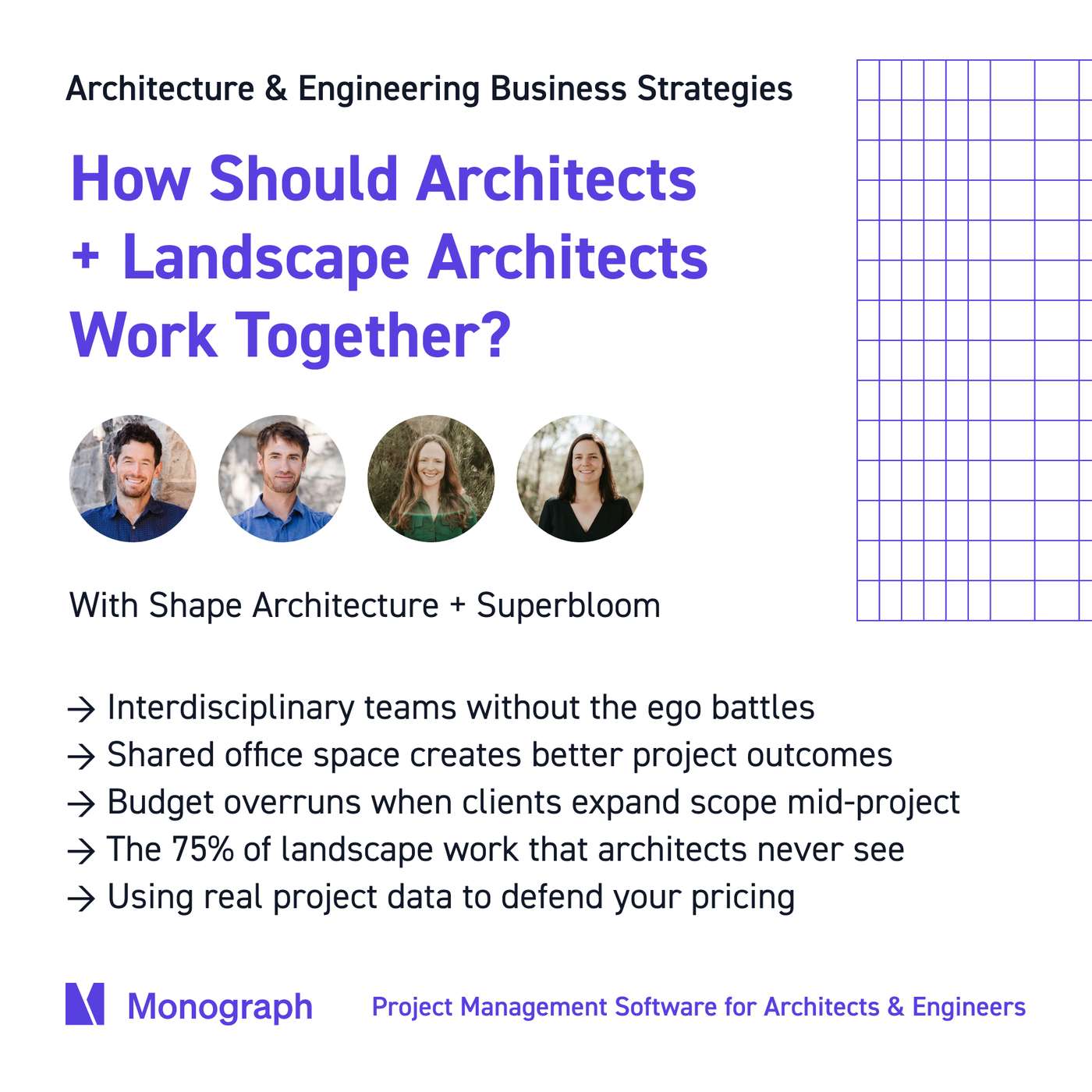 How Should Architects + Landscape Architects Work Together? (w/ Shape Architecture + Superbloom) | A&E project collaboration sounds great–until projects go over budget, scope gets muddy, and no one's sure who's doing what.In this episode, two award-winning design firms share how they actually make collaboration work: → How to staff and structure projects across two firms → How to run weekly planning and manage deadlines → How to divide scope, run client meetings, and stay on track → What tools to rely on: Slack, trace paper, Monograph, and more → How should Architects + Landscape Architects work together?Make sure to listen until the end to hear what they'd never do again!In this conversation, you'll hear about:How Shape and Super Bloom started working togetherWhat kind of projects each firm focuses onHow many projects they're working on at onceHow they structure projects across teamsHow they structure their time week to weekHow they handle client interactions and site meetingsWhat tools they use for team collaboration and designHow architects and landscape architects should work togetherWhat project really tested their collaboration—and how they handled itThe most unexpected thing that helped them collaborate betterWhat architects misunderstand about landscape architects—and vice versaWhat ways of working they'd never go back toQ&A: Is collaboration worth the budget risk for better outcomes?Q&A: When did they adopt Monograph, and why?🟡 Shape Architecture is a Colorado-based firm recently recognized as the 2024 AIA Colorado Young Firm of the Year. Led by Principals Steve Scribner and Morgan Law, they focus on creating high-performance, site-connected buildings across the Mountain West.🟢 Superbloom is a landscape architecture studio recently awarded a 2024 ASLA Colorado Merit Award for their innovative, climate-adaptive designs. Led by Principals Stacy Passmore and Diane Lipovsky, the team focuses on connecting people to landscapes in ways that are meaningful and resilient.💜 HOSTED BY MONOGRAPH The easiest project management software for Architects & Engineers. Get started now: https://monograph.com/book-a-demo | 1h 05m 19s | ||||||
| 12/27/24 | How Dynamic Engineering Grew Profit 25% by Switching from Excel to Monograph | Unbilled hours. Constant firefighting. Are broken systems holding back your A&E firm? In this episode, you’ll learn a simple question to find broken systems and get a concrete example of how a 10-person structural engineering firm in Florida grew profits by 25% after switching from Excel to Monograph. Key takeaways:Ask your team to perform the same task—if their results differ, your systems lack consistency and need fixing.Use tools that visually show budgets, workloads, and schedules to make faster, more confident decisions.Implement systems that automatically track billable hours and improve communication to recover lost revenue.Need to streamline your firm? Visit monograph.com to get started. | 12m 31s | ||||||
| 12/9/24 | How Workbench Cut Monthly Unbilled Fees by 75% After Switching from BQE Core to Monograph | Many architects and engineers struggle to manage their business, from staying on top of budgets to streamlining invoicing and forecasting. In this episode, we explore how Workbench, a California architect-developer + design-build firm, transformed their operations. By switching to Monograph from BQE Core + Smartsheets, they reduced unbilled fees by 75%, cut their billing time from 20 hours a month to just 4 hours, and sped up staffing and scheduling for their team by 8x.In this episode, you'll learn:How to give your team real-time clarity on project budgets and schedules.How Monograph simplifies invoicing, forecasting, and staffing adjustments.How better tools can help reduce inefficiencies and improve team productivity.Workbench used Monograph to save time, improve transparency, and focus on growing their business. If you’re ready to spend less time managing spreadsheets and more time doing the work you love, this episode is for you.Want to learn more? Visit monograph.com to book a demo today! | 43m 32s | ||||||
Want analysis for the episodes below?Free for Pro Submit a request, we'll have your selected episodes analyzed within an hour. Free, at no cost to you, for Pro users. | |||||||||
| 11/27/24 | How Workshop/APD Transformed Their Architecture and Design Business with Monograph | Many architects and engineers feel overwhelmed by the business side of their work. In this episode, we explore how Workshop/APD, a leading multidisciplinary design firm, tackled these challenges and grew their team by 78% with Monograph.In this episode, you’ll learn:How to align your team with real-time project and financial data.How to take control of your firm’s financial health using tools designed for architects.How to build a culture of accountability that empowers your entire team.If you’re ready to solve the business challenges in your firm and scale with confidence, this episode is for you. Listen now and discover actionable strategies to grow your firm while staying focused on what you love—design.Want to learn more? Visit monograph.com to book a demo today! | 13m 56s | ||||||
| 2/22/24 | How Garrison Architects cut costs 50% by leaving ArchiOffice for Monograph | Meet Garrison Architects — a Brooklyn-based architecture firm that specializes in sustainable, modular building design through highly refined modernist aesthetics across private residential and large scale public projects. In 2023, the firm left ArchiOffice for Monograph to streamline and improve project tracking, staffing, and billing, while reducing the cost associated with managing their systems by 50%.Here's what happened: Before Monograph- +$34k annual cost on project management and billing systems- 40-48 hours a month on monthly invoicing- 45-60 days time-to-paymentAfter Monograph- 50% reduced cost on project management and billing systems- 66% less time on monthly invoicing- 2.6x faster time-to-paymentRead the story here - https://bit.ly/49nlNJpNew to Monograph? Start here - https://bit.ly/4bI3S1N | 56m 32s | ||||||
| 2/7/24 | Design-build firm Woodhull streamlined collaboration after switching from BQE Core to Monograph | Meet the design-build firm Woodhull — an integrated architecture, construction, and millwork firm delivering thoughtful and enduring residential and commercial projects throughout New England. Their holistic ethos and business model relies on transparency, communication, and collaboration to drive successful internal operations. Everything starts with the 80 active projects in Woodhull's 25-person design studio, which switched from BQE Core to Monograph to improve speed and accuracy across the entire business.Here's what happened: Before Monograph- 4-6 hours per week on reporting latest project schedules- 5-10 days invoicing process due to back-and-forth between PMs and bookkeeper - 50% errors on retainer fee invoicing, causing client refundsAfter Monograph- 95% less time preparing project reports for firm owners- 53% faster monthly invoicing process- 100% error reduction on retainer invoicing, avoiding client refundsRead the story here - https://bit.ly/3OBJ7LjNew to Monograph? Start here - https://bit.ly/3w8y4mx | 44m 28s | ||||||
| 6/30/22 | MVRDV: How To Win Work (w/ Inger Kammeraat, Jan Knikker) | What does organization have to do with landing new clients? Managing Director Inger Kammeraat and Strategy and Development partner Jan Knikker at MVRDV believe a well-structured workplace is the foundation you need to attract, win and retain your ideal clients. In this Best Practice interview, they explained how they structure their firm to facilitate a healthy pipeline of new projects. They talked about how they use PR to drive business development, how they balance profit with their mission, and how they close the cycle at the end of each project. | 54m 48s | ||||||
| 5/17/22 | Level Architecture + Interiors: Success Stories: Leveling up Practice Ops (w/Adam Gayle) | Running a new business is difficult, whether you're starting with a blank slate, rebranding, or splitting off from a larger entity. The key to success often lies in developing order in the form of a consistent set of principles and practices. During Section Cut, Adam Gayle of Level Architecture + Interiors explained how strategic processes will not only help you organize your practice, but take it to the next level. | 21m 30s | ||||||
| 5/12/22 | bldg.collective architecture + design: Achieving Balance: Creative Expression Meets Professional Service (w/ Steve Perce) | Architects can often feel pulled in two opposing directions. On one hand are the client's desires and needs, and on the other hand is the architect's personal creativity and aesthetic. However, it is possible to keep professionalism and creativity in balance. During Section Cut, Steve Perce of bldg.collective shared his tips for achieving the best of both worlds. | 21m 47s | ||||||
| 5/10/22 | Defining Design Practice: Defining Change (w/ Lorena Galvao) | Best practices in any industry change quickly. Flexibility and agility often make the difference between remaining cutting edge and falling behind the curve. During Section Cut, Lorena Galvao, co-founder of Defining Design Practice, explained why adaptability is so critical within the architecture industry. | 41m 17s | ||||||
| 5/6/22 | Charrette Venture Group: Designing the Client Experience (w/ Lucas Gray, Dena Alspach) | Happy clients are a key ingredient to running a successful architecture business. Positive client experiences are important: when you do it right, you'll secure referrals and repeat business for your firm. During Section Cut, Lucas Gray and Dena Alspach of Charrette Venture Group broke down how to kick off a great client experience before the project even begins—and keep it going past project close-out. | 44m 58s | ||||||
| 4/25/22 | Studio Balcones: Growth Rooted in Community (w/ Jennifer Orr, Tiffany Rasco) | Growth doesn’t happen overnight. But how does it happen? For Principal Jennifer Orr and Office Manager Tiffany Rasco of the landscape architecture firm Studio Balcones, growth goes hand-in-hand with community outreach. In this Best Practice interview, they talk about the importance of creating designs rooted in the local landscape, collaborating with project partners, applying for community certifications and participating in diversity programs, and educating clients throughout the process. | 52m 38s | ||||||
| 4/22/22 | Ennead Architects LLP: How Civic Architecture Can Inspire Change (w/ Molly McGowan, Thomas Wong) | The dream training of an architect isn’t siloed, repetitive work. It’s experiencing a whole range of different scales, different typologies, and different locales in their projects. Ennead Architects doesn’t use a typical studio-based organization for the architects and instead embraces the cross-fertilization of ideas and skills transfer that comes from everyone having a variety of work. Even the partners. In this episode, Ennead partners Molly McGowan and Thomas Wong let us in on how they manage all of their diverse civic projects, build teams, and define success. | 56m 06s | ||||||
| 4/13/22 | GLUCK+: Architects Who Build (w/ Thomas Gluck, Stacie Wong) | In the architect-led design-build model, the architect is responsible not only for design but for construction as well. This represents a major shift from the traditional design-bid-build way of building projects. Yet it offers unique advantages on both the architect and client end, say Thomas Gluck and Stacie Wong, both principals at Gluck+. Most importantly, it makes for a smoother construction process and a better, beautiful building. | 50m 12s | ||||||
| 4/4/22 | Stayner Architects: How To Design New Models for Practice (w/ Christian Stayner) | Many traditional architecture practices are no longer sustainable. Firms that want to lead the path into the future will need to adopt new ways of thinking. In this Best Practice interview, Christian Stayner, Principal of Stayner Architects, explains how expanding your services, collaborating with consultants, and systemizing client interactions can help you create new models for the future of the industry. | 55m 58s | ||||||
| 3/31/22 | Essel Environmental: How the Random Can Change Your Practice (w/ Nik Lahiri) | When unexpected opportunities arise, sometimes it’s best to say yes and figure it out later. But in order to see the project through, you need to understand how to get to the finish line successfully. In this Best Practice interview, Nik Lahiri of Essel Environmental explores how to understand your metrics for success, know where you get your energy from, and set expectations for project milestones to build lasting client relationships. | 55m 28s | ||||||
| 3/29/22 | Runcible Studios: How To Start Your Own Practice (w/ Marilyn Moedinger) | Not every architect should start their own practice. It comes down to how you want to spend your time. If you want to spend most of your time being an architect, don’t start a practice. Starting a practice requires you to spend time on business processes, marketing, sales, and most of all, thinking about money. From setting fees to planning for the future, there are many financial decisions you’ll have to make right from the start. In this Best Practice episode, Marilyn Moedinger, founder of Runcible Studios, shares her expertise on the money side of starting your own practice. | 56m 45s | ||||||
| 3/24/22 | SK Development: How To Manage A Development Pipeline (w/ Scott Shnay) | Developers need a steady pipeline of projects to keep their businesses thriving. That means juggling multiple projects that are in various stages, from design to starting construction, to completing construction. To stay on target, you’re always balancing what you’re working on now with what comes next. In this episode, Scott Shnay of SK Development told us the rules they follow to steadily feed that pipeline while keeping their work top-notch, like working with great partners and sticking to your convictions. | 50m 50s | ||||||
Showing 25 of 93
Sponsor Intelligence
Sign in to see which brands sponsor this podcast, their ad offers, and promo codes.
Chart Positions
5 placements across 5 markets.
Chart Positions
5 placements across 5 markets.