
Insights from recent episode analysis
Audience Interest
Podcast Focus
Publishing Consistency
Platform Reach
Insights are generated by CastFox AI using publicly available data, episode content, and proprietary models.
Total monthly reach
Estimated from 4 chart positions in 4 markets.
By chart position
- 🇪🇸ES · Non-Profit#5300K to 800K
- 🇰🇷KR · Non-Profit#2630K to 100K
- 🇮🇱IL · Non-Profit#2310K to 30K
- 🇵🇱PL · Non-Profit#2410K to 30K
- Per-Episode Audience
Est. listeners per new episode within ~30 days
175K to 480K🎙 ~2x weekly·176 episodes·Last published today - Monthly Reach
Unique listeners across all episodes (30 days)
350K to 960K🇪🇸83%🇰🇷10%🇮🇱3%+1 more - Active Followers
Loyal subscribers who consistently listen
140K to 384K
Market Insights
Platform Distribution
Reach across major podcast platforms, updated hourly
Total Followers
—
Total Plays
—
Total Reviews
—
* Data sourced directly from platform APIs and aggregated hourly across all major podcast directories.
On the show
Recent episodes
Phil Goldfeder, CEO of AFC, on Responsible Financial Innovation, Creating a Standards-Based Association, and Staying Warm and Fuzzy
Jun 25, 2026
Unknown duration
185. Jeff Morgan, President & CEO of CMAA, on Community as the Secret Sauce, Member-Driven Growth, and Global Certification
Jun 18, 2026
Unknown duration
184. David Walsh, ED of VSAE, on Member Recruitment, New Member Engagement, and Learning Pathways
Jun 11, 2026
Unknown duration
183. Emily Bardach, Executive Director of AWPA, on Advocacy, Strategic Planning, and Building Momentum
Jun 4, 2026
Unknown duration
182. Celeste Warren, Founder of Destination STEM, Inc, on Representation in STEM, Virtual Access, and Building the Future Workforce
May 28, 2026
Unknown duration
Social Links & Contact
Official channels & resources
Official Website
Login
RSS Feed
Login
| Date | Episode | Description | Length | ||||||
|---|---|---|---|---|---|---|---|---|---|
| 6/25/26 |  Phil Goldfeder, CEO of AFC, on Responsible Financial Innovation, Creating a Standards-Based Association, and Staying Warm and Fuzzy | How do you help an industry innovate at breakneck speed while ensuring consumer protection, trust, and regulatory compliance? And what role should an association play in bringing competitors, regulators, and innovators together to shape the future of an emerging industry?In this episode of Associations Thrive, host Joanna Pineda interviews Phil Goldfeder, CEO of the American Fintech Council (AFC). Phil discusses:How AFC has grown from roughly 25 members to more than 175 members and partners, while maintaining a retention rate above 95%.Why AFC intentionally brings fintech companies and banks together under one roof, creating collaboration rather than competition.How AFC differentiates itself as a standards-based organization that embraces regulation, compliance, and consumer protection.Phil’s career journey from public service, including roles with Chuck Schumer, Mayor Michael Bloomberg, and the New York State Legislature, to banking and association leadership.How Hurricane Sandy exposed the need for innovation in insurance and financial services and helped shape Phil’s professional path.Why Phil believes association leadership is remarkably similar to elected office: both are fundamentally about service, engagement, and impact.How AFC creates “safe spaces” where member CEOs can openly discuss challenges, best practices, and emerging business models.AFC’s advocacy efforts to educate policymakers and regulators on fintech innovations such as Buy Now, Pay Later and Earned Wage Access programs.How AFC’s annual summit maintains an intimate, collaborative atmosphere even as attendance has grown dramatically.References:AFC Website | — | ||||||
| 6/18/26 |  185. Jeff Morgan, President & CEO of CMAA, on Community as the Secret Sauce, Member-Driven Growth, and Global Certification | How does an association grow from 6,000 to 9,000 members without a membership sales team? What can associations learn from an organization whose members actively recruit the next generation on its behalf?In this episode of Associations Thrive, host Joanna Pineda interviews Jeff Morgan, President & CEO of the Club Management Association of America (CMAA). Jeff discusses:How CMAA represents professionals working across 3,500 member-owned clubs, including golf clubs, yacht clubs, city clubs, ski clubs, and more.How CMAA membership grew from approximately 6,000 members during COVID to 9,000 members today—with no membership sales team.Why private clubs experienced significant growth during and after COVID, including increased member demand, long waiting lists, and investments in facilities and amenities.CMAA’s highly intentional 12-month new member onboarding process, which includes welcome kits, monthly communications, quarterly Zoom sessions, and structured opportunities to build connections.The association’s long-running conference idea-sharing program, where members submit and share more than 100 best-practice posters that become a searchable knowledge resource for the profession.CMAA’s Certified Club Manager (CCM) credential, built around 12 professional competencies, continuing education, and a globally licensed certification model.How CMAA has expanded its influence internationally through partnerships, certification licensing, and conference participation from club professionals around the world.Why Jeff believes clubs are no longer simply physical facilities, but communities that remain connected through technology, virtual programming, and shared experiences.How “community” serves as the secret sauce behind both successful clubs and successful associations.References:CMAA Website | — | ||||||
| 6/11/26 |  184. David Walsh, ED of VSAE, on Member Recruitment, New Member Engagement, and Learning Pathways | What if your association's most effective membership recruiters aren't staff at all, but your members themselves?In an era where association professionals have countless options for education, networking, and professional development, how can associations create such a strong sense of belonging that members actively recruit, welcome, and mentor new participants?In this episode of Associations Thrive, host Joanna Pineda interviews David Walsh, Executive Director of the Virginia Society of Association Executives (VSAE). David discusses:How VSAE serves more than 450 association professionals and industry partners across Virginia, providing education, leadership development, networking, and peer exchange opportunities.How VSAE is expanding its reach throughout Virginia, including launching the Northern Virginia Association Exchange to better serve professionals in the state's largest association market.David's unique association journey, influenced by his mother’s 40-year association career and his progression through membership, marketing, advocacy, and executive leadership roles.How VSAE's annual conference attracted more than 200 registrants and over 50 first-time attendees, the strongest attendance numbers in more than a decade.How volunteer leaders personally reach out to prospective members and conference attendees, creating authentic peer-to-peer invitations rather than relying solely on marketing campaigns.How VSAE's membership committee serves as mentors and ambassadors, ensuring first-time attendees feel welcomed and connected from the moment they arrive.VSAE’s Learning Pathways that help members identify educational content aligned with their career stage, role, and professional goals.How VSAE's Northern Virginia programming combines education, peer exchange, and community-building to create meaningful opportunities for association professionals to learn from one another.References:VSAE WebsiteNorthern Virginia Association Exchange | — | ||||||
| 6/4/26 | 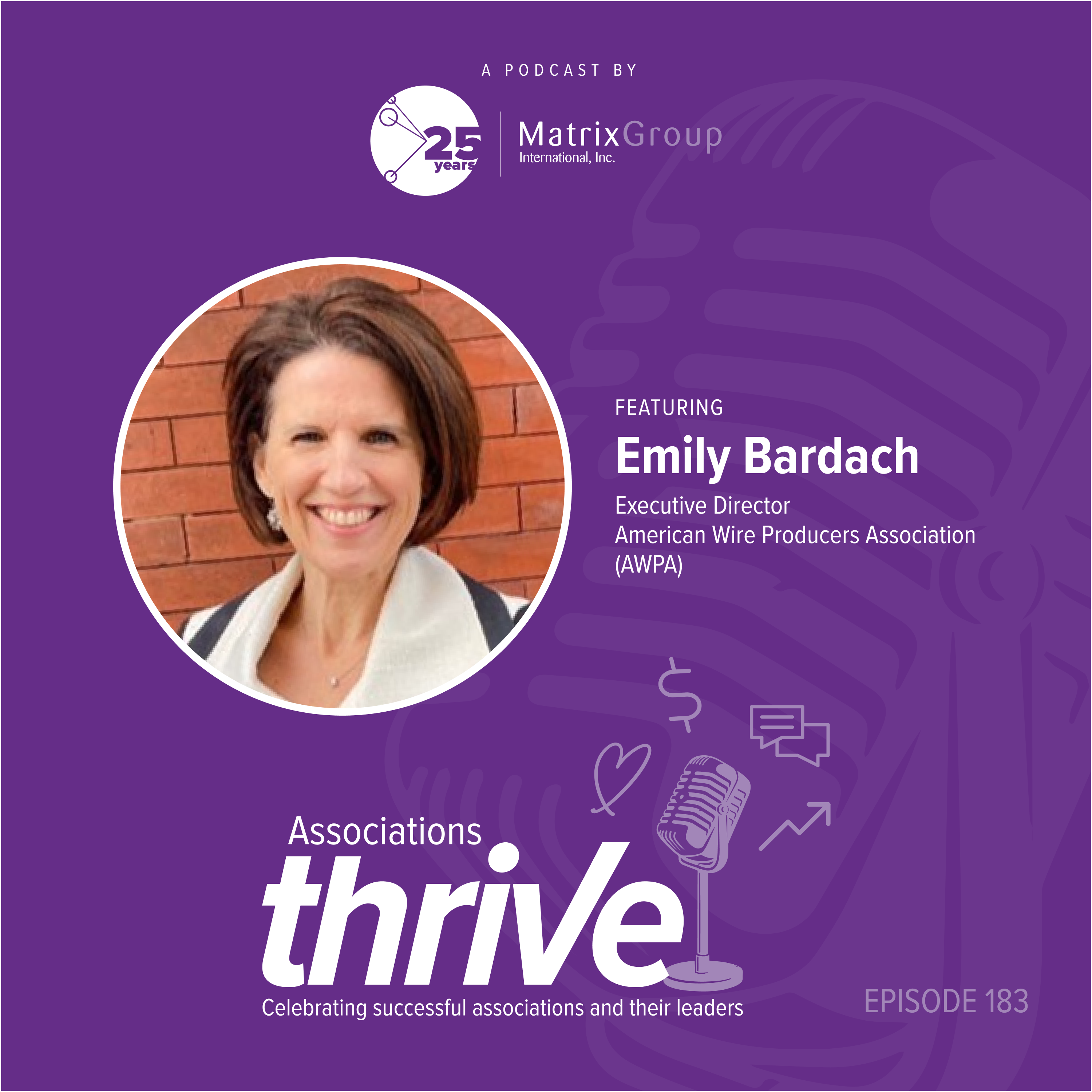 183. Emily Bardach, Executive Director of AWPA, on Advocacy, Strategic Planning, and Building Momentum | When your industry is everywhere but almost invisible, how do you tell your story? And how can associations help members navigate tariffs, supply chain pressures, and changing market dynamics?In this episode of Associations Thrive, host Joanna Pineda interviews Emily Bardash, Executive Director of the American Wire Producers Association (AWPA). Emily discusses:How AWPA represents companies that manufacture wire and wire products, from bridge cables to tiny springs in Windex bottles.Why “wire is everywhere,” touching construction, infrastructure, agriculture, defense, medical devices, automotive parts, and everyday household products.How AWPA is a small but vital industry association with about 85 members, many of them family-owned businesses.Why association staff must understand each client’s unique culture, including details like whether spouses are important at events.How AWPA shifted its advocacy focus from “free and fair access to wire rod” to “building a resilient wire industry across the full supply chain.”How strategic planning helped AWPA’s board align around a new mission, vision, and playbook.How AWPA took risks with its annual conference, including booking a higher-end venue, stronger speakers, and better storytelling through photography and video.How AWPA is building momentum through advocacy, LinkedIn, facility tours with members of Congress, and more frequent Hill visits.References:AWPA Website | — | ||||||
| 5/28/26 | 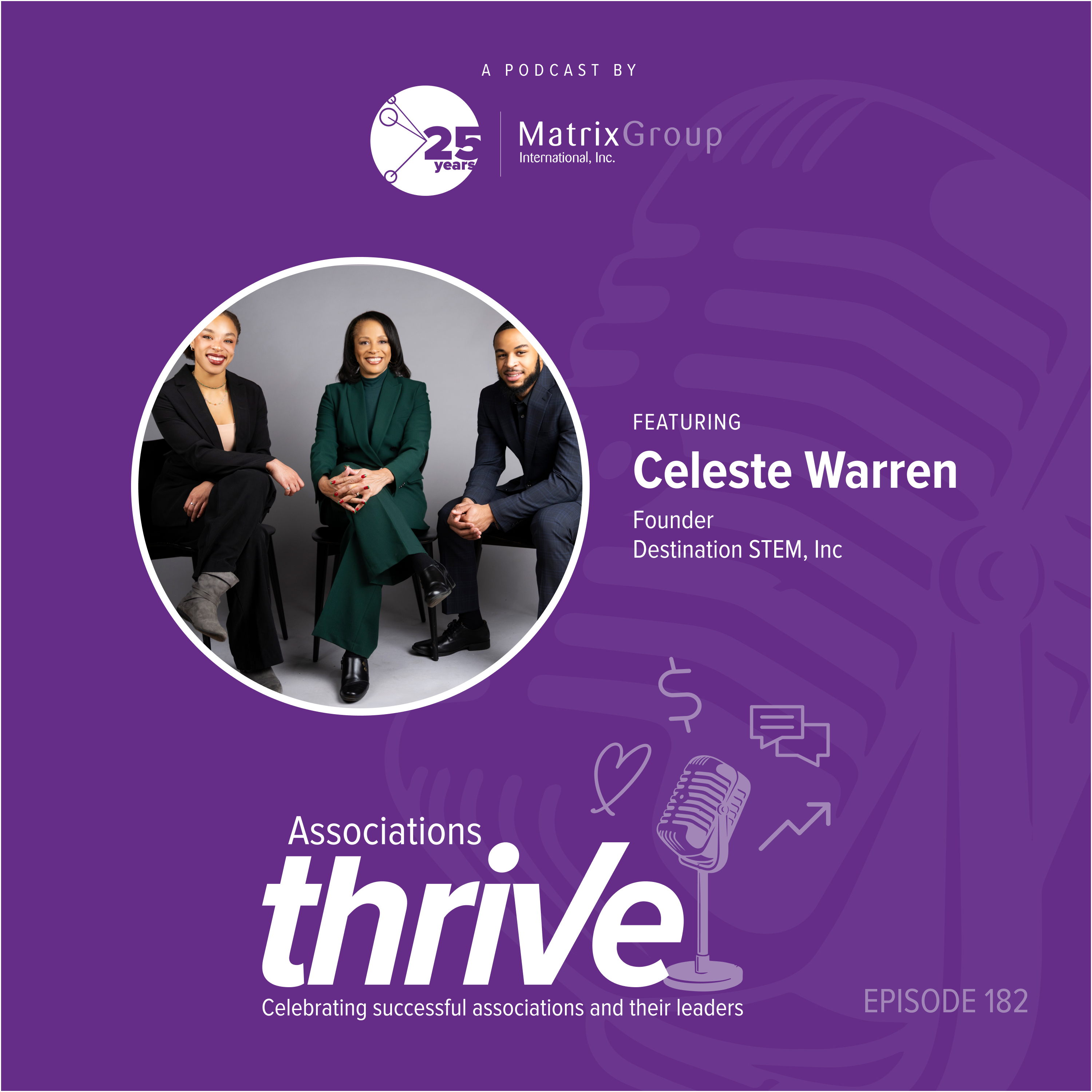 182. Celeste Warren, Founder of Destination STEM, Inc, on Representation in STEM, Virtual Access, and Building the Future Workforce | What happens when young people never see anyone who looks like them in the careers they dream about pursuing? And how can associations, nonprofits, and mission-driven organizations help members build stronger, earlier, and more inclusive talent pipelines in response?In this episode of Associations Thrive, host Joanna Pineda interviews Celeste Warren, Founder of Destination STEM, Inc. Celeste discusses:How Destination STEM provides resources, educational awareness events, mentoring, tutoring, and scholarships to students of color and students in need who want to pursue STEM-related degrees and careers.Why representation matters so much, especially for middle school and high school students who are just beginning to imagine what their futures could look like.How Destination STEM uses college students and young professionals as virtual mentors for younger students, creating relatable role models who feel accessible and real.Why Celeste believes STEM pipeline work must start early, long before employers begin looking for talent in the current labor market.How Destination STEM’s family founding story, with Celeste, her daughter, and her son building the organization together, has become part of its unique appeal and authenticity.How the organization is doubling its scholarships and using its annual awards and recognition banquet as both a celebration and a major fundraising vehicle.Celeste’s big vision for Destination STEM: larger-scale conferences, stronger guidance for students, and a bigger role in building the future STEM workforce.References:Destination STEM Website | — | ||||||
| 5/21/26 |  181. Michele Jones, EVP/CEO of NIA, on Her Long Tenure, National Standards, and Member Value in a Consolidating Industry | What if one of the most important contributors to energy efficiency, worker safety, and emissions reduction is also one of the most overlooked? And in an industry facing consolidation and private equity pressure, how can an association help members see the value of community, standards, and education?In this episode of Associations Thrive, host Joanna Pineda interviews Michele Jones, EVP/CEO of the National Insulation Association (NIA). Michele discusses:How NIA represents more than 250 companies across the mechanical insulation industry, including contractors, distributors, manufacturers, fabricators, and metal building laminators.What mechanical insulation is and why it matters.How industry consolidation and private equity ownership are affecting membership, dues, sponsorships, foundation giving, and conference attendance across the association.Why NIA is launching a “dog and pony show” roadshow to meet directly with member companies.How NIA just held its 70th convention, celebrated in Puerto Rico with strong attendance and recognition of past presidents.How NIA is partnering with AMPP to develop national insulation installation standards.NIA’s new Learning Management System.Why Michele believes mechanical insulation still does not get the respect it deserves, even though it lowers energy costs, reduces pollution, protects personnel, and keeps systems running properly.References:NIA Website | — | ||||||
| 5/14/26 | 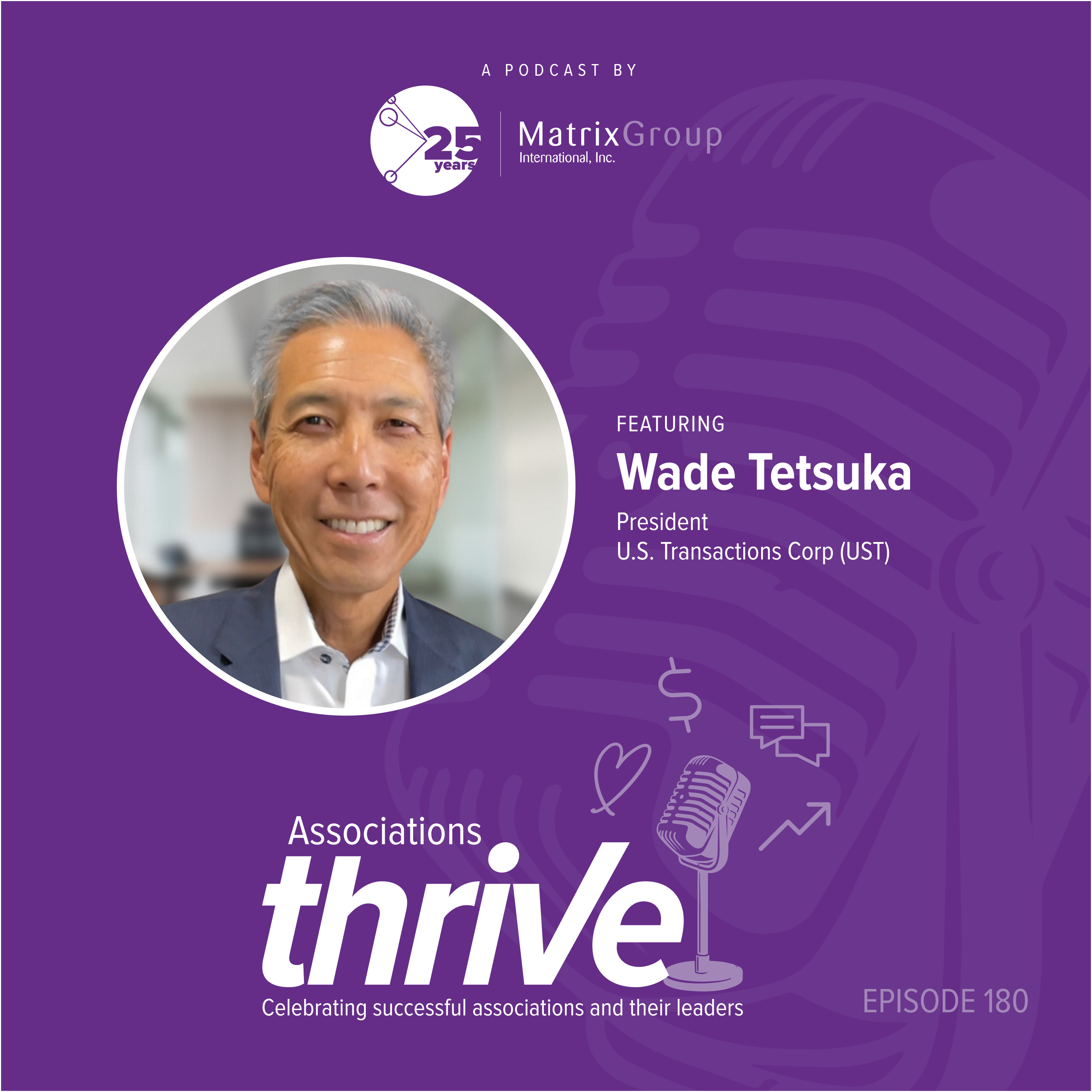 180. Wade Tetsuka, President of UST, on Payments, Peer Learning, and Education as a Bridge to Success | What happens when a fintech leader decides that serving the association community means doing far more than processing payments? And in an environment where associations are under pressure to deliver more value with limited resources, how can they create learning and connections that truly help members thrive?In this episode of Associations Thrive, host Joanna Pineda interviews Wade Tetsuka, President of U.S. Transactions Corporation (UST) and UST Education. Wade discusses:How UST helps associations accept credit card and ACH payments through AMS, LMS, and event platforms, while also helping reduce fees and improve service.Why payment processing becomes an especially important decision point when associations are changing AMS platforms.How UST Education began as simple peer-to-peer lunch roundtables for association IT directors and grew into a major educational platform.How the pandemic accelerated UST Education’s virtual programming and enabled it to serve association professionals across the country.Why Wade believes companies should connect with the communities they serve in a more meaningful way, and how education became that “sweet spot” for him.Why education is the common thread across Wade’s work, board service, and leadership philosophy, and why he sees it as “the great equalizer in society.”What the AANHPI association community means to Wade, and why representation and visibility matter for future Asian American leaders.References:UST Website | — | ||||||
| 5/7/26 |  179. Whitley Richards, CEO of Cause Strategy Partners, on Nonprofit Board Placement, Governance Training, and Leadership Development | What if one of the most effective ways to strengthen nonprofit leadership is to rethink how board members are recruited, trained, and supported? And in a time when AI is reshaping work and human skills matter more than ever, how can associations and nonprofits help members build the judgment, empathy, and strategic thinking that only real service can develop?In this episode of Associations Thrive, host Joanna Pineda interviews Whitley Richards, CEO of Cause Strategy Partners. Whitley discusses:How Cause Strategy Partners is a board placement and governance training provider that works across the United States, the UK, and Hong Kong.How the company has placed about 3,300 professionals onto the boards of more than 1,500 nonprofit organizations over its 11-year history.How Fortune 500 companies partner with Cause Strategy Partners because they want scalable ways to connect employees to meaningful board service as part of leadership development and corporate social responsibility strategies.Cause Strategy Partners’ Board Lead program that prepares professionals before, during, and after placement to become effective board members, while offering the service free to nonprofits of many sizes, including smaller organizations with modest budgets.How the organization “flips” the board recruitment model by inviting individuals to identify nonprofits they care about and explain why they want to serve, creating stronger commitment from the outset.How Whitley wants to bust the myth that nonprofit boards are social clubs; today’s boards require serious leadership, strategy, and accountability.References:Cause Strategy Partners Website | — | ||||||
| 4/30/26 |  178. Michael Coleman, General President of SMART, on Apprenticeships, Member-Centered Benefits, and Advocating for Families and Communities | What does it look like when an organization does more than represent workers and actually builds a community, a career pathway, and a better life? And how can associations help members thrive when workforce shortages, family pressures, and mental health challenges are all converging at once?In this episode of Associations Thrive, host Joanna Pineda interviews Michael Coleman, General President of the International Association of Sheet Metal, Air, Rail, and Transportation Workers (SMART). Mike discusses:How SMART represents more than 230,000 sheet metal, rail, transit, and transportation workers across the United States and Canada.How SMART’s culture of mentorship helps members grow professionally and personally, with experienced members guiding apprentices and newer workers.Mike’s own journey from “floundering” young worker to apprentice, supervisor, local leader, international executive, and ultimately General President.Why apprenticeship is such a powerful model: members earn while they learn, build real skills, gain certifications, and avoid student debt.How SMART is growing membership by widening the recruiting pipeline and reaching veterans, underrepresented communities, and women.How programs like Helmets to Hard Hats and SMART Heroes help service members transition into rewarding union careers.How SMART is making the trades more accessible by addressing real-life barriers, including offering childcare stipends and paid maternity leave.How SMART advocates on issues that go beyond union priorities and affect the public at large, including indoor air quality, fire life safety systems, and safer schools and buildings.How the merger with the transportation union expanded SMART’s reach, while fairness, dignity, safety, and good middle-class jobs remain the values that unite all members.References:SMART Union Website | — | ||||||
| 4/23/26 |  177. Pamela Silberman, Co-founder, Board Member, and Treasurer of STANA, on Smell and Taste Disorders, Patient Advocacy, and Public Health Awareness | Did you know that a loss of smell or taste can be an early indicator of Parkinson's, Alzheimer’s and other dementias? And in an environment where smell and taste disorders are underdiagnosed, underfunded, and often dismissed, how can an association step in to educate patients, influence research, and push for better care?In this episode of Associations Thrive, host Joanna Pineda interviews Pamela Silberman, Co-Founder, Board Member, and Treasurer of the Smell and Taste Association of North America (STANA). Pamela discusses:How STANA is the first patient organization in the United States, Canada, and Mexico focused on people living with smell and taste dysfunction.The many causes of smell and taste disorders, including congenital conditions, infections, allergies, traumatic brain injuries, sinus issues, aging, and COVID-19.How millions of people are affected by smell and taste dysfunction.Pamela’s personal journey after permanently losing her sense of smell following a sinus infection, and how that experience led her to help found STANA.Why STANA advocates for routine and universal smell and taste testing, both to improve diagnosis and to identify links to other conditions such as Parkinson’s, Alzheimer’s, and other dementias.How smell and taste dysfunction can affect mental health, nutrition, safety, social confidence, and overall quality of life.How STANA supports patients through education, virtual community, programming, and practical conversations about cooking, nutrition, texture, and adapting to flavor loss.How STANA is pushing for more patient-centered research by training patients to serve as research partners, not just research subjects.References:STANA Website | — | ||||||
Want analysis for the episodes below?Free for Pro Submit a request, we'll have your selected episodes analyzed within an hour. Free, at no cost to you, for Pro users. | |||||||||
| 4/9/26 |  176. Andrea Wood, President & CEO of ACCP, on the Business Case for CSR, Shared Value, and Building Member-Centric Community | What happens when corporate citizenship is no longer a “nice to have,” but a business imperative under scrutiny? And how can associations help members prove value when the environment turns uncertain?In this episode of Associations Thrive, host Joanna Pineda interviews Andrea Wood, President and CEO of the Association of Corporate Citizenship Professionals (ACCP). Andrea discusses:How ACCP serves professionals responsible for corporate social responsibility (CSR), social impact (CSI), and ESG efforts, acting as liaisons between businesses and communities.The critical importance of making the business case, linking CSR to employee recruitment, retention, morale, reputation, and financial performance.How younger workforce expectations are accelerating demand for meaningful corporate community engagement.Why the most effective CSR strategies embrace a shared value approach, simultaneously benefiting the business and the community.How ACCP supports members with practical, ready-to-use toolkits and resources so small teams don’t have to “start from scratch.”ACCP’s evolving engagement strategy: virtual summits, sold-out in-person conferences, regional meetups, and targeted programming for career stages.How ACCP is helping members navigate political and economic scrutiny by doubling down on data, research, and clear communication of impact.The role of associations as extensions of staff for under-resourced members who need insights, benchmarking, and peer support.Andrea’s leadership approach: listening deeply, staying informed on external trends, and rapidly adapting programming to meet the moment.References:ACCP WebsiteMaking The Case | — | ||||||
| 4/2/26 | 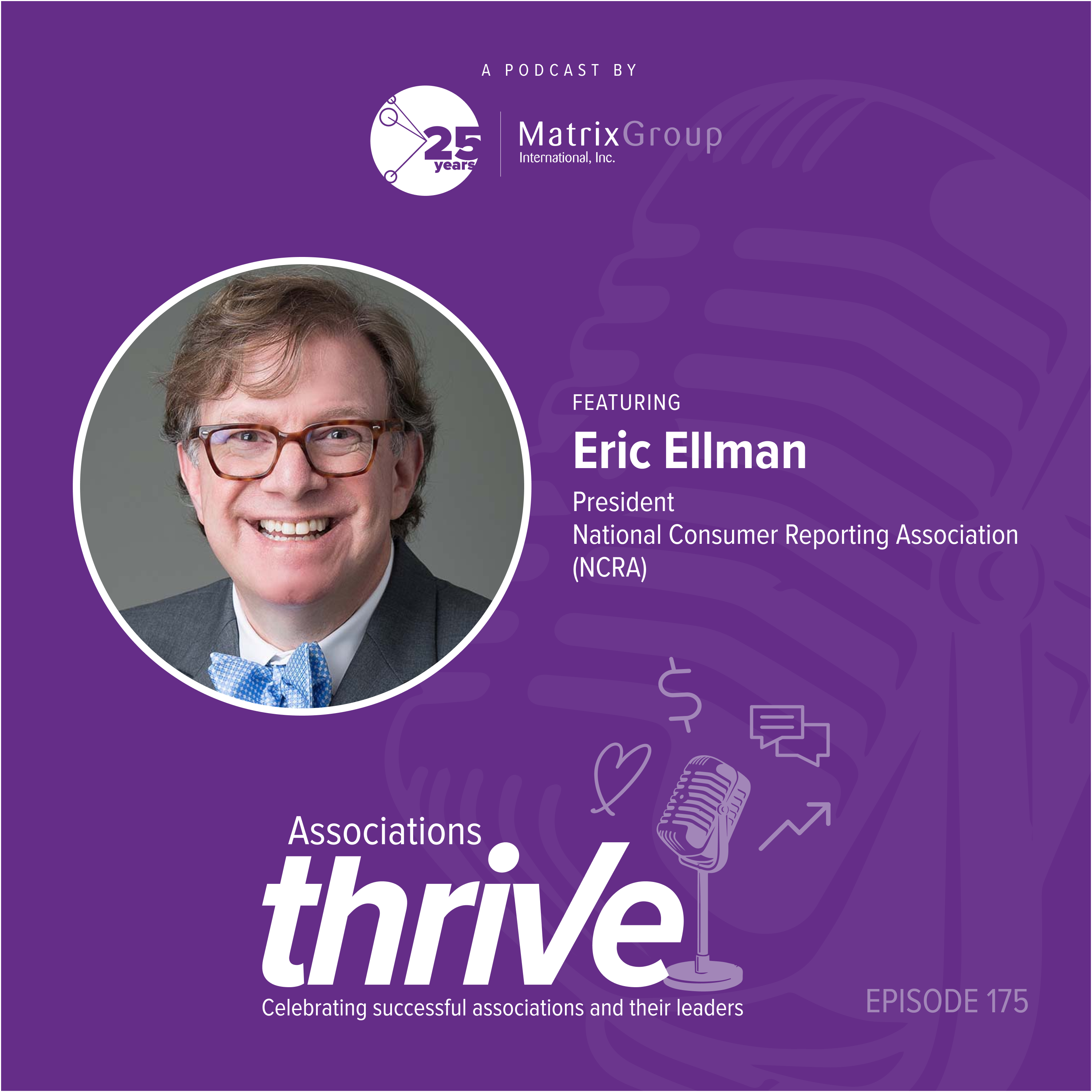 175. Eric Ellman, President of NCRA, on Building Trust, Turning Around an Association, and Elevating Member Value | How do you rebuild an association that is struggling financially, operationally, and reputationally, and turn it into an organization that members are excited to invest in?In this episode of Associations Thrive, host Joanna Pineda interviews Eric Ellman, President of the National Consumer Reporting Association (NCRA). Eric discusses:How NCRA represents mortgage reporting companies and tenant screening companies that provide regulated data to mortgage lenders, landlords, and property managers.How NCRA members act as the “go-betweens” of the industry, combining data from credit bureaus and public records to help mortgage lenders and landlords assess risk in housing.Why the Fair Credit Reporting Act (FCRA) is the governing touchstone of the industry and how it functions as a foundational privacy law.How trust sits at the center of the consumer reporting ecosystem, from consumers, to data furnishers, to reporting agencies, to end users.Why Eric says he is having more fun in this role than at any other point in his career, thanks to culture, trust, and the ability to make a meaningful impact quickly.How he inherited an association in significant financial trouble and immediately focused on stabilizing finances, improving communications, revamping branding, and strengthening public policy work.How NCRA reimagined its annual conference by rebranding it as Elevate, upgrading the content, creating stronger sponsor value, and building energy around the event experience.How Eric personally led sponsor conversations, helped generate record-breaking sponsorship support, and brought in nine new sponsors in roughly 14 months.How NCRA asked members for a special assessment, explained the financial situation transparently, and earned overwhelming member support through a compelling vision for the future.What’s ahead for NCRA in 2026, including continued growth, stronger advocacy, and Elevate 2026 in New Orleans.References:NCRA WebsiteMusic from #Uppbeat (free for Creators!):https://uppbeat.io/t/paul-yudin/quiet-flightLicense code: KJRRI6GHC7WKCLDT | — | ||||||
| 3/26/26 |  174. Gwyn Donohue, CAE, ED of ASAMW, on Small-Staff Leadership, Member Value, and Reinventing Governance | How do you rebuild an association when you inherit the top job, lose key staff almost immediately, and have to figure everything out in real time? And in a relationship-driven industry like commercial construction, how can an association help members strengthen connections, prove value, and grow even when the staff team is tiny?In this episode of Associations Thrive, host Joanna Pineda interviews Gwyn Donohue, CAE, Executive Director of the American Subcontractors Association Metro Washington (ASAMW). Gwyn discusses:How ASAMW represents subcontractors, suppliers, and service providers across Maryland, Virginia, and Washington, DC, serving as the “moving parts” behind commercial construction projects.How Gwyn came into her first chief staff executive role in July 2025 and quickly found herself running the organization with almost no transition playbook when a longtime staff member left just five weeks into her job.How ASAMW relied on highly engaged members and committee chairs to preserve institutional knowledge and keep major programs moving.How Gwyn and the team pulled off the organization’s marquee event, the Subby Awards Gala, a 450-person event with a complex awards program and voting processHow Gwyn modernized ASAMW’s tech operations.How ASAMW is growing membership by leaning into LinkedIn, increasing visibility, promoting sponsor recognition, and meeting the construction community where it already is online.Why Gwyn made governance a priority.What 2026 looks like for ASAMW.References:ASAMW Website62nd Annual Subby Awards Gala | — | ||||||
| 3/5/26 |  173. Johnnie White, CEO of AACE, on the Endocrine Care Team, Patient Education, and Microlearning | What happens when 50 million people need endocrine care… but there are only about 4,000 practicing endocrinologists to see the complex cases? In an environment where misinformation is everywhere and specialist capacity is limited, how can an association help clinicians and care teams deliver better outcomes at scale without diluting quality?In this episode of Associations Thrive, host Joanna Pineda interviews Johnnie White, CEO of the American Association of Clinical Endocrinology (AACE). Johnnie discusses:How AACE’s membership is ~6,000 worldwide, with predominantly physicians and a growing “endocrine care team” that includes NPs, PAs, pharmacists, and primary care clinicians.The sobering workforce math: “there’s not enough endocrinologists” for the volume of diabetes (and other endocrine disorders), and why AACE prioritizes educating the broader care team.How members get access to endocrine-specific education, guidelines, publications, and networking with field experts.The strategic shift from “endocrinologists” to “endocrinology” and how a bigger tent supports care delivery while keeping endocrinologists as the clinical leaders who develop guidelines.AACE’s patient-first digital strategy: landing visitors on the patient portal first, then routing clinicians to the healthcare/member portal.How AACE built “patient journeys” (diabetes, thyroid, obesity, and more) to counter misinformation and provide understandable, trustworthy guidance for patients and caregivers.Why AACE’s patient content is heavily used not only by patients but also by clinicians who refer patients to it for education and reinforcement.The organization’s non-traditional education mix, including podcasts as an accessible channel for timely topics, and microlearning with short modules, tracked for continuing education credit.Johnnie’s leadership philosophy, “Mamba Mentality,” is a continuous quest to improve, seek feedback, and empower experts on the team.References:AACE Website | — | ||||||
| 2/19/26 | 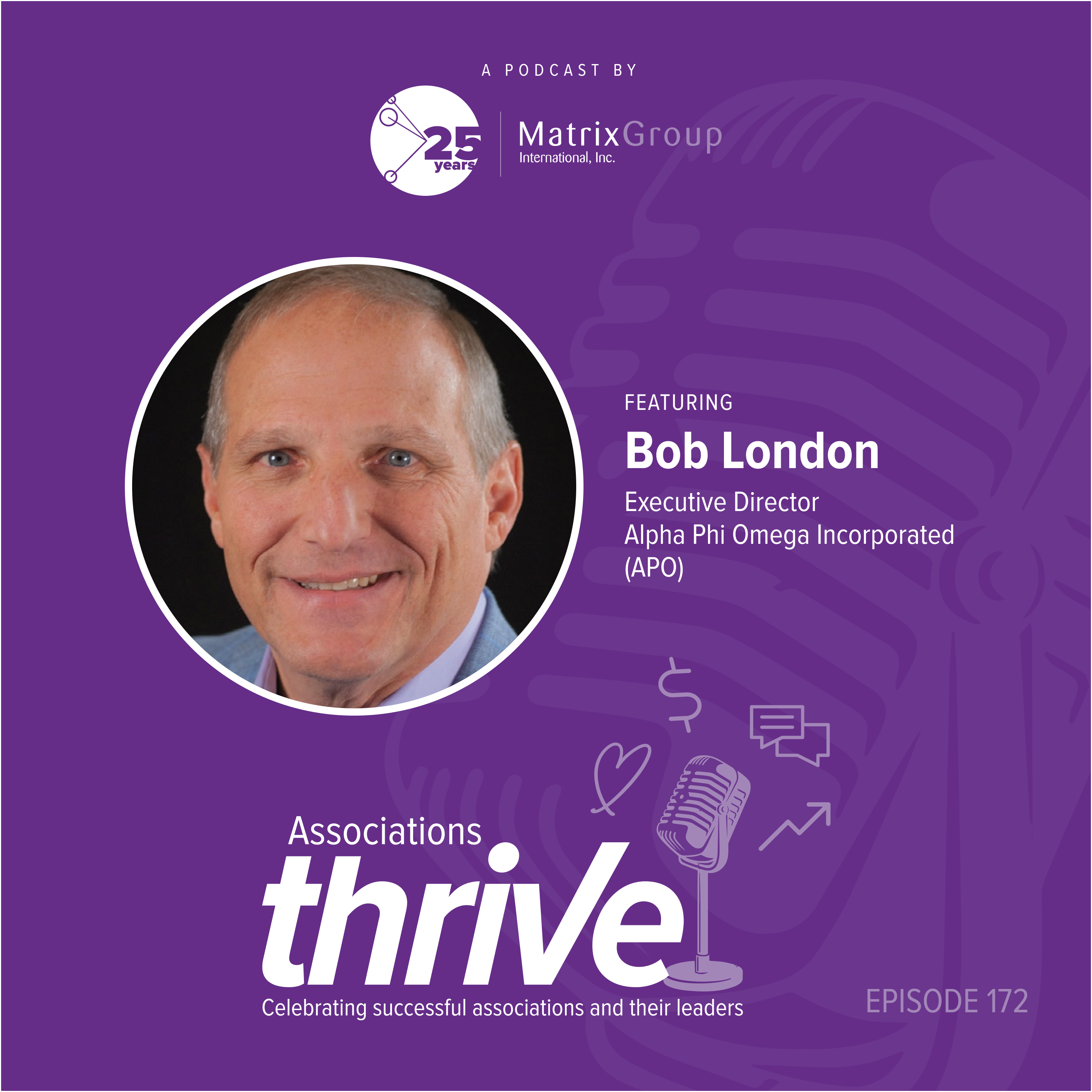 172. Bob London, FASAE, CAE, ED of Alpha Phi Omega, on Leadership Through Service, Capital Campaign Success, and Practicing Foresight | What does it take for a 100-year-old, campus-based organization to stay relevant in a world of virtual chapters, AI search tools, and shrinking higher education enrollments?And in an era of time poverty, information overload, and eroding trust, how can associations help young leaders not only serve—but truly thrive?In this episode of Associations Thrive, host Joanna Pineda interviews Bob London, FASAE, CAE, Executive Director of Alpha Phi Omega (APO). Bob discusses:How APO develops leadership skills through service on nearly 300 campuses, measuring long-term success by how alumni improve their communities after graduation.Why APO focuses exclusively on leadership, fellowship, and service, and how its partnership model with universities differentiates it from other campus organizations.How APO has endured for 100 years by attracting students who are committed to improving their communities, regardless of political or cultural turbulence.The bold decision to remove “campus-based” from APO’s vision statement, and what that means for the future of the organization.Why time is APO’s biggest barrier to membership, and how the organization helps students manage “time poverty.”How Bob fosters a culture of calendar control and focused work within his staff, encouraging everyone yo protect their “golden hours.”APO’s successful $6.5 million capital campaign, combining cash and planned giving to secure the next 100 years while keeping student membership costs to just $85 for a lifetime.Why foresight thinking is now embedded in APO’s board culture, and how scenario exercises and agenda restructuring have shifted the board’s focus toward long-term plausible futures.The signals Bob is watching closely: disruption in higher education and the explosion of information overload.References:APO WebsiteMusic from #Uppbeat (free for Creators!):https://uppbeat.io/t/paul-yudin/quiet-flightLicense code: KJRRI6GHC7WKCLDT | — | ||||||
| 2/5/26 |  171. Sherry Budziak, Founder & CEO, and Kevin Ordonez, President & Managing Director of .orgSource, on their new book, the RUG metaphor, the HEART framework, Leadership, and Culture | What are the “rugs” that your association keeps tripping over but no one talks about? What if there was a common, accessible language to help your staff and board name and move those obstacles? How can an association help members lead with more heart in a fast-moving, AI-driven world?In this episode of Associations Thrive, host Joanna Pineda interviews Sherry Budziak, Founder and CEO, and Kevin Ordonez, President and Managing Director of OrgSource. Sherry and Kevin discuss:Why they wrote their new book, RUG: How to Move What You’re Tripping Over and Lead with Heart, and how the real-life story of a literal rug in a boardroom inspired it.The H.E.A.R.T. Framework: Humanize, Empower, Ascend, Reimagine, and Transform.How the book offers a practical toolkit with discussion questions and “micro-moves” to help teams identify and address cultural and operational obstacles.Why the rug metaphor is so powerful, creating safe, non-threatening language to name problems.How using “the rug” as a metaphor has allowed teams to have more honest conversations and make real progress.Examples of typical “rugs” in associations: over-reliance on outdated processes, fear of making decisions, board bottlenecks, and member experiences designed for internal convenience.How leaders often misattribute cultural or operational issues to technology alone.The need for associations to reframe how they see AI not just as a tech initiative but as a strategic shift in how work gets done.Why leadership involvement is key to moving the “AI rug” and reimagining what’s possible.OrgSource’s new Mastermind and AI Accelerator groups that help leaders and teams take action on these ideas.References:.orgSource WebsiteGet the book: Rug: How to Move What You're Tripping Over and Lead with H.E.A.R.T. | — | ||||||
| 1/22/26 | 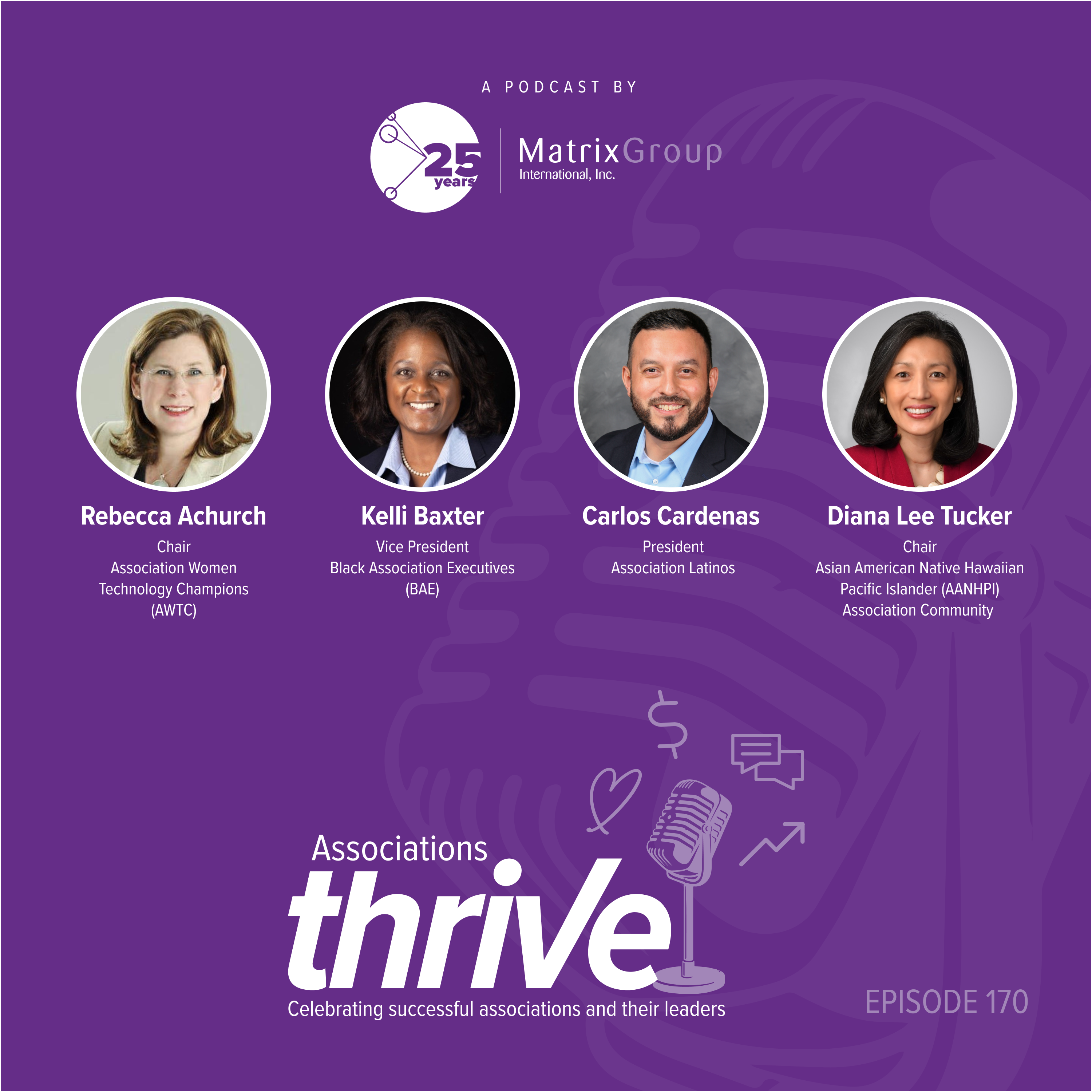 170. Rebecca Achurch, Kelli Baxter, Carlos Cardenas, and Diana Lee Tucker, on the Continuing Importance of Community Groups | What happens when you gather four leaders representing distinct, identity-based association communities? You get a bold conversation about visibility, representation, and creating spaces where people feel they truly belong.In this episode of Associations Thrive, host Joanna Pineda sat down with four Association Community Group leaders:Rebecca Achurch, Chair of Association Women Technology Champions (AWTC)Kelli Baxter, Vice President of Black Association Executives (BAE)Carlos Cardenas, President of Association LatinosDiana Lee Tucker, Chair of Asian American Native Hawaiian Pacific Islander (AANHPI) Association Community They discuss:How each of their organizations was formed out of a need for community and visibility.The power of representation and why identity-specific mentoring matters.Why cultural proximity helps build confidence and unlock leadership potential.Their commitment to allyship and how they've collaborated across groups.The importance of welcoming allies into their communities to foster inclusion.Innovative programs, like peer mentoring and CAE funding, that uplift emerging leaders.Challenges around growth and sustaining energy as founders transition out of leadership.The importance of financial sustainability and succession planning for long-term impact.Their hopes to inspire association CEOs to create similar communities within their industries.Why now is not the time to back away from DEI-focused spaces, despite current headwinds.References:AWTC WebsiteBAE WebsiteAssociation Latinos WebsiteAANHPI Association Community Page | — | ||||||
| 1/15/26 | 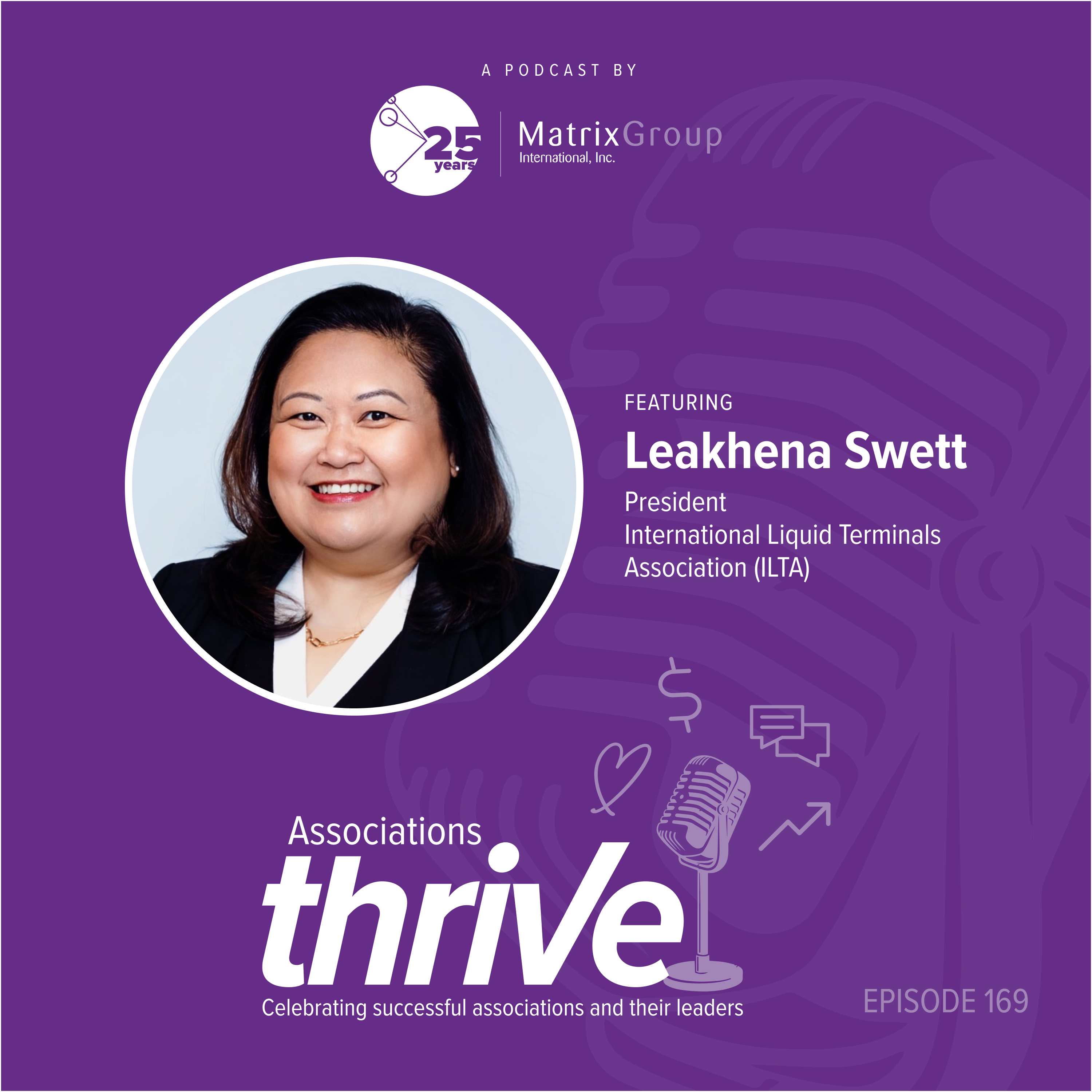 169. Leakhena Swett, President of ILTA, on M&A Disruption, Strategic Flexibility, and Building Community During Conferences | How do you keep members engaged when the industry is undergoing constant mergers and acquisitions? How can an association stay flexible, strategic, and still build a sense of community?In this episode of Associations Thrive, host Joanna Pineda interviews Leakhena Swett, President of the International Liquid Terminals Association (ILTA). Leakhena discusses:What liquid terminals are and how critical they are to the global supply chain, from fuels and chemicals to molasses and palm oil.The diverse membership of ILTA, including 70 terminal members and 300+ supplier members providing everything from drone tech to cleaning services.The constant M&A activity in the industry, and how ILTA mitigates the risk by staying in communication with members and focusing on value.How Leakhena’s background in technology and systems thinking has shaped her strategic approach to leading ILTA.A flexible strategic plan that allows ILTA to pivot quickly, given how fast the industry and regulatory environment are changing.How ILTA is responding to increased demand for in-person engagement by taking committee meetings to member locations.The big changes coming to ILTA’s 2026 annual conference, including CEU accreditation and shorter, more dynamic sessions with organic networking.An intentional move away from rigid session tracks to more inclusive, cross-functional learning.The expansion of roundtable discussions at the conference, supported by a mobile app for gamification and post-event engagement.Why ILTA relocated its HQ from Arlington, VA to downtown DC to better serve its advocacy mission and engage directly with federal agencies.References:ILTA Website | — | ||||||
| 1/8/26 |  168. Matrix Group International, Inc. Staff on Turbocharging with AI, Storytelling, and Personalization | In this special episode of Associations Thrive, host Joanna Pineda is joined by colleagues from Matrix Group International, Inc.: Dave Hoernig, Vice President of Software Engineering, Jessica Parsley, Director of Project Management, and Alex Pineda, Creative Director. They look back on the trends they’re seeing in the association space. They discuss:How AI dominated 2025, with associations investing heavily in staff training, internal policies, and custom GPTs to boost content production and streamline workflows.The AI tools that helped Matrix Group clients modernize outdated content by converting PDFs to HTML, summarizing large documents, and creating metadata and schema for better discoverability.Why associations wrestled with how much previously gated content to expose for AI indexing, balancing member-only value with public visibility and relevance in AI search results.“About the Industry” storytelling sections of a website becoming a trend, with associations crafting narratives to spotlight the importance of their fields not just to members, but to the public and policymakers.How clients faced tighter budgets in 2025, making incremental updates and data-driven decisions more important than ever.The notable rise of multimedia content, with podcasts and audio read-alouds replacing and supplementing long-form text to meet member preferences and improve accessibility.How personalization is becoming easier with AI and how associations can now deliver customized recommendations for members, modeled after platforms like Netflix or Duolingo.How AI is revolutionizing design and development, with tools that boost creativity, accelerate prototyping, and reduce tedious manual work.How mobile-first and voice-enabled experiences are expected to surge, especially as younger members rely more on phones and smart speakers for web interaction.References:Matrix Group WebsiteSee how TFI tells the story of the industry.We made a few tweaks to the ALDA website in advance of a larger redesign in the future. | — | ||||||
| 12/18/25 | 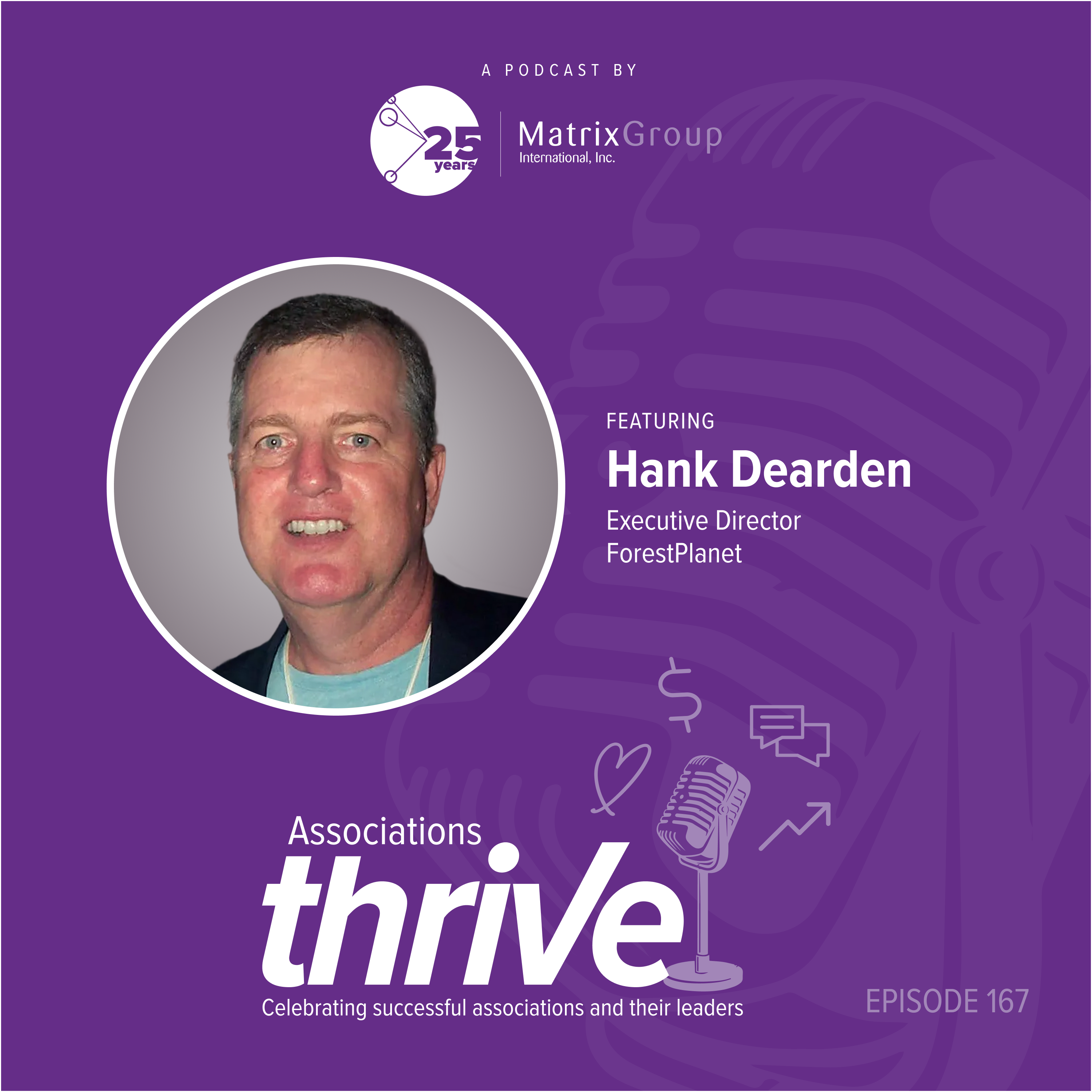 167. Hank Dearden, ED of ForestPlanet, on Planting Trees, Community Impact, and Scalable Environmental Models | How do you tackle deforestation and climate change while strengthening local economies? What’s the role of trees in securing food, water, and livelihoods? And what if environmental nonprofits acted more like sales organizations, with scalable, partner-driven models?In this episode of Associations Thrive, host Joanna Pineda interviews Hank Dearden, Executive Director of ForestPlanet. Hank discusses:How ForestPlanet plants high volumes of trees at very low cost through partnerships with local NGOs.Why ForestPlanet emphasizes community-led initiatives, vetting, and supporting tree-planting organizations in developing countries.How planting trees revitalizes soil, retains water, and improves food and income security.The role of agroforestry and permaculture in transforming degraded land into sustainable ecosystems.Why tree planting is “the catalyst” in a larger chain of environmental and economic benefits.The critical relationship between upstream tree planting and downstream mangrove restoration and fish population health.How ForestPlanet works with corporate partners to plant trees for every product sold. These partnerships benefit ForestPlanet, local communities AND the corporations.References:ForestPlanet WebsiteSupport ForestPlanetThe Hidden Life of Trees, by Peter WohllebenMusic from #Uppbeat (free for Creators!):https://uppbeat.io/t/zoo/clarityLicense code: RQWZMZXYSBVT16ZW | — | ||||||
| 12/11/25 |  166. Richard Roberson, President & CEO of the Mississippi Hospital Association, on the Changing Healthcare Landscape, Members Working Together, and Telling the Hospital Story | How can hospitals in rural and underserved communities innovate, stay open, and thrive amid financial pressures and changing healthcare demands? And how can associations serve as the glue that binds competitors together for a common purpose?In this episode of Associations Thrive, host Joanna Pineda interviews Richard Roberson, President and CEO of the Mississippi Hospital Association (MHA). Richard discusses:MHA’s nearly 100-year history of serving a diverse mix of public, private, religious, and rural hospitals across Mississippi.How MHA helps connect members to collaborate on shared challenges.MHA’s powerful advocacy work at the state and federal levels to support hospitals and ensure they are heard by legislators and agency leaders.The launch and impact of IntelliTrue, a health information exchange platform that improves care coordination, reduces readmissions, and helps avoid unnecessary healthcare costs.How IntelliTrue connects hospitals, physicians, FQHCs, insurers, and mental health centers, providing clinical data that enables better patient care.The innovation behind TrueCare, a provider-owned Medicaid health plan formed by MHA members to improve care and reduce friction between hospitals and payers.How TrueCare is governed by a consortium of large and small hospitals and currently serves 100,000 Medicaid recipients.The power of storytelling and how MHA collects stories through affinity groups, hospital visits, and direct community engagement to humanize healthcare policy.Mississippi’s distinction of having the lowest hospital costs in the country: a positive for patients but a challenge for hospital sustainability.Richard’s vision for the next five years: improved patient outcomes through reduced ER visits and better coordination between providers, supported by a stable policy and payment environment.References:MHA WebsiteIntelliTrueTrueCare Website | — | ||||||
| 12/4/25 | 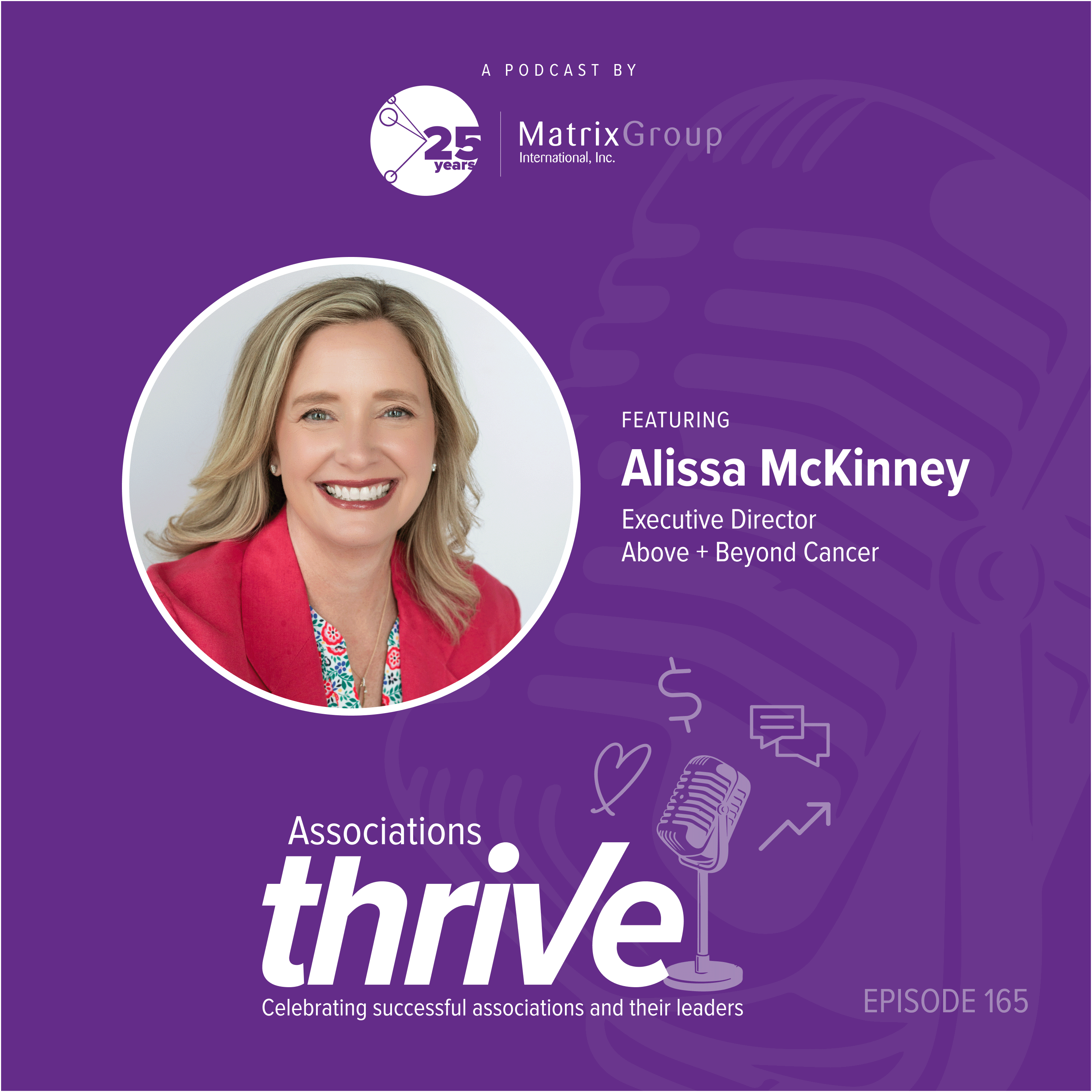 165. Alissa McKinney, ED of Above + Beyond Cancer, on Survivorship, Transformational Journeys, and Building Community | What if we treated every cancer diagnosis not just as a medical challenge but as a journey of hope, strength, and transformation? And what role can an organization play in fostering community and empowerment through that journey?In this episode of Associations Thrive, host Joanna Pineda interviews Alissa McKinney, Executive Director of Above + Beyond Cancer. Alissa discusses:Iowa’s alarming cancer statistics and the environmental and behavioral factors contributing to the state’s high rates.How the medical community defines a survivor as anyone from the moment of diagnosis, not just those in remission.How Above + Beyond Cancer delivers mind-body-spirit programs for cancer survivors and caregivers, all free of charge.Above + Beyond Cancer’s 12-week evidence-based program with pre- and post-assessments to track participants’ strength and health improvements.Above + Beyond’s weekly offerings, like hiking, yoga, aquatics, and pole walking, specifically designed with input from healthcare professionals.Their rural outreach effort, a pilot program to expand cancer survivorship services into rural Iowa, in partnership with local cancer centers and YMCAs.The Transformational Journey program, including physically demanding treks in Patagonia and the Himalayas for survivors and caregivers.How one participant went from being unable to walk a mile to completing a 58-mile hike in Patagonia, rediscovering her strength and confidence.The Celebrate! gala, Above + Beyond Cancer’s signature event that honors organizations and individuals who uplift the cancer community.The upcoming 15th anniversary of Above + Beyond Cancer, including the launch of Iowa’s first-ever survivorship conference in June 2026.References:Above + Beyond Cancer Website | — | ||||||
| 11/20/25 | 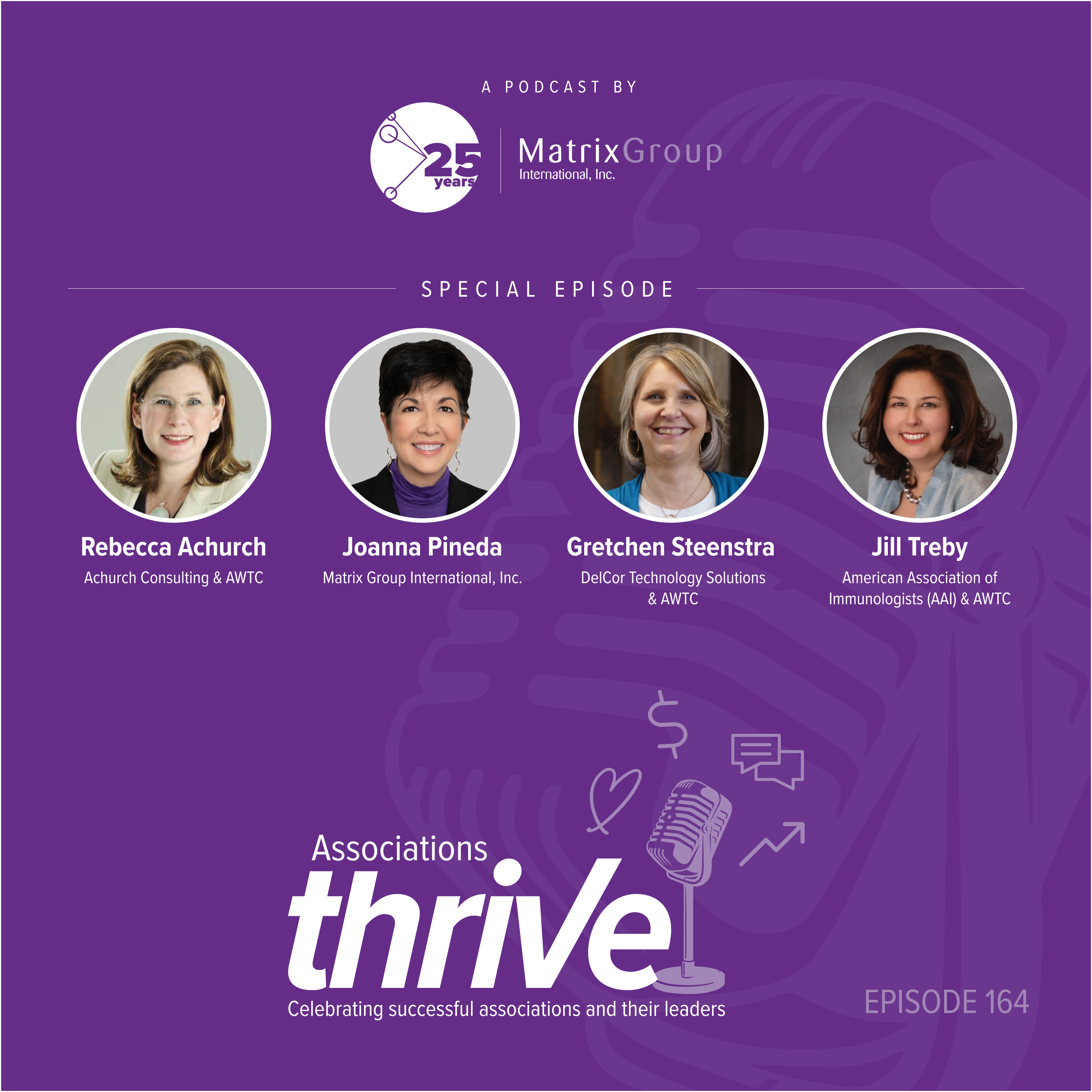 164. Rebecca Achurch, Gretchen Steenstra, Jill Treby, and Joanna Pineda talk about Championing Women and AWTC Advance 2025 | How can your association foster inclusive, empowering spaces that go beyond professional development to create real human connections?In this episode of Associations Thrive, host Joanna Pineda sat down with three Association Women Technology Champions (AWTC) leaders:Rebecca Achurch, CEO of Achurch Consulting and Secretary-Treasurer, Founder and Incoming Chair of AWTCGretchen Steenstra, Director of Client Strategy at DelCor Technology Solutions and Past Chair and Founder of AWTCJill Treby, Director of Membership at the American Association of Immunologists (AAI) and Chair of AWTCThey discuss:The founding and 5-year growth of AWTC as a community for women passionate about technology and leadership in associations.Why “champions” is a verb in AWTC’s name and what it means to be one.The evolution of AWTC’s signature event, Advance, and how it blends networking, learning, and personal development.How the Situation Room format during Advance fosters fast, impactful problem-solving through diverse perspectives.AWTC’s unique, inclusive membership model: free to join, with optional donations, and no barriers to entry.A growing recognition and awards program that celebrates women doing excellent work at all levels, not just lifetime achievers.AWTC’s commitment to access and belonging, including scholarship rates and no-cost virtual programs.The critical role of male allies and volunteers in supporting AWTC’s mission.How local groups (like in Chicago and Denver) are forming organically, expanding AWTC’s reach.Their excitement for 2026: expanded programming, deeper engagement, and a sustainable model that empowers volunteers to lead.References:AWTC WebsiteAWTC on LinkedInAWTC Advance 2025 | — | ||||||
| 11/13/25 | 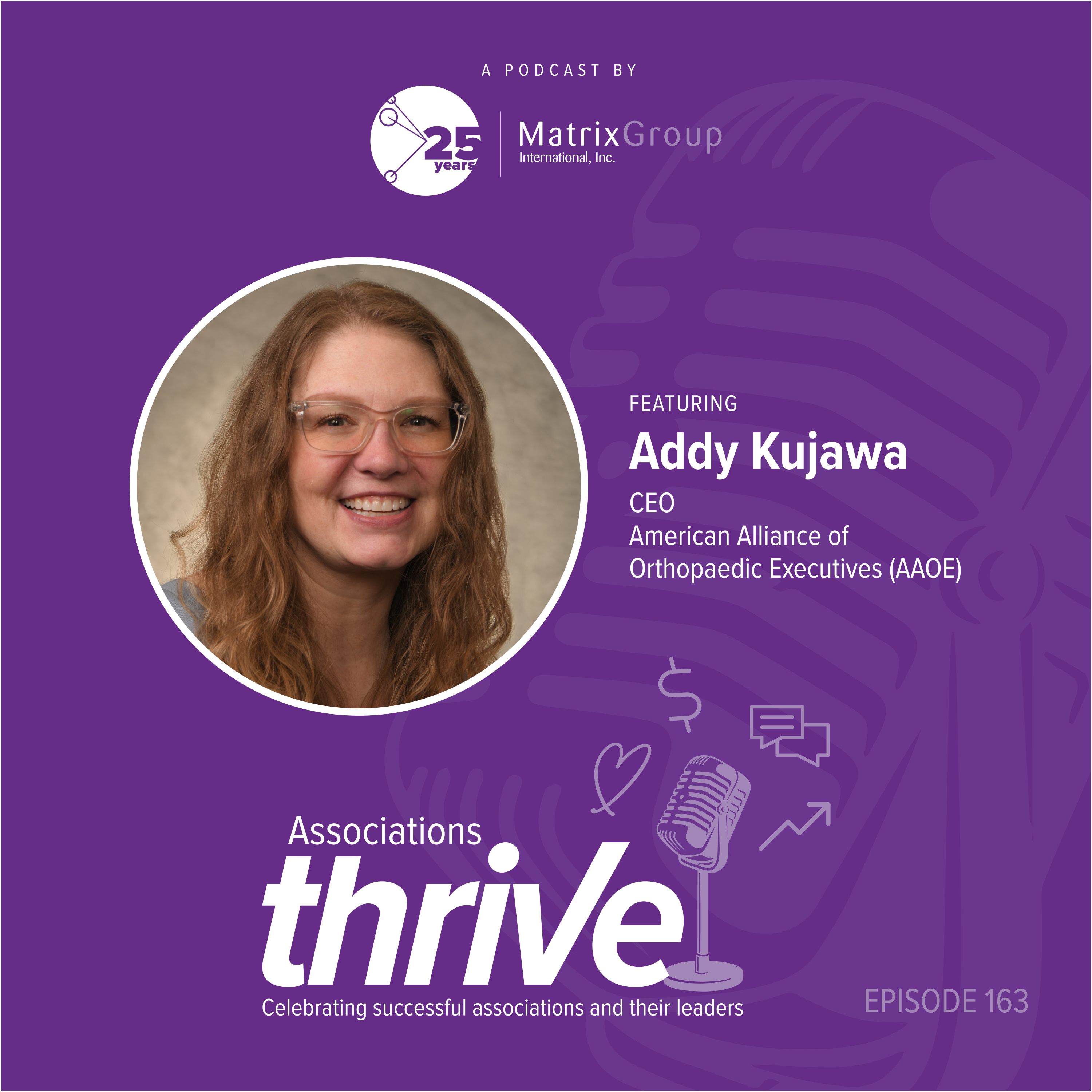 163. Addy Kujawa, CEO of AAOE, on Going Independent, the Entrepreneurial Operating System, and a Culture of Innovation | What does a small association need to go independent? And what does it take to transform an association into an entrepreneurial, nimble, and innovative organization?In this episode of Associations Thrive, host Joanna Pineda interviews Addy Kujawa, CEO of the American Alliance of Orthopaedic Executives (AAOE). Addy discusses:How AAOE supports orthopedic and musculoskeletal practice executives, primarily C-suite leaders focused on the business side of practices.The organization’s evolution from being managed by AAOS to becoming fully independent, and thereby saving costs, increasing agility, and creating a tight-knit, high-performing staff team.The challenges and logistics of relocating the association from Illinois to Indiana, hiring new staff, and setting up operations from scratch.Why independence was the right decision: complete control, direct board governance, nimbleness, and a culture of ownership.How Addy introduced EOS (Entrepreneurial Operating System) to improve accountability, strategic focus, and communication. They began with a 90-day pilot that transformed into a permanent operating model.The success of EOS in fostering innovation, sunsetting underperforming programs, and promoting team-wide accountability and ownership..A young professionals council that created a resource guide for new orthopedic execs, and a revamped webinar program that grew from 15 to 50 annual events.References:AAOE Website | — | ||||||
| 11/6/25 | 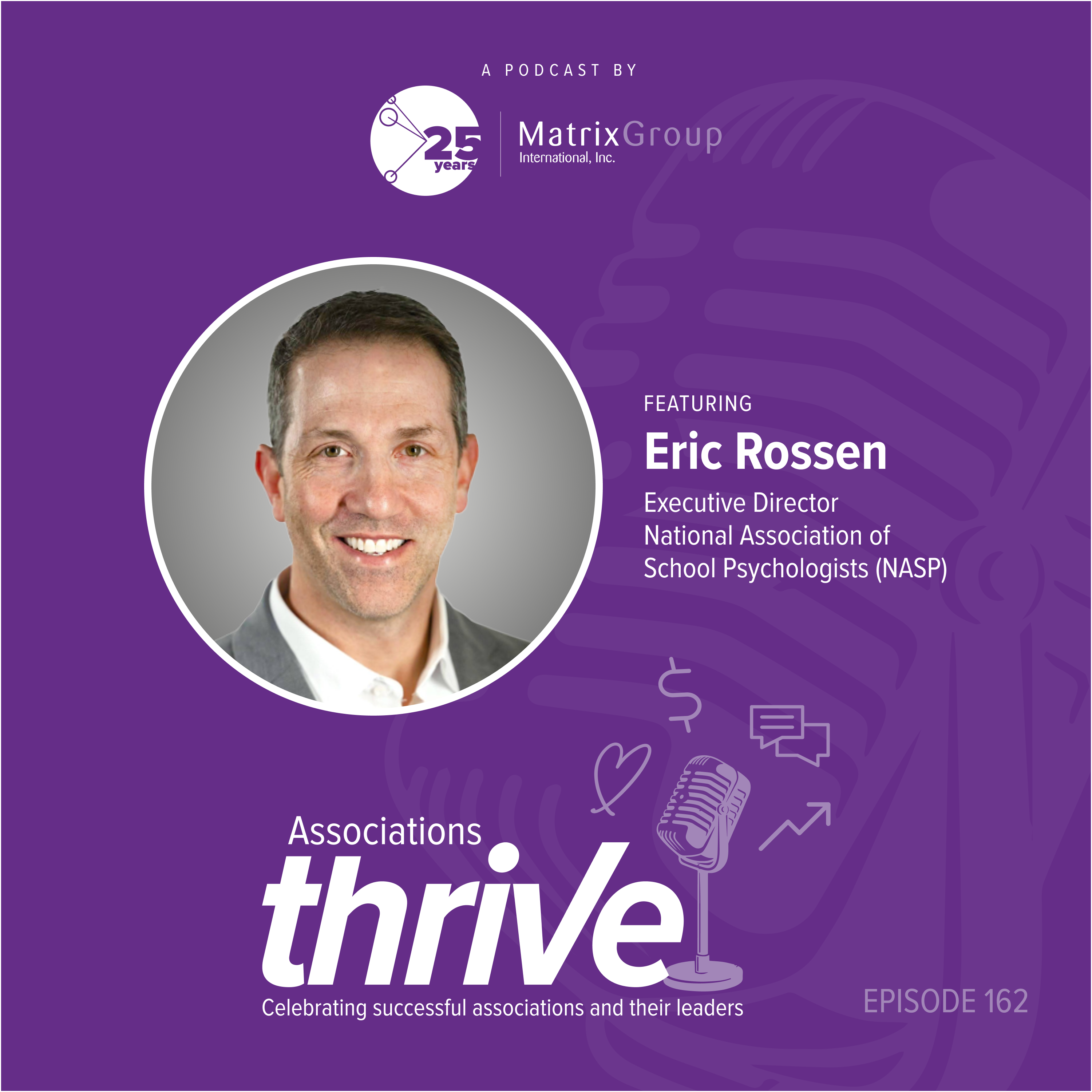 162. Eric Rossen, ED of NASP, on School Psychologist Shortages, Advocacy, and a Culture of Empowerment | What happens when schools don’t have enough psychologists to meet student needs? And how can associations help their members thrive in such an environment?In this episode of Associations Thrive, host Joanna Pineda interviews Eric Rossen, Executive Director of the National Association of School Psychologists (NASP). Eric discusses:How NASP represents over 24,000 school psychologists across the U.S., many of whom serve multiple schools due to a national shortage.The difference between school psychologists and school counselors, and why having both creates “force multipliers” for student success.NASP’s advocacy work around federal funding, including the fight to restore grant money that was being used to address workforce shortages.How NASP is addressing the mental health of its members, who often work in isolated environments, under high stress.Eric’s leadership journey from school psychologist to association executive, and how earning his CAE signaled a full embrace of his role as an association professional.His leadership style shift, from “doing” to empowering, and how he intentionally built trust when stepping into the Executive Director role.Why National School Psychology Week is more than recognition of school psychologists: it’s a tool for public awareness and appreciation of a critical profession.NASP’s upcoming 2026 convention in Chicago, expected to be its largest ever, with Dr. Miguel Cardona as the keynote speaker.How NASP is making its convention more expansive and impactful by welcoming affiliated organizations to host events under its umbrella, creating a “bigger tent” for school psychology.References:NASP WebsiteNASP Annual Convention | — | ||||||
Showing 25 of 186
Pitch Fit is a Pro feature
See how bookable this show is for guests, which brands already advertise, the per-episode ad value, and the best-fit guest and sponsor profile. The numbers are blurred on the free plan.
How readily this show books outside guests like you.
How proven this show is for host-read sponsorships.
For Guests
ProFor Advertisers
ProUpgrade to Pro to unlock guest cadence, sponsor categories, fit scores, and per-episode ad value for this show.
Chart Positions
4 placements across 4 markets.
Chart Positions
4 placements across 4 markets.