
Insights from recent episode analysis
Audience Interest
Podcast Focus
Publishing Consistency
Platform Reach
Insights are generated by CastFox AI using publicly available data, episode content, and proprietary models.
Total monthly reach
Estimated from 5 chart positions in 5 markets.
By chart position
- 🇯🇵JP · Food#8510K to 30K
- 🇮🇳IN · Food#1391K to 10K
- 🇻🇳VN · Food#117500 to 3K
- 🇿🇦ZA · Food#130500 to 3K
- 🇸🇬SG · Food#131500 to 3K
- Per-Episode Audience
Est. listeners per new episode within ~30 days
6.3K to 25K🎙 Weekly cadence·13 episodes·Last published 9mo ago - Monthly Reach
Unique listeners across all episodes (30 days)
13K to 49K🇯🇵61%🇮🇳20%🇻🇳6%+2 more - Active Followers
Loyal subscribers who consistently listen
3.8K to 15K
Market Insights
Platform Distribution
Reach across major podcast platforms, updated hourly
Total Followers
—
Total Plays
—
Total Reviews
—
* Data sourced directly from platform APIs and aggregated hourly across all major podcast directories.
On the show
Recent episodes
Bread Is Life: Kashmir’s Sacred Flame - Whetstone Audio Dispatch
Aug 25, 2025
Unknown duration
Gardening on Water: The Dal’s Ancient Floating Gardens
Aug 13, 2025
Unknown duration
Revolutionary Seed: Voice to Indian Farmers
Mar 2, 2022
Unknown duration
How Indian Food Became Frustratingly Hip
Feb 23, 2022
Unknown duration
Beyond Momos: Imaginary Homelands and Tibetan Food in India
Feb 16, 2022
Unknown duration
Social Links & Contact
Official channels & resources
Official Website
Login
RSS Feed
Login
| Date | Episode | Description | Length | ||||||
|---|---|---|---|---|---|---|---|---|---|
| 8/25/25 |  Bread Is Life: Kashmir’s Sacred Flame - Whetstone Audio Dispatch | What if a simple loaf of bread could tell the story of an entire place, its resilience, its politics and poetry? In this episode of Whetstone Audio Dispatch, host Meher Varma takes us deep into the heart of Srinagar, Kashmir, where the unmistakable aroma of freshly baked tchot leads her to the neighborhood kandur, a traditional bakery that’s far more than just a place to buy bread.Through conversations with bakers, poets, and everyday customers, we uncover how these bakeries, modest structures built of brick and smoke, have become cornerstones of community life, sacred tradition, and resistance. We meet legendary Zareef Ahmed Zareef, who traces the 4,000-year-old roots of Kashmiri baking, and listen to local myths where mystics emerge from tandoors bejeweled and unburned.Whether it’s feeding a neighborhood during a curfew, sharing unspoken trust through pay-later systems, or trading morning news, bread becomes a portal into an unseen Kashmir, one where bread is more than sustenance; it is survival, spirit, and social glue.This episode was made possible by the support of @heirloomcities | — | ||||||
| 8/13/25 | Gardening on Water: The Dal’s Ancient Floating Gardens | Gardening on Water: The Dal’s Ancient Floating GardensFor thousands of years, Kashmir has been called jannat (heaven) by Urdu poets, travelers, and tourists. The Dal Lake in Srinagar is a jewel in its crown. Flamingo pink lotuses carpet the waters, and shikaras —small wooden boats— row upon it, making the destination a favorite for Instagram-loving honeymooners. However, deep in the Dal is a world less visible: its floating gardens. In Gardening on Water, Meher Varma, returns with a two-part audio dispatch from Srinagar, introducing us to the political complexities that challenge the reductive depiction of 'Kashmir as heaven on earth.’ Join us as we row you through the majestic and complex world of Dal's Floating Gardens. This episode was made possible by the support of @heirloomcities | — | ||||||
| 3/2/22 |  Revolutionary Seed: Voice to Indian Farmers | In September 2020, the government of India approved a series of agricultural acts, often referred to as the “Farm Bills.” What was proposed threatened to change the state of agriculture in India forever, and thus, inspired a long farmers' protest that is only just coming to a conclusion (thanks to a recent announcement that confirms the laws have been repealed). This episode tracks my journey to Tikri border — located on the capital’s suburbs — where thousands of farmers lived as they protested the effects of neoliberalism on Indigenous agricultural systems. Cooking with the community and feeding everyone who came to the site (including the police!) was one crucial way in which solidarity was cemented. My guide, and the guest of this show, is the inspirational activist Navkrian Natt, who along with thousands of farmers, resisted injustice with all her heart. Learn more about this episode of Bad Table Manners at www.whetstoneradio.com, on IG and Twitter at @whetstoneradio, and YouTube at WhetstoneRadio. | — | ||||||
| 2/23/22 |  How Indian Food Became Frustratingly Hip | Thanks to the cool-ification of Indian food, traditional ingredients from the subcontinent, like turmeric and ghee, are now repackaged and resold in Western and Westernized markets as if they were “new” discoveries. Cleaned up, minimalistic design labels are often employed to give the familiar and unfamiliar look, and conceal what one can argue is a recolonization of the Global South by the Global North. The U.S.-based academic Rumya Putcha tells us why this hipster Indian food is problematic, while Vidya Balachander, current South Asia editor at Whetstone, helps us unpack the idea of the global supermarket. Topics covered in this episode: Min 1:40: Meet Rumya Putcha Min 2:08: Meet Vidya Balachander Min 3:29: The root of the frustration Min 7:24: Logic of “cool-ification” Min 9:42: Marketing Otherness Min 11:00: Wellness as a form of travel Min 15:56: Displays of diversity in supermarkets Min 18:53: Aesthetics of Otherness Min 21:47: Going beyond outrage Min 25:38: Question of authenticity Min 28:03: No easy answer Learn more about this episode of Bad Table Manners at www.whetstoneradio.com, on IG and Twitter at @whetstoneradio, and YouTube at WhetstoneRadio. Guests: Rumya Putcha (@snailmobile821), Vidya Balachander (@vidya83) | — | ||||||
| 2/16/22 |  Beyond Momos: Imaginary Homelands and Tibetan Food in India | Beginning with a brief history of Tibetans in exile, this episode explores how food can create imaginary homelands, even if it means that authenticity itself needs to be invented and reinvented. Three Tibetans in the diaspora, Jamyang Phuntsok, Tencho Gyatso, and Nima Dorjee, are the guests on this episode. Through conversations that range from personal histories to current food interests, we will talk about gastronomy and memory, tsampa as a potential political tool, and what role food can play for a community in exile. Topics covered in this episode: Min 0:00: The idea of home as connected to food Min 1:42: Meet Jamyang Phuntsok Min 1:58: Meet Tencho Gyatso Min 2:40: Meet Nima Dorjee Min 4:34: An overview of Tibetan food in India Min 6:30: The popularization and adaptation of momos Min 10:09: Politics of tsampa Min 16:32: On authenticity in the context of exile Min 21:05: Chinese influence in Tibetan food Min 23:01: Food and solidarity Learn more about this episode of Bad Table Manners at www.whetstoneradio.com, on IG and Twitter at @whetstoneradio, and YouTube at WhetstoneRadio. Guests: Jamyang Phuntsok (@jongtrukh), Tencho Gyatso (@simplytibetan), Nima Dorjee Ethereal Relaxation by Kevin MacLeod Link: https://incompetech.filmmusic.io/song/8719-ethereal-relaxation License: https://filmmusic.io/standard-license | — | ||||||
| 2/9/22 |  Ripples and Tipples: How Partition Changed Indian Food | In 1947, the British finally left India after 300 years of colonial rule. They created many arbitrary borders as they left, the most prominent of which was the line that was to separate India from Pakistan. The aftermath of this divide resulted in the greatest migration in human history, as millions made their way across hundreds of miles in the hope of creating new homes. The impact of this critical event is mirrored in what has become known as Delhi’s food culture, both at home and abroad. The well-known food historian Anoothi Vishal reminds us how partition lives on in India’s capital, while Jonathan Nunn, editor of the shape-shifting newsletter Vittles, shows us how the event created ripples in the imperial city of London. Partition transformed “Indian food,” in both colony and empire, and still shows its effects in new Indian restaurants today. Topics covered in this episode: Min 0:00: What is Partition? Min 1:35: Meet Meher’s grand-aunt, Jeeti Nani Min 2:30: Meet Anoothi Vishal Min 3:42: From Mughlai cuisine to a dominant Punjabi cuisine Min 8:31: Jeeti Nani’s account of dining practices pre- and post-Partition Min 12:17: Collapse of a feudal order Min 15:14: Meet Jonathan Nunn Min 16:25: Ripple effects of Partition in London Min 21:55: Complexities behind the modern British-Raj aesthetic Min 27:19: Regional cuisines in London beyond Punjabi tandoori food Learn more about this episode of Bad Table Manners at www.whetstoneradio.com, on IG and Twitter at @whetstoneradio, and YouTube at WhetstoneRadio. Guests: Anoothi Vishal (@anoothivishal), Jonathan Nunn (@jonathandnunn) | — | ||||||
| 2/2/22 |  Mid-Day Meal | The Mid-Day Meal feeds millions of schoolgoing Indian children daily, and has widely been considered one of India’s most successful welfare programs. Two economists who have been instrumental in its success, Jean Drèze and Reetika Khera, will uncover the history of this program, but also remind us that because what's on plates is always political, the future of welfare too, is uncertain. A focused discussion on the contentious introduction of the egg in the meal will, in particular, reveal how sometimes, unfortunately, political interests can trump the basic human right to food and nutrition. Topics covered in this episode: Min 0:00: What is the Mid-Day Meal? Min 1:50: Meet Jean Drèze Min 2:14: Benefits of the Mid-Day Meal Min 6:04: Criticisms of the program Min 7:00: Meet Reetika Khera Min 10:31: A strong case for the inclusion of eggs Min 12:51: The politics behind the egg Min 17:52: Why eggs over other sources of protein Min 24:11: Lobbying attempts by the biscuit industry Min 26:48: What Mid-Day Meal looks like today Learn more about this episode of Bad Table Manners at www.whetstoneradio.com, on IG and Twitter at @whetstoneradio, and YouTube at WhetstoneRadio. Guests: Jean Drèze, Reetika Khera | — | ||||||
| 1/26/22 |  Where There Are No Butchers, There Are Cinnamon Buns | This episode flips the script on caste and food by celebrating and exploring the food practices of caste oppressed communities. Is there such a thing as “Dalit cuisine?” Do Dalit chefs and food enthusiasts accept this term? What are Dalit recipes, and how have they been archived and reproduced? Can food be a site of caste abolitionism? The two guests on this episode – Vinay Kumar and Rajyashri Goody – who self-identify as Dalit, offer their own personal reflections on food and food politics. Topics covered in this episode: Min 0:48: The caste system in India Min 3:38: Meet Vinay Kumar Min 4:10: Meet Rajyashri Goody Min 7:37: Caste and food Min 10:14: Is there such thing as standalone Dalit cuisine? Min 12:32: Access to food (and lack thereof) Min 14:49: Where there are no butchers, there are cinnamon buns Min 19:56: When elite words are applied to Dalit food Min 25:49: The complexities behind the idea of a Dalit cookbook Min 27:43: Limitations to a “recipe” Min 31:19: Balancing moments of joy and struggle Min 35:15: Food as protest and resistance Learn more about this episode of Bad Table Manners at www.whetstoneradio.com, on IG and Twitter at @whetstoneradio, and YouTube at WhetstoneRadio. Guests: Vinay Kumar (@thevinaygreen), Rajyashri Goody (@rajgoody) | — | ||||||
| 1/19/22 |  The Dream of Two Kitchens | This episode presents a micro-history of contemporary Indian kitchen design, as told by Manju Sara Rajan, the editor of a prominent design magazine, and Madhav Raman, an award-winning architect in New Delhi. We look at what lies behind the urban, aspirational dream of two kitchens — one visible and one concealed — which has roots in a historical wet and dry kitchen binary. We also look at what interventions open and modular kitchens have made in this history, and what it means for gender and caste politics that still lie at the heart of Indian kitchen design. How do urban Indians negotiate the waves of aromas and the inevitability of oil splatters that come with making Indian food with their desire to showcase their Scandinavian-inspired kitchens in India all at once? We talk about how in urban India, the aspiration is really to have it all. Topics covered in this episode: Min 1:25: Meet Manju Sara Rajan Min 1:58: Concept of the wet and dry kitchen Min 4:30: Meet Madhav Raman Min 4:57: Economic liberalization in India Min 9:50: How the new apartment kitchen transformed the way people cooked Min 13:53: The front-of-house and back-of-house split Min 17:25: The fridge’s place in the Indian kitchen Min 23:06: Vastu-compliance Min 25:04: Future of Indian kitchen design Min 26:01: Gendered labor divide Min 30:07: How COVID affected Indian kitchens Learn more about this episode of Bad Table Manners at www.whetstoneradio.com, on IG and Twitter at @whetstoneradio, and YouTube at WhetstoneRadio. Guests: Manju Sara Rajan (@manjusararajan), Madhav Raman (@anagramarchitects) | — | ||||||
| 1/12/22 |  Eating Capital | Eating Capital focuses on the restaurant business in Delhi and Mumbai, an industry that, according to most experts, has irrevocably transformed due to the COVID pandemic. Cloud kitchens have exploded, and delivery, rather than dining in, has become the name of the game. In this episode I speak with an established restaurant consultant, Samir Kuckreja, and two restaurant owners, Kainaz Messman and Jiten Suchede, to ask what it really takes for independent cafes and coffee shops to tick in today’s highly competitive market. What are the values that restaurant owners must weigh in order to survive? These conversations are full of sharp insights for anyone who has ever thought about opening a cafe, and the news is not all discouraging. Topics covered in this episode: Min 3:22: Meet Samir Kuckreja Min 3:33: The impact of the pandemic on India’s restaurants Min 4:50: Meet Kainaz Messman Min 6:00: Adapting one’s business to survive Min 9:46: Cloud kitchens and delivery models Min 15:20: Meet Jiten Suchede Min 17:11: Jiten’s tips for running a restaurant Min 20:56: Challenges of working in hospitality as a woman Learn more about this episode of Bad Table Manners at www.whetstoneradio.com, on IG and Twitter at @whetstoneradio, and YouTube at WhetstoneRadio. Guests: Samir Kuckreja, Kainaz Messman (@theobromapatisserie), Jiten Suchede (@jugmugthela) | — | ||||||
Want analysis for the episodes below?Free for Pro Submit a request, we'll have your selected episodes analyzed within an hour. Free, at no cost to you, for Pro users. | |||||||||
| 1/5/22 |  The Juice of Mango Clichés | To speak about Indian mangoes may be cliché, but because Indians never seem to tire of the subject, there’s always some juice. London-based writer, Nikesh Shukla, will humorously tell us how to devour one correctly – a skill most South Asians seem to inherently possess – while halfway justifying why our obsession for the fruit can and should live on. A conversation with food historian Vikram Doctor follows as he talks about the colonial legacy that underpins this obsession, and the parochialism that most Indians adopt as they cultivate their specific mango fetishes. I conclude in a kitchen with a Delhi-based pastry chef, Ruchi Vaish, who turns herself in as a Mango Obsessive. For her, mango season is the very best. Topics covered in this episode: Min 00:31: Meet Nikesh Shukla Min 3:27: How to eat a mango properly Min 4:30: Mango in literature Min 7:55: Meet Ruchi Vaish Min 8:02: Ways to cook and bake with mango Min 9:01: Meet Vikram Doctor Min 10:30: Alphonso mango, the “king of kings” Min 12:49: Is mango parochialism political? Min 17:37: The British love for mango pickles Min 21:08: Income hanging from a tree Min 30:20: A mango that’s “good for diabetics” Min 31:55: Making mango cheesecake with Ruchi Learn more about this episode of Bad Table Manners at www.whetstoneradio.com, on IG and Twitter at @whetstoneradio, and YouTube at WhetstoneRadio. Guests: Nikesh Shukla (@nikeshshuklawriter), Vikram Doctor (@vikram.doctor), Ruchi Vaish (@intheknowkitchen) | — | ||||||
| 12/15/21 |  The Scale Show | This episode unravels the discrepancy between the illusion of oceanic abundance that our modern pescatarian diets are premised upon, and the reality of our waterways. To tell this story, I travel through Goa’s fish markets, seafood restaurants and jetties with marine biologist and Goa native – Aaron Lobo. We discuss how the modern fishing industry is depleting ocean life at an alarming rate, the implications of promoting the dinner plate-sized filet, and seeing fish as superfoods. It is quite apparent that there are not that many fish in the sea after all, but rather than making a case to stop fish eating, Aaron suggests something more compelling as a solution. Topics covered in this episode: Min 1:20: An intro to Bad Table Manners Min 3:27: Meet Aaron Lobo Min 4:16: Reconnecting with the food system Min 4:51: Meet Samanth Subramanium Min 5:06: Goa’s economy of idleness Min 6:30: The performativity of modern-day fish markets Min 11:20: From artisanal fishing to bottom trawling Min 18:55: The importance of bycatch to ecology and food security Min 24:18: A case for eating lower down the marine food web Min 26:37: An author’s reflections on fishing Min 28:54: Globalization’s contribution to the arrival of new species in Goa Min 32:00: Steps to a better system Learn more about this episode of Bad Table Manners at www.whetstoneradio.com, on IG and Twitter at @whetstoneradio, and YouTube at WhetstoneRadio. Guest: Aaron Lobo (@meenscientist) | — | ||||||
| 12/14/21 | 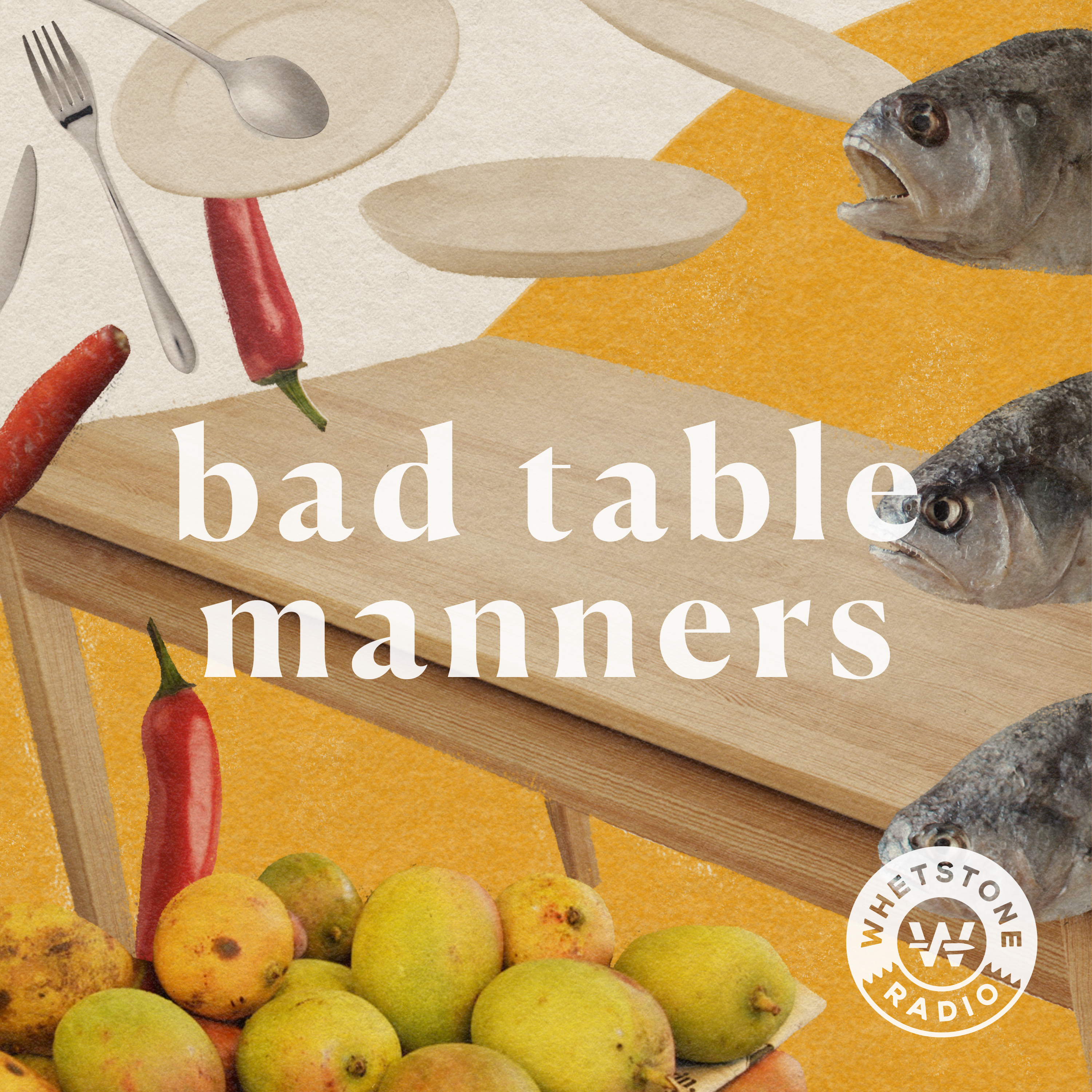 Trailer - Bad Table Manners | Here’s a peek at what’s coming up in the first season of #BadTableManners, launching this Wed, Dec 15! | — | ||||||
Showing 13 of 13
Sponsor Intelligence
Sign in to see which brands sponsor this podcast, their ad offers, and promo codes.
Chart Positions
5 placements across 5 markets.
Chart Positions
5 placements across 5 markets.