Insights from recent episode analysis
Audience Interest
Podcast Focus
Publishing Consistency
Platform Reach
Insights are generated by CastFox AI using publicly available data, episode content, and proprietary models.
Most discussed topics
Brands & references
Est. Listeners
Based on iTunes & Spotify (publisher stats).
- Per-Episode Audience
Est. listeners per new episode within ~30 days
25,001 - 50,000 - Monthly Reach
Unique listeners across all episodes (30 days)
25,001 - 75,000 - Active Followers
Loyal subscribers who consistently listen
15,001 - 40,000
Market Insights
Platform Distribution
Reach across major podcast platforms, updated hourly
Total Followers
—
Total Plays
—
Total Reviews
—
* Data sourced directly from platform APIs and aggregated hourly across all major podcast directories.
On the show
From 11 epsHost
Recent guests
Recent episodes
Why the Fed Matters Now More Than Ever, with Douglas Diamond
Apr 30, 2026
37m 08s
Anxious? Avoidant? How to Build More Secure Relationships
Apr 16, 2026
36m 56s
Could AI Models Forecast Extreme Weather Events? with Pedram Hassanzadeh
Apr 2, 2026
35m 16s
Are Judges Too Powerful? The Rise of Universal Injunctions, with Samuel Bray
Mar 19, 2026
40m 08s
Could Data Centers Break Our Power Grid? with Andrew Chien
Mar 6, 2026
37m 02s
Social Links & Contact
Official channels & resources
Official Website
Login
RSS Feed
Login
| Date | Episode | Topics | Guests | Brands | Places | Keywords | Sponsor | Length | |
|---|---|---|---|---|---|---|---|---|---|
| 4/30/26 | ![]() Why the Fed Matters Now More Than Ever, with Douglas Diamond✨ | Federal Reserveeconomics+3 | Douglas Diamond | University of ChicagoFederal Reserve+1 | — | Federal ReserveDouglas Diamond+5 | — | 37m 08s | |
| 4/16/26 | ![]() Anxious? Avoidant? How to Build More Secure Relationships✨ | attachment stylesrelationships+3 | Amir Levine | Columbia University Medical CenterAttached+1 | — | attachment stylessecure relationships+3 | — | 36m 56s | |
| 4/2/26 | ![]() Could AI Models Forecast Extreme Weather Events? with Pedram Hassanzadeh✨ | AIextreme weather+3 | Pedram Hassanzadeh | University of ChicagoUniversity of Chicago Podcast Network | — | AI modelsextreme weather+6 | — | 35m 16s | |
| 3/19/26 | ![]() Are Judges Too Powerful? The Rise of Universal Injunctions, with Samuel Bray✨ | judicial poweruniversal injunctions+3 | Samuel Bray | University of Chicago | — | universal injunctionsjudicial power+3 | — | 40m 08s | |
| 3/6/26 | ![]() Could Data Centers Break Our Power Grid? with Andrew Chien✨ | data centerspower grid+3 | Andrew Chien | University of ChicagoAI+1 | — | data centerspower grid+4 | — | 37m 02s | |
| 2/19/26 | ![]() Remarkable New Treatments for Spinal Cord Injuries, with Mohamad Bydon✨ | spinal cord injuriessurgery+4 | Mohamad Bydon | University of Chicago | Europe | spinal cord injurysurgery+5 | — | 26m 28s | |
| 2/5/26 | ![]() Can You Improve Your Working Memory and Attention? with Edward Awh✨ | working memoryattention+4 | Edward Awh | University of ChicagoUniversity of Chicago Podcast Network | — | working memoryattention+5 | — | 35m 36s | |
| 1/22/26 | ![]() Why Knowing Your True Self Is So Difficult, with Eric Oliver✨ | self-discoveryidentity+3 | Eric Oliver | University of ChicagoHow to Know Your Self: The Art & Science of Discovering Who You Really Are | — | selfidentity+5 | — | 31m 51s | |
| 1/8/26 | ![]() The Breakthrough Quantum Sensor That Sees Inside Your Cells, with Peter Maurer✨ | quantum sensorsbiological quantum bits+3 | Peter Maurer | University of Chicago | — | quantum sensorqubit+3 | — | 35m 41s | |
| 12/29/25 | How to Manifest Your Destiny with the Late James Doty✨ | manifestationneuroscience+4 | James Doty | Stanford UniversityMind Magic: The Neuroscience of Manifestation and How It Changes Everything | — | manifest your destinyneuroscience+4 | — | 31m 47s | |
Want analysis for the episodes below?Free for Pro Submit a request, we'll have your selected episodes analyzed within an hour. Free, at no cost to you, for Pro users. | |||||||||
| 12/11/25 | What Makes Music Go Viral—From AI to Taylor Swift✨ | musicviral culture+4 | Paula Clare Harper | University of ChicagoTaylor Swift: The Star, The Songs, The Fans | — | music viralitysocial media+5 | — | 35m 41s | |
| 11/24/25 | How Wearable Tech Will Heighten Our Senses and Abilities, with Pedro Lopes | Can you imagine a world in which a wearable device, like a smartwatch, could move your fingers to strum the guitar or play the drums? That kind of technology is part of the innovative research coming out of the Human-Computer Integration Lab at the University of Chicago, led by renowned computer scientist Pedro Lopes. His lab is developing a new generation of gadgets that use haptics (or tactile sensations like the buzz of your smartphone) to move your body, replicate your sense of smell and even make you feel things. In this episode, Lopes explores the potential of wearable devices to transform our future as well as brain-computer interfaces that are being developed by companies like Elon Musk’s Neuralink that directly into the body. | — | ||||||
| 11/13/25 | ![]() Why Are More Women Saying No To Having Kids? With Peggy O'Donnell Heffington | More and more women in the United States are saying no to motherhood. In 2023, the U.S. fertility rate reached the lowest number on record. But the idea of non-motherhood is actually not a new phenomenon, nor did it come out of the modern feminist movement. For centuries, women have made choices about limiting births and whether or not to become mothers at all. This history is documented in a new book, "Without Children: The Long History of Not Being a Mother," by University of Chicago Assistant Instructional Professor Peggy O'Donnell Heffington. Heffington writes about the historic trends of non-motherhood as well as the modern factors that are playing a role in women's choices to not have children today — from lack of structural support in the workplace, to a national law for paid maternity leave, and the sheer lack of affordability. She writes that if these trends continue, American millennials could become the largest childless cohort in history. | — | ||||||
| 10/30/25 | How Full-Body MRIs Could Predict Your Long-Term Health, with Daniel Sodickson | What does it mean to see beneath the surface — of the human body, the brain, or even the universe itself? In his new book, The Future of Seeing: How Imaging Is Changing Our World, Prof. Daniel Sodickson of NYU explores the future of imaging: How technology is transforming not just medicine, but our very ways of perceiving the world. With the rise of AI-driven “digital vision,” Sodickson, a pioneer of MRI innovation, argues that imaging is no longer just a diagnostic tool — it’s becoming a new language of discovery. In this conversation, Sodickson explores the promises and pitfalls of this promising new technology. Reflecting on the history of scientific discovery, we examine what the next generation of imaging might reveal about life itself. | — | ||||||
| 10/16/25 | Is There Such A Thing As A Psychopath? | Few ideas have gripped the public imagination quite like the idea of the “psychopath.” From Hollywood thrillers to true-crime podcasts, popular culture has led us to believe that psychopaths are dangerous and biologically distinct from the rest of us. But what if almost everything we think we know about them is wrong? In this episode, we talk with Rasmus Rosenberg Larsen, an Assistant Professor of Forensic Epistemology at the University of Toronto and author of "Psychopathy Unmasked," whose research is challenging the very foundation of psychopathy as a diagnosis. Larsen explains how the term “psychopath” is relatively new, dating to the Ted Bundy trial in the 1970s, and how TVs and movies have skewed our understanding of the “psychopath.” He discusses psychopathy tests, their impact on the criminal justice system—and what the latest science reveals about the minds we’ve long misunderstood. | — | ||||||
| 10/2/25 | Why We Haven’t Solved Brain Disorders—And How To Fix It, with Nicole Rust | For decades, neuroscience has promised breakthroughs in treating conditions like depression, schizophrenia, and Alzheimer’s. Yet despite powerful technologies and billions invested, progress has been frustratingly slow. Why? On this episode of Big Brains, we talk with Nicole Rust, neuroscientist at the University of Pennsylvania and author of Elusive Cures. Rust argues that the traditional “domino” view of the brain—where one broken piece can simply be fixed—has held us back. Instead, she says we need to embrace the brain’s true nature: a complex, dynamic system more like the weather than a machine. We explore why treatments so often fail, what makes mood such a scientific mystery, and whether a new era of brain research—powered by models, feedback loops, and fresh ways of thinking—can finally deliver the cures that have long eluded us. | — | ||||||
| 9/19/25 | Life On Mars: Is It Possible For Humans? with Edwin Kite | Billions of years ago, Mars may have looked less like the barren red desert we know today and more like Earth—with a blue sky, flowing rivers, and even seas. What happened to turn a once-habitable world into the frozen, lifeless planet we see now? On this episode of Big Brains, University of Chicago geophysical scientist Edwin Kite takes us on a journey through Mars’ hidden past. From evidence of a lost carbon cycle to theories about ancient climate swings, Kite’s research is rewriting the story of the Red Planet. But it’s not just about the past—his work is also at the forefront of a provocative question: could humanity one day terraform Mars and make it a living world again? | — | ||||||
| 9/4/25 | How To Use Nature To Restore Your Focus, with Marc Berman | We’re living in an attention economy—and most of us are broke. But what if the secret to restoring your focus, improving your mental health, and even reducing crime rates wasn’t found in an app or a pill, but in a tree? In this episode, we speak with University of Chicago psychologist Marc Berman, whose research on “soft fascination” and nature’s cognitive effects is reshaping how we think about everything from urban planning to depression treatment. From groundbreaking hospital studies to surprising results with plastic plants, Berman’s work uncovers the deep—and often invisible—power that natural environments hold over our minds and bodies. Whether you're a city planner, a parent, or just someone feeling mentally fatigued, this conversation may just change the way you think about a walk in the park. | — | ||||||
| 8/21/25 | Could Plants Unlock Quantum Medicine’s Potential? with Greg Engel | We’ve long marveled at how efficiently plants convert sunlight into energy—but no one guessed they were using quantum mechanics to do it. In this episode, we speak with Greg Engel, a pioneering biophysicist at the UChicago Pritzker School of Molecular Engineering and the Department of Chemistry who helped launch the field of quantum biology. Engel explains how plants and bacteria evolved to exploit quantum effects for photosynthesis—and how understanding these systems could spark a revolution in quantum sensing, medicine, and neuroscience. Engel’s team has already built quantum sensors inspired by nature’s designs, with the potential to transform how we detect disease, develop drugs, and even read neural signals. The ultimate goal? A new era of quantum medicine, powered by the weird and wonderful physics found in leaves. A new large gift is helping that mission along by establishing The Berggren Center for Quantum Medicine and Biology at The UChicago Pritzker School of Molecular Engineering, partnering with BSD, UC Medicine and others. | — | ||||||
| 8/7/25 | How Microplastics Are Invading Our Bodies, with Matthew Campen | You’ve heard of plastic polluting oceans. But what if it’s polluting you—your brain, your reproductive system, even your unborn children? In this eye-opening episode, we speak with Prof. Matthew Campen, a scientist at the University of New Mexico, whose latest studies have uncovered evidence of microplastics in placentas, reproductive organs and brains of humans—particularly in the frontal cortex, where decision-making and personality live. We explore how these plastic particles are entering our bodies (hint: it’s not just your water bottle), what they might be doing to us, and why scientists are just beginning to understand the true scope of the issue. From declining sperm counts to potential links with dementia, this episode asks a critical question: Are microplastics the next big public health crisis? | — | ||||||
| 7/24/25 | ![]() Why We Get Stuck—And How to Finally Move Forward | Hello listeners…we're re-releasing one of our favorite Big Brains episodes—an incredibly insightful conversation with psychologist Adam Alter. If you've ever felt stuck in your life or career, this episode offers practical strategies and surprising science to help you move forward. From why your best ideas might come after you feel like giving up, to what Netflix can teach us about breaking through inertia, this episode is packed with revelations. We’ll be back with brand-new episodes starting in August—also, check out our new YouTube page where you can now watch video versions of Big Brains. | — | ||||||
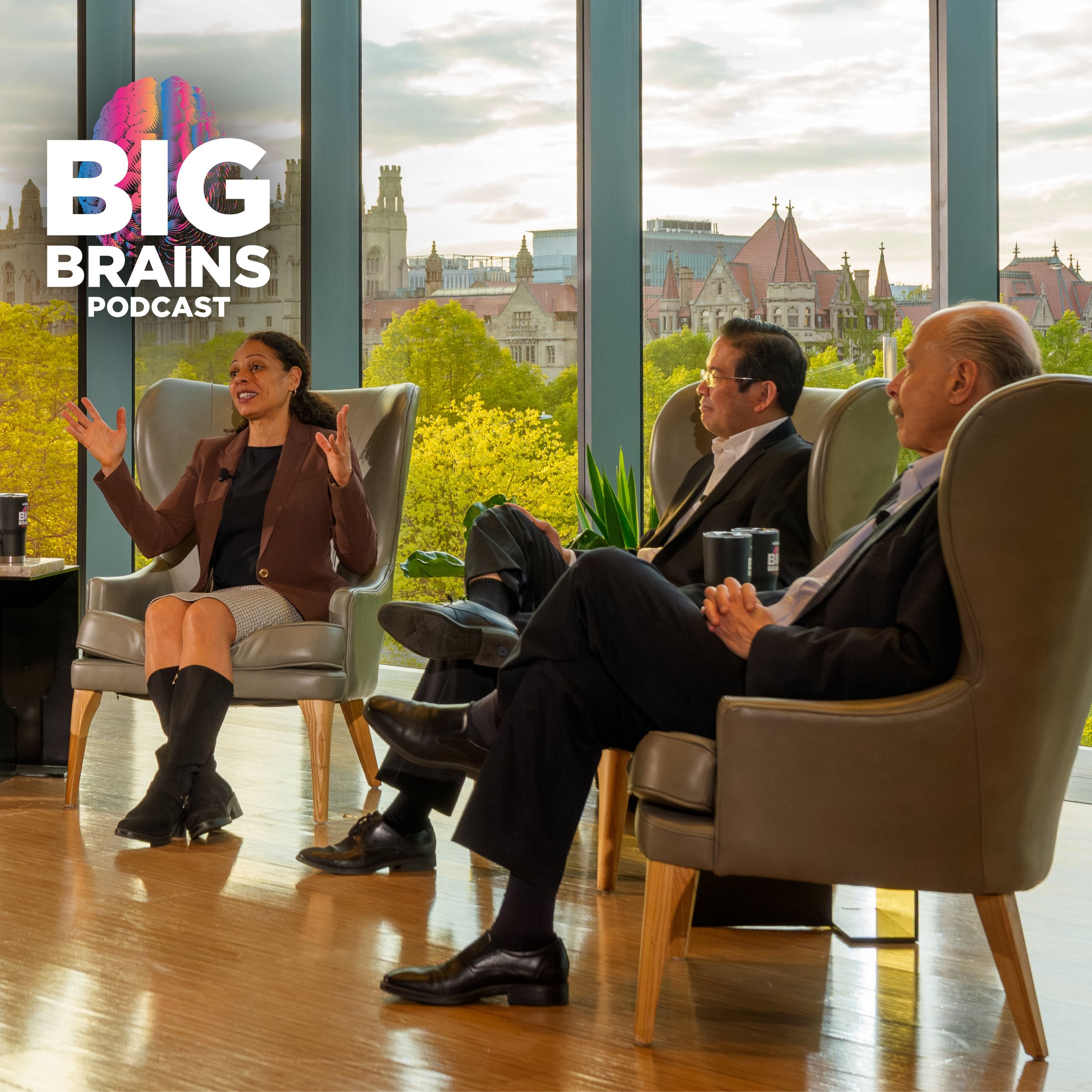
| 7/10/25 | ![]() Inside the AI Debate: Hope, Hype, Or Harm? A Big Brains Panel Weighs In | One of the benefits of producing this podcast at the University of Chicago is that there are often events on campus that bring in not just one Big Brain, but many in order to find answers to the some of the most complex problems of our time. I recently had the pleasure of hosting one such event on artificial intelligence that we want to share with you today. It was part of the Graham School’s Leadership & Society Initiative Symposium, examined how AI could change everything and, more importantly, whether it should. Artificial intelligence is evolving faster than most of us can keep up with—and its impact is already reshaping our lives, from the hospital to the courtroom to the art studio. Is AI moving too fast? Are we focusing on the wrong questions? And what comes after today’s generation of models? It’s a candid, complex, and eye-opening conversation you won’t want to miss. | — | ||||||
| 6/26/25 | ![]() Are Your Medications Safe And Effective?, with Jerry Avorn | For a more than a century, the Food and Drug Administration has worked to protect public health. In his research, Harvard University physician-researcher Jerry Avorn has examined how the FDA’s once-rigorous gold standard approval process has been affected by a powerful shortcut known as the Accelerated Approval Program—originally designed for desperate AIDS and cancer patients. He says that change in the 1990s has allowed more than half of all new drugs onto the market before drug companies have proven they actually help people. In his new book Rethinking Medications: Truth, Power and the Drugs We Take, Avorn cites numerous examples: from a cold medicine that doesn’t de-congest to billion-dollar cancer treatments that only shrink lab results to the controversial Alzheimer’s drug Aduhelm—approved despite no clear cognitive benefits. In this episode, Avorn explores whether some prescriptions in your medicine cabinet are safe, effective and worth the money. | — | ||||||
| 6/12/25 | Are We Making AI Too Human?, with James Evans | Prof. James Evans, a University of Chicago sociologist and data scientist, believes we’re training AI to think too much like humans—and it’s holding science back. In this episode, Evans shares how our current models risk narrowing scientific exploration rather than expanding it, and explains why he’s pushing for AIs that think differently from us—what he calls “cognitive aliens.” Could these “alien minds” help us unlock hidden breakthroughs? And what would it take to build them? | — | ||||||
| 5/29/25 | Inside The Disease That Changes Your Personality, with Bruce Miller | When someone we know or love starts to develop psychological issues, we don't often associate it with a form of dementia. However, this trait is one of the most common signs of frontotemporal dementia (FTD) — the most common neurodegenerative disease in people under the age of 65. In his new book, Mysteries of the Social Brain: Understanding Human Behavior Through Science, Dr. Bruce Miller highlights his experiences observing people with FTD and what they have taught him about what he calls the "social brain." Dr. Bruce Miller has been observing people with FTD for decades in the Memory and Aging Center at the University of San Francisco, where he is also Professor of Neurology and the Founding Director of the Global Brain Health Institute. He shares key insights on how to keep our "social brain" healthy and how it can even unlock our creative potential. | — | ||||||
Showing 25 of 218
Sponsor Intelligence
Sign in to see which brands sponsor this podcast, their ad offers, and promo codes.
Chart Positions
1 placement across 1 market.
Chart Positions
1 placement across 1 market.