
Insights from recent episode analysis
Audience Interest
Podcast Focus
Publishing Consistency
Platform Reach
Insights are generated by CastFox AI using publicly available data, episode content, and proprietary models.
Most discussed topics
Brands & references
Est. Listeners
Insufficient chart data. Estimates will improve as the show charts.
- Per-Episode Audience
Est. listeners per new episode within ~30 days
N/A🎙 Weekly cadence·45 episodes·Last published 4mo ago - Monthly Reach
Unique listeners across all episodes (30 days)
N/A - Active Followers
Loyal subscribers who consistently listen
N/A
Market Insights
Platform Distribution
Reach across major podcast platforms, updated hourly
Total Followers
—
Total Plays
—
Total Reviews
—
* Data sourced directly from platform APIs and aggregated hourly across all major podcast directories.
On the show
From 10 epsHosts
Recent guests
Recent episodes
Blúiríní Bealoidis 44 - Legends & Literature (with Ailbe van der Heide)
Feb 6, 2026
1h 26m 04s
Blúiríní Béaloidis 43 - Indexing Folklore (with Steve Roud)
Oct 9, 2025
1h 14m 23s
Blúiríní Béaloidis 42 - Passing the Time (with Henry Glassie)
May 27, 2025
1h 32m 11s
Blúiríní Béaloidis 41 - Food in Irish Tradition (with Máirtín Mac Con Iomaire)
Apr 2, 2025
55m 40s
Bluiríní Béaloidis 40 - What Is A Folklore Archive
Dec 17, 2024
1h 02m 23s
Social Links & Contact
Official channels & resources
Official Website
Login
RSS Feed
Login
| Date | Episode | Topics | Guests | Brands | Places | Keywords | Sponsor | Length | |
|---|---|---|---|---|---|---|---|---|---|
| 2/6/26 |  Blúiríní Bealoidis 44 - Legends & Literature (with Ailbe van der Heide)✨ | legendsliterature+3 | Ailbe van der Heide | National Folklore CollectionMA in Irish Folklore | — | Irish folkloresupernatural lore+3 | — | 1h 26m 04s | |
| 10/9/25 |  Blúiríní Béaloidis 43 - Indexing Folklore (with Steve Roud)✨ | folkloremusic+3 | Steve Roud | Folklore SocietyEnglish Folk Dance and Song Society+1 | — | Roud Folk Song Indexfolk songs+3 | — | 1h 14m 23s | |
| 5/27/25 |  Blúiríní Béaloidis 42 - Passing the Time (with Henry Glassie)✨ | Irish FolkloreVernacular Architecture+4 | Henry Glassie | Indiana UniversityUCD-University College Dublin+3 | Ballymenone, Co. Fermanagh | Irish FolkloreHenry Glassie+4 | — | 1h 32m 11s | |
| 4/2/25 |  Blúiríní Béaloidis 41 - Food in Irish Tradition (with Máirtín Mac Con Iomaire)✨ | Irish food traditioncultural heritage+4 | Máirtín Mac Con Iomaire | Technological University DublinRoyal Irish Academy+1 | — | Irish foodfood history+5 | — | 55m 40s | |
| 12/17/24 |  Bluiríní Béaloidis 40 - What Is A Folklore Archive✨ | folklore archivestraditional customs+3 | — | National Folklore Collection | — | folklorearchive+5 | — | 1h 02m 23s | |
| 5/9/23 |  Blúiríní Béaloidis 39 - Bees In Tradition (with Tiernan Gaffney)✨ | beesIrish folklore+4 | Tiernan Gaffney | National Museum of Country LifeNational Museum of Ireland+1 | Irelandcounty Mayo+1 | beesIrish folklore+5 | — | 59m 40s | |
| 12/6/22 |  Blúiríní Béaloidis 38: Stones Of Strength In Irish Tradition (with David Keohan)✨ | Irish traditionstone lifting+3 | David Keohan | National Folklore Collection | IrelandScotland+1 | stone liftingIrish tradition+3 | — | 1h 24m 58s | |
| 7/7/22 |  Blúiríní Béaloidis 37: Peig Sayers (with Dr. Éilís Ní Dhuibhne & Dr. Pádraig Ó Héalaí)✨ | Peig Sayersoral tradition+3 | Dr. Éilís Ní DhuibhneDr. Pádraig Ó Héalaí | Museum of Literature Ireland | — | Peig Sayersstorytelling+5 | — | 1h 01m 15s | |
| 6/24/22 |  Blúiríní Béaloidis 36: The Travellers (with David Joyce & Áine Furey)✨ | Irish TravellersTraveller culture+4 | David JoyceÁine Furey | — | IrelandUCD+3 | Irish TravellersMincéirs+7 | — | 1h 44m 20s | |
| 5/24/22 |  Blúiríní Béaloidis 35 - The Civil War (with Dr. Críostóir Mac Cárthaigh)✨ | Irish Civil Waroral history+4 | Dr. Críostóir Mac Cárthaigh | The National Folklore CollectionUniversity College Dublin+2 | — | Irish Civil Waroral testimonies+3 | — | 1h 00m 46s | |
Want analysis for the episodes below?Free for Pro Submit a request, we'll have your selected episodes analyzed within an hour. Free, at no cost to you, for Pro users. | |||||||||
| 12/4/21 |  Blúiríní Béaloidis 34 - The War Of Independence (with Ailbe Van Der Heide) | The Anglo-Irish Treaty was signed on the 6th of December 1921, bringing an end to the 1919-1921 Irish War of Independence. To mark 100 years since the signing of the treaty, I joined my colleague at the National Folklore Collection, Ailbe van der Heide, to discuss her work in researching, editing and transcribing Urban Folklore Project recordings dealing with this tumultuous period of Irish history. The 1979-1980 Urban Folklore Project originated as a Government employment scheme to provide work for university graduates at a time of severe economic recession in 1979-1980. The project was undertaken by the Department of Irish Folklore, University College Dublin, directed by Dr Séamas Ó Catháin, and consists of over 700 tape recorded interviews which today form part of the Natinoal Folklore Collection, University College Dublin. Among the recordings are featured vivid contemporary accounts of the War of Independence as well as material concerning the Easter Rising of 1916 and the Irish Civil War. Join us as we listen to the combatants and bystanders who bore witness to the burnings, raids and guerrilla warfare of the War of Independence, and who worked as part of a hidden network operating under the watchful eye of the crown forces and intelligence services. On 6 December 2021, Ailbe van der Heide and Dr. Críostóir Mac Cárthaigh will be delivering a free online lecture titled 'War of Independence Memories' for the Folklore of Ireland Society. To register, please visit: https://ucd-ie.zoom.us/webinar/register/WN_pHhotkMrSvuOK_JC4Eq5LQ | — | ||||||
| 11/19/21 |  Blúiríní Béaloidis 33 - Death (with David McGowan) | In life, there is much which seems uncertain to us. Concerning death however, there can be no doubt. It was an honour to speak with funeral director, death-care practitioner and proud Sligo native David McGowan on the topic of death for episode 33 of Blúiríní Béaloidis. Sit with us as we explore attitudes and customs regarding death and dying, from the practicalities and preparations of the corpse, to the wake house and beliefs regarding the departure of the soul. The episode features a good deal of archival audio from NFC collections, details of which can be found below. I'd like to thank David for being so generous with his time and knowledge, and send special thanks likewise to Síle Denver and the group Líadan, for permission to include their beautiful rendition of Amhrán Mhuínse to close the episode - baochas ó chroí libh uiléir. "Lord have mercy on the souls of the dead!" Stream 'The Funeral Director' for free here: https://www.rte.ie/player/movie/the-funeral-director/118399528355 Support Líadan here: https://liadan.ie/ Archival audio timecodes: 12:24 - 13:50: Tom Dolan, Kinnegad, county Westmeath describes the 'crippling' that occurs to a body after death. Refers to a joke played at the wake house when hunched corpse was sat upright and had a pipe placed in its mouth. Rec. by Leo Corduff (1970) NFC T0504 13:51 - 14:39: James Grady, Lecarrow, county Roscommon describes how the corpse was laid out on a board to keep it straight, as it stiffens after death. Rec. by Jim Delaney (1961) NFC T0152 18:21 - 19:59: Michael Keenan, Lenamore, county Longford playing 'The Bucks of Oranmore' on the pipes. Rec. by Jim Delaney (1957) NFC T0023 22:42 - 26:33: Mrs. Meath, Ballyhaunis county Mayo describes beliefs regarding wakes, along with neighbourly assistance at the time of a death in the locality. Rec. by Leo Corduff and Ciarán Bairéad (1965) NFC T0298 26:34 - 27:21: Unidentified female singer on Aran islands, county Galway, giving example of keen for the dead (traditional lament). Rec. by Sidney Robertson Cowell(1957) NFC C0714 27:22 - 27:58: Eibhlín ní Mhurchú, Dundrum, county Dublin (formerly Baile Loiscithe, Kilmalkeader, county Kerry) describes keening lament as heard at wakes in her youth. Rec. by Ríonach Uí Ógáin (1995) NFC T2213 27:59 - 28:40: Brídín Iarnáin, Inis Mór, county Galway, giving example of traditional keen for the dead (1949) NFC C0161 37:30 - 39:01: James Grady, Lecarrow, county Roscommon describes how men would be sent for wake provisions. Gives humorous account of the carpenter who, fond of drink, keeps returning to house to measure the body for coffining, receives a fresh drink each time he enters. Rec. by Jim Delaney and Leo Corduff (1961) NFC T0152 39:02 - 39:54: Anne Kiernan, Kinnegad, Cloncrave, county Westmeath, describes the provisions laid on at the wake. Rec. by Leo Corduff (1971)NFC T0545 43:11 - 44:41: Stephen Dunne, Bride Street, the Liberties, Dublin describes the washing of the corpse by a charitable neighbour woman. Rec. by Jim Delaney (1968) NFC T0425 44:42 - 46:46: James Grady, Lecarrow, county Roscommon describes the washing and laying out of the corpse by local women. Rec. by Jim Delaney and Leo Corduff (1961) NFC T0152 58:52 - 1:01:07: Anne Kiernan, Kinnegad, Cloncrave, county Westmeath, describes return of a soul to pay a debt. Rec. by Leo Corduff (1971) NFC T0545 1:01:07 - 1:03:14: Jack Foley, county Down describes the earthly wandering of purgatorial souls (1958) NFC T0063 1:03:15 - 1:04:20: Mary Walsh, Kinnegad, county Westmeath, describes apparitions prior to a death, and visions of the recently deceased. Rec. by Leo Corduff(1970) NFC T0505 1:04:20 - 1:06:02: Michael Dolan, Glangevlin, county Cavan describes how a man used speak with the ghosts of his two sons, killed in the Great War of 1914-18. Rec. by Michael J. Murphy (1972) NFC T0587 | — | ||||||
| 10/30/21 |  Blúiríní Béaloidis 32 - Mushrooms In Tradition | With the coming of the cool wet weather of autumn, life begins to turn inward again . The fields lie fallow and bare, flowers wither, leaves decay, and all life seems to return to the earth. It's in this period of fading light, that strange and beautiful forms begin to arise from the undergrowth in the temperate regions all over Europe. In woodlands, fields, gardens and along roadsides, colourful fungi and mushrooms of all shapes and sizes quietly spring forth and flourish as if from nowhere, while all else appears in a state of decline. A short entry in volume 1670 of the Main Manuscript Collection at the NFC contains information collected from around Ireland on the topic of mushrooms in folk tradition. The material contained in this volume, previously unpublished and explored in this podcast episode, explores traditional attitudes to mushrooms in Irish tradition and outlines their uses along with popular beliefs concerning them. Audio from the NFC sound archive also features, along with audio material from the collections of the Irish Traditional Music Archive and the singing group Landless. My thanks to archivist Danielle Castronovo at the Economic Botany Herbarium of Oakes Ames, Harvard University for her help in filling the gaps of some correspondence between R. Gordon Wasson and the Irish Folklore Commission. My thanks to archivist Maeve Gebreurs at the Irish Traditional Music Archive for forwarding Diane Hamilton's 1957 recording of Robert Cinnamond's rendition of the song 'Gathering Mushrooms'. Thanks likewise to Emmett Gill, archivist at Na Píobairí Uileann for pointing me in the direction of the collection of which this song is a part. Thanks too to Dónal Lunny, copyright holder, for permission to include this piece in the podcast. A variety of sources are consulted and discussed throughout, some links below: Prehistoric fungal representations in Tassili Algeria https://www.britannica.com/place/Tassili-n-Ajjer A Prehistoric Mural in Spain Depicting Neurotropic Psilocybe Mushrooms? https://www.jstor.org/stable/41242925 The Fungus Lore of the Greeks and Romans https://www.sciencedirect.com/science/article/abs/pii/S0007153614800077 Dioscorides: De Materia Medica https://penelope.uchicago.edu/~grout/encyclopaedia_romana/aconite/materiamedica.html Mushroom Artwork of Otto Marseus van Shrieck https://bit.ly/3nEwy3n Plutarch: Essays and Miscellanies https://www.gutenberg.org/files/3052/3052-h/3052-h.htm#link2HCH0065 The Hypothesis on the Presence of Entheogens in the Eleusinian Mysteries https://www.researchgate.net/publication/327838578_The_hypothesis_on_the_presence_of_entheogens_in_the_Eleusinian_Mysteries Mircea Eliade - Shamanism: Archaic Techniques of Ecstasy https://press.princeton.edu/books/paperback/9780691210667/shamanism Nora Chadwick: Imbas Forosnai http://searchingforimbas.blogspot.com/p/imbas-forosnai-by-nora-k-chadwick.html An Irish Materia Medica: Tadhg Ó Cuinn https://celt.ucc.ie//published/G600005/index.html William Camden: Brittania https://www.visionofbritain.org.uk/travellers/Camden/32 Seeking the Magic Mushroom: Life Magazine May 1957 (via MAPS.org) https://bibliography.maps.org/bibliography/default/resource/15048 Tina and R. Gordon Wasson - Russia, Mushrooms and History (vols. 1, & 2) [PDF] https://doorofperception.com/2015/04/r-gordon-wasson-seeking-the-magic-mushroom/ Audio featured from the Irish Traditional Music Archive: https://itma.ie Landless: https://landless.bandcamp.com/ National Folklore Collection online portal: https://dúchas.ie | — | ||||||
| 8/18/21 |  Blúiríní Béaloidis 31 - The Púca (with Aidan Harte) | For this episode of Blúiríní I am joined by sculptor Aidan Harte, whose recent work 'The Púca of Ennistymon' was commissioned by Clare county Council for the town of Ennistymon in the west of Ireland. The piece caused widespread controversy and made headlines nationally and internationally over the summer, being denounced as a pagan idol and sinister statue irreflective of the character and heritage of the town. In the course of our discussion Aidan and I examine the controversy and differing opinions regarding the statue, before taking a closer look at the figure of the Púca himself. The Púca is a solitary spirit in Irish folk tradition. A wanderer of the night, tradition tells us that he is often found in lonely portions of the rural landscape beyond the confines of the town; gambolling and sporting to himself amidst the hayfields in autumn, spoiling the fruit of the roadside with the coming of winter or haunting lonely glens, caves, chasms, cliffs, pools, forts, woods and castles across Ireland that bear his name. His shape is amorphous - many mushrooms are named after him, and he may appear to wayfarers on the road at night as a horse, a goat, a dog, a man or as a streak of light. Those who meet with him in lonely places at night relate how he hoists them up on his back before embarking on a breakneck cross-country ride; leaping over ditches and through hedges, or running along cliff edges frightening and tormenting his unhappy passenger. Other accounts relate the ways in which the Púca protects those whom he meets; safeguarding them against some worse fate at the hands of otherworld beings, or protecting castles and large estates as a sort of tutelary figure or house spirit. Join us as we explore this chaotic and shadowy figure of 'malignancy and mischief'. Some sources drawn on for this episode: The Eldritch World, Nigel Pennick (Arcana Europea 2019) Irish Names of Places, Patrick Weston Joyce (M. H. Gill and Son 1887) Deasún Breathnach, 'The Púca: A Multifunctional Irish Supernatural Entity' in Folklore Volume 104 (1993 i & ii) Erin Sebo, 'Does OE Puca Have an Irish Origin?' in Studia Neophilologica, Volume 89 (2017 Issue 2) Claude Lecouteaux, 'Encyclopedia of Norse and Germanic Folklore, Mythology and Magic' (Inner Traditions, ed. Michael Moynihan, 2016) Claude Lecouteaux, The Tradition of Household Spirits (Inner Traditions, trans. Jon E. Graham, 2013) Katharine Briggs, A Dictionary of Fairies (Penguin, 1976) National Folklore Collection Main Manuscript Collection National Folklore Collection Schools' Manuscript Collection National Folklore Collection Audio Collection For Frank Callery's singing see: https://soundcloud.com/frankcallerysongs For Enda Haran's Music see: https://www.facebook.com/endaharan2017/ https://www.instagram.com/endaharanmusic/ https://endaharan.bandcamp.com/ | — | ||||||
| 4/9/21 |  Blúiríní Béaloidis 30 - The Stray Sod | There are numerous accounts in tradition of wayfarers who suffer fits of confusion and disorientation while traversing the natural landscape. Such bouts were at times attributed to the influence of the fairies (who would set wanders astray for their own amusement) or the power of the stray sod (an enchanted sod of earth which set those who trod upon it astray). While the accounts vary, these occurrences involve situations in which individuals are forced to navigate a landscape characterised by its sudden shift into unfamiliarity and strangeness. Tilled fields that are worked by day become unnavigable and impassable by night. Well-worn and intimately known paths, crossroads and laneways are rendered odd, unknown and eerie all at once. The landscape at times becomes unrecognisable, indefinite and nameless. Landmarks are erased, inverted or otherwise replaced with new and unidentified features. Grand residences and strange houses appear on the side of hitherto barren hills. Impenetrable fogs, mists and coloured hazes descend and disorientate. Rivers, ditches, woods and walls appear to block all progress through the land. Lights rise and float in the distance and familiar reference points fall away, leaving the experiencer to navigate strange and foreign scenery which is at once indeterminate and unknown, with disenchantment coming at the dawn, leaving the exhausted wayfarer to suddenly realise their location, often only short distance from their homes. For episode 30 of Blúiríní Béaloidis Jonny traverses fields, hedges, ditches and heights examining narratives concerning stray sod and 'seachrán sí' (fairy straying) traditions; from the graves of unbaptised children to illusions and phantasms appearing in the natural landscape, and from spirits of the dead refused entry to either heaven or hell, to workings of the fairy host, join us as we explore the liminal personae who inhabit those isolated and unknown portions of the landscape. | — | ||||||
| 2/9/21 |  Blúiríní Béaloidis 29 - A Folk History Of Ireland's Protestants (with Dr. Deirdre Nuttall) | The Irish Folklore Commission (established in 1935) tasked itself with the documentation of the unwritten customs, beliefs and narratives of the Irish people; those ‘disiecta membra’ (as James Hamilton Delargy described them) of a rich heritage which it was feared was in danger of dying out and disappearing forever unless swift action was taken to gather up the fragments that remain, lest they perish. Delargy, and those with whom he worked, endeavoured to secure for future generations the sources of inspiration and pride which he saw as having languished in the ‘lumber room’ of history; those tales, traditions and songs of Ireland, cultural expressions he understood as representing ‘the State Papers of a forgotten and neglected people’. The work of the Irish Folklore Commission then, in recording the voices and ideals of the ordinary people of Ireland , aimed to represent those communities whose voice was not heard among the formal archival records of the state. But, there are silences in every archive, and the Irish Folklore Commission was no different, having its own particular biases and tendencies. Among these biases was an initial focus on the customs of rural people over those in towns and urban areas. Another, and one which is the subject of today’s discussion, was the absence of material collected from Ireland’s Protestant community. Thankfully, this has recently been addressed by Dr. Deirdre Nuttall, who, working with the National Folklore Collection between 2013 and 2017 conducted a folk history of Ireland's Protestants consisting of ninety eight interviews and seventy six questionnaire responses, the results of which she has recently published in her book ‘Different and the Same: A Folk History of the Protestants of Independent Ireland’. Join Jonny and Deirdre as they discuss 19th century conceptions of 'the Folk', examine Protestant origin stories and consider counter-narratives to Ireland's major historical events embedded in the communal memories of Ireland's Protestant community. 'Different and the Same' is published by Eastwood Books, and is available from the publisher directly at: https://eastwoodbooks.com/different-and-the-same/ The book is available in all good bookshops in Ireland, and online. | — | ||||||
| 12/9/20 |  Blúiriní Bealoidis 28 - Land & Language (with Manchán Magan) | My guest for this edition of Bluiríní Béaloidis is writer and documentary maker Manchán Magan, whose recent book 'Thirty-Two Words For Field' is a meditation on old Irish words and the nuances of a way of life that is vanishing with them. The book considers the 'richness of a language closely tied to the natural landscape' which 'offered our ancestors a more magical way of seeing the world'. It considers the 'sublime beauty and profound oddness of the ancient tongue that has been spoken on this island for over 2,000 years'. In this discussion, we consider how language and tradition binds us to the landscape, expolore the role of tradition in modernity and speculate on the ancient connections between Ireland and India. Manchán's book 'Thirty-Two Words For Field' has been nominated for numerous awards, and (as of December 2020) is already in its fourth printing. Copies can be purchased from directly from the author here: http://manchan.com/32-words-for-field Or at all good independent book shops: https://www.easons.com/thirty-two-words-for-field-manchan-magan-9780717187973 https://www.dubraybooks.ie/thirty-two-words-for-field_9780717187973 | — | ||||||
| 10/31/20 |  Blúiríní Béaloidis 27 - The Banshee (with Professor Patricia Lysaght) | The Banshee is a well known supernatural figure in Irish folk tradition. In origin a patron goddess caring for the fortunes of her people, the banshee of folk belief is usually considered to be a harbinger of death, being said to follow certain families from generation to generation. Traditions about her are spread widely throughout the country, and for this episode of the podcast Jonny has the privilege of speaking with Professor Patricia Lysaght, who is the world authority on the topic of the Banshee. Their discussion takes in the rich array of customs and beliefs concerning her, starting with an exploration of the names by which she is popularly known, before moving on to the ways in which she manifests to the people. Her function as a prognosticator of death in the community, the attitudes to life and death that are expressed through her, and the ways in which ancient ideas and motifs concerning her have survived to the modern day are further explored, with archival audio excerpts supplementing the conversation. Patricia's book 'The Banshee: The Irish Supernatural Death Messenger' is the authoritative work on the topic, and is available to purchase online: https://www.abebooks.com/servlet/SearchResults?sts=t&cm_sp=SearchF-_-home-_-Results&an=lysaght&tn=banshee&kn=&isbn= This episode features some music by Landless from their 2018 Bleaching Bones, which can be purchased here: https://landless.bandcamp.com/album/bleaching-bones-2 Music from 'Opening the Astral Doors' released in 2010 by Further Records is also featured: https://furtherrecords.org/album/opening-the-astral-doors | — | ||||||
| 10/9/20 |  Blúiríní Bealoidis 26 - Seals In Folk Tradition (with Ailbe van der Heide) | Seals have been an integral part of coastal life in Ireland for generations, and as such there exists a large body of tradition, belief and narrative regarding them. They were described in tradition as being enchanted people, wise women, fallen angels and drowned (or indeed reincarnated) fishermen, and encounters with them often relate how they would speak to, plead with or warn those fishermen who were about to attack or kill them out at sea or on the shore. Certain families in Ireland (Coneelys, O'Kanes, Dowds, O'Sheas and Gallaghers among them)were considered to have been the result of a union between a mortal and an enchanted seal, and many narrative accounts collected in Ireland describe how such unions came about when a mortal man who came upon a seal-woman in human form on the shore stole her cloak (which allowed her to change form) took her home, married her and had children with her, until one day she discovered her hidden cloak and left her children and husband to return to the sea. For this month's edition of Blúiríní Jonny is joined by Ailbe van der Heide to discuss the topic of seals in folk tradition, join them as they traverse the coasts and islands around Ireland and further afield to consider the interplay between nature, culture, appearance and reality which is brought across by these liminal beings. Some material mentioned in this episode: 'Monolingual Irish Speaker': https://www.youtube.com/watch?v=UP4nXlKJx_4&ab_channel=AnGhaeilge Seán Ó hEinirí (John Henry) in conversation with Professor Séamas Ó Catháin of the Department of Irish Folklore. This video is from a documentary called 'In Search of the Trojan War' from 1985. 'People of the Sea' by David Thomson: https://www.goodreads.com/book/show/309401.The_People_of_the_Sea Bairbre Ní Fhloinn: 'Tadhg and Donncha...' in Islanders and Water Dwellers (1996) https://www.fourcourtspress.ie/books/folklore-commission/islanders-and-water-dwellers/ Linda May-Ballard: Seal Stories and Belief on Rathlin Island in Ulster Folklife Martin Puhvel, 'The Seal in the Folklore of Northern Europe' Folklore, volume 74 issue 1: https://www.tandfonline.com/doi/abs/10.1080/0015587X.1963.9716898 Bo Almqvist 'Of Mermaids and Marriages. Seamus Heaney's 'Maighdean Mara' and Nuala Ní Dhomhnaill's 'an Mhaighdean Mhara' in the Light of Folk Tradition', Béaloideas, Iml. 58 (1990), pp. 1-74 (Available online through JSTOR) Alexander H. Krappe, 'Scandinavian Seal Lore', Scandinavian Studies , Vol. 18, No. 4 (1944) pp. 156-162 | — | ||||||
| 6/22/20 | 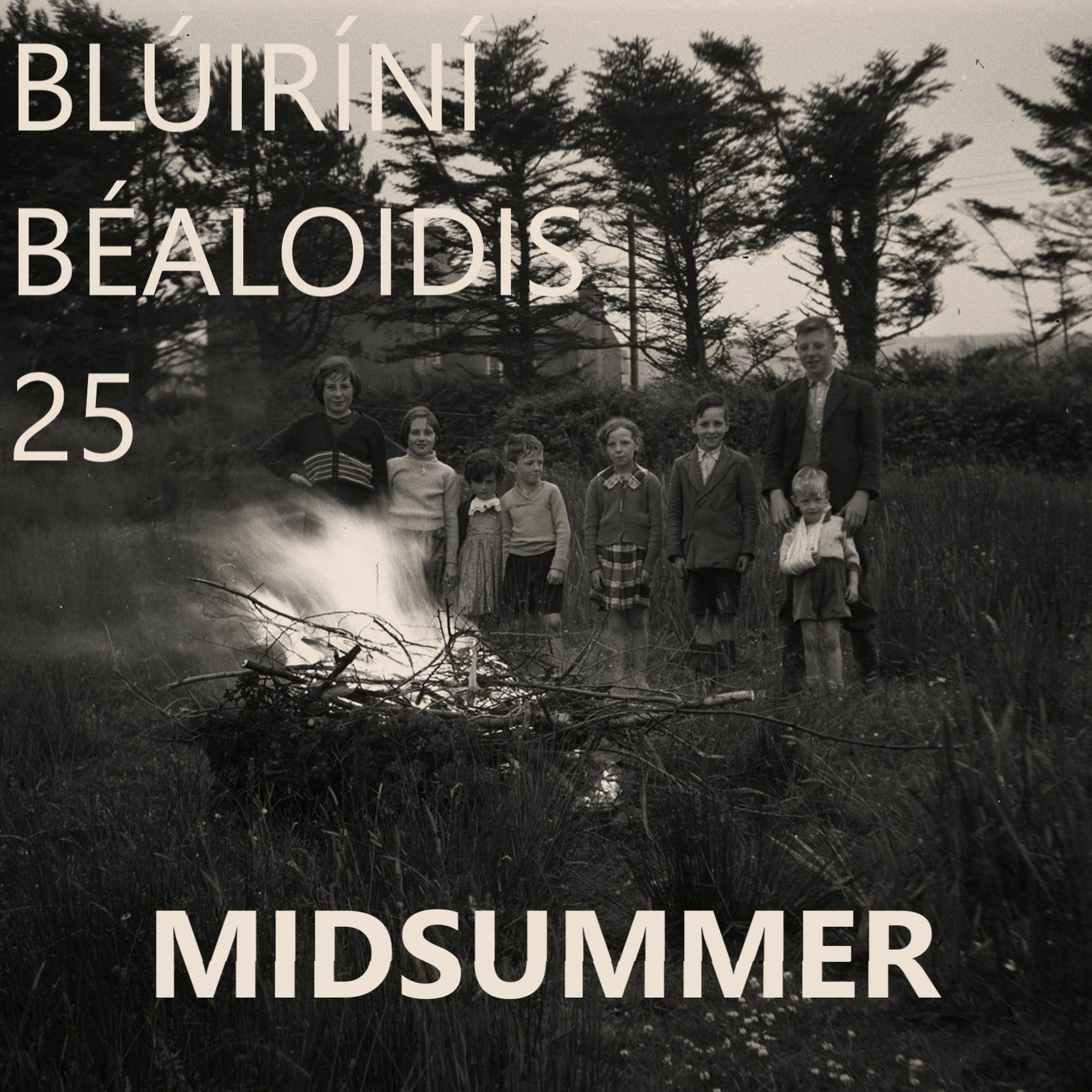 Blúiríní Béaloidis 25 - Midsummer | Midsummer has long been observed as a period of jubilant celebration, with communal gatherings at bonfires and prayers, recitations, music, songs, dance and merriment being the order of the night. Join Jonny for episode 25 of Blúiríní Béaloidis as he explores the origins of midsummer festivities in Europe; recounting the raucous antics of the Brotherhood of the Green Wolf in France, considering the eve of the feast of St. John the Baptist as a symbolic counterbalance to Christmas and focusing on the protective and magical properties of the night. The fires burn on every hill and height, join us as we celebrate midsummer! Our thanks for Michael Anderson and Schola Antiqua for permission to include their beautiful rendition of 'Ut queant laxis' in this episode. To learn more, and support them directly visit: https://www.schola-antiqua.org/ | — | ||||||
| 4/6/20 |  Blúiríní Béaloidis 24 - Folk Medicine | It was said in tradition that 'there isn't an ailment or infirmity the cure of which doesn't grow in the fields or along the hedges', and indeed, our forebears employed a wide range of historical practices to drive out infirmity and illness. While a great deal of folk cures were entirely practical in their application, many others turned to the use of magic, sacrifice and the use of charms, rituals or prayer – modes of thought quite at odds with altogether more modern, secular perspectives. Far from being casually forged in the half-light of ignorance, our folk cures reveal those measures which, being deeply concerned with human life and welfare, were called on in times of crisis, in order to provide reassurance and comfort in the face of insecurity, illness and anxiety. For this episode of Blúiríní, Jonny examines definitions of folk medicine before taking a look at the healing deities of Classical European Paganism, and Irish mythology alike. Our explorations will then turn to consider the host of plagues, pestilences and infirmities outlined in our medieval chronicles, before we take a look at folk cures recorded in the archives of the National Folklore Collection University College Dublin. As we presently accustom ourselves to life in varying degrees of 'lockdown', it is worth turning to the past, in order to draw on the endurance, strength and patience with which our forebears held themselves through hardship. As the saying goes, 'Ní neart go chur le chéile!' ('There is no strength without unity!') Selected Readings of Interest: Chapter Title: Talitha Qum! An Exploration of the Image of Jesus as Healer-PhysicianSavior in the Synoptic Gospels in Relation to the Asclepius Cult Chapter Author(s): Frances Flannery Book Title: Coming Back to Life Book Subtitle: The Permeability of Past and Present, Mortality and Immortality, Death and Life in the Ancient Mediterranean Book Author(s): Bradley N. Rice Book Editor(s): Frederick S. Tappenden, Carly Daniel-Hughes Published by: McGill University Library. (2017) Stable URL: https://www.jstor.org/stable/j.ctvmx3k11.22 Some Notes on Homeric Folk-Lore Author(s): W. Crooke Source: Folklore, Vol. 19, No. 1 (Mar. 30, 1908), pp. 52-77 Published by: Taylor & Francis, Ltd. on behalf of Folklore Enterprises, Ltd. Stable URL: https://www.jstor.org/stable/1254711 Accessed: 20-03-2020 12:03 UTC Indo-European Dragon Slayers and Healers and the Irish Account of Dian Céacht and Méiche: https://www.academia.edu/10246879/Indo-European_Dragon-Slayers_and_Healers_and_the_Irish_Account_of_Dian_Céacht_and_<Méiche Cath Maige Tuired: The Second Battle of Mag Tuired https://celt.ucc.ie/published/T300010/index.html The Identification of Some Pestilences Recorded in the Irish Annals Author(s): William P. MacArthur Source: Irish Historical Studies, Vol. 6, No. 23 (Mar., 1949), pp. 169-188 Published by: Cambridge University Press Stable URL: https://www.jstor.org/stable/30006592 Accessed: 20-03-2020 12:41 UTC The Ancient Irish Hot: Air Bath Author(s): Seaton F. Milligan Source: The Journal of the Royal Historical and Archaeological Association of Ireland, Fourth Series, Vol. 9, No. 81 (Oct., 1889 - Jan., 1890), pp. 268-270 Published by: Royal Society of Antiquaries of Ireland Stable URL: https://www.jstor.org/stable/25506556 Accessed: 20-03-2020 12:22 UTC Dr. Pat Logan: Making the Cures: Ancient Cures for Modern Ills, The Talbot Press, Dublin (1972) Seán Ó Súilleabháin: Nósanna agus Piseoga na nGael / Irish Folk Custom and Belief National Folklore Collection - www.Dúchas.ie | — | ||||||
| 2/14/20 |  Blúiríní Béaloidis 23 - Holy Wells In Folk Tradition | Lying in overgrown fields, by churches and next to roadsides all over Ireland, are hidden holy wells and sacred springs which have for countless generations been visited as sites of pilgrimage and devotion. These wells are generally small bodies of water dedicated to a local patron saint, and were often renowned for the healing properties. For this edition of Blúiríní, we shall trudge across the fields on pilgrimage to these sacred wells, commencing with an exploration of the early Irish literature, which describes the creation of Ireland's rivers when an otherworld woman breaks a taboo in visiting a secret well of knowledge, the rivers of which burst forth and engulf her. Moving on to consider Ireland's placenames in connection with holy wells, we will examine the changing attitudes of Christian tradition to these wells and to the Pattern day - those communal celebrations in honour of the patron saint to whom the well is dedicated, which degenerated into 'discreditable orgies' and scenes of drunken violence, being eventually put down by the Church. The curative (and malevolent) properties of these wells will also be explored, as will be the broader European context for veneration of sacred springs. For this episode I was very lucky to have been joined by Eddie O'Neill and Rosaleen Durkin, who very kindly showed my some of Wicklow's Holy Wells and spoke of their significance. Eddie's family have tended Lady Well in county Wicklow for three generations, and each year on the 15th of August (the Feast of the Assumption) the the entire community would visit the well to offer devotions, and to engage in merriment together, dancing and playing sports. Rosaleen Durkin, a native of Mayo, now living in Wicklow, set up (along with some friends) the group 'Wicklow Wells' which aims to 'preserve and document all the local traditions and folklore and where possible make them more accessible to locals and visitors alike'. For more, see the Wicklow Wells Facebook Page: https://bit.ly/2SRKeZt For Rosaleen's site, see: https://irishsacredwells.com/ This episode features a beautiful piano piece titled 'the Five Daughters' by Richard Moult. For more of Richard's music and art please visit his site: http://starred-desert.com/ | — | ||||||
| 12/5/19 |  Blúiríní Béaloidis - 22 Invisible Worlds (With Eddie Lenihan) | Our lives are built on the stories we tell. At both an individual and a communal level, they orient and mould us, shaping our perspectives and outlining our reality. In an age where life can seem increasingly fettered by rules and regulations, where communication is drowned by endless jargon and noise demanding our attention, where the past is heaved overboard in order that we might more quickly race blindly towards the future, where places become zones, where endless change is automatically equated with progress, and where the sacred is replaced by the material, the stories we tell ourselves modernity seem increasingly to offer little by way of consolation, enchantment, wonder or joy. With this in mind, and in search of alternate perspectives for episode 22 of Blúiríní Béaloidis, I'm setting off from the National Folklore Collection, driving across Ireland to the village of Crusheen near Ireland's western coast, where I have arranged to meet a man who has been described as a ‘national treasure’, a ‘master storyteller’ and ‘inspired performer’ alike. Eddie Lenihan is an author and storyteller who has been collecting traditional stories and customs from an older generation for over 40 years. His 2003 book, Meeting the Other Crowd has been translated into many languages, and is dedicated by Eddie to ‘all those tellers now gone whose voices are not forgotten and to those still with us whose knowledge is more indispensable than ever’. As usual, throughout this episode you’ll hear a mixture of conversation along with original archival field recordings from the National Folklore Collection concerning the topics under discussion. For more information regarding these excerpts, see below. To learn more about Eddie, and to support his valuable work, please visithttp://eddielenihan.weebly.com/ | — | ||||||
| 10/29/19 | 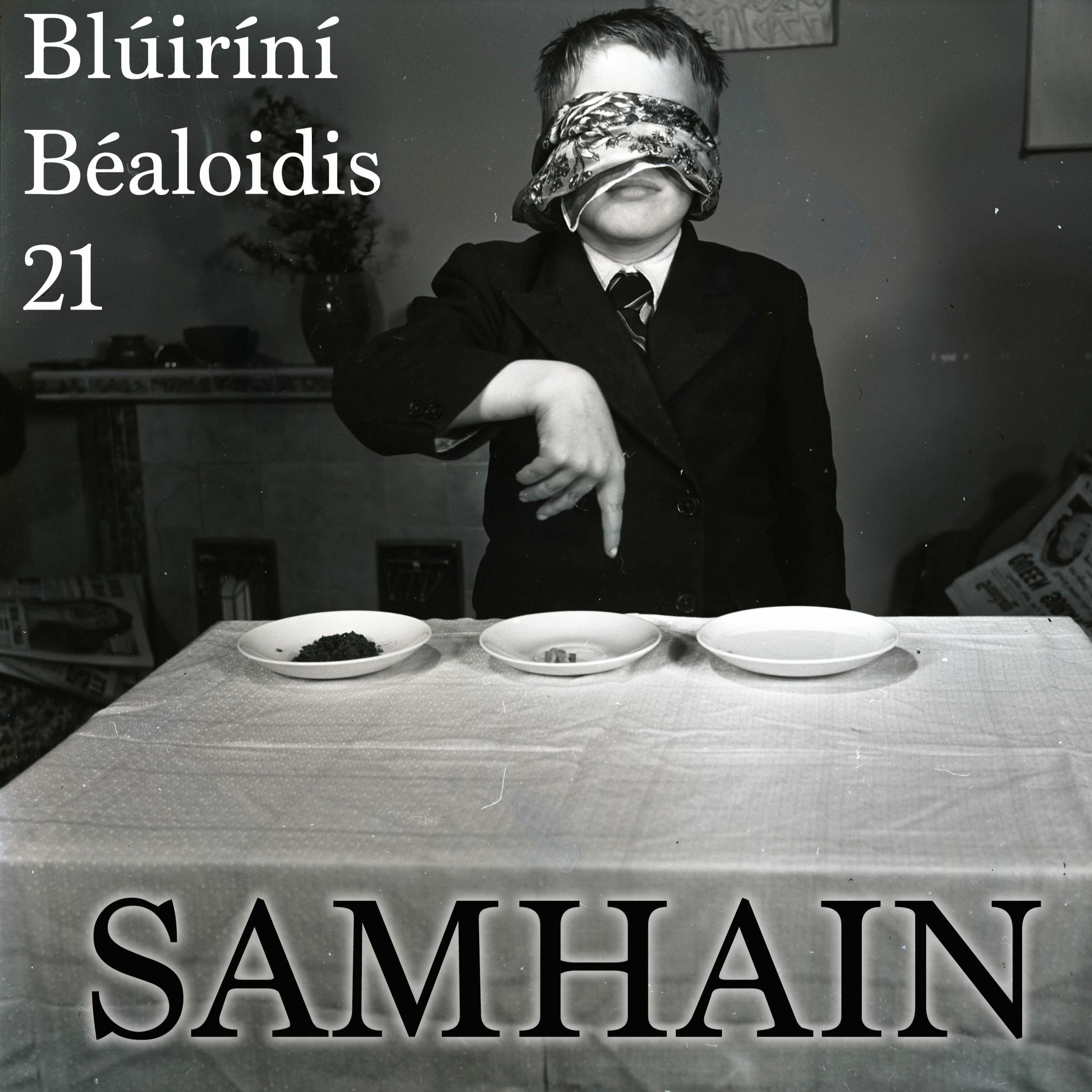 Blúiríní Béaloidis 21 - Samhain / Halloween (With Dr. Billy Mag Fhloinn) | The festival of Samhain has since ancient times been considered as a major turning point in the ritual year. In marking the threshold of darkness and the end of the season of light, the eve of Samhain (observed all over Ireland at sundown on the 31st of October) is characterised by heightened supernatural activity, a return of the ancestral dead, divination magic, mischief, ritual disguise and the suspension of normal modes and rules of behaviour. For this edition of Blúiríní, Jonny is joined by a special guest, Dr. Billy Mag Fhloinn. Billy is a folklorist, archaeologist, author and lecturer, whose book ‘Blood Rite: The Feast of St. Martin in Ireland’ was published in 2016, and who has contributed to international television productions by the BBC, PBS and the National Geographic Channel. For more information about Billy and his work, and to contact him directly please visit his site https://tradition.ie/ This edition of Blúiríní also features contributions from Aghast and Halo Manash Aghast were an all-female group from Norway, whose haunting and atmospheric album 'Hexerei Im Zwielicht Der Finsternis' was released in 1995. For more information, see http://www.metaladies.com/bands/aghast/ Halo Manash hail from Finland, and aim to 'seek, explore, experience, study and decipher reflections of the ever-shifting shapes and spaces of different worlds', in order to 'revitalise one of the oldest subconscious forms of communication, to open the gates and widen the horizon of perception concerning states of otherness lying in-between the cardinal directions.' Our special thanks for their generosity in permitting us to include their music in this edition of the podcast. For more information, and to support them directly, please visit http://www.helixes.org/halomanash/about/ | — | ||||||
| 8/21/19 | 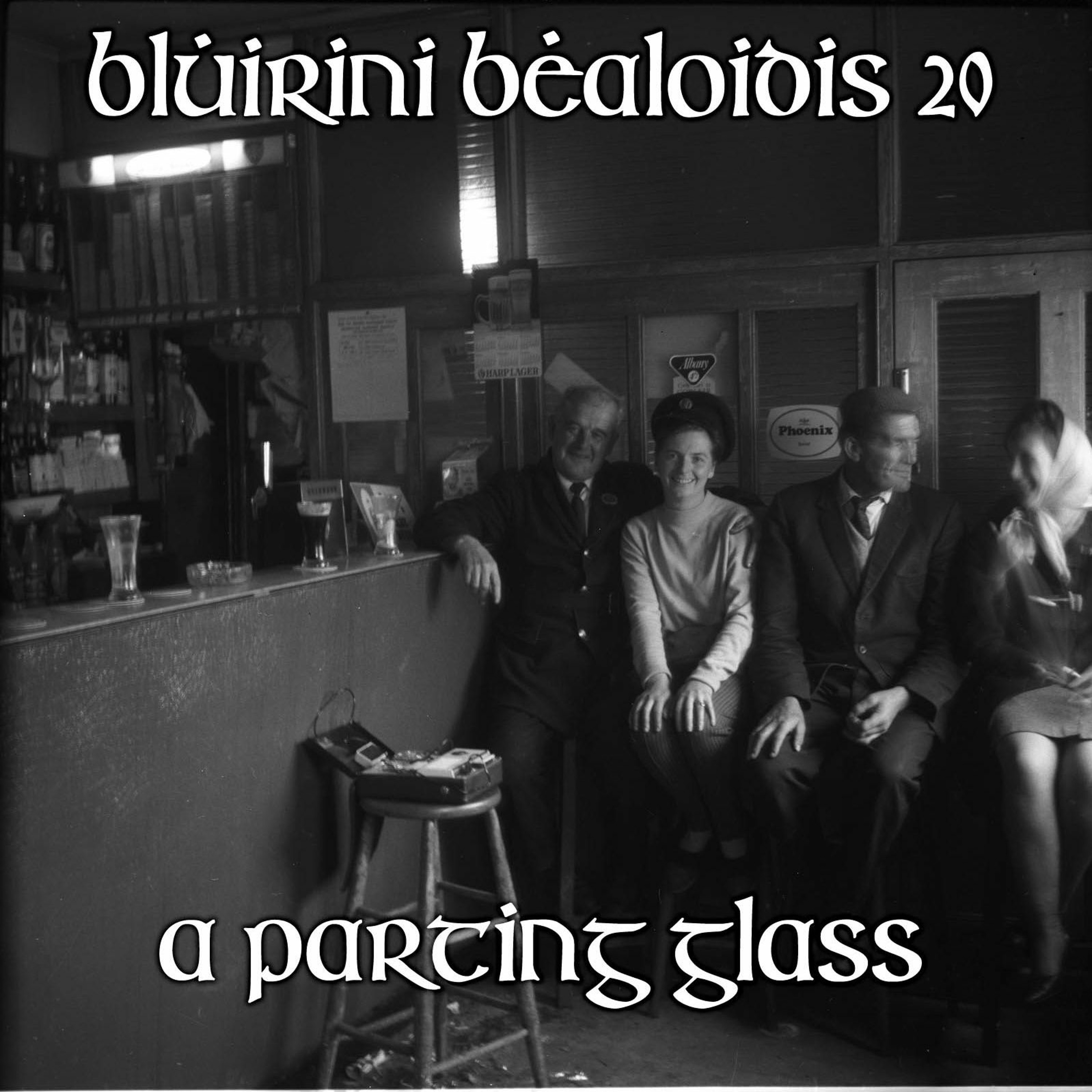 Blúiríní Béaloidis 20 - A Parting Glass (Claire's Final Episode!) | This twentieth edition of Blúiríní Béaloidis comes as something of a bittersweet occasion, with Claire raising a parting glass to 'gently rise and softly call - goodnight and joy be with you all', leaving the National Folklore Collection to embark on a new adventure! In their final episode together, Claire and Jonny highlight some of their favourite archival excerpts from previous editions of Blúiríní, reminiscing on the treasures of the Collection as they go. From song and story, to text and context, they give thought to those who have gone before us - to their nobility and artistry - noting the inspiration that absent friends and family can still provide us today. Jonny will return in the coming months with a new series of Blúiríní featuring interviews and field recordings, but in the mean time we fill up our glasses and bid fond farewell to our dear Claire 'For The Sake of Completeness' Doohan, wishing her a world of joy and every success in the new chapter opening up before her! | — | ||||||
Showing 25 of 45
Pitch Fit is a Pro feature
See how bookable this show is for guests, which brands already advertise, the per-episode ad value, and the best-fit guest and sponsor profile. The numbers are blurred on the free plan.
How readily this show books outside guests like you.
How proven this show is for host-read sponsorships.
For Guests
ProFor Advertisers
ProUpgrade to Pro to unlock guest cadence, sponsor categories, fit scores, and per-episode ad value for this show.