

Insights from recent episode analysis
Audience Interest
Podcast Focus
Publishing Consistency
Platform Reach
Insights are generated by CastFox AI using publicly available data, episode content, and proprietary models.
Total monthly reach
Estimated from 2 chart positions in 2 markets.
By chart position
- 🇦🇺AU · Careers#11300K to 1M
- 🇳🇿NZ · Careers#176500 to 3K
- Per-Episode Audience
Est. listeners per new episode within ~30 days
150K to 502K🎙 ~2x weekly·48 episodes·Last published 2w ago - Monthly Reach
Unique listeners across all episodes (30 days)
301K to 1.0M🇦🇺100%+1 more - Active Followers
Loyal subscribers who consistently listen
120K to 401K
Market Insights
Platform Distribution
Reach across major podcast platforms, updated hourly
Total Followers
—
Total Plays
—
Total Reviews
—
* Data sourced directly from platform APIs and aggregated hourly across all major podcast directories.
On the show
Recent episodes
Dr Eileen Doyle & Tim Bednall Take Us Inside the First Wave of Climate Reporting
Jun 5, 2026
Unknown duration
A New Podcast From the AICD
May 26, 2026
0m 55s
Special Episode - Boards, AI Agents and the Next Wave of Cyber Risk
May 18, 2026
Unknown duration
Skipp Williamson: Why Transformations Go Off Track
Apr 13, 2026
Unknown duration
Former MYOB boss Tim Reed on boards' potential AI blind spots, Australia's productivity puzzle, and what actually happens when private equity buys a business
Mar 30, 2026
Unknown duration
Social Links & Contact
Official channels & resources
Official Website
Login
RSS Feed
Login
| Date | Episode | Description | Length | ||||||
|---|---|---|---|---|---|---|---|---|---|
| 6/5/26 | Dr Eileen Doyle & Tim Bednall Take Us Inside the First Wave of Climate Reporting | This is an episode from the AICD's new weekly podcast series, Director Download. Each episode features conversations with policy experts and leading directors to unpack complex governance challenges and deliver practical insights that can be applied in the boardroom. You can listen by searching 'Director Download' in your podcast player, or by clicking the links below: Listen on Spotify: https://open.spotify.com/show/033f7mHnHstKVIekaBMT2Y Listen on Apple: https://podcasts.apple.com/au/podcast/director-download/id1896576074 More about this episode: Australia's mandatory climate reporting regime has now completed its first cycle, marking one of the most significant changes to corporate reporting in a generation. For boards, the first wave of reports has provided valuable insights into the practical realities of implementation. Although still in its early stages, the regime is designed to improve the consistency and comparability of climate-related disclosures for investors and other stakeholders. Many entities have encountered challenges around data, governance, capability and cost, highlighting the scale of effort involved in meeting the new requirements. Joining us to discuss the lessons emerging from year one are Tim Bednall, Partner and Head of the Governance practice at Mallesons, and Dr Eileen Doyle, a non-executive director with several organisations, including Dalrymple Bay Infrastructure, one of the entities captured in the first group of reporters. This conversation explores what boards can learn from the first group of reporters, where many underestimated the scale and complexity of the task, and what those experiences reveal for the organisations that will come within the regime in the years ahead. We cover: (02:00) Has mandatory climate reporting lived up to expectations? (02:50) What stood out from the first wave of climate disclosures (03:40) Why some boards underestimated the scale of the reporting task (05:30) Has mandatory reporting helped improve decision-making? (15:00) The key areas of uncertainty still causing confusion for directors (18:00) Practical advice for Group 2 and Group 3 organisations Learn more: AICD insights into the early lessons from the first wave of reporters: https://www.aicd.com.au/news-media/research-and-reports/board-insights-australias-first-mandatory-climate-disclosures.html Practical guidance for directors overseeing their organisations' disclosures under Australia's mandatory climate reporting laws, by AICD, Deloitte and MinterEllison: https://www.aicd.com.au/risk-management/framework/climate/a-directors-guide-to-mandatory-climate-reporting.html Join us at the Climate Governance Forum 2026 to explore sustainability reporting and other emerging climate governance issues in greater depth. Connect: Dr Eileen Doyle on LinkedIn - https://www.linkedin.com/in/eileen-doyle-9389841a/ Tim Bednall on LinkedIn - https://www.linkedin.com/in/tim-bednall-b458181b/ AICD on LinkedIn - https://www.linkedin.com/school/australianinstituteofcompanydirectors/ Kulja Coulston on LinkedIn - https://www.linkedin.com/in/kulja-coulston/ Bennett Mason on LinkedIn - https://www.linkedin.com/in/bennett-mason-10517336/ This episode Director Download was produced on Gadigal land. We recognise First Nations peoples' cultural and spiritual relationships to the Skies, Land, Waters, and Seas, and their rich contribution to society. | — | ||||||
| 5/26/26 |  A New Podcast From the AICD | The AICD is proud to announce the launch of a brand new podcast offering - Director Download. Director Download is a weekly podcast series that keeps directors and senior leaders ahead of evolving governance obligations. Each episode features conversations with policy experts and leading directors to unpack complex governance challenges and deliver practical insights that can be applied in the boardroom. You can listen by searching 'Director Download' in your podcast player, or by clicking the links below: Listen on Spotify: https://open.spotify.com/show/033f7mHnHstKVIekaBMT2Y Listen on Apple: https://podcasts.apple.com/au/podcast/director-download/id1896576074 | 0m 55s | ||||||
| 5/18/26 |  Special Episode - Boards, AI Agents and the Next Wave of Cyber Risk | Presented by Okta Artificial intelligence is transforming organisations at extraordinary speed. But as businesses adopt AI agents and autonomous systems, new governance and cyber security risks are emerging just as quickly. In this episode, Mathew Graham, Chief Security Officer for Okta Asia-Pacific, explains why boards need to rethink cyber security in an AI-driven world. He explores the rise of "non-human identities", how AI agents are changing the workforce, and why governance is shifting from controlling access to governing behaviour. Mathew discusses the risks created by autonomous systems operating at scale, the importance of visibility and accountability, and why some leaders still lack a clear understanding of what AI tools are doing inside their organisations. He also outlines practical steps boards can take to build effective AI governance frameworks without becoming a handbrake on innovation. The conversation covers AI-enabled cyber attacks, supply chain vulnerabilities, organisational culture, regulatory change and the growing importance of identity management. Mathew also shares why curiosity, experimentation and strong governance will be essential capabilities for directors as AI continues to reshape business and risk over the decade ahead. Key Takeaways: The rise of non-human identities — how AI agents are becoming part of the workforce and reshaping organisational risk. Governance in an AI era — why boards need visibility, accountability and oversight of autonomous systems. Speed and scale of AI risk — how misconfigured AI agents can create rapid downstream impacts across organisations. Innovation versus control — balancing experimentation and productivity gains with governance and guardrails. Third-party and supply chain risk — managing exposure created by external AI tools and platforms. AI as a defensive tool — using AI to detect threats, analyse data and improve cyber resilience. Board capability and curiosity — why directors need to stay informed, experiment with AI tools and understand their implications. | — | ||||||
| 4/13/26 |  Skipp Williamson: Why Transformations Go Off Track | Skipp Williamson has spent decades working with organisations on one of the most persistent challenges in business: execution. As founder of Partners in Performance, she has seen first-hand how even the most compelling strategies can unravel when delivery falls short. In this conversation, Skipp explores why execution risk is often underestimated at board level, and how major projects can drift off course despite appearing on track. She explains the difference between the "pageantry" of project management and the realities of delivery, and why traditional reporting often obscures more than it reveals. The discussion examines how boards can strengthen oversight without crossing into management, including what to look for in critical projects and how to identify early warning signs. Skipp also shares practical insights on capability, accountability and the importance of leading indicators, alongside lessons from large-scale transformations, AI programs and decarbonisation efforts. Key Takeaways: The illusion of control — how reporting and dashboards can mask emerging risks in major projects. Project failure dynamics — why initiatives drift off course long before problems are visible. Board oversight in practice — probing assumptions, testing readiness and knowing where to focus. Leading versus lagging indicators — shifting from retrospective reporting to forward-looking insight. Transformation at scale — aligning strategy, execution and accountability across complex organisations. AI and execution discipline — applying lessons from past transformations to new technology investments. Decarbonisation as delivery challenge — turning ambition into achievable action. | — | ||||||
| 3/30/26 |  Former MYOB boss Tim Reed on boards' potential AI blind spots, Australia's productivity puzzle, and what actually happens when private equity buys a business | Tim Reed has led through growth, disruption and transition as CEO of MYOB for over a decade, President of the Business Council of Australia, and now as a director, investor and climate policy contributor. In this conversation, Tim reflects on the importance of setting a clear long-term vision, building a culture that delivers, and staying close to customers. He shares lessons from CEO succession, including why different leaders are needed at different stages and what boards should look for when making that call. The discussion also explores the shift from operator to investor, the discipline of private equity, and how boards can think about AI, productivity and decarbonisation in practical terms. Tim offers a grounded view on balancing opportunity with risk, and why getting the basics right, including strategy, people and execution, still matters most in a rapidly changing environment. Key Takeaways: The CEO-to-board transition — recognising when to step away, shifting mindset, and rediscovering energy in new roles. Private equity discipline — aligning strategy, talent and execution in the first 90 days. Customer-centric leadership — direct listening mechanisms and staying close to the market. AI in practice — using AI to enhance thinking, productivity and decision-making without replacing judgement. Risk and opportunity in AI — balancing governance, security and competitive advantage. Productivity and national competitiveness — the role of business, policy settings and investment. Decarbonisation and boards — understanding emissions, trade-offs and the practical path to net zero. | — | ||||||
| 3/16/26 |  Innovation with Intent: OzHarvest Chair Lawrence Goldstone on Boards and Change | Lawrence Goldstone has built a career at the intersection of purpose, people and transformation. He spent decades advising major organisations on strategy, innovation and large-scale change before stepping into the role of chair at OzHarvest, Australia's largest food rescue organisation. In this conversation, Lawrence reflects on leading through CEO succession in a founder-led organisation, balancing financial sustainability with social impact, and why scale is both OzHarvest's greatest opportunity and challenge. He shares practical insights on innovation in the boardroom, including how boards can create space for experimentation and constructive challenge without losing discipline. The discussion also explores workplace design, culture beyond metrics, and why transformation succeeds only when organisations invest time in clarity and leadership alignment before moving to execution. It's a thoughtful look at governance in action, and what it takes to be an "antidote to inertia" in complex systems. Key Takeaways: · Founder succession done well — managing CEO transition "with, not to" a founder, preserving culture while enabling scale. · Balancing purpose and financial sustainability — scaling impact in a not-for-profit while diversifying revenue streams. · Innovation as discipline — creating structured space for experimentation, not just declaring innovation a priority. · Board curiosity and constructive challenge — asking better questions and creating time for real strategic conversations. · Culture beyond the dashboard — experiencing the organisation firsthand, not relying solely on reported metrics. · Transformation fundamentals — clarity of the "why," leadership alignment, and investing time upfront. · Workplace evolution — intentional design of collaboration rather than one-size-fits-all models. · Engagement as competitive advantage — modern communication and investing in human skills early. | — | ||||||
| 3/2/26 |  S3E11 – Diane Smith-Gander on transitioning to the boardroom, effective chairs, and the role of AI in modern governance | Diane Smith-Gander reflects on a career spanning executive leadership, global consulting and some of Australia's most complex boardrooms. In this conversation, Diane discusses the realities of transitioning from management to governance, the importance of preparation and judgement, and why effective boards are curious, disciplined and willing to challenge constructively. She shares insights from chairing organisations across mining services, health, fintech and higher education, including how boards oversee safety in global operations and navigate growing regulatory and geopolitical risk. Diane also explores the practical use of AI in governance, the pressures facing board talent, and why directors have a responsibility to engage publicly on issues that affect long-term organisational sustainability. It's a candid discussion about leadership, reputation and the evolving demands of the modern boardroom. Key Takeaways: The transition to the boardroom — preparing well, earning confidence and learning nuance as a new director. What effective boards look like today — curiosity, respectful challenge, and clarity on the line between governance and management. The chair's role — drawing out diverse views, and shaping productive board dynamics. AI in governance — using AI to sharpen insight, feedback and decision-making without replacing judgement. Time, risk and liability — the growing burden on directors and what that means for board talent. Universities and social licence — leadership challenges facing the higher education sector. Public leadership and advocacy — when and why directors should speak on policy, equality and inclusion. | — | ||||||
| 2/16/26 |  S3E10 - Visibility, Values and the Boardroom: Former David Jones CEO Paul Zahra on Inclusive Leadership | Paul Zahra has spent his career leading through disruption - as CEO of David Jones, head of the Australian Retailers Association during Covid, board director and founder of the Pinnacle Foundation. In this conversation, Paul reflects on what crisis reveals about leadership, governance and values. He discusses why visibility matters in the boardroom, particularly for LGBTQIA+ leaders, and how boards can move beyond tokenism to genuine inclusion. Paul also unpacks the chair's role in setting culture, managing diverse voices and balancing social impact with fiduciary responsibility. Drawing on his experiences across ASX companies, private equity and not-for-profits, Paul shares practical lessons on transformation, stakeholder management and why disruption - from digital to AI - should be treated as an opportunity, not a threat. It's a candid discussion about values under pressure, inclusive leadership and what modern boards need to get right. Key Takeaways: Visibility and leadership — why representation at board and CEO level matters for aspiration, pipelines and culture. Beyond gender diversity — inclusion across sexuality, disability and lived experience as a source of better governance. The chair's role in inclusion — setting tone, managing board dynamics, and creating psychological safety. Values in practice — when leaders should speak publicly, how to weigh risk, and aligning social impact with strategy. Crisis leadership — lessons from retail transformation, Covid and sector-wide disruption. Governance across contexts — ASX companies, private equity, not-for-profits and where boards succeed or fail. | — | ||||||
| 2/2/26 |  S3E9 – Former Mirvac CEO Susan Lloyd-Hurwitz on Australia's housing challengers, gender diversity and transitioning to the boardroom | Susan Lloyd-Hurwitz reflects on a career shaped by unexpected turns, major leadership challenges and a decade transforming Mirvac as CEO - and how those experiences now inform her work in the boardroom. In this conversation, Susan discusses the mindset shift from executive to non-executive roles, the discipline of governing without managing, and what effective boards get right in uncertain times. She explores the balance between being supportive and challenging, the central role of the chair, and why CEO succession is the most important decision a board makes. Susan also shares insights from her work on housing affordability, the realities of leading through complex, politically charged issues, and how boards should think about ESG, diversity and AI in a rapidly shifting global environment. Key Takeaways: · Board effectiveness — creating the right balance between being supportive and constructively challenging management. · Time and focus in the boardroom — avoiding over-indexing on compliance at the expense of strategy, culture and long-term value. · CEO succession — why pipeline development, transparency and early planning matter more than last-minute decisions. · Navigating ESG and geopolitics — boards operating amid shifting expectations on climate, diversity and shareholder primacy. · AI as a governance tool — using AI to sharpen questions and insight, without outsourcing judgement. · Housing affordability — supply-side reform, productivity, planning and the long game required for meaningful change. · Gender diversity and talent pipelines — where progress has been made, where blockages persist, and the board's role in calling out bias. | — | ||||||
| 1/25/26 |  S3E8 - Nothing About Us Without Us: Alastair McEwin on Disability, Leadership and the Boardroom | Alastair McEwin has spent his career pushing for a more inclusive Australia — as a lawyer, board director, Disability Discrimination Commissioner and a commissioner on the Disability Royal Commission. In this conversation, he reflects on what drew him to disability advocacy, what he learned starting out on boards in his twenties, and why great governance is a team sport. Alastair unpacks why representation at the top still lags, how boards can move beyond tokenism, and the practical changes that make boardrooms genuinely accessible. He also shares the Royal Commission's central message: Australia is failing people with disability in mainstream settings — and why lasting reform requires leaders to change systems, culture and expectations, not just policies. Key Takeaways: • Early board experience: purpose, patience, and learning the room • What makes a good chair: relationships, trust, and drawing out every voice • "Nothing about us without us": representation, accessibility, and culture • Practical steps for boards: ask, don't assume; provide supports; build capability • The Royal Commission's core finding: mainstream systems are failing people with disability | — | ||||||
Want analysis for the episodes below?Free for Pro Submit a request, we'll have your selected episodes analyzed within an hour. Free, at no cost to you, for Pro users. | |||||||||
| 1/19/26 |  S3E7 – Polycrisis and Boards: Merriden Varrall on the geopolitical risk directors can't ignore | Geopolitics is no longer just background noise — it's now central to how organisations plan, invest and manage risk. In this episode, foreign affairs expert Merriden Varrall, joins Boardroom Confidential to unpack what today's "polycrisis" world really means for directors. Drawing on her experience at KPMG, the Lowy Institute and the UN in China, Merriden explains why boards must look beyond daily headlines to the deeper megatrends: converging climate, energy and food risks; the erosion of trust in institutions and the rise of populism; and a fragmenting global economy shaped by national security and values-based blocs. She explores the practical implications for Australian boards — from managing exposure to the US–China rivalry and rebuilding supply chain resilience, to understanding how these dynamics affect SMEs and NFPs. Merriden also outlines how boards can become more geopolitically literate: the questions to ask management, how to set up horizon scanning and scenario planning, and why a more nuanced understanding of other countries' perspectives is now essential to good governance. Key Themes: • From headlines to megatrends — directors need to look past daily news and focus on structural geopolitical scenarios and megatrends. • Polycrisis as the new normal — risks like climate, energy, food, tech and conflict are increasingly interconnected and compounding. • Trust gap and populism — erosion of trust in institutions and the rise of populism are reshaping regulation, policy and expectations of business. • Geo-economic fragmentation — values-based blocs, national security logic and "de-risking" are changing trade, investment and tech choices. • It's not just big corporates — SMEs and NFPs are exposed through supply chains, cyber risk, regulation, funding and talent. • Boards' core questions — are we thinking about geopolitics, how are we monitoring it, what scenarios have we planned for, and are our responses sufficient? • Supply chain resilience — having "just in case" models ready, mapping choke points, and setting up data and signals to act early. | — | ||||||
| 1/12/26 | 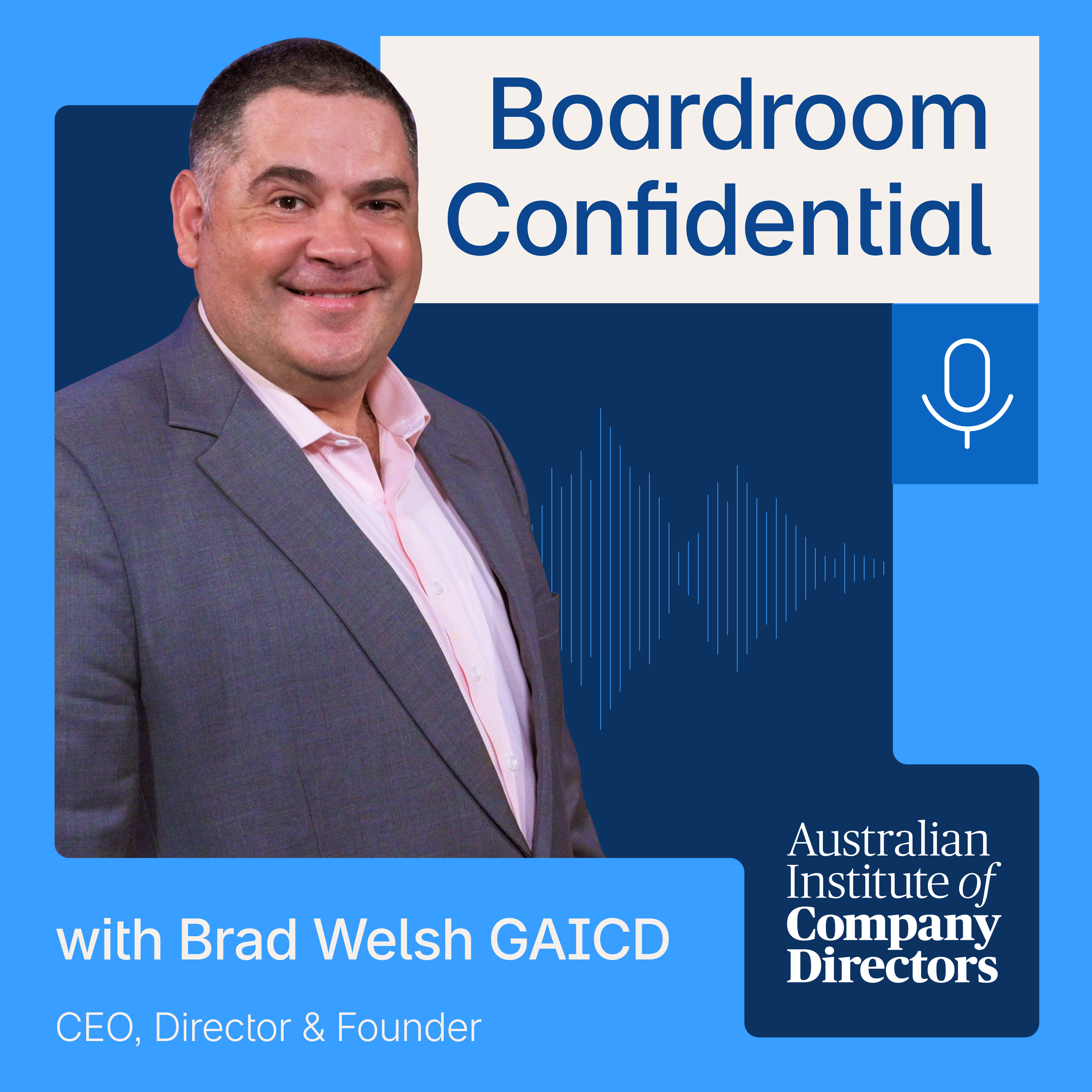 S3E6 – Brad Welsh: Career re-invention, curiosity in the boardroom, and unlocking First Nations talent | Brad Welsh has built a career defined by reinvention — from child protection officer to political adviser, CEO of Energy Resources of Australia, board member at nib, and now founder of Mawal. In this conversation, Brad reflects on the choices, opportunities and turning points that shaped his path, and how curiosity and ambition have guided every reinvention. Brad discusses the lessons learned leading ERA through the complex rehabilitation of a major uranium mine, what long-term projects teach leaders about managing risk, and how to balance the expectations of diverse stakeholders. He also shares his powerful vision for the next generation of First Nations leadership in Australia — building capability in capital and risk, broadening pathways into commercial roles, and helping more Indigenous talent step into the boardroom. Key Themes: • Career reinvention and ambition — seizing "windows" of opportunity, stepping back to go forward, and using each pivot to build range. • Curiosity as a governing principle — staying relentlessly curious about how organisations, balance sheets and communities actually work. • Capital and risk as a global language — why cultures flourish by managing capital and risk in their own way, and what that means for First Nations Australia. • Long-term rehabilitation, short-term milestones — lessons from ERA's Ranger uranium rehabilitation on balancing horizon goals with near-term delivery. • Stakeholders and judgement — putting yourself in others' shoes, making decisions with imperfect information, and knowing when to change course. • The next generation — building a cohort of First Nations leaders for executive and board roles. | — | ||||||
| 1/5/26 |  Holiday Archive - Audette Exel on social entrepreneurship in action, learning from mistakes, and the board's role in promoting philanthropy | Over the holidays, we'll be bringing you some earlier episodes of our Boardroom Confidential podcast. This time it's Audette Exel, the founder and chair of Adara Group. She's also a former director with Suncorp and Westpac and previously served as Chair of the Bermuda Stock Exchange. Audette shares the story behind Adara's unique model, which channels profits from corporate advisory work directly into life-saving development programs in some of the world's most remote communities. She reflects candidly on the mistakes she's made along the way, what they taught her, and why boards need to talk more openly about failure. The conversation also explores governance across complex global organisations, the responsibilities of boards in philanthropy and social impact, and how purpose should sit at the centre of corporate decision-making. Audette offers practical insights for directors seeking to use their influence — and their organisations — to create lasting value for society. Key Themes Purpose-led leadership and social entrepreneurship Innovative funding models for not-for-profits Governance, risk and accountability across complex global organisations Learning from failure and embracing mistakes in leadership The role of boards in philanthropy and social licence to operate Diversity of thought and values at the board table | — | ||||||
| 12/29/25 |  Holiday Archive - David Kirk on investing in Australia's tech start-ups, what big companies can learn from small ones, and how to prepare for board meetings | Over the holidays, we'll be bringing you some earlier episodes of our Boardroom Confidential podcast. This time it's David Kirk, the co-founder of listed venture capital fund Bailador and chair at a range of organisations including KMD Brands, Forsyth Barr and KiwiHarvest. David was also the CEO of Fairfax Limited and had an extremely successful career on the sporting field, captaining the mighty All Blacks to victory in the first Rugby World Cup in 1987. David shares what he's learned moving from executive leadership into chair and portfolio roles, including how to stay focused across competing priorities. He unpacks the chair–CEO relationship: how to be a genuine supporter while maintaining clear accountability, and why trust and expectations matter. The conversation also explores what high-performing boards look like in practice — from encouraging healthy disagreement to avoiding unhelpful conflict, and the simple disciplines that improve decision-making. David also reflects on growth-stage investing, founder dynamics, and why not-for-profits benefit from a stronger "social venture" approach. Finally, he draws leadership lessons from elite sport — and explains why governance in sporting organisations can go wrong when it becomes too representative. Key Themes The shift from executive leadership to a portfolio of board roles What makes a strong chair–CEO partnership (and where it can go wrong) How chairs build effective board culture, debate and decision-making Practical board discipline: preparation, focus, and "reading the papers" Growth-stage investing and governance in tech businesses What business can learn from elite sport—and what sport gets wrong in governance | — | ||||||
| 12/22/25 |  Holiday Archive - Marina Go on how to be an effective chair, tips for starting your director career, and why diversity is critical for boards | Over the holidays, we'll be bringing you some earlier episodes of our Boardroom Confidential podcast. This time it's Marina Go, a board member with Metcash, Southern Cross Media and the AICD itself. She's also been a chair or director with several other organisations including Adore Beauty, Energy Australia, the West Tigers NRL club and Netball Australia. On top of that, Marina was also the GM of magazine company Bauer Media Australia and Private Media. She tells us how her media career prepared her for the boardroom. Plus: advice on being an effective chair, tips for finding your first director position, and lessons from the boardroom of an NRL club. | — | ||||||
| 12/15/25 |  Holiday Archive - Andy Penn on preparing for cyber attacks, effective Chair-CEO relationships and governance at the National Gallery of Victoria | Over the holidays, we'll be bringing you some earlier episodes of our Boardroom Confidential podcast. This time, it's Andy Penn, a director with Coles and Trustee for the National Gallery of Victoria. He also spent seven years as the CEO of Telstra and previously served as the chair of the federal government's Cyber Security Strategy Expert Advisory Board. We talk about: lesson for boards on cyber security, advice on effective Chair-CEO relationships, and governance at the National Gallery of Victoria. | — | ||||||
| 12/8/25 | 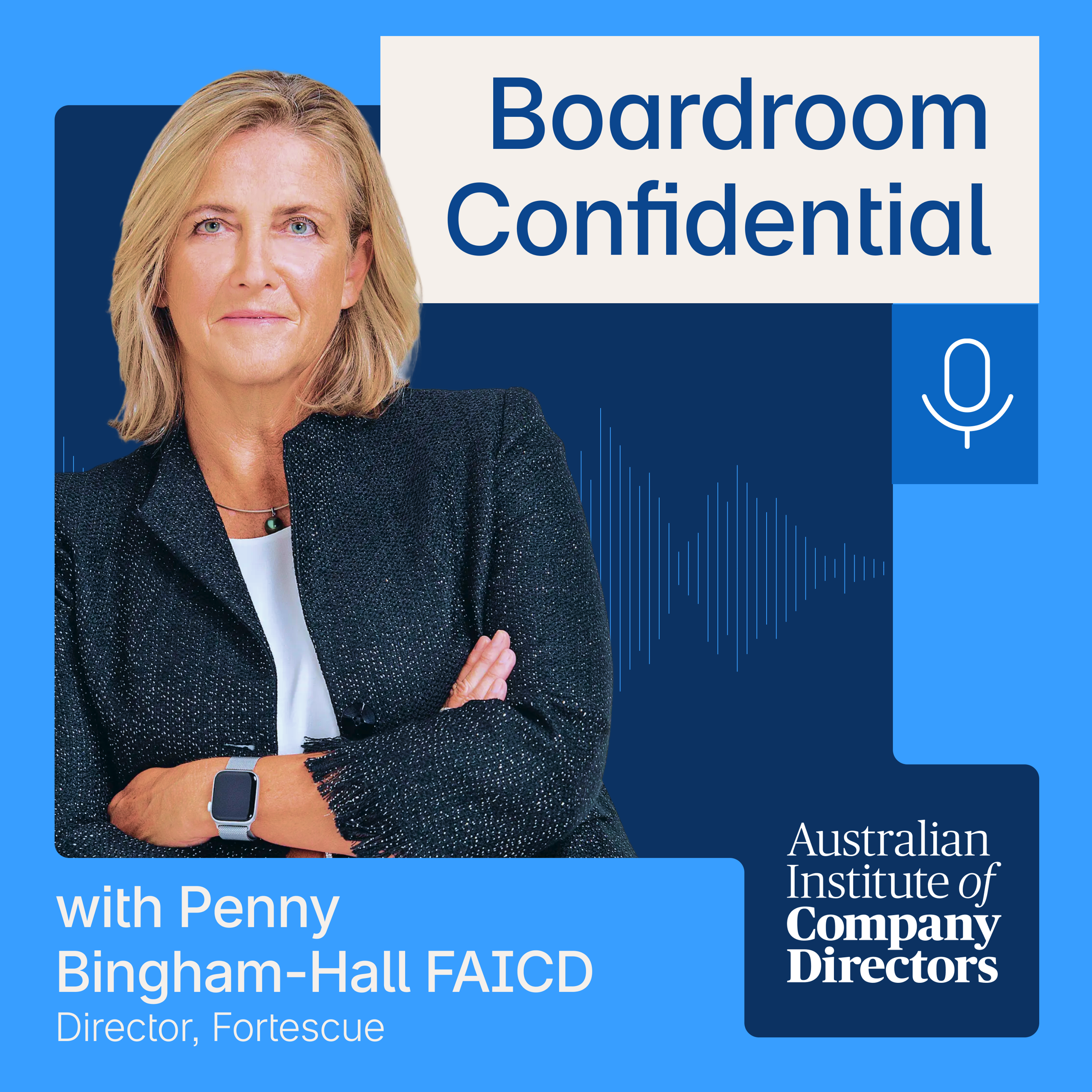 S3E5 – Penny Bingham-Hall: Planning for cyber-attacks, climate governance in action, and building a boardroom portfolio | Co-chair of Supply Nation and Fortescue director Penny Bingham-Hall joins Boardroom Confidential to unpack some of the major issues facing today's boards: harnessing AI's predictive power, overseeing cyber risk in a "when, not if" world, and lifting climate governance from compliance to capability. We also explore the craft of a high-performing board (diverse, collegiate, agenda-sharp), how to build a deliberate portfolio career, and why First Nations procurement is a powerful, practical lever for impact. Key Themes: AI readiness starts with data — know what data you hold, who owns it, and whether your architecture can use it. When cyber hits: plan, then get out of the way — management runs the incident; the chair streamlines comms. Climate governance in action — treat year one of mandatory reporting as a learning year; close data gaps early. Board craft — diverse yet collegiate boards, agenda discipline, safe debate Portfolio building — define your value proposition, test culture and values fit, and be deliberate about mix. Procurement for impact — First Nations supplier engagement as a practical pathway to Reconciliation. Click here for video versions of our podcasts on YouTube | — | ||||||
| 12/3/25 |  Special Episode - From the Server Room to the Boardroom: AI, Identity and the Cyber Risks Directors Can't Ignore | Presented by Okta Cyber security has become a core governance issue, not just an IT problem. In this episode, Mathew Graham, Chief Security Officer for Asia–Pac at Okta, explains why identity is now the front line of security — and what that means for directors. He outlines how cyber risk has shifted from firewalls to cloud systems, remote work and interconnected supply chains, where most breaches now begin with compromised credentials. Mathew clarifies the board's role in setting risk appetite, shaping a culture of security, and holding management accountable through clear, risk‑focused reporting. He challenges common misconceptions ("compliant = secure") and highlights the danger of relying on a single tech provider. He also explores AI's dual edge — accelerating attacks and strengthening defence — and why non‑human identities like bots and AI agents must be secured. Finally, Mathew shares practical steps: stronger MFA, regular simulations and one big question every board should ask — who has access to our most critical data? Key Takeaways: · From tech issue to business risk — why cyber has moved from the server room to the boardroom, with identity now the critical perimeter. · Board vs management roles — the board sets the "what" and "why" (risk appetite, culture of security); management owns the "how". · Good cyber reporting — concise, risk-focused dashboards over jargon-heavy reports; red flags when leaders can't answer "who has access to what?". · SMEs and NFPs — how resource-constrained organisations can use ACSC guidance, baseline controls and targeted investment to lift their posture. · AI as accelerator — attackers using AI for better phishing, faster vulnerability discovery and malware, while defenders use AI for anomaly detection. · Non-human identities & supply chain risk — bots and AI agents as new identities to secure, and why many major breaches now start with a third party. | — | ||||||
| 12/1/25 | 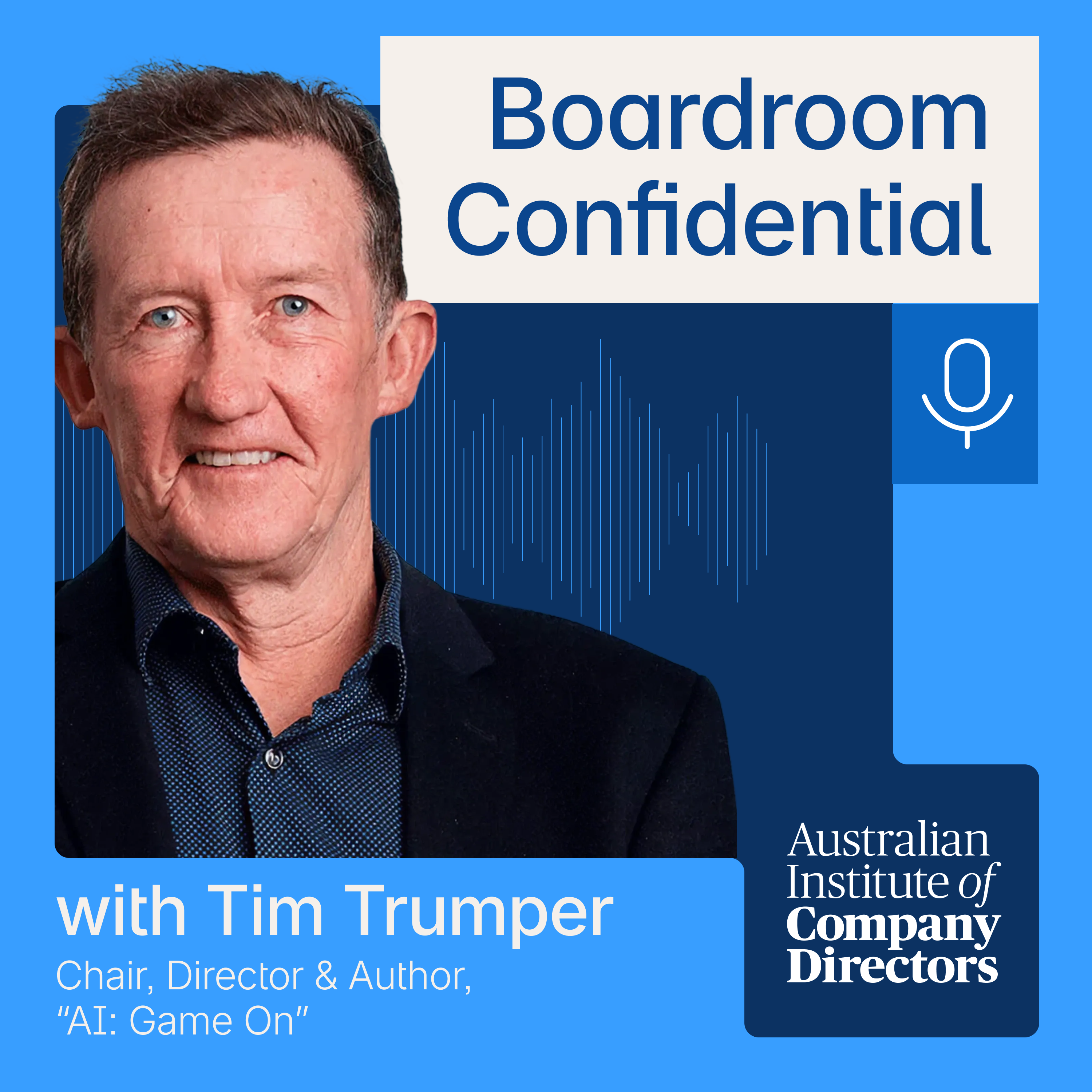 S3E4 – Tim Trumper: Building AI-ready boards, chair succession done right, and leading through volatility | Former NRMA Chair Tim Trumper joins Boardroom Confidential to talk about AI in the boardroom, data-led transformations, and the craft of modern chairing. Drawing on his book AI: Game On, Tim explores one of the central governance questions of our time — "who or what decides?" — and how directors can set guardrails that protect customers while still unleashing innovation. Tim shares practical playbooks from the NRMA's reinvention journey, why whole-of-board learning beats delegating AI to a single expert, and how great chairs keep the "silent voice of the customer" present in every discussion. Plus: chair succession that actually works, and leading through an era where volatility is the constant. Key Themes: · AI in the boardroom — deciding who or what decides, setting boundaries, and avoiding inaction · Guardrails without brake lights — a "data/AI Hippocratic oath" to do no harm while innovating · Leaders must use the tools — boards should get hands-on with AI, not delegate it to one expert · Customer-first data — using insight to solve problems in real time and define "what good looks like" · Chair craft — curiosity, empathy, and the "silent voice of the customer" in every meeting · Chair succession — start early, plan for fit not just skills, and communicate openly · Boards in a VUCA world — adapt fast, think creatively, and stay flexible amid uncertainty Click here to watch a video version of the podcast on YouTube | — | ||||||
| 11/24/25 | 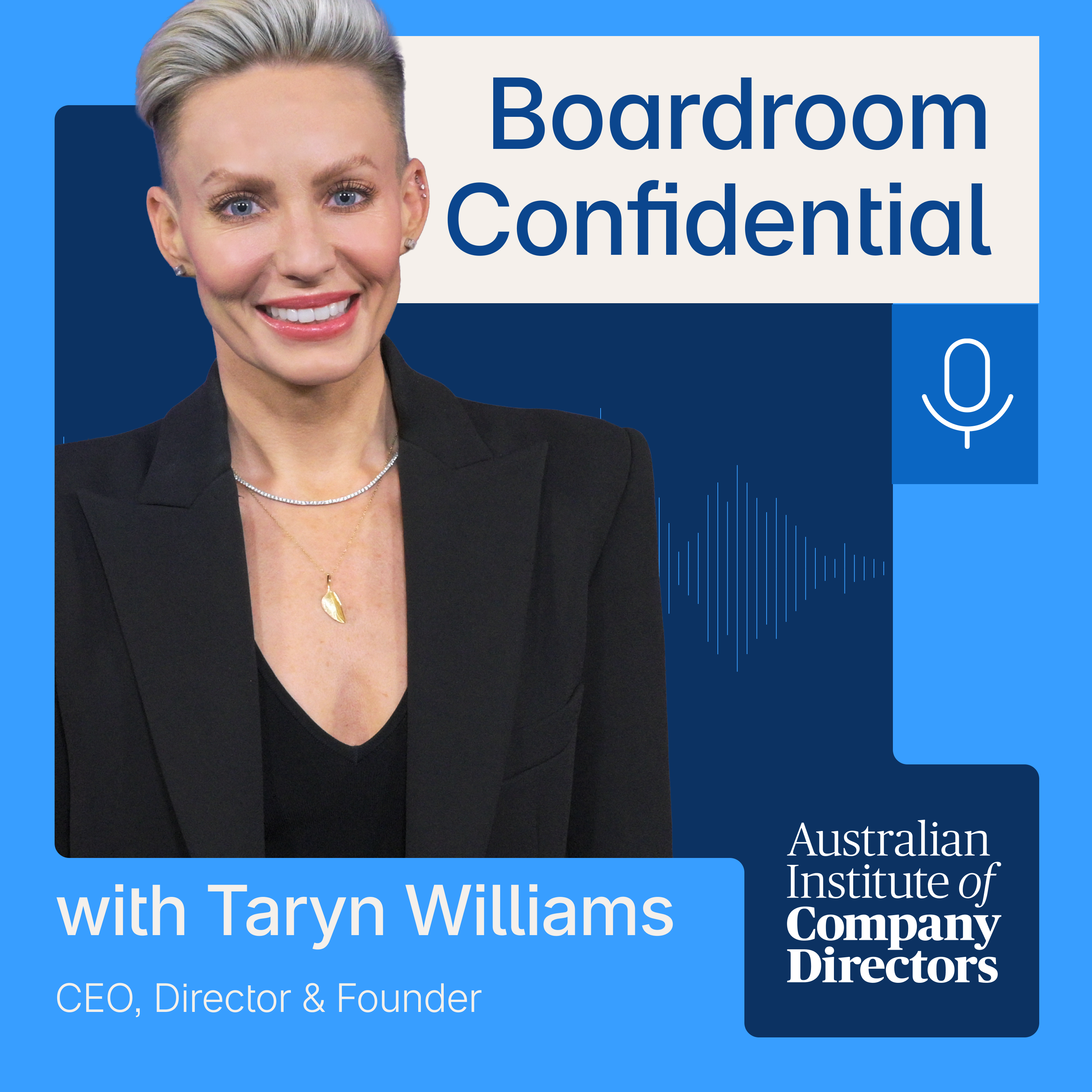 S3E3 – Taryn Williams: Shifting from founder to director, balancing AI opportunities with guardrails, and boards' growing responsibility for brand and reputation | From founding her first company at 21 to building and exiting multiple tech ventures, Taryn Williams has spent her career at the intersection of talent, media and innovation. In this episode, the award-winning entrepreneur and director reflects on the mindset behind scaling fast-growing businesses, the challenge of stepping back as a founder, and how she's navigating the next wave of disruption through AI and digital transformation. Now serving on several boards across technology and creative industries, Taryn shares her perspective on how boards can better engage with brand and reputation — and why curiosity and emotional intelligence are fast becoming some of the most valuable skills in the boardroom. Key Themes: · From founder to director: shifting from execution to oversight · Building strong teams, mentors and advisory boards · Boards' growing responsibility for brand and reputation · Balancing AI opportunity with governance and guardrails · The future skills boards will need — and why EQ matters most Click here for the video version of the podcast on YouTube | — | ||||||
| 11/17/25 |  S3E2 – David Gallop: Staying calm in a crisis, lessons from the NRL & Football Australia, and how to make a CEO-Chair relationship work | David Gallop AM — former CEO of the NRL and Football Australia —share lessons on leadership, crisis, and culture from a career spent in the spotlight. In this conversation, David reflects on two decades at the helm of high-profile sports, the experiences he's carried into the boardroom, and what makes an effective chair in today's governance landscape. Now chair of Venues NSW and Step One Clothing, and a director at Tabcorp and Cricket NSW, David gives insights on handling crises, the balance between board and management, and the art of succession planning. Key themes: • Staying calm and focused under scrutiny • Building trust and boundaries between board and management • The chair–CEO relationship and what makes it work • Diversity, gender balance and leadership pipelines • Culture, communication and respect in times of change | — | ||||||
| 11/10/25 | 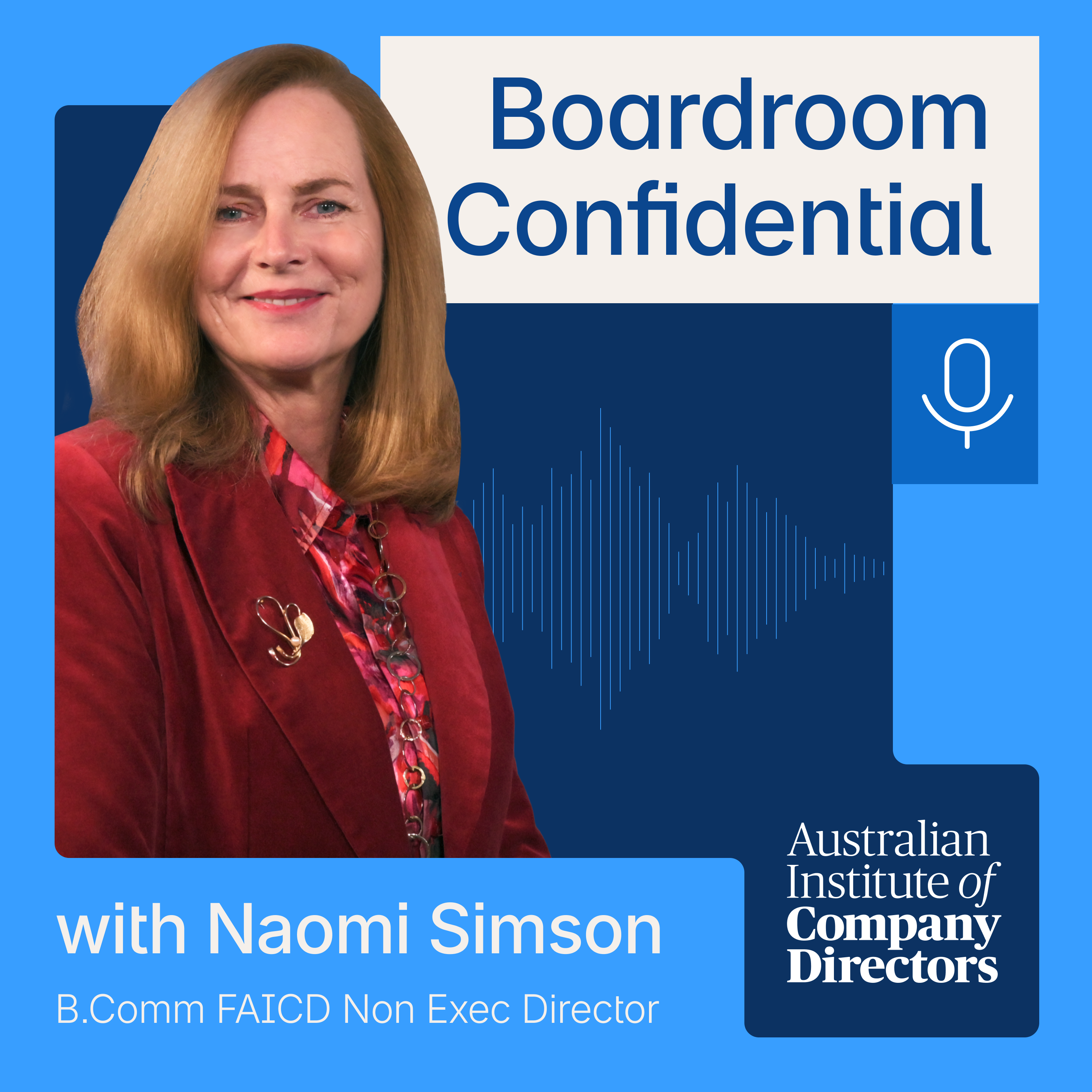 S3E1 – Naomi Simson: Growing Red Balloon Group, small business under threat, and knowing when a founder should step down as CEO | Naomi Simson is an experienced director, successful entrepreneur, and acclaimed author. She co-founded Big Red Group and helped it grow to become Australia's largest experience network. In this candid conversation, Naomi reflects on two decades of building and scaling businesses, the lessons learned stepping back from the CEO role, and why small business remains the backbone of Australia's economy. Naomi also shares her views on the evolving role of boards: how curiosity outperforms expertise, why brand and reputation belong in every risk conversation, and what directors can learn by "sitting in the customer's shoes." Key themes: · Why curiosity can be a director's greatest skill · The board's role in brand, culture, and customer connection Purpose-driven leadership and culture Balancing growth with governance The human cost of overreliance on AI Protecting and empowering small business | — | ||||||
| 5/14/25 |  Inside the AICD's Company Directors Course | This special podcast will take you inside the AICD's flagship Company Directors Course (CDC). Whether you're a current board member, aspiring director, or senior executive – the CDC is the gold standard in governance education. For more than 50 years, the course has helped shape more informed, capable and confident directors. In this podcast, you'll hear from three of the CDC's over 100,000 participants. We'll be unpacking what the course offers, how it equips board members for real-world challenges, and why the CDC is the right next step on your director journey. Thanks to our guests Shirley Chowdhary GAICD, Tim Longstaff GAICD and Nicky Sparshott GAICD. Click here for more information on the Company Directors Course. | — | ||||||
| 4/6/25 |  Special Episode – Thomson Reuters CEO Steve Hasker: the rise of AI, lessons on private equity, and the future of news | Steve Hasker is the CEO and President of Thomson Reuters, plus a director with ASX-listed Appen. He was visiting Australia recently and took part in a special event with the AICD. We talked with Steve about the rise of artificial intelligence, lessons from his experiences with private equity, and the future of news and information. | — | ||||||
| 10/27/24 |  S2E12 – Kate Jenkins: Becoming the Chair of the Australian Sports Commission, gender targets at sports boards, and progress since the Respect@Work report | Kate Jenkins AO GAICD is the Chair of the Australian Sports Commission and the Creative Workplaces Council. She's also a former Sex Discrimination Commissioner and led the landmark Respect@Work report. We talk with Kate about: her chair role at the ASC, gender targets for sports boards and progress since the release of the Respect@Work report. Click here for the AICD guide: "Positive duty to prevent workplace sexual harassment" Click here for research from the AICD and ACSI: "Positive duty: preventing and responding to workplace sexual harassment – Insights from Australian directors" Click here to read about the ASC's Sport Governance Principles | — | ||||||
Showing 25 of 51
Pitch Fit is a Pro feature
See how bookable this show is for guests, which brands already advertise, the per-episode ad value, and the best-fit guest and sponsor profile. The numbers are blurred on the free plan.
How readily this show books outside guests like you.
How proven this show is for host-read sponsorships.
For Guests
ProFor Advertisers
ProUpgrade to Pro to unlock guest cadence, sponsor categories, fit scores, and per-episode ad value for this show.
Similar Audience Demographics
Podcasts that attract a similar listener profile





Chart Positions
3 placements across 2 markets.
Chart Positions
3 placements across 2 markets.