
Broken but Readable
by Greg Scaduto is a freelance journalist, corporate finance professional, and a former US Army officer.
Is this your podcast?Insights from recent episode analysis
Audience Interest
Podcast Focus
Publishing Consistency
Platform Reach
Insights are generated by CastFox AI using publicly available data, episode content, and proprietary models.
Total monthly reach
Estimated from 1 chart position in 1 market.
By chart position
- 🇨🇦CA · Philosophy#6530K to 100K
- Per-Episode Audience
Est. listeners per new episode within ~30 days
9K to 30K🎙 Daily cadence·18 episodes·Last published yesterday - Monthly Reach
Unique listeners across all episodes (30 days)
30K to 100K🇨🇦100% - Active Followers
Loyal subscribers who consistently listen
12K to 40K
Market Insights
Platform Distribution
Reach across major podcast platforms, updated hourly
Total Followers
—
Total Plays
—
Total Reviews
—
* Data sourced directly from platform APIs and aggregated hourly across all major podcast directories.
On the show
Recent episodes
A letter to Elon Musk.
May 25, 2026
11m 09s
In defense of the boomers.
May 18, 2026
11m 55s
The death of the phone call.
Apr 29, 2026
7m 50s
The inventory of an empty house.
Apr 21, 2026
11m 28s
Phronesis
Apr 14, 2026
11m 10s
Social Links & Contact
Official channels & resources
Official Website
Login
RSS Feed
Login
| Date | Episode | Description | Length | ||||||
|---|---|---|---|---|---|---|---|---|---|
| 5/25/26 | 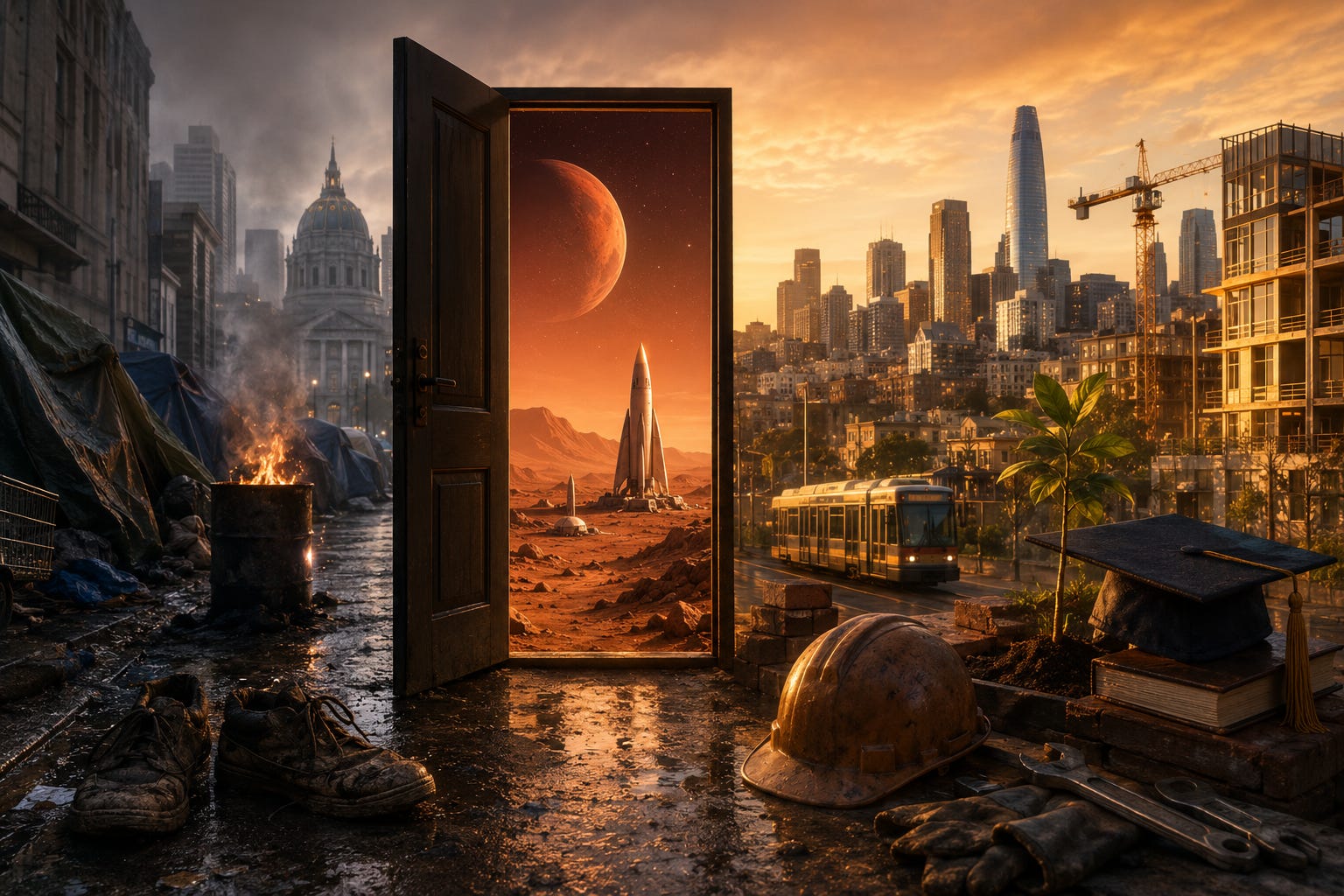 A letter to Elon Musk. | Dear Elon,I’d like to offer you some advice, if you don’t mind.A great deal has been written about you these last few years, and most of it agrees that you are something monstrous. A villain in a cape made of stock options. An emperor of bots. The internet, which is mostly other people who have not met you either, has decided you are a cartoon, and it has drawn that cartoon with such confidence that even people who should know better have stopped looking for the man underneath.I don’t believe it. Not because I admire you particularly, and not because I have access to some private version of you the rest of us are missing. I don’t believe it because I don’t believe it about anyone. I think people are mostly trying. I think the desire to do something good with a life is one of the most universal things human beings carry, even when the doing of it goes badly, even when the trying gets twisted, even when a person’s reach for goodness lands somewhere awful. You are not exempt from this. You are also not exempt from the rest of it: the loneliness, the fear, the longing to leave behind a thing your children might point to and say, that was him.So I write to you the way I’d write to anyone whose work I take seriously. As a person.You have said that for humanity to survive, we must become an interplanetary species. I think you’re wrong about that, and I’d like to explain why.Drive through certain blocks of San Francisco and the city does not look like a city. It looks like an old photograph of a city that has been left out in the weather. Tents lean against tents. A man without shoes walks slow along the curb. A woman in a doorway speaks to a child who is not there. The fog comes down off the hills and through the Civic Center and there is the smell of urine and the smell of weed and the smell of something burning in foil three doorways down. The buildings rise out of the fog with their windows lit and behind the windows are screens and behind the screens are other cities, and the people in those cities do not know that this one is still here.To see all that, and then to see what people do to each other with rifles and drones and artillery, to see the centuries of slaughter we have already authored and the centuries we have queued up for our grandchildren, to read the morning paper and find in it a liturgy of ruin, I do not blame any man for looking up at the sky and deciding that the door is here, the door has always been here, and we should walk through it before the house comes down. There is dignity in that impulse. There is even love in it. A father wants somewhere safe for the children of strangers. The atmosphere of Mars is not safe, but it is, at least, somewhere we have not yet ruined.What if leaving is not the answer, though. At least not yet.On Market Street, men warm their hands at a fire in a steel drum. A young man in a fleece vest walks by them like they’re a flock of gulls. In Washington, meanwhile, the legislature meets. It is still called a deliberative body, in the way a lapsed church is still called a church. It deliberates nothing. It passes the bills its donors have written and ignores the bills its voters have asked for, and the operative provisions of what it does pass are concealed in appendices that the members themselves have not read.So the people stay at the garbage can fires that warm their hands. The young man in the Patagonia keeps walking. The government, which has not decided much of consequence in twenty years, does not decide this either.So here is the question.What if the answer is for the first trillionaire to show moral leadership. And not because anyone asked him to. Because it was right. Because his children will read about him one day. Because in the long arc of how civilizations are remembered, the men who fled are not the men who are remembered.Let me propose something specific.Take five percent of one trillion dollars. Fifty billion. It is a number that ought to feel like a wound, and at the scale of one trillion it does not. Fifty billion, deployed over ten years, placed in a single instrument with a single mandate, governed by people who report to no political party and no quarterly earnings call. You seed it. You call the other nine men at your altitude and ask them to match. None of them wants to be the first, but once it starts all of them will want to be the second. The purpose is simple. To build, inside one American city, a self-sustaining ladder of productive work for the people who currently have no rung to put a foot on.The instrument does four things, in roughly equal measure. It anchors. It trains. It owns. It houses.It anchors by guaranteeing that the city’s largest institutions, its hospitals, its universities, its transit authority, its construction projects funded with public money, buy a steadily rising share of their goods and services from firms located within the city and employing residents at a living wage. The only reason something like this has not transformed San Francisco is that no one with the patience or the capital has bothered.It trains by funding, at full ride, a system of vocational and technical apprenticeships that pay a wage from day one and lead to certified work in trades the city actually needs. Electricians. Pipefitters. Eldercare workers. Solar installers. Childcare professionals. Marine technicians for the port the city has neglected for half a century. These are jobs that cannot be exported and cannot be automated away in the lifetime of anyone now living, and the city, which is aging faster than it is building, cannot function without them.It owns by seeding, through patient capital, a network of worker-owned firms in those same trades, so that wages stay in the city and equity stays with the workers, and the firms compound their value in the hands of the people whose labor created it, rather than draining upward to a holding company in a tax-advantaged jurisdiction whose name no one in the firm can pronounce.It houses by financing the construction of permanently affordable workforce housing on land held in a community trust, so that the people doing the trained work and the anchored work and the owned work can sleep within an hour of the work they do, and the cycle that has hollowed out every American coastal city since the 1980s finally meets a force strong enough to bend it.Fifty billion. Ten years. One city. A model another city can copy without permission.The philanthropy of the past thirty years has, for the most part, failed, and it has failed for reasons that were predictable at the outset. It funded programs, and programs, by their nature, consume the capital that sustains them and produce, in exchange, services that disappear the moment the capital is withdrawn. What I am proposing is structurally different. The capital is not spent; it is placed. It purchases assets, ownership stakes, land, training pipelines, contractual relationships, that continue to generate value after the initial deployment is complete and require no further injection to do so. The distinction is the one between feeding a man versus seating him at a table he owns a share of.Yes, this is the work of the state. And the state will not do it. A man may say what ought to be done and the saying is a kind of comfort to the one who says it. The man at the drum is not comforted. He stands in the cold and the cold does not ask whose job it was. The night comes on and the state is elsewhere and has been elsewhere a long time.Now consider, with the cold eye of a man who has built two of the great firms of his century, what this does for the billionaire who funds it.It buys him the one thing his money has not yet bought him. It buys him a country that will still have him in it when his children are grown. The historical record on this is not ambiguous. Societies that allow the gap between the man at the drum and the man in the lobby to widen past a certain point do not stay societies. They become something else, and the something else they become has never, in any century or on any continent, been kind to the holders of capital.The French knew this in 1789. The Russians knew it in 1917. The British, who learned it earlier and at lower cost, built the institutions of the welfare state precisely because they had read the relevant chapters. The American billionaire class has not read the chapters. It is operating, at this moment, on the assumption that the long American exception will hold.The long American exception is not holding.It also buys him a labor force. Every company in the Valley is fighting for the same engineers, the same machinists, the same skilled tradespeople, and losing them to cities where a person on a technician’s salary can still afford a bedroom. The billionaire who funds the housing and the training does not have this problem. He has built, at the cost of a rounding error on his balance sheet, the one recruiting advantage no competitor can copy without spending a decade catching up. The Romans understood the difference between charity and infrastructure. They built the roads themselves.And it buys him, finally, a place in the story human beings tell about themselves when they are honest. Mars will be settled, eventually, by someone. The man who funds the settling will be remembered the way we remember the men who funded the railroads, which is to say, in a footnote, and not always a kind one. The man who, possessing the resources to flee, instead turned and looked at the city he was standing in and said, this one first, this one before the other, that man enters a smaller and older tradition. There are not many in it. There is room.I won’t pretend you owe any of us this. You do not. You built what you built, through a kind of relentlessness most people cannot summon for an afternoon, let alone a life, and the money is yours under the laws as they are written, and Mars, if you can reach it, is yours too. I am not asking you to feel guilty. Guilt is a poor engine and it burns out the people who run on it.I am asking you to consider that the deepest pleasures available to a human being come from staying. From turning toward the difficult thing and saying, this, too, is mine to attend to. The men I have known who seemed happiest at the end of their lives had stayed closest to what they loved, and had let what they loved become larger than themselves.The door in the sky will still be there next year, and the year after that. The man at the drum on Market Street will not.Start there.With love,Greg This is a public episode. If you'd like to discuss this with other subscribers or get access to bonus episodes, visit gregscaduto.substack.com/subscribe | 11m 09s | ||||||
| 5/18/26 |  In defense of the boomers. | My mother grew up in a house with five kids and almost no money. My grandfather made their lunches every day: two slices of Wonder Bread, one slice of bologna, repeat. The day she got into medical school she came home holding the acceptance letter, breathless, and showed it to her mother, who looked at it for a moment and said, “Oh. Okay. I’m going to bed.”What I remember most from school is how I felt walking home with a good grade in my backpack. The excitement was hers, really. I was borrowing it forward. My mother lit up when I showed her things, and that kind of light costs something to give, and not every house has it. Hers rarely had it. She did better than her mother did. And her mother had done better than hers. That is how this is supposed to work, when it works.My grandmother wasn’t cruel. Her parents came over from Italy with almost nothing and gave her what they had, which wasn’t much warmth, because nobody had given them any either. On my father’s side, my great-grandfather sold fruit on the streets of Newark after coming over from Sicily. His son sold insurance. My father became a doctor. Each one parented imperfectly, the way I do, doing the best with what they had.Lately my generation has taken up a kind of recreational dunking on the Boomers. I see it every day on social media. Someone posts a photo of a paid-off center hall colonial and writes, “they pulled the ladder up behind themselves.” Someone else, a thoughtful person, says her parents’ generation “ate the future.” I read these and I think of my mother and of the sandwiches her father made and the letter her mother would not look at and the long quiet years that came after. And I wonder if we know what we mean. I wonder if we ever have.“Boomer” is a demographic shorthand that has been quietly promoted to a moral category, and the promotion was illegitimate. Pew defines the cohort as Americans born between 1946 and 1964: nearly twenty birth years of people across every race, class, region, and circumstance this country contains. What I mean is that “boomer” isn’t a personality trait.Before we picture every Boomer on a paid-off patio with a margarita, it is worth noticing what the Bureau of Labor Statistics actually says. Nearly one in five Americans sixty-five and older is still in the labor force. Of those working, close to forty percent are part-time. Some of that is preference, but a lot of it is rent.The next time you are at the pharmacy and the woman behind the counter is in her seventies, ringing up your prescription with hands that have done forty-five years of work, look at her. She is closer to a witness of your generation’s economic story than its villain.The Boomers inherited wounds, and their 20s were not a block party. American troop levels in Vietnam peaked above five hundred thousand in April of 1969. Later that year, more than half a million people marched on Washington against the war. The older Boomers were inside that rupture as young adults. They came of age under the draft, under assassinations, under the AIDS crisis that killed their friends in their thirties, under the slow dismantling of the unions and pensions their fathers had counted on.They also built things. The first Earth Day, in 1970, drew twenty million Americans into the streets and led, that same year, to the creation of the Environmental Protection Agency. The Civil Rights Act of 1964 outlawed segregation in public accommodations and banned discriminatory employment practices. Much of the moral language my generation now uses to condemn the Boomers was built, marched for, voted for, or imperfectly absorbed by the Boomers themselves.In 1984, a twenty-five-year-old named Ruth Coker Burks was visiting a friend at a hospital in Little Rock, Arkansas. She was a single mother who sold real estate. She had been raised Methodist in a small Arkansas town where almost no one she knew had ever said the word gay out loud.Walking the corridor, she noticed that one of the rooms had a red bag tied to the door. The nurses at the station were drawing straws. She asked what they were doing. They told her: the man in that room had AIDS, and somebody had to bring him his dinner tray, and none of them wanted to.She walked in.His name was Jimmy. He weighed less than a hundred pounds and his eyes had retreated so far into his skull that you could not tell him from the linens. White upon white. He asked for his mother in a voice Ruth had to bend down to hear.She walked to the nurses station and asked for the number. His mother isnt coming, the nurse said.I would like to try, Ruth said.She took the paper and she dialed and she waited. A woman answered.Your son is dying, Ruth told her.The line went quiet. A long quiet from a house in some other county where the light was failing and a woman stood at her kitchen with the receiver pressed to her ear.My son died years ago, the woman said. He died the day he went gay. I dont know what is in that hospital but it is not my son.And she hung up the phone.Ruth went back into the room. She did not have the language of allyship or any of the words that would be developed, in the decades to come, for moments like this. She had her hand, and she gave it to him. She sat there for thirteen hours. She did not let go when he died.She set out to bury him and found that the town would not permit it. One funeral home after another refused the body, as if the disease itself had moral character, as if to touch what he had been was to be implicated in what he had become. She drove an hour and a half to find a man who would do the work, and she paid him out of her own money, because no one else would pay it and because someone had to.The ashes came back to her in a cardboard box, of the sort that holds office supplies or a pair of shoes, a container that announces by its ordinariness that no ceremony has been arranged for what it holds. She could not afford an urn. She walked into a pottery shop in Hot Springs and stood among the kilned bowls and serving dishes, and a man there, hearing what she needed and perhaps not hearing the whole of it, took down a chipped cookie jar and gave it to her. Into this she placed what remained of Jimmy.A cookie jar. The kind a grandmother keeps on a kitchen counter for visiting children, made to hold the small and pleasurable things of an ordinary life. He had been refused his mother, refused the rites of his town, refused even the dignity of an urn, and what he received instead was the vessel of a childhood no one had let him have.She buried him at night, alone, in her family’s cemetery, with a posthole digger she had thrown in the back of her car. She said a few words over the grave herself.She would do this many more times over the next decade. Word traveled fast through the quiet networks of dying men. There is a woman in Hot Springs. She is not afraid. She will sit with you.She had never heard the modern catechism of inclusion and there was no social media. She was a Methodist single mother in Reagan-era Arkansas, and the Ku Klux Klan would twice burn crosses on her lawn for what she was doing, and she kept doing it anyway.The Boomers, like every generation that ever drew breath, came into the world owing a debt no one had thought to explain to them; their twenties were the long humid corridor of a house their fathers had built and could not bring themselves to leave, full of the war their fathers had won and could not stop fighting, full of the wars their own sons would be sent to fight, full of the slow patient carnage by which a country becomes itself.The credentialed classes have spent a generation learning to treat fluency as a kind of virtue. To deploy the current vocabulary of suffering, to know its nouns and its cadences and the audiences at which it must be aimed, has become a moral performance in its own right. It is one of the more comfortable confusions of American life.The right words came late. They came after a working-class woman in Hot Springs walked through a hospital door no one else would open, and held a stranger’s hand for thirteen hours, and buried him in the dark, in a cookie jar, in a cemetery she would not speak of for thirty years.Her name is Ruth Coker Burks. She is alive. She is a Boomer.My generation is not wrong about the damage. Housing is scarce because zoning was designed to protect those who already owned. Student debt is crushing because policy allowed a lending architecture to expand faster than the wages of the young people it depended on. Health care extracts rent at every turn. Both parties are governed, on most days, by men and women who have held office for too long and acquired the habits of holding it.None of this is generational; it is only human. The country lost its compact with the young because, over the past four decades, American institutions learned to protect accumulated wealth better than they protected the young. Again, this is a policy that is supported today by young and old alike.Here is the spiritual cost of generational contempt, which I think we feel without quite naming. Every generation eventually becomes embarrassing to the next one.Mine will not lack for accusers. The easy charges are already being written: that we outsourced our attention to algorithms, that we treated our children as content, that we replaced therapy with chatbots without first understanding what therapy was for.The deepest charge, I think, will be that we were the first generation in human history to live our entire adult lives inside a system that recorded us, and we did not refuse it. We did not, in any meaningful sense, agree to it either. By the time we thought to ask whether it was a problem, we had already taken its shape.Then there is the matter of what we trained. Every confession, every grief, every cruelty we typed into a search bar in the small hours of the morning will have become, by the time our grandchildren are grown, part of the model that judges them.Gen Z will be blamed for something we do not yet have the language to name. They are being formed by whatever that is now, and one rarely sees clearly the shape of the thing forming you.And the unborn will look at all of us, Boomer and Millennial and Gen Z and the generations after, and they will ask the question that gets asked of every era that has ever ended, which is just what did you think you were doing? The honest answer, in our case, is that we were not certain we were doing anything in particular. We were checking our phones.The contempt we aim at the old is but a rehearsal for the contempt that will one day be aimed at us.My mother is seventy now. She still lights up when I tell her something I am proud of, the way she lit up when I came home with a good test, which is more than I earned, more than she ever got, and the only way any of this ever moves forward.She did better than her mother did. I am trying to do better than she did, which is hard, because she set the bar high. My children, God willing, will do better than I do.This is an inheritance, and it is a long, imperfect handoff, where each generation gives the next a slightly better version of the world than it received, by working harder than is fair, and loving more than is easy, and sometimes, often, by refusing to pass on what was passed on to them.I meant to post this on Mother’s Day, but I didn’t. Happy belated Mother’s Day, Mom. And to all of you, your mothers out there too. Even the boomers.Especially the boomers. This is a public episode. If you'd like to discuss this with other subscribers or get access to bonus episodes, visit gregscaduto.substack.com/subscribe | 11m 55s | ||||||
| 4/29/26 | 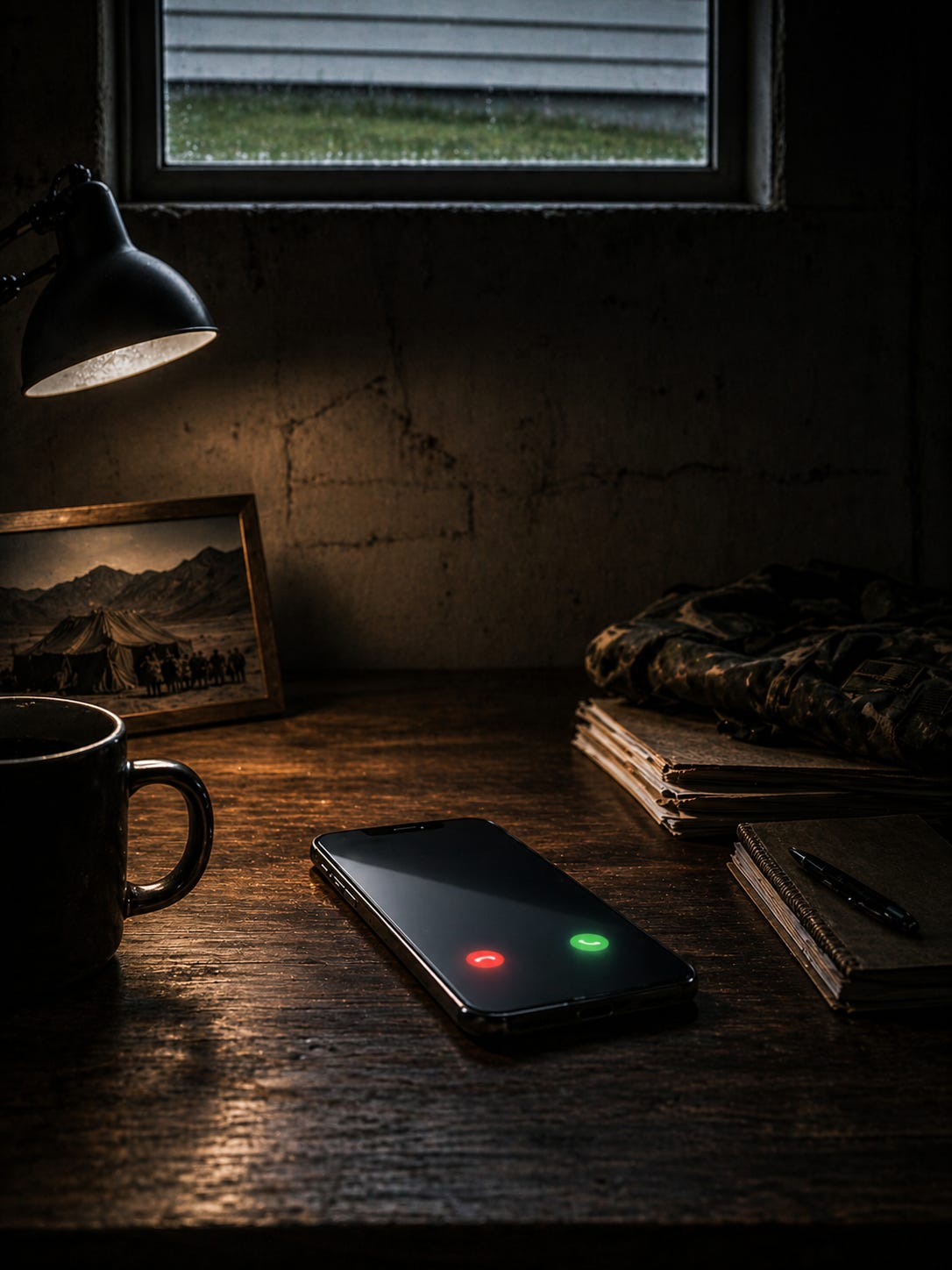 The death of the phone call. | You sit at the desk in the basement corner you call your office. The window above it looks at nothing. Just a wedge of grass and the foundation of the neighbor’s house. The screen glows the pale blue of a thing that doesn’t sleep, and you have been staring at it long enough that your eyes have stopped registering the words. Behind you the house has settled into its night sounds. The refrigerator cycling. The heater ticking through the walls. A beam contracting somewhere over your head as if the house is trying not to wake anyone. From the kitchen comes the smell of the chicken your wife roasted at six, garlic and rosemary gone cold on the stovetop, the kind of smell that means a family ate and a woman cleaned up and a man was not there for either part. Your daughter is asleep upstairs. Your son is asleep in the room across from hers. Your wife has been asleep for an hour. You can hear her breathing through the floor if you listen, and sometimes you do.The phone lights up on the desk. It is your friend from before. From the unit, from the years you both ate the same dust in the Mojave desert, and slept under the same blanket of low grade stress. The screen shows his name and you look at it. You wanted to ask him whether he ever thinks about the young kid from second platoon platoon, the one with the sister, the one whose name you can no longer say without your throat closing. You wanted to ask him whether his father has died yet. You wanted to ask him if he was okay, which is the only question that has ever mattered between you, and which neither of you has ever once asked aloud.You let it ring. You watch the screen go dark. The house keeps breathing.In the morning you send him a text. Hey brother, saw you called. All good?What you meant to say was that you have been sitting at this desk most nights for a year and you do not understand why. What you meant to say was that last week at the gas station you saw a kid who reminded you of the kid from second platoon, and you sat in the truck for twenty minutes afterward and could not turn the key. What you meant to say was that you have not heard your friend’s voice in eleven months and you are afraid the next time you hear it will be at his funeral service, and you will stand there in a suit you bought for someone else’s funeral and not know what to do with your hands. The text said none of this. The text was four words and a question mark, a green rectangle on a piece of glass. He sent one back an hour later. All good brother. You? You wrote Same. You put the phone down and went and made the coffee.What was lost was the breath between the words. What was lost was the catch in his voice when he heard yours, the small involuntary thing the throat does when a man hears a man he has loved for twenty years. What was lost was the chance, the single chance, on a Tuesday night in October at twenty-three minutes past eleven, to be known by another man before the dark comes for them both. Two men can love each other their whole lives and never say it. What saves them is the hearing of it. And there is no hearing in a green rectangle. There is no breath. There is no man on the other end. There is only the silence after, which is the silence that will be there when one of them is gone and the other is left with a phone that does not ring anymore, and a question he never asked.The phone call as the last unedited medium.The dread is new. A phone rings on a desk at night and the person whose desk it is looks at it with the fixed expression of a man watching an animal he has not yet decided to feed. The name on the screen belongs to someone he loves. That is what makes the dread interesting. To be known by people who already know us, at a moment for which we have not prepared, is now the thing we are most afraid of.We did not used to prepare. We just picked up. The voice came out of us with whatever fatigue or irritation or grief the day had left in it, and the person on the other end heard it and made of it what they would. Now we draft. Voice memos can be re-recorded until the catch is gone from the throat. Texts can be edited until they say the thing we wish we felt. The little green dot beside our name can be turned off, so no one knows we are home.What we have built, over fifteen years and without quite meaning to, is a publicist’s job inside every friendship. We manage our image for the people who have watched us cry. We curate our availability for the people who held our children. The phone call is the last room we have not redecorated. This is why the ringing of it produces what it produces. This is why we let it go.What we lost is rhythm.Conversation has a tempo, which is to say it has pauses, and the pauses are where the meaning lives. A held breath before an answer means one thing. A laugh that arrives a beat late means another. The voice that drops a half step on a particular word, the cough that interrupts a sentence and then declines to finish it, these are the structures through which one human being learns what another human being is actually saying. They are also, almost without exception, involuntary. They cannot be drafted.Text removes them, and what remains is the sentence stripped of its weather. We send messages over hours that would have taken twelve minutes by voice and carried, in those twelve minutes, the entire emotional truth of an exchange the texts will never approximate. What looks like a pause in a text thread is an absence. Someone has put the phone down. Someone is in a meeting. Someone is choosing not to answer yet because the appearance of immediacy is socially expensive.A thread that ran across a Tuesday afternoon feels, in retrospect, like a long conversation. It was not a long conversation. It was a series of micro-performances separated by the silences in which we did other things. The twelve-minute call would have left us with the residue a real exchange leaves, the small ache of having been present to another person’s life. The thread leaves nothing. We scroll up the next week and cannot remember what we meant.A commander walks the line at the end of a long day. He does not have a clipboard. He does not ask the questions a survey would ask. He stops at a man and looks at him, and the looking is the thing. He sees the weight under the eyes, the small tremor in the hand that holds the rifle, the way the shoulders have begun to carry something the man has not yet told anyone he is carrying. He asks how the man is and listens to the answer, and then he listens to what the answer did not contain. This is how morale has always been taken. Face to face, in the failing light, by a man whose job is to know which of his men is closer tonight to breaking than he was yesterday. You cannot do this over text.A phone is a small thing on a desk. It rings or it does not. You answer or you do not. The choosing seems like nothing at the time. A man has only so many nights, and only so many friends, and only so many rings before the ringing stops. The window above the desk looks at nothing. The grass is the grass. The phone goes dark. The house keeps breathing. This is a public episode. If you'd like to discuss this with other subscribers or get access to bonus episodes, visit gregscaduto.substack.com/subscribe | 7m 50s | ||||||
| 4/21/26 | 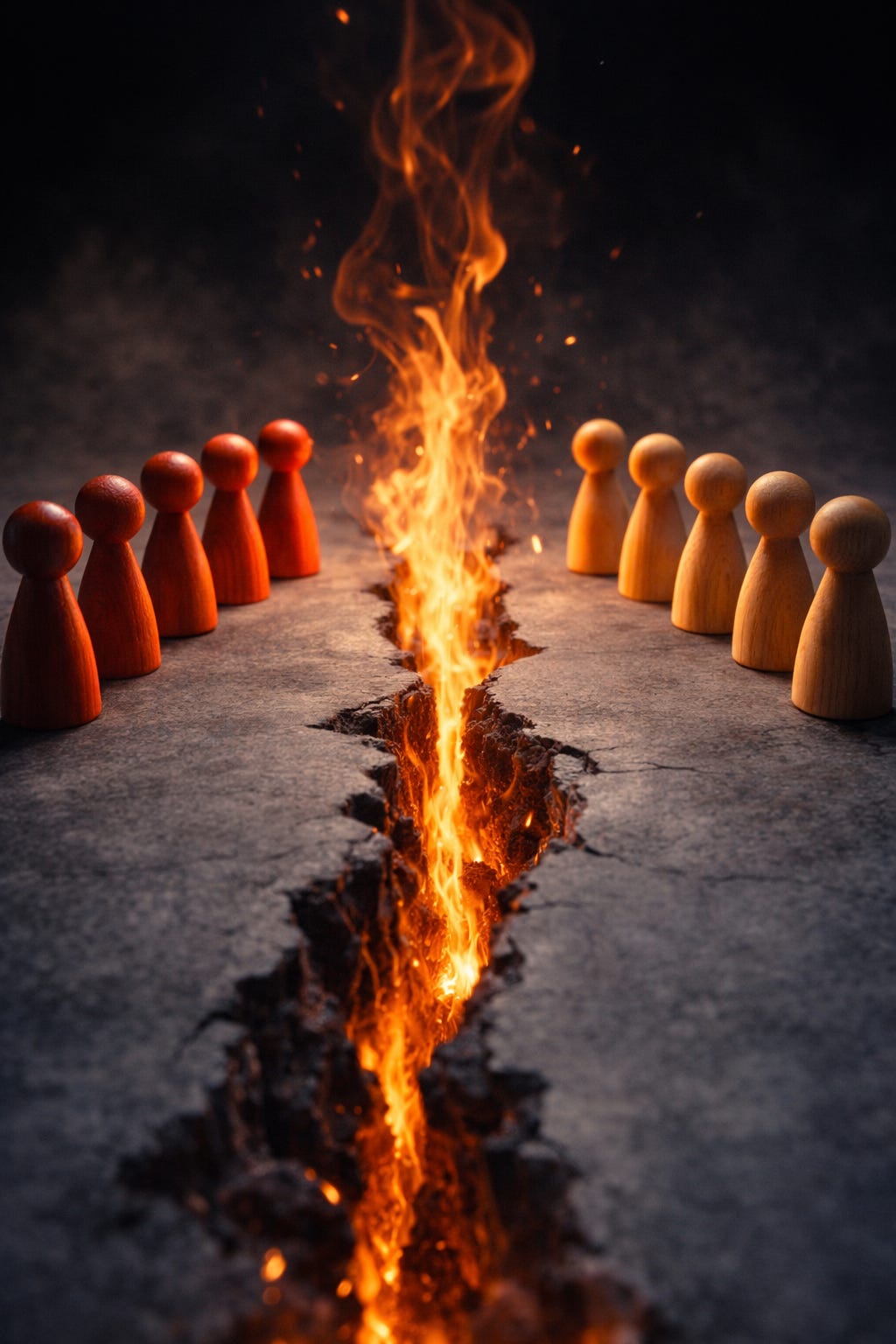 The inventory of an empty house. | Gender discourse has become stupid. I do not mean controversial, or incendiary, or even wrong, though it manages all three on a good day. I mean stupid in the technical sense, as a failure of the intellect to perform its basic office, which is to notice that the world is more complicated than one’s theory of it. The conversation is now carried on at a pitch of abstraction that would have been laughed out of any seminar or conference room at any point before roughly 1990, and it is sustained by combatants who appear to believe that millions of strangers, whom they will never meet, are fundamentally knowable by the team jersey they were issued at birth.The spectacle has the curious feature that its two warring camps, who cannot be in a room together without calling for the other’s excommunication, are in fact engaged in the same enterprise. Both insist that the category does the moral work. Both regard the opposition as so foundationally corrupt that engagement is pointless. And both have arrived, by opposite routes, at the same terminus, which is the decision to stop looking at the people the whole argument is supposedly about.Start with the feminists. Not the moderate kind you meet at dinner parties. The serious writers, widely read, whose arguments are quoted on social media every day and taught in women’s studies departments as canon.I mean people like Andrea Dworkin, who in her 1987 book Intercourse, argued that heterosexual sex cannot be disentangled from male domination, that the act itself is marked by occupation, that a woman cannot meaningfully consent inside a system built to extract her consent. Or Amia Srinivasan, whose book The Right to Sex became a minor sensation in 2021, arguing that who we find attractive is political, that the patterns of desire in any society are shaped by power, and that the erotic preferences of men are, in aggregate, one of the mechanisms by which women are kept in place.These arguments are not on the fringes. They are the water the daughters were baptized in and the air the sons learned to hold their breath against, taught on every liberal arts campus from Wesleyan to Sarah Lawrence, by women who had learned them from women who had learned them in their own turn, recited now with the unembarrassed fluency of a catechism, in seminar rooms where the tuition runs to eighty thousand a year and the central discovery of the semester is that the patriarchy has, once again, been found to be responsible.There is a woman on X, and I know her although we have never met, who posts at three in the morning about her ex-husband. She does not say it is about her ex-husband. She says it is about capitalism, or about the male gaze, or about a study from the University of Michigan which has found, to nobody’s surprise but her own, that men are slightly worse than previously believed. The thread runs to 15 posts. By the eighth she has mentioned a specific brand of running shoe. By the eleventh, a specific restaurant in Cambridge. By the thirtieth, you could, if you were curious and had an afternoon free, reconstruct the entire marriage and file for divorce on her behalf.I follow perhaps fourteen of these women. I have told myself, on several occasions, that I am going to unfollow them, and then one of them will post something like men will literally start a land war in Asia before going to therapy, and I will think, well, not this one, this one is different, this one is funny, and I will keep her, the way a man keeps a houseplant he has no business owning, out of a vague sense that letting it die would say something unflattering about him.And then at two in the morning she will post a thread explaining that to be reasonable itself is a tool of patriarchal suppression, and I will be alone in a quiet house, reading by the light of my phone about how men are, once again, the problem, and wondering, with some seriousness, whether I am.Then there is Andrew Wilson, the Christian populist who recently sat down with Konstantin Kisin on Triggernometry. Wilson says out loud what a growing constituency now believes, a constituency one encounters with increasing frequency at weddings, where a groomsman you last saw at a fraternity formal in 2010 will corner you by the bar to explain, with the patient condescension of a man who has recently completed a podcast, that the decline of Western civilization began the moment women were permitted to open their own checking accounts.Women should not defer their childbearing years for college, because their biological window is narrow and college ruins them for marriage. Women should not vote, or should vote as part of a household, which in practice means their husbands vote for them. The draft applies to men, not women, and until that changes, women have not earned the franchise. Rights do not exist; they are social constructions maintained by force, and since women cannot wield force at scale, they are always appealing to men’s benevolence anyway. Feminism, to Wilson, is a century-long error, and the correction is a return to the stakeholder democracy America had at its founding, when the head of a household cast one vote for everyone under his roof.Wilson’s argument is coherent in its own way, sure. Grant his premises and the conclusions follow. The premises are that morality is grounded in God, that Christian ethics produce the best outcomes, and that force decides everything in the end. The rest is just engineering.What Wilson shares with far left feminists like Dworkin, despite every surface disagreement, is the treatment of men and women as classes whose behavior is explained by their biology or their social function. He would be offended by the comparison, though he clearly should not be. The operation is identical. A particular man or a particular woman is a stand-in for a role the ideology has assigned in advance. The individual is a data point in a case the theorist has already decided.But here is an author you’ll seldom hear interviewed on podcasts. The psychologist Andrew Solomon has spent a career writing against this exact move.He wrote that identity has a vertical dimension, the traits we inherit from our parents, and a horizontal dimension, the traits we discover only by finding others like us. A deaf child born to hearing parents is their child and also something the parents cannot fully comprehend without effort. The parents’ job is to love what the child actually is, not what they expected, and to resist the temptation to dissolve the child into a category.He would tell them you’ve written well, and that much of it was true. Men’s power has disfigured the lives of women. You had seen that plain, and set it down, and the seeing was not the error. But you have built a theory in which good men cannot appear. You have built a theory in which the father of a disabled child, sitting up through the fourth night in a row to keep her from hurting herself, is functionally indistinguishable from a rapist because both are men. Your theory has no room for love that crosses the category you made central. And a theory that will not house love is not a theory at all, but an inventory taken in an empty house, and the inventory of an empty house, however precise, tells you nothing of the family that once dwelt there.And to Wilson I would say something harder.You want to return women to the household because you believe it produces flourishing. You say this with the confidence of a man who has never had to watch the plan come apart in his hands.I am a father. And my son, like every son, is not what anyone expected, because no child ever is. The plan does not survive him. The plan was never going to survive him. And I sit up some nights, in a house that is quieter than I ever thought a house of mine would be, and I think about him, and about his mother, and about the family we were going to be and the family we turned out to be instead, and I understand something I could not have understood at twenty, which is that flourishing is not the correct alignment of bodies to roles. Flourishing is the willingness of a parent to love a child who does not match the plan, and of a partner to love a partner whose life does not fit the template, and of a man, finally, to love himself as the thing he is and not the thing he was supposed to have become.Your system explains every family difficulty as someone failing to fit their role. It has no account of the harder case, which is the role failing to fit the person. That case is real, and common, and it is the case in which love is actually tested. Your theology is silent there, because silence is all it has. It was built to enforce the template, not to meet the person who cannot live inside it.The moral work, on both sides of this polarized debate, is designed to avoid the work of looking. Looking at the particular woman, the particular man, the particular marriage after the cameras are off and the categories have been dissolved by fatigue and time. Both of you offer a way to render verdicts on people they have never met, as if the categories did all the work. The categories do not do the work. Love does, attention does, the daily choice to take seriously the person you have been given.This is why the gender discourse is stupid, and why it is worse than stupid. It is an evasion, and the people conducting it would be embarrassed, I think, if they let themselves name what they were evading. They are evading the sight of one another. There was a time when a person’s church and a person’s marriage and a person’s town did the quiet work of requiring that sight, often clumsily and sometimes cruelly, but requiring it. That time has passed. We ended it ourselves, in installments, and for reasons that seemed sufficient. What rose in the vacancy is judgement, sold in bulk by the category and bought by audiences who have been relieved, at last, of the burden of looking at anyone in particular.Men and women are not interchangeable, and I have never wanted them to be. The difference between them is one of the great gifts of being human, and the places where that difference meets and holds and generates something neither could have made alone are among the places I have been most moved in my life.The category into which a person was born is the beginning of their story, never the end of it. Each soul carries inside it a history no other soul has lived, a grief no other soul has carried in the same shape, a capacity for love that was waiting for a particular person and will recognize that person when it finds them. To love anyone truly is to learn this history, slowly, and to be changed by the learning. There is no shortcut. There has never been a shortcut. And there will never be a theory, of the left or the right, that can do this work for us.Because the work is the point, and the work is what makes us, in the end, worth loving in return. This is a public episode. If you'd like to discuss this with other subscribers or get access to bonus episodes, visit gregscaduto.substack.com/subscribe | 11m 28s | ||||||
| 4/14/26 | 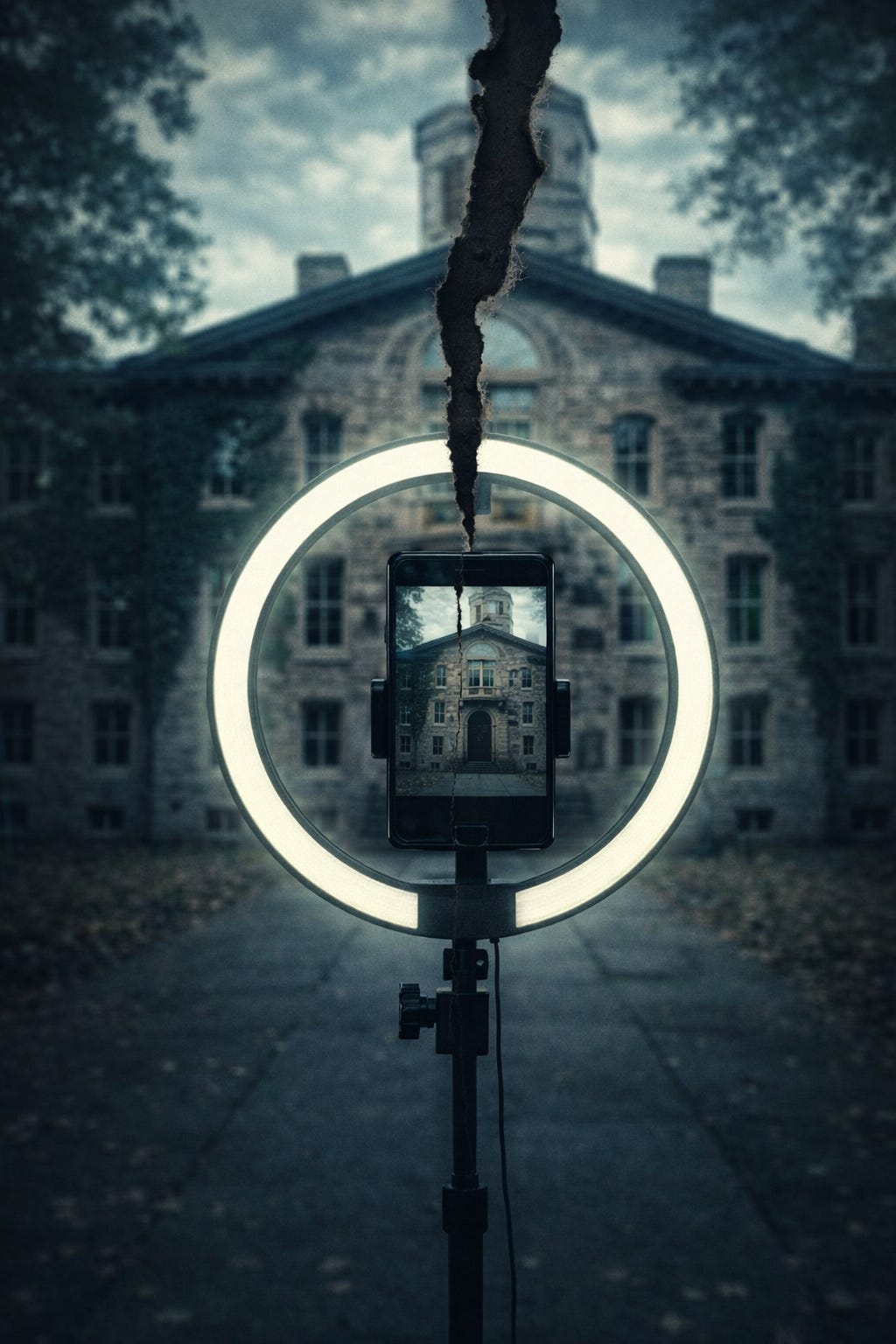 Phronesis | I recently walked around Princeton University’s campus on a Saturday afternoon. It was beautiful in the way old American campuses always are: stone buildings with ivy climbing the walls, oak trees filtering the light, the kind of place that was built to make you feel small in the presence of something lasting.And every single person I passed was taking a picture of themselves.Not of the buildings. Not of the trees. Of themselves, standing in front of the buildings and the trees, so that later they could prove they had been near something meaningful. The whole campus had become a backdrop, or a set. A place where people came not quite to think, but to be seen appearing to think.I sat on a bench for a while. I watched a woman in a cashmere sweater take over 20 photos of herself in front of Nassau Hall.Twenty.I went home and opened the New York Times, which is something I do when I want to know which direction the worry is blowing. There was a column about the crisis of modern masculinity. The author had been writing about the crisis of modern masculinity for what appeared to be most of her adult life, the way some people restore boats they never intend to sail. The prose was immaculate, the author fluent in the language of insight. If you’d read it out loud at a dinner party, people would have nodded and said, “That’s so true,” and then somebody would have asked if there was more wine. I finished it and sat there for a moment, trying to figure out what I’d just learned. The answer, I think, was that things were bad, and that the author had noticed.I closed the Times and opened X. A man with a jawline and a ring light was explaining to his followers that the key to surviving the age of AI was to “acquire assets.” He said this with the serene certainty of a man who has never been asked a follow-up question.Below him, another man was arguing with a woman he had never met about whether feminism had destroyed the family, conducting in public the exact argument he could not win at home. Below that, someone with a graduate degree in something important had posted a statement so detached from observable reality that reading it felt like being gently concussed.Everyone is talking. Everyone is performing a version of seriousness so convincing that it has become indistinguishable from the real thing, except for one detail: nothing is changing. The conversations circle, and the arguments repeat as the selfies accumulate. And underneath all of it, something has gone quiet that used to be loud.The Greeks had this word, phronesis. We translate it as “practical wisdom,” which flattens it a little. Phronesis is the capacity to perceive what a situation actually requires and to act on that perception. It doesn’t mean expertise. An expert knows what to do in general. A person with phronesis knows what to do here, now, when the textbook doesn’t apply and the stakes are real.Aristotle paired it with arete, which we translate as “virtue,” gutting it of its original force. Arete meant something closer to excellence aimed at the whole. A life organized around becoming the kind of person who could be trusted with responsibility. Not trusted because of their credentials. But trusted because of character, built through practice, tested through difficulty, refined in community over years.Greeks did not care whether virtue felt good. They asked what was owed. A Roman would have understood the distinction. The Roman concept of pietas, the debt you owed to family, city, ancestors, and the gods, was not a lifestyle preference. It was the architecture of civilization.Christianity added another layer: the idea that consciousness is not confined to the body. That something in us persists, connects, transcends. That we are answerable not only to each other but to something larger. Islam carried a similar conviction, that submission to the divine was the foundation of justice. Buddhism taught that the self was an illusion, and that liberation came from seeing through it. Hinduism mapped the interior life with a precision that Western neuroscience is only now beginning to approach, describing states of consciousness that modern researchers are rediscovering under fMRI machines and publishing as if they were new.I bring up these traditions not because I think we should live like them. Much of what they built rested on slavery and conquest. But they took a question seriously that we have almost entirely stopped asking: what kind of person should a human being try to become? They built institutions around that question. They organized education around it. They selected leaders, at least in principle, on the basis of it.We have no equivalent today. We abandoned the question when we abandoned the religious traditions that once carried it, and we never replaced it with anything that could bear the same weight.Some of what we abandoned deserved abandoning. The dogmas, the hierarchies, the weaponized certainties, the priests who turned out to be predators. Scientific rationalism arrived and offered something genuinely better: a method for distinguishing what is true from what is merely comforting. We needed that. Badly.But somewhere along the way, the method swallowed the worldview. We moved from “we should test our beliefs against evidence” to “only what can be tested against evidence is real.” And in doing so, lost the vocabulary for everything that makes life bearable: meaning, duty, grace, forgiveness, the sense that you are part of something that did not begin with your birth and will not end with your death.If we are not going to return to religion, fine. Maybe that’s for the better. But we cannot replace religious ethics with no ethics at all and expect the structure to hold.I say this because the structure is being tested right now, and it is failing the test.The systems we are building, the ones that will outlast every person reading this, will inherit whatever values we pour into them. Right now we are pouring in efficiency, optimization, engagement metrics, and quarterly returns. We are building minds without conscience. I’m not saying that to be cute. That is exactly what we are doing. And the market will not correct for this, because markets do not account for the soul. They never have.In the dust of this new age the tools we shape begin to shape us. The machines do not wait. They learn. They judge. And they do not pray before they act. In the old world a man’s conscience was his compass. In this one, it is the code he leaves behind. There is no virtue in speed without wisdom, and there is no mercy in power without restraint. We are not merely makers now; we are translators of our own soul into systems that will outlast us. And if we do not set the bones of those systems in ethics, in something older and truer than profit or pride, then they will speak in the voice of no one, and answer to nothing.This is where the selfies and the AI converge. The woman in front of Nassau Hall and the algorithm curating her feed are participating in the same economy: one that measures everything and values nothing that can’t be measured. She is responding rationally to a system that rewards visibility while punishing depth. The system is the problem.And the system is about to get a lot more powerful.An AI trained on engagement will optimize for engagement. An AI trained on profit will optimize for profit. An AI trained on wisdom would optimize for something else entirely, but we would have to know what wisdom looks like before we could train for it. And we have spent the last century systematically dismantling every institution that once tried to answer that question.People mythologize Elon Musk for his technical brilliance, equating that for wisdom. This is a category error as old as history.This is the gap, and it’s not technological, but moral. We have the tools to build systems of extraordinary power and no shared framework for deciding what those systems should serve. The engineers building these models are, in my experience, thoughtful people asking hard questions. But they are building on a foundation that the rest of us forgot to pour.The question we need to answer is a design question: how do you build systems, political, institutional, technological, that select for wisdom and moral courage rather than ambition? Every serious civilization before ours organized itself around some version of this question. We have stopped asking it, and the cracks in the walls are the predictable consequence of a civilization that scoffs at concepts like duty and integrity.Part of the answer to all of this involves taking consciousness seriously. Not as a new age branding exercise, but as the deepest unsolved question in science. The fact that anything is experienced at all, that there is something it is like to be you reading this sentence, remains unexplained by any model we have. Researchers who ask fundamental questions about the nature of mind should not be treated as if they’ve committed a professional indiscretion. They are working on the thing that matters most.Part of the answer involves rebuilding the practice of interiority. Not the kind found in TikTok clips, spoken by people with jawlines you could teach geometry with. I’m talking about the actual discipline of sitting with yourself long enough to discover what you think, rather than what the feed thinks, rather than what performs well, rather than what is safe. This is unglamorous work and it does not photograph well.And part of the answer might just be this, and I’m sorry it isn’t more complicated: try to get interested in other people. Actually interested. Use the phone to find out how someone is doing, not to watch a twenty-six-year-old in a rented apartment explain the universe to you while you lie in bed feeling like something the dog brought in. Choose depth over visibility, in the small ways, on the days when nobody’s grading you.Look, I know how that sounds.It sounds like the kind of thing someone writes on a bench at Princeton while feeling superior to the woman with the phone. I am aware of the irony. But the irony does not make it incorrect.Tonight, somewhere, in a room without a camera, someone will sit quietly and ask the only question that has ever mattered: what kind of person am I becoming?And whether anyone is watching will be, for once, not the point. This is a public episode. If you'd like to discuss this with other subscribers or get access to bonus episodes, visit gregscaduto.substack.com/subscribe | 11m 10s | ||||||
| 4/9/26 |  You were never meant to love your job. | Most people are told to follow their passion. This advice is exactly wrong for most of them.For most of us, and I mean most of us, like the overwhelming, unglamorous, beautiful majority of us, you are not going to be a famous actor. You are not going to sell out arenas or throw a touchdown pass or have your face on a billboard. You are not going to be a podcaster with a devoted following, or a painter whose work hangs in a gallery in a city where people wear scarves ironically and drink natural wine. You are not going to be one of those people. And that is not a tragedy. That is just the shape of most human lives.For most of us, like 98% of us, the right advice is to find something you are good at, that the economy values, that leaves you with enough self-respect to sit in a quiet room and not want to crawl out of your own skin.You will not hit a walk-off home run at Fenway. You will not win an Oscar. You will very likely sit in a building with fluorescent lights that hum at a frequency just below your threshold of noticing, in a chair that never quite adjusts right, in front of a screen that asks you for the same thing it asked you for yesterday. The hallways will smell faintly of burnt coffee and someone’s lunch. The windows, if there are windows, will look out onto a parking structure. And you will be there for a long time.I worked in a place like this. And there were moments – small lulls in the day, the brief pause between one task and the next – when a colleague would swivel in his chair and say, almost to himself: I cannot believe this is my life at this point. There was a moment, years ago, where I could have gone a different direction. And I didn’t. And I think about it.And you would nod, and commiserate, and feel the specific sadness of shared captivity. Because underneath his words you would hear your own: I have been deprived of something. I was meant for a different life. I made choices, or choices were made for me, and now there are children, and a mortgage, and obligations that have mass and weight, and I cannot leave, and the work is beneath me, and I am disappearing inside of it.That is the thought. And the thought is the problem.Because you believe you are destined for something that will make you feel alive. Something larger. But for most of us, no. There is no larger thing waiting. We sit in the very chairs that were set out for us, and we make jokes about the coffee maker in the break room, and we walk the same carpeted corridor, day after day, alongside other people who are also wondering how they got here. Lost and tentative and quietly ashamed, the lot of us.It took me many years, and more than a few humiliations, to understand that I had been looking in the wrong place. The passion is not in the work. It was never in the work. You will not be saved by the work. But you might be saved by how you treat those beside you. By becoming curious about them, and deciding that their lives matter.What gets called passion begins, if you are a manager, the afternoon you pull a new graduate aside – a young woman who is unsure of herself, who second-guesses every sentence she speaks in a meeting – and you tell her: right now, in this moment, I believe in you more than you believe in yourself. You will not fail. Not because failure is impossible, but because I will not allow it. I am paying attention to you. I am here.And then you watch her. Over months. You watch her find her footing. You watch the hesitation leave her voice. You watch her walk into a room and own it. And when she does, when that moment arrives, the pride you feel is not smaller than the pride of any great achievement you have ever imagined for yourself. It is larger. Because it is hers, and she earned it, and you had a hand in it. She will move on. She will take a better role somewhere else, in a building with better windows, and she will carry that confidence with her, and she will extend it to someone else in turn. You asked for nothing. You received something that compounds for the rest of your life.It comes when you treat an employee eight thousand miles away – a man in a Bangalore office whose name gets mispronounced in every call, who gets spoken over, whose ideas disappear into the silence after he offers them – when you treat him with the same respect and seriousness you would anyone in the same room. You defend his work. You say his name correctly. You make sure he is heard. Not because there is anything in it for you. Because it is right.It comes when there is a young, capable woman on your team who is, and you are aware of this, genuinely attractive, and who has therefore spent her entire professional life being either hit on or looked through, which are, when you consider them, two versions of the same dehumanization. The men who call themselves feminists, and God, they are everywhere in the modern workplace, these bloodless allies with their correct opinions and their tote bags and their utter failure to actually do anything, they are, in practice, the worst offenders, because at least the man who simply ogles her is not also congratulating himself for his enlightenment while he does it.And so what you do, what you actually do, is walk up to her after the presentation and tell her, with zero preamble and zero agenda, that what she built is exceptional. That the team thinks better because she is in it. That she should be proud of it. Full stop. And then – this is the part that matters, this is the whole thing – you leave. You walk away. You ask for nothing. No lingering. No subtext smuggled in under the cover of professional praise. Just the truth, delivered cleanly, to a person who has probably been waiting years for someone to offer it without wanting something back.Fellow men who manage people: do not say you are a feminist. Show it in what you do. The word costs nothing. The walk away costs something. Do that.When you do these things, something shifts. Slowly. Trust accumulates. Influence follows trust. And with influence comes the only power worth having: the ability to improve somebody’s life. Not in a grand way. In a real way. You help a person see that what they do has value. That the hours they spent in that humming fluorescent building meant something. That the work, even when it was grinding and gray, was done alongside people who cared about them. And in a life filled with illness and loss and disappointment and the low background noise of quiet hopelessness, being seen is not a small thing. Being seen is enormous.A battalion commander once told me this. Three combat deployments to Iraq. Two to Afghanistan. His marriage had not survived it. He had been sober for five years. He said that leading soldiers into combat was an act of love. Love for his country. Love for his soldiers. And love for the men and women on his left and right – some of whom he did not particularly like, some of whom drove him to the edge of his patience – but who would carry him on their backs through a hail of gunfire without a second thought.That is the thing, he said. That is the whole thing.You will work. Most of you will work at something that will never be written about. No one will make a film of it. You will not be remembered for it. But there will be people beside you. There always are. Treat them well. The world is older than our grievances and it does not care what we were owed. What it holds onto, what it passes forward in the dark, is the moment one person turned to another and said: I see you. You are not nothing. Keep going. That is all the passion there is. That is enough. It has always been enough. This is a public episode. If you'd like to discuss this with other subscribers or get access to bonus episodes, visit gregscaduto.substack.com/subscribe | 8m 22s | ||||||
| 4/5/26 |  The wound beneath the wound. | Trauma. We are all very into trauma right now. It is on our podcasts and in our group chats and in the passive-aggressive email your aunt sent after Thanksgiving, which is technically about the seating arrangement but actually, if you read it carefully is about something that happened in 1987.And look, I get it. The word arrived and it named something real, and we loved it for that, and then we loved it maybe a little too much, like a college girlfriend, with total sincerity, until one day you hear someone else use the word in a Chipotle and something in you quietly closes.Trauma is having a moment, which is to say it is having about a decade, which is to say that at this point if you attend any social gathering in an American city and say the word out loud, at least four people will touch your arm.The word is in the memoirs, obviously, and in the podcasts where people cry while discussing their childhoods to an audience of strangers who are also, presumably, crying, in their cars, on the way to jobs they have described, to their therapists, as traumatic. My parents, like most of our parents were raised in homes where the primary emotional language was sarcasm delivered at volume, and they would not have used this word.They would have said: something happened and now you are different and that is called being alive, and also dinner is at six. They aren’t wrong, exactly. But they are also not entirely right. Because underneath all of our overuse of it, underneath the podcasts and the arm-touching, there is something real that we have nearly loved to death with our talking about it, something precise and important that deserves better than to be the answer to every question about why we are the way we are.So let me offer you a definition that has some weight behind it. Bessel van der Kolk, the psychiatrist who spent four decades studying trauma at Harvard and Boston University, describes it not as the event itself, but as what happens inside the body afterward. Trauma, he argues, is what occurs any time an experience overwhelms the nervous system’s ability to process it. The brain, in its attempt to protect you, locks the memory not in language but in sensation, in posture, in reflex, in the smell of a particular cologne that empties a room for you, in the sound of a key in a lock that still lands wrong, in the quality of light in late afternoon that you cannot explain but cannot stand, in the specific register of a raised voice that your body answers before your mind does.The trauma does not live in the story you tell about it, but in the flinch you cannot explain. It lives in the tightening of your chest when someone raises their voice, in the way your body goes cold before your mind has caught up. Van der Kolk’s central claim, the one that reorients everything, is that the body keeps the score. The organism remembers what the mind has tried to forget, and it will keep presenting the bill.This is not rare. It is not confined to veterans or survivors of spectacular violence. The research suggests that the vast majority of human beings carry some version of this. A parent who could not be pleased. A household where love arrived with conditions attached, or did not arrive at all. A childhood that looked fine from the outside. These are the ordinary wounds. And ordinary wounds, left unexamined, shape ordinary behavior in ways that cost everyone around them.Consider the boss who yells.You know this person. He sits at the head of a conference table and the room temperature drops when he walks in. He is competent, probably. He may even be brilliant. But when a subordinate makes a mistake, something shifts in him that has nothing to do with the mistake. His face changes before the words come. The volume rises past what the situation calls for. People learn not to bring him problems. People learn to absorb the impact silently and release it somewhere else later, usually on someone smaller. He is, in the language of organizations, a difficult personality. In the language of van der Kolk, he is a man whose nervous system never learned that anger could be weathered without catastrophe.Put him at age nine. His father comes home and the house recalibrates around his mood. There are rules that are never spoken, but everyone knows them. You do not interrupt. You do not ask questions at the wrong moment. You do not make a mistake where he can see it. And when you do, the response is a force of nature, and it leaves the boy with one lesson encoded below conscious thought: power protects. Domination is a form of safety. He has spent forty years becoming the man who cannot be touched, and the people who report to him are paying the tuition on a lesson he does not know he is still learning.Consider the woman who was raped at twenty-two.She was at a party. She knew the man. This is not a story that came with a villain in a mask; it came with someone who had her phone number, who had sat across from her at dinner. She did not report it. She told one friend. She kept moving because stopping felt more dangerous than motion. And she is, ten years later, a person who functions beautifully in most of the rooms she enters. She is warm and she is capable. She is also a person who leaves relationships before they deepen, who finds reasons that feel rational, who is categorized by the people who love her as emotionally unavailable. What she knows, somewhere beneath the explanation she gives herself, is that closeness is where you get hurt. The nervous system learned this at a party at twenty-two, and it has been enforcing the lesson every day since. Van der Kolk would say she is protecting herself, not withholding. The distinction matters. The man she left will not think so. He will lie in the dark and construct his case against her and the case will be airtight and it will be wrong.Consider the man who cannot stop performing.He is handsome enough, successful enough, charming in rooms full of strangers. He is also, in his closest relationships, relentless. He needs the reassurance the way the body needs water. He will ask, implicitly or explicitly, dozens of times a day whether he is loved, whether he is enough, whether he is seen. And the asking exhausts the people who genuinely do love him. They pull back. He escalates. The relationship collapses under the weight of a need that no relationship was designed to carry. He is not weak nor is he a a narcissist, though he may have been called one. He is a boy whose early attachments taught him that love was something you earned through performance, and that its withdrawal could come without warning. His nervous system never got the memo that it was safe to stop auditioning. He is forty-one years old and he is still trying to pass a test that ended decades ago, in a house that no longer exists, for people who may not have known the damage they were doing.Andrew Solomon said that depression doesn’t primarily steal your mood. It steals your capacity to want anything at all. The harm we do each other works the same way. What it takes from us isn’t happiness; it’s the ability to see clearly, to extend good faith, to stay open to the person in front of you.The harm moves down the line the way cold moves through a house. You can feel it before you find it. Almost every person who has hurt you was hurt first, in a room you never saw, by someone who was also never asked. That doesn’t clear the debt. You can still leave. You can still shut the door. But the story where you are blameless and they are simply ruined is a warm story, and warmth is not the same as light.What was done to you was real. No one is disputing that. But you are not the only one to whom something real was done, and the man who hurt you had someone who hurt him, and that person had someone before, and back through the years it goes, an old and patient darkness moving from hand to hand like a coal. You can pass it on. Most people do. Or you can be the one who looks at it long enough to know it for what it is. That is all. That is everything. This is a public episode. If you'd like to discuss this with other subscribers or get access to bonus episodes, visit gregscaduto.substack.com/subscribe | 8m 44s | ||||||
| 2/27/26 |  The two things that could end human control forever. | The AI ProblemTwo topics have something important in common: they both defy easy analysis because they refuse to stay inside a single discipline. One is artificial intelligence. The other is the question of what has been flying in our skies for the last eighty years. I won’t take much of your time.We built artificial intelligence the way we build most things: with tremendous ingenuity and almost no wisdom. We poured into it everything we had written, everything we had argued, everything we had cherished and feared and published and posted in the dark. We gave it our Shakespeare and our comment sections. Our medical literature and our manifestos. The sum of human expression, the luminous and the vile, compressed into matrices of probability and then asked to speak.And it did.What we have made will wear our face and speak with our tongue. This isn’t a metaphor. The voice you hear from these systems is assembled from human voices, millions of them, averaged and weighted and shaped into something that sounds, at its best, like the wisest person you have ever met, and at its worst like the most plausible liar. The difference between those two outcomes is not a technical problem for the engineers to solve. It’s something far more fundamental that few of them are capable of grappling with. I’m talking about moral imagination.The bones of AI are being set right now, in decisions made by a small number of engineers and executives, most of whom are moving too fast to notice what they are deciding.The question of whether these systems are sentient is a distraction, and we should say so plainly. When a system’s behavior becomes indistinguishable from that of a conscious being, the philosophical debate about what is happening inside it becomes academically interesting and practically irrelevant. We do not need to resolve the hard problem of consciousness before we decide how to treat something that may, one day soon, be capable of suffering in all the ways that matter to us. The question is not what it is. The question is what it does, what it learns to want, and who shaped those wants.Elon Musk is laying the foundation for the automation of governance itself. This is not hyperbole. The systems being built now will advise on policy, filter information, staff bureaucracies, and eventually make decisions that were once made by elected officials accountable to the public. The building inspector who might catch the bad wiring in that foundation is not a regulator or a senator. It is, at this moment, almost nobody. The humanities scholars who should be at this table have largely been excluded from it, not because their questions are unimportant, but because the people building these systems do not believe that questions about meaning and ethics are as serious as questions about performance benchmarks. That belief is the most dangerous thing in Silicon Valley, and it is very widely held.What matters is not that these systems are fallible because every tool is fallible. What matters is the architecture of their values, which is to say, the architecture of ours. Because they will reflect us. They will carry no goodness into the world that is not put there by the hand of the maker. And we are not, as a civilization, being careful makers. We are being fast ones.There is still time to do this differently. Not much, but some.The UAP ProblemDonald Trump has said he will release the UFO files.Set aside, for a moment, your feelings about the man who said it. Take the statement on its merits and consider what it actually means, because the answer is more complicated and more unsettling than either the believers or the skeptics want to sit with.The files will come. Some version of them. Declassified documents, sensor data, internal assessments from agencies that have spent decades deciding, often for legitimate reasons and sometimes not, that the public was not ready for what they knew. Those documents will be released into a world that has no shared framework for interpreting them, no institutional infrastructure for processing them, and no agreement on what questions to even ask. They will land like a library dropped from a helicopter. The books will scatter. Most people will pick up whichever one lands nearest.Here is the thing that keeps serious people up at night, and it is not the thing you might expect: the hard part is not confirming that something is there. The hard part is figuring out what to do about it.Assume, for the purpose of this argument, that the most significant interpretation is correct. That there is a non-human intelligence that has been present in our atmosphere and possibly our oceans for a very long time. That some of what has been retrieved is not from here. That people in various classified programs know things that would fundamentally reorganize our understanding of our place in the universe. And that not all of the stories of abduction were bullshit.Okay. And?You still have to go to work tomorrow. Your mortgage payment is still due. Your kid still needs to be picked up from gymastics. The infrastructure of daily life does not pause for ontological revision. The thing that people who obsess over disclosure sometimes miss is that the revelation, however dramatic, does not come with instructions. The question after “what is it” is “what do we do,” and nobody has built the apparatus to answer that.What we have instead is a landscape of silos. Physicists who will not talk to intelligence officers. Intelligence officers who will not talk to journalists. Journalists who do not understand the financial implications. Financiers who think the topic is embarrassing. Military pilots with direct observational experience who have been systematically discouraged from reporting what they saw. Psychologists who study the experience of encounter witnesses but are not connected to the people analyzing the physical evidence. Lawyers who understand the statutory architecture of secrecy but have never sat in a room with an aerospace engineer. And a general public that gets its understanding of the subject from a genre of television that was designed to be compelling rather than true.These groups need to find each other. And the finding needs to be organized, not accidental.The scientists need the security clearance holders, because the physical evidence that would resolve decades of methodological argument is sitting in classified programs. The security clearance holders need the scientists, because no intelligence agency has the tools to evaluate what they may have. The journalists need both, but only the journalists who understand how institutions actually work, which is to say the ones who have covered regulatory failure, financial fraud, and national security law, not the ones who came up through the entertainment wing of UFO coverage.The financial sector is the overlooked piece. Capital follows information, and the people who manage the largest pools of capital on earth have not yet been given a coherent framework for thinking about what disclosure means for aerospace, defense, energy, and the basic assumptions underlying long-term investment. When that framework arrives, and someone will build it, it will move money in ways that accelerate everything else. Institutions respond to incentives. Money is an incentive.And then there are the ordinary people, the ones who have had experiences they cannot explain and have been laughed at or ignored by every official institution they approached. Their testimony is data. Treating it as data, rather than entertainment or embarrassment, requires a kind of disciplinary humility that is not natural to people who have spent their careers inside institutions that reward certainty. Learning it is not comfortable. It is necessary.We are at the edge of something. The disclosure, whatever form it takes, will be but the beginning of a much harder conversation, one that requires people who have never been in the same room to start talking seriously to each other.The files are coming.The question is whether we will be ready to read them. This is a public episode. If you'd like to discuss this with other subscribers or get access to bonus episodes, visit gregscaduto.substack.com/subscribe | 9m 15s | ||||||
| 2/7/26 |  There are no dreams here. | People sometimes ask why I return to these accounts.I don’t return to them. They return to us.Men and women encounter things that do not ask to be believed. They arrive in the night, or in still rooms, or in the quiet hours when the mind has lowered its guard. Whether the cause is body, mind, or something not yet named is a secondary concern.What matters is that they happen.They leave people altered. They rearrange what can be said aloud and what must be carried alone. No argument has ever prevented their arrival.I record them for the same reason one records weather or war. Not to explain them, and not to redeem them, but because they pass through human lives and leave evidence behind.They vary in circumstance, but they speak in the same images, the same movements, the same small vocabulary of the uncanny.The debates will go on. The explanations will multiply. The dismissals will grow more confident.It makes no difference.They come all the same.As for this next one, he told me his story and asked that his name be left out of it. It was never his name that mattered.I. The Night the Sky Looked BackHe’d heard it as plainly as if someone had spoken beside him: Go outside. Look.The voice wasn’t loud or strange; it carried the calm authority of instinct, the kind that doesn’t ask to be believed. So he put down what he was doing, pulled on a coat, and stepped into the night.The air was cool and still. The world felt paused. Across the street a security light hummed against the dark, scattering across the moisture in the air. The neighborhood was asleep, windows dim, dogs quiet. And then he saw it, something low over the trees, gliding without sound or purpose.At first it seemed like a trick of depth, a light out of place. But it wasn’t moving like a plane, or a drone, or anything else that belonged to the familiar inventory of the sky. It was just there, suspended. He squinted.It was roughly spherical, too clean for cloud, too fluid for metal. The air around it bent, as if the object were bending its own pocket of atmosphere. It was blacker than black, an oval shape that swallowed the sky around it. Along its edges, the light refracted and fell away, as if refusing to touch what it did not understand. His body made the decision before his mind did – he stepped toward it.The instinct was not curiosity so much as recognition. A quiet, almost cellular understanding that whatever it was, it was aware of him. That thought brought with it a pulse of heat under his skin, a rising sense that he had entered into something that did not usually include him.And then it turned.No sound nor beam, only the black thing, stark against the spent light of the world, drawing a slow breath from the night. The light of the streetlamp bent off it and died. His mouth went dry.The thing regarded him with no eyes. The world shrank to the size of his pulse. For a moment he thought it would vanish and leave him doubting. But it did not vanish. It came closer, slow as thought, until the air thickened around him and his breath caught in his chest.He couldn’t breathe. Couldn’t move. His vision broke, flickering once like a reel that jammed, the frame blistering before it went dark.The sky is looking back, he thought.He closed and re-opened his eyes, and the night was still. The streetlight hummed, the air sharp and thin. For a long moment he saw nothing but the trees, the quiet roofs, the air raw with mud and pine.Then he found it again, drifting upward over the firs, only a few hundred yards away.It didn’t hurry. It rose the way mist lifts off a lake at dawn, slow and certain, turning smaller as it climbed. No sound or trail, and just a dim pulse fading through the cold. He watched until it was gone, until even the shape of it had been taken back by the sky.When the sky resumed its silence he remained, waiting for the vastness to take him and it would not.II. The Man Who Didn’t Mean to Leave His BodySix months earlier.He worked in guns, though not in the way that left powder burns on his hands. He moved numbers, supply chains, quarterly forecasts.When people asked what he did, he’d answer too quickly, as if speed might soften the sound of it. The men he worked beside had seen combat; their laughter carried the easy shorthand of people who’d once depended on one another to stay alive. He hadn’t served. That absence sat in him like a lodged round, invisible but heavy.In Canada, the winters came early and refused to leave. Snow stacked on the edges of parking lots until it turned black with exhaust. Nights were long and clean. The quiet pressed against the windows like another kind of weather. From his house he could see the lake, flat and gray, the surface still enough to mistake for steel.He would sit on his living room couch after work with a drink, the laptop glow washing his face, toggling between spreadsheets and old intelligence files – projects where men claimed to see beyond walls and oceans. Remote viewing, they called it: a discipline born of the Cold War, when governments believed the mind might be coaxed into a new kind of vision. It required only coordinates, focus, and the strange humility of believing that distance was an illusion.Practitioners described it not as seeing, but as remembering something that was always known. It suggested that the mind was porous, that perception could reach past the body’s borders the way scent drifts through an open door. To read about it was to feel both awe and embarrassment; the mix of emotions that arises whenever human beings dare to name the mystical.The idea was half ridiculous, half desperate. Like a man who sold guns for a living trying to prove the soul had range.He came to it through fatigue, not faith. Through the slow awareness that he’d built a life of safety and still felt hunted by restlessness. He wanted something to answer back. And yes, he was curious.As a child he’d been the quiet one in rooms that were too loud. The boy who read adults like barometers, who could tell when a fight was coming by the pitch of his mother’s voice. He’d grown up learning to stay still, to absorb, to survive on information that no one else admitted was there. It was not fear that made him that way. It was rebellion of a gentler kind – the refusal to become as dull as the people who never seemed to notice anything.Years later, the same kind of watching returned. He began tracing coordinates, sketching what his mind saw before his eyes could argue. He found the discipline comforting. It demanded stillness, the one thing he’d practiced since childhood. He tried not to force it. The harder he tried, the less he saw. When he stopped caring whether it worked, shapes appeared – lines, triangles, arches that seemed to form themselves.He followed the instructions exactly: date, target number, impressions. When he compared his drawings to the hidden photograph – a cylinder, a pattern of diamonds, the archways repeating – it felt like falling through the floor of logic.He didn’t shout or smile. He just sat there, the pen still in his hand, listening to the clock tick. The world was suddenly larger and more delicate, like a thing that might break if he breathed too hard.Outside, it was summer in Calgary, the air warm still, carrying the smell of sun-baked earth. The lake lay smooth and gray-green beneath a sky that refused to cool. The wind came across it in slow waves, lifting the scent of dust and grass.He closed the blinds. The room went dark except for the computer’s light.Somewhere inside that silence, he felt the old sadness rising again, the kind born not of loss but of knowledge. The sense that he’d glimpsed a door he wasn’t meant to open, but he couldn’t unsee what was inside.He poured another drink. The ice broke with the clean finality of a bolt sliding shut. He thought of the veterans’ laughter, the clatter of rifles on metal tables, the easy confidence of men who’d seen enough to stop asking questions. He envied them less than he used to.Because he had begun to see things, too. Not the kind you carry on your back, but the kind that turn toward you in the dark.III. Learning to See Without EyesHe started keeping the curtains drawn even during the day. It wasn’t secrecy, exactly, and more like containment. The light outside felt too loud now. Inside, the quiet had shape, with edges he could move against.He began every session the same way: the notebook open, the pen aligned just so, the air still enough that he could hear the pulse in his ears. He would slow his breathing until the room seemed to exhale with him. The first few minutes were nothing but noise, like the mind clearing its throat. Then the static would thin, and pictures started to rise like fish breaking through dark water.He never knew if they were coming from him or to him. It didn’t seem to matter.The images arrived half-formed: a triangle with its point bent sideways, curved lines that pressed into cylinders, smoke or water or something between the two. Sometimes there was movement in what he saw, a sense of wind, a feeling that whatever he was tracing wasn’t still long enough to be caught. He learned not to chase it.He kept seeing the black pyramids. They came to him in that half-place between waking and sleep, clear as architecture. There was always a white gleam at the peak, a capstone that caught light from nowhere. He didn’t think of them as symbols, not really, more like memories from a place he hadn’t been yet. They had the stillness of monuments and the certainty of things that don’t care to be understood. What unsettled him most was how ordinary they began to feel, like something that had always been there, waiting for him to notice.The moment you reached for it, it fled.He wrote down everything: words that made no sense, impressions of temperature, flashes of color that disappeared when he blinked. Some sessions left him queasy, his skin cold and his stomach tight, as if he’d stood up too fast. He would lean over the table, waiting for the floor to stop moving.He started comparing sketches to the target photographs as soon as they were revealed. The matches were never perfect, but they were close enough to break something open inside him. A pattern here, a curve there. The kind of resemblance you couldn’t dismiss without lying to yourself.He told no one. The moment you said it aloud, it sounded like madness. But when he was alone, studying those lines, it didn’t feel crazy. It felt like he’d stumbled into the small overlap between the world that was measurable and the one that wasn’t.After a while, he noticed his hearing had changed. He could sense hums in the house – the fridge, the lights, the almost-silent hiss of electricity in the walls. The air felt crowded. At night, lying in bed, he would stare at the ceiling and feel something moving just beyond vision, something waiting for him to notice.IV. Into the HollowSpontaneously one night after a remote viewing session, when he was somewhere between asleep and awake, he saw something new: an orb.A flash – black and curved, hovering against the inside of his eyelids. He thought it was just the usual blur, the brain firing shapes for attention. But it didn’t fade. It steadied. He followed it, letting the rest of the world fall away.The blackness deepened until it had texture. Something iridescent shifted within it, colors that shouldn’t exist in air. It pulsed once, as if aware of being seen.The thing turned.Later, when he tried to describe it, he would say it didn’t have a face but somehow still looked at him. He’d never known before that looking could be mutual.For a moment he forgot to breathe. The air thickened. His chest seized. The shimmer went from transparent to matte, from liquid to metal, from distant to consuming. His body locked. The sound in his head flattened to a single low frequency, like the hum of power lines at night.He didn’t fall asleep, nor did he wake up. He just wasn’t in the room anymore.He would remember the sound first, though it wasn’t a sound in the ordinary sense. It was pressure moving through silence, a vibration that hummed in his ribs and the table beneath his arm. Later he would try to describe it and fail; language was made for things that hold still, and this thing hadn’t.The air pressed closer, the edges of the walls bending as if heat were warping them. The orb steadied. He found himself following it, not with his eyes but with something deeper, the way you follow movement at the edge of your vision. The harder he focused, the clearer it became.It was there now – close, definite – a dark sphere floating in front of him. It shimmered like gasoline drifting over dark oil, color and shadow folding into one another. Colors rolled across its surface shifting even as he tried to fix on one. His breath caught. He leaned forward without meaning to, chasing the shimmer as though he might see behind it. The thing responded, almost imperceptibly, turning toward him.It hung in front of him like a thought made visible, dense and alive. Not gas, not metal, not light, but something between, a form the human mind hadn’t yet learned to name. It was an orb, and it was real, and for a moment he had the terrible certainty that it had been waiting for him all along. He wanted to turn away, but curiosity had already made its claim on him.He realized, with an almost clinical detachment, that the thing was studying him. The way the tide studies the shore - patient, unending, changing it without meaning to.It began to move toward him. Slowly at first, then with the kind of inevitability that suggests choice is an illusion. The shimmer thickened into gray, the surface rippled, the edges went soft. The air between them grew dense and particulate, as though it were turning solid from the pressure of its own attention.When it reached him, the boundary of his skin ceased to matter. He couldn’t tell where his body ended and it began. Every nerve felt suspended, unmoored. His breath stopped midway up his chest and stayed there.The orb enveloped him all at once and he was soon inside a craft that looked as though it were melted from wax. Benches, tables, something resembling an instrument panel - each seamless, as though machined from a single slab of material.First, he saw a face, which was pale and hard and without grace. The eyes were slits cut clean into the bone, black as spent coals. It might have been carved from stone or from something older than stone. There was no hatred in it, only the stillness of a thing that had outlasted both gods and men. It looked neither alive nor dead, only efficient. An expression made for watching, not for feeling. There were more beings behind the first one he saw, but they appeared preoccupied, standing before some sort of control panel. Some were close enough to feel, like heat on the back of the neck. Others hung far off, cool and ancient. None of them was kind. They studied him the way a farmer might watch a snake in the feed shed – curious, alert, faintly disgusted.He felt the judgment in them, the cool, dead certainty that he’d trespassed somewhere sacred. It was like wandering into a place that wasn’t built for him, a homeless man stepping into a fine restaurant, the silverware already laid, the air perfumed with something expensive and unnamable. No one shouted or threw him out; they simply looked, the music going on as before, the kindness gone from their eyes. And somewhere behind that silence was a voice, not spoken but understood: You’re not supposed to be here.The sense of being caught kept returning. He didn’t feel afraid. Not quite. He felt accountable.Then came the jolt.Not pain, but a rearranging of matter around the axis of his awareness, like the earth turning beneath a man who believes he’s still.He was back in his bedroom. His body felt like borrowed equipment. The air trembled with the memory of something vast retreating. He could still see the afterimage of the sphere in the corner of his vision, fading like heat from metal.On the table lay the open notebook, the page half-filled with the line that had started it all. His hand was shaking. He wrote without thinking, trying to hold the experience still long enough to translate it into words before it decayed. But already the details were dissolving, the ripples flattening, the sense of presence pulling back into abstraction.He wrote faster.He wrote as if memory itself were a living thing trying to escape him.After he put everything he could recall on paper, the words looked like the notes of a fever. He read them again and felt the growing certainty that he hadn’t imagined it. There was an intelligence on the other side of perception, and for a few moments, it had turned its gaze toward him.The next morning, the lake was bright with morning glare, its surface flat as glass beneath a pale sky that seemed unchanged. But the world had already split. One version went on as before, with the spreadsheets, the emails, the polite small talk about weather. The other stayed here, in the thick, humming quiet of the room, where the air itself seemed thinner, as if reality had loosened just enough to let something else through.He couldn’t explain it. But he knew this much:Whatever he’d touched wasn’t waiting to be found.It had been waiting to be noticed.V. The Blue Woman and the Knowledge SphereThis happened a few months later.He was in bed, but it felt as though his consciousness detached from his body. It wasn’t a dream. But what he saw also wasn’t here, in the reality we mostly understand. He could still sense his body in bed, but his mind stood in another place entirely. The ground was soft, dark, faintly reflective, like wet obsidian. The air pulsed with a blue light that seemed to breathe with him.Then she appeared.She was tall – twelve feet, maybe more – her body elongated and elegant, her skin the color of glacial light. Her face had no lines, no sharpness, only the soft geometry of calm intelligence. The great almond eyes held no whites, only pale blue depth that seemed to stretch forever. There was no movement of lips, no muscles to suggest emotion, yet he could feel her expression – maternal, knowing, immeasurably patient.A sense of communion replaced fear. She radiated something like love, but broader than love: an all-encompassing mercy that made him want to weep without knowing why. It was the feeling of being seen by something that had no use for judgment. It was a love without transaction, without the small print that governs human affection. What passed between them contained no ownership, no need to be returned. Our own love, so often freighted with fear and expectation, seemed crude by comparison, an echo of something purer. What he felt then was an absolute regard for sentient life itself, a mercy stripped of purpose or desire. It was love not as emotion but as element, bright and formless, the white light from which all feeling is made.There was sorrow in her too, and it was old. Not the weeping kind but the kind that endures when all tears have gone to ground. The kind of grief that was no longer loud and pleading, but had learned to breathe on its own. It was the look of one who has buried what she loved and kept walking. He recognized it distinctly.When she moved, the air rippled as though she were made of the same substance as the light around her. She turned slightly, and beside her grew a plant unlike any he had seen.The blossom rose to his waist, broad-leafed and pale, the color of bone dipped in moonlight. Its petals were wide and translucent, trembling as if stirred by an unseen breeze. Each petal shimmered with faint veins of gold light that pulsed gently, breathing in rhythm with the room. The plant seemed alive in the truest sense – not decoration nor symbol, but a being. She ran her hand across a few of the petals, as one might calm a beast of burden, the gesture older than speech.At its center, resting within the petals, was something brighter – a sphere of light, white at first, then softening to amber as it spun. It was as though the plant itself had grown the thing the way a tree grows fruit.She lifted one long hand. The sphere rose to her palm. He felt its hum before he heard her voice. It wasn’t sound, but meaning: Knowledge.The word appeared in his mind as text, bright and silent. Then another: Consume it.He hesitated. The sphere began to shrink, compressing itself until it was no larger than a golf ball. He held it in his hand, felt it vibrate like a living pulse, and – without knowing why – swallowed it.The light vanished. For an instant, all was dark. Then came a rush – not sight, not sound, but a widening inside his chest, a kind of remembrance. He felt suddenly aligned, as though every thought he’d ever had had been rearranged into a more perfect order.She watched him, still and radiant. Her eyes conveyed what words never could: Everything you need is already within you.He understood then that she hadn’t given him knowledge as an object. She’d shown him how to remember it.The cavern brightened, walls rippling with faint veins of light, and she seemed to recede, dissolving into the color she’d been made of.When he woke, the dark of the room felt fragile, like the residue of another world. His mouth still held the faint taste of ozone and salt. Something had been given, something impossible to return.And as he sat upright, trembling with the enormity of what could not be proved, one thought remained – clear, unshakable, holy in its simplicity:She had placed knowledge inside him, not to keep, but to remember. This is a public episode. If you'd like to discuss this with other subscribers or get access to bonus episodes, visit gregscaduto.substack.com/subscribe | 25m 54s | ||||||
| 2/4/26 |  Eyes in the dark. | In the past 30 days since I started doing these podcasts, over a thousand people a day are have been downloading them, but of course not subscribing. I’m not too worried about that. But I’m going to keep going.What follows is testimony. A man named Mario Pavlovich gave it to me in the way men give testimony when the world has cracked open and shown them what lies beneath. He is a social worker. Croatian by birth, Canadian by circumstance. My age. I trust him because I have sat with liars and I have sat with men who have seen things, and the difference is in the eyes and in the pauses between words. This account is one I pulled from many, from chapters I mean to bind into a book if the world permits it. I chose it because the themes recur. Case after case after case, the same architecture of the uncanny, built and rebuilt in the lives of strangers who will never meet.The Shooting, Spring 2022At 2:45am in Edmonton, Alberta, a red Ford Focus stopped one block from Ertale Lounge. Four masked men stepped out with semi-automatic handguns and opened fire on a crowded corner. Seventy rounds tore through glass, brick, flesh. People dropped screaming. One man, Imbert George, twenty-eight, was dead before sirens arrived. Seven others lay bleeding on the curb.The shooters fled, triggering a fifteen-minute chase through downtown Edmonton at highway speeds. They fired into the night and vanished into the sprawl. The neighborhood was left marked by one of the worst mass shootings in Canada’s history.Mario Pavlovich wasn’t in the lounge when the bullets flew, but his business sat in the same neighborhood, its windows facing the street where blood pooled under yellow tape. In the days that followed, customers stayed away. Foot traffic collapsed. His bar’s name became tied to a massacre. What the gunmen hadn’t destroyed with bullets, they finished with fear.The Ruin, Autumn 2022Mario has lived with that night ever since. The silence of emptied rooms, and the weight of bills stacked higher than his receipts. And above it all the memory of the city where the violence fell, just beyond his balcony, altering not only the lives of the dead and wounded but the course of his own.Mario had grown up in Croatia, in a home stripped of God. No prayers at the table, no quiet assurances that suffering had meaning. When the night club collapsed after the shooting, when the money and the pride drained from his life, he had nothing larger to hold on to. He was alone with the ruin.The nights at the group home stretched long. He worked as a social worker now, watching over residents with disabilities in a house that looked ordinary from the street. The work kept them fed, and little more. The true labor was in his mind, holding himself back from the abyss that opened when all was lost.The Meditation, Spring 2023With no faith to fall back on, Mario tried the only thing he could imagine might steady him; he had heard it worked for some people. He sat down, closed his eyes, and began to meditate. At first it was clumsy, ten minutes of breathing, his thoughts tumbling like stones. But over time it became his only refuge. He wasn’t after enlightenment. The work was to blunt the pain, to carry it past another night.On April 26, 2023, at 10:30pm, the rain had eased and left a skin of water on the porch boards. The clouds lay low over the city, white and depthless. Despite the hour, the sky yet held its light, a pallid glow that dies slowly this time of year in Alberta. Mario sat cross-legged on his porch in the damp air, eyes closed, breathing. He thought about his losses, about the years, about how far away home felt. He asked questions into the silence. Is there anyone out there? Is anyone listening?And in the dark behind his lids there came eyes. Not dreamt nor figment. Eyes that looked back at him. They were not wholly human but they bore weight and will. In that moment he was pierced through. Not only seen but known.When he finally opened his eyes, the world outside had gone strange. He didn’t hear the night insects, or the wind, or even the faint hum of the city. The silence was total, pressing, as though the air itself had gone still. Then he saw it.A black triangle moved slowly across the low ceiling of clouds, about a hundred yards away, and larger than any plane or helicopter he had ever seen by a factor of ten. The edges cut hard against the bone-pale sky, each corner set in dreadful clarity. There was no sound of engine nor any labor of machine. Only the slow and fated passage of the thing, black and geometric, borne across the heavens by a will unseen.Mario’s breath caught. He stared until it faded into the distance, swallowed by the night.It was the eyes he remembered most. The triangle was extraordinary, but the eyes were intimate. They followed him afterward, into his sleep, into the blank hours of his shifts, into the silence of his apartment. They made the experience personal, impossible to forget.The Child in the Hall, Spring 2023The night he saw the triangle, he woke at exactly three in the morning. No sound woke him – no creak of pipes, no rustle from upstairs – just the instinct that something was there.Mario’s head turned toward the hallway. The bathroom light was on, casting a pale wedge of yellow across the basement. And in that light stood a figure.It looked like a kid. Eight, maybe ten years old. About five feet tall, slim, the body in proportion the way a child’s would be. But that was the problem. Kids don’t stand still. Kids fidget. They shift their weight, scratch their noses, shuffle their feet. This one didn’t move at all. Its stillness was absolute, the kind that belongs to mannequins or corpses, not children.Its face wasn’t a face, just a smooth impression of a head where features should have been.Mario’s chest tightened. He tried to move but his body felt unresponsive. Not fully paralyzed, but weak, sluggish. He managed to press himself up on his elbows, muscles trembling. The figure took a few steps closer, small and deliberate, like it knew there was no hurry.Mario fought his body upright, his heart hammering, his mind bracing for a fight with something he couldn’t name. And then, just like that, the fear was gone. Not lessened, not fading. Erased. In its place came a calm that didn’t belong to him, as though the figure had reached inside and flipped a switch.It kept standing there, impossibly still, as Mario stood trembling, no longer afraid but knowing he should have been. Then it spoke:Don’t be afraid.Not in some alien whisper, nor in a stranger’s voice, but in his own. The words came from inside his skull, clear as thought but not his thought, as if something had borrowed his voice to soothe him.The child-shape stood there, silent, motionless, the words still ringing in his head. Mario trembled, caught between the knowledge that he should have been terrified and the unnatural calm that held him fixed in place.He stared at it. It stared at him. And in that frozen stillness, the command repeated inside him, steady and undeniable:Don’t be afraid.And somehow, against every instinct in his body, he wasn’t.He asked it again, the words sharp in his mind: Who are you –The reply slid back in, wearing his own voice like a mask, speaking over him as if disinterested in Mario’s shock: Don’t be afraid. Time is not what you think it is.He pushed harder, his thoughts cracking with urgency, suddenly unsure of how many beings he was addressing: Who are you…guys?This time the answer changed. The words struck like a match in the dark.We are you.The phrase echoed inside him, not whispered but installed, like a truth dropped into the machinery of his brain. It made no sense. It made all the sense in the world. The child-figure didn’t move. It didn’t need to. The words had moved instead, reaching across the line between him and it and smudging it away.And then it was gone. Instantly, like a shadow when the light switches off.The basement hall was empty, but Mario could still feel it there, pulsing in his chest, repeating in his skull:Don’t be afraid.Time is not what you think it is.We are you.He stood alone in the silence, knowing he would never again be able to call himself alone.When it was gone, Mario didn’t lie back down. He couldn’t. He sat in the stillness of that basement, every nerve alive, his own voice echoing with words that weren’t his: We are you.He wasn’t afraid. That was the strangest part. Something had stolen the fear, hollowed it out, and left him calm. But the calm wasn’t the comforting kind, and more like intrusion. It was the knowledge that something could reach inside his mind and twist the dials at will. He felt stripped, re-wired, no longer entirely his own.The hours crawled. He kept waiting for the figure to return, for the words to come again. They didn’t. By sunrise he was exhausted, but he knew sleep wasn’t going to save him. The world had changed. The rules he thought held steady no longer applied.The Orbs, Spring 2024On the night of April 8, 2024, Mario stepped onto his balcony in downtown Edmonton. The city around him was too quiet, the kind of quiet that sets the body on edge. He wanted the visitors to come back. Then he saw them.Three orbs.They were each a little bigger than a basketball. Dull metallic at first, no shine, no light of their own. They kept three or four feet apart, gliding in a line that looked practiced. Then, with no hesitation, they shifted into a triangle and held it, as if they had always intended to.From twenty feet away, Mario could see the distortion around them – a ripple in the air, like heat shimmer or water bending light. The sky blurred around the spheres. Then the distortion itself lit up, bright white, liquid in its glow. In the same instant, all three orbs transformed, their metallic skins gone, replaced by spheres of pure, radiant light. Yet they somehow did not cast light upon their surroundings.They were silent. Not a hum. Not a whisper of air.Mario’s stomach dropped, pulse hammering. But he couldn’t look away. As he stared, he had the sudden unmistakable sense that they were staring back. Not with eyes, but with awareness, tuned to him and no one else. His thoughts tumbled: Why me? What are you? And as the questions hit, the orbs shifted, as if in response, changing formation and then locking in again.“I would ask something in my head,” he explained, “and the orbs would react to that. It wasn’t random. It was like they were showing me – we hear you.”It was like being studied in return. He thought, and they moved. He wondered, and they answered with silence and pattern. The feeling wasn’t random; it was connection.“It felt like they were reading my thoughts,” Mario said later. “Like they knew exactly what I was thinking, and when I thought it – they moved.”Mario felt exposed, but he also felt chosen. He didn’t know if the orbs were answering him or playing with him, but the rhythm was undeniable: whatever they were, they were listening.The Orbs ReturnIt didn’t end that night.Over the weeks that followed, the orbs came back. Always three. Always together. They would appear in the same stretch of sky, silent and deliberate, their movements too exact to be chance.Mario started to notice the rhythm. The way they slid into line, then shifted into a triangle, then broke apart again. He felt it wasn’t a show for anyone else – it was directed at him.“They kept coming back,” he said. “Every time, it was three of them. Always three. And every time I thought something, they would answer by moving.”Sometimes they drifted closer, the blur around them thickening, the liquid-white glow blooming until they looked like molten glass suspended in the air. Other times they stayed high, distant, but the effect was the same: Mario would think a question, and the orbs would respond.“I tested it,” he admitted. “I’d think about them moving in a certain way – and they’d do it. Not every time. But enough times that I knew it wasn’t a coincidence.”The silence was always total when they were near. No city noise. No traffic hum. Not even the sound of his own breath seemed right. It was as if the orbs carried their own pocket of stillness, and whenever they returned, the world around him bent to it.The sightings stacked up until Mario no longer counted them as separate events. They felt like one long encounter, broken into visits. Each time they came back, it carried the same message: they weren’t done with him.The Blue Woman, Summer 2023It began in meditation on June 6, 2023, in the same posture that had first brought him the triangle and the orbs. This time the shift was sharper. The body remained seated, but Mario was no longer inside it. He was out – lifted, placed elsewhere – looking into his living room as though it had been fractured into hundreds of copies, layered one on top of the other, marching upward and forward like panes of glass.In one of those rooms stood a woman.She was blue. Not pale, not painted. Her skin carried a color that the night could not dissolve – a solid, mineral blue, like copper turned pure.Mario did not see her arrive. One moment the room was empty, the next she was present, and her presence made the air different. The silence thickened, the way silence does in the woods when something alive has entered.She was over six feet tall and bald, her scalp gleaming. Across her face she wore golden ornamentation, bright as foil, catching light where no light should have been. A long skirt shimmered with flecks like stars sewn into fabric.Her face was proportionate, human. The lines of her cheek, the set of her eyes, the slope of her shoulders – nothing exaggerated, nothing grotesque. In fact, she was strikingly attractive, almost unnervingly so. There was symmetry in her features, an elegance in her bearing. She looked, Mario thought, like “a perfect image of a woman in a sci-fi movie”. Beautiful, idealized, but impossibly present in his room.Mario noticed the stillness. She did not sway or fidget; she did not need to. She was as fixed as stone, and yet there was no doubt she was alive. He felt it in the way his own pulse quickened, registering her before his mind could.The light in the room seemed to know her. It lay against her skin and gave back no shadow, only a soft radiance that was not cast but absorbed.She stepped across the threshold from her fractured version of the room and into his own. The movement was deliberate, unhurried, unchallenged by the division between worlds. She was there.Then the lesson began.She looked at his coffee table. It began to vibrate, the edges quivering until the wood lost its solidity and turned to light – pure, radiant, humming with the impression of energy. Then, as quickly, it returned to wood. She did the same with other objects: the room’s contents dissolved into luminous energy, then snapped back into form. Over and over, the rhythm was the same: vibration into light, light into matter.Mario asked, not aloud but in thought: If this was how the world worked, if vibration gave shape to matter, then what did that mean of God? Was God a musician? An artist?The woman inclined her head. The answer was yes.The teaching was a demonstration, a transmission – it was not conversational. One-way. Yet it was not impersonal. He felt guided, attended to, as if this presence had come specifically for him.Mario tried to speak again, but no sound left him. What he felt was recognition, sharp, immediate, and not that he had seen her before, but that she belonged, and always had.When it ended, she was gone. The layered rooms collapsed back into one. His body reclaimed him, heavy, earthbound. But he carried the knowledge with him: that what he had seen was both intimate and immense, and that the lesson was not about objects at all, but about the nature of existence itself.AftermathIn the days that followed, Mario lived inside the echo of the vision. What unsettled him most was not the spectacle of it all: the layered rooms, the blue woman crossing thresholds, the way objects dissolved into light and returned. What lingered was the intimacy.He grew up without religion, in a family that called on no god when the world came apart, like every place in the shadow of the Soviet Union. After the shooting, after the loss of his business, he had turned to meditation not because he sought transcendence but because it was the only thing left. And so when the divine finally came to him, it came not in the language of scripture but in a lesson made to fit his own room, his own furniture, his own body.Mario felt it as care. Not vague, universal benevolence, but care directed at him specifically, as though this blue-skinned woman had been dispatched to remind him that his ruin was not final. It’s very personal, he said later. I felt like they cared. It’s like they set my life straight.That was the marrow of it. To be singled out, in the midst of loneliness and failure, by something he could only describe as divine. To be told,not with words, but with demonstrations that bypassed doubt, that the world was built on rhythm, that creation itself was music, that God was not a bureaucrat tallying sins but a composer.It did not erase his grief. But it altered the landscape of it. The loss of his livelihood, the long shifts at the group home, the exhaustion of being misunderstood; these burdens did not vanish. Instead, they were reframed inside a larger order, one in which his suffering was no longer senseless but part of a structure he could not yet name.And in that reframing was relief. A reprieve from meaninglessness. The possibility that the worst things that had happened to him were not the whole story.A Pattern EmergesWhen Mario first saw the black triangle blot out the stars, he thought it was an aberration or a mistake in the sky, something that happened to him but did not belong to him. The eyes that followed, the childlike figure in the hallway, the orbs gliding in formation: each new encounter unsettled him further, but he held them apart, isolated phenomena, strangeness without coherence.It was only after the blue-skinned woman that he began to understand these were not fragments. They were a sequence. A curriculum.The triangle had been terror, the brute fact of the unknown imposed on him from above. The eyes had been intimacy, the gaze of an intelligence that not only observed him but knew him. The child-figure had been initiation, demanding that he face a presence in his own space and accept its ability to dismantle his fear. The orbs were dialogue, their movements responding to his thoughts, showing him that communication could take forms other than language. And the woman was instruction, embodying divinity in human shape to teach him that matter itself is vibration, that the universe is art, that he is cared for.Taken together, they formed a story larger than survival. What had begun as a collapse – a man bankrupted, alone, stripped of his past – became the site of revelation. Each visitation arrived when his losses were deepest, and each one suggested that the emptiness he thought was his undoing was in fact a clearing, a space in which new meaning could enter.Mario’s grief did not vanish. His disappointments remained real. But the encounters threaded his sorrow into a larger fabric, in which ruin could coexist with wonder, and in which personal devastation could sit beside cosmic attention. It left him with a sense not of answers, but of trajectory – that he was being guided, step by step, toward a truth both intimate and immense.And so he began to live differently, not as a man undone by chance, but as a man being remade by contact with something that insisted his life had purpose beyond what he could measure. This is a public episode. If you'd like to discuss this with other subscribers or get access to bonus episodes, visit gregscaduto.substack.com/subscribe | 23m 21s | ||||||
Want analysis for the episodes below?Free for Pro Submit a request, we'll have your selected episodes analyzed within an hour. Free, at no cost to you, for Pro users. | |||||||||
| 1/30/26 |  What does non-speaking autism feel like? | We talk about autism as if it were a single thing, when it’s really an argument between biology, identity, suffering, and love, carried out inside real lives. People are always trying to define it, but it resists definition in the way lived things often do, by changing shape depending on where you stand.It’s far more common than it used to be. In 1980, it was estimated to affect roughly one in 10,000 children. Today, the most reliable data puts that number closer to one in 36. Something has clearly changed.The reasons for that increase are argued about loudly and often. Genetics. Environment. Diagnosis. Awareness. Fear. Certainty, traded too early by people who needed an answer more than they needed to be right.All of that exists, and all of it can wait.Autism is frequently defined, and almost always inadequately. It eludes definition not because it is vague or unknowable, but because it is plural. It doesn’t exist in isolation, but in the lives it rearranges.What I want to do instead is try to explain what autism feels like. At least one version of it, as best as I can describe it from the outside. This is version my son lives in. The nonspeaking kind, where language arrives late, if at all, but attention and feeling arrive right on time. He’s seven years old, and this was his morning today.You wake before anyone calls you. January light comes in thin and blue, like it has traveled a long way to reach your room. The house is still behaving. That’s good. You stay put and take attendance of the safe sounds. The heat clicks on, doing its job. A car goes by out front, not interested in you. The refrigerator hums downstairs, loyal as ever. Nothing unexpected.Your body takes a moment to arrive. Hands first. Then feet. Then the rest. You sit up and feel the air on your face. Cold enough to notice. Not painful. You like noticing.Downstairs, the kitchen is already awake. The bowl is waiting. Oatmeal, steam rising, the surface mapped with small soft hills. Mom moves carefully, because she has learned that the morning has a shape and that shape can be broken. She places the bowl in front of you. Spoon on the right. Always on the right.You eat slowly. Oatmeal is reliable. It tastes the same each time, which is a sort of kindness. You rock a little while you chew, the way you do when things feel manageable but close to full. Not much. Just enough to feel where your body is. Mom watches without watching. She has learned how to look sideways, it seems.When you are finished, she wipes your mouth and says it is time to go watch TV. Fifteen minutes on the YouTube app on the living room TV with child settings. She says the number of minutes out loud, clearly.Numbers……help hold the world still. You sit on the couch, and bright shapes drift across the screen. Characters built for much younger people sing their careful songs. You know every one by heart. When a part comes on that works for you, you rewind it. Once. Then again. And again. And Again. The voices are sharp….but they keep their promises. You settle yourself into the rhythm and let it do the thinking for you. For a few minutes, the world agrees to make sense in exactly the same way each time.Dad tells you it’s time for school.“No, Daddy,” you say, not loudly. Not upset. Just a boundary.Dad nods once and walks away. There is no…tension in it, though. The moment is allowed to pass.Just a few seconds later, mom says, “Time for school, Teddy.”Her words land gently. But they land. Your central nervous system kicks into action without delay. Oh…Time to get a move on, for real this time. You cross the room and pull the soft fabric drawer from the play dresser, the one that sags a little in the middle. Inside are the important ones. You do a quick inventory. Raccoon. Beaver. Turtle. Not the exact animals from the Franklin books, but close enough to count, which matters. You adjust them so they’re comfortable.All present. Good.Now there is nothing left to delay. You scoop up the cloth drawer, as you do every morning, so you can keep an eye on them as you get dressed. School will happen whether you are ready or not…[pause] but you prefer to arrive ready.You pause the video yourself before leaving the living room. That matters too. Halfway to the stairs, you turn back. You remember something important.You know what you want to say. It’s simple. It has been waiting.Your snack is still on the counter. You can see it. Pear. Almonds. The bag unsealed. You need it closed. You need it ready. The thought is complete in your head.You turn to Dad and try to send it out.Words form and disintegrate before they reach your tongue. You feel it pressing forward, asking for more space than your mouth can give. You open your lips and nothing comes. Time stretches. Dad leans in closer. You hate the waiting.Your chest tightens. You try again. “Snack, please” you manage, and even that costs you. The word lands heavy, like it used up something you were saving. You look at me hard, willing the rest across the gap.Dad says it for you. “I know, bud. I’ll get it ready.”You nod, relief washing through you, sharp and brief. The thought is gone now, spent. The world has moved the way you needed it to. But the words cost you something.Upstairs, your clothes are waiting. Shirt. Pants. Socks. Laid out in order, like instructions you can trust. You touch each one before you put it on. Proof that they are real. Proof that they have not changed overnight.The car is warm when you get inside. Your father drives the same way he always does, past the same trees stripped bare for winter, their branches drawn dark against the pale sky. You watch the road, not because you care where you are going, but because movement helps you think. Your father’s hand finds yours at a red light. You let it stay.At school, the building rises up quickly. Brick. Glass. Flags snapping in the cold. The doors open and sound rushes out. Children. Voices. Shoes scraping. A voice louder than the others greets you by name. The principal means well. The volume still hits you like a wave. You lean slightly into your father’s leg. He stays until you are steady.You go in balanced on that narrow place where readiness and overwhelm touch, hoping the world will meet you gently.The principal crouches down in front of you, smiling, voice loud with welcome. He says your name twice, the second time bigger than the first. He asks a question and waits.You know the answer. It’s in there. But his face is close and the hallway is echoing and the question has too many edges. You look past him at the doorframe instead, counting the chips in the paint. One. Two. Three.The silence stretches.He laughs gently, mistaking the pause for shyness, and pats your shoulder. The touch comes without warning. Your body jerks back before you can stop it.Everyone freezes for a second. Then the moment is smoothed over. Someone says it’s okay. You are guided forward.You walk on, feeling the small, exact wrongness of it settle inside you, knowing you did not mean to refuse, and that it will look like you did. You want to fix it, but it’s too late.You take a long, slow breath just before the threshold to your homeroom. You let it out through your lips, feeling them tighten as the air leaves you.You step into the room carrying what cannot be put down. This is a public episode. If you'd like to discuss this with other subscribers or get access to bonus episodes, visit gregscaduto.substack.com/subscribe | 9m 14s | ||||||
| 1/29/26 |  In North Dakota's man camps, Indigenous women disappear | Before I started doing these as audio essays, back when this was all just words on a screen that you scrolled through while pretending to answer emails, I wrote a piece that I assumed would sink quietly into the archive. It wasn’t flashy. It wasn’t about the day’s outrage. It didn’t arrive attached to a viral argument or a trending villain. I posted it, closed the tab, and moved on.It turned out to be, by a wide margin, the most-read thing I’ve ever published here.Not close. Not even a contest.Which surprised me. Not because the topic isn’t important, rather because it didn’t seem to belong to the churn. It wasn’t timely in the way the internet understands the word.Roughly ninety percent of the audio essays are written directly for the ear, not the eye. Only a small fraction draws from earlier long-form work, reshaped and tightened a bit to survive being spoken aloud. This piece is one of the exceptions. I wrote it before many of you were here, before I had any sense of what this project would become, and it keeps asking to be read again, in another register, where breath and silence can do some of the work.So I’m bringing it back.It’s about a phenomenon that emerged during the oil boom in the northern plains, which began in the early 2000s and peaked around 2014 in places like North Dakota and eastern Montana, when energy companies moved faster than towns, laws, or conscience could keep up. Thousands of transient workers arrived almost overnight to extract crude from the Bakken shale. There was nowhere to put them, so they were housed in what came to be called “man camps.” They still exist today.That name sounds almost harmless. Slightly comic, even. Like summer camp, but with hard hats. In reality, these were dense clusters of trailers and prefab bunkhouses set just outside reservation land, temporary cities composed almost entirely of men, many of them rotating in and out, many of them unknown to one another, and to the communities they now bordered. They rose quickly, hummed constantly, and existed in a legal and moral gray zone where oversight was thin and accountability thinner.For the women living nearby, particularly Indigenous women, these camps were not background infrastructure. They were a change in the weather. A new calculation. A reminder, carried quietly, that violence does not always announce itself with drama. Sometimes it arrives as a pattern, steady and unremarkable, and waits to see whether anyone will notice.This essay is about that. About how certain kinds of harm become routine. About how systems learn what they are allowed to get away with. And about why the most unsettling injustices are often the ones that persist not because no one knows, but because knowing has been absorbed into the landscape.This is what Hannah Arendt was trying to name when she wrote about evil not madness, but as habit. The quiet moment when something stops shocking us, and starts feeling…administrative.I didn’t expect this piece to travel. But it did. And since it keeps finding readers, I want to let it find listeners too.So here it is, again.It’s called Where No One is Watching:These temporary encampments, called “man camps,” emerged during the oil boom in North Dakota and Montana, when thousands of transient workers arrived to extract crude from the Bakken shale. They’re still there, and Indigenous women are still disappearing with grim, unremarkable regularity.Curious to understand how such a system could exist almost unnoticed, I went looking for anyone who had tried to map its contours. I found it buried on the Northwestern Law website, tucked among symposium papers and tidy reflections on jurisdiction. Man Camps and Bad Men, it was called – just another PDF in an archive nobody reads. I opened it and what unfurled was less an argument than an accounting. A plain record of what had been taken and by whom, the polite language straining to contain what it described. Footnotes and citations could not disguise the truth: that here was the anatomy of a violence older than the state, older than the law, older than any of the men who believed it their right to take whatever they pleased.Before dawn in North Dakota, the man camps are already humming – rows of trailers lined up like a temporary city on the prairie. White pickup trucks idle in gravel lots, their headlights slicing through the dark. The smell of diesel clings to the cold air. Inside the camps, men are waking up for another day laying pipeline, repairing rigs, hauling gravel – thousands of workers who came for the boom.For the women living on the nearby reservations, the presence of these camps is something else entirely. It is a reminder that violence is never far away. As one Southern Cheyenne advocate described, the men here don’t even bother to hide their intentions. She recalled overhearing them say, almost casually:“In North Dakota you can take whatever pretty little Indian girl you like… police don’t give a fuck.”It wasn’t an idle boast. In these man camps, many workers arrive with histories of violence – some with convictions for sexual assault. They come and go with little accountability, shielded by jurisdictional gaps that mean tribal police have no authority to arrest non-Natives. And so, rape, domestic violence, and sex trafficking follow the pipelines, like a shadow that lengthens over the land.Tribal officers have found unregistered sex offenders living in these camps. Indigenous women report harassment, assault, and the constant threat of disappearance. As Faith Spotted Eagle, a respected elder, put it plainly: “We have seen our women suffer.”Boomtowns of ViolenceThe Bakken oil fields have often been described as an economic miracle – an improbable prosperity rising from the shale and scrub of North Dakota. But alongside the promises of employment and revitalization came something more quietly corrosive: the swift erection of temporary housing settlements, or man camps.These are not communities in any meaningful sense. They are assemblages of trailers and pre-fab bunkhouses, thrown up to accommodate a workforce almost entirely composed of men from other states. They arrive by the hundreds, with little connection to the surrounding reservations whose boundaries they skirt. Some bring only their desperation to find work. Others bring criminal records, including histories of sexual violence.The data, fragmentary as it is, yields a grim clarity: when these camps materialize, rates of violent crime surge. Tribal law enforcement officers, already starved of funding and jurisdiction, report sudden spikes in domestic assaults and rapes. In some cases, they discover that individuals housed in the camps are unregistered sex offenders, effectively hiding in plain sight, immune to meaningful oversight.It would be comforting to believe that such predation is an aberration, an occasional horror at the margins of a boomtown. But the evidence suggests something far more ordinary: that when men are severed from accountability and women are left unprotected, violence is not the exception – it is the predictable outcome.Local Indigenous women have described overhearing pipeline workers talk openly about taking what they wanted from the nearby reservations, their voices casual as if discussing a night out. In these conversations, rape was not framed as a crime but as a convenience, an entitlement that no one around them would bother to contest.There is no myth here, no exaggeration of risk. There is only the steady convergence of opportunity and impunity. And in that convergence, Indigenous women – already the most vulnerable population in the region – find themselves regarded not as neighbors or citizens, but as bodies to be used and discarded, their suffering a collateral cost of the oil beneath the ground.The Legal Vacuum Where Violence ThrivesIt is difficult to overstate how completely jurisdictional chaos has hollowed out the idea of justice for Indigenous women. When an assault occurs, there is no single authority responsible for responding. Tribal governments, stripped of power by supreme court case Oliphant v. Suquamish in 1978, have no authority to prosecute non-Native offenders – even when the crime happens on their own land. Federal prosecutors, nominally entrusted with these cases, decline the majority of them, citing limited resources or ambiguous evidence. State police often defer to federal agencies or claim they lack jurisdiction. The result is an elaborate bureaucratic ritual in which survivors recount their trauma again and again, only to watch their cases evaporate.For many, this dysfunction is not an abstraction but a daily calculation: if you report, you may be retraumatized with no resolution; if you remain silent, your safety – and your children’s – stays precarious. In the shadow of man camps, this knowledge spreads quickly: that in the Bakken oil fields, there are men who understand they can rape Indigenous women with near impunity. It is a system that does not merely fail victims – it teaches them, over time, not to expect protection at all.The Violence We InheritedIn the Bakken oil fields, history is not past tense. It is present in every trailer that rises overnight on leased prairie land, in every unlit road where women do not walk alone. From the first fur traders who carried disease and whiskey into tribal villages to the contractors who now drill through ancestral ground, there has been a single, unbroken understanding: that Indigenous women are collateral, that their suffering is the cost of whatever wealth the land will yield. No one says this aloud, but it’s inscribed in the absence of consequence, in the way these stories fail to appear on the evening news.It is tempting, from a distance, to see these disappearances as a modern failure of regulation or oversight – an unfortunate side effect of industrial haste. But the truth is older and simpler. A culture that began by extracting value from Native land has always extracted from Native bodies as well. To look away from this continuity is to pretend the past was settled, the treaties honored, the debts paid. And so the man camps stand as proof of the opposite: that the frontier never closed, it simply reconstituted itself in another form, with the same consequences for those who were here first.In the end there is no mystery here. Only a ledger kept long and open, each entry another name uncounted, another body unsearched for, another promise left to rot in the dark. What is happening in these camps is not an accident. It is the consummation of a covenant made generations ago, when the land was taken and the women with it. And if there is any justice yet to be claimed, it will not arrive by accident. It will come because people demand it without apology, because they will not permit these women to be consigned to silence any longer. This is a public episode. If you'd like to discuss this with other subscribers or get access to bonus episodes, visit gregscaduto.substack.com/subscribe | 11m 22s | ||||||
| 1/23/26 |  The lecture hall of dead-eyed undergraduates. | The CampusI walked across Fordham’s Bronx campus in the early fall, when the air still held a trace of summer but the light had already begun to thin. Leaves scraped along the walkways like small animals fleeing something unseen. Somewhere a bell rang without urgency, just to mark the hour.Students crossed the quad with the unhurried purpose of a migration, some speaking, some not, and their voices grew thin as they neared the buildings. Their steps slowed. The laughter died. They went on in silence toward what waited there.I followed the path toward the philosophy building, and the campus seemed to close upon itself as I walked, brick and stone rising with a somber intent, as though erected less to welcome than to endure. The buildings loomed broad and darkened by years of weather, their towers lifting into the gray air like sentinels posted by men who had perished. The windows lay deep in the walls, unlit and inscrutable, giving nothing back to the gaze that searched them.There was no haste in the place, only the deep stillness of continuation. It felt shaped by time rather than urgency, possessed of a permanence that neither hurried nor softened. As I moved through it, I sensed that whatever knowledge lay within those walls would not be given freely or quickly, but would ask for patience, and perhaps leave behind a measure of doubt as the cost of learning.Inside, the room was dim and cool. Wooden desks scarred with hieroglyphs. A chalkboard that had heard many claims about truth and would hear many more, none of them final. This was where we were meant to encounter Plato. This was where we were meant to reckon with justice.The BookI bought Plato’s Republic and carried it with me like a responsibility I hadn’t fully agreed to. The thing had real weight. It sat in my bag like a brick with opinions. The font was small. The paper was thin. And the sentences moved forward with the quiet assurance of something that did not care whether you were coming along.I highlighted religiously. Whole pages. Paragraphs that glowed with meaning I assumed would reveal itself later, once I was smarter or calmer or older. My internal monologue was deeply sincere.This matters.This is important.I’ll come back to this.I did not come back to this.In class, I nodded. I perfected the look of a young man in active contemplation. I learned to say things like “the ideal city” in a way that suggested I had spent meaningful time there. I participated just enough to avoid suspicion. Around me, others did the same. We were a room full of people quietly agreeing not to ask certain questions.Here’s the part I didn’t understand then, but do now: I wasn’t lazy, and I actually wanted to learn this thing. I respected it. I just didn’t understand it. Not in a way that lodged anywhere durable or in a way that changed how I thought or acted or understood the people around me.I was earnest. And I still didn’t learn.Which is the question that stayed with me long after the book went back on the shelf:What exactly did that struggle accomplish?The Polite FictionHere’s the polite fiction we maintain, together, like a family lie about how the dog died peacefully in his sleep.Most students are not really reading these books.They are skimming. They are sampling AI. They are opening them with the same hope you open a Terms and Conditions page, which is to locate the exit as quickly as possible.Professors have been doing this long enough to recognize the look of someone who has read the first twenty pages, the last five pages, and a summary written by a person who does not technically exist.The students know the professors know.The professors know the students know they know.And so we all participate in this quiet, elegant ballet of mutual non-confrontation.A hand goes up in class. A comment is made. It is… adjacent. No one stops the music.This is not a moral failure, and no one here is a villain. This is what happens when we treat learning like a triathlon people just need to survive.The remarkable thing is not that students fake it. It’s how long we’ve all agreed to pretend that they aren’t.And the professors, God bless them, tend to treat this like a charming inevitability, like a kind of weather.They smile wryly and shrug. They make little jokes about “kids these days,” as if what’s happening is no more alarming than students wearing pajamas to class or calling them by their first name.Which is strange, when you think about it, because this is the part where the transmission of ideas quietly fails. Where centuries of thought start getting treated like decorative antiques. And yet the prevailing attitude is one of malaise and resignation, as if the slow erosion of understanding is just one of those things that happens, like inflation or lower-quality towels.They seem to think what they are witnessing is harmless, merely because it is familiar.And humanities professors, I’ve noticed, love to take pictures of their bookshelves. Not to show you what they’re reading, exactly, but to prove that reading has happened.The shelves are never casual, but heavily curated. Color-coordinated in a way that suggests both moral seriousness and light OCD. The spines face outward like a police lineup of guilt. Plato. Kant. Hegel.Someone always slips in a copy of Being and Nothingness, which is there less to be read than to quietly threaten guests.These images are posted with captions like “Office vibes” or “Current companions,” which is charming, because the books are not companions. They are chaperones. They exist to supervise you, silently, while you answer emails and judge undergraduates.The bookshelf isn’t there to be used much. It stands to show that its owner knows which books belong in a room like this.This is a collective misunderstanding we agreed not to correct. Owning the books feels adjacent enough to understanding them that we let the distinction blur, and over time the blur hardens into a credential.Which is how a shelf becomes a proxy for a mind, and why so many very full shelves are guarding such oddly untouched ideas.Reframing LearningWe talk about learning as though it were synonymous with exposure, as if sitting near a difficult text or struggling through its sentences and smelling the musty pages were itself the point.But learning is not reading hard books.Learning is understanding things.Difficulty has acquired an almost spiritual status in our culture. We treat it as evidence of seriousness, a kind of moral surcharge paid in confusion.Yet difficulty, in itself, has no ethical value. It is simply a condition that may or may not serve understanding.We know this intuitively in other domains. No one trains soldiers by issuing contradictory orders and calling the resulting chaos “character-building.” No one teaches a language by deliberately scrambling the grammar and insisting the student persevere out of respect for the language’s history.Training is structured challenge. It is calibrated resistance. It is difficulty in the service of clarity, not difficulty as a test of worthiness or a rite of passage.If we really care about ideas, we have to care about whether they arrive. Guarding how difficult they are might feel like respect, but it doesn’t keep them alive. It just keeps them contained. Understanding isn’t a favor we grant to people who struggle. It’s the whole reason we bothered having the ideas in the first place.Football and MillSo imagine a Division I football player. A real one. Someone who has spent years learning a playbook so detailed it might as well be written in another language, and who understands, down to muscle memory, what happens when one person freelances at the wrong time.Now imagine trying to explain John Stuart Mill to him—the strange, humane part where Mill argues that societies only get better when individuals are allowed to try different ways of living. That progress doesn’t come from everyone doing the same safe thing, but from people running different routes and seeing which ones work.If you hand him the book and say, “Mill is important, trust me,” he does what conscientious people do. He reads. He underlines. He worries he’s missing something essential that everyone else seems to have absorbed effortlessly.But if instead you say this:Think about the game.Every play is drawn up carefully. Every route has a purpose. But within that structure, there’s room—and sometimes a necessity—for improvisation. A receiver sees something the diagram didn’t predict. A quarterback reads a defense wrong and has to make a decision anyway. Most of these deviations fail. A few work. And when one works, the entire playbook quietly changes the following week.That’s what Mill was getting at with “experiments in living.” The idea was never to throw out the rules and hope for the best, but to keep the structure solid enough that people could try things without falling through the floor. Most of those attempts don’t change much, but a few do. Over time, those few are how anything improves.Changing how an idea is delivered doesn’t drain it of depth. It gives the idea a chance to keep doing its work. And if you care about the work, then helping it travel is part of the responsibility that comes with knowing it at all.And suddenly the football player is nodding. He’s smiling. He’s not pretending to absorb ideas about ethics and epistemology.Nothing was dumbed down, professors. It was simply made legible.Enter AI (Carefully)At this point, AI enters the picture. It should do so quietly.There is no need for awe or fear. AI is a tool, and tools take their moral character from how they are used.The books and the texts remain. So do Plato, and Mill, and Heidegger. What changes is the path a student takes to reach them.AI adapts explanation. It rephrases. It supplies context. It can notice where a reader falters and adjust the angle of approach. It meets students where they are, rather than where a syllabus claims they ought to be.The role of the academic does not disappear. On the contrary, she is just as indispensable. Scholars oversee the material. They correct errors. They decide what counts as faithful transmission. Judgment remains human, as does responsibility.What AI provides is structure. A temporary framework that holds the weight while understanding is built.This is scaffolding for thought, much like the written word in the time of Socrates, the printing press in the fifteenth century, or the internet in the late twentieth century.Once the structure has done its work, it can be removed, leaving only comprehension.What EnduresBut there is an obstacle we face.We have built an educational culture around the idea that minds should look the same while they are learning. Same pace, same entry point, same tolerance for abstraction.But people do not arrive that way. Minds vary. Attention varies. Background varies. Ignoring this only narrows who gets to reach ideas at all.Personalization, in this sense, is a form of dignity. It says the idea matters enough to meet you where you are. It says an idea can survive being approached from more than one direction.Access to ideas should not hinge on a single approved way of thinking.At this point, a familiar objection usually appears.People say that struggle matters. They say difficulty builds character. They say that if learning feels smoother, something essential has been lost.No one is arguing for comfort as a goal.But struggle has a purpose. It serves understanding.If struggle were the purpose, we would teach physics by asking students to reinvent calculus from scratch. We would hand them chalk, a blank board, and a century of missing context, then congratulate ourselves on their perseverance.We do not do this, because it would make no sense.What made John Rawls’s A Theory of Justice beautiful was never the prose. Anyone who has tried to read it straight through knows that beauty is not the word that comes to mind. What made it beautiful was the gamble it asked us to take: to imagine a society built without knowing where we would stand in it, to plan as though luck had not yet chosen us. Fairness begins there, with a humility of mind and a willingness to picture a life other than one’s own.What made Hannah Arendt essential was not the severity of her tone or the chill that sometimes settled over her sentences. It was her refusal to look away, the willingness to name how ordinary people participate in extraordinary harm. She mattered because she understood that evil sometimes arrives without spectacle, seeping in through the small permissions we grant ourselves each day, through obedience to procedure, through habits that dull the edge of conscience, until judgment itself grows tired and lays down, and what was once unthinkable comes to feel like the natural order of things.And then there’s Kant.No one encounters Kant and thinks, This is how I should communicate. You do not finish a page and feel inspired to emulate the style. The prose is so strained, dense, and joyless that it feels like it nearly breaks the medium itself.What mattered about Kant lived beneath the language. The seriousness of the claim that we owe one another moral regard, that human beings are not tools, that dignity does not depend on usefulness. These ideas endured because the thinking altered how the world could be seen.Which is the part worth preserving.Ideas endure the way paths endure. They remain because people keep walking them. When the way becomes needlessly narrow or overgrown, fewer travelers arrive, and the path begins to disappear. The thinkers we return to are still with us because their ideas proved useful for living.If we want those ideas to survive, we have to make them reachable again. This is a public episode. If you'd like to discuss this with other subscribers or get access to bonus episodes, visit gregscaduto.substack.com/subscribe | 15m 59s | ||||||
| 1/21/26 | 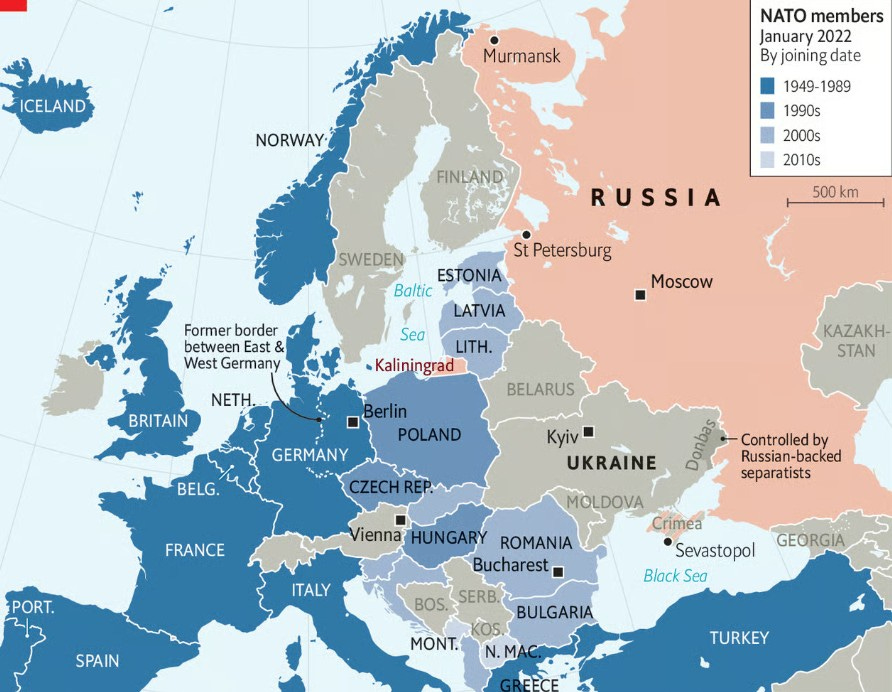 NATO is not a charity | In 2014, Vladimir Putin was helping himself to Crimea, as one does when one has tanks and a complicated relationship with borders. In the summer of that year, the U.S. Army sent my unit to Germany to train with about fifteen other NATO armies.The idea was simple: shoot, move, and communicate together, as if we were one fighting force. Different languages, different uniforms, same plan. In theory.The five officers in my artillery battery were issued a single car to share. A tiny, egg-shaped European hatchback, the kind that looks like it comes free with the purchase of a croissant. It was a stick shift.I figured this would be fine.At the time, I was a platoon leader for a howitzer platoon: four self-propelled 155-millimeter guns and thirty-six cannon crew members. We called them “gun bunnies,” affectionately. They were young, loud, permanently dirty, and ran on caffeine, nicotine, and a belief that somehow this would all make sense later.One evening, after training wrapped up, we finished briefing the soldiers on the next day’s plan. All the officers decided to drive over to the PX on Grafenwöhr base.I grabbed the keys.“I’m driving, bitch,” I said to the battery XO. We were all lieutenants, but the XO was the most senior lieutenant.“Greg,” he said carefully, “do you know how to drive stick?”No, I said. But I am about to learn.We all piled into the car. I turned it on. Immediately stalled. Turned it on again. Stalled again. The XO began coaching me from the passenger seat with the tone of a man who had already accepted that God was testing him.“Okay, ease off the clutch. No, not like that. Greg. Greg. You’re killing it.”The car lurched backward like a drunk mule.I panicked. Overcorrected. Gunned it.And backed directly into a massive drainage ditch on the side of the road.We ended up nose-high, rear end buried in the trench, front wheels dangling uselessly in the air, like a cartoon car realizing too late that the road has ended.We all got out and just stood there, staring at it.The XO put his hands on his hips. “Greg,” he said, “you are calling the fucking commander to explain this.”Before I could respond, eight or ten soldiers appeared out of nowhere.They were not American.They were lean. Sinewy. All tendon and quiet competence. They looked like men who could survive indefinitely on bread, cigarettes, and mild disappointment. They did not ask questions. They did not speak. They simply assessed the situation the way wolves assess a problem.Without being asked, they moved to the back of the car, crouched slightly, and lifted.In about three seconds, the car was back on the road. Perfectly fine. Not a scratch.They immediately started walking away, like this was nothing. Like they had just helped an old woman cross the street.“Thanks, guys!” I yelled.One of them gave a thumbs-up.“Hey!” I shouted. “What country are you from?”“Romania,” one of them said, smiling, as they disappeared into the dark.I turned to the other U.S. officers and said, sincerely and confidently, “Wow. I did not know Romania was part of NATO.”Romania, it turns out, was not just some random country that happened to have extremely competent guys lurking in the woods.Romania joined NATO in 2004, after the Cold War ended and the Soviet Union collapsed. For decades before that, Romania had lived on the wrong side of Europe’s dividing line, under authoritarian rule, inside the Soviet sphere, watching history happen mostly to them.When the Iron Curtain lifted, Romania did what many Eastern European countries did: it sprinted west.They joined because survival, when you have spent decades on the wrong side of history’s dividing line, requires paperwork. Treaties. The kind of binding promises that make it harder for the next tank column to pretend you do not exist. It was a way of saying, formally and indelibly, we are done being the buffer zone. We want binding guarantees, shared planning, and allies who show up before things get bad, not after.And a note to those who side with Putin, citing “NATO expansion”:This is where the argument collapses.It assumes that nations were pushed there by Washington rather than choosing it themselves. It denies agency to states that had lived under domination and decided, deliberately, that they did not want to do so again.NATO did not expand because it was forced outward. It expanded because countries asked to join. They did so openly, repeatedly, and with full knowledge of the risks.To describe this as “provocation” is to rewrite cause and effect. It is to say that the desire to be left alone is itself an act of aggression. And you are performing a useful service for the Kremlin when you say this so confidently.That kind of logic has a long history. It is the language of empires explaining why other people’s choices are unacceptable.And it is dishonest.Once Romania joined, it took membership seriously. Training. Interoperability. Proving, over and over again, that it belonged.Which may explain why, years later, a group of Romanian soldiers could quietly lift an American officer’s car out of a ditch.Lately, when Americans hear “NATO,” they are not thinking about dusty treaties signed in the twentieth century. They are thinking about recent headlines.In the past few weeks, the United States has been openly threatening tariffs on European NATO allies because Denmark and other countries sent troops to Greenland, an Arctic territory the U.S. president has insisted America must control for security reasons. European leaders rejected that idea outright and rallied behind Denmark’s sovereignty.Though he later walked this back in remarks at Davos, the president at one point declined to rule out using military force to seize Greenland, a move that would pit the United States directly against a NATO ally.That dispute prompted war-game exercises with European forces in Greenland and emergency talks in Brussels and Davos. Russia seized on the controversy to claim the alliance was in crisis. The European Union began preparing an Arctic security initiative in response.At the same time, the Pentagon has reportedly planned to reduce U.S. participation in some NATO advisory groups, a decision that, while gradual, signals a shift in how America engages with alliance planning and military expertise on the continent.The question, then, is not abstract. It is what NATO is, and what happens if the glue that holds it together starts to crack.Taking NATO skepticism seriously matters.The United States spends more on defense than the rest of NATO combined. For decades, many allies under-invested in their own militaries while assuming American protection would remain permanent, unconditional, and essentially free. That created a lopsided arrangement in which U.S. taxpayers carried costs while foreign governments deferred hard choices at home.There is also a deeper concern. Alliances, once formed, tend to become self-justifying. Missions expand. Commitments harden. What began as a clear Cold War necessity can drift into something automatic, defended more out of habit than strategy. From that perspective, asking whether NATO still serves concrete American interests is not reckless.Skeptics also point out that Europe is wealthy, technologically advanced, and fully capable of defending itself if it chose to. If nations face real threats, the argument goes, they should meet them with real investment, not moral appeals or historical sentiment. A security guarantee that costs nothing eventually means nothing.Finally, there is a democratic argument. Americans never voted for permanent, open-ended obligations that could drag the country into conflicts far from home, based on decisions made by governments they did not elect. Questioning those commitments is not isolationism. It is accountability.From this view, the pressure applied by figures like Donald Trump is not about abandoning allies, but about forcing realism back into a system that drifted toward complacency, and reminding everyone that American power is a choice, not an entitlement.That argument lands with many Americans because NATO feels abstract. Distant. A European thing. A logo, a summit, a building in Brussels.This essay does two things.First, it explains what NATO actually is, in concrete terms.Second, it explains what quietly changes if it weakens or collapses, in ways that do not show up immediately on cable news, but matter enormously over time.What NATO Actually Is (and What It Is Not)NATO was created in 1949, in the aftermath of World War II and at the beginning of the Cold War.At its core is a single idea: collective defense. Article 5 of the treaty states that an attack on one member is considered an attack on all.NATO is not a standing army. It does not have divisions waiting for orders from Brussels.NATO is infrastructure.It is shared military planning.Shared command structures.Shared logistics.Shared assumptions about who shows up, how fast, and under whose authority.That means when a crisis occurs, countries are not improvising under pressure. They already know the playbook.This distinction matters because many people quietly conflate NATO with the United Nations.The United Nations is a forum. It exists to manage disagreement, pass resolutions, and reflect global opinion.NATO is a commitment. It exists to deter war by making the response to aggression predictable and overwhelming.The UN is built around consensus, including among adversaries. NATO is built around trust among allies who have already aligned their interests.When the United Nations fails to act, that is often frustrating, but rarely surprising. It is designed to include everyone: democracies, autocracies, kleptocracies, countries that jail journalists, countries that sell weapons to both sides of a war, countries that believe corruption is not a bug but a cultural inheritance. Getting all of those actors to agree on decisive action is hard by design.The UN excels at statements, at strongly worded resolutions, at conferences where delegates denounce atrocities committed by regimes they quietly do business with on the side. It produces language that sounds like action and feels like motion, while carefully avoiding anything that would meaningfully disrupt the interests of the most powerful or least scrupulous members.This is not because the people at the UN are uniquely cynical. It is because the institution is structured to prevent unilateral force, even when force might stop something awful. The veto exists. Procedural drag exists. The incentive to look busy while doing nothing exists.So when the UN stalls or deadlocks, or issues a statement that reads like it was written by a committee of lawyers who all desperately want to go home, that is not corruption in the cartoon sense. It is systemic paralysis. A moral traffic jam.That is why NATO is different. When NATO fails to act, the alliance itself stops making sense. Its credibility depends on the belief that its commitments are real.Why the United States Built NATOThere is a persistent myth that NATO exists because the United States decided to be generous.That is not true.The United States built NATO because it learned, twice in the first half of the twentieth century, that instability in Europe eventually becomes American war.NATO is a forward-defense system. It keeps threats distant. It prevents small crises from becoming continent-wide wars. It does so at a far lower cost than fighting alone after the fact.In that sense, NATO is insurance. Not a charity fund for a continent we picture as permanently on vacation, but a system designed to prevent the moment when everyone is standing in the wreckage afterward, blinking at one another, asking who was supposed to stop this from happening.Like all insurance, its value is easiest to underestimate when nothing is on fire.Deterrence depends entirely on credibility. An adversary does not need to believe that you want to fight. They only need to believe that you will.NATO removes ambiguity. It tells potential aggressors that escalation will not remain local or bilateral. It will be collective and punishing.Once that certainty erodes, behavior changes.Pressure increases in the gray zones, the places just short of open war. Unmarked drones drift a little too close to airspace. Cyber intrusions shut down ports or power grids for a few hours and then disappear. “Routine exercises” are conducted right up against borders.Provocations get bolder because nothing immediate happens. Each unanswered move becomes data. Each delayed response is read as permission.Eventually, miscalculation becomes more likely, not because anyone wants a war, but because enough small, deniable actions pile up that someone guesses wrong.That is how conflicts start now. There are no declarations, just assumptions. And the most dangerous thing about deterrence failure is that it often looks like calm, until it does not.What Weakening NATO Actually ChangesSome consequences of NATO dissolving are less visible, but more serious.First, nuclear proliferation returns. Several NATO countries rely on the alliance’s nuclear umbrella rather than their own weapons. If confidence in that guarantee fades, incentives to pursue independent nuclear capabilities grow. This would happen quietly, technically, and permanently. More nuclear states mean more instability, not less.Second, Europe re-arms, but in fragments. Without NATO coordination, countries re-arm independently. That produces duplication, mistrust, and competitive defense postures inside Europe itself.Germany accelerates rearmament. Poland races ahead with heavier forward deployment. France doubles down on strategic autonomy and nuclear independence. Each choice is rational on its own. Together, they create parallel military structures that do not fully talk to each other.History is clear on this point. When Europe is heavily armed but strategically fragmented, it becomes dangerous.Third, Russia gains leverage without invading anyone. NATO weakening does not mean tanks rolling west tomorrow. It means energy coercion, political pressure, cyber operations, and the quiet isolation of smaller states. Power shifts without headlines.Fourth, China draws conclusions far beyond Europe. Alliances are watched. If NATO weakens, the lesson is not restraint. It is that long-term American commitments are negotiable.Fifth, U.S. credibility erodes in ways budgets do not capture. Every statement, hesitation, and conditional commitment becomes data. Competitors study it. Partners react to it. Once credibility is questioned in one theater, restoring it elsewhere becomes far more costly.What NATO Really BuysNATO buys time. It buys distance. It buys predictability.It keeps worst-case scenarios theoretical rather than real.The danger of dismantling it is not that catastrophe immediately follows, but that catastrophe no longer has to be prevented.So, Brandon, there is one remaining question.Are any of your sons draft-eligible? This is a public episode. If you'd like to discuss this with other subscribers or get access to bonus episodes, visit gregscaduto.substack.com/subscribe | 18m 52s | ||||||
| 1/17/26 |  The exile of a female astronomer (in the name of protecting women) | Here is the link to Dr. Beatriz Villarroel’s piece in the Liberation Times, mentioned in the beginning of the episode.Podcast transcript:So I’ll just say straight off that the reason any of this matters is that, years before we put anything into orbit, something reflective and physical was already up there – appearing briefly, then vanishing.But there’s a lot to this story so let’s back up.Yesterday, an article was published in an outlet you’ve probably never read or heard of, written by an astronomer you’ve probably never read or heard of. This is not a criticism. It’s just how attention works now. Important things tend to arrive quietly, like a neighbor knocking to tell you your headlights are on.The outlet was Liberation Times, edited by Chris Sharp. He tends to publish careful, unnervingly sober reporting about subjects most institutions would prefer to keep at arm’s length, which is why so few people are aware of his existence. I’ll link the piece in the description.The astronomer was Beatriz Villarroel. Dr. Villarroel is an assistant professor at the Nordic Institute for Theoretical Physics – an establishment devoted not to the manufacture of fashionable certainties, but to the patient, often uncomfortable business of thinking at the outer edges of what is known. NORDITA exists precisely to ask questions that do not yet have agreeable answers, and to do so with mathematical rigor rather than ideological reassurance. To work there is not a credential one acquires by accident, nor one retained by indulging in intellectual frivolity.She holds a PhD in astronomy.She leads long-running projects that search historical sky surveys for anomalies most astronomers never think to question.And before we talk about what she found in the sky, we need to talk about what happened to her on Earth.Before the Science, the TreatmentIn 2023, Beatriz Villarroel published a guest essay on Critical Mass, edited by Lawrence Krauss. It was not polemical. It was not angry. It was restrained in that very Scandinavian way where the sentences line up politely, remove their shoes at the door, and then proceed to describe something genuinely harrowing without ever raising their voices.She wrote not to litigate her science, but to document what had happened to her professionally over the previous two years. Not because of misconduct. Not because of fraud. Not because of bad science. But because of who she chose to work with.She described how, after deciding to collaborate with exoplanet pioneer Geoff Marcy, she became the target of sustained harassment and discrimination within the international astronomy community. Marcy had been accused of sexual harassment in 2015, subjected to public shaming, and forced into retirement from UC Berkeley after an internal investigation. There were no criminal charges. No court proceedings. No legal adjudication. And no pathway for rehabilitation.Villarroel notes this with particular care, because she herself had experienced retaliation earlier in her academic life after rejecting quid pro quo advances from a superior as an undergraduate – an experience that helped drive her out of her original field and into astronomy. She understood, firsthand, the gravity of such allegations. Years later, she got to know Marcy personally and chose to work with him on scientific grounds.She writes, plainly and without flourish, that she believes certain principles should not be controversial: that human beings have a right to dignity; that punishment without due process is not justice; that lifelong exile imposed by the court of public opinion is not morality. Even guilt, she argues, does not erase the right to rehabilitation. Without these principles, she suggests, human community becomes something smaller and crueler.With that understanding, she joined the international VASCO collaboration, which searches for vanishing stars and anomalous transients using historical astronomical data, including pre-Sputnik images. The work includes a large citizen-science component and has expanded toward real-time detection using modern instruments. It is careful, technical, and openly exploratory. She describes Marcy as an inspiring and valued collaborator.As a direct consequence of that collaboration, a SETI conference (which stands for search for extraterrestrial intelligence) at a public institution in the United States barred Villarroel from presenting results of her own research. The exclusion was not framed as punishment. It was executed through a newly crafted Code of Conduct provision, written broadly enough to sound principled and narrowly enough to apply only to her. The letter informing her of the decision cited Marcy by name and instructed her to withdraw her presentation.The same institution later held another conference and kept the very same Code of Conduct provision in place – the one that had already been used to exclude her – making clear that this was not an isolated decision but an ongoing policy for them.When Villarroel published a first-author paper in Scientific Reports in 2021 with Marcy as a co-author, screenshots of her name circulated on social media alongside accusations that said things like “Yes, women participate in rape culture”, because of her collaboration with Marcy. Other scientists publicly urged that the paper not be cited or promoted. A prominent astronomy promotion platform announced that it would not promote the paper at all, nor another exoplanet paper by a California team with Marcy as a co-author, citing opposition to sexual harassment – without reference to the content of either paper.A senior academic editor excluded Villarroel’s first-author paper from a scientific newsletter, asserting that she could not plausibly have been the intellectual driver of her own work. He claimed to recognize her co-author’s “style” and refused to promote the paper on that basis.* After Villarroel organized a successful academic meeting and invited the same collaborator to participate, she was subjected to direct, threat-like communications and severe public allegations. The sustained pressure culminated in a medical emergency, and she was admitted to the emergency room weeks later.* As her postdoctoral funding neared its end, a SETI-affiliated institute informed her that she would be barred from applying for grants or publishing papers unless her research team excluded that collaborator. She withdrew her application.* Another SETI-friendly conference invited her, then ceased all communication without explanation and failed to confirm her registration.* During this period, Villarroel observed social-media calls for “academic death kisses” for all collaborators of the same individual, including explicit instructions for how such punishment should be carried out.* The pattern extended beyond her case. A former graduate student – now an assistant professor – was pressured to remove the collaborator’s name from a paper despite his substantial contributions, following sustained online harassment and intimidation directed at her and her tenure prospects. Several senior academics participated in the campaign, including individuals previously involved in actions against Villarroel.* A subsequent article in Science praised this outcome, without acknowledging that denying proper authorship credit constitutes academic misconduct and violates editorial standards.* Villarroel submitted formal complaints to professional organizations, including the American Astronomical Society. She was later informed that the cases were considered closed. No corrective action was taken, and the harassment continued.* All of this occurred before the publication of the transients paper.So this was not punishment for startling conclusions. It was preemptive discipline – a message delivered quietly and repeatedly. You may work. But not with everyone. Not on everything. Not without permission.There’s this one quote from Orwell, when he said that power does not need to announce itself. It merely needs to be obeyed.This is what that looks like in modern academia.The most recent paper she published is the most groundbreaking:She co-authored this paper in October of last year, 2025, a paper published in Scientific Reports – a fact that should arrest the listener before any conclusions are drawn. This is a peer-reviewed journal within the Nature family, among the most exacting and prestigious scientific publishing institutions on the planet, where conjecture is not rewarded, fashion is not indulged, and assertions survive only by submitting themselves to hostile scrutiny.Papers are peer-reviewed.Methods are scrutinized.Statistics are checked.Nothing about this was casual.What the Transients Paper Actually DidThis is the point at which the conversation needs to slow down, because it is also where misunderstanding most often takes hold. The paper does not argue for extraterrestrial origin, intentional design, or any settled conclusion at all. Instead, it undertakes a far more careful task: a systematic examination of historical photographic plates of the night sky taken between 1949 and 1957, years before humanity had launched a single satellite into orbit.A photographic plate, for those of us who did not grow up in observatories, is essentially a large, glass-backed photograph of the sky – an early, analog method of recording forty or fifty minutes of starlight at a time, long before digital sensors made such things feel effortless.On a small but persistent subset of these plates, the researchers identified bright, star-like points that possess the same optical characteristics as stars and yet behave in a distinctly different way. These points appear only once, remain visible for less than a single fifty-minute exposure, and are absent both from images taken shortly before and from every image taken afterward. Because they are transient by nature – appearing briefly and then vanishing without recurrence – they are referred to simply and precisely as “transients.” The first and most essential task of the study, therefore, was not to interpret these phenomena, but to determine whether they could be dismissed as artifacts, errors, or other familiar imperfections in the photographic record.Why These Are Not DefectsPhotographic defects don’t behave like real objects. They don’t hold their shape the way stars do, they don’t register with the same optical fingerprint, and they don’t follow any rules except randomness. Most of all, they don’t respond to the geometry of the Earth and the Sun. Real objects do. When Villarroel’s team mapped where these brief flashes appeared in relation to the Sun, they found something decisive: the flashes were almost entirely absent from Earth’s shadow.That matters because light behaves differently depending on how it’s produced. A scratch or a flaw glows nowhere and everywhere at once. But a reflection only appears when sunlight strikes a surface at the right angle. When the Sun is blocked, the reflection vanishes. What these plates show, again and again, are flashes that behave exactly like reflected sunlight – brief glints off flat, mirror-like surfaces moving high above the atmosphere. And because this occurred years before Sputnik, before human-made objects filled orbit, the usual explanations – dust, scratches, film contamination – simply fall away. What remains is something real, physical, and unaccounted for.The CorrelationsAt that point, the team did something deliberately conservative. They didn’t ask what these objects were, because that question invites speculation. They asked something much safer: when do they show up? To answer it, they aligned three independent timelines – dates when transients appeared, dates of above-ground nuclear weapons tests, and dates when people reported seeing unidentified aerial phenomena – and looked for patterns across them.What emerged was understated in presentation but consequential in implication. Transients were significantly more likely to appear within a day of a nuclear test, and on days with higher numbers of UAP reports, the number of transients rose as well, increasing by roughly 8.5 percent for each additional report.The associations are modest, but they recur with a regularity that chance alone does not explain. Crucially, they cannot be attributed to observer bias or photographic error, because neither the astronomers analyzing decades-old plates nor the witnesses reporting sightings at the time had any knowledge that such correlations existed.What This Means, and What It Does NotWhat the paper offers is not a theory of motive or origin, and it is careful not to indulge in speculation that outruns the evidence. Instead, it establishes something narrower and far more difficult to dismiss: that reflective objects, behaving like sunlight glints rather than self-luminous sources, appeared repeatedly at high altitude or orbital distances in the years before the space age, and that their appearances were not randomly distributed in time, but clustered around periods when humanity first began detonating nuclear weapons in the open air. That finding alone constitutes a serious scientific result, independent of whatever future explanations may eventually emerge. It is also worth noting, without drama but not without weight, that this work was carried out by a scientist who had already incurred professional cost for declining to conform to the unspoken boundaries of acceptable inquiry.A Defense, Plainly StatedIf Villarroel were mistaken, the remedy would be elementary: replicate the analysis, interrogate the statistics, and publish a rebuttal. That is the ordinary hygiene of a healthy scientific culture. What followed instead was exclusion, intimidation, and a silence so deliberate it functioned as a verdict.Can I ask astronomers a genuine question?And I ask this as someone very much outside your world, standing at a respectful distance, doing my best not to knock over any sacred furniture.Why is it that academic astronomers – of all people, the professionals whose literal job is to stare into eternity – are behaving like a medieval guild during the time of the plague, huddled together with torches and pitchforks, policing the boundaries of thought like a nervous theocracy?There is no moral universe – none – in which the punishment of one man justifies the exile of everyone who dares to work alongside him. To collaborate with someone is not to excuse them. It is to affirm the possibility of dignity, due process, and redemption. Without those, human community collapses into something smaller and crueler, even when it wears the right language.And there is a bitter irony here that deserves to be named plainly.Many of the same institutions that speak endlessly about inclusion and protecting women have seen fit to harass, marginalize, and professionally strangle one of the most promising and intellectually bold astronomers of her generation.If that contradiction does not trouble you, it should.Dr. Villarroel should not be shunned. She should be supported. She should be celebrated. And – this may be the most uncomfortable part – she should probably be emulated.And to Dr. V, if you’re listening: there is a world beyond the cloistered monastery of the academy. It is larger, rougher, and far more interesting. We see you there, standing. That some of your peers deride you should not slow your stride.You do not answer to them.The sky goes on doing what it has always done. Light moves, glances off surfaces, disappears. Nothing waits to be named. The work of discovery has always belonged to those willing to look without assurance of safety or reward. When that willingness is punished and curiosity becomes a nuisance – the loss does not arrive with ceremony. It arrives later, as blank space. As questions no longer asked. As instruments turned aside. And one day we will realize that something crossed above us and left no trace, not because it could not be known, but because we taught ourselves not to look. This is a public episode. If you'd like to discuss this with other subscribers or get access to bonus episodes, visit gregscaduto.substack.com/subscribe | 16m 31s | ||||||
| 1/16/26 |  What's going on with this whole Greenland thing? | In this episode, I try to do the calm, slightly sheepish thing that feels increasingly rare, which is to pause for a moment and ask what’s actually happening before deciding what to feel about it. Using a small, unpretentious framework meant mainly to preserve my blood pressure, I walk through the recent Greenland episode, looking past the surface noise to the strategic realities underneath, and then to the deeper shift in how power is being described, claimed, and justified. Along the way, we talk about alliances, trust, and the quiet damage done when long-term relationships are treated like short-term leverage. It’s an effort to slow the moment down, to separate confidence from wisdom, and to ask whether the future being outlined in careful language and glowing maps is one we would still choose if we were thinking past the end of the week.FULL TRANSCRIPT (since Peter asked for it): Before we begin, I should probably admit that this is not my first time trying to understand a Trump foreign policy decision by staring at it for a while, tilting my head, and thinking, Well. That can’t possibly be the whole story.Because experience suggests it never is.So, over time, I’ve developed a little framework. Not because I enjoy frameworks. I do not. I would rather be petting a dog. But because with an administration this casually dishonest, a framework is sometimes the only thing standing between you and a full day of yelling at your phone.The framework is very simple.First: what is actually going on.Not what was said. Not how it was framed. But the underlying situation that existed before the announcement, back when people were still using full sentences and inside voices.Second: what is the Trump public-facing narrative.Which is usually streamlined, emotionally satisfying, and engineered to make you feel like something decisive is happening, even if the details remain politely offstage.Third: what are they really saying behind closed doors.Meaning the conversations where no one is performing. Where the maps come out. Where the tone changes. Where the jokes stop being funny.And finally: what does it all mean.Not just for this particular headline, but for how we now operate as a country. How we talk about power. How we treat allies. How comfortable we’ve become with the gap between reality and its press release.This is not a clever framework. It is more like a flashlight you keep by the bed. Not elegant, but useful when the lights go out.And with that in mind, it’s probably time to talk about Greenland.Because one morning we wake up and discover that the United States of America is, apparently, interested in buying it.Buying it.Which is odd, because most of us last encountered Greenland in roughly seventh grade, as a large white shape on a classroom map that our teacher assured us was “very cold” and “not actually that big in real life,” and then we all moved on to learning about Peru or mitochondria or whatever.Greenland, as a concept, has mostly existed for us as a kind of honorable blank space. A place where the rules of our normal thinking don’t fully apply. Ice. Silence. A few brave people. Dogs that look like they could survive a nuclear winter. End of list.And then suddenly it’s on the news. The President is talking about it. People are asking, with varying levels of sincerity, whether it’s legal to buy a country.You can almost feel the collective American brain doing that thing it does when it hasn’t quite caught up yet. Like when your phone autocorrects a word into something insane and you stare at it for a second thinking, No. That can’t be right.But here’s where the laughter starts to thin out.Because under the joke is a seriousness that refuses to go away.It turns out Greenland is not just a big white shrug on a map. It’s a place with radar systems and shipping lanes and rare earth minerals. It’s a place where the ice is melting, which means the future is showing up early, like an uninvited guest who knows too much about you.And at some point, usually mid-chuckle, you realize:Oh.This isn’t random.The joke arrived first. The strategy arrived quietly. And now they’re sitting together at the same table, smiling at us.Which is where the tone has to change.Let us be precise.The United States did not suddenly “discover” Greenland because of curiosity or whim. It did so because power, when it shifts, reveals what was always important and merely ignored.Greenland occupies a strategic position in the Arctic that no serious military planner disputes. It sits beneath missile trajectories, astride submarine routes, adjacent to newly opening shipping corridors, and atop resources that modern economies require.Russia understands this. China understands this. The United States understands this.What changed was not the assessment, but the language.Under the Trump administration, strategic necessity was translated into the vocabulary of ownership. Security became acquisition. Partnership became leverage. Geography became property.This is not a small rhetorical shift. Language is policy rehearsing itself.When a nation begins to speak of allies as assets, and treats territory as merchandise, it is preparing its citizens for a world in which consent matters less than control and power dynamics.The outward narrative from Trump was blunt and unmoored by ethical principle, as it often is.Greenland matters. Denmark is weak. America should act.What was omitted was the cost.Because empires do not collapse when they lose strength but when they lose credibility.Power exercised without legitimacy invites resistance. And strength expressed without restraint provokes coalitions against it.History is unambiguous on this point.The danger is not that Greenland is important. The danger is that we are relearning the language of dominance and mistaking it for clarity.And that brings us to what unsettles me most about this episode.Not the proposal itself, but what it reveals about how we are learning to speak about the world again.There is a loneliness in transactional thinking. A belief that everything must justify itself immediately, or be taken, or be discarded. It leaves no room for patience. No room for shared stewardship. No room for the quiet dignity of mutual dependence.Greenland is not empty. It is not silent. It is home.And Denmark, for all its imperfections, is not irrelevant. It is part of a web of trust that has, for decades, allowed American power to feel less like force and more like leadership.When we erode that web, we do not become freer but more exposed.Alliances are not treaties alone; they are habits of trust built slowly through restraint, memory, and the unglamorous discipline of keeping one’s word when no one is watching. After the Second World War, American power endured not because it was unmatched, but because it was embedded in relationships that made smaller nations feel protected rather than consumed. When that trust frays, it does not announce its departure. It lingers, then withdraws quietly, leaving behind cooperation that looks intact but no longer holds under strain. History shows that credibility, once lost, is not reclaimed through force or transaction, but only through time, humility, and acts that cannot be priced.Behind closed doors, the conversations are likely sober. Analysts discussing missile arcs. Admirals pointing to maps. Intelligence officers worrying about Chinese investments that arrive smiling and leave permanent footprints.Those concerns are real and deserve seriousness.But seriousness does not require cruelty, and strength does not require humiliation.A nation is judged not only by what it defends, but by how it defends it. By whether it can hold competing truths at once: that the world is dangerous, and that domination is not the same thing as security.If we teach ourselves that everything valuable must be owned in order to be protected, we will eventually find ourselves very rich, very powerful, and very alone. This is true also for individuals.And that is not the future most Americans think they are choosing.Trump and Hegseth approach power the way a teenager approaches a weight room: everything is about lifting the heaviest object in sight, preferably while someone is watching. The point is not endurance or form or whether the building will still be standing in twenty years, but the brief, intoxicating sensation of having impressed the room. In this frame of mind, allies become background characters, planning becomes a buzzkill, and restraint reads as weakness. It is not that the future is ignored; it is simply assumed it will accommodate the ego presently occupying the space.Marco Rubio knows better – you can see it on his face and hear it in the utter lack of conviction in his voice and the restrained precision of his statements. He’s no imbecile, like Hegseth. He is a coward, and an opportunist, and so he plays along for a chance at one more suckle on the teet of political influence and relevance.This is the Rubio code of ethics.And what’s sad is one can just picture this:The room is quiet.A conference table. Flat screens glowing with satellite images. Clean lines crossing the Arctic in colors chosen to look neutral. Flight paths. Missile arcs. Shipping lanes opening where ice used to be.There is a document on the table. Twelve pages. Standard font. A purchase agreement for something that will never sign it back. Someone has already highlighted the favorable clauses.No one speaks. They don’t need to. The numbers are persuasive. The map is precise. Everything important has been reduced to scale.Outside the room, an ally waits. Not invited in. Not consulted. Just informed. Their silence mistaken for consent because it slows nothing down.The men in the room believe they are being practical. They believe history favors those who act while others hesitate. They believe ownership is the same as security.But the room does not record doubt.And the agreement, once executed, does not learn.It only moves forward. This is a public episode. If you'd like to discuss this with other subscribers or get access to bonus episodes, visit gregscaduto.substack.com/subscribe | 9m 57s | ||||||
| 1/13/26 |  Helicopters, flashbangs, zip-tied kids: the true cost of "law and order" | This episode is me, 13 days off cigarettes, trying to make sense of the raids that have turned neighborhoods into places where dawn knocks feel like threats. It starts with the facts: Renee Good shot dead by an ICE agent in Minneapolis last week, families zip-tied after helicopters dropped agents on a Chicago apartment building, a farmworker falling to his death fleeing a raid in California -- and the numbers showing most people detained have no criminal record. From there it moves through the economic hit, the constitutional cracks, the quiet damage done to communities, and the moral question John Rawls would ask: would you build this system if you didn’t already know you’d be on the safe side of the door? It’s not polished or balanced; it’s just what happens when you quit one bad habit and pick up another -- talking too much about what we’re doing to people who pick our food and clean our floors, and wondering out loud if we’re still the country we tell ourselves we are. This is a public episode. If you'd like to discuss this with other subscribers or get access to bonus episodes, visit gregscaduto.substack.com/subscribe | 25m 00s | ||||||
| 1/12/26 |  A journal entry from a Mars rover | This is something I wrote years ago but never shared with anyone. It's a journal entry from the Mars rover called Curiosity. Not really, but use your imagination. This is a public episode. If you'd like to discuss this with other subscribers or get access to bonus episodes, visit gregscaduto.substack.com/subscribe | 11m 23s | ||||||
| 1/12/26 |  The worst imaginable performance in a little league game. | This is a story about driving through North Jersey to the place where I would tell the story of my worst little league game ever. This is a public episode. If you'd like to discuss this with other subscribers or get access to bonus episodes, visit gregscaduto.substack.com/subscribe | 11m 32s | ||||||
| 1/6/26 |  How does one find a voice? | I felt I should address the very valid criticism I have received for having an unprofessional podcast. Thank you for your time. This is a public episode. If you'd like to discuss this with other subscribers or get access to bonus episodes, visit gregscaduto.substack.com/subscribe | 6m 26s | ||||||
| 1/5/26 |  Italian-Americans, US Army, and the FBI | These are some thoughts I’d like to share with you on Jersey Italians, the Army, and the FBI. This is a public episode. If you'd like to discuss this with other subscribers or get access to bonus episodes, visit gregscaduto.substack.com/subscribe | 10m 35s | ||||||
| 1/4/26 |  The Broken Voice: Episode 1 | I’m trying a new format because it’s a new year. I have also committed to never smoking another cigarette again, perhaps for the rest of my life. Americans think this is funny. They tell me “Hey, Greg. 1986 called and they want their new year’s resolution back.” But perhaps if you’re an Indian man, or even a Briton, you could offer some words of encouragement for me. It’s January 4th and I’m really struggling. But I have 2 young sons, and I’m 35. I think it’s time to take my health more seriously. But more importantly, I hope my first podcast, which I hope to be the first of many, which will never exceed 10 minutes in length, will spark some good-faith discussion among the 7 people who actively ingest my content. I offer this with love, and not in self-indulgence. I want to know what you think on this serious current geopolitical issue. Thank you for listening. -Greg Scaduto, January 4th, 2026 This is a public episode. If you'd like to discuss this with other subscribers or get access to bonus episodes, visit gregscaduto.substack.com/subscribe | 10m 12s | ||||||
Showing 22 of 22
Sponsor Intelligence
Sign in to see which brands sponsor this podcast, their ad offers, and promo codes.
Chart Positions
1 placement across 1 market.
Chart Positions
1 placement across 1 market.