Insights from recent episode analysis
Audience Interest
Podcast Focus
Publishing Consistency
Platform Reach
Insights are generated by CastFox AI using publicly available data, episode content, and proprietary models.
Most discussed topics
Brands & references
Total monthly reach
Estimated from 2 chart positions in 2 markets.
By chart position
- 🇮🇳IN · Investing#1761K to 10K
- 🇦🇹AT · Investing#156500 to 3K
- Per-Episode Audience
Est. listeners per new episode within ~30 days
750 to 6.5K🎙 ~2x weekly·48 episodes·Last published 1w ago - Monthly Reach
Unique listeners across all episodes (30 days)
1.5K to 13K🇮🇳77%🇦🇹23% - Active Followers
Loyal subscribers who consistently listen
600 to 5.2K
Market Insights
Platform Distribution
Reach across major podcast platforms, updated hourly
Total Followers
—
Total Plays
—
Total Reviews
—
* Data sourced directly from platform APIs and aggregated hourly across all major podcast directories.
On the show
From 10 epsHost
Recent guests
Recent episodes
New York Media Matters – and Leaders: Christy Tanner '99 and Carroll Bogert
Jun 18, 2026
Unknown duration
Robert K. Steel: Leadership Across the Private, Public, and Nonprofit Sectors
Jun 4, 2026
Unknown duration
Rabbi Angela Buchdahl: The Heart of a Stranger
May 21, 2026
Unknown duration
Marla Blow, President and CEO of the Skoll Foundation: Transformation and Renewal
May 14, 2026
Unknown duration
Anthony W. Marx, President and CEO, The New York Public Library: Master Class in Transformative Leadership
Apr 23, 2026
52m 57s
Social Links & Contact
Official channels & resources
Official Website
Login
RSS Feed
Login
| Date | Episode | Topics | Guests | Brands | Places | Keywords | Sponsor | Length | |
|---|---|---|---|---|---|---|---|---|---|
| 6/18/26 | ![]() New York Media Matters – and Leaders: Christy Tanner '99 and Carroll Bogert | In this episode of Capital for Good, we speak with two extraordinary media leaders — Christy Tanner '99, the president and CEO of New York Public Radio, an iconic and 100-year-old center for local and global media, and Carroll Bogert, the CEO of The City Reporter, the independent newsroom founded in 2019 to cover breaking news, investigative, and service journalism in New York City. In this wide-ranging conversation, we hear from these industry veterans about their early callings as reporters, their respective careers as pioneers — one using journalism to hold power to account, one forging new business models in the face of technological transformation — and their thoughts about the challenges, and opportunities, of the current moment in New York and around the world. We start with Tanner and Bogert's gravitational pulls to journalism and the formative experiences as reporters that would shape their careers in media. Tanner explains how as a young girl, inspired by the likes of Nancy Drew and Nellie Bly, the ability to "ask questions, investigate things, find out what's going on," and the creative process of writing "captured my imagination." Her first jobs at the AP and in local newsrooms in South Carolina and Tennessee taught her how investigative reporting could have tangible impact, prompting changes in government policies. For Bogert, a member of the generation of idealists who grew up on "Woodward and Bernstein and All the President's Men," journalism was "something noble… and world changing:" a way to "uncover abuse at the top and change history." As a foreign correspondent for Newsweek, she would chronicle the Tiananmen Square crackdown and the fall of the Soviet Union. As the industry evolved, so too did their respective paths. Bogert would go on to leadership roles at Human Rights Watch and as the founding president of The Marshall Project, a nonprofit news organization covering criminal justice in the United States. "The though line," she says, is that "challenging the abuse of power is the essential role of journalism. Power requires constant vigilance because it will trend towards abuse if it's not watched." Tanner, whose experiences included hosting a kind of proto-podcast in the mid-1990s, saw early on that "the internet was going to change media forever." Back in New York, she had a "front row seat to the invention of streaming as we know it" — newspapers, magazines, television, audio — and would become a leader in the digital transformation of legacy media companies like The Washington Post, Reed Elsevier, TV Guide, and CBS. While both new in their current seats, Tanner and Bogert bring their expertise as seasoned industry leaders — and New Yorkers – to the roles. Tanner notes that while NYPR has grown into a multiplatform organization with radio (WNYC, WQXR), digital news, and podcasts with significant national and global reach, its local resonance with New Yorkers is remarkably strong. Bogert explains that at "this historical moment," when investigative newsrooms are disappearing, "local media is where it's at." She believes that the independence of nonprofit media organizations gives them "a particularly special role" to hold political leaders accountable and to rebuild trust in media. While acknowledging any number of challenges — in the industry, in a fraught political environment — Tanner and Bogert are optimistic: about the opportunities for organizations like theirs to collaborate, to "share best practices," to develop more sustainable business models, and to cultivate greater understanding of the need of philanthropy to support media as a critical pillar of our civic infrastructure. Mentioned in this episode: New York Public Radio The City Reporter | — | ||||||
| 6/4/26 | ![]() Robert K. Steel: Leadership Across the Private, Public, and Nonprofit Sectors | In this episode of Capital for Good we speak with Bob Steel, partner and vice chairman of Perella Weinberg Partners, whose career has spanned the pinnacles of business, government and nonprofit leadership. Following nearly three decades at Goldman Sachs, Steel held senior roles at the US Treasury, as Under Secretary for Domestic Finance under President George W. Bush, and in New York City government as Deputy Mayor for Economic Development under Mike Bloomberg; was CEO of Wachovia Corporation and Perella Weinberg; and along the way has served on numerous boards, corporate and civic, including at major universities like Duke, important ideas and policy organizations like the Aspen Institute, and several of New York City's anchor institutions. We begin with some of the formative individuals and institutions that would shape Steel's trajectory: his parents, who set an example of service to their North Carolina community; the attention of Dr. Joel Fleishman, a Duke Professor who challenged Steel to become a more engaged student; and the opportunity to join Goldman Sachs in 1976 when John Whitehead and John Weinberg took over the leadership of the firm. "I got on the bus at the right time," Steel says. Steel describes what it was like to work at Goldman Sachs in a period of extraordinary growth and globalization. Over close to three decades, he built several businesses across the US and Europe — "multiple careers in one institution" — and ultimately served as the firm's vice chairman and member of its management committee. "The moral of the story," he observes, "is that well-led firms that are growing create opportunities that are pretty special." In 2006, at the urging of fellow Goldman Sachs partner — and recently confirmed US Treasury Secretary Hank Paulson — Steel went to Treasury to serve as Under Secretary for Domestic Finance. Within a year, the country was in the throes of the financial crisis, and with the support of Paulson and Fed Chair Ben Bernanke, Steel and his colleagues labored to prevent the worst impacts of the crisis on the American people, and to begin to steer the economy to more stable ground. After Treasury, Steel returned to the private sector as CEO of Wachovia, where he led the bank's sale to Wells Fargo. Soon after Mike Bloomberg recruited him to serve as Deputy Mayor for Economic Development, where he would oversee the administration's five borough economic development strategy and job creation efforts across more than a dozen city agencies: tens of thousands of employees and billions of dollars in annual operating budgets. We discuss a number of the major initiatives that Steel and the Bloomberg team undertook, among them the creation of the Cornell Technion campus, today a center of applied science in the city and region. We also discuss Mayor Bloomberg's vision for long-term investments, and the latitude given to an exceptional and collegial cohort of talented commissioners. "It might be my best job ever, I learned so much," Steel says. Through these experiences, Steel has come to understand the distinct but complementary roles of the private, public, and nonprofit sectors, and their respective and mutually supportive "vectors of leverage." "You can't have successful business without government," he believes, "and you can't have good government without successful businesses. And then you add NGOs that provide exceptional seasoning and consciousness that is beneficial." Although no longer at city hall, Steel remains deeply involved in the life of the city, with board roles at Lincoln Center, Rockefeller University, the Hospital for Special Surgery, the Economic Club of New York, the Partnership for New York City, The Morgan Library, and the New York Climate Exchange. We touch on New York's recovery from the pandemic; why some of today's challenges, including affordability, are a function of the city's success (i.e., not enough housing for all the people who want to be in New York); the competition from smaller cities across the country as attractive places to live and work; and the opportunity and imperative to make long-term investments in the city's future: schools, infrastructure, arts, parks, among them. We conclude where the conversation began: "I'm so appreciative of the organizations and people that helped me grow," Steel says. "If you did a balance of trade, I've gained so much more than I gave that I feel incredibly fortunate." Mentioned in this episode: Cornell Tech | — | ||||||
| 5/21/26 | ![]() Rabbi Angela Buchdahl: The Heart of a Stranger | In this episode of Capital for Good, we speak with Angela Buchdahl, the senior rabbi of Central Synagogue in New York City and the first woman to lead that congregation in its 185-year history. Born in Korea to a Jewish American father and a Korean Buddhist mother, Buchdahl is the first Asian American to be ordained as a cantor or rabbi in North America. She is also well known for her innovations in leading worship, reaching millions across 100 countries via livestream and cable broadcast. Her New York Times best-selling memoir, Heart of a Stranger, roots her unlikely story and experience as an outsider and boundary crosser in both ancient Jewish traditions and in the universal longing for belonging. Heart of a Stranger, Buchdahl explains, is both a particular and shared narrative. She tells us that, as a child, she often felt she was an outsider: Korean in America, American when she returned to Korea, and an unusual mixed-race family in the Jewish community. She connects this experience to her family's — starting with her mother who was born in Japan, where her family had been displaced, before returning to Korea and eventually immigrating to the United States — and to ancient Jewish narratives, from the biblical story of Abraham, a stranger in a foreign land, to millennia as diaspora outsiders around the world. Buchdahl also speaks of crossing boundaries to find home. "Home is where your people are," her mother told her, and then demonstrated how welcoming others (as an ESL teacher in Tacoma, Washington and a founder of an organization to assist new immigrants to the US — in Buchdahl's words, a "serial welcomer") could be transformative for everyone, creating community in the place of strangeness. This too, Buchdahl reminds us — the act of welcoming, with compassion and empathy — has roots in Abrahamic and other spiritual traditions and can be a powerful antidote to the isolation and polarization dividing us today. Agency and intentionality are central themes of the book, and of our conversation. We discuss what this means in the Jewish context — Buchdahl's decision and acts to define her own identity and path –— and its more universal applications: the spiritual imperative we all have to be boundary crossers. For Buchdahl, much of her early calling and connection to faith came through music, what she calls "my natural spiritual language." We explore how music has shaped her identity, her roles as cantor and rabbi, and the way she leads the congregation at Central Synagogue. Music is about beauty, she notes, but even more so about the "energy and electricity that comes when we're making it together." Buchdahl believes that much of her responsibility is to feel and modulate that energy. We end with a broader discussion of leadership and what it means to have the "appropriate" amount of humility (in Hebrew, "anavah") to lead. Sometimes, Buchdahl says, even if it is uncomfortable, "you have to step in to fill that space," and all the more so in moments of destabilization. "You have to speak to people's fear, to then move forward and beyond." While there is no shortage of challenges — Buchdahl cites anti-Semitism, climate and technological change, isolation and polarization, to name a few — she also believes "there are ways to mine each crisis for the opportunity it provides us." We conclude with a return to agency — and exhortation. "Every day," Buchdahl says, "we can take one step towards building the world we want to live in." Mentioned in this episode: Heart of a Stranger: An Unlikely Rabbi's Story of Faith, Identity and Belonging, (Angela Buchdahl, 2025) | — | ||||||
| 5/14/26 | ![]() Marla Blow, President and CEO of the Skoll Foundation: Transformation and Renewal | In this episode of Capital for Good we speak with Marla Blow, the president and CEO of the Skoll Foundation, the leading philanthropy focused on social entrepreneurship and innovation around the world. Over the course of this conversation, we learn how Blow's career in finance and financial inclusion, across the private and public sectors, would prepare her to lead a dynamic institution and community of innovators in this era of extraordinary change — and resilience. We begin with important elements of Blow's origin story, including her childhood outside of Atlanta, a city (then) on the precipice of rapid growth, where she was drawn to the idea of helping people translate opportunity into long-term financial security. "I thought I could help people make better decisions," she said. That instinct would carry her to Wharton, Wall Street, an MBA at Stanford, and to Capital One, where she learned the discipline of applied behavioral economics and consumer lending. In the Obama Administration, Blow joined the Consumer Financial Protection Bureau, where she began to see more clearly the full landscape of American consumers — including those who were not well served by the traditional financial system or many of its products. That realization led her to found FS Card Inc to provide fairly priced credit to underserved consumers, an experience Blow describes as a "crash course" in entrepreneurship and the capital markets. Following the successful sale of FS Card, Blow helped lead Mastercard's Center for Inclusive Growth, where she was able to pursue financial inclusion at scale. Blow speaks candidly about the extraordinary moment in which she assumed the CEO role at Skoll in 2025. The dismantling of USAID and broader cutbacks of support to and from multilateral finance institutions sent seismic shocks through the social entrepreneurship ecosystem that Skoll has supported since 1999. "I don't think any of us could have predicted that things would shift in this magnitude, or that they would shift this quickly," she says. And yet, Blow also describes with great admiration the resilience of individuals and organizations "that have been able to figure out how to pivot," efforts the foundation supported with a $25 million "pivot fund." Blow draws on the analogy of a forest of seemingly freestanding trees that are deeply interconnected beneath the surface. "It's the roots that enable them to transmit nutrients, to transmit information, to rebuild and regrow after absorbing and experiencing a shock," she says. We also discuss a signature dimension of Skoll's work: the role of catalytic capital in driving impact. Today, approximately 80 percent of Skoll's endowment, managed in partnership with the Capricorn Investment Group, is aligned with the foundation's impact objectives in climate change mitigation and resilience, economic opportunity, health care, and responsible stewardship. Blow explains that these kinds of investments are not concessionary — their "financial returns continue to meet or exceed the performance of comparable asset classes" — and are exemplified by social enterprises like Apis & Heritage Capital Partners, a 2025 Skoll Award recipient that transitions small businesses to employee ownership – and has enabled main street workers to increase their net worth by a factor of ten. We close with Blow's sources of optimism. They begin, she explains, with community — the cross-ideological partnership emerging across philanthropy, the private sector's increased engagement, the deep networks built over more than two decades of convening social entrepreneurs at the Skoll World Forum. "We are going through something, it's going to take a toll," she says. "And there is a light on the other side of it. We can continue working toward that light." Mentioned in this episode: The Skoll Foundation Skoll World Forum Transformation and Renewal in the Impact Ecosystem, The Skoll Foundation 2026 Annual Letter Capricorn Investment Group Evolving Philanthropy for Collective Action, (Stanford Social Innovation Review, Blow & Gips, 2024) Apis & Heritage Capital Partners Consumer Financial Protection Bureau Mastercard Center for Inclusive Growth | — | ||||||
| 4/23/26 | ![]() Anthony W. Marx, President and CEO, The New York Public Library: Master Class in Transformative Leadership✨ | transformative leadershipeducation+4 | Anthony W. Marx | The New York Public LibraryAmherst College+3 | South AfricaInwood+1 | transformative leadershipNew York Public Library+5 | — | 52m 57s | |
| 4/9/26 | ![]() John Witt and The Radical Fund: How a Band of Visionaries and a Million Dollars Upended America✨ | legal historyprogressive movements+4 | John Fabian Witt | Yale Law SchoolNAACP+3 | America | Garland FundBrown v. Board of Education+5 | — | 27m 46s | |
| 3/26/26 | ![]() Deven Parekh, Insight Partners: Software, Startups, and Scale-ups in the Age of AI✨ | software investingtechnology+4 | Deven Parekh | Insight PartnersBlackstone+1 | New YorkerWharton | Deven ParekhInsight Partners+5 | — | 36m 05s | |
| 3/12/26 | ![]() Mellody Hobson, Co-CEO, Ariel Investments: Everything is Possible✨ | investmentfinancial literacy+3 | Mellody Hobson | Ariel InvestmentsPrinceton+1 | South Side of Chicago | Mellody HobsonAriel Investments+5 | — | 36m 01s | |
| 3/10/26 | ![]() Introducing Capital for Good Season Five✨ | social enterprisesustainability+3 | Mellody HobsonTony Marx+6 | Ariel InvestmentsNew York Public Library+3 | — | podcastbusiness leaders+3 | — | 1m 29s | |
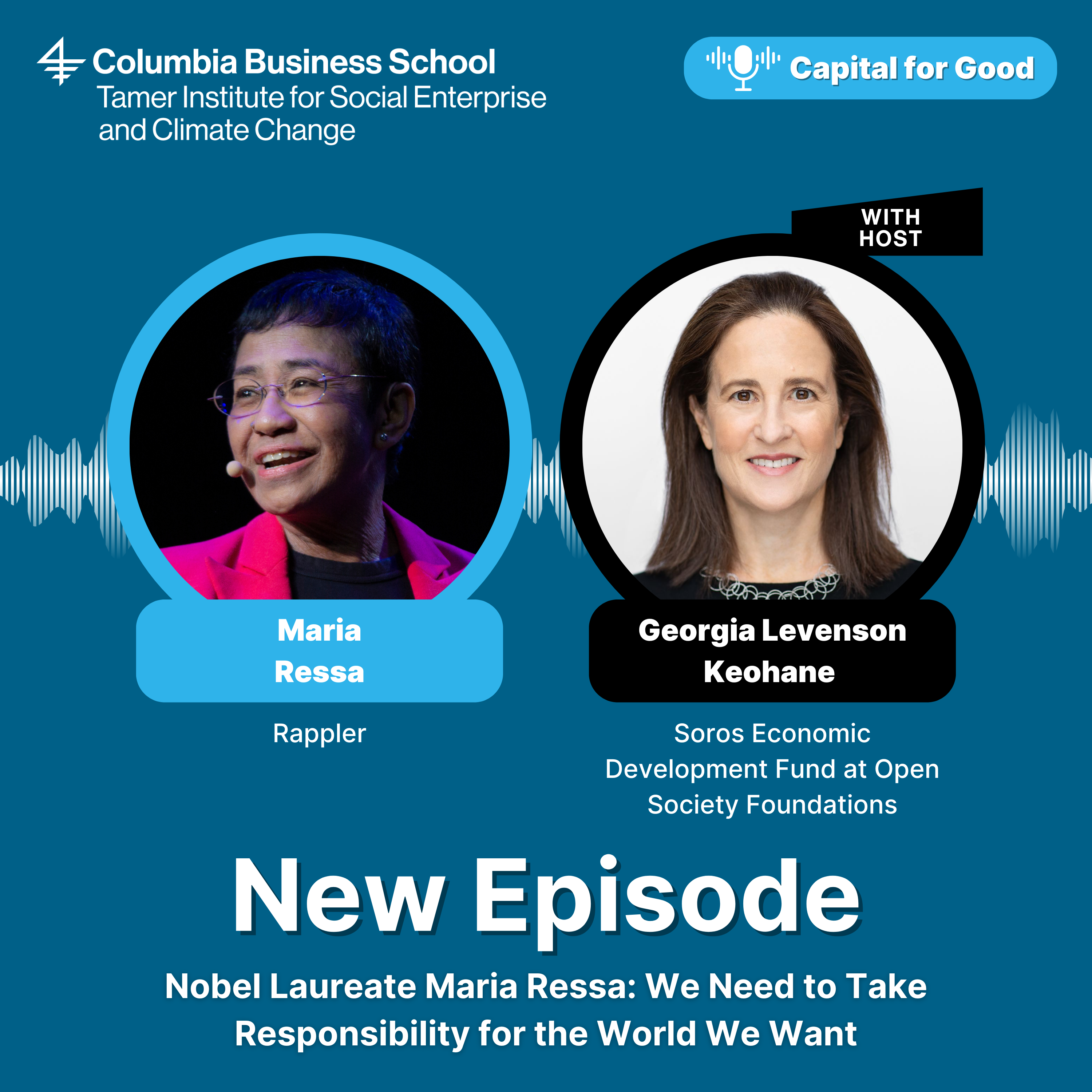
| 7/24/25 | ![]() Nobel Laureate Maria Ressa: We Need to Take Responsibility for the World We Want✨ | free speechjournalism+4 | Maria Ressa | RapplerInternational Criminal Court+1 | PhilippinesUnited States | Maria RessaNobel Peace Prize+6 | — | 43m 31s | |
Want analysis for the episodes below?Free for Pro Submit a request, we'll have your selected episodes analyzed within an hour. Free, at no cost to you, for Pro users. | |||||||||
| 7/10/25 | ![]() Brad Lander, New York City Comptroller: the Virtuous Cycle of a Successful City✨ | public financeresponsible investment+4 | Brad Lander | Tamer Institute for Social Enterprise and Climate ChangeFifth Avenue Committee+2 | New York CityNew York | New York City Comptrollerbudget watchdog+6 | — | 40m 33s | |
| 6/25/25 | ![]() Emma Bloomberg and Murmuration: Technology, Data, Research, and the Power of Community-driven Civic Engagement✨ | civic engagementtechnology+4 | Emma Bloomberg | MurmurationTamer Institute for Social Enterprise and Climate Change+1 | New York CityNew York | civic engagementMurmuration+4 | — | 32m 21s | |
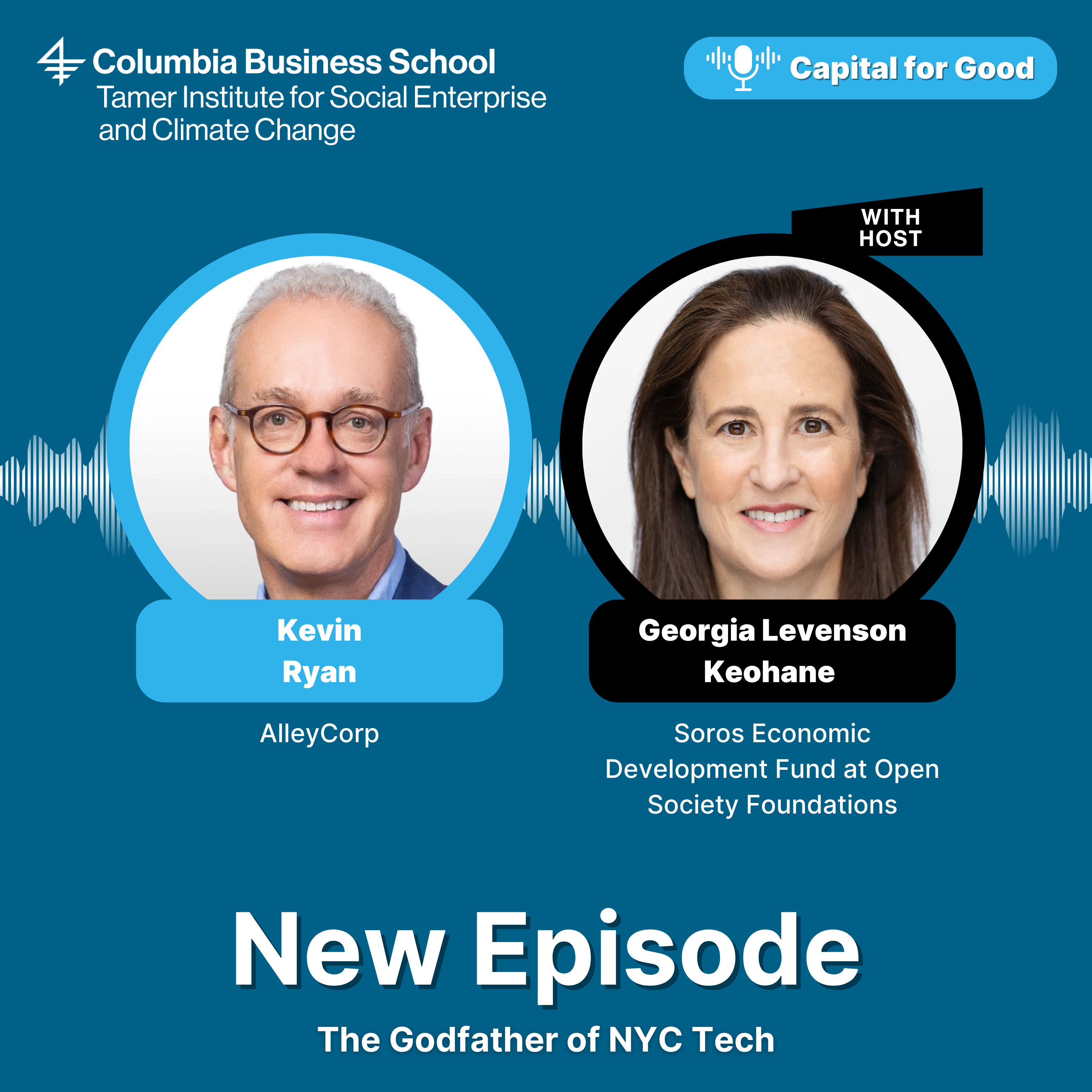
| 6/12/25 | ![]() Kevin Ryan, the Godfather of NYC Tech✨ | internet entrepreneurshipventure capital+4 | Kevin Ryan | MongoDBBusiness Insider+10 | — | Kevin RyanNYC tech+5 | — | 26m 24s | |
| 5/29/25 | ![]() Maria Teresa Kumar: We Market Democracy Every Single Day✨ | voter registrationcivic engagement+3 | Maria Teresa Kumar | Voto LatinoTamer Institute for Social Enterprise and Climate Change | Northern California | voter mobilizationLatino community+3 | — | 30m 14s | |
| 5/15/25 | ![]() Looking to the Horizon With Goldman Sachs Alternatives' Greg Shell | In this episode of Capital for Good we speak with Greg Shell, a seasoned investor, civic leader, and partner at Goldman Sachs Alternatives, where he leads the firm's inclusive growth strategy. Over the course of the conversation, we discuss how Shell's three decades and expertise in investing, and his commitments to creating opportunity and greater economic and social mobility, for many years pursued through board leadership and community and nonprofit engagement, have come together in impact investing, first at Bain Capital, and now at Goldman Sachs Alternatives. Shell explains that he believes deeply in the power of capitalism — the power of the profit model to drive innovation, opportunities for ownership and wealth building, economic growth — and that the current system is failing to deliver broad based economic and social mobility. He notes that stagnant wages, growing income and wealth inequality, and deep and real economic insecurity, are all profound challenges, but ones that must and can be addressed. "Our economy would be bigger and faster growing if more people could participate and contribute fully," Shell says. This is also the thesis of the private equity strategy he leads at Goldman Sachs Alternatives that invests into affordable and high-quality health care, education and workforce development, and financial inclusion. In each vertical, Shell's team identifies companies that focus on remedying exclusion as social and economic challenge and market opportunity, where need drives demand, innovation expands access, and both lead to social impact and strong business fundamentals. We walk through two portfolio examples in education (online literacy intervention) and health care (autism services). Despite the turbulence of the current environment, Shell is optimistic. "Human capital is the first, best and greatest asset we have," he says. "Investing in human capital is always the right decision, and if we do it the right way" can deliver extraordinary returns, on every dimension. Thanks for Listening! Subscribe to Capital for Good on Apple, Amazon, Google, Spotify, or wherever you get your podcasts. Drop us a line at socialenterprise@gsb.columbia.edu. Mentioned in this Episode Goldman Sachs Inclusive Growth | — | ||||||
| 5/1/25 | ![]() Anna-Lisa Miller and Ownership Works: Reimagining Equity to Build Wealth for All | In this episode of Capital for Good we speak with Anna-Lisa Miller, the Executive Director of Ownership Works, and a long time advocate of economic inclusion, empowerment and mobility. Miller started her career in corporate law at Paul, Weiss, Rifkind, Wharton and Garrison, and transitioned to the nonprofit sector – the Kohala Center and Project Equity – to pursue her passion for creating opportunities that uplift workers and families. Today, at Ownership Works, she leads an organization and movement focused on employee ownerships models that "reimagine equity to build wealth for all." In 2024, Miller was named as one of Business Insider's top 10 business leaders spearheading industry-transforming change. In this wide ranging interview, we learn how Miller's commitment to finding pathways to economic opportunity and mobility for workers and families is rooted in her childhood experiences; she moved to the U.S. at a young age and was raised by a single mother who rebuilt her career as a nurse, supporting three children paycheck to paycheck -- and never far from financial insecurity. Trained as a corporate lawyer, Miller moved into the nonprofit sector to test various models of employee ownership and economic mobility before meeting Pete Stavros, who had been successfully experimenting with owner equity in various portfolio companies he oversaw at KKR. Both understood the broader potential of the approach as a way to build employee wealth and improve business performance, and in 2021 formally launched Ownership Works (OW). Today, with 30 employees, nearly 100 partners (including 37 private equity firms, publicly traded companies, professional service firms, institutional investors, labor groups and foundations), and 130 companies across a wide range of industries implementing the model, OW aims to create $30 billion in wealth by 2030 and create proof points that influence how companies across the private sector harness the power of employee engagement and ownership. Miller walks us through various components of the OW model, sharing the example of Charter Next Generation, an Illinois manufacturing company that has used employee ownership to improve substantially employee engagement, retention and company profitability. She hopes that the long-standing bipartisan support for employee ownership as a path to economic inclusion and opportunity serves the movement well in this moment. In the meantime, she and OW are focused on collecting additional data and case studies that demonstrate employee ownership's value and feasibility, to encourage broader adoption and new norms in business. "You hear a lot about win-wins," Miller says. "This truly is." Thanks for Listening! Subscribe to Capital for Good on Apple, Amazon, Google, Spotify, or wherever you get your podcasts. Drop us a line at socialenterprise@gsb.columbia.edu. Mentioned in this podcast: Ownership Works Private Equity Is Starting to Share With Workers, Without Taking a Financial Hit New York Times January 2024 Charter Next Generation: Follow a Real Life Journey to Shared Ownership | — | ||||||
| 4/17/25 | ![]() Tom Steyer: Cheaper, Faster, Better: How We'll Win the Climate War | In this episode of Capital for Good we speak with veteran investor and climate activist Tom Steyer. Over twenty-five years, Steyer founded and ran Farallon Capital Management, a $36 billion multi-strategy global investment firm. In 2012 he stepped away from Farallon to dedicate his time, resources, and energy to mobilizing climate action: clean air and energy initiatives in California; climate focused ballot initiatives in numerous states; youth voter engagement and mobilization (NextGen America); and a 2020 Presidential run largely focused on the climate crisis. Today, Steyer is the co-executive chair of Galvanize Climate Solutions, a climate-focused investment firm, and the author of Cheaper, Faster, Better: How We'll Win the Climate War. We begin the interview by discussing Steyer's parents, both civically engaged members of the Greatest Generation. In his father's case, a lawyer who served in the Navy and then as a prosecutor at Nuremberg. Steyer describes World War II as a crucible moment for Americans — galvanizing collective action and a sense of being part of something larger than oneself. For Steyer, the climate fight is a similar calling. We discuss why, despite current political headwinds, the momentum behind the climate revolution — the transition to net zero via the development and adoption of low carbon technologies — is very much alive, well, and accelerating. In Steyer's view, this is because of the dramatic decline in costs of renewables — solar and wind are now the cheapest forms of energy — and because applied technologies like batteries and electric vehicles continue to improve in quality and cost, driving demand. "This is not eat your gruel," he says. "It's cheaper, faster, better. When you put eight billion people on a problem, they solve it." We also explore promising new technologies coming on-line, from geothermal energy and AI optimization of the electric grid to geosynthetic seawalls. While these new technologies will enable the transition, Steyer notes that "climate capitalism" also requires new rules and policies to speed innovation and deployment; ultimately this means paying for carbon pollution. He argues that despite objections to the idea of a "tax," people are already paying — in the form of destruction to homes, businesses, livelihoods, health — though often it is the most vulnerable, those who have contributed the least to the problem, in the United States and around the world, who bear the cost. We conclude with a call to action. Historically, Steyer reminds us, "we've chosen to do the right things, even when they're hard, and that has always paid off for us, and it will always pay off for us. That is who we are, and that is where this world is going. This revolution is happening. Our job, as Americans, is to be at the forefront." Thanks for Listening! Subscribe to Capital for Good on Apple, Amazon, Google, Spotify, or wherever you get your podcasts. Drop us a line at socialenterprise@gsb.columbia.edu. Mentioned in this podcast: Cheaper, Faster, Better: How We'll Win the Climate War, (Spiegel and Grau, 2024) | — | ||||||
| 4/3/25 | ![]() Michael Posner, Conscience Incorporated: The Role of Business and Investment in Protecting Human Rights | In this episode of Capital for Good we speak with Michael Posner, the Jerome Kohlberg Professor of Ethics and Finance at NYU's Stern School of Business, director of the school's Center for Business and Human Rights, a long-time leader in the field, luminary thinker, advocate, former State Department Official, and the author of the new book, Conscience Incorporated. We begin with Posner's early interests in international human rights issues, sparked in law school when he was tasked with investigating atrocities in Uganda under Idi Amin. He lays out the principals of early, post-World War II and UN inspired human rights law focused on universality, and the responsibility of governments to promote, protect and enforce human rights. Notably absent from this early framework is the role of business. Posner explains that his interest in the intersection of human rights took shape when he began to observe that large multinational corporations had a critical role to play, particularly when they operated in weak states that lacked the ability to protect human rights. We discuss why companies should care, fundamentally, about human rights on ethical dimensions ("outsourcing might be a smart business strategy, but you can't outsource responsibility if you're the main economic beneficiary,") and because there are material costs that can arise from irresponsible practices, often reputational crises and/or regulation. We explore the deficiencies of various business frameworks: how and why Milton Friedman's shareholder primacy worldview fails to account for environmental and social externalities and a broader set of stakeholders; how and why ESG conflate environmental and social considerations and emphasize risk rather than meaningful performance on issues like climate change or worker protections. Posner suggests that this moment of backlash against all things ESG, DEI and "woke capitalism" offers us an opportunity to do better. We touch on sometimes complex tensions between climate change and human rights concerns, acknowledging that climate change can only be solved if we transition to a lower carbon economy, with the scale up of renewable energy and the development of technologies like electric vehicles, which in turn rely on things like batteries. We know that today batteries are reliant on inputs like critical minerals, long mined in ways and places rife with human rights challenges, and today often controlled by Chinese companies. China is also the world's largest and lowest cost producer of solar panels, and much of that production occurs in Xinjiang, with forced labor of the Uyghur ethnic minority. Posner discusses a number of ways to better integrate climate and human rights considerations. Before opening the floor to audience questions, we discuss the evolution of technology and human rights issues. When Posner was at the State Department from 2010 to 2012, he had a front tow seat to the Arab Spring and the "Facebook Revolution," witnessing how activists used social media to fight authoritarianism. Although he says he still believes in the power of technology to open up political discourse, he has become much more concerned about issues of data privacy, surveillance, harmful violent and incendiary content, information and disinformation, and ways in which companies try to shield themselves with first amendment (to which they are not legally subject) to avoid more vigorous content moderation or human rights engagement. We conclude with the role of corporate leaders when it comes to human rights. While Posner notes he is typically conservative about how much executives should speak out on specific issues, he believes strongly that "business leaders need to be attentive and active if there are fundamental threats to our democracy." This episode of Capital for Good was recorded as part of Social Impact Week 2025, a week of social impact-related events for the Columbia Business School community, organized by the Social Enterprise Club, Green Business Club, Community Impact Club, and LEO Impact Fund. Thanks for Listening! Subscribe to Capital for Good on Apple, Amazon, Google, Spotify, or wherever you get your podcasts. Drop us a line at socialenterprise@gsb.columbia.edu. Mentioned in this Episode Conscience Incorporated: Pursue Profits While Protecting Human Rights The Fair Labor Association | — | ||||||
| 3/20/25 | ![]() Janno Lieber, Chairman and CEO, the New York MTA: "Never Bet Against New York" | In this episode of Capital for Good we speak with Janno Lieber, the chairman and CEO of New York's MTA, one of the world's oldest, largest, and most complex public transit systems. "New York is my passion," Lieber says, and the throughline of his career. Lieber, a lifelong New Yorker, business leader and transit veteran — he was a transportation advisor to Mayor Koch, an Assistant Secretary of Transportation in the Clinton Administration, and led the rebuilding of the World Trade Center site after September 11 attacks — talks about the complexity of overseeing a public transportation system that spans a 12-county, 25-million person region: 6,400 subway cars, 472 stations, 5,700 buses, and two major commuter rails. Lieber notes that the success of the region — it is the economic powerhouse of the local state and much of the national economy — rests on density and mobility. "The ability to get around New York only works if you have great mass transit," he says; the MTA moves more than six million people per day. For users, trains, buses and subways are 15 percent the cost of owning an automobile. "The magic of transit," Lieber explains, "is it is one of the very few things that makes living in New York City and the region affordable." We discuss congestion pricing, the decades in making the policy to charge automobiles $9 a day to enter the most congested part of the city to reduce traffic, improve emissions, air quality, health and safety, and help finance maintenance and upgrades to the 100 year old transit system. The program launched January 5 and early data is very promising: a 10 to 20 percent reduction in traffic; significantly reduced travel times for drivers from New Jersey, Long Island, Queens and the Bronx, and along some of the city's most crowded thoroughfares (i.e., Canal Street, 34th Street, 42nd Street and 57th); increased transit ridership; and revenue generated for critical improvements: elevators and ramps to make all subway stations accessible and ADA compliant, new train cars and electric buses, new tracks, signals and power systems, mitigation efforts in areas that may see spillover traffic. Lieber notes that the economic benefits are already observable in the zone itself: increased pedestrian traffic, an uptick in retail, restaurant and Broadway sales, and promising indices in commercial leasing — "a vote of confidence" in the program. For all these reasons the business community has long supported the policy. The MTA is equally pleased to see high rates of customer satisfaction coming from drivers with reduced commute times, which Lieber believes will also be important to counter the recent political opposition from Washington. Lieber reminds us that congestion pricing has been successfully tested in the courts, and there is nothing in the federal law or program design that would allow for its rollback. We also speak about how central public safety, real and perceived, is to the economic and civic health of the city. "Public transit is where six million New Yorkers every day form their opinion about whether government works, and to some extent whether this community, this experiment in diversity and tolerance and economic dynamism, is working," Lieber says. While the data show that overall crime in the city is down, crime in the subway is down, and subway crime accounts for less than two percent of overall crime, high profile and frightening crimes, and the city's larger mental health, substance use and homeless crises that are acutely manifest in the subway system, play an outsized play role in the public's sense of security, order and well-being. "Not only to the subways have to be safe, they have to feel safe," Lieber insists, and we discuss numerous efforts the MTA is taking in coordination with other city agencies to address these issues. We conclude with the resilience of New Yorkers in the face of adversity — the fiscal crisis of the 1970s, the September 11 attacks, the dotcom burst, and the financial crisis, Hurricane Sandy, the pandemic — and how the city "bounces back even better" to become a better version of itself. "Never bet against New York," is Lieber's motto. Thanks for Listening! Subscribe to Capital for Good on Apple, Amazon, Google, Spotify, or wherever you get your podcasts. Drop us a line at socialenterprise@gsb.columbia.edu. Mentioned in this Episode Congestion Pricing Reduced Traffic. Now its Hitting Revenue Goals, (The New York Times, 2025) | — | ||||||
| 3/6/25 | ![]() Introducing Capital for Good Season Four | Capital for Good is the podcast where we hear from business and civic leaders about their visions, plans, and hard work to build a vibrant, inclusive, and sustainable society. Through in-depth and candid conversations, we explore solutions to some of our most urgent challenges. In this season of Capital for Good, host Georgia Levenson Keohane will speak with an extraordinary line-up of guests, including business and government leader Janno Lieber, the CEO of New York's MTA, one of the country's largest and oldest public transportation systems; journalist, digital media CEO, and Nobel Prize winner Maria Ressa; investor, climate champion, and former Presidential candidate Tom Steyer; Maria Teresa Kumar, president and CEO of Voto Latino; Kevin Ryan, one of New York and the country's leading internet entrepreneurs and investors; Anna-Lisa Miller, the founding executive director of Ownership Works; New York City Comptroller and mayoral candidate Brad Lander; Greg Shell, managing partner and head of inclusive growth strategies at Goldman Sachs; and Michael Posner, the director of NYU's Center for Business and Human Rights and author of the new book, Conscience Incorporated. | — | ||||||
| 3/13/24 | ![]() Investing in Women, Investing in Our Future | In this episode of Capital for Good we speak with three inspiring leaders in women's health, Erika Seth Davies, Jade Kearney, and Flory Wilson, each pioneering advances in reproductive and maternal health, and each using business, investment, engagement, and advocacy as levers for social change. Davies is the CEO of Rhia Ventures, a nonprofit that advances reproductive and maternal health equity by leveraging capital to focus on the needs, experiences, and perspectives of historically marginalized people in decision making. Rhia ventures activities include venture capital investing (via RH Capital), ecosystem building, corporate engagement and advocacy, and narrative change. Wilson is the founder and CEO of Reproductive & Maternal Health Compass (RMH) Compass, a nonprofit focused on the role employers play in access to reproductive and maternal health, and on providing companies with the tools, resources, support, and recognition necessary to offer best in class RMH benefits for all workers. Kearney is the co-founder and CEO of She Matters, a digital health platform designed to improve maternal morbidity through cultural competency and technology. Focused in particular on improving health outcomes for Black women, and on the epidemic of Black maternal morbidity, She Matters is a B2B company that offers health providers a culturally competent certification program tailored to the specific nuances and challenges facing Black women in the US health care system. Over the course of this conversation, we touch on the personal and professional experiences that have informed each of these leaders' work in health equity and access. We also explore how current headwinds and retrenchment — on reproductive and maternal health, on racial equity and inclusion, and on corporate activism — motivate them and have shaped their innovative business models. "If anyone says entrepreneurship is easy," Kearney says, "point them in my direction. Social entrepreneurship is sometimes gut wrenching because you're so close to the problem. But change is also soul feeding because you're so close to the problem." Thanks for Listening! Subscribe to Capital for Good on Apple, Amazon, Google, Spotify, or wherever you get your podcasts. Drop us a line at socialenterprise@gsb.columbia.edu. Mentioned in this Episode Rhia Ventures Reproductive and Maternal Health Compass She Matters | — | ||||||
| 2/28/24 | ![]() Lise Strickler '86 and Mark Gallogly '86: Three Cairns Group, the Climate Crisis, and Climate Solutions | In this episode of Capital for Good we speak with Lise Strickler '86 and Mark Gallogly '86, the co-founders of Three Cairns Group, a mission driven investment and philanthropic firm focused on the climate crisis. In the years since Columbia Business School, where they met in 1986, Mark has worked in investing, philanthropy, and public policy; as co-founder of Centerbridge Partners, an investment firm with over $30 billion of assets under management; and before at The Blackstone Group. Mark's work in public service has included two stints under President Obama, and most recently at the US State Department as an Expert Senior Advisor to Special Presidential Envoy for Climate John Kerry. Lise has extensive experience in the climate advocacy sector and has spent the last 20 years working with local, state, and national organizations to advance public policy and build momentum for scalable solutions to the world's climate crisis, including as a board member of the Environmental Defense Fund and co-chair of their 501(c)4 political advocacy partner, EDF Action; on the leadership council of the Yale School of the Environment; and on the advisory boards of Environmental Advocates NY, the Yale Center for Environmental Law & Policy, Columbia University's Climate School, the Tamer Center for Social Enterprise at Columbia Business School, and the Adirondack Trail Improvement Society. In this wide-ranging conversation, we cover a number of the challenges — and promising solutions — to the climate crisis. We begin with their respective "climate journeys," including for both formative childhood experiences in nature and the outdoors. Lise credits her parents for "passing on the values of hard work, conservation, and leaving the world better than you found it," and recalls how the environmental activism of the 1970s, including the passage of important legislation like the Clean Air and Water Acts, shaped her understanding of environmental issues and the potential to address them. We discuss the genesis of the Three Cairns Group, and some of its first major initiatives, each focused, in different ways, on developing ideas and climate solutions that are potentially scalable, and then working with partners across sectors and across the world to implement. For example, Three Cairns has recently launched Allied Climate Partners (ACP), a platform that has aggregated capital from philanthropy, governments, development finance institutions and the private sector to support early-stage climate projects and businesses in emerging markets, including in Southeast Asia, the Caribbean and Central America, Africa, and India. We also explore why Mark and Lise believe that universities, as centers of learning, "creators of new knowledge that advance civilization," and places that produce the leaders for tomorrow are natural partners for their work on climate. We touch on various efforts they are involved in at Columbia and Yale. Finally, Lise and Mark remind us that, while the challenges of the climate crisis are many, there are number of breakthroughs that motivate them to keep moving forward: some technological, like MethaneSat, a new $100 million methane tracking satellite, or the falling costs of renewables; some policy related, like the passage of the federal Inflation Reduction Act, the Infrastructure and Jobs Act, the CHIPS and Science Act, that are driving trillions of dollars into climate, or more locally the promise of congestion pricing in places like New York City that will reduce emissions and elevate the importance of public transportation as a climate and equity issue. Lise and Mark note that communicating these gains, and framing climate challenges as ones we have solutions to – and agency in – is critical to the tackling the crisis, particularly for young people "who want things to be better, and want to make them better." Thanks for Listening! Subscribe to Capital for Good on Apple, Amazon, Google, Spotify, or wherever you get your podcasts. Drop us a line at socialenterprise@gsb.columbia.edu. Mentioned in this Episode Three Cairns Group Allied Climate Partners Methane Sat The Environmental Defense Fund Columbia University Yale University Inflation Reduction Act Infrastructure Investment and Jobs Act CHIPS and Science Act New York Congestion Pricing | — | ||||||
| 2/14/24 | ![]() Shaun Donovan: Home, Community, and the Affordable Housing Crisis | In this episode of Capital for Good we speak with Shaun Donovan, one of the country's most important leaders — and lifelong advocates — for housing, economic development, and shared prosperity. Donovan has worked at the highest levels of government — as Secretary of the US Department of Housing and Urban Development and Director of the Office of Management and Budget under President Obama and as Commissioner of the Department of Housing Preservation and Development in New York City — overseeing large scale public-private partnerships. Today he approaches that work from Enterprise, where he leads the nation's only nonprofit that brings together in one place housing solutions, capital, and community development. We begin with some of Donovan's formative personal and professional experiences that motivated his lifelong commitment to housing. Growing up in New York City during a time of crises, with high levels of street homelessness and neighborhoods across the city severely challenged, Donovan was drawn to work at community-based organizations focused on homelessness, rebuilding communities, and financing community revitalization. We discuss how these experiences would inform his years in government, and his understanding of the role of the public sector. "I am a deep believer in the power of government and the need for a strong government role in the service of the public good," Donovan says. He notes that, in particular, government can make foundational investments in things like infrastructure or basic scientific research that lay the groundwork for much broader economic prosperity, and can set the "rules of the road," for commercial market players. He also underscores the importance of cross sector partnerships: Government can scale innovations tested by the nonprofit and private sectors or shape policy that responds to community-based movement building. Donovan's forty-year commitment to housing is rooted in the sector's "unique" role in people's lives — where people live and their quality of housing — affects larger opportunities and well-being: schooling, health, safety, and employment. Housing has also become the most expensive thing in most people's lives: more than half of US renters spend over 30 percent of income on rent, closer to 50 percent for lower income Americans. We discuss how today's affordability crisis has led to record levels of street homelessness, overcrowding, evictions, and instability in communities across the United States — the worst Donovan has seen in his lifetime. The high cost of housing also prevents individuals and families from moving to higher paying jobs; limited economic mobility in turn exacerbates economic and political segregation and polarization. Despite these challenges, Donovan is encouraged by important developments at the national, state, and local level. We discuss what he calls the "New New Deal:" the trillions of dollars the federal government has deployed to infrastructure and climate (via the Inflation Reduction Act), political momentum at the state level to increase the supply of affordable housing, and a wellspring of housing innovation in communities across the US. At Enterprise, Donovan and colleagues take on all of these issues, with a particular focus on racial equity and building resilience and upward mobility. Founded forty years ago, Enterprise today invests approximately $10 billion a year into communities ($64 billion cumulatively to build or preserve 950,000 homes), owns and manages 13,000 affordable homes, and is the country's largest housing policy and advocacy organization. All of these activities involve partnerships. For example, Enterprise has recently joined forces with LISC, Habitat for Humanity, the United Way, and Rewiring America to apply for $9.5 billion from the Greenhouse Gas Reduction Fund to work with 156 communities across the country to decarbonize affordable housing, invest in resilience, and ensure an equitable low carbon transition. Enterprise also oversees a variety of innovation challenges to support effective housing solutions developed by community-based organizations across the United States. "We have solutions, we know what works," Donovan says. "I think this is the moment, potentially, when we come together… to build a national movement to make housing a critical part of how we support families in this country." Thanks for Listening! Subscribe to Capital for Good on Apple, Amazon, Google, Spotify, or wherever you get your podcasts. Drop us a line at socialenterprise@gsb.columbia.edu. Mentioned in this Episode Enterprise The Inflation Reduction Act Greenhouse Gas Reduction Fund Power Forward | — | ||||||
| 1/31/24 | ![]() Dr. Fei-Fei Li: The Worlds I See: Curiosity, Exploration, and Discovery at the Dawn of AI | In this episode of Capital for Good we speak with Dr. Fei-Fei Li, the Sequoia Professor of Computer Science at Stanford and the Denning Co-Director of Stanford's Human Centered AI-Institute. Dr. Li has been called the godmother of artificial intelligence and has emerged as one of the country's leading scientists — and humanists. She is also the author of the new book, The Worlds I See: Curiosity, Exploration, and Discovery at the Dawn of AI. We begin by discussing how and why Li employs a "double helix" structure in her book to tell two interlacing stories: the evolution of a new field of science and her own coming of age as a scientist. Together, they form an homage to the intellectual foundations of her work, and to the teachers, mentors, and family members whose sacrifices made her work possible. We explore how the very act of writing the book serves to introduce an underrepresented voice — that of a woman, an immigrant, a person of color — into the world of artificial intelligence and science more broadly. Li believes strongly that "progress and discovery come from every corner," and throughout her career has worked towards "lifting all walks of life." In explaining just what she means by "human centered AI," Li explains that there is "nothing artificial about artificial intelligence." As a "tool made by and for people," she argues AI should be used to make people's lives work better. Li describes any number of extraordinary and beneficial applications of AI, including those in neuroscience, the social and political sciences, business, education, climate change, and health care, from research drug discovery to diagnosis, treatment, and delivery. We also touch on some of the major risks of AI. While Li believes it is important to examine the longer term and potentially existential threats of AI — the current and popular pre-occupation with sentience and machine overlords – she is more concerned with the technology's urgent (and potentially catastrophic) social risks: significant biases in data and algorithms, issues of privacy, the problems of misinformation and disinformation, and the profound and uneven economic disruptions that the technology can bring about. "AI can grow the global pie of productivity," Li says, "but there is a difference between increased productivity and shared prosperity." Li also warns of severe levels of underinvestment by the public sector in AI. She has worked closely with the state of California, the federal government, and the UN to encourage more of a "moonshot" mentality when it comes to resources for blue sky innovation, and for the development of governance and guardrails essential for public safety and trust. Li concludes by encouraging others to follow their own North Stars. "My North Star hasn't changed, it is still AI, but it is the science with an expanded aperture: the greater North Star of doing good that is human centered." Thanks for Listening! Subscribe to Capital for Good on Apple, Amazon, Google, Spotify, or wherever you get your podcasts. Drop us a line at socialenterprise@gsb.columbia.edu. Mentioned in this Episode The Worlds I See: Curiosity, Exploration, and Discovery at the Dawn of AI Stanford University Human Centered AI Institute AI4All | — | ||||||
| 1/17/24 | ![]() Suzanne Nossel: Dare to Speak | In this episode of Capital for Good we speak with Suzanne Nossel, the chief executive officer of PEN America, and one of the country's most prominent experts and voices on free speech, free expression, and human rights. Nossel has held leadership roles in government, the nonprofit and private sectors, and is the author of the award-winning book Dare to Speak: Defending Free Speech for All. We begin with some of Nossel's formative personal and professional experiences that shaped her passion for human rights, including participating as a young person in the movement to free Soviet Jews in the 1980s, and her years after college in South Africa during the country's early transition from Apartheid to democracy. Both influenced what would become a throughline throughout her career — "an impulse to advocate for people who take great risks, who assert themselves, who challenge authority," whether that was leading important initiatives at the State Department under President Obama, at the UN under President Clinton, or at civil society organizations like Human Rights Watch, Amnesty International, and now PEN America. Nossel walks us through a kind of "free speech and free expression" 101. She explains that while much of the important conversation about free speech centers on the First Amendment, and therefore on protections against government infringement on speech, more broadly free speech is also the foundational right for all other rights in a free and democratic society, the "catalyst for a range of social goods." Nossel reminds us that the open exchange of ideas allows for deliberation, persuasion, debate, accountability, the ability to make better policies, choose better leaders, and advance scientific progress artistic creativity; freedom of expression is "an underwriter of so many other movements, the ability to advocate for… women's rights, climate justice, racial justice." She worries about a rising generation becoming alienated from the principle of free speech, seeing free speech at odds with commitments to diversity, inclusion, and pluralism — when in fact they are mutually supportive and reinforcing. We discuss many of the ways Nossel and her PEN America colleagues aim to serve as "guarantors of free speech and open discourse" through work to "celebrate and defend freedom of expression worldwide." Some of this takes the form of enabling and amplifying lesser heard voices like Dreamers or incarcerated writers; some through awards, festivals, and public programming celebrating a "big tent" of writers and voices that in turn supports PEN's free expression and advocacy work, including the defense of persecuted writers around the world, litigation, i.e., the recent federal lawsuit in Escambia County, Florida challenging book bans, or warnings on the dangers of education gag orders. For years, PEN America has also worked on issues of campus free speech, a topic we explore in light of the recent protests and crises of university leadership. Nossel hopes that today's campus convulsions have brought about a recognition that universities need to put in place deliberate, intentional training and inculcation of a culture of free speech, open discourse, and academic freedom to support the diversity of experience, opinion, and perspective that makes universities "catalysts for understanding and growth." We also touch on the large and "messy" issues of online speech, the ways it can be weaponized, the challenges of disinformation, of businesses built on algorithms that prioritize inflammatory content — that are not governed as public entities or liable for most posted speech, and of the lag in appropriate regulation. "The best we can do is experiment," Nossel says. To date, that experimentation has included important new EU regulations, and efforts from the tech companies themselves to improve content moderation. Nossel herself sits on the Meta oversight board, a group that works to apply human rights principles to adjudicate complex content moderation quandaries and dilemmas. While deeply concerned about speech issues — particularly the problems of misinformation in an election year (in the United States and around the world), Nossel is also hopeful there is increased recognition, on the political left and right "that each has a stake in speech." "Speech really should be an issue that sits above politics, and for a long time it was," she says. "My hope is that we can go back to that when it comes to the nature of our discourse." Thanks for Listening! Subscribe to Capital for Good on Apple, Amazon, Google, Spotify, or wherever you get your podcasts. Drop us a line at socialenterprise@gsb.columbia.edu. Mentioned in this Episode "In Win for Free Expression, Jude Rule Lawsuit Challenging Escambia County, FL Book Banks can Move Forward," (PEN America, 2024) "A Free-Speech Fix for our Divided Campuses,"(Suzanne Nossel, Wall Street Journal, 2023) Dare to Speak: Defending Free Speech for All, (Suzanne Nossel, Dey Street Books, 2020) PEN America | — | ||||||
Showing 25 of 53
Pitch Fit is a Pro feature
See how bookable this show is for guests, which brands already advertise, the per-episode ad value, and the best-fit guest and sponsor profile. The numbers are blurred on the free plan.
How readily this show books outside guests like you.
How proven this show is for host-read sponsorships.
For Guests
ProFor Advertisers
ProUpgrade to Pro to unlock guest cadence, sponsor categories, fit scores, and per-episode ad value for this show.
Chart Positions
2 placements across 2 markets.
Chart Positions
2 placements across 2 markets.