
Insights from recent episode analysis
Audience Interest
Podcast Focus
Publishing Consistency
Platform Reach
Insights are generated by CastFox AI using publicly available data, episode content, and proprietary models.
Total monthly reach
Estimated from 10 chart positions in 10 markets.
By chart position
- 🇬🇧GB · Courses#26100K to 300K
- 🇨🇦CA · Courses#26100K to 300K
- 🇳🇱NL · Courses#3300K to 800K
- 🇯🇵JP · Courses#3030K to 100K
- 🇸🇪SE · Courses#3130K to 100K
- Per-Episode Audience
Est. listeners per new episode within ~30 days
292K to 838K🎙 Weekly cadence·59 episodes·Last published 9mo ago - Monthly Reach
Unique listeners across all episodes (30 days)
584K to 1.7M🇳🇱48%🇬🇧18%🇨🇦18%+7 more - Active Followers
Loyal subscribers who consistently listen
175K to 503K
Market Insights
Platform Distribution
Reach across major podcast platforms, updated hourly
Total Followers
—
Total Plays
—
Total Reviews
—
* Data sourced directly from platform APIs and aggregated hourly across all major podcast directories.
On the show
Recent episodes
Episode 25: Collaborate and Promote Visibility — Team and Transparency
Sep 1, 2025
28m 41s
Episode 24: Progress Iteratively with Feedback — Why Small Steps Matter
Sep 1, 2025
28m 15s
Episode 23: Start Where You Are — Assess Before You Build
Sep 1, 2025
26m 26s
Episode 22: Focus on Value — Customer First
Sep 1, 2025
30m 21s
Episode 21: What Are Guiding Principles?
Sep 1, 2025
30m 41s
Social Links & Contact
Official channels & resources
Official Website
Login
RSS Feed
Login
| Date | Episode | Description | Length | ||||||
|---|---|---|---|---|---|---|---|---|---|
| 9/1/25 | 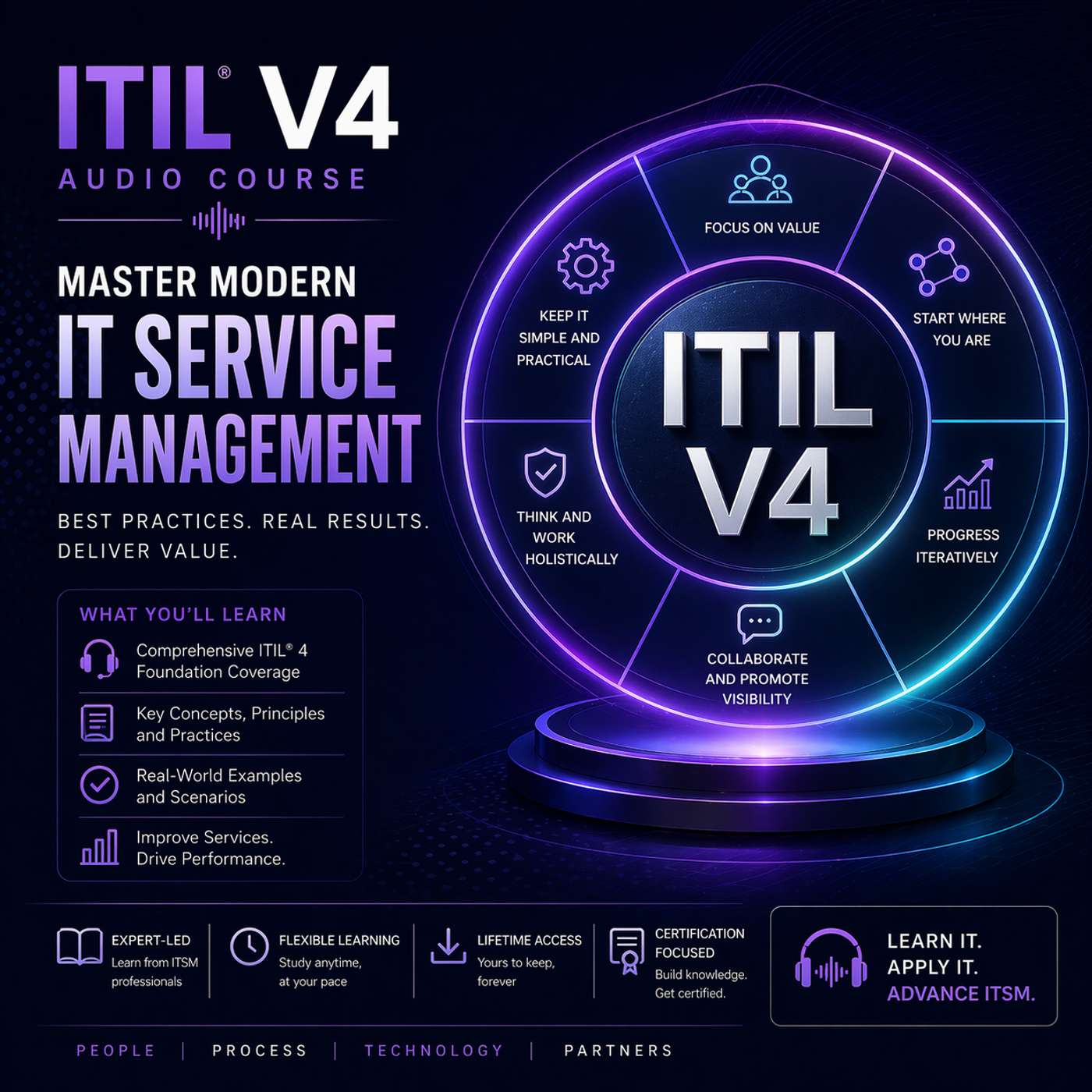 Episode 25: Collaborate and Promote Visibility — Team and Transparency | No service can succeed in isolation, which is why collaboration is essential in ITIL’s framework. In this episode, we’ll examine the guiding principle “Collaborate and Promote Visibility,” which emphasizes teamwork, communication, and openness as the drivers of success. Collaboration ensures that diverse perspectives are included in decision-making, preventing blind spots and reducing risks. Promoting visibility means making information accessible so teams understand progress, challenges, and goals. This transparency builds trust, aligns stakeholders, and allows for quicker and more informed responses. Without collaboration and visibility, even the most well-designed services can falter due to miscommunication or hidden obstacles.We’ll also highlight how this principle applies in practice, such as project dashboards that track work openly, cross-functional meetings that break down silos, and regular feedback loops that include both customers and providers. Exam questions may test your ability to recognize when lack of visibility causes service failures, so keep this principle in mind as both a practical tool and a theoretical anchor. This episode was produced by BareMetalCyber.com. | 28m 41s | ||||||
| 9/1/25 | Episode 24: Progress Iteratively with Feedback — Why Small Steps Matter | Big-bang changes often fail because they are too risky and too complex. The principle “Progress Iteratively with Feedback” reminds us that improvement should come in manageable steps, each guided by learning and user input. In this episode, we’ll explore why breaking work into smaller increments reduces risk, builds momentum, and allows teams to adjust quickly if something isn’t working. We’ll also discuss the importance of collecting and acting on feedback at every stage, ensuring that changes actually meet the needs of customers and stakeholders.Practical examples include agile software releases, where new features are delivered incrementally and adjusted based on user response, or organizational rollouts where pilot programs provide lessons before scaling. This principle reflects modern best practices in IT and beyond, teaching you that success is more likely when you move in small, validated steps. For the exam, it’s important to remember that iteration and feedback are inseparable — one without the other misses the point. This episode was produced by BareMetalCyber.com. | 28m 15s | ||||||
| 9/1/25 | Episode 23: Start Where You Are — Assess Before You Build | Change and improvement are constant in IT, but too often organizations throw away what already works. This guiding principle, “Start Where You Are,” encourages you to first assess the current state before making changes. In this episode, we’ll explain how this principle helps avoid waste and ensures improvements are built on proven strengths. You’ll learn why careful measurement, baselining, and observation are critical steps before introducing new tools or workflows. By building on existing capabilities, organizations save time, reduce disruption, and create more sustainable improvements.We’ll also cover how this principle applies in practice, from evaluating an existing service desk process before deploying a new system, to reusing effective security policies instead of reinventing them. For the exam, remember that ITIL champions evolution over revolution. Incremental progress is far more effective when you start from a realistic understanding of where you are today. This episode was produced by BareMetalCyber.com. | 26m 26s | ||||||
| 9/1/25 | Episode 22: Focus on Value — Customer First | The first guiding principle is “Focus on Value,” and it captures the essence of why IT services exist at all. In this episode, we’ll explore how every decision, process, and improvement effort should be evaluated by the value it creates for customers and stakeholders. Value is not defined by the provider but by the consumer, meaning that understanding customer needs and expectations is essential. We’ll look at practical ways organizations can align to this principle, such as through customer journey mapping, user feedback loops, and continuous performance measurement. By doing so, they ensure resources are spent on what truly matters.We’ll use real-life examples — from streaming platforms tailoring content recommendations to retailers simplifying checkout experiences — to show how focusing on value directly shapes customer loyalty and business success. For the exam, remember that this principle is the foundation of all others: without value, nothing else has meaning. This episode was produced by BareMetalCyber.com. | 30m 21s | ||||||
| 9/1/25 | Episode 21: What Are Guiding Principles? | Guiding principles are one of the most distinctive features of ITIL 4, offering simple yet powerful advice that can be applied universally across organizations and situations. In this episode, we’ll introduce the seven guiding principles that serve as a compass for decision-making and service management activities. Unlike strict processes, these principles are flexible, designed to be adopted and adapted to the needs of any team or project. They help organizations avoid unnecessary complexity and keep their focus on value, outcomes, and collaboration. By mastering them, you gain tools that work far beyond the exam — they become ways of thinking that improve real-world practice.We’ll also discuss why ITIL emphasizes principles rather than prescriptive rules. In today’s fast-moving world of digital transformation, organizations must be able to pivot quickly. Principles provide timeless guidance that can be applied to agile teams, DevOps environments, or traditional IT operations alike. This adaptability is what makes the guiding principles so critical to your understanding of ITIL and its relevance in modern organizations. This episode was produced by BareMetalCyber.com. | 30m 41s | ||||||
| 9/1/25 | Episode 20: Service Relationships: Provision, Consumption, Management | Services don’t exist in a vacuum — they exist in relationships between providers and consumers. In this episode, we’ll examine the ITIL concept of service relationships, which involve three main elements: service provision, service consumption, and service relationship management. Provision refers to the provider delivering services, resources, and actions. Consumption refers to the customer using those services to achieve outcomes. Relationship management is the ongoing coordination, governance, and communication that ensures the connection works smoothly. These elements define how value is co-created in practice.We’ll walk through a practical scenario, such as a company subscribing to cloud services. The provider provisions the infrastructure, the customer consumes it to run applications, and both sides manage the relationship through agreements and communication. Seeing this interplay helps you understand how ITIL ties value creation to collaboration rather than one-sided delivery. This episode was produced by BareMetalCyber.com. | 29m 41s | ||||||
| 9/1/25 | Episode 19: Service Offerings Explained | Service offerings form the bridge between a service provider and the consumers who benefit from their services. In this episode, we’ll define what an offering is in ITIL terms — a formal description of one or more services, goods, or resources presented to a target consumer group. We’ll break down the components of offerings, which can include tangible goods, access to resources, and service actions. You’ll learn how offerings can be packaged, customized, and positioned to meet the needs of different customer segments, and why this matters both for business strategy and for exam preparation.We’ll also highlight how offerings create clarity. For example, a software company might provide a basic tier with limited features, a premium tier with full functionality, and additional warranty levels like 24/7 support. These structured offerings help organizations communicate clearly and set expectations, making them essential for both customer satisfaction and organizational success. This episode was produced by BareMetalCyber.com. | 20m 03s | ||||||
| 9/1/25 | Episode 18: Utility and Warranty — Twin Pillars of Service Value | Utility and warranty together define whether a service truly delivers value. In this episode, we’ll revisit and expand on these two foundational concepts. Utility is fitness for purpose — does the service provide the functionality customers need? Warranty is fitness for use — does it perform reliably at the required level of availability, capacity, continuity, and security? Both must work together to create value. A service with strong utility but poor warranty may function but fail often; a service with strong warranty but weak utility may work reliably but not solve the right problem.We’ll use familiar examples to illustrate this. A streaming service must offer the right content (utility) and ensure smooth playback without interruptions (warranty). If either pillar fails, customer trust is lost. By mastering this balance, you’ll understand why ITIL places such importance on these terms, and you’ll be ready to handle related exam questions with confidence. This episode was produced by BareMetalCyber.com. | 23m 00s | ||||||
| 9/1/25 | Episode 17: Understanding Risk in Services | Risk is an unavoidable part of delivering services, and ITIL places strong emphasis on understanding how risk shapes outcomes. In this episode, we’ll explore the ITIL definition of risk as a possible event that could cause harm or make achieving objectives more difficult. Services always involve balancing risks against opportunities: every new feature, every supplier contract, and every technology decision comes with uncertainties. You’ll learn how ITIL encourages identifying, assessing, and managing risk so that organizations can deliver value without exposing themselves to unnecessary threats. Exam questions often test this perspective by asking you to distinguish between risk, issue, and problem.We’ll also connect the idea of risk to real-world situations, such as implementing cloud migration or introducing new security controls. Both can create risks — downtime, breaches, or cost overruns — but with careful management, the benefits can outweigh them. Recognizing this balance is key both in ITIL theory and in organizational decision-making. This episode was produced by BareMetalCyber.com. | 19m 47s | ||||||
| 9/1/25 | Episode 16: Outputs vs. Outcomes — Getting Real Results | One of the most important distinctions in ITIL is between outputs and outcomes. Outputs are the direct deliverables of a process — the things you produce, like a software update or a report. Outcomes are the results achieved by using those outputs — improved user productivity, reduced risk, or higher customer satisfaction. The exam often asks you to recognize this difference because it shapes how services are designed and evaluated. Focusing only on outputs risks losing sight of why the service exists in the first place.We’ll illustrate the concept with scenarios. For example, an IT team may deliver the output of a new helpdesk portal, but the outcome is measured in faster resolution times and happier employees. By learning to separate outputs from outcomes, you’ll see how ITIL aligns activity with value, ensuring that services do more than just deliver deliverables — they deliver results. This episode was produced by BareMetalCyber.com. | 22m 24s | ||||||
Want analysis for the episodes below?Free for Pro Submit a request, we'll have your selected episodes analyzed within an hour. Free, at no cost to you, for Pro users. | |||||||||
| 9/1/25 | Episode 15: Cost and Value — What’s the Difference? | In service management, cost and value are closely linked but not the same. This episode focuses on distinguishing these two concepts, which the exam often tests in subtle ways. Cost represents the resources required to deliver a service — the money, time, and effort invested. Value, on the other hand, is the benefit or outcome that the customer perceives from that service. For example, the cost of running cloud servers may be high, but the value to the customer could be even greater if it allows their business to scale quickly and reliably.We’ll discuss why confusing cost with value can lead to poor decisions, such as cutting essential support functions because they appear expensive while ignoring the value they create in preventing downtime. By practicing with these distinctions, you’ll sharpen your ability to analyze service tradeoffs, which is useful both for the exam and for real organizational decision-making. This episode was produced by BareMetalCyber.com. | 23m 57s | ||||||
| 9/1/25 | Episode 14: Value in Everyday Life | Abstract definitions can be difficult to grasp, so this episode connects ITIL’s concept of value to examples you use every day. Think of subscribing to Netflix, hailing a ride on Uber, or ordering through a food delivery app. In each case, you are not buying technology; you are buying outcomes and experiences. ITIL defines value as the perceived benefits, usefulness, and importance of something. In plain terms, value is why customers choose one service over another, and why they are willing to pay for it. Seeing value through everyday services makes the exam content far easier to internalize.We’ll also highlight how organizations measure and deliver value differently depending on customer needs. For some, value is reliability; for others, it’s speed or personalization. Recognizing this flexibility helps you understand how ITIL is applied across industries, from finance to healthcare to entertainment. By the end of this episode, you’ll see that value isn’t theoretical — it’s the foundation of why services exist in the first place. This episode was produced by BareMetalCyber.com. | 23m 23s | ||||||
| 9/1/25 | Episode 13: Service Management as a Practice — What It Means | Service management is more than a collection of processes; it is a professional practice that organizations adopt to consistently deliver value. In this episode, we’ll define what ITIL means by “service management as a practice” and why it is critical to success in modern IT. You’ll learn that it encompasses structured ways of working, standardized roles, and proven methods that allow teams to align technology and people with business goals. By framing service management as a discipline rather than a set of ad-hoc tasks, ITIL helps organizations improve reliability, efficiency, and customer satisfaction.We’ll also explore how seeing service management as a practice creates consistency across industries. Just as accounting has shared standards, service management provides a common language and toolkit for IT professionals worldwide. Understanding this concept allows you to appreciate why ITIL has become the de facto standard, and it prepares you to connect the abstract framework to the concrete work you do every day. This episode was produced by BareMetalCyber.com. | 24m 19s | ||||||
| 9/1/25 | Episode 12: Customers, Users, and Sponsors — Roles in Service Management | Service management is not just about technology; it’s about people and their roles in creating and consuming value. In this episode, we’ll explain the three primary roles ITIL identifies: customers, users, and sponsors. Customers define requirements for services and take responsibility for outcomes, while users are those who actually consume the service in their day-to-day work. Sponsors, on the other hand, provide financial or organizational support to make the service possible. Understanding these distinctions is critical because exam questions often test your ability to recognize who plays which role in a given scenario.We’ll bring these roles to life with examples, such as a company rolling out a new collaboration tool. The sponsor may be the executive funding the project, the customer may be the department requesting the tool, and the users are the employees who rely on it daily. This clear separation of roles helps avoid confusion and ensures accountability across the service lifecycle. Recognizing these dynamics will strengthen your understanding of how ITIL applies in practice. This episode was produced by BareMetalCyber.com. | 22m 39s | ||||||
| 9/1/25 | Episode 11: What is a Service? | At the heart of ITIL lies one fundamental question: what is a service? In this episode, we’ll unpack the ITIL definition of a service as a means of enabling value co-creation by facilitating outcomes that customers want to achieve, without the customer having to manage specific costs and risks. Two key ideas drive this definition: utility and warranty. Utility is about fitness for purpose — does the service do what it’s supposed to do? Warranty is about fitness for use — does it deliver reliably, at the right level of performance and availability? These two pillars combine to create real value for the customer.Through relatable examples, such as using an online banking app or streaming your favorite show, you’ll see how utility and warranty play out in practice. Without utility, the service is meaningless; without warranty, it’s unreliable. Together, they form the backbone of how ITIL defines and evaluates service delivery. By mastering this concept, you’ll gain clarity not only for the exam but also for real-world decision-making about service design and delivery. This episode was produced by BareMetalCyber.com. | 24m 47s | ||||||
| 9/1/25 | Episode 10: Key Terms Q–Z | The final part of our glossary journey takes you through the key terms from Q through Z. This segment closes the loop, ensuring you have the full language of ITIL at your fingertips before we dive deeper into frameworks and practices. Terms in this section often appear in exam questions where precision matters — knowing exactly how ITIL defines them can mean the difference between a right or wrong answer. We’ll guide you through examples, analogies, and small scenarios that turn abstract terms into real-world applications.By completing the glossary, you now have the building blocks to tackle the rest of the PrepCast with confidence. You’ll no longer feel bogged down by new words because you’ll already know their meaning and how they connect to the larger system. This vocabulary mastery is one of the strongest exam advantages you can build early. With the glossary behind you, you’re ready to move into the key concepts that define service management itself. This episode was produced by BareMetalCyber.com. | 24m 40s | ||||||
| 9/1/25 | Episode 9: Key Terms H–P | Continuing our glossary foundation, this episode covers the essential ITIL terms from H through P. As with the previous glossary section, our focus is not only on giving you clear definitions but also on showing you how these terms fit together within the framework. You’ll encounter terms like “incident,” “outcome,” and “problem,” which are central to exam success. We’ll explain each one in plain language and provide examples so you can remember them more easily. For example, an incident might be as simple as a user being locked out of their account, while a problem represents the deeper cause of repeated lockouts.By listening carefully, you’ll see how these terms don’t exist in isolation but instead form part of ITIL’s broader ecosystem of service management. These glossary episodes are designed to reduce exam-day confusion by giving you a mental map of the ITIL vocabulary. Think of this session as strengthening the links in your chain of knowledge, ensuring that each new concept has a solid foundation to rest upon. This episode was produced by BareMetalCyber.com. | 23m 01s | ||||||
| 9/1/25 | Episode 8: Key Terms A–G | Every strong foundation begins with vocabulary, and in ITIL that means mastering the glossary. In this episode, we start with key terms from A through G, giving you definitions and examples that make them easy to recall on exam day. Rather than just memorizing words, you’ll hear how each term fits into the bigger picture of service management. For instance, understanding what an “asset” is ties directly into practices like IT Asset Management, while the concept of “governance” shapes the Service Value System itself. Building this mental dictionary early will make later episodes easier to follow.We’ll also provide quick memory cues and analogies to keep terms from blurring together. The exam often tests your ability to recognize the precise ITIL definition, so clarity matters. By the end of this glossary segment, you’ll not only know the words but also how to connect them to the processes and principles that come later. Think of this as the scaffolding for the rest of your learning journey. This episode was produced by BareMetalCyber.com. | 26m 05s | ||||||
| 9/1/25 | Episode 7: Study Methods for Audio Learners | Not everyone studies the same way, and if you’re listening to this PrepCast, you may already know you prefer audio learning. This episode is dedicated to strategies that maximize retention when studying through listening. We’ll talk about active listening, note-taking techniques that work without visual aids, and the power of spaced repetition. You’ll learn how to revisit glossary episodes regularly to reinforce memory and how to use real-world analogies as mental anchors. For example, linking ITIL’s concept of value to something as familiar as a streaming subscription can help the definition stick.We’ll also share tips on combining audio study with other methods, such as flashcards or short written summaries, to reinforce learning through multiple channels. The goal is to turn passive listening into active engagement. By using these techniques, you’ll find that your study time becomes more efficient and less overwhelming, especially when balancing a busy schedule. This episode was produced by BareMetalCyber.com. | 21m 31s | ||||||
| 9/1/25 | Episode 6: Common Mistakes to Avoid in the Exam | Many candidates fail the ITIL Foundation exam not because they don’t know the content, but because they make avoidable mistakes under pressure. In this episode, we’ll highlight the most frequent errors and how you can sidestep them. These include misreading negatively worded questions, rushing through list-based questions without double-checking, and overthinking simple recall items. We’ll also talk about time management mistakes, such as spending too long on one question and running short at the end. Hearing these pitfalls ahead of time will keep them from becoming your downfall.We’ll also discuss mindset errors, such as bringing in outside assumptions from your workplace instead of sticking to the ITIL definitions. Remember, the exam is testing ITIL’s framework, not your company’s processes. By internalizing these lessons, you’ll be able to approach the exam calmly and strategically, improving your chances of success. Think of this episode as your personal warning system — learn from others’ mistakes so you don’t have to repeat them. This episode was produced by BareMetalCyber.com. | 23m 02s | ||||||
| 9/1/25 | Episode 5: Bloom’s Levels Explained | A key part of preparing for the ITIL Foundation exam is knowing the depth of knowledge you are expected to demonstrate. In this episode, we’ll explain Bloom’s taxonomy as it applies to ITIL. The exam questions are written to test only the first two levels: recall and understanding. Recall means remembering definitions, terms, and straightforward facts, such as “what is a service?” Understanding goes a step further — it requires you to explain concepts in your own words, connect them to examples, and recognize how they apply in context. Knowing this distinction prevents you from overcomplicating your study plan.We’ll walk through examples of how a recall question might look versus how an understanding question might be framed, giving you a feel for how the examiners think. By practicing both types, you’ll avoid the trap of focusing too much on memorization or too little on context. This awareness will also help you pace your learning and set realistic expectations about the level of mastery you need. By the end of this episode, Bloom’s levels will no longer be abstract theory — they’ll be practical tools for exam success. This episode was produced by BareMetalCyber.com. | 21m 59s | ||||||
| 9/1/25 | Episode 4: Exam Format, Question Types, and Strategy | No matter how well you study, exam success depends on knowing what to expect on test day. This episode demystifies the ITIL 4 Foundation exam format, walking you through how many questions there are, how long you’ll have, and the passing score required. We’ll discuss the different question types — classic multiple-choice, negative worded items, missing word style, and “select two” list questions. Each has its own quirks, and understanding them will help you avoid being caught off guard. You’ll also learn why the exam tests only the first two levels of Bloom’s taxonomy — recall and understanding — and how that shapes the way you should prepare.We’ll then move into strategy: how to pace yourself, how to eliminate wrong answers, and how to use context clues to choose between similar options. These techniques can make the difference between barely passing and scoring confidently. By removing uncertainty about the exam itself, you’ll be free to focus on demonstrating your knowledge. With clarity about the structure and strategy, you’ll head into exam day ready to succeed. This episode was produced by BareMetalCyber.com. | 22m 54s | ||||||
| 9/1/25 | Episode 3: ITIL 4 vs. Previous Versions | ITIL has been evolving since the 1980s, but ITIL 4 represents its most significant transformation. Earlier versions were heavily process-driven and sometimes criticized for being too rigid. ITIL 4 responds by simplifying the approach, focusing on principles, adaptability, and delivering value in a fast-changing digital landscape. In this episode, we’ll highlight the differences between ITIL v3 and ITIL 4, from the shift toward the Service Value System to the emphasis on collaboration and automation. These changes reflect how organizations actually work today, where cloud computing, agile development, and DevOps play major roles.By the end, you’ll see that ITIL 4 is not a rejection of the past but an evolution that keeps the core while shedding unnecessary complexity. This perspective will help you answer exam questions about what has changed and also explain to colleagues why adopting ITIL 4 makes sense. Understanding the simplification will also give you confidence in seeing ITIL as practical, not just theoretical. This episode was produced by BareMetalCyber.com. | 23m 23s | ||||||
| 9/1/25 | Episode 2: Why Service Management Matters | Before diving into the details of ITIL, it’s essential to step back and ask: why does service management matter at all? In this episode, we’ll frame service management in beginner-friendly terms, showing how every modern organization — from banks to streaming platforms — depends on well-designed services. You’ll learn how service management brings order to complexity by aligning people, processes, and technology toward a common goal: delivering value. We’ll discuss examples like online shopping or ride-sharing apps to show how invisible but critical service design affects our everyday lives.By grounding ITIL in the real world, you’ll see that it’s not just theory — it’s the foundation of how businesses deliver results consistently and reliably. This understanding helps you appreciate why certification in ITIL is valuable and why companies worldwide continue to adopt it. This episode was produced by BareMetalCyber.com. | 26m 07s | ||||||
| 9/1/25 | Episode 1: Welcome to ITIL Foundation & How to Use This Course | The journey to mastering ITIL begins with understanding how this course is structured and what you can expect along the way. In this introductory episode, we’ll explain the purpose of ITIL Foundation, the exam it prepares you for, and why ITIL remains the global standard for service management. You’ll discover how each section of the PrepCast has been designed for audio learners — clear explanations, real-world analogies, and exam-focused insights. Think of this episode as your roadmap: it will guide you in pacing your study, revisiting topics, and making the most out of the glossary and concept-driven segments that follow.We’ll also provide advice on how to fit ITIL study into your daily life, whether you are listening during your commute, your workouts, or while taking notes at home. By the end of this introduction, you’ll know how to navigate the PrepCast and approach each episode with confidence and focus. This episode was produced by BareMetalCyber.com. | 23m 56s | ||||||
Showing 25 of 59
Pitch Fit is a Pro feature
See how bookable this show is for guests, which brands already advertise, the per-episode ad value, and the best-fit guest and sponsor profile. The numbers are blurred on the free plan.
How readily this show books outside guests like you.
How proven this show is for host-read sponsorships.
For Guests
ProFor Advertisers
ProUpgrade to Pro to unlock guest cadence, sponsor categories, fit scores, and per-episode ad value for this show.
Chart Positions
11 placements across 10 markets.
Chart Positions
11 placements across 10 markets.