
Insights from recent episode analysis
Audience Interest
Podcast Focus
Publishing Consistency
Platform Reach
Insights are generated by CastFox AI using publicly available data, episode content, and proprietary models.
Total monthly reach
Estimated from 1 chart position in 1 market.
By chart position
- 🇹🇷TR · Courses#543K to 10K
- Per-Episode Audience
Est. listeners per new episode within ~30 days
2.1K to 7K🎙 Biweekly cadence·60 episodes·Long inactive - Monthly Reach
Unique listeners across all episodes (30 days)
3K to 10K🇹🇷100% - Active Followers
Loyal subscribers who consistently listen
900 to 3K
Market Insights
Platform Distribution
Reach across major podcast platforms, updated hourly
Total Followers
—
Total Plays
—
Total Reviews
—
* Data sourced directly from platform APIs and aggregated hourly across all major podcast directories.
On the show
Recent episodes
60: From DRC Congo to America: Creed's Graduation Speech
Jun 2, 2022
Unknown duration
59: ACT's Great Inflation - A Rant
Nov 12, 2021
Unknown duration
58: My Graduation Speech and Challenge to the Class of 2021
Apr 29, 2021
Unknown duration
57: Live Q&A at the End of an Online Workshop
Apr 15, 2021
Unknown duration
56: Why You Should Never Take the 5th Experimental Section of the ACT
Apr 8, 2021
Unknown duration
Social Links & Contact
Official channels & resources
Official Website
Login
RSS Feed
Login
| Date | Episode | Description | Length | ||||||
|---|---|---|---|---|---|---|---|---|---|
| 6/2/22 | 60: From DRC Congo to America: Creed's Graduation Speech | From a kid growing up in extreme poverty to now living in the United States, my son Creed gives his 6th-grade elementary graduation speech. | — | ||||||
| 11/12/21 | 59: ACT's Great Inflation - A Rant | You are paying more for everything in 2021. While inflation in the United States runs rampant, ACT is fully on-board participating in the great rate hike of 2021. Hold on to your wallets! ACT is about to make bank off of you. | — | ||||||
| 4/29/21 | 58: My Graduation Speech and Challenge to the Class of 2021 | To the graduates of the Class of 2021, congratulations on your high school accomplishments. Now, I challenge you to live a life that matters. | — | ||||||
| 4/15/21 | 57: Live Q&A at the End of an Online Workshop | Listen in as students post questions at the end of one of my online workshops. I answer as they are posted, and you can listen to all my answers in this episode. | — | ||||||
| 4/8/21 | 56: Why You Should Never Take the 5th Experimental Section of the ACT | Most ACT tests now have a 5th experimental section. Most stay and try on this section. In this episode, I explain what this section is and why you should never take it. | — | ||||||
| 4/1/21 | 55: Trouble Finishing the Reading Test? This Trick Can Immediately Raise Your Score | If you find yourself running out of time in reading, many students give up on the last passage. Using this simple tip, students who struggle finishing reading can immediately raise their scores. | — | ||||||
| 3/25/21 | 54: Master the Dash and Raise Your English Score Now | Most students pick a dash if it looks good. Many test-takers have no idea the rules for using the dash. A dash is on almost every ACT test you take. In this episode, we'll review the rule for a dash and look at examples how it is used. | — | ||||||
| 3/18/21 | 53: 7 Keys to Writing a Winning Scholarship Essay | Follow these seven tips, and write a scholarship essay that wins. | — | ||||||
| 3/4/21 | 52: 9 Ways to Stay Focused During the ACT Test | Recently, I was asked during a workshop, "How do I stay focused during the ACT test?" In today's episode, I give 9 ways you can stay focused during the test. Let me know which ones of these distractions apply to you and how you handled them. | — | ||||||
| 2/25/21 | 51: 2 Important Rule Changes and How You Should Adjust | In this episode, we discuss two important rule changes that may affect when you take the ACT and how you keep time during the test. | — | ||||||
Want analysis for the episodes below?Free for Pro Submit a request, we'll have your selected episodes analyzed within an hour. Free, at no cost to you, for Pro users. | |||||||||
| 2/18/21 | Episode 50: Math - What is Tested? A Detailed Look at the July 2020 National ACT Math Test | Source: ACT.org (https://www.act.org/content/act/en/products-and-services/the-act/scores/understanding-your-scores.html) Mathematics 60 Preparing for higher math (57-60%) Number & Quantity (7–10%) Algebra (12–15%) Functions (12–15%) Geometry (12–15%) Statistics & Probability (8–12%) Integrating essential skills (40-43%) Modeling | — | ||||||
| 2/11/21 |  Episode 49: Is the ACT Science Test Changing? | Although the ACT has been virtually the same for the last few decades, there are subtle changes that are important to know. In this episode, we'll discuss some of the changes you'll see in the science section of the test. I Ordered My Test and Answers. Now What? https://podcast.chadcargill.com/4 | — | ||||||
| 2/4/21 | 48: What are Zero Level Classes and How to Avoid Them | According to Education Reform Now, approximately one-in-four college freshmen had to enroll in remedial courses during their first year in college. Looking at the total cost of these remedial classes, including private, public, and community colleges, the remedial class enrollment adds up to an estimated $1.5 billion annually. (Source: Study.com) Remedial (0-level) courses are identified by the first digit in the course number—a zero (0), e.g., UNIV 0123. These courses cannot be applied toward the degree, but do count for full-time enrollment status (except for honor roll eligibility). “0-level courses” can be counted toward NCAA athletic eligibility only if taken during the student’s freshman year. Some colleges use ACT scores to determine this. For some it will be at least a 19 in that ACT subsection. For others it will be a placement test students will take before enrolling. Freshman students receive recommendations regarding the need for remediation through the Entry Level Assessment Report (ELPA) provided when they enroll for their first semester. Remediation will normally take place during the first year on campus, preferably during the first semester. According to State Regents policy, curricular and performance deficiencies must be remediated within the first 24 hours of college credit. (Source: okstate.edu) Math Placement Exam Prior to enrolling in an OSU math class, you will need to complete the Math Placement Exam to ensure you have the best opportunity to succeed in your first math course. Incoming students should complete Math Placement after March 1 and it is recommended at least one week prior to your scheduled orientation program in order to enroll in math for your first semester. Please contact a local proctor to make neccessary arrangements, or If you have a webcam and a reliable Internet connection, you can take the Math Placement Exam with ProctorU for $10. Math Placement Exceptions There are a few exceptions for taking the math placement exam: The first exception is if you have taken a college-level math course that is posted on a college (not high school) transcript showing successful completion with a grade of “C” or better in a prerequisite or required math course for your intended major. You can find required prerequisites in OSU's Catalog for the math course(s) required for your major. The second exception is AP or CLEP exam credit. If you have your AP Calculus score and earned at least a 3 on the AB test, on the BC test, or on the AB subsection of the BC test, you do not need to take the math placement test. Please bring evidence of your AP score or CLEP exam credit to your orientation session. If you do not have your AP or CLEP scores, you should take the math placement test. Please note that zero-level, beginning algebra, intermediate algebra, and pre-college algebra courses are considered “pre-college level” and do not count as college-level math. Additionally, statistics courses do not serve as exceptions to taking the math placement. (Source: okstate.edu) OU- WHAT IS DEVELOPMENTAL STUDIES? The Developmental Studies program was developed to help students who do not meet the university's minimum mathematics, reading, and English requirements. Who Takes Developmental Studies Courses? The typical student is either a returning student who needs a refresher in mathematics, English, or reading before tackling college-level courses or a traditional student who does not have a strong foundation in high school mathematics, English, or reading. What Courses are Offered in Developmental Studies? Developmental English – This course is designed to prepare students for college-level English composition courses. It includes foundational techniques, such as developing strong thesis statements, constructing logical arguments, and utilizing communicative, persuasive rhetorical principles. Also included will be public speaking and presentation skills. This course serves as the prerequisite for Principles of English Composition (ENGL 1113). Developmental Reading – This course is designed to improve students’ reading skills in college courses. Skills presented will include improving vocabulary, active learning, concentration skills, finding main ideas, patterns of organization, note taking, outlining, annotating, point of view, and creative and critical thinking skills. Developmental Mathematics - These courses are designed to give students a refresher in mathematics, specifically basic and intermediate algebra. They serve as prerequisites to Mathematics for Critical Thinking (MATH 1473), College Algebra (MATH 1503), and Pre-calculus for Business, Life, and Social Science Majors (MATH 1643). How do Developmental Studies Courses Fit into OU Academics? Developmental Studies courses are zero-level courses that carry load credit only, counting towards full-time student status, including financial aid and all other aspects of student life. However, the courses do not satisfy degree requirements or count in GPA calculations. Developmental Studies courses must be taken and passed with a grade of C or higher before a student is allowed to take a college-level class, including mandatory Gen-Ed classes required for all OU degree programs. The Developmental Studies courses are to be taken upon intial enrollment at OU and in consecutive fall and spring semesters. How To Effectively Practice for the ACT https://podcast.chadcargill.com/33 How to avoid: Take hard classes. Take a English, math, and science classes your senior year. Take my workshop. Study my prep book. Your Test Day Checklist - What You Must Bring to the ACT https://podcast.chadcargill.com/37 Master These 5 Comma Rules and Raise Your ACT Score https://podcast.chadcargill.com/19 | — | ||||||
| 1/28/21 | 47: Why GPAs are a Joke! | GPAs are used for many things like qualifications, scholarships, and even academic championships. Unless analyzed thoroughly and taken into context, they are almost meaningless numbers. Yet, many continue to use GPAs as a comparative measurement. In this episode, I'll tell you why they shouldn't. | — | ||||||
| 1/21/21 | 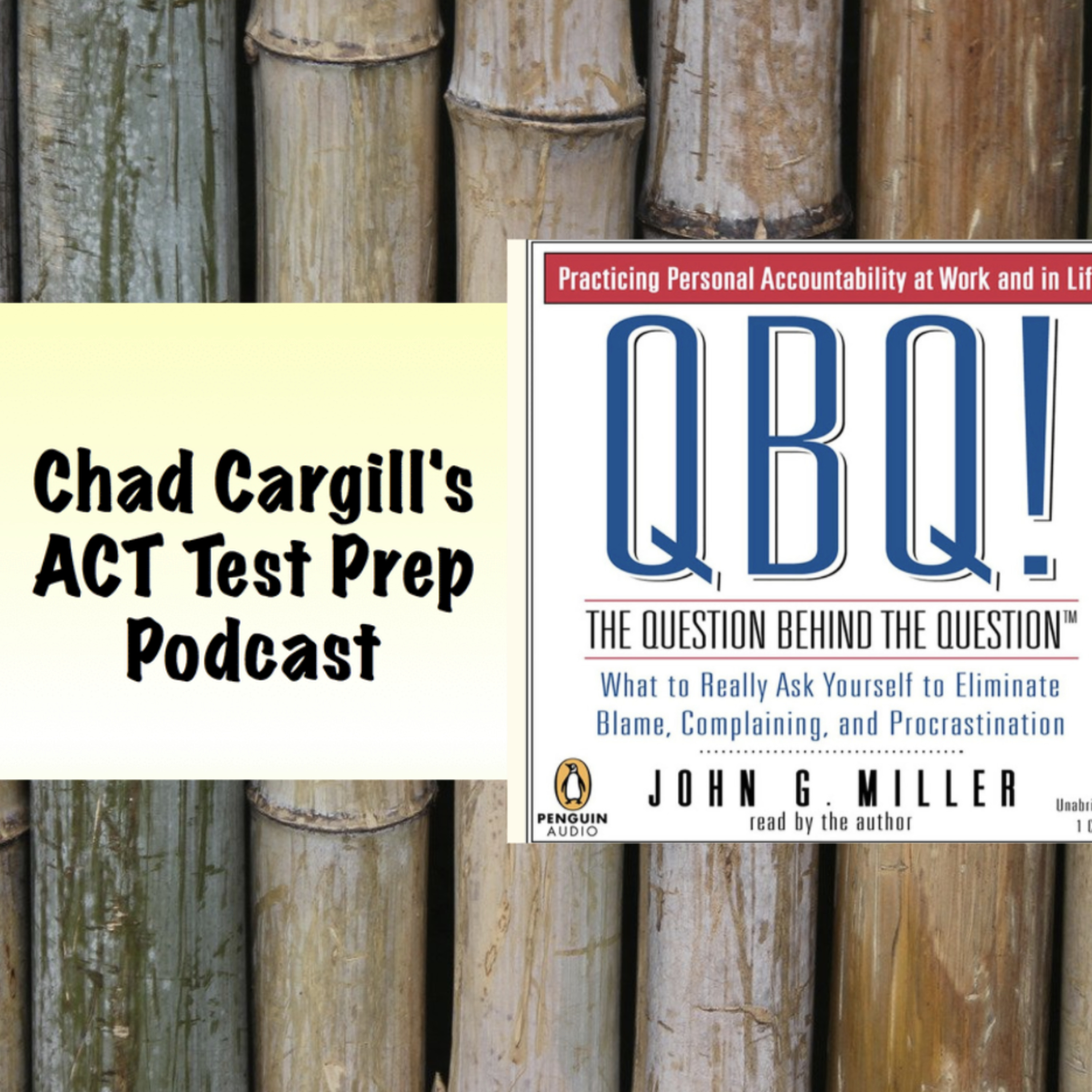 46: QBQ! My #1 Recommended Book with John Miller | What makes a question an IQ or a QBQ? In today's episode you'll meet John Miller who is the author of the most impactful book I've read other than the Bible itself. But be warned, this episode may change your life. QBQ! changed mine. Special Guest: John Miller. | — | ||||||
| 1/14/21 | 45: A Look Ahead to 2021 | As we start the new year, we reflect on the challenges of 2020 and turn our focus to a new beginning in 2021. | — | ||||||
| 12/10/20 | Episode 44: How to Determine if You’re a First Instinct Test-Taker | Are you a first instinct test-taker? Sometimes you're told, "Go with your gut" or "Pick whatever you initially thought was best." Is this true? If so, is it true for everyone? In this episode we dive into the strategy of first instinct test-taking. We'll identify what it is, examine why you would do it, and discuss how you can determine if you should use it. Articles referenced in the episode: https://www.edweek.org/teaching-learning/going-with-first-instinct-not-always-best-test-strategy-research-finds/2013/06 https://www.psychologytoday.com/us/articles/200505/the-first-instinct-fallacy | — | ||||||
| 12/3/20 | Episode 43: How To Do Scholarship Projects That Leave a Legacy with Drew Files | Drew Files was a great high school softball player at Moore High School in Moore, OK. While in high school, she wanted to use her talent as a way to inspire and help others. She decided to organize a softball game at her high school to raise money for a great cause. This softball game is now an annual event at the high school, making a huge difference for some amazing kids. Drew's legacy lives on through this game. In this episode, Drew shares her story and challenges students to make a difference as she did.Special Guest: Drew Files. | — | ||||||
| 11/26/20 | Episode 42: Thanksgiving: Why I'm Thankful for School with Creed and Clarity Cargill | Clarity and Creed spent the first several years of their lives in an extremely impoverished area of the world. Their original home is Kinshasa which is the capital of the Democratic Republic of Congo. After almost 5 years in the United States, they have a much different perspective of school than most who have always lived here in the United States. In this episode, Creed and Clarity share why they are thankful for their school and the United States. | — | ||||||
| 11/19/20 | Episode 41: ACT Writing - When You Should Take It and How To Get a Great Score | Students wonder if they should take the ACT writing test. And if so, how should the essay be written to get a great score. In this episode, we break down the ACT writing test and look at the strategies needed to maximize your score. | — | ||||||
| 11/12/20 | Episode 40: How To Correctly Use Who and Whom | In high school, choosing between who and whom was very difficult for me. But once I learned a simple trick, this became one of the easiest things in the English language. In this episode, we dive back into the English section of the ACT and learn when to pick who and when to choose whom. Louis Zamporini is a man _ I respect. It was King Henry VIII _ had six wives. I talked with Teresa _ was trying to paint the walls of her new living room. There is the new student _ you were asking about. For _ did Molly vote? _ will give the graduation speech on Friday evening? Our new neighbor, _ we met yesterday morning, works at Conoco. With _ are you rooming with for your freshman year at college? whom 2. who 3. who 4. whom 5. whom 6. Who 7. whom 8. whom He gave it to John and me/I. John and me/I went to the game. Between you and me/I, let's keep that a secret. | — | ||||||
| 11/5/20 | Episode 39: Interested in an Engineering Degree? Types of Engineering Explained | Many students say they want to be an engineer, but what kind of engineer is the question. In this episode, I explain the main types of engineering degrees and the general purpose of each type. Types of Engineering Degrees Offered at Oklahoma State Aerospace What is aerospace engineering? Aerospace engineering is the study of the science and technology of flight, and the design of air, land and sea vehicles for transportation and exploration. Biosystems What is biosystems engineering? The study of biosystems engineering merges engineering and agricultural science to improve our quality of life while maintaining the environment and preserving our natural resources. Chemical What is chemical engineering? Chemical engineering is a discipline focused on conceiving and designing processes to produce, transform and transport materials — beginning with experimentation in the laboratory followed by implementation of the technology. Civil What is civil engineering? Civil Engineering is one of the oldest engineering disciplines with the focus on the built environment that encompasses much of what defines modern civilization: buildings, bridges, roads, etc. Computer What is computer engineering? Computer engineering encompasses a broad range of technologies that utilize digital devices for the benefit of society. Subdisciplines include digital electronics, VLSI chips, embedded controllers, networking, software development, memory and storage devices, cloud computing, internet-of-things, computer security, application-specific IC's, graphics processing units, and computer architecture. Electrical What is electrical engineering? Electrical Engineering encompasses a broad range of technologies that utilize electricity for the benefit of society. Subdisciplines include energy systems, machines, power electronics, analog electronics, instrumentation, sensors, signal processing, machine vision, communications, robotics, wireless devices, radar, photonics, biomedical devices, and artificial intelligence. Industrial What is industrial engineering? Industrial Engineering and Management (IEM) is an engineering discipline that focuses on designing, operating, managing, and continuously improving manufacturing and service systems so that they are effective and efficient. Mechanical What is mechanical engineering? Mechanical Engineering is focused on a learning and research environment to instruct and encourage our students to reach their full potential in technical expertise, innovative expression and collaborative design. US News and World Report Mechanical Engineer 32 in 100 Best Jobs Someone with a mechanical engineering degree has many job options for his or her career path. The skills of a mechanical engineer are needed in many industries and on many types of projects, from vehicle manufacturing to nanotechnology. Mechanical engineers are involved in the production of mechanical instruments and tools from start to finish, and their work includes aspects of design, development and testing. PROJECTED JOBS 12,800 MEDIAN SALARY $87,370 EDUCATION NEEDED Bachelor's Civil Engineer 33 in 100 Best Jobs From the street in front of your home to the Golden Gate Bridge, civil engineers are responsible for the design and maintenance of public works and facilities. Civil engineers are involved from start to finish in the process of constructing buildings, bridges and roads. PROJECTED JOBS 20,500 MEDIAN SALARY $86,640 EDUCATION NEEDED Bachelor's | — | ||||||
| 10/29/20 | Episode 38: Best in Class: What Some Schools Do That All Schools Should Do | When I worked as an engineer at Lucent Technologies, we used benchmarking to study other companies, processes, and systems. Certain practices would be identified as "Best in Class." Some high schools have features, processes, and cultures that fit the "Best in Class" standard. In this episode, we discuss a few of these and why I call these "Best in Class." | — | ||||||
| 10/22/20 | Episode 37: Your Test Day Checklist - What You Must Bring to the ACT | Are you making sure you have everything you need for the morning of the ACT? This episode provides a checklist to make sure you are ready to walk out the door with everything you need to take the ACT. | — | ||||||
| 10/15/20 | Episode 36: Does Eating Certain Foods Help Raise ACT Scores? | Does what you eat the morning of the ACT help you raise your score? If so, what should those foods be? | — | ||||||
Showing 25 of 57
Sponsor Intelligence
Sign in to see which brands sponsor this podcast, their ad offers, and promo codes.
Chart Positions
1 placement across 1 market.
Chart Positions
1 placement across 1 market.