

Insights from recent episode analysis
Audience Interest
Podcast Focus
Publishing Consistency
Platform Reach
Insights are generated by CastFox AI using publicly available data, episode content, and proprietary models.
Total monthly reach
Estimated from 6 chart positions in 6 markets.
By chart position
- 🇨🇦CA · Technology#2005K to 30K
- 🇸🇪SE · Technology#9710K to 30K
- 🇮🇪IE · Technology#105500 to 3K
- 🇲🇾MY · Technology#136500 to 3K
- 🇳🇿NZ · Technology#141500 to 3K
- Per-Episode Audience
Est. listeners per new episode within ~30 days
8.5K to 36K🎙 ~2x weekly·26 episodes·Last published 1w ago - Monthly Reach
Unique listeners across all episodes (30 days)
17K to 72K🇨🇦42%🇸🇪42%🇮🇪4%+3 more - Active Followers
Loyal subscribers who consistently listen
6.8K to 29K
Market Insights
Platform Distribution
Reach across major podcast platforms, updated hourly
Total Followers
—
Total Plays
—
Total Reviews
—
* Data sourced directly from platform APIs and aggregated hourly across all major podcast directories.
On the show
Recent episodes
Episode 26: Z.ai interview
May 12, 2026
1h 00m 22s
CrossOver Episode with Kyle Chan
Apr 28, 2026
1h 11m 07s
Episode 25: Embodied AI ecosystem
Apr 22, 2026
56m 12s
Episode 24: Iran conflict's affect on global supply chain
Apr 10, 2026
53m 52s
Episode 23: Initial look at Iran conflict
Mar 20, 2026
1h 16m 30s
Social Links & Contact
Official channels & resources
Official Website
Login
RSS Feed
Login
| Date | Episode | Description | Length | ||||||
|---|---|---|---|---|---|---|---|---|---|
| 5/12/26 |  Episode 26: Z.ai interview | This week, I had the chance to interview Lou from Z.ai. It was really a great conversation to talk to her about the work that they are doing there and how they look at developing newer models and her view toward AGI.I get the feeling of just incredible hard work that Zhipu is going through as part of their effort to produce the best models and products out there. You can see that with GLM-5.1, which I can attest to as being very good for programming. It can do a lot of thinking of solve problems. I get the sense that GLM models are now able to do some form of RSI (Recursive Self Improvement) where the models help improve or create new more powerful models.One thing that stand out to me about GLM models is their size. They are in the 750B param range which can still fit as Quantized models and run locally on boxes with really large VRAM. However, they are also large enough that they are competitive with larger models. I think there are probably some sacrifices that you have to make in a 750B param model vs 1.6T or 3T param models.It will be very interesting to see where Z.ai goes from here since they have now received a lot of funding since IPO which gives them a larger war chest to do the work that they need to do. This is a public episode. If you would like to discuss this with other subscribers or get access to bonus episodes, visit tphuang.substack.com | 1h 00m 22s | ||||||
| 4/28/26 |  CrossOver Episode with Kyle Chan | This week, I had the pleasure of doing a crossover episode with Kyle Chan who X profile can be found here. We discussed a wide range of topic related to all aspect of AI. We really had a fun time discussing the full scope of China’s supply chain vs other countries. If we look at things holistically, China is definitely building the same supply chain advantage in AI as it has in other industries.I would recommend everyone to read and listen to Kyle’s substack. I’m sure I will be doing more stuff with Kyle in the future. There are a lot of interesting topics and trend that we are both seeing. AI is just the start and we can probably discuss EVs, renewables, batteries and other industries and supply chains in the future. You can see Kyle’s podcast of this episode here. This is a public episode. If you would like to discuss this with other subscribers or get access to bonus episodes, visit tphuang.substack.com | 1h 11m 07s | ||||||
| 4/22/26 |  Episode 25: Embodied AI ecosystem | This week, I welcomed back Qian Yu on the show to talk about China’s AI (especially embodied AI) ecosystem.If you would like to know how Chinese entrepreneurs can start new AI robotics/embodied AI product, this would be a good episode to listen to. We also talked about World Model vs VLA, educational institutions involved in AI industry and some of the projects that we have seen recently like the Honor and Xiaomi humanoid robots.I talked about the difference between reinforcement learning in world model vs LLMs. How can you have recursive self improvement in real world models?And finally, we also talked about the recent Sugon rack innovation. How Chinese players leveraged domestic supply chain to create a high voltage rack that allows superior cooling to existing solutions. This is a public episode. If you would like to discuss this with other subscribers or get access to bonus episodes, visit tphuang.substack.com | 56m 12s | ||||||
| 4/10/26 |  Episode 24: Iran conflict's affect on global supply chain | This week, I welcomed back Dan Collins to talk about something that has come to the forefront since the start of the Iran conflict. We are really in a historically unprecedented disruption when it comes to supply chain and energy. What does it mean when this many “molecule” or “atom” get taken off the global market. What will that do to global prices of everything and shortages of things like food? That will cause huge disruptions everywhere. Near the end, Dan and I spent sometime just talking about where the Iran conflict is going at the moment. Always great to discuss something in traditional engineering and hard sciences with someone that have experience in this area like Dan. This is a public episode. If you would like to discuss this with other subscribers or get access to bonus episodes, visit tphuang.substack.com | 53m 52s | ||||||
| 3/20/26 |  Episode 23: Initial look at Iran conflict | This week, I welcomed back my friend Snek onto the show to talk about what we are seeing so far in the Iran conflict.We tried to look at it from the view of how the conflict started, how it’s progressing and where it is going. We covered what Iran is likely getting from Russia & China in the form of intelligence and supply chain. We looked at the possible land invasion plans that’s been rumored.Since Snek is very familiar with both this conflict and the Russia/Ukraine conflict, we also talked about the parallels and similarities we saw in the two conflict. Finally, we went into the geopolitics a little bit based on what we think will play out in the region. This is a public episode. If you would like to discuss this with other subscribers or get access to bonus episodes, visit tphuang.substack.com | 1h 16m 30s | ||||||
| 3/10/26 |  Episode 22: Collaboration with China Research Collective - Embodied AI discussion | I have joined a project called the China Research Collective to look into providing English language translations of how China thinks about different topics of modern economy. This week, I invited Qian Yu on the show to discuss it and to talk about the first topic we are looking at together: Embodied AI.It is very good to have him on the show, because he is in Tsinghua University right now and have access to many of the people involved in China’s LLM and embodied AI industry. Of course, I have my own experience with China’s embodied AI industry which I’ve talked about before. So, I think this is a good thing to explore as I discussed Galbot investment, Xiaomi’s usage of robots in its factories, the entire supply chain, D-Robotics AI chips and services like Tuya (which help customers find suitable model, hardware module & ODM). It is amazing to have access to this supply chain, which allows prototyping in just 4-6 weeks. That’s something not possible if you are working on these projects in America. This is a public episode. If you would like to discuss this with other subscribers or get access to bonus episodes, visit tphuang.substack.com | 55m 53s | ||||||
| 3/1/26 |  Episode 21 | This week, I invited my discord friend “Sagar” on the show to talk about his experience in moving back to China from his finance sector job in America. It is always interesting to broach this topic, because many of us who grew up in the West now see living standard higher in major cities in China than where we live.I thought it was important for someone who made the move to give everyone an idea of the experience of moving to a tier 1 city like Shanghai and settling down with your friend + looking for a job afterward.Since we both work in finance, we had a discussion also about Shanghai’s finance sector and what it needs to do to create more service sector jobs to accommodate all the young college grads coming into the work force.I apologize for audio this week. Due to the fact that Sagar had issue connecting to my usual recording site (vpn problems), the quality of recording was worse than usual. This is a public episode. If you would like to discuss this with other subscribers or get access to bonus episodes, visit tphuang.substack.com | 1h 13m 52s | ||||||
| 2/14/26 |  Special Episode on Type 09V | This is an emergency episode of my podcast and I invited Bora back to the show to talk about Type 09V submarine.In my mind, this is possibly the most consequential PLA program of the next decade. Well, this program and the Type 09VI submarine that will likely come along also. This submarine by itself will change the balance of naval warfare globally once it enters service in large quantity in the early 2030s.Think of a modern Chinese version of Seawolf. That’s what Type 09V is.And Type 09VI will also be quite the strategic and geopolitical gamechanger because it will be the first non Western SSBN that can get close to CONUS without being tailed. That was never the case for Russian/Soviet SSBNs.There will be more analysis of Type 09V by myself and others in the future, but I hope this is a good first technical overview online. This is a public episode. If you would like to discuss this with other subscribers or get access to bonus episodes, visit tphuang.substack.com | 39m 54s | ||||||
| 2/6/26 |  Episode 20: Discussion with Glenn Luk on China's investment priorities over past 30 years | I welcomed back Glenn to talk about something that he knows far better than me. How has China prioritized investment in different industries over the reform period since opening up.China started off by getting investment and investing its own money in export factories to get wealthy through exporting to global market. After the great financial crisis hit, China shifted toward growing its economy and invest in economy through more emphasis on the real estate and infrastructure. This had actually started after liberalization of housing ownership in the late 90s but was really accelerated with many shovel ready projects in second half of 2000s. Eventually, this was shifted to new productive high tech industries as Chinese businesses continue to get more competitive in the global market. Every phase of development made a lot of sense given where China was in terms of development, economic size and demographics.As we head toward the 15th Five Year Plan, we should see continued focus on investment in areas like grid toward more clean energy (State Grid is investing 4B RMB over this period) as it seeks more energy and technological independence. This is a public episode. If you would like to discuss this with other subscribers or get access to bonus episodes, visit tphuang.substack.com | 1h 36m 55s | ||||||
| 1/23/26 |  Episode 19: Discussion with Bora at start of 2026 | This week, I welcomed back my friend Bora to talk about where things are at currently. The hot topic of this week is Trump’s capture of Maduro and his operation in Venezuela. We discussed about Greenland also and MAGA’s desire to take it. We also talked about Iran and the Russia/Ukraine conflict.There is a lot of stuff going on geopolitically. But since this is a China based podcast, we also talked about interesting platforms we saw for the PLA in 2025 and what we are looking forward to in 2026. This is a public episode. If you would like to discuss this with other subscribers or get access to bonus episodes, visit tphuang.substack.com | 1h 00m 06s | ||||||
Want analysis for the episodes below?Free for Pro Submit a request, we'll have your selected episodes analyzed within an hour. Free, at no cost to you, for Pro users. | |||||||||
| 1/10/26 |  Episode 18: Open Source AI with Tiezhen Wang | This week, I’m really excited to welcome Tiezhen/Tom Wang from Huggingface on my show. You can find him here on X.We talked about his background working at Google before he joined HF. Although, we did not get a chance to go really deep into running AI on robotics, but we did discuss the constraints facing AI on edge devices. Basically, 7B parameter model is close to the largest models we can reasonable run on a phone and small board type of device due to memory constraint. Although, Tom has been raving about OpenGLM’s open sourced 9B parameter AI agent that can reach your phone GUI and handle tasks.We then talked about what you can do to fine tune models. For those out there that are interested, I would definitely recommend trying it with one of the 3B to 8B parameter Qwen models and use your own data. You can also try quantizing it (which may require data set depending on which NPU you are running off).Open sourcing is very exciting and collaborative for many AI researchers. That’s why they are working so hard on it. I get that. And you can see with the number of projects and check ins on AI projects, many of them are just done by Chinese researchers. Chinese devs are not only rolling out open source models, but also involved in help building all the tools used in AI work.Toward the end, we spoke more about the economics involved in AI right now. Why certain AI labs are racing to IPO. This is a public episode. If you would like to discuss this with other subscribers or get access to bonus episodes, visit tphuang.substack.com | 1h 07m 41s | ||||||
| 12/24/25 |  Special Christmas Episode | As we hit the Christmas season of 2025, I have a special episode out to first talk about the 6 future industries that China said it will be focusing on over the 15th Five Year Plan period.The industries are Quantum Computing, Bio-Manufacturing, Hydrogen & Nuclear Fusion, Brain Computer Interconnect (BCI), Embodied AI and 6G Telecom. Embodied AI is something I really care about and talked about quite a bit on this episode. Especially as it relates to EV and smart phones. Hydrogen and Embodied AI will have huge 2026 in China. Keep an eye on the number of consumer embodied AI products like toys, little gadgets and companions that will come online next year.I also talked a little bit about H200 and the EUV news. I’m not too worked up by either news. I think H200 purchase will have a positive effect for the small AI labs like DeepSeek, Zhipu, Moonshot and Minimax. But the biggest players in China’s AI world are still ByteDance and Alibaba. ByteDance made a very strong move recently with Doubao Phone. They are only going to push further ahead here next year with more OEM partners. Xiaomi and Huawei are likely going to use their own LLMs. Xiaomi’s recently released model was really good. I’m generally not too surprised by EUV news. I think it shows that there are so many people know about the projects that even Reuters found out about it. Getting this into risk production and HVM will require them to fine tune the entire process and get all the little details right. We will see how long that will take. I would think 2028 would be on the later side. This is a public episode. If you would like to discuss this with other subscribers or get access to bonus episodes, visit tphuang.substack.com | 48m 36s | ||||||
| 12/17/25 |  Episode 17: Dan Collins and his experience in China | This week, I welcomed my friend Dan on the show. You can find him on x https://x.com/DanCollins2011. He worked extensively in China’s auto industry and actually lived in Shanghai area until a few years again. I welcomed him on my show to talk about his experience in China and now in America with the semiconductor industry.Just like episode 16, I feel the conversation about traditional engineering and hard sciences is really important. Mechanical and chemical engineering on traditional pillars of industrialization. Too much focus has been on China’s new tech sector and not enough time has been looking at China’s advancement in traditional engineering sector (outside of the EV sales).We also talked about the China and US relationship. I welcome his optimistic outlook of the relationship. This is a public episode. If you would like to discuss this with other subscribers or get access to bonus episodes, visit tphuang.substack.com | 1h 07m 09s | ||||||
| 12/4/25 |  Episode 16: China's progress in traditional engineering | This week, I asked my friend Mr. W to come on the show to talk about China’s progress in traditional industry like chemical and mechanical industry. We also spent a lot of time talking about China’s changes in engineering code and how that has catapulted the quality of their product since 2014.The traditional engineering and hard science industries have much longer development time cycle than more “sexy” new industries like software and AI. It takes long period of R&D (just incredible amount of test and trials) to develop the right procedures, material science and building standard. The West has decades of R&D head start vs China in these areas. So even though people that work in these industries in North America are generally older (without a lot of young blood), they are still ahead in many areas. China will have to do the grind to catch up across the board. Although, it has already caught up in many areas. We talked about how the enforcement of engineering code has significantly moved China up the value chain. The only way China can get past the news stories of “lead painted toys” and “cheap Chinese crap” is through consistently improving quality.But the interesting part is just how losing the older generation of traditional engineering talents will have on US industrial competitiveness in the future. You can see this video here where an American tried to make a BBQ brush with all American components only to find it impossible to find machinists to do many of the simple tools needed for the brush. If a “simple” expertise like making basic components on BBQ brush can go away so completely over time, it would be catastrophic to lose machinists from Boeing & chemical engineers from Dow Industry over the next decade or two. After we recorded the podcast, news came out that China had developed 17m super long super high pressure steel pipe after 13 years of R&D. This can used to transport high-temperature, high pressure, flammable/explosive oil, gas and chemicals. The manufacturing of 10m+ pipes in this segment had long been monopolized by foreign countries, so huge step by Norinco to develop this.And finally, we discussed how the advanced economies will hate China for taking away the fat margins that they get in these traditional higher value added industries. This is a public episode. If you would like to discuss this with other subscribers or get access to bonus episodes, visit tphuang.substack.com | 1h 13m 23s | ||||||
| 11/20/25 |  Episode 15: Rick Joe on Fujian Carrier and 9/3 parade | This week, I invited Rick Joe onto my podcast to talk about the commissioning of the CV-18 Fujian carrier. Rick talked about the previous carriers and the steps that PLAN took to get to its first catapult equipped super carrier. We also discussed about how PLAN is likely to use CV-18 initially. Be patient guys. It took 9 years for CV-16 to achieve FOC status after joining service in 2012. It will probably be faster for CV-18, but give it sometime to fully develop and operate all the necessary aircraft.We then talked about all the aircraft that are likely to operate off CV-18. KJ-600 may be the most interesting and important one.After that, we moved onto our next topic of 9/3 parade and the general PLA development in the past year. The drone discoveries are very interesting and so are all the missiles. Rick offered his thoughts on those platforms also. This is a public episode. If you would like to discuss this with other subscribers or get access to bonus episodes, visit tphuang.substack.com | 1h 00m 23s | ||||||
| 11/5/25 |  Episode 14: China's Rare earth move and tech breakthroughs | This week, I decided to summarize the thread I have worked on for a while now since the announcement of China’s Rare earth export controls. I spent the first portion of the episode talking about why they did and why it’s effective. I spent the rest of the episode going through the thread I have on twitter/x to talk about the tech breakthroughs that they’ve had in the past year that allowed them to impose these sanctions from a position of strength.This past month showed that among high tech/modern economies of this world, power comes from technology/scientific prowess. If you can wreck other countries’ economy through tech control, then your threats have bite. They are taken seriously. It gives you geopolitical power. But in order to impose your export control on others, you also need to have backup plans in the event that retaliations happen. China has made a lot of progress in the high tech sector in the past year that gave them extra leverage. And that would include the all important AI sector where Huawei actually created something really great. They are the only player out there that controls the full supply chain for AI. They have invested in many of the supply chain players to ensure that they cannot be cut off in the event of something big. As such, all the other breakthroughs do support AI. However, they also support other modern industries, because a lot of the supply chain is used across many industries. This is a public episode. If you would like to discuss this with other subscribers or get access to bonus episodes, visit tphuang.substack.com | 1h 17m 38s | ||||||
| 10/17/25 |  Episode 13: Angelica Oung on Nuclear Energy and Cross Straits Relationship | This week, I invited Angelica Oung on the show to talk about one of my favorite topics: Nuclear Energy. She is able to give us a very detailed explanation of the nuclear power situation in Taiwan as well as grid situation as a whole. I’m super glad to hear the anti-nuclear stance of the DPP, since I had no idea of its history with that.Also, I was really glad to talk to her about the craziness around American VC money going into SMRs and the progress around thorium molten salt reactors in China as well as fusion reactor.We finished up with the evolution in our view toward mainland and on her recent trip to mainland China. You can see Angelica’s most recent substack here on her interview with François Moran as well as her other hot takes on all things Taiwan and China. This is a public episode. If you would like to discuss this with other subscribers or get access to bonus episodes, visit tphuang.substack.com | 1h 26m 56s | ||||||
| 10/8/25 |  Episode 12: China's recent move in Gold Market | This week, I welcomed Eric Yeung (@KingKong9888) to talk about what’s been happening recently going on with China and gold. I asked Eric to discuss what is currently happening on the Shanghai Gold Exchange and Shanghai Future Exchange with respect to Gold Vault.What does it mean for SGEi to be opening up vaults around the world? What does it mean for China to be talking to other countries about storing their gold reserves in SGE vault? And what does it mean for China and Russia to be building an alternative securities depository system to Euroclear and ClearStream? How does all of this play out in China’s overarching goals of creating an alternative financial system to the one that has been created by Western countries?I think Eric did a pretty good job explaining all of that here. And I recommend everyone to follow him on X or Xiaohongshu.As an update from today:China is also currently in a spat with BHP where it is refusing to buy any iron ore unless traded in RMB. This is another sign China intends to conduct energy and natural resource purchase in RMB and to use its own domestic exchanges. Even more recently, Russian oil traders are shifting to yuan payment from Indian refiner in another move that is undoubtedly going to fuel Petroyuan move. This is a public episode. If you would like to discuss this with other subscribers or get access to bonus episodes, visit tphuang.substack.com | 33m 19s | ||||||
| 10/1/25 |  Episode 11: AI competition with Alibaba and Huawei | This week, I welcomed back Glenn Luk as well talked about the recent happenings with respect to Alibaba’s Great Leap Forward in its AI ecosystem, cloud platform and the full stack solution. We talked about over how Alibaba has gotten back into the good graces of Chinese government and did all the hard work of becoming a powerhouse in AI. They are basically the only hyperscaler outside of Google who is doing its own models, AI apps, AI servers, chips and cloud solutions. AI is a central part of Alibaba’s strategy in winning the global cloud competition. It is now making great progress in rest of the world as seen by its major data center expansion strategy in 2025 and 2026.We also talked about how Huawei and Ascend have caught up in the AI chip race by coming up with whole system approach which takes advantage of Huawei’s core competency in networking and software integration with hardware. It seems to us that many people are missing the full picture when only comparing the chips rather than the full system.Please listen in as we explore global AI race and more. This is a public episode. If you would like to discuss this with other subscribers or get access to bonus episodes, visit tphuang.substack.com | 1h 11m 06s | ||||||
| 9/24/25 | 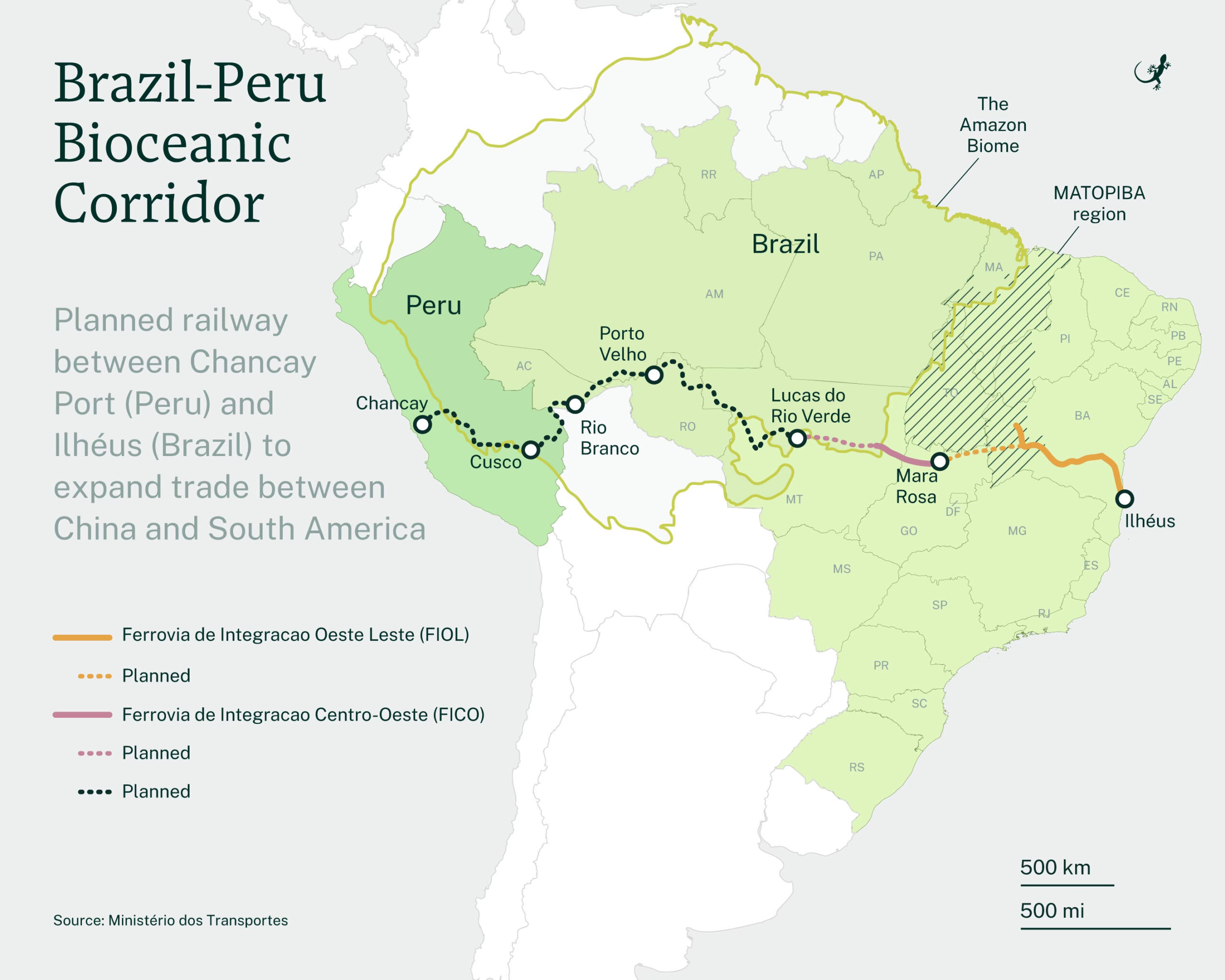 Episode 10 - A view from Brazil | On this episode, I spoke with my friend Nelson, who is a Brazilian journalist currently living in and reporting from Beijing. We talked about how China and Brazil’s relationship has grown in the past 15 years. How Brazil and America’s relationship has been declining, especially under Trump. And we talked about what are the things going forward that will likely to continue to pull the 2 countries together.Did you know that ByteDance CEO just met with Lula to build a $10B data center in Brazil or that Huawei has just restarted selling phones in Brazil? This is after Alibaba and Huawei are both investing in new data centers for their cloud in Brazil.Did you also know that China is very involved with building infrastructure in Brazil? Recently, it is in discussion with Brazil to build a Bioceanic Corridor from Peru to Brazil’s Atlantic Coast. This is a public episode. If you would like to discuss this with other subscribers or get access to bonus episodes, visit tphuang.substack.com | 1h 05m 33s | ||||||
| 9/15/25 | 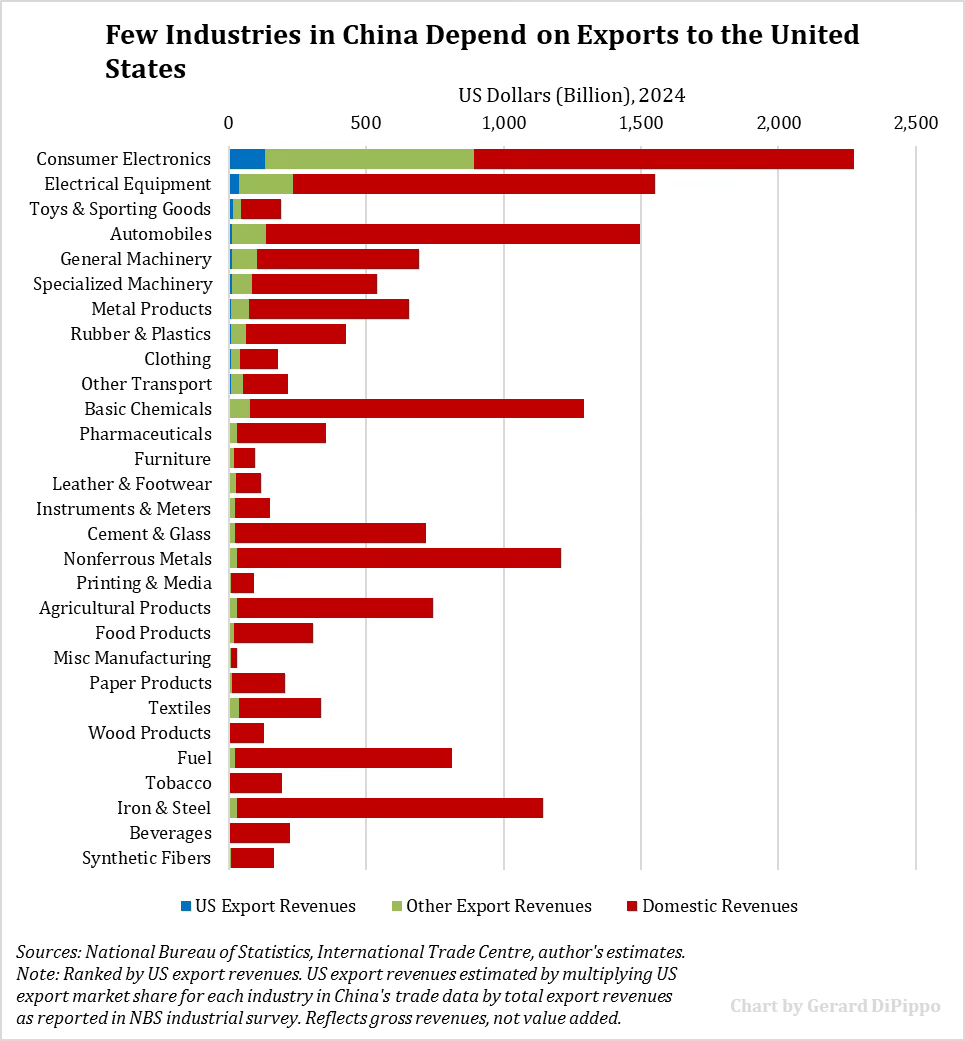 Episode 8: Han Feizi on China | This week, I’m happy to welcome Han Feizi on my show. He is a writer on Asiatimes and has very interesting and high quality view on China’s economy and its changes over time.Since I recently stayed in Beijing for 3 weeks, it was good to catch up with him just on what I saw and how it matches up with what he sees on the ground.One thing that Han really emphasizes is that China’s economy is actually a lot larger than US’s economy. In fact, it is not at all dependent on export, because China specifically does not report on activity of certain service sectors as part of economy. As such, trade war doesn’t really do much to most of China’s regions. The chart above would just show how much of China’s production for each industries is actually dependent on US export. You can see that Consumer Electronics is basically the only major one. Of course, a large part of that is just Apple exporting products made in China to America and then making a huge profit on top. This is a public episode. If you would like to discuss this with other subscribers or get access to bonus episodes, visit tphuang.substack.com | 1h 10m 34s | ||||||
| 9/5/25 | 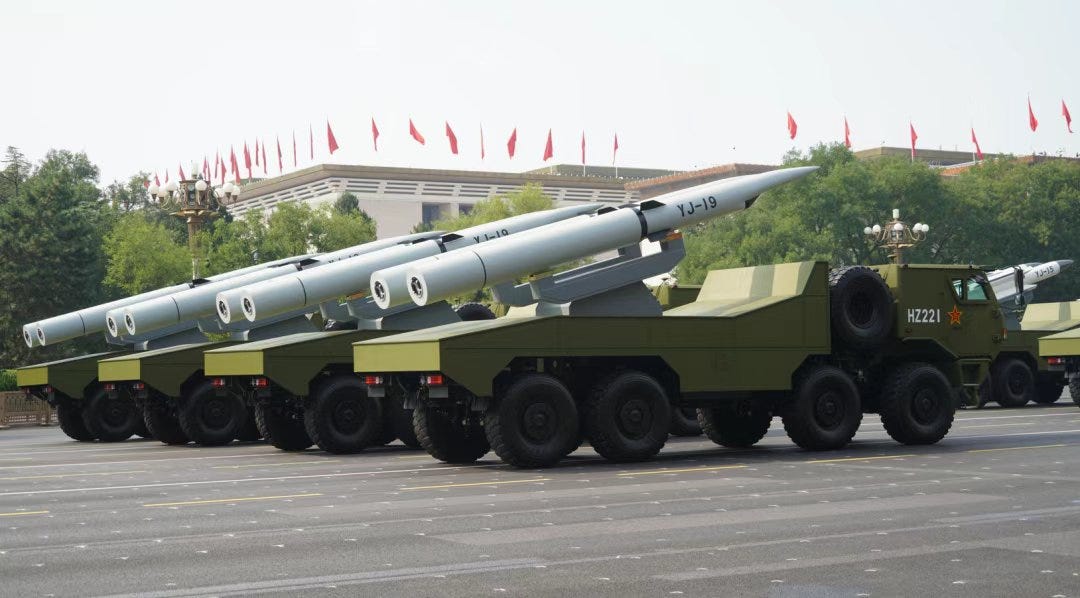 Episode 9: Initial thoughts on 9/3 Parade | In this episode, I am joined by Lei and Bora to discuss all the various interesting platforms that we saw in the recent parade. We didn’t talk about the political/geopolitical side of things since that’s really not interesting. We also didn’t talk about nukes, since that’s just a distraction.So, we really focused on which platforms on game changing and we they are important. I think we spent the most times on YJ-19 and the UUVs (AJX002 & HSU100) + Underwater implications:We also took a serious look at the various UCAVs on display, especially from just the huge # of highly capable large drones that seem to already be in Western China for tactical and conceptual development of MUMT and unmanned air warfare.And the last one we really spent a lot of time on were the laser platforms and just the huge implications as they keep getting more capable over time.Of course, I also talked about the coolness of seeing all the new EV related tech that was showcased in the Type 100 tank and FSV, but that’s not as transformational as the other stuff we saw. This is a public episode. If you would like to discuss this with other subscribers or get access to bonus episodes, visit tphuang.substack.com | 2h 06m 09s | ||||||
| 8/27/25 |  Episode 7: Thoughts from my China Trip | This episode, Lei joins me as we discuss the things that I encountered during my trip to China, where I had a lot of thoughts about the overall economic situation, the current tech scene and development socially since the last time I was there.For me, there were a lot of surprises, especially in the second and third tier cities.A common refrain I hear from parents in their 40s is the concern that their kids won’t do better than them, because of the involution culture. But in a world where developed country are facing declining lifestyles, is it reasonable for Chinese people to expect every generation to outperform the previous one? This is a public episode. If you would like to discuss this with other subscribers or get access to bonus episodes, visit tphuang.substack.com | 1h 26m 17s | ||||||
| 8/8/25 | 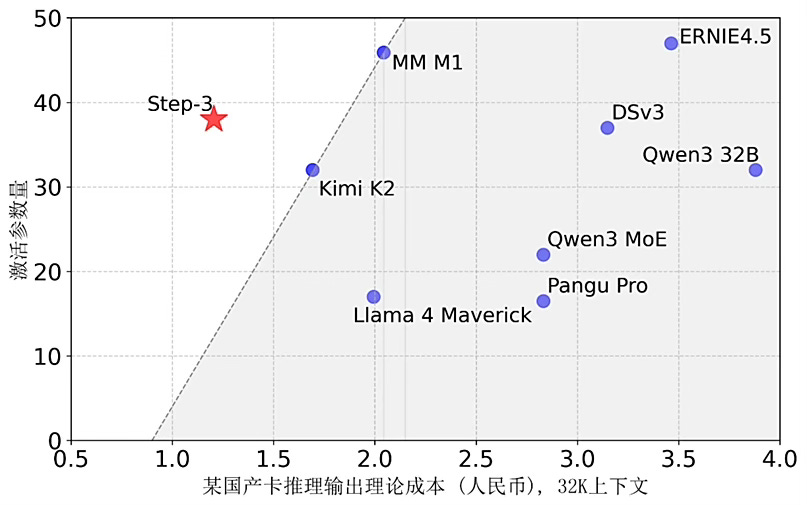 Episode 6: AI Q&A | This week, I decided to do a Q&A of AI related questions I have received on substack, Twitter, discord and forum.Open source models running on domestic AI chip. New way of measuring from Stepfun.I talked about AI robots, AI applications in industries and running AI on different type of chips.I will have more on China and AI once I get back from my China trip. The way that AI is incorporated into Chinese society since DeepSeek is something to behold. This is a public episode. If you would like to discuss this with other subscribers or get access to bonus episodes, visit tphuang.substack.com | 1h 08m 20s | ||||||
| 7/29/25 | 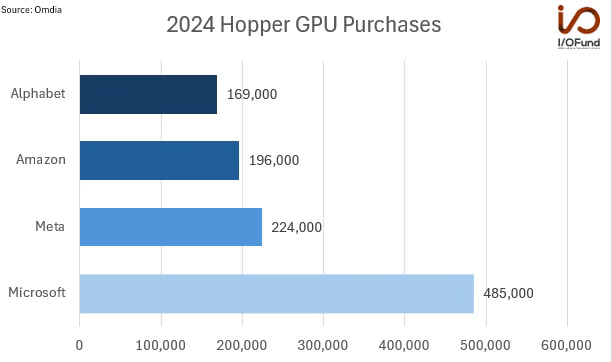 Episode 5: AI infrastructure | This week, I invited my friend Simon on the show to talk about AI infrastructure. This is a very interesting topic to think about. We talked about the reason for Nvidia’s market dominance and the problems that Intel and AMD have faced in developing their own market place. We talked about the number of chips involved and the challenges in building large data centers. Here is a chart of the Hopper deliveries for 2024. Keep in mind that Google also has their own TPU for inference.Here is a chart of Chinese Hyperscaler’s purchases of H20 in 2024. But keep in mind that they do rent compute from public/state built data centers that use smuggled in H100/H200 as well as Ascend chips.Here is the deliveries of H100/H800 in 2023. So if we just consider the Hopper deliveries from 2023 and 2024, the American hyperscalers have quite the computation advantage over Chinese hyperscalers. Although, the gap is much smaller if we factor in all the smuggled in chips. As I’ve discussed before, China had them everywhere to the point where they were sitting idle in many cases.I also asked Simon about the amount of chips needed to do inference. How was Tencent able to have enough compute for 8 million DeepSeek R1 requests at the same time with much less compute than what Google had. He sent me this chart of where the results improve logarithmically in compute for reasoning. So if you look at green line, going from 4 generations to 16 generations improved accuracy by about 15% and then going from 16 generations to 64 generations improved the result by another 5%. If we look at Google search results, they appear to be giving progressively better AI results on top. That is likely from running through and generation more tokens on their reasoning models.So you can choose to serve 8 million prompts at same time with vastly less compute, but you will also have inferior results. although you will also reach diminishing returns pretty soon.Here is a chart of rental cost from various Nvidia chips in China. Despite the increased demand for inference post DeepSeek, the cost of all Nvidia rental cost continue to drop, so they are likely not facing a crunch for computation yet. This is a public episode. If you would like to discuss this with other subscribers or get access to bonus episodes, visit tphuang.substack.com | 1h 22m 53s | ||||||
Showing 25 of 29
Sponsor Intelligence
Sign in to see which brands sponsor this podcast, their ad offers, and promo codes.
Chart Positions
6 placements across 6 markets.
Chart Positions
6 placements across 6 markets.