

Insights from recent episode analysis
Audience Interest
Podcast Focus
Publishing Consistency
Platform Reach
Insights are generated by CastFox AI using publicly available data, episode content, and proprietary models.
Most discussed topics
Brands & references
Est. Listeners
Insufficient chart data. Estimates will improve as the show charts.
- Per-Episode Audience
Est. listeners per new episode within ~30 days
N/A🎙 Weekly cadence·84 episodes·Last published 5mo ago - Monthly Reach
Unique listeners across all episodes (30 days)
N/A - Active Followers
Loyal subscribers who consistently listen
N/A
Market Insights
Platform Distribution
Reach across major podcast platforms, updated hourly
Total Followers
—
Total Plays
—
Total Reviews
—
* Data sourced directly from platform APIs and aggregated hourly across all major podcast directories.
On the show
From 10 epsHost
Recent guests
Recent episodes
The One About Business Architecture: Where Do We Go?
Jan 6, 2026
1h 04m 22s
Episode 83: The 2025 Christmas Special
Jan 2, 2026
37m 06s
The One About AI Coming for Advisory Consulting Jobs
Dec 30, 2025
32m 43s
The One About Selling Architecture Consulting
Sep 9, 2025
42m 09s
The One About Why Whynde and Chris Got Into Consulting
Mar 25, 2025
9m 04s
Social Links & Contact
Official channels & resources
Official Website
Login
RSS Feed
Login
| Date | Episode | Topics | Guests | Brands | Places | Keywords | Sponsor | Length | |
|---|---|---|---|---|---|---|---|---|---|
| 1/6/26 |  The One About Business Architecture: Where Do We Go?✨ | business architectureAI disruption+3 | — | the Twin Cities Business Architecture Forum | — | AIdisruption+3 | — | 1h 04m 22s | |
| 1/2/26 |  Episode 83: The 2025 Christmas Special✨ | consultingAI disruption+3 | — | — | — | consulting industryAI impact+3 | — | 37m 06s | |
| 12/30/25 |  The One About AI Coming for Advisory Consulting Jobs✨ | AIconsulting+3 | — | — | — | advisory consultingAI disruption+3 | — | 32m 43s | |
| 9/9/25 |  The One About Selling Architecture Consulting✨ | architecture consultingenterprise architecture+3 | — | EASwiss Army | — | selling architectureconsulting challenges+2 | — | 42m 09s | |
| 3/25/25 |  The One About Why Whynde and Chris Got Into Consulting✨ | consultingcareer journeys+2 | — | General ElectricIBM+1 | — | consulting careersmentorship+2 | — | 9m 04s | |
| 3/11/25 |  The One About Enterprise Architect Skills for the Future✨ | Enterprise ArchitectureAI+2 | Whynde Kuehn | SAPEA | Newton SquarePA | GonkulatorsFlux Capacitors+1 | — | 21m 03s | |
| 2/11/25 |  The One About Building a Career Narrative✨ | career narrativeconsulting+3 | — | — | — | career transitionjob market+3 | — | 36m 52s | |
| 12/24/24 |  The 2024 Christmas Special✨ | end-of-year reflectionconsulting learnings+3 | — | the British Computer Society | — | beginner's mindsetpersonal growth+2 | — | 1h 02m 32s | |
| 11/27/24 |  The One About Winning New Business✨ | business developmentconsulting+3 | — | RedditLinkedIn | — | consultantssales+3 | — | 51m 01s | |
| 11/13/24 |  The One About Existential Angst✨ | existential angstconsulting+4 | — | Reddit | — | management consultingcommunication challenges+2 | — | 47m 25s | |
Want analysis for the episodes below?Free for Pro Submit a request, we'll have your selected episodes analyzed within an hour. Free, at no cost to you, for Pro users. | |||||||||
| 9/18/24 |  The One About Finding and Landing Clients | Finding and landing clients can be a daunting challenge for even the most seasoned professionals. Consultants want genuine opportunities to help solve problems and make a meaningful impact. There are 6 takeaways you need to know for transforming the sales process. We Discuss: How do you ask for business without using standard sales approaches that feel phony? How do you find people to have initial conversations with about potential business? How important is emotional intelligence (EQ) in consulting sales? How do you leverage your network to find business? When is the right time to transition from relationship-building to making a sales pitch? How can consultants overcome their discomfort with selling? Key Highlights: Strategies for finding and selling to clients in consulting, emphasizing authentic relationships over aggressive sales tactics. (00:02:37) The importance of emotional intelligence (EQ) in understanding client needs and building rapport. (25:23) Offering value first, such as through thought leadership or free workshops, before trying to sell services. (21:36) Networking and leveraging existing relationships are presented as crucial for finding new business opportunities. (05:37) Partnering with others who have complementary skills, especially for consultants who may lack sales experience. (29:43) The challenge of knowing when to transition from relationship-building to making a sales pitch. (39:25) The importance of making it easy for potential clients to take the next step in engaging services is emphasized. (40:26) Consulting sales as an ethical pursuit of helping people solve problems. (41:13) 6 Takeaways: Successful consultants focus on building authentic relationships and understanding client needs rather than using aggressive sales tactics. Emotional intelligence (EQ) is crucial for consultants to effectively read situations, connect with clients, and identify potential opportunities. Offering value upfront through thought leadership, free workshops, or problem-solving sessions can help establish credibility and open doors to future business. Leveraging existing networks and partnerships, both internal and external, is essential for finding new business opportunities and complementing one's own skills. Consultants often struggle with transitioning from relationship-building to making a sales pitch, highlighting the importance of recognizing buying signals. Framing consulting sales as an ethical pursuit of helping people solve problems can help overcome discomfort with traditional selling approaches. | — | ||||||
| 9/3/24 |  The One About Asking Good Questions | In the fast-paced world of consulting, the ability to ask insightful questions can be the key differentiator between average and exceptional performance. Here are 7 things you need to know about the art and science of effective questioning to generate superior outcomes. We Discuss: How can consultants ask good questions without appearing incompetent? Is the Socratic method overused in consulting? How does asking questions differ across cultures? How can technical consultants improve their questioning skills? How can junior consultants ask questions of senior team members or clients? Key Highlights: The importance of asking good questions as a consultant, rather than just appearing as an expert (00:02:58) Building rapport and psychological safety is crucial for asking probing questions effectively (00:26:13) The Socratic method can be valuable if used with humility and genuine curiosity, not to prove someone wrong (00:30:05) Cultural differences play a role in how questions are perceived and should be asked (00:40:09) For technical consultants, developing questioning skills may require intentional effort as it doesn't always come naturally (00:44:03) Asking questions demonstrates expertise more than just stating facts, though this can be counterintuitive (00:46:16) Good questioning involves being curious, open, caring about the intent, and can be learned through practice (00:45:22) Questions are fundamental to human existence, learning, and career development (00:45:46) 7 Takeaways: Effective consultants focus on asking insightful questions rather than simply demonstrating expertise, as this approach leads to better problem-solving and client relationships. Building rapport and psychological safety is crucial before asking probing questions, especially in different cultural contexts where relationship-building may be more important initially. The Socratic method can be a powerful tool when used with genuine curiosity and humility, rather than as a means to prove someone wrong or appear superior. For technical consultants, developing strong questioning skills may require intentional effort, as it often doesn't come naturally to those with an engineering mindset. Asking thoughtful questions can actually demonstrate more expertise than simply stating facts, though this approach may feel counterintuitive at first. Good questioning involves being curious, open-minded, and caring about the intent behind the inquiry, skills that can be learned and improved through practice. Questions are fundamental to human existence, learning, and career development, serving as a powerful tool for personal and professional growth. When you have a minute, go to the YouTube Channel to see all the free content. While you're there, LIKE and SUBSCRIBE. Check out https://patreon.com/ConsultantsSayingThings and subscribe for special access to EVEN MORE content from the team. | — | ||||||
| 9/2/24 |  The One About Strategic Foresight 2035 | The consulting industry stands at the cusp of a profound transformation, driven by rapid advancements in artificial intelligence and changing business landscapes. Here are 5 things consultants need to know about adapting and thriving in the future of 2035. We Discuss: How will the role of consultants change by 2035? Is there a historical analog for the current pace of change in consulting? What should individual consultants do to prepare for these changes? Will AI completely replace human consultants? How might consulting firms change their investment strategies? Key Highlights: The discussion focuses on a Strategic Foresight Study for 2035 produced by 2b Ahead, a German research firm, examining emerging trends in consulting (00:01:10) There's increasing uncertainty and "fog" in the business world, making navigating uncertainty a key value proposition for consultants (00:06:09) AI and automation are impacting knowledge work and consulting more than previously expected, potentially displacing roles like legal and medical professionals (00:23:44) The pace of technological change and dissemination of information is accelerating, leading to faster development and adoption of new tools (00:15:02) By 2035, consulting firms may need to invest more in AI hardware rather than just hiring more consultants (00:29:29) Consultants should focus on recording their work in AI-accessible formats and developing "original thought" that AI currently can't replicate (00:31:40) To remain relevant, consultants should actively use and understand AI tools to improve their work and potentially create new business models (00:35:47) The potential impact of AI on consulting ranges from incremental improvements to transformative change if AGI (Artificial General Intelligence) is achieved (00:34:34) Embracing uncertainty and adapting to new tools is key for consultants' future success (00:40:18) 5 Takeaways: The consulting industry is facing increasing uncertainty and complexity, making the ability to navigate ambiguity a crucial skill for future consultants. Artificial intelligence and automation are impacting knowledge work more significantly than anticipated, potentially displacing traditional consulting roles and requiring consultants to adapt their skillsets. By 2035, consulting firms may need to invest more heavily in AI hardware and capabilities rather than solely focusing on hiring human consultants. To remain relevant, consultants should actively use AI tools, focus on developing "original thought" that AI can't replicate, and look for ways to make their services more accessible and scalable. The future of consulting will likely involve a symbiotic relationship between human expertise and AI capabilities, with successful consultants leveraging both to provide unique value to clients. Here is the link to the full report, Strategic Foresight 2035 by 2b Ahead. https://2bahead.com/en/zukunftsstudie-kundenkommunikation2030-1 Patreon subscribers get the full document as well as the summarized set of slides. When you have a minute, go to the YouTube Channel to see all the free content. While you're there, LIKE and SUBSCRIBE. Check out https://patreon.com/ConsultantsSayingThings and subscribe for special access to EVEN MORE content from the team. | — | ||||||
| 3/25/24 |  The One About The Buggy Whip Moment | The rise of AI in consulting is akin to the demise of the buggy whip industry in the early 20th century. Just as the automobile rendered buggy whips obsolete, AI and large language models threaten to automate many tasks traditionally performed by consultants. Here are 7 things you need to know about adapting to survive this disruption. We Discuss: What is the threat AI poses to consulting? How do consultants USE AI instead of being replaced by it? How can consultants keep an authentic voice in the face of LLMs? What is the consultant's value proposition in an AI future? What types of consulting careers are most likely to be impacted? Key Highlights: The consulting industry may be facing a "buggy whip moment" due to the rise of AI and large language models (LLMs) that can automate tasks traditionally done by consultants. (00:02:53) Consultants who don't adopt AI tools risk being replaced by those who do, similar to how those who didn't adopt typewriters were replaced by those who did. (00:06:45) AI tools can augment consultants' capabilities, allowing them to do more work at a better quality level. (00:27:36) The consulting industry may shift from providing free advisory content to protect their IP from being used to train AI models. (00:10:47) Consultants should be vigilant, view AI as an opportunity, skill up, focus on human elements, niche down, and get closer to clients to navigate the changes brought by AI. (00:33:56) Consulting work that requires human-level decision-making and capability will likely remain relevant in the short to medium term. (00:40:17) Consultants should protect their IP going forward to maintain their value and competitive edge. (00:44:01) Soft skills, emotional intelligence, and creativity will remain important for consultants as AI focuses on past data rather than innovative thinking. (00:30:32) Consultants who enjoy building machines (processes and new things) will have an advantage over those who prefer running machines (turning the crank). (00:41:10) 7 Takeaways: The consulting industry is facing a potential disruption due to the rise of AI and large language models that can automate tasks traditionally performed by consultants. Consultants who fail to adopt AI tools risk being replaced by those who do, highlighting the importance of staying current with technological advancements. AI tools can augment consultants' capabilities, enabling them to deliver higher quality work more efficiently. The consulting industry may shift away from providing free advisory content to protect their intellectual property from being used to train AI models. To navigate the changes brought by AI, consultants should be vigilant, view AI as an opportunity, develop new skills, focus on human elements, specialize in niche areas, and build stronger relationships with clients. In the short to medium term, consulting work that requires human-level decision-making and capability will likely remain relevant. Soft skills, emotional intelligence, and creativity will continue to be valuable assets for consultants, as AI focuses on analyzing past data rather than generating innovative ideas. When you have a minute, go to the YouTube Channel to see all the free content. While you're there, LIKE and SUBSCRIBE. Check out https://patreon.com/ConsultantsSayingThings and subscribe for special access to EVEN MORE content from the team. | — | ||||||
| 2/15/24 | 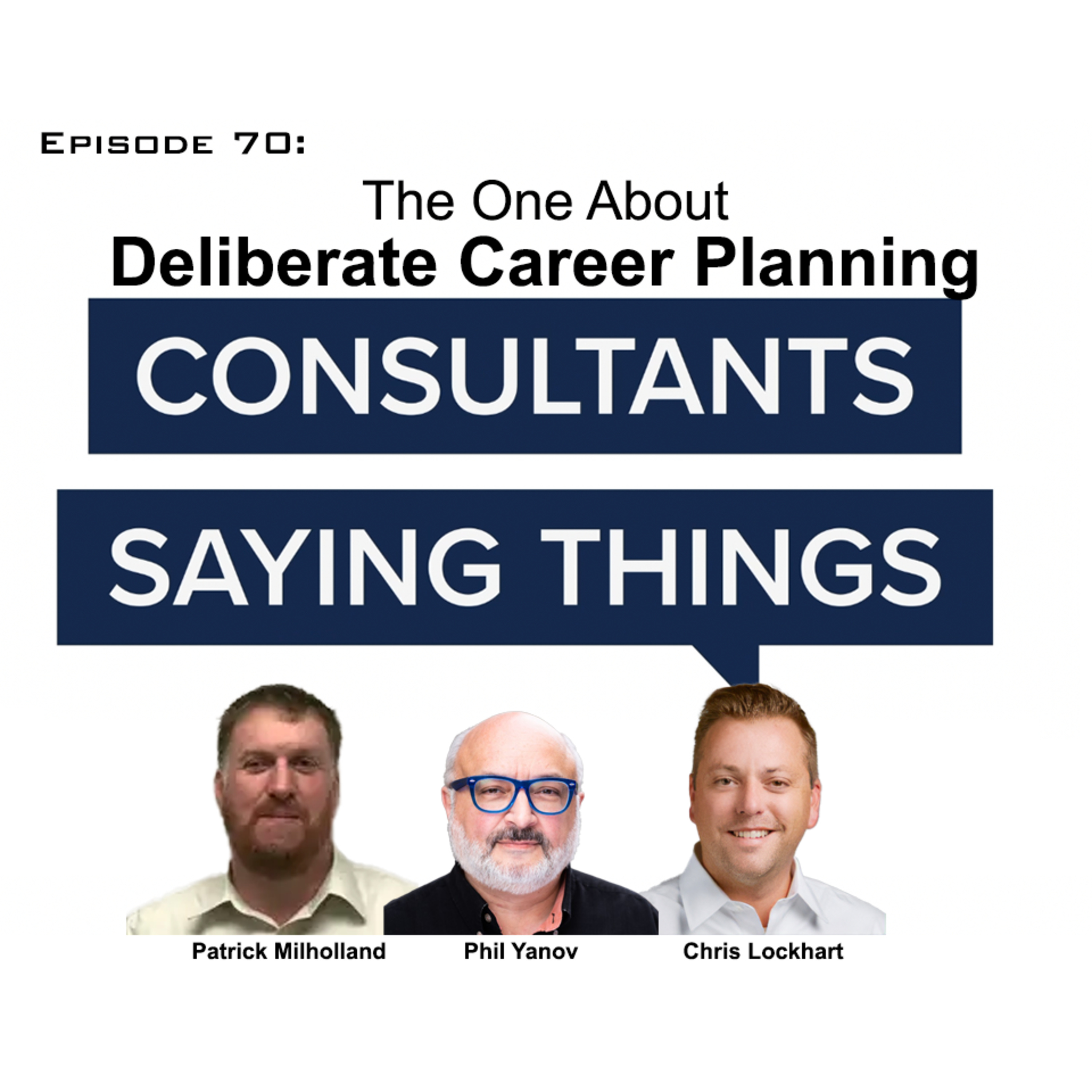 The One About Deliberate Career Planning | For ambitious consultants aiming to establish themselves as thought leaders and advance to senior decision-making roles, deliberate career planning is important. Here are 5 tips for actively managing your consulting career. We're joined by Patrick Milholland who in his career has served in every major C-Suite position but found his groove with a non-profit career, specifically his utlimate goal of a CIO career. We Discuss: Why would someone plan their career this way? How does education impact the career plan? What are some of the pros and cons to taking this approach? What were some of Patrick's hard choices in his journey? What are some of his insights gleaned from following this process during his career? Key Highlights: Patrick deliberately pursued 3 degrees with the goal of becoming a CIO (3:00-6:24). There was a clear career plan in place and calculated choices were made to achieve the goal. Working as a consultant provided great experience and exposure that enabled attaining a CIO role (12:11-14:18). The consulting skills translated directly. The consulting role was left for a CIO position at a nonprofit where purpose and satisfaction was found, beyond just financial motivators (14:18-15:45). Over time, impressive credentials and titles were accumulated that opened up additional career opportunities (32:13-34:12). The background stood out. Be deliberate about aligning career choices with defined goals and to consider personal tradeoffs like family time (40:24-41:28). Having a plan matters. Location has an impact – being in Silicon Valley expanded options vs. being in Ohio (34:05-34:24). 5 Takeaways: Education has an impact on getting noticed and gaining positions and needs to be aligned with the career strategy, sometimes by sacrificing things Working as a consultant can provide experience and exposure that enables a longer term career plan. Purpose and satisfaction beyond just financial motivators is more important than most people think when they're starting out. The accumulation of impressive credentials and titles can open up more and better career opportunities. Knowing your values, and being deliberate about aligning your career choices with those values will better enable you to reach your goals. When you have a minute, go to the YouTube Channel to see all the free content. While you're there, LIKE and SUBSCRIBE. Check out https://patreon.com/ConsultantsSayingThings and subscribe for special access to EVEN MORE content from the team. | — | ||||||
| 1/11/24 | 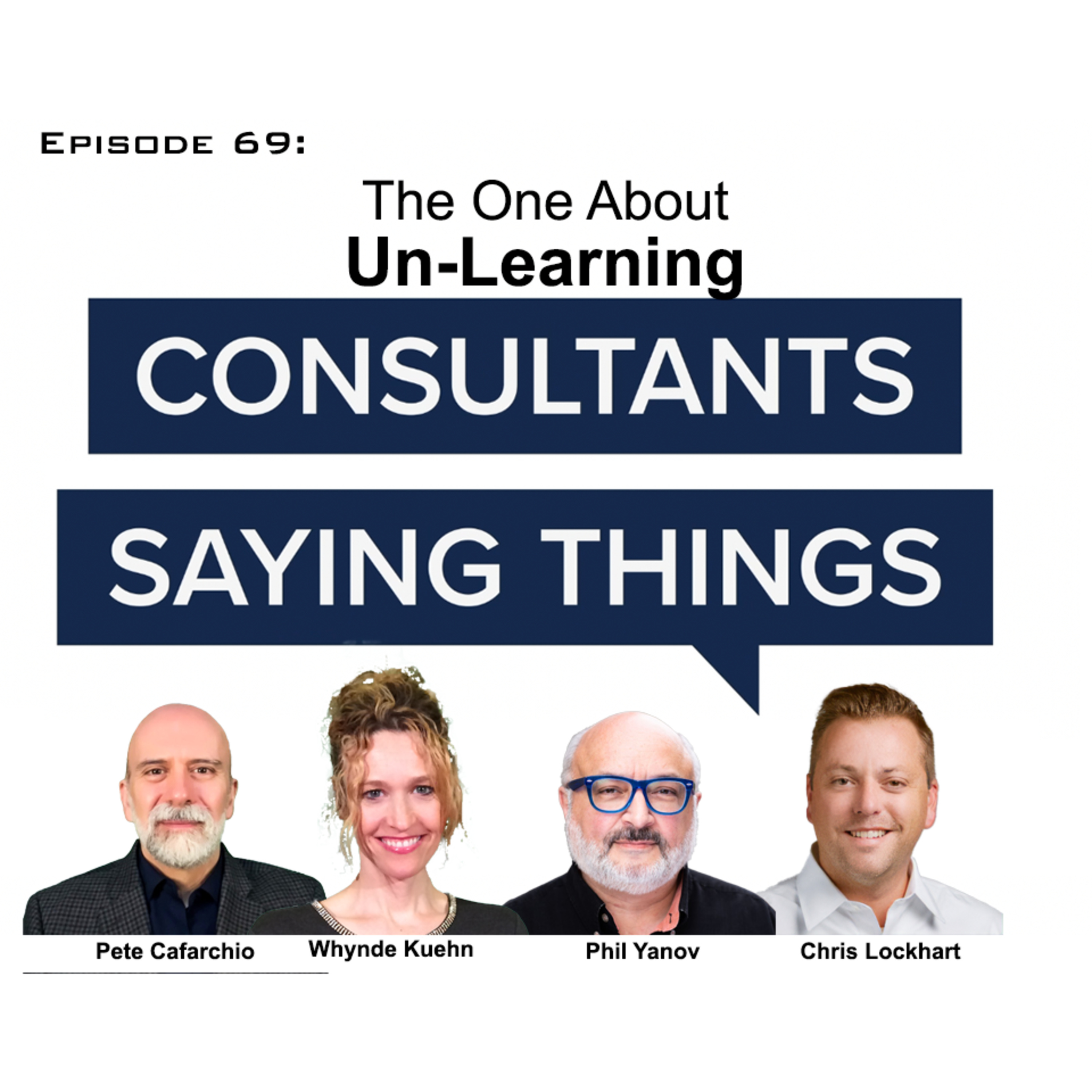 The One About Unlearning | We spend our lives gaining knowledge of the world around us. Unlearning things, making room for new knowledge or corrected or updated knowledge, is a skill we aren’t usually taught and don’t often practice. Here are 8 important things to know about Unlearning. We're joined for this discussion by Pete Cafarchio who is an executive coach that helps transform leaders, teams, and cultures. Pete is the CEO of Oculus Consulting and helps practitioners perform at their best. We Discuss: What is unlearning and why is it so important? What are the implications of unlearning for us as consultants? What are the implications for our clients? How do we effectively challenge a client’s stuck mindset? What's preventing us from applying this strategy? Key Highlights: Unlearning is challenging deeply held beliefs and assumptions to make room for new perspectives (6:36). It takes courage since consultants are paid for what they know (6:15). We tend to defend our thinking, but feeling defensive can indicate we're not fully convinced about something (24:25). Self-awareness of our emotional reactions can reveal opportunities for unlearning (25:05). Groupthink and technology like social media algorithms can reinforce entrenched thinking, making unlearning more difficult (17:58, 30:04). Practical tips for unlearning include exposing ourselves to contrary views (35:02) and asking questions that imagine project failure scenarios (36:32) or competitor advantages (37:13) to surface overlooked issues. Facilitating unlearning conversations creates value for clients by getting them to reconsider assumptions (44:23). Information is now ubiquitous; consultants add value through context, application and strategy (43:36). 8 Takeaways: Unlearning involves challenging ingrained beliefs to make room for new perspectives, which takes courage since consultants are paid for their knowledge. (6:36) Feeling defensive about an idea can signal that we are not fully convinced about it and presents an opportunity for unlearning. (24:25) Technology like social media algorithms tends to reinforce tribal thinking, making unlearning more difficult. (30:04) Intentionally exposing ourselves to contrary opinions helps to challenge our assumptions and unlearn. (35:02) Asking “what if we fail” questions imagine failure scenarios to uncover overlooked issues. (36:32) Posing “what would competitors do” questions surfaces organizational vulnerabilities. (37:13) Facilitating unlearning conversations creates value for clients by getting them to challenge assumptions. (44:23) With ubiquitous information, consultants now add value through context, application and strategy rather than just providing information. (43:36) When you have a minute, go to the YouTube Channel to see all the free content. While you're there, LIKE and SUBSCRIBE. Check out https://patreon.com/ConsultantsSayingThings and subscribe for special access to EVEN MORE content from the team. | — | ||||||
| 12/28/23 |  The 2023 Christmas Special | With focus on people, practical tips, managing uncertainty, anticipating trends, and weighing digital impacts - our annual Christmas Special is chock-full of useful and relevant stuff for consultants. We Discuss: First appearances on the podcast by each of the cast and current reflections on what each of us said back then Best-of moments from 2023 and why they are relevant Predictions for 2024 Key Highlights: Phil reflects on his comments from the first ever episode in 2018, showing how his views on the importance of understanding people and their needs is still highly relevant today. (00:05:32) Whynde observes how the need for human connection seems amplified now compared to when the podcast started, noting massive changes like work-from-home and AI. (00:13:35) The cast has had thought-provoking conversations over the years that have informed major life and career decisions, keeping the focus more on functioning as good human beings rather than just technology. (00:25:49) The episode on Using LinkedIn for Success was the most popular of the past year, indicating an interest in practical tips beyond just consulting. (00:37:30) Tom Graves advises not trying to predict the future but instead focusing on adapting in real-time. (00:48:03) Whynde hopes businesses become more thoughtful and discerning with new technologies like AI, carefully examining what it really means and the unintended consequences. (01:11:43) Shashi predicts a major skills shift as AI gets democratized, with business users outside IT getting more tech-savvy and implementing solutions themselves. (01:16:01) Phil sees cyber security threats growing as more are able to "game the system", making it harder to discern what's real vs AI-generated. (01:18:37) Chris predicts more focus on how AI is relevant and applicable to solving business problems, beyond just the "gee whiz" factor. (01:23:02) 7 Takeaways: The focus has evolved to be more on functioning as good human beings and maintaining sanity versus just discussing technology. There is strong interest beyond just the consulting audience in practical advice like effectively using LinkedIn. Adapting in real-time is advised over trying to predict the unpredictable future. Carefully examining what emerging technologies really mean for businesses, including unintended consequences, is hoped for. Major skills shifts alongside potential growth in cyber threats are predicted as AI becomes democratized. Maintaining work-life balance seems increasingly challenging amidst more remote work and turbulent times. Frameworks shared, like Chris Potts’ unifying model, can help guide decision-making amidst constant change. | — | ||||||
| 12/12/23 | 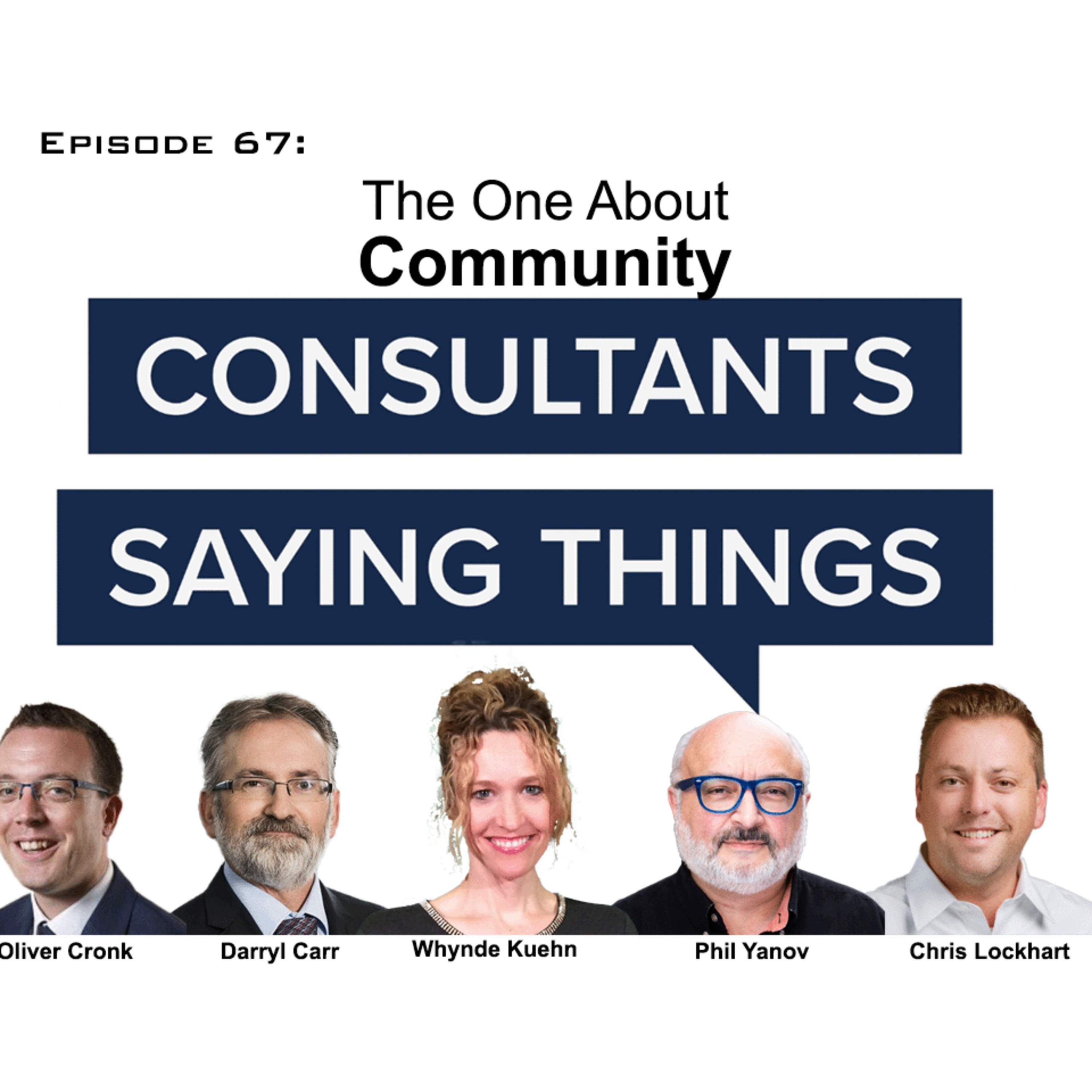 The One About Community | The digital age has offered countless opportunities for connection, but the depth and authenticity of these connections often fall short. Check out these 5 strategies for growing professional communities. We Discuss: Why do these communities matter? What problem are they solving? What are some challenges faced by consultants when seeking to build authentic, supportive networks? What are some strategies for a) finding a community to be part of; b) growing one of your own? How much does being ‘close-knit’ matter with these communities? Key Highlights: Introduction to Converge Australia 2023, a series of 32 events in 25 days across Australia bringing strategy, architecture and community professionals together (2:20-4:00) The motivation and goals in attending professional community events (23:27-25:52) How to find and get involved in a professional community (25:52-28:11) Expectations and mindset that drive people to attend events like this (30:32-31:47) Importance of quality conversations over scale (36:35-38:18) Keys to building community (40:25-42:16) 5 Takeaways: People attend these events to interact, gain new ideas, meet interesting people, and to make connections - if you're building a community you need to understand their motivations and why people come together Getting involved in a professional community starts with building relationships and networks over time in areas that you have a genuine interest Go in with a learning, exploratory mindset without set expectations and be prepared to give more than you receive and contribute value Breaking large groups of people into smaller, more intimate groups leads to better conversations and connections than one large event Understand who you want to help, what they need, how you can help - realize people are actively seeking community and connections When you have a minute, go to the YouTube Channel to see all the free content. While you're there, LIKE and SUBSCRIBE. | — | ||||||
| 11/21/23 | 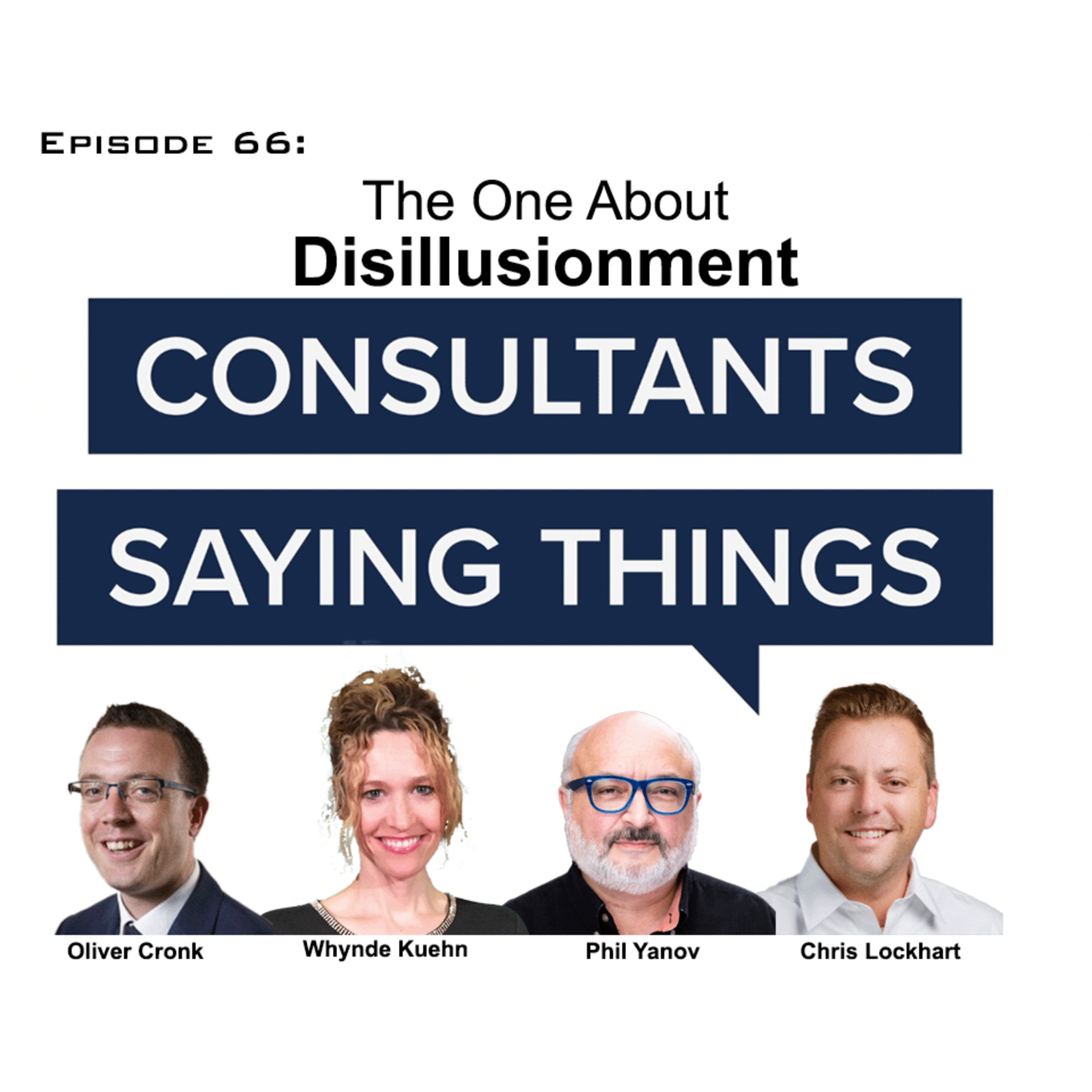 Episode 66: The One About Disillusionment | Consulting is known for long work hours, lack of work-life balance, tedious work, and sometimes lack of meaning. Here are the 5 things you should know about consulting and disillusionment. In this episode we discuss: What causes consultants to become disengaged or lose passion for their work over time? How do consulting firms try to engage and motivate their employees? Do these things work? What warning signs should consultants look out for that may indicate they are becoming disengaged? Are certain types of consulting roles or firms more prone to this than others? What should the cats on the ground do if they sense they're becoming disillusioned? Key Highlights: Disillusionment begins when reality doesn't match expectations (9:00) Misalignment with values and life priority changes can also lead to disillusionment (14:15) Warning signs include apathy, irritation, fatigue (16:10) Lack of purpose, autonomy, work-life balance, not feeling valued causes issues (23:00) Steps to address: clarify values, assess root causes, change teams/projects, change industries (27:30) 5 Takeaways: Disillusionment in consulting careers can happen when reality doesn't match expectations, values are misaligned, or life priorities change over time. Early warning signs include apathy, irritation, disconnection, fatigue. Lack of purpose, lack of autonomy, poor work-life balance, not feeling valued, and not aligning with company culture can also lead to disillusionment. Steps to address disillusionment: clarify values, assess root causes, explore options like new teams, projects, sabbatical, industry roles. Catch issues early. To retain talent, companies should provide coaching/mentors, flexibility, continual growth opportunities. Fostering feelings of value and community also helps. If leaving a company, do it gracefully - don't burn bridges. Thank them and own that it's your decision to make the change. This preserves professional reputation. When you have a minute, go to the YouTube Channel to see all the free content. While you're there, LIKE and SUBSCRIBE. | — | ||||||
| 10/10/23 |  Episode 65: The One About Corporate IT | The Corporate IT group is sometimes viewed as a black hole consuming resources and getting in the way of getting business done. Almost like some don't know what Corporate IT does... Some in the enterprise don’t really know how to engage with and leverage technology to deliver value. If it is hard for those who work FOR the company, it can be even harder to navigate corporate IT as a consultant who has landed someplace to try to address business problems. Given that corporate IT represents a set of services or capabilities that enable an organization to realize business objectives, it is pretty important for anyone seeking to effect change to understand how to engage with them. Consultants especially need to work with corporate IT in order to deliver promised value for their consulting services (and to collect their fees). Suffice it to say that “navigating the client’s IT organization” is not typically taught to consultants before they show up to solve business problems. I wanted to explore this topic with some smart friends. I hit up Chris Potts and R.M. Bastien who have both written and spoken on this topic a great deal. In this episode: What do we actually mean by corporate IT? What does it consist of and what does it usually provide to the rest of the company? Why do some IT groups have a dubious reputation for delivering value? This isn’t true everywhere… what makes the difference? Why does IT sometimes seem disconnected from the business it is enabling? For consultants on technical engagements, what are some tips for establishing rapport with the IT group? For consultants on strategy engagements, how do they engage with client IT groups? Chris Potts is a globally-recognized enterprise architect, enterprise designer and mentor who has worked in over 27 countries and helps companies, governments and individual leaders with the creative, practical, cultural and political aspects of being successful in their given contexts. He's the author of a series of books on the value of IT, architecture and how change relates to them both. R.M. Bastien has worked for over 25 years as a management coach, trainer, and architect. His mission is to help leaders understand and overcome the challenges and limitations of the current corporate IT engagement model, and to achieve higher quality and faster delivery of business goals. He is the author of an executive leadership guide to corporate IT strategy. Check out their sites and publications below: Chris Potts Online: https://lnkd.in/gn7ux8F5 FruITion Trilogy: https://lnkd.in/g35RPPiS R.M. Bastien: https://rmbastien.com/ Understanding the Corporate IT Strategy Game: https://a.co/d/75pPl6X Add your thoughts to the conversation on LinkedIn or YouTube. You can also like and subscribe on the YouTube Channel (and you should!) | — | ||||||
| 9/12/23 |  Episode 64: The One About Workshop Must-Haves | Consultants are required to have multiple sets of skills. One of those involves bringing people together in workshops to address problems or work out complex tasks. Many consultants are terrible at it... In a recent thread in Reddit's r/consulting community, a junior consultant posted that they were running their first workshop and wanted the community's input on how to effectively run this session. I thought this would make a great topic for... more seasoned (old) consultants to reflect on. I asked my friends to join me in a conversation on must-haves for running workshops. In this episode: What's the difference between a workshop, a meeting, a gathering, etc.? When should a workshop really just be a brief meeting or an email? What works best, in-person, virtual, hybrid? When should each be used? What are table stakes, absolute must-haves for any workshop? How do you get good participant engagement in a workshop? How do you ensure participants get value from a workshop? If you are a consultant and haven't already joined the r/consulting community on Reddit, you probably should. Add your thoughts to the conversation on LinkedIn or YouTube. You can also like and subscribe on the YouTube Channel (and you should!) | — | ||||||
| 8/8/23 |  Episode 63: The One About Driving Real World Outcomes | Clients don't hire consultants to learn about our unique frameworks or totally novel perspectives or listen to our thought projects on topics like AI, data strategy or new product development. They hire us to help drive outcomes. Sometimes these are outcomes that the client has already defined, other times they need some help divining what should actually result from a particular strategy or project. Naturally there is a tension between the design of something and the realization of the thing. For consultants, there is a struggle between the abstract, ambiguous, hand-waving strategic things and the super technical, hyper focused lost in the weeds things. Oftentimes we lose sight of the actual reason for working a problem with a client. We become so involved and invested with the details of HOW that we forget WHY. The outcome is what matters. Keeping focus on that is not always easy. In a recent conference hosted by IASAGlobal.org dealing with Business, Innovation, Leadership & Technology (BIL-T) and focused on driving real world outcomes, my friends and I were asked to host a live session of our podcast. With a dose of editing legerdemain and a degree of intrepidity, we managed to craft an episode from the live talk. In this episode: What are ‘good’ behaviors with regard to delivering outcomes? What should consultants be caring about? Are Client and Consultant outcomes always aligned? How do consultants balance what the client wants vs what is achievable? How do consultants know the right level of detail for the audience/client/group? Add your thoughts to the conversation on LinkedIn or YouTube. You can also like and subscribe on the YouTube Channel (and you should!) | — | ||||||
| 7/11/23 |  Episode 62: The One About Work/Life Coherence | Vacation is a great time to contemplate life, work, and life and work. The two can frequently be at odds for most people. When we can relax our brains for minute, there's an opportunity to check-in and assess whether the work that we do and the life that we lead support one another. We hear all about work life 'balance' but that concept suggests compromises and doing neither work nor life well, but each in mediocrity. What we should be after is figuring out if our life and our work are coherent. Does the one support and sustain the other. Do they move us in the same direction toward our goals or are they moving in different directions, tearing us apart. My friend Phil joined me to talk about this. To be honest, we didn't start out intending to discuss it or make it an episode. We were just having a chat and captured some interesting conversation that has so many 'legs' to it. I suspect we will discuss this more in the near future. In this episode: What's the problem with work/life "balance"? Why are so many people seemingly stuck in work or life situations making them unhappy? What are some purposes to life and how can work provide support? How can you use questioning to help attack this issue? Add your thoughts to the conversation on LinkedIn or YouTube. You can also like and subscribe on the YouTube Channel (and you should!) | — | ||||||
| 6/6/23 |  Episode 61: The One About AI in Consulting | AI is taking over the world. It is suddenly and urgently intruding into everything. It can think better than you, faster than you, treats your kids better and is taking your job. What is a consultant to do? Personally I've been giving everything AI-related a generous dose of side-eye. I see possibilities but also a lot of danger and a more than a standard level of hype. But when it comes to consulting specifically, it seems these tools can both help and hinder our work. Our clients have new powers, but so do we. What are the impacts on the consulting industry? Oliver and Phil and I sat down to discuss. In this episode: - Is AI a threat to the consulting industry? - What types of consulting are at risk? - How will consulting need to change to survive? - What are the impacts to consultants and their careers? - What skills will consultants need in order to navigate this future? This is a great, 40 minute episode. But if you have the stomach, hang around afterwards for an additional 15 minutes of unscripted conversation about this topic... which is a wide, varied, deep subject area. I mention a website about Enterprise Architecture in this episode, http://www.chrisonea.com. There isn't an AI article there, but there IS a bunch of other stuff that might be interesting. Add your thoughts to the conversation on LinkedIn or YouTube. You can also like and subscribe on the YouTube Channel (and you should!) | — | ||||||
| 5/2/23 |  Episode 60: The One About Ego | Which is worst? Too much ego in the workplace, not ENOUGH ego in the workplace, an inability to read the room and tune to the right level of ego needed for the moment? The answer is Yes. Ego can lead to self-deception and self-sabotage. Where humility is required, we often find exactly the opposite. We so often encounter (or embody) a total lack of awareness of how actions and behavior are perceived. In the workplace, especially as consultants, this is amplified by clients, context and environment. Getting it right is just not an easy thing to do. I asked my good friends to join me for a discussion the topic of ego. Watch as Phil Yanov, Whynde Kuehn, and Oliver Cronk help me sort it out. Please do indulge us and our egos. For this, our 60th episode and the end of Season 5, we have a record-setting 5 minutes of cold open... It definitely is worth it. Well, at least partially. In this episode: What does the word "ego" actually mean outside of a clinical context? What is too much or too little ego? How does one fine tune the ego for the situation? How do you know when ego is getting in the way of your objectives and how do you correct that? How do we hold ourselves accountable for our ego? Add your thoughts to the conversation on LinkedIn or YouTube. You can also like and subscribe on the YouTube Channel (and you should!) | — | ||||||
Showing 25 of 84
Pitch Fit is a Pro feature
See how bookable this show is for guests, which brands already advertise, the per-episode ad value, and the best-fit guest and sponsor profile. The numbers are blurred on the free plan.
How readily this show books outside guests like you.
How proven this show is for host-read sponsorships.
For Guests
ProFor Advertisers
ProUpgrade to Pro to unlock guest cadence, sponsor categories, fit scores, and per-episode ad value for this show.