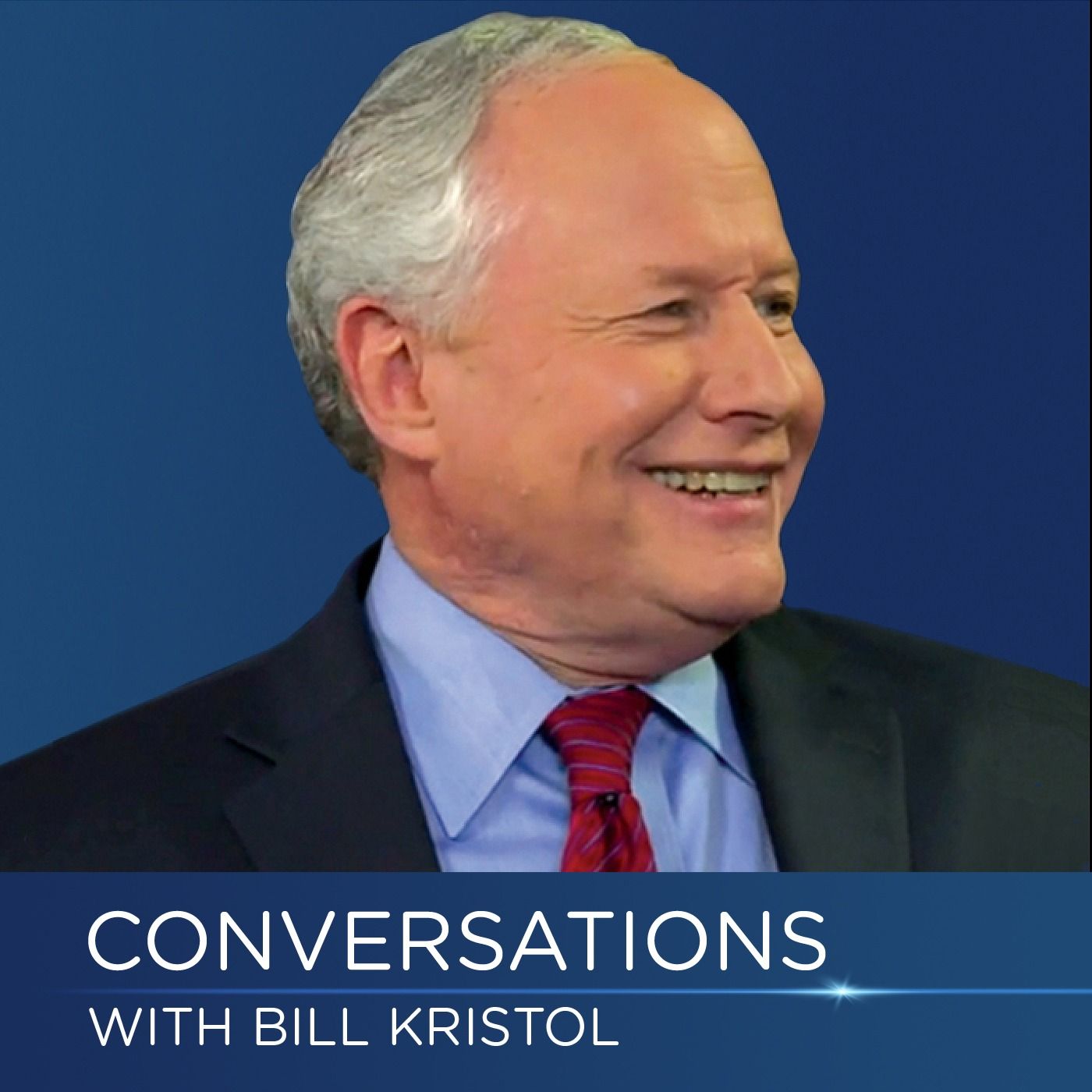
Conversations with Bill Kristol
by Bill Kristol
Is this your podcast?On the show
From 17 epsHost
Recent guests
Recent episodes
Steve Rosen: New Military Challenges in the Age of AI, Drones, and Cyberattacks
Oct 14, 2026
1h 10m 28s
Phillips O’Brien on Ukraine, Iran, and What’s Next
Sep 30, 2026
58m 52s
David Axelrod on the 2026 Midterms: How Big a Wave?
Sep 18, 2026
56m 58s
Doug Sosnik on Two Different Elections: 2026 and 2028
Aug 27, 2026
1h 07m 17s
Eric Edelman: Trump and the American Military
Aug 7, 2026
1h 06m 02s
Insights from recent episode analysis
Audience Interest
Podcast Focus
Publishing Consistency
Platform Reach
Insights are generated by CastFox AI using publicly available data, episode content, and proprietary models.
Most discussed topics
Brands & references
Total monthly reach
Blended from 1 signal.
Built from
By chart position
- 🇺🇸United States · PoliticsHOME#1663.8K to 24K
- 🇧🇷Brazil · Politics#173204 to 1.3K
- 🇮🇳India · Politics#194129 to 807
- 🇯🇵Japan · Politics#162100 to 623
- 🇻🇳VN · Politics#10753 to 332
- Per-Episode Audience
Est. listeners per new episode within ~30 days
4.4K to 27K🎙 ~2x weekly·325 episodes·Last published 4d ago - Monthly Reach
Unique listeners across all episodes (30 days)
8.8K to 55K🇺🇸86%🇧🇷5%🇮🇳3%+5 more - Active Followers
Loyal subscribers who consistently listen
3.5K to 22K
Market Insights
Platform Distribution
Reach across major podcast platforms, updated hourly
Total Followers
—
Total Plays
—
Total Reviews
—
* Data sourced directly from platform APIs and aggregated hourly across all major podcast directories.
Social Links & Contact
Official channels & resources
Official Website
Login
RSS Feed
Login
| Date | Episode | Topics | Guests | Brands | Places | Keywords | Sponsor | Length | |
|---|---|---|---|---|---|---|---|---|---|
| 10/14/26 | Steve Rosen: New Military Challenges in the Age of AI, Drones, and Cyberattacks | "For the first time ever, the United States homeland cannot be taken for granted as a secure rear area against non-nuclear attacks." So argues Steve Rosen, professor emeritus of government at Harvard, in a bracing Conversation on the radically new security environment created by AI, precision strike weapons including drones, and cyber capabilities. Because these technologies give a distinct advantage to the offense, Rosen contends the US must "think about ways of similarly putting adversary assets at risk." He also explains what twentieth-century history can teach us about mobilizing the nation's resources in government, industry, and the wider community of experts, to counter critical threats to America and the free world. | 1h 10m 28s | ||||||
| 9/30/26 | Phillips O’Brien on Ukraine, Iran, and What’s Next | Where do things stand in the wars in Ukraine and Iran? What are the implications of these wars for military technology, the future of warfare, and our highly fluid geopolitical environment? In this Conversation, Phillips O'Brien, the distinguished military historian and author of the indispensable Phillips's Newsletter on Substack, shares his perspective on the two major wars. O’Brien also considers the ramifications for US-China military and technological competition, the future of the Middle East, and the faultlines in Europe. This is an unusually incisive analysis of both the facts on the ground and the larger and gathering geopolitical threats we face. | 58m 52s | ||||||
| 9/18/26 | David Axelrod on the 2026 Midterms: How Big a Wave? | We are less than seven weeks away from Election Day, and early voting already has begun in some states. To discuss where things stand and where American politics might go after the midterms, we are joined again by David Axelrod, chief strategist for Barack Obama’s presidential campaigns in 2008 and 2012. Axelrod shares his perspective on how the election might play out when Trump “is in a deep hole and keeps on digging.” He explains how the fundamentals point toward a historically bad year for Republicans—with a war and tariffs, unmistakably the president's own doing, felt acutely by voters through rising energy costs. Kristol and Axelrod also discuss how the Democratic Party is dealing with the rise of economic populism, and where both parties might go in terms of ideology and character of candidates as we look toward the presidential race in 2028. | 56m 58s | ||||||
| 8/27/26 | 2026 elections2028 elections+4 | Doug Sosnik | Substack | — | Doug SosnikBill Kristol+7 | — | 1h 07m 17s | ||
| 8/7/26 | military leadershipTrump administration+4 | Eric Edelman | Department of Defense | TurkeyFinland | Trumpmilitary+7 | — | 1h 06m 02s | ||
| 7/24/26 | politicization of civil serviceTrump administration+4 | Don Kettl | Trump AdministrationCongress | United States | Trumpcivil service+5 | — | 1h 01m 28s | ||
| 7/9/26 | Supreme CourtTrump administration+5 | Ryan Goodman | New York UniversityDepartment of Defense+1 | — | Supreme CourtTrump administration+6 | — | 1h 02m 43s | ||
| 6/26/26 | modern politicsliberalism+3 | Harvey Mansfield | The Rise and Fall of Rational Control | — | Machiavelliliberal thinkers+5 | — | 55m 54s | ||
| 6/11/26 | 2026 electionAmerican politics+4 | Ron Brownstein | Bloomberg OpinionCNN | — | 2026 electionsTrump disapproval+5 | — | 1h 05m 37s | ||
| 5/20/26 | US-China relationsinternational power dynamics+3 | Aaron Friedberg | Princeton | United StatesChina | ChinaUnited States+5 | — | 48m 35s | ||
Want analysis for the episodes below?Free for Pro Submit a request, we'll have your selected episodes analyzed within an hour. Free, at no cost to you, for Pro users. | |||||||||
| 5/8/26 | Ukraine WarRussia+3 | Phillips O’Brien | — | UkraineRussia+4 | UkraineRussia+5 | — | 1h 06m 57s | ||
| 4/23/26 | Trump's psyche2028 elections+3 | A.B. Stoddard | — | Arlington Cemetery | TrumpA.B. Stoddard+4 | — | 1h 04m 01s | ||
| 4/9/26 | Aristotlepolitical philosophy+4 | Mark Blitz | Aristotle’s Political Philosophy | — | Aristotlepolitical philosophy+6 | — | 56m 22s | ||
| 3/19/26 | Iran WarGeopolitics+3 | Aaron Friedberg | Princeton | IranChina+4 | Iran WarChina+5 | — | 1h 20m 49s | ||
| 2/27/26 | American politics2026 elections+4 | Doug Sosnik | — | — | Doug SosnikBill Clinton+5 | — | 1h 12m 29s | ||
| 2/12/26 | immigrationdeportation+4 | Aaron Reichlin-Melnick | American Immigration Council | — | mass deportationimmigration policy+4 | — | 1h 20m 22s | ||
| 1/22/26 | Trump's bullyingEurope's response+4 | Francis Fukuyama | NATO | DenmarkEurope+4 | TrumpFukuyama+6 | — | 1h 01m 49s | ||
| 12/30/25 | American politicsmidterm elections+3 | Ron Brownstein | Bloomberg OpinionCNN | — | Trump approval rating2026 elections+3 | — | 1h 22m 59s | ||
| 12/4/25 | Trump's foreign policyglobal security+4 | Robert Kagan | Conversations with Bill Kristol | AsiaMiddle East+2 | Trumpforeign policy+5 | — | 1h 13m 02s | ||
| 11/20/25 | Dick Cheneypolitical legacy+3 | Steve Hayes | The DispatchCheney | — | Dick CheneySteve Hayes+4 | — | 1h 18m 52s | ||
| 10/28/25 | Jonathan Karl on Trump’s Retribution Presidency | How has the second Trump presidency differed from the first? How did Trump’s experiences during his time out of office and on the campaign trail in 2024—including his trial in New York and the assassination attempts—shape him? What can we expect in the months and years ahead? In this Conversation, Jonathan Karl, a leading chronicler of Donald Trump and author of Retribution: Donald Trump and the Campaign that Shaped America, argues for the centrality of retribution in understanding Donald Trump’s second presidency. Drawing on his extraordinary access to the president over many years, Karl reflects on how we got here and considers where we might be going. | 1h 05m 34s | ||||||
| 10/17/25 | Timothy Snyder on the Trump Administration at Home, and What’s at Stake in Ukraine | Where do things stand in the United States nine months into the second Trump administration? Where do things stand in Ukraine, and what are the implications of the war for the future of liberal democracy around the globe? In this Conversation, the distinguished historian Timothy Snyder reflects on the situation of the United States, Eastern Europe, and the politics of the current moment. | 53m 59s | ||||||
| 10/3/25 | James Carville on Politics Today, 2026, and 2028 | “It’s hard for me to imagine a voter that votes in 2026 that doesn’t have Trump on their mind.” According to veteran Democratic strategist James Carville, Trump "keeps jacking the stakes up, every day” and remains the focal point of American politics as we head towards the midterms next year. As he puts it, the Republican Party has become a “personality cult” while the Democratic Party is "a coalition in search of itself." As he explains: “I don’t think Democrats can know who they are until Democratic primary voters weigh in and decide. It’s not up to me to say what the Democratic Party should be. It’s for eight people to run for president and then have Democratic primary voters pick one, and then that’s what the party becomes.” In a wide-ranging Conversation, Carville shares his distinctive perspective and characteristically shrewd insights on where our politics might be headed as we look toward the midterms and 2028. | 1h 00m 20s | ||||||
| 9/11/25 | Aaron Friedberg on the Trump Administration's Surprising China Policy | The second Trump administration’s approach to China so far differs from the more consistently hawkish posture of the first term. To analyze the increasingly dangerous state of our geopolitical situation and the threat posed by China, we are joined again by Princeton professor Aaron Friedberg. According to Friedberg, China continues to strengthen in military, technological, and geopolitical might as it continues to advance its ties to Russia and North Korea. Meanwhile, in Washington, the position seems to be emerging that the US can make a deal with China, as well as draw back from American positions in Europe and elsewhere. As Friedberg puts it, this policy would leave American allies in Europe and Asia more vulnerable to China and Russia—countries that have their own differences but are united by an “ideology that’s anti-Western, anti-liberal, anti-democratic. And that’s a pretty powerful force.” Friedberg argues that the various and growing threats to the US and the world order remain ever more interconnected. To counter these threats, the US must increase engagement around the world and strengthen collaboration with allies—rather than “making deals” with adversaries while retreating from global commitments. | 1h 19m 54s | ||||||
| 8/28/25 | Anne Applebaum on Ukraine, Europe, Trump, and the Danger of Authoritarianism | Much has happened since we were last joined by Pulitzer Prize-winning historian Anne Applebaum in February, including the Trump-Putin summit in Alaska and the Zelensky visit to the White House that provoked an alarmed and last-minute rush to join by European heads of state. In this Conversation, Applebaum shares her perspective on the situation on the ground in Ukraine and the response in European capitals to reduced US support for Ukraine on the battlefield. Drawing on her recent book Autocracy, Inc, out this week in paperback, Applebaum considers the growing authoritarian threat and dangers to liberal democracy on both sides of the Atlantic. As she states, “the farther you go down the road [to authoritarianism], the harder it becomes to turn back.” | 52m 59s | ||||||
Showing 25 of 325
Pitch Fit is a Pro feature
See how bookable this show is for guests, which brands already advertise, the per-episode ad value, and the best-fit guest and sponsor profile. The numbers are blurred on the free plan.
How readily this show books outside guests like you.
How proven this show is for host-read sponsorships.
For Guests
ProFor Advertisers
ProUpgrade to Pro to unlock guest cadence, sponsor categories, fit scores, and per-episode ad value for this show.
Chart history for Conversations with Bill Kristol
Peaked at #93 in SG, currently #93 in SG.
| Market | Genre | Peak | Current | Trend |
|---|---|---|---|---|
| SG | — | #93 | #93 | — |
| VN | — | #107 | #107 | — |
| IL | — | #128 | #128 | — |
| TH | — | #136 | #136 | — |
| IS | — | #138 | #138 | — |
| Japan | — | #162 | #162 | — |
| United States | — | #166 | #166 | — |
| Brazil | — | #173 | #173 | — |
| Denmark | — | #178 | #178 | — |
| India | — | #194 | #194 | — |
Chart Positions
10 placements across 10 markets.
Chart Positions
10 placements across 10 markets.