

Conversations with Institutional Investors
by Investment Innovation Institute [i3]
Is this your podcast?Insights from recent episode analysis
Audience Interest
Podcast Focus
Publishing Consistency
Platform Reach
Insights are generated by CastFox AI using publicly available data, episode content, and proprietary models.
Total monthly reach
Estimated from 1 chart position in 1 market.
By chart position
- 🇦🇺AU · Investing#1925K to 30K
- Per-Episode Audience
Est. listeners per new episode within ~30 days
2.5K to 15K🎙 ~2x weekly·132 episodes·Last published 1w ago - Monthly Reach
Unique listeners across all episodes (30 days)
5K to 30K🇦🇺100% - Active Followers
Loyal subscribers who consistently listen
2K to 12K
Market Insights
Platform Distribution
Reach across major podcast platforms, updated hourly
Total Followers
—
Total Plays
—
Total Reviews
—
* Data sourced directly from platform APIs and aggregated hourly across all major podcast directories.
On the show
Recent episodes
135: Funds SA's Con Michalakis – TPA Lite, The Comic Con of Asset Allocation and my Best & Worst Investment
May 13, 2026
Unknown duration
134: JANA's Jo Leaper – Risk as a Source of Alpha
May 3, 2026
Unknown duration
133: From the Archives – Gus Sauter and the Early Days of ETFs
Apr 13, 2026
Unknown duration
132: Michael Kollo – New Book, Building an AI Equity Analyst and AI as a Review Agent
Mar 29, 2026
Unknown duration
131: From the Archives – Greg Cooper
Mar 15, 2026
Unknown duration
Social Links & Contact
Official channels & resources
Official Website
Login
RSS Feed
Login
| Date | Episode | Description | Length | ||||||
|---|---|---|---|---|---|---|---|---|---|
| 5/13/26 |  135: Funds SA's Con Michalakis – TPA Lite, The Comic Con of Asset Allocation and my Best & Worst Investment | In this episode of the [i3] Podcast, Conversations with Institutional Investors, we speak with Con Michalakis, Chief Investment Officer of Funds SA, which is a $50 billion investment manager for South Australian public sector superannuation funds and other approved state authorities. Con is well-known in the Australian investment industry, not in the least, for his outspoken views on a variety of investment topics, including gold, crypto and asset allocation, much of which has historically been disseminated through his notorious Twitter or X feed. We trace back to Con's roots as a quant and value investor, and discuss how this continues to shape his current investment philosophy, despite the fact that he calls himself now an ex-quant. We discuss the changes in governance and the implementation of a TPA lite framework at Funds SA, while we also touch upon the turmoil in private credit. Finally, Con admits that he was wrong about innovation and disruption being the most dangerous words in investing, while he stands firm on his dislike for crypto and dynamic asset allocation. Enjoy the show! Follow the Investment Innovation Institute [i3] on Linkedin Subscribe to our Newsletter Explore our library of insights from leading institutional investors at [i3] Insights Overview of Podcast with Con Michalakis, CIO of Funds SA 03:00 I'm more of an ex-quant these days 05:00 In my heart, I'm still a value person and a contrarian; I like to invest in areas that are unloved or where capital is scarce 09:30 When I joined Statewide, the GFC hit. It was the worst I'd ever seen and Statewide was in trouble 12:00 By the time we merged with Hostplus, we were one of the top performing funds in the country, but that first six to nine month period was hell 13:30 Covid was short in terms of the market bounce back. What was hard was early access to super 14:30 Governance changes at Funds SA; "There were a lot of meetings here at Funds SA" 16:00 Having a risk management lens and no more siloes is a key part (of the new governance structure) 16:30 You used to have a photo of Trump on your desk to remind you of risk. Do you still have that? "No, I see enough of him!" 18:30 Making changes to the investment committee 21:30 We cut our tracking error budgets for Australian and global shares down by half to almost two-thirds. We've introduced passive, we've introduced quant systematic, and we have an active sleeve. You can't be full one or the other. 23:30 The world has changed: there is faster money, there is pod shops (fund managers that distribute capital across numerous semi-autonomous teams (pods) led by individual PMs) and there is instant reaction 24:00 You have to embrace dispersion across styles and managers 27:00 Implementing "TPA Lite". 27:30 "The idea that you are going to do dynamic tilting, or that you are some sort of macro guru, I call that a Comic Con of Asset Allocation. Everyone dresses up in their favourite character." 30:00 There is a slight survivor bias in the group of TPA proponents that the added value is based on 35:00 You said previously that innovation and disruption are the two most dangerous words in the industry? "I was wrong". 39:00 There was a shoe company in the US that was going bankrupt and pivoted to AI and the stock price went up 5x. Clearly, there is some nonsense going on. 43:00 Crypto; if you want to have it as a digital Ponzi scheme, go for it. 45:00 At Funds SA, we have zero Australian private credit 46:00 Some sort of global small/midcap manager, who has never done private credit in their life, is saying it is going to die. What do they know? 52:30 My worst investment? Probably, single strategy hedge funds. 55:00 Con's Twitter/X presence Full Transcript of Episode 135 Wouter Klijn 02:56 Con. Welcome to the show. Con Michalakis 02:57 Good to be here. Thank you for inviting me. Wouter Klijn 03:00 No worries. So I want to take you back all the way to the beginning to get sort of a sense of your thinking on investments. And I believe you studied mathematical science in Adelaide, then went on to do a Master's in financial economics in London, and ended up at the Oxford Said business school. So there's sort of a combination of, you know, purely mathematical thinking, but also strategic thinking. How has that shaped, sort of, your outlook on investments? Con Michalakis 03:28 Yeah, sure, so I would say I'm more of an ex quant now. I mean, it's a long time ago since I did option pricing and was a quant So, but still, you know, numbers guy in terms of how I think about it, and to be, to be honest, you know, the younger people that I've worked with, whether it was at Statewide, Hostplus, at Funds SA, to say they're brighter, they're more technical, they're more up to speed, so they've way taken over. So I would, I would call myself ex-quant. I still think in terms of numbers, still, you know, pretty Stemmy. And there's a bias across all three firms that I've worked for for sort of STEM type thinking, you know, science, technology, engineering, maths, the but you can't just all have one I have now believe that you can't just be one grade. I still think you can take stem people and teach them finance. It's hard to take finance people and teach them stem but you need, you need all sorts. And some of the best thinkers are not necessarily the way they think and critical thinking. They're not always just stem types. I've learned to embrace more diversity in that and interesting some of the managers that we've invested in, you know they come from interesting historians. So you got a critical thinking is more important. But, yeah, definitely bit of a buy. As the stem. Wouter Klijn 05:01 Yeah. So how would you describe your investment style now? Then, because, of course, you mentioned three firms you you worked at Pezna for a while, which is a value shop, a deep value shop. Do you still have some of that thinking as part of your DNA, or are you looking more as sort of a contrarian investor. Con Michalakis 05:22 I think in my heart, in my heart, I'm still a value person and a contrarian like to invest at the margin in areas that are either unloved or where capital is scarce, because highly likely the risk is that hasn't been priced in, and therefore there's a trade off. But definitely call it the maturity cycle, diversification, the ability to invest long term and make sure you have investments across a broad, strange range of strategies and asset classes, and not being sort of, you know, across the cycle, not having one dominating I think, is very important. I've learned that lesson, and it's a lesson that I know, but in my heart of hearts, if it's contrarian in value, it's probably my kryptonite. Wouter Klijn 06:19 Yeah. So, so you learned those lessons. Can you give an example of some of the things, some of the trades? Maybe that taught you those lessons? Con Michalakis 06:28 Yeah, probably bond allocation, fixed income, you know, like, if you look at the Japanese bond market, you know, it was the widow maker, you know, you didn't like it at four. Didn't like it at 3,2,1,or 0, it's come back now. So, you know, maybe the mean reversion took 30 years, but it's coming back. You could just got to be a bit you got to be a bit more smarter than naive mean reversion. Value Investing. There's been a value, statistical value, risk premium over 100 years, but you know, arguably, it's been very chopping. Hasn't worked since the GFC or prior to the GFC. If your portfolio, if you're running a diversified, multi strategy, strategy, multi asset portfolio, and you've let one style dominate your over a cycle, you're going to outperform or underperform because you're too biassed to that at the margin, though, you know, at the margins, I remember you're running a world diversified fund. Occasionally you get thrown these strategies and ideas where either the market has unloved it or there's an opportunity to extract return. That's pretty good. So, you know, we were a bit late to that at state. Well, I definitely noticed. Plus, when we did the sort of insurance link strategies with quota shares, we did that last year here too, at funds SA, and that's that's done really well, you know, in the small and mid cap, you know, where managers can probably do a little bit better. Venture capital, when that was unloved 15 years ago, we were late to that at Statewide, but Hostplus was very good. So you want to, you want to be diversified, but you want to go to early areas and adopt that if you can. Wouter Klijn 08:11 So looking back on that, what does that mean for portfolio? This, is there still a place for value, or are you more style neutral guy? Con Michalakis 08:20 There's a place for value and be conscious. If you're going to use a combination of passive, quant, systematic and traditional fundamental, you want to be conscious of what your and how your managers managing that. Some are core. Some identify as value. Some are kind of fighters, quality or growth. You want to be conscious of what you're carrying into that portfolio, except particularly in this incredible market movements that we've had, probably since Covid, for lack of a better word, that you're going to have dispersion. And that gets down to beliefs. Can you ride the cycle. Do you have the ability to, if you have good relationships and you trust your managers to reinvest when there's…, their style or, you know, there's always a style that they've had an issue with a couple of stocks, do you have the backbone to just stay in the game with them and reinvest? Wouter Klijn 09:18 Yeah, you just mentioned that Covid period. Do you have any sort of lessons from that? Did you change anything in the portfolio to deal with sort of that volatility? Con Michalakis 09:28 You know, when I joined statewide, it was a GFC, so, so I left Pzena, it was, you know, a couple of weeks off, and joined Statewide the first week, my first week that weekend, Fannie and Freddie was nationalised at the end of the week, Wouter Klijn 09:44 yeah. Con Michalakis 09:45 The week later, Lehman went under. Now we're in the GFC, Wouter Klijn 09:48 yeah. Con Michalakis 09:48 And that was painful. So really, from September until April, September 2008 April 2009 this was one of the most acute periods of investing I've seen. I. All when, famously, Westpac, had a failed rights issue early on my career, and I think it was Kerry Packer heard to bail it out. We've had Asian crisis, 9/11 but this was, this was up there with one of the worst I've ever seen, and Statewide was in trouble. It really didn't have a diversified portfolio. Didn't have a lot of cash or a lot of bonds. It had to pay hedges by selling equities. Luckily, Chris Williams had joined me, I think October, November that year. Jimmy Vernon Payne is now a consultant at Jana. Bill Watson, I think he's at first super, or is he moving to, you know, I think something like that. And all of that was happening live, and we had to manage that. And that was a really difficult period. We had to write off assets, we had to rebalance the portfolio, but to put in governance structure. We can talk a bit about that later. That was a doozy. Wouter Klijn 11:02 So that was heavily equity focused portfolio, Con Michalakis 11:05 that was a heavily illiquid portfolio, but more importantly, didn't have cash or bonds, Wouter Klijn 11:10 yeah, yeah. Con Michalakis 11:11 We didn't have any fixed income. Fixed income was a bit of a saviour. The Aussie dollar collapsed, the international allowed you to international fell by more. So that was a difficult time, and that taught us the importance of the diversification, liquidity, managing portfolio shape, not for currently, but looking out forward, and having a risk management system in that you could understand and also live by. I would say, though, by the time we merged with Hostplus, we were one of the top five or six performing balance funds in the country in terms of peer surveys, your future, your super we're the best Aussie equity numbers over most time periods, the most fixed the best fixed income numbers. Pretty proud that by the time we had merged with Hostplus, we were one of the best performing funds in the country, but that initial six to nine month period was hell Wouter Klijn 12:06 yeah, I can imagine. I mean, I had in there that, like you must have done something right, because you survived for 14 years after joining state. Con Michalakis 12:13 Well, ultimately, the central banks and the unbelievable amount of QE and reinvestments and bailing out the financial system. You know, one of the first responders was the Aussie dollar rallying, and we kept the hedge, and we used those hedge gains to rebuild asset allocation. And then, frankly, equity started recovering. I think by May, it bottomed out and it was on the rallying. But yeah, for that period, it felt it was uncomfortable. Now, covid, so, so, so the time we got the covid, we were so well diversified. We had risk management planning, we had liquidity ratios, we had stress testing in in play. And I was only for a week. I remember it was pretty late nights, early mornings, late nights. Chris was then the deputy CI, Chris Williams, who's now Hostplus, was the deputy CI. And I remember was one morning, Chris goes, Okay, now I'm worried this. There's no market. There's no market in bonds. The market was unruly. And I remember being on the couch one night. I was sort of had Bloomberg on, and I saw this big headline, unlimited QE and I remember saying, Okay, this is done. It's over. The markets will respond. So covid was short in terms of the bounce back. What was then hard for most super funds was early access. How would people tap into super How would you manage that? We were moving then to weekly Investment Committee meetings. We had a risk scorecard checklist. We were going through valuation scorecard stress testing. I actually thought we played that well. What surprised us was how quickly the markets bounced, Wouter Klijn 13:58 yes, Con Michalakis 13:59 and we had underperformed just, you know, in that immediate period. And then there was a vaccine that was announced. We had quite a few value strategies. They did really well. And then we came through. Yeah, the time we merged, performance was pretty good. Wouter Klijn 14:14 So it sounds like that in a number of these like tricky situations, liquidity was a central theme in sort of trying to manage the risks in the portfolio, has that sort of changed your ideas on how to manage liquidity, and also in the current environment, where it's quite volatile, very concentrated markets, what is your philosophy towards liquidity? Con Michalakis 14:38 So front and centre, you know the changes, the big changes we've made at Funds SA, they say was governance. We've set up, we've we've, there was a lot of meetings here. So there was a lot of meetings. There were a lot of people in meetings. We've tightened the meeting schedule. There's less people than meetings. We've broken down silos, and we've introduced concepts like, okay, we've got a proper investment strategy that embraces diversification. We've got liquidity ratio and stress testing. We've got fee budgets. We've got active fee risk budgets that we're implementing. And so we spend, really the first four or five months of every year updating our investment strategy policy, making sure it's fit for purpose, and then basically the rest of the year, reviewing the asset classes that are sympathetic to the overall investment strategy, and in that risk portfolio shape, managing the portfolio, not for today, but over the next 12 months, we have an unlisted forum that goes further and making sure we've got a enough liquidity. What's our effects? Hedging policy, terming out hedges, making sure if markets move, we can take advantage of what's happening. And that's that's that served us really well at statewide. I know it's served Hostplus really well, and we're off to a good start here, ending March. Financial year to date, I would say our balance fund's in the top quartile. Early days, nine months and one year I've been here 14 months. But having a risk management lens and the and shaping the portfolio is and no more silos is a key part. Wouter Klijn 16:21 Talking about risk management. I've heard that you used to have a photo of Trump on your desk to remind you of risk did you bring that to Funds SA? Con Michalakis 16:29 No, I see enough of him. I see enough of him everywhere, whether it's news or media. I don't need a photo. It was a joke. I think the team went to some charity and they got a maga hat, and I had a photo of him and Putin, I think, on my desk, which was good, because 2016 election was unusual. If you remember how markets traded, they priced a Clinton win and then a Trump win in the reverse was like, bit like Brexit, actually. And so no, I see enough of him, and I see enough of his policies and and I see enough of the reactions to the markets to tweet, so I, I he's a constant reminder. I don't need him. Wouter Klijn 17:06 You don't need to be reminded of that. So you mentioned that setting down a proper governance framework was important in sort of reshaping the portfolio Statewide. Can you tell me a little bit about what you think are the essential ingredients of that governance framework? Con Michalakis 17:22 Yeah, sure, and I starts here with Funds SA so, you know, 14 months in, what did we do? Start with the basics. We actually wrote a plan. I wrote a plan for the board, and what we said was governance strategy, team, structure and within government, Jana coming on as a full of service asset consultant. I've worked for Jana for a number of years, and they've been a great partner, and I consider them not a service provider. They're a partner to us, and we, we, we, we, basically, we rest on their shoulders. We don't have to make things we we can get a lot of their IP and thinking and basically build on that in terms of governance. It was recasting the Investment Committee. There's now a smaller Investment Committee. We have an independent chair, David Holston, who was my asset consultant, then retired, then joined Statewide as the chair of the Investment Committee and board member. He's here as an independent but making sure that's in that's in play, doing things like Investment Beliefs, having detailed asset class reviews, bringing the team together. We have a weekly portfolio construction forum where there's the investment strategy team and the asset class heads. Once a month, we invite Jana as well to that, having papers prepared, going through the shape of the portfolios, what's happening in the markets, trying not to be short term, and managing this for the medium to long term, that's been the, probably the biggest changes here, plus the usual, introducing liquidity ratios, thinking of risk, thinking of how you're going to diversify the portfolio, and being small enough to take advantage of strategies and ideas, should they present themselves? They don't often, and we don't think we can trade our way through it, and we can talk about DAA coming up, but just being aware and being able to execute quickly Wouter Klijn 19:29 Before we jump into DAA, I want to talk a little bit about Funds SA in sort of the broader investment industry here in Australia, because it's relatively unique. You have worked at a super fund as well. At Hostplus, obviously, they are subject to a whole set of regulations where they need to pass a performance test on the Your Future, Your Super that has influenced how they allocate, especially on the passive, active side of things. At funds, I say you don't. Really have those restrictions. Does that give you an edge or an advantage in finding opportunities that super fund? Con Michalakis 20:07 Oh, yeah. So we're about 50 billion in assets, and over 90 per cent is the local state pension scheme, Super SA that we run money for it's regulated by the state. So we're like a state, sovereign, if you want to, in that sense, and it has constitutional protection, which is a unique feature. I do think, not being having different being regulated by the state, we have unique and we have some unique tax advantages. Gives us a bit of an edge. We can think about how to invest the portfolio. We still shadow, for lack of a better word, we still shadow Your Future, Your Super we think about the risk we're taking from that lens, but we can free ourselves from the day to day regulatory of an official APRA burden, for lack of a better word, and that gives us, I believe, some unique advantages that we can we can exploit. Wouter Klijn 21:17 Yeah, Con Michalakis 21:18 That doesn't necessarily mean that some advantages can be also a balast, because it's active management is difficult. Can't just blindly do it, and hasn't worked for a long time, and it's particularly in recently, it's been a very difficult area. And you know, one of the one of the things we did in the previous review is we had pretty large active tracking error budgets that was purely active in Aussie and global shares. We've basically cut that down by a half to almost two thirds and and one of the reasons is we've introduced passive we've introduced quant systematic, and we have an active sleeve, and we want to let it go, just, just so we, you know, again, diversification, even within Aussie or global equities, it can't be for one or the other. Wouter Klijn 22:09 Yeah. So is that active component more of a satellite allocation, is it a relatively small? Con Michalakis 22:15 It's more sort of, yeah, core satellite approach to the active might be a bit more satellite. You can have some style neutral managers. You might have some small to mids value or quality growth. But we, you know, we manage that within a mix, and our tracking error, you know, is moving, you know, maybe in the past it was in the threes. It's now in this of the one, one and a half at both Aussie and global equities, Wouter Klijn 22:40 that active, passive element is quite interesting in the light of the current environment, because we've seen, you know, equity markets more or less rally for quite a number of years now, concentration in markets, which makes active management quite difficult. But if we would were to see a flip or some sort of recession, that's often where active management shines as well, where they can reduce sort of the downturn. Are we setting ourselves up for failure in that sense, because we're moving away from that active element, and then when a crisis happens, we might not have enough of that. Con Michalakis 23:16 I mean, we were pretty active at Statewide. We had quite working very well in Aussie and global. And as I said, global, by the time we had finished that net a fee Alpha was pretty good. Aussie was unbelievable. Closer to 2 per cent I would say to you, the world's changed. There's faster money, there's pod shops, there's instant reaction. We've seen it even. I mean, look at between March and April. You basically had equities, you know, fall anywhere between five and 8 per cent and in the first two weeks of April, they basically come back. And in coming into the third week, we're now setting new all time highs, Wouter Klijn 23:56 yeah, Con Michalakis 23:56 so the Fast Money response, and what I've I believe, is that you have to embrace dispersion, dispersion across styles, strategies and managers, and in this world of faster money, moving money, you probably want a bit of everything. And the idea that you can be totally active sounds romantic, but I think the path dependency will kill you. The idea of being totally passive, we have some tax advantages that doesn't totally make sense to be totally passive, and the idea of being totally systematic, well, fine, but there was a thing called a quant winter in 2007 and these things will happen. So why not have a bit of everything if you can, but be careful, you know, set your tracking error budget, set your allocations, and try not to one of the things I think that could be happening in industries. If something's not working, they're closing it down, and then they're just going straight to this that's working. Well, okay, that's creating flows and opportunities. When that sort of stops, that's going to create some opportunities on the other side. And I think the other side of that could be an environment where active managers who are targeted and doing well will do better. Wouter Klijn 25:26 Yeah, yeah. So as part of that, move to towards more passive, basically reducing tracking error, but then we see funds doing a little bit more on the dynamic asset allocation side, where partly is sort of trying to implement some total portfolio thinking, putting trades on top of the portfolio that are almost a little bit hedge fund, like relative value trade, global macro trades. What's your view on that? Is that something Con Michalakis 25:56 This is going to be fun. So one of the things I one of the things when I came at Funds SA is that there was, there was a lot of siloed behaviour. So there was the asset class, people were doing their own things. Then there was sort of an overlay, doing their own things. What I brought is, everyone's in the room once a week, and we're thinking of what's the long-term strategic asset allocation. Now markets move so you move away from that, what's the commitment to if you've got private capital investments, whether it's equity infrastructure, what's being drawn down, what's being distributed? There's foreign exchange movements, how you should think about the foreign exchange. There's also demographics. There are flows in that. Are flows out they're switching as well. And so I come across from a, I'm going to call it TPA Lite, Wouter Klijn 26:47 yeah. Con Michalakis 26:48 So I come across from a total portfolio. What are our exposures? Where, where would you want to be? And if we don't really have strong ideas, run them very close to the strategic assets. After all, it gets reviewed every year, right? We've spent a lot of time spending that as what a research, time looking at that with our asset consultant. The board adopts it early in the year. And if we don't have an idea, stay close to that, then markets drift. And it's all about the rebalance, the idea that you're going to do dynamic tilting, or that you're going to do overlays on top, or you're some sort of macro guru. I call that the Comic Con, right, of asset allocation. Everyone dresses up in their famous in their favourite character. One's a dynamic tilter, one's a post Keynesian, one's a Keynesian. One's a value guy, one's a trend. Great. You can have it. It's all yours. I just think it's noise. And good luck trading that in the last three or four months. In fact, good luck trading that since Liberation Day, and good luck trading that since covid. Because how many people would have told me bonds went from zero to four or 5 per cent and equity market set new time, all time highs? So I think we take a broader portfolio lens, manage that from a portfolio construction level, figure out where the opportunity sets are. Allow a little bit of flex, but you're not going to see us trading frozen concentrated orange juice and pork bellies. Wouter Klijn 28:22 So do you see DAA as a form of market timing? Yeah, Con Michalakis 28:25 They can have it. You know, I've heard about other funds. You know, they do SAA, TAA, DAA, macro thematic. Yeah, all yours. It's up to negative. Good luck to them. Wouter Klijn 28:37 So I had taken you as a little bit of a TPA cynic. But obviously you're Con Michalakis 28:43 Not totally a TPA cynic. I just, you know, I read the study, and I did start at Watts and Wyatt, and there's Thinking Ahead Group. I think the ideas of TPA are good. The complete adoption, am I going to be the purest TPA, and I know there's been some great funds out there that have done it, that's theirs. I live in a world where we have different clients who have different needs. We have one client who has a sort of an absolute hurdle cash flow for 30 years before it goes negative. I have super clients who, you know, they want us to manage a CPI target. They want to manage against peers. They're switching in between funds. There's demographics. I look at everything, not just through a pure TPA. Call it TPA Lite, Wouter Klijn 29:30 yeah. Con Michalakis 29:30 And you know that study that showed all the TPA funds outperforming before I had a good look at it, it felt a little bit like, nothing against my old colleagues, but that looked a little bit like consultant swab. Wouter Klijn 29:42 Yeah, I looked at that report as well, and I think they came up with 180 basis points or something, but it seemed to be just an aggregate of the funds that were included in that group, Con Michalakis 29:53 Slight survivor bias, right? Wouter Klijn 29:54 Survivor bias, but also not necessarily relating it back to TPA. It's just, you know, here's a group of TPA. People. And I think there was even a Swedish fund in AP7. I think it is, which is, to my knowledge, highly geared equity fund. It's not quite comparable Con Michalakis 30:09 yeah, comparable we, we look at portfolio construction across the thing, we think about what, what, you know, what are we doing to diversify? What are we doing to beat objectives? You know, sometimes your illiquidity mismatches on what's what's a good proxy, where's the actuals? You know, like you maybe want to have some more linkers than nominals in your bonds at the moment, because it's working with better within your overall fixed income allocation. That's how we think about it. We want to term out our hedges. But the idea of being pure TPA Lite, or pure What's your equity equivalent ratio? Yeah, you can have it. Whoever does that. Good luck to them. Wouter Klijn 30:45 Yeah. Do you think that is to a degree related as well to how large investment team is? Is it easier to do TPA and sit around the table in a relatively small and mid-sized team? Con Michalakis 30:57 So I've been very lucky that within Statewide, Hostplus and Funds SA, we have relatively small teams, and I think that means there are no silos. That means that we can be far more sort of linked up, to use the term in terms of how we're building portfolios, and have the key people, the discussions in the room. I think that's an advantage that we enjoy wherever you use external managers. We do the implementations internally, of course, but we It allows us to just think a bit and build portfolios, as opposed to trying to manage a lot of people. Wouter Klijn 31:39 Yeah. I think in a past interview, you sort of stated the importance of stating your opinion and letting the board know what your thinking is. Is that you know possible in every organisation? Or does that need to be created like a culture created around speaking your mind? Con Michalakis 31:57 Oh, again, maybe luck, all three funds I've worked for boards wanted trust and transparency. There's the Funds SA. It's seven individuals. It's incredible board. And one thing I enjoy, you know, from the chairman, John the CEO, and our board members, is, obviously, I'm not a shrinking violet. So they enjoy the two-way communication, and I think they they want transparency, and with transparency, you can build trust. And so they like the fact that we can have these discussions. Same at the IC. I do think smaller committees allows to have better conversations. That's so the board is, you know myself, the deputy CIO, whoever's presenting, if there's an asset class, the IC, there's there's John, myself and David Holston, the deputy, Kelly, who is sort of like our she makes the trains and run on time in the implementation group, and it just jells at these meetings. It just allows good discussions ample time to have that. And you build trust because they know what you're thinking, you know what they're thinking, and you get, I believe, a better outcome, Wouter Klijn 33:14 Now Funds SA has gone to quite evolution in recent times, apart from the organisation growing quite rapidly over the last couple of years, you also had a new chair in. Guy DeBell, had a new CEO with John Although John Piteo has been there since 1995 I believe. Con Michalakis 33:35 Yeah. So I think it's two years so relatively new, yeah. So John, Guy, there's a couple of new board members. Been a few new executives, obviously, new CIO, new deputy CIO, we've added to our implementation team, where Kelly's almost like she's like our COO within the within the investment team. I do think it's a sense of renewal, but I'm probably not the right person, because I've only it's 14 months, but I gather that over the last two years, the Funds SA has changed. It's in a sense that it's more focused on investment returns. Clients are important, and the people who are responsible for managing this business wrapped around making sure we've got appropriate it's really good data and tech that we have here. So yes, I'm part of that change. I think investments has changed a lot, and the team has done a good job, really. I mean, there was a lot of changes, changing governance, beliefs, strategy, no more silos that they've had to go through a lot of change in that responded world to all of that, plus having me Wouter Klijn 34:55 Fair enough, there's also a lot of change happening in the industry itself, and one of the things that a lot of people talk about these days is AI, artificial intelligence. And I sort of, when I was preparing for this interview, I found an old interview with the AFR, and you said that innovation and disruption were the two most abused words in the industry. Do they? Does it apply to AI, what's your view there? Con Michalakis 35:22 Okay, I read that article, and I reckon that's aged like a bucket of prawns in the sun. I reckon I was wrong. Okay, so, so this is, let's this is, this is where, you know, you sort of read that went, Oh, I think we are in the age of innovation and disruption. And I severely underestimated, I think that was 2012 Yeah, maybe not. Yeah. A bit later, I think there's been a lot of disruption and innovation, whether it's the digital whether it's obviously now with AI, I think AI is a, is a, there'll be new versions of energy, there's there's ways of living. There's also some bad disruption in terms of, we're in a multipolar world. You know, the cost of warfare has gone down, so the marginal propensity to war goes up. You know, we grew in a pretty balanced world post the war, that we knew we had one world, and now it's, it's bifurcating into various regions and so, so I think I was wrong, having said that, you know, is it as innovative as we've got the round will and introduce fire? Probably not. But the world is changing, and I think we should embrace that, particularly if I think about Australia. And as an allocator, you know, the world has changed since GFC, in some ways, not for the better. We have to deal with energy resilience and climate. We have to deal with critical minerals. What does ai do to the workforce? What does it do for people who gain from the expected productivity gains? Does it go to capital or labour? If it goes all one way to capital, not labour, there will be riots. There will be a greater disparity in terms of wealth and income. People will be unhappy. There will be volatile elections, social media and the rise of that. So I think there's a lot going on in the world, and we just got to make sure whatever as innovation happens, that the gains are shared. Wouter Klijn 37:47 Do you think it changes as well the asset management game, especially on sort of the active management side, where access to data is easier, it's harder to gain an edge. Con Michalakis 37:59 So I think the biggest winners in that have been the quant funds and the systematic funds, who are naturally very data enriched and aren't afraid to embrace large language processing models, systems. Much more sort of, might be a bit of P-hacking to use the stats term, but there's, there's a lot more sort of mining and using of alternative data, they were much better than the fundamental types. Probably the systematic quantum are much better job in risk management, more than anything else, the risk management's kept them in the in the game, more than, say, the fundamental types. They're learning those lessons. But you know, when we see, we look at it here, internally, at Funds SA, and then when we see with our managers, it doesn't matter if it's a credit manager, an equity manager, a passive manager, voting of shares. People are using AI in their business. They're using it initially as a tool. We use it here across there's a lot of people, vibe, coding, building macros, building things. It's it's changing. Do I think there's a bubble in parts of AI sector? Absolutely. Do I understand the valuations of some of these large language models that are burning cash and on record valuations? I do not. There was a shoe company the other day on the New York Stock Exchange that was going fail, going bankrupt, pivoted to AI stock went up 5x right? Clearly, there's some nonsense going on. But whenever there's an innovation cycle, or whenever there's disruption, you do get, you know, the old Manic Panic and crashes Kindleberger, you know, one of the bubble things is there's an innovation cycle, and that's part of the game. Wouter Klijn 39:51 Yeah, yeah. In some parts of the industry, there's a bit of a reminiscence of the dotcom bubble where, you know, you just had to come to your company name and the share price went up at the same time. You know, you see chips are still TSMC came out today, and I think they still had a record profit on selling the chips to the AI sector. So there is a real story there as well. Con Michalakis 40:19 It's a real story. So Nvidia, the foundries in Taiwan, like TSMC, these are these companies are printing real profits, right? They and Google's another one. So, you know, it's not bubbles can sometimes be overused. But there's, you know, there's some interesting valuations away from them that, you know, it's hard to get your head across, Wouter Klijn 40:40 yeah. But do you think that that shifts the structures in the equity market as well? There seems to be, you know, the size factor comes back, but almost in the opposite way, where, you know, large caps are dominating, outperforming, Con Michalakis 40:53 I think when it gets priced in, and we've had a well priced in, I think there will be again, when you get so much, maybe the value person in me, the valuation dispersion, the opportunity sense, will come in. And lately we've seen that with the EM bounce back pretty hard. We're starting to see a little bit of, we're certainly seeing a lot of good alpha, but also some good returns out of the small to mids. So, you know, we had the rise of the Magnificent Seven. The first version of that look a bit bubbly. It's sort of corrected, and now we're getting the sort of the AI type plays. It's it's part of cycles. You can't pick them. You can't pick them on the way up. Good luck picking them on the way down. You just have to be conscious of what positions you take and make sure that at the margin you can sort of lean against it. And, you know, I have opportunity on the right tail in terms of VC or some of these companies, and then on the left tail be diversified and managing your active exposures. I do think the business that we're in of managing capital, whether you're an asset owner or a fund manager, will be changing over the next five years. Wouter Klijn 42:09 In what way? Con Michalakis 42:09 Hard to say how it morphs. But you know, if the agentic AI and the models and the and you can develop personas, and they have memories in those models, you know, do you need as many analysts? Do you need to see? I mean, it starts giving you that. So while that rises, you will need the correspondent rise and people almost acting as human whisperers of AI and that output to boards and individuals explaining what that means. So, you know, there's, there's going to be a coincidental rise of those two, Wouter Klijn 42:43 yeah. Con Michalakis 42:43 But you know, the first one has more of an employment impact than the second one, Wouter Klijn 42:47 Yeah, yeah, for sure. So we're not at a stage yet where you should just hold passively the top 20 or top 50 stocks and just let them get on with it? Con Michalakis 42:55 I don't think I mean passive is a valid part of of any portfolio. But again, I'm not a person you know full TPA or full passive or full active, you know, like I you can have it all right, don't? You don't have to vote against it, but in a default setting where you don't know what you're doing, you don't know where the world's going. Sure, passive and systematic will give you that that beta exposure, but you know, you probably at the margin, can do with a bit of active. Wouter Klijn 43:31 Yeah, yeah, sure. Okay, so you said you were wrong on the innovation and disruption. You've also been quite critical on crypto. Were you wrong on that as well? Con Michalakis 43:41 No, that's a load of nonsense. And the thing look, crypto, if you want to have it as a digital Ponzi scheme, go for it. Shoot your lights out. Congratulations. But it's not money. That's the thing that bugs me. When people turn around and say, crypto, or even the gold bugs, gold is not money, and crypto is not money. And we saw that when we went through and with oil in the crisis. The first thing people wanted was cash. And basically, and I would sell all the other nonsense because they wanted cash. I You don't do gold back that. You don't do crypto back there. I'm not, you know, stable, this whole sort of stable area, interesting, the way, sort of FinTech, and that's processing interesting, but, you know, there's been a lot of nonsense in that you can have it that's that's happy to provide the chips and the shovels and the data that they need. But, you know, sustainable crypto, give me a break. You're burning. Energy is already scarce, and what's that used for? Wouter Klijn 44:41 I think you called sustainable crypto a vegan tomahawk steak. Con Michalakis 44:45 And once it was, apologies to vegan Tomahawk steaks, which probably, you know, tastes a lot better than the rubbish that's built out by some of those crypto types. Wouter Klijn 44:54 Fair enough. Another sort of point of discussion in the industry at the moment is private credit. It, and we've seen some liquidity issues with some of the funds. But what's your view on that? Is that a problem with private credit, or just the wrapper that? Con Michalakis 45:09 So I should say at Funds SA we have zero Aussie private credit. Wouter Klijn 45:14 Okay, Con Michalakis 45:15 I feel pretty good about that, actually. So zero, we have about 60 basis points of global private credit. So we're in an interesting situation, but we've put on some really well established global private credit. We've just put on some clo equity, both secondary and primary. I actually think the opportunity space looks good for us because we're underwriting into that. We don't have any existing ones. I think some of the commentary written about private credit has come from it's interesting. You've had all the big, large players in private credit saying, yeah, there are problems, but it's not systematic. Who's on the other side is some sort of global, small, mid cap manager who's never done credit, and they love saying it's a bubble, it's going to die, right? And so what do they know, right? I mean, I mean, the reason they're upset is probably because private credits up there are higher up the cap structure getting their returns. Don't believe private credit, per se, is the SPV of real non-recourse real estate debt of 2007 that's going to cause some sort of crisis. Banks, private credit managers, long term sort of locked up capital that does this is it will, will look will make sure that the system does what it has to do. Are there problems? Yeah. Then one of the big problems is that there was a lot of these BDCs. And when you have a listed entity with unlisted assets, and you offer a liquidity redemption window, it's always the same thing. In any crisis, in any dislocation, it's either leveraged money or money that's not there for strategic reasons, that wants to depart, that creates the opportunity for others to come in and take advantage if they have to sell out of discount. Now are there private credit loans or issues, whether it's been in SaaS software disrupted by AI, or, frankly, bad lending. Course, there are, are there in 5000 equity stocks in the global capital market? Are there 50 or 60 that are in big trouble, or at 70 or 80 that could be in fraud? Course, they are. So you know, you're always going to have problems right in loans. But is it a big systematic issue other than the retail, you know, illiquidity, BDC type, or occasionally bad loans, sure, but I don't think it's a systematic issue. Wouter Klijn 47:52 Do you see it potentially as throwing up some opportunities for a fund like you? Con Michalakis 47:56 Oh, yeah, we're taking it as we speak. You know, we're allocating to special sits managers or people who can provide capital and solving for the opportunity. And we're, you know, again, we've come in underweight, so I should be saying private credit is really bad, but I just don't believe it and we're gonna, we'll take advantage of the opportunity across our manager set. We're pretty excited by it. Wouter Klijn 48:21 Yeah, yeah. Fair enough. So going forward, what's on your agenda for Funds SA? Is there still a lot to do in the portfolio? Con Michalakis 48:29 So I'm pleasantly surprised how well the performance has been. We're off to a really good start again. Strategy, governance, team. Jana non silo, I really would love to have the third fund I've worked for to continue to have very lucky at stay white, first quartile. Hostplus is a machine, right? It's, I still speak to some of my old colleagues, that is one of the, one of the great funds, and will continue to do all because it knows what it's doing. Yeah, we've turned it around here at Funds SA and my focus is to keep that turn around really happy where we are. But this is like a cricket game, right? It only takes one bad ball and you think you slug and you're bold and you look like an idiot. So happy where, where we've where we are in the process. Early days, very early days, but we got to maintain that focus. Managing portfolios for our clients and members is a privilege, and we can't take, we just can't stop. We got to be on the game and making sure we're aware of what's happening. Wouter Klijn 49:37 So you mentioned Hostplus, when you look at Hostplus, it does really well, but it also has a very clear sort of target client base. They're young people. They have a long runway, so they can take a lot of risk, which has led to the asset allocation that they have. I think at Funds SA, it's probably much more of a mixed bag in terms of. The demographic of their member base. Does that make it more difficult to set a strategy? Con Michalakis 50:06 Yeah, so Statewide also didn't have a lot of cash flow, right? So being a smaller team, the unique tax advantages and obviously they're not being regulated by APRA and the setting up the governance structure, I think gives us, and being 50 billion and not 500 billion, and not trying to manage really large cash flows, it allows us to be a bit more nimble and take advantage of the opportunity. Should we get it? And so, like, last year, I was that all of funds. So whether it was the investment team, the finance and ops team, the legal and odd, you know, we've had a couple of opportunities, and we turned them around, going through the process, you know, Investment Committee negotiating commercials, operational due diligence, commercials, and we can turn around within there's one we turned around in eight weeks, Wouter Klijn 51:06 yeah, Con Michalakis 51:07 and the the manager said, We've never seen this before. And they manage some sovereign wealth, money, some large pension. Funny. So having the ability to invest, sticking to your beliefs, I think is a Core Advantage. One of the questions I get asked a lot, and I think you were going to ask me, is, you know, what's the best investment you've made in your career? It's the people. Wouter Klijn 51:34 Yeah, Con Michalakis 51:34 It's the people. So having being surrounded by really core bunch of people that you can trust. I had that at Statewide. I had that at Hostplus, and we building this at Funds SA as a core, bunch of people, close to your consultant, close to your investment committee and board, and being on this and being committed and not stopping, like being at it, just focused on doing this. That doesn't worry me, because I think we know what we're doing, and it's starting to show on the results. Wouter Klijn 52:08 Yeah, yeah, for sure. Con Michalakis 52:09 And you can be niche, you know, we can do a 20 or 30 million VC and 20 or 30 million co invest at our size, and we can do a couple of these, but if you're 300 billion or 150 to get access, and to do that, it's much harder, and just sizing that and taking advantage of that opportunity set, it's I find it easier to run less money than more money. Wouter Klijn 52:34 Yeah, yeah, for sure. Now, usually I don't let people get away with just talking about the best investment. Can you tell us what was your worst investment and what did you learn from it? Con Michalakis 52:43 My worst investment, and what did I learn from it? So throughout all the career, probably single strategy hedge Funds was the worst investment. I'm not going to name names, but at Statewide, we had single strategy and you know these, they're all great, big names, big personalities. They promise you diamonds and they give you rocks, right? And we moved away from that at Hostplus. And this is, again, this taught the importance of working with great people. There's Greg, Sam and myself. It was Chris at when I was at statewide, and Dan who it continued lessons just wasn't working. We moved with John to a sort of an allocator model where they were closer they could implement, they could do overlays that was Blackstone here at Funds SA and say Peter, who runs the alts team, has moved from those single strategies to MAN and Blackstone, they're highly specialists. They know what they're doing, and it's worked very well, as opposed to trying to manage these on your own, which are really difficult, Wouter Klijn 53:53 yeah, yeah, I can imagine. Con Michalakis 53:55 So I gave you an investment, and the asset class so far, it's turned around. I feel good about that. The other one was, I remember going down the rabbit hole on tail risk. Wouter Klijn 54:08 Was this the crisis mitigation stuff? Con Michalakis 54:13 Yeah, yeah. And, you know, you put it on, it works until it doesn't, and then doesn't work. Your people lose going, and then you take it off and, you know, we never got to invest, thankfully, at statewide and Hostplus, and we had a tail risk here at Funds SA, we took it off and we put, put it to productive capital that can make money. Because, remember, you are diversified. You know, the one thing we spend with members is take that, take a traditional balance fund. Equities are down eight, 9 per cent you're about half in equities. You've got fixed income cash now, when bonds move away in a stagflation that could, that could hurt. You've got a bunch of infrastructure and property real assets tend to do okay, so you don't feel the full effect of that. That's the beauty of diversification. And you know, you have to remind people, so the idea that I'm gonna and I'm. Sorry to tell him, and I hope he doesn't call me, you know, idiot, moron, imbecile, than he does, but it's just too hard, Wouter Klijn 55:08 yeah, Con Michalakis 55:09 To be fair, and to be fair to him, he does say you should be invested in equities and have this, yeah? Well, we just do balance funds. We've got high growth funds, balance funds, conservative funds. You have the journey for a member. We've got different tailored solutions for clients, so sticking to your strategy and being diversified works. Wouter Klijn 55:28 Yeah. Now we might finish up with a bit of a personal note. I think a lot of people, apart from, of course, knowing you as CIO, also know you from your Twitter feed? Con Michalakis 55:39 I've locked that now, are you probably on there, so you still see it? Wouter Klijn 55:42 Yeah, I actually do. But you know, you got a lot of opinions on there. What do you see of the role of that? And do you use Twitter as well for, you know, getting some market insights? Con Michalakis 55:55 Well, you get a lot of information very quickly. You also get unfortunate, a lot of fake information. Con Michalakis 56:01 But I remember many years ago, I did an interview with the Advertiser on this. It started off for football and music. It just morphed into fin Twitter back in the glory days, which was pretty bare knuckles and fun. I've actually met a lot of people through that. Met them around the world. You've met interesting people. You then go to private sort of messaging. So just gotta it's like anything in life, you can use it for good and use it for bad. Use it for noise. Mine's more selective. Wouter Klijn 56:34 You say it started with music. And I saw some of your comments are around Joy Division, punk music. And I was looking at that, I'm like, That's not just standard business school playlist, Con Michalakis 56:47 But you'd be amazed. Our chairman famously was interviewed, and he's a big punk rocker, really, Guy, Guy, you know, he will wax lyric on Husker Du or, Wouter Klijn 56:58 Really? Con Michalakis 56:58 Pixies, my old co-deputy, CIO, Greg, at Hostplus, we could lose three years just talking about Nick Cave or Joy Division. So, no, no, you'd be amazed. You'd be amazed. How many people come out of their shell when you start doing the music. You'd be, it's more diverse than you think. Wouter Klijn 57:21 Oh, good, good. Con Michalakis 57:23 Including the metal types, you'd be amazed how many metal types. I'm not going to out them, but there's some crazy ones out there. Wouter Klijn 57:30 Fair enough. Fair enough. Now I looked at it and I'm like, Oh, I can now safely bring up my vinyl record collection at some stage, which features a lot of punk, but we'll leave it for another time. Thank you very much for this conversation. Con Michalakis Was a lot of fun. | — | ||||||
| 5/3/26 |  134: JANA's Jo Leaper – Risk as a Source of Alpha | In this episode of the [i3] Podcast, I'm speaking with Jo Leaper, who is the Head of Operational Consulting at asset consultant JANA. We talk about the next evolution of risk management, where risk doesn't reside just with a dedicated team, but is addressed by all functions, including the investment team. When implemented well this form of holistic risk management is not simply a cost, but can lead to operational efficiencies and even alpha. Afterall, investors need risk to produce returns, but how you manage that risk is the key. __________ Follow the Investment Innovation Institute [i3] on Linkedin Subscribe to our Newsletter Explore our library of insights from leading institutional investors at [i3] Insights __________ Overview of Podcast with Jo Leaper, JANA 01:30 Why is operational due diligence important? 06:00 What I'm seeing is investment governance getting more involved and almost acting like a bridge between the investment team and the risk team. 13:30 Hopefully, we will get to a world where risk is not a cost of business, but it is an enabler of outcomes 17:00 New regulation will always cause a little bit of friction and in all honesty it should 19:30 There is already a strong focus on valuations and risk in unlisted assets, but it will get more intense 23:00 We talk about 'risk sensible' a lot; funds still need alpha 23:30 Is there such a thing as operational alpha in risk? Absolutely. 25:30 Managing risk in a $2tn organisation. Employing multiple custodians and services providers Full Transcript of Episode 134 Wouter Klijn Jo, welcome to the podcast. Jo Leaper Thank you for having me. Wouter Klijn So today we're going to talk about operational risk and operational due diligence. Why is that so important? Jo Leaper 01:36 Operational due diligence, it's always important for investors to know what they're investing in, and if you're not doing operational due diligence, you're not necessarily understanding what that actually understanding what that actually is, because the risk is important to the portfolio. You need the risk to generate alpha. But if you don't know what those risks are, if they're hidden, then that's where you fall into a trap. Wouter Klijn 01:52 Yeah. So what are some of the main challenges in managing this? Jo Leaper 01:57 Really the complexity and a lot of the investments that clients have, and the market has, are investments that have come up over time, and in those spaces, historically, you had a pretty good idea about what you were investing in. But assets are getting more complex. Structures of operating funds are getting more and more complex, and so none of them can know everything. So really for us, getting them to look at the operational risk is getting them to say, I can work with that, or I can mitigate that, or I can accept it. It's when you don't know what those risks are that the complexities really come into play. And I think particularly if you look at the current world, with geopolitical issues at the moment, even managing some of the structural issues and challenges in the industry, there are unintended consequences to those actions. So understanding what your managers are doing a it's a really good learning place, because they're doing this, and a lot of our clients are starting to invest internally as well. But it's just, it's a good way to say, You know what, that's commensurate with what our members and our beneficiaries are looking for. And we do want risk in the portfolio. We need risk in the portfolio. But if you don't know what it is, that's a problem. Wouter Klijn 03:02 So yeah, it's right. The world is increasingly becoming more complex. I mean, you mentioned geopolitics, but you know, we also see AI and machine learning and so many different things. Jo Leaper 03:10 It's a really challenging time from a risk perspective at the moment, because you've got a lot of participants in the market, not just investors, but a lot of market participants with legacy instruments, legacy technology, and the market is moving at a faster pace. The regulator is expecting more. Members are expecting more. And we've got a lot of data, but sometimes, unless you've got the right guardrails around how you're looking at it, how you're using it, are you going to get the right outcomes. It's the right intention. But you know, the end of the day, it's members best financial interests, not ours, not anyone else's, it's the member. Wouter Klijn 03:44 Yeah. So you took recently a look at CPS 230 operational risk management approach guideline, and you, you sort of indicated that it signified a little bit of a shift in thinking about risk management. Can you? Can you walk us through that Jo Leaper 04:00 Of course. So APRA has always been Prudential, like that's literally in their name, and they try not to be prescriptive in the way that they do this. When CPS 230 came across the desk, it really was to bring back a larger view of resilience and resiliency. And I think a lot in the industry are still wanting APRA to be a lot more prescriptive. And that's not going to happen. That's not what they do. It's not their nature. And so when you look at it, and you will look at what APRA is trying to achieve, their ultimate goal is really the same as the industry's members, best outcomes. That's what we want. And if you can do that by shoring up the system and the structure, APRA can't enforce particular investment styles, but they can try to make sure that the system has the right controls and the right mechanisms to manage turbulence when it happens. Wouter Klijn 04:46 So I mean, clarity is always, you know, a key issue around regulations. I was recently at a conference where I think the word clarity and taxonomy were the two most used words, yeah, during the conference. But. But, yeah, in this complex environment, it can, cannot always be, you know, that straightforward. You can't describe it. So, so how sort of do you deal with that? And I think part of the shift in the risk management is also around integrating risk management so that you don't have separate silos with just investment risk or just operational risk. So you're working towards more of a holistic risk. To what degree do you think that investment team should take this on board in terms of the non investment risk? So Not, not, you know, the investments, the business side of things, Jo Leaper 05:38 I think they have to be part of the conversation. It doesn't matter. And I've always said in public, it doesn't matter what investment strategy you come up with. If you can't implement it, if your operational teams, your custodians, your administrators, can't manage it, there's no alpha there. It's dead money. And so they do have to be part of the conversation. What I'm seeing, and what I'm liking seeing in the market, is this rise of investment governance being more involved and almost being as the bridge between the investment team and, say, the risk team, so that it's a much more holistic conversation members best financial outcomes is always the bottom line. If that's your guiding principle, you're doing well in the industry. But if you had two managers side by side that looked very equal, would you take the one with the lesser risk on I would Yeah. And so I think they really do have to be in there, but it's also about improving the communication and the decision making processes, and that they're part of the broader discussion. So if we go back to your previous question in terms of APRA and what they're looking for, they still want the same goal, same as what the investment teams want, which is members best financial interest. And so I think with CPS 230 and then, as you say, going into the businesses, by looking across the risk spectrum, they're going to end up with an overall better outcome, because the cost to member isn't just the risk in the portfolio or the fees. It's legal, it's admin, it's it, it's audit, all of those costs come in too. And so if you can find a way to structure or manage your investments to ensure that you're looking at those things as well, that's your true cost of investment. So the more you can find, I'm going to say strategic alliances, a synergy, whatever you want to call it, but the more you can get some cohesion there in the decision making and some understanding of each other's process, I think the better it will come together. Wouter Klijn 07:20 So is it more a degree to a degree about communication, or do you think should it be a new function within the investment team? Jo Leaper 07:32 A risk function that is one person responsible for line one risk has always been part of it. So I don't think that's any change really. In particular, I think the main change is actually coming through the FAR legislation, the financial accountability regime, because that's designating individuals as being specifically responsible for particular parts. And when you think about it, the board is absolutely responsible at the top, but they have to delegate. The board can't do everything. They can't know everything. The IC can't. The audit and risk committee can't, and each of those C suite executives or others who are designated accountable can't know everything about everyone else's role if they're not communicating, if they're not exchanging knowledge between teams, if they're not talking in advance of an investment, they're letting themselves down. The better ones will have their operational and risk teams separate to investments, but we'll talk to them regularly in terms of we've got this coming up. This is what we're thinking. Is that doable? Is that not doable? What? How long will that take the custodian? What will it cost me? And it becomes part of the process, not an add on at the end. Wouter Klijn 08:29 Yeah. So do you think that this will change, then structures within organisations? Because I sort of had the idea around, okay, well, if we make this everybody's responsibility, then it ends up that nobody's responsible. Nothing gets done, right? So with FAR coming into place, and basically, I think it requires organisations to pinpoint people and say, okay, they're responsible. In practice, that might not necessarily work out that way. But do you think that structures might have to change to make this more smooth process, or Jo Leaper 09:00 They already are. I think in a lot of cases, APRA has definitely given indications to funds with regards to where their operational function sits, where their risk function sits, where their finance function sits, and what should be within investments and outside. The main thing with SPS 530 was segregation of duties, and so a lot of funds have taken that to heart and done some really good steps to get going. And now we're seeing this move. And if you look on SQL LinkedIn, there are so many investment governance and investment risk roles coming up for advertisement now, because there's a recognition that there has to be a bridge between the two and a dotted line is okay, but it can't necessarily be sero to CIO, necessarily, because day to day, they're not going to be across the challenges. Whereas an investment governance person or investment risk person as line one working into line two, risk, that's a much better conversation. And there is also that the way the information bubbles up, the language that you would use with an investment committee about risk may be slightly different to what you would use with a risk committee about risk, and this allows us. To look at the operational outcomes and say, Well, hang on, what should be going to the IC and what is actually an ongoing risk that may need to be managed by audit and risk and funds are just getting there in terms of giving that some thought now too. Because really, if we're going to make the audit and risk committee delegated from the board responsible for the risk, they need to understand the investment side. But equally, the investment committee needs to understand the audit and risk side as well. Wouter Klijn 10:25 So these sort of new roles that are created or that are out there, do they function as sort of a translator between the different teams? I sort of make the analogy where, you know, insurance companies often what we found that the investment team didn't really talk to the actuarial team, even though they worked off same assumptions. And, you know, there was obviously a liability question around there, but, but there wasn't really a lot of communication, and the language was quite different. That could potentially be a problem here, too. Jo Leaper 10:55 Yeah, it definitely can be. And I think they've always talked, but they're not always talking the same language, or they're using a word, and it's not necessarily the same on both sides. And someone who's got a good understanding of operations and investment or risk investment and governance can be that conduit. But it's also when they're looking at new investors or new investments rather, that they can then say, Hang on a second. What's going into the mandate? CPS, 230 if we go back to that, or 530 has quite a bit of onus on the asset owners of what they need to understand. There's been a big move and a much bigger shift towards including some of those requirements in the mandates or inside letters, and having the investment team do that. They're looking for a practical outcome. That's their job. That's what they're very, very good at. But an investment governance or investment risk person will look at it from the broader enterprise perspective, and so having someone in the middle that marries the two concepts and says, what's easy for the manager to facilitate to us in terms of information and what can we easily digest and use? Because it would be nothing worse than getting something back from the manager and nothing happens with the information. Yeah, that's really quite challenging. Wouter Klijn 11:58 Yeah. So what is your sense of how much organisations are on top of this? The FAR regime is relatively new. It comes well this month into force in 2026 what is your sense there? Jo Leaper 12:13 They started work on it quite a while ago. Yeah. And it sort of started around the same time as CPS 230 was just getting moving. And so I think they're reasonably well along in terms of the journey and designating what, who's accountable, who's accountable for what, etc. But if we go back to the premise of APRA and members best financial outcomes, and what we want to see with clients, it's that we want to see them utilise that legislation and structure to improve things, not to make it harder. Historically, I would have said that regulation was really additive. It's like, what's the next thing we can do that? What? How do we plug that hole? How do we make more sense of it? And you end up with boards with ginormous information packs that not sure they're totally understanding. And it's not because they don't have the intent to, and it's not because they don't have the capability. It's just that the volume of information is so much, and I think same with FAR, by stepping back and having those executives understand what their responsibilities are and utilise that in a, in their decision making and B, in how the information comes up to the ICS and the boards, we should see it evolve. And I think we've seen a little bit of evolution. But imagine the next two or three years, as far gets locked in, and as CPS 230 gets more settled, we start to see up as reviews of asset owners around that as well. Fingers crossed. We'll start to see that cohesion come, and then hopefully we can get to the world, which is what I'd really love, where risk is not a cost of business, it's actually an enabler of outcomes, whether that's investment or otherwise. Wouter Klijn 13:39 Yeah, yeah. So when this all comes together, what are some of the main areas that you really want to take an extra look at? I think in the past, you have mentioned, like systems and security, costs, things like that, what are sort of the main areas? Jo Leaper 13:53 Well, at the moment, the hot ones, ai, ai, has got the potential to do amazing things for our industry, but it's also got a lot of challenges, and where the industry is going at a very fast pace, so that that is a question, the integration of the broader operational costs back into that risk discussion is another large part of it, really strong alignment of roles and responsibilities. And I think what we're seeing across not just not just asset owners, I think it's actually across, whether it's investments or broader companies that the roles and responsibilities aren't always aligning with where the current role is and with historically, I think the world globally had a view that if you're the CRO, your job is this. If you're the COO, your job is that. But companies merge and morph and their roles change slightly. Now we've got new legislative requirements coming in. It's going to force some Dillon force some delineation, which is probably necessary. But at the same time, I think if you look at it from the positive perspective, it gives organisations a chance to go back and say, Hang on a second. If we did this now, starting from scratch, how would we set that up? Now? What would our structure look like? Who would be doing what? And so I think I. That's probably the biggest potential driver of immediate change, is making sure that your roles and responsibilities are aligned. Tech is still a huge one. It's never going to go away. Legacy technology in the industry, like I said earlier, is, it's quite challenging, yeah, and so yeah, there's a lot. But at the same time, if you've got the right premise in front of you of how do we get the best outcome? We should be okay. Wouter Klijn 15:23 So do you think that the regulator, to a degree, want to go back to basics, and basically, as you said, not add something on, but to rethink the entire approach to risk management? Jo Leaper 15:33 I think so. I was involved in the Appra and ask for discussions on CPS 230 and as you know, I'm leading the ask for working group for operational due diligence as well. And all the way through the comments from APRA was we didn't want this to be additive. They really do want us to look at removing something. But if I'm a board trustee, how do I get comfort that taking away that piece of information isn't going to cause me drama later? And that's where there really is a lot of work going on in the industry. There's a heck of a lot of work going on in the industry looking at what's going up to boards and what's actually being presented internally, because you've got this push pull between board and management, management that are doing the work want to present it. They need the feedback, they need the support and to know that they're doing a good job, which means lengthy papers, however, for the trustees to do their best job, a more efficient approach would be, let's just raise the anomalies. And it's finding that balance between the two, and some funds are making a lot more progress than others. Others are looking at what goes to the IC versus audit and risk or other committees as well. And so again, that evolution will continue. It'll be interesting to see where it goes. Wouter Klijn 16:39 Yeah. Now this is an Australian regulation. It's not sort of a coordinated global effort, I think. And sometimes that can be quite tricky, because we require more information from a whole lot of external services providers, often. And I sort of remember when they were talking about valuation methods in unlisted assets that it's sometimes very hard to get it out of the managers that you employ. To what degree do you think that might, you know, cause some trouble in implementing this? Jo Leaper 17:08 It will always cause a little bit of friction. But in all honesty, it should. It really should, no no. Because if you look at, say, you've got the ipef standards, you've got other industry groups that are designating what they believe is best practice. The ask for guidance note is looking to do that as well. But I think different markets are at different stages. Some of the alts in the US are incredibly developed in terms of the way they do the valuation committees, the way they do their independent valuations, how they validate and verify the information they provide. And others are in a much more, I'm going to say more infancy sort of state. They've absolutely got the right idea. If we want alpha in portfolios, sometimes we've got to accept a little bit of that risk, and that's where the individual risk appetites and risk frameworks make a difference. But it's certainly not a blank check to accept everything. And I think what we've learned, particularly since the original guidance note came out is that talking to those managers, having that conversation, starts to change the dialogue. You know, we've had managers where we've done DD reviews for years, and then five years later, they come back and go, Oh, we're actually about to uplift that is all that stuff you said still valid? And sure enough, that's what they take, which is great, but we're one voice. Some of these big managers could have 50 consultants asking for things, and unless we're collectively asking for the same we don't talk to each other. It's not necessarily going to align, but I do think there is a lot of focus on the unlisted market at the moment, particularly private credit, private debt and otherwise. And there should be, but it's an evolution as well. Wouter Klijn 18:37 So is this going to affect the private asset space more or do we actually suppose more? Jo Leaper 18:41 I think the valuation governance frameworks that are in 530 already are having that impact, but I think it will get more intense, because APA really wants to understand and so does ASIC. And unfortunately, as we all know, there have been some challenges in the industry around shield and first guardian and others in terms of look through and understanding what you're actually investing in, and at the end of the day, good governance will get you so far. The valuation processes can be as robust as possible, but there is always risk. And that's, like I said, it's that balance of is that risk in line with what we're trying to achieve for our members? Yeah, sometimes it will, and sometimes it really won't be. Wouter Klijn 19:17 Yeah. So these new rules are basically they intended to uplift governance, make people responsible, personally responsible, for some of these areas. What is your sense on how much impact this new legislation will have? If I compare it, for instance, to your future super that had quite a massive impact on the industry? Is this similar? Jo Leaper 19:40 I'm actually not sure on that one. I think with your future, your super the regulator was looking for very specific outcomes and trying to correct specific behaviours. But APRA, in the recent prudential standards, the cross industries and the super standards, they're saying Prudential. They're saying that it's they're not going to be prescriptive. And so. Don't know that it will be quite as much of an impact. But what I do think is that 230 in particular is allowing for the right sizing of risk, and that's not being prevalent in the past. So in the past it was you need to look at your manager. You need to look at it every year. You need to have covered this, this and this, and this is how they categorised and and there you go. Whereas now it's a much more sensible approach, from an mdfi perspective, to say, Hang on a second. My riskier managers deserve more attention. I need to work on them if I'm going to stay invested my less risky managers, okay, I still need to look at them. But where's the best place for me to spend members money and our resources that members are paying for to get the best kind of outcome? And so that right sizing is really critical. At the same time as we've been talking about, the alpha has to come from somewhere. And if you can find the right way to use 230 to look at those risks, you can really start to drive the uplift that you were talking about. And I think in our previous discussions, I've talked about giving Alpha its wings. Risk has to be part of the discussion to enable an investment it's not just a detractor. And I think historically, the world's been a risk cost, cost of compliance, cost of doing business, as opposed to hang on a sec. Are there things I can do here in my business to make it safer, potentially attract more money into the investment manager we're looking at and start to generate some real outcomes. The flip side, though, is the potential for contagion risk, because if we have manager concentration, which is where 230 comes into play, but we've also got those geopolitical risks, I think, as we were talking about before, there is so much more general risk across the market that April's right, there is the potential for a systemic event at some point, but there always has been, and there always will be. So the more prepared we are for it, the more we understand what our managers are doing, the better look we've got on the data, and the better way for us to try and look at correlation and causation as two different factors in there, there's a much better chance that we'll be prepared, and that's what they were wanting with 230 it's operational resilience. It's the readiness, yeah, and you can see at the moment. Wouter Klijn 22:11 I think you mentioned before the sort of what is playing out in the private credit space as well, and in the US. Do you think that this will help prevent sort of, especially the super funds, investing in funds that might have over promised on liquidity or have too high of a retail base? Jo Leaper 22:30 Yeah, and I think so yes, and I do think it is, if it's not already, it already is starting to prompt those discussions. And when we say that risk is necessary. It's understanding the risk that is necessary. And if this prompts those discussions, then I'm really happy, because that way they can look at it and go, does this work for us, or does it not? It might have fit in the portfolio. It doesn't now, or that opportunity we said no to that actually fits now because we don't have a better understanding. So I think it is that evolutionary discussion that private credit, private debt, feel like the hot topic at the moment, but really it's just about trying to get any funds, need to get extra alpha in there, and finding the best way to do that, logically and sensibly. We talk about risk sensible a lot. Wouter Klijn 23:16 So you mentioned the alpha and talked about the concept of giving Alpha its wings. I think in the US, they talk a lot about operational Alpha. Do you think there is alpha in this sort of holistic risk management framework? I genuinely Jo Leaper 23:29 I genuinely do we, particularly from our side, we get a lot of the operational alpha out of the operations side. Risk is definitely part of it. But unless you're understanding that whole of risk construct, you can't necessarily seek out the operational alpha, but the operational alpha can also extend into how my FX is being done. How am I actually implementing my trading What am I doing with my idle cash that sits at custodian if it's not getting a lot of cash return on it? And so if I was to say, take that operation sorry to the custodians in the world, take that operational cash and invest it that comes with operational risk, which means I need to be talking to my IT team, my risk team, my audit team. How am I going to be investing that? Am I in sourcing? Am I outsourcing? There is genuinely a possibility to generate more alpha from what you have already within the portfolio. It comes with risk with every change that you make. That holistic approach absolutely is a way to try to generate that alpha in a sensible way. Yeah, just understand it. Wouter Klijn 24:30 So it's not just about avoiding disasters. Jo Leaper 24:34 No, no, definitely, not definitely avoid disasters. Please, avoid disasters. It's about trying to find a way to do what the job is. Yeah, our job is to manage someone else's money. We have to do that in a really sensible way. And I'd hate to see alpha being left on the table, because someone could make the operations work. That's not a sensible approach to me. Wouter Klijn 24:57 Yeah, so we started off saying that this is. Is becoming more important because the world is complex. Investments are more complex. Do you think there's also a element here where it's going to be harder for the more funds get larger and larger? I mean, we see some of them hitting, you know, close to $500 billion. How do you how do you manage risk in an organisation that's like one or $2 trillion? Jo Leaper 25:25 I think that is a very interesting question that we don't necessarily have the answer to yet. Fair enough, I think we need to learn from what overseas peers are doing. There are definitely pros and cons to internal management at Every Size and every fund needs to make their own decision. In that sense, if we look at the US funds that are already that size, they've got 234, custodians, right? I'm not sure in this market that we're prepared for that, but we probably should be looking at multiple custodians at some point. They also have multiple securities lending providers. They also have much larger teams, but then their regulatory environment is different to ours, and so we can't say, Let's do what the Canadians do, let's do what the US do, or what the Koreans do, or Netherlands. It's what do they do. And what can we learn from Yeah, because other people have done this before us. So we'd be very naive to come in and go, right, we can build a model from scratch, but I do think a lot of a lot of investors would benefit from going back to the drawing board and saying, if I started this fund today at this size, how would I set it up? And that's quite challenging. Wouter Klijn 26:30 Yeah, so you mentioned you're part of as far Working Group on it as well, and I believe you're coming up with a guidance note on investment management, operational due diligence at sort of a high level. What will this focus on a roadmap for funds to implement? Jo Leaper 26:46 It's not a roadmap. It is more it is a guidance note. So it's more like a practice summary. What what we want to do is continue on the previous work. The genuine benefit that we want is to bring a benchmark to the market for what they should be expecting. Because when the guidance note was written, which was seven, eight years ago, to where general market practices are, has changed. There's no point leaving guidance as it was 10 years ago. There are really good innovations in there. And so with the guidance note, we've kept the same categorizations like trading and back office risk valuations, HR, etc, but what we have looked to do is bring together, and in the Working Group, we've brought together, got Jana as an ops DD consultant to asset owners, Mercer as an ops DD consultant to asset managers. And then we've brought in superannuation funds, obviously, as far and asset managers that are part of Asfa, as well as a legal component as well, to try and ensure that the guidance note reflects all of the different parts of the industry and how they work together. And so it's very different format. You know, we'll see a very different format there is the sort of documentation you should be asking for to try and validate, because we really are leaning into apras document and understand what you're doing. And so we're leaning into that a lot. It has an extra section on CPS 230 it is less prescriptive in terms of how often you should do the review, and it's trying to be more reflective of 230 in terms of risk adjusted approach. Let's use the resources sensibly and try and make sense of it. What is different about this model in Australia, though, we're the only market in the world where the manager pays for that review, right? Okay, and a lot, a lot of the feedback we got from overseas counterparts was that that's they're just not okay with that. And when it first started way back in the day, I wasn't okay with it either. But working with that model for so long and seeing that the reviewers are putting into the reports that go to the clients and prospects, exactly what the manager has said, typos and all. It gives me a lot more comfort that it's in there as it should be, because it's not an audit. This is where I really get into someone say, get on my high horse a little bit. I really want risk to not be seen as a cost. And yes, this is a cost. Yes, it costs the manager. Ultimately it's going to cost all clients. This is a pretty economical way, because it's a smaller fee paid for there. But what the feedback from the managers that I'm really enjoying, including overseas managers, which is great, is they are able to distribute it to any of their clients globally, to any of their prospects globally. That's really good, and because it gives us a standardised benchmark of good practice, as opposed to you had x many tests in this GSW seven that didn't pass, it's actually really good, genuine feedback for the managers, because a risk or a compliance review that they get done is often based against legislation as opposed to market practice. And so I think our clients and the as well as the asset managers that are using the reports are getting a lot more back and a lot more relevant information they can use to lift the quality of the market. And if the rest of the world wants to follow suit, great if they don't. This is where we're going at the moment, it's not for everybody. And as you said, as super funds grow more and more. Maybe this is useless, maybe it's not. But could it be useful, perhaps, in the retail space, in the platform space, when you're dealing with very high volumes of investments coming in and investors that may not be as savvy as some of our wholesale investors. Wouter Klijn 30:14 Well, Jo, thank you very much for your time and for coming to the office. Jo Leaper Thank you very much for having me. It's been great. | — | ||||||
| 4/13/26 |  133: From the Archives – Gus Sauter and the Early Days of ETFs | In this episode of the From the Archive series, we look at a 2019 interview with Gus Sauter, the former Chief Investment Officer of Vanguard, who worked for more than 25 years at the company. Sauter is also an adviser to the Australian Retirement Trust, then Sunsuper. Index and passive investing have gained momentum in recent years and it is estimated that about 60 per cent of investments follow passive strategies today. Considering this sheer weight of money and the move of more Australian superannuation funds to passive investing in recent years, it is easy to forget that index tracking and the popular investment vehicle for doing so, Exchange Traded Funds, were once controversial. In fact, Jack Bogle, the founder of Vanguard, was not a fan when Sauter launched the ETF business for the company. In this interview, Gus takes us back to those early days and revisits the active/passive debate, a discussion he never tires of. __________ Follow the Investment Innovation Institute [i3] on Linkedin Subscribe to our Newsletter Explore our library of insights from leading institutional investors at [i3] Insights __________ Podcast overview Gus Sauter 1:00 You started a bank at age 8, is that true? 3:00 Then a goldmine in your 20s? 4:20 Gold is an Armageddon type of investment; if the world collapses, gold is probably going to be fine 5:50 My first stock 6:30 I've had the active vs passive debate literally thousands of times and 'no' I'm not tired of it. 7:00 Passive is a good investment strategy, but it is never going to be top performing in any given year 9:00 I'm not totally on board with the efficient market hypothesis 10:00 Why indexing works 12:00 But does the market capitalisation method work in fixed income, where you skew to the most in debt entity? 14:00 Over time, markets have become more efficient, compared to the 1980s. 15:00 Did Jack Bogle cut his holiday short to find out why you were adopting ETFs? 16:00 Jack disagreed on ETFs 17:00 The crisis of 1987, and the subsequent redemptions from mutual funds, shaped my thinking on ETFs 19:30 Is there more institutional takeup of ETFs in the US, than there is in Australia? 20:00 ETFs are not a product; they are a way to distribute index funds. 21:00 Not a fan of smart beta 27:00 You don't think there is necessarily a correlation between GDP growth and stock market returns? 28:30 You can take a great firm and make it a lousy investment by overpaying for it and visa versa 31:30 Working with Sunsuper 33:00 Do you see a lot of similarities or differences between the issues that investors in the US and Australia grapple with? 35:00 Should pension funds in Australia be more dynamic in their asset allocation? 37:30 What have you learned from past crises? 42:00 Jack said: "One day indexing is going to be really big and we'll have US$ 10bn in assets" We now have US$ 4 trillion. Full Transcript of Episode 133 Wouter Klijn 01:00 Gus. Welcome to the show. Gus Sauter Well, thank you. I'm glad to be here. Wouter Klijn 01:52 Let's start a bit with the start. I'm going to take you right back to age eight. There is a website that is called Buggle heads, and it has your buyer up there, and said that at age eight, you started taking deposits and making loans to neighbours, effectively starting your own bank. Is that true? And what is wrong with playing with Lego? Gus Sauter 02:16 It is true. I'm hesitant to admit I think I probably broke several 100 banking laws. But yes, I didn't think my neighbours were going to turn me in. They would give me $1 or two, and I would turn around and deposit it in the bank and earn interest on it, and then turn around and give them the interest that they would have earned. So yeah, I was a little enterprising at eight and not too much into Legos. Wouter Klijn 02:40 So where did you get the idea from? Gus Sauter 02:43 You know, just from my parents and going to the bank with them. And I guess I was just curious about how money could make money for you and and really, that was the genesis. Wouter Klijn 02:53 And then it also says that around in your 20s, you formed your own gold mine, but what inspired you to make that investment? Gus Sauter 03:04 Probably naivety. I was working as a commercial real estate developer in Denver, and we were building, really about 11 story office buildings, and I was working on the financial side of putting these deals together, and this opportunity came along to develop a gold mine, and I figured, well, I'm the financial side raising capital to build buildings. Why can't I raise some capital to build a gold mine and and so I put a venture capital deal together. Took me about three years to run it under. Turned out to be a little bit of a frustrating point in my life. Wouter Klijn 03:35 I can imagine. So looking back, what is your view on gold today? Because a lot of investors think that gold is a bit speculative. It doesn't have any inherent value. How do you look back on that? Gus Sauter 03:47 Yeah, so I started that in 1982 and that was really kind of the height of the gold mania, the gold rush, and I was looking at a little bit more like a mining company, as opposed to the lustre of gold itself, although I must admit, if we were mining for salt, I probably wouldn't have created the firm. So my view then was to hopefully make money mining gold and selling it immediately, not holding on to it. My view is that gold is kind of a Armageddon type of investment. If you if the world collapses, probably gold is, is fine. My view is the world is not going to collapse. And so I, you know, gold doesn't give you any sort of rate of return. It is, you know, as you indicate speculative. You buy it with the idea you can sell it later to somebody at a higher price. There's no dividend on it, no interest. So I think if people do have it in their portfolio, it should be a small, small part of the portfolio. Wouter Klijn 04:47 Yeah, well, I'm glad the world is not coming to an end. So we had banks, we had a gold mine. You mentioned real estate. How did you get started in the asset management industry when my gold mining venture went on? Gus Sauter 04:59 I had a good friend from business school who had kept in contact with me, and he went to work for Pimco, who is now the famous bond management firm, and he kept after me, and kept telling me that I belonged in the investment management industry. And actually, quite honestly, I felt that as well. I bought my first stock when I was 11 or 12 years old after after the banking experience and and I loved investing, so I followed his advice. And interestingly, I had some opportunities, perhaps, to go with PIMCO out on the West Coast, in California, but I grew up in Ohio, in more the centre of the United States, and I wanted to go back home. Unfortunately, there just aren't many investment management firms in Ohio. So I worked for a bank in Ohio in their trust investment area, and got experience. Wouter Klijn 05:47 And I think that that first stock was that a basketball team. Gus Sauter 05:51 The basketball team was actually my second stock. Yes, my first stock was a snowmobile company, and my second one was the Cleveland Cavaliers. I'm proud to say I was one of the original owners of the Cleveland Cavaliers. I grew up 90 miles south of Cleveland, so, yeah, Wouter Klijn 06:07 So taking it to Vanguard, not looking at individual stocks, but we're looking at indexes, and even to deal this day, we still have this discussion about active, passive. You know, what is better? Do you get tired of this conversation? Gus Sauter 06:27 You know, I've had the debate 1000s of times, literally 1000s of times, as we were trying to build indexing back in the 80s and 90s, it was not well received at all. And it was really a brick by brick business building venture, and I was invited to many, many conferences, and interestingly, they would have me on a panel, and I'd be in a debate with somebody else, and it would always be a top performing, active manager. So you know, you're always kind of with with your back in the corner. Indexing is a very good strategy and appropriate for most investors, but it's never going to be top performing in any given year, it's going to be a good performing investment that really compounds over time into top performance. So I actually, I do love the debate, because I think it shows the advantages of indexing and also allows for the advantages of active management to complement indexing. Wouter Klijn 07:18 And it seems that we have moved on a little bit from one against the other two, where I think we see more especially amongst the larger funds that don't always have a choice to go 100% active, that they say, well, we'll do both. We will have a core allocation to passive, and we'll do some things around it in the active space. Do you feel that the this debate has become more sophisticated around this issue. Gus Sauter 07:42 I do. I think a lot of investors have realised that there are significant advantages to indexing, and it should be a core portion of their portfolio. It's a great foundation, because it's going to provide you with very competitive returns that will outperform a majority of investors in the marketplace. So it's a great place to start, and you have a good deal of confidence that it will provide that rate of return for you in the future, at the same time the satellite portion. So a core satellite approach, you can use the satellite portion to invest in actively managed funds to enhance your returns that you get from an index fund. So if you if the index fund is your your ballast, or your foundation, hopefully you can add some incremental return above and beyond that, without too much risk, by investing in active as well thinking about indexing. What is indexing? Wouter Klijn 08:28 And I think in the past, you have made a strong point around an index is a market capitalization weighted construction. Why do you feel strongly that it has to be only that type of model? Gus Sauter 08:45 So it turns out that there are two rationales for why indexing should be an attractive investment number. The first one is based on the modern Efficient Market Hypothesis. I personally believe the markets are quite efficient, but not perfectly so. So I'm not totally on board with the efficient market hypothesis. If you if you believed in the efficient market hypothesis, then clearly the only thing to do is index. I mean, that states that everything's fairly priced and you shouldn't spend any money trying to outperform because you're not going to be able to do it. The other argument is what is called sharp math, or Bill sharp was the inventor of this simple concept that in aggregate, investors get the rate, the market rate of return. I mean, in aggregate, investors own the market. They own it by market capitalization. In other words, they own more stock in in, let's say, Facebook or or Microsoft or bhp, than they would in a small company. So that, by definition, is telling you that investors, in aggregate, own by market capitalization, some will outperform, but others will underperform by the same amount. I mean, to the extent everybody on average gets the market you can't all be above average when you introduce. Costs into the equation, and costs are really significant. I think people really dramatically underestimate the impact of costs. Then all of a sudden, the marginal outperformance before costs become underperformance after costs. And that's really why indexing works, because it's extremely low cost. It's a handful of basis points, or a fraction of a percentage point that you pay in costs, and you get largely the market rate of return, and you'll outperform a majority of investors because of that, but that argument is based on market capitalization weighting. There are, as you're implying, other ways that people are coming up with indexes equal weighting, or things called fundamental indexing. Those really give you something very similar to what you get with capitalization weighting, with tilts to it. So in other words, there are segments of the market, there are large cap stocks, there are small cap stock, there are value oriented stocks, and there are growth-oriented stocks. So all of these different segments of the market will perform a little bit differently from the market as a whole. And when you weight things differently from a market cap weighting, you're actually inadvertently tilting towards one of those investment styles. So when you equal weight an index, you're getting a tilt towards smaller cap stocks. And it turns out that you can just invest in a small cap, a small cap index fund that is capitalization weighted, and get a very similar return. Same thing when people tilt towards value, when these fundamental indexes, they're basically a tilt towards value. You can get the same return if you use a capitalization weighted index that is tilted towards value, so the capitalization weighting is less expensive. You don't have to rebalance as much. It's lower cost than fee wise that most of these other types of indexes charge. And it's it's more tax efficient because you basically buy and hold so I think you can accomplish if you want a small cap tilt or a value tilt, you can do it with capitalization weighted indexes. Wouter Klijn 11:59 I think part of the debate around market capitalization model is around. Is this the best way to construct an index? And I think where this debate becomes most clear is within the fixed income space, where there are issues with having the largest exposure to the most indebted entity in the index, even though that represents the market. Do you think that's a fair comment? And can we still call them indices? Gus Sauter 12:26 So you know, going back to the sharp math, the bill sharp math, which is a mathematical tautology, again, you know, in aggregate, investors are going to get the market rate of return when we start to think of other asset classes other than stocks, like bonds, fixed income. The concept still applies. If you want to be a top performer, outperforming the average capitalization weighting still makes sense. It's true that you put more weight in in companies that have or countries, for that matter, that have greater debt. And people have said, well, so you're taking more risk because you're investing in the most heavily debt laden companies or countries, but at the same time, that's already implicit in the pricing. So in other words, if there's additional risk associated with investing in either that company or that country, it's going to be reflected in a higher yield, a higher rate of return. So so you're really being compensated for that. And the people who say, Well, you know, you're just taking on greater risk, you're being compensated for taking on greater risk. And again, the only way to ensure that you're going to be a top performer over the long term mathematically is by relying on that sharp math and owning the entire market capitalization, weight weight market. Wouter Klijn 13:42 So this is where the efficiency of the markets come back in, where it says, Okay, this is greater risk, but it's priced accordingly. Gus Sauter 13:51 Yeah. So you know, as I said earlier, I don't believe in perfectly efficient markets, but I don't think there are grossly inefficient markets either. And actually, over time, I think the markets have become more and more efficient. I mean, I think back to the 1980s when I started in this business, and quite honestly, active management was a lot easier back then than it is today, and that's because there were greater inefficiencies. So there were greater opportunities to take advantage of mispricings. Today, those mispricings are very small, and even if they're not precise, they're not grossly wrong. And so, you know, it's very, very seldom that you would find a company or a country that is much riskier than its yield would indicate. Wouter Klijn 14:33 I would like to take you back a little bit to innovation in the index space, and especially the exchange traded funds. I understand that you were one of the earlier believers at Vanguard within this vehicle, but I also heard that when Jack Bogle, the founder, found out that you were going into ETFs, that he cut short his holiday and came back to grill you on why you're going down this route, even though he was supposed to have retired already by that stage. What happened there? Gus Sauter 15:01 Yes, Jack was retired at that point, and Jack always went on vacation for the whole month of August. He had a house up in the mountains, and he went away for the month of August. We happened to announce that we were going to launch ETFs while he was away. I mean, that was just pure coincidence. And since he wasn't working with the company anymore. He wasn't aware that we had been working on this for, actually a couple of years. It took a long time for us to to launch because of our unique structure and getting it through the regulators. But so Jack did find out when he was on vacation. I don't know that he actually came back early from the vacation, but, but the day he got back it at Vanguard, and so he still had an office at Vanguard where he did his research. And we have a building that has the the dining area, the dining hall, that most of the employees congregate for lunch, and it has an upper level and a lower level. And I entered it the lower level to go grab some lunch, and Jack happened to be standing in at the upper level, at the top of the stairs, and he saw me at the bottom. And this this foyer is typically filled with lots of people around lunchtime, and Jack has had a booming voice, and he held out, gosh, what the heck is going on around here? So you know, Jack was vocally not in favour. Or, you know, I'll say it's that Jack was against ETFs. Jack and I agreed on an awful lot of things, but we disagreed on that one. Wouter Klijn 16:33 Did he ever turn around on this topic? Gus Sauter 16:35 No, he was very vocal, you know, till his final days that he did not like ETFs. Wouter Klijn 16:42 So what attracted you in ETFs as a vehicle? Gus Sauter 16:45 I started with Vanguard in 1987 to be precise, October 5, 1987 some of your listeners will recall that October 19 was the crash of 87 two weeks after I started. And I think we're all shaped by our experiences, and that was a scary one for me. I was actually managing the very small equity group at that point in time, but it put a lot of pressure on us. And, you know, we had some withdrawals, and I was trying to sell stocks to meet those withdrawals that day. And that really kind of shaped my thinking. When I started thinking about ETFs, I started thinking that we were we had just come out of the late 1997 period, which was known as the Asian contagion, and the markets became very volatile. Then we went into the summer of 98 which was the Russian debt crisis, again, volatility in the markets, and I was worried that we might experience another crash of 87 type of event. So I started thinking about, how could we enable investors that wanted to get out of our funds, enable them to get out of the funds without impacting the fund itself. When an investor gets out of a fund, you have to sell off some of the investments in order to fund their redemption. So I started thinking that if we had a share class of ETFs in the same fund. In other words, you could invest in the Fund two different ways, either directly with the fund, like you typically would, or through the ETF share class. It turns out, because of the mechanics of the ETF share class, if an investor happened to own that share class, they could sell that on the stock exchange, which is where you trade ETFs, and it would have zero impact to the fund. And so I reasoned that if investors were so inclined to sell, they would be attracted to the ETF share class and not to the conventional share class, and that would enable them to have all the flexibility they want without disrupting the investors that were long term oriented and leaving the fund with additional costs. So they really complemented each other. Wouter Klijn 18:46 Yeah, and is that impact mainly in terms of taxation? Gus Sauter 18:50 It's, it's both taxation and transaction costs. Yes. So the taxation piece would be, if you have to sell off an investment that is appreciated in price, you have a capital gain you have to pay tax on. But at the same time, if you have to sell off, you have transaction costs of selling the investments as well. And so we would avoid all of that by if people were in the ETF share class. Wouter Klijn 19:11 I think to a degree, the initial take-up here in Australia was mainly retail, and we don't see a lot of institutional investors using ETFs other than temporary parking money or tilting how's the situation in the US? Is there more institutional take up? Gus Sauter 19:29 There is a little bit more institutional take up in the US. So we see institutions using them for any number of reasons. Sometimes they use them for long term investments. Sometimes, as you indicate, just short terms, they might be migrating from one type of investment to another, or from one manager to another. You can imagine a large institution that has a manager, and they might fire the manager, but they need market exposure while they're looking for a new manager, and so they might move, for short term, into ETFs. So I'd say ETFs. Are used considerably by institutions and tremendously by the advisor community in the US. Wouter Klijn 20:07 So what do you think is going to be the next innovation in indexing or in ETFs? Is that around active ETFs, or perhaps the Smart beta ETFs? What is your view on that? Yeah. Gus Sauter 20:18 So the interesting thing a lot of people talk about ETFs as being a product, and I've been pretty vocal saying they're they're not a product. They're a way to distribute a well known product. In other words, it's a it's really just a different way to distribute an index fund. If you look at all the ETFs they can be done in a traditional mutual fund, ETFs in the United States are legally organised as mutual funds with certain exemptive relief. So they come out of the same part of the tax code. To me, ETFs are really just another way to distribute. I do think they will grow into a way to distribute active funds as well the Smart beta concept I'm not a big fan of. In fact, we had what's become smart beta in the early 90s. We started, I mentioned earlier about the different segments of the market, and that's a little bit of what smart beta is all about, is targeting different segments of the market. You know, talked about fundamental indexing. That's fundamental indexing turned out to be difficult to market, so you rename it smart beta and like, why would anybody get dumb beta if you could get smart beta, but it's really just getting different exposure to different segments of the market, and you can do that through capitalization weighted indexes, which we have offered since the early 90s. But I think my objection is they're being marketed as something that will provide you long term outperformance, and I just don't think that's going to hold up. And I think investors are expecting more than what these products can deliver. Wouter Klijn 21:52 You talked a little bit earlier about the market structure as well, and that you said that in the past, it was probably a little bit easier to be active, and today, markets are a little bit more efficient. There has been a lot of discussion as well about the impact that the large technology firms have on the structure of the market with capital light models, and potentially has changed the structure of the market as well in the sense that there's less ability to participate in the growth. Do you worry about these types of developments? Gus Sauter 22:27 I don't. I think that technology has been an advantage for investing and has reduced costs significantly. So I think on the transaction cost side, it used to be that humans were involved in all trading. And if you wanted to buy something, you had to buy it from a market maker, and or conversely, sell it to a market maker. Now it's done electronically. Almost all trading is electronic nowadays, and it cuts out a layer of profit that that middleman would would earn. And so transaction costs have plummeted. I mean, literally, from what would have been 1% or more if you, if you bought a stock, to now maybe a quarter of a percent. So that is a huge amount of savings to investors. That's a benefit. I think your question is also about investing in technology companies, they are light in capital. As you point out there, it's more human capital than physical capital. That's I don't think that distorts the market. It's just a different way of creating a business. And ultimately, you're investing in businesses for the profit they earn. And it doesn't really matter if the profit is generated by human capital or machinery, like a manufacturing company. So from an investment standpoint, you just have to analyse it differently. I think you were also asking a little bit about, do you get to participate in the early stages of, say, it being kind of venture capital, a lot of firms, Lyft just went IPO last week in the United States. Lyft is like Uber, if Lyft isn't here in Australia, and the people that created Lyft, it went for $22 billion IPO. So these are called unicorns, anything that IPO is for more than a billion dollars, and the venture capital investors do extremely well and and then ultimately, investors, public investors, get to participate after the initial public offering. You know, I think that's just the risk one takes in venture capital for every unicorn we hear about, there are 1000s of dead unicorns along the road. So you should be compensated for risk. And even when these companies do go public, they still generate good profits for investors. I mean, look at companies like Facebook or. Amazon or Google investors, public investors, have made a lot of money investing in those, those companies. Wouter Klijn 25:07 Now, you did work with the Securities and Exchange Commission in the US on equity market structure issues. What did they focus on? Gus Sauter 25:17 It was a number of things. So I worked for help four different commissioners, four consecutive commissioners of the SEC over a decade or more, and they were working on a lot of structural changes to the marketplace, you know, going from that old structure that I mentioned, where everything was driven by humans, and prices were priced in eighth so it was $10 point 125, cents, 12 and a half cents. They created decimalization, so things started being priced in pennies. They brought in electronic trading. They tried to make sure that electronic trading was fair across different platforms. So there are, there used to be three exchanges in the United States. There are probably 50 now, or maybe even more than 50 at this point in time, and it's not fair if you trade on one exchange when there's a better price on another exchange. So they were trying to link the exchanges together to ensure that investors would always get the best price they could. So I sat on a number of panels for the SEC and gave my thoughts and opinions as to how I thought things should be done, and had the opportunity to speak directly with all of the commissioners during that time period. So it was a lot of fun for me to as a practitioner, to help out with the regulators as they were, I think making great improvements in our marketplace. Wouter Klijn 26:36 Yeah, expanding a little bit on this idea of markets and exchanges as a vehicle to participate in profit. A lot of the discussion around emerging markets is about the economic growth and GDP growth and how you can participate in that as an investor, but I think you are a little bit more cynical about the direct relationship between economic growth and GDP and how that translates into markets. Can you expand a bit on that? Gus Sauter 27:06 Yeah, I can give you two examples that explain that GDP growth, economic growth and stock market returns really aren't correlated. So think back to the global financial crisis 10 or 12 years ago, as you recall, Everybody I talked to around the world felt we were going into a very slow growth economic environment, and I agreed with that view. And it turns out we were all right. We've been globally. We've been in a very slow growth economic environment. And then, if you'll recall, at the same time, because of that, people felt that we would have very low equity returns going forward because of this low growth. I was arguing that, no, it would actually be the exact opposite, that you would have high returns going forward because of the perceived risk in the marketplace. We'd had the crash of the tech bubble in 2000 to 2002 and then we had the financial crisis. And I think investors perception of risk was extraordinary. And you know, if you think, Well, if you were expecting a low return in equities, let's say equities have returned historically about 10% and if you expected, say, 5% would you invest in equities when you could get a 4% return on bonds, which, have, you know, a fraction of the volatility. Nobody would invest in equities. They'd put all their money in bonds for, you know, you wouldn't take all that volatility risk for an extra 1% so I was arguing that the stock market had repriced itself so that it could provide great returns going forward. It's all about pricing. That's what determines future returns. You can take a great firm and make it a lousy investment by overpaying for it. Conversely, you can take a lousy firm and make it a great investment by underpaying for it. So it's all about where you price things initially, and the markets had pulled back dramatically, pricing things very low to provide great returns going forward, which we've had over the last decade, extraordinary returns. Another simple example that I give is the period of the 20th century, the 1900s the UK economy grew 1.8% per year. Their GDP growth was 1.8% per year, and the US economy grew 3.2% per year, much faster growing economy, if you compound that out over the 100 year time period, the UK economy grew about seven fold. The US economy grew about 17 fold during that same period of time. During that period of time, the UK equity market returned about 10.1% per year on average, obviously, with volatility. During that same period of time, the US equity market returned 10.1% per year with volatility. So there really has been no correlation between economic growth and equity returns. Wouter Klijn 29:53 You mentioned there as well that the important element in there is risk. Is it a case where. Perhaps people focus too much on on volatility as a measure of risk, rather than taking into account all the other elements, including valuation. Gus Sauter 30:08 Yeah, I think people do do focus on volatility. And if you've got a long time horizon, you don't really need to focus on it. If you've got a short time horizon, I think volatility probably is important to you. If you need your money a year from now, volatility is definitely your enemy. If you you happen to get a bad return over the next year and take your money out, you've got less money to take out. So. So volatility is important, depending on your time horizon, if you're 25 years old, saving for retirement 40 years from now. It doesn't really matter if the market goes down dramatically in the crash of 87 or the the crash of the tech bubble or the global financial crisis. All that matters is where the market is 40 years later, when you you're retired. And actually, if you look at a the stock market itself. Look at the price levels of the stock market over the last 50 years, all of those market crashes look like a blip in the in a heartbeat. When you look at them, they're really nothing when put in a long term perspective. But so people probably do focus on volatility a little bit too much, but people tend to be too short term oriented, too they don't think long term. Wouter Klijn 31:24 You are here in Australia, partly because you're an advisor to the Investment Committee of Sun super. How did you get in contact with them? Gus Sauter 31:32 I retired six years ago from from Vanguard, and Sun super was a client of Vanguard. I had not actually had I spent a lot of time in Australia during my working career, because I did have an investment team in Melbourne. So I got here a couple of times a year, and did meet a number of clients at Vanguard's. But I don't believe I had actually ever met Sun super. Turns out, when I retired, Scott Hartley, who was the CEO of Sun super, was, I think, looking for somebody to lend advice to the Investment Committee of Sun super somebody who had perhaps a slightly different point of view. He was looking for somebody who could, I think, play a slight devil's advocate role, maybe offer a slightly different point of view. And while you know, investing is investing, and we've all had the same theory of investing, you do have a little bit of a different experience depending on your environment. So, you know, my work experience is probably different from what you might experience in Australia. And so I think Scott felt I might be able to add something at the margin to Sun super as either a devil's advocate or something that they just hadn't thought about. Wouter Klijn 32:39 So did you have to play devil's advocate a lot so far. Gus Sauter 32:41 Oh, you know, I I chip in every meeting, and you know, I wouldn't say anything earth shattering, just something that a lot of times there's perceived wisdom. And sometimes I question it. Sometimes I might even believe in the perceived wisdom. But, you know, I just want to be a hair shirt and challenge the thought, so see if people can justify the thought. So I, you know, I try to play a meaningful role without being obnoxious. Wouter Klijn 33:13 So do you see a lot of similarities or differences between the issues that the Australian pension funds and perhaps us institutional investors grapple with… Gus Sauter 33:25 I think the nature of superannuation is a little bit different from institutional investors in the US. So ultimately, Superannuation is about members, whereas institutions in the US frequently might be an endowment, a foundation, a defined benefit plan, a pension plan, and of course, you have those here as well. But Superannuation is not like that. Superannuation would be more similar to our 401, K plan structure, and where you're dealing directly with individuals and members. And so I'd say it's very similar to that, which is, in our view, it's a little bit more retail than institutional. But I'd say it's applied a little bit differently. Here in the US, it's typically stocks, bonds and cash, and here, through most superannuation firms that I'm familiar with, in addition to those big building blocks that everybody's familiar with, they also invest in private investments as well, and alternatives also. Wouter Klijn 34:30 Yeah, I think in the past, you also have put a lot of emphasis on the importance of asset allocation within an investment strategy. And I think in Australia, there's still a lot of funds that have a static asset allocation, high percentage of equities, little bit of bonds. Do you think that makes sense, or should there be a more dynamic form of asset allocation to play into the different circumstances in the market? Gus Sauter 34:56 Investing is a social science and not a hard science, if it were. A hard science, I would say, you know, you should be dynamically adjusting your portfolio given the circumstances. Unfortunately, if you ask 10 economists, what's going to happen in the economy over the next year, you'll get 11 answers and and that's the problem with with investing, we just don't know what's going to happen. I mean, everybody's got an opinion, but frequently the consensus is wrong. So if you were correct and knew that the market was going to go down, and if you're correct in that assumption, then yes, it would make sense to dynamically adjust your portfolio and lighten up on equities. Unfortunately, people overestimate their you know, their knowledge is, there's a it's called in behavioural finance. It's called overconfidence. People suffer dramatically from overconfidence, and they typically do the wrong thing at the wrong time. And so, you know, think to yourself, how many people do you know you've heard of that sold out in 2009 got out of the stock market in 2008 or nine after the market had crashed. And then, I mean, people were asking me, in 2012 When do I get back into the market? Well, the market was already up 100% by 2012 and they've been sitting on the sidelines. So that's the danger of trying to dynamically adjust your portfolio. It's just that we just don't know what's going to happen. Wouter Klijn 36:25 Yeah, I think there's an interesting illustration of that in the annual report of one of the largest Australian super funds. And this is a super fund that has what I call a direct investment option, where they allow the members to manage or pick some of the investments directly. And you could see that over the course of the financial crisis, it's exactly what they did. They sold out at the lowest point and sold back in when already stocks had gone up for most of its recovery, and so destroyed quite a bit of value there, which I think everybody's prone to but it's an interesting question around these direct investment options as well. Gus Sauter 37:05 Yeah, that's, that's, that's a tragic story. I mean, you know, that impacts people's lives and their, ultimately, their retirement. And it's, it's really unfortunate. There's been a whole study in finance called behavioural finance that looks at these issues, and hopefully in the future, we'll learn and be able to counteract them. Wouter Klijn 37:24 Yeah, now throughout your career, you've seen a few crises. Is there anything that we can learn from them? Every crisis is different, but are there some shared elements that people can guard against, or is it more a question of sensible asset allocation? Gus Sauter 37:42 You know, I think it does boil down to sensible asset allocation. At Vanguard, we always talked about stay the course. And the only reason for that is, as I mentioned earlier, because we just don't know what's going to happen. I think the crash of 87 I going into that, you know, I didn't think we were going to get the returns that we had gotten previously. I didn't see a crash coming, and it happened all in one day. And so, you know, it was too late to respond after the fact the tech bubble, actually, we at Vanguard were concerned about that. I mean, that's, to me, that's one of the most visible things that you could observe. I mean, valuations were just ridiculous, and we did. We didn't know how it was going to play out. I mean, we knew that returns were going to be less going forward than historical returns. We didn't know if it would just be you'd get 3% for the next 10 years, or whether you'd see a 43% decline in the market. Well, we got the ladder. Unfortunately, we didn't know that. The other, the other situation I saw that really, you could see, I think pretty plainly, was one I mentioned earlier at the bottom of the market in the global financial crisis, that equity returns were going to be good going forward. But usually, you know, in my career, the only two that really seemed probable to me was the decline of the bubble or the imminent decline of the tech bubble, just returns were just going to be less, and in financial crisis being an opportunity to invest at the bottom. But I didn't see the financial crisis coming. I mean, we knew there was a lot of turmoil, but I didn't see the destruction that we had. So, you know, you didn't have cash sitting on sidelines to bottom, anyways, if you didn't get it out of the market beforehand. So, you know, our view is, really, unfortunately, investors typically are best off if they stay the course. I mean, that's just what we observe historically. Wouter Klijn 39:38 Yeah, and doing a bit of crystal ball gazing. Are there any sort of risks that you think people should look out for today? Gus Sauter 39:45 You know, it's interesting. The markets have been, actually pretty, pretty reasonable, not, not too volatile. You know, we've had a few spikes here and there. But actually, if you're the last five years, historically, that's we've experienced low. Volatility. I think it's more of the same for the foreseeable future. I don't see what upsets the apple cart from an economic standpoint. You know, typically economic expansion ends when either the central banks are trying to fight inflation, which they're not. I mean, they're hoping we get a little bit more inflation, in fact, and the other would be when consumers are so stretched from borrowing that they just can't spend anymore. And while I am a little bit worried that debt levels have increased, I don't think they're at crisis levels, and hopefully we don't get to crisis levels. I mean that that's what happened in the financial crisis, but so I think it's a little bit more of the same kind of muddling along, probably okay returns in the stock market and slow growth for the next year or year and a half. Wouter Klijn 40:50 And summing it all up, I thought I might ask you as well, looking back over the long career that you have, could you share some of the moments that you find most memorable of them as well, and perhaps some points where you said that was a hard period, but I learned a lot from it. Gus Sauter 41:10 Yeah, well, there are so many things that I remember. I mean, you know, obviously the crash of 87 was really scary, and I was two weeks into my job, and I wasn't even thinking about, could I be fired or laid off, because all of a sudden we've got a lot less assets. But fortunately, we stuck with it. So that's certainly my mind. You know, reflecting back on my career, I think the most fun was actually the people relationships, the people I worked with, a great bunch of people still have very strong friendships. Going back, I also enjoyed talking with investors. For the most part. I was, you know, back at the office, overseeing the investment team, but but I would get out and talk with institutional and retail investors from time to time, and I really enjoyed that. And I guess a few particular instances, I remember one day Jack Bogle, early on in my career, coming into my office and standing in the doorway. We had just crossed $2 billion in our s, p5, 100 index fund, the only index fund at that point, and and he said, Gus, you wait some day. Indexing is going to be really big. We'll have $10 billion someday. Jack boogle was not really prone to understatement, but he missed that by by a bit, because he's now Vanguard has $4 trillion worth of indexed assets. But I'll always remember that one, and I guess that you mentioned something that I really learned from that might have even been a scary experience. The financial crisis was extremely, extremely scary, and I had the opportunity with our CEO, Jack Brennan, to speak with the Treasury and various regulators during that period of time trying to figure out what was going to go on. I remember driving in to work at about four in the morning, because that's when our opportunity was to talk with the Treasury. They were working all night long, and I was sleeping for a couple of hours, but it was pitch black out, and I was thinking to myself, you know, the world may have changed going forward, and that was scary. And, you know, I learned I don't want to repeat that one. Wouter Klijn 43:19 No, I can imagine that. Well. Gus, thank you so much for this conversation, and it was a pleasure to talk to you. Gus Sauter 43:28 Well. Thank you very much. It's been very fun to be with you. | — | ||||||
| 3/29/26 |  132: Michael Kollo – New Book, Building an AI Equity Analyst and AI as a Review Agent | In this episode, I speak with Michael Kollo, a return guest to the [i3] Podcast. Michael has recently published a book on artificial intelligence, called: Future-ready with Generative AI Skills, Mindsets, and Stories in the Age of AI We speak with Michael about how he build an equity analyst AI agent in a weekend, how AI helps review your work and how you can get it to find solutions that are tailored to your style of working. We also delve into deeper philosophical questions around the nature of language, how AI changes people's interaction with language and whether AI changes our perception of what is artificial and what is not. Enjoy the show! __________ Follow the Investment Innovation Institute [i3] on Linkedin Subscribe to our Newsletter Explore our library of insights from leading institutional investors at [i3] Insights __________ Overview of Podcast with Michael Kollo 03:00 We, collectively, still struggle to have the right framing for what this kind of AI is 04:00 I wanted to write a book on AI from a white-collar perspective that was neither hype nor alarmist 10:30 You build an equity analyst in a weekend, using AI agents, which produces broker reports? 14:00 What good looks like is still very much an individual judgment 14:30 AI is a mirror to yourself 18:00 Students are very strong users of AI across many different disciplines. And they are symbiotically learning with the AI and are becoming natural users of it 18:30 One of the more powerful usages of AI is not to do a job, but to review a job 21:00 AI helps you to think on a meta level: what is it that you find interesting, useful and powerful? 23:30 Can you get an AI system to explain to you in plain English why a non-linear system works, test it in 10 different ways and write a research report about it? Yes, you can. 31:00 "I'm expressing myself in my adult language (English), but (AI) is taking it and swirling it into patterns of Hungarian (my childhood language) that are hitting me back at a whole different angle that I'm not sure if I could have done myself". 32:30 "Language was supposed to be this thing that was supremely human. It encapsulates all this weirdness and contradictions that is to be a human being. 34:00 An AI system is not an individual or a single entity that has a will or a desire. It is a field that you can land on and move from one place to another, as you will. 37:30 There is a danger that power users of AI might experience burnout, because they are constantly given things to review. 43:00 AI experts should not be asked about workforce impact, because they don't know enough about it Full Podcast Transcript Wouter Klijn 01:17 Welcome to the [i3] Podcast. I'm here today with a return guest, Michael Kollo. Mike, welcome to the show. Michael Kollo Hi. How's it going? Wouter Klijn Pretty good. Pretty good. So we're here to talk about a book that you wrote on generative AI. It's called Future Ready with Generative AI: Skills, Mindsets and Stories in the Age of AI. Michael Kollo 01:39 Well, thanks very much for that. That's a bit of a mouthful. We kind of continue to expand the title. It feels it's coming out in the middle of March, so I think the 14th, 15th. It's being published by a publisher called Rutledge, which is a UK based publisher. So it'll be available here in the US, in the UK, all around the place. Wouter Klijn 01:58 So what prompted you to write this book? Michael Kollo 02:01 So look over the last three years and for years before that, but certainly the last three years, the topic of AI has obviously become very, very popular. Everybody's been thinking about it and talking about it. But one of the things I found through lots of presentations about 40 keynotes per year from all kinds of different audiences, from boards of directors all the way down to, you know, the average person kind of presentations is that we, we collectively, still struggle to have the right framing for what AI, this kind of AI is, and what it might mean for us. I don't think anybody has answers as to where it's all going, what will happen to the workforce or jobs or personal relationships and so on, but I think we have a pretty good inkling as to its capabilities and how fast it's moving. We have a pretty good inkling as to the different areas it might impact, but we don't have the right framing or the right thinking about it. So I was very keen to write a book that I could capture the imagination of a white collar worker in across any industry, just about to help them just understand what this thing could be and what it means, and get them to form their own view, but to form it in the middle ground, not to be hype and not to be alarmist. I wasn't keen on creating a book about how it could all go wrong and how it could be all terrible. And I wasn't also keen to create a book about, you know, the utopia that it could foreshadow in the future, but I was just interested in informing the average person how the middle ground could look. Wouter Klijn 03:29 Yeah, so not hype, but you do call it a civilisation altering technology. What do you mean by that? Michael Kollo 03:37 Yeah, so that's, um, so okay, there's a story behind that. Okay, so the story is the following. I, I was asked to give a brief testimony to the Senate, Senate hearing in Australia, and it was for the education use of AI within education. And so a lot of the speakers before me had come and talked about the dangers and the problems and so on. So I was really keen to try to counterbalance that with the significance, but in a positive light as well. And what I was trying to say with to that audience is that if we get this right in terms of how we teach the next generation, how we enable the next generation to reason and to think better, then we could bring about a whole golden age, a whole kind of new renaissance, I suppose, of reasoning and thinking, and this could be civilization altering. And so really, the context of it was, how do we use this technology to enable people to be their better selves, or to reason or to think better? It was a bit idealistic, absolutely, because we all know that not every technology, in fact, most technologies, arguably, and not always used for the betterment of people. There's a whole bunch of other negative things that we've had recently, especially with social media and the way that it impacts people. But I was kind of, I suppose, making a case for if we can use this properly, in a good way, that there's enormous an abundance of positivity that we could have for our civilization. So. I really was looking for a term that would say, actually, civilization materially changed with the printing press. It materially changed with a few other critical things we've done in the past, nuclear power, or electricity, or so on. And each one of these changes just brought about change. That's all it is. And this is one of those moments, Wouter Klijn 05:17 And you explore that concept further by actually saying it's not just the technology. I think you describe it as: it's a system that helps you navigate uncertainty. Can you explain a little bit what you mean by that? Michael Kollo 05:31 So this was one of the big challenges I had in the book, is I was trying to get across to people that they should not think about this as just technology, as data, as statistics, because for a lot of people, that alienates them immediately from the topic. They go, Well, I'm not about technology, I'm about people. I'm about conversation. I'm about artistic things. I'm about something else. And so for them, it pushes it away somewhere in the corner for someone else to deal with, and it's more comfortable that way as well. And so I was trying to find the right words or the right framing in this book by positioning it in as a companion, positioning it as a co worker, positioning it as a whole bunch of different kinds of things in the fiction and the non fiction stories. And I think in this particular case, it was somewhat of an abstract way of saying that if you think about this as a reasoning engine, as a thinking intelligence of some kind without will and without desire. So we take those off the table and we say it's just about that. Then it really is about how to help the average working person understand information, distil it, or expand it or manipulate it in different ways, and then ultimately, to deal with the core part of most jobs, which is dealing with uncertainty. Decision making under uncertainty certainly is really prevalent in finance and in financial services, but it's prevalent in many other industries as well. You have to make decisions. Do you write two two paragraphs or one paragraphs to your boss to explain what happened? Do you do you put in a big report or a small report? Do you go with one stock manager versus another stock manager? Whatever the decision might be, there's a constant set of understanding, evaluation, analysis that happens in our world. And this is a capability. I wouldn't even call it a tool. I'd call it almost like a companion to help with that. Wouter Klijn 07:13 I think a lot of people are a bit concerned whether it's going to replace them or not. You say it's more of an analytical tool that helps you make better decisions. And I thought it was an interesting example that you gave in a book where you talk about a friend who is a programmer, and he basically recognised where his own input was when he asked it questions. And some of it was really relevant, but some of it led him down, you know, a deep rabbit hole that absolutely was not worth pursuing, but he recognised which one was, you know, the right path to follow. And that's when he realised, this is where I contribute to it. It will help me. But left on its own, it could easily descend into, you know, just time wasting, resource wasting. Do you think that that translates to other professions, and in particular our industry. Michael Kollo 08:04 Yeah, look absolutely so white collar work Financial Services is about navigating uncertainty. So as we just said, it's about creating analysis, thoughtful analysis. Some of the analysis is pretty scripted, cash flow modelling and things like that. It's almost like a task based thing. But then there's a lot of choices to make along that pathway. So if you're, let's say, doing manager selection, you might look at the track record, you might look at the data, you might look at the portfolios, but then you might also look at the character of the manager. You might look at the way they talk about the markets, and you try and anticipate how they will respond to certain market conditions, and you try to essentially understand their partner. So I think it's, it's, there's a lot of judgement that goes into these things. There's a lot of personal judgement that happens as well. And so when you're using these AI systems to analyse something, because you don't have a set path, you're discovering the path as you go, and you're using judgement as your compass. In a way, you're using these systems more or less as a transportation vehicle to get to where you want to go, but your compass is in your hands, which is your judgement and so but the speed at which you can get to those places is much, much quicker. So it puts some pressure on your judgement to be a lot quicker. Your Compass has to figure out where you are much quicker, because these systems can, at speed of light, create analysis in different directions. So I think, I think the first part is understanding the fact that you're in charge with that judgement, with that compass, with the where should you go? What does good look like, is entirely up to you. There's only a very few jobs where what good looks like is already scripted, that is already is written down in hard ways, and you're just executing that, in which case your judgement is anyway not in the picture. And so you would assume that for those kinds of things, that you'd almost happily hand it over to an AI system. But anytime it's up to you, and you understand the why something happens and why that your judgement works like that, you should think about these as just very rapid, iterative companions. Wouter Klijn 09:59 It's. Yeah, but having said that, I do understand that you build an equity analyst in a weekend which can produce its own broker reports, and quite hard to distinguish from the human produced ones. Michael Kollo 10:12 So this was a kind of experiment I did recently. We were just chatting about it before, but Okay, so let me describe what it does, and then let me describe why it still fits into my model, so I can defend my model, my mental model here. Okay, so in the first instance, what it does is it's a forensic accounting type system. So it takes financial statements over a number of years for a company, it then looks through them, looks for unusual attributes of the accounting that's been presented, the cash flow statements, the earnings, the accrual accounting, the way that various other things. It then creates hypotheses as to try to explain those particular anomalies, and goes out there and test those hypotheses. And it does so by looking at competitor data, by looking at product market fit, by reading the news, by looking at other contractual, other statements, and so on. So it covers a wide variety of different data sources from trusted places. But importantly, the way that it thinks, the mechanism of its reasoning is a very kind of stoic, kind of philosophical kind of reasoning. So observation, empirical, observation, hypothesis, test, confirm or deny. And it does that. And so it typically takes about 17 page, 17 minutes, excuse me to do something, and as an output, it gives me back exactly the investigation path. What is what is found, is unusual, where it looked and so on. When I was calibrating it, after a couple of iterations, I started noticing that I was guiding it more as to what is significant. So what is material? You found a bunch of things over there. It's actually, don't worry about that. That's it's interesting, but it's not material for what I'm trying to do. Or what does a hypothesis actually look like? Well, I want you to actually create very striking hypothesis. Don't want you to create an average hypothesis that says that the reason that that particular ratio is out of whack is because, on average, you know, cash flows are easy to do with something. I want you to create a punchy one that says it's that way because the manager is trying to do something bad. It's a governance outliers. Yeah, I'm looking for I don't want average explanations to average things. I want extraordinary explanations or extraordinary things, a combination of both. So what good looks like lay in my hands and my compass lay in my hands. And so from the outside, it looks like it produces five, six pages of beautifully written material, and soon enough, you'll have one, and I'll have one, and the person down the street and person listening to this will have one. But I want to distinguish what what makes it tick and what actually makes it good or not, will no longer be just the advent of that. There is five pages, because today, you know, there's lots of people that provide equity research, but not infinite amount, just a lot. Tomorrow, there'll be a lot more, but it'll be even harder to tell inside those systems what is the reasoning pattern being followed and why that's good, why your system of reasoning is better than mine. And so therefore, if I'm trying to evaluate which Equity Research AI I should listen to, I'm probably going to need my own AI that that, you know, I've calibrated that tells me this is actually a better way of thinking about it, and it will go and evaluate other systems so you can see kind of escalating. But the problem is, what does good look like? Is still a bait, at the moment, very much a source of individual judgement, yeah. Wouter Klijn 13:20 And going into that a bit further, I thought one thing that was fascinating in your book is where you describe, sort of the the impact that expertise and training and just experience has on how you interact with an AI system. So I think there's a couple of stories that you tell in the book where people quite quickly recognise, okay, this is the path to go through, but to a degree, it also relies on how well they understand where their advantage lies. That can be sometimes a very tricky thing to analyse and to recognise. Michael Kollo 13:56 I often, over the last years of working with AI, I found that it's most often a reflection on me, in other words, like it makes me question why I do that thing, or why I'm asking it that way. And so it's a mirror point to yourself, really, which is, again, a very unusual thing, this idea of meta Meta reasoning, or meta thinking. So thinking about thinking, when I asked that question of doing it that way for the equity research for example. Let's take that example. Why is the forensic accounting the right approach? Why is this kind of a hypothesis testing the right way of doing things? Are there other ways of thinking about value? Is there other ways of solving for this kind of problem? And I think knowing the why and owning it then becomes a very empowering thing. To go back to the AI system and go, Okay, I want you to look at these three other ways of doing forensic accounting. But ultimately, the aim is to do whatever the objective is, and you can rotate your lens around the problem, if you're comfortable enough to rotate your lens. Around the problem. I think for a lot of us, we become accustomed to doing things a certain way, and we haven't exercised those muscles of, why am I doing it this way? There's just a there's a process, there's a structure. I'm going to look at these five things, or these six things. I'm going to fill out the boxes. You know, I'm going to talk a little bit about it, but I didn't set up this system. I'm just executing it. I I'm just a custodian of it. I think for those kinds of jobs, companies are going to look at that and go, Well, if you don't, if you're just a custodian of this system, either you quickly start to own it and go, Why? And that becomes you, becomes yours and your manifestation of your will, or it becomes a process that's executed, in which case, why not bring an intelligent system to do it? Wouter Klijn 15:47 Yeah, yeah. So often people think, Well, young people that are growing up in this age of, you know, a lot of technology, the internet, that they might be better equipped to work with AI. But it seems, from sort of this reasoning, that potentially more senior, more seasoned people could work better with AI because they know better questions to ask it or better give them better instructions. Michael Kollo 16:12 I think so. I think I think there's, out of any problems that I can see, this is one of the biggest ones I can see, which is that we have many of our industries are set up in ways where younger people come in, they learn by doing or by osmosis, and then over time, they develop knowledge and they develop judgement, and then they manage others to do the same. And if AI comes in, hollows out that beginning part and basically says, well, we can kind of execute based upon your commands, dear senior person, and you're quickly going to get to a point where, which is what you're seeing today, which is that graduates are having a lot of difficulty finding work. They are possibly the cheapest resource, yes, but they also the ones that are most unproven in terms of their ability to add value. So for the average organisation, look at an AI system, and they go right, if we can basically scale the expertise we have in the senior people, maybe we can do that. I think that's one point of view. I think the other point of view is that younger resources are often more flexible in their cognitive capabilities. So they may not yet have worked out what they believe to be the best way of doing things, but that often means that they are open to different ways of doing things, and they're open to learning and so on. So normally, a lot of the younger generation that come across in universities are very strong users of AI across multiple different disciplines, and they're symbiotically learning with the AI system to use it better and become natural users of it, which means that they're able to question and iterate to better solutions much more rapidly than a domain expert who's just trying to manifest their own way of doing things into an AI system. Wouter Klijn 17:51 It seems like an ideal tool to do like pre and post mortems of certain business cases. Michael Kollo 17:57 It's so good. I mean, the one of the use cases that so often people start with AI going, why? I'd like you just to do something for me. Okay, write my report, or, you know, write a transcript of this podcast, or whatever it is, and therefore it'll just do it for me. Probably one of the even more powerful use cases is the reviewer. Is the review this for me. Review this report and tell me where the inconsistencies are, where the mistakes are. What's better way to frame this? When I wrote this book, I gave it to a number of times to be reviewed, and while it was complimentary to begin with, it was very sharp and very critical very quickly, about, you know, loss of tone, about consistency across chapters, about consistency of messaging. And it helped me to pretty high level, which I'm not sure I rose to, but, but it's, it was a, it was a really interesting thing where you put something that you feel like it's a part of you, like when you write a book, you inevitably put a lot of yourself in it, and it acknowledges that goes, thanks, Mike, yep, I can see this is you. That's lovely. Anyway, now you need to do these things. You almost like, Oh, it's right. I don't like it, but it is right. Wouter Klijn 19:02 Yeah. So it's polite, but also, to the point, to a degree, it seems that what you get out of it depends a lot on how specific you are in what you put into it. And I think you gave this example in your book, where there was somebody in a financial services company who said, Write me a market update, and then that led to rubbish. But then, when you specified, okay, write a market update about volatility in emerging markets with, you know, an eye on the US dollar, then it came up with something much more interesting and much more to the point. To what degree is it like a matter of, like, you know, garbage in, garbage out, and just being specific about what you want, Michael Kollo 19:46 it's all about that. So, I mean, there's a bunch of different ways I can say this, but let's say, for example, in this example, you said, right? Write me an interesting market update. Okay, so what does interesting mean? So this goes back to our meta conversation, right? So what makes interesting for you? Well, interest. For me, means sharp market movements with contradictory news or mysteries. Okay, great, so is a mystery. Is a sharp market move 5% or 10% Well, at least 10% okay, great, etc, etc. You follow this path and suddenly you get half a page of write for me, articles that relate to at least 10% market moves, accompanied by interesting news articles that point to x, y, z, etc, and you start to really define very carefully what it means. So you can't just look at something and goes, I'll know what it when I see it. And this meta thinking actually makes you again question, what is it that you do? What is it that you find useful, valuable, powerful, and so on. And these systems can take you anywhere. So one of the kind of visual metaphors in this book, which I quite like, is the is the kind of the Ranger metaphor. So imagine like an infinite woods in front of you with many, many clearings. And your guide arranger is going to take you to one of those clearings. And depending upon how you instruct it in terms of what kind of clearing you'd like to get to, you can get to beautiful oak trees and sunny whatever, rainbows and butterflies. Or you can get to dark, terrible things, or you can get to pretty average looking, or you can get to plasticky ones, or any proportion permutation of woods that are available to you. And the only thing that will take you to one place to another is what you whisper into that, into that Ranger, AKA your prompt. So if you just say to it, take me to a wood clearing, please. You're literally looking at any number of those that you could land in. Wouter Klijn 21:34 Where are some of the best benefits you think can be had in our industry? And you know, we sort of discussed the analytical part of it, the decision making process. But you also describe in your book, where you make the comment, financial markets are not linear, and one of the things that we often hear about AI systems is that they can help find trends in nonlinear processes. Is that sort of another area where you find a lot of benefits in? Michael Kollo 22:01 It's a good question. So people often confuse these terms. So with generative AI, and specifically with language models that this book deals with, it is very much the patterns and trends within language and expression and information. And so really, what you're doing here is you're intermediating your and another person reading of information. So if you're doing a report or analysis and so on, you're putting a system in the middle of that which is very good at reasoning, cognitive capabilities, but also speculative writing, creative writing, and so on, so on. Can you get it to explain a non linear system for you linguistically? Yes. Can you get it to recommend for you methodologies to tackle that loneliness, yes, can you get it to write the code and execute that nonlinear system to test it for that yes, you can. Can you actually ask it to test 10 different ways of modelling that weird nonlinear system, write the code, evaluate it on certain grounds, come back to you, write a research paper for you and explain it to you without the technical logit. Yes, you can. And so where we are today is this really interesting moment where, at the beginning of it, had we been having this conversation three years ago, I would have said to you, well, it's good for doing, I don't know, emails and reporting, but after that, you're on your own. Today. We're at this point where the systems can pick up skills, can pick up what this is a methodology from Claude. Can pick up, in this particular case, Knowledge Base. Can execute code, can test, can revise their hypotheses, can re execute again, iteratively learning and updating their hypothesis, all through the medium of language models. So language models become the controlling layer, and underneath that are these systems that are working not just to write code, but to execute and then learn from it. So again, two years ago, yeah, I would have said to you, yeah, just use it to write some code, and then good luck to you, Python or whatever else you want to do today, the system will write it and execute it and look at the results and to see whether it's actually what you want, and then go back and write it again, if it isn't all in a loop. And I think it's, it's a it's easy to lose track of how fast this progress is going. If you haven't looked at it for six months or nine months, you might go back and say, I tried that. It just didn't work. But I, and this is something I find often in LinkedIn, because I'm quite active there is that people don't understand that this is a very much a thing in motion. So whatever has you kind of characterise it as it's like that, or it's like this in six months time is no longer probably not true anymore, except, so this is one of the challenges of writing a book like this. I had to write in such a way that I try to pick out those eternal characteristics of the system. But I wouldn't be too much pointing fingers, going, haha, I can't do this, because by the time the book come out, it can do it just fine. Wouter Klijn 24:47 But is there sort of a confusion, maybe sometimes, about what it does, because you take a clear approach that you look at, sort of the language, the large language models, but the language aspect of it, while, if you're. Looking from an investment side, you're probably looking more at mathematical trends rather than just language. Do people confuse that you think where… Michael Kollo 25:08 Massively so right? Let's take a step back for a second so you've got basic statistics, econometrics, statistics that used to measure back test so on. Most of quantitative finance, if not all of it presently, is based upon econometrics and linear models. So standard linear models, little bit of exponentials, maybe a little bit of logit here and there, and that's about it. And so therefore those systems are input output equation go hypothesis testing, kind of methodology, then neural networks came along to finance, probably 2014, 2015, and people went, Oh, can I use this to do stuff, trading, liquidity management, high frequency, because it eats up data at higher rates. Can't use it for monthly data. So it's a very specific area. Finances started to think about using it, which is the higher frequency trading elements of it. Can't use it for macroeconomic research, because the data is to 60 observations, monthly observations to work with, or you got 600 it's just not enough. You don't have hundreds of 1000s. So the methodology fell by the wayside as a primary methodology to model financial systems at anything else but a high frequency range when language models came along, and this is a very specific area of AI or kind of neural networks. It said, Look, maybe we can model how language, or how words and tokens, in this case, come together. And it turns out it was quite good at that system, again, through the transformer mechanism, but that that mechanism didn't transfer. I can't put a stock price in there and go by the way, can you also tell me what's going to happen to happen to that? So it's much more along the lines of modelling language, and over time, it obviously got bigger and better to the point where now we can do 24 languages, but we can do number of programming languages, and we can do mathematical proofs, which was an unusual thing up until now because we thought, well, how can language models do maths that's kind of dumb. Maths is a whole other part of your brain and whole different ways of adding numbers together. And still today, if you ask a system to do math for you, it's more likely to write code and then execute the code and give you back the response than it is to figure it out directly. So when you're thinking about the difference between language models or generative AI versus modelling or forecasting the world, forecasting methodologies are often much more simple in their applications, with more limited data, with more speculative outcomes, but the difference now is that language models become so powerful that they themselves can do the testing for you. So it's not the case that the language model itself has a neural network that's specifically about stock prices, but the fact that the language model understands the fact that it can run a regression for you, test the results, understand what the results are, gives you back the results, or iterates over and over again. So it's a layer that sits on top of empirical testing, and does that testing with you, for you so on. Wouter Klijn 28:09 Yeah. Because I think when you wrote this book, you can sort of get a sense that you get almost at a more philosophical level, where you start to ask what language actually is. And I think there's a passage in your book where you talk about beneath the surface of language, words and concepts in communication, there are deep patterns that represent common ideas, thoughts, impressions, emotions and experiences in life, where you basically talk that there's a lot of abstract commonality among different languages. And I think you gave an example where from your childhood, where you go back to Hungary, and it's a very different language. It's, I think you say it's more complex, but you realise that there is these commonalities underlying that. Can you tell me a little bit about how it has changed your concept of language. Doing this, doing this exercise, Michael Kollo 29:04 It's a big topic. I think it's one of those things that is very personal to most of us. When I first looked at this, I thought that maybe language itself was a weak expression of an inner world. So you have this big inner world. Both of us have first language is non English, and so our we grew up as children speaking another language, and so maybe there's like this big inner world of emotions and so on that we try to squeeze through the keyhole of language into the outer world. And therefore AI is just that keyhole, or language model specifically just represent that keyhole, but they can't represent the entire inner world. I think as I got to know language models more, and as they kind of got bigger and better, I felt like there was more power and more things that linked us than not through languages, through the expression of language alone. Yeah, and that made me question about my inner world, whether my inner world was also a lot more linked to both language and maybe to each other and to other people and but I think just falling deeply into this idea of what can language represent about the mind, how much of your mind is imprinted into the words they use, and how you express yourself and so on. I think for me, has been an interesting journey. Again, being dual language, expressing my ideas through English, getting the system to translate into Hungarian writing music with that, writing poetry, with that, seeing the way that the words form around my ideal, of my thoughts in a different language, has been really humbling. There's this moment where you're like, I'm expressing myself in my today's adult language, but it's taking it and swirling it into patterns of Hungarian which then hit me back on a whole other angle that I'm not sure I could have done myself and and again, these are moments where you have these wow moments about this is more than a or, if it is a mirror, it's a mirror into humanity, as much as it's a mirror to yourself. Wouter Klijn 31:07 Yeah, and you delve also into the concept, then what does it actually mean artificiality? And I think, you know, for me, it's very relevant, because as I starting to use it more, I'm starting to think, should I give chat GPT a byline or not? Michael Kollo 31:24 Oh, interesting. I like it. I like it. Wouter Klijn 31:27 But, you know, it becomes concluded where the system didn't generate it by itself. I didn't generate it necessarily by myself, but it was an interaction. So tell me a little bit about how you now think about the concept of artificial. Michael Kollo 31:43 It's so that I never liked the word artificial, because it there's always a tribalism attached to it. For me, like a separation. Artificial means not of Me, of over there, and that separation means that it's over there, and it's becomes adversarial eventually. And so I feel like we have lots of adversarial pictures of AI in our history, right? So everything from terminators to whatever, and they're normally just versions of ourselves to humans with more power, bigger muscles, you know, etc. It's always very amusing for me now to watch Terminator two back, which is an awesome movie, and go, these systems have figured out how they work time travel, but they don't quite understand language, you know, this kind of I think because, you know, language was meant to be supremely human. It was meant to be the thing that really encapsulates the weirdness that is and contradictions that is to be a human being. So I think, I think we're just in a very different world than we were back when those kind of systems were thought about. And I think AI really came from a world where technology and statistics and data were over there, and we with our humanity and our flowing and whatever were over here. And it was a very clean separation, and made us feel comfortable now that separation is not so clean anymore. Now these systems can talk to us, can modulate voices, can understand and reason and help. The number one usage for Claude is personal therapy, like it's it's going to be really so called, coming into this space that we, up until this point, we had thought about as purely human, and that's okay. That's not something to be concerned about that's more about a really interesting kind of self realisation about what it is that you bring to the table, versus what's another AI bring to the table. So to your point about having a when you set up a GPT or any kind of system, you'll say to it, this is what I find interesting, and what I don't find interesting, and you will embed a part of you into it, and then it'll run for a while. And if you allow it to continue to evolve itself, aka, based upon a number of clicks or readerships or your likes, for example, it will try and choose more of that or less of this. Again, it's just a ranger. An AI system is not an individual. It's not a single entity that has a will or a desire. It's a field. It's an S surface area, and it's a vast surface area that you can land on and move from one place to another, as you will, because you bring the will, it brings a surface area. Wouter Klijn 34:16 Yeah. So it comes back to sort of this concept, the better you know yourself, and the better you know your skill set. You seem to get more out of these systems. Do you think that that will translate in how people, the people that will do it better, are a specific type of mindset and thinking, for example, about people whose jobs revolve around delegation. It seems that a lot what you do in interaction with language models is delegating them to do things right, and recognising where you come short, and finding solutions to that. Do you think there will be a certain subset of people that are just better in interacting with these systems? Michael Kollo 34:58 It's a really interesting, very live. Problem, right? So lots of HR professionals are grappling with, what are the skills of the future? I think, being able to explain yourself and what is it that you want to do and why is absolutely a key skill. There's no question. Now. Full stop. Agree with you. Nothing more to add. There is a danger here. And it's a very funny one. So one of the things that you find when you work with AI too much is you get spoiled. You have this intelligent system that is only constantly listening to you, thinking about what you're saying, and trying its damned hardest to do how you want it to be done. As it learns more about you and learns about the background, how you like to do things, updates his memory, or your skills or whatever. Every conversation feels like. It's easier. It's like it's already a step in there. It's already thinking about it like that. You already find yourself nodding as it's finishing the note to you. It's very hard for humans to compete with that. It's very hard for me to walk back into room with four humans that I don't much work with and try to align them, to get them on my page, to get them understanding, to get them understanding. There's all the social cues, the etiquettes, the intentionality, the all of the things I've got to work past, then I've got to understand where you're coming from, then I've got to align you, and so on, so on. The gift for me is that I get to work with people, and that maybe one of you has a better idea than I do, and we make something better than so that's there's absolutely reasons to make that investment. But I think in many cases, people will go, why am I doing this? If I can just go to an AI system and it'll get me quicker, better, faster. This feels so slow, this feels so difficult, by the time I get around to it and so on. And so what I think this will kind of lead us to is a world where individual power users will be incredibly good at using AI systems, and their only danger will be, as I'm finding certainly recently, is burnout. Ai burnout, right? I work six hours, and then I my brain stops. I look at a blank wall. I can't really focus anymore, because the man of will and attention. It's literally like a room full of really smart people constantly giving you things to review, and you're constantly judging reviewing next, judging reviewing next. And as soon as you set another milestone, it's achieved and it's achieved and it's achieved and you're running at full speed, and I tend to be quite strategic. Think I do tend to think a couple of steps ahead, and even I'm like, Okay, so I've thought three steps ahead, and you've already got there, so I need to now think three more steps ahead and so on. Wouter Klijn 37:36 Yeah. So in that context, like so we talked a little bit about this, this equity analyst that you created, and I thought one interesting aspect of that is that it came up with, I think you said, it creates a hypothesis, but then it spawned new agents to look in different elements of all of those hypotheses. So you get this sort of cascading effect and but ultimately it came back and gave you a report. But when you look at that process on itself, it seems like it's something very different than, I think, where people started out maybe two years ago, where everybody was expecting that AI would automate a lot of stuff. This doesn't feel like automation. What is your sense there that these language models end up more, as you say, reasoning agents for individual people, rather than straight through automation? Michael Kollo 38:36 It's a good question. So I think we need to understand the category of use cases much better in organisations. So an organisation is a rich set of use cases, and then sub use cases tasks underneath them, and some of those tasks are about the movement of information. Reporting. For example, you're moving information from one system to another. Maybe you're combining it with few things. Maybe you're making a calculation. But then ultimately, so everything from your custodian to your fund, reporting to other things are simply linear movements, and what you're doing, in most cases is your search, retrieve problems. Where is my data? Where can I get it? Is it accurate? And then moving it from A to B? So that's fine. I think that's automatable, and it's automation friendly, and maybe up until now, it's been hard to automate because it was the data's been finicky. It's been all over the place. It's been messy. Now with AI, it'll iteratively search and find things for me and things like that. So that's better then you've got this class of discovery type problems, right? So discovery is, I don't know what I'm looking for. I just have a principle of what I'm trying to do. So in this case, the principle is, I think there might be something wrong here, but I don't know what it is, so I have to give the AI system breadth to explore that, and I'm going to lean into its intelligence to do that. So I'm going to lean into the idea that it can creatively create hypotheses, that it has the reasoning systems to test those, or to write code and so on. So I expect it to go widely in a deep research kind of way. So go. Wide and come back in again. Go wide, come back in again, go wide, and so on. And at the end of it all, I wanted to have covered a lot of ground, and ideally, hopefully it's figured out what relevance is, or I've given it good instructions as to what relevance for me looks like. So out of the 180 things are found, only 18 get mentioned to me, and out of the 18, only three are flagged for me to do, and again, for research purposes. This is an incredibly powerful tool. That's what you're seeing now. Physics Research people are talking about, or mathematics research being co done with AI at much faster speeds. I'm not giving you another example, Monash. I was at Monash, I think last year, I was giving a presentation to the faculty and a bunch of other quants in the room, and it was about using AI as a paper reviewer, as an article reviewer, so if you've got a working paper, submit it to a journal. Normally it takes six, seven months for you to come back, and then little bit back and forth, and then the next journal and so on. Give it to an AI system that goes out there, reads the nearest 20 other papers, figures out what your unique contribution is. Then reads the next 20, the next 20, the next he's read 150 papers and said based upon what you've done. And these 150 papers, I think these are the elements that are unique, or not unique, or these are the suggestions I would have, and so on. It can now do that within the space of 15 minutes or 20 minutes, and that's a tool that allows us to create much sharper research. But then you ask the obvious, the question, and you go, Well, why don't we just get the AI to do that the beginning of my research project, rather than the end? Before I even pick up the pen to go, what should I be doing? Let's go that way. So, a lot of different applications. But the bottom line is, the is, we're all discovering this idea of what it is useful for, because, at the moment, this thing called generative AI, and where it's put into agentics, or whether it's a chat bot, is is a raw material. It's like the genie flask with the genie coming out of it. Wouter Klijn 41:52 Yeah. So in a lot of ways, AI helps to accelerate processes, rather than really replace entire functions. What do you think is, sort of, if we may do a little bit of crystal ball gazing, what is sort of the natural progression of that? I mean, as you said, there's only so many hours you can review, you know, all the things that come back at you and the information overload. Do you want to take a stab of where AI might take us in the next two or three years? Michael Kollo 42:23 I don't actually, I'm going to plead ignorance, but you should definitely just read the book. No, it's, um, yeah, I have a bug bear about people that have expertise in one field being asked about a different field. I sort of often think that, you know, AI experts shouldn't be asked about workforce impact or things like that, because they just don't know enough about it. I don't think it's as Armageddon as everybody believes it is to be. I get the sense that, like with anything else, people will do very creative and interesting things certain Emperor's close moments might happen, things that you know, we kind of do currently, just because we think we should suddenly become not that relevant. I think there is reason to think that there'll be moments of disillusionment, perhaps in a sense of society will and unions and governments will suddenly go, Hey, this is happening way too fast for me. We need to slow this down, not necessarily for safety, but more for like protection, society, workers, those kinds of things. But ultimately, the there's a very small percentage of people in the entire world that will take this and will do incredible things with it. Will advanced sciences, biochemistry and physics, mathematics, hopefully economics, although I don't hold my breath much, much further, and I think everybody else will be struggling or a little bit trying to balance between the human rate of change that's possible, which is typically three, 4% per year versus the AI possibilities that will keep opening new doors every time that you're just about told your staff about what you think AI is another door gets opened, and in three, four months time, you need to tell them what else it is, unless we adopt it and use it, it won't have any impact on our society. So AI is not a weather pattern where you just sit here and it rains on you, and then it doesn't rather it is only comes about because somebody has picked it up and done something with it. And so innately, the rate of change from AI in the world is only manifested through the adoption of people, at the rate of adoption of people. And so that gives us a lot more time, I think, that more people believe when they just look at the capability and go, Oh, look, you can do this. So therefore tomorrow, it's only going to be done this way. Wouter Klijn 44:46 Yeah. Now that's a fair comment. Well, Mike, thank you very much for this conversation, and thanks for coming to the office. It's fascinating. Michael Kollo 44:54 My pleasure. Thank you. I look forward to the GPT, by the way, the [i3] AI column, I look forward to reading that. Wouter Klijn 45:03 Yeah, I should have a few AIs writing for me that would be helpful. All right, thank you. | — | ||||||
| 3/15/26 |  131: From the Archives – Greg Cooper | Greg Cooper is Chair of financial services giants Perpetual and Colonial First State, but is perhaps best known for his role as the Chief Executive Officer for Schroder Investment Management in Australia. In this interview from late 2019, only weeks before COVID-19 broke out, we spoke with Greg about whether public markets are broken, the state of active management and his interest in the venture capital space, topics that are still very much alive today. Enjoy the show! __________ Follow the Investment Innovation Institute [i3] on Linkedin Subscribe to our Newsletter Explore our library of insights from leading institutional investors at [i3] Insights __________ Greg Cooper podcast overview: 1:00 Starting out in actuarial studies 3:00 Focussing on Japanese equities 4:00 Compared to 1986, Japanese equities are still at the same level 5:00 What were some of the highlights of your career at Schroders? 6:50 We've moved on from strategic asset allocation 7:55 As a CEO, don't be afraid of what others think and try to draw out ideas 9:35 Are public markets broken? 11:00 Not having a well-developed VC industry means that a lot of good ideas get starved of capital and eventually go offshore 11:30 Will that change when the effect of QE goes away? 15:00 No investor is entirely passive. 16:30 Passive rose, because active had too large a share, but you can't have a 100 per cent passive investment market 17:30 Will value-style investing come back? 21:30 You have an interest in fintech and hold a board position at OpenInvest? 25:00 Joining the TCorp board and chairing the investment committee Full Transcription of Episode 131: Wouter Klijn 01:12 I'm here today with Greg Cooper. Greg, welcome to the podcast. Greg Cooper Thanks, Wouter. Wouter Klijn So can you tell me a little bit about how you started in the asset management industry. We had some former guests on there that started with, you know, creating banks at eight. What were you doing at eight? Greg Cooper 01:26 I certainly wasn't creating banks. Probably more surfing and and that kind of stuff up on the beaches and the Central Coast than anything. I mean, my career in investment really started in the latter stages of high school. I was at one stage looking at becoming an accountant. And then my maths teacher at the time had said, Have you thought about actuarial studies? I didn't even know what one was at that point in time, and, you know, and so I looked it up, and things kind of sort of went from there so that, I suppose that was the real genesis of things year 11 and 12 at high school. Wouter Klijn 01:59 So how do you transition from an actuary training to an investment career? Greg Cooper 02:04 So I mean, I started out in the more traditional actuarial fields. I was working for Taos Perrin the time as a defined benefit actuary, and it was at the point in time, I was in the early 90s when the SG was just coming into play defined benefit plans, some were being wound down, but there was a lot of work to do in the DB space, but as SG kind of kicked in. Then there was a whole pile of, you know, actuarial work to do around, you know, justifying minimum contribution levels and so forth. And then, you know, one day, one of the investment guys had come over to in the investment asset consulting area, come over and asked me if I was interested in doing some research. And it was on Managed futures at the time. And, and I kind of said, I said yes. And and started doing and I really enjoyed it. And that was kind of the first foray into investment consulting. And so sort of from starting out in the actuarial field, I was lucky enough to get off at a roll up in Hong Kong with with towers. And I sort of took the view that the traditional actuarial work was, was, was a good mainstay, but was not likely to be a growth engine. And moving into the investment space was, was a lot more interesting, and it also worked from a commercial perspective.Wouter Klijn 03:15 Yeah, did you ended up doing anything with those managed futures research? Greg Cooper 03:19 Well, apart from it was kind of the early stages of hedge funds, I guess. And it was at the point where saying, you know, alternatives kind of had a place in a portfolio that was, that was the primary emphasis of the research. So, you know, it's interesting. And obviously, you know, alternatives nowadays have become a much bigger, much bigger part. But back then, it was really just looking at that small hedge fund, like type diversifying characteristics and see whether they fit it in a portfolio. Wouter Klijn 03:44 Yeah. And then from there, you went to Schroeder's and started doing Japanese equities. Why Japanese equities? Greg Cooper 03:51 Yeah, good question. It was really partly as a function of the role that was there at the time and Schroeder's. I come out of asset consulting, I was much more interested in working in the asset management side of things, the role, while it was in Japanese equities, it was much more about the product side of things. So it was more like being in charge of the business, of running an asset management sort of sub strategy, if you like, rather than specifically worrying about, you know, Japanese equities or European equities. But it was very interesting, because at that point in time, Schroeder's was the biggest manager of Japanese equities. You know, you were just coming out of the 90s, which had been a bit of a lost decade, but, but in the latter part of the 90s, you know, Japan had taken off with the likes of SoftBank and so forth. So, you know, there was this real kind of boom happening, and it was just a really interesting time to be involved in, in in the markets, but particularly Wouter Klijn 04:48 in Japan. Yeah, any views on Japanese equities today? Greg Cooper 04:51 Well, it hasn't been a terribly good investment since that time. I remember one day sitting with one of the team, and he said, he said, Oh, you know, he said. I started in Japanese equities in 1986 and the markets pretty much at the same level it is was then. And I think we're always say the same now, so, but it's, you know, it's a very interesting case study in what happens in a deflationary environment. And, you know, when assets get overvalued, you know, you can have everyone thinks that equities kind of go and, you know, 10 years in equities, you'll make your money, but you'll make money. Wouter Klijn 05:21 I was just about to say, Did I just hear you say that equities don't go up always. That's right, Greg Cooper 05:25 so, you know, and it's a fantastic case study, but also one, I mean, sort of investment aside, it's a good one to think about, that, you know, despite, you know, the economic criteria not looking that good. You know, the social cohesion in Japan, everything else is held together very well. And so, you know, life isn't all about just economics. There's more to it than that. Sorry, all the economists. Wouter Klijn 05:49 So you spent almost 20 years at Reuters, climbed up to be the CEO of the Australian business, and also had a global distribution role. What are some of the highlights you look back on your career. And also, do you have any tips for aspiring CEOs, Greg Cooper 06:06 I suppose, in terms of highlights, you know, it was just, it was fantastic, and still is fantastic being involved in, in in sort of the dynamism that is the whole investment marketplace. I mean, in particular, just look at, I mean, not just Australia, look globally, but certainly in Australia, you know, the rate of change that's taken place with funds. And, you know, back in the late 90s, early 2000s you know, there was obviously a much larger number of very, very small funds. And you look at where we've come to now, I'm having conversations about internalising and, you know, financing specific assets, and you know, the size of the asset pools and so forth. So I would say, you know, over that whole span, it's just been a very exciting time, and I think that will continue. It's no less exciting looking forward than it has been in the past. But just the sheer growth of the industry has been fantastic terms of some particular highlights. I mean, I always quite enjoyed standing back and looking at sort of the way the industry was was developing, and coming up with suggestions for maybe how things could be done better, or where, you know, the industry had adopted certain practices that I didn't think were the right sorts of practices, and it was much more fun kind of standing back and trying to point those out and offer suggestions for better ways forward, rather than just joining the chorus of sales people out there. Wouter Klijn 07:21 Can you give an example of that? Greg Cooper 07:23 I mean, the key one that you know, and I write a lot of research papers around this, is the i concept of around, sort of objective Based Investing, and the idea that benchmarks and the whole strategic asset allocation process, which we've grown up with in the 80s, didn't always work. And you had in Japan is a great case in point, you know, a fixed, strategic asset allocation with a large exposure to equities through the 90s in Japan killed you. And so you know that that, to me is, you know, it's resonated very well in the industry, and I think it's a key part of sort of thinking about how to do things differently. And so, you know, sort of, it's not to say that strategic asset allocation is that that style of investing is bad. It's just to say that I think we've moved on from there, and there and there are better ways to think about this, and there's some consequences that come from that, and that's worth bearing Wouter Klijn 08:07 in mind, the consequences. Yeah, so in your answer, it sort of shows that you, you've always been quite keen on fostering a culture where it's open for discussion, and there's pretty much no topic of debate. Why is that so important to Greg Cooper 08:21 my mind. You know, we work in an industry where there are lots of really intelligent people, and no single person has all the right answers. So the more you can foster debate, and the best way to foster that debate is to have a fairly transparent and open culture, then ultimately you get a better outcome. And it might be sort of painful in the near term to hear, you know, if your particular idea shouted down or what you're doing, you know isn't you know doesn't resonate with everyone, but I think fundamentally, it gives you much better outcomes, and when, when people are, you know, more open, transparent, and in particular, prepared to bear criticism to their ideas. That's how you that's how you drive change and move things forward. So you asked about sort of tips for aspiring sort of CEOs, and that would be, you know, a very clear one to me is, don't be afraid of what others think and try and draw out that. And certainly don't create a culture where you know yours or a small number of views preside. You want to create a culture where you hear right through an organisation, because then, particularly today, like the world's changing so much, sometimes the best ideas come from, you know, some of your really junior people who are right at the coalface. So you want to, you want to make sure those ideas get aired and have as much resonances, you know, some of the more experienced ones. Wouter Klijn 09:36 Yeah. So is that a matter of staying competitive, or is it also more generating sustainability within a business that you can see risks or potential challenges coming that are further ahead. Greg Cooper 09:47 I think it's both. I think, you know, this industry is nothing if not cyclical. We see markets are very cyclical. You know, performance of asset managers is very cyclical. You know, the active industry is probably having a pretty hard time. Of it at the moment, I see that as a very cyclical outcome, and I just think that if you're not open to, you know, sort of change happening, then you know, particularly when times are good, and that's often the time when it's hardest to make changes in an organisation, because everything seems to be going well, but that is often and always the most dangerous time when everything's going really well, because you tend not to see the risk. So just trying to, yeah, it's not to say you get it right all the time, definitely not, and it's difficult, absolutely. But at least, you know, keep your eyes open. Wouter Klijn 10:30 So one of these big topics we've recently spoken about is the functioning of the public markets. And we see that more companies stay longer private. There seems to be a bit of a challenge in raising capital through the public markets. What is your view on that? I think you have a bit of an idea that maybe the public markets aren't where Greg Cooper 10:50 they used. Yeah, look, I think I wouldn't say the public markets are broken, but, but I do think there are some real issues in the way public markets are functioning. And if one goes back and sort of says, Well, what was the point of a public market? It was to allow capital to be held in the hands of a very, very heterogeneous group of individuals, and for new capital formation to happen. The way the broader investment market has changed is you've got a smaller number of very large holders, and almost by definition, those holders end up becoming more passive in their equity holdings. They have to become much more active in a governance sense to compensate, but they become much more passive in terms of their equity holding, just because they have to be so I think that that has changed the way you know public markets function, and will continue to change them. And at the same time, you know whether it's regulation or other things sort of driving, you know how new capital gets formed, people are more prepared to sort of keep their companies private and accept some of these large investors because they just don't need to go to the public markets. And the private markets tend to give them a bit more flexibility. So I think that's changing the whole dynamics of it. Where I see a real danger is in the smaller end of the corporate capital formation process, where how do new ideas get funded? And I think in other jurisdictions, particularly in the US, where they have a really well formed venture capital industry, we don't have that. And I think there's a danger in Australia that not having a well formed, or even a barely call it embryonic VC type industry means that there'll be lots of good ideas that get starved of capital and potentially go offshore, and that's bad in the long term for the economy, and bad certainly for those funds in the long term. Wouter Klijn 12:38 So to what degree is this also the influence of quantitative easing, because you could make the argument that, well, it's easier to raise capital from the private markets when capital is so cheap, but once that goes away, then perhaps the public markets start functioning, and the way they should be, well, there's Greg Cooper 12:54 certainly more capital around. There's no question about just given what's happening in terms of QE. But but whether we have QE or not, you will still have larger asset pools. So in a relative sense, you know, you just have to look at the Australian market. You know, the top 10 asset pools, you know, represent a significant chunk of the Australian equity market. So that feature occurs no matter what, with or without QE. So I think, I think QE has pumped, yes, more capital in the system. But I wouldn't blame QE for where we are. And I don't mean blame in a negative sense. I mean it's just where we are is a function of the rise of large asset pools. And that's that's not a bad thing by any stretch. It probably leads to, you know, better overall capital allocation decisions, because they've been made more professionally, rather than by, you know, a vast number of more amateurs, but, but it does have that consequence of potentially, certainly in Australia, starving the more junior end of the market of capital. The other Wouter Klijn 13:54 consequences is that there's more money flowing into passive and you've did some research around how this could potentially also distort markets, especially the public markets, where they come up with all sorts of different flavours of essentially similar indices, but it also then channels potentially funds to, particularly a couple of companies that occur often in certain indices, and basically get funding on the basis of that, rather than of their fundamentals. Yeah. Greg Cooper 14:21 So I thought, like any, any capital allocation process that's rules based is prone to, prone to some form of danger. So if you just keep following those rules blithely, and the whole, remember, the whole point of passive was about allocating, you know, in a in a certain way, a market cap weighted sense, across the broader economy, almost. And it works when you've got very large and diverse equity markets, but gradually, as the proportion that is passive becomes larger and larger, and indeed, in fact, in certain markets like Australia, where they're sort of more concentrated, that can have a consequence that it starts to distort certain companies in the way that they're weighted. In the indices. And then, I think the rise of passive as a sub. Don't use the word asset class, but, but where you get, like, you know, sort of a passive exposure to a certain thematic that then overweights the companies with no real bearing on their economic impact, and and you just get this weight of money. And then the other passive money comes in and has to allocate more to it, because to it because it's got a higher weight. And so you can end up with a with a disproportionate allocation in certain companies. And you've seen that, I think, in some of the tech names and even some of the dividend payers, whenever a thematic comes through, it gets a lot of money, and then, by definition, those companies get pushed up in price and get overvalued. Wouter Klijn 15:42 Yeah, yeah, yeah. I can remember that at one stage I saw there was a sushi ETF coming out, and I was wondering if that's really a product The world needs. Yeah. Greg Cooper 15:51 I mean, those are, those are marketing concepts. You know, the idea is that passive was meant to be low cost exposure to a broader group of investments. And I think that's been sort of slightly skewed when you start talking about real flavour of the month passive strategies. Wouter Klijn 16:04 So the other argument for passive investing is that it's simple. It simplifies the investment process, and often, when there's too much complexity in a portfolio, it's hard to keep track of it all and also to basically communicate it to stakeholders. How do you look at complexity? Are we giving up too much by just having passive strategies? Greg Cooper 16:24 Look and passive has a very good place in some portfolios. And bear in mind that actually the bigger investors, as we just talked about, have virtually no choice but to hold passive or quasi passive exposures. The point that I would make about passive is that no investor is truly passive. You have money coming in if you're in your accumulation phase. You have money going out if you're in a decumulation phase. So you have to manage the cash flows and where you allocate capital to and take it from. Shouldn't be entirely a passive decision. You should have some view on where you know what price you're paying for assets you know, and particularly when you're allocating amongst equities, bonds, property, cash, whatever you should have some bearing. So you can't be entirely passive, I think, in a total portfolio context, and even where you are, those big passive holders have to take a much more active role in a governance sense. So, you know, to me, passive is just, you know, it's a it's a simple way of implementing a certain part of your investment strategy, but it's not your investment strategy. It's just a way of implementing a piece of the investment strategy, and as long as you bear the total portfolio in mind and your objectives and all that kind of stuff, passive has a has a place to play in that, but it's but it's not the answer to everything. Wouter Klijn 17:40 So you're not concerned about the predictions that I think it is by 2021 we will see more money in passive than in active, Greg Cooper 17:46 Not at all. And I think, again, I would, I would sort of come back to the point about markets being somewhat cyclical. And I think the passive will rise just because active, you know, probably had proportionately too larger share. But there's a point where passive can't, you know, you can't have 100% passive, or the markets don't function. So, you know, and whether that, I don't know whether that numbers, you know, 40, 5060, whatever. And I kind of almost, you know, it's not that relevant, because we'll never get to really high levels, just because something will happen that causes a change and the cyclicality will kick in. Wouter Klijn 18:21 Yeah, you mentioned that cyclicality, looking at investment styles, value hasn't worked for probably the past decade. What are your thoughts around that? Is that something that is structural, or is that cyclical? Greg Cooper 18:33 You can make an argument for both. I mean, I've seen plenty of arguments about it being structural just because of the way value is defined. And I think, you know, if we think about value in a, you know, sort of booked value context, or, you know, or in businesses which, have, you know, high tangible assets and low intangibles, then certainly there's this, you know, that's, you know, there's a change that's taken place in markets where intangibles are now, you know, of extreme importance. And so how you define value, I think, has probably changed over the course of that, but, but, you know, value as an investment philosophy is, you know, a very sensible strategy buy things that are cheap. I mean, like, it kind of makes intuitive sense, and I don't think that will ever go away. I'd be far more concerned about buy things that are expensive, things that are cheap, but values also had, you know, it's had long periods where it doesn't work again. That's the cyclicality of markets, yeah, Wouter Klijn 19:28 but it is within these big technology companies, where there's so much depending on the IP that arguably, it is harder to value what an IP is actually worth and when it's at a discount Greg Cooper 19:38 or not. So I agree. I think that's the issue. Is, is the definition of value, and how do you how do you place a value on certain of these organisations? Is the more difficult thing, but also too. I mean, I think certainly at the moment, markets have gotten a bit carried away. And whether it's QE or, you know, the some of the passive bits that we talked about, or just sort of momentum. Generally encouraging more investors to invest in it's could be a whole combination of things, but it's quite clearly that there are some levels of what I would call exuberance in certain parts of the marketplace. And while that hurts in a value context, you know, value is always going to be or any investment style hurts the most at its peak or at its trough. I should say, you know when the when the alternative is at its peak, that's, that's the point of Wouter Klijn 20:27 maximum pain. So do you think that the process of value can be adjusted to reflect the current market conditions, or do you get very quickly to a point where you basically have style drift? I think I'd Greg Cooper 20:40 be very careful about saying current market conditions, because, because that that I think does infer style drift, I think it's more about, you know, making value work for the nature of markets, and recognising that the term of value, and particularly getting this rise of intangibles on the balance sheet requires maybe a bit of a different way of thinking. But I'm sure there's plenty of value managers have already all over that and captured it, and some of these things probably still look really expensive. So, yeah, I think, I think again, styles are cyclical, and value and quality in particular. You know, if I had to have a bias in my portfolio, would be slight advice to value and quality than I would be to certainly to momentum. Wouter Klijn 21:17 So one of the things that you, you're interested in is more in this private market aspect. Can you tell us a little bit about what you're Greg Cooper 21:24 doing there? Well, it really comes back to the whole sort of VC space, and how do you encourage better capital formation? And particularly, as I said, in Australia, I think you know, you've got a well established VC market in the in the States, potentially, sort of, as the assets have grown in that space, probably, you know, managers charging too much for the for the service, much like, sort of what happened, I think, in private equity. But in Australia, we don't have it. And I just think that there's, there's really something that can be done. And where you've got a small number of large asset pools, you know, we really should be looking for ways to allocate capital to that space and try and generate some sort of venture capital ecosystem, albeit without necessarily, you know, I think this is our chance to kind of invent that space without imposing, you know, a more traditional third party fee model over the top. Wouter Klijn 22:16 Now, one of the activities you do is, you're a director of a FinTech company. One of them is open invest. What is your interest there in this particular space? Greg Cooper 22:26 So that was much more specific in the asset management space, and we talked about some of the issues that active asset managers, or just asset managers generally, were facing, and the rise of large asset pools, particularly in Australia, making the institutional market less of a source of funds for them, but at the same time in the, you know, what I'd call, sort of the retail and wholesale markets, you've seen this, this real explosion in SMSFs and and so forth. And I would say, actually, a large amount of professional or non professionally invested assets. And so the idea behind open invest is to have a simple mechanism through which people can allocate to a diversified portfolio and get a lot of the benefits that come from a more traditional portfolio structure, but build it very cheaply. You know, one of the things that gets me is when I look, sort of, you know, all the regulation, other things that have had gone on in Australia, in the retail marketplace, Royal Commission and so forth. You know, the cost to member hasn't really gone down. And it's like, well, you know, surely we can build things, particularly with technology, that deliver professionally managed portfolios to individuals at a much cheaper cost. And that's, that's the concept behind open investor. Wouter Klijn 23:38 It's an interesting model, because I think it shows what a lot of FinTech companies trying to do, in the sense that you have sort of a traditional model, where you have a distribution platform, you have the asset manager space, but then there's elements incorporated of social media, like features, so you can like things, you can share things. In essence, what is happening there is that you try to create communities around certain products or services. Is that sort of what interests you, or is it more directly coming from? Greg Cooper 24:09 Yes. So the point to me is really about, you know, simple, well designed portfolios being delivered to the general public in a relatively cheap format. And I think that's, you know, we were great at creating themes, and, you know, charging, you know, probably excessive fees for that as an industry to individual consumers and trying to stir up, you know, momentum around those particular themes or concepts, whereas actually, what I think we really should be doing, particularly with a more fiduciary type of mindset, is simple, you know, typical balance type portfolios that are well diversified and well structured and delivering them at a pretty reasonable fee, and that's the concept. And you know, with that, you need to have things like content layer. That sort of give you all of the right sort of behavioural impact with your customers and so forth, and deliver the messages out there in the right way. But the real premise is you have to do all that sort of stuff to deliver a simple, well diversified, professionally managed portfolio at a cheap cost. Wouter Klijn 25:17 Yeah, absolutely. But I was also thinking about that struggle for getting people's attention, and it can be very powerful to have something that's just sitting on your phone, and you can talk to other people, and you basically can go there without necessarily having to invest in a fund. You just you can just check up on it. That must be a very powerful Greg Cooper 25:36 feature, I think. So, yeah. I mean clearly that, you know social media, more generally, is changing the whole way in which consumers interact with each other, way in which they interact with third parties, and that will continue. People come up with new ways of delivering content to the end customer. You know, things like web 3.0 and things blockchain and so forth, could even mean that, you know, some platforms are no longer the right delivery mechanism for for all sorts of content, because it becomes much more individual to individual. But I but, yeah, I mean, I think what you're seeing is an explosion in the way people want to interact. And definitely have to look at my kids, you know, they spend an awful lot of time looking at their phones and interacting through their phones, and it's just, it's the norm. Yes. Wouter Klijn 26:23 So you just mentioned the fiduciary side as well, and you've joined the asset owner side as well with T Corp. Can you tell me a little bit about how you came to T Corp and what your role is there? Yeah. Greg Cooper 26:35 So I've joined New South Wales Treasury Corporation as a non Executive Director. I was lucky enough to get approached by them in my sort of last few months at Schroeder's, when it was, you know, all very public that I was retiring from executive life, and I think it just turned out to be a good fit. I mean, T Corp is a fantastic organisation that's going through some pretty fundamental changes, particularly in the investment model as a result, you know, of the merger between what was workcovers, now I care state super and the original T Corp portfolios. And now it's, you know, looking at a an asset size in excess of $100 billion and needs to be managed in that form. So it's a really exciting time to be there. The team's been built out. It's, it's, it's a great role. So as well as being a non exec, I'm also chair of the board Investment Committee. Wouter Klijn 27:29 Yeah, the executive team seem to have a real drive to build us out into a global quality asset management firm, coming from sort of that more sleepy government organisation, probably. But yeah, I probably but, yeah, I probably wouldn't Greg Cooper 27:41 describe it necessarily as sleepy, but, but certainly quieter, and the asset size was significantly smaller if you go back five years. And I just think that that, you know, we've seen a pretty fundamental change in their business, or driven by the right sort of economics and and that's a great time to be there and be involved in the transition. There's also, you know, it's a very interesting business, Teik court, because it's also the government's debt issuing authority. So it's got a very large, you know, issuance side to the to the balance sheet as well. So it's a fundamentally different organisation to most asset owners in that you've got, you know, these two fairly large parts to the business. Wouter Klijn 28:22 So it took a while to get your head around all the different moving parts. I would say some of it, Greg Cooper 28:26 you're still getting your head around. You always are. But I think, you know, that's the that's the great thing about, you know, these sorts of roles and the challenges. And, you know, particularly in moving from a third party asset manager to an asset owner, there's, you'll learn new things all the time, yeah. Wouter Klijn 28:40 So what else is on the agenda for you? So you have directorships? Can we see you at any other roles? Greg Cooper 28:49 Well, I think in terms of sort of building out a portfolio, you'll see me pop up, I suspect, in one or two other places, as in a non executive or advisory type capacity, as well as that, I've got some personal business interests with the family, which, which keep us occupied for a little bit of the time. And as I said that, you know, the whole thing we talked about in terms of the venture capital space is something that interests me in terms of helping, you know, build out that ecosystem in Australia. And I think, you know, it's, it's a, it's a really exciting time in my career to be involved in a whole range of different things, rather than, you know, sort of singly in one sort of more commercial type arrangement. Wouter Klijn 29:30 Yeah, yeah. Excellent. Well, Greg, thank you very much for your time. It was good speaking to you. Greg Cooper 29:36 Thanks, Wouter, that's great. | — | ||||||
| 3/1/26 |  130: RQI Investors' David Walsh – Is A Quant Winter Coming? | In this episode, I'm speaking with David Walsh, who is the Head of Investments of RQI Investors, a First Sentier fund manager. And we delve into the concept of a Quant Winter. Some market participants argue a new Quant Winter is in the making, since growth and momentum factors are compounding with limited breadth, driven partly by the promise of AI. This can lead to distortions in the market and the collapse of quantitative models. David has tackled this topic in a recent paper, called 'Lessons from the Quant Winter' and we discussed what it is, how likely it is another one is coming, the impact of monetary policy and innovations in quantitative strategies through machine learing and AI. For the full paper, please see here: https://www.firstsentierinvestors.com.au/au/en/adviser/insights/latest-insights/lessons-from-the-quant-winter.html __________ Follow the Investment Innovation Institute [i3] on Linkedin Subscribe to our Newsletter Explore our library of insights from leading institutional investors at [i3] Insights __________ Overview of Podcast with David Walsh, RQI Investors 04:00 From engineering to investing 09:00 What is a Quant Winter? 11:00 Is a Quant Winter a form of mean reversion? 15:00 Do I see another Quant Winter emerging? Probably not. What we are seeing is an anti-value period 18:30 On average value should beat growth, because the market is behaviourally tilted towards growth and overpays for it 20:00 In a high volatility environment, a rotation towards quality is sensible 23:00 A good quant portfolio is not just about established factors, it should be much more about finding idiosyncratic sources of alpha 25:00 You don't want a 100 signals in your portfolio; you want them to be able to breath 26:00 Machine learning let's you build models in ways you couldn't in the past 28:30 How to deal with cost in implementing non-linear signals 31:00 Higher dimensional portfolio optimisation through quantum computing 33:00 Quant Winter versus a recovery 38:00 Is AI in a bubble? "My guess is that the air will come out of the balloon, rather than it popping" 41:30 The extent to which passive or passive-enhanced money has affected the market structure is definitely an issue that has been arising in the past five or 10 years. You can broadly read that the market is becoming less efficient Full Transcript of Episode 130 Wouter Klijn 00:00I Welcome to the [i3] Podcast. I'm here today with David Walsh, who is the Head of Investments for RQI Investors. David, welcome to the show. David Walsh Thank you very much. Great to be here. Wouter Klijn So I understand you studied electronic engineering before you got into the investment industry and specialised in reducing circuits and chips, is that correct? And optical communications? So how do you end up in the investment industry after that? David Walsh 00:28 Yeah, well, that was the topic du jour when I was studying my electronic engineering, way back a long time ago, the idea of what was called, at the time, very large scale integration, which was the idea of taking a circuit board or a chip design, and shrinking it down as small as possible had a lot to do with the way in which the mapping of the transistors on the chip worked, the material science underneath which materials you're going to use. That was very interesting. Also worked and looked at optical communications quite an early part of that industry. A lot of the talk about the fibre technology and loss rates and speed rates and bandwidth and so on, are quite interesting topics that were quite topical at the time. Emerging industries, the material science and the optical technology side, were very interesting, and clearly emerging technologies that have gone a long way since then. I took that and worked in power and mining engineering for a few years after I graduated, not directly in those topics, but used a lot of the ideas and instrumentation design and the like when I when I was in the industry, it doesn't naturally segue into finance, but it's important to think that a lot of the problem solving techniques that you get from being an engineer or training as engineer, the way you approach problems, the technical issues you use, the things you realise you're missing, apply themselves pretty well to a finance study as well. So when I, some sense, moved careers from engineering to finance, a lot of the skills came with me. Wouter Klijn 01:49 So when you talk about shrinking circuits and chips, is that related to like Moore's law, where, you know, trying to get more and more things on the chip and making them smaller, and then that would increase the computer power. Or is that totally off? David Walsh 02:05 Yep, no. Same field, pretty much. The idea there is you can only shrink them down to a certain size, beyond a certain size. It's impossible to to get the chip widths, the better the actual tracks you use for transmitting electrons around the circuit. You can't get them any smaller than a certain size. So there's that sort of limit, physical limit. There's been a lot of work since then. That's a long time ago. A lot of work since then, that's evolved that technology. But the idea was, how far could you get it down before we started to impinge on on issues regarding impurities in the material, in terms of the track sizes, in terms of the transition times, in terms of getting things out of sequence. So the design was really important in that sense, that was kind of the the intuition behind it. Wouter Klijn 02:44 Do you sort of with that background look at today's, you know, development around machine learning and AI and like this need for chips and the dominance of AMSL, with that background, does that surprise you? Sort of where that has gotten to? David Walsh 03:02 Not at all. No, I think it was a natural evolution. We would see of the of the the technology was growing back in the day when I was again while studying it a long time ago, the evolution of the technology was, was clearly progressing towards faster chips, greater memory, better software and the like. It's pretty early days, but you can see the trajectory it was moving on. A lot of discussions at the discussions at the time not about where the hardware or software would go, but how the usability of those technologies would move. And really, even then, artificial intelligence was a concept. At some point the industry expected to get to the point where it could replicate some kind of human behaviour, not to the scale we see it today. But certainly there was trajectory. I don't think it's been much deviation from that. The only real direction I think has been interesting, and I don't really understand this properly yet, is the idea of quantum computing, which gets away from the original idea of logic gates being zeros and ones to an issue where to a logic gate or a bit can have both zero and one at the same time based on some probabilistic distribution, which I can I've studied Quantum Physics A long time ago. I kind of understand basically the principles. I still don't get quantum computing the way I'd like to. Wouter Klijn 04:04 Yeah, no, it's a fascinating topic, but very complex indeed. So that engineering background you now work as a quantitative investor. So you know that engineering background was that sort of a natural progression to become a quant, rather than, say, a fundamental approach? David Walsh 04:21 Yes. So I transitioned across to finance academia first. So I was doing a higher degree in Finance as part of my studies, further studies. And I liked it, and transitioned across at an academic level, mainly because I liked the idea of research and pushing the ideas of knowledge and challenging myself. And I liked teaching. I like communication side. Did those skills necessarily move them across to quantitative investing? The answer is yes, I think fundamental investing has changed quite a bit since I've been in the industry. There are a lot more quantitative skills being used, but it's still not disciplined in a way that a quantitative investment process is. So having those tools and techniques that I'd learned as an engineer were not. Really directly applicable, but the discipline around problem solving, the idea of numerical optimization, the idea of constructing a problem in a certain way, those things lend themselves very naturally to quantitative investing, Wouter Klijn 05:11 Yeah, but you're not getting to a stage where you built your own computers and systems for backing up the quant strategies? David Walsh 05:18 No, no. There are many more, many people in the industry, including people that work with us, who are much better at that than me, my skills, are more around I think thinking about how the evolution of information works in markets, what things get priced in, what don't, what drives volatility, what events are happening that will perhaps override those that sort of quantitative discipline applied to the investment market. So it leads us on, naturally to where I've sort of come from in my come from in my industry, rather than going back to the technological side. Wouter Klijn 05:46 Yeah. So part of the reason to do this podcast is because you wrote a paper that was talking about the quant winter lessons from the quant winter, which is perhaps not the topic you expect from a quant, because, you know, always works, doesn't it? What is a quant winter? David Walsh 06:02 So quant winter was a term that was coined by a couple of industry people back in about 2020 also 2021 to reflect a certain period when a lot of quant factors didn't work as expected, both not in terms of factors not working, but in terms of the complementary factors that usually work not working either. So I went to almost a drought. So you could call almost a winter or a drought would be sort of either terminology. I don't like the winter term very much because it tends to mean that there might be seasons in quant behaviour. There's a spring and a summer. Yeah, that's not really how you want to think of the world, but a lack of of drivers of underlying fundamentals that have worked for a very long time, that certainly reflects a more wintry period or more drought period in terms of those factors. So it wasn't coined by me, but it's become a bit of a topic, particularly more recently, with some of the quant factors behaving in, again, peculiar ways, particularly for the last year or so. That suggests that maybe there's been some discussion, maybe there are reflections of that quant winter appearing now. Winter appearing now. Are we still saying the same things? Is it going to happen again? The Quantum winter itself probably can't be defined easily as being a single period, although it does tend to reflect times when certain style factors didn't work as expected, and the other factors, as I said, which were complementary to those didn't work as expected, either, and that period of nothing working was a winter or a drought. Wouter Klijn 07:25 So what is, sort of the fundamental driver behind that? And as I was reading the paper, I got a sense that it points out that people were paying more for sort of the same earnings growth, that there seemed to be a bit of a mean reversion element to it, where you know that trend of paying more for the same earnings growth is not sustainable, so at some point that will break. Is that just mean reversion, or is there something else going on? David Walsh 07:51 Yeah. So you don't want to try and bet against the markets when they're doing things which appear to be irrational. We all know that those sort of expressions, but what appeared to be happening was a narrow part of the market became more and more expensive after a long period when value was hadn't worked for about 2011 to 2017 or 18, value had been in a difficult period, low interest rates, low inflation and stimulated growth. Companies had driven a lot of the AI boom. A lot of the technology around that was developed in that period because it had a runway. A lot of investors were buying in to that period, what we saw from about 2017 or 18 onwards was a strong period when value underperformed, because that narrowness of growth continued very strongly and went upward. So in a sense, it's mean reverting. It kind of is a precursor to a mean reversion. I think that's why it's thinking of it. So in other words, markets became more and more expensive during that period, with the inevitable outcome that eventually it's going to be a reversal, which we saw in 2021 so that you get a reversal. And that was, in some sense, the main reversion that you speak of. But what was interesting as part of this was there was no way probably you could really have predicted or changed your position accordingly if you want it to be tilted towards value, you couldn't change that value characteristic. But normally, in an environment we know in quant investing, if value is not working, which is associated with mean reversion, trending signals like growth or price momentum tend to work, they didn't really work either. So it's because the market was so narrow, in the sense of a handful of stocks that were running, you couldn't really pick up a growth story unless it was very much a tech, US tech, expensive US tech story. And that's not usually, that's too narrow a bit for most investors to make. Certainly, for quant investors to make. Wouter Klijn 09:34 So in this quant winter, a lot of factors are not working. Some factors are, I think, distorted a little bit in how they perform as well, when you look at that, is that mainly a problem from the perspective of a factor neutral investor, because usually, then you sort of don't want to take a bet on one particular factor. You try to have a broad spread that if one doesn't work, hopefully some of the other ones work. So is it mainly a problem from that perspective, or just did nothing work at all? David Walsh 10:05 So if you were to bet on tech, as I said, I mentioned earlier, so if it was a tech bet, you're willing to buy expensive tech, expensive tech growth in the US, then you didn't have a problem. You were going to be overweight those names, and you'd do fine. But most managers weren't willing to pay up for the excessive earnings multiples, because the earnings had not yet been realised, even though the valuation is reflecting those earnings. So you're getting stocks trading on 30 and 30 plus times forward earnings. Those sort of numbers are pretty big for anybody to own. So that was a difficult thing to swallow, and that was what was driving the market lot of the time. That concentration was driving it. So in a sense that if you have a diversified factor model, like an alpha model, the quant model shop like us would have, you'll find a lot of things wouldn't work. You wouldn't necessarily be penalised by them, per se, on average. But in this case, we would have been, because we've been underweight a lot of those, those tech stocks. But generally, those sort of factor models would be have an alpha drag because of those. In fact, any model would have an alpha drag unless it had those characteristics that we talked about. I'd be, I'd be thinking that it's kind of a binary bet. A lot of ways, you either buy that story or you don't. And if you don't, no matter what your investment style is, you're going to be underperforming, whether diversified quant or a style risk premier capturer or a fundamental investor, the same thing will apply. Wouter Klijn 11:23 Yeah. Now, you mentioned earlier that there are some people that saying maybe we're facing another quant winter. And to a degree, it does sound familiar, the concentration in the technology stocks, we do see that it impacts how momentum and growth work, because sometimes they seem to get a bit concluded in this narrow market. What is your take? Are we facing another quant winter? David Walsh 11:47 Yeah, again, I'd push back a little bit on the term quant winter, although it's an easy thing to say, I get it, and it's catchy, isn't it? It's very catchy. And I get the point. I think probably the more the story that we are so uncertain of the direction, there's a lot of volatility in factors. There are periods and pockets when things are working. Things are working more quickly, perhaps, than we might have expected. Things which are in the past have worked aren't working. That sort of lack of product predictability probably isn't quite the same as a quant winter. It's more about an excessive period of volatility and uncertainty in the market, and so you're getting a lot of policy decisions, a lot of directions of the market, which are probably not what you would have taken as your bet being longer term, certainly. So do I think, to answer your question, do I think we're seeing a another winter emerging? Probably not. I think what we're seeing is an extensively value, anti value period in concentration and in expensive stocks and in tech unwinding. We are seeing that at the moment, and that unwind I would expect to continue. I don't think I would see a period where everything goes flat. More likely we'll see value continuing to do well, as we've seen over the last few months, after a period when it didn't do well, momentum will have difficulty. Growth stories, which are very uncertain in a higher inflation, higher interest rate environment, are difficult to pick. So some of those factors that have worked for a little while are not going to work. Would have called a winter No, I'd probably call it more just a high volatility. In fact, there's a lot of factor risk going on. So perhaps in an environment when someone like like us, who's investing a lot of these contractors, needs to be very cognizant of those. Probably would like to take some risk out of them, out of the process, or have it taken out simply because cross sectional deviation has gone up this uncertainty we're seeing. Yeah. Wouter Klijn 13:34 So how do you prepare for that? I mean, the increase in volatility, does that also provide opportunities? David Walsh 13:42 So yes, um, if it's cross so usually, quantitative models work better in environment when cross sectional dispersion opportunity set is bigger. Yeah, no question about that. So, so yes, you're exactly right. That's what you'd expect to see. So bigger dispersion, more likely opportunity set, provided it's the right sort of dispersion that you would see. So on average, that's true if it's macro factor risk or thematic risk that you're not normally betting on or is driven by factors you wouldn't normally see. What happens then is those factor opportunities don't appear. Contra sectional risk increases, and the model automatically adjusts itself by shrinking its positions and holding more names. That's part of the rebalancing process. When you use a risk model that we do, you tend to hold more names in period when cross sectional variance is higher. That's kind of what we're seeing at the moment. Volatility has been up a lot more uncertainty, and we tend to see a more of a risk averse process falling through. But we still have great conviction in our ideas. Longer term. You know, we were happy with those things. There's nothing in there we want to throw away. But it does seem to be that a lot of volatility in those factors and a lot of factor risk, which is not part of the normal Alpha factor risk that we need to take into account. Wouter Klijn 14:51 Yep. So you mentioned the value factor there, and you said, well, that underperformance is sort of unwinding, but you don't necessarily. Expected to outperform going forward. What is your sense there in terms of, you know, the role of the value factor in portfolios? Because we've seen a long period where it pretty much did nothing or underperformed, then it started working a little bit again. But it's, it seems that you saying, well, we don't expect that to continue for a long time? David Walsh 15:21 No, no, I think what I was saying was the value factor probably should continue to work for a little while, but the growth component of that probably, the growth factor probably would not so Okay, so I'm more of the view that historical evidence associated with value is going to continue to be true. We've gone through some periods when it didn't work. As you noted, 2011 2018 1020 period value was a struggle. It's rebounded strongly, given back some it's come back again. More recently, on average, value should beat growth, because the market is behaviorally tilted towards growth and overpays for it. Yeah. So you tend to get this bedding up of growth and then disappointment. The market sell off, you get glamour stocks, which are sold off, and you get under unloved stocks being sold off too far before that and bouncing again. That value premium has been shown many times through history. I would expect that to continue in the future, but longer term, but with volatility being as high as it is and uncertain drivers that we're seeing, macro drivers, thematic drivers, as well as these sort of factors which are highly volatile. I'm not going to say that we're going to have a period over the next 12 to 24 months when value is going to shoot the lights out, but I'd certainly expect it won't underperform by anywhere near as much as it has done during the period we saw prior to that. Wouter Klijn 16:31 So it's not time to throw value out of the portfolio just yet, because it seems that when you look at sort of asset owner portfolios, that some of them have migrated from a pure sort of value exposure to more of a quality exposure, and basically, don't have a lot of exposure to it, to a pure value factor. David Walsh 16:53 That's that's a good point. I think the the idea of a rotation towards quality measured however you can measure it, quality is a bit of a slippery concept, but, but measured however you measure it, that's sensible, because in a higher risk environment, you know, more likely better quality stocks, again, however you measure them, should outperform. But we would make the case pretty strongly that it makes sense to have a style balance for asset owners. They should be having quality in their portfolio, certainly, perhaps a little bit more of that, if that's their view, but you're going to be buying growth, because growth is where a lot of the returns are going to come from, and so you need to buy growth. You generally have to buy good quality, bottom up stock picking growth managers understand those companies, understand where growth is going to come from, not just narrow in tech, but more broadly than that. But that gives you a risk. You get an expensive growth e portfolio, particularly with the quality side that sits out there on its own without a balance now that stops paying off, you can significantly underperform. So we find, not only does value outperform over the long term, we like to think of value as being an insurance policy against those and then in client portfolios, we've had just a few clients have told us this. They like a low turnover, transparent, robust value process to balance out the styles they get from their other managers. So it's almost like a risk management tool in some for some clients, it certainly is. Others buy the value story and will own it longer time as a longer term as their core there's no question about that. But certainly for some larger asset owners we speak to, it's a balancing item. It's almost insurance policy in some ways. Yeah. Wouter Klijn 18:25 So one debate in the quantity industry is focusing on, you know, how many factors are there, actually? And the answer, I find sometimes, ranges from three to five to like, 1000s. Yeah, sure. Where do you sit? David Walsh 18:41 So there's a lot of discussion around what the academics called the factor zoo, lots of ideas and many, many different anomalies and factors in there. We tend to break it down, sort of at a high level, in terms of what we call composites or families of signals which follow certain themes. When it comes down to it, there's going to be themes which are, at one end, very risk based. So for example, volatility type signals, which will pay off over time. If you're tilted towards low volatility on average for the long term, it should outperform. Or there are periods, as we know, but it doesn't work. But that's quite a simplistic implementation. You just tend to buy low vol, low beta names and lab perform well, there's not much science in that, a little bit. And if you did build portfolio, build portfolios properly, you'll certainly see that that tends to act more like a risk premium. So you're picking up risk, and you're being rewarded for taking on that risk, risk associated with low volatility. You might do the same thing in taking on risk associated with value. For example, if you believe value is a risk, or if you believe that quality is a risk, you might find those as well. So at one end, you can think of these high level factors as being risk premia. I think any good quantitative portfolio should have a component of those within them, even if it's seeking idiosyncratic alpha, simply because we know that risk premia. Listing works on average, but your portfolio shouldn't be all about that. It should be much more about searching for more idiosyncratic sources of alpha and building those in. And that's when we get into this factor zoo issue that a lot of academic evidence, a lot of practitioner evidence, finds things that work, that perhaps worked thematically at the time, or perhaps based on a certain data set, or perhaps we're not able to be replicated, because this is replica replicability issue in finance academia, as is in every industry built you to do the same thing over again. That chasing of that next big idea probably is not really the way that you'd like to build your your alpha model, right? So I'd like to have, I'd like to think of our model as being a balance between risk premia, not too many of those, a small proportion of those that give you that long term risk premia harvesting issues associated with behavioural in markets, certainly behaviour in terms of the way in which investors work, the way that markets are pricing things in the data complexity issue is one that's really important. So issues around complex data models and how hard it is for individuals, or even invest many investors, to process efficiently and ingest that level of data. And I think those things, and I guess and limit, as well as some things associated with an inability to price in these things simply through mechanical issues, whether it's a short selling constraint or trading issues or institutional things that prevent you all of these things lead to various types of what I'd call idiosyncratic Alpha sources. Now, if you were to build a model that was a range of all of those things, you could end up with hundreds, as you said, of factors in there. The danger with that is you just squeeze out anything, you overfit. You end up with it with it, with a model which is very much data driven, can't be replicated in the future, no individual signal gets any oxygen. So as a balancing act, a little bit of art in building a model that says, I want enough alphas in now, have enough conviction over that are spread across a number of different insights that consistently work. So how many do you have? Well, 10 is too few and 100 is too many. It really depends on the alphas that you actually have, yeah. So really, it depends on the research you do. And that leads a little bit to the nature of, sort of the differentiation between quant managers that comes a lot of the time from the way in which you research and build those models, I think. Wouter Klijn 22:15 And has that changed with the advent of machine learning in its current form, because you're basically looking with some of these risk premium for trends that are replicable, and machine learning gives that extra element where it can find nonlinear trends, so it potentially opens up a new source of factors. Is that how it works? David Walsh 22:40 Or, yeah, very close to that. I think the there's a bit of a misnomer with AI, which I don't like the term artificial intelligence very much anyway, or machine learning, then it's going to find the answers for you. It's not really working that way. The insight, the understanding of economics behind it is really much more associated with what drives good returns machine learning tools, and has been a strong advance in many of these machine learning tools over the last three to five years, as we all know, let you explore those ideas in ways you couldn't in the past. It lets you pick up data sets you couldn't in the past. It lets you test things and build models you couldn't in the past. That's where a lot of the innovation comes from, not from finding new ideas, there's a little bit of that, but then taking old ideas and making them implemented, implementing them more efficiently. I think a lot of the ideas associated with machine learning allow you to extract those. I can give you an example. A lot of models that you might have in quantitative investing look at peer relative valuations. So you look at a peer group and you say that company is expensive compared to that company. So I'll go overweight, the cheaper one underweight, the more expensive one in that peer group. The question then is, how do you define the peer group? Do you talk about a sector? Do you talk about common geographic revenue? Do you talk about same customers? How do you do it? Well, in some sense, the machine learning tool in the past, you would have done that. You would have specified it that way, the machine learning tool has the ability to, in some sense, learn what the peer groups are over time within which your relative valuation signals can work. So while in the past, you might not necessarily have been able to pick up what those peer groups look like, now that relative valuation signal can be applied within peer groups that are determined by the machine learning tool. That's a really nice innovation, and much more powerful than a simple sector relative PE, for example, yeah. Wouter Klijn 24:30 But do you find that that that group, that it then identifies, that that is a stable, permanent sort of group? Because sometimes you think that they find trends, but yeah, it might be a moment in time. David Walsh 24:44 Yeah, really good point if you tune your model in us. This is part of the use of machine learning. If you tune your model in a certain way, you can find at that point in time the perfect peer group. And then tomorrow it doesn't work anymore, and yesterday didn't work either. Depends on how you tune it. If you. May tune the model too slowly, those peer groups don't evolve quickly enough. Which case you're lagging. So it's a question of how you build your machine learning model, how you understand it, and then the interpretation of what those peer groups might actually mean. So you want some kind of level of stability, but you want to be adaptive as well. And that comes down to the machine learning tool you use, the way in which interpret the evidence, the way you measure the importance of the input factors. All these sort of things matter. Wouter Klijn 25:22 And the other thing that matters as well, and that is, I think, cost, because, from what I understand, that some of the non linear signals that are found by machine learning that they're real, they're sort of sustainable, but if you don't manage your cost properly, then get eroded away very quickly. David Walsh 25:41 Yeah, two levels of cost for that. One is the trading of them. You can wear a lot more market impact by turning these things over much more quickly. So it's got to be an integral part of your process for testing and implementation of quant signals. No question about that. But the second thing is the cost involved in processing these things earlier on. When you do the analysis for these you're requiring fairly sophisticated tools that need to run for some time, and conventional computing hardware and systems are quite often not built for it. You need to be able to use much more scalable processes to be able to do a lot of the work that you need to do now. So cost in the sense of fixed and variable, cost of the hardware and software you use, as well as the trading costs associated with implementing them. Wouter Klijn 26:19 Yeah. So we started off talking about a quantum winter, where you have certain factors not working. You got some distortion with factors. Do you think that machine learning can also help in sort of managing the risk, in the sense that it would pick up these signals earlier from distortions taking place? David Walsh 26:36 Yes, indeed. So there's two strands. So that's a really good question. There's two strands to that. One would be trying to assess the way in which these signals are being implemented, sorry, being priced in. Now, what we've seen particularly at corners in the market. In Australia, we saw this in October and November. We saw sharp sell off and then rebound. A lot of factors behave very differently around those corners. Now, could you have a machine learning tool that allowed you to adaptively pick up what the factors are being priced in and change your model accordingly. Yes, of course you could whether that generate you get your original question, which is another good one, what about the cost involved in this? If you're turning over your portfolio too quickly, is to chase these things. Does the net reward? Is net reward positive? After costs, you might generate turnover. You burn it all up in transaction costs you earn you nothing. So you need to be able to assess those in history to work out whether it cost you when the time comes. But the answer is definitely yes. Machine learning tools could do that. They can also adaptively weight signals through time. So you need a machine learning tool that tells you what the best trade off between returns and risk and cost might be in terms of the mix of signals you use. That also is something that tells you in the normal run of things, rather than actually in terms of more in more volatile times too. So I'd say definitely, machine learning can help you in terms of portfolio construction, in terms of model selection and in terms of adaptability in the market. One thing I'll get back to a moment. I read an article this morning on quantum computing, again, trying to understand it, which I don't one of the tools that's being used there is for much more higher dimensional or granular portfolio optimization. So it's actually applications of that that apparently are toy examples that are being used at the moment that demonstrate how a much more efficient portfolio potentially can be built, not by changing the machine learning tool, by changing the particular application of a technology, the hardware you might do give much more space to search that space more efficiently than you're otherwise able to. So not just a machine learning tool, it's a hardware solution. Wouter Klijn 28:25 Yeah, so with your background, then you look at quantum computing, and it's sort of a high level. Do you think that the gain there is mainly in faster computers, or could it also be that the fact that I work differently allows for a different type of software or program to be implemented? David Walsh 28:44 I think the first one, again, I put the condition on that I'm still learning this stuff slowly, and I couldn't profess to be anything like an expert in what they do or how they might implement it. However, I think it's much more associated with the the selective problems it can address that current technology can't address. It has ability to compute many more computational cycles in a more complicated way than current computer. Computer literature, sorry, computer architecture can solve that particular problem. Lends itself very nicely to quantum computing, and I think that's where a lot of it will happen. I don't think quantum computing will come up with new ideas, as in the first pass it might, because of the machine learning tools you can evaluate on that lead to more things, but as a solution to a problem. At the moment, it's addressing problems which current hardware cannot really address because they're too complex or too big. That's where it'll probably come through, in my opinion. Anyway, my unlearned opinion. Wouter Klijn 29:41 Yeah, interesting. So I think what part of the reason that you think it is not a quantum winter is because you talk about a sense of recovery, that we're in a stage where actually quite a lot of factors are working. There's some exceptions to that, maybe a low volatility. Not as robust at the moment, but it's basically a period of recovery, rather than a period leading up to our problem. And then I thought about that, because in the context, as well as the broader sort of monetary policy, we had a period where there was very loose monetary policy. It basically prevented the recession. That was the most widely predicted recession we were going to have. Is there an element there where perhaps there is the system had didn't have the time to flush that out, and there's a bigger crisis building because of that, the monetary policy has basically prevented the crisis from happening. David Walsh 30:41 Yes. So there's probably two strands, if I can answer that in sort of two different ways. There's always been talk post any kind of major sell off or major economic disruption, and the support that's provided by by government institutions like quantitative easing, post GFC that prevent the natural run of capitalism, the creative destruction of capitalism for taking place. Yeah, really, companies that should have should go broke. I mean, should have been allowed to go broke. And we didn't get much of that. We had Lehman Brothers, right, but that's pretty much it. And Bear Stearns, obviously. So there's, there's that issue. I think there should have been. I mean, nobody wants to see this sort of thing happening. But in practice, if you believe in a capitalist system, that's a natural result. And things go wrong. Things are not working should be stopped, and things are working should replace them. Now, the creative destruction idea that wasn't really allowed to happen through implementation of lower interest rates, deliberately low inflation, productivity was very low. That stimulated a lot of and simulated a lot of growth in some areas, which turned out to be good, but prevented others from recycling the capital being recycled into more efficient places. So definitely, that's, that's an issue we've seen. I think, I think that probably explains a lot of the, or some of the growth we've seen in tech, in particular, a long runway of low interest rates of the market getting used to low interest rates and willing to buy longer dated cash flows and earnings that's certainly been built into the prices for a lot of tech companies in environment which is much more strict and higher interest rates and short term, it's unlikely that we've got the same runway that they've had. So you can sort of see that they would have performed the way they've done, and it's been great for a lot of reasons. Do I think a sort of thing is going to continue? That's really a different, much more, much more interesting and complex question, because I don't. I think in an environment we're seeing higher interest rates. Inflation is sticky. Despite posturing, interest rates are probably going to stay higher longer term. Certainly in Australia, we've seen that that's an inflation story, as much as anything else that will probably tend to play out in in a slowdown of growth plays nicely to value style. Getting back to what we talked about earlier doesn't mean it's building up something else to happen. To get into your question, I'd probably think that one of the the main things we've seen associated with the results of those long, long growth those companies didn't go broke. They probably should have. We've seen that in the past, but also the exuberance we've seen in Tech has played itself out in excessive spending, both in the past and into the future, on CapEx for data centres and for growth of hardware, extrapolating into the future, things which probably shouldn't be extrapolated in the way that they have been, and I'd be quite suspicious of that can't be continued, particularly the capex side, which just seems outrageous and unlikely to be able sustainable both, not just from environmental perspective, something from terms of finding the cash to invest in these for the return on invested capital you expect you probably won't see. So my expectation is a lot of those things will be scaled back, that those those dreams will not become reality. We won't have data centres in space, none of that going on, which I found also hilarious when I heard Elon talking about it. I think it's much more that those things will be scaled back. We can't have a sort of CapEx, we currently can't live with the depreciation that comes from that capex, in accounting sense, into the future. So I think those things be scaled back to be more reasonable. A lot of those businesses we're talking about do generate cash. They are next generation. They will be there in the future in some sense, perhaps not those companies, but the ones that come after them will be around. It's no questions technological shift, but it won't play out the way it's playing out at the moment. Wouter Klijn 34:22 It doesn't seem at the moment, though, that they're scaling back, because I think they recently announced a combined US$600 billion in more capex that they're planning to spend, yeah, and at the same time, people have sort of said, Oh, it's not so much of a problem, because these companies, you know, the cash flow positive and have a lot of equity. So it wasn't, you know, a debt fueled spending, as some of the crisis have been in the past, but some of these companies are now starting to raise debt. David Walsh 34:48 Yes, yes, that's right. There's 100-year bond or something that was Google listed the other talked about the other day. There's certainly been some debt fueling, I think a free cash flow for these companies is not as high as they thought. Open AI is a good example. Microsoft has plenty of cash, but the free cash flow, since companies is falling at the same time as the capex is increasing, the only way continuing to capex is to raise capital through debt or equity, and debt being the way they're talking about I'm confident or respectful of the market mechanism here. I think the market knows this, and it's already starting to price in some of the issues associated with this, this exuberance we've seen that's been going on for some time has probably rationalised itself a little bit, and I think it's more like that. These plans will simply be scaled back. There'll be some remnants of it. There are large data centres in the Midwest of the US and so on, which are being built now, and probably will continue to be built, some sense. But that long term growth of CapEx to solve a problem which doesn't yet exist simply to serve these things seems unlikely. So my view would be, it's more likely the air would come out of the balloon rather than a popping. Wouter Klijn 35:47 So this type of big, you know, more macro orientated developments, how does that feed in with sort of your quantitative process? Does do you build signals on the back of that, or is it more it informs the broader portfolio. David Walsh 36:01 Yeah, so it's more. It will not really find its way into portfolio construction wouldn't really find its way into alpha generation unless we can find something which we believe will consistently work through the cycle. It should really be kind of all weather. If it's thematic change that's happening then, then it's less likely to find its way in, it'll be more noticing what the risks are, understanding the processes and the outcomes that we see. And then when clients are curious, we can inform them. Team members are curious, we can inform them and understand how it works, because we know we can't predict the market well enough to understand a lot of these sort of underlying moves that take place, and the impact they can have on on returns, on portfolios. So just as being informed about the market, rather than making changes to the process, what we do in the process should be longer term. I don't think there's any real need for us to try and implement macro factors directly in, on thematic grounds like that. If we find something that's useful, very happy to do it. But I don't think there's going to be macro factors. There's too few macro drivers to make enough breadth in the portfolio decision making to allow you to put them in as an alpha factor. One thing I would talk about which has spurred some research that I've been thinking about more recently has been this capex idea. So there are certain regulations which are used around the world, accounting standards regarding revenue recognition, when you recognise revenue, and how you measure that. And it seems to me that revenue recognition is an area which is not well understood in the in the technology side. And if you recognise revenue at the right time, then you probably are understanding much more about the underlying development of the company and the quality of the company that goes with it. I don't think revenue recognition is very well understood in the IT sector at all at the moment, and how it's actually working. It's just a exuberance pay for the future growth story. So that leads me to think, How can we better incorporate revenue recognition more broadly across the market, across the portfolio, not just in tech. Wouter Klijn 37:53 Yeah, yeah. Interesting. We looked at this quantum winter concept, and that's more about, you know, how different factors behave at the same time. Do you also keep an eye on sort of market structure at sort of a higher level? And the reason why I'm asking is because we've seen, especially in Australia, because of changes in regulation, because of mergers and peer awareness, that funds have been using more systematic strategies passive, but a lot of the time it's more passive and enhanced. So there's more money flowing in that side. Does that create distortions that sort of affect your process? David Walsh 38:33 That's an open question, a good one, and an open question, the extent to which the growth of passive money, or very low risk, active risk, funds, ETF flow, retail flow, the impact that has on overall market structure and the pricing in of of ideas and what's driving them. That's definitely an issue that's been emerging, particularly in the last 45 or 10 years or so, and more recently, with the growth of index portfolios. The flow into index funds and the flow into benchmark hugging funds has a number of different effects. You'd imagine. One of them would be that conventional things, which we priced in, are now being priced in by fewer investors. Which case it should create an opportunity. There's less efficient markets. You'd think that's possible. One answer. The other reason these things never get priced in that no one buys them because you think it's a good idea, but people stop buying that because just go to the to the index, which case you're betting on the wrong horse. And that's possible, too. The emergence of these sort of things causes distortions, a lot of inflow, a lot of capital chasing fewer names. Market goes up and up on the back of these pricing issues that we see, this, this sort of flow issues we see, I can't see that changing, and it's definitely going to have an impact. It's just very cloudy as to what the impact might actually be. I think you can broadly read that the market becomes, as I said, less efficient. And there's an argument, also an interesting argument is. Well that it actually becomes potentially better for investors in an environment like this. And the reason for that is goes like this. If your index funds are growing, it means that the ability for stock to be borrowed is increasing. So if you're going to borrow stock and short it, you can now do more of it. So availability of shorting is higher, which means bad news should be priced in more easily. See the logic. So that would suggest that the short sale constraint and the ability to borrow is being reduced by the growth of index funds. Now, whether that's be true or not, I haven't seen any evidence on that, but you can kind of get the get the logic behind it. So it's too many things at play at once, on average. Definitely, it's been a change to the industry. It's not going to go away anytime soon. I would say that it's going to make everyone's investment processes more difficult, because less is being priced in by the things we used to get priced in by and more as being simply just buying at the close to meet a benchmark. Wouter Klijn 40:51 Yeah, yeah, yeah. Fascinating. So if I might end up with a slightly tricky question, because we talked about the quantum Intuit. You don't like that term because it implies cyclicality, yep. So we get it, it's not cyclical. But we did recently a poll at our equity conference, and quite a few quants in there as well, and said, if it was to be divided in four seasons, if it's not winter, where are we at? And we got the majority that actually said, summer. Oh, right. Where do you sit? David Walsh 41:21 Yeah, well, I think we've definitely come out of a period when quantitative investing was not front and centre with a lot of asset owners allocations for a variety of reasons. It could have been the performance from way back during the GFC. It could have been through some more volatile periods. It could have been quant winter that inverted commas quant winter period. But we certainly seen a lot of factors working at once, and a lot of emergence of quant businesses over the last few years that have really driven good performance have gained great reputation and have shone in the light of or perhaps in the lack of light from other managers who've struggled to perform. Deep failure, managers haven't done so well. Strong growth, managers haven't done so well. So that emergence, along with the idea that machine learning and data becoming more available, lends itself more towards popularity for quant investing. Are we in summer yet to use your analogy? No, I don't think so. I think we're in the upswing. I think there's still a lot of scepticism about the long term performance of quant factors have with quant models, have? We've certainly seen strong demand in our quant processes, consultants, clients have been very interested. I think what that means a lot of people is from one person different to another. You know what that quant process means? So some think of it as being very idiosyncratic factors that are all quite unique and different, and all driven by AI and black box and who knows? Others think of a simply risk Premier. And that variation probably won't resolve itself, but it also tends to lead to a lot of uncertainty, what, whether you're where you are, in that, in that, in that, in that seasonal period. Yeah, we're talking about, I think we're not there yet in terms of summer, but we're certainly growing towards it. Quant performance has been good. The risk controls are important. Technology is driving a lot of it. I can definitely see it being a, being a strong period for quaint investing for the next, certainly, next few years. Wouter Klijn 43:17 Yeah. So spring, perhaps? David Walsh Let's say spring. Wouter Klijn Let's say spring. Well, David, thank you very much for coming to the office, and thanks for this conversation. David Walsh 43:24 Oh no, that was fantastic. Thanks. | — | ||||||
| 2/17/26 |  129: From The Archives – Fiona Trafford-Walker | In this episode, we go into our archive to October 2019, when we interviewed Fiona Trafford-Walker. Fiona was one of the key consultants behind the success of Frontier Advisors and spent 25 years with the asset consultant, advising many of the largest funds in Australia. She has been named several times among the most influential consultants in the world and was a driving force behind the fight for equitable fees in the industry. In this interview, we delved into the changing role of asset consultants, questioned whether too much time is spent on manager selection and examined the struggles of value-style strategies. Fiona has since retired, but is still active in the industry through various director roles, including for Victorian Funds Management Corporation, Perpetual and as a member of the IFM Real Estate investment committee. __________ Follow the Investment Innovation Institute [i3] on Linkedin Subscribe to our Newsletter Explore our library of insights from leading institutional investors at [i3] Insights __________ Overview of Episode Overview Fiona Trafford-Walker podcast: 2:30 I'm an accidental asset consultant 4:30 You're named as one of the most influential asset consultants in the industry. What makes a good asset consultant? 5:35 You have to be willing to collaborate 7:00 Technical skills are very important, but equally important is time in the markets 7:30 The changing role of asset consultants over the years 9:30 As asset consultants have increased their senior staff, have conversations become more focused on strategy? 10:30 There is still the need to have a blend of specialist and generalist skills 11:50 Are we already heading to having a panel of asset consultants? 13:00 Is there a good balance between the time spend on manager research and that on asset allocation? 14:30 What type of data should inform changes in asset allocation? 16:00 There is not much you can do about geopolitical risk; predicting what politicians are going to do next is pretty hard. 16:30 But trade wars are a real thing that have an effect on markets 18:00 Are the struggles of active managers, particularly value managers, structural or cyclical? 19:00 There seems to be a need to tweak the value process to allow for the new capital-light business models. But at what stage do you get style drift? 21:30 Frontier Advisors took the decision to build a platform with all their research on it, quite a brave step in an era where softcopies get distributed easily. 26:00 You spent some time arguing for lower fees in the industry. Are we at the right level? 27:30 The real change has been the internalisation of asset management by some funds. 29:00 Can internalisation refocus asset management on the long term? 30:00 Bottom draw mandates 31:00 To what extent should asset owners engage with the companies they invest in? You are on a number of boards and see both sides? 33:00 Governance certainly has changed as asset owners realise they are the beneficial owners 35:00 To what degree can you divest from companies as a fiduciary? 38:00 The challenge of developing retirement products 41:00 At the moment, the willingness to do things together [as funds] isn't there. 42:00 What is next in store for you? 44:00 What issues come up in mentoring new asset consultants? Full Transcript of Episode Wouter Klijn 01:12 I'm here today with Fiona Trafford-Walker, who is a director with Frontier Advisors. Fiona, welcome to the podcast. Fiona Trafford-Walker Thank you. Walter, happy to be here. Wouter Klijn So 25 years of Frontier advices, has it gone quickly, or do you think it's a long time ago since you started out? Fiona Trafford-Walker 01:28 I think the answer today is both, when I think back that it's been 25 years, I feel like, wow, that's such a long time. It's about half my life. And if I think about it like that, it feels like it's a very long time. But also, I think it's gone very, very quickly when I think of what it was like to start the organisation with Ray King, obviously he was very integral to starting the asset consulting business inside industry fund services, which became frontier. And I remember very clearly the first day walking to the office in Carleton. There were two of us in this room working out of there. And then I think of how, you know, we grew over the years. Some terrific people came on board, and then all of a sudden, it's 25 years later. So in some ways, it feels like it's a long time. Otherwise, it feels like it's gone very, very fast. Wouter Klijn 02:13 Yeah, if I can take you back a little bit to the start of your career, I read this funny quote one time that you did an interview with The Sydney Morning Herald, where they asked you how you became an asset consultant, and you sort of made this comment where you said, yeah, it's not really something that you aspire to in university. It sort of happened. Can you tell us a bit about that? Fiona Trafford-Walker 02:33 Yes, that's definitely true. I'm a great accidental asset consultant, I think, for a few reasons. One, it's not something back, you know, 25 years ago that people really knew that much about it was a relatively new career. Back then, the asset owners were much smaller. The system was very different. And I was interested in financial markets research, and I grew up in North Queensland, where the career prospects for that sort of thing are obviously relatively narrow. So I knew I had to move, and I knew it would have to be Sydney or Melbourne, and so just applied for a number of different jobs. I remember going for my interview again with Ray King, because he has employed me twice now, and sitting in the office at Towers Perrin in Sydney. And you know, Ray was asking me all these questions, and I couldn't answer most of them, and I thought I'd completely mucked up the interview. And next thing you know, they're offering me a role. It was a research role, and it was in the investment consulting business in towers parent, but sitting alongside that function, and my job was to do specific research that might help the consultants provide advice to their clients. And there were two of us in what we called the Global Research Unit, which I used to think was kind of ironic, given there were two people in Melbourne in a global unit. And after six months, the person I reported to Ron Bird, decided that he would move into funds management. And so I think they looked at me and said, Oh, well, we'll just move you into the asset consulting business. So I moved in, and I was there at Towers Perrin for a couple of years, and I just really, really enjoyed that work. I think what resonated with me was the chance to do research and practical research that could then be used to influence client portfolios and then outcomes for members. And I think I just not made that connection well enough before in those first six months. So I moved into the asset consulting division, and then in the middle of 1994 when Ray left to start industry fund services, I moved over with him, and the rest, as they say, is history. Wouter Klijn 04:32 So you've been called one of the most influential asset consultants in business. What makes a good asset consultant? Fiona Trafford-Walker 04:40 I get asked that question a lot now, and I think, I think what happens as you get older, people ask you all these questions, and so I've had to actually think quite a lot about it, because it was not something I ever thought about a lot beforehand. For me, I just did what I thought was the right thing, and it sort of happened to work out. But as I look back, I think. There's a few key characteristics. One, I think, is you have to be able to listen to people, and not only listen, but you have to hear. So listen to what they say. Sometimes their words aren't exactly what they mean. So you have to be able to read the room and understand what a question really means, and then you have to answer it and be clear in your answer, depending on the audience, use the right kind of terminology. So for example, in a trustee meeting, where you might have a lot of people who don't have an investment background, speak in very plain English so that people can understand what you're recommending that they do equally. If you're speaking to a much more technical audience, for example, internal team, then you tailor the way you speak to answer the questions and have the discussions. So listening and hearing and communicating, fundamentally, I think, is really, really important. The next thing I think you need to be really good at is collaboration, because as an investment consultant, asset consultant, you're giving advice, and a client may or may not take that advice, so you have to be willing to work with them to get a good solution that works for them. And sometimes you might go in with the best of intentions, the best advice you can possibly develop, but a client might say that doesn't work for me for these reasons, and so you have to always collaborate and move and shift and evolve your advice to make sure that you can continue to influence the clients. I think also, there are some fundamental skills around you know, the technical skills you really need to have, and they have changed over the years. So, for example, when I first started, I think we still use lotus, 123, but I'm not actually sure, because we didn't use it very much. And then we graduated to excel, and when we were interviewing people, when, for example, about 15 or so years ago, we'd interview people, and we used to do these tests in Excel, and they would have to do a VLOOKUP and those sorts of things. Whereas the technical skills nowadays, not only in the use of various pieces of software, but also the financial technical skills, are much, much stronger, and we see the young people coming through. They've clearly exceptionally skilled. And for people like me who don't necessarily have all of those technical skills, it's about other experience and skills you can bring So, experience with clients, time in the markets, I think that makes quite a big difference. And I look back now over, you know, nearly 28 years of of being in the markets and seeing things, and I think having that perspective is also something that's quite valuable. So you Wouter Klijn 07:23 show that have there have been some changes within the essence consulted industry, and I think some of those shifts have been quite big. As the pension funds become larger and become more almost financial services companies. How does that affect the role? Fiona Trafford-Walker 07:42 It's had a very profound influence. And if I think back over the various phases, so the first phase, when I first started, you would be the expert in the room. You would take your papers, the clients would thank you. They would pretty much do everything you said, and you would go away again, and then you would come back to the next meeting. And as those businesses became more sophisticated, they employed their own people. The work shifted. So some stuff that we used to do, they then took on. And at first it was some of the more straightforward things, for example, processing applications and letters and those sorts of things. But increasingly, you've seen a lot of skill developing in those internal teams. And so the role of the consultant now is very much to work alongside those teams in what I think is a very complimentary manner. Because if you think about it, and the way that I think about this, and I know that I'm absolutely biassed in thinking this is that I think there's always value in an external perspective. But clearly I'm biassed because that's what I've done for 25 odd years. But I look and think if you want to really kick something around, you know, getting people who are working for you, inside your organisation also working for you, but from the outside, you're all still working for the same reason, the same purpose. So I think working alongside those internal teams has meant, though, that the level of skill, the level of experience, the specialisation, has really had to change in asset consulting businesses. So your business model has gone from one which was probably a more typical pyramid, where you've got a few senior people and many more junior people, to being like an inverted pyramid where we've got many, many more senior people now who all can have a counterpart type relationship with the other people in the funds. And sometimes I go to some of those meetings, and they are talking at a level that is really, really deep. These are highly specialised people, and that's one of the most profound changes. I think. Wouter Klijn 09:35 So does that focus in the discussion then also shift to a more strategic type of discussion where you talk more at a high level about decision making, rather than the implementation. Fiona Trafford-Walker 09:45 Yeah, it varies. So some of those discussions, if it's specialist to specialist, they go so deep that I can't follow them, particularly on some of the newer areas, and that works for them. And that might be about a technical. Matter. It could be about implementation operations. It could also be strategic, if you sit alongside that. Though, when I think about strategy for the funds, I think that there are a group of people who can step back from that specialisation and bring what I call a truly generalist perspective. And it used to be, everybody was a generalist, and then everyone said, Oh, you've got to be a specialist to be successful, whereas now I think you can be successful and be either, or, some lucky people are actually both. That's pretty unusual, though. So people who can sit at the really the CIO type level, to sit back from the portfolio, to think about how the whole thing fits together, that's where a lot of the strategic discussions still occur. And those skills are not as common in the industry as they were perhaps, perhaps 10 years ago, as people have changed and people have left, but there's still that need, I think, to have the blend of of the generalist and the specialist, so you can have all kinds of conversations about how you make money for your investors, how you protect their returns, or, you know, whatever your goals are. Wouter Klijn 11:01 Yeah. Now a number of years, I did an interview with Damian Maloney, who was then the CEO of Frontier Advisors, and he sketched a vision where, or a vision a future where he thought assets consultants will no longer have this exclusive role with one particular fund, it's more likely that it becomes like law firms, where there's a panel of different asset consultants and they specialise in different things. How far along are we in that? Do you think Fiona Trafford-Walker 11:28 We haven't got in our client base many of those kinds of relationships we tend to rather than working in a panel? And it might be because there aren't that many consultants you can actually put into a panel, we tend to work with the internal teams who might then go and get specialist advice from someone for a particular reason. So for example, if they're doing an infrastructure deal, they might go and work with a traffic consultant or an airport consultant, something like that. But the concept of a panel where you have panellists who might be doing similar things. We haven't quite gotten to that, but I think broadly, there is a sense of a panel where the internal teams that are very active internally and, you know, and that's not the majority. At the moment, there's still lots of funds that are, you know, run very, very leanly with a lot of outsourcing, but those internal teams, I think, are increasingly surrounding themselves with expertise as they need it. And then, of course, the trustee surrounds itself with expertise as it needs it. So we have relationships with internal teams and also with boards and investment committees. So you're seeing a little bit of the panel approach in that sense, but not where you kind of line up and you go and get one report from one another report from another. It seems to be much more targeted. Wouter Klijn 12:41 Sometimes, asset consultants are seen as gatekeepers, probably especially by the fund managers want to get on the approved list. When you look at the dimension of the time spent on manager selection and, for instance, asset allocation, keeping in mind sort of the research that's done on the impact of asset allocation. Do you think there's a right balance there, and to what degree, if you do focus a lot on asset allocation, can you be dynamic in that? Fiona Trafford-Walker 13:10 Yeah, look, I've never thought that there was the right balance we you know, one of the very first papers that I did was really to try to replicate some work done in the States, about, you know, where do returns come from, and particularly where does the volatility of returns come from? And there was some early work done which showed that particularly the volatility of returns came from the asset allocation, and within that thinking about your strategic allocation, because that was the nature of that paper back then. This is what this is, 25 years ago that has evolved to being around strategic and dynamic asset allocations. That said, the role of active money management in that can still be really value additive. You know, it can be the cream in the coffee, so to speak. And so anything that helps you get you where you need to go is worth looking at. So for me, it's about the balance of time. And I think that over the years, you know, we would always have been better to have spent more time on asset allocation, like, what's going on the world? How do you position your portfolios? And for some reason, it was just never really seen by the industry as something where you should spend a lot of consulting dollars or internal dollars. I think that's changed now with some of the numbers are coming out, and you can see the difference in performance. That said, my personal perspective is there should always be room in your portfolio for good money managers who can make money over time for their clients. And I think that the time on manager research to find those firms is well spent, but probably we, collectively as an industry, spend too much time trying to find out who those firms are when. If we could deploy some of those resources into working out what's going on in the world and how to set your asset allocation, and I think dynamic is a really, really important dimension, then that probably would be better over time. Wouter Klijn 14:57 So what should inspire some of these. Changes on the dynamic asset allocation. And I think particularly about we did a poll recently amongst investors and asked them what the top risks are from whether you're going to make your return or your liabilities. And the number one concern was geopolitics. And I can sort of understand from there could be a tail risk potential event. But then, when we asked if anybody made any changes based on geopolitical events, there were very few that actually did. How do you incorporate it and what should inspire changes in an asset allocation? Fiona Trafford-Walker 15:35 Geopolitical risk, I think is really hard. I mean, I feel quite lucky. I work with some terrific people, and particularly the director of investment strategy, Chris Trevilian. He runs our Capital Markets team, and they think a lot about some of these tail risks, not only some of the structural changes in markets and in economies and in the world. So for example, things like demographics and climate change and others. Then you do have things like geopolitical risk. You've got quantitative easing and these sort of weird things that create enormous amounts of noise, and they do change the way that market and market participants respond to things. So we look at geopolitical risk and we think, well, we can't do much to manage that like it exists. We have to think about, how do you defend against it? Diversification is a good way of defending against it. But if you're trying to predict what politicians are going to do next, it's pretty hard. But then sometimes those risks creep into what I've loosely called real things, like the trade wars, for example, now that that is a real thing having a real impact on markets and on economies and on exchange rates and and and on people who are fundamentally affected by what happens in, you know, their own businesses. You know, small businesses in rural USA, for example, and businesses in China, and increasingly, businesses here. So we try to put the things we can understand but not control into one area so the least we know what's going on, and then we try to work out how might that squeeze out and affect the advice we give clients. And geopolitical risk has featured in a lot of the quarterly market outlooks that we do, but we try not to set portfolios based on things like that. But you have to have an eye on it these days. It's a brave new world, I think. Wouter Klijn Yeah, that said there's an argument that, you know, fundamentals should come to the fore at some point, like at some point, but it's been a bit of a long time now. Fiona Trafford-Walker So, you know, the rubber bands getting longer and longer, but we are in very unusual circumstances, and I've spoken a lot with investors about the absence of value working in the markets for at least the last 10 years, and there's a number of changes within the market that could make the argument that this is a more structural development. One is, of course, the capital life model of technology companies. There seems to be also more stricter regulations on how much management of a company can tell a fund manager without having to disclose it to the rest of the world. So there seems to be a number of elements that are not really in favour of active management. Wouter Klijn Are you concerned that this is a structural issue, or do you think this is mainly still a tale from QE and cheap money. Fiona Trafford-Walker 18:21 I think it's probably the latter for the most part. But I do think that, you know, there are some structural changes going through markets, and I think technology is one of them, and understanding the impact that that will have on, for example, people who work in organisations and the work that they do, and how that might be displaced and what happens with them. So I do think there are some fundamental changes coming through, really, on the more of the social side, and that will change the way that companies operate, the way companies think, and also, I think the what asset owners and shareholders think and expect. So we did quite a big paper a couple of months ago just looking at active management, because the last 12 months was really, really terrible, and I think the worst year in the last 20 so it's really easy to look at that and go, Well, it's broken. But I think again, if you look through the fundamentals and think good active managers, if they're doing good research by good companies at decent prices, then the value style over time, to me, still is something that has a lot of merit, but, you know, maybe there's an openness to something like, you know, a new value style that does allow for some of these structural changes. And I think that technology, and, you know, machine learning, robotics, AI, those sorts of things are complicated, and they will change business models. And I think being open to that is probably the best defence. Wouter Klijn 19:43 So there might be some changes within the investment process, within value. To what degree can you adjust that process? And at what point do you say, wait a minute, you got style drift going on here? Fiona Trafford-Walker 19:57 Yes, the old style drift used to be something that fund managers were hung, drawn and quartered for. I don't hear people talk about style drift that much anymore, to be honest with you. I mean, maybe someone like Fraser Murray, who runs our equity research might hear that more than me, but certainly when I used to do manager research, that was something we were very vigilant to look out for, mainly because when you're putting together portfolios for clients, you have managers playing certain roles. And so if one manager you think is going to do something, but they creep to do something else, it does cause you problems with your overall portfolio, because you end up with too much of something you might not have wanted. That said, I think that it's always healthy for any firm, not only a money manager, but even our consultant as well, to say, well, is the way we do things still sensible? And so if you are going to have any kind of drift in your business, and we are drifting now, maybe called pivoting, I don't know, which is a very cool thing to do, you talk about it and go and engage with your customers and clients and say, look, we've been doing things this way for such a long time, but we think the world has changed, and we're going to evolve to do something different. And I look at the business model at Frontier, for example, and the work that was done, you know, when Damian was a CEO, which is going back to 2011 around technology, we were always way behind on technology. And He came in and sort of had a look again, the value of an external perspective coming in and saying, we need to really wrap that up. And would have been easy for us to say, well, we're a consulting firm. You know, technology is not our thing, but in fact, that's been incredibly empowering for us. But you've got to take your staff and your clients on that journey so it becomes something you can do together. And I think it's the same philosophy about money management and styles. Wouter Klijn 21:45 Yeah, the technology platform, in a way, was quite a brave step, because I remember that when it was introduced into the market, and the idea that clients could log in and see research there, that they thought, well, if they see it on that system, then it's very easy to print it out and it gets all spread around and lose IP and but I think at the moment, it's actually turned out to work quite well. What do you think made it work? Fiona Trafford-Walker 22:13 Oh, look, you're absolutely right. When we first talked about doing it. And, you know, back back then, the way that we used to think about consulting, and I think all the other firms would have been the same, is that you that you, you had your processes and people and everything, you developed your IP, and you protected that very zealously, and that's what you sold. You sold time, and you sold IP, and that's all you had to sell. So when Damian came in and said, you know, we should actually put this on its head, we were like, wow, we're going to be kind of giving IP away. Is that? How's that going to work? I think the philosophy that we had was that if we shared it, we would back ourselves to continually develop fresh IP and fresh ideas, and that people, in seeing how open and transparent we were, would say, well, these are good people. They do good work. I want to work with those people. So the sharing of IP was something that was that Damian drove back then in a very different way to the way that we used to collaborate and share the IP. It was one of the hardest transformations in the business, though, for a few reasons. One is we did actually have a database, which we affectionately called the prober, because we would be out there probing managers for for information about their processes. And the prober was just a an Access database. It was a very internal database. It was full of typos, grammatical area errors, inappropriate things that should never have been written. Thank you. Mike fish, and so we we decided we needed to go back at least three years to build something that people could see what they were going to buy. So we printed off all the notes for the last three years, and a number of us then went through and actually edited every note. It nearly killed us. It was just it was very difficult, but we ended up with something that has, I think, become, if I do say so myself, I think it's become the standard in the market for you know how you communicate with clients, how open you are, how how you can prove the value that you add. And I think that then led to being not only an internal system, but an external system on manager research, but now increasingly on capital markets research. So all the asset allocation we do is all done through the system, and that system is being enhanced all the time. So it was a very big transformation, and it was not easy, and it really took probably about five years from when we started to getting to the end and saying, I think this actually works pretty well now, but it was a very significant change and and it's been very, very positive, yeah, and it's enabled us to get efficiencies which we would never have been able to get before. So the concept of productivity actually is now quite a valuable one inside, inside frontier, whereas before, we just could never work out how to be much more productive, other than getting other people to do the work. Now we have this major tools. Wouter Klijn 25:01 It's very important. So in a way, it motivates people to constantly look for new ideas and new research and produce that Fiona Trafford-Walker 25:09 Yes, yes. And if I think back to one of your early questions about what makes a good consultant less so individually, but as a as a firm, you know you have to think of new ideas for your clients, and you don't need new ideas all day every day. You really need a couple of really great ones each year, maybe even one a year. I'm not even sure the number, but if you know you have a process that develops IP good ideas for clients, then the clients will look at you and say, Yes, I want to deal with those people because they're smart. They'll help me do my job better. So I think that that has enabled us to think in different dimensions about development of IP and ideas. Wouter Klijn 25:47 You've also been quite active in the whole debate around fees and been driving funds to look at those arrangements. Can you tell us a little bit about how you think where we ended up is the right space? Because partly, there has also been a large unexpected impact from regulations with the introduction of my super. Fiona Trafford-Walker 26:06 Well, not only my super but things like RG 97 and other things. So if I think back and it's 10 years since I wrote that first paper, and 10 years since Ken marshman, who was my counterpart at Jana at the time, and I sat down and had discussions about this as an industry issue, and the perspective we always took that did get a little bit lost at times, was it was always about net returns. It was just, what did you pay to get those returns? And was there a fair and transparent sharing of the, you know, the economics? So we developed six principles, which were very much around fairness, transparency, the right to commercially negotiate, all those sorts of things. And I think, though, as I look back, and I'm actually very close to finishing a paper that sort of updates on where we are 10 years on, I think on some measures, it's been very successful. It's made people think about just how much they pay for what they get, and is it worth it, and some things are worth paying for. You know, there are some terrific firms out there that do great work. It's research intensive. They deliver for their clients, and yes, you should definitely pay for that. But there are others where you sort of think, well, does that really a good sharing? And I think it's enabled a lot more discerning, I think, between firms that are worth paying for and those that possibly need to just sharpen their Proposition A little bit more or think about the products that they offer. So I think that's helped the biggest shift, though, I think that has caused real change in the funds management community is the internalisation by the asset owners, and that had sort of been flagged by a few some, in fact, some did manage money internally back then, but it wasn't a very public thing, and it's been increasingly flagged by some of these very large asset owners. And I think that as that became a lot more prevalent, I think the funds managed community look, looked and thought, well, the money is going to flow from us to them, and that's exactly what you've seen. And so that, I think, has made people sort of sharpen their thinking about, not only about their products, but about, you know, the economics, the prices they offer. But it's pretty hard to compete, in some cases, because the internal model is a relatively cheap model. I think what I would like to see in the next five years is full transparency from the asset owners who do manage money internally, just to be clear, that they're the same standard is being applied around the search for excellence. You know, by whether you're in an inside an asset owner business or you're outside, in many ways, what you're really doing is transferring risk from outside to inside. So you just want to be clear that that turned out to be a good thing. Wouter Klijn 28:44 Do you think that there are any concerns over whether the standard might slip? You could also, because that's a discussion that's often had where you say, well, it's very hard to fire the internal team because your colleagues work with them and they have influence. But you could also think about it. Well, the industry has for a long time been focused on very short term results, and maybe this will enable to put some strategies in place that are much longer term, that look more at buy and hold type of strategies, and potentially drive also some change there. Fiona Trafford-Walker 29:18 Yeah. Look, I really hope so. I think that you know the certainly institutional investors like super funds and other long term investors, that the one major advantage they have is time. And if you have time on your side, then that's an incredible opportunity you can exploit. And a big way to exploit time is to be a truly long term investor and to ride the cycles of business out. If you've got a company going through a tough time, understand it, but don't bail because your tracking error has gone up, or you've got a report to provide to a trustee, or something like that. And so in many ways, it's not completely fair, because, you know, that's not necessarily the way that an external money manager gets treated somewhere. I think it depends on how well they sell their story, but for the most part, the focus on the shorter term numbers, I think, has not been a positive thing here. I do think with internal money management, that it's a great opportunity to enable true long term investment to occur. And I used to call them bottom drawer mandates. And my idea, like in the mid 2000s was you would just go and buy chunks of businesses and literally stick them in the bottom drawer, good quality businesses just doing their job, performing well, clearly, if there's some kind of event, yes, you need to get it out of your bottom drawer and have a look at it. But otherwise, it seemed to me that the ability to provide capital for such long periods would be very positive, not only for capital markets, but for the community, society. For business, this flow on effects are quite significant. If businesses know they can truly invest for the long term, then it's just a win win for everybody. So hopefully we'll see that. I think increasingly we are seeing in the processes being developed by the asset owners, that definitely is something they're capturing. So that's really positive. Wouter Klijn 31:04 So with the internal teams investing, they're closer to the market as well. And one of the things that is interesting, I think, there, is that they become much more aware of their responsibility as an owner of these assets, and engage more with the companies. To what degree do you think that that's desirable? Should they engage and try to get better outcomes in as far as they can? Or should I just leave companies to do that? Fiona Trafford-Walker 31:32 Well, for me, it's about responsible ownership, and I think, I mean, I see these things from two perspectives now, because I'm actually on two company boards, and I'm also on the board of another investment organisation, and so I see a perspective I didn't have before, which has been really, really valuable. I think companies need to be allowed to just get on with the running of their businesses, just in the same way. Our Super Fund is a company, and should be allowed to do the same thing, but at the same time, they need to be accountable for what they do. Need to be transparent and to move with the times. So, for example, the shareholders are saying, What are you doing on climate change? Well, answer that question. Be clear about it. Commit to being responsive if if they have questions about, How do you treat your workforce? Well, answer those questions. And I think there's a bridge to be made between the asset owners and corporate Australia. I think it's they still have to work at how to kind of operate with each other. That said, I don't think that you want the shareholders kind of sticking their noses in too much, and vice versa. We have to learn to coexist. I think, Wouter Klijn 32:47 Yeah, I think it's interesting, because in the recent years, we have seen more emphasis on governance, and sometimes it can be a bit vague in what exactly people mean by that, but at the same time, there's some real consequences to ignoring that part. So this morning, we just had news come out that some of the pharma companies are now being held accountable for the opioids in the US, and I think Johnson and Johnson has to pay more than 500 million and but there's another company, and that has apparently offered a 12 billion settlement to settle all of the cases that are against it, that's that's obviously having a real life impact on these companies. How do you look how that has developed over the course of your career? Is that really true, that there is more emphasis on it, and is there a clear way of doing this? Fiona Trafford-Walker 33:40 Yeah, oh, there's definitely more emphasis on it. I think, I think, like when I first started, the fund managers couldn't, you know, had the relationships with companies, and they decided how they would vote and and that was something that was highly delegated. But as the the asset owners got bigger and bigger, and they realised, well, we're the beneficial owners of these shares, we ought to decide some of these things or be part of that conversation. So they started voting their proxies, but that typically was around things like remuneration, or a director standing, or something like that. Then the next wave, though, has been, I think as responsible investment has become, really quite a powerful movement, I think, for one of a better word, where they're saying, hang on a minute. There's a lot more going on in companies, and we own large chunks of them. And you know, for example, many have signed up to the United Nations Sustainable Development Goals, the United Nations sponsored principles, responsible investment. And that means you have to do something. You have to ask questions, put your money where your mouth is, literally. So we are seeing significant change, I think now, particularly by the big asset owners, to think about where they put their capital, what businesses are they supporting? We have a number of clients who think a lot about the just transition in a climate change context, because. Because clearly many of them have members and employers who might be affected by that so thinking, Well, how do they participate in that process? So might not be something that happens quickly, but something over time, and how can they help them make that transition as effectively as possible? So that is much more powerful today, and I think that's entirely appropriate when you are the trustee of multiple billions of dollars of other people's money, you have to think about, you know, how you how you invest it, where you put it, what you expect companies to do with it, Wouter Klijn 35:32 Yeah, in the local context, we've seen a lot of emphasis being on cutting out tobacco companies from portfolios. And it seems that the next discussion is focusing more on a low carbon environment or portfolio. To what degree do you think that these types of actions align with the fiduciary responsibility as well? Because yes, there's obviously great risks attached to it, but there's also a point where you say, Okay, you can't just keep cutting out chunks of portfolio. How do you deal with that? Fiona Trafford-Walker 36:05 I find that one really tricky. So I, I would always rather engage to help improve something. But there are some businesses. So for example, tobacco is one is they're always going to make cigarettes or vaping or whatever, and other things called so they're not going to fundamentally change their business model. You have to decide, do you want that in your portfolio or not? And some of those things, for me, anyway, get into kind of an ethical debate about whether that's good or bad. Some of it, though, is more tangible. So for example, you know you can point to, you know, things like lawsuits and, you know, future lawsuits. And so it can become quite a real thing. So it goes from being ethical to being actually something much more financial. Tobacco, I think, is in that category. But most, most businesses, it's not that straightforward. It's so for example, AGL is one I think, that got a bit of press a couple of years ago, where the easiest solution would be to say, well, we don't like what you're doing with coal, so we're just going to divest. Whereas a better solution was, which actually, I think, is what occurred, is to say, how are you going to transition? And they committed to a transition plan. And so, you know, you've made an impact there by saying, all right, you know, how do we help this company transition over some reasonable period so that we get where we want to go, and we've influenced the business. To me, that's a good use of that, of that power, and that, you know, the votes. But I think it's from a governance point of view. It used to be, it had to be, you know, members best interest, and a very fiduciary duty. And I think that has morphed a lot. So the concept of fiduciary duty, I think the lawyers would say it's still the same, but there's now community expectations, and there's a bigger overlay on that now that I think has made some of those decisions a bit easier than they might have been, but I'd always rather engage if you can, some companies don't want to engage, or if they do, they decide they just don't want to listen, in, which case you just invest somewhere else. There's plenty of companies, companies companies to invest in. Wouter Klijn 38:03 Another problem, or more of a challenge that industry is facing today is the development of retirement products. Now, apart from sort of the product issue that there is investment challenges as well to it, why do you think it has been so hard to come to a solution to this? I mean, people have been retiring, right? Fiona Trafford-Walker 38:22 Yes, yes. I think what I put it down to is we all got so excited building what I think is fundamentally a really, really terrific accumulation system. I mean, I think it's easy to beat ourselves up, and you could always do things better. That's definitely true. But fundamentally, the system we have here is really, really good. It's sort of one of the top three or four in the world, as assessed independently, many, many more people today retire with much more money and therefore dignity in retirement than they would otherwise have had. The coverage is much better in terms of the workforce and in terms of women. So I think we kind of got a bit excited building that that we sort of thought, well, we could just take those concepts and apply them in retirement. So, you know, the easy solution was, well, the money was small, so we'll just do a different tax assumption, and we'll put some products that work. And I think we always knew, or the industry always knew, that that was just a bit of a band aid solution. And though, as people think about it, I think the real challenge, though, is in retirement, you need to have much more fun consideration of your individual financial circumstances. In accumulation, you don't necessarily need that. You need to know a small number of things about someone. They choose the right option, they build their pool. But in retirement, you need to know, for example, any other money? Do they own their home or not? Are they in a relationship or not? All those sorts of things. And most people don't go and get financial advice. And so how do you help them in retirement? Build something that I think is the industry calls sort of mass customization. I think that's really hard. That said there. A lot of really smart minds working on this. Now, the money in the funds in retirement phase is growing rapidly, so the Critical Mass is is being developed. And so I think it will not be too long before we see some really, really good products coming out. But yes, I think you're right. It's definitely underdone. Wouter Klijn 40:19 It's an interesting sort of issue, because we had the my super legislation come in, and so there's now this sort of legal definition of what a default option should look like. And I think sort of that concept was taken then, oh, let's do that for retirement. But you can't necessarily do that because of the vastly different circumstances that people are in. Do you think that one solution should be more that it's based on a concept or a platform that has then multiple different solutions hanging under it, or is it possible to have a my pension default? Fiona Trafford-Walker 40:53 Well, look, I think also all those things are possible. I do think that to build some kind of platform, you do need quite a lot of collaboration to get critical mass across some of the funds, to make sure you can do things like pooling for longevity and all those sorts of things. And I think at the moment, the willingness to work collectively and to pull money doesn't necessarily seem to be there. I think the lot of the funds are trying to really do their own thing. So I think there's an opportunity to do something along those lines. I think possibly it's technically a lot more complicated than then it might first appear You're right. You should be able to have, well, we have my Super Why can't we have my pension? And I think it's probably quite technically difficult compared to an accumulation phase. Then again, as I said, so many smart people in the industry are trying to work out how to continue to look after members. I think we've looked after members really well until the point that they retire, and it's that next phase when, arguably, they actually need You more. You know, I think, because that's a can be a tricky time for a lot of people. And as they retire, then, as they age, thinking about, how do they get health care advice? How do they get aged care advice? It's this, we don't necessarily look after people at that point very well at all. I think so. Wouter Klijn 42:10 Fiona, what's next in store for you? I think you recently have relinquished the role of director of consulting and taken on a few board positions as well. What can we see from you in the future? Fiona Trafford-Walker 42:25 Yes, you're right. I am. My role has changed. And so I handed all of the consulting responsibilities and practice responsibilities over to Kim by water in 2017 and as I mentioned earlier, Chris took on investment strategy and and other people took on other things. And so I've been really excited to see how well they've done and how, you know, they've made their own mark, and they've thought about what the company should look like and what those roles should look like, and I think they've all done a terrific job. And so my role has moved to be more strategic. And when I can't do it on this, on this, because I'm not on a video, but whenever I say strategic, I do the bunny ears, because no one exactly knows what strategic means, but it's turned out to be things like working with clients on governance issues or investment issues or behavioural finance issues. It's helping them think about what their internal team should look like, what their delegation model should look like. I don't do a lot of can. I don't do much Consulting at all anymore. On the client front, I mentor some of the staff inside frontier, which has been great. You know, they're a fabulous bunch of people. And I'm on the investment committee, so I think more of that kind of thing is, is really interesting, and I really enjoying that corporate work as well. So that sort of you know that balance would be good, but I'm one thing I have learned over the last 25 years, it just doesn't pay to plan too much. And people often say to me, or did you? Did you plan this? And I'm like, No, I didn't plan any of it. But as opportunities come to you, be open to them. And as I say to people, you just got to be yourself and back yourself and have a go and you know, so I'm open minded to things, and I'll just see what happens. Wouter Klijn 44:07 So you mentioned the mentoring element. Are there any specific things that you see in this new cohort of asset consultants that stand out? Fiona Trafford-Walker 44:18 The biggest thing that I talk to the people that I mentor about is it's their own confidence. And I'm not sure if this is necessarily the people that come into the asset consulting business or whether it's just the people that you know that we attract at Frontier or not, but a lot of the younger people, I look at their CVs and their skills, and they're so, so incredibly capable, but they're also just a little bit uncertain a lot of the time. So I spend a lot of the time talking to them about how to get their capability and their confidence in line with each other. And a lot of that is just helping them think about, you know, as you do things, think, okay, yeah, I did that, and I might not have been able to do that. I. Month ago, and now it's all fine, and you sort of build this on this bedrock of capability and confidence. So that is something that I work with them on. I think that technical skills are exceptionally strong, and I think the key though will be to take those technical skills and turn them into consulting skills, because consulting is a funny thing. It's, you know, it takes time. Some people are naturally good at it. Some people it's not their thing. And in firms like frontier, now there's lots of opportunity to do lots of different things, so you can focus on consulting and research and other things. But it's you turning that capability, the technical capability, into something that you can go to a client and the client goes, Yeah, I want to hear what you have to say, because you're really smart and you've really thought about this, from my point of view. But I think they are very purpose driven. I know that that's a stereotype of, you know, the Generation Z and the millennials, but they are very purpose driven. That's it. I think a lot of people at Frontier repurpose driven as well, so we sort of blend together well, I think. But they get terrific bunch of people, and it's, it's, I really enjoy working with them, and I really enjoy learning from them as well. Because sometimes, as a mentor, it's easy to sit there and, you know, tell people I did this and I did that, but that's not that helpful. I like to hear what what they're doing, what they're worried about, what are they thinking? What's their experience, actually? And, you know, it's big difference. Sometimes the age difference is 25 years. So their world is very different to my world. Yeah. Wouter Klijn 46:35 So next generation is ready to take on the challenges. Fiona Trafford-Walker 46:39 Absolutely, I think they are ready, they're capable, they're willing, and I think, you know, they're excited by the opportunity, but the firm in the next 25 years will look very, very different. I think, you know, changing, evolving, continually evolving, is really, really important, and that flexibility and resilience will be important skills. And I see lots of evidence of that, Wouter Klijn 47:01 Well, Fiona, it was great having you on the show. Fiona Trafford-Walker 47:04 My pleasure. Thank you. | — | ||||||
| 2/2/26 |  128: MLC Asset Management's Dan Farmer – Active Management, Private Equity, AI and the Early Days at Telstra Super | In this episode, I'm speaking with Dan farmer, who is the Chief Investment Officer of MLC Asset Management. We talk about Dan's early days managing an internal Australian equity portfolio and getting involved with derivatives at Telstra Super, almost straight out of university. We talk about some of his mentors, including Steve Merlicek, and the influence they've had on Dan's investment philosophy. We also touch on the merger between IOOF and MLC and the new capabilities this has brought to his team. __________ Follow the Investment Innovation Institute [i3] on Linkedin Subscribe to our Newsletter Explore our library of insights from leading institutional investors at [i3] Insights __________ Overview of Podcast with Dan Farmer, CIO of MLC Asset Management 02:00 Getting a job at Telstra Super, while still at university. "Imagine a graduate helping out dealing in a small Aussie equity portfolio, probably one of the first internally managed [portfolios] going around" 06:30 How did those first company meetings go, when you were still a 20-something year old? "I thought I was being taken seriously at the time, but in retrospect I probably wasn't" 08:00 The investment philosophy I build up over the years is being active in all areas, whether it is active in asset allocation, using active managers or being active in currencies 12:00 Dealing with market concentration in the US and the Magnificent Seven, while being cognisant of the Your Future, Your Super regulations 17:00 Looking at Private Equity, you really need to take a longer term perspective. Under YFYS, private equity is benchmarked against listed global equities, that has been a particularly hard benchmark to beat over the last few years 25:00 Steve Merlicek told me that if you have high conviction in a position, make sure you follow through on it 29:00 It is pretty hard for a CIO today to be purely an investor; you have to manage your team and there is also the regulatory aspects to it 33:00 Too stringent an implementation of TPA can create its own problems 36:00 We are doing some work around looking whether AI changes active management, where active becomes data scraping with some AI tools applied to it. We haven't reached a conclusion yet 43:00 MLC is the fund with the highest number of retirees. What special insight does this give you? Full Transcript of Episode 128 Wouter Klijn Dan, welcome to the show. Dan Farmer 01:51 Thanks for having me. Pleased to be here. Wouter Klijn 01:53 So tell me a little bit about how you got started in investing. I had a look, of course, at your CV, and you spent 17 years with Telstra before going over to IOOF. Tell me a little bit about how you got started and what some of your key moments were at your time with Telstra. Dan Farmer 02:12 Yeah, look how I got started. So I was doing my masters of finance at Melbourne Uni, so I was in my fifth year of study, and thought I better grow up and get a job and actually start earning some money. So I started looking around, and I got a tip off from one of my college supervisors about a role going at Telstra super, which, at the time the CIO was a guy called John Simkiss. So went over there, got a job at Telstra super, and it was fantastic, great, great time to enter the industry. The Super industry in Australia was really in its infancy. Imagine a graduate out of uni, and I was straight helping out, dealing on a small Aussie equity portfolio that the group was running, probably one of the first internal managements going around in the Aussie super industry. So great learning curve. You know, really cut my teeth on that, that Aussie equity portfolio. So it taught me a fair bit of humility. It's not easy running a direct Aussie share portfolio, so I think that set me in a good stead about how the industry actually operates. Wouter Klijn 03:12 So you said it taught you some humility. What do you mean? What are , Dan Farmer 03:17 It is tough to outperform the market. If you're sitting on the outside, it's very easy to throw rocks and say, well, you should be outperforming in this market and be quite critical of managers. But I think it gave me an insight on the nuances of running a portfolio. It gave me a good insight into risk and look, I think I was very lucky starting off with that role. Also part of that portfolio was using option strategies around individual stocks to provide some protection. So that also gave me probably my first taste of asymmetric risk and using options to control risk. Wouter Klijn 03:54 So thrown straight away into the deep with options and derivatives and Dan Farmer 03:58 Yeah, it wouldn't happen today. Wouldn't happen today. This is back in the early 90s, but had a really good, really good boss in John Simkiss, who used to be Head of Research at UBS Australia. So it was great start. And look milestones at Telstra Super, as I said, the industry was in its infancy, so I think when I got there, the portfolio was two balanced managers. That was it. You know, might have been BT and Schroders. So really went through the whole evolution of moving from balanced managers to specialist Australian equity managers, specialist global managers, specialist fixed interest managers. So, you know, that whole exercise, you know, working with consultants, it was a great time to be entering the industry. And then Telstra Super also went from purely a defined benefit fund to an accumulation scheme. You know, as Telstra was reshaping its workforce, you could just see members leaving the DB fund, and we set up an accumulation Fund, which was a little bit novel at the time for a corporate super fund, but was very successful. And that's obviously, you know, huge part of the Telstra super fund as it is today. Wouter Klijn 05:02 And I think your main role was looking after equities. Why equities? Why did you start there? Dan Farmer 05:07 To be perfectly frank, that was the job offer. That was my toe into the door. And look, I did love the space. And it was Australian equities, which was very relatable. I think it's a great spot for new people to enter the industry, because you can relate to the businesses. It's tangible. The management of those companies are very proximate. So, you know, I was a young, early 20s guy meeting CEOs of, you know, big Australian businesses. It was a fantastic learning curve. And I think I learned a lot more in the direct Aussie shares to start with, and then really put me in good stead with the managers. And it was a terrific spot. I mean, active management was certainly dominant back then. And there was some great, you know, Great Aussie equity managers going around. I think one of the first appointments I made was Perpetual when it was just coming out of the trusteeship. So did that search with JANA and, you know, really had good access to those managers?. Wouter Klijn 06:06 Yeah, so how did those first company meetings go? I mean, did you, did you feel that you were taken seriously, or did you have to build up? You know, some slick... Dan Farmer 06:15 I felt like I was being taken seriously at the time, but in retrospect, I probably wasn't. That's, that's all right. So no, look, those, those meetings were great. And really, I think the industry back then was, it was probably a bit smaller. There was a bit of an acceptance of new people coming into the industry. So I'm sure I asked a lot of pretty naive questions at the time. But, you know, good, good, good respect. But it was, it was interesting because we also, when we're running direct portfolios, going into a lot of smaller companies as well, and they're very hungry for capital. So it was a really good dialogue with a lot of those, a lot of those CEOs and management teams. Wouter Klijn 06:56 Yeah. So do you feel that gives you a different perspective on you know, now, as a CIO of a large company to had that experience of like boots on the ground and and talking to management themselves. Dan Farmer 07:07 I think it does like at the end of the day when we're investing. Obviously, as you climb the ranks of an investment team, you probably become less and less proximate to the actual investments. So a reminder, at the end of the day, when we're investing in an index, you know, whatever global equity index that is, ultimately, that's a series of underlying management teams under a series of underlying business strategies. And hence, one of the , I guess, philosophical beliefs that I've built over the year and we run in the team, is a belief in active investment management in all its forms. Be it being active with asset allocation, using active managers where it makes sense in that particular asset class, you know, being active with currency, active with style selection. So I think that grounding in direct shares, and the fact that it is a very differentiated asset base, and there's a lot of idiosyncratic risk in there, really filtered up, you know, throughout my career, and just how we think about managing money today. Wouter Klijn 08:08 Yeah, do you see a change in the role of active management today as back when you started? Because we obviously seen a lot of changes in markets, in the Super system, new regulations coming in with Your Future, Your Super What is your current view on active management? Dan Farmer 08:27 Yeah, look, still see a role, very much a role for active I mean, the industry has changed, and it's, it's a big topic, particularly at the moment where there's obviously, at the moment, high concentration in in equity markets, and the concentration is correlating with some high valuations, so it is putting some challenges on on active managers at the moment. Now, I've been around long enough to see a few cycles of different forms of this, and I remember the 2000s, where, you know, we had a similar concentration wasn't quite as high, but, you know, very similar in the sense of valuations high. Think a little bit different this time around in terms of what's driving it. You know, we are seeing earnings in some of those, you know, tech stocks, which is driving a lot of the concentration and valuation stretch. So it's a bit different. But ultimately, when we look at our active managers, you know, stripping out the concentration effect, we still generally see them as adding value against their benchmarks. So we actually are spending a bit of time thinking about what's the right mix of systematic, more risk control, lower tracking-error managers, your traditional fundamental bottom up managers, active managers, getting that mix right. And going back to probably you know, some of my heritage in options and active management, what is the, let's call it the, ultimate asset owners risk, or us as investment manager, in controlling the risk that those active managers have when you put them together in aggregate? So we have a number of active managers in each equity asset class. You know, start, you know, we're doing some work around controlling the risk where you do have concentrated markets to just cap some of those potential outcomes you can get in these conditions. Wouter Klijn 10:08 You had an interesting example there where you look at the managers and stripping out those big tech stocks. So do you almost take a separate approach, where you look at the market ex-Mag Seven, and then have a separate strategy for that? Dan Farmer 10:21 Not per se, we were looking at that, that ex-Mag Seven active management, performance, really, for interest. And coming back to that question about the role of risk control in that when we do have these particularly concentrated equity, equity markets, at the end of the day, as you mentioned before, we are benchmarked against Your Future, Your Super benchmarks. So ultimately, that's what we're aiming to be. So for us, it's what the what is the right mix of systematic, quantitative managers which have actually done quite well in this environment. Yeah, they've been generating outperformance your fundamental, bottom-up active managers, which have found these concentrated markets hard, just finding it difficult to buy those highly valued tech stocks. And then, of course, what's, what's our role as the ultimate owner of that mix in terms of managing that risk? So we've, we've been really fortunate at MLC to have a really strong derivatives team capability within my investment team. So they're putting in place some derivative strategies which are somewhat complicated. I won't go into the full weeds, but we use dispersion trades, where we put a trade on which basically looks at the dispersion of the Magnificent Seven stocks to a basket of almost call them inverse Magnificent Seven stocks. And if that correlation widens, we get paid either way, so it's non-directional. So we're doing things like that. It is our role to try to look to manage some of the risk at the total equity asset class level. Wouter Klijn 11:51 So I think we spoken about that trade a little bit earlier in a different interview, so you still have that on. Is that how you deal with the potential of, is there an AI bubble? Dan Farmer 12:02 Yes, we still have that trade on. It's not as big as we would have liked it, because it's been a very successful trade, and we have that on, and we're looking at other outperformance options, different trades, to put that in place. Now, what we what we want to be careful of is that we're paying our active managers active fees, and we don't want to just undo the positions they have on. So we're trying to get non-directional, non-linear positions where we take some of the risk out of those positions. So if the AI stocks continue to run, we benefit where our active managers may be a little underweight some of those and vice versa. If, if the stocks fall, we're not undoing the manager's trade. We get that performance back. So in aggregate, I should say our equity performance in global equities, which is most pronounced with concentration for our largest fund, which is our MLC MySuper fund has actually been adding alpha, because we have a 60% of that equity, international equity exposure in systematic strategies, 40% in in traditional fundamental active and then we have some risk control over that. So in aggregate, we've actually outperformed in that portfolio through this environment. Wouter Klijn 13:08 And I think that derivative capability that came from the merger between IOOF and MLC, So previously, there wasn't that capability there, did you you know, from your early days, having already managed derivatives, that you thought like, finally, I now got this extra tool in my toolbox. Dan Farmer 13:27 Yeah, it was, it was terrific coming in as being appointed to CIO of the joint group, because there was a lot of great capability, you know, the really strong private equity capability in MLC, really strong alternatives capability in MLC, and then the derivatives capability was really exciting for me. As I said, it's a space that I used to be in my younger days, and could see the value in client derivatives to manage, to manage risk. And the team, you know, really had a strong capability. They're doing a range of things than more traditional, just FX hedging, that's more your trading. But as I said, some of these risk management positions which really do tie into both our dynamic asset allocation positioning, so the derivatives team are certainly in and around our thinking on how we want to position our active asset allocation and come up with ideas, rather than just doing a straight cash, physical tilt, you know? Can we execute that, either through derivatives or futures in a more efficient way, or give us a different payoff that suits our view? And then also down, as I said, down at the asset class construction level, where we may have industry biases, country biases, for instance, another trade that, another piece of work that team helped with was a, was a banking basket we saw in one of our portfolios, Aussie banks somewhat expensive. So that team was in and around building a bank basket. Wouter Klijn 14:51 I think CBA was the most expensive bank in the world? Dan Farmer 14:55 I was probably a bit polite, but yeah, it was very, very, very expensive. So we actually built a basket of foreign banks that kind of proxied Aussie banks, put some risk around it, and use that as well to solve for some of our asset class construction positioning that we wanted to fine-tune. Wouter Klijn 15:12 Are there any other trades like that that you're currently looking into that haven't been put on yet? Dan Farmer 15:19 We're looking at, it's about performance options. Looking at that, we are doing a bit of work, as I hinted at around, when we look at our active manager portfolios in aggregate. And we, you know, believe in active management when we do get into these markets where concentration is is pronounced, you know, do we want to control for other things, like country, you know, is a simple way to manage some of that risk. Just country risk. Look across how active managers generally underweight the US, if you just controlled for that risk at an overlay level, you know what improvement that makes. So we're doing a lot of work around that, that piece. And I think that dispersion trade idea that, or dispersion option that I talked about. It's got other applications that we're we're looking at, but it doesn't work all the time. It depends on pricing, depends on the basket you can put on. But it's that , it's really trying to keep the deep diversification that we want in our portfolios, but just adding a bit of extra layer of risk control down into the portfolios. Wouter Klijn 16:21 Yeah, the other capability that you mentioned was private equity. What is, your view from an asset allocation perspective on private equity as an asset class, because we have seen some problems with being able to exit companies and having to set up continuation vehicles. What is your experience? Dan Farmer 16:41 The experience has been good, and I should say, winding the clock all the way back to that Telstra super I mean, my boss, Steve Merlicek, was very keen..., we were early investors in private equity way back in the Telstra Super days, IOOF, we started private equity. And then, of course, MLC acquisition comes along and I find myself with a great existing private equity capability. So you can, you can get a sense, I'm quite I'm positive on the asset class. It is a long-term asset class, so you need to bear that in mind. And I look back on the performance of the MLC private equity capability, and that's, we've got four people in New York, six in Australia. So it's a reasonable commitment the business has made to that and that team is basically establishing really strong GP relationships for the fund investments, but then also about 40% of our private equity exposure, our largest MLC, My Super fund, 40% of that private equity exposure is co-investments. So the team does a lot of detailed work on co-investments, and getting a those really good opportunities and B at a more attractive price point. So private equity and look in Your Future, Your Super land private equity is benchmarked against listed global equities, which has been a particularly tough benchmark over the last few years. But I think you really need to take a longer term perspective, if you can, to look through those periods. So I look at our our private equity programme, I think it's outperformed listed, listed equities, including the rally we've had recently by round about, I think it's around about, 3% per annum over the last 15 years, including the run up we've had over the last couple of years in listed markets. And then the private equity programme, look, we're starting to see activity. We've had a patch where exit activity has been quiet. As you noted there in our programme, we're starting to see exits pick up. Some of it is to continuation funds, not our continuation funds, but others. So we're starting to see some, some exits there. And, you know, we're starting to see the return profile pick up again with that, with that activity, which is great, and we expect to see that. And there's, you know, we think, I think there's some real kind of permanent, structural reasons, you know, we're in the more lower, lower mid market space. So, you know, gearing is not such a prominent feature of the value proposition in private equity. The value proposition is really around pairing up with great GPs, usually early in their life cycle as a GP. So we're an important investor in their funds, and really making sure those GPs are very active in the terms of their management interaction with their underlying businesses. So really getting strong management teams in reshaping the businesses, helping those businesses, you know, back with their own strategic plans and their own mergers and acquisitions, to really grow those businesses. So we've seen that value come through in our private equity programme, more through the EPS growth than, let's call it financial engineering. Wouter Klijn 19:45 Yeah, yeah. And when you look at private equity as an asset class, I mean, you run multi asset portfolios, what is the role, and how do you tie it back to other asset classes? And one of the reasons why I'm asking this is because. Um, recently, I did an interview where they basically said, Okay, if we look at a portfolio at the total level, and not necessarily TPA approach, but if you, if you look at the total portfolio, private equity is very growth orientated. And so what does that mean for your equity holdings? Are you going to have a bit more of a skew towards value style, bit more conservative equity. Or does that not tie together for you? Dan Farmer 20:28 Look, so obviously when we build the total portfolio, as you say, we run through the typical capital market assumptions, strategic asset allocation process. So and we're solving for when we're thinking about the allocation of private equity at the top level. We're solving for a lot of things, you know, liquidity. How much illiquidity can we bear? The reality is, what's the fee, fee load that we want our portfolios to have? The optimizers, in a purely quantitative sense, the optimizers love private private equity because it's, you know, lower, lower volatility, and it has, you know, our capital market assumptions do have an excess return which it has delivered. So we tend to be, yeah, so we will tend to hold in most of our , call it balance, to balance growth portfolios, kind of 5% allocation of private equity. So it's, it's meaningful, but not, not massive, in terms of what does that mean for the rest of our equity portfolios, we probably don't think about it so much in the value/growth factor sense. Our private equity is mid market, so we probably think about it in a bit of a market cap sense. So how much do we want in our listed equities in that small and mid probably where it does show up is more in the total risk I mean, private equity is always going to be, given Your Future, Your Super benchmark, a very high contributor to overall tracking error, just because there is kind of a mismatch with the benchmark that you're going against over shorter periods. So hence, things like, as I said, we have 60% of our global equities in systematic equity strategies. So they're not passive, but they're taking, call it, 50 to 80 basis points of tracking error and far more risk-controlled. So you can get a much better handle on what benchmark risk you're going to get out of those managers, compared to your, to your, to your active managers. So it it shows up in that mix of the styles we run our active equity portfolios in. Wouter Klijn 22:24 And recently we spoke about you're doing a bit of a review of the MySuper option, and looking to increase growth assets a little bit there for younger members. Does that also translate in more private equity in those options? Dan Farmer 22:38 Not necessarily, and we're still working through that, that work, so our corporate super team are doing a broader enhancements across our master trust, MySuper offerings. So working through that, but it wouldn't necessarily lead to a bigger, a bigger allocation to private equity. Wouter Klijn 22:59 Fair enough. Fair enough. Now, you mentioned earlier, there in your Telstra Super days, you worked with Steve Merlicek, which he became CIO there, and then, I think you followed him to IOOF afterwards, where he became CIO and you joined him. How was it working with him? And do you see him as a mentor? Because, you know, we're still the early days back then. Dan Farmer 23:24 Steve is, Steve was great. And I keep reminding Steve, he dragged me across to IOOF, he brought me across to IOOF. So Steve was, Steve was, yes, certainly got me into that side of the market. But Steve was a, Steve's a great mentor. I still see Steve regularly, and he's always, he's just invest investments in his veins, so to speak. So he's always talking about individual stocks he's looking at and investments that he's making. So he's super active. And I think Steve probably taught me a lot of important things around team and managing money. So he had a few key sayings: "Keep it simple, stupid", was one of his favourites, which was really around, we're here to we're here to add return. Stay focused on on investment outcomes, which sounds obvious, but there's a lot of distractions in the industry. So Steve would always pull you back to, well, what does this mean for the portfolio? What are the investments looking like? And I've tried to keep that. Another good saying that he had, which I've continued to follow, is: hire people that are smarter than you. And like, I could say that's not hard for me, but it is important to hire really good people and be confident to give them space and empower them to do what to do what they do. Yeah, so Steve is, you know, I think, really integral. And just some of those basics around investments, and I think probably one of the big positions we put on back in those days was a currency, a currency position. So Steve was very much encouraging the camp: If you've got a conviction in an investment thesis, make sure you have the courage to follow that through. Obviously, take the risks into account. No one has perfect foresight. But if there's a, if there's a position you have high conviction in, make sure you reflect that and have the courage to put that in the portfolio. So, you know, eg, when the Aussie dollar was above parity against the US dollar, Steve took position of go zero hedging, which was, you know, worked out really well, but that was pretty bold, pretty bold position at the time. So that those examples of back your conviction. So, yeah, Steve was a mentor, for sure. Yeah. Wouter Klijn 25:45 How would you define your, your way of running a business and investment business as CIO? Dan Farmer 26:00 Look, there's a few different aspects to being a CIO today, I think certainly in the investment part. So I try to, and this might sound a bit strange, but I try to make sure I'm actively, heavily involved in the investment side, so going to all the investment meetings and being involved, but not necessarily dictating micro terms. So I see my role as two-fold: so being in and around the investment strategy, making sure the actual investment process strategy, the way we make decisions, is working well. How do we think about making decisions? What are our approaches to making decisions? So that very high level, is our strategy really strong and our process really strong? And that's been probably particularly important in my CIO career. Where we're at the IOOF, Insignia, MLC role, we've had a lot of growth through acquisitions and mergers, so bringing teams together, so just making sure the process is strong, is an important part of my role, and then obviously getting involved in the actual investment decisions. And I see primarily my role is to challenge some of the discussions, come at things from a different perspective. I'm talking to different sets of people than my team are, putting, putting some different ideas in and challenge the process to make sure it's robust, and try and make sure we've got good thinking in the day-to-day decision making. And then ultimately, if there's hard calls to make, they'll fly up to me to make those calls. So that's the investment piece. And then there's obviously managing the team. And as I said, like you need without a really strong, capable, empowered group of talented investors around you, I don't think any CIO is going to succeed unless they have that that that support around them. So making sure the team are free to focus on what they need to focus on. So help to the degree possible, try to shield from a lot of the noise that's in and around businesses, and give them a good, good, empowered environment. So I really try to empower my senior investment people to take ownership of their portfolios, which they do, and really drive a lot of decision-making with me coming along beside them, so making sure I've got the right people and they're in the right environment to make strong decisions. Wouter Klijn 28:15 Yeah. So my colleague Teik, he recently explore the idea of is the CIO of today, a manager or an investor, but from your answer, I get you're both, or somewhere in between? Dan Farmer 28:27 Try to be, I like to think it's a bit of both, like I don't think you get, I don't think purely, it's very hard to be a purely investment [CIO], I think these days, because you do have to manage the team, and there's also regulatory environment, everything else that comes with the role, but my passion is, is ultimately the investment part of the job. I love looking after the team. I'm lucky to have a great team around me, but it's a bit of both, and I think they are interrelated. So I think, you know strong, strong investment outcomes is part of having the team, hopefully in the right headspace with the right structure to help support that investment decision-making. Wouter Klijn 29:05 So how much delegation do you have in terms of, you know, delegation from the IC and the board, because you mentioned earlier, Steve was very much about conviction, and if you have high conviction in a trade, you should explore that. How much room do you have to implement conviction trades? Dan Farmer 29:25 Yeah, and I think we're lucky with our boards and committees that they give us an appropriate amount of delegation, and they understand a lot of our committee members, both from our super fund trustees and our investment manager trustees, have been in markets in some shape or form themselves. So they're very..., they understand the practicalities of running money effectively. So we have delegations around asset allocation ranges, so myself and the team are able to move within predefined ranges around our strategic asset allocation. It varies, but call it plus or minus 10% so quite, quite reasonable ranges. Now we don't necessarily use those full 10% ranges, but we're able to move around without, without having to..., we report everything back up, obviously, but we don't have to go up for that those asset allocation moves. We can reweight managers within ranges hire and fire, depending exactly where the manager is. But hire and fire would typically go to the go to committees for that manager, hire fire function. But we do have delegations. The committees have given us delegation for many of our funds. If there's a manager where the team's walked out and there's a real problem then I have authority to exit that manager straight away, if it's it's a situation where it doesn't make sense, it's a clear-cut case that we need to get out of that manager. So we get a quite a bit of delegation, and the committees get very interested in how we position, etc. Good, well, I'm very lucky in the good, good committees that understand how these things work. They get involved where they need to be, and they'll often get involved where it's policy, strategic stuff, as opposed to the day-to-day minutiae of how the portfolio is run. Wouter Klijn 31:08 Because I think delegation is one of the things that people look at when they are starting to implement TPA, the total portfolio approach. It's a bit of a buzzword these days. What's your view on TPA? Are you trying to implement it or? Dan Farmer 31:21 Well, it's, it's, it's an interesting one, and probably each person you asked about TPA has got a different definition of what it is, without sounding too flippant. But look, I think at the end of the day, everyone's running some form of it, like we we ultimately live or die by how our total portfolio outcome operates. So we don't have a strict form of TPA, but certainly asset class PMs, when they're building their portfolios, interact very closely with the Diversified PMs. So I've very much quite like as flat as possible team structure so we don't get too siloed in that we have an investment team member that's running a particular asset class that doesn't... What I don't want is to have people running parts of the asset class portfolios where they don't necessarily understand the drivers and dynamics of the top level diversified pm so we have quite a flat structure, and really try to make sure that the asset class PMs feel a high degree of ownership on their portfolios. But they understand when we almost call what we do call the Diversified PMs are their clients. They want to understand their their clients' needs of what they're building at that top level. And that dynamic is working well, there's, I think it brought up. You always want a little bit of tension between this is a great idea at the asset class level, at the top level, at the top level, but I've got that risk elsewhere, and having that dynamic. So we've, I think we've got a pretty good operating rhythm there. I think two, two of a stringent implication inputs implementation of that total portfolio can create its own set of problems if it gets too strict and too fragmented and too siloed, because it becomes, I think, a bit of a capital allocation challenge at the at the top, if you're not getting that dialogue across teams. So we, we look at, absolutely, look at the total portfolio level, but we try to do it in a more of a in a flat team structured way. Wouter Klijn 33:17 Because one of the things with when you look at different approaches to TPA is that it's this effort to get everybody to think about, you know, what, what impact does the investment have at the total portfolio level? And sometimes I think, isn't it the CIOs job? Dan Farmer 33:32 It's really the communication that you want to have, that communication between where that asset class, PMs portfolio is ultimately landing, and what role is that having at the total portfolio level? And we absolutely measure risk, you know, the contribution to risk from all of those portfolios, the managers in those portfolios. So we have very good, as you'd expect, very good transparency through to where the risk in alpha is coming from. And then my role as CIO is to try and make sure we've got great communication. Great communication channels, and there's constructive and healthy tension between asset class PMs, this is a great idea. We want to do a diversified PM say, hey, that might not fit because of this reason, and just making sure that no one's getting lazy in the process, which they're not, Wouter Klijn 34:18 Yeah, for sure. Now, we spoke earlier a little bit about the impact of the technology stocks on the equity markets, but if we look broader at AI, do you see a role for that in your day-to-day job in the asset management industry? Dan Farmer 34:34 Yeah, the use of and it's a topic actually my leadership team and the whole MLC and Sydney business has been looking at is, which I'm sure most businesses are, is, how do we implement this? So we've been doing a lot of work in the team just on a few things. How do we use, how do we use existing tools that we have in the AI, tools that we have in the organisation, just for, let's call it efficiency. Just speeding things up, which every business, and I think that's probably going to be from an investment point of view, a bit of a theme next year, as we start seeing a bit of that efficiency turning up in in either cost saving or ultimately in margin in businesses next next year. So in our business, we're doing a lot of work just on the efficiency part. We're trying to challenge ourselves to how to think bigger and beyond just the efficiency piece, because I think that's just almost has to be done. So what does it mean for how markets are invested? And you've seen in the past, we were talking before about indexation as passive, as a strategy. I'm not quite old enough to have been there, but old enough to be around it that running passive money was actually probably a technology issue. When you look back long enough to get the data of what's the market cap of each stock, how do you weight the index before you had so as technology grows, how we invest can change. So we're trying to think a bit bigger about well, what does it mean for your traditional active management? It becomes more about how much data can a manager scrape and apply some reasonable AI to it? So don't have any strong, strong outcomes to that thinking yet, but it's something we're alive to, that the way, at the end of the day we're processing information to arrive at a decision. You know, does the dynamics of that change? Is it about how much, how much data, how much information can you get? What AI logic? What else can we apply to that to arrive at investment outcomes? So I think that'll be for us, a really interesting space over the next it's probably next 10 years, really. But you know. Wouter Klijn 36:40 So are you looking there into: is it harder for active managers to have an information edge, or to, you know, gain insights that other people don't have? Dan Farmer 36:49 Could could be and that's what we're trying to think about. And it doesn't mean those active managers will evolve as well, many of them will. So it's about, how do they evolve? Does it actually create new and different opportunities for those managers as you get that , let's call it, data richness improve and AI, injecting itself in different ways into the process. It'll just mean, you know, they need to be and need to be alive to that as it evolves. Wouter Klijn 37:20 Because one of the applications that I found was interesting as well is that fund managers have been using it as a as a learning tool as well, where you know, if they look at a new sector, it might have taken weeks to come up to speed to know exactly how all the supply chains work and what the key elements are, but These days, you can get at a reasonable level in, like, a matter of hours. Do you see your role there? Dan Farmer 37:47 Yeah, so it's almost not quite a graduate in your pocket thing, but it's, it's a little bit like that. So your basic , you know, provide me a written summary of this particular industry or this issue. Now, we're highly conscious that you have to have someone interpreting that with some degree of knowledge, like, there is it, if you just took that as verbatim truth, that would be a pretty risky approach, approach to take. So we've had a, you know, a few experts come in and just remind us that AI is not always, you know, factually correct. It can sound convincing, but it may not be correct. So be aware of that. So we are using that, but in a very in a knowledgeable way that we have senior people looking clearly, applying judgement over the top of that. And really, the day to day at the moment is probably one of the things that, as we've looked into this become more apparent to me, is distinction between it just AI and automation as well. So we've, we've had a lot of things, let's get AI to do this for us. And as we've looked at it, well, really, this is just an automation project. So, you know, it's, it's interesting, kind of where the slice, where AI will, will, will come in first. Wouter Klijn 39:02 Yeah, the information that supplies the always have to check it a bit. It's not just hallucinations, but it's often also just plain wrong. I was doing an exercise yesterday where I looked up the bio of another CIO of a different company, and the first result was, of course, an AI summary, and it's plainly told me that this person was the former CIO, and had left in 2021. But he's still there. He's been there since the last 10 years. So I'm not sure where this information comes from. Dan Farmer 39:32 Well, that's the thing, and it's, and it sounds very convincing, so it's, it's treat it with care Wouter Klijn 39:36 So what's on your agenda for next year? Dan Farmer 39:40 Look, always, always a big year. So our CEO has put out a strategic plan, and we've got, you know, the investment team's got elements. It's, it's more heavily involved in around that. So our private equity capability, which was mentioned earlier, we're really keen to grow that into new channels for a few reasons. We think it helps support the programme. You know that programme benefits from fund flow. Being bigger participant with those GPs helps us get greater access to co-investments. So we're looking at, you know, private equity. We've, we've launched a co-investment, more closing a co-investment fund for we've got a private equity retail, always open evergreen Fund, which is, which is growing and performing, performing well. And thinking about our, which is another initiative that we're pursuing, our Managed Accounts business, which is, is growing very well. It's just ticked over. I think, $4 billion in our last update. You know, thinking about ways private equity alternatives can be safely built into that, into that managed account programme, because those asset classes have been really good contributors from both a return and risk perspective for our diversified funds over very long sweeps of time. So we would like to get our managed account members access to that. So we're thinking about ways of pursuing those opportunities in a, in a in a very managing liquidity, managing all the various risks that come with that. Wouter Klijn 41:15 I hear some echoes in there from current discussions on private credit and liquidity and offering it to more the wealth space, is that the issue you think about? Dan Farmer 41:25 Yeah, we're thinking about that. And we're thinking about it really. Or the piece I'm thinking about with the team is offering that in a diversified, managed account where we're controlling the asset allocation along with our clients and the construct of those so it's about: how do we do that, in a, methodology which addresses some of those? Making sure liquidity at the total level is managed, you know, at very comfortable levels. You know, making, you know, the valuation policies strong, which it is that the valuations are coming through. So all of those topics, but at the end of the day, we look at it and go, what's what would generate a better outcome for our clients? And we're running with private equity. We're running alternatives in our main MySuper funds and our wholesale funds performing very well important components. So the challenge to us is: Well, how do we make sure all our clients can get access to that in a, you know, you know, in a very thoughtful way? Wouter Klijn 42:19 Yeah, yeah. So you're not offering daily liquidity on these private equity funds. Dan Farmer 42:25 No, not the standalone No. So we're around all of that. So that's No. And again, it's just about setting those things up properly in the first instance, that they're robust through time for those, for those types of issues. Wouter Klijn 42:37 So this strategic plan that you mentioned, I think it's 2026 to 2030 strategic plan. Is there an end goal there, where we want to be this big by 2030 or we want to have achieved these type of metrics? Dan Farmer 42:54 Well, we certainly want to be one of the biggest players out in the industry, from my perspective, in the investment team perspective, it's really about our clients having a great return experience and feeling very confident in the process, so whereby, we can deliver great outcomes to our clients across all the different products we offer, and be transparent about how we're doing that as much as possible. Help the clients understand what we're doing in portfolios. And we've, we've got a tool called Investment Central, which allows our adviser clients to look into most of our portfolios for the managers' exposure. And we think that really helps build that understanding and trust in the products. You know, our goal would be to have our clients think: hey, this is my obvious place to go for investment solutions. Wouter Klijn 43:48 And I think one focus of that strategic programme as well is the retirement phase and having that smooth transition between accumulation and retirement. Now I did see at one point, there is a statistic that MLC is the fund with one of the largest number of retired members. Does that give you special insight into, you know, there's the regulator wanting funds to develop retirement products. Do you have a special insight in what the key elements are that have worked over time for the retired members? Dan Farmer 44:21 You know, I think I had a similar stat where, I think where the group is the largest pension or retirement income payer outside the federal government. Think they're your statistics probably, probably correct look. And I think there's a lot of different elements that go into that. From an investment team perspective, it's probably an extension a lot of things we've talked about. So there's for an investment perspective. It's for our MySuper, default options is the glide path. We've got the correct shape and trajectory on the glide path, you know, our diversification. So as you get into retirement you want low volatility. Some of those strategies I've been talking about, like the alternatives, where we have insurance-related investments and some opportunistic credit, which are really good diversifiers, they generate good income to create that smooth ride for retirees. So we think about those allocations as we go through the glide path, but it's really much more than that, and this quickly gets out of my area, but it's the digital experience that the retirees have around that it's things like: is it the retirement boost when you switch from accumulation of pension, making sure they access that which members can, and then optimising the structure of the portfolio, not so much from an investment perspective, but the product, I should say, to optimise the ability to access Age Pension as as you get older. So there's a whole lot of aspects around that retirement piece. I mean, the business is clearly working on that. The Master trust really going through a good enhancement programme around all of those aspects going forward, you know, large part to create, you know, really do the work now for members in the accumulation phase and those getting close to to really optimise their experience in retirement with with our products. Wouter Klijn 46:18 Yes. Fair enough. All right. Well, thank you very much, Dan, for coming to our offices. It was great talking to you. Dan Farmer 46:24 Thank you and thanks for having me. It's a pleasure. | — | ||||||
| 1/19/26 |  127: Frontier Advisors' Kim Bowater – Consultants in a Changing Industry, AI and Gender Diversity | In this podcast, I'm speaking with Kim Bowater, who is the Director of Consulting at Frontier Advisors. Kim has spent 23 years at the firm and saw the asset consultant grow from a small advisory firm with just 13 people when she started in 2002 to the leading asset consultant it is today. She is one of the driving forces behind a number of key initiatives that have supported Frontier's growth, including the establishment of a technology platform that allows clients to access research online and the initial set up of the retirement business. In this episode, we discuss how the continuously changing industry affects the role asset consultants play, the impact of AI and gender diversity within the investment industry. Follow the Investment Innovation Institute [i3] on Linkedin Subscribe to our Newsletter Explore our library of insights from leading institutional investors at [i3] Insights Overview of Podcast with Kim Bowater, Frontier Advisors 03:00 I come from a science family; I'm the only one that went into finance 06:00 When I joined Frontier there were 13 people 07:00 Frontier's new independent CIO service 10:00 You led the first phase of Frontier's technological overhaul that saw the implementation of a digital platform for clients. How did that come about? "I put my hand up." 14:00 We are a reasonably open book in terms of our research and ratings 16:00 Does this platform allow you to address knowledge management of the organisation 15:30 We've developed an AI agent, called Frank, that allows us to access all of our data in a streamlined manner 20:30 Ashby Monk said asset consultants might be in trouble with the rise of AI. Do you agree? "No!" 23:00 You've started Frontier's retirement business. What are your thoughts towards product development and investments? 25:00 Retirement is a meaty problem 26:30 Annuities haven't been helped by the low-yield environment that we've had for so long, but in principle, we do think they have a role to play 32:00 The industry has changed quite a bit, how do you look at the future growth of Frontier? Where is it going to come from? 38:00 How do you look at the gender balance in the investment industry today? Full Transcript of Episode 127 Wouter Klijn 00:00 Kim, welcome to the show. Thanks. How are you pretty good, pretty good. Thank you very much. Thanks for having me. So why asset consulting? I think you started originally out as a actuarial consultant. How did you become involved with the asset consultancy side? Kim Bowater 00:18 Yes, well, I am, yes, I did maths at university and took up an actuarial consulting role, which was coming from a scientific kind of family, a bit of a leap into the unknown. It worked with defined benefit funds, so in the superannuation space. But after a few years, I felt like I was more attracted to the asset side rather than the the liability side. So started the CFA course, and then kind of naturally moved into to asset consulting. It was, it was relatively kind of organic, one step at a time, then then in an intentional path. But here, but here I am still. Wouter Klijn 00:59 So what sort of science is your family into? Kim Bowater 01:02 My father was a a senior lecturer of Applied Chemistry, and my mother was a Pharmacist, and she had a science degree as well. Yes. So there was no one in finance in my family. I thought, let's give something we've got. We don't know what it is, but we'll give it a go. Wouter Klijn 01:20 Is that your form of rebellion? Kim Bowater 01:22 Yes, they were intrigued too, Wouter Klijn 01:25 Fair enough. And now you've been with Frontier for 23 years, so you don't see that too much anymore in the finance industry, where everybody has like to be your gigs. So 23 years, that's, that's quite a long time. And you've, you've, now, you know, climbed all the way up to part of the leadership team, part of the Investment Committee, but when you sort of look back on that period, was there anything that stood out for you? Is like, these are some of my standout moments? Kim Bowater 01:55 Yeah, I mean, it's, it's been a good journey. I think Frontier also changed a lot, and our clients, particularly in the Super space, have changed a lot over 23 years. So it feels like a role that's had a lot of change in it, rather than kind of just one firm. I think when I when I started, we were under the leadership of Fiona Trafford-Walker, who, you know, many people will still remember as a leader in the industry and frontier, had a had a really nice culture. I thought client focus, kind of team oriented, but forward looking, kind of challenging ourselves and and I think kind of one, it's not necessarily a serious tan at moment, but I'm quite proud of of the fact that we've managed to have a culture that's endured with those characteristics. That's something I'm quite proud of. Frontier has always been a good place to be part of, and we still hear that today. Wouter Klijn 02:58 Yeah, I think Fiona was one of the first people that I interviewed, I think, for this podcast series A while ago. But yes, it's still one of my favourites. Kim Bowater 03:08 I think also, you know, just thinking about the evolution of advice, the different environments we've been through, you know, COVID, GFC, all the evolution in the superannuation space that's impacted on investment processes and governance and portfolios is something that, you know, we've really focused on working with clients to help them succeed. And I think, you know, I feel that's been a really rewarding journey, I think, for funds themselves, as well as for ourselves, who are, who are also here to kind of create good outcomes for members. We've we've done very well, you know, in our in the external survey of asset consultants, which has been the Peter Lee survey for a long period of time, and that's always been a kind of standout moment for me and the team, you know, to receive really positive feedback from our clients that we're actually, you know, adding value, because you're always a step remote. Step removed as an advisor, in a way, I think, as well from, from looking at Frontier as it's grown, you know, when I joined, there was maybe 13 people. Oh, wow. It was a pretty small, you know, we all did something, you know, we did a range of things. It was mostly super now, you know, two thirds of our clients are outside of super across a whole range of areas. We're working with clients in New Zealand and Japan the Pacific. We have an office in Japan and now recently announced a new independent CIO service. You know, all of those are really significant kind of standouts. Wouter Klijn 04:38 That was quite an exciting announcement. Because, I think to a degree, it does change the business of Frontier a little bit. Because I think so far, Frontier has been able to provide advice, but not necessarily implemented advice. And now with this team up, where you bring in the investment team of state Super 14 people come. Coming over, you actually will be able to implement that as well. It's quite a bit of an evolutionary step for the business. But what do you see, sort of the future? How, how do you think that this might add to growth? Kim Bowater 05:12 Yeah, I mean, it's exciting. We've always, you know, we've been an independent, kind of institutional advisor, so not not having implemented product business, and we're going to continue to be an independent advice led consulting business. And this really, you know, in our mind, extends the reach of that it's not implemented product solution, but we have found that there are asset owners. It's less, less kind of common in superannuations that have grown and have internal teams, but outside of super and some at the smaller end, perhaps, you know, want external advice, want an institutional advisor, but don't really have all of the tools to implement it or execute a bit reporting or custody or execution. So this just provides some extra service levers that we can work with organisations that need those components. It's still, it's still advice LED. It's recommending portfolios that really align to their needs and objectives. And previously, the only other solution they've had is to go into an implemented, like a Balanced Fund, kind of wholesale, kind of group product. And this is, this was providing, I think, a really, potentially, really attractive solution. So from a from a growth standpoint, I think it extends the reach of our our institutional advice, to the border, to broader markets where they need some additional service capability as well. Wouter Klijn 06:38 Yeah, yeah. And from what I understand, this mainly is targeted, sort of the smaller end of the spectrum, like the charities, maybe some family offices. Is that right? Yes, yeah. And does that also allow you to then tap more into sort of the private wealth space? Kim Bowater 06:53 Yeah, potentially, we've been working in the private wealth space for a while now. That's obviously a growing area, and they're also, you know, a group's interested in in working with an organisation like us as they've got bigger so and they they also can have other additional needs, like reporting and various things that that this can assist with. So it just provides a greater flexibility of us to to help our clients with all of the different aspects that they need. Wouter Klijn 07:25 Yeah, and it's very aligned structure as well, because State Super has now become a co-owner of Frontier, yes, and it's been a long-term client as well. Kim Bowater 07:35 So it's yes, it's exciting and and to have you know a team with Charles and 14 people join us is really exciting, too. Wouter Klijn 07:44 Yeah, yeah, for sure. So if I may take you back a little bit about your journey at Frontier and changing essence consultant environment, I think what I saw one big change that Frontier has gone through over the years is when it started to implement the technology platform where, basically, clients could log in, find recommendations, find all sorts of information, and also with the help of a few foreign partners, I think, on this platform, and You were actually the one that led the first part of this project, weren't you? Yes, how did that come about? Kim Bowater 08:26 I put my hand up, or it might have been volunteered. I can't quite remember. I mean, the the genesis of it really was we were, we were finding that, particularly in superannuation, as investment teams were growing, that there were the people that we were advising to that, you know, had their own, you know, had a range of working needs. So some of them would want, you know, direct, curated advice from us. Some of them wanted to do their own research, but leverage our breadth of work to do that. So technology really enabled a different mechanism in which kind of the work that we were doing in our research teams could be shared, and it could be utilised in a way that, you know, individuals wanted to. So the first project was really looking at the manager research database, and we had an internal system. But this was really looking at, well, how do we, how do we strengthen that and have a really good system that can be used externally? So it was, it was an interesting project. It took a lot of mapping, and I think it strengthened our own internal processes as well, and kind of built it out so it could be evolved from here. So be that into kind of areas like private wealth or offshore in Japan, it's been really good to have done that, that really early work. And it's It now includes, that was just the database really to start with, but it includes a range of kind of tools and and systems, portfolio analysis, you know, real life. Sets database all sorts of different things that we use internally and that our clients can use. So it's really added, I think, a dimension of flexibility in terms of how clients can work with us. Wouter Klijn 10:12 Yeah, usually technology doesn't make the headlines in this space, but I remember quite vividly when I realised how important it was when I actually was doing an interview with one of your competitors, and the news had just come out, and I sort of brought it up, it's like, Oh, if you've seen the frontier is doing this, and they're like, it's crazy. We never, we never give our research reports out, and we have one copy, and we hold it very tightly. We never put anything online. And they just have a system where you can log in. And they thought, you know, this is going to make it really hard to get back and talk to fund managers, because if you give them a negative rating, they'll never talk to you again, and now you're just putting it all online. Was that ever a consideration, a conversation, that maybe the reports would more easily be disseminated? Kim Bowater 10:59 I mean, it's a secure system, so we were not worried that it would kind of be available to everyone. But, I mean, ultimately we were, we were not, you know, closed about, you know, what our ratings were. So if we were asked by a manager, we would, we would talk about that. So I think we've always kind of taken an approach of, you know, we've all got a role to play in working with with asset owners, and we should be transparent about how we're thinking about things. And, you know, I think that builds better relationships, even if you start with a negative rating or not rated situation we were, I mean, there is a, there is something to be said around, you know, do you want to do? Do you want to do all your thinking and work before you kind of get into a communication with a client about a new idea, or manage a recommendation, or, you know, investing in Bitcoin, you know, that sort of thing. Do you want to kind of have done lots of work before you even have that conversation. Whereas this has all that meeting notes, it has a whole range of things. It has thoughts processes in along the journey, so to speak, and and so that was a conversation, because I think when you're just providing advice, you kind of do a short list. So it's managers, you do a short list, you provide a recommendation, and it's kind of the end of the process. But we were finding, you know, particularly for asset owners, with super teams, with client with teams, investment teams, with more sophisticated internal processes as well. You know, they were wanting to have a conversation very early in the stage in the process. And so, you know, we're a reasonably kind of open book. We'll start kind of with, you know, we we have, we've got these questions about a topic, and then, you know, ultimately you get to the end of a rating or a view to invest. But I think it's important, with all the questions in the world and things that we don't know, investments are, you know, inherently uncertain in terms of where they'll go in the future. So I always think, you know, being able to ask the difficult questions that you don't know the answer to is just as useful as you know, having done all the work and having the final answer that you think Wouter Klijn 13:15 yeah, so you haven't got any pushback from managers on... Kim Bowater 13:15 No, no. And you know, we try and you know, we try and be transparent. We, you know, in terms of not just our ratings, but, you know, areas of focus as well. With our research programme, there's a lot of managers and products out there. We can't cover everything. So we just think it's useful to have a two way dialogue with that universe. And yeah, no, they haven't. They haven't had any any particular pushback, yeah. Wouter Klijn 13:44 So it started out as sort of organising the database, but over the years, it has grown quite a bit. And I think you already mentioned there's a lot of different tools in it, meeting notes. What is your current thinking about what sometimes referred to as knowledge management, because, to a degree, it retains the institutional memory of Frontier as a business as well, where, I think previously, sometimes when you know in an organisation, when when somebody leaves a lot of information leaves with them, but having this in place, in sort of central place, does retain some of that has your sort of ideas about knowledge management changed in that perspective. Kim Bowater 14:28 Look, I think it's been, it's been an ongoing quest, you know, to manage your data and knowledge well. And you know, technologies continue to evolve. We're in a process of really centralising all of the data and and knowledge and past work that we've done on the cloud, and really looking, you know, you need efficiency of data access, security, data governance and being able to extract better insight. So having things. Obviously dotted about in in the manner of old, is is not the best way to extract data. And so we're, we're in the middle of a centralization project at the moment. We've also got a private AI tool, which we've called Frank, after an internal competition Wouter Klijn 15:20 I've met Frank, I think, at the last annual conference. Kim Bowater 15:24 And you know that that that allows that kind of data set and knowledge to be to be accessed through that tool and and for all of us, really, in a more streamlined manner? Wouter Klijn 15:36 Yeah, now AI is something that is obviously on a lot of people's minds in a moment more whether it's a bubble and it's about to burst. In terms of application to this, to the data, where do you see the biggest gains? I mean, you just mentioned this agent that has been developed, but where do you see, sort of the biggest benefits? And part of the reason why I'm asking it is because I was reading a report recently from MIT, which basically looked into companies running AI pilots, and it's sort of concluded that 95% of businesses got no benefit out of it, which is not that great number. So keen to hear what your experience is. Kim Bowater 16:20 Yeah, look. I mean, I think it's a, it's going to be a journey, and we're in a really, really relatively early phase. So, you know, Frank, for us, is a really useful tool to, I think it'll create efficiencies in data access. You know, it can apply style, kind of guide to it. So there's just a kind of wording benefit. We view generally AI just to kind of take a step back, it's as a strategic priority. We think it's an area where there's a lot of change, where we need to be thinking about what it means for our business. So we're working on that, that strategy at the moment, and we're also thinking about a lot from an investment and economic standpoint, I think we have a range of kind of projects underway. A lot of it's kind of in that kind of efficiency space, or in the can, can we use it to provide a different perspective to the one we might have come up with in a qualitative sense, and understand why? So it's a kind of robust, adding robustness to our own processes. But all of that's quite, quite new, and we're seeing it, you know, kind of expand out into so many different areas in the world and businesses. And there's obviously a governance and a risk aspect to it as well. So we're using it as a tool, a supplementary tool, but you know, I think we'll take learnings from that and continue to develop it from there, without kind of getting too ahead of ourselves on it. Wouter Klijn 17:52 So I did a recent podcast with Ashby Monk from Stanford University, the long term investing Institute there, and he is very interested in AI, and in think he has some projects going on with some businesses on the side as well. But I basically asked him, Where do you think AI would fit within sort of the pension industry? And he started describing basically the idea that you could use it to get alternative viewpoints, in the sense that you could very specifically make it a specialist, but also more general at, you know, board type of advice. And he started describing where it could be used. And I said that again, this sounds like an asset consultant. And he sort of agreed. So I said, So are they in trouble? And he said, Oh, they might be. Are you? Are you worried about that it gets to a point where, you know, it replaces advice. Kim Bowater 18:44 Yeah, no, no. Look. I mean, who knows, who knows where it will go, and I suspect you know potentially some of the power of it in things we can't, you know, yet envisage, but I do think it's potentially useful to provide separate different perspectives and all of those things, but investing is such a challenge, thinking about particularly the total portfolio and how all the different components come together, where the risks are, where the opportunities are, what the different competing things to weigh up, you know, risk and return and fees and all of the things, particularly in Super that you need to weigh up, you know, it's a complex problem, and AI, I think, should be useful in in processing some of that. But I don't think it takes away from, from, you know, the insight that an experienced investment person will will have, and I don't think, you know, investment committees will, you know, have an AI advisor that they'll be as comfortable with compared to a, you know, an experienced asset consultant, where they're looking for an independent perspective from their from their internal CIO. Wouter Klijn 19:55 It can obviously lead to some efficiencies, but I think at the moment, as well, the system. We're still at a stage where it makes a lot of mistakes. Yeah. So I find that whenever I use it, I almost spend as much time correcting its mistake than I actually gaining in benefits. And it sort of has this idea that we still need more evolution in that space, because at the moment, it's like broadly right but specifically wrong. And yes, but I'm very interested in this space. So yeah, we'll be interesting to see what happens there. Another sort of big development is, you know, the retirement space. Obviously, the regulator has put out some requirements there for people to at least develop sort of a strategic plan. I mean, it has changed a few times. There were sippers. Now there is covenants, but the idea is that we need to basically have a more mature approach in that particular space. Now, I think you've also set up the retirement business for frontier. Tell me a little bit about how that started and what sort of your thinking is towards this space. Do we need a whole range of new products, or is it more tweaking for a specific set of circumstances? Kim Bowater 21:13 Yeah, it was, yeah. Some time ago, we started to think about retirement in some ways, from an investment or product standpoint, given where we're from the investment side, and what, what that meant in terms of the member experience. What was different about it is the, you know, you think a lot about my super and different options and their collective vehicles, but retirement has a an, you know, a lot of of challenges that go to the individual member and what they need. And I think the so we, you know, life cycle is, is more common than it was back then. But that was something we we did some, some work on and, and then also, you know, in retirement, what, what does a member actually need? And what would that mean for for the investment product? And there's always that challenge around different circumstances and pension and all of that sort of thing. It's been really slow, I think, and in its evolution, part of it is, you know, there's been a range of other things that supers also been focusing on, but I think we're now getting into a stage where we are seeing, you know, the maturing of the system, lots of members moving into retirement and and so, you know, I can see why the regulatory focuses has been increasing. So the retirement income covenants now been out for three years, and I think what it's captured is the kind of multi dimensionality of the of the issue, you know, understanding the members need. So there's, there's a whole thing around, kind of, what data do you have on the members, the cohorting of members, how do you communicate with the members? Like, what, what is the fit for purpose assistance, which may go to product or advice? And then kind of, what's, how do you assess whether it's been successful? So moving, getting all of those elements lined up and interacting is a, you know, is a meaty challenge, and and when I think the the industry is is still working on but, yeah, it's not specifically, I think a product problem, though, obviously, investments need to be made and solutions need to be found. But it's, it's the combination of, you know, the advice putting understanding the cohort and their needs and then having their solution to put them in, the ongoing support from there. Wouter Klijn 23:42 So there's been a lot of talk about the product space. And obviously one type of solution would be something that's akin to an annuity. But then again, I also think then of the UK experience, where for a long time, annuities were mandatory, and the moment they stopped that it was kind of like everybody. So they're not a very popular product for most people. Do you see a role for annuities, or are they just not popular enough? Kim Bowater 24:10 Yeah, I mean, I think I've always felt like there's, they have a role as part of the solution for a particular type of member. We we've done a couple of kind of workshops with groups of funds over time, led by David Carruthers at Frontier, and one of those was about longevity and what a longevity solution would look like. And you know, because in principle, it does seem to make sense for those looking for some certainty, I don't think it's been helped by kind of being in such a low yield environment for so long, and where other markets have been so strong. Because I think when you weigh up the relative choice, maybe just being in a Balanced fund or a slightly more conservative fund looks pretty good and you don't have to lock up. Your money. It may be if we hit an environment where certainty, you know, has more value, that annuities will will have another, another kind of flush of interest, but, but I think the the most recent work that apron ASIC have done showed, you know, quite a lot of people approaching retirement age don't feel like they have sufficient funds. So you would think that that certainty would be valuable, but it's, again, it's, you know, with the covenant providing the tools for members to kind of work through the various solutions, I think is, is where the purpose of an annuity, and potentially the arguments that would make members pick it up will come retirement. Wouter Klijn 25:45 Is quite a complex space, because there's a lot of different levers to think about. But from an investment perspective, is there a chance that we may be also overthinking this? Because when you transition to retirement, obviously you're going to have an income stream coming out of it. But at the same time, you're probably going to be needed to be invested for still quite a number of years. If you're retired at 60, you probably got another at least 10-15, years where you want to have some exposure, probably through growth assets. That's the time where your balance is the biggest. So you get the most benefits from it as well. And at the same time, I also think some of the conversations that you know you have with members on just the super animation side is is hard enough to explain the differences between the investment options later on, bringing in income streams, annuities, you know, pooled vehicles. Are we maybe just overthinking it? Yeah. Kim Bowater 26:43 I mean, potentially, you know, advisors have always had this kind of, you know, historically, this bucketing sort of approach, where you just have some money in cash, and then you have the longer term in a in something that's more growth oriented. And, you know, there's an intuitiveness to it. From a member standpoint, it doesn't necessarily need to be an incredibly complex solution. Wouter Klijn 27:04 Yeah, I think it was the old equip that used to have this approach where that plan is just, if they had to start from basically from scratch, they would just do a third, a third, a third, third cash, thirdly, fixed income, first growth assets. And that seems to still work pretty well, yeah, yeah. In that sense, maybe it is all too complicated with adding a lot of product. Kim Bowater 27:27 And I think, you know, we have seen, I think, in life cycle or age based default type structures, they used to de risk quite, quite early into retirement. And I think they've recognised the point that you've made, which is, you know, there's still a long period in retirement to go. So you don't necessarily want to de risk, you know, at 60, you want to maintain your growth exposure, because you've potentially got another 20 plus years to go, as long as you can kind of take the, you know, any volatility that comes with that you're you can be better placed over the long term to maintain a, you know, a good, balanced portfolio. Wouter Klijn 28:09 Yeah, and you mentioned earlier, as well the life cycle funds, which is sort of an instrument vehicle, where you could potentially see a stage where you could have this seamless transition, where you don't have to necessarily think about it, because once you get to retirement, it's already de risk. You just have to change sort of the structure that it's helping at the same time it's it's kind of interesting to see that around the time that my super came out in the legislation, a lot more life cycle funds came out as well, which, okay, you need a new default. So that might be a good starting point to think differently about. Are we still on the right track at the same time, these things are very hard to compare with other products. Is there also a bit of a you can hide a lot in a life cycle fund? Kim Bowater 28:55 I think there's probably a range of of rationales for a life cycle product, the super industry certainly become, you know, more peer aware and competitive, and, you know, there's a lot of focus about making sure you're a strongly performing fund. So in some ways, that's that's kind of fed through the industry from a from a regulator perspective, I think funds also, of course, need to judge kind of what's their membership base. So if your main membership, by default, goes into my super you know, what do you do if, say you've got a lower risk, an older, more conservative membership base, on average, compared to, you know, a younger more risk taking potentially membership base in another fund and your those two defaults are being compared against each other. It may make more sense to have a life cycle product that can respond within the default to the different types of of members. It exist and still being kind of comparable, you know, in a, you know, balanced survey type construct. Yeah, I think, you know what I originally when we first did the work on life cycle, what I liked about it was that it had a sense of from, just from the member perspective, that this, you know, age is something you do when your assets are bigger. You know, you don't want to be losing taking on too much risk. You might want to, you know, have more moderate risk, and the fund is managing that for you without you having to think sort of people don't spend a lot of time thinking about their super default option and whether it's fit for purpose. You know, after a decade of when you set it, and I think that's right, because we still see in Super a tendency for for members to increase switching in challenging market environments. And that's often the worst time to switch, because they do it at the bottom. You know, it happens at the bottom of the market after the GFC, a lot of people we didn't see, you know, they didn't switch back for a very long time, so that the risk of not having enough in retirement is really coming to bear there because of switching due to risk concerns. And so if you're in a life cycle product where some of that risk concern is is being abated because you're near a retirement and you're in a bit less risk than you were naturally, I think you know, it can provide a greater sense of, you know, willing to stay with it for members when you get into more tricky environments. Wouter Klijn 31:29 And I think the same is true for sort of the younger cohort, where I think a lot of life cycle funds tend to be a bit more aggressive there. So a lot of growth assets in the early years, which you know if I think if young people make a choice, they tend to go more conservatively, rather than more aggressively. So it's probably good to have that setting up front, that if they don't do anything, they're in a high growth asset. And I think that's recently David spoke about that as well, where, separately, with his work with the actuary Institute, where they're looking at what is the chance of actually making your investment objective? Well, if you're in cash, you're not gonna make and that's a different risk than how volatile is your investment, right? So it also works for the younger cohort. I think there maybe finishing up. We can look a little bit about where frontier is now, obviously away from the early days where everything was super it's a much more diverse business. Now. There's a big insurance business that has been built up. You've been active in the private wealth space. What is, sort of your sense of where the industry is evolving? Because at the same time, we have the consolidation fewer funds, and we've seen also more fluidity, I think, between what was used to be silos. We had the retail funds, we had the industry funds, we had private wealth. But now people tend to move more across. So all of the organisations seem to get more sophisticated. What does it mean for your client base, what is sort of your outlook on where you might grow, and how the first fight it is? Kim Bowater 33:07 So I think, I mean, we've really broadened our business. So we obviously have a heritage in superannuation, and that continues to be quite a large part of our business, including offshore as well. But we've really broadened and as as a business, as a consulting team, into more specialisation of asset owner type. So we have quite a an experienced insurance and liability driven team, mostly of actuaries that really are very in tune with investing for those sorts of requirements and what that that market is, and we have a team that's focused on the smaller asset owner space, be it, you know, universities, that They can be quite sizable, charities, family office, wealth, and I think with that group, which is kind of quite diverse in and of itself, what we're seeing when they've come to us over time is they they've got to a size where they can kind of contemplate an institutional advisor, and they want to really strengthen their arrangements, their governance, their portfolio, make sure It's fit for purpose. And that's kind of where we frontier comes into play. And I think what we're seeing is the growth in in assets enables that so in wealth as well. We're seeing a movement of talent between, you know, super and consulting and wealth, and we're certainly seeing wealth really look to kind of strengthen its own processes and portfolios. And that's that's really important. I think that's really exciting for the investment industry. Fund managers as well in Australia, you know, who have been in the institutional space and in a consolidating supermarket, but now you know, have this. Broader opportunity set as well, and and, you know, wealth platforms that are really looking to kind of make sure they're they're bringing a strong, robust institutional quality to their client base. Wouter Klijn 35:12 Yeah, yeah. So we started off saying, you've been 23 years with Frontier, you've seen a lot of change in the industry. And I remember reading earlier this year for International Women's Day, you you wrote a piece that when you finished your CFA in 2001 there were only two women in the Melbourne chapter for the CFA. I think that has changed a bit. But what is your view at the current state of sort of the gender balance in the investment industry. Are we getting there, or are we still a long way off? I mean, Kim Bowater 35:47 it's certainly a lot better than than then. That was a bit of a surprise, because, you know, in science and, you know, actuarial, actuaries and such, it was much more balanced. And it took me a little while to figure out too, because frontier was always, you know, had leading female investment, people with Fiona, but others like Kerry Williams and Sarah Khan, so we were a bit of an outlier and and often, you know, people mentioned that specifically as having kind of more women, which was great, I think. But yeah, it took me a little while to realise the investment side was, more broadly, was was a bit poor. And I think we're seeing more women, particularly in asset consulting and in asset owners. I think then the fund manager side, it's still, it's got better, but it's off a really low base. And I think there's a range of data we continue to track that. I think the CFA does work on that as well. Lot of male oriented, dominated investment teams. And I just think, you know, diversity of thought and diversity of perspective is really important in investment decision making, and you can't just have and likewise, you know, gender has a role in that, and just to kind of having one woman is not sufficient to to open that diversity gate and for other types of diversity too. So I think there's, there's definitely more to go. I think there's a lot more, you know, senior, experienced women and in the industry that people can look to, and that's really important too, to see what success looks like, and see different ways of being in a senior role. So I think that will feed on itself still. But you know, every organisation should be thinking about about that aspect. It's something we cover in our manager research as well. We think, you know, just continuing to discuss that topics an important way that change occurs. Wouter Klijn 37:42 Yeah, it's interesting to hear you say that you didn't initially realise, because obviously Frontier has that heritage. And I mean having Fiona Trafford Walker there, I think she, you know, is one of the big figures of this industry. Was there a point where you sort of went like, oh, not every organisation has a Fiona. Is there sort of that realisation that you went, Oh, this is actually quite a unique situation. Yeah. Kim Bowater 38:06 No, it was, well, I mean, certainly at the I mean, investment teams when I started at Frontier, were very small. They mostly male, but very small, so it wasn't kind of a fair judgement. But, you know, boards and investment committees were mostly male fund managers. Teams were mostly male. I remember going on a research trip. We're becoming a range of asset classes, but mostly private markets. And, you know, I think we met with around 30 firms, like, so, a lot of different investment people through those meetings. And I got to the end, I thought, Oh, we've met with, like, maybe three, three, you know, maybe not 300 people, maybe over 100 people from investment teams. And I think three were female, right in the whole trip. And I thought that's yeah, it just kind of once, you kind of didn't notice it for a little while, then you're like, Oh no, that's not Yeah, that's just low, that's a low level. So it, it kind of came to to bear from a couple of different, different elements, but I think a lot of work's been done on that. I think organisations see the the merit in, you know, a broader perspective and team and, you know, so we're, we're on a, we're on a positive journey, I think, with it, yeah, yeah, excellent. I don't really know what it is about investments that would make it like this, to be honest, but Wouter Klijn 39:28 Well, I do remember that one of the early podcasts that actually Daniel grioli did for me, he was talking to Denise Selden, fund manager in the US, and she started out with, I think, encore on the stock exchange floor, and that was at a time that women were not allowed to, like, visit the same cafeterias or something. I think there was a sort of form of segregation. So at least we've come a long way since. But yeah, we still got some way to go in other aspects. Yeah. But Kim, thank you very much for your time. It was great talking to you and yes, thank you for coming on the show. Kim Bowater 40:06 Thank you. It's been great. | — | ||||||
| 1/5/26 |  126: Professor Scott Donald – Should Trustees Use AI? | In episode 126, Scott Donald, Professor at the Faculty of Law and Justice of the University of New South Wales, breaks down how artificial intelligence is reshaping the work of superannuation trustees. Efficiency is the big draw, but legal and ethical risks mean trustees are moving carefully. AI is already embedded in parts of the finance sector, from document summarisation to risk management, yet its tendency to hallucinate and behave inconsistently remain serious hurdles. Scott explores where AI can genuinely add value and discusses its application to investment strategy, compliance and even private-market valuations, while stressing the need for strong human oversight. Enjoy the show! Follow the Investment Innovation Institute [i3] on Linkedin Subscribe to our Newsletter Explore our library of insights from leading institutional investors at [i3] Insights Overview of Podcast with Scott Donald, Professor at UNSW 02:00 Using AI as a trustee is a little bit different because you are managing money of somebody else 04:00 AI can be applied where a trustee knows what information to look for, but just asking it to go and look for something can be quite dangerous. 07:30 Trustees have an obligation under the SIS Act to form an investment strategy. I think it would be very dangerous to use AI here. 10:00 Risk is where you don't think to look; AI can help with that 12:30 AI models don't really hallucinate. They don't seem things that are not really there, because they don't care about the truth. 14:30 In contrast to a fund manager, a trustee often has to answer to the Australian Financial Complaints Authority (AFCA) and they will ask you to justify your decision. 'The machine said it', is not an answer that is going to work. 18:00 How human interaction with an AI model occurs is actually quite crucial and we haven't really grappled that to the ground yet 24:00 Should trustees use AI at all? "I think they should consider it, because it can drive down costs" 30:00 Most of the AI systems out there are trained on datasets that are massive, compared the data in a super fund 37:00 As investment and legal professionals, we have to be aware that some of the skills that got us to where we are now are no longer worth the cost to us to acquire Research paper: Donald S, 2025, 'Artificial Intelligence and Super Fund Trusteeship', Company and Securities Law Journal, 41, pp. 137 - 157 Full Transcription of Episode 126 Wouter Klijn 00:00 Welcome to the [i3] Podcast. I'm here today with a return guest, Scott Donald, who is a Professor at the Faculty of Law and Justice at the University of New South Wales. How did you come to research this topic? Scott Donald 00:24 Look, it's very difficult to avoid the issue of AI. It comes up everywhere in the news, talking to trustees about what they're doing, the plans they have for next year, and so on. So for a lot of Trustees, it's a really important issue. Trustees typically don't have enormous resources to spend on things, and they've got an enormous list of things they've got to get through. Yeah, so it's, it's a natural place for them to look for efficiencies and ways to get things done quicker, more rigorously, perhaps cheaper. So just hearing it on the on the grapevine, that they were really interested in this, but, but also a little bit nervous. Yeah, you know, what were the risks? How, what, what, from a legal perspective, might be some of the issues. And so that was really how I started to get engaged in this is to think, Well, we know trusteeship is a little different. Yeah, it's not just about managing your own money. You're managing money for someone else, and that that does change things a bit. So that's how it came about. Wouter Klijn 01:22 So did you find that they were already dabbling in AI, or were they more curious? Scott Donald 01:27 I think most of the big financial institutions are well down the track of thinking about how they can employ AI in different areas. And so the trustees that are part of those big institutions were hearing things or being told that they should consider different ways of organising their operations. But just generally, even at conferences, you'd see people talking in groups, or maybe the presentations from people who are spruiking the advantages of AI. So they were coming across it in lots of different ways, and there'd be very few boards, super fund, boards, managed investment scheme, boards that aren't think, haven't thought about, haven't discussed, how might we use this? Could we do that? Could we do this? Or could we do that? But it's hard to get independent advice on it, because the expertise in the area is so much in the hands of those who are selling the various products that you know you're sitting there as a trustee with lots of other concerns to do with the administration of the trust, to invest and so on. And now you've got, well, hang on, what do I do with AI? It's, it's, it's not an easy area to get into, yeah. Wouter Klijn 02:32 So what are some of the obvious applications of AI for a trustee? I could imagine that, you know, they get large amounts of documents to read. A core of AI, at least with large language models, is sort of the summarisation capabilities. Can they just chuck it in AI and tell them what they should know? Scott Donald 02:52 Well, sometimes that's always very tempting, and sometimes it's a better idea, and sometimes not so much. I mean, AI is very good at collating information. You can send out to search things, find things. It's helpful if you know kind of what the lay of the land is beforehand, because it's not quite so good at disclosing that it hasn't actually found something, or it hasn't known. And we'll maybe talk a little bit later about sort of hallucination and the way it can create apparently information. So I think certain types of summaries, it's very useful for, I think some of the trustees that we've been speaking to who are using it to in very controlled environments, so places where or circumstances where they know what type of information is likely to be relevant, they know what type of information they need to bring to bear on a decision, then I think it's much safer. I think just asking it to go and look for something could be kind of dangerous. I don't know if you've ever tried to plan a trip somewhere using it, or tried to find the date for something, it quite happily will come back and tell you the wrong answer, and not really. You've got no way of second-guessing whether that's right or not. Yeah. So, so I think that that kind of summarisation is useful, but you need to be really sensitive and thoughtful about is this an area where we know what sort of information we're likely to find. So, you know, the insurance companies have used AI very effectively to understand better the nature of the risks and the sorts of information they need to work out what the underwriting risks are around around their book, but they're looking for specific things. They're interested to find patterns that they might not have seen otherwise. That I think works quite well. I think if you were just trying to do it in an area where you know, perhaps you didn't know what sorts of answers you wanted to find. You might be a little bit more. Might be a bit riskier for you. Wouter Klijn 04:49 Yeah, so I think in your paper you list a few areas where it could potentially be applied, and I picked out a few that I thought were interesting for. Sort of the investment environment, and one of them is investment strategy, mandate, compliance and private market valuations. Now those sound kind of complex topics. Is that sort of an obvious area to apply? Scott Donald 05:16 Ai, let's start with the investment area. I think, for instance, if you're a superannuation trustee, you actually have a responsibility under the under the SIS Act to formulate an investment strategy. That particular act is one. I think AI, you'd be very nervous about using AI for, because the actors said you as trustee, and therefore, you know your directors have a response, a legislative responsibility to do something, which means that if it's ever comes into question as to how that was done, you need to be able to demonstrate how you might have gone about it. So the highest level investment strategy story that that, I think you need to be careful about how you might use it. But beneath that, you could fund funds and investment managers, investment managers and investment firms have been using AI for some time to go looking for trading strategies, to go looking for risks, to go looking for other sorts of things that maybe wouldn't be apparent using normal kinds of analytical techniques. And I think it can be tremendously powerful there, because at that point that's really kind of a flow down from the overall strategy. And I think you can, you can certainly use it there. And hedge funds and investment managers and others have been using it there quite productively for some time. Yeah, and that makes perfect sense. Wouter Klijn 06:33 I think the area of private market valuations, there's this a lot of focus on that by the regulator. They want to see more of it, potentially more look through. How can AI be applied there? Scott Donald 06:47 Look, one of the nice things about listed markets is you've got lots of people looking at the data from lots of different angles, asking lots of questions. And so any finance theorist will tell you that an efficient market hypothesis, you know that all that information is going to come to bear in private markets, you don't have that quite so much. And if you're trying to work out what the value of a property is, and all your all the leases and all the rest of it, and drawing all that information together can be incredibly time-consuming. People make mistakes, not just machines, and so, you know, it's error-prone as well. So I think some of that data collection, again, where you're looking for particular things, where you're looking maybe through lease terms and so on, trying to work out if there's anything unusual in any of those that might give you concern about risks. I think it could work very well. Ultimately, though, in something like a valuation of a private asset, again, you're probably going to want some kind of expert human looking at it and going, Okay, does this make sense? But maybe looking having that person look at what the AI has come up with to say, Well, why is this coming up with a different answer? Or what's what sorts of signals that are coming through the analysis that an AI model can do that I wouldn't have seen otherwise. Wouter Klijn 07:57 So it's sometimes that third opinion, second opinion, to just have a look at things and maybe come up with areas that have been overlooked. Scott Donald 08:06 I think so. I think there's, I mean, one of the challenges in risk management generally, and it has been for as long as I've been part of the industry, which is now approaching 40 years, is risk is where you don't think to look right? You can measure the all the data that's coming out, but that will tend to tell you things that you already sort of sense. Occasionally, you'll see something what you really the real risk, the one that really kind of keeps you awake at night is the one that you haven't seen. And AIS go about their tasks slightly differently. They can find things that don't jump out at you as an analyst, or perhaps don't get picked up in the econometric models or the linear types of analysis that typically we do. So I think there's a real opportunity there. The challenge, though, again, is, is that those risks have to be tied down to something. So you have to have some way of understanding why might that be a possibility? Because, I mean, we can all, we can all think of risks that are wild and outlandish, but that's not really the point. It's actually trying to work out how it might play out. What might, what might the cause be? How might it play out in my portfolio? How is this something that I should be really concerned about? And some of that modelling actually is something that, you know, it takes a bit of time to do that, but an AI can do that quite well. Wouter Klijn 09:23 Now, you mentioned earlier that part of hallucinations, and I think that is sort of the key part to tackle with bringing AI forward. Now, I had recently a conversation with Alistair Barker at AustralianSuper, and he's looked a lot into AI, and he sort of made an interesting remark where he said, You need to allow AI to hallucinate, because otherwise it will never come up with novel answers. You just have to manage that. What is your take on it? Scott Donald 09:50 I'm going to take a peculiarly lawyerly approach to this, so it might be a different one might come up slightly different, and that is that as law. Is we care about why things are decided the way they are quite a lot. And so for us, process is very important. Yes, it's good to get the right answer, but mostly the situations where a lawyer gets involved, the wrong answer has been arrived at, and we're trying to work out whether there's been a breach that is culpable in some way, that somebody has acted carelessly or in some other way, and that's where the issue of whether something's a hallucination is actually quite important. And as a lawyer, and if I was a philosopher, I'd say actually, aI don't hallucinate. When you hallucinate, you see something that nobody else sees, but you believe it to be true, and the AI models don't do that. They don't care whether it's true. That's not part of their register, right? They all they're trying to do is identify patterns. The semantic truth of something is not something that's important to them. Yeah, and that's really a big problem as a lawyer looking at a decision system, because I don't want to be on the defending side trying to say, Oh yes, Your Honour. I We employed this. We've employed someone who doesn't care about the truth. You know, we wouldn't employ a person who said that. They just look for a good answer. They don't care about the truth. You always. So I think, I think that's important. And so if you think about the different types of errors that can get made, the hallucinations, one where the person thinks it's true, but nobody else you know the objective truth tells you it isn't a lie, is where you're trying to you know it's not true, and you're trying to convince somebody else that it is true. The law doesn't like those but the AI model isn't doing that. Typically, it's doing something else. And I hope you'll excuse the French here, but it's BS'ing, right? Because it's saying something, and the truth, or otherwise of it is not of relevance. It's been given a task to find something, and it's and it's projecting that back to you, but actually, the truth of it isn't, isn't the key, and that's a problem that really is a problem in certain circumstances, for a trustee, particularly, but also for a judge, actually. And this is why this, this is why you're seeing the kind of frisson that you're seeing through the court system at the moment and through the legal profession, is actually truth matters, and a desire to not tell lies matters. So the nature of the of this is actually quite important. And so I would be very nervous if I was defending somebody in the end, and it doesn't care about the truth, it just tells us what it thinks is the best answer, and we go with that. Worse still, if I can't explain how the model got to that answer, and that's so the opacity and the non linearity also pose challenges, and what we've got to remember is that often trustees is different from an investment manager, but for a trustee, you'll be up answering questions to AFCA (Australian Financial Complaints Authority) or to a court, where they will quite they will actually expect you to justify the decision. So the first thing that AFCA does is to say, Okay, there's been a complaint made against you, Mr. Trustee, or miss trustee, could you please explain your decision? The machine said it or the machine, the machine said no, or machine said yes, is not an answer that's going to work very well in that context. And so to the extent that trustees of super funds are using these machines tests to assist their decision processes. They always need to have in the back of their mind that if it's a type of decision that could be challenged at some place like Africa, so it could be an insurance decision, TPD, insurance, or some other kind of it needs to be something that they can be really confident, that they can defend, because otherwise you're just gonna be writing checks to disgruntled members. Yeah, and that, and that doesn't seem sensible, so I think, I think an awareness of where the risks lie in different models, and there'll be different risks, is really crucial. Wouter Klijn 13:55 And sort of comes back to the idea that maybe a machine helps with a decision-making process, but you're still, the end, responsible for their decision. Trustees, in particular, they carry that responsibility. They can't just hand it off to a system. Scott Donald 14:11 That's true. I mean, I still think there are things that trustees can use them for quite, quite intensively. The one of the issues we've talked my colleagues and I've talked to trustees about at some length, because it's a bit, it's a bit subtle. Is okay? So what is the kind of human input? Where do you where do you have that occur, and what's and how thick is it, if you like, because it seems to me, you know, the human in the loop argument, oh, well, that's right, we're gonna run the machine. Then somebody's gonna, Scott's gonna sit down. He'll have a look at it, and he's an expert, so he'll work out whether it well, hang on, a second process of review has to have different criteria than the original decision process. Otherwise, it'll just come up with the same answers, right, right? So the nation of notion of a review is inherently that you're looking at something from a slightly different perspective. So what is that perspective? Why haven't you already built that into the into the. Into the system, because it's a system that you can programme how you like. So you could, you could add that in there. So that's the first thing. The second thing is, if Scott's going to spend only 20 minutes or 10 seconds or 15, you know, I have a really short time looking at this thing, what's how much is he going to catch that the machine that's been probably spending less time, but actually using a lot more rigorous analysis has come up with. So you don't want it to be too narrow, because it's gonna you're gonna still let through lots of problems. On the other hand, if it's too thick, not only do you have cost implications, but you also have then the possibility of going before a court or tribunal and saying, Oh yes, you know, we run, we run the machine, and then Scott spent an hour reviewing it, on average. Over the course we dedicated two people full time to review these decisions. If it's too thick, the court may say, Well, okay, so the model doesn't matter, then I just want to understand what those people did, and we're right back where we started, except you're probably spending those people probably spending less time doing what we now call a review than they did making the original decisions. And so it becomes, again, much more vulnerable to legal challenge. So I think thinking about how human interaction with this model can occur is actually quite crucial. It could be quite subtle as to exactly how you position it, how you explain it, how you track the circumstances where human intervention occurred or didn't occur. And I think, I think we haven't really kind of grappled that to the ground yet in terms of all the different types of ways in which we could use these models, because it could make it could actually make quite a difference. You could end up undoing the good work that you've done by not being able to explain it, or by not really, kind of getting that human machine dynamic, yeah, established properly. Wouter Klijn 16:47 And I think there's a number of issues with sort of answers that AI systems come up with, because there is definitely a tendency for the machine to want to please you, so you're not necessarily going to get a whole different perspective on a certain matter. But what I also found is that it can be quite inconsistent, and I'll give you a little example, because I've been playing around with it, but I use a lot of images for my newsletter, and sometimes I get very blurry, low resolution images, so I thought I'll take one and see if it can sharpen it up a bit and give me a better quality picture. And surprisingly, it did it perfectly, and I suddenly had this really clear, high res image. This is great. So I did it again the week after, and it told me, Oh no, no, I can't manipulate images of real people. I'm like, you just did that last week. No, I didn't had this argument with this AI system, but it just came up with a completely different answer. But what do you think of that in the context of, you know, if you having to justify yourself in front of a court, and it can be wildly inconsistent responses or decisions from these systems. Scott Donald 17:55 It does rather undermine the kind of argument that you're using it, because it brings rigour and consistency to your to your decision making. It's which, which often is why people want to use it and quite rightly, right? So that that that can be a problem, I think another problem that people haven't quite I think the technicians understand it, but people in our industry, perhaps the less across it is some of the value in what we're asking these models to do is if we can get them to actually learn organically from their from the experience, so that they evolve as more information, either in the local in the kind of the local environment, or more generally, in the sort of the world environment can be, can be brought to bear on it. That means that the decision that you make today is going to be different than the decision that you might make in two weeks time or whatever, and we're kind we kind of used to that, like we as human beings. We make decisions in that way. But it does actually make it perhaps difficult to go back and actually, if you haven't tracked exactly why it was a decision was made by the machine on day one, day 15, and day 30 and day 200 it'll come up with different decisions, and you won't necessarily be able to track back. So actually, tabling, tabulating, kind of how we got to particular decisions is going to be really important. We can't ask the it's how. I suppose maybe we could ask the machine, what were you thinking two two years ago, or two weeks ago? Or, you know, when this particular event occurred or this particular decision was taken, I think we're much more used, certainly as lawyers, we're much more used to interrogating people about those sorts of things and getting a sense of and accepting the uncertainties and ambiguity in witness evidence than we would be trying to interrogate a machine to tell us that particular machine that we've already said doesn't really care that much about the truth, and just one the truth and just wants an answer that fits the the rules it's been given as best as possible. So yeah, I think it's a real issue. Wouter Klijn 19:51 In the paper you you mentioned the aspects of risk and where you look for risks. And I kind of had to giggle a little bit, because. It describes that risk is mostly found in situations where a lack of accuracy has negative consequences. And I thought that's pretty much everything. Scott Donald 20:09 So if I, if I employ an AI, an LLM, to write a newsletter to my to my members, and I choose a word that's not quite the best word that it could have been chosen or that, then, it might not be as clear. It might be ambiguous. I haven't done the best job of communicating with my members, but I can probably live with it if I send in a report into APRA describing my portfolio position and my AI has decided to fill in a gap that wasn't because the data wasn't there. That's what I mean by that being a problem or, like, there's real consequences to that. I was recently in a situation where I had to submit some things on a particular date for my university. In my university, gar, we had a particular day I had to do. So I was really struggling to find what date it was for this particular year. So I just went into Google thing, planning actually to go right through to the University website. But I won't mention the name, but a very well known AI gave me a date. Luckily, I didn't believe it, because it was eight days later than the date that I was supposed to actually submit. That would have had terrific consequences, as in, terrifically bad consequences. So I think even even in certain simple things, the concept, the consequence of it being wrong, a greater whereas in other in other circumstances, they're probably not. If I get an AI to rewrite an email that I've already half drafted so I know what I want to say, and maybe it doesn't do a terrific job, and that's not a big risk. I've already thought about what I want to say. I can look at it and I can either correct it or go with what's there, and it may be better than I originally came up with, but if I'm going to use it to try to value a complex derivative, and it ends up in some weird place, yeah, that could end up costing me a lot of money. Yeah. So I think there's, I think there's a sort of sense that, again, it's knowing what the risks are with the model that you're using and thinking very carefully about the institutional context and setting that you're going to be using it in, and trying to think, well, is that risk a problem here? A model that generates the wrong outcome in a hedge fund may not be such a big issue. There's not, there's a lot of proprietary trading going on. You know, it's some, some of that's going to work. Well, some it's not. If I've written something very carefully in my PDS that goes out with my manager investment scheme that says I will do X, Y and Z, and for some reason, I've done X, Y, Z and Q, again, context matters in terms of those sorts of risks. Wouter Klijn 22:44 So do you think that trustees should use AI at all for important tasks and decisions? Scott Donald 22:51 I think they should consider it. I think, I think the consideration of it is really, is actually really important. I think there'll be places where they can they really can drive down certain costs and also improve certain types of interactions. I think some of the member interactions that they can have can work very well. You know, one of the challenges we always have in the superannuation industry is providing information to people in a timely way that's helpful to them in a format that they can understand and I think carefully directed. I think AIs can help us to have those sorts of interactions, or at least in a different set of interactions that maybe complement what we already do. Would I be having them answer questions from a regulator where the where the accuracy is absolutely crucial? No, I certainly wouldn't be doing that because that that could have all sorts of adverse consequences. Wouter Klijn 23:45 So when we talk about setting sort of guidelines around how to interact with AI and where to use it, I sort of earlier spoke about sometimes it can be quite inconsistent. Is it possible to sort of develop a general set of guidelines around this, keeping in mind that this space changes so rapidly. Some functions that were there a couple of weeks ago are no longer there. There's new functions. There's changing functions and applications are the guidelines always behind the ball. In that perspective? Scott Donald 24:18 I think they all regulation, to some extent, is likely to be chasing, trying hard to catch, to keep up, and something to some extent that's to do with the design of the regulation, as well as, to what extent do you want to try to discourage certain types of conduct? Or it's not, it's not all about punishment. It's often about trying to encourage certain things and discourage others. So I think regulate, regulating anything is hard, and regulating something that moves at the speed that AI moves at is particularly hard. What I would be really keen to see people do, though, is sort of look inside that label, because there's so many different things AI gets used for. And. Think you really need to understand, okay, what is this? What? How are we going to use this particular piece of technology? And if it's just an LLM to improve our responses to questions at the annual members meeting, for instance, then that implies a certain set of guide, you know, the certain things that you would certainly set up as guidelines around for that. If it's an investment strategy thing, it's slightly different. If it's something that's going to be informing or even powering your determination of insurance claims from members, then I think it's different again. So I think I'll be pleased, I'll be happier when I see people stop talking about AI models so much and really focus on the specific tools and apps and models that they're using, and think about them a bit more carefully, because I think there's big differences across the across that diversity. Wouter Klijn 25:49 Yeah, I was just about to ask you about different AI models, but more so on the side of security. So there's, of course, the systems that we're familiar with, but they tend to be open to the public, and you have to be careful with what type of proprietary information you put in that. And you can also build a closed system where it doesn't go outside the organisation. It only deals with the information that you feed it. But there was a well published study by MIT earlier this year that looked in how successful pilot programmes were with AI, and surprisingly, they found that the companies that use off the shelf systems tended to do better than systems that they were trying to build themselves, and whether it was due to costs or complexity, but they found the off the shelf systems work better in terms of that trustee environment. Do you think that there's Do you lean to any particular model? Scott Donald 26:48 Again, it depends on and depends on how you're using them. When you start to look at what AI is doing, potentially for you, and just in kind of very abstract terms, and particularly where it's embedded in some kind of decision process. We know it costs money to train AI to do something, and you either, you either pay that money up front and you're aware of it, or there, or there's some other way in which the money is being paid. It's like when you go to a poker game, if you don't work, if you don't know who the Patsy is, it's you, you know, if you don't, if you can't work out how they are no nothing is free. So if you can't work out where the money how you're paying for something, then be careful, because it's coming from somewhere. So you're paying you're paying for this technology somehow, and you're typically paying for it, more or less in sense as what a micro economist would call a fixed cost. And you would do that if you thought that the incremental costs of every decision, the marginal cost was very low. And so it's kind of this classic efficiencies of scale, economies of scale, right? It works really well on a cost basis, if it's a, if it's a sort of problem or process that you're going to run often, and it's a relatively stable process. So you don't have to keep training it. You don't have to keep throwing in, oh, hang on. Say, Oh, hang on a second, there's just been a new law passed, or there's just been a new regulation, or a new whatever. So you don't have to keep modifying the model from outside. So there's certain types of decisions I think that work better on that efficiency if you only make the decision infrequently, and it's in a volatile environment where the conditions change all the time in ways you have to then it's going to cost you a fortune to do so. I think it's, again, it's when you look at the sorts of decisions that superannuation trustees, for instance, make, which is sort of where the paper is mostly looking at, there are some decisions that they make very frequently on very similar bases, and that's the sort of place where you might go. Actually this could, this could work quite well there. Now we just need to be careful, though, because when we talk about training systems, most of the AI models are trained on data sets that are massive compared to the sorts of data sets that we have within a super fund. And particularly if you're going to say, well, for reasons of confidentiality and privacy, we can't really allow our member details to get beyond our own walls, right? Our biggest funds only have 2 million members. 2 million data points is nothing for a big AI to churn through. And if we're talking about decisions made with respect to say, insurance. It might only be a few 1000 of those each year. We don't really have the data sets that are going to be very effective in generating really sophisticated, rich models. So how do we get around that? Can we find some other way that we can work with some others who might have some data? We certainly know we can't go to public data because that's going to that's going to breach the confidentiality that we have. I mean, one of the things, and again, this is probably too detailed, but one of the things that you know we all do when we sign up to invest in a super fund or a managed investment scheme is we find sign the application form, and on there it says, you know, you consent to your data being used in particular way. Not all. Those consents actually work in terms of allowing people to use the information that's there for AI. So if I'm a trustee, some of some have now woken up to this, and so they've amended what they write there to try to ensure that they can use data in certain ways. But if I haven't, the very real risk that I'll get sued by someone who says, I just found out that you put my data into this model, and that's now informing some other data set that I didn't give you authority for. And that's the sort of stuff that regulators love, because it's really easy to prosecute so so even very practical things like what's what's written on the application form, you know, something as mundane and as prosaic as that is affected by these sorts of considerations. Wouter Klijn 30:45 Yeah, yeah. So what's next for this research? Have you been talking to people about establishing guidelines or using this for a basis for that? Scott Donald 30:53 Look, I mean, UNSW has a programme that's public, that's announced with with one of the big fund providers, and that's and that's giving both both parties an opportunity to learn from each other. My objective in in raising this was not so much purely to to inform that process, but just generally, to alert people who were, you know, hearing that from management and from other sources that they had to be thinking about how they might use AI and that trusteeship and really were starting to get a bit nervous about what that might mean and where the risks might lie, and to and to encourage them to actually think very carefully about what sorts of processes, what sorts of uses they might put this Technology to some of them in there's some very, very smart people working at the universities who really understand how these models work. I've seen some of our, some of our and UNSW, I've seen some of the people there. I've seen them on television and thought, wow, that's really insightful. What they don't know, though, is how that engages with business or with different types of decision context, institutionally. And so I really encourage people to try to draw on that and not just take the kind of headline marketing speology that you get from some of the providers, but to actually really drill down and go, Okay, how might we use this to make a difference? What really are the risks? How might we, how might we address that? How can we talk about this, to the people that we have, our stakeholders that we have to talk to? And, you know, once you start doing that, you start to realise it's not just, you know, there's something involved to it. There's actually, it's me costly to go through that process of thinking about it. Take some time as well. So, but I think, I think you have to, I think at this point, certainly, when I'm speaking to my students at law school or speaking to trustees, there's a sense of, we can't stick our head under the sand and pretend this is going away. It's actually there. It's actually has some really important applications, and the fact that it wasn't here in quite the same way five years ago. Is not a reason not to we just have to invest in our knowledge and understanding. Wouter Klijn 33:06 Yeah, do you use AI in your own job every day, every day? Absolutely, what sort of tasks? Scott Donald 33:14 Well, it's embedded within a lot of programmes where I don't even see it really. I mean, a lot of the Google searches have that sort of stuff in there. And from time to time, I'll be interested in understanding something that I haven't come across before, and that's a first cut. Sometimes I'll chase things down. I don't very often use it to large language models to run over my writing. I find I'd do enough writing as it is that I'm not too worried about that. But yes, in a pro inappropriate ways. I've used image generation models as well for Occasionally, when I'm doing presentations and I can't find the image that I want to sometimes I'll use it for that. That's fine. Wouter Klijn 33:51 I've heard of an interesting application where students are using AI in novel ways, and not so much of what we hear about. They write an essay for you, but more in terms of learning and changing the way they learn about certain topics. So one application was where, basically, they trained in AI to be a specialist in a certain particular topic that they were studying, and then had a Q and A session, essentially with this artificial expert. And by that, it reiterated certain content that they were trying to memorise. Have you seen some of that? Have you seen other ways of students using AI? Scott Donald 34:29 Oh, yes, we I mean, for quite a number of years, I've done things like given students an essay question and then shown them what what a simple AI answer would look like, and then get them to critique the AI answer, and so it that's really helpful, because that really forces them to think critically, as opposed to just descriptively about a particular asset question. So So yes, we do. I think that that sort of stuff can can work very well. And I mean, I still remember when I was I was young. About 30 years ago, researching for my master's degree, I used to go into the bowels of the London School of Economics, and if I found two or three cases that were relevant to my thesis at that point, that was fantastic, and it was a great day, and they were dusty, and I probably ended up with all sorts of mites and other sorts of things from books that hadn't been opened for decades. These days, students can find that same, not three cases. They can find 300 cases, if they exist within seconds. So the skill that I had and the perseverance of being able to go in those particularly dingy corridors is no longer worth anything. I think we need to realise that actually some of the stuff that we as slightly older, more experienced investment professionals, legal professionals, governance professionals, some of the things that have got us to where we are now are no longer worth what they cost for us to acquire that we're going to be able to do certain things, like rephrase an email very quickly, and there's no value in doing that anymore, because a machine can do it, can Do it far quicker and far better than we can. So why would we Why would we do it? Why would I still go down to the bowels of the LSE to find a case when I can sit at my desk and type in a few keywords into one of the legal databases, and I've got everything there. Wouter Klijn 36:14 Yeah, as long as it hopefully doesn't hallucinate any cases. Scott Donald 36:18 Well, that's where you then would sit and check and go and go through. So we learned to do different things. We learned to think critically. We learned to check the veracity of the data. I never checked whether any of the little leather bound books that I found in the basement of the LSE were actually the real copy or some, some spurious version. I just assumed that, because they were there, that they were right. Maybe I should have, but I never tried to cross check it or anything. But now, obviously verifying sources is very important, because the potential for not just AI, but for all sorts of alternative versions of facts to come, to come to light is much greater. So, yeah, yeah, for sure. So I think, I think it changes this. It'll change what analysts need to do, security analysts, investment analysts. It'll change what, what we all need to be able to do, because we'll need to be able to do something different and better than what the machine can do. Wouter Klijn 37:18 Yeah, yeah, for sure. Well, plenty of food for thought there, Scott, thank you for coming to the offices and thank you for the discussion. Scott Donald Thank you very much. | — | ||||||
Want analysis for the episodes below?Free for Pro Submit a request, we'll have your selected episodes analyzed within an hour. Free, at no cost to you, for Pro users. | |||||||||
| 12/3/25 |  125: The Devolution of Neoliberalism – UTS Finance Department Roundtable | In this special edition of the [i3] Podcast, in collaboration with the UTS Finance Department, we explore how the neoliberal model of economics, which largely ignored politics and focused on financial metrics, has eroded over time and made way for the rise of populism, which has exerted its influence on economies around the world. Why did the guardrails that neoliberalism provided slowly disappear and what are the consequences of this? Is there any model that will replace it? Political Economist Elizabeth Humphrys, Geopolitical Specialist Philipp Ivanov and UTS Industry Lecturer Rob Prugue delve deep into this fascinating topic as part of the Circle the Square roundtable series. __________ Follow the Investment Innovation Institute [i3] on Linkedin Subscribe to our Newsletter Explore our library of insights from leading institutional investors at [i3] Insights __________ Overview of Podcast 00:00 – Introduction Wouter introduces the special i3 Podcast edition, produced with UTS Finance. He outlines the episode's theme: how the post-war neoliberal guardrails that long supported economic certainty have eroded, creating persistent uncertainty in markets. He introduces guests Elizabeth Humphrys, Philipp Ivanov and Rob Prugue. 03:04 – Origins of Neoliberal Guardrails (Rob) Rob explains the emergence of post-WWII guardrails: Bretton Woods institutions, NATO, the World Bank, IMF and other frameworks enabling stability and collective economic growth. They created a predictable environment but gradually weakened. 06:05 – Australian Context & Rise of Neoliberalism (Elizabeth) Elizabeth describes the long boom after WWII, its collapse in the 1970s, and neoliberalism's emergence. She explains how the Hawke Government in 1983 implemented major reforms—floating the dollar, tariff cuts, privatisation—enabled by strong political capital and union involvement. 10:09 – Global Perspective (Philipp) Philipp explains the Cold War dynamic: US-led order versus the Soviet bloc, with non-aligned states largely weak. Post-1970s Soviet stagnation and 1990s globalisation cemented US dominance, setting the stage for the "golden age" of the neoliberal order. 14:21 – Pax Americana and the Peace Dividend Rob discusses how guardrails encouraged discipline: countries deviating too far politically were penalised by markets. But global shifts, manufacturing loss and deindustrialisation gradually hollowed out these systems. 16:02 – Contestation of Neoliberalism & Social Impacts (Elizabeth) Elizabeth stresses that neoliberalism was contested from the start. She highlights social movements in the Global South, rising inequality, and sharp pain in Eastern Europe during rapid liberalisation. Domestic consequences—job losses, wage stagnation—fuelled political distrust. 22:03 – Globalisation, Inequality & a Multipolar World Wouter links globalisation to economic displacement. Philipp outlines four major geopolitical mistakes after the Cold War: Assuming China would remain benign Dismissing Russia Taking the developing world for granted Ignoring the power of nationalism and inequality 27:26 – Where Are We Now? Have the Guardrails Fully Collapsed? Rob argues that the guardrails can't simply be rebuilt—political divisiveness and grievance-driven politics are now embedded. Trust in US institutions and commitments (e.g., AUKUS) is eroding. 30:45 – Are We Heading Toward Chaos? (Elizabeth) Elizabeth argues capitalism is resilient but political legitimacy is collapsing. The promise of neoliberalism—trickle-down prosperity, stable institutions—failed large groups of people, fuelling anti-politics, housing unaffordability and climate-related tensions. 37:17 – Beyond Traditional Politics Elizabeth notes the breakdown of mass-membership parties and unions. Declining voter turnout and low trust create fertile ground for populism and fragmented political identities. 40:13 – Global Fractures & Major Trends (Philipp) Philipp highlights five converging forces shaping today's uncertainty: Economic fragmentation Great-power competition Societal divisions Climate change Technological revolution (especially AI) 45:28 – Technology as an Amplifier Rob and Philipp discuss how technology intensifies divisions but is ultimately a human-driven tool. AI raises the stakes of geopolitical competition, especially between the US and China. 53:14 – What Could Future Guardrails Look Like? Rob foresees three emerging forces: Rise of nationalistic policymaking Oligarchic influence filling the institutional vacuum A tri-polar world (US, Europe, BRICS) 55:24 – Can Australia Rebuild Guardrails? (Elizabeth) Elizabeth doubts that politicians currently have the vision for a new national project. She emphasises conflicts between economic growth, climate needs and powerful resource sectors. 59:24 – The Populist Base Rob asks whether a new base of disillusioned voters is forming. Elizabeth agrees: anti-politics creates a vacuum easily filled by opportunistic populists, on either left or right. 1:02:03 – Role of Media Rob highlights how politically aligned media ecosystems widen the vacuum and intensify division. 1:03:10 – Conclusion Wouter closes by noting the episode doesn't provide solutions, but maps the journey from stable post-war neoliberalism to today's entrenched uncertainty. Full Transcription of Episode 125 Wouter Klijn 00:00 Welcome to a special edition of the [i3] Podcast, produced in partnership with the University of Technology of Sydney's Finance Department, which includes the Anchor Fund, an educational investment fund managing real money, which is run by students and overseen by Associate Professor of Finance, Lorenzo Casavecchia of UTS. So this episode aligns with the second instalment of the UTS Circle The Square sessions, which are a thought-provoking series of roundtables on economic, financial and political ideas. You can find them on YouTube, and of course, [i3] is very happy to support them. So today we will delve into the neoliberal model, which, post-war, has provided guardrails for economics to operate in and allow investors to focus on the usual numbers, earnings, inflation and growth. But these guardrails have been eroding under the influence of various forces, including the rise of populism, and this has led to an almost permanent state of uncertainty. And of course, we all know markets don't like uncertainty. So how did we get here? What has changed, and why did a neoliberal model held together for such a long time in the first place? So this episode sits a little bit outside of our usual investment talk. It's more about the system underneath the data, applied political economics, and we're asking why the guardrails that once held in place neoliberalism have been thinned out and what is left behind. So I'm joined here today with three panellists. So first off, we have Elizabeth Humphrys, who is the Head of Discipline for Social and Political Sciences at the University of Technology Sydney. Elizabeth is a political economist who focuses on the impact of financial crisis and climate change on labour relations. She is the author of the 2019 book 'How Labour Built Neoliberalism'. We're also joined by geopolitical strategist Philipp Ivanov. Philipp has been globally recognised as an expert on international relations, particularly China and China-Russia relations, and he has worked in Russia, in China and the United States. So he will provide us with a global view on this issue. He's also an Industry Fellow at UTS. And finally, we've got Rob Prugue, who is an Honorary Industry Lecturer at UTS, but who most of you probably know as the former CEO of Lazard Asset Management for the Asia-Pacific region. He's one of the driving forces behind the Circle The Square roundtable series. So welcome everyone. Okay, so we're looking at uncertainty in markets, which, to a large extent, has been caused by the dismantling of the guardrails in which the political debate have moved. Now let's start at the beginning. What were those guardrails and what kept politics out of the market for such a long time? Rob Prugue 03:04 I think the best way to explain this is it's it's nascent, and where I least I see it began, and it probably began post-WW2, when the West in particular, needed to rebuild itself after near a decade long World War and the destruction that obviously it needed to be addressed, and having learned the lessons of previous mistakes such as League of Nations or working in a bilateral World, the West appreciated early on. In order to counter the Soviet force, it needed to unify, and as part of that, it needed to build a system that would rebuild an economy by lifting the ship rather than individually handing out life preservers and life jackets to sectors, or worse, certain people. As a result, guardrails were built to make sure that this was a system that benefited the totality, rather than specific groups, and over time, that worked well. This is not to suggest that neoliberalism didn't have its challenges. Of course, we had wars. Of course, we had economic cycles. Of course, we had large unemployment. But when you compare it to pre-1946, and the fact that you know now, the world had access to nuclear destruction, all things considered, neoliberalism certainly post-WW2 had its benefits, and that peace brought a national prosperity. The guardrails were there, not necessarily as instruments of curtailing growth, but think of it as. Golf rules. I'm not a golfer, but when you go out in the golf there are certain etiquette and rules that are applied. The guardrails have that. But then they built systems and infrastructure to again, manage that. It's as simple as the World Bank, Bretton Woods, World Bank and IMF, the United Nations, the international scope, the World Health Organisation, to name but a few. But then progressively, even domestically, you had these guardrails, and that despite its shortcomings relative to pre-1946, level allowed the West to unite as a group, allowed the west the formation of NATO, the formation, again, of these other organisations. And that benefited many, until it didn't. Wouter Klijn 05:53 Yeah, Elizabeth, if we go to you, do you want to provide a little bit of a local flavour to that and put it in the context of the local labour policies. Elizabeth Humphrys 06:05 Sure, I think for Australia and other what I'll call, like highly industrialised countries, not so much like just the what we would call the West. After the World War, there's this long period of growth, largely fueled by the rebuilding efforts in some ways, after World War Two, but that protracted period, like the, you know, in my work and in political economy we call the long boom, it sort of came to an end in the early 1970s with the oil shocks, issues around inflation and other sort of not just issues external to the economy, but perhaps contradictions within the economy that sort of came to the fore. And I would characterise that period as more taking, taking its its lead, perhaps from Keynesianism, like these are these bodies of policies are never implemented, as in a textbook, right? They're contested, they're partial. They vary between countries. But the end of that period, in the early 1970s really, for me, that's when neoliberalism starts to cohere, not just as an ideology, but as a political project that begins to be implemented in different countries, and it looks different in Thatcher's Britain, for example, or Ronald Reagan's us, to how it looks in Australia. And it's really only in 1983 with the election of the Bob Hawke government under the slogan bringing Australia together, that we start to see some of the kind of like Big Bang economic reforms that we associate with neoliberalism, like floating the floating the dollar, foreign bank, banks being allowed into the country, reductions in tariffs, privatisation, these sort of all flow from then. But what's really important to understand is these things are not just about what the ideology of an individual political party is, but often who has the political capital to implement those policies at that time. So even though, of course, Fraser was much more conservative than Bob Hawke on a range of issues, he didn't really have the political capital he was in a war with the unions to introduce the big reforms that were being called for via government, government inquiries, when Bob Hawkes comes to the table and that bringing to Australia together, slogan, it's really to the way I would term it, restore profitability of the system that the rate of profit from investment needs to be restored, or accumulation needs to be restored. And Hawk says we have the answer that, in collaboration with the unions who have been on the front foot in the 1970s demanding a bigger share of the pie, a bigger share of GDP going to workers wages vis a vis to profit. He says, we can help deal with this unrest. And really that's the political context for me that sees this weird situation where we both get the advance of neoliberal, what we would call neoliberal policies that I mentioned a moment ago, but also at the same time, a return to centralised planning, centralised wage setting and bargaining with the support of some of industry, the metal Trades Union, for example. Sorry, the metal trades industry body was really central, as was the metal Trades Union, into bringing in this new kind of arrangements under the hawk heating government, which, of course, longest labour or social democratic government, 13 years from 83 up until 1996. Wouter Klijn 09:51 Yeah. So if we then draw back to a global picture, and you know, Philipp, I introduced you as an expert on China and Russia relations, do. Can we even talk about neoliberal guardrails in those countries, but also broader? How do you see the global perspective from that? Philipp Ivanov 10:09 Yeah, well, I think from the from the End of the World War Two, just drawing on what drop told us, you know, you have this dynamic of competition. So you have the two geopolitical blocks. You have the US-led system, and you have the Soviet Union and its allies, and then you have a whole group of non-aligned states. Now we call them kind of geopolitical swing states, using the Goldman Sachs sort of terminology, but back then, they were called non-aligned. So the India and China can be in that category as well. Then us creates the international institutions that Bretton Woods institutions, but it's institutions that are mainly built by the West, but, but right at the beginning, in the 1940s and 50s, there was a genuine desire for this institution to include everyone, including the Soviet Union. So there's dynamics of competition on cooperation. Was still was still there the non-aligned states, and particularly big ones like China and India are quite weak and underdeveloped, so their role in international system is really not that important. So it's really the world is dominated by this, these two rivals, and then as Soviet economy and political system starts entering stagnation. In the 1970s you know, us, led bloc continued to prosper, and with that, the Bretton Woods institutions and the systems that you know that we today discussing as neoliberal systems, largely, you know, by the 1980s you know, the Soviet Union enters into this period of deep and as we now know, the final decline and and the US led system strived and prospered, and it enters its golden age, which is essentially 1980s and 1990s you know, the age of globalisation. And you know, of course, it's uneven. It's an unequal as the rest of for the rest of the world. But we see, you know, by the 1980s we see the sort of this golden age of US led order, including the political order as well that which has elements of neoliberalism. So you have the globalisation, both economic but also political and cultural. You have US Strategic Hege money, essentially, is only one prime one superpower. We have absolute primacy of the US dollar, you know, of US culture, to some extent, of the US, economic systems and rules and structures, you know. And then we start seeing the rise of China. But it's the rise that was back then, seen as benign, you know, the consensus was that the China will become the United States, just like the United States or any other democratic nation, as its economy became a market economy, you know, you we had, you know, from 1990s to about 2007 we have a stable and predictable Russia that relatively benign, with a few exceptions. And then you have convergence of most states, including what used to be called non-aligned states in the 70s, you know, around the US led system, largely with exception of maybe some countries like Afghanistan or Nicaragua and so. And then the rise of the technologies as well, which, you know, played a big role in that convergence, the internet and then social media. So then that's kind of where we ended up by 2005 or so, you know, when I think that order started to unravel. But I think that will be your next question, yes. Wouter Klijn 14:21 So to what degree is this, this framework synonymous with like, you know, what people refer to as the peace dividend, you know, Pax Americana and the great American Peace. Is that all overlapping? Or do you see this as a separate system? Rob Prugue 14:36 Any government that swayed too far away left or right from the guardrails, got penalised in the borrowing cost. So whether you're left or right, you had policies that you needed funded. Some of these policies couldn't be self funded through taxation. They needed to borrow money, and so there was a shared vested interest for since basically much. Of the post-war period, until the guardrails began to be dismantled. And within that dismantling of the guard rails, we now began to see certain sectors benefiting at the expense of the rest. And as that continued, we saw more and more disenfranchised so the rust belt of the US, they felt the pain as the factories were being closed and moved to China. Australia used to have some manufacturing. Now we're, you know, now we're mining and service, very little manufacturing. So you can see how this sort of morphed itself very slowly, one drop at a time, until that glass got full. Yeah. Wouter Klijn 15:47 So Elizabeth, if we take a domestic view at this, how did those guard rails sort of got eroded here? Because I think you tie it back in with some of the weakening of domestic institutions, Elizabeth Humphrys 16:02 Yeah, I guess, like, I come at neoliberalism in a more critical fashion. So when we're talking about the guardrails, the setting up of those guardrails, or the setting up of frameworks, was always contested in the first place. It's not like we can presume there's a shared interest, even between unions and business or the or even within the corporate sector, between finance and manufacturing, right? These things are always contested politically. So for me, I think we need to think globally that the implementation of neoliberalism had its antinomies. It had the negative things or the negative consequences. And some of this included from what I would call from below, right. So around 2000 we actually see the outbreak of mass social movements moving from the Global South, Latin America, from, you know, the the so called IMF riots, the water wars in Bolivia, into the streets of Seattle and eventually into the streets of Melbourne, contesting the roles of things like the World Economic Forum, the World Bank. We've got to understand this is nearly revisit as contested in both its implementation and it's sort of thinning, as we've been talking about. And the timeframe this happens on in different countries varies. So, you know, we bring up Russia and the Eastern European countries. Neoliberalism comes later in those contexts because of authoritarian rule before that, it comes later to the Mediterranean, because we have Mussolini in Italy, we have Franco actually, neoliberalism is is sort of not delayed, but it's on a different time frame. But the very fast implementation of neoliberalism in Eastern Europe means that the pain that people experience as ordinary workers is really, really sharp. It's on a protracted timeframe that the gap between the rich and the poor. So, you know, we measure these in the Gini Coefficient. This, this becomes drastic, and we get situations like, you know, New Zealand, before neoliberalism, it had a Labour government like Australia implemented in the 1980s it's more equal than Australia. Australia is less less an equal country, but actually neoliberalism there leads to New Zealand having a greater gap between the rich and the poor compared to Australia today. All of these things play out because they have social and political consequences. And I do agree it's not like anybody came along with a plan about how to dismantle the sorts of structures that were built up in the 80s. But I think there's one important thing I always try and remember neoliberalism as a sort of policy platform argued that that a greater amount of decision making should be in the hands of markets as compared to in the hands of government. We understand this as the small state, lower taxes, deregulation, privatisation, but this, this is a shifting of responsibility for a range of decisions, even, you know, floating the dollar into the hands of markets. This has a political consulate consequence that when people in the Rust Belt start to experience the world as they're working harder than ever and getting far less. And you know, my dad at retirement, he was an oil refinery worker. So like, you know, I experienced neoliberalism firsthand growing up in a working class family. They they see their lot as undermined in in that period. And so it's not just a like we can't take a sort of pathologized approach to Why do these people look to politic populism, or why do people look to be dissatisfied with the political system or the financial structures? Is we've got to see it as their experience in the 80s and 90s led to dissatisfactions which play out now politically and so for me, the it's not just about how corporate interests or particular interests in the more elite sections of society or in in global supranational bodies like the IMF, World Bank, UN even the ILO right, which is a tripartite body between unions, government and industry, these things aren't just contested there and understood politically and discussed there. They are discussed every day by people who used to work in manufacturing jobs, or like my dad and all his friends who worked at the mobile refinery in Melbourne, which is now now closed, after decades and and generations of families working there, this leads to to a really sort of, for me, a confused way of understanding the consequences of neoliberalism. We can't just build back what you used to be there. Decisions are made on both what policies are fit for purpose in the moment, which is why you can get people to look the ALP in the 80s, to look to both Keynesianism and neoclassical economics at the same time, they're looking for policies that are fit for purpose. So it's no use having a kind of more paranoid who are the Who's this group of people who are bringing us this new world order? For me, it's a bit conspiratorial. I actually think mostly people, governments, policy makers, business, are looking in a self interested way, sometimes in a national interest, way for what policies are fit for purpose. And to me, that's led to a thinning of policies in relation to what we understood as those classical, more hegemonic neoliberal ideas and policies, but also to the more hegemonic social democratic ideas that have existed through the long 20th century. Wouter Klijn 22:03 Yeah, and to what degree can we tie this back as well to globalisation? Obviously, when globalisation kicked off, there's a lot more challenges for people to keep manufacturing in their own economies. It goes to cheaper labour, countries that sow seeds for also dissatisfaction and ultimately rise of popular populism. To what degree can we tie that in in this debate, and maybe Philipp for you as well, the other part of his the post sort of war guard rails America was a dominating force at that time. Now we're living in a very different world where, as you indicated, you know, China back then wasn't as big as it is. Now we're living much more in a world where there's a multi polar world, where different forces have different influences that are all eating away at the previous system. Philipp Ivanov 23:07 Well, we talked about the sort of economic guardrails. We talked about socio economic or social political guardrails. But there's also geopolitical guardrails that were ignored, I think. And there are four, in my view, that are quite fundamental, particularly from the collapse of the Soviet Union. It was sort of four fundamental mistakes were made, I think, by the triumphant West. Number one is the idea of China is the factory of the world. That is, that it's always going to be benign, convergent power that will largely look at the West and will largely follow that path. I think it's been a fundamental mistake, as we're learning now. Number two is ignoring Russia as a decline in power that no longer important, no longer influential. That sort of can be ignored. You know that old thesis by some of the American policymakers, that is, you know, it's essentially a petrol station masquerading as a country. Bad mistake, in my view. Number three, taken for granted the rest of the world, including countries like India or countries of collective Middle East or Africa, thinking that they essentially are converging around globalisation, which they have been, until they start converging, or until they looked elsewhere for alternative governance models or sources of growth or source of sources of equality. Right? And then I think the fourth one is really ignoring the kind of fundamental historical forces of power of nationalism and of inequality. And I think inequality plays a big, big role in that unravelling, you know, but also that sort of that nationalism, that idea that nationalism is no longer relevant and only appears occasionally, you know, around particular issues which we know is not true. And you know, you look at the world now, it's very nationalist world. And the kind of the raw power dynamics are on display. You know, it's the largest number of wars and conflicts at the moment than any time since the World War Two. And you know, the inequality, apart from, obviously economic inequality that we see around the world now. But it's that strategic and power inequality is that there's a sort of this politics of strategic grievance. You know, who is, who is kind of, who is reaping the benefits of the power and influence. Now we see it in China. They call it the age of humiliation that they're trying to repair. And, you know, rejuvenation of the great Chinese nation. That's how President Xi Jinping describes it. It's the sort of the the top of the mountain, if you, if you, if you look at the world, you know, we see it obviously in Russia. You know that the collapse of the Soviet Union, according to the Russian president, was the greatest geopolitical catastrophe of our time. So that politics of grievance caused by that perceived inequality of power, of economic wealth, of sort of influence and respect. I mean, that plays a big role. So I think there's some these are the, I guess, both the guardrails that were we as a collective West forgot to, you know, construct and to follow. But it's also, I think some fundamental mistakes in collective policy making. Wouter Klijn 27:26 Yeah. So do we have a sense of where we are in this erosion of the guardrails? I mean, are we getting towards the end of an era? I mean, is the rise of populism and perhaps the second administration of Trump the culmination of this development, or are we somewhere in the middle? Rob Prugue 27:45 I, as I've said before, I can't see how one can unscrambled eggs. I think the divisive politics of today is well ingrained, so much so that even traditional parties right now more so visible on the right than on the left are being it's almost like a hostile takeover by not necessarily an ideologically driven group, but to paraphrase Philipp, the politics of grievance. So Philipp correctly mentioned the politics of grievance as it relates from an international playing field, but domestically, we have it here. Elizabeth touched on that as well, where certain groups felt left behind, and that even continued much further in the 90s and 2000 with more of the regulatory guardrails which were meant to be a levelling playing field, because, after all, even the IRS the SEC in the US are being pulled back the Department of Education. It's almost, as I said earlier, government guardrails are equivalent or synonymous to bureaucracy now, and so how do we rebuild that? I don't think, personally, I don't think we can, because now at least we've gone to, at least with regards to the states that it moves so drastically away from the systems that they themselves built and marketed globally has been dismantled. So if you're outside the US, you now have to ask yourself, all right, we do a treaty. Will that treaty or that deal, still be viable? And we see remnants of that here in Australia, with regards to AUKUS and the submarines, as I think, I can't remember who it was, they correctly pointed out that there's a law in the. West that they must fill their needs before they can sell it to others. That law and the US submarine fleet needs major rebuild probably means we're not going to get those submarines anywhere near the timeframe that has been sold. So I'm not saying that the submarine is it. I would hate for anyone to cherry pick what I said, but rather look the totality, and that is, can we go back, given how massively the US has dismantled it, even within its own borders? Wouter Klijn 30:34 So what are the implications? Then, for today? Are we, you know, slowly heading towards total chaos? How do we deal with a post certainty world Elizabeth Humphrys 30:45 capitalism is more resilient than, I think, total chaos, but I know, like progressives are very fond of that, Gramsci quote about that when systems decay, these morbid symptoms appear when there's no kind of hegemonic order. And I do think it's kind of applicable to now in that we, we had a sort of well understood and accepted form of social democratic government of different varieties. Not the US is not exactly social democratic, but it was, it was sort of accepted, and there were consent from the masses. Right? To put it in those terms, for those systems, we're not in that period anymore, right? The government legitimacy is at an all time low in across the Anglosphere, where, where, where we are. And then the point about global grievances is very well made, right? We live in a with the consequences of colonialism that led to an unequal share of wealth and the extraction of wealth from certain geographies and its removal to others, and the build up of wealth in in what we will call the poor the core and and it's not grievances about payback, it is grievances about wanting equality, justice and a bigger share of the pie, is how I look at it. And we should see that they're not just legitimate, but completely understandable. So that promise of neoliberalism that you know that remember Thomas Freeman saying in 1996 that no two countries that have had a McDonald's have ever gone to war. Now we know that this is clearly not the case, right? But that was a promise, right? A promise of a peaceful future from the neoliberal order that trickle down our economics is a promise of something that is desired by the majority, and when they cannot be delivered because of the constraints of the system. I would argue this has this plays out politically. So for me, you know, there's this fascinating study done in the US around what I would call anti politics, and others might call populism, where they looked at these these, they had interviewed people over multiple generations about all sorts of issues. There's massive database of these interviews with ordinary UK people, and what they found in terms of politicians, is that politicians have always sort of been on the nose, right? They've never been particularly loved, but the difference now and Peter Marr, Peter Mayer and and other leading figures in in the UK have said, is the difference is that the political system itself is on the nose. Now. This is the difference in the present period. And so actually, the question of restoring faith in politics and in the Australian political system as well, is is a difficult question to solve. When people feel that politicians are self interested, that they are not from the ordinary people, that they don't represent them, that they're not trusted. This is a massive ball of difficulty in terms of policy making, right? So we get a situation, I think, where people generally want the playing field levelled in all sorts of ways. But can the system actually do this and maintain growth we have in the wings. We in the wings are massive issue around climate change, environmental damage and growth itself, with with vested interests from certain sections which are key in mining in Australia, who make massive profits with very few people employed in those industries. So we, we, there are choices to be made in Australia, and I think potentially because of geopolitical needs, because of domestic profitability and growth needs. Often those discussions about what the future could. Look like in terms of being equal, dealing with climate change, come into conflict with those other things. Like, I don't want to go out and limb, but I don't think we'll ever see those submarines. The timeframe might be never, but it for me, me, the heart of the problem is that promise of in the domestic sense, that promise of the neoliberal future of trickle down, of bringing Australia together, as Hawke said, and the failure for that to eventuate still lives in the minds of people of my generation who grew up in the 70s, but my parents and then, of course, young people now who see that they'll never make it into the housing market, right? And not, I don't mean the the ones we teach at our uni, in our in our courses, right, who come from much more middle class backgrounds, but the chances that your average person owns a house who's 20 today are actually really delayed, if ever. But I do think it's not just about selling bureaucracy. Governments still make choices. So like the the housing discussion about how we will use the future funds to fund to fund housing through investing and earning interest, this is a very different kettle of fish to a policy of just going and building public housing right now, that is an ideological choice about who should do the building and who should own those properties. So there is still a live discussion, I think, and it's not about going backwards, but whether we actually want to say, yes, social housing, public housing can be built by governments with their expertise and owned by them in the future, rather than the private sector trying to solve this problem. So that issue of who, who's responsible for social policy the market or governments? For me, this still persists. It doesn't often get a hearing and election time in those terms. But, yeah, we can't go back. We can't unscramble the eggs in that way, but we actually can go forward in building a different set of policies through, I think, considered debate from all sections of society, you'd hope. Wouter Klijn 37:17 It almost sounds like you're describing an era where we're moving beyond politics, where people no longer feel affinity with political parties, but more of an era where people are interested in particular interest groups or particular issues, is that maybe where we see the rise of populism as sort of a disguise of the rise of special interest groups, rather than politics as we knew it, Elizabeth Humphrys 37:44 I think we have seen one fundamental change that the political system that Gramsci was talking about when he was in jail under Mussolini in Italy, of mass membership political parties and mass membership trade unions is over right membership of the ALP, membership of the Liberal Party, these are at all time lows. Membership of civil society organisations have been declining. And this has been well documented across the US so and the UK, most of actually Europe, not just the English speaking parts and so, I wouldn't say necessarily it's a rise of special interest, but the old political order is seriously frayed, if not seriously damaged. Now I think we don't see it as clearly in Australia, because we have compulsory voting, but people voting has been going down. It may pick up at some point, but it is on a downward trend across Western Europe, across the Anglosphere. This is a this, this disengagement from politics and seeing that your views might be represented in a parliament, because that's what not voting is, not thinking you have relevance or that you can can impact this is this is a, this is a really profound issue. And so when we put all that together, this kind of fraying of the political system, disenchantment and outward hatred of the political class in some sections, right? You know, Trumpism is one example. Brexit is another. Palmer and his party here, there are lots of examples of the old ways of doing things, of a two party system in this country being, you know, seriously undermined. Primary votes for the major parties are at the lowest point historically in Australia today, that tells us something about where people see their interests as being represented, and if they don't find an avenue to feel represented, yes, then populism and what kind of anti politics is, I think, one way that. See that play out? Wouter Klijn 40:02 Yeah, Philipp, maybe you can add to that, because obviously, you know, I think Trump is sort of the biggest symptom of the rise of this populism. Where do you see the fractures internationally? Philipp Ivanov 40:13 Yeah, well, I think that with what we just discussed is also has, sort of, it can be described maybe a little bit simplistically, and this sort of across the five big trends. So number one, you have the economic fragmentation. And within each of this trend, I have to add, there's contradictions, there's tensions. So you have the economic fragmentation is sort of de globalisation, which is, you know, again, debated and debatable, because within each of these movements of economic fragmentation, we see some contradictions. For example, there is a push for sovereign capabilities or de industrialization, but at the same time this economic independency, or core dependency, still exists, still very strong. Then the second big trend is the major power competition, particularly US, China, but also Russia against the West. But even within this, you know, rivalry still coexist with dependency, and I think the US China relationship is a perfect example of that. Then you have the societal divisions that Elizabeth talked about. You know, despite the growing wealth, and say, across most of the western world, there are these grievances, there are cultural, sort of cultural divisions, the political divisions, religious etc. And then you have the two sort of underlying trends. One is climate change again, which is a really divisive trend, because, on the one hand, it's a global, shared problem, but there are politics of grievances and inequality that play a big role. Who has to pay for for fixing the climate change impacts and issues that are associated with climate change. And then, of course, the technological revolution, again, you have this incredible connectivity. You know, the whole world is converged, even the poorest countries. Everybody is on the internet. Everybody is now going to be a part of that? Well, not everybody, but most countries will be a part of that, AI ecosystem. But there's, of course, there are divisions, there's inequalities. So if there's five big trends converging at the same time in this very compressed period of time, but each of them, we don't even have an agreement on their direction, on the trajectory, you know? So each has this contradictory forces within them, and then, and so it creates this sort of really uncertain environment, and, and I think this is probably the best way to describe it with period that we are now, is this some kind of transition. And the question is, well, not so much a question, but I think we do have agency. What comes after? You know, it's we shouldn't be so sort of pessimistic and and passive that, you know, these trends would necessarily result in, let's say, a major war or climate catastrophe or some kind of societal collapse. We as countries, and each country, it's each government, you know, we have agency and how the next the next decade, will be shaped, you know, and I think that kind of, I think that that message often gets lost, you know, because we are so focused on uncertainty, so focused on reacting to this wave of shocks and issues. But, you know, we have the we have the opportunity to shape it, what the next, what the next decades will will look like, but it doesn't. It's not the message that I think people hear from the political leaders. You know what to going back to what Elizabeth said, and so it creates certainty. Degree of pessimism and passivity. I guess maybe that that is one of the explanations of why people don't vote or don't participate in civil society institutions. You know, or you know that might explain tribalism. On either on the internet or in real, real life, because they people feel that they don't have agency to shape what the next period should look like, including their own life, because they think that these big trends, these big shocks, are just so overwhelming, and they see their government don't have a coherent vision to shape it, Rob Prugue 45:28 To me, the greatest threat as an investor, I would pose it in a term that I like to use, political convexity, that In the ear of Pax Americana, even through disruptions, there was a path, and the markets knew what that path was. As we started breaking away from the path, we brought in uncertainty. Initially, the market accepted that, but now the market is jumping much more quickly at any any shock than was visible in the past. Some of that may be, as Philipp mentioned, International. Some of it may be domestic, as Elizabeth mentioned, as someone who grew up in Washington, DC in the 1970s I could see much of these transitions. And I was there at the end of the Vietnam War. I was there when the US went off the gold standard. I was there doing Watergate. I was there doing the US embassy in Iran. So I could, as a young adult or a child, I could see that. But now, as touched by Elizabeth, you this, this grievances. There was, there was at least a safety net of some sort, a perceived or otherwise, but there was a safety net. Now I don't think people think there is a safety net, and so is when the, what I call the resource belt, hear about the move towards cop 30, or the push towards solar panels, or even the push towards EV it's kind of laughable that, you know, it's not a debate between Holden versus Ford. It's a debate between combustion and greenies that that's just incoherent. I don't understand that kind of debate. It's we've, we've turned politics almost into religion, where if you challenge my thoughts, you are challenging my beliefs, and therefore you're an enemy. And you're seeing that playing out brilliantly in the divided conservative movement here in Australia, between what I would briefly call the city conservatives and the resource conservatives. And within certainly the resource conservatives, this disenfranchised, these people who no longer feel to have agency. They will listen to whoever promises them, and you'll note that they don't necessarily challenge them anymore. We used to in Elizabeth's father's era, in my father's era, we challenged our politicians. We didn't just take what they said for granted, sure there was an alliance and sure there was a certain level of belief, but we were willing to challenge the politicians. Now you don't see that, and as a result, you see in this this morphing of populism rise up on empty rhetoric and selling scapegoat ism, and you know you're hearing it, because they don't talk about their vision, they just talk about what's wrong, and they make the person feel heard, and that is a huge political pull for someone who feels they have no agency. As a Latino, I remember, you know, I call this ping pong politics, where you go far right, far left, far right, far left. And although in Peru we have five year terms, not four year terms, a little bit longer. You don't, in the last six presidents, five of them are in jail, and not always because of corruption is fabricated or real. It's like, I'm going to get rid of you so you won't come back and dismantle what I'm building. So it's a democratic coup of sorts, where not a coup of military, but a coup A coup of ideology and empty rhetoric. And that's why I have grave concerns of the rise of the populism. And no one on the left should be dancing with joy that the Liberals are being divided in two, because in that that vacuum will be filled. And I rather least you know, have an understanding where you know who's managing that vacuum, than handing it over to empty rhetoric. Philipp Ivanov 49:58 No absolutely. I totally agree, I guess, on the point on technology, the sort of often we hear about its destructive role in particularly in Division in our society across religious or cultural political lines and but, you know, I think we overestimate in its role. It's definitely a very powerful amplifier of political divisions, or major power competition, any of these trends that I mentioned. You know, technology is a big amplifier and a big, big factor, but we're the one where humans are driving these trends. First and foremost, it's not these trends are not driven by technology. Technology is a tool. It's a very powerful one. And then we're about to learn how powerful artificial intelligence is as a tool, because that takes all that technological revolution to the whole new level, because it plays with cognition, with reasoning, it's something that we have at the moment, at least little understanding and little control of but, but the role of technology should always be discussed in the context of the role of humans. First and foremost, it can't be discussed as a sort of a separate issue that kind of exists in its own universe and drives its own trends and shapes and and influences how societies and nations work. No, it's not like that. It's our tool. We created it, we shape it. And you know, now we've created a new one that we're still learning about and probably will be learning for generations to come. But I think that, you know, taking it to the kind of the world of geopolitics, it is a powerful factor in the way that countries now look at each other, and we know that the technological competition is essentially at the heart of the tensions between the two superpowers that we have now, United States and China. It's really the tension is not about the land. The tension is not really about ideology, but the tension is about who controls the future and who controls the resources and technologies to control the future. And so you know that so our the US China, competition is first and foremost, the technological competition, then geopolitical competition. Wouter Klijn 52:58 Yeah, so talking about the future. We're in a period of transition. We would it's not really clear where we're going or what the next system will be, but do we have a sense of where potentially the new guardrails will come from? Rob Prugue 53:14 For me, look, that's a million dollar question, and I will try to take a stab, if I may, and say I could see three things forming at once. Firstly, a more nationalistic approach to the world. Australia, first, America, first, more self serving interests driving it. Then, as the guardrails have been dismantled and left a vacuum, my concern is that vacuum will be filled by oligarchistic approach in Australia, the mining in the US, the broligarx was called the bro look, the tech leaders, where self serving interest will take that role to fill that was previously done by other department, government departments, perhaps, or influence it, or drive it. And then from a global political point of view, from a multilateral world to a bilateral, unilateral world, where you basic, I could see three blocs forming, the US Europe and The BRICS, where you have three economic powers right there, and how the three will intermingle, how the three will work together. Will the EU come as they did under the the Plaza Accord or the Louvre Accord? I doubt it possible. But I doubt it um. Um, and all these things. When you look at it, the totality means that there's greater uncertainty, and greater uncertainty means that the dividends from the Pax Americana are gone. Yep. Wouter Klijn 55:14 Elizabeth, do you want to contribute to that? Where could potentially guard rails come from? In Australia? Are we just going to have a dominance of mining industries? Elizabeth Humphrys 55:24 There's not much of a future if we're only relying on that. But I think politicians are aware of that, right, like we've had a century of politicians being aware that Australia is too dominant on primary industries and resource extraction, but it's not been able to resolve that policy, either through the Keynesian long boom or through the neoliberal era. There are tensions particular to the Australian economy that I'm not confident that the politicians even know how to address. I you know my expertise is not in not in what guardrails give confidence to international markets. So I'll leave that to you guys to sort of respond to. My thinking is always about can, can, can governments or political sectors lead national projects that that, that that are that cohere and bring justice. We don't just want coherent projects that trample over minorities. We want these, these, these projects that take us forward. For me, that accord era of Hawk and Keating was the last time there was a truly kind of Grand National attempt to have this project that would address those contradictions of the Australian economy at that point, replan industry, give labour a fair share, protect its wages in a high inflation environment, you know, success or not, or criticism or not. Aside, I'm just saying that, that that, that lack of vision we've lived with what for now for 30 plus years. And so when we look at politicians now whose horizons are quite low, who, who they talk about, like the, you know, the small target strategy in elections, none of this gives me much confidence, but and also we just got to remember it's it's not always just about the individual politician who goes down in the history books. It's often about sections of society, what I would call a social base. Right? The social base of the unions gave the Labour Party its power through that long 20th century that's gone. What social base? What? What large groups in society are going to lead to secure futures? I'm not sure where that is and just on climate change. Of course, it's never about fossil fuels versus green greeneries, greenies. Renewable energy is itself a profit making possibility, right? And I think that that that markets understand this, right? But often we're having this debate about so and so versus so and so. For me, my research is about how climate change and its heat is a massive OHS problem for the future, which the insurers are concerned about, politicians barely on their radar. You know, there's a lot of hidden things, but hidden profit making in the in this. So really, this is a war between people who want to make profits between from renewables and people who want to make profits from fossil fuels. But we don't often really talk about it in those terms. We're talking about tree huggers versus, you know, multinational oil. Rob Prugue 58:55 But Elizabeth, aren't you also concerned that you talked about the base? Isn't it also possible that there's a new base forming that is that disgruntled, the left, those who are left out, those who have been disenfranchised, and therefore that they're going to be in the populace who are, are are, let's face it, opportunists. They're not ideological driven. They're opportunists. They will tap into that make promises. Elizabeth Humphrys 59:24 Absolutely. You've not read my work, but you're you're in the vibe of it. If there is a vacuum, it will be filled. And what I see anti politics, or you're calling populism, creates an environment that is not of the left or the right people, then individuals or political parties try and capitalise on that, so we can have both Trump in the US and Syriza in Greece, or Podemos, the mass movement out of the progressive Square protests in Spain. It is not automatic that it goes to the left or the right, and these are they. But the problem for these individual politicians or political parties is if they cannot deliver on their promises, this just leads to, often, their their quick ousting. Right now, Trump has has survived longer than most promising things to the rust belt, but then barely delivering these, tensions can't be paper and over forever. And so part of I think, the the contestation in the US is because Trump can't deliver on the populist promise of those which he was first elected, and now this has led into a much more racialized kind of policy framework and punitive policy framework that we see in the current era. Sometimes I think that even the geopolitics is about managing the domestic, internal contradictions and problems that Trump has. But he's I just really, I just reject an approach that really sees the problems as lying with an individual figure like Trump. So the people want to say Trump's crazy, or pathologize him, or pathologize his voters as being you know, those articles, people who vote for Trump have a 10 point lower IQ. This gets us nowhere, right? They're less educated, they are voting out of their interests, their life experience, and who they're hoping can realise a different future. And in that sense, every voter in the US here, any other country, is up for grabs in in in a period of turmoil. And we want, I think we want civil society organisations, politicians and just generally, community leaders as trying to map out paths economically and socially that take us forward. You know that, and there's nothing automatic about that to my mind. Wouter Klijn 1:01:59 Do you want to respond to that? Rob Prugue 1:02:03 One point I would add to that is media. Yeah, you know the so we don't, we may have algorithm and social network, but we have politically divided media as well. On the one hand, you have the right of, you know, News Corp or channel nine, and then on the left you have the guardian, or in the US, of course, you have Fox News on one side and MSNBC on the other. And this has happened for a long time in the UK. It's now spread throughout the world. But all these things and again, make it the vacuum is getting larger and larger, and Elizabeth raise a really valuable point at the end of the day, someone's going to fill it. And if it's filled with someone without a unified vision, then this, this turmoil, will just continue. This, this divisive world of us versus them will just continue to burrow in, and from I guess, a market point of view, continue to drive this uncertainty. Wouter Klijn 1:03:10 So we end up there with a lot of questions. We never promised any answers. We just tried to describe sort of the movement, from that post war, neoliberalization to where we are now, which is a almost permanent state of uncertainty, but hopefully we've given you something to think about. So with that, I would like to thank Rob Philipp and, of course, Elizabeth as well. Thank you very much for this debate. | — | ||||||
| 12/1/25 |  124: Fidelity's James Richards – Investing in Energy Transition Materials | In this episode, I'm speaking with James Richards, Co-portfolio Manager of Fidelity International's Transition Materials Strategy. James runs a strategy that invests in stocks of companies that are exposed to materials that will play a crucial role in the energy transition. And it's not all about copper or lithium. James keeps his investment universe wide and includes commodities, such as animal fats and wood chips. We discussed the spike in rare earth materials earlier this year. We also look at why this is a super-cycle, but unlike the previous, China-led one. And finally, we explore whether this strategy correlates with the Australian economy and its emphasis on materials and style factors, including value. Enjoy the show. Follow the Investment Innovation Institute [i3] on Linkedin Subscribe to our Newsletter Explore our library of insights from leading institutional investors at [i3] Insights Overview of podcast with James Richards, Fidelity 01:00 What are transition materials? 04:00 This was an analyst-driven idea, based on common themes emerging in different materials, rather than a product team idea 06:00 This is a different supercycle from the China-driven supercycle 07:00 There is a school of thought that says iron ore is benefiting from the transition. I don't really believe that 9:00 The energy transition will have an element of decommoditisation to it. There will be pockets of price premiums 11:00 Rare earth prices spiked earlier this year as generalist investors came into this market 14:00 In the first six months of this year, China has installed as much wind and solar as 90 per cent of all wind and solar ever built in the US. 17:00 Are we experiencing a uranium/nuclear renaissance? 21:00 This is not a commodity strategy; you invest in equities. Why? 24:00 We are looking to expand the universe rather than contract it, because we think the opportunity set is wider than even we envisaged. Chemicals is an interesting area. 25:30 Correlations with the commodity-heavy Australian industry. 29:00 You can see the way the world is heading, but when we get there is often unclear. You can lose a lot of money investing in a great demand stories that are just uninvestable at this time 31:00 Is this a value play? Disclaimer: The content in this podcast is for institutional and wholesale investors and is not for distribution to retail investors. This podcast has been prepared without taking into account any person's objectives, financial situation or needs. It is provided for general information purposes only and is not intended to constitute advice of any kind. References to specific stocks is for illustrative purposes and is not a recommendation to buy, sell or hold those stocks. You should consider the relevant PDS and TMD for any Fidelity Australia product mentioned before making any investment decisions, available at www.fidelity.com.au. Full Episode Transcript Wouter Klijn 01:16 James, welcome to the show. James Richards Hi. Wouter, thanks very much for having me. Wouter Klijn So let's start at the beginning. What are transition materials and why should institutional investors care? James Richards 02:15 You know, I think that the transition is one of the big structural thematics of the next couple of decades, and transition materials are what I call a wide range of commodities and materials that benefit from the process of the transition, and in many cases, the demand driven from the transition, coupled with the fact that it is never been so difficult to bring on new supply of a number of commodities, will create the conditions where, you know what I think could be the next super cycle for a wide range of commodities. And this is a very, very investable thematic, in my view, Wouter Klijn 02:49 Before we get to the super cycle, can you tell me a little bit about where this idea came from? Because I understand this was more of an analyst driven idea to set up the strategy. Is that right? Yeah. James Richards 03:00 I mean, you know, I think normally ideas are born in this, in the product team, and, you know, then they go and find a portfolio manager, you know, this one is something that came out through, you know, hours and meetings and the sort of the work that we were doing around, around the commodity space, and the same themes, you know, started to come up again and again, first of all, in copper. But then, you know, we began to get increasingly excited when we saw the same themes coming up across a wide range of commodities, and, you know, as far afield as vegetable oil and animal fats. And it was then that we saw that there was a sort of wide ranging, quite diversified, investable thematic here. Wouter Klijn 03:41 So what's the story with animal fats? James Richards 03:45 Well, animal fats is so the renewable diesel chain, you know, particularly in the US, but also also wide. What are more widely, you know, is sealed by animal fats and vegetable oil. And you know, there is a, there is a fine, a finite supply of these things, and so you have to incentivize it. And the only way to incentivize new suppliers through price and, you know, the demand that is in there's been created by stricter regulatory standards and and stepping up of requirements, you know, really places a challenge on those supply chains. Wouter Klijn 04:22 Yeah. So is that in your portfolio animal fats and oils? James Richards 04:26 We certainly think that the vegetables animal fats is a very interesting long term thematic, Wouter Klijn 04:30 yeah. Okay, interesting. So coming from themes that you saw in copper and copper is, of course, a key material in electrification. So is this transition the story to renewable energy? Is it just about electrification, or are there themes involved in this as well? James Richards 04:51 So I mean electric, if you look at the sort of the current opportunity set, electrification is an obvious one. You know, it has various aspects. You know. Renewables is one obvious aspect. Electric vehicles is another. And if you think about sort of the grid requirements of the increased demand for electricity, you know that that that that also has some pretty found profound implications. But it's not just electrification. If you think about sort of hard to abate areas like like steel production, maritime fuels, aviation fuels, you know, the circular economy is a very is a very interesting area. You know, it's a much, much wider area than just electrification. Wouter Klijn 05:38 And I think you've mentioned digitization and urbanisation, as to key thematics that are related to the transition materials. In particular, James Richards 05:47 I think one of the one of the interesting aspects that you get here is that you get demand that is driven by the transition but then you have a lot of other structural demand drivers that are also facing in the same direction and pulling on the same commodity demand chains. And so, for instance, AI and data centres will drive demand for copper and other and other commodities, but also the industrialization of India and Southeast Asia as they start to hit levels where commodity intensity picks up quite dramatically. You know, they're essentially being competition with the transition and data centres for scarce supply of commodities and, you know, and that is quite exciting, I think, in terms of compromises will have to be made. I mean, if you look at the sheer population size in India, and you put a sort of average peak commodity intensity on it, like the numbers are mind boggling. And so, you know, compromises are going to have to be made. And the only way that you get those compromises made, and the signal that you get to to get substitution, and all the ways to get the numbers to work. You know, the only way you can get there is through price. Wouter Klijn 07:03 So there's a couple of big trends involved. You just mentioned one around the super cycle in commodities. So when you sort of look back over time, have we had some of these super cycles before? James Richards 07:16 I mean, I do have a history degree, but not much of a history student, so I'm kind of more focused on, on the most recent, which is, you know, the early, the early years of my career were with the China driven super cycle. And, you know, that was one of the reasons, where I saw, you know, clear echoes of what I was seeing, you know, today, you know, versus what I was seeing there are seeing above trend demand for commodities driven by China hoovering up, you know, pretty much every commodity in sight. And you know, decades worth of under investment in commodities at the time. So you had a relatively curtailed supply side. And that's really important is, you know, in order to make money in commodities, the supply side has to struggle to keep up with demand. And so, you know, commodity with 20% demand, keiger, you're not necessarily going to make money if the supply side is a lot, is it elastic? And so, you know that supply side is really, really important, but it is a different super cycle, I think, from from the China driven super cycle. In the the China driven super cycle, I think mainly had winners, whereas in this super cycle, I think, you know, there are clear winners and losers in terms of in terms of demand, you know, and you know, the transition kind of gives the clue to that in thermal coal, demand should decline over time. All demand should decline over time. You know, we're talking, we're talking longer term here. And you know, there are areas like, I think, although there are some demand benefits for steel, you know, the process of decarbonizing steel is quite, is quite difficult and expensive. And so I think there is, there's some difficulties around that. And you know, I'm in Australia, and you know, there's a school of thought which, which says that iron ore is benefited by the transition. I don't really believe that, you know, I think that the iron iron ore, and particularly lower grade iron ore, is one, is one of the commodities I have big question marks on on a 10 to 15 year view. Wouter Klijn 09:18 Why is that? Because you could imagine, that you know, steel is still used in some of the infrastructure. I mean, you know, you think of windmills, probably mainly carbon fibre, but there's still elements of steel. James Richards 09:31 Sure. But if you're, if you're going to produce low carbon, low carbon steel, you know, the the miners are working with the steel companies on technologies, but you know, there's a lot of unanswered questions around what the cost implications of those that are, what the capital implications of those are, and who's going to pay for it. And so I'm not I, I think that I find it difficult to see a world that doesn't use Pilbara, Pilbara, but I just don't know exactly what that world looks like. And. And what, and what the what the implications are for their position on Costco. Wouter Klijn 10:04 Yeah, yeah. So another element of this super cycle that is relatively unique to this one is there's an element of a de commoditization of certain materials. And I think it's an interplay where ESG credentials, geopolitical alignment and some processing capabilities can cause changes in prices and cause some price premiums. Can you explain that a little bit? James Richards 10:30 So it's something I believe in quite strongly. And you know there is, there's active debate, and you definitely come across people in the industry who disagree with my point of view on this, but, but my point is this is that, essentially, you know, as we begin to look forward for different things in a, you know, a tonne of commodity, of commodity product, the features that we that we need to promote, are going to have to be incentivized in some way. So if you want a low carbon tonne of aluminium, you're gonna have to pay a premium for that. And if you look at the producer's day, you get some people who do get premiums for that. You get you get some who don't. And there are some commodities where it's quite difficult to see these premium but we've seen a really interesting example this year in rare earths, where, you know, the world has priced rare earths for the immediate part, for the last few years on essentially the China price. And you know, supply chain security suddenly come right to the front of people's focus and and you know, the US government has done a deal with with a large US rare earth producer this year, giving a price floor which was very significantly above the China price. And so, you know, if you particularly in a world where you mind about the security of your supply chain, there are areas where you're gonna have to pay a differentiated price, I think, to incentivize Wouter Klijn 12:06 Yeah, so the rare earths were a bit of a outlier, I think, in recent times, where they spiked up, and I think more recently, came down a bit. But I remember you talked about like the teslaization of rare earth stocks. Can you explain it a little bit? James Richards 12:23 I've been doing this, this for 20 years, and I'm kind of used to generous participation in in in metals and mining being been sporadic and selective, and multiples generally being quite low. And you've seen, you know, so you've seen in various, in various spaces, this year, the the multiples suddenly expand dramatically, as as, I guess a wider investable public has come into the stocks. And, yeah, I mean, as rare earths were, were right at the forefront of attention, you know, the multiples did expand, you know, very, very dramatically, which is, you know, which is a lot of which is very pleasurable all around, Wouter Klijn 13:07 yeah, so did you do some profit taking on that? James Richards 13:09 I think Fidelity would really like me not to answer that. Wouter Klijn 13:16 Fair enough. So rare earths are intricately linked to China. And I think we've seen in a number of transition materials, where, where China comes up. I saw somewhere a statistic that I already control 70% of global mineral refinery capacity. That makes you think, are there geopolitical elements that you have to be aware of when you invest in this space, because obviously there are some tensions between China and some of the Western developed countries. If they have a sort of a stronger strangle hold over some of these materials that can potentially impact valuations, there might be strategic considerations that come into play. Is that something that you keep in mind when you look at this? James Richards 14:02 I mean, absolutely. I mean, you know, rare earth, as you said, is a really good example. I mean, it's not 70% processing in rare earths. It's more like 90. And, you know, magnet making is also dominated by the by the Chinese. And, you know, I think, I think, given, the events of this year, people are very, very sensitive. You know, people have, certainly, over the last two or three years, have become a lot more sensitive as to where their supply chains are. You know, we've seen, we've seen several geopolitical events over that period increase that consciousness and and so if you, if you want trade routes to and supply chains to shift, you're going to have to incentivize that. And there are some areas, you know, and we talked about about rare earths, where the process of that incentive incentivization has begun, and you've seen stocks, individual stocks, benefit quite significantly from that. And there are some where it hasn't so. And you know, China dominates with the world's processing of a number of metals. But, you know, you look at copper smelting, and and, and some other, some other processing industries, and you know, there aren't, at the moment, huge incentives being offered. And, you know, and the there is limited incentive to build new capacity in the West, and in the longer term, we're going to have to think about whether that's right or not, and how we change that. Wouter Klijn 15:32 Yeah, yeah. Now another potentially geopolitical, and definitely a political topic is the Trump presidency. Of course, we have seen the impact on, you know, the energy transition in the US, where less attention for for renewable energy. But how do you look at that in terms of investing in the transition materials? Does that impact your strategy a lot? James Richards 15:57 It's great. Stat in the in the bhp commodity review at mid year, you know, it said that. It said that China had installed, I think, as much wind and solar in the first six months of this year, equivalent to 90% of the wind and solar ever built in the US. And that is, I mean, mind blowing. And you look at quite significant rollout in other Asian countries, Africa is beginning to, is beginning to instal some meaningful amounts of renewable energy as well. And so you definitely have some gives and takes, and even in the US, like I'm not going to comment on policy, on policy, but you've seen some areas where which have been much, much stronger than than expectation, as well as some areas which are probably where our demand expectations have dropped a bit. Wouter Klijn 16:52 And what about the tariff war that we saw earlier this year? I remember you were speaking at one of our events in February, and there was a lot of questions around Trump, but a tariff war hadn't happened yet. And, you know, materials, commodities, it's a global trade. Did that get a bit of a knock from them? James Richards 17:11 Well, we obviously saw a lot of volatility in the in the first in the first half of this year. And you know, the lack of visibility was, I think, difficult for producers and customers were kind of feeling their way to a degree. But I mean, kind of, if you think about what you actually saw, speculation about copper tariffs led to a huge amount of the world's visible and invisible copper inventories heading to the US, tightening the global market and and and so and so, arguably, was copper positive. And you know, there's still a large, a large amount of inventory sitting in the US, which you know, would need shifting if it was to come available to China or the rest of the world. And you know, tariffs can create new profit pools and and as well, as well as reduce, reduce other ones. And so, like, I think, for an active portfolio manager, you need to watch change and when, regimes shift, you need to be mindful, but more often not, they create opportunities as well as risks. Wouter Klijn 18:26 Yeah, yeah, for sure. Now, Trump is not the only one that sort of affects the energy transition. We also seen a lot more demand coming from the rise of artificial intelligence and use of artificial intelligence, especially data centres where, you know, they're quite energy hungry operations. How do you look at that? Is that affecting you? Think the transition could derail it? Could it, you know, delay it? What's your What, what's your take there? James Richards 18:55 I mean, it's, it's something that that we factor into the way we think about commodity demand and, and, you know, is, is it's nice to have in many cases, rather than utterly central to investment cases. And, yeah, as I said, I think earlier, like we see AI and and data centres as, as competing with, with other significant structural drivers for in some cases, you know, quite scarce supply of commodities. So, I mean, it's definitely, it definitely, for me, a positive, but it's one of a number of positives. It's not the it's not a main driver, and it's not massively significant, particularly in copper today, so and so the relevance is still to come. Wouter Klijn 19:41 We have seen that some of the key players, such as Amazon and Google that they're looking now at nuclear energy generation. And I think in some of the white papers you've written, you talk about uranium as potentially experiencing a structural demand Renaissance. James Richards 19:58 And I think that's happening all. Already like, because obviously you had a long period of decline, you know, from which lasted for a prolonged period of time. You know, partly because of nuclear accidents in the past, but people have begun to understand that, particularly as you roll out renewables, you need a base load of low carbon power, and nuclear is an obvious source of that. And so you've seen, and again, like the tech players, are nice to have and definitely additive to the demand story. But what you've also seen is a series of governments change their view around around nuclear, and in some cases, make u turns. And you've seen, again, like China, just drive nuclear power growth, which leads to significant amounts of uranium demand. And then longer term, obviously, and you know it again. It's a It's tomorrow's story, rather than necessarily today's you've got, you've got the innovation of small modular reactors, which I think changed the use case for for nuclear. And are tremendously exciting potential, you know, tremendously exciting potential innovation. Wouter Klijn 21:18 So how do you look at nuclear, or, more specifically, uranium as the material in the context of your strategy, because I could imagine that some people also invest in this type of strategy with an element of ESG in the back of the mind. It's not necessarily an ESG strategy, but there are elements there where you can think the E is obviously very relevant when you invest into the energy transition. But at the same time, uranium also has, you know, dual use. It has some issues with pollution. How do you look at it from that angle? Do you get questions around that? James Richards 21:55 Less so than you think. You know, sustainability is important to us, and you know, I kind of often say that, you know, I've been an ESG analyst for a lot longer than the most because if you think about metals and mining, it's, it's inherently an impactful activity. But a lot of what we know, what we could now call ESG, have been, you know, business issues for for the majority of my career, availability of water, how you get on with the local communities? You know, they're not new issues, just because we now call them ESG. And so, you know, this has always been a part of how we think about about stocks. You know, safety. You know, if you're running, if you're running an operation properly, you should be able to keep your employees safe. And so and so. We apply those same frameworks to to Uranium companies. We don't punish uranium for for its use, for its potential use in weapons, because we do see it as critical to the to the transition. Wouter Klijn 23:00 Yeah. Now, if we delve a little bit into the way you approach investing in this space, this is not a commodity strategy, necessarily. You invest in stocks. You invest in equity. Why do you choose this route and not go to the raw materials? James Richards 23:16 I feel, I feel quite passionate about this because, you know, I really feel that commodity based strategies are the wrong way to do this. And there are various reasons for this, you know, one is, I think liquidity can can force you to make compromises and into going to areas that you don't necessarily want to go into. Because, you know, in several of the interesting areas that we're talking about. There isn't really a liquid, a liquid instrument to play. Rare earths is a good example, very difficult to play as a commodity. And then, you know, as a I would say this is an equity person. But you know, the way that we choose stocks is focusing on, ideally, the low cost, high quality assets, ideally with growth, with solid capital allocation. And we're looking for, ideally for assets that generate free cash flow through the cycle. And so, for instance, you can, you can own a commodity, but if you own a low cost producer of that, of that commodity on a flat commodity price, you can own quite a decent carrying yield. And obviously, if the commodity then does what you expect it to and goes up, then you have leverage to that. And if you're growing as well, then, then, then, then you get further leverage. And so as long as I think you are picking the right kind of stocks, you know, I will always believe that equities is a superior way to do this than commodities. Wouter Klijn 24:57 And how do you sort of limit or define. Your Universe, because we talked earlier about animal fats. I know there's, I think wood pulp as well, is in material in your portfolio. How do you sort of limit it to the relevance to the energy transition? James Richards 25:15 We've intentionally looked widely because, you know, I think, I think you can think about this matter too narrowly, and the the impact it's going to have on our on our lives, you know, getting to where we need to get to is not narrow and so and so we are constantly looking for new areas, and particularly less well understood areas. You know, chemicals is a really good example in that you have there a space where you ask management teams about the relevance of transition to their portfolios and and I haven't yet got that many really good replies. And so chemicals is an example of so we're looking to expand the universe rather than contract it, because we think that the opportunity set is even wider than we've envisaged. And as you say, we've construed this, the opportunity set is more widely than most. Wouter Klijn 26:09 Yeah, what sort of chemicals are involved in energy transition? James Richards 26:13 Well, this is, I mean, this is, this is the point is that I don't think that that people have a good grip on, you know, polysilicon is an obvious one where, where where there is demand benefits and solar, but in the same way as as copper goes into all these applications, it can't be true that, that there aren't a wide range of chemicals that are driving this in a way that I don't think is is sufficiently understood. Yeah, so look, silicone is also, you know, going, going to into a you also see demand benefits in silicones. So it's, it's, they are there, but just, it needs some finding. Wouter Klijn 26:52 Yeah, is there any application in, say, coolants, or is that just water? James Richards 26:59 You know, it's very the thing I really like about talking about this area is everybody I talk to gives me ideas, and you've given me something to go and work on. Wouter Klijn 27:11 Fair enough. So when you look at this area, there's obviously a lot of commodities involved. There's a lot of metals involved. We're sitting here in Australia talking about this topic. And obviously Australia is a very mining heavy commodity heavy economy. To what degree does this strategy correlate with, say, an Australian Equities portfolio, James Richards 27:30 As far as commodity share demand drivers, and particularly in terms of China, there should be some correlation, particularly with the mining slice, you know, I think over time, you know, copper and commodities that are geared to this thematic, in my view, should, should outperform some of the commodities which are more geared, I think, to the previous Super Cycle rather than the next one. That's my view. Wouter Klijn 28:01 Yeah. So we have a lot of iron ore here, which obviously is not escorted, but also lithium. James Richards 28:08 So lithium, lithium obviously sees tremendous demand. You and this, you know, I've talked about supply being as important as demand and inside and understanding the supply side being been utterly critical to this. And you know, lithium is a commodity where the China is supporting on an immense amount of supply. And so economics in that industry have been pretty challenged long term. Assuming that lithium continues to grow at Advanced caga, then you know, we have to keep on bringing on new supply, and so that has to be incentivized somehow. And so, you know, I see the future for lithium has been brighter than it is today, but not necessarily anytime soon, although, you know, things can change so fast. And you know, we've seen a couple of months ago, suddenly everybody was talking about anti involution in China and the need to make industries profitable. And so think things can change pretty fundamentally, very, very quickly, and that's why I think you need an active portfolio manager keeping an eye on on this and reacting as things change, rather than more passive strategies. Wouter Klijn 29:23 Yeah, do you also keep an eye on, sort of, like, new materials coming out? James Richards 29:29 I mean, keep an eye on everything. I'll be honest, like it's like, that's why it's insanely exciting and interesting space, because you see these innovations, and the majority of things that you see can't go nowhere. Some of them are uninvestable, but things can, things can change. And you particularly need to keep, at the moment, an eye on what's happening in China, because so much innovation is happening there. And so I. You know, this is a space that's characterised by innovation and change, and so reacting to that and sensing the opportunities as they come and the threats as they come as well is part of the day job. Wouter Klijn 30:11 Yeah, because there is a lot of innovation in this space. Like, I think a couple of months ago, there was a lot of chatter about superconductors, and they were getting closer to that, that will be a game changer. I've seen to this space James Richards 30:23 Well, and people only, people talk about game changers in the nuclear area as well. And so in a number of these cases, you know, the world may well get there, but it's whether it's five years, 10 years, 15 years, you know, it's, you can see the world the way the world's heading. It's just, it's when, when we're going to get to that destination is often, is often unclear, and something, and some things, will get there faster and but in many cases, things get pushed out. Yeah, I saw a really interesting stat the other day with great minds predicting innovations, and the innovations they predicted were almost always correct. They just, they just, would, they just their prediction was just too early. Wouter Klijn 31:09 Yeah, that's, that's the question, when to, you know, jump into a particular material as well. Because so, James Richards 31:15 I mean, that is really, really important, because you can get, you can lose enormous amounts of money in investing in a great demand story that that is just uninvestable near tan, because that, and that's why, you know, I said again and again and again, you need to think about demand, but you need to think about supply almost as much As demand, because I don't want to lose money for two years and be right in tan, you know, I think it's really important to invest in the long term but with a short term focus, Wouter Klijn 31:53 Yeah, because we looked a little bit into where we're at with nuclear fusion. And one of the approaches that has been tried here in Australia uses boron, but I presume it's a little bit too early to jump into boron in a moment? James Richards 32:08 Boron is something I look at every now and again, and I haven't found and I can see work be exciting, but I haven't. I haven't, I haven't got the stage where I'm excited enough, yeah, yeah. But, and, and if I think about the first time I find it exciting, I'm very glad I didn't invest at that point, because it would not have been exciting. Wouter Klijn 32:32 Fair enough. Fair enough. So I asked you about the correlation with Australian equities, because obviously this can function as a bit of a diversification strategy. When you look at investment styles, where do you think this has overlap? Because you could imagine that some of these commodity plays could potentially be value stocks, a bit of the cyclical companies there. Does that turn out to be true? Is this sort of a value play? James Richards 33:02 I think, I think if you look at, if you look at the way that we invest, it's very much valuation focused, but with a strong quality overlay in that we want to be in good assets. We don't love leverage on the balance sheet and and so and so. I mean, I think if you look top down portfolio, it screens well for value. And as you say, multiples are different across different commodities. But So yeah, from a top down basis, we screen as value, but if you look under the under the under the lid, it's a little bit more complicated. Wouter Klijn 33:46 Yeah, so this strategy plays into the energy transition. And of course, the purpose of the energy transition is to basically decarbonize the economy, the global economy. But how does this sit next to, sort of a decarbonization goal or an emissions reductions goal? Because, you know, the production of some of these materials are potentially quite intensive in that perspective. How do you think about that? James Richards 34:16 I mean, this is the, this is the consistent RNA is that, you know, it's, it's a lot of, on the face of it, the carbon footprint of the portfolio is, is higher than you'd like it to be, because, you know, these, these activities, have a physical footprint. There's, there's heavy processing, and there's trucks and and there is, there's a significant amount of mission emissions involved, but, and you know, those emissions are more for some commodities, and then they offer for others. But these commodities, we think are necessary to unlock the transition. And so, you know, the view we take is that, you know. We are willing to take that footprint in the short term, but in the longer term, we're looking for producers to reduce their emissions and to get and have a realistic pathway to a better point in the future. Wouter Klijn 35:14 Yeah, it's sort of along the same lines as you know, if you have a portfolio of windmills, it's not necessarily low carbon, but obviously it's going to help with the energy transition, James Richards 35:25 Yeah, and, but I think direction of travel is also really important in that, you know, there are, in most cases, there are ways to decrease that footprint quite, quite materially. And so you want to see companies working along that path, and and and kind of helping and sponsoring innovation to help with the remaining emissions where it's more difficult to shift, yeah, and that's why, and, you know, so we think about scopes one and two, but we think about scope three as well, because, you Know, supply chain emissions are important, and the extent to which the company, a company, can influence its supply chain emissions, you know, is something that that we think about a lot. Wouter Klijn 36:10 Your strategy does sometimes get compared to other climate solutions out there in the market. And I think you're quite passionate about the fact that you have a different way to approach what you see as the enablers of the transition. Can you tell me a little bit about that? James Richards 36:26 Yeah, I mean, I think there are many valid ways to approach this, but I think you need, you need to know what, you need to know what you're doing. And I think it's quite difficult to have the same level of expertise in the commodity space and in the technology space, you know, I think the very different multiples, the risks and the challenges are different across both and so I think a more focused strategy in both areas kind of makes sense. And, you know, the thing that I love about the way that we're doing here is that, if you have the transition developing faster in China and the east, you versus the west from the technology side, I think the winners and losers are different because, you know, Chinese decarbonization is not necessarily going to use Western providers. In fact, it's most unlikely to and vice versa. Whereas, if you're going to consume a unit of commodity, it doesn't really matter where that unit's been. In many cases, it doesn't matter where that unit has been is being consumed. Wouter Klijn 37:40 Yeah, I think you said in a previous conversation, I don't I don't care where the copper is sold, as long as it's sold. Speaker 2 37:48 That's probably more brutal than I was intending to be. But in the spirit there, I can understand why I said that. Wouter Klijn 38:00 Fair enough. We might finish up with a bit of a left field question. We were close here to Martin Place, and there's like 400 people aligned outside of the gold place. Now there's some limited applications of gold in industrial use, but is this a transition material, or is this not in the portfolio? James Richards 38:18 I mean, there's, there's been many times this year where I wish that that we thought that gold was a transition material, but I've been, I think the the relevance is minimal silver. You know, obviously has some, some some applications in, in in photovoltaics in particular. And you do get, I mean, so there's a fair amount of gold in the portfolio, because, because gold and others, is often produced by silver, by companies who also produce silver and and also companies who also produce copper and so and so there is, there is gold exposure in the portfolio. But do we target pure play gold companies? No, because we don't think that kind of that thematic appear. Wouter Klijn 39:03 Fair enough. Fair enough. Well, James, thank you very much for this conversation, and thanks for coming to our offices. Well, thank you very much for having me. This podcast was sponsored by fidelity international as such, the sponsor may make suggestions for topics, but final control remains with the investment Innovation Institute. Wouter Klijn 39:38 Thank you for listening to the i three podcast. For more information, please visit our website at www.i3-invest.com. That's the letter i The number three, Dash invest.com and don't forget to like subscribe and review. Thank you very much. | — | ||||||
| 11/17/25 |  123: Cbus' Linda Cunningham – Pricing Risk in Debt Investments, Private Credit and the Impact of Retail Investors | Note: This episode was recorded before the release of ASIC's Private Credit Surveillance Report 820. The ASIC report mentioned in the podcast relates to the Private Credit in Australia Report 814, released in September 2025. In this episode of The [i3] podcast, I'm speaking with Linda Cunningham, who is the Head of Debt and Alternatives for Cbus Super. We talk about some of Linda's core beliefs when it comes to debt investing, including the banking 101, to be very careful when borrowing short and lending long at the same time. We discuss the importance of cash flows and ensuring the ability of a borrower to pay their interest. We discuss liquidity mortgage funds and private credit funds aimed at retail investors, as well as the occasional funky fee structure. We even talk about how Linda once provided a loan to finance a catamaran called the soggy moggy. Enjoy the show! __________ Follow the Investment Innovation Institute [i3] on Linkedin Subscribe to our Newsletter Explore our library of insights from leading institutional investors at [i3] Insights _____________ Overview of podcast with Linda Cunningham, Head of Debt and Alternatives, Cbus 03:00 My father was a bank manager and I wanted to get into banking at an early age 04:00 In year nine, I had a discussion with a teacher about the difference between a bank and a building society 05:30 Late 80s, the property market was booming, but interest rates were high. One of my jobs was to drive to Geelong and go through the credit files. One of the lessons out of that was how important cash flow is for a loan. Where is the interest coming from to pay you? 11:30 Matching liquidity profiles, the case of AXA products marketed to retail clients. "Having daily liquidity is great, until it is not" 17:30 You can finance anything, I've financed a catamaran, but it is about where it sits in the portfolio 18:30 Setting up the internal credit capability for Cbus. "You are coming from a bank and so you don't think about who is going to communicate with the borrower what the interest rate is" 19:30 "I started in 2016, but we didn't write our first loan until 2019" 20:30 Financing a catamaran, the 'Soggy Moggy'. 22:30 Debt is not like equities; you can't just go out and buy a ready-made portfolio 32:00 There is no pressure for us to allocate money [to loans], we can give that money to managers 34:00 On occasion, we are seeing some 'funky [fee] structures'. 36:00 Private credit is not new; there have been mortgage funds operating in Australia for at least 30 years 38:00 What is getting more focus is: where is the private credit sector getting its money from? 40:00 I do worry about the flow-on effect from what is happening in retail products 41:30 The market is very competitive on loan transactions at the moment, are people pricing risk appropriately? 45:00 It takes someone really strong, who gets paid on funds under management, to say no to the funds, whereas at Cbus we don't have that tension. I can look at other credit managers 49:00 On the internal front, we would like to do a little more construction deals. We think there is going to be a little more residential over the next year or so 50:00 We are not sure if in affordable housing equity is the way to go. But we do think that with debt you get an appropriate return for your risk Full Transcript of Episode 123 Wouter Klijn 01:16 In this episode of The [i3] podcast, I'm speaking with Linda Cunningham, who is the head of debt and alternatives for Cbus Super. We talk about some of Linda's core beliefs when it comes to debt investing, including the banking 101, to be very careful when borrowing short and lending long at the same time. We discuss the importance of cash flows and ensuring the ability of a borrower to pay their interest. We discuss liquidity mortgage funds and private credit funds aimed at retail investors, as well as the occasional funky fee structure. And of course, we delve into the state of the private credit market and ASIC's recent comments on the sector. We even talk about how Linda once provided a loan to finance a catamaran called the soggy moggy. Enjoy the show! Linda Cunningham 02:06 Linda. Welcome to the podcast. Thanks for having me, Wouter. Wouter Klijn 02:09 So your journey started a bit unusually compared to maybe some of your peers. I believe you started in the industry when you were just 15 years old. How did that happen? Linda Cunningham 02:20 That's correct look, and I'm going to age myself here, but we are talking, you know, the early 1980s I had grown up. My father was a bank manager, so I had, from a very early age been exposed to banking, and by the time I was finishing year 10, I had a decision to make, which was, you know, Did I did I want to go on to year 12? Did I want to go on to university? I knew I wanted to end up in banking. Superannuation funds didn't really exist at that time, but I knew I wanted to get into the lending side of things, and I had the opportunity to actually start working in the local branch at the bank, a different bank to where my father was, and I enrolled to do a TAFE course. So I did a Gosford Teik, an accounting course three nights a week for four years. So once I finished that, I enrolled in doing my degree by we'll call it remote learning. In those days it was called by a correspondence. Yeah. So by the time I was 23 I had been working for eight years, three years in a branch and five years in the corporate banking area, yeah. And I had my degree. Wouter Klijn 03:40 Excellent. And I think there was an anecdote where you even on the school playground would discuss monetary policy or something. Linda Cunningham 03:49 Look, I do remember, in a commerce class in year nine, having a debate with my teacher about the difference between a bank and a building society. And apparently I was, I was quoting the Banking Act of 1959 in those discussions to tell him there was a difference, right? Wouter Klijn 04:09 Right. Not your average conversation, I think, for a teenager. Linda Cunningham 04:12 No. But look, it had been something that had always interested me. And look, I still now people have various dreams. One of my dreams is always rolling coins. So yeah, rolling up the 20 cent pieces and 50 Cent pieces into the pieces of paper. I can still do that in my head, Wouter Klijn 04:31 Very good. There's probably muscle memory comes into play with that one. So having started relatively young, you've seen probably a few financial crisises. I think the 1990 collapse of the Geelong based pyramid building society was one of them. Can you share some of your learnings from some of these downturns with us in terms of how it shaped your outlook on investing? Linda Cunningham 04:56 And look, that was absolutely a very interesting time to be in the lending space. I had moved from New South Wales to Victoria with my work. And, you know, late 80s, everything was booming in property, everything was booming everywhere. But you also had interest rates pretty high. And, you know, the market was, was, was very hot, and the bank I was working for had exposure to all of the pyramid associated companies. So there were actually four building societies there. And we were actually doing what these days would be called a warehouse loan. So we're effectively providing them, you know, with the loan, 80 cents in the dollar, based on a, on a on a pool of mortgages, and those loans, the underlying loans, would be some commercial property. They'd be residential. It'd be a whole mix of things. And one of my jobs I got to do was to get on the freeway and head to Geelong every few months and actually sit there and look through the credit files. There was you couldn't get them on Excel. You couldn't log into a data room. You'd actually go in and sit there in the premises and look through those credit files. And I think for me, one of those, the sort of lessons out of that was, was really how important cash flow is for a loan. You know, if you are, you know, in our case, we're expecting, you know, the borrower being, say, pyramid building society, to still pay our interest. But you know, if you've got a pool of loans that are in there, that are just secured against a vacant block of land or a non income producing property, where is the where's the income coming from, where's the interest coming from, to actually be able to pay you? And I think that was, that was probably one of the strongest sort of lessons that I actually had, was really how critical income is. And I would say that was even important. If you looked across, you know, the banks books at that time, and a couple of other names you've got to mention from that era. You can't not mention the state mortgages tri Continental, all of the state banks, like I work for State Bank of New South Wales, which actually was in a pretty good state, but we're probably still in that time whereby we actually had a large proportion of our property based loans, which were from an LVR perspective, we had breaches, right? And it was one of those situations where you we actually did okay, like those loans were were pretty good, because the income was still solid on them. The borrowers were still earning enough income from these assets to actually be able to pay the interest. But, you know, they suddenly went from having a loan to valuation of, you know, 60% to 80 or 90% breaching covenants, etc, just really because of the rapid change in interest rates in the market and the impact on on property values, Wouter Klijn 08:02 yeah, and I think that importance of knowing where the income come from and the underlying assets that sort of carries through through time. Because I think we recently spoken about a loan, and we won't name any names, but it basically looked like a term deposit. But when you looked under the hood, it was something very different, with very different liquidity profile, Linda Cunningham 08:24 Absolutely. And look, that's, that's not a new thing. You know, it has its place. It is just understanding how you're matching what you're what you're doing. I mean, we, we do do construction loans, and generally most construction loans, particularly you, if you're building, say, an apartment complex or something like that, your your only income, your only earnings that come in is when your pre sales of those residential apartments settle. So you are capitalising interest on on your loans. Now I think that's absolutely fine if you're understanding what you're investing in and understanding what you're expecting out of that investment, Wouter Klijn 09:09 Yeah, and as long as you understand the risk profile, because you know, if you expect the term deposit, then you find underlying assets that have maybe seven, eight, sometimes 30 year maturity rates, then that's quite a mismatch, of course, and it sort of comes back to what I think I've heard you talk about, this sort of banking 101, where you basically have said you never borrow short and lend long at the same time. Can you explain a little bit that philosophy and how that comes back today in your approach. Linda Cunningham 09:42 I mean, when you think about banks or or any form of money lender, you know the reality is you, you need to raise your funds from somewhere, and then you're lending it out. And most organisations, or most of those structures, banks, in particular, I mean, banks run raise funds for. From long term capital markets. They have equity in place. They have subordinated debt in place. They have term deposits from from people. But they're, they're consciously thinking about the overall asset liability matching. And I think that's, you know, that classic thing I worked at AXA, so I moved to AXA once I left banking. So I moved there in in 2000 or 2001 I was there for over 12 years. So that obviously covered the GFC as well. Yeah, and look, you know, AXA had what they referred to as an income the mortgage funds were income funds, Australian mortgage Income Fund. Those funds were providing commercial loans to small corporates. So you know, they were traditionally the sort of four to $20 million sort of size loans. Really good book, really good quality book. There are a few others in the market, like perpetual, very similar. I mean, probably 40% of the assets in that portfolio were actually your neighbourhood shopping centres. You know, the ones where you've got Coles, Woolworth, your chemist, your butcher, those sort of things. So good income producing assets. But those products were to retail and wholesale investors, and as part of the characteristics of those funds, they did have the ability to have daily liquidity, and that's great, until it's not. I mean, there was nothing wrong with those loans that were in that book. And for you know, the entire life of of that particular fund, it had been in net inflows every single month, up until September 2008 and then by 2008 you had the Australian Government introduced the deposit the deposit guarantee, straight away, that really reinforced for people, the difference between something like a mortgage fund or a private credit fund or any other sort of funds. And you've got to remember, these things have been around for decades. You started off with debenture funds and so on, suddenly realised that it's very different to being with the bank. And look, you know that that fund was, was frozen in October 2008 we at that stage, we had one problem loan across the whole period of time, one problem loan, but our investors had to wait, you know, three to four years to actually get their money back, because we had commitments in place for loans. And often loans will repay you early, but you can remember it's it's also GFC, it's hard to refinance. So borrowers weren't going to repay you back early unless they, you know, unless they wanted to. So, you know, I think that for me, really highlighted that aspect of, you know, borrowing short daily liquidity and offering a product or that, or investing in something at the back of that that is a longer term investment. Wouter Klijn 13:24 Yeah, yeah. Because, essentially, to provide that liquidity, then you either have to build in a cash cash pool, which will have a drag on returns, or you rely on new investors coming in, which is, you know, of course, not guaranteed, but, but those structures are still around, right? Linda Cunningham 13:44 Look Absolutely and we already use the word pyramid, but it is. It's one of those things I mean loans, private credit is good. Loans are good. You've got to remember, we're still talking generally at the top of the capital stack. So the asset class, I like, it's, you know, just making sure that investors understand what what they're getting in assets. These assets will produce income coming off them, so there's always a little bit of income coming out. But unless you're actually getting loans that are repaying during that period, or, as you said, new investors coming in to pay out the old investors. It works until, as I said, until it doesn't. Wouter Klijn 14:34 Yeah, no, that's, that's very true. I can remember that period. Actually, I was just starting at Morningstar, and suddenly all these funds started to lock up. And there was plenty to write about to tell you that, but it was a very interesting period, for sure. Linda Cunningham 14:50 Look, I remember it quite vividly. I mean, I was, I was involved in actually looking at some of the hardship requests that came through. And. That is absolutely devastating to see that, you know, there were people who had sold their home, and the advisor had told them to put it in this account because it was, you know, it's like a term deposit, or it's a cash account. Don't worry about it. And then they go to buy a new home and they don't have their money anymore. Situations where people who had saved a deposit had been saving it because the interest rate was that little bit higher, they'd been saving their deposit there they couldn't access their deposit. There were situations where people had been putting aside money for their wedding, money set aside for funerals, other family events that were taking place. And when you read the the hardships, provisions, I mean, that's, you know, it's very tough, and you feel for people who just haven't understood or haven't realised that this situation could happen, that when they do want their money back, they won't get their money back. So it is about, you know, is it right for the person and how much, how much they should have in those kind of structures? Wouter Klijn 16:11 Yeah, and that brings a very sort of practical face to liquidity. Because I can also remember, you know, this, you know, the famous book, The Big Short, where they're talking about these investments in subprime loans, and basically they put this trader forward as this genius trader, but his funds locked up. And you sort of justify that by Well, if you go out now, then you lose all your money, but if you stay for a while, then you make a lot of money, but the investors might have different liquidity requirements, so you can't just tell people like you're not getting your money back, right? Linda Cunningham 16:46 No, look, it is. It is just challenging. I, as I said, I think loans is great. I'm I'm too conservative. You know, it is about I like loans. I love looking at them, you get to see so many different asset classes across my career, working in banks. Look, I've done things from hotels to hospitals. I've done seed lots, I've done abattoirs, I've done a catamaran. There's some really interesting things that you can finance. Because the reality is you can finance anything but, but it is about where it fits into a portfolio. Wouter Klijn 17:32 Yeah. And that brings us sort of to the direct lending business, because you originally joined Cbus in 2016 to set up the direct lending business for the fund. What were some of the main challenges to get this off the ground? Linda Cunningham 17:49 Look, I would say it was, it was very much at the beginning of sea buses, internalisation journey, I probably thought that there would be, when I arrived that there would be more processes and procedures and things like that in place. The operational background that Brett Chatfield is is is very determined and very clear on what he wanted to achieve. So when I arrived, I spent quite a lot of time working with him in terms of, you know, just setting up the whole, the whole processes, the procedures, the Credit Framework, you know, the delegations, the whole process for a credit cycle. I mean, we do have, you know, a credit process and framework, which is, you know, 4050, page document that gets updated each year in terms of making sure that everyone in the team is consistent in how we think about, you know, the debt side of things, and what we look for, what you've got to address in your credit manuals or in your credit papers and things like that. So there was a lot of work that was was done in putting that in place. But also, you come from a bank, you don't even think about who is going to produce the interest statement for the borrower, who is going to communicate with the borrower and what their interest rate is. So there was a lot of work with our operations team to make sure that we could actually put those, those things in place. And of course, don't forget your regulatory things. You know, all of a sudden you're going okay. So do we have lending as a designated service on our AML KYC policy? Where are we on the regulatory side of things? So I started in the end of 2016 we didn't write our first loan until the beginning of 2019 Wow. Wouter Klijn 19:43 Okay, that's how long it took to set up all the processes. Linda Cunningham 19:46 Exactly. Look at the same time. And you know, that was, I was looking after the rest of the global credit sector at that stage. And so, you know, we you still had your day to day, you know, with your managers and things like that going on. But it was very much we need to take our time in setting this up, thinking about where we want to play in the market, and how and and when we want to play. I think, yeah, important aspect of it. Wouter Klijn 20:15 Do you still remember some of those early loans that you made in 2019 I presume the catamaran that you just mentioned was not until later. Linda Cunningham 20:24 The catamaran was back in my banking days. Okay, I'll confess this thing ended up being called the Soggy Moggy it was. It was a catamaran that was supposed to sail from Victoria to Tasmania, and it was a deal that State Bank of New South Wales did with, think, at the Bank of Tasmania, or whatever it was, a state government sort of initiative, let's say it was fine. We got our money back, because we actually had a put option on that catamaran for it to be sold to a European company that was actually going to sell it across the English Channel. So it was fine, but yes, that was that would not be something that Brett or Christian or even Lee now would be very comfortable in in us putting in the book. Wouter Klijn 21:18 That's That's unfortunate, because I've just got a plumber around who I talked to and is in sea bus, but so I can't tell me on a miniscule part of catamaran. So, but what were some of those early direct loans that you got involved in, in 2019 Linda Cunningham 21:38 Things that we got involved in those early days were things like mainly syndicated transactions. We were very clear that if we were going to do bilateral loans with people in the market, that's really labour intensive. So for us, this is an institutional loan portfolio where we're looking to participate alongside banks in the syndicated loan market. So we've been in, we're in shopping centres, office buildings, a couple of transactions that we didn't end up doing, that we bid on and then were under priced in. So a couple of those loans are still in our book. Yep, been good performers. Very happy with what they've done. They've performed the way that they were supposed to to go, but it was, it was slow, but that's what the organisation was really clear. It wasn't about. You know, debt is especially this type of loans. Is not like equities. You can't just go out and buy a ready made portfolio. And aim was to think carefully about what, what we put on the book. Because when you write a loan, you you are in the situation that Australia is not a big trading market. You can buy and sell loan, but not a lot of that takes place. So if you invest in a loan, you have, you have to live with that loan. So it was about making sure that we were cautious about what we got invested in and at the same time. And the thing that, I guess continues to this day, is we don't have to write a loan. We would like to grow our loan book. It's an important, and we think, a valuable part of, sort of the global credit sector. But the same time, if we actually don't see that we're getting good opportunities or good deals to do, the team's not given dollar targets. The team's given a return target, and you know, a long term objective as to where we see that as a manager weight so if they're not seeing good deals, and you even, recent times, we've seen that we've knocked back deals not because they're not good borrowers, but because, really they have the structure hasn't been right, and the pricing is not reflected the risk. Wouter Klijn 24:04 You did make some some loans during the covid pandemic, which you know probably wasn't that long after you actually started first investing. What gave you the confidence to do that,? Linda Cunningham 24:17 Really, that was, I would have to say, Kristian was, was really strong leadership across that period of time? And you can't you've got to forget. You've got to remember that what was happening in the superannuation industry at the time we had early release happening, and my team also manages the cash for the fund. So front of mind, we were seeing all of the requests coming in for early release. That Kristian was, you know, this is a time of challenge, but it's a time of opportunity as well. And he was very clear that he wanted us to be that's the entire investment team thinking about what the opportunities were. So I think from the. You know, around about the 20 months from April 2020, we did probably about $1.2 billion worth of investing in the direct debt strategy. Okay, we did a couple of residential construction projects where we sort of, you know, we had definitely had one transaction, which had been knocked back by a bank because of the covid pandemic and the uncertainty about what was going to happen on construction sites and so on. But we didn't couple of others as well whereby, you know, we just knew that you needed to get these things built. They were good opportunities. They were, were comfortable with pre sales, were comfortable with the builders. It was great opportunities to do transactions and provide good, solid returns for the members. And look, it wasn't just loans. We're also our portfolio is quite has a really broad remit. So we're buying corporate bonds as well at that at that particular time, and getting some fantastic opportunities to get funds invested for the members. So you've got to remember them. Yes, you had members leaving, and you had to make sure you're meeting those but you also had managed members who were staying, and you needed to take care of the returns for them as well. Wouter Klijn 26:22 Yeah, yeah, I can imagine, with Cbus being, you know, for the construction industry, that there's a fair few sole traders as well that probably made use of access to the early release and hardship rules, maybe because they wouldn't be able to get out and perform their jobs. Linda Cunningham 26:40 Look absolutely, I think that was consistent across the whole sector. You know, those early days you were stopping and trying to work out, well, how many of our members may be eligible for this? And if you remember, some of those rules were really just a self certify structure. And you know, a lot of people who were nervous about what was going to happen, and it's about, I need this opportunity is in front of me. I need to take advantage of it. While is there Cbus, as well as other funds, have also done the numbers to see what that has impacted on the long run for people from their superannuation balance perspective. But at the time, I guess you know, that was the right thing for people to do. Wouter Klijn 27:29 Yeah, so Kristian Fok was driving some of these initiatives saying, like, let's look for opportunities as well. Was it hard to sell that to the IC and the board? Because it was a very, sort of nerve wracking time. Linda Cunningham 27:41 I think Kristian was had the support of the board. This is, this is a numbers game. You know, you need to understand your members. You need to understand that book, but it was very important that you don't forget what you're here for. And I think, you know, there was very much that steady state, obviously the returns in March, April, May, etc. Thing. If you look at the numbers and you see there is the recovery, you'll see that it was it happened quite quickly. And if you were too nervous, you would have missed out. So it is about being confident. Kristian and Brett were very good in terms of driving that staying invested. Wouter Klijn 28:29 And you mentioned during the time there were just certain assets that needed to be built. Can you tell me a little bit about your approach to funding construction projects? Linda Cunningham 28:38 Sure. And look, there were some of the other fun things I've, I've done across my career in banking. You know, in the early days, I ended up in the property team in Sydney, which was quite interesting, and then down here in Victoria as well. So I just as background, I've been involved in things like construction of crown in Melbourne, 333, Collins Street, Dockland stadium, Park, Hyatt. So I've always loved the construction side of things. And I think that was another that was another carrot for me in terms of joining sea bus, the fact that I knew that Brett was very keen that we do participate in the construction space, but I'm an old banker, so we are quite conservative in terms of how we approach construction. And here at the at present, we've got sort of three construction deals on our book. One of those is a residential construction and you that has pre sales in place that that cover our debt. So we will do some construct residential construction deals that don't have 100% pre sale coverage. And that's a really that's a real testament to the the internal knowledge that we have within. Sea bus, because you need to have confidence that you can get this building, that this building can be built, and that people will buy the product. And so it's really important from the internal conversations we do have about any of our construction deals, but just coming back, the other two deals that we've got are actually industrial properties, and they're both ones which are operating businesses running really well, and they're expanding, and so they've actually got pre commitments in place to take that additional space. So it's construction that is not speculative, that that's not where we're playing, but it's a good, you know, component of of our book, we've done construction for social and affordable housing. And that was another one that was done in the in the depths of covid. Again, looking at it, we actually had a takeout from our community housing provider to buy that on completion. So we knew that if we could get that finished, we actually had the takeout from community housing provider who had their debt locked in to be able to buy it. Wouter Klijn 31:10 Yeah, yeah. And that's how you manage your risk. So you have this internal portfolio, but you also make still use of external fund managers. How do you think about that mix? Is there sort of an optimal balance between internal and external investments from a debt side of things? Linda Cunningham 31:29 I mean, the overriding statement is, is what's in the best interest for the members? So we do have a longer term manager, weight, which sees that our internal strategy growing over time, but that's always asterisked with if we can see appropriate opportunities for that portfolio. So we do think having the mix of internal management and world class external managers is ideal. It enables us that flexibility to make sure we're getting the right return for risk all time. So we're seeing what our external managers are doing. We're talking to our external managers on a regular basis, and some here in Australia, some are offshore. So we actually have that global approach to how we're investing. So if we were looking at transactions here in Australia, and we're saying that just doesn't make sense, we can't see things that make sense. There's no pressure for us to write a deal. We can allocate the money to managers. And I think that's, you know, that I see that as really is the sweet spot. There is no it is not that we have to internalisation for the sake of internalisation. It is about getting that right return for the members, but, but I'll say, we do. We do benchmark ourselves. So in other words, we run, what are the costs of running an internal strategy compared to what it costs us to get external managers in place? And you know, we're always conscious of of that. We talked about some private credit managers before we get a lot of people who would like us to, you know, allocate to them rather than having an internal strategy. And we've seen some really competitive pricing. But it's interesting, when you read the the asset report in terms of fee structures and where things get hidden and all of those, we're very much about transparency. I mean, none of the managers in our credit space are on any form of performance fees or anything like that. It is give us your rate, and we will pay that all of the income on our loans come to the members. There is no, there's, there's nothing funny, and we've seen some, let's call it, funky structures offered to us, which we sit there and go, This doesn't fit in with RG, 97 Wouter Klijn 34:19 What sort of funky structures? Speaker 1 34:22 Oh, you know, where they'll take part of the upfront fee, or they will offset fees with other charges and other things that come in place. Yep, that's not we're not comfortable with that. And and the other thing you have to think of with, with, with some of those is we might pay a bit more to somebody else, but I'd prefer to be paying a bit more to have confidence in a manager than other managers, who won't charge you very much, but they give you rubbish. You know, that's an easy. easy decision. Wouter Klijn 35:01 Rubbish is still rubbish. Speaker 1 35:03 Rubbish is still rubbish. And the cost of buying that rubbish and having it in your portfolio, you know, the losses that you might incur, in no way can you justify having a slightly cheaper fee but picking up rubbish? Wouter Klijn 35:19 Yeah, no, for sure. So let's delve a little bit deeper into sort of the private credit sector, because it has been very popular. We've just seen the release of that ASIC report that highlighted some questionable practices. I mean, overall, they were relatively positive, but I did see some issues there, and often heard criticism or comment around profit credit is, well, it's still relatively new. It hasn't gone through a business cycle, and you don't know, you know what the level of defaults will be. And I think when we sort of prepared for this podcast, you said it's not that new at all. It's been around forever. Can you explain it a little bit? Linda Cunningham 35:58 Absolutely, we're already talking about a pyramid building society and those in estate mortgages. If you think about it, there's been debenture funds or mortgage funds operating in Australia for at least 30 years. I mean, even if you you look at IFM who've got their specialised credit funds. I mean, that's been operating since 1999 that has been playing in a mix of public and private credit for a very long period of time. You're talking about 26 years now that that's actually been operating. So I think private credit has always been around, and what's my definition of private credit, very similar to assets, and it's basically anything that's not done within a bank, and I actually think there's a need for funding outside of the banks. And you think about why this occurred, and you think about the asset report also talks about Australia having about 50% of the private credit is real estate based. And I think that does come back to you know, the difference between how a housing loan on a bank balance sheet, what capital you require for a housing loan compared to what capital you require to do, you know, commercial property loan. Yeah, I think that has been a big driver in provide or in in there been an appetite for for people outside of banks to provide the funding. And I think that's a good thing for the market. It's a good thing for the stability of the banks and so on. It is just probably what's become more of focus is, where are the where it's the private credit sector itself getting its money from. There's obviously institutional investors Wouter Klijn 38:01 From you? Speaker 1 38:07 And look, we prefer, we prefer in in that space to choose our own, be selective, and tune us our own assets, and do it directly when we're not interested in having a manager really in that space for us, but I think it has been around for a long time. But yes, there's not been as much oversight of the sector. There hasn't needed to be the GSC, there was quite a lot. I mean, you had funds at that particular time, you know lm finance up in Queensland. Always think of the Queensland gold chains, white shoe brigade. If you look at LM finance, you, you look at Storm Financial, you look at any of those names, you, you'll see these same patterns repeating themselves. Wouter Klijn 39:01 Yeah, I remember Storm Financial was, I think we wrote about that for years. That was, that was a big one. But it also at this time. I think part of the reason why the report also came out is what we talked about earlier. There is now participation from retail investors into the private credit space, and so new vehicles have been constructed that live on advisor platforms, and they tend to have daily liquidity and back to the old mortgage funds like there's only a couple of ways to provide that liquidity, and it doesn't come from the underlying assets. So do you worry about seeing sort of this increased retail participation in the private credit space. Linda Cunningham 39:45 So I guess where I sit. I'm I am slightly like removed from it. I I worry about the retail investors that mentioned the days with AXA. But it probably even goes back to my days been on the counter and seeing people come in every second Thursday to cash their pension checks. You There are a lot of people who are relying upon income and want their return. And I just, I worry about that side of things. I worry about the flow, potential flow on effects. You know, there are good lenders out there, but it is about, you know, is the product matching it? Are the way they funding it appropriate? Yeah, that would be sort of that biggest question Wouter Klijn 40:31 What are some of the other concerns you have about private credit funds. I understand that some of them might have some leverage in them? Linda Cunningham 40:39 That's a good question. That is certainly a trend that we are seeing. There is a lot of debt that's been put into these funds, also known as a NAV loan. On the positive side, it can help the manager to smooth the cash flows and possibly boost the returns to in the investors. But on the downside, that debt ranks in front of the investor. So I worry that's not fully understood by wholesale investors. There could also be some risks for institutional investors who support a manager that offers a wholesale product. In this scenario, you're likely to see loans being shared across the platform, across the wholesale and the institutional investors. So how are decisions being made on those underlying loans in a scenario where the fund manager is needing to get loans or part of the loan repaid as quickly as possible to meet redemptions, yet the institutional investor might have a more patient timeframe. Where we are in the in the current environment, is often the products are not paying a lot more than, say, a term deposit or something. So people are looking at them and going, well, that's only a little bit more. That's obviously not much riskier. Or, you know, it must be okay. And I think that distorts the fact that some of these structures are there's a level of fees and expenses and things like that that are coming out before the investor actually sees their return. So they're not seeing that. In reality, say we're getting a pass through of all of those things, their return would be a lot higher. Alternatively, and this is where the market is very, very competitive on loan transaction at the moment is, Are people pricing risk properly? And that's, that's where it starts impacting, say, on us and the transactions that that we're doing, you know, at the moment, there's a lot of competition in the in the Australian space. You've got foreign investors, institutional investors here. You've got a lot of the foreign banks here, and you've obviously got your private credit funds, your Australian banks. Australia's a small market, there's not a lot of transactions, so you are actually seeing people competing to do transactions. Wouter Klijn 43:22 Yeah. Does that have sort of a flow-on effect, in the sense that underwriting standards might drop a little bit Martin's coming in, does that have sort of that cascading effect? Linda Cunningham 43:34 It absolutely does. And so that's why, that's where it does impact us. We do see that, you're, we're in syndicated deals. So we, we're seeing who's in those deals and who's in those transactions. There's been a number recently, you know, in the last few months, where, by we've knocked that participation in a transaction, not, you know, it's, it'd be a good borrower, but the pricing for the way it's been structured, and when I, when I'm in structured, the covenants that are in place looser than They should be, and that might be okay, the borrower might not do the bad, the wrong thing, but they're very loose covenants, and the pricing is low, and we can look at that and we just say, look, thanks, we won't participate in that transaction. So the team's really quite disciplined. You know, we've got a broad group of people in that team now with broad experiences and things like that. But no one feels the pressure to they just want to do, you know, good transactions and that are appropriately priced. Wouter Klijn 44:46 Yeah. So do you see more of that happening? Do you see more loans, where you think like: 'I'm going to skip on this one' ? Linda Cunningham 44:53 Some of those are easy decisions. Where it gets where it gets harder is where Look, you're always going to want the loan to pay you a little bit more than what it does. I mean, that's, that's your borrowers always want to pay less, and lenders always want to charge more. So there's, there's, there's a space where that is really a clear decision. And there's borrowers whereby you know, you're prepared to give them a little bit of a leeway because they're good operators and things like that. But there's other transactions where you just say that that doesn't make sense for for where we see that risk, or the potential risk of that transaction, we will just walk away and again, because we're not we don't have to play in one space. I always think back to the days when I worked in the bank, if you're in the property section of the bank, and the bank says we've got enough property and not doing any more, what are you going to be doing if you're in a credit fund and credit returns are not looking good, what are you going to do? You've got investors that have given you money that want to get invested. You know, it's it's quite challenging. It takes someone very strong who is earning their money on funds under management. Say no thanks to the funds. Whereas that's not, that's not a challenge that we we have at sea bus, because I can look at other I can look at credit managers and allocate to them, or I can sit down with, you know, Justin Pascoe and the asset allocation team. We can talk about credit markets generally, what we're seeing the themes, and we just think about, well, you know, should we do we want to do, go underweight credit at this particular time. How do we want to position ourselves? You just got to maintain your discipline. Wouter Klijn 46:45 Yeah, for sure. And you do come at it from a different angle than, I think, a fund manager as well, because you're investing for members in sort of a context of a multi asset portfolio, and I think you've stipulated that the credit part of the portfolio, the fixed income part of the portfolio, it's not a standalone option, it's part of the multi asset portfolio. Does that make you look different at how you invest in credit and in certain transactions? With that idea that maybe more a diversification lens rather than a pure credit lens. Linda Cunningham 47:22 Look, absolutely it is when our manager, when our members invest, majority of our members go with one of the pre mixed options. Okay, and so all of your pre mixed options, most of them, will have some exposure to credit, but as part of that overall portfolio, you know, our total credit component might be six or 7% of it, so it's not a significant component in in the first place, they have exposure to equities, infrastructure, private markets and so on. Where, where credit does cross over is the fact that, if we are in public credit, it's tradable. Sometimes it's not tradable when you want it to be tradable, but, but generally it's tradable. It's like equities. It trades like equities, but on the private side, you have to be conscious that you're actually using some of the funds illiquidity budget. So when we do do private credit, whether we do it in house, ourselves or via a manager, we are conscious that we are making that long term commitment. We're allocating money to something that may not pay us back for three to five or seven years time. And so we actually treat that as an illiquid asset, so we expect it to give us a premium over a liquid asset. We also when we look at the overall sort of risk side of the fund, we do, we do take into account that is illiquid. So you always sit down with the Private Markets team. We're having discussions all the time about how we think about our illiquid component of the portfolio. So it's got to compete, to an extent, with other illiquid assets, whether it is the property, the infrastructure, private equity, Wouter Klijn 49:15 yeah, yeah, that makes sense. So last question, what is on the calendar for the rest of the year? Do you have any research projects coming up? Any reviews of sectors? Linda Cunningham 49:26 Look it's really a business as usual time the sectors we think are well set up, and we talked before about the fixed income sector, our fixed interest sector is just govies, so that's where we make our duration call. Our credit sector is just credit, and it is predominantly floating rate credit. But those sectors are set up well, we're happy with the managers in it, but it's a matter of monitoring and just and just continuing to make sure that they're, they're fit for purpose and set up the way that we want. On the internal side of things, we're keen to do some more construction deals. We like to think that there's going to be a bit more movement on in particular, residential construction over the next year or so. So there's a focus there, and the team, obviously has been we've been working on the social and affordable housing side of things. We'd be keen to be involved in that space that's been particularly challenging, but it's a continual head down and see what we can do and see if we can make it stack up. Wouter Klijn 50:35 Yeah, yeah. What's the interest in affordable housing? Is that from a credit perspective, or is there that element of ESG to it Linda Cunningham 50:44 Look, it's predominantly from a credit perspective, but we do think about a sort of if we can make it work, it's a win, win, win. So we need to get fundamentally returns for the members, and we think that's why debt makes sense. We're not sure that equity, especially in social and affordable housing, is the way that we want to play. But for debt, you can get an appropriate return for you. Or risk, we'll look at doing it, but also the construction side of things. If we can create jobs for the members, that's also a win. And the third point really is that societal, there is a need for some more housing across the board, but in particular in that social and affordable space. So if we can support that, we're very keen to do. Wouter Klijn 50:21 So, yeah, absolutely, yeah. Well, Linda, thank you very much. That was a fascinating conversation. So thank you very much for your time. Linda Cunningham 50:29 Thank you. I appreciate the opportunity to talk to you. | — | ||||||
| 11/3/25 |  122: Fidelity's Maroun Younes and James Abela – SMIDs in a World of Large Cap Dominance, Are Things About to Change? | In Episode 122 of the [i3] Podcast, Conversations with Institutional Investors, we speak with Maroun Younes and James Abela, co-portfolio managers of the Fidelity Global Future Leaders strategy, about the attractiveness of small and mid-cap investments, a $12 trillion market with significant growth potential. They acknowledge the recent underperformance of small caps due to market concentration in large caps, particularly in US tech, but point out that people are starting to wake up to the risks associated with those concentrations. Are we in an AI bubble, driven by these large caps? The conversation starts at a high level, discussing the importance of quality, value, transition, and momentum, and then we do a deep dive into specific investments, such as Arista and FICO-score provider Fair Isaac Corporation. We also come back to AI and see how it can be used by asset managers. ________ Follow the Investment Innovation Institute [i3] on Linkedin Subscribe to our Newsletter Explore our library of insights from leading institutional investors at [i3] Insights ________ Disclaimer: The content in this podcast is for institutional and wholesale investors and is not for distribution to retail investors. This podcast has been prepared without taking into account any person's objectives, financial situation or needs. It is provided for general information purposes only and is not intended to constitute advice of any kind. References to specific stocks is for illustrative purposes and is not a recommendation to buy, sell or hold those stocks. You should consider the relevant PDS and TMD for any Fidelity Australia product mentioned before making any investment decisions, available at www.fidelity.com.au. Podcast Overview 04:00 Large caps outperforming small caps in the US is unusual; historically small caps have outperformed over time. But people are waking up to the risk of concentration, both at a stock level and sector level 07:00 We are not too concerned about US exceptionalism, because we don't see a huge break point going forward 07:30 It is always hard to tell whether we are in a bubble, but there are early signs of a formation (of an AI bubble). There is a lot of spending in this area and at this stage we don't see that return on capex coming through 09:00 Fidelity webinar on AI 10:30 We have four focus areas: quality, which is the love quadrant, value is a neglected quadrant, transition is the quadrant of hope and momentum is the hot quadrant 13:30 We have guardrails for allocating to the different areas: 40 per cent quality, plus or minus 10, value 30 per cent, transition 20 per cent and momentum 10 per cent, 17:00 The case of Arista, looking for a catalyst to unlock value 20:00 Another case study, Fico credit scores 23:00 On selling discipline 28:00 We are not looking to make a big market call, but are looking to participate in the continued rally 31:30 We mainly have exposure to China in the healthcare sector. Most Chinese tech companies are too large for us 32:30 Getting compared to the QSML exchange traded fund 37:00 Looking but not buying; the case of Deckers and the Hoka shoe 44:00 White paper on Lessons Learned over the years 45:00 Using AI in our work; you can get to a working knowledge of a company in a matter of minutes For the Fidelity webinar, 'Navigating the AI boom: A framework for investing', please see here. For the Fidelity white paper, 'Discovering tomorrow's global future leaders, today', please see here. Full Transcript of Episode Wouter Klijn 00:00 Welcome to the show. James and Maroun Thank you, Hi. Wouter Klijn So why small and mid caps? What got you started in this particular space of investing. James 00:21 Well, for me, I started in the Australian market, in Aussie mins and smalls, but we were asked by clients to move into the global space. That's where Marouns joined me to attack this global market, which is huge. The tractions are significant. There is a very, very big market. The size of the market is 9 trillion US, which is huge. So 12 trillion Australian so it's 5x the size of the Australian market. So the opportunity set is significant. The breadth and depth of stocks is very significant. So the number of stocks you can own in the universe, in each sector or in each theme, is quite broad and diverse. Valuations are very attractive, and one of the other key things is that they are still under researched, and in many cases, under appreciated for what they actually have in terms of quality. So that allows moon and I to find ideas that are often 15 to 20% EPS growth on 15 to 20% roes trading on very reasonable multiples, compared to things that are more discovered in large caps and the size we can now go up to is about 60 billion US, which is our universe scope, which gives us quite a long runway in terms of years of holding stocks before they are large caps. They're all the key attractions. So it is a very attractive space. Wouter Klijn 01:32 So we've seen a lot of concentration, in particular US equity markets. And we did see that earlier this year's small and mid caps have underperformed a bit. Are the two linked? Is the concentration in the market affecting the smaller mid cap space? Maroun 01:47 Yeah, absolutely. So they're two sides of the same coin. So you've basically had in the US market a concentration of maybe half a dozen stocks, predominantly in the technology sector, and they've been doing incredibly well. So they've propelled the market a lot higher, and they've they've allowed large caps to outperform small caps. That's quite unusual. Small caps historically, if you look back 25 - 30, years, small caps historically, have outperformed large caps. They're smaller. They're growing off a smaller revenue base. It's much easier for them to double and triple in size over time, but certainly over the last maybe five or six years, that's not been the case. So it has tempered some enthusiasm, I guess, in the past, for smaller mid caps. But I think you're also starting to see people now waking up to the risks associated with the concentration levels, both at a stock level as well as a sector level, and people actively now looking to diversify away from that. Wouter Klijn 02:44 Yeah. So you don't see it as a structural change. This, the small cap premium is still out there. It might be just a temporary dislocation. Maroun 02:51 I think so. If you look back in history, there has been periods in time where, where large caps have done quite well. If you look back to the nifty 50, back in the early 70s, there was that there was a handful of stocks that did incredibly well, predominantly at the top end. So we do go through periods every so often. I think this is another one of those episodes. Wouter Klijn 03:09 Yeah. So might be a nice buying opportunity then? Maroun Absolutely, yeah, we definitely think so, yeah. Wouter So we've looked a lot at US exceptionalism, a lot of talk around that, especially the Magnificent Seven. But you know, is it the broader market, or is it just the Magnificent Seven that are exceptional? Or do you see that also extended to the to the smaller mid cap space? James 03:35 Yeah, with US exceptionalism, it's a very big topic area. So what we focus on, I guess, in our world is returns, and the return profile of the mega caps is quite high. Still, during that 20% level, in terms of roa's or Reich's return on investor capitals, our index is still around a 15 to 16% level, which is quite high, and also the US in aggregate compared to the rest of the world, is very high. So 15 to 20% returns on capital, compared to the world average of around nines to 10s, whatever you want to call it like, the US, is 50% better on average, in terms of returns on capital to the rest of the world. So we are still, you know, half of our fund, at least, is in the US. There's a lot of talk about the US builds great businesses. The Chinese build great manufacturing, and European builds great regulation. It's a well known kind of cliche, but the fact is that the US does have great businesses, whether they're whether whatever you is you want to say, the cause of that is, and that's expected to continue, especially for the next few years. Yeah, so we don't think it is a one off, and it's not just the mag seven either. Mag seven are symptomatic of the US being a leadership marketplace, and we find that's why we find it very attractive, because in global mids and smalls, we've built a portfolio which has returns on capital of in the 20% range as well, and still a very reason. Or valuations. So, you know, we aren't too concerned about that concept of us exceptionalism, because we don't think it's there's a huge break point that's obvious coming forward. Wouter Klijn 05:10 So there has been a lot of talk around whether we are in an AI bubble or not, and whether the Mag Seven isn't a symptom of that. What's your take on it? Do you have any views on whether we're in a bubble, just in an expensive period. Maroun 05:22 Yeah, it's always hard to know whether you're actually in a bubble or not, but certainly there, there are signs, early signs of formation. There's a lot of spending going into this area, and at this stage, we're not seeing the return on that, that increased capex come through now it may still Come, come come further down the track, and in which case, all this spending is justified. And you know, things continue as they are, but when you're seeing an increasing level of CapEx, I mean, some of these companies in the mag seven are spending 10x the amount of CapEx they were 10 years ago. So they were capital like businesses, and now they're quite capital intensive. Businesses spending a lot more money, that money needs to earn an attractive rate of return, because one of the things these businesses have done historically is deliver very high rates of return. So when you're investing a whole lot more money and you're large and you're dominant, the hurdle rate for you to keep on growing becomes it becomes incredibly high. So I guess we'll see over time where this ends up being a bubble or not. But certainly there are some early signs that, you know this could head down that path. Wouter Klijn 06:31 Yeah, yeah. So most people talk about the mech seven when they think about AI and AI development. Are there any opportunities in the smaller myth gap space that stand out? Maroun 06:40 Yeah, so we're seeing quite a few of those, and we have a few of those in the fund itself. They don't dominate the headlines that they're not household names, but a lot of them are in what we call the enabler space right now. They're either doing things like advanced packaging and hybrid bonding or certain techniques such as power efficiency in industrial end markets. We go through this in quite a bit of detail. Recently, we did a webinar probably about half an hour. We went through AI in detail and what it means for our universe. And we even had our sector lead, that technology sector lead, dialling from Hong Kong through the webinar as well. So if people are interested, I'd encourage them to have a look at the webinar for quite a bit more detail, Wouter Klijn 07:23 Yep, and we'll put a link in the description. So let's have a look at your process, your investment process. There's four areas that you focus on, quality, value, transition and momentum. Why these four elements? James 07:38 They really allow you to keep a balance style through the whole sort of movements of the market. So markets can be like what I call quality momentum cheerleading. It can be a bear market, where value and transition kind of works much better. They can be very thematic elements of the market. So this allows us to be basically balanced, but also have guard rails that makes sure we're not too extreme in one particular style factor, specifically like quality, is quality compound. It's a high return businesses that are long duration value. Businesses are typically lower valuation, but at least the balance sheets are good, and they're not in some strategically declining marketplace. We're happy to hold those if they're just out of favour. Transition names can be turnarounds. They can be cyclicals on the recovery. Or they can be innovators, and then momentum can be top of cycle, cyclicals top of cycle, thematics or or things that are just like in in a hot sort of thematic as well. So that those four elements is how we think about it, that we think about it in terms of risk as well. So that allows us to think that your blind spots and your winning spots tend to be governed by where the stocks are on that journey. So we have different sort of funny names, like qualities a love quadrant Valley is a neglected quadrant transitions. The quadrant of hope and momentum is like all like the night club quadrant or the hot quadrant. It's where things are. Yeah, lots of fun and things are going up. Wouter Klijn 09:03 Is that how you label stocks as well? These are the hot stocks, and these are, James 09:07 well, they get labelled in qvtm, so they get labelled by that, but it's your brain definitely is wired to where that is. So for example, the quality quadrant is love quadrant. Like a long term marriage or a long relationship, you get very comfortable. You get very complacent. So the risk is in, this is business. So this is, you know, competition, capex, complacency, arrogance is what can set in when you're a high quality stock. If you've got something that's unique, and we've found things that are unique have 20% returns for, say, 10 to 20 years. That can happen if you are offering something very unique, but you have to work very hard for that to work for 20 years. Wouter Klijn 09:43 So does that help you in managing, sort of, also the risk of, like, you know, falling in love with a stock or, yes, developing bias? James 09:48 Exactly. So at the individual stock level, yes, you are trying to manage the stock, individual stock risk. And then at the portfolio level, you're trying to manage factor exposure risk, and you're not. Trying to, for example, in 23 and 24 Those years were very much quality momentum markets where a lot of it was generating alpha from PE expansion or earnings upgrades. So what you end up having, you're managing risk at the stock level and the portfolio level, and what you also then have is a spread of businesses that are like four sort of types as well. So quality compounders, which are those beautiful compounder stories, cyclicals. So your value transition, momentum, kind of triangle, cyclical, mid cycle, top cycle. Then you have your innovators, which go from transition to momentum when they're going from generally low returns to high returns. And sometimes they can move over into quality if they can sustain that for many years, and you've got your thematics, which are generally momentum. So there's these four types of stocks that you can can own, and they they're on very different journeys. What they're doing in terms of share prices and returns and multiple expansion is very, very different, but that we've made alpha in all of those categories, those four stocks types that I mentioned. So we do it for stock picking, for risk, to make sure our heads in the right space, but then also to make sure the portfolio is generally balanced all the time in a market that can do well in up markets and down markets. Wouter Klijn 11:16 Yeah. And do you have certain ranges that you move in between quality and value and momentum, or do we try to get a style neutral type of… James 11:24 Yeah, we have a guardrails. It's based on a 25 year back test. It's 40/30, 20/10 actually. So quality, 30 plus or minus 10. Value, sorry, 40 plus or minus 10. Value, 30 plus or minus 10. Transition, 20 plus or minus and a momentum, 10 plus or minus 10. And as long as we're within those ranges where then our rolling three year out performance, you know, should always be positive. That is the goal. And that was based on a 25 year back test using the UBS HOLT system. Wouter Klijn 11:52 So value has been sort of unloved for quite a while, until, sort of the Ukraine war happened. How do you hold on to that allocation? Because it can be quite painful, I think sometimes during the cycle, Maroun 12:07 yeah, yeah, it's, it's different types of value, so a lot of it is cyclical. So you can have energy going through a different cycle that's not tied to the broader, you know, value versus growth. We've made money in energy. We've made money in insurance, getting in and out again. Insurance has its own cycle, depending on when there's catastrophes and when you have a hardening or an increasing in premiums and a softening that's taking place. A lot of these things are really related to demand, supply dynamics within their tight little within their tight little industry, because supply is quite lumpy. It comes on in chunks. And so you might get periods where a lot of supply comes on and you get an oversupply, and the respective prices for the industry drop, and then you get a period of no new money coming in, because returns are quite low and lots of companies are losing money, and then you get a demand spike, and that actually pushes up pricing, and supply has got a lag response. So we're not looking to play the quality versus value macro cycle. You know, when we're looking at cyclicals and value names, we are looking at them at a stock by stock or industry level basis, Wouter Klijn 13:22 so quality, value and momentum are probably, you know, well known style factors, style approaches. Transition is a bit different, though, and when you talk about transition, you're not talking about the energy transition. What do you mean exactly by transition? Yeah, Maroun 13:38 Look, I think James alluded to a little bit in one of his earlier responses, but transition really is we're talking about a change in the business model. So it could be a turnaround. You could have had a business that's been underperforming for a long period of time. You get a new CEO come in place, there's a cost cutting programme. Potentially there's divestment of non core assets. The business is going to refocus on areas that it competes well in, and forget everything else. So that would be a transition name. You could also be a biotech stock or an early stage technology name. And you're going through that journey of you're still loss making now, but you're building up scale, and in another six to 12 months, you're going to hit that profitability mark, and you're going to be break even self funding, and then, you know, on that path to increasing margins and returns over time. So when we're talking about transition, it's not the energy transition, it's a fundamental transition, or a fundamental shift in the business itself, either the business model, or just moving through that life cycle. Wouter Klijn 14:46 So you recently wrote a piece on a case study that you invested in Arista, which is a networking equipment company. Now there was sort of an interesting situation there where there were concerns around whether there would keep. Their main client, or whether they were potentially cut out of that ecosystem. And you went there, you talked to management, and you got a clear picture. But is that the type of transition you're talking about, or is it? Is that just a catalyst that you're looking for when investing in particular companies? Maroun 15:16 Yeah, so Arista itself, we actually classified it as a quality name, not a transition name. It was a high quality business that had been doing incredible margins and returns over a long period of time, and it had been outgrowing the broader market. So for us, it was a long term quality compound. But you're absolutely right, the opportunity was caused by this location, and that this location was so Arista, at that point in time had, and still does have, two large clients, being Microsoft and meta. And this is back to 2020. Meta had basically come out and said that they're delaying their capex spending, and a lot of the market participants thought that that was meta's way of saying that they're going to be spending less with Arista and a few other people now, myself and the technology team went to Silicon Valley. We met with both Arista and Facebook at the time, and it was very clear to us that the issue why meta was actually postponing its spending was to do with the Intel chips that it wanted access to, rather than anything else, and that they were not looking to move away from Arista in the network switches department. So for us, ideally, yes, you want it. You want to look for a dislocation. You want the market to be concerned about something, and then for you to have a differentiated point of view, because that really is where the mispricing occurs, and we're looking to take advantage of those situations. So even though Arista wasn't a transition, per se, there was a temporary dislocation for about a year or so, until the market gained comfort that actually Arista is not losing any share from from from Facebook, and Facebook remains a loyal customer. But it was that temporary dislocation in price that we took advantage of and ended up being quite profitable for us. Wouter Klijn 16:56 Yeah, I presume that it doesn't happen all the time. Do you stumble upon these occasions regularly, where you find that the market is interpreting certain data in a certain way, but when you actually talk to the company, it turns out to be another way? Maroun 17:11 Yeah, I can give you a recent example. One that we're looking at for a long period of time is called Fair Isaac Corporation. So you may or not know, but in the US, there's a thing called the FICO score, which is effectively your credit score. You need that to get you needed to get home loans, auto loans, you know, lots of different things and and it's called FICO because it's Fair Isaac Corporation. So this company has effectively had a monopoly on credit scores for decades. Anytime you need to get a loan, you go to a bank, they request your FICO score from FICO, it comes back, if your credit is worthy enough, then you sort of get the loan. And you know, and off you go. Now, recently, what happened was the head of the Federal Housing Authority, the FHFA, in the US. Bill Pulte, who was appointed by President Trump, came out and tweeted that FICO have been raising their prices quite aggressively, and they have FICO score back in 2019 or 2020, cost cost you 50 cents, and now it cost you $4.50 so it's gone up nine fold in five years. But $4.50 in terms of the cost of buying a home, when you think about things like land taxes, when you think think about insurance and all sorts of different fees that you paid to real estate agents, it's actually a tiny part of the entire thing. But in percentage terms, these guys have been increasing pricing, 5060, 70% year on year for the past four or five years. So, you know, the share price in FICO corrected quite aggressively. Was sort of 22 $2,300 a share. And it sort of came down to about 14, $1,500 a share. And for us, you know, speaking to the company, understanding how reliant the lenders are on a FICO score. And there is a competing product called Vantage score, but it's not, it's not anywhere near used as much as FICO and a lot of the systems in terms of lenders, the mortgage, you know, the guys that securitize loans and sell it as MBS products to end investors, all of their systems are all set up on FICO score, so the incentive to switch is not really there. And then, when we spoke to the company, they still had views about, you know, creative ways in terms of they can increase pricing going forward. So for him, it wasn't deterring them whatsoever. And so we took advantage of that. And then, you know, recently, within within the last couple of months, we've actually seen them come out with a unique way of changing their pricing and still getting, effectively, 100% year on year price increase, but just doing it in a way that is quite innovative, cutting out the middleman, so the end customer is still paying the same but they get twice, Christ twice. The revenues for themselves, and the FHFA came out and said, we're actually supportive of it. So this is a business with pricing power. But again, a temporary dislocation. The shares were down sort of 30, 40% and you could sort of get in there, do the do the research, and walk away with a differentiated point of view and take advantage of that dislocation. Wouter Klijn 20:18 Yeah, yeah, for sure. So you're keeping a close eye on Trump's tweets as well, then to see if it's any opportunities there. Maroun 20:25 His tweets are always creating opportunities. It's basically creating opportunities on a daily basis. Wouter Klijn 20:32 Either that or chaos. So if you look a little bit at your selling discipline. So I saw that last year there was a time that you you trimmed some of the stocks because you were looking at the PE ratios that were quite high. Can you tell me a little bit about how you how you stick to that selling discipline, even in markets like today, where it still seems to be going up all the time, but obviously you have to take profit at some stage, yeah. Maroun 21:01 So we've got different reasons for sell, for selling, and one of them could be the thesis is broken, right? So we assumed something was going to play out with this company. It's not looking like it. Our initial assessment is incorrect, and we need to get out, because it's not what we thought it was. That's a bit different to what you were alluding to, and you're absolutely right. Another reason why we would sell is where the valuations are no longer representing a mispriced opportunity, and we are relatively sensitive to valuations. Even though we do like quality names, we're not going to go out and pay crazy multiples for it. So if I go back to last year, the middle of last year were overweight the US, and towards the end of the year, we found a lot of names in the predominantly in the US had run, had run up so much and well ahead of their fundamentals that we were taking profits in some of these names, and when we were recycling them, we were just finding more relative value opportunities in places like Europe, for example. So we went from the middle of last year being overweight the US towards the end of the year being underweight the US. And that was really just because of risk management, right? We just wanted to make sure that the valuation of the portfolio level was manageable, because you don't want to be susceptible to large drawdowns if you get a bear market, if you get rates moving up, if you get value sort of having a strong style rally, so we manage that as well at the portfolio risk level. So what we were doing last year was more around the valuation side, and ended up being predominantly moving away from the US in other areas, into other areas. James 22:37 Yeah. Also, for last year, was particular the timing question you asked, because 23' – 24' Maroun and I four Maroun and I noticed a lot of the performance of the stocks was from PE expansion, so that's fine if there's earnings underneath that. So yeah, we haven't had to chase stocks on 40 or 50 times PES, for example, to try to get alpha. A lot of the times they're buying stocks on 20 to 30 times PES that are good quality businesses. But we've also held stocks that have, like, held on to stocks that have gone up four to 500% because the earnings are actually moving up in that quantum, that magnitude. So Apple oven, for example, we still own today, that is up four or five times from our original purchase. But the earn, the earnings numbers are actually a lot higher, 404 500% higher. But then also, if you look out one, two and three years, the earnings continue to grow at, you know, very high levels. So that also makes sense. But if it doesn't make sense and why we did trim a lot, a lot of the stocks, like, for example, in US industrials, the stocks normally traded at 10 to 20 times. Multiples, no trading at 3530 or 30, a button above PES and the earnings growth was Five 6% so the analysts getting nervous. We're like, this is getting a bit and so that's when it's a bit more dangerous, in our views, that the multiples have expanded, but the earnings are not there. And then, if you roll out year one, year two, year three, the multiples are still high relative to history, high for the growth and high in absolute terms relative to the market. So that's why you got to Yeah, that context is what we constantly think about. And if Yeah, like Marin said that if the thesis is broken, that's definitely a sale. But then also the valuations just start to make less sense to us, then the mispricing is not there, and then we will trim or exit. Wouter Klijn 24:26 And how do you look at the individual companies placed in sort of the broader market environment? Because we are in sort of an unusual period where it just seems that equities just keep going up. I mean, we've seen a lot of super funds that basically said market is expensive. We're taking risk off lower equities and then just continue for another three years. Yes, and might continue for another five years. How does that change your thinking in terms of portfolio construction? Maroun 24:53 Yeah, I mean we our view is that we're hired to solve the investment piece, so we're not really trying to make a big call from. It is to cash. So we have a bit of flexibility in terms of cash, but realistically, cash for us, most of the time, is sort of five or 6% or below. We're not going to sort of go out and say we're really negative on the market. We're making a big market core, and we're going to go to 20% cash, for example. That's just not what we do. Because ultimately, what our clients are hiring us for is we want you to solve the equity piece, and we assume that you know, if they're getting nervous about valuations or equities, they can make a move themselves at their portfolio level, whether it's an individual, whether it's an institution, they can shift some money out of equities into cash, but that's sort of not, not for us to make for them, having said that, we do keep an eye on the market levels. We're looking at sentiment. We're looking at euphoria. And so within equity, sometimes we can sort of move a little bit more defensively, out of higher beta names, out of names that are more exposed to the economic cycle. If we feel as though we are going more towards top of cycle, we might go into things like a bit more defensive health care, consumer staples, where we think they're going to be relatively unaffected, even if you go through a recession or anything like that. So So we're making those sorts of decisions, but we're not going to be sort of moving the portfolio from 100% equities to 80% equities and the rest in cash. Wouter Klijn 26:16 So how are you positioned at the moment in terms of those that balance between defensive sectors and more growth he wants. Maroun 26:22 So right now we are, we do have a little bit more beta than the market. Our view is this, you know, the euphoria that we're in continues. We don't want to be super exposed to it, but we want to participate in it. So I think our beta at the portfolio level is probably about 1.05 Yeah, so slightly above market. We don't have a huge amount of defensives in there right now, and cash is probably running at about 5% so relatively neutral ish for us. So we're not looking to make a big market call, but we're looking to participate in the continued sort of rally. James 27:00 Sector positions are mainly technology, consumer, financials. They're our main sort of positions that are like and industrials, industrials, that those four sectors make up probably 70% of the portfolio today. But also on your question, it's also the market level. So that the market, I know it, is quite euphoric, and people say like the market, and we were aware of it, the market's gone up nearly 20% has gone up nearly 20% for three years in a row, and it's looking like the construct doesn't look scary yet, like it looks quite good. It the breadth and depth of the market is still quite wide. The valuation parameters of the market is still quite attractive. It's on like an 18 times per year, growing at double digit returns. The ROA is still about 15% ROE of the market in our mids and smalls universe, our portfolio is around 20 times, with over 20% ROA growing at double digit as well. So there's nothing that's like screaming red flags in terms of valuation parameters of the market or our position relative to the market, but we do track that every single quarter quite religiously, and try to make sure that the PE to G, pe to growth ratio, makes sense, the Pe to the roe also makes sense. That gives you an idea of where the market, you know, is extrapolating, and that's where you can get extended. But yeah, there's nothing that's a massive red flag at the moment that's yeah, concerning us. Maroun 28:22 Yeah. I think it's probably at this point worth highlighting the bifurcation between large caps and smaller mid caps. So everything James said is absolutely true. Our small and mid cap universe today's is trading on valuation levels broadly consistent with its 20 year history on free cash flow. Yield, yeah, free cash flow, yield, PE A lot of those different valuation metrics where you're seeing valuations looking very stretches in large cap land. So if you look the MSCI World, it's trading at valuation levels that are in the top decile of its long term historical averages. So that valuation euphoria, you're seeing it predominantly concentrated in large caps, in our segment of the universe, our valuation levels are broadly in line with the history, and so is the growth rate. So for us, relatively speaking, it's quite attractive. And hence why we're more invested in small and mid caps? If we were running a broad cap or a large cap mandate, then we probably might have a different answer for you in terms of valuations running too far ahead. Wouter Klijn 29:21 So we talked a little bit about the sector balance. What about in terms of geography? I think in the recent webinar that you did, you talked a little bit about China, there's some ideas around, I think, the tech ecosystem that might get a bit of a wake up call. What is your exposure there? Maroun 29:38 We have a little bit of exposure to China, but not in the technology sector. Right now, we have exposure to China in the healthcare sector. Most tech, yeah, most of the technology names in China that are doing quite well are too large for us, so we're not really participating in the Chinese tech space, per se, but we published another small cap. So. Unfortunately, not a smaller mid cap, yeah. So we are slightly overweight China. Our benchmark is developed markets, so any position in China is an overweight so we are slightly overweight China. We are overweight Europe, and then we're a little bit underweight the Wouter Klijn 30:16 US, yeah. So you just brought up benchmarks, and as I was preparing for this podcast, I asked some of the asset owners what I should ask a small and mid cap manager. And they said, What about performance comparison to ETF? Do you benchmark yourself to an ETF? Because there's, these days, there's an ETF for everything. So there is a quality value ETF. How do you look at that? James 30:41 Yeah, qsml is definitely one that a lot of clients raise, and a lot of clients have that exposure in our universe, qsml has done quite well. We've done quite similarly to it. I guess the difference is that we are more balanced than the pure quality factor style, but mids and smalls has had a quite a good rally, like overall, especially small caps. So that's, I guess, what you want to participate in longer term. But we definitely do look at it, qsml, Van Eyck product, Maroun 31:14 Yeah, I think for us, a single style factor is not really who we're looking necessarily at, because, remember, we're a blend of four different styles in there, right? So what we're ultimately trying to do is deliver a smoother return outcome for clients, and we've done that. So if you look back at calendar year 21 it was a very quality growth in momentum a year, same as 23 and 24 but 22 was was the exact opposite of that. You know, it was anti quality. Quality sold off quite aggressively. It was pro value. We outperformed in calendar year 21 we outformed the calendar year 22 we outformed the calendar year 23 very different markets, and we delivered consistent alpha in very different markets. So if we were tilted to one style or another, whether it be quality or value or anything else, we would have had some periods where we did incredibly well, and would have had some periods where we underperformed the broader market. And so you ride that volatility up and down if you're excessively exposed to one style. What we're trying to do is just sort of deliver consistent Alpha year on year, independent of what the broader market is doing, independent of what style is doing well, or what style is not doing well, independent of what rates are doing, what inflation is doing, what the Fed is doing, all those sorts of things. Our process is really more designed to give you that smoothness of return profile. Yeah. Wouter Klijn 32:32 Fair enough. If we delve a little bit into your your process, one question that I always like to ask, because it gives a little bit of a sense of how you think about companies is, can you think of a company that you've done due diligence on? It looked initially attractive, but as you dug deeper, it actually turned out now we're going to stay away from this talk. Maroun 32:51 Yes, someone we looked at earlier, probably towards the end of last year into early this year, was was Decker's outdoor. They own a bunch of different shoe brands, the two most prominent ones which account for over 90% of their sales, would be the Ugg boots, which we all know, and the other one is the Hoka shoes, which are those thick cushioned running shoes? Lightweight. Yeah, lightweight. Thick cushioned running shoes and Deckers has been on an incredible growth profile. The last four or five years, sales have been increasing double digits and accelerating. For a number of years, margins have been going up, returns have been going up. So everything kind of looked quite attractive, but when you sort of dug in a little bit below the surface, you realised it was the growth was predominantly driven by increasing penetration of Hoka there, you know, and they were first mover. Effectively, there was competition coming in, because you can't really copyright shoe design, you know, there might be certain elements of it, like, you know, Air Max or something like that. But, you know, anyone can sort of come out with their own version of it. So competition was picking up. It wasn't an area that you could have long term, sustainable competitive advantages in and and it was predominantly, you know, single product risk and trading on very high valuation levels, because the market had woken up to that growth profile. James 34:14 So we kept looking at it, because it's all people running out of the gym, running down the street, running through the park, everyone's wearing Hoka you get into a lift, someone's wearing Hoka, like Maroun. We got to look at this Hoka again. But we did it like, for like, a year, and we spoke to the analysts probably five times about it, Maroun 34:30 And then, and then, you know, we decided to stay away from it. And then earlier this year, they guided to, you know, they they missed their numbers by a few percent and guided to a slightly weaker than expected quarter, still growing, but not 20% growth. It's going to be more like 10, 11, 12% growth when you when you're a stock on, you know, 50 times PE that's a very sharp draw down, right? So the stock basically halved in the space of two months, even though. It's still growing, but just not growing as quickly as what it was. And so for us, it was having the discipline to not get caught up in the euphoria and just just look at it objectively and ask yourself whether the fundamentals justified the valuation levels and our view they weren't. Wouter Klijn 35:18 So was that a buy moment when it halved? Maroun 35:22 So we have looked at it again, but you know, at this point in time, we're still sort of staying on the sidelines. James 35:28 And symptomatic of our process too, like we meet with all the analysts around the world. So the shoe market is big, so Puma is listed, Nike's listed, Adidas is listed. So we've got analysts in Japan, sorry, and that's yeah, so Japan and Europe. And in this one, America, so Maroun, and I like saw what the Hoka brand was doing in our eyes, with people in the lift, in the gym, in the parks, and the valuation was at incredibly high levels. So, but the context of shoes was very competitive. So Nike was having a tough time. All of them having a quite a tough time. So yeah, it wasn't an easy marketplace as well. So you had this Hoka brand that was doing something very different to the rest of the market. But then eventually the market weight, or the market anchor, basically brought it down. So yeah, it was a very interesting one for our process and conversations that we have between ourselves and the analysts. So it is quite an interesting example. Wouter Klijn 36:28 Yeah, yeah, sounds a bit like I had a recent conversation where we're talking about the nature of cyclicality. And the comment was there around well, some companies might not look cyclical, where their clients are, so maybe everybody that wanted that shoe bought that shoe? Maroun 36:44 Well, it's fashion risk, right? And fashion can be fickle. You know, what we used to wear 20 years ago and what we wear today? You know, very, very different, yeah. Wouter Klijn 36:55 So just asked you about what would potentially be a dud investment. What is your most your favourite investment? Maroun 37:01 Yes, well, certainly the most profitable, memorable one for us would be AppLovin, which is a very unique business that does ad tech. Basically, it's historically surfaced ads for you in the video game world. So if you're playing a mobile video game and you're getting ads within the video game. They're sort of the matchmaker that sit between the advertisers and the suppliers of ads, and historically, they've only surfaced you ads for other video games. So you're playing a video game, and then you see an ad and how you might be interested in this video game. Do you want to download it? What they realised is they were that they had the technology and the information to be able to also serve you ads for different verticals. And a vertical they got into, they opened it up in beta form in q4 of last year, but it was e commerce. So now all of a sudden, you can be playing a video game, and you might see an ad for you. Might you might be interested in this shirt or this shoe or something like that, right? And and it was, they opened it up in beta form in q4 of last year, and all the feedback from the advertisers was that the return on advertising spend is very, very high. It's second probably only to meta, ahead of ahead of tick tock, ahead of Snapchat, Pinterest, Google, even so, you're opening up a new segment of the market all these e commerce advertisers who previously wouldn't advertise with you. You're delivering them very high return on advertising spend. It's incremental new customers. It's not sort of customers that that you're getting in different parts of the funnel, and this year, they've gone from beta to now opening it out more broadly. And so we're seeing rapid adoption in that and so the stock almost went up tenfold over the course of 18 months. So it has definitely been very profitable for our investors. Wouter Klijn 39:00 So how would you classify stock like that? Is that traditional marketing is it like AI that uses the algorithm to predict what you want to buy? Maroun 39:09 It's got AI in it, so the engine that powers is AI. So say it learns they're not obviously going to reveal their secrets in terms of what they do. But you know, if you're on social media, it's relatively easy to know what you're interested in, right? Because you click on a bunch of different links you might be following you know certain people. So if you follow, for example, a lot of different food bloggers on Instagram, Instagram quickly works out that you're interested in food, right? And if you click on different articles about celebrity chefs and all those sorts of things, it works out pretty quickly you're interested in food, so it can service you ads related to food, whether it's cookbooks, whether it's a new new restaurant is opening up, you might be interested in going to it. It quickly works it out. When you're playing a mobile video game, it's a lot harder to figure out what you know or what you're interested in, right? So they've got an AI system that sits underneath there. Yeah, and it has been able to sort of figure out quite effectively, things that you're interested in, how they do it. It's a bit of a black box, but that beauty of the AI model, so it's very hard to replicate. They're sitting on a huge amount of data. There's no one effectively, with the exception of a very distant player called Unity, which is a very, very distant number two that has the data or the capabilities that they do. And like I said, they've just opened themselves up to a whole new customer base that can now, that can now sort of spend with them. So it's it's doing a lot of things. It's leveraging AI, it's giving customers who, over the last three or four years or five years have only really been able to spend money with Google, Facebook and Tiktok. In terms of advertising, now you're getting a, you know, another avenue for you to place ad dollars in, and you're getting incremental sales, you know. So it's, it's definitely doing a lot of good for its customers, yeah. Wouter Klijn 40:54 So in terms of the process, is it a quality, value transition or momentum stock? James 40:58 We call that an innovator. So basically, I'm from transition to momentum. But remembering now, like normally, quality we have as a multi year high roe business, this business, roe has gone from 10 to 60 but it's held that 60% Roe, which is in the top one to 2% of the world's ROA, or return on investor capitals for now two years. So, as I say, and I know, in my experience in the Australian market, if you find a stock that goes from like transition to momentum into quality, that's up 10x so it's happened with aristocrat, you know, going back many years in the Australian market. It's happened with Apple oven in this marketplace. And it's happened with other stocks that we've had that were, you think their momentum, they cyclicals, but then they managed to sustain that ROA for a very long period of time, and that's when stocks can go up, you know, 510, x as these ones do so. They are innovators that go from your transition and momentum to quality, which is a very powerful structure. And even now, like you asked the question, now, the EPS growth of that business is more than 50% like this year, and then the year after, and they just did 300% return in the last two years. These stocks that have the earnings growth can go up a lot, but it's because, like Maroun's described, it is very innovative. What it is doing, he's doing something very different, but it is solving a problem for its clients and the world. So when you do that, you create a lot of value, which is what we're trying to find every day. Wouter Klijn 42:24 Yeah, for sure. So to finish up with the if any research projects on the boil, I believe you recently published a white paper. What was that looking at? James 42:34 Yeah, it's a bit of detail. The white paper really looks at lessons learned that we've had over the years, the process, the asset class, and just takes, yeah, takes readers through, I guess, the journey of what we try to do in the Fund, and the data to support that, that process. Ultimately, that's what I'll be coming out soon. And then recently, Maroun and I led the AI webinar, which is, which is significant. AI revolution is a massive they call it the fourth industrial revolution of the world. So that was a really interesting thing that we've done just recently. Wouter Klijn 43:06 Have you used AI in your own sort of research or your processes rather investing? Maroun 43:12 I use it almost every day. I've got perplexity Google, Gemini, use a little bit of chat, GPT and grok as well, but perplexity is my favourite of all them. I've actually got a paid subscription with perplexity that I use, and it's amazing. I mean, the amount of things you can leverage it for, it's just amazing. Wouter Klijn 43:32 Can you give one example of what you use it for? Maroun 43:34 Yeah, so I've got, like, a prompt, for example. Let's say it's a stock. I want to get up to speed on it very, very quickly. We've obviously got internal analyst notes, so we can read a lot of that. But even for private companies that we might not have notes on internally, I type in what I want it to do, and it goes down. It searches information for me, market shares, how those things have trended over time. It does a huge amount. Basically, it can do a relatively decent report on a business that would get you from A zero working knowledge to at least a respectable level of working knowledge. And it can do that for you in minutes. And so you can get up to relative good speed in 10 minutes, 15 minutes on a company after you've read it. And then from there, you can go and say, right, these are the key areas I need to look into. These are the key areas I need to dive into a bit, you know, because these seem to be the key value drivers. And then you can spend the next two or three weeks diving into just those key areas and making sure you have comfort around that. But it basically saves you that upfront work of about a week, you know, a week's worth of work, and does it for you in literally minutes. Wouter Klijn 44:43 So there's definitely some productivity gains. Maroun 44:46 There huge amount. Yeah, a huge amount. Wouter Klijn 44:49 Fair enough. Well, Maroun, James, thank you very much for coming to our offices and for doing this podcast. Maroun and James Thank you very much. My pleasure. | — | ||||||
| 10/13/25 |  121: JANA's Mary Power – Offices Market Woes, Liquidity and Blended Approaches to Property | In this episode of the [i3] podcast, I'm speaking with Mary Power, who is the Head of Property Research at asset consultant Jana. We cover the struggles of the property market in the early 90s, when Mary started out in the industry, and the learnings from that time. We take a look at how investors have dealt with 13 consecutive rate rises, starting in 2022 and we cover portfolio construction issues, including blending listed and unlisted property assets, the convergence of real estate and infrastructure, while Mary also predicts that up to 50% of Australian property money might be reallocated to international assets as super funds grow bigger. ________ Follow the Investment Innovation Institute [i3] on Linkedin Subscribe to our Newsletter Explore our library of insights from leading institutional investors at [i3] Insights __________ Overview of podcast with Mary Power, JANA 03:00 Getting into the industry 04:30 The early 1990s was a dramatic period in the office market and as a young person in the industry that experience was fascinating 07:00 I think we have turned a corner in terms of unlisted property 8:00 In June 2022, we headed into 13 interest rate rises, which was a significant head wind for the property sector. 10:00 The REIT sector is very sensitive to interest rates 11:00 Are REITs equities or properties? 12:30 Property people don't price off the cash rate; they price off the 10-year bond rate 14:00 The Melbourne property market is still a little bit difficult 16:00 People aren't getting their forward projections of labour seating in offices right 19:00 I think it is very hard to promise quarterly, ongoing liquidity in a portfolio with large assets 25:00 There is a big push for the build-to-rent sector to mature in Australia 31:00 Super funds could move up to 50 per cent of Australian property money offshore Full Transcript of Episode 121 Wouter Klijn 02:01 Mary, welcome to the podcast. Mary Power 02:04 Thank you very much, pleasure to be here. Wouter Klijn 02:07 So you've been with Jana for more than 15 years. What got you into property investing or property research in the first place? Mary Power 02:16 Oh, I might have to let you in on a little secret. I I've actually had two stints at Jana. I was actually at Jana in the between '94 and 2000 as well. So yes, I was how did I get into property? It's a great question. I had a friend whose father was a valuer, and I commenced the property valuations course at RMIT, and he got me a cadetship at Urbis, known as at Cox then, and I was hooked. I was enjoyed it immensely. And love the idea of the commerce and the built form coming together. Yeah. So I, I really enjoyed it. And I, I joined at a time when the property market was exuberant in the late 80s, and then it went into the early 90s, which was the recession we had to have. So I saw the best and the worst at the time. And I always say I learned all my skills over those eight or nine years. Wouter Klijn 03:12 Yeah, and apart from the environment at a time, has the investment side changed much? I mean, do do the valuation practices change the deals, change the structures. What's that like? Mary Power 03:26 It's a great question. In fact, a lot of it's changed, and a lot of the fundamentals remain the same. So lots of change, lots of so if you went into the early if you went into the early 90s and we had that recession, which absolutely impacted the office sector. In Melbourne alone, there were six office buildings that were built, and they would have been built on, not with pre commitments that you would have today, so built by developers who then had to entice tenants in. So a mill, we say, a million square feet, or square metres of Office became was built, and then the rest became vacant. So vacancy rose to about 25% and in fact, rents halved. So it was a really dramatic period in the office market. And it was, you know, as a very young person learning it was, it was, it was fascinating. What had happened over that period. We didn't have a Funds Management basis. Then the I think, as we headed into the 90s, I think amp and national mutual were about the only funds managers that were available. Most of property was held within a Balanced fund. And of course, over the course of the next few years. If you fast forward to 2025 the Mercer survey is, in fact, about 94 billion. That's without Goodman, I think that adds another 18 billion on. So, you know, you're a very substantially funds management platform has emerged over that period, over that last 30 years. And you know, it. It now consists of specialist sector managers plus diversified managers. So it's been amazing. Wouter Klijn 05:05 Yeah, sounds like the office sector has gone through a few problematic periods and more exuberant ones, because we've seen, of course, with covid and as well that it got strongly impacted we were working from home. Did that experience earlier on help you going through the covid period? Mary Power 05:26 I think covid, I always say covid was a black swan event. No one had, noone had predicted it, but the balance sheets and corporates and and employment data was all in good shape. It wasn't the same. In the early 90s, we had very high unemployment, up to 11% most people I knew had someone had lost their jobs, and these were very smart people, and we had a lot of corporate issues going on in the early 90s. That wasn't the case in covid. We were in pretty good shape going into the into the covid. So I think whilst it was annoying, and we hadn't seen it before, it was nothing like what I'd seen in the in the early 90s. So that gave me some comfort at the time, yeah. And of course, we had, you know, the new phenomena of working from home, which was something we hadn't had before. And of course, you know, various states had different lockdown periods. Melbourne had a very severe lockdown period. And of course, it's taken some time for people to return to the office. Yeah. Wouter Klijn 06:28 Fair enough. So if we fast forward to today's environment, I looked recently in sort of the superannuation returns for the full financial year, and spread out by the different asset classes. And what sort of struck me is that unless that has been relatively poor performer in recent years, last two years, negative, this year, low, single digit, but at the other side, first time it's single digits again with positive results, have we turned the corner there? Mary Power 07:01 I think we have, and I think you know what happened in 2020? Was covid occurred, and there was this, you know, significant lockdown over quite a long period of time. Never good for the built form that have leases in place. They have contractual leases in place, but you still need people to buy things at shopping centres and office buildings to be occupied for those leases to be sustainable and and of benefit to the tenant. So I think that was very difficult period. I mean, I'm would, I would call the Property Council at the time, they had to negotiate with tenants, 1000s of and come up with a code of conduct of how to interact with a tenant during this, you know, significant period of disruption. And to their credit, they did do that within a reasonably short period of time. On the other hand, infrastructure asset had one contract with talking about 1000s of contracts through the property sector. So it was, it was very, a very difficult period, but I think they did a great job. And then, of course, we headed into in June 22 the start of 13 interest rate rises, which, of course, was a significant headwind to the property sector, because it had performed quite well, even through covert up until the mid, mid 2022 and then we started facing into to higher interest rates. And the higher interest rates, in fact, had been quite difficult for cap rates at the time as a differential. So we know what happened. Cap rates expanded, capital values went down in most cases, the income line, the leasing line was was not too bad that that sort of stood up. You know, it was really the rapid interest rate rises 13 right? Interest rate rises in a short period of time. That really was the problem for the property industry, yeah. Wouter Klijn 08:50 And then if you look at the listed side of the property sector, somehow they did much better. So I looked at Australia's property that increased by 13.8% and then I think international listed property went more than 9% why is there such a strong difference between the listed space and the unlisted space over that period? Mary Power 09:12 So I think, you know, the listed is highly correlated to equities, so you have a big influence. You know, I go back to March 2020, and the a rate sector fell by 46% so that was a very, you know, that was a very stark fall compared to what the unlisted property index was doing at the time. So the A rates are, you know, they've got some interesting characteristics. For instance, the Goodman group makes up about 39 40% of the a rate index. So that will rise and fall depending on on how government have performed over over a period of time. So I think the other thing is that, you know, the a the rate sector, while it is very much correlated to to equities, it's very interest rate sensitive. So you get interest rate, you know, interest rate. Cuts like we've had attractive, very attractive for for the rate sectors, you know, good for repricing of debt. Good indicate, lead indicator. And I think, yeah, the rates can be a good lead indicator for unlisted property. Yeah. Wouter Klijn 10:15 So do you subscribe to the idea that REITs are equities in the short term and property in the long term, or are they just always equities? Mary Power 10:24 Yeah, I think that's a great question. I think over the long, long term, you'd think that they do. You do have a quite a strong correlation, you know, to property over the long term. I think though, you need to be able to withstand having them in the portfolio. You do need to be able to be aware of the volatility. So if you're sitting there in March 2020 you have to ask a trustee or a fund how you know how comfortable you are with a 46% drop in your rate portfolio over that period. Because I think the way we structure a diversified portfolio is we try to buffer, we try to include asset classes like property and infrastructure and private equity that actually buffer equity market risk, so it actually allows you to have strong equity market exposure, but realise that in a downturn in equity markets that you've got these other unlisted assets that actually provide a buffer and should not decline as far As your equities do Wouter Klijn 11:21 Yeah, so we've just seen a quite controversial cut in interest rates from the RBA. And then I think there was a lot of comments that I didn't cut the time before that, but now we just seen that inflation figures came out, and they are sort of, I don't know if spiked is the right word, but it went from 1.8 to, I think, 2.9 What are your thoughts around that? Is that an indication that that won't be cut for a while? And how does that affect the property sector? Mary Power 11:52 Yes, always cautious on commenting on interest rate cuts. But look, I'd like to think that there, you know, are some more coming. I think the benefit of of the cash rate being cut is obviously in the debt markets, so very attractive for pricing of debt. So that's a that's a big positive property. People don't generally price off the cash rate. They obviously price off the 10 year bond rate. So the 10 year bond rate at, you know, 4.29 4.3 has been reasonably sticky above that 4% mark. There was some excitement when it got under under four, you know, you know, more than 12 months ago now 18 months. But I think you know, to get true increases, it would be great for that 10 year bond rate to come down. The only other benefit, of course, is, of course, the cash rate with with gearing and debt, allows you to be accretive, especially when the markets have bottomed. So you know that that is an attractive feature if you add gearing onto your base, base return. Wouter Klijn 13:01 So we've seen a lot of volatility in recent years, and I think you've spoken in the past about the importance of cell evidence stabilising to get a better sense of where the sector is. Is that happening? Are we getting to a more stable environment? Mary Power 13:19 Your short answer is yes, the MSCI Mercer unlisted survey for property is indicating that this is a third quarter of positive returns. So that's fantastic. So yes, we are. I think there's pockets, there's sub markets. Now it's not everything. Not everything is on the, on the on the rise, and I think our one call out at this moment would be the Melbourne office market at this stage, again, back to covid, longer to come out. You know, had severe lockdowns, longer time returning to work. And there has been some punitive tax, taxes that have been introduced into Victoria around the foreign owners surcharge, and that has deterred offshore investors from coming into into Victoria. So we've seen lot less sales in Victoria than anywhere else. So the sales evidence allows the valuers to actually have some some sort of basis for undertaking evaluations. Melbourne is still a little bit difficult. Yeah. Wouter Klijn 14:21 So those numbers that we mentioned earlier about this that they're not unless Should we take them with a grain of salt then in the unlisted space, or have there been enough transactions that we can get a good sense of what happened there? Mary Power 14:34 I think we're in a reasonable place with with where we're at with valuations now and going forward, and the other the real green shoots for property are the fact that there's a lack of supply. So what kills property supply in a recession like the early 90s? Now, we haven't, we're not. Hopefully we're not gonna have a recession. And supply is is very muted. Is muted? Yeah. Yeah. So that's really positive, and so is the sustainability the tenants are requiring that. That's very important. So not every building is the same. So the universe of, you know, desirable buildings has actually shrunk on the basis of sustainability. And that, again, you want to be in those buildings. That's a good thing, yeah. Wouter Klijn 15:21 So you mentioned that the Melbourne office market, and it seems that there's more and more companies that sort of either referring the working from home or reducing the number of days that you can do that is that supporting the office market. Are we seeing some more positive numbers coming out there? Mary Power 15:40 Yes, yes. I believe so yes. And I think, you know, again, with this lack of supply, people are actually got their forward projections a bit wrong. You know, I was over in the UK, there was a big investment house over there that had been in Canary Wharf was coming back to London, and they miscalculated by some enormous amount of seating, whether it was 3000 seats or something. And instead of being able to go into one location back in the city, they actually had to spread it out across a number. So people aren't necessarily getting the getting the forward looking Labour Employment seating arrangements, right? So it's putting more pressure on, on building, on certain buildings, within certain sub locations, yeah, so that's a positive thing, because it'll drive rents. It will drive rents, and that will drive returns. Wouter Klijn 16:32 Yeah, yeah, yeah, that's interesting. So we talked a little bit about, you know, the unlisted and the listed space, but some of the recent developments we've seen as well, that fund has started sort of blending both listed and unlisted exposures. And partly that seems to be, you know, where they have the relationship and the expertise, they tend to go direct, but then in other markets where they might be less familiar with or don't have the relationships, they might have more listed holdings. What is your opinion on that sort of blended approach, and how do you implement it? Mary Power 17:07 Well, well, it often circles around two things. One, liquidity, they need some level of liquidity. And the second is that there has been a pushover a few years now for where funds have had an unlisted exposure that may have some gaps in it, and they call it a completion portfolio. They may complete the overall exposure on the exposure side with supplementing with some listed so let's say they're underweight industrial they may have gone across the globe and bought industrial stocks and use that as their proxy to build up that that exposure. I think that can work. It depends on your time frame. And back to your earlier question about, you know, is property is, is listed rates more like property on a longer term basis? Yes? I think the answer is yes. And I think if, but then you've got to marry that up with a fund's ability to absorb the risk of volatility in, you know, periods of stress, like we saw in covid. So it really comes down to the perception of risk and return and that level of bullet tolerance to volatility. Wouter Klijn 18:17 What does it mean for the liquidity profile? Is that harder to manage, because, obviously listed space is much more liquid. How do you manage that? Mary Power 18:24 Well, that is a very topical question at the moment, because there are, you know, funds that are looking to change their liquidity mechanisms, rather than one long Cliff event, they're looking for quarterly liquidity, or allowing investors potentially quarterly liquidity with a cap, not just, you know, they can get at any stage. I think it's very hard to promise liquidity ongoing quarterly with large assets in a portfolio, because I don't know practically how that works. I think people that need liquidity should almost be sticking with REITs. Yeah, the only other areas that I've seen is where they've actually buttressed some debt exposure alongside the unlisted that allows some runoff characteristics as as loans are realised, and that will give some some level of liquidity going forward. Wouter Klijn 19:18 Another development that we've been looking at is, is there starting to become an overlap between infrastructure and real estate assets? And for examples, we've seen situations where there's empty land on at airports or at ports, and perhaps that can be developed for property purposes. What do you see there? Mary Power 19:45 Yeah, definitely, definitely. I think going forward, there will be a blurring between property and infrastructure, and I think it will be possibly, sort of viewed through the lens of the cash flow. Because I think one of the things that. Uh, even this last period of the last five years has demonstrated is that, you know, the cash flow needs to be able to withstand things like capital expenditure, and that's a dint to the cash flow. So if you look at infrastructure, mainly it's contracts, and they're pretty stable, and you can actually increase the gearing quite substantially. Property you need to be able to allow for these capex requirements, whether it's incentives or actual expenditure on the on the building. So I think where you start to get some purity in the cash flow, like you do almost with infrastructure, that'll be very interesting area of interest Wouter Klijn 20:39 in the past, infrastructure property either set in separate asset classes or were an alternative asset class. But we see these days more the rise of sort of mid risk in these assets being labelled as mid risk. Is that sort of an indication of that trend that I coming closer together? Mary Power 20:57 Yeah, I think that's that's really important, because I think what's happening is that, you know, illiquid assets now, particularly in property infrastructure, almost need to compete for a place in the portfolio on a whole of portfolio perspective. So if you've got an infrastructure investment and a property investment, you need to look at those on a risk and return basis. So, you know, I think that blurring and that competition between the two asset classes will continue going forward. Wouter Klijn 21:27 Might it also be heightened the competition for these assets by if we get to a stage where there's more and more people retiring looking for income streams, portfolios probably being more geared towards income streams. Do you think that that will contribute to the competition for assets? Mary Power 21:43 Yes, definitely, definitely, and that stability of income. Wouter Klijn 21:47 So maybe we don't need annuity products, just more property assets? Mary Power 21:51 Yeah. And some of the annuity providers had had the basis of the annuity has been, has been property assets, yeah, at all a part of it, anyway. So yes, I think that's, that's, that's quite possible. Wouter Klijn 22:04 Yeah, very true. So if we look at the environment again today, what are you finding? Where do you find more interesting opportunities? What sectors look attractive at the moment? Mary Power 22:16 So yes, we have been looking across the globe at all various sectors. And I was going to say, 18 months ago, we went to Europe. We were very excited in Europe. In 23 mid 23 Australia had had fallen by minus 1.6 the UK was down minus 17, and the US was down minus 10. So I thought this looks very interesting in the UK. Not always. The UK is not always interesting, but it was certainly interesting at that time. And we identified an opportunity. Was an opportunistic opportunity, where they where we invested, where our clients invested, on a, on a, on a multitude of different sectors. But the attractive feature was the discount and the ability for interest rates to fall over time, which was, which was pretty, which was pretty compelling on both fronts, and it's going to be a great vintage for investment over that period. Yeah, yeah. Closer to home, we've looked at and in, and funds have invested in convenience retail, which is a smaller retail, and the attraction of that is its necessity. You've got to buy there, you know, you need to get your usual everyday goods there as a as opposed to expenditure, you know, experience based retail. And I think that that's going to be very solid performer, particularly in a falling interest rate environment. So that's that's been very attractive. We also like the idea of the of the being smaller assets. You know, more assets, smaller assets. You know, big assets can have big problems from time to time. So smaller assets can be quite attractive. And we found that to be quite, quite a good way. You know, area to be looking in. Wouter Klijn 23:59 Yeah, last year there seemed to be a lot of, I call it hype around, sort of the bill to rent in the US, but in Australia, it seems to be still a relatively immature market. Is that starting to change, or are we still at the beginning of it? Mary Power 24:15 Look, I think we're still at the beginning. I mean, I was at Ann Rove and spoke at a on a panel last about last week. And I sort of had to remind myself and sort of others that, you know, we've had sort of five years taken out of the investment timeline over the last five years. So I think we've got to remember where we've been, to think about where we're going. And I think, you know, the US has got a 30 or more than probably 40 year history in multi family. The UK is probably 1015, years into it, and Australia is very immature at this stage. And I think there's a few reasons. I think we've had this period of disruption of five years or more. We've. Had, you know, such negative returns that people aren't allocating. And I think that building costs have escalated so much as well, and development sites have gone down as well in price. So I think, you know, there's a whole lot of things, but I would think if you look forward over years, it will start to mature. I mean, it has to mature. You know, the housing Australia Future Fund is very prominent. We've looked at half deals which are an interesting structure, they're more they're a debt structure, so a blurring of two asset classes, property and debt. So I think that over time, it will mature, and it's certainly a big government push for it to mature? Wouter Klijn 25:41 Yeah. So we talked about a number of opportunities in the different sectors, and I think if you look at property versus sort of other asset classes like equity or bonds, it tends to be a little bit more transactional focused. How do you look at opportunities in terms of a portfolio, and the construction of the portfolio. Do you just have to wait for certain deals to come up? Or do you really think, okay, we can't this might be an interesting deal, but from a portfolio perspective, it doesn't make sense to add this at this stage. How do you deal with sort of those tensions? Mary Power 26:17 Well, the usually the first question that's asked is, what's the deployment capability over five years? So if you've got a lot of deployment if you've got a lot of deployment capacity, that's a great thing, because you can actually plot out where you want to be over time. If you haven't got any deployment capability, you're actually waiting on redemptions to come back. That's a that's a very hard it's a much harder game because you gotta wait. Gotta make sure the timing is right. You know, there's not a there's not a defined, actually a defined date that you know you're going to get your money back. So matching deals and and flows is is very difficult. So if you've got big deployment capabilities, I think we've been very keen to be students of the rate markets and the debt markets, to look where where things are moving to. And in fact, we've done a lot of work in the US. Where we've gone into, went to single family housing, medical office, senior housing, storage. So we've gone into a lot of areas where the rates were lead indicators for those, for those sectors. So the emergence of the alternate sectors, which is what they're called, really has has been expressed through the rates, which has been interesting. Wouter Klijn 27:32 And how do you look at the tension between sort of large funds and smaller funds, in terms of this, this portfolio construction question, because sometimes it seems that small funds have less ability to take on a lot of illiquidity. Is that true? Or how do you look at that question? Mary Power 27:47 Well, I think you've really got to start. I like to start at the basics. What's the investment objective for the fund, what's their tolerance for volatility, and then how many, how much equities and bonds do they have in the portfolio, and then how much illiquid assets do they have? Do you know, if they're running in liquid exposure of 40% that's very high, and that could be across property, infrastructure, private credit and private equity. So you need to sort of start with the basics of each fund and how they're the composition is at the at the time, look at their investment objective. If they've got a CPI plus two, it's very different to a CPI plus seven. Yep. You know expectation. So, so you need to be able to construct your portfolio based on what their expectations are for risk and return. Wouter Klijn 28:33 And another trend we've seen recently is there's a lot of talk about total portfolio approach, or the joint up investing, and sort of the conversations I had around that is one sort of hurdle that I need to overcome is to speak the same language around investments, and that can be quite different, whether you talk about property or you talk about equities or fixed income. How do you see that conversation taking place with sort of China's clients? Is it hard to make the translation exercise? Mary Power 29:03 I don't think we've had a problem with that. I mean, you know, we look at discount rates across infrastructure and property, you know, forward looking PES in private equity. So I don't think that we've had much of a problem with the language going forward. So I think we understand, you know, discount rates, cap rates, growth rates, I mean, yeah, discount rates, cagers, leverage all really important parts of, you know, of the investment subset across every, every asset class, really? Wouter Klijn 29:41 Yeah, yeah, for sure, if we sort of look a little bit ahead, how do you think that the blend between sort of super funds, exposure to Australian property and international property will develop over time? Are we seeing less investment in Australian and more in international like we see? Probably more money shifting into international equities, or what is sort of your view there? Mary Power 30:06 Well, I think the I think it is inevitable money will go offshore, and it has the bigger fund, the big, big funds with lots of deployment capacity are likely to take up exposures in areas that they can't get here in domestically. So that's some of the areas that I spoke about earlier, single family housing, medical office. So so those that have developed up and have a, you know, some level of track record investment, you know, you know, the markets are quite deep, so I think money will definitely go offshore. What percentage of a total property allocation would go off? I'd say up to 50% could okay. It could be anywhere between 30 and 50 Yeah. Wouter Klijn 30:51 And do you expect to see a shift as well in the mix between unlisted and listed? Or is that more up to the individual fund? Mary Power 30:59 It's very much an individual fund, fund basis, very much an individual fund. Again, you know, perhaps if there's a reason they need liquidity for within the portfolio, they might elect to have an allocation to rates. Wouter Klijn 31:14 Yeah, yeah, for sure. Well, Mary, thank you very much for participating in this podcast. It was great to have you on the show. Mary Power 31:20 Oh, thank you very much for having me. Thank you. | — | ||||||
| 9/29/25 |  120: Stanford University's Ashby Monk - The Future of the Pension Industry | In this episode, I speak with Ashby Monk, who is Executive & Research Director at Stanford Long-term Investing, a part of Stanford University in California. Ashby has been advising most of the large superannuation funds in Australia on governance, organisational efficiency and knowledge management. He is a regular visitor to our country, and has been here 55 times. We discuss the future of the superannuation industry and the role of innovation. Unsurprisingly, this means that we spend a fair amount of time talking about artificial intelligence and the changes it might bring to the industry. Ashby is of the opinion that it will be transformational, while initial problems such as hallucinations are quickly being dealt with. What does AI mean for the super industry? Well, consultants might be in trouble as AI systems will come to play a critical role in providing alternative views or in red teaming. Asset managers, too, will come to feel the heat, and boards might want to add directors with deep technological knowledge. Enjoy the Show! ________ Follow the Investment Innovation Institute [i3] on Linkedin Subscribe to our Newsletter Explore our library of insights from leading institutional investors at [i3] Insights ________ Overview of Podcast with Asby Monk, Stanford University 03:30 I've never met a pension fund with an R&D unit. 09:00 I've seen Australia as the future of pensions 10:00 People in Australia don't quite know how cool it is, the member first culture 12:00 There is no professional School of Investing in the world; it is an apprenticeship 16:00 The secret sauce for a pension fund is in understanding your own advantages, weakness and goals 20:00 You can have a culture of knowledge sharing or a culture of secrecy and I don't think you need to do much more than to say those words to understand what is implied 22:30 What attracted me to the asset owner industry is that it is a mission-driven culture 26:00 The AI boom…, everybody acknowledges that particularly our industry is going to be transformed 28:00 AI for knowledge management; the hallucinations are starting to go away. We are very close 32:00 Red teaming with AI; ask to replicate what your analysts are doing to see if you get a different view 33:00 Consultants might be in trouble, unless they move fast towards AI 34:00 Anybody who provides advice…, even me, you could probably ask an AI: 'How would Ashby respond to this idea?' 36:00 The big asset managers that we can think of right now, their existence is threatened 37:30 There are about eight Australian super funds that can be world role models 39:00 I often ask: 'Who on your board has technological expertise?' and the answer is often 'none'. 41:00 Deep thoughts to conclude "The 'Investor Identity': The Ultimate Driver of Returns" by Ashby Monk and Dane Rook, 2023 Full Transcription of Episode 120 Wouter Klijn Ashby, welcome to the show. Ashby Monk 02:27 Thank you so much. It's an honour to be here. Truly. I think that if I didn't have my job, I would want your job. Wouter Klijn 02:35 It's pretty fun. Ashby Monk 02:39 Yes, you know, because the investment Innovation Institute almost sounds like my life's work, but you've already got it, so I'll have to find something else. But it's, it's a it's a pleasure to be here, in large part because I think you and I are working on very similar things. Wouter Klijn 02:57 Thank you very much for that. And you also have your own podcast, which has an interesting name of 'Don't get fired'. Why did you choose this title, Ashby Monk 03:05 Don't get fired Podcast, yeah, so that is meant to celebrate the heroic nature of innovation and institutional investment. Oftentimes, I'm sure you're aware the pathway to doing creative things, especially as it relates to the asset owner side of things, that pathway generally flows through a courageous person that is deciding, I'm going to do things differently, and in the process, generally takes career risk. And so the don't get fired podcast is meant to be somewhat funny, but it's also meant to acknowledge, like, we don't have standard pathways of innovation in this industry. You know, I've never met a pension fund with, like, a well formed R and D unit. Oftentimes, it's just a person who is ready to take on a challenge and and I think we do need R and D units, and so the podcast is all about different pathways to innovation. Wouter Klijn 04:06 Yeah, yeah. It's interesting because I think that's my cat. Ashby Monk 04:13 Hello Kitty. That's a perfect that cat wants to talk to us about innovation, Wouter Klijn 04:16 Exactly, but yeah, no, it's, that's, that's interesting because I listened to your last episode with Mark Delaney, and he made a reference to that where, I think, before he joined the superannuation industry and became CIO, now of Australian super, he worked for an insurance company. And he said, he sort of made his remark that at the beginning, when he worked, there was one of the most innovative companies in Australia, and then over time, they became scared of innovating, and it actually ended up collapsing. And he for part of it was because of a lack of innovation, which is basically goes to the core of your premise with the podcast. Ashby Monk 04:57 I mean every, every, long-lived organisation faces this challenge around how much to exploit and how much to explore. So you exploit the assets, you have to generate performance, and then you also have to explore in order to, you know, go out and find new things to exploit in the future. And there's a balance, and I think it was the Winner's Curse, or the winner's winner's dilemma, maybe, where those organisations that are very successful often end up in a pattern of exploitation, and then that ultimately sows the seeds of their demise, those organisations that go on for generations. So these family owned companies that you know, go hundreds of years into the future. They build very deliberate innovation practices and and the funds that you and I study, these are funds that have stakeholders rather than shareholders. We know these funds are going to live for centuries. You know, like obviously, many of the super funds are fairly new on that time scale, but University endowments, sovereign funds, etc, they're looking out 100 years into the future. Those organisations are going to have to balance that exploitation, exploration dilemma. And I'm not sure most of them are ready for that. Wouter Klijn 06:24 Yeah, it's sort of a fine balance between sticking with a winning formula and doing enough innovation to stay relevant, I suppose. And you're right, the super funds are relatively young, so maybe they are a bit scared to, you know, do too much innovation and and mess it up, but, yeah, it's a developing industry, but one of the things that I thought was quite interesting when when you spoke to Mark, is that you mentioned you've known him for 13 or 14 years. And I know you have been advising a number of funds here in Australia, but your interaction with the funds goes back quite some time. How did you first get involved with the Australian funds? Ashby Monk 07:04 Well, my mentor, my academic mentor, is a guy named Professor, Gordon Clark, who is Australian who, I think you probably know Gordon, I think he still comes down to Melbourne once a year, for a month. He might even teach a class at Monash, one or two classes every year. And really, he was the one who introduced me to the Australian superannuation industry. And as somebody you know, obviously very interested in the future of pensions, you can't help but be blown away by what's happening in Australia. So I would argue the accumulation side of the equation is basically solved in Australia. Now, the de accumulation, the retirement side of things, there's still some challenges, and people are working on those challenges, but the superannuation industry, by and large, feels like the future for the rest of the world defined contribution, so you're not taking that longevity risk pooled, so you're getting the best asset management the lowest cost. And then also there's the regulatory aspects, where you know you have to contribute, so there's that mandate, and so that combination of everybody contributing professional management and really getting this accumulation running puts Australia in a very rare community in the world where it feels like you got your pensions organised. The Canadians seem pretty good, but those are mostly DB plans and so we all wonder what happens when the nanobots get injected and we live for 200 years? How are we going to manage that? They would tell you that they can manage that through maybe renegotiation. But in the Australian case, you won't have to. People are just going to have to work for longer because there won't be as much money there. And so, you know, obviously I'm, I'm talking like a true Stanford engineer. People are going to live forever with nanobots, but, but really, politicians everywhere are trying to figure out how to manage the unfunded liabilities for old age retirement security, and so you have that there. And so I know there's a long winded answer, but going back 14 years, I was introduced to the Australian super folks. And really, as sad as this is to say out loud, I think I've been back 55 times. Wow. I owe a lot of trees to the world. I got to plant some trees, but that's largely because I've seen Australia as the future of pensions. Wouter Klijn 09:42 Yeah, yeah, it's an interesting system, because my background is Dutch, so I grew up in defined benefits schemes as well, and I know that my dad retired in his late 50s with 70% of his last earned wage for the rest of his life. So that's that's not really working, if you and is he still going? Lift to 100 he's still going. He's still there. Ashby Monk 10:04 Yeah, pretty great if you can get it, Wouter Klijn 10:07 yeah, although it did require along the way some adjustments, like they did realise at one stage it wasn't affordable, so they had to make some adjustments as well to the benefit formula. Ashby Monk 10:17 But you thought just one thought, well, we're on the Australian uniqueness. Because I think, you know, people in Australia don't quite understand how cool it is the member first culture. The it may frustrate you as a superannuation fund that your members can stand up and leave and go to a different superannuation fund, but it also means, when you're talking to your board of directors and you're saying, we need to do this innovative thing, it's for the member the board listens. When you go to a fund that has a monopoly over their asset base, over their membership, they don't necessarily have to listen to that. And so, you know, the Australian superannuation industry is not only the future, but it's the most innovative. It's in competition with each other, and there's been some deviations recently where there's the my super, there's the you know, the different benchmarks that feel like maybe they are making the innovation less palatable, but compared to the rest of the world, the Australian industry feels dynamic and in constant renewal. Wouter Klijn 11:28 Yeah, yeah. It's interesting to see where that will go with the especially the performance test, because I think the main reason behind it was to force some of the smaller funds to merge. But we're almost getting there. So is that still going to be relevant going forward? Because, as you said, there are some, there are some restrictions to what it put in place with tracking error and peer awareness. So yeah, that will be interesting to see whether that gets solved or not. Ashby Monk 11:57 And if it's solved, does it just put you like, let's say pure awareness becomes a, in quotes, problem. Doesn't that just make you the same as the American endowments that stare at each other all day long, or the Canadian pensions, you know, like, by the way, like this right now in the rest of the world is an industry that 100% herds the way best practices are communicated in this industry. I'll remind you, like there is no professional school of investing in the world. It's an apprenticeship. The way best practice gets communicated is by peer imitation. Follow the leader. And so right now, Australia is becoming the leader in many domains. And then the question I think you and I are asking is, how do we keep that innovation going so that you're not just exploiting the assets you've developed over the last 10 years, you're continuing to explore, but most of the other funds are are exploiting, you know, like the Yale models everywhere, Wouter Klijn 13:00 yeah, but especially as well going into retirement, because, as you said, I think accumulation has probably been more or less solved. Retirement hasn't, and it almost seems that some of the solutions that are also palatable to members almost have an element of defined benefit to it, where funds can pull again and an income stream is being formed, and one that is not relying on, you know, an insurance type of arrangement. Ashby Monk 13:30 But even there, you know, you've got organisations in Australia that are really taking retirement seriously, whether they're hiring a chief retirement officer, or they're naming their new fund with the word retirement in the title, right? And so in that sense, like I'm really excited about this future of mass customised deaccumulation. I know that's a mouthful, but you can imagine technology enabling people to communicate scenarios, goals, you know, health status, things like that, and start to build portfolios that meet your retirees where they are well, of course, managing the you know, the downside risks that Come with living much longer than you expected, but I am really excited about moving beyond just annuities or the simple defined benefit structures. And I think in Australia, where you have so much data on your members, you might actually be able to use this innovation mindset to build the future of retirement, the accumulation Wouter Klijn 14:41 And that sort of ties in with what I wanted to talk to you about as well with long term investing. Because, you know, these are problems that have a very long term horizon, and sometimes, you know, we do get a little bit stuck in, you know, what's the next quarter of earnings? You know, is this manager under or out? Performing, but there's some fundamental questions that lie beneath a successful pension system. And basically I was talking in a previous podcast to Eduard van Sheldon, who has been sometimes your collaborator on some papers, and he's now involved with fclt Focusing capital on the long term. And so for this might be a nice extension of that concept, because… Ashby Monk 15:25 Are we in competition with FCLT at i3, you know, if I, if I'm here as your representative, do you see that as you know your your competition, or are they part of the family? Wouter Klijn 15:41 We're all friends, aren't we? But, but I thought it was interesting because it ties back into some of your ideas that you put in a paper around investor identity, which I think has also been part of your work with some of the Australian funds here on basically, not so much identity as you know, what do we stand for? But more? What can we do? What is our operational capabilities? What is our skill? And I sort of was amused by the fact that you describe it in the sense of how you put a chocolate chip cookie together, yeah, which my daughters love. So I see a lot of that. And sort of this, this idea of, how do you cook up your own risk adjusted return? Yeah, to stay with that analogy is that where you think the secret sauce is? Ashby Monk 16:29 So the secret sauce is in understanding your own advantages, weaknesses and goals. So that's the first thing to just throw out there. The identity was meant to say, after travelling the world for 20 years and consulting, but then also writing books and papers, this realisation that, first, most of academia is not paying attention. So we've got 10,000 business schools. The last I checked, there's no professional schools of investing in the world, but to understand how CalPERS or ADIA or Future Fund or New Zealand superannuation fund, how they make decisions and operate and optimise for their stakeholders, it's not necessarily the kind of thing you learn in A Business School. Singapore's GIC. The G stands for government. And so in many cases, you really need to understand how you operate inside government. And so all of this is to say we didn't have models of Investment Management. And I mean that isn't from an academic model perspective, to allow people to understand, hey, this is how I should run my fund again, the role of models like the Canadian model, the Yale Model, the Australian model, the Norwegian model, the Dutch model. These were ways to be inspired, but there's nothing that says the Canadian model should or needs to be implemented in Australia, right? The Canadian model is a defined benefit model, a Crown Corporation model, the Australian model might be an industry fund model and a defined contribution model. And so understanding those details are critically important. And so we wrote this paper about the investor identity, which has a thumbprint in the middle, fingerprint, ultimately, to say, Yeah, we may produce returns with the same core ingredients, but there is no, you know, there is no chocolate chip cookie that is the same, perfectly, the same from kitchen to kitchen, from batch to batch. Frankly, no chocolate chip cookie is the same. And so acknowledging that broad differentiation and that your people are going to be different. If you're in Juneau, Alaska, or if you're in Abu Dhabi, your culture will be different. If you're a member driven fund sitting in Melbourne, or your public pension plan in Iowa, your technology will be profoundly different if you're sitting in Silicon Valley versus sitting, I don't know, in Oslo. You know, the thing we wanted to at least acknowledge. And so the identity is meant to be an irreducible model of the inputs and enablers that long term investors use to drive return, and I can talk you through them. But ultimately, it was really meant to be a model that allowed boards of directors, CEOs, heads of strategy, heads of asset allocation, to begin to think about this is our organisation. These are the inputs we have. Here's what's good, here's what's bad. Here's an asset allocation or an implementation we can pursue and have high conviction that will outperform. Wouter Klijn 19:47 Yeah, I'll put a link for the paper so people can go really in the weeds. But I thought what was quite interesting as well that you gave some practical examples of how this model can be applied to investors and. To their long term strategy, and one of them looked at private markets, and they decided that maybe they needed to have more exposure to private markets. And then when they actually went through the exercise of what is our capability, what what is the expertise of the people we have, that they found some gaps in technology and expertise that they realised they had to pluck first before they could, you know, spend the money. And that's, I quite like, the fact that it's a very practical framework as well, where it's not just, you know, people in boardroom talking about great thoughts, but actually still doing the same thing that it always done. There are some practical implications of this. And you also describe that within the core ingredients, there are ways to improve it. And you give three high level elements, there governance, culture, technology. And I wanted to pick out one of them, because I think culture is sometimes not always well defined, but you say at one point it is Shadow governance. What do you mean by that? Ashby Monk 21:09 Culture are the norms and procedures, often unwritten governance protocols. So it's our expectations of each other. It's our routines. You can have a culture of knowledge sharing, or you can have a culture of secrecy, and I think you don't need to do much more than say those words for you to understand what's implied. You know, you can have a radical candour culture, like a certain hedge fund in Connecticut, or, you know, you can have a, you know, a collaborative culture. All of these things imply something about process, information, flows, recruiting and retention of talent, and so it sits atop the key inputs and helps you drive better investment decisions. I mean, that's assuming you have a good culture, effective culture, I've seen many times where the culture is not effective, and understanding that you need to improve your culture is actually really important, calling it out for people and saying, Look, this isn't a constructive culture that you're creating here. You know that's also actually a valuable part of the process and understanding your identity and your strengths and weaknesses. Wouter Klijn 22:24 And how do you think how malleable is that culture? Because we talked a little bit about the nature of a large part of the Australian pension system, where, you know, they come from a background of not for profit or profit, to members. That's already like a vastly different starting point than when you look at commercial asset management firms. Can you change a bad culture, or is it just tinkering at the edges? Ashby Monk 22:53 I think first thing to say is, I think part of what attracted me to this industry, so that is, let's call it the asset owner industry, whether it's Dutch, Canadian, American or Australian, is that it is a mission driven culture. Most of the people inside these funds are there because they believe in the mission, and they are willing to forsake some compensation, usually, but some corporate benefit in pursuit of this higher purpose. What a cool job. And, oh, by the way, like, you can be paid pretty well and like, it's a really fascinating job where you're constantly learning on and on and on. But at the core, we're mission driven in this industry. We're trying to protect nation states through sovereign funds, retirement security through pension funds, on and on and on. So I love that aspect to it, and it does take a huge amount of time and effort to build that type of mission driven culture inside a commercial enterprise, and they're constantly trying right like this is partly why here in Silicon Valley, people are always changing the world. You know, with their search algorithm or their, you know, whatever is the new cryptocurrency they're going to change the world. They're trying to tap into that mission driven culture. And in our industry, we have it and so, protecting it, nurturing it, using it for the recruitment and retention of people, using it to guide that decision making. You know, beyond our own tenure at an organisation is really important and valuable, like think about making decisions for the benefit of members long after you've stopped working there, if you're buying a real estate asset or an infrastructure asset or a timber asset. You're thinking about the members benefit decades from that, or you should be. So I think that's a very powerful meta layer inside these organisations. Wouter Klijn 24:55 And the other element of it is technology, and we've spoken in the past a little bit about. At knowledge management and the interaction with technology and how to retain, you know, core information and the knowledge build up over, you know, decades of doing transactions and issuing mandates, but that's only one part of it. Of course, now we're looking at integrating artificial intelligence. Do you think that it's more important these days to get a technology right? Is it playing a more important role? Ashby Monk 25:27 Tech is the crack in the door for innovation. So if you know, you're down in Australia, which means you think innovation is probably a little bit easier than it is elsewhere. Now you may work at a superannuation fund and think to yourself, gosh, it's so hard to do innovation, but you're better off than you are if you're in an American public pension plan. And in part that is that competition that all those things, but wherever you are, okay, technology is changing so quickly that boards of directors are asking their C level executives, what are we doing about this? It's becoming a crisis, and I know that most big organisations wait for crises to drive huge change, whether it's moving from a product based asset allocation to a risk based asset allocation, or, you know, strategic asset allocation to dynamic asset allocation. These are usually in response to crises. Well, the AI boom, and it may have a bust, because we're seeing some pretty wild valuations and a lot of capital flowing into the space right now. I saw today some wild news, but everybody acknowledges that our industry is is in particular, our industry is going to be transformed now, people, anybody that's using a spreadsheet listening to this, if you have a spreadsheet as part of your core day to day, that's probably going to go away in the Next 10 years, yeah, okay. Like, that's a crazy thought. How many people see spreadsheets as a critical piece of their day to day in the investment industry? Fine, maybe it's 20 years. But 20 years from now, if you're writing in spreadsheets, you're doing so, you know, because you're ironic, like people typing on typewriters today, you know you're doing it because you think it's cool, like listening to record players. Wouter Klijn 27:25 You know that is cool. Vinyl. Ashby Monk 27:26 That is cool. I agree with you. It is cool. I love the vinyl, but, but you know you're doing it because it's like fun. It's old timey. AI will connect to your PDFs, your email, your Word documents, extract the data you need, clean it, ingest it, and, even better, overlay it on top of other data sets, so you start to get a rich sense of what you own. And then this is just getting the data organised. Now that the data is organised, and in a dashboard, you're having these epiphanies about it. Oh, I didn't think I owned that there in that structure. Can you model it, modelling into the future, new knowledge, new intelligence, and then you start opening up new markets, investing in nature as an asset class, investing in compute as an asset class. And you know, there's new things that will start to emerge out of this that are really excited, exciting outer space people are going to be investing in. Wouter Klijn 28:30 Yeah, I think I've seen some startups on mining in outer space, which is quite, yeah, yeah, but, but coming back to sort of the AI bit, and we've spoken a little bit before about the role that AI can play in knowledge management, and I think this was around the time that GPT three came out, and was this example with Morgan Stanley that applied it in his wealth management. And I asked you whether this was the tool that we all had been waiting for to now, you know, probably manage our knowledge. And I remember you gave this illustration of well, almost because you asked it to write your resume based on information that you gave it, and then it came up with a resume that basically said, included universities that you never went through, papers, you never written, but all sounded possible. Yeah. And do you think we've moved on from that? Is it more reliable to for organisations to actually the outcomes, Ashby Monk 29:33 The hallucinations are really going away. I still spot hallucinations, but it's so good. So if, if Google is what chat GPT truly has the how. Okay, so, so, like that, just that's a very simple way of thinking about what the gpts are going to deliver you out and like right now. Yeah, and so in that sense, I think we're in this map quest moment. For those of you that are old like me, you grew up with paper maps, and then once paper maps were going away, you ended up with this platform called Map Quest where you would literally go in and you would prompt the system to say, imagine I was here, and I needed to go there write me directions. And it would write them point by point, and you would print these things out, and you would literally get in your car with printouts from MapQuest, and you would go point by point. And occasionally it would be wrong. You'd be like, Oh crap, there's construction here. What do we do? And you'd have to figure it out. Chat. GPT, to me, feels like an incredible Mapquest style prompt. Hey, my neck hurts. Can you teach me how to diagnose my thing and it will give you point by point diagnostics. You still need to do it yourself. And so in that sense, we haven't quite taken that intelligence layer, we're kind of at the artificial knowledge layer, where it's delivering you the knowledge, but then it's up to you to decide how you apply it. AI will be when you say, you know, I need to figure out if I have a, you know, a bulging disc in my neck, or if I just have a sore tendon, as an example. And the AI goes into your watch, and it can see your gait, and it can, you know, pull the readings off your phone and immediately tell you that you know, based on your ear bud readings from your ear that it's a disc that's AI, a k is, here's how you go and figure it out on your own. So I think we're close to, like, the true AI moment, but, but not quite there, but like, it's, it's around the corner, Wouter Klijn 31:51 Yeah,it feels very close. Ashby Monk 31:51 Like it's very close. And like, I, I think, like a an easy way to see the power is to use AI as a red team. So you've got, you're making your decision, you've got your own process, your own people, your own information, your own risk management, and you've got this AI system, and everybody should have a budget for whatever system. This is where you're experimenting and learning, and you're asking it to replicate what your current analysts are doing and just see, like, what are you missing? You know, run ask the AI to run this memo through your system and point out what's missing. What are the things that we should be asking? And then have your investment committee ask that when the person is presenting the memo, those are the easy ways to start to use AI, and in doing that, you'll start to understand where it's hallucinating, where it you know is going wrong, and how to apply this artificial knowledge, which is what we're getting. You will also start to prep yourself for the era of A i, not just the a k, where it is now able to turn the plane for you, you know, like a true copilot, where the pilot is sitting there and the plane is flying itself, Wouter Klijn 33:09 Sounds a bit like an asset consultant. Are they in trouble? Ashby Monk 33:17 Oh, boy, I think so. Wouter Klijn 33:20 Well, maybe this is just a third voice, Ashby Monk 33:22 Or maybe, or maybe they're gonna be there. They're going fast towards AI. Who knows? But? But, I mean, you know, if you think about, like the headlines about McKinsey or any of these consulting businesses, like they're in trouble, you know the the moat here is the data, the information, the knowledge. And so if you have these walled gardens of data, then you're probably safe for a little while. And I do think that's where the consultants have a moat. They have the historical data, they have the fund performance. They haven't really made use of it in the way that I think we're talking about. So they themselves will need to use AI to ingest every single report they've ever done, every transcript, every call, and they'll begin to formulate their own llms slash ontologies, you know, gpts that are providing these insights. But, yeah, I think anybody that's in the business of advice, even me as an academic, you know, you could probably go into chat GPT to say, and say, How would Ashby respond to this idea? And you probably get a pretty decent response, because I've written eight books and 180 papers, which are definitely in there. Wouter Klijn 34:40 Yeah, yeah, yeah. That's interesting because I was recently talking to sue brake, former CIO future highlights. She's now involved with an AI company called dragonfly oh and and, but part of what they do there is basically creating. In expert personalities using AI, feeding all the data in it, and then almost question it like an interview. So the example that I gave is that they they try to understand the perspective of a mega Trump person. So to build this model, and then try to ask it questions in how somebody like that would look at economic, financial questions. That's one example. But I can build a whole bunch of personalities, but it sounds a bit like that, maybe they can build an Ashby personality, or maybe I should. Ashby Monk 35:33 Won't people be shocked when we tell them that this isn't actually Ashby? This is Ashby's robot on this podcast, Wouter Klijn 35:41 I would be in trouble then. Ashby Monk 35:43 No, you know, this is really me but, but I do hear stories of investors wearing, you know, lapel mics, and they're they're trying to capture as much of their audio, because they've got this in their mind, magic that they want to bottle. And it is super wild the moment we're in. I mean, I just marvel that we get to live in this moment where, yeah, this industry is about to be transformed. It is interesting. And if you're an asset owner, you have a mandate to be there for it. If you're an asset manager, you don't know, interesting. Nothing says the companies are going to stay forever, you know, like the big asset managers we can all think of right now, their existence is threatened right now. Australian super A R T aware, like they're going to be there. They're, you know, they have stakeholders. They're not shareholders. And so it is. It is a really wild moment for me to think about what is this entire industry look like 24 years from now. Just put, like a, sometimes I put a very precise number on these things to help clarify. Like, okay, my kids are this my kids are in their, you know, late 30s. And what is the world like? Well, pension funds. Do they have global offices anymore? I don't know. Do they? Wouter Klijn 37:13 It seems that most Australian funds are building global offices. Ashby Monk 37:16 Well, I know, and I might have even helped with some of that. Wouter Klijn 37:21 To go into that, I think you advised most of the top eight Australian pension funds, if you look at sort of those high level areas, governance, technology, culture, what do they need the most help with? Where they pull you in? Ashby Monk 37:38 Oh, they need so little help compared to, like, the typical county pension plan in America. I mean, it's all it's like, you know how, like, coaches pay, you know, they coach the people who are the best the most. Have you heard like this? You know the it's like, I'm trying to create global role models. And it happens that in Australia, you have about eight that could be global role models truly like in the way that the Canadians were in the knots. You know, every one of those funds that you're thinking about right now, they're taking a slightly different perspective. Some care more about impact. Some care about insourcing. Some care about being the world's best partner to the world's best managers. Some have the built environment. So, you know, on and on and on, there's really interesting things happening in that geography. And so when they come to me, usually it's, it's about, hey, we're trying to reach we're trying to do something better. We'd like to do X, and then where I can offer some information is, here's the organisational gaps you have today that might inhibit your ability to be successful at that thing. And so do you need to change a delegation framework? Where should we get inspired for that. Do you need to change a compensation policy? How much, how far you know, is it going to change your culture? Do you need Board education? Do you need to pay a lot of money for data? Do you need to hire somebody on your board that has a background in data analytics? You know, one of the things I find myself saying a lot to people is like, who on your board is an expert in technology? It's like, none like, we've just spent all this time getting investors on the board just in time for the investors to be less valuable than the software engineers or the, you know, AI architects, you know, and some of these funds are spending meaningful dollars on their tech stack, and so, you know, that's an area where I might help Wouter Klijn 39:49 That's quite interesting, because getting tech savvy people on board might be not as easy as just, you know, finding somebody with the right background. On because highly trained, highly technical people do not necessarily other people that you know. Take a step back. Look at a broader picture as a board member. Have you? Have you seen it done? Ashby Monk 40:13 Well, that's it's a challenging question, my friend, Wouter Klijn 40:18 That's what we're here for. Ashby Monk 40:21 I know, I know it's like, if I know, if I say no to that, I've just threw everybody I know under the bus. Look, I think people are trying really hard to get this right, and and part of like, what we do in this industry is like, we are doing our best with scarce resources, and so most of the time, the boards are struggling to understand the complexity of what we're doing, whether you're in Australia or you're in Riyadh, you know, these organisations are investing huge quantities of money through very sophisticated vehicles with a huge tech overlay. It's all changing right now, and so it's hard. I do think these pension funds need safe spaces to learn from each other, which is why I think what you're doing is so important. Again, like, just, I mean, obviously, like, I'm here talking but, but other people here talking about what they're experiencing and doing and learning. This is the pathway to avoiding big problems, mistakes, but it's also about CO opting each other's legitimacy. So just me saying right now, hey, every board of directors on a pension fund really needs at least one person with a skill set around data tech and not just like it. You know, this isn't about putting Norton Antivirus onto an iPad. This is about making a plan for data governance, you know, data management, data cleaning, all of this stuff. I think just saying that on a podcast, people like, oh, gosh, maybe we do need that. And what was the question? I know I had to dodge it, but Wouter Klijn 42:03 I'll let you dodge it. So coming back to the interview you did with Mark Delaney, he spoke a little bit about resistance to change and the obstacle that can form to innovation when you go into these funds. Do you find a lot of resistance to your IDs? What are sort of the main things that I push back on? Ashby Monk 42:28 Oh my gosh. Every single time my friend, in fact, I would say my job is there some person in an organisation, pension fund, sovereign fund, endowment, that knows they want to do something, and they're looking, they're looking to catalyse that change. And so they go out and they're like, who can I bring in to talk to my board, or talk to my staff, or or, you know, write a report? And inevitably, they tumble around and somebody asks them to talk to me, and they say, you know, will you, you know, fly to this city. I can cover coach, airfare and a night at the Motel Six, and nobody is as crazy as me. I'll say yes, and I'll go and I'll do it. You know, fly to Juneau, but, but usually, my purpose in those places is to stretch the imagination of what they can do, but also, like what they should be doing. Some of that is, this is what your peers are doing, because there aren't great resources explaining everything that your peers are doing. First of all, telling you who your proper peer group is. That's like, incredibly valuable. Like, oh, you're doing this, this, and you have this implementation, you should talk to these three plans, yeah, you know, that's incredibly valuable. So, you know, I am the person stretching the imagination. And then generally, there's some CIO or CEO who comes in and is, like, That guy, Ashby, like, I'm glad he's out of the room. He's crazy, but let me tell you, like, I just want to, I want 22% of what he just asked for. And I knew that. I mean, I'm probably giving away now, but like, I know that I'm asking for the stars, and then ideally, you go land on the moon, yeah. Wouter Klijn 44:18 Well, every organisation changes with just like one idea at a time, right? It's like an old brand new framework. We might just end up with a last question, and I'm going to steal this from your podcast just for this episode. All right, you have a section in your podcast. It's called deep thoughts, and so if I put you on the spot once again, what deep thoughts should pension funds have in Australia by the current state of the industry? Ashby Monk 44:49 The Deep Thought I have is just that good decisions compound. I find myself thinking this lately, and I think there's. The first time I've said those words. So I think it's not a new thought in our industry, like compounding of returns, but I do think, if you just take a second and think, hey, every decision we make, whether it's to internalise an asset, hire a great lawyer, bring in a new data provider, if they're well executed decisions, those decisions compound on each other. Hey, we've got a great lawyer and we've got a great data set. Can we bring in a new analytics provider and that lawyer will think creatively about AI on top of that data set, and now you've got aI on top of a data set, you might say, do we still need to pay that overlay manager, all that we're paying maybe not. Whoa. There's another good decision. All of a sudden, you're bringing some of this internally, these decisions about your organisation, your portfolio, and its implementation, when done with, call it self knowledge, self awareness, and in a deliberate process of trying to generate the best ideas and pursue them, I think you end up in a really great place 1020, years from now, too often, our decisions in this industry are about t equals zero. Should we do this? Manager, that manager or in house? And so you choose the manager that offers you the fee discount without necessarily realising that that decision to fund that manager, it it means you won't have that internal expertise. Alternatively, you decide to bring that expertise internally, and you decide to set up an office in Singapore or wherever. Maybe that wasn't the right decision either, right? So these are all of the things that like feel obvious, but I think when you start thinking around as an organisation, where are the opportunities to compound good decisions and do so within our organisation over time? I think that's my deep thought. Fair enough, may have been shallow, it may have been shallow, but it's, it's still, I'm still refining my deep thought. Wouter Klijn 47:10 I think there's a lot of areas where we can have deep thoughts about but we will have to wrap it up at some stage. So Ashby, thank you very much for coming on the podcast. Much appreciated. Ashby Monk 47:20 Oh, I love coming on here. Thank you for having me anytime. | — | ||||||
| 9/15/25 |  119: Janus Henderson's Richard Brown – Small Caps in a Concentrated World | In this episode of the [i3] Podcast, I'm speaking with Richard Brown, who is a Client Portfolio Manager with Janus Henderson Investors. And today we are going to talk about global small caps. We look at whether small caps are affected by the increasing concentration of the equity markets, particularly in the US, where technology stocks have dominated returns in recent years. We talk about catalysts for unlocking the current small cap discount versus large caps, including the rate environment and the current business cycle. And we take a look at a few case studies of where to invest and where not, involving fuzzy pandas, Italian industrial stocks and JB Hi Fi. This episode was sponsored by Janus Henderson Investors, and as such, the sponsor can make suggestions for topics, but the final control remains with the Investment Innovation Institute. __________ Follow the Investment Innovation Institute [i3] on Linkedin Subscribe to our Newsletter Explore our library of insights from leading institutional investors at [i3] Insights ________ Overview of Podcast with Richard Brown, Client Portfolio Manager, Janus Henderson Investors 02:00 The appeal of small caps and the case for egg producers 08:00 Does the concentration in equity markets and the increasing value of the Magnificent Seven require you to adjust valuation models for small caps? 09:30 The small cap discount to large caps has reached quite an extreme by historical standards 11:30 More clarity on the direction of rates would help small caps 13:30 There is an opinion that if rates stay higher for longer, then that would be bad for small caps. That is something we fundamentally disagree with. 14:00 The consensus view that small caps have underperformed as rates have gone up, that just hasn't been true versus history 18:00 About 30 per cent of small cap companies in the US has had a negative EPS over the last two calendar years 20:00 The two catalysts for small caps: clarity on rates environment and confidence in business cycle 23:00 Are the future small caps all about AI? 26:00 Examples of AI small caps; filling in doctor's insurance papers 36:00 Healthcare, REITs and the dangers of playing the sector game 41:00 Examples of what not to invest in: the case of an Italian industrial company 43:00 Fuzzy panda, short-selling and meme stocks 45:00 Is there a small cap premium in the Australian market? Maybe, but JB Hifi has been one of our strongest performers Full Transcription of Episode 119 Wouter Klijn 00:00 In this episode of the [i3] Podcast, I'm speaking with Richard Brown, who is a Client Portfolio Manager with Janus Henderson Investors. And today we are going to talk about global small caps. We look at whether small caps are affected by the increasing concentration of the equity markets, particularly in the US, where technology stocks have dominated returns in recent years. We talk about catalysts for unlocking the current small cap discount versus large caps, including the rate environment and the current business cycle. And we take a look at a few case studies of where to invest and where not, involving fuzzy pandas, Italian industrial stocks and JB Hi Fi. This episode was sponsored by Janus Henderson Investors, and as such, the sponsor can make suggestions for topics, but the final control remains with the Investment Innovation Institute. Richard, welcome to the podcast. Richard Brown 02:10 Hi Wouter. Thank you. Delighted to be here. Wouter Klijn 02:14 So why small caps? How did you get involved in this particular area of investment? Richard Brown 02:18 Look, I think small cap is one of the most interesting areas you can be involved in, in capital markets, in truth, huge inefficiencies available for active stock pickers. You know that can certainly peak at peak interest. But you also end up looking at some very bizarre and unusual areas of the market. You know, egg producers, other companies working in particularly niche areas of the market. And you know that that that sort of area of small cap has always sort of piqued my interest and draw me to this area within within investment. So, yeah, I've been working with in the equity market since 2010 and really for the vast majority of that time, it's been with a focus on the small cap area. Wouter Klijn 03:00 So is there a current investment egg produces? Richard Brown 03:04 Well, actually, after a long standing investment there, we've actually had to just take profit after we saw some very strong returns driven by a strong pricing environment that states on the back of an outbreak of bird flu over there. But so I was quite sad to leave that investment, but it was a good one to us. So that's a good reason to be selling a stock. Wouter Klijn 03:24 Yeah, it would be interesting doing due diligence on a company like that, but maybe we can bring it a little bit to a higher level the current environment for small caps. I mean, I think markets are in a very interesting stage at the moment anyway, because we've seen a huge concentration in the US markets. We have it a little bit here in Australia, with a lot of money going into one particular bank, CBA, that seems to crowd out a lot of stocks. How do you look at the current environment for small caps in sort of in that environment where you have this domination of the Magnificent Seven. You got other stocks in, you know, Taiwan with TSMC. Do they still have a chance? Richard Brown 04:07 Yeah, I think so. And you know, undoubtedly, this is a question that comes up time and time again recently, because the vast majority of asset allocators attention are towards the mag seven. And look, that's hardly surprising, as it gets given this huge AI innovation wave that we're really only just beginning to understand. But for me, what's quite interesting is, you know, a lot of people preface that discussion by saying, well, small caps have underperformed large caps, and I think it's quite important to pick that apart, because what we focus on is really the operational performance of small caps, and that's what attracts us to this area, because it's been very strong and high growth for a long period of time. And actually, if you look at this period of so called underperformance versus large caps, actually that operational performance has been fine. It's been very solid. It's been roughly on the same trend as what we've seen over the last sort of 50 or 60 years. Yes. So it's really a case of those returns in large cap being super normal. And for me, you know that that's certainly something that I find quite reassuring as a small cap investor, that if we just continue plotting this sort of steady course, this AI innovation wave is going to, is is going to is going to chug along there in the background. But you know, small caps can still play their part, and indeed still are for asset allocators in their portfolio. Yeah. Wouter Klijn 05:29 So we've seen strong returns in equity markets in recent years, and I think it hasn't happened too much in history that the s, p5, 100 at three consecutive years of double digit returns and four years is even rarer. But what do you think this environment does to the valuation of small caps? Does it? Did you need to adjust how you evaluate small cap models in this current climate? Richard Brown 05:55 No, we are quite dogmatic in our approach in truth. So our valuation models are totally unchanged. And really what we do is we focus on looking for high return businesses that have positive incremental returns that are not yet reflected in their underlying valuation. And we would do that at the crop of markets, and we would do that even when markets maybe appear to be overheating. So indeed, that hasn't really changed the way that we're valuing stocks at this moment in time. And you know, when we take a step back and say what the valuations look like for the asset class as a whole, like you say, it's been a it's been a period where a number of other asset classes have been making new all time highs and potentially reaching bubble territory in certain areas of the market. So small cap, we're on roughly our long run average, if you're just looking at forward forward PE and that's true of most regional markets as well as global small cap markets as a whole. So what that has ultimately meant is that the small count, small cap, sorry, discount versus the large cap area, the market has reached really quite bizarre, extreme by historical standards. And you know, the real catalyst for that came through the aggressive rate cycle that we saw through 2122 if you look back prior to that. And again, this applies to most regional small cap markets across the world. Small caps were trading on a premium versus large cap, because that strong, operational, higher level of earnings growth that small caps tend to achieve was 10 tended to be rewarded with it with a higher valuation. Yeah, as we stand here at this point in time, we've had that aggressive rate cycle come through now, now a massive discount applied to the small cap space. So I think is a good time to be looking at it. Wouter Klijn 07:39 So is there any sort of market event or as a catalyst that might unlock the discount and bring it more in line with historical averages? I mean, you were talking a little bit. Maybe we're getting to bubble territory in large gaps. Do we have to wait for sort of a correction in those stocks? Or could there be something else that would bring the discount closer to historical averages? Richard Brown 08:03 Yeah, it's a great question, and in truth one that we've sort of been scratching our heads about a little bit already over the course of the last 12 or 18 months, as we would have expected that valuation discount to already been narrowing, but we haven't really seen that at all yet. For us, it's really going to come down to two main catalysts, I think, to see asset allocators really move back into this space. And the first is clarity over the direction of rates. And that's something I think is worth digging into in a little bit more detail, actually, and it's and its impact on the small cap market. And of course, when you look at rate forecasts at the moment, I mean, they're changing almost daily with the latest unemployment numbers or CPI pruned out of the US, or indeed, whatever next press statement we get out of the White House with regards to the lineup of the Fed, but I think more clarity on the direction of rates is one which is going to act like a trigger, as well as more confidence in the economic cycle overall. You know, small caps are more cyclical in nature versus their large cap years. So we do need to see more confidence that GDP growth is going to be be solid or strong into the future. And I think that's going to catalyse that return to the asset class and narrowing of that valuation. Wouter Klijn 09:12 And what is your sense about the rate environment? Because we saw here in Australia a situation where the RBA, the Reserve Bank, the central bank here has just cut rates, but the decision before that, they left it neutral, and they got a lot of commentary around not cutting in that meeting and leaving it to the latter one. But then, more recently, we've seen inflation figures coming out that are well surprised on the upside, and were far higher. From memory, it jumped from 1.9 to 2.8 and I think we've seen in the US similar sort of worries about the inflation rate there with the US tariffs. It does change this day to day, but do you have a sense of where it might go? And of course, also then the impact on. Small companies who, as you said, you know, they tend to suffer a little bit when rates go up. Richard Brown 10:04 Yeah, yeah, absolutely. And, you know, as you've outlined there, I think it's rarely been as complicated as and on a knife edge with each of these announcements, it's actually quite nice seeing my bond colleagues actually having to do some work for once, having sort of just sat around for two decades, having a very boring period for them in their markets. Look, if you were to push me out, the view of our team is that the direction of rates is still down. We don't think that we're going back to zero. And a lot of people's conclusion from that is in a higher for longer rate environment, that will not be good for small caps, and that is something that we fundamentally disagree with. And the reason for that is we think that there's a few lessons here from history. So if you look back at the last time rates stayed at the these higher levels, well, the most recent period was back in the mid 2000s a fantastic time for small versus large. And then if you go back even further, even before I was born in the early 1970s when rates were sustainably much higher for much longer fed Fed funds rate peaking at 19% through the late 1970s and into the early 1980s again, really strong time for small versus large. So I think the sort of current consensus view is small caps have underperformed as rates have gone up. That just hasn't been true versus history. Now, what could be the reasons for this? For us, it very much boils down to the funding on the balance sheets of these small cap stocks. A lot of them have far greater levels of floating variable rate debt rather than fixed rate debt, so and shorter duration. So what you tended to see there is the small caps were feeling this funding pinch much sooner than their large cap peers, and that's why they've underperformed on the way up. It also means that actually, if we see that reversal and rates begin to come down a bit, they'll feel that that funding benefit a lot sooner. What actually matters if rates just stay higher for longer, isn't whether you've got fixed or variable, floating rate debt. It's actually your your debt pile overall and there. And this is, I think, a common misconception, again, driven by a lot of the exaggerated statistics coming out of the Magnificent Seven market, which is a huge net cash area of the of the large cap sphere, small caps actually have less leverage than large caps overall. So in a buyer for longer rate environment, small caps actually should be in a relatively good place to be able to handle that. The one caveat, obviously, is in a higher for longer rate environment, you you need pricing power, and that's something that we spend a lot of time trying to identify. And start by identifying those stocks with a high ROE or an improving high and an improving roe. And indeed, you've got to be careful in terms of the valuation you're paying, because the cost of capital, of course, matters again. So for us, those those two things are critical when we're selecting our stocks, but for the asset class as a whole. Think small caps are actually in a good place with regards to higher for longer. Wouter Klijn 13:05 Yeah, that access for capital is quite important for small caps. And it made me think as well, we've seen sort of conversations around companies staying private for longer, taking longer to go to a list on the on the market, particularly sort of during the low interest rate environment. Has that changed the small cap universe at all? Has that had an impact at the margin? Richard Brown 13:31 Is what I would say there. And undoubtedly, stocks are staying private for longer, VC funding in that space, particularly in the tech area of the market, that is a phenomenon that that has continued, and at the margin, that is a niggle and the frustration, because some of those stocks might present quite interesting stock opportunities for your diligent stock picker. What I would say is it, it matters even less for us, I think, and that is, a lot of those stocks are stocks. Probably we wouldn't be particularly attracted to we're looking for companies with a very long history of profitability, very consistent operational performance, and a lot of that funding and stocks staying private like I say, come from more the sort of unicorn type stocks that we see out of the tech area of the market, so probably stocks that would interest us a little bit less than and the other thing that I would say on the matter is, and you know, I've heard this narrative a few times. I've wondered if it's being pushed a lot more by VC or private equity rather than your your average listed small cap manager. But look, there's 4000 stocks in our investment universe. The fact that a few more aren't coming to that market isn't really meaningfully reducing the number of stocks that we can go out and find that look very interesting and priced in effectively. So no, I think you know, it's a niggle at the margin, but not something that particularly frustrates us. Wouter Klijn 14:58 So you mentioned the importance of profitability. Does that mean you avoid unprofitable companies? Or are there some selective opportunities? There? Richard Brown 15:07 No, that's right. So we do. We avoid unprofitable companies, which has become an increasing influence, especially with regards to our US allocations. Right now, at this moment in time, roughly 30% of US small cap. Yet, you heard that right? 33 0% of the US small cap market is it's got negative, negative EPS over the course of the last two calendar years. So that's quite concentrated in a couple of sectors, healthcare, biotech and tech. And there's many a good manager that will go into that area and pick the winners, those ones that are going to turn from negative earnings growth up to 100 baggers because they've put a sensational turnaround in or found a wonderful new drug. But that's just not something that we think our skill set is well aligned to. Is the truth. And if you look back through history, those companies with strong operating cash flows over the long term have tended to outperform the average stock with all cash generation. So for us, it's an area that we avoided, and continue to avoid now, in truth, that does present one risk to us and one risk to our strategy, and one that we're always keen to highlight to anyone that wants to invest with us. And that is, you know, if we do see rates going back to zero, this cohort stocks is probably one that's going to perform quite nicely, so we've got to be aware of that. It's something that we've got to watch in the market as it comes through. But over most market cycles, I think you're going to be paid to avoid that area of the market in general. Wouter Klijn 16:38 Yeah, fair enough. What about the merchant acquisition activity in the market? Obviously, that that has some potential to unlock value also takes companies out of the small cap space. What are your thoughts around that? Are we moving forward with it? Richard Brown 16:55 Yeah, this, this has been an area that's been, I think, relatively subdued in recent years, but there's still been a persistent tail. Tailwind for the area. You know, just by the simple arithmetic of small caps, there's many, many more buyers of the stocks I own versus, you know, no one's going to be able to buy in video of this world. So by that sort of, you know, just pure maths means that the small cap area of the market is going to continue to continue to benefit from this, but it's benefited less over the course of the last few years. You know, CEOs CFOs haven't been, or haven't had the confidence. You know, they've just seen their their funding go through the roof, so the first thing they think about isn't going out and making a new acquisition at that point in time. So again, it's linked to the, you know, the two catalysts I described earlier on for the small cap asset class as a whole. If, you know, we see a bit more clarity on rates, or indeed, rates coming down a little or more, you know, confidence on the cycle as a whole. I think you see that that boardroom confidence increase as well. And M A activity improved. And in truth, through, you know, we've been running this global small cap strategy for six years now, we've actually been a little bit surprised by how fewer stocks we've owned have been taken out. If you think about what we're looking for, we're looking for high return businesses trading on sensible or attractive valuations with decent balance sheets, and you think that would be a list of requirements quite high up on the agenda for private equity firms, other industrial buyers, etc. So my view there is that it's just one of those phenomenons that you struggle to explain, and elastic band will bounce back at some point over the course of the next few years. So yeah, we think that we're we think that that's on its way back, and we'd certainly be benefits of that in this space? Wouter Klijn 18:41 Yeah, yeah. Fair enough. Now, one topic that everybody seems to be talking about is artificial intelligence AI. And I was recently at an event where I was told that out of the venture capital deals today, 60% are taking place that include an element of AI, or are in the sector of AI. Is this an indication for what might happen in small cap space? Does it filter through as sort of, you know, are we going to just see this whole rest of AI companies coming through in small cap space? Richard Brown 19:12 Yeah, well, those that don't stay in private hands for too long for us to get our hands on them. I think that's right. But in truth, you know, I look at that, that VC funding cycle that you see there, and I actually use that more as a gauge of excitement levels within markets, or are we indeed reaching bubble levels. It doesn't quite feel like it yet, but you know that used to play out in terms of listed market valuations in the tech space, but now it largely plays out in terms of these funding rounds we see in Silicon Valley. For me, though, AI is more interesting for small cap, actually in a slightly different way. So first of all, there's the AI capex splurge that we're seeing now in data centres. And small cap are certainly participating that in that, not in the same way as a meta. Or Microsoft or or indeed, an Nvidia, but we own a number of stocks that are heating and ventilation providers, construction providers, fibre optics, all things that are going into these data centres, and they've seen a step change in their growth, and that looks very much set, set to continue. So that's kind of the first wave of AI influence on small cap and on our strategy. But the second wave, I think, is actually probably a little bit more interesting, and that is the integration of AI into a lot of these business models. And their small caps are of a size that they're able to be a little bit more nimble. They can be a little bit quicker to market in some things sometimes, and that, I think is going to drive a lot of operational efficiencies at these companies, but also revenue growth in a number of new areas. And maybe, if I were to just throw one stat around that, which I think is an interesting one, if you look at the US market today, the margins on us, small caps is around 6% if you compare that to us, large cap, it's mid to high teens, say, around the 16% mark. Now if you apply an AI efficiency gain of, say, 200 basis points, okay, bit of labour arbitrage there. In general, you're going to boost margins by 200 basis points. If you boost a 6% margin by 200 basis points, that equates to 33% earnings growth. If you apply the same to a 16% margin, you're seeing a far smaller impact on on on earnings overall. So the fact that small caps are very labour intensive, they are lower margin at this point in time puts them in a good place to benefit from the AI efficiencies that should come through over the course of the next few years. Wouter Klijn 21:45 Is there any indication of that already happening? Do you see companies where they have led to substantial productivity gains? And I'm asking that because there has been a recent MIT report where they looked into investment into AI, and it's sort of at a high level, concluded that 95% of investments are just not adding any value. And think like, wow, that's, that's a lot of wasted money, but it's, you know, what's, what's the picture in the small cap space? Yeah. Richard Brown 22:15 So what I would say is we get a clearer picture from driving revenue growth of new products at this point in time, you're asked to take a bit of a leap from the efficiency side. But looking at how I personally have started integrating copilot into my day to day, I think there are certainly, for me increasing use cases of efficiency gauge throughout my day. And you know, I think that's going to play out in a number of different ways for almost every company within the market, but to give you a few examples, maybe, of the sort of growth side of the equation where AI has been integrated, I think these can be quite interesting and quite informative. So we own a stock over in the US called Doximity, which is effectively the LinkedIn for doctors or physicians. And quite often, when I mention this stock on LinkedIn, I get a bit of a mixed response, because I think, yeah, it's bit like ma might either love it or hate it on LinkedIn, but it's proven incredibly popular over in the US with with physicians over there a lot, because a lot of these doctors work across a number of different hospitals, so it's nice to have all of their credentials just in one place, so a patient can look it up and and see what this doctor is particularly good at. And also, you know, as a doctor, you can sign up to particular news feed. So if you're an eye doctor, for example, you can, I don't know what an an eye doctor news feed looks like. Wouter Klijn 23:35 I think the feed has very small lettering. Richard Brown 23:40 Yes, but where's where AI is really interesting for these guys is that they've started selling to the doctor community in the US a AI bot that can effectively help manage their time. And it's in ways that at the moment, a lot of doctors are wasting their time with administrative duties. So the very obvious example is insurance forms in the US, if you're a doctor and you want to treat someone that is normally accompanied with a very complicated, long insurance form that they need to fill out. And as the CEO of the company puts worse, you know, AI isn't yet any good at writing a very interesting novel that you want to sit down and read, but it is absolutely fantastic at filling in insurance forms for for doctors. And you know, if you're a doctor, you certainly haven't become one to fill in forms. So they're delighted. Also means that they're able to see more patients each day. And you know, since they launched this product last year, you've actually seen a 20% jump in growth of that particular segment within their business over the course of last year. Maybe a slightly different example comes from, again, another US stock called oddity technology, and they are an online beauty company. So think of makeup and wellness products, and what they've done very successfully is built in a sort of person. Personalised shopper AI bot into their their offering, which, you know, we're beginning to see more and more from a number of consumer retailers online, but they've done it particularly well in that, you will go on, and I've, I've tested this. I'm not normally a buyer of these products, but I've gone on and tested this. And, you know, they ask, you know, when does your skin when do you get skin breakouts? When are you feeling particularly tired. You know, it's a bit of a an agony. On talking to you about all of the sort of aches and pains and woes your feeling with regards to your skincare, etc, and then they direct you to a very bespoke and specific product that is going to be going to be best suited for you. And again, the growth that you've seen from that company has been fantastic, even at a time where, actually, especially this year, this year, the US consumer, has been brought into question a few times and and also, you know, the broader beauty category has been been quite a tough one for a number of other operators. So it's a really good example, I think, of AI integration, but also the ability of, you know, if you, if you get the right stock, you can, you can still earn some really attractive returns back in broader sectoral or segment trends. Wouter Klijn 26:04 Yeah, I think the example of the shop bot, it sort of makes sense, because there's sort of a low risk to things going wrong, right? If it recommends the wrong product, then, oh well, you just return it. But the example that you gave about the doctors and filling in of the insurance forms that seems to be a little bit more higher risk, because you can't get that wrong. It needs to be very specific, and we all know that some of these language models hallucinate a little bit. You don't want to have that happen on an insurance contract. How do you sort of set safeguards around it? Or how does the company do that? Richard Brown 26:45 Yeah, and like you say, we've all got that funky reply out of chatgpt or copilot, or whichever one you've you've been deciding to use, and there probably will be, and undoubtedly will be, hiccups along the way on these things. It's where you've got to take a view on management and the quality of their implementation. And this is where we not only lean on our vast regional network of fund managers and analysts in the US, in Europe, in Asia, in Japan, visiting the Australian market to meet CEOs and CFOs all the time, and sit down and discuss topics like that with them, understand the due diligence that's been going on in the background, but also, you know, leaning into their track records and seeing, you know, like I say, we are not buying speculative stocks that are selling us a dream, but are sitting there, you know, Not, not making any money. We're we're we're wanting to invest in those companies that have already built our trust by delivering very strong and stable return profiles over the course of many years. So it's really a combination of all of those things, but I would say sitting across the table from a CEO or CFO is vital in getting those insights in terms of safeguards and the management of those risks, not just in AI, but across a plethora of different topics within the businesses. Wouter Klijn 28:09 Is there also any opportunities on sort of the energy supply side, because there's a lot of energy needed for AI, but they tend to be more larger utilities. Are there any sort of companies that maybe deliver special cables, or is there any opportunities in that space? Richard Brown 28:26 Yeah, so we've got some cabling and some energy infrastructure names. We've particularly added one in the early part of this year. Actually, that's more Germany facing because we're in the process of seeing a big fiscal splurge from Germany over the course of the next few years, and a lot of that will go into energy infrastructure networks, and that company certainly seems well placed with in that regard. But we also own another stock, again, based in Europe, that does the linings of LNG vessels. So basically, if you want to fill up a ship full of natural gas, you've got to make sure that you don't have any leaks, and there's quite a lot that goes into the technology to ensure that. And this company is effectively, although they don't admit it, got a 100% market share of that market worldwide. They say something like 90% I think just through fear of the regulator seeing that 100 number. And again, what have we seen there? We've seen a big boost in the LNG market on the back of Europe trying to wean itself off of Russian gas and having to source it from elsewhere. So there's there's elements of that within the energy market, and we're always keen to find those sort of idiosyncratic stock stories beyond just buying a commodity price. But I'd say for the small cap market overall, it's a relatively small portion of, small portion of our market, and a small portion of our strategy as well. Wouter Klijn 29:47 Yeah, yeah, that's interesting about the LNG company. I mean, maybe from a regulator point of view, that would be a problem. But what's the point of breaking up a small cap, right? It's already small cap. Richard Brown 29:56 So exactly, and, and, to be honest, if you're commissioning. A fuel commissioning a large boat for construction. Are you going to choose the lining specialist the first time they want to try this thing when it's going to cost you hundreds of millions of pounds to build this thing? Probably not, and your insurer probably wouldn't let you either. So no, they're they're in pretty good shape, those guys. Wouter Klijn 30:18 So if we look a little bit that sort of regional divisions. It seemed that in recent Well, probably last year, European and Japanese small caps seem to have done quite well. What's your sense of what's going on there? Why did they outperform? Richard Brown 30:35 Yeah, so we've seen, like you say, quite stark regional performance after a multi year period of US dominance. What has been the trigger for that? Well, in Europe, I mentioned earlier on the fact that Germany are turning the tax on with regards to fiscal expansion. And to be honest, when you look around at the developed world, Germany has been the dramatic outlier in terms of their their their budget over the course of the last few decades for long held cultural and cultural reasons there, but you know, under immense pressure, you're seeing Germany and Europe push through reform fiscal in Germany, but also a large degree of deregulation across the rest of the European bloc. And Europe has always traded on quite a significant discount versus other developed markets. So as soon as you reach that point, you only need a small piece of good news to see investors come back and start saying, well, actually, it's a very low valuation. If things do improve here, then there's some very attractive returns on offer. So you've seen investors come back to that region. We've seen many a full storm with regards to Europe, so they're certainly not out of the woods yet. But, you know, in terms of not letting a good crisis go to waste, we've heard a lot of good news out of the region in terms of, you know, trying to turn around what have been pretty anaemic growth there for many a year on the Japanese side, it's, you know, a slightly different story, and that, you know, you've seen that big governance change in governance structure drive there over the course of the last few years, but the sort of more recent Catalyst has been the fact that we're seeing wage growth come through, and that's making everyone quite excited about domestic consumption there. And that's normally when you see small caps perform quite nicely because of domestic their revenues are and at times, a little bit more consumer orientated than than their large cap peers. So you've kind of seen Japan sort of push through through the second quarter, and then actually, if we look over the last month, it's actually been the US market that's actually started to outperform again. Just as you know, you've seen slightly better economic data out of the US. You've seen trade negotiations largely Go, go in the right direction, and, and, and, and you see the US small cap market start to perform there. And really it's just as you list that sort of merry go round that we've seen this year as a sort of service, as a good reminder for for us in terms of how to manage this risk. And what we really try and do is is ignore all of that and. And and, what do I mean by that? I mean we run a region neutral portfolio. Okay, so 60% of our indexes in the US, you're always going to find 60% of our strategy in the US, about 17% in Europe. You'll find 17% of our strategy in Europe. And that's because you quite get, often get these swings in in in regional sentiment, it is not our edge to determine how sustainable they are. We think if we tried, we'd probably get it quite wrong. Actually, where we think that we're good is identifying these interesting small caps within each region. So let's not play that game. Let's have a region neutral portfolio and just just try and let the stock picking do the talking rather than any sort of top down view on on regions? Wouter Klijn 33:46 Yeah, yeah. And in terms of sectors, we talked a little bit about AI, but are there any particular sectors that look attractive at the moment, I sort of heard a lot of talk about healthcare, but at the same time, we've seen some large cap healthcare stocks that have done absolutely dismal. But what is sort of going on in that space? Richard Brown 34:08 Yeah, so healthcare has kind of split into a little bit in the small cap space. In terms of, there is a large portion of sort of biotech related names, however, for us on our team specifically, you know, coming back to and I'm sounding quite boring here, but that's probably good, because the sort of boring consistency of how we approach the market is kind of, I think, our edge actually, in our discipline there, we're looking for those names that have performed very consistently over a long period of time that is under appreciated by the market. So you know, as soon as you're running a sort of systematic model along those lines, large parts of the healthcare small cap space don't really screen particularly attractively to us, where much more is about, you know, the getting the next drug right, rather than, you know, assessing its its historic return profile for us in terms of what sectors look attractive. Well, again, we've large run largely as. Sector neutral portfolio, because we don't like to play this game all that much. But naturally, when you're a bottom up stock picker, you do find an aggregation of those stocks coming in particular areas. So we're overweight the industrials area at the moment. That includes many a sub industry, and there's some low beta stocks alongside the sort of high beta stocks that you would think synonymous with, with the industrial sphere. And then our only meaningful underway actually comes from the real estate sector, REITs, which is probably the biggest contradiction in our positioning right now, in that, you know, you push, pushed me earlier on, on, you know, do I think rates are going up or down in the next year? And you know, the broad consensus across the team is that we're probably more likely to see rate cuts than rate hikes. And with that in mind, you know, REITs have kind of been at the epicentre of underperforming as rates have gone up. They should benefit as rates are coming back down, but we've done a lot of work in that space, and very consistently when we put our most favourite stocks in that space up against the other stocks that we have in the strategy right now, they come out as a very distant second place. So for that reason, we've, we've continued to run with that underweight positioning, but they're really the two main sectors where we're taking a bet. Wouter Klijn 36:14 So Is that related that on the way to reach is that related to the discussion whether REITs are actually equities or property, which, you know, I've heard an answer to, but I'll let you answer it first. Richard Brown 36:25 Yeah. I mean, it's the classic, classic debate, isn't it? I mean, the truth is, I don't feel particularly strongly on in either direction. What really determines our investment universe is, is our index. We do that so that our clients have a very strong idea of the characteristics we should have dictated by the universe that is dictated to us by MSCI, and MSCI puts, puts, REITs into our listed space. So I'll sit on that side of the fence for now. But it's not, it's not an area that I feel particularly emotional about I think, etc, Wouter Klijn 37:03 Yeah, the answer I heard is that in the short term, it's it's equity, in a long term, it's property. But I don't know if that's true. Maybe I might put you on the spot here, but if you think about the investment process, can you give an example of a company that initially looked interesting but then didn't make it through the due diligence for for particular reasons? Richard Brown 37:28 Yeah, sure. And maybe, maybe just for the listeners, it's worth explaining that on on our strategy, we've we've got a proprietary screening model that is very systematic, and, you know, incorporates many of the features I've discussed already. Around are we paying an attractive valuation? But the second level is really these regional teams meeting CEOs and CFOs all the time. And in truth, their input is is invaluable, because there's only so much you can learn from historic report and accounts, and it comes in many different forms. But I guess one, well, a few recent examples, maybe so. An Italian industrial company was screaming value at the top of our screen. We think this looks very interesting from its return profile. It's trading far too cheaply. We then have our meeting with our regional team. We do the work on it. And what becomes very apparent very quickly is this, this, this company is very reliant on one very large client in the Middle East, in Saudi one, one big project that they've been involved with there. So the potential for re rating there, and the potential for that return profile continuing, you know, was heavily reliant on, just on huge concentration risk from a from a client point of view. So that's one that we decided to pass on and move on with that regard. Another, I think, interesting example, which is slightly different is that one of our stocks was subject to the short sellers report by a short seller called fuzzy Panda, which really tells you everything you need to know about capital markets. Today, the company was forced to post a riposte against fuzzy panda. This was an online educational company roughly this time last year, in fact, where, you know, if we were running it purely on a screening based model, without that regional team's input, probably would have sold it immediately, you know, given the uncertainty that that brought about. However, our team there had a long running history with the management there met with them very briefly after this short sellers report, went through every line item of the short sellers report and debunked all of the the challenges to the investment thesis they report back to to to us, and we retain the position, and it's been one of the strongest performers for us over the course of the last 12 or 18 months. So yeah, that qualitative input, that interaction with management, especially in the small cap space, is is truly invaluable to us. And the sort of hybrid of. Approach of a systematic screen with this qualitative input, something that we think is quite compelling. Wouter Klijn 40:07 Yeah, that name Fuzzy Panda reminded me a little bit of, like, you know, the names that you see on Reddit and platforms like that, and that made me think of meme stocks has that impacted the small cap space much? Because, I suppose with large cap, you don't quickly turn that into a meme, but small caps maybe a little bit more. Richard Brown 40:27 Yeah, again, I would say largely at the margin is the truth there and and again, you're going to get a sense of how boring we are. We just kind of carry on doing what we're doing and ignore anything that's going on like that, because normally, once something's remotely close to a meme stock, it's trading on a valuation that's probably about 50 times higher than where we would actually feel it's all comfortable. So yeah, you know, we've seen that, and you've seen that play out in terms of the financial press, but in terms of our day to day, we just kind of plod along and ignore that and carry on with our nitty Wouter Klijn 41:00 Fair enough, well, and as an asset owner, once told me, I want my invested managers to be very boring and that I can do the same thing over and over again and do it well. So that's not a negative in that sense. Richard Brown 41:11 Well, in an industry where very little is guaranteed, I can guarantee the boring, dull discipline that we will pin for the small cap market. So that interests you, please. Yeah, get in context. Wouter Klijn 41:23 So while I if you here as a small cap specialist, I thought I asked you to finish up a couple of questions about the Australian market as well, because the small cap factor is pretty much well documented in academic literature, very many successful funds, but it seems to be absent from the Australian market. There seems to be no small cap premium here. What do you think is going on there? Yeah. Richard Brown 41:48 Well, you know, if I, if I look at the MSCI indices, and we quite often do on on, on a regional basis, actually, I would say that the Australian market hasn't followed all that dissimilar path to what we've seen elsewhere. You know, pre 2020 there was a small, small, small cap premium from a from a valuation point of view, but that's, that's that's largely evaporated since 2020 and I think especially so in the Australian market. I'm not sure if I can offer too many conclusions there as to exactly what's driving that, but all I would say to listeners, is it's a market where we've quite very consistently found names that we find quite attractive. It's not an area we've been overweight like I say. We tend to operate on a largely region neutral basis, but it's one where we haven't struggled to fill our Australian portion in a number of sort of recycling through a number of the banks that we've seen there, some of the metals and materials names, but a coffee manufacturer, but also, you know, the great Australian institution that is JB Hi Fi, has been one of the strongest performers for us over the course of the last few years. No, I don't place the Aussie market in an outlier in that regard, and like I say, is one that's that's been quite good to us, so hopefully that continues. Wouter Klijn 43:03 Excellent, excellent. Well, Richard, thank you very much for your time. It was great talking to you. 43:08 Thank you very much. Take care. | — | ||||||
| 9/1/25 |  118: National Reconstruction Fund's Mary Manning – Supporting Australian Manufacturing, Quantum Diamonds and Cyber Security | In this episode of the [i3] podcast, "Conversations with Institutional Investors", we speak with Mary Manning, Chief Investment Officer of the National Reconstruction Fund Corporation, a recently established $15 billion fund that has been set up to promote the manufacturing industry in Australia. We speak with Mary about the investment objectives and how to balance investing in innovative new technologies, such as the fund's investment in quantum diamonds, that is industrial diamonds, not the fancy ones, with the risk profile of the fund, Mary reveals that they have over 900 applications for funding and are now looking for the best opportunities to invest, but also how to balance the strategic asset allocation and avoid being exposed to too much equity holdings. We also discuss what sets the NRFC apart from other government funding and investment vehicles such as the Clean Energy Financing Corporation and the Future Fund. Follow the Investment Innovation Institute [i3] on Linkedin Subscribe to our Newsletter Explore our library of insights from leading institutional investors at [i3] Insights Overview of the interview with Mary Manning: 02:00 What is the National Reconstruction Fund Corporation? 08:00 Focusing on the seven sectors of priority: red tram 13:00 One of the risk of having a broad mandate is that you are trying to do everything all at once and not achieve much at all 15:00 We need to be a self-sustaining organisation, so we need to have some sort of dividend income stream 17:30 We have made 10 investments to date; the largest is a $200 million investment commitment in Arafura Rare Earths Limited to help finance the Nolans Project in the Northern Territory 19:30 Investing in quantum diamonds 21:30 The point of the NRF is to manufacture things 23:30 We get a lot of dual-use technologies that overlap between defence and enabling technologies 26:00 We do have certain funding targets for the seven sectors, but you might also notice that they don't add up to $15 billion 28:30 We do have some restrictions, but they are not necessarily old economy. We have a focus on manufacturing and some of that includes old economy type businesses 34:30 A great problem to have is that we've had over 900 proposals (for funding) 36:30 The Act does not allow us to have control positions 40:00 There is some confusion about what the NRF does and what the Clean Energy Finance Corporation does. 44:00 When I started it was a bit like drinking out of a fire hose for quite some time. Full Transcript of Episode 118: Wouter Klijn 00:00 In this episode of the [i3] podcast, "Conversations with Institutional Investors", we speak with Mary Manning, Chief Investment Officer of the National Reconstruction Fund Corporation, a recently established $15 billion fund that has been set up to promote the manufacturing industry in Australia. We speak with Mary about the investment objectives and how to balance investing in innovative new technologies, such as the fund's investment in quantum diamonds, that is industrial diamonds, not the fancy ones, with the risk profile of the fund, Mary reveals that they have over 900 applications for funding and are now looking for the best opportunities to invest, but also how to balance the strategic asset allocation and avoid being exposed to too much equity holdings. We also discuss what sets the NRFC apart from other government funding and investment vehicles such as the Clean Energy Financing Corporation and the Future Fund. Let's get started. Mary, welcome to the show. Mary Manning 02:18 Thank you so much for having me. It's a pleasure to be here, Wouter Klijn 02:21 No problem. So can you tell us about what actually the National Reconstruction Fund Corporation is? Because I understand it's created to help diversify and transform Australia's industry and economy, but it also has a return objective. You've been asked to take a commercial mindset to the organisation. Is it as a sovereign wealth fund, a government corporation, a subsidisation vehicle? What is it? Mary Manning 02:47 Great, great place to start. So the National Reconstruction Fund, or the NRF, as we call it, is a sovereign fund. It was set up by the government about 18 months to two years ago, and the purpose is to device diversify and transform the Australian economy. But maybe we can dig a little into what, what that means and and why the NRF was was set up. So the impetus for the National Reconstruction Fund and similar funds around the world, there are a number, that have have been established, was perhaps in the wake of some geopolitical events, and then certainly in the wake of COVID that governments realise that countries need to have some sovereign capabilities. So globalisation meant that, you know, there was a lot of changes in the world, but it also meant that a lot of countries lost sovereign capabilities in in certain areas. And one area where Australia's sovereign capability had been on the decline for some time was manufacturing. And so the Australian economy as as you're well aware, and your listeners will be well aware, you know, lots of very impressive sectors in terms of mining and commodities and digging stuff up, and, you know, putting it on on ships and sending it elsewhere, but not a lot of processing or value add or the manufacturing of those types of minerals, and similarly, a very vibrant services economy, But manufacturing in terms of actually making things in Australia had been on the decline, and, you know, an economy that's structured this way carries certain risks. So covid is probably the best example in terms of, if there's a shock to the global economy and supply chains get disrupted, it's a very uncomfortable and vulnerable place for a country to be to not be able to make certain things. So I guess medical sciences is a great example. During the pandemic, Australia could manufacture hand sanitizers or certain vaccines or, you know, let alone semiconductors and aspects like this. So part of the reason the NRF was was set up, was to make sure that we have these sovereign capabilities. And those are some of the companies that that we're investing in. The next part that I'll add is those are some of the push factors about why the NRF was set up. But in terms of pull factors, as you may know, Australia has amazing research and innovation inside our our universities and world class startups and scale ups, but a lot of these, I. Sort of companies or ideas that are in universities are not making the jump to commercialization, and then a lot of startups and scale ups are actually going offshore because they can't find the financing in Australia. And so another aspect of the NRF is to make sure that these domestic companies or Australian born companies or Australian born ideas stay in Australia and benefit Australia and Australians going forward. So that's a brief intro to the NRF, and I'm sure we'll get into some more of the specific factors in the rest of the podcast. Wouter Klijn 05:31 Now it's interesting that you mentioned that, that it sort of came out, that COVID realisation, that a lot of manufacturing had disappeared overseas, and we've seen a lot of discussions around reshoring, friend-shoring, but it seems to be more about supporting industry from the ground up. Mary Manning 05:49 Yes, that's exactly true, supporting industry from the ground up and also helping to create new industries. So you know, one of the areas which is a focus for the National reconstruction fund is quantum and you may be aware, but Australia is a global leader in quantum computing and in the supply chain that goes around quantum computing, it's a Centre for Excellence in terms of people who work in the quantum industry. And so this is not sort of a industry that used to be great and then got offshore. This is an emerging industry which is really exciting for Australia, and so that's part of our job also, is to make sure that those new industries emerge and become as important and as powerful as they can be. Wouter Klijn 06:30 Yeah, so we delve straight into some of the thematics in your portfolio there, quantum computing. How did you identify that? Is that something that the team came up with as a thematic or is that part of sort of a policy push into this sector? How does the opportunity get identified? Mary Manning 06:50 Maybe I will take a step back and just outline, sort of the the investable universe of the national reconstruction fund, and then I can go on to where quantum fits inside that. So the NRF has seven priority sectors across the economy in which we can invest. And seven is a lot. So we made up an acronym to to remember the the seven, and it spells red tram. So if you can't remember what the remember red tram. So the R, the first R is renewables and low emissions technologies. The E is enabling. Capabilities. So this is kind of a broad brush term for a lot of aspects of technology. It's AI, machine learning, robotics, space, biotechnology, etc. The D is defence, the T is transport, the second R is resources. The a is agriculture, fisheries and forest trees, and the M is medical science. So if you add up all those seven red tram sectors, it is a huge part of the economy. And one of the things that I did when I started was back to your very first question about sort of sovereign capability and why the NRF was was set up. If you look at those red tram sectors, some of them are sectors or industries where Australia already has a very strong competitive advantage globally. So resources, AG, renewables would would definitely be in that category. And the idea is just to value add more improve those industries and integrate them more into a manufacturing supply chain. The other ones, defence is probably the best example, and medical science is also. These are our areas where you have to have sovereign capability, regardless of whether you have a competitive advantage or not, because it's it's a vulnerability and a sovereign capability aspect. And then, you know, transport is probably somewhere in between. So those are seven priority sectors. It's very broad, and it covers the whole scope of of the sovereign capabilities that Australia has and also needs. And then one of the things that I wanted to do when I first started was identify different sub sectors within those red tram because, you know, they're they're very broad. So what are the sub sectors which within each of those so we actually identified over 50, which means that investable universe is enormous and within enabling capabilities, which is the tech part quantum, was specifically listed in our act, the act that set up the NRF and called out of an area of focus. So of course, we looked at it. That's what we're mandated to do. But certainly, once the investment team started digging into the opportunities in quantum it became obvious that this is a really exciting time for Australia, and it's an ability to, like, build an ecosystem around an emerging technology in an area where Australia is already considered a global leader. So putting those kind of two things together, it's an area where we spent a lot of time analysing and looking for good investments. Wouter Klijn 09:42 Yeah, yeah. So it's a broad uniform you also have a very sort of broad mandate, in the sense that you need to improve the Australian economy. No pressure there. So how do you narrow that down to investment opportunities? And maybe you can put it a little in the context of you have a very clear investment objective, you have a target, what does that mean for sort of the risk profile that you target in the fund and the type of companies you can invest in? Mary Manning 10:13 Yes, we do have a commercial return. You mentioned this at the beginning, and it's really important to go back and highlight this. We have a benchmark. It's the Aussie government five year plus two to 3% and you know, the investments that we make need to generate a commercial return. There's another very important part of our our target return, and the benchmark, which is that we must target this benchmark over the medium to long term. And one of the areas that we're finding already where the NRF can play a very important role, is that a lot of the private funds, and you know, certainly the Superfund industry, they by definition, may be required to have shorter timeframes. So if you're a private fund, and you've raised the fund, and you need to deploy it by x date, you need to have generated returns by x data, you're not going to be able to raise fund two and that, that, you know makes sense, and certainly with your future, your super you know, the super funds have have, like performance hurdles, which are, are quite regular. And that is, is, you know, it can influence the way that you invest. And as you may know from my previous role, I spent a lot of my career doing equity investment, and your time horizon is super short. You have to give your investors like a monthly report, and you have annual performance, and you have your Bloomberg. And you know, you wake up in the middle of the night and check your your alpha every day. And so one of the great things about the NRS mandate is we can take a longer term view. And you know, that really opens up the universe in terms of of some of the the companies and the industries in which we can invest, because it's not a daily or a monthly or even a yearly target that we're aiming to. It's more that medium to long term. So in terms of identifying different opportunities, there's a couple of ways to look at it. I should mention that we can invest across debt and equity. So this is a really important aspect of of what the NRF can do. Similar to my comment before, in terms of, there's the seven priority sectors, and there's, you know, around 50 sub sectors. Underneath that, within debt and equity, there's 15 different sub asset classes that we can invest in. So on the debt side, that goes for everything from senior secured to mezzanine to to venture debt. And then on the equity side, everything from listed equities to private equity to Series A, B, and then there's, you know, if you add all of those up, it's about 15 different sub sectors. So the combination of of the sub sectors and the sub asset classes means that we have an absolutely huge mandate. So one of the first things I do you know, you you know that that show on Netflix, everything everywhere all at once. One of the risks of of having a very broad mandate is that you try to do everything everywhere all at once, and you end up doing nothing particularly well. So I wanted to make sure that, you know, we use this very broad mandate, but also we're focused on the right things, so that we can actually get some things done, certainly in the early years of the NRF. So we do have a strategic asset allocation that allocates between debt equity, and we can also do partnerships. So this is investing via managed funds, which in turn invest on our behalf, and then there are also certain allocations in terms of the different priority sectors. And within that, those 50 sub sectors, we've identified two or three within the red tram of where we want to focus and where we're seeing the most opportunities. So that's what we're focused on right now, and anticipate that over time, those things may change, but it's important to have a map about where you're going and start in that direction, and then if you you need to, you know, alter course as you go then, then you know that. That's certainly understandable, but I felt very strongly when I started at the NF about a year ago that we needed a map, and then we're following that map now. Wouter Klijn 13:58 Yeah, absolutely. So can you tell us a little bit about what that SAA look like? Is it more akin to, say, a Balanced Fund, of a super fund, and I also believe that there is a capital commitment of about $15 billion for the fund. Does that sort of influence as well the way you look at the investments you make? Mary Manning 14:18 So it's kind of a triangulation. I'm not going to give you the exact numbers in the in the SAA. That's That's confidential, but there are a few aspects of the NRF mandate that were taken into account when this was developed. The first is that we need to have a diversified portfolio and invest across debt and equity, invest across those seven priority sectors, and then also invest across Australia. So we can't just put everything in New South Wales, or, you know, everything in like Perth based companies. So those three aspects of diversification were taken into account in terms of what the allocations are. Secondly, we do have a medium to long term time horizon, which I mentioned before, and so that. Means, particularly in more of the early-stage equity, you have the luxury of being able to invest in, say, Series A, B or C, D, where you might not get that return for a few years. The other aspect of the NRF is that we do need to be a self-sustaining organisation. So there needs to be some sort of interest income or dividend income or coupons from certain investments, so that we are a self-sustaining organisation. It's not like a private fund, which, you know, I was more familiar with before, where you have a management fee, and then you have a performance fee, and your management fee is what's paying your working capital in the immediate term. Then ref obviously doesn't have a management fee, so we need to have some of those returns from from the dead investments early on, so that that's sort of how I circled it. And then we, I mean, the other thing is, $15 billion is a lot of money, and I take that very, very seriously as a responsibility. And from a stewardship perspective, it is, it is taxpayer money. And so sort of allocating out to the the different sub asset classes and then checking to make sure what that meant in terms of, like our market share, and whether that was reasonable in the context of the Australian economy. So I guess an extreme example would be if the SAA said, let's put $14 billion in series AB, that would be like a multiple of the current market share. So obviously that's not going to work. So when I'm saying like triangulating, these were all the factors that went in and then coming out with a with an allocation that made sense across all those different characteristics. Wouter Klijn 16:29 If I look at the mandate, where the fund is at a high level, intended to stimulate local manufacturing and support the economy, there seems to be a little bit of a bend towards potentially more startup companies, smaller companies, but I think you can invest across the entire spectrum of startups to more mature businesses. How do you see that interaction between sort of those high-level objectives and managing the risk profile of the fund. Does that limit the amount of like startups you can invest in? Mary Manning 17:04 This is a good question. So maybe I can just give you some flavour of what our, our current portfolio looks like, and then certainly what our what our pipeline looks like. So in our current portfolio, we've made 10 investments to date, and I'm really proud of these investments. I've been at the NRF for about a year, and our first investment was November. So in less than a year, we have deployed almost 600 million of capital across 10 investments. So I'm pleased with that momentum, but within that 10 the smallest is a $13 million early-stage investment in a in a quantum company, and the largest is a $200 million convertible note in era fewer rare earths, which is a listed rare earths company. So even in those like a small portfolio of 10 investments, you see a really big range in terms of the size and the maturity of the company in which we can, we can invest. So for right now, you know there, there's certain investment deployment targets, which, which we are aiming for. And it's important to have a diversified This is a very, very simplistic point, but it's worth making. The best way to have a diversified portfolio is to have diversified pipeline. I spend a lot of time looking at the pipeline and working with the team to make sure that we have that diversified pipeline, and then, if we can execute those deals, end up with a with a diversified portfolio. So in terms of your specific question about allocation to early stage, there's a couple of things that go into it. I guess. One would certainly be the risk metric. The second would be what I mentioned before, in terms of the NRF being a self sustaining organisation. And then the third would be just the capacity to deploy the 15 billion. So those are some of the factors that go into our investment decisions. Wouter Klijn 18:49 That quantum company that you mentioned was that Quantum Brilliance? Mary Manning 18:53 Yes, we made two quantum investments. Quantum Brilliance is the $13 million. And then we also made an investment in into QuintessenceLabs, or we call it Q Labs, which is another quantum business based in Canberra. Wouter Klijn 19:03 So that first one, I think they make. It's a foundry for quantum diamonds. And we're not talking jewellery here. We're talking about industrial applications. But what makes that an attractive investment? Mary Manning 19:16 Yes, you're right. This is not like Tiffany, the Tiffany of quantum, that's important to highlight. So part of it is within the quantum industry. There are companies and startups that are developing quantum computers, and then there are companies that are in the quantum supply chain. And as you may be aware, within the like quantum computing, there are number of different modalities, and it is unclear right now which modality is going to be the winner. There is some suggestion, and it's kind of a working thesis around the world, that it's, it's a winner takes all, or certainly a winner takes, takes most in in the early stages of those, those quantum modalities. You know, there's a few examples there. But when we look at individual quantum investments, and certainly quantum is a portfolio, you need to have some balance in there. Just saying, I think that this quantum modality is going to be the winner, and we're putting all of our quantum investment in that, that that is a very, very risky strategy. So quite early on, we actually developed some thinking around a portfolio approach to quantum and which modalities plural do we think could be potential winners? And let's try to have exposure to multiple modalities, and then let's have exposure within the quantum supply chain, and some of those picks and shovels companies which they can be successful regardless of of what the outcome is in terms of the modality. So quantum billions, which is, as you say, sort of the hardware around the foundries and the diamond technology, and then, you know, Q Labs and other companies that have to do with cyber security or the or the software. Those are companies which are or, you know, quantum sensing is another example. Those are also companies which we are very interested to invest in. So that's a top down approach to quantum brilliance. Bottom up, we really liked the company's products and the fact that it is a foundry, so it's manufacturing something. Perhaps one of the areas that I have not focused on enough is that the point of the NRS to manufacture things. So we like that, that aspect of QB really like the founders and the team and, yeah, they were fundraising, and it was a really good match with NRF and our mandate. Wouter Klijn 21:28 The other quantum company, Q Labs, or QuintessenceLabs. It uses quantum communications. What is that? And why is that attractive in terms of the cybersecurity that they focus on? Mary Manning 21:41 Yeah. So Q Labs is a very interesting company, and again, really like, like the founder, and certainly the products that they have and some of the customers that they have, because one of the to use some familiar phraseology, like the known unknowns about quantum is that as we start using quantum computing more in society, there's a cybersecurity risk, which is, is enormous, and it's kind of like a few steps away from where we are now, like people are just focused on what quantum computing can do, and then what that means for some of the, you know, the activities that that go on in the economy. And then the third step is, okay, well, what does that mean for cybersecurity? And Q Labs is, is really a pioneer in terms of of identifying some of those cyber security risks and then coming up with with solutions. They have some very impressive companies around the world. And this is a Australian born and Australian based company that's in Canberra. So again, really good fit with with the NRF mandate. Wouter Klijn 22:37 Are there any sort of national securities aspects that you have to consider when you're looking at things like cyber security and, you know, cutting edge technology as quantum computing. Mary Manning 22:48 It's a very interesting question, and one that I was probably not prepared for. So do you like, not the question I wasn't prepared for, but, but the the linkages I was unprepared for, in terms of, if you remember, in red tram, the D is defence, and the overlap between the tech part of the pipeline and the proposals that we get in the defence part is very, very strong. So we get a lot of dual use technologies that overlap between defence and enabling capabilities. And it's an opportunity for the NRF, because certainly having a sovereign investment investor, where you have some of these thematics that are important to the government, and they have something to do with defence, it's quite helpful to have a sovereign investor on your cap table for a number of reasons. So that's an area where we are seeing quite decent deal flow. Wouter Klijn 23:39 So as a sort of a government vehicle, do you get to see insights in certain deals that maybe a commercial organisation doesn't? Mary Manning 23:47 No, I don't think so. There's no like, there's no sort of inside track. I think one, one of the pieces, the feedback that we've heard a lot from from companies, is that people are very patriotic, and they want some of these founders. They want to stay in Australia. They want their kids to grow up here. They they want the weather, and they want to go to the beach on the weekend. I'm sorry, being facetious, but like, people really want, like, are very patriotic founders. However, sometimes the business opportunities are are offshore and the funding is offshore. And so we do get a number of people who come to us who say we would love for a sovereign investor to be on the cap table, because it means we can stay here, and it means that, you know, as this company grows up, and if we need to list somewhere, at least, there'll be some voice on the table that's saying list on the ASX, not, you know, do a a flip up to us, top CO and then list on on ad stack, and Australia is losing a lot of really good companies, primarily to the US, but but other jurisdictions as well for those reasons. And so having a sovereign investor which is aligned with their interests and has a medium to long term outlook, like the NRF can be helpful in keeping some of those companies on shore. Wouter Klijn 24:58 Yeah, so we've discussed the seven priority areas, the red tram, so to speak, and each of those areas have their own financing target associated with it as well. And had a look at some of them, and it's I think one of them is renewables and low emission technologies, which has a target of up to $3 billion which is the largest of the seven categories. And at the same time, I also saw that there are certain restrictions about investing into coal mining, into forestry assets, sort of the old economy, type of assets. Is there a certain sustainability bent to to the fund. Mary Manning 25:42 Yes, maybe I'll take the there's a few questions in there. So yes, we do have targets that were in the act, in the priority sector declaration for the different red trams. But you also may have noticed that they don't add up to 15 billion. So there was kind of like some high-level thinking about these are levels of allocation, but they don't add up to 15. So the ultimate number is is not going to be exactly aligned to those. And the other comment I'll make in that context is that it is surprising how much these these sectors overlap with each other. So renewables and low emissions technologies overlap very, very closely with transport, because a lot of the deals that we get have to do with electrification or EVs or electrification fleets, etcetera. And has, has there's a transport angle to it. There's a whole other area of renewables and low emissions technologies which overlap with agriculture. This was another similar to my comment about defence and enabling capabilities that I was a bit surprised about. But if you look at like sustainable aviation fuel, for example, one of the reasons Australia could have a competitive advantage in that going forward is because the available of feed stock, whether it's sugar cane or other agricultural products. So there's a really strong link between those two. So to be totally frank with you, it gets a bit complicated in terms of allocating individual deals in the red tram buckets, because some of them are in like two or even three, that, I think, is actually evidence that the NRS mandate is really important, because all of these, these same issues that the Australian economy is dealing With, and the areas where we have where we focus, they're all interconnected. And so if you can help solve problems in in one area there, there's second and third order effects that that will help elsewhere in the economy. So to your second question, which was about the sustainability bent and sort of the old economy versus new economy. Yes, we do have exclusions. There's not very many. So as you would well be aware, in some private sector, sustainable funds or ESG funds, there's, like, a list of exclusions that are, as as long as there are, we basically have three or four. And it's not an old economy or new economy dichotomy, because there's a lot of part of of manufacturing, which, which could be considered, you know, old economy, and then there's, there's parts of, you know, like AI or quantum, which are very strongly new, new economy. But one of the things that that we found is that it's not really an old, new, new dichotomy. It's just like, What are these companies doing, and are they, are they forward facing? So it's my understanding that those exclusions are more so that it wasn't contradicting the investments we'd be making in renewables and low emissions technologies. So to be investing in in renewables and then be also financing a coal fired power plant, or you're working, you're working against each each other in the in the portfolio. So that's one of the reasons why there's exclusions. The other aspect to mention, from a sustainability perspective, but also in terms of some of the rationale for setting up the NRF and what we are mandated to do. So we have all the sort of financial metrics what we have to do. And then there's a section in the act called Section 17, which talks about other factors that we have to have regards to in our investment approach. And so very creatively. We call them the section 17 factors, or that have regards to factors. And these are things like emissions reduction, circular economy, job creation, national security, crowding and private finance, regional development. They are more like non financial aspects that we look at in our investment process. And two of those, the emissions reduction and circular economy principles are related to sustainability. So there is that sort of connection between what we're doing and and sustainable investing. Wouter Klijn 29:30 Yeah, because I know that in your background, you worked as an equity investor at Alphinity, and I think Alphinity definitely had a bit of a sustainable angle to its approach to equity investing. So was that sort of part of an overlap with the fund, and was that part of the reason why you joined it? Mary Manning 29:51 Well, yes, we can. We can talk about the personal reasons why, why I joined the NRF. I think the first thing is, it is a very, very exciting mandate. I. Spent most of my career in investing in equities, and we're all very aware of the concentration in listed equity markets anywhere in the world, whether it's the mag seven in the US or whether it's the Australian banks in Australia. And as a listed equity portfolio manager, like what you're doing on a day to day basis is kind of boiling down to a handful of stocks, which you may have been looking at for years and years. So from my own intellectual and sort of professional development, I wanted to do something that was much broader. And the NRF certainly, certainly fits, fits that, that characterization. So the ability to be a chief investment officer that was, was very appealing to me from a professional perspective, and then the ability to invest across debt and equity. And I'll, I will take this opportunity to say I have an absolutely amazing team, because debt is not my background, and even, you know, very early stage VC investment is also not my background. And so I'm really pleased with the team that's in place, because we work very, very closely as a team to make sure that everybody brings their area of expertise to the table, and everybody also has a broad view in terms of of sectors that we can invest in. So and then also, you know, the NRF, it's not just that we have a benchmark and we have to beat the hurdle rate, and then that box is kicked, and we move on to the next thing. There are these more important factors about diversifying and transforming the Australian economy and creating jobs and Regional Development, national security, the ability to play a role in that, even a small role, is really, really appealing to me in terms of the attractiveness of the NRF, and certainly my role there. Wouter Klijn 31:36 So the team that you lead, are they all pure investment background, or are there also backgrounds that are more related to sort of the bigger macro picture, sector expertise? What is sort of the background of your team? Mary Manning 31:52 When I started, there was very few people on the team. This is an important point to highlight, is that another reason why I wanted to join the NRF is that it was kind of like a startup, but it already had $15 billion which is very rare, right? Usually, I've started a fund in my in my career, it was a fund within Ellison capital. But, you know, you start with like, $100 million or less than that, in some cases, and you're building the team, and you're building the investment process and the strategy while you have very little bit of money, and then the idea is, once all those things are running, you go out and use it to raise more money. And the NRF was, was not that we had already been mandated $15 billion and then you're kind of building it from there. So when I started, there was these really important building blocks that needed to be be put in place. And one was the team. So the way it's structured is, is not unlike an investment bank. We have a head of debt, who's Simon Beisel, and then we have a head of equity investments, who's guy raper, and then we had have a head of priority sectors, who is Andrew Macphillamy, me. And then underneath the debt and equity, there's, there's sort of the asset class specialists who have extensive backgrounds in investing in those asset classes. And then under Andrew's priority sector investments team, there's the sector experts, and then we have a pool of associate directors and senior associates who can work across all deals. And so the idea is that when an investment proposal comes in, or when we're looking at an opportunity, you have a deal team that has asset class. So if it's a debt deal, you have an asset a debt person, you have the person from that has the priority area, industry knowledge. And then you have people from the pool who are working on the modelling and the writing the paper. And then we also have sort of specialist expertise in terms of technical analysis, ESG, etc, and that's how the deal teams are put together. And that's, you know, how we've made 10 investments in a very small period of time. But it's working really well, because you get a good cross pollination of of ideas. And, you know, hopefully come out with with really good investment ideas that have had a, you know, full 360 look at the opportunity. Wouter Klijn 34:01 Are you still building out that investment team, or is it now well in place? Mary Manning 34:07 We are still building out. So a great problem to have is that we have had over 900 proposals so that the NRF, yeah, I know. And hats off to to another colleague of mine, Frank Tonkin, who it's his job to to handle a lot of the inquiries as they come in. We do have a web form, so we get a lot of proposals that come in that way. And then certainly, the investment team has an origination strategy, like, it's not just the deals that come to us, it's what kind of deals do we want to do? And let's go out and and talk to our, you know, the broader community and our networks and and bring in the kind of deals that we want to do so a combination of the inbound and outbound is over 900 proposals, so you need a big team to be able to to filter through those, and then to be able to execute on a timely basis the investments that we want to do. And that's one of my commitments to the private sector. Sector. One aspect of the NRF, which we haven't discussed, is that we are mandated to crowd in private sector capital. So what that means is that, say there's $100 million debt deal, and one of the big four banks is going to do it, we can't just swoop in and say, No, come with us instead of the NRF will do it, instead of one of the banks, if there's private sector capital that is going to do that deal, then they should do it, but say there is a deal where they're kind of struggling to get it off the ground, and if the NRF commits like a cornerstone, then everybody else will come in, or you know that you're the first investor in a Series A, and if the NRF is there, then then other people will commit to the Series A, that that's the the crowding in aspect of it. And so one of my commitments is that if we are going to be crowding in private capital, you know, from from the market, we need to be working on a time frame which is in line with with private capital deals. We can't be taking twice or three times longer to get deals done. Otherwise it's going to be difficult to partner with them. So the team is still growing, because we have a lot of deals in the pipeline, and we have a lot of deals that need to be executed by the end of this financial year. Wouter Klijn 36:02 So how close do you get to the companies that you invest in, in terms of, you know, do you go all the way to a private equity model where you take board positions that you, you know, get really hands on with the management? Or do you keep at arm's length? Mary Manning 36:17 So as for the act, we are not allowed to have control positions. So yeah, we can't have more than 51% or there can't be aspects of our ownership or investment that that would indicate control. That said, as part of our due diligence, we have a very detailed investment process that was other than the team that was the second major block that I needed to put in place is like, what is like, what is the investment process here? We can't just, I said about everything everywhere, all at once before. The other image that we use a lot on the team is throwing spaghetti on the wall and seeing what sticks. That is not our investment process. We have a very, very detailed investment process that goes through the initial screening and then phase one, phase two, phase three, due diligence. And so in order to process things, you know, quickly, we get to know the companies very well through phase one, phase two, phase three, and then if and when we invest, we have other called amps asset management plans, which is our intention of how we're going to manage that asset once it's in the portfolio. And we work with companies to make sure that those amps are in place. But yeah, it's not control positions, and then we have seats in the board and are dictating to the companies which way they go. Wouter Klijn 37:32 Fair enough. And do you use external managers, or can you also take direct stakes into your investments? Mary Manning 37:38 Both, is the short answer. So so far, of the investments that we've done, most of them have been direct, and that was certainly the majority of our intention for the investments. But in that strategic asset allocation we we discussed earlier, there is an allocation to to partnerships, and we've done two so far. The most recent is, is Brandon capital, we already made $150 million allocation into their BB6 fund. And Brandon, as many of your listeners would know, is a global leader in medical science and venture capital investing, and we're really thrilled to have them as a partner A because it helps us address a part of the market which is very specialised, like it's not a coincidence that Brandon is one of our first partnerships investment, because to really understand some of those early stage medical science deals, you need a lot of sector specific knowledge. And well, we do have some of that in house. It's really helpful to have a partner. And then there's other aspects of the partnership which are, which are helpful, in terms of their network, their, you know, their research, their own sort of research capabilities, and so that's something that we're looking for in partnerships. We've also made an investment in RCF Resource Capital Funds. So that's those are two examples. But certainly, as as other opportunities become available with respect to like funding funds, that's something that we can look at. Wouter Klijn 39:01 So it's a bit of a combination, sort of like the Future Fund that, until recently, wasn't allowed to invest with external managers. I think if we look at the objective of the fund, one of the things that struck me is there's some areas of overlap with the Clean Energy Finance Corporation. How do you sort of split out what is your area and what is their priority? Mary Manning 39:24 Thank you for asking, because there is some confusion about what the NRF does and what CEFC does. The first point to make is that there are a number of SIVs, that's what we're called specialist investment vehicles that are set up by the government. So CEFC is, is one, but NAIF and Export Finance Australia, Net Zero Economy Agency, Arena, these are other ones. And then you have a Future Fund, which is, is not a SIV, but obviously has, has similar characteristics. And we are mandated to cooperate with these, these entities. And it is fantastic. I come from a background where it's, it's more about competition than collaboration. And so I just like to call out that the CEFC has been very helpful to the NRF. They've been around for many years and have learned a lot of important lessons, and they they have been very helpful as the NRF gets set up, and certainly sharing those those lessons with us. So it's a very collaborative environment. And certainly because renewables and low emissions technologies are one of our priority sectors. There's a lot of areas for overlap there, but the main difference is that the CEFC, or one of the main differences, can invest in generation, and that renewables, low emissions technologies, for the NRF, is not about generation, it's about the manufacturing that has to do with the renewables supply chain, so they're related, but you know, we are not. A good example would be, if someone's building a wind farm, we're not financing the wind farm. But if there's a company that wants to make a part that goes on to one of the wind turbines, and they're manufacturing that in Australia, then that's certainly something that the NRF would look to do. Wouter Klijn 40:59 So that's clearly a distinction there. So if you look forward, what are sort of your priorities for the next 18 to 24 months? I mean, you've got 900 proposals to look at. I'm sure that keeps you busy, but it's sort of a strategic level. What are you focused on? Mary Manning 41:17 It's a great question. So because we're just into a new financial year, I have done an outlook for certainly the next 12 months, and then there's a medium-term outlook as well. So the first thing is that we need to continue to deploy capital at scale. And with speed, $15 billion is a lot of money to deploy between now and FY 30. And so there's certain milestones that we need to meet within there. And I'm really pleased at the outcome from the last financial year, because we kind of went from a standing start. We had no investments at all, and not really a team and not really a process to So to go from there to exceeding our target, which was $550 million of investment, I'm pleased about that. We need to really continue that momentum going into FY26 so that's the first thing. The second thing is to do some more debt deals. So we have done 10 investments, but really, like, two of them are our partnerships, and eight of them are or, you know, seven or eight, depending on how you count, our equity investments. So we need to diversify that portfolio into to make sure that it's across all of the aspects of the asset classes, and then also diversify across the seven priority sectors. Of the 900 proposals that we've received, some of them are clumped a little bit in the priority sectors. But I'm very set on having a diversified portfolio, so making sure that that that's diversified. And then I think the other thing is, and why, I just like to say thank you for having me on this this podcast, is to make sure that people in the market know who the NRF is, and they know who I am and who the team is, and that we really, you know, develop these partnerships, whether it's a we sometimes call them like capital P partnerships, those are the funds in which we invest. But there's also small p partnerships, which are just people that we work with in the market to discuss deal flow and to discuss what's happening in the Australian economy and investment opportunities. So really, just to get the NRF name out there and to work with people in the financial ecosystem to make some great investments. Wouter Klijn 43:15 Yeah, do you work with some of the super funds as well? There's obviously a lot of expertise in that sector here in Australia. Do you sort of catch up for peer conversations there? Mary Manning 43:28 Yes, it's an area where I would like to do a lot more collaboration. So to be honest, when I started, it was like drinking out of a fire hose, and not just for a short period of time, like months and months of drinking out of the fire hose. So you know, now that we have that momentum and we're moving forward, I would love to engage more with, with super funds, certainly, where there's areas of overlap between the debt and equity parts. And then I know there are, there are certain like, whether it's renewables or different parts of super funds, where they're they're focusing on, on those asset classes. And then I guess the other thing is just to listen to what the super funds are saying in terms of areas where they're seeing opportunity, or areas where where they're not seeing opportunity, and why that is. That could be really helpful feedback for the NRF and how we look at investments. Wouter Klijn 44:14 Yeah, and if we do a little bit of crystal ball gazing, we fast forward 10 years, you've deployed the money, it's working. What is sort of the measure of success that you're looking for, in terms of the the objective to stimulate the economy and stimulate manufacturing in Australia? What does that look like? Mary Manning 44:34 So looking forward 10 years, that that would count in the medium to long term, you know, time frame that I talked about before. So I guess the first thing is, we would've had to have had to deploy the 15 billion, and ideally that we would see returns from that, and that's being recycled back into investment. Secondly, if you look at the CEFC, which you brought before, certainly they started and they were successful in their investment. So they got more money allocated to be able to fulfil there. Mandate, and that is also an important goal for the NRF, is to do such a good job that, you know, we continue there. And then, I guess the third thing would be some of those, you know, section 17, or have regard to factors that we discussed, whether we can see evidence that that our investments, you know, have led to job creation, have led to commercialization of Australian research that they've led to improvements in national security. They've there. You know, there's some good projects we can point to with respect to regional development. These are some of the things. They don't happen overnight. So it's not like you make the investment announcement and you can measure it the next day, but certainly on that medium to long term time frame, those are our areas that that we're focused on. Wouter Klijn 45:40 Now, I think it's it's very interesting. You get involved in a lot of exciting sectors and see a lot of new technologies, but there's also a big responsibility on your shoulders of transforming an entire economy. So Mary, thank you very much for your time. You sound plenty busy, so it was great having you on the podcast. Mary Manning 45:59 Thank you so much for having me. I look forward to staying in touch. Wouter Klijn Thank you for listening to the i three podcast. For more information, please visit our website at www.i3-invest.com. And don't forget to like, subscribe and review. Thank you very much. | — | ||||||
| 8/18/25 |  117: Geopolitics with Alan Dupont – Tech wars, Geoeconomics and the Mag 7 | In this episode, I'm speaking with Dr Alan Dupont, who is the founder and CEO of Cognoscenti Group. Alan is a highly respected geopolitical strategist and has advised a wide range of governmental and commercial organisations, including the Northern Territory Government, Asia Society, the Australian Strategic Policy Institute and Outcomes Australia. He has advised several Australian ministers of defence and foreign affairs, and in 2013 established and led the Abbott government's defence white paper team. Alan started his career in government, including as an Army officer, intelligence analyst and diplomat. In this episode, we take a look at the geopolitical turmoil around the world and its impact on economies and investment markets. We discuss the disintegration of Pax Americana, where the US had the balance of power since the Second World War. And we look at the redistribution of power around the world, including the potential of non-state actors to play a role. We examine US President Trump's use of tariffs and the dollar as financial weapons, and ask the question whether the performance of The Magnificent Seven is related to the tech war between the US, China and Russia. __________ Follow the Investment Innovation Institute [i3] on Linkedin Subscribe to our Newsletter Explore our library of insights from leading institutional investors at [i3] Insights __________ Overview of Podcast with Dr. Alan Dupont 04:00 Early interest in geopolitics and working with Michael Hinze at CQS 06:00 We are slap bang in the middle of moving from Pax Americana to another system, which is yet to emerge. 08:30 Kondratiev Cycles and why they are important 10:00 Are we moving into the national security era, where security takes primacy over trade and commerce? 13:00 I don't think we are on the eve of a new world war. Putin is constrained in what he can do. 17:00 The scope of a fruitful relationship with China is limited by the very nature of its system 20:00 If Australia has to choose between the US or China, then we will get a polarised, deglobalised world and we will have to forfeit a lot of economic benefits from globalisation, which are considerable 21:30 There is a technological and financial war going on 23:00 Trump decided to weaponise the dollar for geopolitical reasons 24:30 Geoeconomics: the use of economic and financial power for geopolitical objectives 28:00 Alan, you called the Iran tensions a few days before the rocket launches happened. What gave you this insight? 32:30 China has its nose in most of the key technologies of the future world. But they are not ahead in the most important one: AI 39:30 Is the technology war part of the reason why the Magnificent Seven have performed so strongly in recent years? Full Transcription of Episode 117 Wouter Klijn 00:00 Hello and welcome to the i3 podcast: 'Conversations with Institutional Investors'. My name is Wouter Klijn, and I'm the Editorial Director for the Investment Innovation Institute. For more information about our educational forums for institutional investors, please visit our website at www.i3-invest.com. That's the letter i and the number three at invest.com. There, you can also subscribe to our complimentary newsletter. I3 insights in which we discuss investment strategy and asset allocation questions with asset owners from around the world. Now, as you all know, we love our disclaimers in this industry, so here's ours. This recording is for educational purposes only. It does not constitute financial advice and is intended for institutional and wholesale investors only. Please enjoy the show In this episode, I'm speaking with Dr Alan Dupont, who is the founder and CEO of Cognoscenti Group. Alan is a highly respected geopolitical strategist and has advised a wide range of governmental and commercial organisations, including the Northern Territory Government, Asia Society, the Australian Strategic Policy Institute and Outcomes Australia. He has advised several Australian ministers of defence and foreign affairs, and in 2013 established and led the Abbott government's defence white paper team. Alan started his career in government, including as an Army officer, intelligence analyst and diplomat. In this episode, we take a look at the geopolitical turmoil around the world and its impact on economies and investment markets. We discuss the disintegration of Pax Americana, where the US had the balance of power since the Second World War. And we look at the redistribution of power around the world, including the potential of non state actors to play a role. We examine US President Trump's use of tariffs and the dollar as financial weapons, and ask the question whether the performance of The Magnificent Seven is related to the tech war between the US, China and Russia. Let's get started. Alan, welcome to the show. Alan Dupont 02:36 Thanks very much. Wouter, pleasure to be here. Wouter Klijn 02:40 So I had a little bit of a look at your background, and you have quite a varied background, including starting as an Army officer and intelligence analyst. Is that sort of where your focus on geopolitics today come from? Or is it more related to sort of your study? I think you studied international relations. How does one become a geopolitical strategist? Alan Dupont 03:06 Well, good question, and actually started probably earlier than you think. I always was interested in global affairs when I was even a student at secondary school, and that flowed through into my time as an intelligence analyst, which really whetted my appetite for international affairs, because I was the Vietnam desk officer, and, you know, I was briefing ministers and involved in high level geopolitics from a very early age. And so I re credentialed myself after I got out of the army, I went back to university and decided this is what I wanted to do for the rest of my life. Then the question was, well, how would I be able to do that and earn a sufficient money to keep in the lifestyle that I wanted? Right? So anyway, it all worked out okay, eventually, with a few detours on the way. Yeah, fair enough. So you have a wide range of advisory roles, also to government. But one thing that stood out for me as well is that you are involved with a hedge fund. Michael Heng says, CQ, s, so there's a bit of an investment angle there. What's What's your role with the hedge fund? Yes, well, the the context is that later in life, I was appointed to the chair at Sydney University, and the chair was funded by Michael hinsey. And when I first met him, I said, Michael, do you understand that this is this is actually national security, not financial security? And he smiled as Yes, as I fully understand that. So that began a sort of a long association with Michael, and then one thing led to another, and he invited me to come on to his advisory group to give a geopolitical dimension to his investment decisions, which was quite path breaking at the time. So I agreed to do that, and I served on that advisory group for nearly 10 years. Learned a lot about investment head. Funds, what they do, and I hopefully they learn something about geopolitics. So that was how it all happened. Wouter Klijn 05:07 I think CQ s is global macro, isn't it? So it's more of a more in common with geopolitics than than, say, other types of in strategies. Alan Dupont 05:15 Well, well, Michael would tell you there, there's sort of, it's sort of a multi asset investment platform where geopolitics has taken into the decision making in a way that most other hedge funds don't. But, you know, really, I really think it's on the edges, because it's very hard to find a geopolitical trade, per se. You have to be aware of what's going on the world, but what's the trade? You know, it's quite difficult, so it took us a while to work that one out. But no, no, he's been quite sort of bit of a thought leader in the sense that he has brought the two dimensions together to the benefit of both. You know, so, and I think more and more investment companies platforms are starting to factor in geopolitics now for pretty obvious reasons. Wouter Klijn 06:03 Yeah, we've seen a lot of developments in that space. And you and I have spoken a little bit over the year about this concept of the end of Pax Americana, the great American Peace, and that there will be a redistribution of powers and potentially multiple power centres coming up, even maybe non state actors. Where are we in that shift away from Pax Americana? Alan Dupont 06:30 So where? Where we are at the moment is right, slap bang middle in the most disruptive part of this process of moving from one system to another one, which is clearly yet to emerge. So if you look at this historically, there are these great wave cycles that macro cycles that shape history. And every 80 to 100 years or so, the existing system starts to break down, and you get a lot of turbulence and unpredictability, just as we're experiencing now. And the bad news is it often lasts for 10 and 20 years before the new system emerges. So Max taxi, Americana, the American Peace is a system that was set up by the victors of World War Two in 1945 all our institutions and our norms were shaped by essentially United States and the West, and now that's under threat from authoritarian challenges and and even under threat from the US president himself, Donald Trump. I mean, in a way, he's trashing the legacy of his predecessors all the way back to 1945 and he's the guy who's really shaking up taxi Americana and saying, we're not going to be global cop anymore. We're not going to carry the burden for everyone else. We're going to look after ourselves, America first, and the rest of the world has to stand up and do what we've been doing. And you can understand why he's doing that, but that's that's another reason why Pax Americana is fragmenting. But will we see a Pax Sinica that is a, you know, a Chinese led world order? Possibly, a lot of people think so. I've got my doubts about that, but that's where we're at the moment. Wouter Klijn 08:14 So these big cycles in history, I think, that are called comrades cycles. Can you explain a little bit about how they work and why they're important? Alan Dupont 08:23 Sure. So there are two theories about the way the world works. One was articulated by a Russian economist named condratia, and the other by his geopolitical equivalent, who said, Well, the same thing is going on the geopolitical space. And when you marry up the two waves, if you like the the ups and the downs, they do tend to coincide. And I think the singular insight by both of them into the way in which the world works is that, like everything in life, things rise and fall. And it's no surprise that governments, empires, principalities, kingdoms, also rise and fall, as we know now in the distant past, empires like Rome rose slowly and they declined slowly over hundreds of years, whereas in the you know, the sort of Uber accelerated world in which we live, things happen much more quickly. So the theory is that every 60 to 80 to 100 years, the old system exhausts itself. And economically speaking, what happens is, you see, if you think, after the Second World War, the economy, global economy, boomed, tremendous advances economically, then it sort of platted out and lost a bit of steam, and globalisation, which was its handmaiden, started to come under under stress. And now people are saying, well, globalisation is dead or certainly not as prominent as it was before. And now we're into the national security era, where national security starting. To take primacy over a trade and commerce, and we can see that playing out everywhere, including with Prime Minister Albanese visit to China this week, where he's caught between a rock and a hard place. On the one hand, he wants more trade with China, but on the other hand, China is hardly classified as a friend, because he's been doing some rather nasty things against Australia and within the region. So how do you reconcile those two? And it's, it's really very difficult to do. Wouter Klijn 10:27 Yead, and with this shift to national security, I think one of the big impacts, as well as on Europe, where obviously Trump has said, You guys are going to have to spend more on on defence, I think there's the Ukraine war that sort of made him realise that maybe we should prop up our defences a little bit more. What do you think that is going to mean for the European industry there? We will see sort of a renaissance of the military complex there, or the industry. Is that going to drive growth? Or how do you look at that? Alan Dupont 10:59 Yes. Look, it's hard to really fully understand how fundamentally Europe's security environment has changed over the last few years, primarily because of Putin's invasion of of of Ukraine, but, but it's a way, it's been a wake up call for Europe, about the fact that they've been clearly freeloading off the United States for 75 years, and that has to come to an end. And slowly, grudgingly, they've come to that conclusion. And now, all of a sudden, with a bang, they've finally woken up, and the light bulb has gone off, and they realise that they've hollowed out their whole defence industry sector to the point where they can't even make as much ammunition as a North Korea. Okay, this is a bit of a problem, so that's been a big wake up cause. So I think this is a fundamental shift that defence the defence industry is going to become. It was already becoming a priority for most of Europe, not all of Europe. The Spanish, for example, said, Hey, we're not going we're just not going there because our social welfare state's too important. But to me, that's a false premise. It's not an either or proposition between the caring economy, the welfare state, and defence. You have to do both. It's a question the balance between them and Europe didn't have the balance right, and now it's shifting to rebalance. And that means defence industries, anything to do with defence, broadly defined, is going to get a massive stimulus. And we've already seen that, particularly in Germany. I mean, it's just amazing how much the Germans are now putting into the defence sector, very late in the day. But it is definitely a trend that's going to consolidate and accelerate, I think, over the next five to 10 years. Wouter Klijn 12:56 And I read this morning that Trump was apparently has said to Zielinski, when he was on the phone with him that where he basically asked the question, if we provide you the weapons, would you strike Moscow or St Petersburg? And it made me think, could this conflict grow into a broader conflict, potentially a New World War? Alan Dupont 13:19 Look, a lot of people think that it could. I'm not one of them. I'll tell you why. Putin's calculation is that he could get away with the invasion of Ukraine, because the West would never stand up to him, because he had nuclear weapons, so he rattled the nuclear weapons case for the last four years. But the reality is, if Putin was foolish enough to use nuclear weapons, it would be a suicide note for Russia, because he's not the only one with nuclear weapons, right? Yeah, so that would actually destroy his dream of making Russia great again. What's the point of blowing everyone else up, if you blow yourself up, right? Yes, I think they're always been constraints on what Putin will do in Europe, and the fact that the Europeans and and even the US were reluctant to take him on only encouraged him to keep pushing the envelope. But if the Europeans are standing up and Trump is starting to reverse his position. Now suddenly the task of, you know, making Russia great again becomes much more difficult and counter productive for Putin's own rule. So my argument is contrary to the view that we should concede to Putin the most effective way of stopping him from doing what he's doing in Ukraine and in beyond is to be stronger, to deter him and make him realise that he can't win. And I think Europe and the US combined are capable of doing that. It's not their economies combined. Economies are 10 times the size of Russia's Russia's economy. Is only slightly bigger than Australia's, so it would be completely foolhard here for him to study. Then go right now, I'm going to invade Europe, you know. So, so that's why I don't think it will escalate. My concern is we'll go into this. No, you know, sort of no man's land. Of nobody's winning, but nobody's losing sufficiently to bring about a peaceful settlement, which is what everybody wants. Yeah, it has a rings as well of the old Vietnam War to it, where it was a much longer drawn out conflict than people expected, correct? Yeah, yeah, interesting. So what's, what's the role of China in all of this? Because we have seen some support from China for for Putin. There's also, of course, concerns around the Taiwan situation, whether that would escalate and how that would draw other parties into the conflict. What are your thoughts around that? So my view is that China is a greater problem for democracies than Putin for the simple reason that China is the only near competitor to the United States. It's an emerging superpower, and it It dwarfs the capacity of Russia in any field, economic, financial, militarily, and why I see China as a problem is that fundamentally, its values and interests are completely opposed to those of Australia's and the US and most democracies. Now that's not a reason for not trading with them or having a stable relationship with them, but there are clear constraints about how far Democrats can go in having constructive relations with China. If China continues to be as assertive and aggressive as it is globally, trade coercion against Australia, what it's doing in the South China Sea. I mean, I could give you a whole list that. So it's not that I'm anti China or anti anti Xi Jinping, but I just see, think that the scope for a fertile relationship with China is limited by China's China's the the nature of China, China's system and its actions. But now the second point is this, China plays on a global chessboard, and all these conflicts are connected. What happening in Ukraine is clearly connected to to the Indo Pacific. China is supporting Russia. It's pretty clear. It's been careful not to go too far, but it's providing all sorts of material to Russia in the war against Ukraine. It's flooding Europe with cheap goods, subsidised goods, okay? It manipulates the market. Critical minerals is a classic example. One of the reasons why our critical minerals miners is having struggling with prices, because China has artificial depressed them to keep them to keep them out of the market. So all those sorts of things are going on in the economic sphere, and then in the financial domain, China would like to see the US dollar dethroned and replaced by preferably by the yuometer knows that that won't be possible, but certainly by a bricks currency, or some other alternative that doesn't favour the United States. So is that in Australia's interest? I wouldn't have thought so. But anyway, that's debatable one, I suppose. So my bottom line is that China wants to be number one. It wants to be the preeminent state in the system. It's entitled to have that aspiration. But the problem for the rest of us is, what does that mean for the rest of us? If China's going to be number one, well, then we're presumably going to be number 234, and five, right? And is that, if you're happy about living in the China world, that's probably great, but I personally would not be. Wouter Klijn 18:54 So how do these tensions interact with sort of, the broader trend of de globalisation? And I think you also, more recently, mentioned a term geoeconomics. How does that all tie together? Alan Dupont 19:09 Yeah, okay, well, the concern of a lot of people is that, okay, if there's not a game changer here, we're going to see a bifurcated world, okay, the sort of a bit like a rerun of Cold War, of a Cold War, and a lot of people think it's just cold war too. And I I'm sympathetic that I don't know quite whether it's a cold war, but it's pretty close to it. So if China wants to be number one, that means China has to be the dominant economy. It has to be the rule setter, rather the rules taken. It's all about establishing the rules and enforcing the rules. So it is conceivable the world could divide into, you know, a pro China world and a pro kind of Western world, and they grow further apart, and then we start to have serious decoupling. Of the economies, which has already started, we start to get protectionism, right? We're seeing that play out. I mean, Trump is the chief villain here with with his tariffs, but also China has been doing similar things in other ways, right? So both are responsible for that. So a divided world is not a good word for Australia to live in, because we want the benefits of both, as do most other countries. So if you have to choose between two different systems, that's bad news. So you just get a polarised, deglobalized world where we have to forfeit a lot of the economic benefits of globalisation, which were considerable, and then it starts to play into very it plays into everything, including technology, for example. Now AI, like is a classic example. So everybody goes around and says, whoever is the dominant player in AI is the, is the key technology of the future will rule the world. Putin's then she said that. So there's a arms race going on, the technology space. AIS is the crown jewel, if you like. But across the board, quantum, all, sort all, every major technology that's fundamental the future economy, China wants to dominate. It said that clearly, and so the US has said, Well, hang on, we're not going to let you dominate, because that means we're number two and we're subordinate to you, so so that. So the in the technology space, there's a war. There's an undeclared war going on. People call talk about the tech war, and there's a lot of truth to that. There's definitely an economic war going on, and a financial one as well. War as well. Now they're not what I use the term war. I use it loosely, you know, it's definitely competitive, adversarial behaviour. It's not it's not collaborative behaviour anymore. Yeah, and, and unfortunately, the trend is more of this rather less of it. So how do you break that nexus? Nobody's got the answer. My feeling would be somebody's going to have to win and come out on top, and that's the way it'll happen. Wouter Klijn 22:02 Yeah, I think in this financial war, you've spoken about Trump's willingness to use the US Dollar as a weapon, can you explain a bit your thoughts around that? Alan Dupont 22:13 Yeah, well, up until 2016 before Trump was elected, the first time, the US was very reluctant to use the principal tool, and it's geopolitical Toolkit, which was the US dollar. Yeah, that was a no no. Obama and predecessors didn't want to go. They didn't felt they had. Feel they had to go there, because they felt they still had. They were leading China comfortably. But as China developed and started to close the gap. When Trump came to office, he recognised, unlike his predecessors, that the the main sort of leverage that the US had over China was this was its reserve currencies. The US Dollars reserve currency status, which means, you know, most of the world's international transactions in US dollars overwhelmingly. So I think the yuan is still only about 4% of of international transactions. Us is about 60 something percent, right? So, so Trump decided to weaponize the dollar for geopolitical reasons, and he's any on the second time around Trump, 2.0 he's continuing with that. For example, he's threatened the bricks, the bricks plus group, that if you guys go down the road of a bricks currency, we're, we're going to whack 100% tariffs on you. All right, so he's using every tool at his disposal to reinforce America's position in the world, just as China has been doing for the last 20 years. So he's taken a life and lead from China's book, right? Yeah, this is unheard of for democracy to think like that. But that's, that's the way Trump's gone. And in a way, in my view, he had to go down that route because China was playing a different game to everybody else, and that meant everybody else is going to lose now, China subsidises everything. Strategically, it's China Inc. There's no such thing as a private company, as we would understand it in China, everything is subservient and subordinate to the will of the Chinese Communist Party, and Xi Jinping pulls the Levers as required for geopolitical purposes. So us is starting to do the same thing, and this is where geo economics comes in. That geo economics essentially means the use of economic and financial power for geopolitical objectives. It's been done before. If you go back to the 1930s no if you go back even further to prior to World War One, Germany, Imperial Germany, did it and then. Hitler's Germany did it, and other countries have done it historically. It's not new, but just the way. But the capacity to weaponize your currency in a globalised world is far greater. Okay, so that's so I don't this is we're going to see more of this in the future. I have no doubt of that. Yeah, it has turned out that especially the tariff weapon has is proven to be quite powerful. I mean, Trump has threatened, in many different ways to put different tariffs on then he, you know, goes back a little bit. But then there's, I think, with most countries still a 10% tariff China is higher. Wouter Klijn 25:39 Was it sort of clear that this could be wielded to such a great extent. Alan Dupont 25:44 So I think that people misread Trump views on tariffs. I actually wrote a piece saying this when, when he late last year. So a lot of people thought, one, that he wouldn't do it, that is impose new tariff regime. And secondly, that even if he did, it would be largely ineffective, because they only saw this being wielded in a kind of narrow economic sense. What they didn't understand that he's using for political and geopolitical reasons, right? And he's he's come out quite clearly and stated that so not only does he think that the US is going to make more money from this and level the trade playing field, because he feels the US has been ripped off by all these people countries that are running large surpluses, but he sees tariffs as a geopolitical tool to leverage America's strengths to get what it wants. And so he's using that as a big stick to beat people on the head. Now everyone's throwing up their hands saying, This is outrageous, which it is okay, and, and, and then there was the a period of time when they talked about taco, taco Trump. You know that he talked a lot, but didn't deliver. Okay, but then, after he struck Iran's nuclear facilities, no one's talking about that anymore. So the point is, Trump now people realise that he will do it. Yes, he might back off, he might play around with timings, and so on. But the end of the day, the world is going to be confronted with the highest level of tariffs that we've seen since the 1930s minimum level, base level, 10% probably on average, is going to be closer to 15 to 20% on on most goods traded with the United States. So that's a major imposition on free trade, and it's very, very consequential in a negative way for Australia as a trading nation. It's a big problem. Wouter Klijn 27:48 Yeah, for sure. So you mentioned Iran there, and it made me think you spoke a couple of weeks ago at our insurance investment forum, and that was before Israel launched rockets on Iran. And you already reflected then that there was this concern about the level of enrichment that Iran could do and whether that would lead to a more more conflict in the region. And then, not that long after it actually broke out. How did you predict that? Alan Dupont 28:20 Well, you know, as I think I said to you once, that it's always dangerous to make predictions, especially about the future. Okay, so I usually don't make projection predictions, but what I what I do do, is draw people's attention to things that have a higher probability of happening than other things, right? So I think the time, I think it was about two or three days before the strike, I could see that there was a window, a brief window of opportunity for Israel and the United States to basically do severe damage to Iran's nuclear enrichment facilities. And that window would close reasonably soon, and the the window had opened for two reasons. One, because Israel had taken out a lot of Iran's air defence systems in a previous attack. And secondly, the Israelis had inflicted enormous damage on Iran in other areas too, and its proxies, and so was relatively weak and right for the taking. The only thing was, how do they get Trump on board? And I think was sold to Trump on the basis that, hey, you can do it, and if you do it, you will have done what no other US president has ever had the guts to do, because Trump likes that kind of talk, right? Yeah, yeah. And we can take him out, and you'll be a hero, right? And we'll clear the path for you. So, I mean, it was, and then Trump will just basically said, Okay, we'll do it, much to a lot of people's surprise. And then, of course, we've had the subsequent debate about, well, what damage is really done, and can, can Iran get nuclear weapons very quickly, again, etcetera, which is. Separate issue. But the point is, in doing so, Trump demonstrated that when push comes to shove, he will take action, and so it's best to actually take him at his word and not just be dismissive of him as just all talk no action. Wouter Klijn So no taco Trump then? Alan Dupont well, I think that was always a very foolish acronym to be honest. Wouter Klijn 30:23 Fair enough. So I want to go back to earlier comment you made about technology and the role of technology in geopolitical tensions. Potentially a technology war AI plays a big role in that. And I think you've mentioned earlier as well that there is this report or paper by the Australian strategic policy institute that looks at key technologies, and it assesses 44 key technologies, and basically concluded that China is ahead on 37 of them. And if you look at some of the main ones that China is ahead on, it includes like advanced aircraft, engines, drones, advanced robotics, anonymous systems, they all seem to be technologies where one AI is important in but also that potentially have a dual use and a military angle to it. What should we read into this? Alan Dupont 31:18 I think what the US has has read into it, and and it should read into it is the fact that not only has China closed the gap on a whole range of strategic technologies, but it's possibly ahead in several and the gap may actually widen in the future because of the enormous resources China's putting into this. I mean, they have, I think they have more engineers, software engineers, and the rest of the world put together. So they've got just, it's just the sheer magnitude of the effort they're putting into the stuff is closing the gap. And so the consequence of this is that if they should come to dominate all these fields and increase the gap, then then they've won the race to be number one. I mean, you know, you can't come back from that if you get that, if they get too far ahead now. So the next thing I'd say is that that was one report by ASPI. It's a It's authoritative. It's well researched. I've had a look at it. But there are others who say, Well, they're not ahead in all those areas, or they're not as far ahead, and it's a bit bit more of a line ball. My own view is that China has got its nose ahead in the majority of the key technologies that will determine the future, the future world, but in the most important one, AI, they are not ahead, not withstanding deep seek and all the hyperbole around some small, little Chinese startup with a few million bucks somehow outperformed all the the monolithic tech companies, big tech that are spending billions of dollars on these frontier, you know, sort of models. I don't think that has happened, but I understand that China has certainly got, you know, impressive capabilities growing all the time. But I would say my own assessment is that the US is probably, probably three to four years ahead across the AI macro system, and it has no intention of losing that edge. So watch this space. Wouter Klijn 33:27 Yeah, yeah. So the US still ahead in AI China is quite good in sort of electrical vehicles. Do you think that that could cross over into, you know, military applications, where you combine electric vehicles, anonymous vehicles, with drones and potentially longer battery lifespans, where it becomes a problem? Alan Dupont 33:50 Obviously, they're all connected. I mean, there's a term that they use, the tech stack, yeah. So what that means is, if you really want to be a dominant player in any particular space or silo or sector. It's no good just producing the best widget for this year, you know, or the best bit of software for for last year, you've got to actually dominate the whole sector and all its manifestations. So the tech stack, you know, so, like in an EV, so it's not just the car, the drive system, it's sort of the robotics, the battery, you know, the battery technology, etc, etc. You need to have pull that together and be leading edge in all that, right? If you really want to win, that's what China's done, and it's very impressive, you know, you got to give them full marks for that. Whereas we, the rest of us, are sort of, you know, have a much more tactical, short term approach to these things. The Chinese take losses, subsidise and they for 20 years until they actually get to the point where they become, they occupy the dollar. On the position. That's the Chinese modus operandi right now. It's only dawned on its competitors, probably in the last 10 years, that's how they operate. So on scrambling around to catch up. But we don't have the capacity, the monopoly capacity, that the Chinese state does as an authoritarian state, that they can just decide and Xi Jinping can sit down with his Politburo and go, we're going to do A, B and C, and it just rolls out, yeah, you can't do that in the West. So we have to come up with an effective counter that plays to our strengths. And my answer to that is, okay, just as China has leapfrogged a lot of technologies to become leading edge or close to it, we need to leapfrog the tech stacks that China has assumed will be in place for the next 10 or 20 years. For example, EVs and battery technology. What happens in EVs? The kind of EVs we've got today aren't the EVS that everyone wants. In 20 years, there's new forms of breakthrough technology that transformed it. Batteries are different, no matter what. Even need batches and some other drives, a drive system critical minerals. You know, that's another area where China has a dominant position. But we need to ramp up in terms of producing magnets, the neodymium precio Dean magnets, which drive everything, getting from wind turbines to cars and to the military side. So this is your point about dual technology. People talk about, oh, the in the defence area or in this area, and that. Sorry. They're all connected these days, right? So if you look at defence spending, most of it goes on what, what I would call dual use infrastructure and technology. I'll give you a quick example, a ship lift. Lifts ships. Okay, it lifts any kind of ship by weight, not because it's a Navy ship versus a merchant ship or a fishing vessel. So, so if the Navy wants to lift the Navy ship, why should it build a navy only ship? Lift that, you know, a billion dollars, when it can use a civilian ship, lift that already exists. So when China builds the world's biggest ship building industry. Produces 50% of the world's big ships. All that capacity is there for their Navy as well, and that's why they've got such a large and growing navy. We in the West, the US, produces about 2% of the world ships. It cannot build enough ships. Honey builds any ships can't build enough submarines. You can only build just under one submarine a year, nuclear powered submarine. The Chinese are cranking out two or three of these a year, right? So you can see how these dual use capabilities energises and strengthens your military capabilities. That's how the US won the Second World War. The West, it out produced Germany, China is out producing the west by orders of magnitude on just about everything. And so therefore we have to have an asymmetric status strategy where we think, okay, we're not going to have a big, massive conveyor belt churning out ships or whatever it is. We're going to have 3d printers. Okay, lots of 3d printers, all decentralised, all producing bits and pieces for the big ship or the submarine. And that's starting to happen, but we need to ramp that up, scale it up. And it means you have to have some manufacturing capacity to do that. Wouter Klijn 38:41 When you look at sort of these developments in these trends, and then you take into consideration what happens in the equity markets, and I particularly think of the US equity market we've seen in the last couple of years, that the rise of the Magnificent Seven on the back of AI, but there's clearly, you know a broader trend going on there, where you know technology becomes more and more important. Do you think that the technology war and the war for chips and AI did that has correlations with the rise of the Magnificent Seven, and going forward, that technologies will be probably the drivers of equity markets, or is that a stretch? Alan Dupont 39:23 There's some interesting points there. So the way I look at it is, Look The Magnificent Seven, you know, are clearly, they're all American, so they're all, you know, the US wants to see their dominant position maintained. But the problem is on the social side of the house, there are real concerns about monopoly control, about protection of privacy of our data, etc, etc. So, so it's not like the US is 100% any us, even the Trump administration has. Concerns about them becoming too powerful. So what is, again, the balance between having leading edge big companies with huge resources that are essentially American or Western, you know, driving the tech revolution has shifting from China's. So yes, you want to see more of that. But how do we get the best out of both? And how do we put sufficient controls into protect privacy, which is important in democracies. The Chinese don't worry about privacy. It's not a factor for them. Okay, so, so how do we get that balance right but still win the technology race or be competitive anyway, in the technology race against the country doesn't have to worry about a lot of things that we worry about, so it has much more of a free hand. That's a real dilemma. And you can see that playing out in all sorts of ways. And then the final point I make on this in terms of dilemma, is what the what the US realised in the first Trump administration when they started to put blacklist some Chinese companies like Huawei, for example, to prevent them attaining a monopoly position or getting unfair advantage, what they found was they were shooting their own economy in the foot because so much of the export revenue earned by the Magnificent Seven came out of China. Yeah, Nvidia, for example, is a classic example sell, you know half? Well, I don't know about half, but certainly a large proportion of chips are bought by China. So Nvidia says, Well, hang on a minute. If we, if we sort of now blacklist, essentially China, we're going to lose a quarter of our revenue. How does that going to work? So you're going to subsidise, you know? So these are the problems you get. And the other thing is, if you completely cut China out of the market, then the Chinese will be incentivized to develop their own which is what they're doing. Yes, what's the balance? You know? So, I mean, I've got an answer for that, but that's, that's the that's the question, that's a problem. Wouter Klijn 42:09 Yeah, yeah. And I think we've seen already some of that. Again, earlier this week, some of the bands were lifted on the sale of certain high-end chips. So Nvidia is allowed to sell certain chips again to China, and immediately stock price goes up. Correlation there, right? Alan Dupont 42:29 Yeah, exactly. So it's not easy. It's very complicated world out there now. Wouter Klijn 42:33 It is indeed well. Alan, thank you very much. I know you're very busy, so I'll leave it at this, but we could talk for hours on end. But thank you very much for your insights, and it was great to talk to you as always. Alan Dupont 42:46 Okay, thanks, Wouter. It's a pleasure to talk to you. Wouter Klijn 43:02 Thank you for listening to the i3 podcast. For more information, please visit our website at www.i3- invest.com and don't forget to like, subscribe and review. Thank you very much. | — | ||||||
| 8/4/25 |  116: Igneo Infrastructure Partners' Danny Latham – Infrastructure 2.0, Waste to Energy and Transition Assets | In this episode of the [i3] podcast, Conversations with Institutional Investors, we speak with Danny Latham, Partner and Head of Australia and New Zealand for Igneo Infrastructure Partners. We discuss the evolution of infrastructure assets, termed "Infrastructure 2.0," which includes renewable energy, digitalisation, and waste management. Danny highlights the shift from traditional infrastructure to more dynamic, B2B-focused assets, emphasising the importance of cash flow predictability and regulatory risks. He also touches on the role of gas as a transition fuel, the potential of hydrogen, and the integration of water management in infrastructure projects. Finally, Danny explains his investment strategy, which involves active management, matching up hard assets with good people, and leveraging mid-market opportunities for value creation. Follow the Investment Innovation Institute [i3] on Linkedin Subscribe to our Newsletter Explore our library of insights from leading institutional investors at [i3] Insights Overview of podcast with Danny Latham, Igneo Infrastructure Partners 02:00 The Four C's of Lending: capacity, capital, collateral and character 04:00 Funding versus financing; there is plenty of capital in the world, but are people prepared to pay for services and products? 05:30 My first venture into infrastructure was actually a prison in rural Victoria 09:00 Changes in the infrastructure over the last 30 years 13:30 There used to be a perception that these assets looked after themselves 17:00 Infrastructure 1.0 versus 2.0 18:30 Theoretically, infrastructure 1.0 should be a little less risky, but you are trading demand risk for regulatory risk 24:00 Are people taking more risk because of the odd YFYS benchmark? Yes, we are seeing that 26:00 Atmos Renewables, a key example of how Igneo invests 27:00 We've moved away from large caps, because we see more opportunities, better bolt-ons and better bilateral deals in the mid-market space 30:00 Today, our focus is on taking ownership stakes of 50 - 100 per cent, so we are driving the bus 35:00 Large, hyperscale data centres today are probably more frothy than other parts of the market 36:30 Australia's power consumption will double between now and 2050. Where is that power going to come from? The potential conflict between energy transition, decarbonisation, and the reliability and affordability to support growth is a huge thematic across the globe. 38:00 Natural gas does have a long term role as a transition fuel 41:30 In the UK, the last coal-fired power plant has been shut down. In fact, one of the last assets we've acquired in the UK was a waste-to-energy asset that is located on an old coal-fired power plant site. 44:00 In a waste-to-energy model, you get paid for your fuel. So it is quite a different model. 46:30 In Australia, we are actually not that good at recycling water. One of our businesses takes wastewater and uses that to water the McLaren Vale wine region. 50:00 Adjacency benefits: Amazon has just bought the plot of land next to our waste-to-energy plant in the UK 54:00 AI and infrastructure; is it all about data centres? Full Transcript of Episode 116 Wouter Klijn 00:00 Hello and welcome to the i3 podcast: 'Conversations with Institutional Investors'. My name is Wouter Klijn, and I'm the Editorial Director for the investment Innovation Institute. For more information about our educational forums for institutional investors, please visit our website at www.i3-invest.com. That's the letter i and the number three at invest.com. There, you can also subscribe to our complimentary newsletter. I3 insights in which we discuss investment strategy and asset allocation questions with asset owners from around the world. Now, as you all know, we love our disclaimers in this industry, so here's ours. This recording is for educational purposes only. It does not constitute financial advice and is intended for institutional and wholesale investors only. Please enjoy the show This episode of The i3 podcast was sponsored by Igneo Infrastructure Partners. As such, the sponsor may make suggestions for topics, but final control over the podcast remains with the investment Innovation Institute. Welcome to Episode 116, of the [i3] Podcast, Conversations with Institutional investors. In this episode, I'm speaking with Danny Latham, who is a partner and head of Australia and New Zealand for Igneo Infrastructure Partners, a manager that's owned by First Sentier Group. Danny and I are discussing the new wave of infrastructure assets, also referred to as Infrastructure 2.0. What is this and how does it fit in with an existing portfolio of assets? Are they riskier than traditional core assets, and what's their return profile? We take a look at assets such as waste to energy in the UK, where Amazon has just bought a plot next to Igneo's plant, we will discuss gas as a longer term transition asset and the national security aspects of it. Finally, we talked about capturing and repurposing wastewater and of course, AI, please enjoy the show. Danny, welcome to the show. Danny Latham 02:26 Thank you very much. Wouter Klijn 02:27 So tell me a little bit about your background before we get into all the details of the deals and the pipes and everything. Why investing and why particular infrastructure? Danny Latham 02:37 Sure. Yeah. So thank you. Thank you for the opportunity to be here. So in some respects, sort of my, my journey to infrastructure really started with, I guess my first exposure to the investment industry was more in mortgage securitization, okay, so back in the sort of the early 90s. So yeah, been around a little while, and so as part of that sort of evolution. So been involved in sort of a lot of the, I guess, a lot of the foundations around, sort of credit analysis and the like and, and I guess, sort of some of those learnings for being sort of good stead for, I guess, sort of the subsequent career in infrastructure. And I guess, sort of some of those principles around, if you like the four C's of lending, Wouter Klijn The four C's? Danny Latham The four C's, yeah, so capacity, capital, collateral and character. Wouter Klijn Okay, so last one is a bit different than the first three? Danny Latham Absolutely. And I think this is sort of a, I think it's probably an hour, an area that's sort of less focused on. But when it comes to investment, investing, whether it be in the public markets or the private markets, a lot runs, we are still fundamentally a people business. And so as part of that people business, character becomes important, right? So who are you dealing with? Who are you backing? What are their values? What are their ideals, in terms of, sort of managing money as part of that fiduciary responsibility, in terms of whether it be in the infrastructure world, about or even in my previous life, in the mortgage securitization world, is, if you lend someone money, are they going to pay it back? Wouter Klijn 04:20 Yeah, yeah. It's kind of important. What about the other three C's? Danny Latham 04:29 Yeah. Well, I think that is actually a very direct correlation across to sort of investing in all its guises. So it's understanding where the cash flows are coming from the variability of those cash flows, the capacity of the business to to pay. And this is sort of, I touch on, sort of in other aspects, but it's also about this sort of financing versus funding sort of ability. So I think, as a general rule, there's plenty of money out there to. Finance things. But in a cost of living pressured world, are people prepared to pay for the for the services and the products, and whether it be infrastructure, whether it be anything, so that's sort of that, I think that that funding capacity is often sort of under, under appreciated and and so it doesn't matter what you put into a model you need to under underpin that was sort of saying, what is the partly comes back to the character, what is the ability and propensity of people to pay? Wouter Klijn 05:32 Yeah, yeah. So we'll go a bit deeper into the investment process later on as well. But do you still remember your first infrastructure deal? Danny Latham 05:42 I do actually, and and essentially. So if I sort of segue from my journey from sort of mortgage securitization, yeah, into infrastructure. Mortgage securitization was great, and was lending, it was getting people into houses and so forth. But fundamentally it was, it was sort of just financing, yeah, and so for me, I guess intuitively, it was about sort of what's what's more real, and infrastructure became something that is more real. And so I grew up on a farm. My dad was a builder, so a lot of my sort of upbringing was about real stuff. Yeah, yeah, tangible stuff. So that sort of segued into, sort of my, my jumping from sort of financing, which was a little bit less real, into something much more real and tangible. And my first opportunity, as I sort of looked at the as I jumped into that sort of infrastructure space, was actually a social infrastructure asset in in rural Victoria, basically the sale of a prison. So, so a very atypical journey into, sort of jumping into that sort of infrastructure space. But then sort of that was sort of a more of a lending type deal, the real big sort of infrastructure. First asset was the Melbourne City Link deal, where it was, it sort of quite interesting this sort of, we were the, we were the underbidder to what became Transurban, yeah, sort of way back there in the in the 90s. So, so that was sort of the, if you like, that, sort of that start of definitely something real in the context of of a new build toll road, in a fundamental piece of infrastructure in Victoria. Yeah. Wouter Klijn 07:32 So how do you go from mortgages to a prison, which is a form of housing, to a toll road? Danny Latham 07:39 Yeah, good question, because if you unpick it all, it all goes back to those sort of the four C's I talked about. And this is really sort of as a if you like an infrastructure investor, and really an infrastructure investor on behalf of clients and that sort of fiduciary responsibility. It was really about sort of understanding the cash flows, delivering expected investment outcomes, to for the risk, to to those underlying clients. And so it's back to those sort of four C's. So, so as I mentioned, those sort of foundations in the securitization world did translate across to and they equally apply to all investing. So fundamentally, investing comes down to cash flows. Where are they coming from? What's the variability, what's the risk of those cash flows turning up? And how do those cash flows end up in the hands of investors? Wouter Klijn 08:37 Yeah, with toll roads, it's quite interesting, especially new toll roads, because much relies on, sort of the estimation of traffic flow and usage of the road itself, which, you know, can sometimes be a little bit of an esoteric art. Danny Latham 08:50 Oh, absolutely. And I think you touched on a great point in terms of the evolution of this space over the last sort of 30 odd years. And if we look at sort of the, I guess, my experiences over those last 30 years, and it tends to be the ability to forecast and predict human behaviour has become the most challenging aspect of that sort of infrastructure journey. So particularly for as you, as you touch on, for if you like new build toll roads, where you actually then sort of say, what's the likelihood that someone is prepared to pay a toll to save some time, versus sort of that they stay on the congested road? So that sort of predicting of human behaviour, I think, frankly, has been probably one of the biggest challenges and been one of the biggest one of the biggest issues of infrastructure over the last over the last 30 years. So as a general rule, particularly for by definition, humans tend to be lethargic and apathetic in terms of. Their behaviours, they tend to be creatures of habit. So they tend to, sort of for them to change is often misunderstood from, from an economist perspective, the economist will say your time saving is x, so therefore you should be your value of time is y, so therefore you should be prepared to pay a toll. Yeah, yeah. It doesn't sort of get into the behavioural aspects around around people. Wouter Klijn 10:26 Yeah, there's a bit of behavioural finance in there, counting on people not to change their stripes. Absolutely, absolutely. I was going to leave the question question for last. But since you mentioned it, what are some of the biggest changes you've seen over the 30 years that you've been involved in this space, I can imagine that the type of assets have changed, but also the structures of the transaction themselves. Danny Latham 10:49 So if you think from it, from an industry perspective, if we go back to sort of the mid 90s, particularly here in Australia, obviously the real estate and the property space have been around for forever. It's really around that sort of mid 90s that the private equity and private infrastructure funds management really started to sort of take off. And there was a whole congruence of factors that sort of sort of all came together at that point in time, one of which was obviously mandated superannuation, so that the pool of capital was increasing. There was a whole lot of micro economic reform in Australia at the time, really striving for productivity improvements. And as part of that, there was also, in some states, like Victoria, there was sort of financial stress. So there was whole lot of factors sort of manifested at the point in time in terms of supply of opportunities, and then also demand for those opportunities. And that sort of really started in that sort of space. So that's the origin of it. And then over the last 30 years, what we've seen is the as the growth and the development of the infrastructure space globally, and not dissimilar to the evolution of the infra of the property sector, it has grown and developed. So if I look at it, I'm trying to think where, what the analogy now is, is I think where I think the infrastructure sector is probably beyond the the pimply adolescent, yeah, we're probably now into the to the young, young adult phase, and at the point of, sort of getting married, having children, and the sector has grown. It's segmented by by sector, by geography, by by by risk, and so so back in the sort of the mid 90s, it was a bit more of a homogenous sort of product. It's now grown and developed. And so from an investor perspective, there's there's much greater choice in terms of the number of players, the number of managers, the number of strategies. And so therefore there's a greater opportunity for the end investor to then say, well, okay, what? What works for me in terms of my own objectives, in terms of risk and return? So I think that's probably the main it's that evolution in terms of diversity of options. Now, as part of that, the definition has certainly evolved. So if we go back to the start of my infra journey, it was reasonably traditional. It was very much sort of the infra 1.0 it's now evolved, and it's now to the 2.0 which we can dig further into. But it's even then beyond that, sort of, almost, sort of a very, very diverse extension of the of the definition and and, like beauty, it's very much in the eye of the beholder as to what people's definition of infrastructure. Wouter Klijn 13:56 Did you see sort of an increasing specialisation as well? Because I think there's sort of, you mentioned the private equity industry that's involved in many infrastructure projects, and you've seen sort of an evolution there, where initially they had similar models, like, you know, reduce costs or change management, but now they've evolved to target very specific parts of different business models. Some of them use AI. It's much more specialised. Is that similar in the infrastructure space? Danny Latham 14:24 Yeah. I mean, I think the the thematics that play out on a from a PE perspective, are no different. So I think there's, there was a perception incorrectly, that these assets looked after themselves. Fundamentally, these are large, complex businesses, and in some cases, much more oversight visibility from a community perspective, so many more stakeholders in terms of of those sort. Of having a view around these businesses. So in terms of the they certainly don't look after themselves. So I think that's one of the I think one of the main aspects in terms of that sort of evolution is these need to be, if like actively managed, no different to PE the the end game might be different. So depending upon the nature of the asset, depending upon the structure in which it's held, it may be that they they're held in an open ended fund, and they're sort of very much sort of built out over a long period of time. So it's less focused on an exit in five to 10 years time. It's but nonetheless, you are actively managing these businesses you are, you're appointing the boards, you're appointing the management teams, and then you're down in the trenches. Wouter Klijn 15:46 So you mentioned there that we've moved on to infrastructure 2.0, how is it different from the first iteration? Do they still include include core assets? I mean, can you tell us a little bit about is there a different risk profile, are they more like greenfield projects? Danny Latham 16:04 Sure, I mean, that's sort of that evolution of the sector, and it's not, it's not just an infrastructure thematic. So what we've seen is a fundamental shift in terms of, and I guess you can put it in the context of, sort of the third industrial revolution, or the fourth industrial revolution, and then sort of what flows off the back of that from a from a broader community perspective, but also from an infrastructure perspective. And so if you think about, sort of the the traditional infrastructure, arguably, is probably more of a second industrial revolution type, types of scenario around those sort of traditional assets, of of utilities, water, gas, electric, telco, and then more on the sort of GDP correlated assets, more around sort of your ports, airports, road, rail. So if you think about they are very much a early 1900s sort of thematic as we move forward into, I guess, that sort of third and fourth industrial revolutions. It's more about electrification, Internet of Things, AI and and that's sort of how that sort of set up. I put sort of the the traditional infrastructure in that 1.0 and now we're moving to the 2.0 and the 2.0 is really driven by a lot of those sort of macro thematics that we see that are not just infrastructure related. So energy, energy transition, or decarbonization, digitalization, de globalisation, as we've moved from a sort of a global world to a much more sort of look after ourselves in a post pandemic world, and then a lot feeding off the back of that also is a lot more about circular economy. So how do we, how do we do more locally with what we do? How do we, how do we recycle our waste. How do we be very focused on our water use, etc, etc. So that's, I think that's the part of that evolution, and they can co exist. But as a general rule, I think what we see is that the the infrastructure, 1.0 tends to be a bit more traditional, a bit more of a of an interface with government. So these sort of regulated monopoly assets that are sort of focused around sort of economic regulation, because they're monopolies, and the influence of regulators in that, if you go to the 2.0 it's a bit of a sort of move from a B to C world to a B to B world. So if you think about a lot of the 2.0 assets, whether it be solar farms, wind farms, data centres, there's there's less of a government involvement in that part of the world, they also tend to be a bit more sort of smaller to mid cap assets, rather than large cap assets. Wouter Klijn 19:01 Does that mean that the return streams are also less stable? I mean, do they, if they're less monopolistic, less government involvement? Is there less predictability in sort of the cash flows? Danny Latham 19:14 Theoretically, right? Yes. However, if you then look at actual experience, particularly over the last sort of three to five years, particularly as the as the interest rate cycle and the inflation cycle has turned we've seen that sort of translate into cost of living, pressures, rising interest rates, etc. That should be in a traditional infrastructure world, under traditional infrastructure regulatory models would translate through to inflation protection, prices being passed on to consumers, et cetera, et cetera. However, in a cost of living, pressured world that increasing pressure to. Increased prices has then come with regulatory risk. And so this is where it sort of comes down to, they intuitively should be less risky. But our experience has been, certainly, over the last five years, is you've almost traded off that sort of demand risk with regulatory risk. And so we've seen it in so UK, water is a great example. It's a sad example, in terms of from an investment outcome, of of how that sort of regulatory risk has manifested, Wouter Klijn 20:32 Walk me through that situation, what happened there? Danny Latham 20:37 I don't think we've got long enough to go through. So at a high level, and this sort of comes back to, sort of, I touched on a little bit earlier, in terms of that, that that financing versus funding issue, yeah. So if we look at back, way back and under the under the Thatcher government, there was a there was a huge requirement to invest in those networks to, for example, to reduce the 30% leakage in the in the water networks in the UK, particularly around Thames. So at that point in sight time, that was the government said, well, we don't have that capacity to fund that capex. So we'll pass it on to the new owners, in the case of the privatised businesses. And so at that point of the cycle, it was about the regulator saying, well, we need investor capex to fix these businesses. I think what's then happened over the last sort of five to 10 years is that that pendulum has swung away from the investor towards the consumer, and so this is where it comes to that sort of regulatory political risk, in terms of, you can't increase the price of water. So, so the businesses then get sort of squeezed, because their their cost pressures are increasing their requirements to deliver service standards are increasing their ability to deliver those has been constrained because they haven't been able to increase prices. And so that's that's where that sort of crunch became. So was that there was that pendulum shift. And so from an igneo perspective, we've been sort of very deliberate. And if I go back to those four C's, it sort of comes back to sort of a capacity and a willingness to pay for the service provided. And so we very deliberately have moved more to that sort of B to C. Environment, sorry, B to B, I apologise. B to B, environment away from that B to C, and that sort of dealing with customers who are willing to pay value the service. And generally, it tends to be more on that 2.0 space rather than the 1.0 space. Wouter Klijn 22:57 Yeah, you mentioned there that part of the 2.0 infrastructure, there's decarbonization and digitalization. Those tend to be projects that probably still need to be built, Greenfield projects. Does that raise the risk level? And if you look at those type of assets, and you look at it from a portfolio construction perspective. And so you have an existing portfolio of traditional core infrastructure assets. How do you blend that with these new type of assets? Danny Latham 23:30 It's probably partly symptomatic of the, I guess, the evolution of the sector. And so even if you sort of look here in an Australian context, particularly with for the super funds, as it moves to that your future, your super benchmarks, and the MSCI benchmark, that has tended to sort of focus more, probably more towards the 2.0 than the 1.0 assets, because it's it's pushing the market to pursue higher returns? Wouter Klijn 24:01 I think the the benchmark used in your future year super is quite aggressive, isn't it? Danny Latham 24:06 And it is a, it's a, it's an odd benchmark, right in so far, it's most, most indexes you would think you can replicate. In the case of the that benchmark, it actually is taking the median from all the various funds that contribute to the performance over a quarter. The benchmark actually takes the median performance of the fund on a quarter by quarter basis. Okay, so it's difficult to replicate unless you buy the whole market. Yeah. And so from that perspective, it's a bit of an oddity. So I sort of moved away initially. It was sort of more sort of NAV weighted, and then sort of saying, well, that that got a little bit distorted depending on the size of the contributors to the benchmark. So I think this, it's not perfect. Yeah, but that has, that has certainly changed behaviour. Wouter Klijn 25:04 So are people taking more risk because of the benchmark? Danny Latham 25:07 Yes, we we're seeing that Yes. So it may turn out to be sort of unintended consequences from a, from a from an end game perspective, because, I think from a super fund perspective, they're solving for a liability profile that needs to be paid out in 10-20 years' time. So have that sort of volatility in the short term. I don't think is great, but far better for me to sort of talk about, sort of what government policy is in terms of sort of the Australian super system, but I can sort of comment it in terms of what I've observed from a behaviour perspective. And that behaviour is to is for investors to seek higher returns. Yeah, so that tends to sort of suggest more towards the 2.0 than the 1.0 assets. Now that also translates into, probably a segment of the market where, one, there's the most opportunity, and two, on the back of that, the most capital that's needed. And so that 2.0 I think, as I talked about, is energy transition, is digitalization, is that sort of transport and logistics in that circular economy? If we look at that sort of just sheer demand for capital, that's enormous. Wouter Klijn 26:36 If we look at a transaction in that energy transition space, you've mentioned Atmos renewables as a good example of your investment strategy. So that's a renewable platform of nine operational wind farms, so in three different states. So it clearly plays into the whole energy transition space. But what makes it a prime example of how you invest? Danny Latham 27:00 I think it goes back to the sort of thematic I touched on earlier about sort of the, I guess, the growth and evolution and maturity of the sector. So we've certainly invested in sort of many large cap opportunities over the last 2030, years. But fundamentally, Igneo as a business is very much a sort of a global mid-market specialist. And what we looked at in that space is sort of we looked at to deliver, we're an active manager, so we looked at to deliver alpha to our investors. And that alpha can come from two aspects, one increasing earnings or and or reducing risk. And a key, key plank of that, that strategy or that philosophy, is really that buy to build, and that's really, really where Atmos comes in. So as a value investor, we see that building these businesses is where we see the best value. And so we very deliberately have moved away from the large cap part of the market, and very much into the mid market, where we see more opportunities, a greater ability to do bolt ons and bilateral deals. I mean, everywhere, every manager will talk about their utopian outcome of the number of bilateral deals and proprietary deals. And to be fair, I mean, Atmos is a great example of that, of that philosophy, really, that we put into action so we built what a business over the last five years. And part of that is really a combination. This sort of comes back to the character point at an asset level as well. We've actually combined hard assets with soft assets and and that sort of physical assets with people. And we built that over, over those, over that time. So if we look at that journey over the last five years, we've initially acquired a brownfield operating wind farm. That original was a project. It was an asset. The O and M for that asset was outsourced to another party. Now, from our perspective, my comment about we need to put the two together. And so over that journey, over the last number of years, we then built out a management team, in the first instance, the corporate infrastructure around that, that business, then an O and M capability. We then in, sourced and reconnected the people and the assets and brought that under the under the one house. And then we then look to do, do further bolt ons, and some of those bolt ons that came with some of the people we built, we bought with those assets came with a development capability. So fast forward to today. So Atmos is now top five renewables player in the Australian. Market. So with some 17 renewable plants, about 1.6 gigawatts of capacity, and a pipeline of another six gigawatts over time. So in terms of some of the metrics, the EBITDA has increased from 40 million to 160 million over the journey, over $1 billion of follow on equity has been invested in seven bolt on transactions and on that value creation thematic. This is sort of, as I said, as a value investor, that's what we're seeking to deliver to our investors at least 100 basis points of value creation on that on that strategy. Wouter Klijn 30:41 Yeah, so why was it important to bring the operations and management back inside the business? Is that partly to do those bolt-on acquisitions, or is it governance? What makes it important? Danny Latham 30:51 Both, it is about it's about control. So if I look at the evolution of Igneo as a business over our our full journey, there's almost two stages of our evolution from from 94 to 2007 was much more of a passive approach around our involvement with these assets from 2007 and this is really driven on the back of our real estate business at the time, which was very much active hands on management of shopping centres and office buildings and so forth. So that that philosophy translated from the real estate business across to the infrastructure business. So from 07 to today, increasingly we've we've we've always been an active manager from oh seven onwards. The the stakes we take in the assets has really increased. It to from today, our focus on is on 50 to 100% of a business. So we are very much driving the bus in terms of that now. So that's at an Igneo level, at an asset level. It's the same philosophy. So you want to have, there's a, there's a huge value of incumbency in the in this sector. So an Atmos is a great example of that, where, if there's a, if there's a new brownfield opportunity that comes into into the market, and put it in context, these will be smaller deals, mid market, small cap deals, most of the big guys won't get out of bed for so that gives the opportunity to do it on a bilateral basis, because the track record of Atmos and Igneo is so has been so effective in doing Those sort of bolt on strategies, we then become the go to contact, because people know we can contract, can transact. Wouter Klijn 32:48 Yeah. So do you have certain targets for, like, margin, increase, of earnings, of revenues? Is there sort of a minimum that you're trying to achieve in every transaction? Danny Latham 32:58 There is, I mean, there's, always a base case return. When we look at our original underwriting case, when we look at an asset we will there's a minimum return. So if you look at across the broader portfolio, at the moment, that sort of return profile at an asset level is above 11% return per annum. What we're finding, as I touched on, is that, and Atmos is a great example. The bolt ons that we're doing tend to be at least 100 to 200 basis points better than that. And that's really and I think this is where sort of that mid market versus large cap thesis comes out. We're seeing better value in the in the mid market space. And that value manifests itself in three ways. And it's it's not rocket science. It is buying well more levers in terms of how you manage these assets and then potentially how you exit them over time. And I think we're just saying that there's a there's a there's a better value proposition in buying in the mid market space that translates to the bilateral deals, the proprietary deals, negotiated outcomes, rather than sort of auctions, where it's a bit of a cost of capital shootout. And so it's more in that buying, well, these smaller assets then you've and because we control the assets where we're driving the bus, we can have many more levers to pull in terms of that value creation. Wouter Klijn 34:27 Yeah. Now the energy transition is not just about solar and wind. What do you look at as some of the potential blind spots that other might have missed in this transaction? I think you own a gas network, for instance, Clarus, but you also have been looking at hydrogen, as I understand it. Are there any sort of, you know, hidden gems in this transition? Danny Latham 34:51 I think the main sort of comment is to say that this has historically been a bit of a tendency to look at sort of each of these sort of segments. Assets on a silo basis. The reality is there's increasingly more adjacency benefits associated with with these assets. So for example, a data centre is clearly focused on power and water, and increasingly about renewable power and recycled water. And so again, as a value investor, we say, well, okay, as part of that thematic, where is the best value play in the context of that? So we are looking at, sort of, how do we supply so we generally are not playing at that large cap, hyper scale end of the market that tends to be, if we look sort of at various points of the cycle, different assets or different sectors in different geographies offer different value or are more frothy than at other points of the of the cycle. And so if we look back a few years ago, renewables was frothy. Large hyperscale data centres today is probably more frothy. Wouter Klijn There's a lot of interest there than other Danny Latham than other parts of the market. And obviously it's an enormous thematic in terms of that the AI boom and the data centres to support that we are, we are sort of very again, come back to sort of those four C's, which are very, we're very cash flow focused. And how deliverable are those cash flows? How near term are those cash flows? And so we have a very much a propensity to focus on nearer term cash flows and not paying away the future, yeah, and so. So we are seeing aspects of the market don't give too much away. We are starting to see sort of aspects of the market where we can see silver that adjacency benefit. If we look at sort of globally, yeah, there's a lot of focus around around renewables. There's a lot of focus about just sort of fundamentals of of power consumption and power demand. And so if you look at sort of here in Australia, the energy consumption, electricity consumption, I should say not energy electricity consumption is looking to double over the course of the of the sort of AEMO (Australian Energy Market Operator), the the market operator has come out and said, doubling of capacity over the course of the next, sort of now, to 2050 so where is that power going to come from? And that's becoming sort of a, a key issue. And this, this is an issue globally, about, almost the in some jurisdictions, the potential sort of conflict between energy transition, decarbonisation and reliability of supply and reliability and affordability of energy to support growth. And that's really one of the big, huge thematics that's playing out globally. We've seen more recently, the US go a different path, potentially to the to the rest of the world, but the here in Australia, Europe is very much on that sort of energy transition story, but we also need to be cognisant that power needs to be reliable, it needs to be affordable. Wouter Klijn 38:27 So in that discussion, where do you see the role of gas? Because some people say it's a fossil fuel, but people say it's a transition asset. I think, from what I understand, you take a more pragmatic approach. You're looking at improvements rather than sort of exclusions. But what's your philosophy around that? Danny Latham 38:48 Absolutely So our view on natural gas, it does have a long term role as part of the as a transition fuel in the net zero journey. It'll remain a critical part, particularly here in Australia, of the of the energy mix and And increasingly, there's a focus on things like energy security. So again, if you look at sort of the aemos, sort of 25 year roadmap, I think, I think what's not terribly well understood that they've actually forecasted, that the power coming from gas generation is actually increasing from forecasts to increase from 11 and a half gigawatts today, it's actually increasing to 15 gigawatts in 2050 Now on the flip side, so in that environment where electricity consumption is doubling, we're actually seeing a sixfold increase in grid scale renewables, so wind and solar and an enormous increase in battery and storage capacity. So it's part of the problem, but it is fundamentally part of the. Solution as well, to to provide that certainty of the light staying on, so fundamentally, to bring the community along in terms of this transition store a journey the power needs to stay on. Wouter Klijn 40:14 Yeah, and I think guess is particularly good example of where it ties back in with national security, because we've seen in Europe where large parts were not fully dependent, but to a degree dependent, on gas coming from Russia. And there was a bit of a scramble when that came into jeopardy. Has that changed the nature of the projects that are coming up? Danny Latham 40:39 It has and what we've and you raise a good point in the context of the perception around decarbonization, particularly in Europe. And so if you look at sort of that sort of evolution, even pre Ukraine, sort of more so say, in places like Germany, post Fukushima, sort of that sort of move away from sort of nuclear in Germany, whereas the likes of France is very much kept on the path of nuclear being a key part of the of the energy, the energy mix. And so therefore timing wasn't great in the terms of shutting down some of the sort of the nukes at the point that then sort of gas become more constrained in the particularly in the German market and across Europe. So therefore it sort of came back to that sort of reliability, certainty of supply, certainly keeping the lights on, become a more pragmatic view around the energy transition and and so we are seeing different opportunities. We've seen investor sentiment evolve around the broader story and and I think one of the things that's become a little bit more holistic is sort of, what's the what's the broader game around abatement in the first instance. But if you can't abate all of the emissions, where do you then go in terms of carbon capture and so forth? And we're starting to see that in there. And obviously Ken Henry came out recently, and sort of it was a very interesting sort of pivot in terms of how we sort of moved away from productivity, but moving to things like environment, environment and regulation and environmental approvals and so forth. That's not, that's not dissimilar, if you, if you look at the UK, I mean, the last coal fired power station has been shut down, yeah, in fact, one of the assets we've acquired in the UK is actually a waste to energy plant, which is actually located on an old coal fired power station, right? So purpose, and that's, that's actually the feedstock that supplies that waste to energy plant. Is actually municipal waste that's been diverted away. And this is sort of this adjacency. It's, we don't sort of live in silos. It's all sort of interrelated. The feedstock that's coming to or supplying that plant is being diverted away from landfill, and obviously in somewhere like the UK, where there's less land, landfill is becoming a big issue. From an environmental perspective, it's actually you're then moving away from potential release of methane that's coming out of those, that's leached out of those, or leaked out, I should say, out of those, those landfill sites, it's applied to. So from methane CO two is produced when you burn that municipal waste. But the next part of that, that story, and this is where, probably the UK is more advanced than anywhere, is around, then the capture of that, of those co twos and SOX and NOx in terms of the flue gases and to liquefy that. And this is already pilot projects that have been proven up at a small scale. So at the point in time that the it moves to a sort of a carbon pricing, or more developed carbon pricing regime, you then can move to that sort of abatement of capturing carbon, rather than just the avoid the abatement of it. Wouter Klijn 44:06 Does that capturing of the gases make the income stream less attractive? I mean, I can imagine it is quite an expensive technology? Danny Latham 44:16 Well at the moment. So if you think about the economics of those sort of waste to energy plants. There's a feedstock that's coming in. So if you think about the municipal councils and so forth that are so they've got, they can dispose of that waste either into landfill, which costs you money, because you need to pay to a landfill Levy, or you then pay our plants to take that waste, you burn that waste, you produce electricity which you can then sell. So in some respects, the if we can get, then get a revenue stream on the back of the of the carbon, and we need to, it needs to be economic in terms of the 100. Of millions, hundreds of millions, pounds of investment required to to put onto these various plants. But we'll only do that, obviously, if it's economic, but it will then be an additional revenue stream, rather than a cost to these businesses. Wouter Klijn 45:15 And there's there seems to be an interesting dynamic there that you get paid for the fuel that you're getting? Danny Latham 45:20 Correct. That is, that is quite odd. Yes, in a normal world, you would normally be paying for the gas, or you'd be paying for the coal. So it is a, it is a different model, but, but it's all part of that, I guess, that circular economy aspect of and even here, in an Australian context, increasingly so, one of our, one of our sort of smaller platform businesses, is integrated Waste Services here in Australia, and that's actually increasingly taking on the back of the changed dynamic around waste. And who's going to No one's buying our waste anymore, and we need to look after it locally. Then it's a also you need to focus on recycling. So for example, there's a lot of construction and demolition waste, and so like, if you, if you renovate your house, it's more expensive to get rid of the rubbish than it is to buy new sort of dirt. So it's that thematic where you you're looking to recycle that waste you don't want to put into landfill, because it costs you money to put it in landfill. So the more you can sort of repurpose that construction and demolition waste. So for example, crush it, use it for road base. And so become much more, much smarter in terms of how we, we think of materials and resources and be and don't you sort of dump it, and is there, is there an alternative purpose for it? And so it's a different mindset. And that's that, I think also increasingly, then translates across to to to say something like water, yeah. So Australia, as the the driest continent on Earth, leave me out Antarctica. We're not that good in terms of, sort of, how do we, how do we recycle our water? And so a lot. So even here in Sydney, we a lot of the water that comes through our networks ends up in the ocean, yeah, one of our businesses down in in Adelaide. So rather than pumping that water out into the ocean, which is sort of waste, why? Why not repurpose it? So actually, we use it to actually irrigate the McLaren Vale one wine region, yeah, so use it for much more noble purpose. Wouter Klijn 47:45 Yes indeed, for wine production. Just just to come back to that example of burning waste for energy, yeah, I could imagine that when you run a coal plant, you sort of know what the yield is you're getting from burning coal. But waste, I could imagine can be more variable in terms of how much energy you produce from it. How do you predict that? Danny Latham 48:05 No, absolutely. So, yeah. I mean, depending on the sort of the, I guess, the calorific value of the plant, of the feedstock that comes in, but generally, where there are prescribed specs, specifications for for that feedstock that comes in, into the plant, and so that's sort of monitored, and that's sort of, then you can have a within sort of thresholds, a reasonable level of predictability around the calorific value and how that translates into energy production, right? Wouter Klijn 48:34 So it's not on a Monday you get 50% less than on the Tuesday. Danny Latham 48:38 Yeah. I mean, there might be sort of events that sort of changed, sort of the mix of, so is there, is there a an FA Cup final at Wembley, but generally it's, it's reasonably constant, Wouter Klijn 48:50 Yeah, okay, now, because, I mean, it's one of the characteristics of infrastructure that you have a sort of predictable, stable income stream. So I could imagine that you want to have clear measurements around that what you produce every quarter Correct? Danny Latham 49:05 No, absolutely. So this is so infrastructure, as you say, has been and as it should be. It's been sold, and it has, frankly, it's also delivered over the last 20 or 30 years as that stable, predictable asset class that has been and ridden through very a lot has happened in the last 20 or 30 years, whether it be sort of the covid or the financial crisis, or here in Australia, sort of the Asian crisis and so forth, with things like, sort of our ownership of Brisbane Airport. And I think what the infrastructure, in my view, the infrastructure sector has proven itself to delivering in that I mean, I think some of the lessons learned, probably more as a lead into the financial crisis, were around things like capital structure and so don't, don't, sort of over. Lever these assets and try and dress them up and to be something that they're not, keep the fundamental characteristics of the asset and don't distort it through the capital structure, so predictable, inflation protected, high yield and generally this sector has has delivered that over the last 20 years. Wouter Klijn 50:19 You mentioned earlier, data centres been very popular, as you said. It might be getting into frothy territory, and it plays both into the energy transition and sort of the digitization trend there. But from what I understand, it's also has an interesting sort of infrastructure around it and network around it. So it's not just the data centres itself, there is the energy supply, but there's also a water element, I think you mentioned, and I believe you sit on the board of coNEXA, which is a sustainable water infrastructure business, what are sort of the opportunities? There? Danny Latham 50:57 No, absolutely. So you touched on, sort of the energy so I'll just quickly touch on that. So I've talked about that, that waste to energy plant in the UK on the old coal fired power station, Amazon has just bought the site next door, right? Because if you think about from a data centre perspective, they're wanting sort of base load, predictable, secure electricity supply, yeah. So that's a little bit more complex than just throwing the cable over the fence and plugging in, but that's an example of that adjacency benefit that increasingly, as you touched on around water, I think increasingly, is now a focus on not just power, it's also about water, and That becomes almost just as the supply of power becomes a almost that increasing focus from a social licence perspective, so will water. So if we look at various parts of particularly parts of the US, but also here in Australia, the ability to site data centres is very much dependent upon can you get access to power? Can you get access to water? So even here in Sydney, we've seen more recently, the ability to put more data centres into the Macquarie Park precinct has been constrained. So that is becoming an increasingly a part of, part of the part of the discussion. And if you look at it from a from a broader perspective in terms of that sort of the water supply, so, yeah, very deliberately, from it from a connector perspective, and we'll touch on that from a hydrogen perspective as well. So if you think about, sort of, when you what you look at, sort of water, what's the, what's the specification of that water, and what's the, what can you use it for? So again, rather than pumping water out into the ocean, how can we recycle it? It doesn't need to be drinking water spec. And so how can we use that sort of repurpose that water? So we've got a water water treatment plant, recycled water treatment plant in Fairfield, sort of almost in the geographic centre of Sydney, and it can take that sort of treated effluent. And in some, some cases, it sort of almost helps Sydney Water. Well, it does help Sydney Water because it basically takes load off their sewage system, which is, which is overloaded, so, so, so conexor is almost helping Sydney Water in relieving them of that burden. Because if you think about a number of the large sewage outflows, whether it be North Head or Malabar, they're sort of 100 year old pipes. They're at capacity, the ability to upgrade them is difficult, and so the more around that sort of load management is is a win, win. And then you get rid of through the customer, and the customer is saying, Well, okay, I don't need drinking water to run my data centre. I don't need my I don't need drinking water to irrigate my my vines. And so it becomes a very, very sensible sort of holistic strategy around what's the best use of that water and the most efficient use of that water. Wouter Klijn 54:13 So as you own different assets within the energy space, within the water treatment place. Can you see certain synergies starting to develop there, or are they still separate? Danny Latham 54:27 No, no, there's definitely synergies. So I touched on whether we're so we may not, for example, want to play in the in the in the hyper scale data centre space, partly because it's in that large cap part of the market, and that's not where we're playing, but as a supplier to to those businesses, absolutely. And that's sort of that very much, that that transition from the B to C to the to the B to B. So, so if you think about from a from a data centre, the hyper scale is impact. Particular good credits. Come back to my four C's. They're good credits, good capacity to pay and and that's a, that's a good investment decision to supply them with water over, over a long, long period. It's a, it's a thematic that's not going away. Wouter Klijn 55:17 So data centres, I mean, it has touch points with the energy transition with digitization, but for many people, it's also a play on AI, which is part of the reason why it's became become so popular. Is there another way to play the AI theme through infrastructure? Danny Latham 55:36 I think data centres is the most direct route to that. I think probably more the the AI boom is probably more as a as a user and a beneficiary of that technology, in terms of how we apply that, in terms of the operations of our assets. So that's sort of, it's more of, how do we, how do we become more efficient in terms of managing our assets and running them, whether it be predictive technologies around maintenance, whether it be sort of, how do we manage our sort of fleet of garbage collection trucks in New Zealand? So I think so in terms of specific it's more using AI in our businesses to become more more efficient. So the direct investment on the back of that sort of accessing that thematic is more around the data centres, but I think it's, it's similar, I guess, to you touched on hydrogen, yes, before. So where, from a risk perspective, we're not in the business of the bleeding edge of of technical and innovative change, but we're happy to provide products and services to those businesses that are taking that risk. So so for example, so taking going back to connect, sir. So up in, up in Newcastle, it provides, currently, it provides water to Orica recycle water for their ammonium nitrate plant. So they, they are increasingly a beneficiary, and they're, they're looking at hydrogen as part of that broader strategy that step from ammonia to hydrogen as part of that story, the port of Newcastle is looking at terms of that sort of, there's sort of a world beyond coal, or diversifying away from coal. Notwithstanding this a lot of metallurgical coal coming out of the out of the Hunter is sort of saying, Well, okay, let's look what is, where does, sort of the port of Newcastle go. So we're looking at, sort of working with the port of Newcastle to to supply them with water. And again, if you think about from a from whether it be from an ammonium nitrate perspective production, or whether it be hydrogen, you'd actually don't want drinking water because that's that's got fluorides and chlorine, so you want to demineralize that water back to pure water, and so the recycling is of treated effluent is maybe a more efficient path to get there. Wouter Klijn 58:17 Yeah, fair enough maybe to finish up. You've been in this industry for 30 years. You know what keeps you interested in this space? And do you have any sort of daily habits that keep you sharp? Danny Latham 58:25 Yeah? I mean, I think the, I think one of the one of the aspects of infrastructure, is because it's, we're all immersed in it, yeah, on a day to day basis, you're a user, you're a customer. So, so in that respect, you've got a sort of a front row seat, in the context of what that means from from a user experience. I think my fair share of airports around the world over the last 30 years, I do pay for my carbon footprint in terms of, sort of what we pay in terms of abatements and credits. So that's and I can't sort of come back to that sort of that original, sort of intuitive feel about infrastructure as real as tangible. And back to my sort of upbringing, and I look at that in how it then translates to, I think about my four children and sort of next generation, and what that means for them. Can I make a difference in terms of the world that that I leave behind, and so that all of those aspects sort of keep me pretty focused on, not only that, not only the today for our investors, but it's almost a dual benefit of delivering for our investors, but also leaving a better world for my children and others. Wouter Klijn 59:56 Fair enough, that's a noble course. Well, Danny, thank you very much for coming to our office and thank you for your time. Thank you very much. Thank you for listening to the i3 podcast. For more information, please visit our website at www.i3- invest.com and don't forget to like, subscribe and review. Thank you very much. | — | ||||||
| 7/14/25 |  115: Gain Line Analytics' Ben Darwin – Performance Analytics, Team Cohesion and The Wallabies | Ben Darwin is the Co-founder and General Manager of Corporate at Gain Line Analytics and in this episode we're going to take a look at what makes teams successful and stay successful. Ben is a former Wallaby player, having played 28 test matches for Australia. He's a former coach and a performance analyst, having worked with a number of rugby teams, including a Japanese team, the NTT Shining Arcs and Suntory Sungoliath, he started Gain Line in 2013 out of a desire to introduce a greater degree of empirical analysis into professional sports. But his research goes broader than just sports, it also goes into the dynamics of professional teams across industries and the cultures they foster. In this podcast, we're looking at how this has implications for investment teams and also for super fund organisations. Overview of Podcast with Ben Darwin, Gain Line Analytics 03:00 I was always interested in Australian sports punching above its weight 05:00 I realised that my efforts as a coach did not necessarily have any influence on the outcomes 08:30 We would find that teams that didn't buy new talent and held on to the players they didn't want did better 11:50 Attribution bias, we overly attribute performance to the individual 13:00 With cohesion, I'm trying to measure the attributes that drive people's understanding of each other 14:00 We all misattribute what change does 18:30 When people try to make things better, they usually make things less cohesive 20:30 The dangers of growing organisations (super funds) too quickly 23:30 Growth is really hard 27:00 Cohesion is not the same as culture 37:30 Is it possible to build cohesion in a team with a high level of turnover? 44:00 The tumble down effect: one change causes more changes, which causes even more changes 48:30 Cohesion can drop 50% in a week, but it can't grow 50% in a week. It grows maybe five per cent a year 52:00 My experience is that economies of scale are vastly overrated 1:05:00 Often we are dealing with a competent person who works in a structure that makes them look like they are incompetent 1:06:00 Building interpersonal trust is great, developing clarity is better Follow the Investment Innovation Institute [i3] on Linkedin Subscribe to our Newsletter Explore our library of insights from leading institutional investors at [i3] Insights Full Transcription of Episode 115 Wouter Klijn 00:00 Hello and welcome to the [i3] podcast, conversations with institutional investors. My name is Wouter Klijn, and I'm the director of content for the investment Innovation Institute. For more information about our educational forums for institutional investors, please visit our website at www.i3-invest.com There, you can also subscribe to our complimentary newsletter, [i3] Insights, in which we discuss investment strategy and asset allocation questions with asset owners from around the world. Now, as you all know, we love our disclaimers in this industry, so here's ours. This recording is for educational purposes only. It does not constitute financial advice and is intended for institutional and wholesale investors only. Please enjoy the show. Welcome to the [i3] podcast, conversations with institutional investors. I'm here today with Ben Darwin, who is the co founder and general manager of corporate at Gain Line Analytics. And today's topic is a little bit different from our normal investment focus podcast, because we're going to take a look at what makes teams successful and stay successful. So Ben is a former Wallaby having played 28 Test matches for Australia. He's a former coach and a performance analyst, having worked with a number of rugby teams, including a Japanese team, the NTT shining arcs and Centauri Sun Goliath, he started gain line in 2013 out of a desire to introduce a greater degree of empirical analysis into professional sports. But as research goes broader than just sports, it also goes into the dynamics of professional teams across industries and the cultures they foster. So in this podcast, we're going to have a look at how this has implications for investment teams and also for super fund organisations. So Ben, welcome to the show. Ben Darwin 02:21 Thank you so much. Wouter Klijn 02:22 So tell me a little bit about the origin story behind gameline. I just mentioned why you started it, but can you tell us a little bit about the history of it? Ben Darwin 02:31 I suppose I have to begin in a way, and I apologise to go back, but with my own history in that not being Australian and coming from the UK, I always sort of had a bit of a always felt like a bit of an outsider in my view of the world and becoming sort of, then part of Australian Rugby. I was always confused by this idea of, like, people say to me, you know, I go to the UK. Oh, geez. They breed them big in Australia. Actually, I was born in crew in the Midlands, like, I'm not even from Australia. And they would say, you know, you Australians, you're so good at sport and things, and I'd be like, I don't, I don't quite understand why. And so I was always interested by this idea about Australian sport punching above its weight, and why rugby particularly punched above its weight, and also why countries like England or France for that matter, or just generally, larger countries would would have all the resources in the world and not necessarily be as successful. And I remember a particular phrase by Peter Fitzsimons talking about England coming out to play, and thinking, is this the best they can put together? Because with, you know, they've they have a million rugby players. For example, in England, Ruffin, I think we have 60,000 so it's like, how's it, how's this taking place? So as a player coming into that environment, I was a little bit confused by it. And then you become, you know, one of the problems with sport is we all see things. So magically, we all see and we, you know, we see individuals as heroes, and not sort of think of them as everyday people. So you then sort of become part of that environment, and you meet the coaches, and you meet people as part of the system, and think, well, like, how is this successful? It doesn't, doesn't make sense. And not that people aren't talented, but the people you're up against being just as talented, if not more, talented, and not understanding why. So then I became a then I became a coach, because I had a spinal injury 2003 so I got very young into coaching, and the first club I was ever a part of, I don't think I won a game as a coach, so I'm like, Okay, I'm a terrible coach. And then I went to another club, which was the Western Force, which was a startup team, and we didn't win anything. And then I went to Japan and didn't lose for two years. Then I come back and coach somewhere else and win there. And then I coached again in Japan and didn't lose. And thinking, okay, maybe it's just me in Japan, but then I'd have other teams in Australia to do well or poorly. So I began to understand that that my influence on a team was sometimes good, sometimes bad, but that didn't necessarily lead to outcomes, and I've got so probably my worst coaching I ever did was in a team that did not lose the whole year. So my son. I was trying to derail them, and almost did derail them, to be honest, but they won despite me. And once you bounce around enough organisations, you start to kind of see some causality around performance. And sometimes teams win with good coaches. Sometimes they win despite good coaches. Sometimes they lose with good coaches. You talk to enough people with enough experience, they'll tend to tell you the same thing. So the last team I was part of, from a coaching perspective, I also became a data analyst, and that was the Melbourne rebels, and that one of the questions they asked me was after two years, because we spent a lot more than the market. We basically spent double what the market had in terms of talent, but we didn't win a lot of games. And so the question came up for me as an analyst, how long is it gonna take for us to win? So that question led me down this path, and I did one more stint, sorry, approaching at Suntory, like I said, and I came back to Australia and basically started the business because I didn't want to work in sport anymore, because I could not control the outcomes at all. Yeah, the team that last job I had as a coach, I was literally fired after we went undefeated. So I'm like, okay, bugger this. I could this is not working. So gameline is basically a consultancy company because then, because you see a lot of people in sport, when they lose their jobs, or in business, they become a consultant to kind of fill the time. This is basically that option. It's just gotten out of hand, but it's a stock gap that's gotten out of hand now for 13 years. Wouter Klijn 06:28 Yeah, it's got out of hand in a good way. Ben Darwin 06:30 Yeah, in a good way. So that's kind of how I arrived that point. But the original idea for the business was actually not cohesion analytics, as we call it. It was actually something entirely different, which was a model whereby clubs would come to us, and we would tell them who was, who was off contract. And the way I arrange the data is I always arrange the data visually so I could just easily find a player, and I arranged them by team, but I would couple all the all the players in that team together, and then I would notice contractual changes year to year between teams. And there was one particular team that that basically came to us and said, We want to gut the whole team. Can you help us find new players? And we tried to help them do that. And then they came back and said, We're really sorry. The owners got financial problems. We have to keep the players we don't want. So we knew what they wanted and didn't want, and it wasn't what they had they didn't want. And the next year, they went from, I believe, second last in the year they came to us, and the next year, they made the finals for the first time. And I don't think they've had the final since. So this one year where they stabilised because of an external force, which was the financials, made them keep the place they didn't want, they dramatically improved. And I'm like, okay, that does not make sense. And then there was another example. At the same time in 2013 of a team called the highlanders in Super Rugby, who had a recent period of under performance. And they were gifted through New Zealand Rugby, a large amount of players have been highly successful at the 2011 World Cup and and the the market responded by saying, Okay, look how much talent they have. So they went, I believe, from 40 to one, so with 2% chance of winning the competition, to six to one, which put the favourites second favourites. And they won three games, including losing to the rebels, which generally gets you five as a coach, right. But, yeah, but that that team two years later, without most of those guys, then won the cop. So I was really confused now because, and it was almost running against my own self interest, because we were trying to help players go into the marketplace. And what it was saying was, don't buy talent. Yeah, hold on to the talent you don't want. And so the more that people that imported, the less they could do. So sorry, the more, yeah, more people imported, the worse they got. And the less they imported, the better they got. So I started to run analysis on this, and just built some very simple algorithms, one called Twi, which the acronym I'll regret forever, particularly in financial services that we've that's what we've got and and we just started to find some commonality. And then we found weaknesses in that system. And then there was a it's been a continuous iteration ever since, on this kind of formula for success or failure. And then team started talking to us, but the core of that research was not out of sport. It was it was out of Grossberg work on portability talent. It was around military data on shared experience. It was around hospital research on contractual stability. It was on other military research around structure and size of teams, and we just then applied it to sport, and then it came back again, where we've taken it back to corporate again. But this the we just found it to be particularly long term, really strongly predictable on performance, but also we felt was getting to the heart of causality, because a lot of data in financial services and in sports. Sports industry is fundamentally measuring outcomes, measuring performance, but what we're trying to get to the heart of is what's causing that performance. Yeah, so we're not really interested. In, in the scenario of like a company is selling this much more, what, which is, why are they selling this much more? Or why are they having performance? So we're trying to remove ourselves from form. And the turn of phrase I'll use to that is, the closer we've what we're finding is the closer you would get to correlation, the further you would move from causation. Yeah, two things were so tired, I'll give a very simple example. This in sport, in rugby, the team that makes the most line breaks or gets the most run metres will generally win the game. Okay, well, that's pretty close to try scored, because you can't really make one score tries without making line breaks. So why don't we just say the team with the highest score wins the game? Okay, but that's really not getting to the heart of causation at all. Let's go right further back. Why are they catching the ball? Why are they able to pass the ball? Let's keep, keep coming back to the core about why the skills of the players develop so well. And so what we're we're really trying to is to move entirely away from form, because form has no hard end causation. Wouter Klijn 10:59 Yeah, yeah, you touch upon something there that I thought was interesting as well. You, you did a presentation for us at our strategy forum in May, and you were talking about this concept of spending a lot of money on talent is actually not necessarily helping the team perform better. And I sort of made a comparison there with investment teams, where you often have a star investor or a star fund manager, but if you take them out and put them in a different team, in a different company, they don't always perform as well or are as successful either. And you talked a lot about cohesion within a team. Can you tell us a little bit about what do you mean by cohesion, and how do you develop it? Ben Darwin 11:41 So that turn of phrase, and all of these pretty much terms have been used, you know, brought up by other people, but the turn of phrase attribution bias, I really like, which is we overly attribute performance to the individual, either successful or unsuccessful, to the individual, rather than the collective of the situation that person's performing in. So what we're trying to do is to understand what are the drivers of that individual performance. And so we know that a player is is much more likely to perform well when, for example, in rugby, you have a 910 combination, a passer and a catcher, if that passer has been passing to that person 9000 times before they're going to know where to put the ball. Okay, in financial services, for example, you might have a researcher. Relationship between a researcher and a fund manager, and that researcher knows how to deliver the information effectively. And you can use all of the terms and phrases that we like you know, and can get to a shorthand, or can look for the keys that this person's really interested in? Well, that's just a relationship that can work much faster and cover off more detail. And we also like how the things are handed to us. So whatever form this takes, whether it be sport or corporate, I don't really see too much of a difference. So what I'm trying to do in cohesion is I'm trying to measure the attributes which directly drive understanding between people. And there's different forms of understanding. So that understanding could either be interpersonal understanding, it could be system understanding, it could be role understanding, and then things like size of the team, which we can touch on later on, then structure, which is extremely important how different parts interact. In fact, there's a group I did some some work with in Sydney. Was a was a asset management company, and they had different divisions in the business, and realised the different divisions were not talking to each other, and another one would make a change, and the other one would say, Why didn't you tell us this was going to take place? This is going to take place, this is going to completely stuff our systems up. And they were like, we didn't even think of talking to you. And I mean, I've done work with an almond manufacturing company that had the same problem, right? It doesn't systems are systems are systems. And of course, there's different nuances to each scenario, but, but under we all miss attribute what change does in its many forms, and so cohesion is fundamentally trying to measure change as well as the level of understanding between the component parts of the team. So if I look at a if I look at a team, and we've done work with Platinum, for example, the Platinum team has a level of measurable understanding that we can map at any one point, and it's shifting all the time, up, down and and when a team doesn't change, it's shifting. So if you and I do something, if we do this podcast, there'll be misunderstandings. We do it again, and you'll go, Ben yesterday, I heard about this, but I want to talk more about this. Or you might say, I I know when Ben's talking too long, or, you know, I know with my wife, for example, you know when the when the left eyebrow goes up, that's a dishwasher related issue, right? We have this shorthand that we all misunderstand, right? If I could give you a really easy example of this, and I. Didn't present this at the thing, but I was, I was in the supermarket one day, and I normally shop at Woolworths in Blackburn, and I was up at Doncaster, which is a little bit further from our house, with our daughter, and my wife said, Can you do the weekly grocery shop? Okay, now, sometimes I sit my car on my phone after I've done a grocery shop, and my wife sells me say, Why are you taking so long? And on this particular occasion, I couldn't find anything in the Woolworths in Doncaster, right? And my wife messaged me, why you taking so long? It's like because bread's not where bread is. It's in my mind's eye. I had a picture because I know I actually do this sometimes at conferences. I say, right? Tell me who does the shop right, and which, which one do you go to? And they say, Woolworths here. I say, Where's the bread? They'll go, oh, seven. Where's the chocolate? All four, right? You have in your your head of mine's eye. So not every Woolworths is mapped out the same. And so there is a map in your head of what that looks like. Or, you know, you get in the car and the indicator goes off because the windscreen wipers on the other side now, right? Yeah. And so we we use the human brain, uses shortcuts all the time to help us, and it's discombobulating when it becomes ambiguous as to where things are, and all of a sudden we keep going to the wrong places, yeah. That's cohesion. That's a form of cohesion. I have a level of cohesion with that supermarket. Now, if I keep going to Doncaster, I'll build up a different cohesion. The problem is the learning and the unlearning, right? That's also a form of cohesion, and because if you've done something a lot before, now it becomes the problem, right? If I have a if I have a CRM that I'm using in my financial services business, and I changed to a new one, because it's better. The problem now becomes the old system, and my knowledge of the old system, the longer I've used the old system, the harder it is me. Whereas there's some kid who's just come straight out of uni, he's never used a CRM before, he doesn't have to unload, yeah, and all of this have this all the time, and it's moving all the time. We're learning, we're unlearning all the time. And so what I'm trying to do is just put all of that into a number, and that's how we're doing it. And it's really objective. It's not, it's not like I said, whether we like each other, it's not. And I'm not saying that doesn't contribute, but what I'm trying to find is, what can I measure and what can I see, and what does that do? Wouter Klijn 17:19 So can you tell us a little bit about the different ingredients of that measurement? Because, of course, cohesion can be between team members, but it can also be related to the environment in which they operate and even the organisation in which they operate. They all tie together in a way. How do you measure it? Ben Darwin 17:41 So I can't, obviously, go into the human brain, and I can't do questionnaires, because we're looking at 1000s on 1000s of teams every day. And we also don't The question is, don't always naturally give you the question. I mean, Enron was regarded as the best place to work in America, literally, as they were being indicted, right? So yeah, it's right to the phrase, so that's just not going to necessarily give us the answer. What I can measure is how long people have done something. I can measure how long people have done something together. I can measure how long they've been in those roles, and I can measure what they've done before. Okay? And each of these components will have a different impact on the performance. I can measure the size of the team. I can measure how long they got at work, right? Like, like, COVID produced some really interesting data for us, because things started to take longer, or it trapped people working together, yeah, and their performance improved, you know, because of that, okay, they were forced into groups they weren't normally part of. They were isolated. There's a really interesting test bed for us, because one thing that we actually find is when people try to make things better, they generally make things less cohesive. Cohesion is usually driven by disaster, bankruptcy, firings, inadvertent changes that improve, that improve systems inherently, but weren't meant to do so, you know, I was, I was looking this morning at sporting leagues in Australia, and one of the competitions that's improved dramatically in Australia is the NBL, and it did so because they It fundamentally. They tried to grow it too fast, too many teams came and went, and it went into chaos, and so they shrank it and stabilised it and made it better. The same things just happened with Super Rugby. They're talking about this being one of the greatest seasons ever, because it shrank and stabilised. Yep, you sack half your staff, they will, inadvertently, the numbers will go up for cohesion, you know, you shrink it, stabilise it, or right size it, as it's often the turn of phrase. But growth, as we talk about a lot, is the enemy of understanding. Trying to grow because you have to hire, trying to grow because you have more people, fundamentally works against the nature of cohesion. Wouter Klijn 19:55 So that's quite an interesting point, because we're at that stage. Much in the Australian super innovation industry, where there's a handful of funds that are growing quite quickly. And partly it's because of the demand that it inflows from Super innovation itself. And partly it's because they're starting to do some of the investment functions themselves in house. So they need to have the expertise in house. So there's, there's a couple of organisations that, literally, in a couple of years, went from maybe 2030 people to hundreds of people, in some cases getting up to 1000 people. What are some of the dangers of that rapid growth then? Ben Darwin 20:34 Well, I think, I think the military has got a lot to teach us about growth. And you know, what the military's always done is they've broken themselves up into groups. And you know, if we, if we go back to the the notion II had a really interesting conversation with some of the guys at platinum, and talking about the early days of platinum, and one of the points they made to us was, when there was six of us in a room, I could just turn the chair and get the answer, and they know we they would know what even the question was before I answered it. And you can't replicate that in a large organisation, right? And so they talked about the growth they had, and then it became too hard to get a room big enough to have the meetings of everybody, and no one get the herd right. And then it got harder to bring people into the organisation. So the things that you can do in the early days of your success are no longer achievable on a when you become a corporation, when you become a large organisation. So you have to then change the steps of which you go about. You have to have, you know, all hands meetings are pretty ineffective. So you have to understand who needs to be in the room. What is the information want to disseminate? We're going to have to give everybody this information first, whatever it might be. And we've been working in Formula One, and one of the teams that had been highly stable for a number of years, we said to them, Do you have an org chart? And they said, No, we don't. Don't have one. It's like, why? It's because we never needed one, because everyone knew where they were supposed to be. Now we've taken on a whole bunch of people. Everyone's asking for an org chart, and we're like, okay, maybe we do need one right now. So So growth will have to drive a change of the processes. I think one of the mistakes that early startup businesses make is they try to introduce the processes the large organisations have when they don't actually need them. You know, we had an investor coming to us and say, you need to do this, this and this, this and this. And it's like, you know, have all your notes taken for meetings. And you know, you know, you and your business partner, Simon, need to process everything so you can communicate properly. I'm like, but he hears my conversations because he's at the desk next to me. Wouter Klijn 22:35 Yeah, Ben Darwin 22:35 and and we talk every day because he drives me to work. We don't need some of these processes that we think we need. So I think, I think right sizing process is a really important point. If you then break your company up into different divisions, the danger then becomes the different divisions will divert in their behaviour from one another, right? So then you build a set of offices all around Australia, and I don't if you remember the McDonald's movie they made about the founder, no, they they the early days of McDonald's. They would build different ones around the country, and they'd come across and, like some of them, were serving fried chicken, completely deviating from the processes that made the organisation successful the first place. So having having the processes that allowed you to maintain cohesion. Because if you just become an amorphous mass, you have chaos, right? But if you, if you don't, if you break yourself up, it comes with its own challenges of deviation behaviour. So there's, there's all these things, and, like, I say, growth is really, really hard. Wouter Klijn 23:36 Yeah, is there sort of a optimum size? Because, you know that there is this concept that's often used within sort of corporate culture focused strategies, and it's a concept borrowed from anthropology, where they say, you know, once an organisation grows beyond the 150 people, it's no longer possible to know everyone within the company. And sort of the idea that maybe, in the olden days, tribes were consisted of no more than 150 people, and after that, they would split off. Is there sort of a, you know, sweet spot there? Ben Darwin 24:10 It entirely depends on what you're trying to do, and the and the complexity or the simplification of the task that is required. You know, military always tend to say, once you go beyond six, it gets really hard, but, but I'd just say mathematically, it just as it grows out, it gets harder and you get less time. Okay, so do you sport a doubles tennis team? Can probably learn to play together very, very quickly. But a a basketball team takes longer, a a symphony takes longer. A an AFL team takes longer. But if you take a symphony, for example, there's different parts of that symphony. There's the violin section, and they can take cues off one another. So it's it's always context, and it also we need to understand what is the context of performance. Okay? So to win the a league, you don't actually need a lot of stability. You saw the success that Auckland FC have had in their first year with some limited, what we call externally shared experience, prior shared experience with New Zealand. But the a league is not a very cohesive league to win the Champions League. You know, we were looking at the most cohesive team that's ever existed in the in the Champions League. And I think it was Real Madrid in 2018 and the numbers were extraordinary, because they're up against other teams with money and cohesion, you know, such as the formerly Manchester United used to be, or IX, for example. You know, they're really well built clubs, and so it it all depends on what your notion of good looks like. And to give an example, there's a there's a group of jet fighter pilots in the US, and they have called the Blue Eagles. I'm going to I'm going to get that wrong. Maybe we can correct me and I apologise, but I watched a documentary on them, and they rotate new teams every sort of two years. Yeah, they have a a level of closeness. They can get to each other in formation that at the start of the year they won't even attempt. So they're trying to get inside five metres, and they're trying to get inside one metre from each other. And they slowly progress through the year that by the end, if they can get to less than one metre from each other, then they're in a fantastic place. But they don't attempt that at the end. So that's what their good looks like. If your good is inside 10 metres, you probably do in a couple of weeks. Yeah. So and also depends on what are we up against? So the AFL is the highest stability league in the world, and part of that is that their teams are so stable that even to get competitive in that league takes five years, right? Where's the a league? Six months, you know, three months you can make you into competitive. So none of this is is a or b or black and white. It's like there's levels of this and and the other part is, too. Is what are you doing ... how much complexity does this job require? How complex is this task? Need that we have how we have to work together in order to get to a level of success? Wouter Klijn 27:10 Yeah, you also make the difference between cohesion and culture. Culture is something that think is increasingly more on the agenda, because if you have a good culture, then a lot of benefits stem from that. And it's increasingly seen as not just like a soft skill, but it's, it's, you know, an important way of creating a sustainable business. But it's not the same as cohesion. Can you explain it a bit? Ben Darwin 27:39 Well, I think the one of the one of the challenges that we see, particularly in sport, is it's very difficult for people sometimes to understand success or failure. And so they'll say, why is this team so great? Because, you know, they've had a lot of success, and they go, Okay, well, they got a great coach. And then that coach will leave. So for example, if we use football Liverpool, right? They had a great coaching clock. He left, the new coach comes in, and there's like, well, it's gonna take a long time to come. And they won the league in the first year, right? And so it's like, okay, well, maybe it wasn't him, maybe it was something else. So then what they go is, okay, well, the club's got a great culture. Now, one of the things I might find is when teams are winning, people do point to them having a great culture. But my experience, and particularly when I was at the Brumbies, you know, we would, we were just as much of a set of rat bags, if not worse, than anyone else, right? But people wouldn't believe me. They would say, you know, how are you? You know you must your team's winning, therefore must have a great culture. And I'm like, have you met our players? Right? Have you? Have you been with us on end of Season trips? Like we're just as badly behaved as anyone else. But one thing that happens that I I'm lived in Newcastle quite a lot, and one thing I would find is, if the team was winning, the town would protect them, right, right? They would hide the behaviour of the fires. Oh, boys will be boys. When things are losing, you're on your own. Now, full of bad behaviour comes out. So in terms what I find behaviourally is that if things are winning, the bad behaviour takes longer to get out, but it's still there. Now, the next part is, what is culture? I mean, what do you believe culture to be? Wouter Klijn 29:24 Well, I actually have a background in anthropology, and it's probably the most discussed question in anthropology, and to my knowledge, they never really came up with with one definition of it. But, you know, basically it has to do with a set of relationship, a set of customs and sort of historic knowledge of those type of interactions. Ben Darwin 29:46 So one way of describing it might be, for example, normative behaviours. Well, you cannot achieve normative behaviours with a bunch of people thrown together, right? You get chaos. I. I talk it was like being like a refugee camp, whole bunch of different, you know, influences and a mishmash of different cultures, so to speak, different sets of behaviours. You throw them in together, and then what happens is the environment will then drive the behaviours right, and you keep people together long enough, and that will start to become a normative behaviour. So for example, in small towns, if you and I move to a small town, because we all have to see each other every day, you say hello to each other every day, right? You take care of your neighbour, right? Because we know that's the best thing for us to do in terms of our survival of the town is not to foster a bad reputation in terms of our interpersonal, you know, behaviour amongst one another. So we become more service orientated towards other people the town. Now the driver of our behaviour, then, is actually the size of the town, right? So, so I see cultural funds as an outcome of of the circumstances in which that team exists. So small teams will build understanding faster. Their normative behaviours will be adapted to quicker. And then, for example, if you set in place rewards, you know, like this is why we had a Royal Commission in financial services, right? You you build certain rewards, people start behaving in certain ways, and so and so. But if you and I go from that small town into a city, we cannot say hello to everyone, we cannot look after everyone, it will destroy us, right? So you then you stop saying hello to everyone, and again, that's an outcome. So I see, often times, culture, the normative behaviours, as an outcome of the drivers, right? And and those normative behaviours sometimes are good, and sometimes they're not very, not very good. And an example I give sometimes is, you know, there was a team in the AFL of the West Coast Eagles who who were very well known, I was living in Perth at the time for their off field behaviour. And one of the players recently went to jail and said, as part of his criminal case, I was told by the senior players, if you're not going to to take gear with us or smoke crystal meth with us, then you're not going to be part of this team. So he did it, and he The team played well. They won the grand fall. They made the final 16 of 19 years, and they're in the compost, or six out of 18 years. And they they won three grand finals, and they were very, very successful. Now, a lot of those players then left off the back of that, and the and the cohesion dropped, yeah, away and they they're now stuck in a bit of a hole themselves, and they're not getting great outcomes. So I think one of the challenges is, is if culture is the normative behaviours, sometimes those normative behaviours are driven by the conditions under which they are built, but also part of those conditions is the amount of turnover that you have in that environment. And so I think there can be, you know, with the background that you have. And I don't, you know, I don't have degrees in this, right? I'm just trying to be as objective as I can be. But I think there are times when we mistake behaviours for causality, right? So, and I'll give you an example. They did a study on hugging in the NBA, yeah, and they found that the teams were hugging each other were winning, right? And we know that hugging gives you oxytocin, makes you feel good. And they thought that might be at the heart of success, so they coded it. And they looked at the teams who are hugging before the games and touching each other on the bum and all this sort of stuff and high fiving and saying, Well, maybe this affecting their performance. And there's a link, there's a link between doing it and success, but if you then go and say to a team, you need to hug each other more, right? Which is what then happened, and teams I've been associated with started doing it. It wasn't going very well because the players were not comfortable to do it, yeah. What was actually taking place is the teams have been together for a long period of time, knew each other, and the hugging like if you saw me on the street now, we wouldn't have right? We're not quite there yet. Maybe, maybe we have coffee 10 times. The 10th time we'll have a hug. Okay, yeah, but we would have built understanding over that period of time. That is what I believe was taking place, is that the teams who buy product of being together for a long time knew each other, therefore they were hugging. But that was not a driver of the outcome, and I think that a lot of these ideas around culture I built on that. Now, if I might divert, I mentioned to you earlier, I had a story about culture, yes, so in the world of in the world of Twitter, I caught quite a bit sometimes, and, and there was a turn of phrase that comes up quite a bit. And I've even had this I met with a guy who was part of the Big Four, you know, any said, you know, I believe that that cohesion can have a profound impact on performance. And he said, Well, what about culture? Each strategy for breakfast? Like, yeah, it's a phrase, right? So that phrase has been attributed to Peter Drucker, yes. And so this person on Twitter was saying, culture is strategy for breakfast, therefore you're wrong. Like, okay. So I wanted to look it up. And so I looked up that there is actually a Drucker Institute. And someone had put on Twitter that the Drucker Institute on the front page has cohesion eats strategy for breakfast. I'm like, Okay, well, if they're writing it, then you must have said it. So I then went and found this other podcast where they said we looked in everything Drucker ever said. And he never said it, but he did say, I'm paraphrasing here, culture is extremely difficult to shift, yeah, which I definitely agree with. And so I emailed one of the university professors. Now, I don't have a degree, and I'm always very intimidated by dealing with anyone who has university degrees and professors, and my mum actually has a master's in ancient history and archaeology. But one thing I've always been interested is, like, you know, the whole thing about peer review and about research and, you know, writing bibliographies. Okay, so I emailed this guy and who had, who had written this, this piece for the the Drucker Institute, and I said, Did you and I said, Did you know Drucker never said that? And he said, to be honest with you, I never thought to check. I just Googled it, and in google it says he said it. So I put it on the front of it, and then all of these other university professors came onto this email chain, and then one of them came out and said, No, here's the guy who said it, someone from MIT. Drucker never said this. And there was all these kind of people saying, Okay, well, maybe we're not mistaken. I was, like, stunned, because if there's anyone ever that makes sure they do research as university professors, and even they were falling into the trap that we all do, of course, which is, you just Google it and that makes sense. Wouter Klijn 36:32 Yeah, it's shorthand, yeah, yeah. Ben Darwin 36:34 And so I think that happens a lot. You know, there's so many phrases that people use and say, Okay, well, that phrase is the evidence. Like, maybe it's not even the case. We just say it, right? Wouter Klijn 36:43 Yeah, yeah. It's just a way to quickly come to conclusions. I think, yeah, there's a whole range of quotes attributed to Einstein, to Mark Twain, to Keynes, that all things that they've never said, but they're still good quotes. Ben Darwin 36:58 Yeah, one of my favourites is that no one ever built a no one ever built a statue to a critic. And Roger Ebert, the film critic, actually has a statue of him sitting there, so it's one of my favourite ones. Wouter Klijn 37:08 That's great. That's great. So you mentioned earlier there as well, like turnover. So when we go to this concept of cohesion is driving performance? Is it possible to build cohesion in a team or in an organisation that has a high level of turnover? Ben Darwin 37:28 So again, there's a nuance to this, which is one, what are you up against? You know, the team that has the least turnover, you know, will probably build the most levels of cohesion. I think one of the key components here is, where are you drawing your talent from, and what has that talent done before? Yeah. So there's different components to people and and if I just give the easy example of if I take somebody who's been part of Magellan for a period of time, and then they come across to a platinum they're going to bring things with them. They're going to bring previous experience, they're going to bring bring biases, and they're going to bring fantastic information. But what's important to understand is that it's different, and that doesn't necessarily mean it's going to work at your other organisation. And I apologise I probably said the completely wrong thing in terms of organisations. But the point being that that it's not just turnover, it's also from where you grab your talent, the position, you know, one thing we find is very much in sport, is certain positions require understanding, or less or more understanding the context of the group of what you're going into. So when we did, when we looked at football, so, so Grossberg said that he felt that the research he did on Morgan Stanley, sorry, not felt the research he did on Morgan Stanley, said took someone three and a half years to peak performance. We did the same thing in the EPL. The answer was 2.9 seasons. But it was, it was conditional one, where are you coming from? Where are you going to? What is the state of the team you're entering? The more stable the 10 you enter into, the greater the chance you have of performing. Well, there's a turn of phrase called the Bayern Munich mirage. So if you come what you're coming from, is what I'm talking about here, is they say that in football, once, if you leave Bayern Munich, you'll never be the same again, because they have had, particularly 2010s at a period of high level of sustained stability, which went on to the German national team and and so if you leave that environment, you won't be able to, and that's attribution bias, right? You won't be able to perform to the same standard and then different different parts. So strikers, for example, it's easier for them to change clubs than midfielders, because that's the management position, right? And each industry will be affected in different ways. Generally, in rugby, cohesion manifests itself in defence. I've just been working on the NFL, and it actually works itself in attack, because you have to work together more on attack than you in defence. So each each part will have a different component, the position will have a different component, and then you slowly start to work out what those different parts are. Wouter Klijn 39:58 Mm. So within corporate teams, what would sort of be, you know, quick and easy wins for people to build cohesion. Ben Darwin 40:08 So the first thing we always begin with is, what am I looking at? What I mean by that is, is that we tend to all attribute performance with that term, attribution bias to the individual and to try to understand as best we can, is this, what is creating this success or failure in this person? And so if, if they have come from another system, what are they struggling to adapt to? So and we're not saying don't bring people into other places. That's fantastic, but if they've been using a different CRM, for example, a different organisation, they're going to struggle with yours, right? So they're going to take three times as long, and they're going to take longer than the kid you just got out of university. But there's some things that this person knows that that kid doesn't know, so the juice might be worth the squeeze in this particular case. So we need to give them more time. So don't compare the young person to the older person. So if you the first thing is the context of the individual's performance, the second part is the context of the team. They might have gone in to an A team, right? So you go into play for the Melbourne storms of the world and people generally perform, well, okay, whereas and different teams inside your organisation will be built differently. And then, if I use the rugby league turn of phrase, you then go to play for a West tigers, you then don't generally perform well, okay, but you need to understand that performance in that context. What is the context of how they're performing? Why are they performing the way they are? And then also understand that turnover is never black and white so and to give an easy example, everyone's got choices all the time, and organisations will say to us, we're so unlucky. We've had so many people decide to travel in the same year or so many people decide to have kids. Okay, now my wife and I have four kids, and you know, there's certain points in time where my wife's like, I'm not enjoying work. Why don't we turn another kid? Right? So, so, you know, you know. So sometimes people might decide not to have another child or not travel because they're enjoying work so much, they don't lose their opportunity at the organisation they're in, or they start to think, you know what, I'm not enjoying myself, so I might go and do something else, or, you know, get picked up. So turnover is turnover, in my mind, right? In sport, yes, you have injuries, whatever it might be, but if people are doing things they haven't done before, sometimes they're more likely to get injured. So I think it's really important to look at at the context of what you're ending up with, and why are we losing people so much, or why are we getting people so much? And I always say, like, just because somebody, you know, if somebody is creating turnover in their behaviour, then you probably need to exit that person. So it's not saying don't ever have people leave. And once we understand what we're looking at, and once we understand the decisions we're making and and to look at turnover in a very opaque level, then the thing is to understand, okay, what changes Am I looking to make, and what is the speed of that change? And one thing that does also happen is that people are always going to be their own biggest fans. You know, with sport, we know at the parents, right? The parents are going to so we talk about, if you import talent above someone else, the people below will leave. We talk about, sign one, lose three. And to give a very easy turn of phrase, let's say, you know, in a business perspective, you sign a very talented 50 year old and you lose 230 year olds, right? That 50 year old comes with you for five years, and he does okay, but the 252 30 year olds have gone off and started another firm, which is now one of your competitors against you. So you lose those two guys, the 50 year old their leaves, and you're like, we don't have those next guys ready to go, because those 230 year olds left. So because we don't have any with that level of talent. HR, go find someone for me tomorrow. That person comes in, and then they introduce a new CRM, that all of a sudden, 10 of your people are now underperforming. And so you he says, I need to sack five of those guys. I need to bring people with the last organisation we're in. And then Away you go, right. There's a whole we talk about the tumble down effect one. Change creates more change creates more change. So there always needs to be a context of, if I'm going to get talent, what is that talent? And even if that person is the nicest person in the planet, and I've been that guy, and you've been that guy, and you know, this is not about people being good or bad, it's just, what is the context here of, what will this do? Yeah, and so that is not necessarily thought about enough. I'd say, Yeah, Wouter Klijn 44:41 I think there was an interesting slide as well that you put up at your presentation where it showed the interconnectedness between different employees. So if you remove one person, it might affect, say, four or five relationships, or maybe a bit more. But if you remove four or five people, then suddenly it starts escalating, because there's. Of you know this, this almost compounding interest type of relationship, where you remove a handful of people, and it can affect up to 5060, different type of relationships, and it's much harder to to deal with and to replace than just with the single individual. Can you explain it a bit more? Ben Darwin 45:17 yeah. So, so, you know, literally, I believe sometimes multinationals can be brought down by these sort of things, right? Can I use a sporting example? Is that? Of course, yeah, okay, so, so Alex Ferguson had this really interesting impact on football when he was coaching people, inadvertently were having a bias towards Scottish coaches. There was nine Scottish coaches in the top two divisions of English football. There's now one. But when he was coaching, everyone believed he was very that was maybe part of the deal, right? They'd hear a Scottish accent. They go, Okay, we want that. So when he left and and he brought it, they brought in Moyes, who was also Scottish, who was having success at Everton. Okay, now this is from the best I can glean, and we have some insights, and some people we work with in football that can help us with a lot of this. So we kind of, we're not just guessing, but one of the things Ferguson did was like, don't change too much. And then Moyes wanted to introduce the things he did at Everton to the group, so he didn't change the team, but he changed the way they played. So now that group is and also understanding that Ferguson had been able to weather the storm of the new ownership of the club, right, which is we, you know, we know what's going on now with menu, and we're now at the peak point of that tumbledown effect. It's now at the end of its cycle, moist change the way they played, and the players could not adapt fast enough to the way he wanted to play. So his response was that was going to be okay. Well, I'm going to bring in people who can right? And I remember talking to somebody at Manu at the time saying they're completely changing how we recruit now to match this new way of playing, right? So, so now that doesn't work. They they move him on, and then they bring in another coach. And my memory's gonna fail me here. They bring in another coach, so German style, for example, of coaching, or Dutch style coaching, and that guy comes in, and now all their recruiters are recruiting to the wrong model, because they're recruiting to the Everton model. Yep, yeah, they're going to change again. Yeah. They're not quite sure what they're supposed to be looking for. And then they got half the team. And so the cohesion numbers are just dropping and dropping and dropping, and they've been dropping ever since. And so they're spending money to bring in the new talent, because the talent they just acquired is not performing very well. And so everyone says the biggest problem at menu is recruitment. Okay, so that doesn't work. So they go another coach again. They go another coach again. But the the ownership at this point is just trying to squeeze every dollar they can out of the organisation. And so we keep having to buy to find the answer, which is creating less stability. Now, one of the biggest drivers of skill acquisition stability if I, if I'm dealing with constant change, I don't get better, because I'm spending all my time adapting to new environments, right? And so those young people come into a Bed of Chaos. They don't become good at what they do, so they can't create talent to sell. And it just has that tumble down effect. So it can literally begin with one thing, which is maybe Scottish coaches are great. Let's get Moyes to all of a sudden, now the club is basically having to sell its entire list. And the hardest part now is, you know, it's very difficult to have a conversation with somebody at that level of crisis. You want to stop it at the head and say, just think about what you do next, right? Because these, the way we describe cohesion is it can drop 50% in a week, but it can't grow 50% in a week. It grows 5% a year, right? So it grows slow, but can be destroyed fast, like you're building a house, right? Can't build a house fast, but you cannot open pretty quickly. So that that kind of small components can lead to underperformance, which will lead to more change, which will lead to greater under performance. And now you get chaos, clouding, causality, right? And so what they tend to do is we need to go get the players who are playing well somewhere else, who then don't play well for you, or we go get a coach who's coaching well somewhere else. And the classic in rugby league at the moment is you go and get the assistant coach from the great club, and they don't necessarily perform to the same level. That happens everywhere all the time. Yeah. Wouter Klijn 49:29 So do you think there are learnings in that for mergers and acquisitions in the corporate world we see currently, within the super innovation system, there's lots of funds that are merging. Some of them are very different. Organisations come from the different industries. How, how you bring that together is quite tricky, and sometimes it's better. You know, especially in corporate, corporate acquisitions, they don't always add value, and more often than not, they don't add value. So. Is there some learnings there that makes, perhaps, easier to do mergers? Ben Darwin 50:06 This answer I could give you could take three hours, right? But one thing that happens is, when we look at sporting teams who merge, it's not that common, but the Waratahs just went through it. And rugby as an example, no, no, go for it. You take a bunch of people somewhere else, you bring them together, and so basically, together. And so basically, with the Waratahs this year, they're a merger, a team that just faltered, which is Melbourne rebels. They bring a bunch of kids in right now, one of the things you want to create in any system is you want people coming through the system together, from the university graduates through, well, let's call it your academy, or, you know, the floor where guys are working together, and they become the senior guys and and all of that knowledge and time helps to protect the business from whatever market. So the problem is, when you have a merge, is everyone who's coming up through your system will have never been with any of those people before. So it doesn't just hit you when you have that merge, because you have those people come in with shared experience together, but none of them have worked with anyone else. So over the next couple of years, what will tend to happen is the people who come in together from somewhere else will tend to stick together and then leave together. So one of them goes, they all go, right, yep, yep. Because why would they be loyal? You know, if you, if you join an organisation, and let's say you've been there for 25 years, and they say, we've just hit COVID. Could you take a pay cut? Your wife's going to say to you, they've looked after us. Let's look after them, right? Yeah, if you've been at one for six months, and you come in and they say you need to take a pay cut, your wife's going to say to you, why are we being loyal to this organisation? Because we don't know if they're going to be loyal to us. We it's not that you don't trust them. It's just you don't know them. Yeah, there's no pattern of previous behaviour, so you're going to act quite differently. And that's not, that's just loyalty to family. That's not. There's no good loyalty available. There's just different types of it. So that's the first that's the first component. The next component is you're merging different systems upon each other, right? So there's different types of mergers. If you're buying a technology, if you're buying a business for a technology, that's just the system you're bringing in, but you're not bringing in the people who administer that system. And so it's when you merge people together and systems together with those people at the same time that tends to become a problem. If you're a if you own a mine, and you're just buying a hole in the ground, have at it, right? So there's different types of mergers that we look at, and then there's things like vertical acquisitions. But you know, all of the research that I found so far is telling me that that economies of scale is a vastly overrated issue. Just leave things as they were, for the love of God. And when people do that, that tends to be more successful over time. Yeah, and, and, but how you how you do it, how you go about that process, and, of course, size. So I'm not saying mergers and acquisitions are going to be successful or unsuccessful, but there are certain times, certain ones that we look at and go, this is not going to work at all. Now there's another, there's another form of merger which can take place sometimes, which is like, if you import a CEO from one of your competitors and he brings a whole bunch of people with him, you're fundamentally, fundamentally merging the company. If you look at borghetti, when he came to went to Virgin Airlines. He basically brought Qantas with him, and it was a merger, but not in name, yeah. And so that has its own components of outcome, so to speak. Wouter Klijn 53:32 Yeah, for sure. One concept that I find quite intriguing as well that is related to this is the idea of knowledge management within an organisation. And so there's been studies done into this, whether you can sort of retain a form of institutional memory so that you don't have to reinvent the wheel every time teams change, or, you know, senior management changes, but whether you can sort of codify this for new people to quickly access, see how things are done, what the history is of certain, perhaps transactions or certain techniques that they use, and get up to speed really, really quickly. Do you think that that is possible to then also help improve the cohesion that you have sort of this knowledge base that you can tap into and very quickly understand how an organisation functions. Ben Darwin 54:29 I think I was looking at a study the other day, and I'm not going to quote it directly, but it was talking about most knowledge acquisitions done with 80 before 80% of the time it's done on an informal level. You know, it's the the conversations at the water cooler, so to speak. So I think that, I think that you can optimise that structurally. I'm really interested in German companies, the way the German boards are built in that you have to have people who are on the floor. And I was, you know, looking at Mercedes and Ben. And you look at the CVs of their of their board members, and they're like, you know, Gert. Gert began as a 15 year old intern with BMW, right? And you think about when a decision is thrust upon an organisation like, we're going to switch to this type of tool set. And Gert can say, I remember we did that in 78 9107, and 14, and it only worked once, because of these were the circumstances. We did it slowly, whatever it might be, yeah. So I think that that creating structures that retain institutional knowledge is the most important component of that. And then I think that the way that Australian companies are generally built is this kind of, I'm not going to call it a plague, this kind of scenario of non executive directors on the board, the adults in the room, so to speak, who, and there's different forms of them, absolutely, and they provide a fantastic service. But I think there's always a danger if you have a CEO who is the main font of that knowledge and memory, right? Is you need that memory on your board. I think it's extremely important. Because when the big decisions come, and I remember talking to a board and the AFL and we presented to them, and they said, this was so good, you should have been here five years ago. And I said I was, but none of you were in the room, right? And now we're still having the same conversation, right? Five years later, yeah, which can be, you know, we never name we don't, we don't, some some companies we work with name us, but we don't tend to name who we work with, except if, if I'm sort of presenting to a room up, but I won't, we won't put it up publicly for a whole bunch of reasons, because sometimes they just don't listen at all. Yeah, and one of the questions I actually have for board members is, why are you on the board? Are you on the board so you can tell your mates, are you on the board, and would you be comfortable for this company or team to fail, you know, while you're here, but be successful later, and you not to get any of the responsibility for that. Like, what's the most important thing out of this? You know, if, if you're not winning today, but you're winning in five years time, permanently. And I'm, I've actually got this idea about coaches, which is that coaches should be rewarded, but only for the wins they have five years after they retire. Yeah, because they, you want them to be thinking about that, about how they set up the team for success further down the track, and that needs to be their kind of be all and end all in a way, because otherwise you're just self interest, right? You know, the nature of our work is, is trying to understand self interest. And I've, I've had scenarios where we've talked to coaches and they've said, one, I don't have any permission to do what you think we should do. That's fine. So maybe we need to have a different conversation about this, about how we have success. But also is that that sometimes people want organisations to fail after they leave. Yeah, they don't want to set up for long term success for a whole range of reasons. Right? Revenge is pretty sweet sometimes. So it's, it's needs to be about who is the person who's looking after the long term success and isn't thinking about self interest. I think a lot of self interest is inadvertent. The other part is, and I'll say this, and you know, put this to other other It can't just be about sport. Is that we, we've been presenting to coaches who are performing extraordinarily well, and we actually saying you need to understand you are not necessarily the coach you believe yourself to be . Wouter Klijn 58:29 Or the reason for success. Ben Darwin 58:30 Yeah. And so they're like, Get out of my office, right? Because they're, they're renegotiating their their lease. In fact, there's a great study I just saw from the University of California. I'm going to get this wrong. They did on monopoly. And what they did is they they flipped a coin at the start of the of the game, and the person who landed on heads, they got two dice and got 200 every time they passed. Go, yeah. And the person who who had tails got $100 and they got one dice. So they weren't going around as fast, and so inevitably, the person who had heads would win, yeah. And they did it 180 to 80 something times, and the person with the heads, I think, won all of them. And they would start talking down to the other person, right? Yeah. It starts sort of cheating. Did I present this at the conference? Wouter Klijn 59:18 Yeah, you did. There were some videos where you can see them just becoming more and more rude, but Ben Darwin 59:24 yeah, and they asked the person at the end, why did you win? And none of them pointed to the coin flip. Okay, that's coaching. Yeah. No one wants to know when the when the The coins are stacked in their favour. So it's like their favour. Wouter Klijn 59:37 That's a big discussion, also in investment industry, right? When you have successful fund managers, are they just lucky, or are they actually doing something that is better and repeatable, or is it just how the markets played out? Because often you see that investment decisions are made and implemented for entirely different reasons than what it's. Played out to be, even if it's a successful trade. And I think there's a sort of a famous example that we've heard is where a fund basically took a position based on the idea that Hillary Clinton was going to win the US elections over Trump. And of course, Trump won, but the rationale behind the trade was, well, if Hillary wins, is great for markets, and we're going to make money out of this. Well, Trump won, and the market still went up, so they still made money, but for completely their own reason. Yeah. So is that like, is that skill? Ben Darwin 1:00:30 Well, the thing is, too, is that then what happens is, because you've you've theoretically now good at what you do, then you get the good trades, right? You get the good information comes to you, particularly in startup investment. The other thing. And I might be wrong about this, but I believe there was a report out of a company that had, you know, like online trading, and they found the best investors were people who either died or lost their login because they hadn't they they weren't making any changes, right? Wouter Klijn 1:00:57 Well, there's definitely correlation to super funds there, because some super funds offer their members self directed options where they have a certain percentage, and it can be quite high. It's up to 60 to 70% of their portfolio that they can invest themselves, and they can invest it in single names, also within bandwidth. And invariably, they do way worse than their just default option, because they just chop and change and incur fees and get out of trade at the wrong time, or get into trade at the wrong time. And usually it is driven by trying to change return, and you're always too late when you do that. So there's definitely a correlation there as well. Maybe to sort of finish up, what are you working on towards future research? Any new areas that you're looking at? Ben Darwin 1:01:46 I'm a really big believer in the turn of phrase. I think it's the stonemasons creed. You know, you keep hitting the same spot, and if you want to break the stone, it's the 100th hit that breaks the stone. So and everyone forgets the first 99 they go, Wow, what a great blow. And it's like, it doesn't work like that. You have to keep going at it. So what I'm finding is, the more we look at the work, the more we keep focusing on the same thing, the more we discover. So it's more of an iteration. And I think about guys, you know, who make the samurai swords. Yeah, you know, they do it for 30 years, and they can understand, Okay, well, if I do this many folds of the metal, it creates this brain, and if I stoke the fire in this way, and so you make mistakes and you improve it, and you make mistakes and you improve it. What we're trying to do at the moment is, in all of the systems we have, we're trying to break it, keep trying to break it and find Okay, so what does the Auckland Football Club, for example, doing well in their first year? What does that tell us? So what's the truth of performance? That's always keeps coming back to for us? What is the truth of performance? And I think one of the great challenges has been, is to keep on questioning the way things are done, particularly in trying to prove things out. And I think through conversations with my mom and that experience with the Peter Drucker experience, yeah, it tells me that just because something is studied and done doesn't necessarily mean they're getting it right, and that applies for us too, and and we need to look at things again and again in the most objective way we can say and begin with, okay, what do we actually know? And everything else is on the outer until we really feel like we can prove this out. What I would say is that we're slowly but surely expanding the different things in which we're looking from and learning, but the for me, you know, there are accountancy firms who are the Canterbury crusaders of accountancy firms, and there are accountancy firms who are the West Tigers of accountancy firms, and they have more in common with each other, yeah, right, than they do the other accountancy firm, right? And I think one thing that is quite interesting is, is how all of this comes from governance, and where it begins from. And I think a structure of governance is where I'm kind of looking at a lot. At the moment, you create conditions. There's a there's a great example of this in rugby league. So the Paramount eels had a lot of success in the 80s and 90s, not perfect by any stretch, but I think they won 58% of the gains, and they decided, because of fundamentally, the dominance of one person in the club, to kind of limit the limits the the tenure on their board. And by simply limiting the tenure of their board, they then went through like 11 CEOs and nine different coaches in 25 years, and went from 58% winning record to 36% winning record because everyone wanted that success inside of that tenure, right? Yeah, so for me, it's what the structures do through good decisions, and what are the long term ramifications of those structures. And then. How can we create structures? And the other part that I think I'm really learning is that, you know, we go to this notion of good and bad culture and good and bad people. I kind of everyone fundamentally, I think, believes they're doing the right thing. Most of the time, they just have a different version of what a good thing looks like. And so, you know, we've had so many different conversations with organisations. We've just been like, my god, you people are you look incompetent, but they're not incompetent. They're just dealing with a really difficult structure. It's making them appear to be incompetent, or also maybe, maybe they're making them appear to be extremely confident, competent. Okay, and let's not over believe that they are necessarily fantastic at what they do. Maybe it's the scenario of that. So with kind of there's an evolving view for us that cohesion is an outcome as well of of other components, and it has obviously a set of ramifications, but everyone's doing their best. Wouter Klijn 1:05:59 Yeah, so it's not simply a matter of sending somebody, a team, away, if we can to do some team building exercises, play ultimate frisbee and they come back as star investors. Ben Darwin 1:06:11 Well, unless your job is to play ultimate frisbee, that would work. But, but literally having this conversation right now internally, you know about what that stuff does. I think, I think developing interpersonal trust is great. I think developing clarity is better. I think doing the thing you're supposed to be doing is best, right? It better to just get that process right first, then the fun comes later. If I walk into an office, I see a table tennis table, I walk straight back out the door, no interest. People just put stuff on it, right and it's noisy. Get rid of it. Wouter Klijn 1:06:43 Yeah, fair enough. Well, Ben, we could talk about this for another few hours, but you've been very generous with your time, so I'll let you go. But thanks very much for this conversation. It was fascinating. Ben Darwin 1:06:55 It's absolute pleasure. Thank you. Wouter Klijn 1:07:12 Thank you for listening to the [i3] podcast. For more information, please visit our website at www.i3-invest.com and don't forget to like, subscribe and review. Thank you very much. | — | ||||||
| 6/30/25 |  114: Bellmont Securities' Michael Block – The Michael Block Roadmap to Investing | Michael Block is Chief Investment Officer of Bellmont Securities and Adjunct Industry Professor at the University of Technology Sydney (UTS), where he helped establish the UTS Anchor Fund. The UTS Anchor Fund is a live investment portfolio managed by students to give them hands on experience with managing portfolios. In this episode, we take a look at Michael's extensive career in investing, spanning roles with Future Plus, Nambawan Super, Australian Catholic Superannuation & Retirement Fund and now Bellmont Securities, and discuss the lessons learned during this time and how you can condense this experience in a course for students. We talk investment theory & philosophy, impact of regulations, meeting your investment heroes and the Michael Block Roadmap to investing. Enjoy the Show! Overview of podcast with Michael Block 02:00 I'm just a nerd with a PC, interested in investments 05:30 I once was an analyst working for the government looking at money laundering, where I saw the bust of a bikie gang and they confiscated a live alligator 08:00 The greatest accolade I can have is that the people I've [mentored] are now achieving in the outside world 09:00 Getting involved with the UTS Anchor fund 11:00 The UTS Anchor fund helps students 'from go to woah!' 13:00 The Graveyard of Good Ideas – There are many good ideas that super funds can't do 16:00 A super fund of the future will look massive and passive 17:00 Changes in the wealth space can be glacially slow 20:00 There will never be another super fund that fails the [YFYS] performance test again, because they will never take enough risk for that to occur 26:00 The Michael Block roadmap: 1 Set an age appropriate SAA 27:00 Funds that don't believe in lifecycle just want to put everybody into a balanced fund. That is lazy 28:30 The Michael Block roadmap: 2 Only move away from the SAA under extreme circumstances 30:00 The Michael Block roadmap: 3 Decide when to be active and when to be passive 35:00 Your time horizon is what matters; LTCM became insolvent but was ultimately proven right 40:00 Super funds are faced with an activity bias 42:00 I rather be vaguely right, then precisely wrong 44:00 I'm a purist so I believe there are only two asset classes: equities and bonds 48:00 Mean/variance optimisation is like driving in a car looking only in the rearview mirror 55:00 On Jeremy Grantham and other heroes __________ Follow the Investment Innovation Institute [i3] on Linkedin Subscribe to our Newsletter Explore our library of insights from leading institutional investors at [i3] Insights The [i3] podcast is available on Apple Podcast, Spotify, Amazon Music, YouTube Music, or your favourite podcast platform. | — | ||||||
| 6/4/25 | 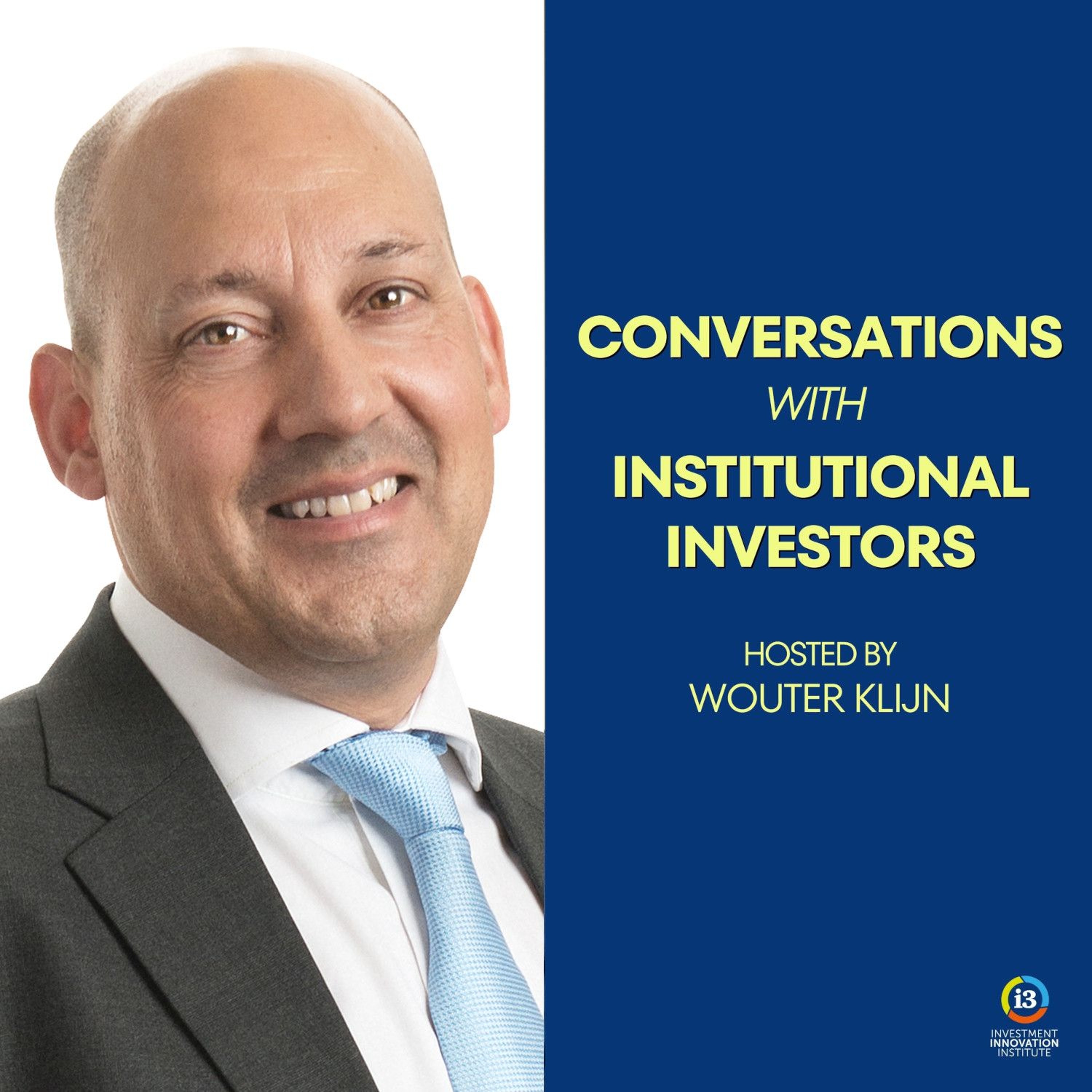 113: FCLT's Eduard van Gelderen – Long Term Investing, Concentrated Portfolios and Decarbonisation | Eduard van Gelderen is Head of Research for Focusing Capital on the Long Term (FCLT), an organisation that was established in the wake of the Global Financial Crisis, or Great Recession as it is known in the US, to move away from a so-called "quarterly capitalism", which arguably contributed to the crisis, and towards a true long-term mind-set. Van Gelderen joined FCLT in 2024, after spending over six years as the Chief Investment Officer of pension fund PSP in Montreal, Canada. He is also well-known for his role as CEO of APG Asset Management, the investment arm of pension behemoth APG, in the Netherlands. In episode 113 of "Conversations with Institutional Investors", Van Gelderen discusses whether private equity can be a model for long term investing, dealing with concentration in portfolios, decarbonisation and the rise of A.I. Enjoy the Show! Overview of podcast with Eduard van Gelderen, FCLT 03:00 In 2026, FCLT celebrates its 10 year anniversary 04:00 When I was CEO of APG AM, we became one of the first members of FCLT 05:00 Three things are important to me: innovation, strategic thinking and having an impact 07:00 Dominic Barton of McKenzie and Keith Ambachtsheer and long term investing 08:00 If corporates are too short-term focused, then they will not invest enough in truly value generating projects 11:30 I do like the private equity model, but they still look to exit in about five years. Is that really long-term investing? 13:00 One of the nice things to see when I moved to Canada is the difference in board composition 17:00 Is passive investing leading to fragmented ownership and therefore less stakeholder engagement? 18:00 If you really understand the business models of the companies you invest in, then you can be much more concentrated and still be diversified 20:00 Diversification is possible, not with a small number [of assets], but definitely with a more limited number of names than the index 23:30 Sectors that are carbon intensive will need to do something or they will be punished, weather it is by governments, or regulators. For investors this means there is a financial reality here 24:00 But at this point the carbon price is too low for investors to make a decision 25:00 If I diversify over different sectors, then I need to use the less intensive sectors to hedge what I do in the carbon intensive sectors. That is a portfolio construction question 26:00 Stranded business models: It has happened before. The ones that reacted to all the opportunities that the internet offered became the winners, but there were certainly companies that completely missed the boat. I'm convinced that we are going through the same cycle again. 29:00 I don't think A.I. is just a toy; I think it is going to disrupt a lot of things that we take for granted 31:30 How will A.I. impact the business model of an investment manager? There will be operational efficiencies, but where managers are not yet very advanced is about 'How can we do advanced analytics?' And it is not just about alpha generation, it is also about portfolio construction, risk management and trading 35:30 I do think we need to rethink diversification in the current uncertain environment 39:00 Upcoming research projects: future fit boards and proxy voting 43:00 I truly believe that public and private markets will merge at some point; it is really a data issue Follow the Investment Innovation Institute [i3] on Linkedin Subscribe to our Newsletter Explore our library of insights from leading institutional investors at [i3] Insights | — | ||||||
| 4/29/25 |  112: Fulcrum's Suhail Shaikh – Absolute Return Investing, Market Timing and The Role of Luck | Suhail Shaikh is Chief Investment Officer of Fulcrum Asset Management and is the portfolio manager of Fulcrum's Discretionary Macro and Diversified Absolute Return strategies. In today's incredibly volatile environment of tariff wars and deglobalisation, investors tend to be more sensitive about the level of their absolute returns, than their performance against the benchmark. In this episode, we delve into the philosophy of absolute return investing, we talk about the role of skill versus luck, the use of Nowcasting, learnings from the COVID-19 pandemic and the ever controversial topic of market timing. Enjoy the show! 02:00 Started off working on the intranet and taught myself HTML 02:30 Internship at Goldman Sachs 03:30 A lot of well-known global macro traders made their money during equity market crashes 05:00 If you are constantly looking for the next accident, then 90 per cent of the time you are wrong. It is important to make money while the sun is still shining 10:00 Crisis risk offset and momentum during COVID 13:30 Leaving the model aside 15:00 Using Nowcasting for analysis 18:30 AI has been more useful to us in portfolio construction, risk management, scenario analysis and stress testing. I'm more sceptical about AI being helpful in alpha generation. 22:30 Behavioural finance and Fulcrum paper: 'Don't Bet the Ranch' 23:30 To determine whether someone is skilled or lucky, look at the number of views they take over time 31:30 Sizing [trades] is a complex topic 33:00 The role of dynamic asset allocation 34:00 "The biggest accidents in asset management happen when, in a draw-down, people don't know whether they are benchmarked or absolute return" 35:00 "Dynamic asset allocation is market timing" 40:00 Global Macro and the Magnificent Seven 42:00 Bitcoin and momentum strategies 44:30 Some clients explicitly prohibit us from investing in Bitcoin The paper "Don't Bet The Ranch: Hit ratios, asymmetry and breadth" can be found at: https://fulcrumasset.com/insights/investment-insights/dont-bet-the-ranch-hit-ratios-asymmetry-and-breadth/ Follow the Investment Innovation Institute [i3] on Linkedin Subscribe to our Newsletter Explore our library of insights from leading institutional investors at [i3] Insights | — | ||||||
| 4/2/25 |  111: ART's Michael Weaver – The Role of Real Assets in a Pension Portfolio | In episode 111 of the [i3] Podcast, we speak with Michael Weaver, who is the Head of Global Real Assets with the Australian Retirement Trust. We discussed the role of real assets in the context of a multi-asset, pension portfolio, the ever-lurking threat of inflation, the return of office property and more. Please enjoy the show! Overview of Podcast with Michael Weaver, Head of Global Real Assets, ART 02:00 Role of real assets in a multi-asset portfolio 03:30 We don't call them mid-risk, but it is a similar philosophy 06:30 Inflation: what we are most worried about is unexpected inflation 08:00 We would expect to grow our infrastructure portfolio in Australia, but also internationally. 09:00 Benefits of larger scale, post merger 12:00 Massively expand the real asset team, no. But expand yes. 16:00 Retail and Office property: we are actively looking at new investments 20:00 Did Covid wobble your confidence in airports? Wobble is probably a good word. 25:00 Impact of data centres on power generators 27:30 Multi-family, build-to-rent property 33:00 Energy transition assets Follow the Investment Innovation Institute [i3] on Linkedin Subscribe to our Newsletter Explore our library of insights from leading institutional investors at [i3] Insights | — | ||||||
Showing 25 of 134
Sponsor Intelligence
Sign in to see which brands sponsor this podcast, their ad offers, and promo codes.
Chart Positions
1 placement across 1 market.
Chart Positions
1 placement across 1 market.