

Insights from recent episode analysis
Audience Interest
Podcast Focus
Publishing Consistency
Platform Reach
Insights are generated by CastFox AI using publicly available data, episode content, and proprietary models.
Most discussed topics
Brands & references
Est. Listeners
Insufficient chart data. Estimates will improve as the show charts.
- Per-Episode Audience
Est. listeners per new episode within ~30 days
N/A🎙 Weekly cadence·117 episodes·Last published 1w ago - Monthly Reach
Unique listeners across all episodes (30 days)
N/A - Active Followers
Loyal subscribers who consistently listen
N/A
Market Insights
Platform Distribution
Reach across major podcast platforms, updated hourly
Total Followers
—
Total Plays
—
Total Reviews
—
* Data sourced directly from platform APIs and aggregated hourly across all major podcast directories.
On the show
From 12 epsHost
Recent guests
Recent episodes
Justice by Algorithm? AI, Job Anxiety, and the Future of Courts
Jun 16, 2026
Unknown duration
The Disappearing Line: What are the New Ethics in an Era Where Nothing Is Neutral?
Jun 1, 2026
22m 42s
Court Leader's Advantage 5/19/2026 Episode - Do We Need to Rethink Public Outreach?
May 18, 2026
29m 46s
Court Leader's Advantage 4/21/2026 Episode: NACM Midyear: What Was Your Biggest Takeaway?
Apr 20, 2026
22m 01s
The Upskill Battle: Courts and Employee Career Development
Mar 16, 2026
27m 22s
Social Links & Contact
Official channels & resources
Official Website
Login
RSS Feed
Login
| Date | Episode | Topics | Guests | Brands | Places | Keywords | Sponsor | Length | |
|---|---|---|---|---|---|---|---|---|---|
| 6/16/26 | 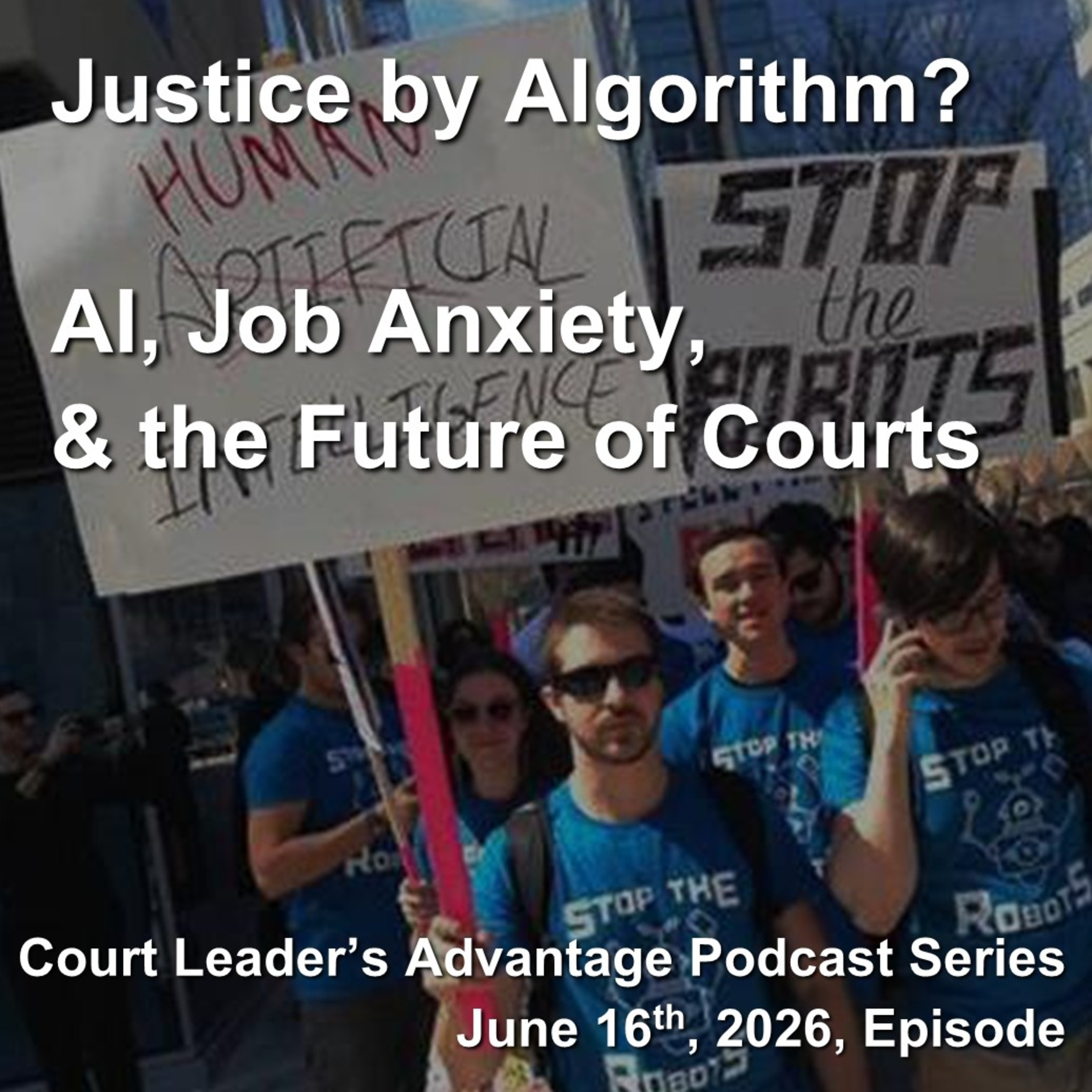 Justice by Algorithm? AI, Job Anxiety, and the Future of Courts | June 16th, 2026, Court Leader’s Advantage Podcast EpisodeWhen former Google CEO Eric Schmidt, real estate executiveGloria Caulfield, and music executive Scott Borchetta praised artificial intelligence during recent commencement addresses, graduates responded not with applause but with boos. For a growing number of Americans, especially youngerworkers entering the workforce, AI is no longer viewed primarily as a tool of innovation and opportunity. Rather, it is increasingly seen as a threat to jobs, economic security, and public trust.The concerns are multifaceted. AI's massive demand forelectricity and water raises environmental questions. Its capacity to generate misinformation and "hallucinated" facts raises concerns about public trust and the integrity of information. Most significant for Generation Z, however, is the fear that AI will fundamentally alter the job market andundermine economic security.Many technology leaders appear largely unmoved by theseconcerns. Sam Altman, CEO of OpenAI, has argued that fears of widespread job displacement are overstated. Jensen Huang, CEO of Nvidia, contends that workers will not lose jobs to AI itself, but rather to workers who know how to use AImore effectively. Jeff Bezos, founder of Amazon, has similarly predicted that AI will increase productivity, create new opportunities, and improve living standards rather than simply eliminate jobs.The public remains unconvinced.A March 2026 Quinnipiac University poll found that 70% ofAmericans believe AI will reduce the number of available jobs. Among Generation Z, concern is even more pronounced, with 81% believing advances in artificial intelligence are likely to decrease employment opportunities.These concerns are fueled by highly visible workforcereductions. In 2025, Amazon announced approximately 14,000 corporate layoffs while acknowledging that AI-enabled efficiencies played at least a partial role in workforce reductions.[i] UPS announced plans to eliminate 20,000 positions. While the main reason for the reduction in force was a pullback by Amazon, CEO Carol Tomé also cited efficiencies from implementing AI.[ii] Cisco reduced itsworkforce by more than 4,000 employees while increasing its focus on AI-driven networking and security products.[iii] For many workers the message is unmistakable: artificial intelligence means fewer jobs rather than greater opportunity.Courts have historically been cautious adopters of newtechnology, and artificial intelligence appears to be no exception. Yet courts also face chronic staffing shortages, budget constraints, growing caseloads, and increasing pressure to improve efficiency. State legislatures, funding authorities, and court leaders may soon begin asking whether AI can help courts accomplish more with fewer resources.This month, we examine the growing backlash againstartificial intelligence. Is it a temporary reaction or the beginning of a lasting shift in public attitudes? Are court professionals and the public prepared for the inevitable transition? [i]Variety, "Amazon Says It Will Lay Off 14,000 Corporate Workers, Citing AI" (October 31, 2025)[ii] Gulf News, "AI Job Cuts: Major Companies Replacing Humans with Bots in 2025" (February 21, 2026)[iii] PBS (October 28, 2025), “Despite reporting record quarterly revenue of $15.8 billion — up 12% year-over-year —Cisco announced layoffs representing less than 5% of its global workforce, as the company realigned around AI-driven growth”Today's PanelTJ BeMent Court Administrator, 10th Judicial Administrative District Athens, GeorgiaRick Pierce Judicial Programs Administrator, Administrative Office of the Courts, Mechanicsburg, PennsylvaniaKarl Thoennes Court Administrator, Second Judicial Circuit Court, Sioux Falls, South DakotaCreadell Webb Diversity, Equity, and Inclusion Officer, 1st Judicial District of Pennsylvania, Philadelphia,Pennsylvania | — | ||||||
| 6/1/26 | 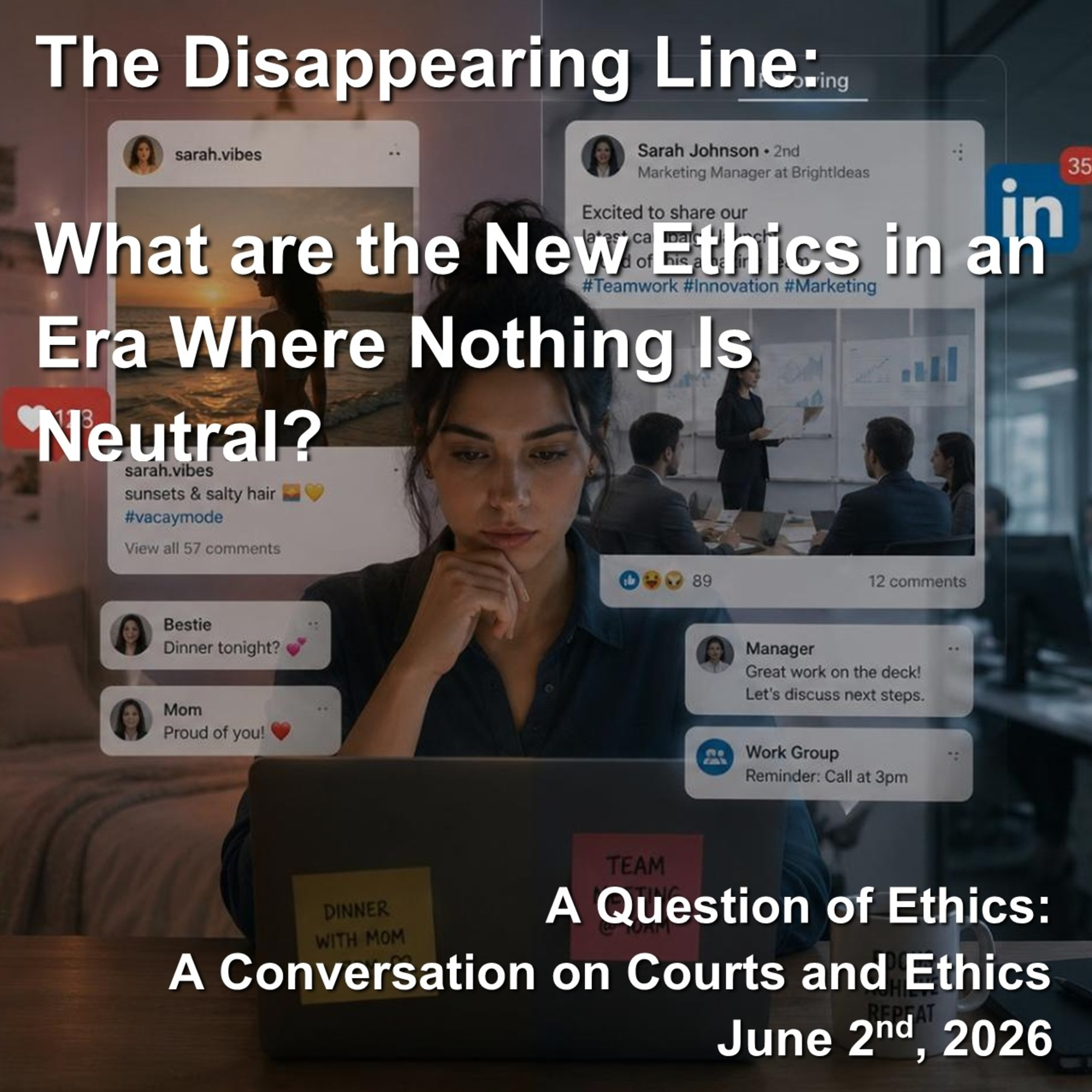 The Disappearing Line: What are the New Ethics in an Era Where Nothing Is Neutral?✨ | ethicscourt professionals+3 | — | Model Code | — | ethicscourt+5 | — | 22m 42s | |
| 5/18/26 |  Court Leader's Advantage 5/19/2026 Episode - Do We Need to Rethink Public Outreach?✨ | public outreachcourt system+4 | — | FBIDateline+2 | — | courtspublic outreach+5 | — | 29m 46s | |
| 4/20/26 |  Court Leader's Advantage 4/21/2026 Episode: NACM Midyear: What Was Your Biggest Takeaway?✨ | NACM Midyear ConferenceRule of Law+2 | — | the Pima County Consolidated Justice Courtsthe Institute for Court Management+5 | TucsonArizona+5 | justice systembest practices+2 | — | 22m 01s | |
| 3/16/26 | 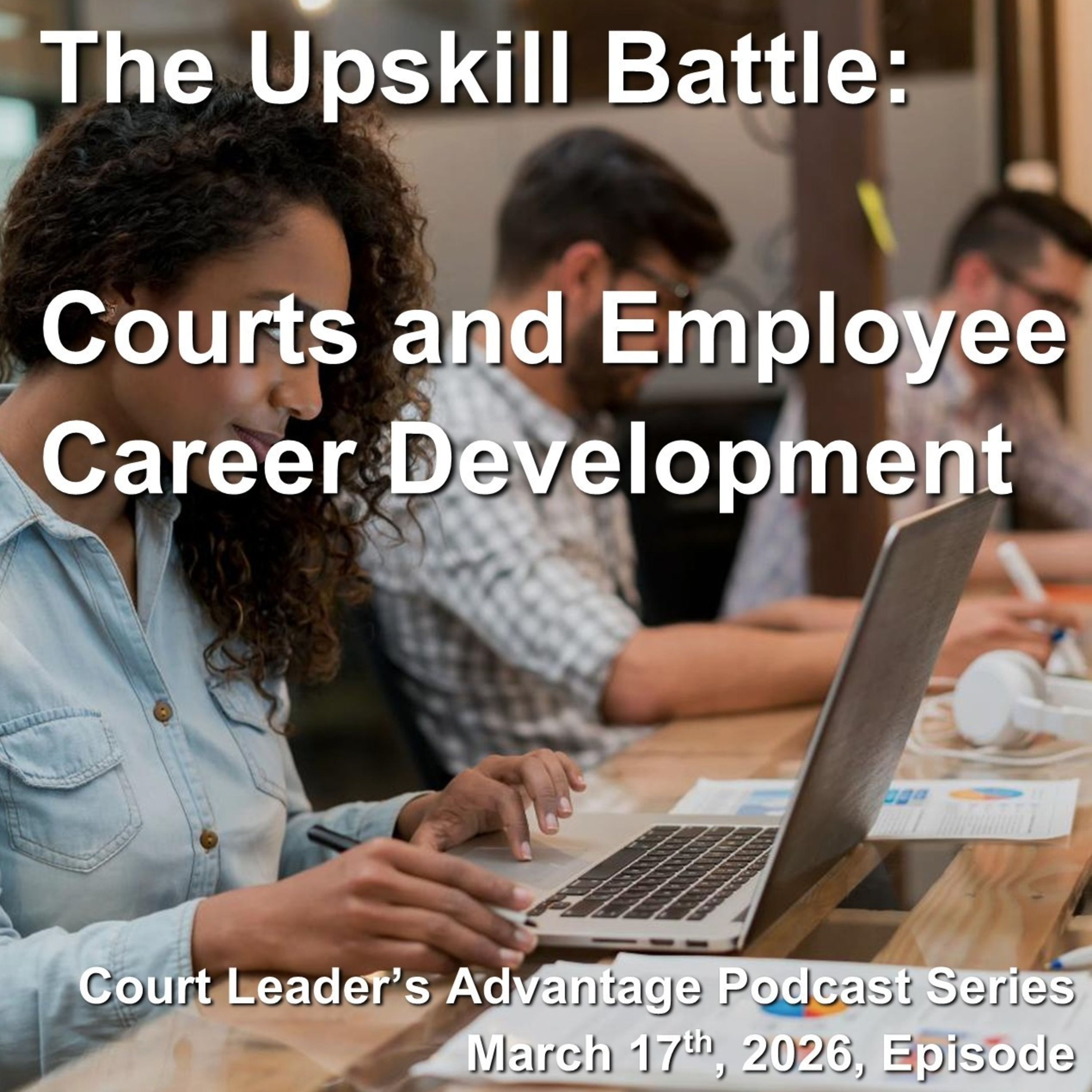 The Upskill Battle: Courts and Employee Career Development✨ | career developmentemployee engagement+1 | — | the Court ManagerFederal Court+2 | — | performance improvementemployee retention+1 | — | 27m 22s | |
| 2/28/26 |  Reimagining Access to Justice: Should Courts Go More into the Community?✨ | Access to JusticeCourts+1 | — | the Alaska Legal Services Corporationthe Alaska Legal Services Corporation’s+6 | AnchoragePhiladelphia+3 | legal problemscommunity engagement+2 | — | 26m 52s | |
| 2/16/26 |  AVA and the Courts: What Can We Learn from Alaska’s Bold Experiment with Artificial Intelligence?✨ | artificial intelligencecourt systems+2 | Jeannie SatoAubrie Souza+1 | the Alaska Virtual Assistant (AVAAVA+8 | AlaskaPortland+1 | Alaska Virtual Assistantcourt technology+1 | — | 33m 45s | |
| 1/19/26 |  Workplace Mediation: Can It Change the Way We Handle Conflict? What Courts Need to Know✨ | workplace mediationconflict resolution+2 | — | the U.S. Equal Employment Opportunity Commissionthe Multnomah County Circuit Court+5 | U.S.Portland+4 | dispute resolutionemployee burnout+3 | — | 30m 04s | |
| 12/15/25 |  Can Hiring a Court Manager Be Merit-Based?✨ | court managementmerit-based hiring+2 | — | the Unified Judicial SystemSuperior Court+3 | PierreSouth Dakota+4 | merit systemobjectivity+3 | — | 29m 15s | |
| 11/18/25 |  Who Speaks for the Unrepresented? Exploring New Models for Legal Access✨ | legal accesscommunity justice+2 | — | NACMthe Alaska Legal Services Corporation+6 | AmericaUtah+7 | legal representationjustice system+3 | — | 34m 38s | |
Want analysis for the episodes below?Free for Pro Submit a request, we'll have your selected episodes analyzed within an hour. Free, at no cost to you, for Pro users. | |||||||||
| 11/17/25 |  Unpacking Mentorships What is the Potential? What are the Pitfalls? What is the Path to Growth?✨ | mentorshipprofessional growth+1 | — | NACMPima County Consolidated Justice Courts+3 | TucsonArizona+5 | game-changerexperience+3 | — | 33m 21s | |
| 9/15/25 |  Disengaged and Disappearing: What Is the Threat to Our Courts?✨ | employee disengagementworkplace culture+2 | — | Gallup CorporationGallup+5 | the United StatesU.S.+7 | Gallup reportengagement statistics+2 | — | 34m 09s | |
| 8/16/25 |  Divided Justice: Can We Overcome the Tension Between Urban Power and Rural Reality in America’s Courts✨ | urban courtsrural courts+3 | Melinda BrooksTimothy Ezell | AI-assisted litigant self-helpvirtual hearings+6 | AmericaPhoenix+7 | court systemsjustice+2 | — | 23m 52s | |
| 7/13/25 |  Justice by Design: Can We Achieve Open, Standardized Court Data? | July 15th, 2025, Court Leader’s Advantage Podcast EpisodeOne of the major challenges facing state trial courts today is the disturbing lack of accurate national statistical data. Beneath the surface of our justice system lies a troubling truth: we often don’t know, we can’t know, what’s really happening.How many cases do our courts handle? What kinds? How efficiently? Without reliable data, we are left to make educated guesses in the dark. This absence of clarity is not accidental, it is the result of a decentralized system ofjustice.Some of the results include:Lack of Uniform Court CodingWhat one court calls a “hearing,” another might call a “conference.” These differences seem small, but they add up to a patchwork of mismatched codes, formats, and definitions across jurisdictions.Limited Data Transparency and Public AccessEven when data exists, it is often locked behind arcane systems, hard to find, and harder to interpret.Hurdles with Data SharingDisconnected technologies, legacy systems, and inconsistent standards create silos of information making collaboration truly a challenge.Inability to Measure Performance and OutcomesWithout standardized metrics, we can't track how long cases take, how they’re resolved, or whether justice is truly being served. It’s like trying to navigate with a map that constantly changes shape. Addressing this challenge is the National Open Court Data Standards project (NODS). It is a collaborative effort led by the National Center for State Courts, the Conference of State Court Administrators, and the Joint Technology Committee.By creating shared standards for collecting, sharing, and interpreting court data, NODS shines a light in the shadows, allowing courts to operate with greater transparency, efficiency, and consistency.This month, we are looking at the National Open Court Data Standards project. We explore how this effort will transform access to court data for researchers, policymakers, the media, and the public. Today’s Panel: The Honorable W. Brent Powell, Judge on the MissouriSupreme Court.T.J. BeMent, Court Administrator for the 10th Judicial District Court in Athens, GeorgiaLaura Ritenour, Caseflow Management Specialist for the Administrative Office of the Courts, Phoenix, ArizonaBecome part of the Conversation. Submit your comments and questions to CLAPodcast@nacmnet.org | — | ||||||
| 6/16/25 |  Improving Access to Justice – One State’s Experience | Court Leader’s Advantage Podcast Episode June 17, 2025Civil case filings per capita have been declining nationally for decades. John Greacen and Alan Carlson explained this in their book, What Is Happening to State Trial Court Civil Filings? The absolute number of civil filings in state courts has increased somewhat, however overall filings have not kept pace with population growth and have been in a long-term decline. Meanwhile, the National Center for State Courts' annual State of the State Courts poll reported that public trust and confidence in the state courts rose in 2024 to 63%. However, this figure has stagnated between 60% and 64% over the past four years. These troubling numbers raise some important questions: How are people resolving their disputes? How are people now resolving their disputes? Are they, in fact, resolving them at all? One thing is certain: more and more, people are not turning to the courts, the traditional venue for peacefully settling conflict.What can we do about this trend?What can we do about this trend? How can we encourage the public to once again rely on America’s courts to address their issues? This month, we explore how Arizona is tackling the challenge of Access to Justice. Arizona's Supreme Court’s Access to Justice Committee has been working to rebuild public trustand encourage people to return to the courts as a reliable resource for resolving their disputes. Today's PanelThe Honorable Samuel A. Thumma, Judge on the Arizona Court of Appeals Mr. Kip Anderson, Court Administrator for the Mohave County Superior Court in Kingman Arizona, Dr. Kevin Ruegg, Chief Executive Officer for the Arizona Bar FoundationJudge Thumma is Chair of the Arizona Access to Justice Committee; both Dr. Ruegg and Kip Anderson aremembers of that committee. Become part of the Conversation. Submit your comments and questions to CLAPodcast@nacmnet.org | — | ||||||
| 5/19/25 |  AI in the Courts: Are Your Policies and Training Ready for the Future? | Court Leader’s Advantage Podcast Episode May 20, 2025Artificial Intelligence (AI) is no longer just a futuristic concept, it is already reshaping how we live and work. Courts are no exception. With its immense power, AI is transforming the justice system in ways we could have only imagined a few years ago. Here’s how AI’s power is already making waves:Unmatched Efficiency: AI can produce polished reports, memos, and articles in mere minutes—dramatically reducing the time and effort needed for routine tasks.Instant Access to Information: AI enables litigants,families, and other court users, to engage in meaningful conversations about procedures without relying on human staff.Sharper Decision-Making: AI-driven insights are helping leaders make more informed, data-backed judicial and administrative decisions.Compelling Presentations: AI tools are enhancing professional presentations and transforming complex ideas into easily digestible information for audiences. Yet, with all this potential comes a need for caution. The NACM AI Guide strongly emphasizes the importance of training and comprehensive policies to mitigate risk while unlocking AI’s potential. This month, we’ll tackle two critical questions: How can courts ensure they’re getting the right AI training? And what does a comprehensive AI policy look like? Courts will needto answer these questions in order to harness AI effectively—and responsibly. Today’s PanelStacey Marz, Administrative Director for the Alaska CourtSystem, Anchorage, Alaska Shay Cleary, Managing Director for Court Consulting Services at the National Center for State Courts, Williamsburg, VirginiaTina Mattison Deputy Court Administrator for the Pima County Consolidated Justice Courts in Tucson, Arizona Become part of the conversation. Submit your comments and questions to CLAPodcast@namnet.org | — | ||||||
| 4/15/25 |  The Future of Hiring: Is There a Balance Between AI, Diversity, and Court Expertise? | April 15, 2025, Court Leader’s Advantage Podcast EpisodeEmployee hiring is at a crossroads. With artificial intelligence (AI) revolutionizing the way resumes and applications are screened, employers—including courts—are rethinking how they identify top talent. At the same time, the push for greater diversity means evaluating candidates from vastly different backgrounds using a common set of standards.Courts are grappling with severe staffing shortages, struggling to find candidates who not only have technical expertise but also the interpersonal skills to navigate high-stakes legal and personal matters with litigants and families. With these challenges converging, one question looms large: How do you hire the right candidate in this volatile environment?This month we will explore the dynamic tension between the quest for increased diversity and keeping evaluations unbiased. We will discuss the quest to find a balance at a time when artificial intelligence is potentially changing the very rules for selecting new talent.Today’s PanelCreadell Webb Chief Diversity, Equity and Inclusion Officer, Philadelphia CourtsT.J. BeMent Court Administrator, 10th Judicial Administrative District, Athens, GeorgiaElizabeth Moss Human Resources Director, Alaska Court System, Anchorage.Sara Kujawski Manager, HR Talent Strategy & Management, State Court System, St. Paul, MinnesotaBecome Part of the Conversation!Leave a question or comment about the episode at clapodcast@nacmnet.org | — | ||||||
| 4/2/25 |  Artificial Intelligence: Ethics and Courts | Question of Ethics Conversation: January 23, 2025Artificial intelligence has the potential to reshape the judicial system. AI-powered tools, from legal research assistants to sentencing algorithms and customer service chatbots, offer efficiency but also introduce risks, particularly bias. Additionally, the confidentiality of court records and legal proceedings becomes a pressing concern, as AI systems require vast sums of data for training—potentially exposing sensitive information to breaches or misuse.While AI chatbots improve accessibility by guiding litigants through procedural questions, the possibility of providing incorrect information and the prohibition against providing legal advice highlights the need for careful human oversight.As courts integrate AI into their operations, how do we ensure transparency, accountability, and fairness? What ethical and legal questions arise?Today's Moderator Creadell Webb, Chief Diversity, Equity, and Inclusion Officer for the 1st Judicial District in Philadelphia, PennsylvaniaToday's ModeratorCreadell Webb Chief Diversity, Equity, and Inclusion Officer for the 1st Judicial District in Philadelphia, PennsylvaniaToday’s PanelCourtney Whiteside Director, Municipal Court St. Louis, MissouriAlison Braaton Clerk of District Court, Grand Forks County, North DakotaAndrea Powers Human Resources Director, Idaho Court System, Boise, IdahoAmy Emig Business Development Manager, Enterprise Technology Services Division, Oregon Judicial Department, Salem, OregonKelly Hutton Court Administrator, North Dakota Court System, Grand Forks, North DakotaPeter Kiefer host of the Court Leader’s Advantage Podcast SeriesNickolas Brackley Technology and Solutions Specialist, Enterprise Technology Services Division, Oregon Judicial Department, Salem, OregonNorman Meyer, Retired Clerk of the United States Bankruptcy Court for the District of New MexicoRoger Rand IT Manager, Multnomah Circuit Court, Portland, Oregon | — | ||||||
| 3/17/25 |  How Do We Navigate the Tension Between Cities and Municipal Courts? | March 18, 2025, Court Leader’s Advantage Podcast EpisodeThe relationship between cities and their municipal courts is often marked by underlying tension. While courts must function independently, their close ties to city governments can create friction over revenue, resources, and oversight.Underfunded municipal courts frequently struggle with case backlogs, understaffing, and limited access to justice. Judicial independence and the autonomy of other elected officials, such as the Clerk of Court, can also be at risk when city governments exert influence over judicial appointments, salaries, or case outcomes. This interference undermines the courts' ability to serve as impartial arbiters of the law.This month we will explore the tension between cities and municipal courts. We will also discuss how municipal courts can navigate these challenges.Today’s Panelists• Lizzie Alipaz, Court Clerk and Deputy Town Clerk for the Town of Timnath, Colorado• Lori Tyack, elected Clerk of Court for the Franklin County Municipal Court in Columbus, Ohio and• MiHa Kapaki, Court Administrator for the Grays Harbor County District Court in Montesano, WashingtonLeave a question or comment about the episode at clapodcast@nacmnet.org | — | ||||||
| 2/16/25 |  Trauma-Informed Engagement and the Courts: What We Need to Know Now? | February 18, 2025 , Court Leader’s Advantage Podcast EpisodeUnderstanding trauma-informed engagement is increasingly essential for court employees and judges. Many—if not most—individuals who interact with the court system have experienced significant trauma. Whether they are litigants, witnesses, or defendants, they often carry the invisible weight of past or ongoing adversity.A trauma-informed approach helps court professionals recognize signs of trauma and respond in ways that foster trust, reduce stress, and minimize the risk of re-traumatization. Additionally, this approach supports the well-being of court employees by equipping them with strategies to navigate difficult interactions while mitigating the impact of secondary traumatic stress on themselves.This month, we are exploring the role of trauma-informed engagement in court interactions. How can courts further integrate this critical practice to enhance fairness, empathy, and effectiveness in the justice system?Today's Panel: Carrie Summer-Namura, Program Coordinator for the Clackamas County Circuit Court, in Oregon City, OregonJill Houck, Trial Court Administration for the Superior Court in Cape May and Atlantic Counties New JerseyTrent Baker, Program Coordinator for Early Childhood Court, Dependency Drug Court & Juvenile Drug Court, 17th Judicial District, Fort Lauderdale, FloridaLeave a question or comment about the episode at clapodcast@nacmnet.org | — | ||||||
| 1/27/25 |  Data Analytics: Data, Courts, and Ethics | November 21st, 2024, Question of Ethics Conversation Copilot describes data literacy as understanding, interpreting, and using data effectively. It involves knowing how to read charts and graphs, understanding statistics, and being able to critically evaluate data sources for their reliability and relevance. Just as how literacy with words helps you comprehend and communicate in language, data literacy empowers you to navigate and make sense of the vast amounts of data we encounter daily. Problem Analysis is an often-overlooked component of decision-making. In this episode we discuss data literacy and how it intersects with ethics in the courts. Episode Moderator: Roger Rand, IT Manager, Multnomah County Circuit Court, Portland, Oregon Episode Panel: Courtney Whiteside, Director, Municipal Court, St. Louis, Missouri. Courtney is also the chair of the NACM Ethics Subcommittee. Stacy Worby, State Jury Coordinator, Alaska State Court System, Anchorage. Ellen Haines, Supervisor, IT Training & Data Analysis Department, Multnomah Circuit Court, Portland, Oregon Peter Kiefer, Host, Court Leaders Advantage Podcast Series, Auburn, New York. Jeff Chappell, Court Administrator, Municipal Court, O'Fallon, Missouri. Creadell Webb, Chief Diversity, Equity, & Inclusion Officer, 1st Judicial District, Philadelphia, Pennsylvania. Leave a question or comment at ethics@nacmnet,org Join the Question of Ethics Conversation held after the Subcommittee meetings every fourth Thursday of the month at 2:00 pm ET. | — | ||||||
| 1/18/25 |  What are the Five Biggest Opportunities Facing Young Workers Today? | January 21, 2025, Court Leader’s Advantage Podcast Episode Last month we talked about the five biggest issues facing young workers. This month we will look at the five biggest opportunities young workers have in 2025. The five are: The opportunity to Develop Valuable Digital Skills & Technological Expertise Access to Continuous Learning and Development to expand their knowledge & skills The Chance to Build a Global Network of peers and mentors The ability to excel at Collaboration & Connectivity which enhances team dynamics, and The opportunity to find a career where they Feel Valued & Seen Today’s Moderator: Erika Schmid, Supervisor, Multnomah Circuit Court, Portland Oregon Today’s Panel: Samantha Wallis, Assistant Court Administrator, District Court, Coeur d’Alene, Idaho Daniel Meza Rincón, Deputy Juvenile Court Administrator, Utah Administrative Office of the Courts, Salt Lake City Victoria Murray, Business Intelligence Analyst & Supervisor, Maricopa Superior Court, Phoenix, Arizona. Carrie Summers-Nomura, Program Coordinator, Clackamas County Circuit Court, Oregon City, Oregon Courtney Whiteside, Director, Municipal Court, St. Louis, Missouri Leave a question or comment about the episode at clapodcast@nacmnet.org | — | ||||||
| 12/15/24 |  What are the Five Biggest Issues Facing Young Workers Today? | December 17, 2024, Court Leader’s Advantage Podcast Episode This month and in January we’re looking at the 5 biggest issues and the 5 biggest opportunities facing young workers today. This month we will consider the five biggest issues which include: • Work-Life Balance • Job Security • Mental Health and Well-Being • Diversity, Equity, and Inclusion (DEI) • Career Development and Growth Opportunities Moderator Erika Schmid Supervisor, Multnomah Circuit Court, Portland, Oregon Today’s Panel Samantha Wallis Assistant Court Administrator, District Court, Coeur d’Alene, Idaho Daniel Meza Rincón Deputy Juvenile Court Administrator, State of Utah, Salt Lake City, Utah Victoria Murray Business Intelligence Analyst & Supervisor, Maricopa Superior Court, Phoenix, Arizona. Carrie Summers-Nomura Program Coordinator, Clackamas County Circuit Court, Oregon City, Oregon Courtney Whiteside Director, Municipal Court, St. Louis, Missouri Leave a question or comment about the episode at clapodcast@nacmnet.org | — | ||||||
| 12/2/24 |  Ethics and Problem Analysis | September 26, 2024, Question of Ethics Conversation Problem Analysis is an often-overlooked component of decision-making. There are several highly effective business problem analysis models, each tailored for different types of challenges. Some of the most popular models: • Root Cause Analysis which includes techniques such as “The Five Whys” and the “Ishikawa Fishbone Diagram” • SWOT Analysis (Strengths, Weaknesses, Opportunities, Threats) • Gap Analysis which includes identifying gaps between where an organization is and where it needs to be, then focusing on areas of improvement. There are several ethical concerns when conducting good problem identification and analysis. • What if you cannot obtain the political buy-in needed to properly analyze the problem? • How do you properly identify and analyze a business problem with a strong political undercurrent? • How do you proceed if a solution is already laid out for you? • When we become operationally aligned with a decision-maker do we run the risk of “preemptive avoidance” where we decide not to initiate a topic because we know it will provoke a negative response? Today’s Panel • Samantha Wallis - Deputy Trial Court Administrator, Supreme Court, Coeur d’Alene, Idaho • Rick Pierce - Judicial Programs Administrator, Administrative Office of the Pennsylvania Courts • Stacy Worby - State Jury Coordinator for the Alaska Court System • Creadell Webb - Chief Diversity, Equity, & Inclusion Officer, 1st Judicial District, Philadelphia, Pennsylvania Leave a question or comment at ethics@nacmnet,org Join the Question of Ethics Conversation held after the Subcommittee meetings every fourth Thursday of the month at 2:00 pm ET. | — | ||||||
| 10/14/24 |  Artificial Intelligence Is Already Here: Is Your Staffing Using It? Do You Know? Do You Care? | October 15, 2024, Court Leader’s Advantage Podcast Episode Forbes Magazine recently published an article titled “10 Biggest Business Trends Everyone Must Be Ready For Now.” The list? 1. Generative Artificial Intelligence Will Be Everywhere. 2. Demand for Interpersonal Skills 3. The Move to Sustainable Business 4. Business Resilience 5. Personalization of the Customer Experience at Scale 6. A Customer Experience Revolution 7. The Data Economy 8. The Search for Skills Solutions 9. Employees Demand Remote Work opportunities 10. The Shift to Diversity and Inclusivity Many court administrators appear to see artificial intelligence as an IT issue. However, it is definitely a consumer-based concept now. A short time ago, the venture capital firm Andreessen Horowitz announced its top 100 consumer AI apps. The most popular one by far? ChatGPT, trailed by other tools including Microsoft CoPilot, Google’s Gemini and Bing, Character AI, Perplexity, Claude, and even Grammarly. These tools can create compelling text in seconds. It can significantly shorten the job of developing reports, briefs, presentations, and emails. There has also been considerable discussion about the problems with these tools. Hallucinations Lack of Transparency Appropriating Personal & Confidential Information Bias This month we’re looking at the court’s position on using consumer AI tools. Is it occurring? Are courts aware of these tools? Do we think that staff might be using them with or without the knowledge of upper management? Are courts even concerned about them? Today’s Panel: Roger Rand Information Technology Manager, Multnomah County Circuit Court, Portland, Oregon T,J BeMent District Court Administrator, 10th Judicial Administrative District, Athens, Georgia Lori Tyack Clerk of Court, Franklin County Municipal Court, Columbus, Ohio Dana Bartocci Human Resources & Development Director, Minnesota Judicial Branch Leave a question or comment about the episode at clapodcast@nacmnet.org | — | ||||||
Showing 25 of 120
Pitch Fit is a Pro feature
See how bookable this show is for guests, which brands already advertise, the per-episode ad value, and the best-fit guest and sponsor profile. The numbers are blurred on the free plan.
How readily this show books outside guests like you.
How proven this show is for host-read sponsorships.
For Guests
ProFor Advertisers
ProUpgrade to Pro to unlock guest cadence, sponsor categories, fit scores, and per-episode ad value for this show.