
Insights from recent episode analysis
Audience Interest
Podcast Focus
Publishing Consistency
Platform Reach
Insights are generated by CastFox AI using publicly available data, episode content, and proprietary models.
Est. Listeners
Based on iTunes & Spotify (publisher stats).
- Per-Episode Audience
Est. listeners per new episode within ~30 days
1 - 1,000 - Monthly Reach
Unique listeners across all episodes (30 days)
1 - 5,000 - Active Followers
Loyal subscribers who consistently listen
1 - 500
Market Insights
Platform Distribution
Reach across major podcast platforms, updated hourly
Total Followers
—
Total Plays
—
Total Reviews
—
* Data sourced directly from platform APIs and aggregated hourly across all major podcast directories.
On the show
Recent episodes
Episode 18: Rupture Theory (Ft. Cam West)
Apr 30, 2026
1h 15m 56s
Episode 17: Who Paid The Riddler of Western Marxism? (Part 2)
Apr 21, 2026
1h 11m 24s
Episode 16: Who Paid The Riddler of Western Marxism? (Part 1)
Apr 21, 2026
1h 11m 14s
Episode 15: Wokeness Must be Defended
Apr 3, 2026
1h 13m 45s
Episode 14: Theoretical Players' Ball
Mar 21, 2026
1h 06m 41s
Social Links & Contact
Official channels & resources
Official Website
Login
RSS Feed
Login
| Date | Episode | Description | Length | ||||||
|---|---|---|---|---|---|---|---|---|---|
| 4/30/26 |  Episode 18: Rupture Theory (Ft. Cam West) Episode 18: Rupture Theory (Ft. Cam West) | J. E., Cam, and Mac are joined by Cam West of Negation Magazine to discuss his essay "Rupture Theory" and the possibility of politics at a distance from the state. We discuss the status of the party-form, the dialectic of spontaneity and organization, and so on, especially as they pertain to the last 10 years in the US.Cam West's article = https://www.negationmag.com/articles/rupture-theory | 1h 15m 56s | ||||||
| 4/21/26 |  Episode 17: Who Paid The Riddler of Western Marxism? (Part 2) Episode 17: Who Paid The Riddler of Western Marxism? (Part 2) | By popular demand, J. E. and Crane unite in a two-part episode (of which this is the second part) to, uh... review? critique? lampoon? Gabriel Rockhill's book Who Paid the Pipers of Western Marxism Inter alia, they answer pressing questions like, who controls the academic world? (Probably not annoying "idealist" grad students) Did the Frankfurt School destroy the American labor movement? (No, lol) And, what does it mean to use wissenschaftlich DHM hermeneutics to dialectically situate subjective agency with the objective totality of material conditions? (Hell if we know!) | 1h 11m 24s | ||||||
| 4/21/26 |  Episode 16: Who Paid The Riddler of Western Marxism? (Part 1) Episode 16: Who Paid The Riddler of Western Marxism? (Part 1) | By popular demand, J. E. and Crane unite in a two-part episode to, uh... review? critique? lampoon? Gabriel Rockhill's book Who Paid the Pipers of Western Marxism. Inter alia, they answer pressing questions like, who controls the academic world? (Probably not annoying "idealist" grad students) Did the Frankfurt School destroy the American labor movement? (No, lol) And, what does it mean to use wissenschaftlich DHM hermeneutics to dialectically situate subjective agency with the objective totality of material conditions? (Hell if we know!) | 1h 11m 14s | ||||||
| 4/3/26 | 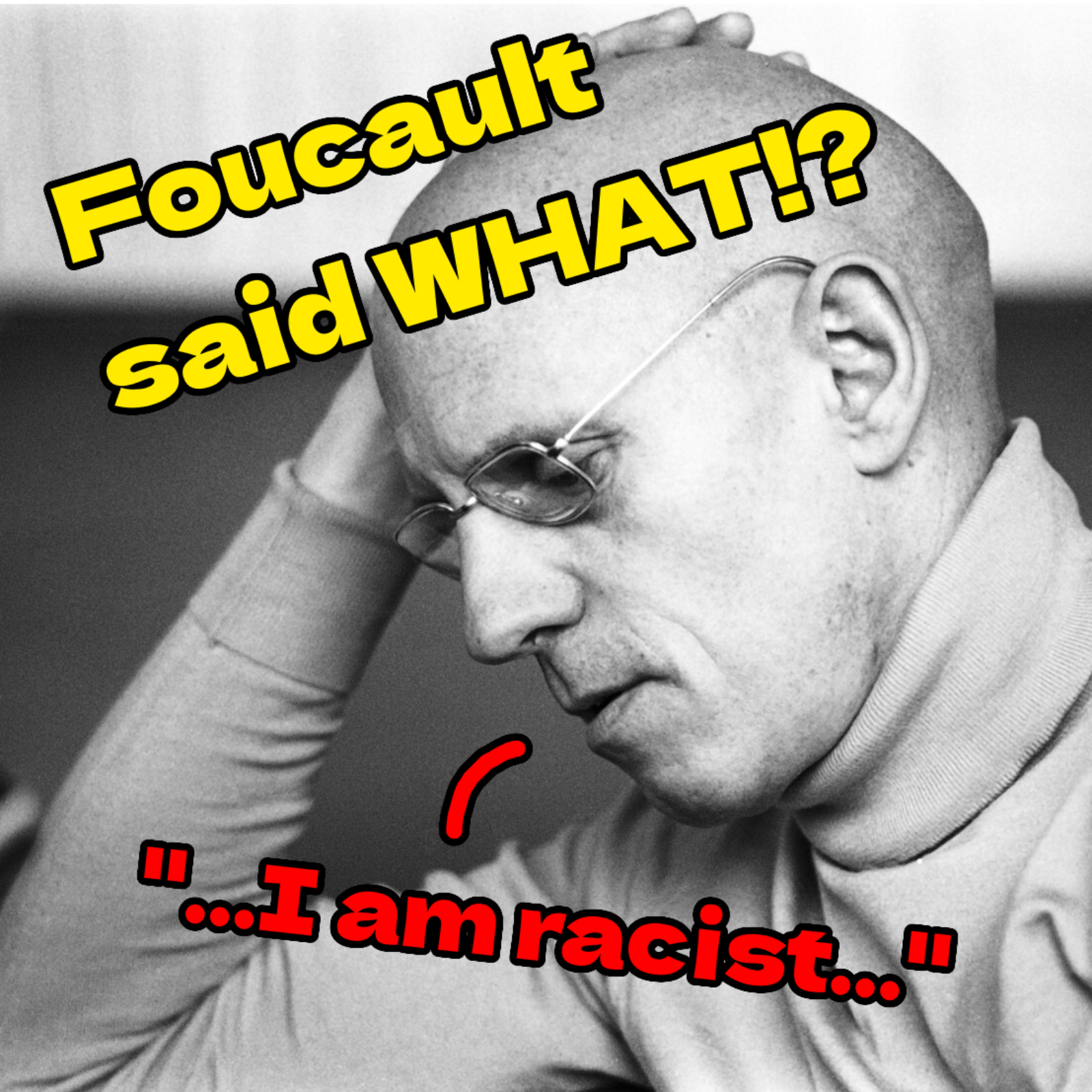 Episode 15: Wokeness Must be Defended Episode 15: Wokeness Must be Defended | The description: JE, Cam and Re interrogate Foucault's mid 1970s lectures at the Collège de France, Society Must be Defended. They discuss Foucault's method, his genealogy from Race Wars to Racism and modern conspiratorial thinking among other things. | 1h 13m 45s | ||||||
| 3/21/26 |  Episode 14: Theoretical Players' Ball Episode 14: Theoretical Players' Ball | J. E. and Anatarah discuss Johan Huizinga's classic book Homo Ludens, a foundational work for game studies. | 1h 06m 41s | ||||||
| 3/5/26 |  Episode 13: Discoursing the Discorsi Episode 13: Discoursing the Discorsi | Helen, Esther, and Crane tackle the first book of Machiavelli's Discourses on Livy, reading Machiavelli as a precursor to historical materialism and a radical republican. In the process, they pose the question: what can the critical theory of society learn from Machiavelli today? | 1h 31m 53s | ||||||
| 2/20/26 |  Episode 12: A User's Guide to Montaigne and the Function of Skepticism Episode 12: A User's Guide to Montaigne and the Function of Skepticism | Crane and Helen talk about Horkheimer's 1938 essay "Montaigne and the Function of Skepticism," which sees Horkheimer both show the skeptical core of both religious dogmatism and philosophical skepticism, as well as its changing valence throughout the development of the capitalist mode of production. | 1h 57m 12s | ||||||
| 2/6/26 |  Episode 11: Situationism and the Critique of Reification Episode 11: Situationism and the Critique of Reification | Imogen, Sebastian, and Sam discuss Situationism as a vindication of Hegelian Marxism and a critique of reified life through its various forms of appearance: artistic production, urban planning, and student life. | 1h 25m 38s | ||||||
| 1/23/26 |  Episode 10: Working Through the Past with Ernst Bloch Episode 10: Working Through the Past with Ernst Bloch | Esther and Sebastian discuss the 1932 fragment Nonsychronism and the Obligation to its Dialectics from Bloch's Heritage of our Times. Our hosts talk about their personal encounters with Bloch, revolutionary traditions and the meaning of the communist dictatorship of the present over the past. Special guests include: Kanafani, Amel, and Pasolini. Bloch's essay, as Walter Benjamin commented, "takes its place inappropriately". Perhaps its time was never there, perhaps it contains a utopia waiting to be excavated. | 1h 15m 45s | ||||||
| 1/9/26 |  Episode 9: Fighting About Lukács Again Episode 9: Fighting About Lukács Again | Mac and Crane are joined by J. E. to continue the discussion about Lukács's politics and his essay "Legality and Illegality." This episode goes into depth on the historical and political context of Lukács's work, debates in the Comintern, and the aftermath of the Hungarian Revolution. | 1h 21m 37s | ||||||
Want analysis for the episodes below?Free for Pro Submit a request, we'll have your selected episodes analyzed within an hour. Free, at no cost to you, for Pro users. | |||||||||
| 12/26/25 |  Episode 8: The Anime Question Episode 8: The Anime Question | The culture industry is at it again! Their new weapon: anime. Their strategy? The media mix. In this episode, the anime subcommittee of the CTWG tackle the anime media-form by discussing Marc Steinberg’s anime’s media mix. We talk about modern anime’s history, the emergence of the media mix, and transition from Fordism to post-Fordism. | 1h 19m 49s | ||||||
| 12/11/25 |  Episode 7: Lukács - Nope or Yup? Discussing "Legality and Illegality." Episode 7: Lukács - Nope or Yup? Discussing "Legality and Illegality." | Mac and Crane discuss the essay "Legality and Illegality" by György Lukács (Georg Lukács) in the context of his broader development: after joining the Communist Party in 1918, Lukács would play an important role in the leadership of the short-lived Hungarian Soviet Republic (March to August 1919), around which time he would write many of the essays later collected and published in Tactics and Ethics: 1919-1929, only to reverse some of his positions on core issues in his subsequent exile in Vienna, resulting in History and Class Consciousness (1923). In their discussion of the vicissitudes of fate and philosophy, Mac and Crane attempt to answer the fundamental question tragically left out of E40's classic song "Choices": Lukács - Nope or Yup? | 1h 47m 54s | ||||||
| 11/26/25 |  Episode 6: Introduction to the History of Left Communism Episode 6: Introduction to the History of Left Communism | J. E. is joined by Cam for an introduction to the history of left-communism, specifically the German/Dutch (councilist), Italian (Bordigist) and French (ultraleft) traditions. The books we mention are the following: Histoire Critique de l'Ultragauche by Roland Simon The Future of Revolution by Jasper BernesThe Science and Passion of Communism edited by Pietro BassoThe Communist Left in Germany by Denis Authier and Gilles Dauvé The Italian Communist Left by Philippe Bourrinet Rupture dans la Théorie de la Révolution edited by François Daniel. | 1h 26m 10s | ||||||
| 11/13/25 |  Episode 5: A Conversation About Dialectical Biology. Episode 5: A Conversation About Dialectical Biology. | In this episode, Mac Parker and Anatarah Bin AlKaf have a casual chat on Richard Lewontin and Richard Levins seminal book the Dialectical Biologist. They cover why this book remains a key contribution to Marxist theory, philosophy of nature, and philosophy of technology. Along the way, the conversation tackles the influence of Friedrich Engels on Marxist science historiography and science critique from Boris Hessen to the Max Planck institute’s historical epistemology research program. Our discussion culminates in a call for an integrative approach—one that unites political philosophy and science, the local and the global—in the spirit of the dialectical biologists’ vision.The books discussed were (or alluded to):- The Dialectical Biologist (1985) by Richard Levins and Richard Lewontin- Biology Under the Influence (2007) by by Richard Levins and Richard Lewontin- The Social and Economic Roots of the Scientific Revolution (2009) ed. Gideon Freudenthal and Peter McLaughlin- Abstraction and Representation (1996) by Peter DamerowPlease support us at: https://www.patreon.com/crittheoryworkgroup | 1h 03m 31s | ||||||
| 11/1/25 |  Episode 4: Amadeo Bordiga and the Murder of the Dead Episode 4: Amadeo Bordiga and the Murder of the Dead | In this episode, join your hosts Sam Thomas (resident Italophile), J.E. Morain, and James Crane for a discussion taking the 1951 polemic, “Murder of the Dead,” as a point of departure for deeper dive into Amadeo Bordiga’s bellicose and beautiful run of essays in eco-communism throughout the 50s and 60s. Topics of discussion include: Bordiga’s critique of a version of the ‘state capitalism’ thesis, the conceptual matrix of living/dead labor and variable/constant capital, the theoretical and stylistic function of ‘invariance’ in Bordiga's writings, coal mine collapses, the flooding of symbols of national pride, and scientific-scatological reflections on the ‘how’s of abolishing the antithesis of town and country. We end with a few remarks on the conquest of the fear of death and the “natural condition of the prosperity of the species” in Bordiga's 1961 “In Janitzio Death is not Scary.”Other Bordiga essays discussed in the episode:“The Filling and Bursting of Bourgeois Civilisation” (1951)“The Human Species and the Earth’s Crust” (1952)“The Spirit of Horsepower” (1953)“Weird and Wonderful Tales of Modern Social Decadence” (1956)“The Legend of the Piave” (1963)Please support us at: https://www.patreon.com/crittheoryworkgroup | 1h 11m 56s | ||||||
| 10/31/25 |  Episode 3: Ghassan Kanafani: Realism Against Reality Episode 3: Ghassan Kanafani: Realism Against Reality | “The motive for realism is never the confirmation of reality but protest.” —Alexander Kluge“I want my stories to be one hundred percent realistic while at the same time presenting something unseen.” —Ghassan KanafaniIn this episode, join your hosts Sebastian Kokesch and James Crane for a discussion of the necessary connection between aesthetic autonomy and revolutionary political commitment in Ghassan Kanafani's best-known literary writings in English translation: Men in The Sun ('62), All That’s Left to You ('66), & Returning to Haifa ('69). From the perspective of the 'undivided' project of Ghassan Kanafani—as novelist, critic, and militant—we read each of these novels as a contribution to the same culture of resistance he theorized and organized.Please support us at: https://www.patreon.com/crittheoryworkgroup | 2h 04m 18s | ||||||
| 10/31/25 |  Episode 2: Politics of Early Critical Theory Episode 2: Politics of Early Critical Theory | Join your hosts J.E. Morain and James Crane for an introduction to the rogue's gallery of far left dissidents (communists, socialists, anarchists) who formed the core of the 'Frankfurt School' from the early 1920s through late 1940s.Please support us at: https://www.patreon.com/crittheoryworkgroup | 1h 29m 26s | ||||||
| 10/31/25 |  Episode 1: Introducing Racket Theory Episode 1: Introducing Racket Theory | Critics and theorists! Our first official episode of "Critique of the Podcast Form," a discussion with J.E. Morain, Mac Parker, Re Tejus, and James Crane on the CTWG's recent "Racketology" dossier: https://ctwgwebsite.github.io/blog/category/racketology/Please support us at: https://www.patreon.com/crittheoryworkgroup | 1h 20m 24s | ||||||
| 10/10/25 |  Episode 0: Debrief MN1 Episode 0: Debrief MN1 | Critics and Theorists: the CTWG is proud to present "Episode 0: Debrief on Margin Notes Vol. 1" of "Critique of the Podcast Form," a critical theory podcast! Make sure to watch this space and also bother us for more episodes.Please support us at: https://www.patreon.com/crittheoryworkgroup | 33m 48s | ||||||
Showing 19 of 19
Sponsor Intelligence
Sign in to see which brands sponsor this podcast, their ad offers, and promo codes.
Chart Positions
10 placements across 9 markets.
Chart Positions
10 placements across 9 markets.