

Insights from recent episode analysis
Audience Interest
Podcast Focus
Publishing Consistency
Platform Reach
Insights are generated by CastFox AI using publicly available data, episode content, and proprietary models.
Most discussed topics
Brands & references
Est. Listeners
Insufficient chart data. Estimates will improve as the show charts.
- Per-Episode Audience
Est. listeners per new episode within ~30 days
N/A🎙 Weekly cadence·13 episodes·Last published 6mo ago - Monthly Reach
Unique listeners across all episodes (30 days)
N/A - Active Followers
Loyal subscribers who consistently listen
N/A
Market Insights
Platform Distribution
Reach across major podcast platforms, updated hourly
Total Followers
—
Total Plays
—
Total Reviews
—
* Data sourced directly from platform APIs and aggregated hourly across all major podcast directories.
On the show
From 10 epsHosts
Recent guests
Recent episodes
Zero Units: Inside the National Guard Shooting
Nov 28, 2025
33m 42s
Georgia Drops Trump Election Case
Nov 26, 2025
28m 29s
Ukraine vs. Russia: The Geneva Meeting
Nov 24, 2025
35m 51s
NATO-Like but Not NATO? Inside the Secret Ukraine Deal
Nov 21, 2025
27m 10s
How the Shutdown Warped the Jobs Numbers
Nov 20, 2025
21m 04s
Social Links & Contact
Official channels & resources
Official Website
Login
RSS Feed
Login
| Date | Episode | Topics | Guests | Brands | Places | Keywords | Sponsor | Length | |
|---|---|---|---|---|---|---|---|---|---|
| 11/28/25 |  Zero Units: Inside the National Guard Shooting✨ | national securityimmigration+4 | — | CIAFBI | Washington, D.C.West Virginia | National Guardshooting+6 | — | 33m 42s | |
| 11/26/25 |  Georgia Drops Trump Election Case✨ | Georgia election caseTrump prosecution+4 | — | GeorgiaJack Smith | — | TrumpGeorgia+7 | — | 28m 29s | |
| 11/24/25 |  Ukraine vs. Russia: The Geneva Meeting✨ | diplomacypeace negotiations+4 | — | U.S.NATO+1 | UkraineRussia+1 | UkraineRussia+7 | — | 35m 51s | |
| 11/21/25 |  NATO-Like but Not NATO? Inside the Secret Ukraine Deal✨ | Ukrainepeace plan+4 | — | NATOWhite House | UkraineRussia+4 | UkraineNATO+5 | — | 27m 10s | |
| 11/20/25 |  How the Shutdown Warped the Jobs Numbers✨ | jobs reporteconomic data+3 | — | Bureau of Labor Statistics | U.S. | jobs numberseconomic data fog+3 | — | 21m 04s | |
| 11/19/25 |  How Saudi Arabia Bought a New American Alliance✨ | U.S.-Saudi relationsdefense architecture+3 | — | United StatesSaudi Arabia+4 | — | Saudi ArabiaU.S. relations+3 | — | 28m 29s | |
| 11/18/25 |  U-Turn on Capitol Hill: House Vote on the Epstein Files✨ | Epstein scandalpolitical activism+4 | — | Department of JusticeCongress+1 | — | Epsteintransparency+6 | — | 26m 53s | |
| 11/17/25 |  Grounded by Politics: Inside the FAA’s 43-Day Safety Crisis✨ | air travel safetygovernment shutdown+4 | — | FAATSA | U.S. | FAATSA+5 | — | 24m 36s | |
| 11/16/25 |  Karoline Leavitt: The New First Lady of Power?✨ | politicsmedia+3 | Karoline Leavitt | White HouseTrump-world+3 | — | Karoline LeavittWhite House press secretary+3 | — | 34m 02s | |
| 11/15/25 |  The Chaotic Week of Donald Trump✨ | political crisislegal battles+4 | — | Jeffrey EpsteinRepublican Party+2 | — | Donald TrumpMarjorie Taylor Greene+5 | — | 41m 21s | |
Want analysis for the episodes below?Free for Pro Submit a request, we'll have your selected episodes analyzed within an hour. Free, at no cost to you, for Pro users. | |||||||||
| 11/14/25 | 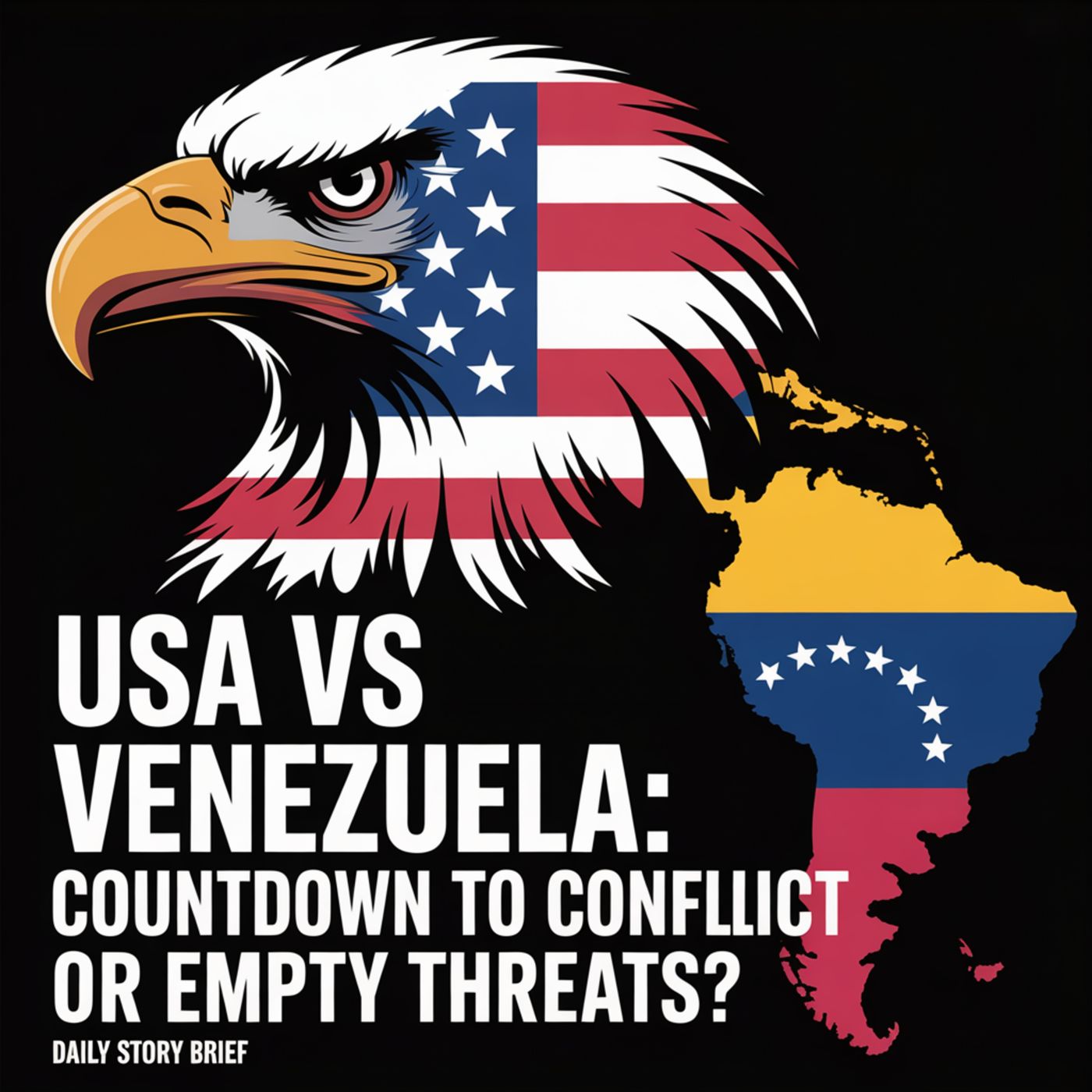 USA vs Venezuela: Countdown to Conflict or Empty Threats? | USA and Venezuela are suddenly staring each other down across the Caribbean— but is this the opening act of a real war, or just a very loud bluff?In this episode of Daily Story Brief, we unpack the escalating showdown between Washington and Caracas as aircraft carriers, troop movements, and fiery speeches fuel talk of a possible U.S. strike on Venezuela. You’ll get a clear, step-by-step explanation of what’s happening, why it’s happening now, and how close this crisis really is to crossing the line into open conflict.We start with the basics: President Donald Trump has been briefed on updated military options against Venezuela, including potential ground strikes, just as a major U.S. naval buildup unfolds in the Caribbean. At the center of that deployment is the USS Gerald R. Ford, one of the most powerful symbols of American military reach. Officially, Washington talks about counter-narcotics and regional security. Unofficially, many observers see the classic signs of coercive pressure on Nicolás Maduro’s government.On the other side, Caracas isn’t treating this as a drill. The Maduro regime has ordered a mass mobilisation of around 200,000 troops and rolled out Russian-supplied air defence systems such as the TOR-M2E, sending a message that any attack will be met with force. Venezuelan state media frames the U.S. presence as a direct threat to sovereignty and a pretext for regime change—another chapter, they say, in a long history of North American intervention in Latin America.But this standoff doesn’t exist in a vacuum. We’ll walk you through how oil and the global economy shape every decision here. Venezuela sits on some of the world’s largest proven oil reserves, and its political fate is deeply entangled with sanctions, energy markets, and great-power competition. As the world wrestles with price shocks and shifting demand, the question of who controls Venezuelan oil—and under what government—takes on global significance.Complicating things further, Colombia has suspended intelligence sharing with the U.S. in protest of recent American strikes on suspected drug-carrying boats in the Caribbean. Those operations, part of the decades-long War on Drugs, have reportedly caused civilian casualties and raised fresh legal and moral questions about the use of force at sea. We’ll explain how that decision by Bogotá reshapes regional dynamics and why the erosion of trust with a key U.S. partner matters for any potential campaign against Venezuela.Throughout the episode, we break down the key questions people are asking right now:Is the U.S. actually preparing for an invasion, or using military pressure as leverage?How much of Venezuela’s mobilisation is real readiness, and how much is political theatre?What role do Russia and other external players really have on the ground?And how do ordinary Venezuelans and their neighbours get caught in the middle of this power game?By the end of the episode, you’ll have a grounded sense of whether this is countdown to conflict or empty threats: what would have to happen for shots to be fired, what off-ramps still exist, and why careful diplomacy may matter just as much as aircraft carriers and missile batteries.If you’re tired of alarmist clips and out-of-context tweets, hit play and let Daily Story Brief walk you through the crisis—one story, clearly explained.Become a supporter of this podcast: https://www.spreaker.com/podcast/daily-story-brief--6811252/support. | 31m 50s | ||||||
| 11/13/25 |  Epstein’s Inbox: Inside the New Email Trove | Newly uncovered emails from Jeffrey Epstein’s estate are shaking Washington—and they paint a far more complicated picture than anyone expected.In this episode, we break down the explosive messages obtained by the House Oversight Committee and explain what they reveal about Epstein, Donald Trump, and a circle of powerful men caught in the shadows of his world.From private accusations to political fallout, here’s what’s actually inside Epstein’s inbox—and why it matters now.The newly released documents, spanning roughly 2015 to 2018, provide an unusually direct look into Epstein’s private communications during a period when he was already a controversial, publicly disgraced figure. Though his name is typically associated with crimes dating back decades, these messages show an Epstein who remained active, connected, and outspoken—and whose opinions about major political figures, particularly Donald Trump, were far from flattering.At the center of this episode is Epstein’s unexpectedly hostile view of Trump. Across multiple emails, Epstein describes Trump as “dirty,” accuses him of questionable business dealings, and even claims that he was “able to take him down.” The tone is not one of rivalry or friendship—it’s contempt, and at times, a clear desire to expose Trump. These exchanges stand in sharp contrast to the public assumptions that Epstein and Trump were closely aligned during certain periods of their lives. Instead, the documents show Epstein attempting to distance himself, criticize Trump, and sometimes even weaponize information against him.One of the most discussed messages involves Epstein offering a reporter what he described as photos of “Donald and girls in bikinis in my kitchen.” The documents do not confirm the existence of these photos, but the fact that Epstein believed such images could be used to damage Trump is notable—and deeply unsettling. Another exchange references Epstein’s claim that Virginia Giuffre, one of his most well-known accusers, had spent time at his house with Trump. The Trump White House has categorically denied this claim, calling it false and politically motivated. The emails do not provide definitive proof, but they show Epstein pushing this narrative with confidence.Beyond Trump, the episode also examines references to Bill Clinton and Prince Andrew—two names long tied to the Epstein scandal. While these messages are less explosive than Epstein’s commentary on Trump, they add more depth to the web of relationships surrounding Epstein in his final years. The documents reinforce that Epstein saw himself as someone who still had influence, leverage, or at the very least, damaging information about powerful individuals. Whether his claims were accurate, exaggerated, or manipulative is part of the conversation we explore.Politically, the reaction to the release has been sharp and immediate. The White House dismissed the documents as a “hoax,” echoing language that has become familiar in moments of politically charged scandal. Meanwhile, segments of the far-right online ecosystem—typically quick to amplify any story that appears damaging to political opponents—have treated the release with unusual skepticism and at times open hostility. Many of these voices, who normally embrace conspiracy narratives involving Epstein, have either minimized the story or rejected the new material outright due to its negative portrayal of Trump.If you want a clear, focused overview of the documents everyone is talking about, and why they’ve reignited debates in both parties, this episode gives you the essential context—without the noise.Become a supporter of this podcast: https://www.spreaker.com/podcast/daily-story-brief--6811252/support. | 31m 34s | ||||||
| 11/13/25 | 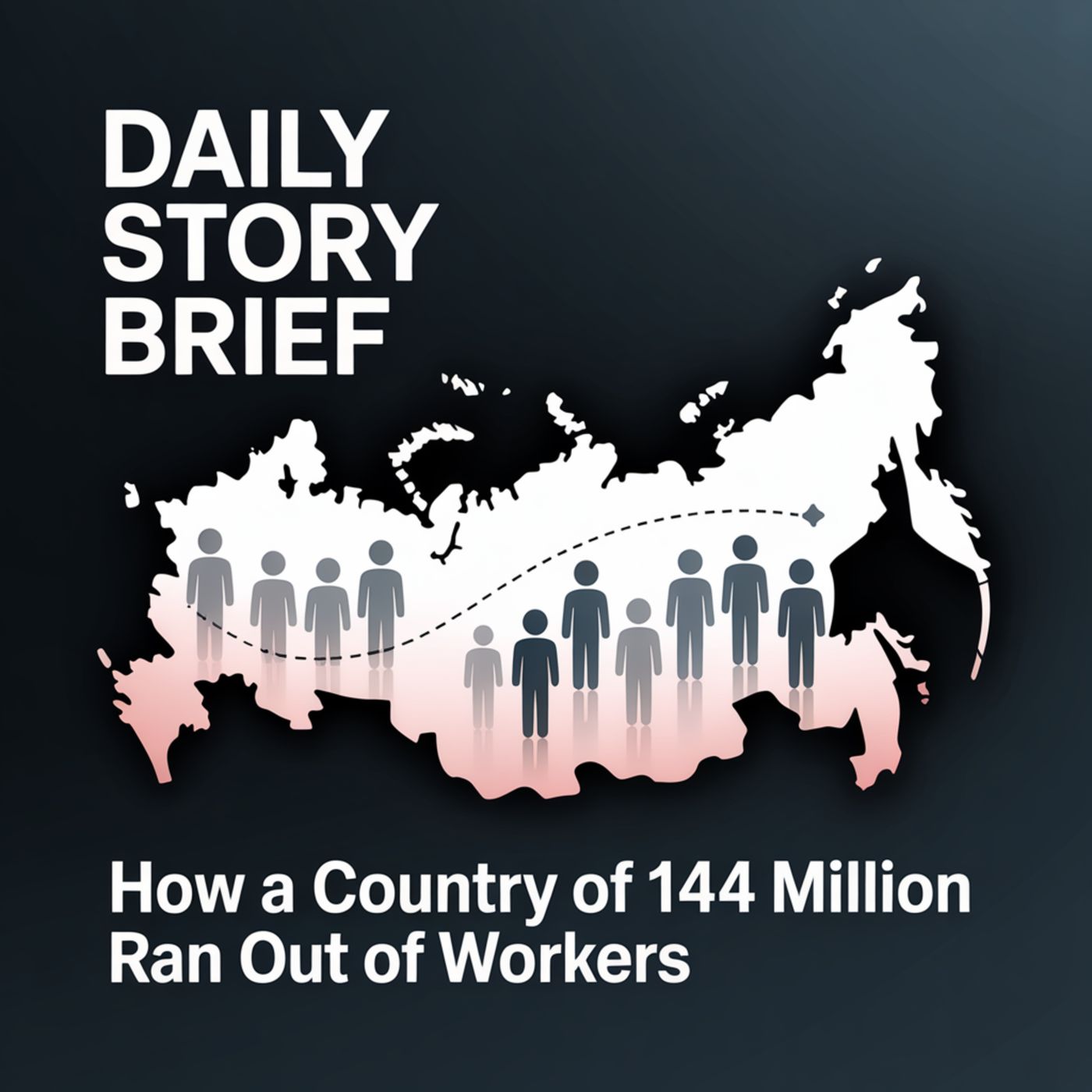 How a Country of 144 Million Ran Out of Workers | How does a country of 144 million people run out of workers? In this episode of Daily Story Brief, we unpack how Russia’s labour crisis became one of the most dangerous threats to its economy and long-term stability.Russia’s demographic crisis didn’t start with the war in Ukraine—it started with the collapse of the Soviet Union. When the USSR fell in 1991, a brutal economic shock sent birth rates plunging and death rates soaring, creating the infamous “Russian cross,” the point where the lines for births and deaths cross on a chart. From the early 1990s onward, deaths routinely outnumbered births, and Russia’s population began to shrink even in peacetime.In this daily news explainer, we walk through how that early trauma created a hollowed-out generation. Fewer children were born, male life expectancy stayed low, and public health problems—from alcoholism to heart disease—meant millions of men never reached retirement. By the 2000s and 2010s, Russia was already an aging society with a shrinking pool of working-age citizens, even as the government tried to reverse the trend with cash incentives and pro-natalist campaigns.Then came the full-scale invasion of Ukraine in 2022—and the demographic crisis hit fast-forward. Mobilisation orders pulled hundreds of thousands of mostly young men out of the civilian workforce. At the same time, a massive exodus of skilled professionals, IT workers, and entrepreneurs left the country, creating a “brain drain” on top of the existing “gray wave.” Casualties at the front, combined with wartime uncertainty, further discouraged families from having children. Together, this turned a slow-burn demographic problem into an acute labour shortage.We’ll break down the numbers behind this workforce disaster: record-low official unemployment rates that look “good” on paper but actually signal a labour market stretched to the breaking point, millions of missing workers compared to past decades, and a government that increasingly relies on measures like prison labour and tightened controls on internal mobility to keep factories and infrastructure running.This episode also looks at how Russia’s economic model amplifies the crisis. For decades, the country has depended on a rigid, oil-and-gas-centric system where energy exports fund the state and crowd out more diversified, high-productivity sectors. That model demands a steady flow of low-cost labour for extraction, transport, and heavy industry—but the domestic workforce is shrinking, and productivity growth is weak. Even before the war, analysts warned that this resource-dependent model “no longer delivers” sustainable growth.Could Russia simply replace missing workers with migrants from Central Asia, as it has in the past? We explore why that safety valve is now failing. The war, a weaker ruble, the risk of migrants being pressured into military service, and rising xenophobia and state crackdowns on Central Asian workers have all made Russia a less attractive—and more dangerous—destination. Recent reports show declining migrant numbers and increasing harassment and violence against those who do arrive, closing off what used to be a critical source of replacement labour.If you want more than headlines—and you want current events explained in plain language—hit follow on Daily Story Brief. Share this episode with a friend who keeps hearing about Russia’s “demographic crisis” but doesn’t know what it actually means. One story, clearly explained, in your ears every day.Become a supporter of this podcast: https://www.spreaker.com/podcast/daily-story-brief--6811252/support. | 38m 26s | ||||||
Showing 13 of 13
Pitch Fit is a Pro feature
See how bookable this show is for guests, which brands already advertise, the per-episode ad value, and the best-fit guest and sponsor profile. The numbers are blurred on the free plan.
How readily this show books outside guests like you.
How proven this show is for host-read sponsorships.
For Guests
ProFor Advertisers
ProUpgrade to Pro to unlock guest cadence, sponsor categories, fit scores, and per-episode ad value for this show.