
Declarations: The Human Rights Podcast
by Declarations: The Human Rights Podcast
Is this your podcast?Insights from recent episode analysis
Audience Interest
Podcast Focus
Publishing Consistency
Platform Reach
Insights are generated by CastFox AI using publicly available data, episode content, and proprietary models.
Most discussed topics
Brands & references
Est. Listeners
Insufficient chart data. Estimates will improve as the show charts.
- Per-Episode Audience
Est. listeners per new episode within ~30 days
N/A🎙 Weekly cadence·110 episodes·Last published 5mo ago - Monthly Reach
Unique listeners across all episodes (30 days)
N/A - Active Followers
Loyal subscribers who consistently listen
N/A
Market Insights
Platform Distribution
Reach across major podcast platforms, updated hourly
Total Followers
—
Total Plays
—
Total Reviews
—
* Data sourced directly from platform APIs and aggregated hourly across all major podcast directories.
On the show
From 1 epsHosts
Not detected.
Recent guests
Recent episodes
Resisting Algorithms: Human Rights in the Age of Platforms
Jan 22, 2026
56m 45s
The Sociology of Humanity: Benjamin P Davis and “Another Humanity”
Dec 18, 2025
Unknown duration
Shifting Tides: How the Media Landscape and Press Freedom Are Changing Worldwide
Nov 13, 2025
Unknown duration
Invisible Chains: How Censorship, Misinformation and Propaganda Shape Stockholm Syndrome in African States
Nov 7, 2025
Unknown duration
Human Rights and American Foreign Policy with Andrew Preston
Oct 29, 2025
Unknown duration
Social Links & Contact
Official channels & resources
Official Website
Login
RSS Feed
Login
| Date | Episode | Topics | Guests | Brands | Places | Keywords | Sponsor | Length | |
|---|---|---|---|---|---|---|---|---|---|
| 1/22/26 | 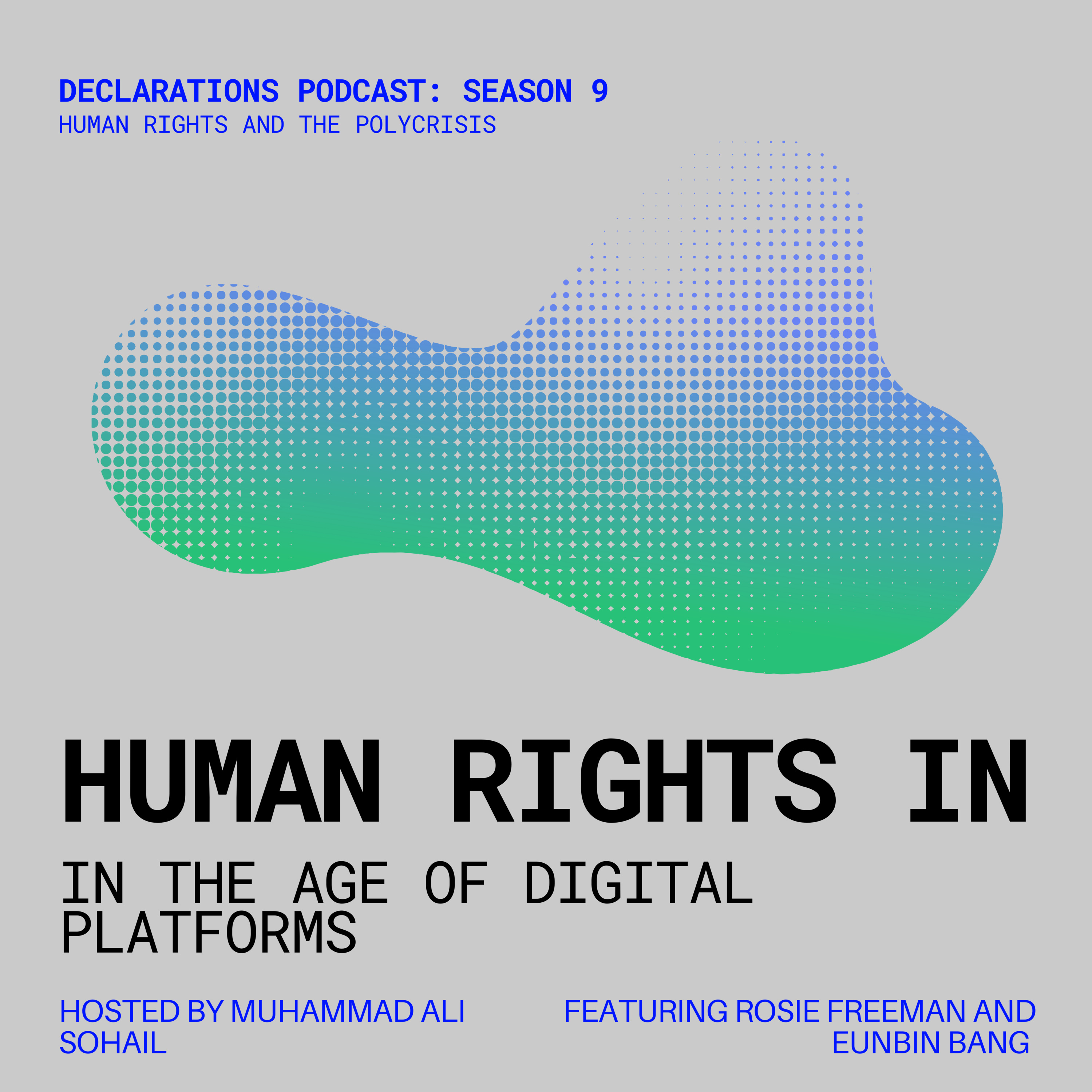 Resisting Algorithms: Human Rights in the Age of Platforms✨ | algorithmic governancedigital resistance+4 | Rosie FreemanEunbin Bang+1 | Centre for Governance and Human RightsCambridge University+2 | — | algorithmshuman rights+5 | — | 56m 45s | |
| 12/18/25 | 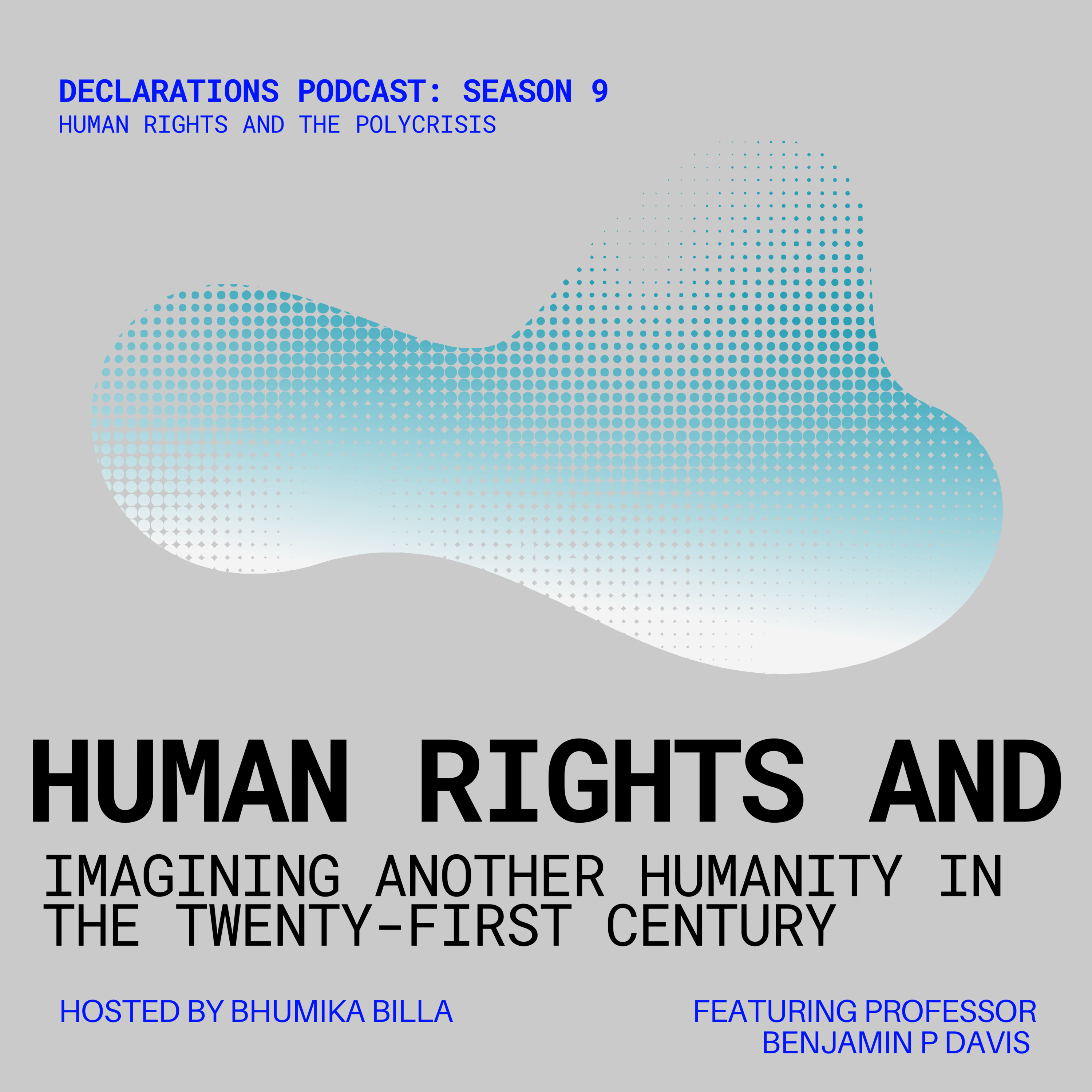 The Sociology of Humanity: Benjamin P Davis and “Another Humanity” | What does it mean to imagine another humanity in a century marked by war, displacement, and deep inequality? In this episode, we sit down with Benjamin P. Davis, author of Another Humanity: Decolonial Ethics from Du Bois to Arendt. Davis traces shifting ideas of “the human” through the works of W. E. B. Du Bois, Édouard Glissant, Sylvia Wynter, and Edward Said—thinkers who redefined human rights and humanism in the face of empire and exclusion. Drawing on Hannah Arendt’s post-war correspondence with Karl Jaspers, Davis invites us to reflect on what a decolonial ethics of humanity might look like today. Together, we ask: how might we live into Glissant’s question of whether we have the right, and the means, to imagine another dimension of humanity?About the Guest Benjamin Davis is a scholar of political theory, decolonial ethics, and the global histories of human rights. He previously held fellowships with the Department of African American Studies at Saint Louis University and the Centre for Ethics at the University of Toronto.He is the author of three books. His first, Simone Weil’s Political Philosophy: Field Notes from the Margins, repositions the mystic Simone Weil as a major political thinker. His second book, Choose Your Bearing: Édouard Glissant, Human Rights and Decolonial Ethics, interprets poet and theorist Édouard Glissant as a vital voice for contemporary human rights practice. His most recent book, Another Humanity: Decolonial Ethics from Du Bois to Arendt, offers a defense of “the human” and “humanity” amid today’s critical theoretical debates.Website: https://benjaminpdavis.com/Email: benjamin.davis [at] tamu.edu. Connect with Us Subscribe below for more regular and profound discussions. Connecting practitioners, activists, and students together to dissect the compelling intersections related to human rights and social justice. X: @DeclarationsPod Instagram: @declarationspodcast LinkedIn: Declarations: The Human Rights Podcast Share your thoughts using #declarationspodcast Email us at info@declarationspod.com Episode CreditsHost: Bhumika Billa, Guest HostProducer: Bhumika Billa and Shubham JainExecutive Producer: Sarah Awan Podcast Lead: Shubham JainShow Notes: Yusan Ghebremeskel Publisher and Communications Manager: Evie Nicholson Editor: Max Parnell | — | ||||||
| 11/13/25 | 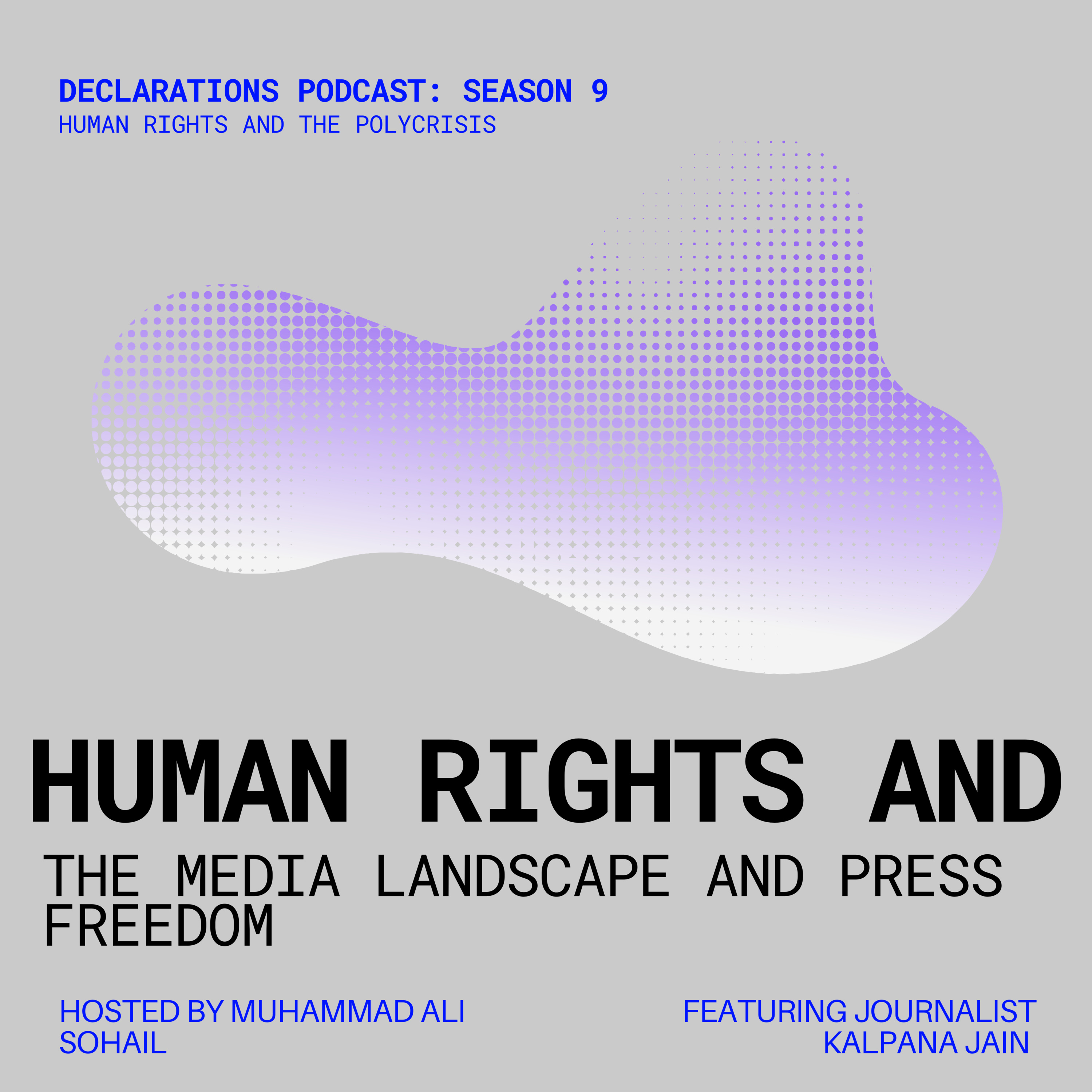 Shifting Tides: How the Media Landscape and Press Freedom Are Changing Worldwide | Welcome back to Declarations!In this episode, we’re joined by renowned journalist Kalpana Jain to explore how the media landscape has evolved and how press freedom is shifting across the globe. From the West to South Asia, we unpack the complex forces shaping what gets reported, whose voices are amplified, and how journalism is being redefined today. The media has undergone a seismic shift over the past two decades, technologically, politically, and economically. Today, journalism faces mounting constraints: declining independence, a shrinking space for investigative work, all amid escalating risks for journalists worldwide. At the same time, newsrooms are evolving rapidly to combat the rise of misinformation in an increasingly complex digital environment. About the guest:Kalpana Jain is a senior journalist and currently senior ethics and religion editor at The Conversation US, a global news and commentary-based website.She has covered a wide range of issues both in the U.S. and internationally. She was senior education editor at The Conversation US, before moving into her current role. She worked as a writer and researcher at Harvard Kennedy School and Harvard Business School She was part of a small, select team for a flagship program of Harvard Business School researching 50 years of women at HBS.She worked for many years as a reporter and editor at India’s leading national daily, The Times of India. Her reporting played a significant role in elevating public health as an important topic of news coverage. Based on her reporting, she was selected a Nieman Fellow in Global Health Reporting in 2009. She has taught case-writing at Harvard. She has conducted workshops teaching scholars at Harvard Divinity School, Stanford University, on how to write for the general public. She has also conducted such a workshop for religion scholars at the annual conference of American Academy of Religion.She is an alumna of Harvard Divinity School and Harvard Kennedy School. She holds a Master’s in Theological Studies and a Master’s in Public Administration. In 2010, she was awarded William A. Starr fellowship for innovative thinking in journalism and John Kenneth Galbraith Fellowship for outstanding academic and professional achievements at Harvard.Subscribe below for more regular and profound discussions. Connecting practitioners, activists, and students together to dissect the compelling intersections related to human rights and social justice. Share your thoughts using #declarationspodcast Email us at info@declarationspod.com Episode Credits Host: Muhammad Ali Sohail Producer: Muhammad Ali Sohail and Sarah Awan Executive Producer: Sarah AwanPodcast Lead: Shubham Jain Show Notes: Yusan Ghebremeskel Publisher and Communications Manager: Evie Nicholson Editor: Max Parnell | — | ||||||
| 11/7/25 |  Invisible Chains: How Censorship, Misinformation and Propaganda Shape Stockholm Syndrome in African States | Welcome back to the second episode of Season 9 of Declarations!We are often informed to the terrorising, oppressive and distressing effects of Human Rights abuses across the continent of Africa. However, what happens in the rare cases that citizens don't know they're being abused? By exploring the implicitly powerful weapon of censorship, misinformation and mass propaganda, we can observe how patriotic, anti-western narratives succeed in instilling hope and nationalistic pride, rather than terror, to these inhabitants. Farooq Adamu Kperogi is a Nigerian-American professor, author, media scholar, newspaper columnist, blogger and activist. Professor Kperogi's research broadly explores the intersection between communication in a global context and the singularities of the communicative practices of marginal groups within it. He is interested in the transnational, mass-mediated, online discourses of marginalised diasporas in the West, which he studies by examining the alternative and citizen online journalistic practices of previously disempowered Third World ethnoscapes whose voluntary geographic displacement to the Western core imbues them with the cultural and social capital to be vanguards for potentially transformative cross-border exchanges with their homelands. Subscribe below for more regular and profound discussions, connecting practitioners, activists, and students together to dissect the compelling intersections related to human rights and social justice. Share your thoughts using #declarationspodcast Email us at info@declarationspod.com Episode Credits Host: Ed Parker & Yusan Ghebremeskel Producer: Yusan Ghebremeskel Executive Producer: Sarah Awan Show Notes: Yusan Ghebremeskel Publisher and Communications Manager: Evie Nicholson Editor: Max Parnell | — | ||||||
| 10/29/25 |  Human Rights and American Foreign Policy with Andrew Preston | Welcome back to Season 9 of Declarations!This season we are looking at the notion of Human Rights and The Polycrisis.In our first episode, Co-host Ed Parker sits down with Andrew Preston, an acclaimed historianof American foreign relations post 1890, to trace the role of human rights in American protest movements and foreign policy debates, asking whether humanitarian ideals have ever truly guided U.S. decision-making. From campus protests against the Vietnam War to campaigns like Save Darfur, American activists have long invoked the language of human rights topress for change at home and abroad. But has this discourse meaningfully shaped U.S. foreign policy—or has it always taken a backseat to strategic interests?Together, they explore key moments when human rights language surged, examine its retreat in recent years, and consider how American power has influenced—and at times undermined—thebroader global human rights regime. Looking ahead, they ask whether we are witnessing a lasting shift in U.S. foreign policy priorities or simply thelatest chapter in a long cycle of competing values and interests.We hope you enjoyed this podcast. If you did, please check out our last season, available on all podcast platforms, or follow us on social media @DeclarationsPodShare your thoughts using #declarationspodcast Email us at info@declarationspod.com Credits:Host: Ed Parker Producer: Ed Parker and Sarah AwanExecutive Producer: Sarah AwanShow Notes: Yusan GhebremeskelPublisher and Comms Manager: Evie NicholsonEditor: Max Parnell | — | ||||||
| 9/11/24 | Human Rights Volunteers: Lessons from Due Diligence during Qatar 2022 | Join our host, Iman, in conversation with Lucy Amis from the University of Cambridge's Centre for Sport & Human Rights (CSHR), alongside our panellist and podcast lead Shubham Jain, as they discuss the need for mainstreaming human rights in sports, and how the CSHR's innovative initiative, the 'Human Rights Volunteer Programme', can help promote human rights during sports events and offer a means for remedy for violations. | — | ||||||
| 9/4/24 | Advancing Rights Through Protest & Revolution in Syria | Join guest host, Dounia, in conversation with Omar Alshogre as they discuss the relationship between activism and human rights in the context of the Syrian revolution. What is the future of the Syrian revolution? Has it fallen into oblivion? Will Syrians ever succeed in getting rid of a regime which has been plaguing the country for more than 50 years? | — | ||||||
| 8/28/24 | Unlearning Gender-Based Violence | Join our guest host, Maryam, in conversation with special guest Salman Sufi, founder of the Salman Sufi Foundation, as they discuss gender-based violence in Pakistan. How can the systemic infrastructure perpetuate such violence, and what can human rights activists do to mitigate these harms and close some of these systemic gaps? | — | ||||||
| 8/21/24 | Prisons, Captivity & Justice in India | Join our host, Iman, in conversation with special guests, Uma Chakravarti and Suchitra Vijayan, and our panellist Jigisha Bhattacharya, as they discuss incarceration and its politics in contemporary India, focusing on addressing concerns such as human rights violations, democratic oversight and the silencing of dissident voices. | — | ||||||
| 8/7/24 | Protecting the Protector | In the 100th Episode of the Declarations Podcast, Iman is joined by special guest Lucia de los Angeles Diaz Genao and panellist Matias Volonterio to discuss: what can we do about violence against activists? How do we protect the marginalised who raise their voices? | — | ||||||
Want analysis for the episodes below?Free for Pro Submit a request, we'll have your selected episodes analyzed within an hour. Free, at no cost to you, for Pro users. | |||||||||
| 7/31/24 | Politics & Human Rights: With the Politics or Against the Politics? | In this episode of Declarations, our host Iman is joined by special guest Siri Gloppen and panellist Charlotte Abercrombie to discuss global democratic backsliding and its impact on human rights. They evaluate the role of courts in safeguarding human rights and the risks of politicising fundamental freedoms. This episode comes at a crucial period, where democracies appear to be in peril worldwide. | — | ||||||
| 7/23/24 | Human Rights: Of, By, For Which People? | In this episode, our host Iman is joined by special guest Tarah Demant and panellist Tess Hargarten to discuss the impact of Western hegemony on modern human rights and the development of human rights organizations worldwide. This topic is especially relevant at the current moment, when multiple contentious wars are raging with more and more human rights violations coming to light. | — | ||||||
| 7/17/24 | Season 8 Episode 1 - Introducing Horror, Hope & Human | Who are human rights for? Where is the 'human' in 'human rights'? What have we learned about human rights conceptually, as well as in practice, over the last 75 years? In this brief first episode, our host Iman introduces our theme for this season, and gives an overview of the questions we seek to probe while reflecting on the 75 years since the Universal Declaration of Human Rights. | — | ||||||
| 6/15/23 | Season 7 Episode 9: Prioritising Human Rights in the Green Transition | In episode 9 Declarations host Neema Jayasinghe is joined by panellist Aimee Hobley and guest speaker Kristin Hughes. Their discussion explores the potential human rights challenges raised by the ongoing green transition. Kristin offers insight and expertise on how the multistakeholder green transition can mitigate against the potential threats created by rare earth mining and resource insecurity, and how upscaling a circular economy can be part of the solution. In order to avoid repeating the ecological and humanitarian injustices of the fossil fuel revolution, human rights need to be at the forefront of a just renewable energy transition and global climate change response. | — | ||||||
| 5/4/23 | Season 7 Episode 4: Lawfare: The Modern Version of Warfare | In this episode, host Neema Jayasinghe is joined by panelist Vanessa Dib to discuss developments of lawfare, the power of law being used as a weapon of conflict, with guest Mr. Jason McCue. In this day and age, wars can take place within and outside the traditional confines of borders and boundaries as wars are increasingly started, fought, and ended through lawfare. To better situate the discussion, Mr. Jason McCue will help us explore what lawfare is, how is lawfare is used today, and future developments of it by using the Libyan civil war as a case study. | — | ||||||
| 4/27/23 | Season 7 Episode 3: Privacy for Public Figures | In this episode, host Neema Jayasinghe is joined by panellist Olivia Chen and guest Professor Gavin Phillipson to discuss the legal connotations of privacy for public figures. Professor Phillipson provides a detailed insight into how the law utilises both objective and subjective criteria to assess whether a person has a ‘reasonable expectation of privacy’, as well as how the status of a public figure enters into the consideration process. Moreover, the panel discusses whether it is reasonable to hold public figures to reduced rights of privacy based upon their ‘role model’ responsibilities. | — | ||||||
| 4/20/23 | Season 7 Episode 2: The policy that never took off: Assessing UK’s Rwanda Asylum Plan | This episode focuses on assessing the Rwanda Asylum Plan - UK’s most controversial migration policy in recent years. According to the proposal, 99 asylum seekers whose claims were declared “inadmissible” were scheduled to embark on a flight relocating them to Rwanda on the 14th of June 2022. While never enacted, the plan attracted widespread media attention and the criticism of many NGOs fighting for migrants rights. Our guests, Peter Wiliam Walsh and Colin Yeo will discuss the origin of this policy, its problematic nature as well as what could be done in the future to avoid similar mistakes. In our modern society, we expect developed democracies like the United Kingdom to set a positive example when it comes to respecting human rights. So, was this just a policy accident in the UK government’s overly nationalist agenda or is this the beginning of a hostile immigration environment in post-Brexit Britain? Only time will tell. | — | ||||||
| 4/13/23 | Season 7 Episode 1: The Race for Justice in Ukraine | In our first episode, host Neema Jayasinghe is joined by panellist Charlotte Duthie to discuss the contemporary race for justice in Ukraine with guest Dr. Felicity Gerry KC. The ongoing war in Ukraine has recently hit its year-long mark since the initial Russian invasion in February 2022. This episode will focus on discussing and evaluating the different avenues for achieving transitional justice for Ukrainians. Are Russian military leaders better dealt with by the international community, the Ukrainian judiciary, or a synthesis of the two? As a practitioner, Dr. Felicity Gerry KC offers a refreshing and optimistic insight into the capacity of international criminal and humanitarian law to prosecute such individuals in the future. | — | ||||||
| 3/30/22 |  Deepfakes and Non-Consensual Pornography | The Deepfake detection platform Sensity came out with a report in 2019 that 96% of Deepfakes on the internet are pornographic and 90% of those represent women. Deepfakes are a modern form of synthetic media created by two competing AI’s with the goal of replicating hyper-realistic videos, images, and voices. Over the past five years this has led to major concerns of the technology being used to spread mis/disinformation, carry out fraudulent cybercrimes, tamper with human rights evidence, and most importantly in relation to this episode create non-consensual pornography. In this episode, the last of this season of the Declarations podcast, host Maryam Tanwir sat down with panellist Neema Jayasinghe and Henry Adjer who is not only responsible for the Sensity report that came out in 2019 but is also a seasoned expert on the topic of deepfakes and synthetic media. He is currently the head of policy and partnerships at Metaphysic.AI and also co-authored the report ‘Deeptrace: The State of Deepfakes’ while at Sensity. This was the first major report published to map the landscape of deepfakes and found that the overwhelming majority are used in pornography. | — | ||||||
| 3/23/22 | Artificial Intelligence: The ultimate threat to workers’ rights? | In this episode, host Maryam Tanwir and panelist Archit Sharma discuss the impact of technology on employment with our guests, Martin Kwan and Dee Masters. This area is a complicated web of issues, but our guests have the expertise to help us better understand the stakes. Dee is a leading employment barrister at Cloister’s Chambers with extensive experience in the intersection of Artificial Intelligence (AI) and employment. She advises many companies on how to ensure their AI systems are compatible with law and the rights of workers. Martin is a legal researcher and journalist, and the 2021 UN RAF Fellow. Hehas written many articles on topical human rights issues, including recently a fascinating article on Automation and the International Human Right to Work, which will be the first workers’ rights issue we look at in this episode. Artificial Intelligence brings many promises, but to many it is a threat as well. As AI can increasingly perform tasks at a low cost, what happens to those whose jobs are displaced by robots? And if we are using AI in the workplace to monitor our employees, and to make recruitment decisions for us, how can we ensure workers’ rights are respected? Is there sufficient oversight and accountability when AI makes decisions? Fundamentally, where do human rights and the rights of workers fit in the equation with AI and employment? | — | ||||||
| 3/16/22 | Freedom of Expression and Internet Shutdowns in Pakistan | In this week’s episode of the Declarations podcast, host Maryam Tanwir sat down with Munizae and Sulema Jahangir to discuss freedom of expression and internet shutdowns in Pakistan, and their implications for human rights in the country. Freedom of expression, attacks on civil society groups, a climate of fear continues to impede media coverage of abuses by both government security forces and militant groups. Journalists who face threats and attacks have increasingly resorted to self-censorship. Media outlets have come under pressure from authorities not to criticize government institutions or the judiciary. In several cases in 2020, government regulatory agencies blocked cable operators and television channels that had aired critical programs. International conferences raising awareness on human rights and promoting initiatives safeguarding human rights (organized by the guests) were mired by technology shutdowns. We explore with our guests the issue, the stakes, and potential solutions. | — | ||||||
| 3/9/22 | Biometrics and Refugees | In episode 5 of this season of the Declarations podcast, host Maryam Tanwir and panelist Yasar Cohen-Shah sat down with Belkis Wille, senior researcher at Human Rights Watch, and former UN official Karl Steinacker to discuss the collection of refugee biometric data. In summer last year, Human Rights Watch reported that a database of biometric data captured by UNHCR from Rohingya refugees had been handed to Myanmar’s government – the very government from which the refugees are fleeing. This scandal has brought to head the debates surrounding using biometric data of refugees – from Yemen to Afghanistan, Somalia to Syria, biometric data is now fundamental in how aid groups interact with refugees. But how does this affect their human rights, and can it ever be used responsibly? | — | ||||||
| 3/2/22 | Empathy Games | For Episode 4 of this season’s Declarations podcast, host Maryam Tanwir and panelist Alice Horrell sit down with Karen Schrier, Associate Professor and Founding Director of the Games and Emerging Media program at Marist college, and Florent Maurin, creator of The Pixel Hunt, a video games studio with a focus on reality inspired games, to discuss empathy games. | — | ||||||
| 2/9/22 | Live Facial Recognition in the UK - The London Metropolitan Police’s trial | The third episode of this season of the Declarations Podcast delves into the topic of live facial recognition. Host Maryam Tanwir and panelist Veronica-Nicolle Hera sat down with Daragh Murray and Pete Fussey, who co-authored the “Independent Report on the London Metropolitan Police Service’s Trial of Live Facial Recognition Technology” in July 2019. Live facial recognition (LFR) has been a widely debated topic in the past years, both in the UK as well as internationally. While several campaign organisations advocate against the use of this technology based on the Prohibition of Discrimination, independent academic research on the topic reveals important insights into various trials of this technology. Our guests are at the forefront of this research and in this episode present some of their findings. | — | ||||||
| 2/2/22 | Fortress Europe | In this week’s episode, host Maryam Tanwir and panellist Yasmin Homer discuss the role of technology in the securitization of European borders with MEP Patrick Breyer and researcher Ainhoa Ruiz. It was 71 years ago that the 1951 UN Refugee Convention codified the rights of refugees to seek sanctuary and the obligation of states to protect them. In 2015 Angela Merkel famously declared, “Wir schaffen das,” that we can do it. Yet, in 2021, the International Organisation for Migration has described 2021 as the deadliest year for migration routes to and within Europe since 2018. At least 1315 people died on the central Mediterranean crossing, while at least 41 lives were lost at the land border between Turkey and Greece. The creation of a “Fortress Europe” emerges as an issue beyond borders, getting to the heart of what it means to be a citizen in a globalised, technologized world. It combines political, social, and economic interests, with the inclusion of private interests and the development of border technology for “corporate interest.” The question of accountability is at the core: if state policy includes, and can depend, upon the lobbying of private security companies, who are they beholden too? If this technology is produced for commercial interest, can its application be done fairly, without bias, or without profit? Securitisation constructs a constant psychological reality of war, impinging on the rights of those trying to get in the fortress, and those already inside. The only difference between the two is luck of circumstance. | — | ||||||
Showing 25 of 63
Pitch Fit is a Pro feature
See how bookable this show is for guests, which brands already advertise, the per-episode ad value, and the best-fit guest and sponsor profile. The numbers are blurred on the free plan.
How readily this show books outside guests like you.
How proven this show is for host-read sponsorships.
For Guests
ProFor Advertisers
ProUpgrade to Pro to unlock guest cadence, sponsor categories, fit scores, and per-episode ad value for this show.