

Insights from recent episode analysis
Audience Interest
Podcast Focus
Publishing Consistency
Platform Reach
Insights are generated by CastFox AI using publicly available data, episode content, and proprietary models.
Total monthly reach
Estimated from 9 chart positions in 9 markets.
By chart position
- 🇺🇸US · Design#24100K to 300K
- 🇨🇦CA · Design#45100K to 300K
- 🇳🇱NL · Design#10010K to 30K
- 🇮🇳IN · Design#1581K to 10K
- 🇫🇷FR · Design#1681K to 10K
- Per-Episode Audience
Est. listeners per new episode within ~30 days
118K to 362K🎙 ~2x weekly·221 episodes·Last published 2d ago - Monthly Reach
Unique listeners across all episodes (30 days)
236K to 723K🇺🇸41%🇨🇦41%🇳🇱4%+6 more - Active Followers
Loyal subscribers who consistently listen
94K to 289K
Market Insights
Platform Distribution
Reach across major podcast platforms, updated hourly
Total Followers
—
Total Plays
—
Total Reviews
—
* Data sourced directly from platform APIs and aggregated hourly across all major podcast directories.
On the show
Recent episodes
Ep 231: Business Behind the Design #2 - AI, Client Delays, and the Future of Design
Jun 22, 2026
Unknown duration
Ep 230: From Clinical Precision to Creative Vision - Embracing Your Past to Build a Profitable Design Business with Katie Rainey
Jun 15, 2026
Unknown duration
Ep 229: Profit Isn't an Accident Part 4 - Stop Duct-Taping Your Business Together
Jun 8, 2026
Unknown duration
Ep 228: The Art of Being Principal: Conversation with Katie Decker-Erickson
Jun 1, 2026
Unknown duration
Ep 227: Profit Isn't an Accident Series - You're Paying Someone to Do It Twice
May 25, 2026
Unknown duration
Social Links & Contact
Official channels & resources
Official Website
Login
RSS Feed
Login
| Date | Episode | Description | Length | ||||||
|---|---|---|---|---|---|---|---|---|---|
| 6/22/26 |  Ep 231: Business Behind the Design #2 - AI, Client Delays, and the Future of Design | Are your prospective clients taking longer to sign contracts? Are projects stretching across years instead of months? Are clients questioning purchases, breaking projects into phases, or running your designs through AI before making decisions? In this episode of Business Behind the Design, Michelle Lynne is joined by Ruth Ann Jansen, Melissa Lee, and Erika Bonnell for an honest conversation about the realities interior designers are facing right now. The panel discusses how shifting client behavior, economic uncertainty, AI, and increased competition are changing the design industry—and the strategies successful firms are using to protect their time, maintain profitability, and continue delivering exceptional client experiences. From contract clauses and project pause fees to vendor relationships, luxury client experiences, and the growing importance of human connection in an AI-driven world, this conversation offers practical insights for designers looking to navigate today's market with confidence. In This Episode, We Discuss: Why clients are taking longer to make decisions than ever before The impact of AI on the interior design industry How designers are protecting themselves from stalled projects Contract clauses every firm should consider Why your design fee must stand on its own—even if furnishings never happen The risks of relying on furniture margins to make a project profitable How to structure fees for long-term custom home projects The growing appeal of procurement support and outsourcing Why relationships still matter more than technology How luxury firms are elevating the client experience Building stronger relationships with vendors, builders, and trades Why some firms are becoming more selective about the projects they accept The future of AI and interior design Key Takeaways Clients Are More Analytical Than Ever Designers across the industry are seeing clients spend more time researching, comparing options, and evaluating investments before committing. Economic uncertainty, increased competition, and access to AI tools are all contributing factors. Protect Your Time with Clear Boundaries Several panelists share how they're implementing project pause clauses, restart fees, contract expiration dates, and payment milestones to prevent projects from lingering indefinitely. Design Fees Should Be Profitable on Their Own One of the biggest mistakes newer designers make is reducing design fees in anticipation of earning profit through furnishings. The panel emphasizes the importance of pricing every service as a standalone offering. AI Can't Replace Relationships While AI may influence how clients research designers and products, the group agrees that successful projects still depend on expertise, experience, vendor relationships, and human connection. The Client Experience Is Becoming a Competitive Advantage Whether it's personalized gifts, thoughtful touchpoints, or simply understanding what matters most to clients, creating memorable experiences continues to set premium firms apart. Go Deep, Not Wide When it comes to vendors and product partners, building stronger relationships with fewer, carefully selected partners often creates better outcomes than constantly chasing new sources. Connect with Michelle You can check out our designer resources on The Design Bakehouse website or follow her over on IG @byMichelleLynne Meet the Guests Ruth Ann Jansen President of The Dove Agency, helping interior designers streamline operations and scale successfully. IG: @thedoveagency Melissa Lee Founder of New South Home, known for creating elevated, highly personalized client experiences while delivering beautifully designed homes. IG: @newsouthhome Erika Bonnell Founder of Erika Bonnell Interiors, specializing in luxury residential interiors and operational systems that keep projects moving efficiently. IG: erikabonnellinteriors | — | ||||||
| 6/15/26 |  Ep 230: From Clinical Precision to Creative Vision - Embracing Your Past to Build a Profitable Design Business with Katie Rainey | What if the experience you think makes you an outsider in the design industry is actually your greatest advantage? In this episode of Designed for the Creative Mind, Michelle Lynne sits down with interior designer Katie Rainey to discuss her journey from Doctor of Physical Therapy to owner of a thriving interior design firm specializing in waterfront and lifestyle-driven homes. Katies design philosophy is that beauty and function are necessities, not luxuries. With a Doctorate in Physical Therapy and a background in human movement, she crafts spaces that are both beautiful and intuitively designed for real life. She partners with busy families and professionals seeking solace in nature - whether by the water in Annapolis or in the mountains of New Hampshire - guiding them through the intricacies of a renovation or a new build. With deep construction knowledge, she collaborates closely with builders and architects to ensure seamless execution from concept to completion. As part of a military family, Katie has lived across the U.S. and in Europe. She draws inspiration for her designs from this global design perspective, having lived in diverse landscapes. Katie shares how she initially hid her medical background, believing it had little relevance to design, only to discover that her expertise in movement, ergonomics, and human behavior became one of her strongest differentiators. From designing custom solutions that improve clients' daily lives to building a business rooted in confidence, process, and professionalism, Katie offers valuable lessons for designers at every stage of business. The conversation also explores networking, pricing, client communication, boundaries, and the mindset shifts that helped Katie transition from treating design as a passion to running it as a profitable business. Whether you're transitioning from another career, struggling to communicate your value, or looking for encouragement to own your unique story, this episode is packed with practical wisdom and inspiration. In This Episode, We Discuss: Katie's transition from physical therapy to interior design Why your previous career can become your biggest business advantage Using ergonomics and human movement to create more functional homes How Katie found her unique positioning in the design industry The mindset shift from hobbyist to business owner Learning to separate emotion from sales conversations The "Pass the Salt" approach to discussing money with clients Why clear processes create better client experiences Educating clients through deliverables and expectations The importance of boundaries and scope management Networking strategies that helped Katie build a business in a brand-new market How confidence and consistency lead to stronger business growth Balancing motherhood, business ownership, and personal fulfillment Key Takeaways Your Past Experience Is Part of Your Expertise Katie spent years downplaying her background as a physical therapist before realizing it gave her a unique perspective that directly benefits her clients. The skills, knowledge, and experiences from previous careers often become the very thing that sets designers apart. Design Is More Than Making Things Beautiful A successful design must function for the people who live in it. Katie's understanding of ergonomics and movement helps her create spaces that support her clients' lifestyles while remaining beautiful. Confidence Comes from Process One of Katie's biggest business breakthroughs came from developing a clear process and communicating it effectively. When clients understand what to expect, they feel more confident moving forward. Networking Doesn't Have to Be Complicated From introducing herself to architects to striking up conversations at the gym and ice rink, Katie demonstrates that meaningful business relationships often start with a simple conversation. Business Growth Requires Personal Growth Success isn't just about improving your design skills. It's about developing confidence, setting boundaries, understanding your value, and learning how to lead clients through decisions. Memorable Quotes "Own your background. Whatever you did before design, there's something there that makes you a better designer." "If it looks beautiful but doesn't function for you, what's the point?" "You're not trying to convince clients to hire you. You're guiding them as the expert." "We are a for-profit company, not a non-profit." "We're most memorable in person, not behind our computer." "Whoever is going to hire me isn't going to hire you because I'm not you and you're not me." Connect with Katie Rainey Website: katieraineydesign.com Instagram: @katieraineydesign Facebook: Katie Rainey Design Connect with Michelle Lynne If you enjoyed this episode, be sure to subscribe, leave a review, and share it with a fellow interior designer who could benefit from today's conversation. For coaching, mentorship, and business resources for interior designers, visit our website at thedesignbakehouse.com. Loved This Episode? Leave a review and share this episode with another designer who needs the reminder that their unique background isn't something to hide—it's something to build on. | — | ||||||
| 6/8/26 |  Ep 229: Profit Isn't an Accident Part 4 - Stop Duct-Taping Your Business Together | If you've ever ended the day feeling like you worked nonstop but still didn't get to the things that actually move your business forward, this episode is for you. In the final installment of the Profit Isn't an Accident series, Michelle explores what happens when all of the little operational problems in a design firm pile up at the same time. The delayed vendor emails, missed lead follow-up, disconnected systems, inconsistent marketing, and never-ending procurement tasks aren't separate issues—they're symptoms of a larger problem. Michelle calls it the duct tape business: a firm that runs on the owner's memory, attention, and personal effort instead of systems and infrastructure. In this episode, you'll learn why being the "glue" holding everything together creates a ceiling on growth, how operational sprawl quietly erodes profitability, and what it takes to build a business that doesn't depend on you being involved in every detail. You'll also hear an exciting update on Sidemark 2.0 and how Michelle is working to help designers simplify and connect the systems running their firms. In This Episode, Michelle Discusses: What a "duct tape business" really is Why being the integration layer in your firm limits growth The hidden cost of fragmented procurement tracking How disconnected systems create operational sprawl Why marketing is often the first thing to disappear when operations become overwhelming The delayed consequences of inconsistent marketing The mindset and identity shifts that keep designers stuck in chaos How to identify the most expensive operational problems in your business Why consolidation is more valuable than adding more tools Building infrastructure while actively running projects The common thread connecting procurement, markup, financial tracking, and operational inefficiencies A first look at what's coming with Sidemark 2.0 Key Takeaways You're Not Running a Business—You're Holding It Together Many design firms operate with the owner serving as the connection point between every process, decision, and system. While that may work for a season, it eventually consumes all available time, energy, and mental bandwidth. Operational Chaos Isn't a Requirement The complexity of running a design firm is real. The chaos doesn't have to be. Sustainable firms are built on systems, processes, and connected tools—not constant personal oversight. Marketing Problems Often Start as Operations Problems When your backend is disorganized, marketing becomes the first thing sacrificed. The problem is that the consequences often don't show up until six to twelve months later when the pipeline starts slowing down. Profitability Is a Structure Problem The gap between what you're billing and what you're actually keeping is rarely caused by a lack of talent or effort. More often, it's the result of fragmented systems, poor visibility, and operational inefficiencies. Resources Mentioned Join the Sidemark 2.0 Waitlist: https://api.mysidemark.com/widget/form/4Ug6Rgg2uqCX0MydoJ2v Learn more about Private Coaching: https://thedesignbakehouse.com/private-coaching Explore the Profit Mixer: https://thedesignbakehouse.com/profit-mixer Loved This Episode? If this series helped you see your business differently, share it with another designer who could benefit from it. The interior design industry doesn't have a talent problem—it has a business systems problem. Sometimes one conversation can help another designer start building a more profitable firm. Be sure to subscribe so you don't miss the next series from Michelle. | — | ||||||
| 6/1/26 |  Ep 228: The Art of Being Principal: Conversation with Katie Decker-Erickson | What does it really mean to be the principal of an interior design firm? In this first episode of The Art of Being the Principal, Michelle Lynne and Katie Decker-Erickson join forces to have the candid conversations most design business owners need—but rarely hear. No fluff. No trendy buzzwords. Just honest discussion about what it takes to lead a profitable, sustainable interior design business. Together, they explore the transition from designer to CEO, why so many firm owners get stuck operating instead of leading, and how systems, processes, and strategic hiring create the freedom to focus on what you do best. Whether you're running a six-figure firm, building toward seven figures, or simply trying to create a business that works for you instead of the other way around, this conversation will challenge you to think differently about leadership, delegation, and your role as the principal. In This Episode, We Discuss: Why Michelle and Katie created The Art of Being the Principal The difference between being a business owner and actively "CEOing" Why most interior design firms are still very small businesses—and the unique challenges that creates The three pillars every successful firm must master: Marketing Operations Finance Creating dedicated CEO time in your weekly schedule How systems and processes protect your creativity Moving from business operator to business owner Why your first hires shouldn't necessarily be assistant designers The importance of buying back your time strategically Hiring people who are smarter than you in their area of expertise Building a culture where mistakes can be acknowledged and corrected How to know when someone is in the wrong seat on the bus The power of finding team members who consistently give "the extra 5%" Why leadership requires discomfort, self-awareness, and difficult conversations The connection between leadership, motherhood, and personal growth The importance of "winding the clock" and creating space to think strategically Key Takeaways CEOing Is a Verb Owning a business and leading a business are two different things. Successful principals intentionally set aside time to focus on leadership, marketing, finances, and growth—not just project execution. Systems Create Freedom When processes are documented and repeatable, your business becomes less dependent on you. That creates more room for creativity, strategic thinking, and growth. Protect Your Time Time is your most valuable asset. Every task you continue doing yourself should be evaluated through the lens of ROI and whether someone else could do it better. Hire for Expertise The goal isn't to be the smartest person in the room. Strong leaders surround themselves with specialists who challenge their thinking and elevate the business. Growth Requires Letting Go What helped you reach six figures won't necessarily get you to seven. Scaling requires delegation, trust, and a willingness to shift from doing the work to leading the people who do the work. Wind the Clock Leadership isn't just about doing more. Sometimes the most important work happens when you slow down, reflect, connect with peers, and intentionally decide where you're headed next. Mentioned in This Episode The upcoming Art of Being the Principal Live Event (August 24 in the Dallas/Fort Worth area) Connect With Us Michelle and Katie want to hear from you: What challenges are you facing as the principal of your firm? Which pillar do you struggle with most: marketing, operations, or finance? What topics would you like covered in future Art of Being the Principal episodes? And settle the debate: Should it be called a Summit or a Retreat? Leave a review, send a DM, or connect with us on social media. Katie: @successbydesign_coach_podcast Michelle: @by_michelle_lynne Remember: Your business should be working for you—not you working for it. | — | ||||||
| 5/25/26 |  Ep 227: Profit Isn't an Accident Series - You're Paying Someone to Do It Twice | In this third episode of the Profit Isn't an Accident series, Michelle Lynne dives into the hidden operational cost that many interior designers don't realize is quietly draining their profits: double entry. From project management platforms to accounting software, Michelle breaks down how disconnected systems create unnecessary labor, reconciliation headaches, bookkeeping expenses, and unreliable financial visibility. She shares real examples from her own firm, ML Interiors Group, and explains why so many design businesses are operating with what she calls a "Frankenstack" of disconnected tools. This episode explores: Why double entry is costing your firm more than you think The operational risks of disconnected project and financial systems Why bookkeeping alone does not equal real-time profitability visibility How inaccurate or delayed financial data impacts decision-making The difference between project health and financial reporting What integrated systems actually look like in a design firm How better operational infrastructure leads to better business decisions Michelle also shares the story behind The Profit Mixer, the operational platform she uses and teaches through The Design Bakehouse, and how it was designed specifically to eliminate the double entry problem for interior designers. Key Takeaways Double entry creates hidden labor costs every single month Separate systems inevitably drift out of sync over time Reconciliation work is expensive and often avoidable Clean bookkeeping does not automatically mean clear project profitability Your accounting system should remain the source of truth for financial data Better systems produce better data, and better data produces better decisions Operational clarity reduces stress and improves confidence as a business owner Action Steps from This Episode Michelle encourages designers to: Audit every operational and financial tool in their business Identify where information is being manually duplicated Trace a purchase order from placement to accounting reconciliation Review bookkeeping invoices to uncover reconciliation-related labor costs Evaluate whether their current systems are actually supporting profitability visibility Resources Mentioned The Design Bakehouse Profit Mixer SideMark Dove Agency QuickBooks Quotes from the Episode "You're paying somebody to do it twice." "The labor that double entry creates produces no value." "Better information produces better decisions." "Profitability is not an accident. It's operational clarity." What's Coming Next In the next episode of Profit Isn't an Accident, Michelle tackles what happens when untracked procurement turns into a true cash flow crisis — the small leak that eventually becomes a financial flood. | — | ||||||
| 5/18/26 |  Ep 226: Messaging Secrets to Stand Out in a Saturated Market with Kamala Nair | In this episode of Designed for the Creative Mind, Michelle sits down with copywriter and brand voice expert Kamala Nair to talk about the missing piece in so many interior design businesses: messaging that actually connects. Kamala shares why stunning portfolios alone are no longer enough to stand out in a saturated market and explains how strategic storytelling can help designers attract the right clients, communicate their value, and create a brand that feels memorable and magnetic. From finding your "hook" to embracing authenticity in the age of AI-generated content, this conversation is packed with insights for designers who want their words to work just as hard as their visuals. In This Episode, We Cover: Why beautiful images alone don't convert clients The biggest messaging mistake interior designers make How generic copy creates distrust with potential clients What a strong brand "hook" really is Why authenticity matters more than polished perfection How to communicate transformation instead of just services Using storytelling to create emotional connection Why your website should speak to clients, not other designers How AI-generated copy can dilute your brand voice Ways to use your messaging across your website, social media, proposals, and discovery calls The importance of getting specific about your ideal client How Kamala built a niche copywriting business exclusively for interior designers Strategies for making time for business growth and strategic thinking The role discomfort and risk-taking play in entrepreneurship Key Takeaways Your portfolio gets attention. Your messaging builds connection. Clients may initially be drawn in by beautiful photos, but it's the story behind the work that creates emotional resonance and trust. Specificity is what makes brands memorable. Generic phrases like "timeless interiors" or "luxury living" aren't enough to differentiate you. Kamala explains how designers can uncover what truly makes them different and communicate it clearly. Authenticity converts better than perfection. In a world full of AI-generated content and copy that sounds the same, imperfect but genuine messaging often connects more deeply than polished generic language. Great marketing sells the feeling, not the product. Kamala shares the famous Rolls-Royce advertising example to illustrate how successful brands sell transformation and experience rather than just features. Favorite Quote "Your specificity and your authenticity are what sell you." Resources Mentioned An American Marriage by Tayari Jones The "Alice Audit" brand messaging intensive with Kamala Nair Connect with Kamala Nair Website: Kamala Nair Inc. Instagram: @kamalanair Connect with Michelle The Design Bakehouse Michelle Lynne Interiors Sidemark If you enjoyed this episode, share it with a fellow designer and leave a review to help more creatives discover the show. | — | ||||||
| 5/11/26 |  Ep 225: Profit Isn't An Accident Series - The Markup Myth | Why Cost Plus 30% Is Quietly Killing Your Profit In this episode of Profit Isn't an Accident, Michelle Lynne tackles one of the most accepted pricing "standards" in the interior design industry: cost plus 30%. And here's the truth most designers never hear: A 30% markup is not the same thing as a 30% profit margin. Michelle breaks down the real math behind procurement, markup vs. margin, and why so many talented design firms are unintentionally underpricing themselves into burnout. If you've ever felt busy but not profitable, this episode explains why. You'll learn how to evaluate your procurement costs, rethink your pricing structure, and start building a business model that actually supports your firm long term. In This Episode, We Cover: Why "cost plus 30%" became the industry norm The difference between markup and profit margin Why a 30% markup only creates a 23% margin The hidden costs of procurement most designers ignore How time, freight, damages, storage, and admin eat into profit Why many design firms are unknowingly subsidizing procurement with design fees What "minimum viable markup" means Why Michelle recommends a minimum 75% markup How vendor relationships can improve your margins Why charging correctly improves the client experience The emotional side of raising prices How pricing acts as a filter for better-fit clients Why profitability creates freedom, flexibility, and sustainability Key Takeaways Procurement Is Not Free Every item you source requires labor, communication, coordination, tracking, problem-solving, and risk management. If your markup does not account for those operational costs, your firm absorbs them. Markup and Margin Are Not the Same A 30% markup does not equal a 30% profit margin. Example: Wholesale Cost: $1,000 Selling Price at 30% Markup: $1,300 Actual Margin: 23% That difference matters more than most designers realize. Design Firms Are Running Two Businesses You are both: A service business (design expertise) A retail business (product procurement and sales) If your product pricing is too low, your design fees end up subsidizing your retail operations. Your Pricing Impacts Your Client Experience Underpricing creates stress, overwhelm, and operational strain. Profitability allows you to: Hire support Improve systems Deliver a better client experience Protect your energy and creativity Michelle's Recommended Pricing Structure Michelle recommends designers move away from cost plus 30% and instead consider: Higher product markups (often 75% minimum) Procurement management fees Passing receiver/storage/delivery costs to clients Stronger vendor relationships to improve buying power Mentioned in This Episode Private coaching through The Design Bakehouse The Profit Mixer procurement and pricing tool Interior Design Business Bakery coaching program Connect with Michelle The Design Bakehouse Website Instagram @thedesignbakehouse Subscribe & Review If this episode helped shift the way you think about pricing and profitability, share it with another designer and leave a review wherever you listen to podcasts. | — | ||||||
| 5/4/26 |  Ep 224: Intention Behind Design: Interview with Kate Vitale | In this episode, Michelle sits down with Kate Vitale, founder of Vitale Interiors, to explore the intersection of interior design, wellness, and intuition. With a background in corporate fashion and trend forecasting, Kate brings a unique perspective to creating spaces that feel grounded, calming, and deeply personal. They dive into what "interior wellness" actually looks like in practice, how designers can better listen to what clients aren't saying, and the realities of building a creative business—from confidence challenges to finding community. This conversation is equal parts design philosophy, business growth, and personal evolution. Kate Vitale is the founder of Vitale Interiors, a Long Island based interior design studio known for blending timeless style with a sense of calm and groundedness. Formerly a fashion executive, Kate brings an intuitive approach to design, carrying with her a refined instinct for what feels both current and enduring. Vitale Interiors is celebrated for its textural, nature-rooted approach to elevated living - layering natural materials, classic elements, and wellness-driven principles to create elevated spaces that feel like home. She helps clients tune into what they really want, beyond trends or expectations, and create spaces that reflect them on every level. What You'll Learn in This Episode What "interior wellness" really means (beyond buzzwords and trends) How textures, color, and layout subtly impact how we feel in a space Why clients often communicate their needs indirectly—and how to listen for it The truth about trends in interior design (and why they're not as fleeting as you think) How Kate transitioned from corporate fashion to running her own design studio The role intuition plays in both design decisions and client relationships The confidence shifts required when stepping into leadership as a business owner Why community and support are essential when growing a creative business Key Takeaways Design is more than visual—it's emotional. The way a space is layered, textured, and arranged directly affects how people feel, even if they can't articulate why. Clients don't always say what they need—but they show you. Pay attention to the underlying meaning behind comments like "we never use this room" or "something feels off." Trends aren't the enemy. Unlike fast fashion, interior design trends evolve slowly—often lasting 15–20 years when applied thoughtfully. Confidence is built through doing. Learning to trust your vision (and not over-deliver unnecessary options) is a key shift in becoming a strong designer. Building a business is personal growth work. Entrepreneurship will surface new challenges—and new levels of self-awareness. Notable Moments Kate's perspective on balancing aesthetics with emotional impact The story behind her shift from fashion to interiors during COVID A candid conversation about confidence, client presentations, and over-delivering Michelle and Kate discussing how design decisions influence connection within a home The importance of intentionality—in both life and business About Kate Vitale Kate Vitale is the founder of Vitale Interiors, a Long Island-based design studio known for creating timeless, grounded spaces rooted in nature and wellness. With a background in fashion and trend forecasting, she blends intuition with strategy to design homes that reflect her clients on a deeper level. Resources & Mentions The Book Thief by Markus Zusak Tiny Beautiful Things by Cheryl Strayed A Tree Grows in Brooklyn by Betty Smith Connect with Kate Instagram (Personal): @katevitale_ Instagram (Business): @vitaleinteriors Want to work with Michelle? Email our team at hello@thedesignbakehouse.com to learn more about coaching opportunities like Kate experienced. Loved This Episode? If this episode resonated with you, share it with a fellow designer and leave a review. It helps more creatives discover the show and grow their businesses with intention. | — | ||||||
| 4/28/26 |  Ep 223: Profit Isn't An Accident Series - You're Billing. So Why Aren't You Profitable? | Most interior designers think they have a revenue problem… when they actually have a tracking problem. In this kickoff episode of the Profit Isn't an Accident mini-series, Michelle Lynne pulls back the curtain on what's really happening inside your projects financially—and why "busy" doesn't always mean "profitable." If you've ever wrapped a project and hoped you made money (instead of knowing), this episode will hit home. Michelle shares a behind-the-scenes story from her own business that reveals how small, overlooked gaps in procurement tracking can quietly drain thousands from your bottom line. This isn't about working harder or booking more projects. It's about building systems that give you clarity, confidence, and control over your profit. What You'll Learn Why revenue isn't the problem (and why more projects won't fix profitability) The critical difference between having your books done vs. actually knowing your numbers Where profit is really won or lost (hint: it's not at the project level) The biggest hidden profit leaks in interior design firms: Reselects and revisions that never get rebilled Freight and receiving costs that quietly get absorbed Vendor payment timing mistakes "Shadow items" that never make it into your financials Why spreadsheets eventually break down as your firm grows How fragmented systems create errors, double entry, and lost profit The power of real-time procurement tracking (vs. after-the-fact reconciliation) The mindset shift from "designer who runs a business" → "business owner who designs" Key Takeaways Profit isn't something you feel—it's something you track. If your margins are leaking, more volume just creates a bigger leak. The real problem isn't mindset—it's systems and visibility. Item-level tracking is the only way to truly understand profitability. Clarity in your numbers creates confidence in your decisions—and more freedom in your creative work. A Story You Won't Forget Michelle shares a pivotal moment from her "chaos era," when two team members gave conflicting answers about the same project's financials. That disconnect revealed a deeper issue: 👉 Multiple systems 👉 No single source of truth 👉 Money slipping through the cracks That moment led to a complete overhaul of her procurement and tracking systems—and ultimately changed how she runs her business. Action Steps If you do nothing else, do this: 1. Audit Your Last Project Can you clearly see your margin line by line? Not just total profit—but furniture, freight, custom, etc. 2. Map Your Current System Where does procurement live? Is it connected to billing? Are you entering data in multiple places? 3. Identify the Gap If you can't easily answer these questions, that's your opportunity. Mindset Shift "Clarity on the business side creates space on the creative side." You don't need to become an accountant. But you do need to be the person who insists on knowing what's happening financially in your business. Resource Mentioned Michelle introduces The Profit Mixer—an all-in-one system designed specifically for interior designers to manage: Procurement Project management Proposals & purchase orders Financial tracking & reporting Including her proprietary 16-step project process to protect profit at every stage. Learn more: thedesignbakehouse.com/profit-mixer What's Next Next episode: The Markup Myth — Why "cost + 30%" isn't a real pricing strategy (and what to do instead) Share the Episode Know a designer who's busy but not seeing the profit they expected? Send this episode their way—it might be the shift they've been needing. | — | ||||||
| 4/20/26 |  Ep 222: Scaling Smart: Hiring For Profit, Not Just Capacity | Hiring feels like a milestone—but what happens after you bring someone on is where the real work begins. In this episode, Michelle sits down with Erika Bonnell, Melissa Lee, and Ruth Ann Jansen for an honest conversation about what it actually looks like to grow a team inside a design firm. From hiring the wrong role to realizing leadership is a learned skill, this conversation pulls back the curtain on scaling a business in a way that's both profitable and sustainable. If you've ever thought, "I just need to hire someone and everything will feel easier," this episode will give you a much more grounded (and useful) perspective. What You'll Learn Why hiring doesn't automatically fix overwhelm The biggest misconception designers have about growing a team How to determine who you actually need to hire (hint: it's often not a junior designer) The difference between managing people vs. leading them Why more team members ≠ more profit How to think about scaling based on your desired lifestyle, not industry expectations When to hire vs. outsource vs. use contractors (1099s) What roles actually "move the needle" in a design firm Why operations hires are often the most impactful How to measure if a team member is truly contributing financially The role AI is starting to play in design firms (and hiring decisions) Why tracking time is critical—even if you charge flat fees How to avoid costly hiring mistakes Key Takeaways 1. You might be hiring the wrong role. Many designers think they need a junior designer—but what they actually need is administrative or operational support. 2. Hiring creates new problems (not just solutions). Managing people, training, and leadership all require time and energy—often more than expected. 3. Smaller teams can be more profitable. Scaling down doesn't mean failure. It can mean better margins, less stress, and more intentional growth. 4. Operations support is often the biggest game-changer. Getting procurement, invoicing, and admin off your plate frees you up to design and generate revenue. 5. Hire for values, not just skill. Skills can be taught. Cultural fit and alignment are what make team members stay and thrive. 6. Not every season requires full-time hires. Contractors, freelancers, and outsourcing can reduce risk and increase flexibility. 7. You need financial clarity before hiring. Understand how a role contributes to revenue—or how it frees you up to generate more. 8. AI is shifting how firms operate. From client communication to renderings to internal systems, AI is reducing admin load—but requires intentional implementation. 9. Time tracking is non-negotiable. Even experienced firms are surprised by how long projects actually take—and that data is critical for pricing. 10. Business first, always. You can care deeply about your team—but not at the expense of the health of your business. Notable Quotes "Hiring someone does not automatically fix the overwhelm." "Sometimes you don't actually need the role you think you need." "Smaller does not mean less profitable." "People don't follow managers. They follow leaders." "Find your zone of genius—and build around it." "Nobody will care about your business as much as you do." Practical Next Steps If you're wondering whether it's time to hire: List out everything you want off your plate Identify patterns (admin vs. design vs. operations) Decide what actually drives revenue Run the numbers before hiring Consider outsourcing before committing to full-time Final Advice from the Panel Erika Bonnell - Erika Bonnell Interiors https://erikabonnell.com/ Hire to free up revenue-generating time—and let go quickly if it's not workingt Melissa Lee - New South Home Interiors https://www.newsouthhome.com/ Align hires with your long-term vision and strengths Ruth Ann - The Dove Agency https://www.thedoveagency.com/: Scope the role clearly and track profitability from day one Closing Thought There is no one "right" way to build a team. The best business model is the one that supports your goals, your lifestyle, and your definition of success. | — | ||||||
Want analysis for the episodes below?Free for Pro Submit a request, we'll have your selected episodes analyzed within an hour. Free, at no cost to you, for Pro users. | |||||||||
| 4/13/26 |  Ep 221: Why You're Not Making Money on Furnishings (Even When You Think You Are) | Furnishings should be one of the most profitable parts of your interior design business—but for many designers, it feels like the exact opposite. In this episode, Michelle pulls back the curtain on what's really happening behind the scenes with furniture and procurement. From underpriced markups to disorganized systems and hidden time drains, she breaks down why your margins might look fine on paper… but still leave you feeling overwhelmed and underpaid. If procurement feels like it's running you instead of supporting your business, this conversation will help you rethink your pricing, your process, and your role as a designer. What You'll Learn Why furnishings are not a transaction—but a full process The biggest mistake designers make when pricing furniture What's actually included in procurement (hint: it's a LOT more than you think) Why a 30% markup is outdated—and what to consider instead How underpricing happens gradually (even when you think you're doing it right) The hidden cost of disorganized systems and double entry Why raising your markup alone won't fix profitability How to shift from "order taker" to trusted expert The power of presenting a complete design vs. individual pieces Two common patterns designers fall into (and how to break them) Key Takeaways 1. Procurement is a Process, Not a Line Item Sourcing, quoting, ordering, tracking, receiving, managing damages, and client communication—procurement includes far more than just buying furniture. 2. Your Markup Must Reflect Reality If you're still using cost-plus 30%, you're likely undercharging. Your pricing should account for your time, expertise, and responsibility—not just the product. 3. Disorganization is Expensive Spreadsheets, inbox tracking, and disconnected systems create inefficiencies, errors, and unnecessary labor costs. 4. You're Not a Personal Shopper Presenting one item at a time positions you as a vendor. Presenting a full design positions you as the expert. 5. Profit Comes from Structure + Pricing You can't fix a broken process with higher prices. Real profitability happens when your systems and pricing work together. Signs Your Procurement Process Needs Work You feel constantly "on" managing orders and updates You're tracking items in your inbox, head, or spreadsheets Projects feel chaotic behind the scenes Your profit doesn't match the effort you're putting in You avoid furnishings altogether to reduce stress Michelle's Perspective There's no single "right" pricing model—but there is a wrong one: Any structure that doesn't properly compensate you for your time, energy, and responsibility Minimum suggested markup on wholesale furnishings: 75%+ Procurement, when structured correctly, becomes a scalable and repeatable profit center Tools & Resources Mentioned Profit Mixer – A project management and financial system designed specifically for interior designers Combines procurement tracking + financial data Eliminates double entry between systems Provides real-time visibility into project profitability 16-Step Project Management Framework Michelle's complete process from client inquiry to project completion Coaching Options VIP Intensives 90-Day Advisory Learn more at: thedesignbakehouse.com/coaching Coming Next Week Michelle shares a special panel conversation from High Point Market on: Hiring for Profit (Not Just Growth) You'll learn: What it actually costs to hire How to know if a hire supports revenue Lessons learned (the hard way) from experienced design firm owners | — | ||||||
| 4/6/26 |  Ep 220: Why Your Construction Projects Aren't Profitable (Even When the Budget Is High) | Construction projects often look like the most profitable work in an interior design business—but behind the scenes, they're where many designers are the most underpaid. In this episode, Michelle breaks down the hidden disconnect between what designers charge and what construction projects actually require. From the constant decision-making to the mental load that never turns off, she reveals why traditional pricing models fall short—and what needs to shift. If you've ever felt busy, overwhelmed, or undercompensated during a renovation or new build, this episode will help you understand why—and what to do about it. What You'll Learn Why construction projects feel profitable—but often aren't The hidden responsibilities designers take on during construction The difference between renovation (reactive) vs. new build (proactive) projects Where pricing structures typically break down The real cost of underpricing construction administration How "emotional pricing" quietly hurts your business Why raising your prices alone won't fix the problem What it actually means to align your pricing with your role Key Takeaways Construction projects don't just scale in size—they scale in responsibility. As the project grows, so does your mental load, decision-making, and ongoing involvement. Renovations and new builds are not the same. Renovations = reactive, unpredictable, fast decision-making New builds = proactive, structured, vision-driven You're not just designing—you're leading. During construction, you become the interpreter, problem-solver, and decision-maker for everyone involved. Flat fees often fail mid-project. What felt like a solid number at the beginning rarely reflects the true scope as the project evolves. Construction administration is not a "small add-on." It's a major, time-consuming, high-responsibility phase that deserves its own pricing structure. If your structure is broken, raising prices won't fix it. You'll just charge more for the same exhausting experience. Common Pricing Mistakes Pricing based on initial scope without accounting for project evolution Underestimating time, interruptions, and mental energy Including construction administration inside the design fee Making pricing decisions based on what feels "comfortable" Keeping fees fixed even as responsibilities expand Mindset Shift Stop asking: "What feels fair?" Start asking: "What does this role actually require of me?" Because strong pricing isn't about feelings—it's about alignment between your responsibility and your compensation. What to Do Instead Separate design and construction phases clearly Define and charge for construction administration Build structure and boundaries into your process Track your time and analyze where your effort is going Price based on responsibility—not just deliverables Final Thought Construction projects aren't just bigger—they're heavier. And when your pricing finally reflects that, everything changes: your profitability, your energy, and your life outside the business. What's Next Next week's episode dives into furnishings and decorating pricing—and where designers are leaving even more money on the table. Share the Episode Know a designer who's deep in construction projects and feeling stretched thin? Share this episode with them—it might be exactly what they need to hear. Resources Mentioned Design Revenue Audit A diagnostic deep dive into the financial structure of your design firm, including pricing, procurement, and operational profitability. 90-Day Advisory Private strategic advisory focused on restructuring the revenue side of your design business. VIP Intensive A focused strategy session designed to map out the most efficient path toward a more profitable firm. Learn more at: TheDesignBakehouse.com | — | ||||||
| 3/30/26 |  Ep 219: From Inquiry to Contract: The Missing System in Your Design Business | What if the reason your inquiries aren't turning into clients has nothing to do with your talent… and everything to do with what happens in between? In this episode, Michelle Lynne breaks down the exact gap most interior designers don't realize they have: the missing sales process between inquiry and signature. Through real stories from her own business, she shares how "being easy to work with" was actually costing her clients, confidence, and contracts. From over-delivering on discovery calls to second-guessing every follow-up, Michelle walks you through what it really looks like when there's no system in place—and how everything changes when there is. This episode will help you understand why clarity creates conversions, how to lead client conversations without feeling salesy, and why your sales process is not just about closing—but about protecting your business from the wrong clients. If you've ever had a "this felt like a yes… so why didn't they sign?" moment—this one is for you. What You'll Learn in This Episode: - Why conversations that feel good in the moment don't always convert - The real reason clients "need to think about it" - How over-explaining and over-giving creates confusion (not trust) - Why "being nice" can actually cost you the sale - The difference between reacting vs. leading on client calls - How a sales process creates confidence—for both you and your client - Why clarity is the most powerful sales tool you have - How a structured process filters out the wrong clients before they ever sign - The hidden cost of letting the wrong clients into your business - Why every part of your business needs a process—especially sales Key Takeaways: You don't need to become someone you're not to sell well. You don't need scripts that feel stiff or tactics that feel pushy. But you do need a clear, repeatable process that guides your clients from inquiry to decision. Because without it, you're not leading—you're reacting. And when you're reacting, your business becomes inconsistent, unpredictable, and harder to grow. A strong sales process doesn't just help you close the right clients. It protects you from the wrong ones. And that changes everything. Mentioned in This Episode: Design Revenue Audit https://thedesignbakehouse.com/design-revenue-audit Private Coaching https://thedesignbakehouse.com/private-coaching Follow Along: Instagram https://www.instagram.com/thedesignbakehouse/ If This Episode Resonated: Take five minutes today and map out your current sales process. What happens when someone inquires? What is the next step? And the next? And the next? Because this part of your business is too important to wing. | — | ||||||
| 3/23/26 |  Ep 218: The Client Red Flags Costing Designers Thousands (And How to Catch Them Early) | The Client Red Flags Costing Designers Thousands (And How to Catch Them Early)Designed for the Creative Mind Podcast You can have incredible talent, a full calendar, and stunning projects—and still feel like your business is harder than it should be. In this episode of Design for the Creative Mind, we're diving into one of the most overlooked reasons interior designers struggle with profitability and burnout: saying yes to the wrong clients. Because the truth is, not every client is an opportunity. Some are a liability. And the real problem? Most designers don't realize it until they're already deep into the project. Michelle shares real client stories and hard-earned lessons from her own firm to help you recognize red flags earlier, protect your time and energy, and build a design business that actually works for you—not against you. What You'll Learn in This Episode Why being a talented designer doesn't automatically make you a profitable business owner The hidden costs of the "wrong" client (that don't show up on an invoice) How early-stage client decisions impact your entire project—and your capacity The difference between trusting your gut vs. relying on a structured sales process Why your client selection process is just as important as your pricing or marketing Key Takeaways 1. Not every client is the right client Early in your business, every project feels like a win. But as you grow, discernment becomes critical. Some clients will cost you more in time, energy, and stress than they're worth financially. 2. Misalignment shows up early—if you know where to look From budget disconnects to decision-making habits, your sales process should help you identify red flags before the contract is signed. 3. Budget vs. vision misalignment is not a sourcing problem—it's a clarity problem Trying to "make it work" for a client with champagne taste and a beer budget only creates friction, revisions, and distrust later. 4. Decision paralysis slows everything down A client who struggles to make decisions early in the process will continue that pattern throughout the project—impacting timelines, team capacity, and overall momentum. 5. Procurement needs clear boundaries When clients are involved in sourcing and purchasing, it creates confusion, delays, and lack of accountability—ultimately affecting your ability to deliver results. 6. Boundaries must be process-driven, not personality-driven Being "always available" doesn't make you a better designer—it creates unsustainable expectations. Clear communication standards should be built into your process. 7. Process creates predictability When you rely on emotion, your business feels inconsistent. When you rely on process, your business becomes stable, scalable, and easier to manage. Red Flags to Watch for During Your Sales Process Clients whose budget doesn't align with their expectations Indecisiveness or hesitation in early conversations Resistance to your guidance or expertise Desire to self-source or "price check" everything Early boundary testing (frequent texts, off-hours communication, etc.) Action Steps Review your current sales process—do you actually have one? Identify where you can better screen for client fit before signing Define clear boundaries around communication and procurement Pay attention to early behaviors—they rarely change later Start treating client selection as a core business skill Resources Mentioned Design Revenue Audit A diagnostic deep dive into the financial structure of your design firm, including pricing, procurement, and operational profitability. 90-Day Advisory Private strategic advisory focused on restructuring the revenue side of your design business. VIP Intensive A focused strategy session designed to map out the most efficient path toward a more profitable firm. Learn more at: TheDesignBakehouse.com What's Next In the next episode, we're continuing the conversation on profitability by breaking down why so many interior designers are underpricing their services—and how to start correcting it. | — | ||||||
| 3/16/26 |  Ep 217: Booked Solid...But Where's the Profit? The Interior Designer's Hidden Business Problem | Why Busy Designers Still Struggle With Profitability Designed for the Creative Mind Podcast Interior design is one of the few professions where it's incredibly easy to build a business that looks successful on the outside but quietly struggles behind the scenes. Beautiful projects. High-end homes. A full calendar. And yet the numbers still feel tighter than they should. In this episode, Michelle Lynne pulls back the curtain on a common issue she sees when auditing interior design firms: businesses that have grown busy but were never intentionally structured to be profitable. If you've ever looked at your workload and wondered why the revenue doesn't reflect the level of effort going into your projects, this conversation will help you understand why. Michelle shares her own experience running a seven-figure design firm, the moment she realized revenue alone didn't equal success, and the structural issues that quietly erode profitability in many design businesses. This episode is about stepping back from the day-to-day hustle and evaluating the foundation of the business itself. In This Episode You'll learn: • Why interior design businesses often evolve into busy but poorly structured firms • The difference between revenue and true profitability • How underpricing, thin procurement margins, and unpaid project management quietly erode income • Why many designers underestimate the time required to deliver a project • The role emotional labor plays in designer burnout • The three numbers every design firm should track to understand financial performance • How improving your business structure can be more impactful than simply getting more clients Key Takeaway Busy is not a business model. A profitable design firm is built through intentional structure: pricing, procurement strategy, time awareness, and clear operational boundaries. Once the business is designed with the same level of intention as the projects themselves, the entire experience of running a design firm can change. Resources Mentioned Design Revenue Audit A diagnostic deep dive into the financial structure of your design firm, including pricing, procurement, and operational profitability. 90-Day Advisory Private strategic advisory focused on restructuring the revenue side of your design business. VIP Intensive A focused strategy session designed to map out the most efficient path toward a more profitable firm. Learn more at: TheDesignBakehouse.com Next Episode Next week's episode explores client red flags that can cost interior designers thousands of dollars before a project even begins, and how to identify those warning signs early. | — | ||||||
| 3/9/26 |  Ep 216: The $50K Hiding Inside Your Design Process | Episode Description Most interior designers assume they need more clients, more marketing, or higher design fees to increase their income. But often the real issue is something much simpler. Their process. In this episode, Michelle Lynne breaks down where interior design firms quietly lose money through unstructured discovery, unlimited revisions, procurement administration, underpriced phases, and furniture margins that are far too small. These "small" decisions can easily add up to $30,000–$50,000 or more in lost revenue each year. The good news is that fixing these leaks doesn't require more clients or more work. It requires a better structured process. Michelle walks through the most common revenue leaks she sees when reviewing design firms and explains how a few strategic adjustments can dramatically improve profitability. If you've ever felt busy but underpaid, this episode will likely show you exactly why. In This Episode • Why most interior designers don't actually have a pricing problem • How unstructured discovery quietly costs designers hours of unpaid work • The real financial impact of unlimited revisions • Why procurement administration is one of the most misunderstood parts of design • The difference between furniture markup vs margin • Why a 42% furniture margin should be the minimum standard • How scope creep disguises itself as "good client service" • Why designers often underprice concept development and vendor coordination • The missing project management phase many designers forget to charge for • How small process adjustments can add $39,000+ in recovered revenue Today's Episode Covers The Hidden Revenue Inside Your Process Many designers believe growth comes from adding more projects. But often the fastest way to increase income is simply tightening the process around the work you are already doing. Michelle explains how design firms frequently absorb work unintentionally through discovery calls, revisions, and project coordination. The Furniture Margin Mistake Costing Designers Thousands One of the largest revenue leaks Michelle sees is incorrect furniture pricing. Many designers sell furnishings at cost plus 20–30%, which results in extremely small margins. In this episode, Michelle explains why profitable design firms typically maintain a minimum 42% margin (about a 75% markup) and how that margin supports procurement labor, risk, and operational infrastructure. Scope Creep Disguised as "Client Service" Interior designers naturally want their clients to feel supported. But when boundaries aren't clearly defined, designers often absorb additional work in the name of service. Michelle explains why defining phases, deliverables, meetings, and revision limits protects both the client experience and the designer's income. The Small Process Adjustments That Change Everything Michelle walks through a simple example showing how three small adjustments can dramatically improve revenue: • Paid strategic planning phase • Structured revision cycles • Procurement or project management fees Together, those changes alone can add nearly $40,000 in revenue annually without adding more clients. Links Mentioned in This Episode Design Revenue Audit Find the $50K hiding inside your process: https://thedesignbakehouse.com/design-revenue-audit Lead Lab https://thedesignbakehouse.com/lead-lab Private Coaching https://thedesignbakehouse.com/private-coaching Instagram https://www.instagram.com/thedesignbakehouse/ About the Host Michelle Lynne is the founder of ML Interiors Group and The Design Bakehouse, where she helps interior designers build profitable, sustainable businesses. Through her design firm and coaching programs, Michelle works with designers across the U.S. and internationally to refine pricing, process, and business structure. Her work has been featured in Forbes, Martha Stewart, Southern Living, Apartment Therapy, The Spruce, Modern Luxury, Luxe Interiors + Design, Dallas Morning News, and This Old House. Subscribe & Review If you enjoyed this episode, make sure you're subscribed to Designed for the Creative Mind so you never miss a conversation about the business side of interior design. And if this episode helped you rethink your pricing, process, or profitability, leaving a quick review helps other designers discover the show. | — | ||||||
| 3/2/26 |  EP 215: The Real Reason Your Marketing Disappears When You Get Busy | WHY YOUR MARKETING DISAPPEARS WHEN YOU GET BUSY There's a lot of advice out there about getting more leads and increasing your visibility. But almost nobody talks about what happens after real life gets busy. If your marketing disappears during install weeks, deadlines, or full client schedules, you're not alone. Most interior designers rely on motivation and inspiration to stay visible, and that approach almost always leads to inconsistency. In this episode, Michelle Lynne shares how she markets her own design firm even during busy seasons. Instead of relying on inspiration, she uses a simple monthly planning system that keeps her business visible even when her schedule is full. You'll hear how marketing at ML Interiors Group is planned a month in advance, how blog content, Pinterest, and social media work together, and why pre-scheduling content removes the daily pressure to come up with something to post. Michelle also explains how the same system powers Lead Lab PLUS, where designers get access to the exact marketing plans used inside ML Interiors Group. If your marketing disappears every time life gets busy, this episode will help you build a system that keeps working anyway. IN THIS EPISODE YOU'LL LEARN - Why motivation is a terrible marketing strategy - The real reason marketing becomes inconsistent - How creative professionals accidentally make marketing too complicated - How to plan a full month of marketing at one time - Why blog content should anchor your marketing plan - How Pinterest and social media support long-form content - How pre-scheduling removes daily marketing pressure - What stable marketing actually looks like in a real design firm RESOURCES MENTIONED Done-For-You Monthly Marketing Content (MARCH 2026): https://thedesignbakehouse.com/product-details-416363/product/march-marketing-2026 The Design Bakehouse Shoppe (for future content and other cool things): https://thedesignbakehouse.com/bakehouse-products Lead Lab https://thedesignbakehouse.com/lead-lab Private Coaching & Mentorship https://thedesignbakehouse.com/private-coaching Sidemark Marketing Platform https://mysidemark.com CONNECT WITH MICHELLE LYNNE The Design Bakehouse https://www.thedesignbakehouse.com ML Interiors Group https://www.mlinteriorsgroup.com Instagram https://www.instagram.com/thedesignbakehouse/ Podcast Designed for the Creative Mind IF YOU ENJOYED THIS EPISODE If this episode helped you think differently about marketing, be sure to subscribe and share it with another interior designer who wants more consistent leads without more daily marketing pressure. | — | ||||||
| 2/23/26 |  EP 214: You Wanted More Leads. Now What? | You worked hard to get the lead. You posted. You showed up. You marketed consistently. And now your phone is ringing. So why aren't more of those inquiries turning into paying clients? In this episode, we're talking about the part nobody glamorizes in the interior design business: what happens after the inquiry. Because getting leads is not the win. Converting them is. If you're booking discovery calls but hearing: "We're going to think about it." "We're talking to a few designers." "Can you send over pricing?" Then this episode is for you. Inside, I'm breaking down: Why inquiries are not the same as income The biggest mistakes designers make on consultation calls How free brainstorming sessions are quietly killing your conversions Why lack of structure creates hesitation What a professional intake and consult process actually looks like How to confidently close without sounding pushy Marketing gets them in the door. Process gets them to sign. If you want to build a repeatable client pipeline instead of constantly chasing the next lead, start here. To tighten your marketing and conversion process, explore: Lead Lab Essentials: https://thedesignbakehouse.com/lead-lab-essentials Lead Lab PLUS: https://thedesignbakehouse.com/lead-lab-plus Stop asking how to get more leads. Start asking what you're doing once they call. __________________ RESOURCES: MARKETING MEMBERSHIP - Join our hands-on visibility program, no contract, only $59/month or our new PLUS level for done-for-you marketing for $179/month. https://thedesignbakehouse.com/lead-lab Stay in touch with Michelle on Instagram: https://www.instagram.com/thedesignbakehouse/ SIMPLIFY YOUR MARKETING, SIMPLIFY YOUR LIFE. All-in-one software that organizes sales, marketing, and business services all in one convenient location. https://mysidemark.com/ Join our Free Facebook Community: https://www.facebook.com/groups/idbizlaunchpad Get clarity on your next best step today! https://thedesignbakehouse.com/review-planning-guide Have ideas or suggestions or want to be considered as a guest on the show? Contact me! | — | ||||||
| 2/18/26 |  Ep 213: If Your Leads Are Price Shopping, You're Teaching Them To | If you're constantly getting inquiries that sound like this… "How much do you charge?" "Can you give me a ballpark?" "What do you charge per room?" You're not alone. And no, it doesn't automatically mean your leads are cheap. In this episode, we're getting real about why price shopping leads keep showing up in your inbox, and the uncomfortable truth most designers don't want to admit: If your leads are price shopping, your marketing is teaching them to. Because when your messaging is vague, your process isn't clear, and your content only shows the finished product, clients don't understand what they're actually hiring you for. So they default to the only thing they can compare: price. In this episode, I'm breaking down: Why clients ask about pricing so early (and why it's not personal) The biggest marketing mistakes that attract price-first inquiries How to educate potential clients through your marketing without sounding snobby or defensive What to change on your website, Instagram, and inquiry process so your leads come in pre-qualified How to position yourself as the expert so pricing becomes part of the conversation, not the first question If you want better leads, higher-end clients, and inquiries that sound like "we want to hire you," instead of "what's your hourly rate?" this episode is your wake-up call. Because the goal isn't to convince people you're worth it. The goal is to market in a way that makes the right clients already know you are. Ready to fix your marketing? Check out Lead Lab Essentials and Lead Lab PLUS (linked below) to get the structure, strategy, and support you need to stop winging your marketing and start attracting clients who are ready to book. RESOURCES: MARKETING MEMBERSHIP - Join our hands-on visibility program, no contract, only $59/month or our new PLUS level for done-for-you marketing for $179/month. https://thedesignbakehouse.com/lead-lab Stay in touch with Michelle on Instagram: https://www.instagram.com/thedesignbakehouse/ SIMPLIFY YOUR MARKETING, SIMPLIFY YOUR LIFE. All-in-one software that organizes sales, marketing, and business services all in one convenient location. https://mysidemark.com/ Join our Free Facebook Community: https://www.facebook.com/groups/idbizlaunchpad Get clarity on your next best step today! https://thedesignbakehouse.com/review-planning-guide Have ideas or suggestions or want to be considered as a guest on the show? Contact me! | — | ||||||
| 2/9/26 |  S8 Ep.212 From MTV to High Point: How Rhobin DelaCruz Built a Design Career by Design | In today's episode, I'm sitting down with interior designer, creative instigator, and community builder Rhobin DelaCruz. Rhobin has worked with brands like GQ, TED, and MTV, but what really stands out is how intentionally he approaches both design and business. From the way he talks about community to how he shows up at High Point Market, everything he does is rooted in purpose, clarity, and connection. This conversation covers a lot of ground—from career pivots to nonprofit work—and it's one of those episodes that reminds you how powerful design can really be. In this episode, we talk about: How the Design Besties were formed and how a simple group chat turned into a mission-driven nonprofit Why transforming teachers' lounges became the heart of the Design Besties' work and the unexpected emotional impact of their first project How thoughtful, well-designed spaces can support wellness, leadership, and community within schools What it means to be named a High Point Style Spotter and how Rhobin approaches that role Rhobin's unconventional path from advertising and MTV into interior design The reality of gatekeeping in the design industry and how community has shifted in recent years Why investing in business coaching and showing up at market with intention changed the trajectory of his career I loved this conversation because Rhobin is so honest about both the challenges and the wins. His story is a reminder that careers don't have to be linear, community really does matter, and when you lead with intention, the opportunities tend to follow. I hope this episode leaves you feeling inspired to take up space, connect more deeply, and build something meaningful in your own work. RESOURCES: INTERIOR DESIGN BUSINESS BAKERY - Our year-long mentorship and coaching program: https://thedesignbakehouse.com/interior-design-business-bakery SIMPLIFY YOUR MARKETING, SIMPLIFY YOUR LIFE. All-in-one software that organizes sales, marketing, and business services all in one convenient location. https://mysidemark.com/ MARKETING MEMBERSHIP - Join our hands on visibility program, no contract, only $59/month or our new PLUS level for done-for-you marketing for $179/month. https://thedesignbakehouse.com/lead-lab Stay in touch with Michelle on Instagram: https://www.instagram.com/thedesignbakehouse/ Join our Free Facebook Community: https://www.facebook.com/groups/idbizlaunchpad Get clarity on your next best step today! https://www.designedforthecreativemind.com/reviewguide Have ideas or suggestions or want to be considered as a guest on the show? Contact me! https://www.DesignedForTheCreativeMind.com/contact | — | ||||||
| 2/2/26 |  S8 Ep. 211 From Design to Staging: The Income Stream You're Missing with Guest Marianna Cherico | In this episode of Designed for the Creative Mind, Michelle sits down with home staging coach Marianne Cherico to explore how staging can become a powerful extension of an interior design business. With decades of experience in real estate and staging, Marianne shares practical strategies for building relationships with real estate agents, shifting mindset, and positioning staging as an investment rather than a luxury. You'll learn how designers can diversify income streams, stand out in a competitive market, and communicate value in a way that attracts long-term clients and referrals. Whether you're new to staging or looking to refine your approach, this conversation is packed with actionable insights and real-world experience. Marianne's freebie is 3 Steps to Fully Book Consults with Agent Referrals -https://coachingbymarianne.com/3-steps-to-book/ RESOURCES: INTERIOR DESIGN BUSINESS BAKERY - Our year-long mentorship and coaching program: https://thedesignbakehouse.com/interior-design-business-bakery SIMPLIFY YOUR MARKETING, SIMPLIFY YOUR LIFE. All-in-one software that organizes sales, marketing, and business services all in one convenient location. https://mysidemark.com/ MARKETING MEMBERSHIP - Join our hands on marketing & visibility program, no contract, only $59/month. https://thedesignbakehouse.com/lead-lab Stay in touch with Michelle on Instagram: https://www.instagram.com/thedesignbakehouse/ Join our Free Facebook Community: https://www.facebook.com/groups/idbizlaunchpad Get clarity on your next best step today! https://www.designedforthecreativemind.com/reviewguide Have ideas or suggestions or want to be considered as a guest on the show? Contact me! https://www.DesignedForTheCreativeMind.com/contact | — | ||||||
| 1/26/26 | S8 Ep.210 When Design, Wellness, and Leadership Collide with Natalie Froom | In this episode of Designed for the Creative Mind, I'm sitting down with Natalie Froom, founder and principal designer of Studio 180 Design. Natalie and I go way back—she came through the Interior Design Business Bakery shortly after the pandemic, back when she lovingly calls herself a "baby designer." Fast forward to now, and she's running a growing studio with a team, a refined process, and big plans for the future. This conversation is one of those full-circle moments I absolutely love. We talk about how Natalie's background in psychology and nutrition led her to interior design, how wellness and environment are deeply connected, and how her business (and confidence) evolved over time. If you're a designer who's still figuring out your niche, your process, or your next level—this one is for you. In This Episode, We Talk About: How Natalie's background in psychology, nutrition, and wellness naturally led her into interior design The connection between mental, physical, and environmental wellbeing (and why it matters in design) Finding your niche by doing the work—and letting your projects guide you Why Natalie focuses on busy, high-level professionals who want a true turnkey experience The importance of process over "just talent" when growing a design business How collaboration (not competition) elevates design and the industry as a whole Balancing beauty with practicality—creating homes that are both elevated and livable Why Natalie believes personality matters more than a rigid design "style" Growing from a solo designer into a team-based, scalable business Looking ahead: international growth, team expansion, and better work-life balance Natalie's journey is such a powerful reminder that you don't have to have everything figured out on day one. Your niche can evolve. Your process can be refined. Your vision can grow bigger than you ever imagined. What matters most is building a solid foundation, staying open to learning, and allowing yourself to grow into the designer—and business owner—you're meant to be. If you've ever felt like you were "behind," unsure of your style, or still finding your footing, I really think this episode will resonate with you. Watching Natalie step into her confidence, refine her process, and build a business that truly supports her life is exactly why I do this work. This conversation is proof that when you focus on process, collaboration, and intention, growth follows—both creatively and professionally. If this episode sparked something for you, I'd love for you to reflect on where you are in your own journey and what your next evolution might look like. Fix the Leaks: The Hidden Places Your Business Is Quietly Losing Time & Money https://www.addevent.com/event/qjrn64tbm77l How to Price Your Design Services with Confidence https://thedesignbakehouse.com/pricing-workshop More about Natalie: Design is Natalie's lifelong passion, where crafting exquisite interiors is an art of precision. Beyond aesthetics, her journey has honed top-tier communication, mediation, and organizational skills. Multitasking is second nature, orchestrating projects with intricate moving parts. Exceeding expectations is the norm, achieved with a proficient, trustworthy team. This commitment to excellence is why Studio 180 Design has proudly earned multiple Houzz awards for exceptional client experience. This is the essence of Studio 180 Design - where meticulous details converge to craft exceptional RESOURCES: INTERIOR DESIGN BUSINESS BAKERY - Our year-long mentorship and coaching program: https://thedesignbakehouse.com/interior-design-business-bakery SIMPLIFY YOUR MARKETING, SIMPLIFY YOUR LIFE. All-in-one software that organizes sales, marketing, and business services all in one convenient location. https://mysidemark.com/ MARKETING MEMBERSHIP - Join our hands on marketing & visibility program, no contract, only $59/month. https://thedesignbakehouse.com/lead-lab Stay in touch with Michelle on Instagram: https://www.instagram.com/thedesignbakehouse/ Join our Free Facebook Community: https://www.facebook.com/groups/idbizlaunchpad Get clarity on your next best step today! https://www.designedforthecreativemind.com/reviewguide Have ideas or suggestions or want to be considered as a guest on the show? Contact me! https://www.DesignedForTheCreativeMind.com/contact | — | ||||||
| 1/19/26 |  S8 Ep.209 How Smart Designers Use Paid Ads to Stay Fully Booked with Shelby Fowler | In today's episode of Designed for the Creative Mind, I'm sitting down with Shelby Fowler Moss to talk about something that makes a lot of designers nervous: paid ads. Shelby is a paid ad strategist and sales expert who's helped businesses generate tens of millions of dollars through advertising, and she brings a refreshingly honest, no-fluff perspective to this conversation. If you've ever felt like paid ads are risky, confusing, or something only "big businesses" can afford, this episode is for you. Shelby and I break down what actually makes ads work, why so many business owners get burned by agencies, and how designers can think about ads in a smarter, more sustainable way—without gambling their money or chasing vanity metrics. We dig into what success with paid ads really looks like, why understanding the lifetime value of a client is critical before you ever spend a dollar, and how ads should be viewed as a long-term investment rather than a quick win. Shelby also shares why most agencies fail to clearly define success, how business owners can protect themselves, and what designers need to know even if they plan to outsource their ads. One of my favorite parts of this conversation is Shelby's concept of "digital billboards" for local businesses. We talk specifically about how interior designers can use simple Meta ads on Facebook and Instagram to stay top of mind in the right zip codes, instead of wasting money on traditional local advertising that often ends up in the trash. If you've ever advertised in a neighborhood magazine and wondered if anyone actually saw it, this will hit home. Shelby also walks us through her "attract, demonstrate, sell" framework and explains why showing your work, your process, and your personality builds far more trust than simply saying you're the best. We talk about creative fatigue, why video matters, and how designers can position themselves as the go-to expert in their market without needing massive budgets or complicated funnels. This episode is a must-listen if you want to understand paid ads without the hype, learn how to think like an investor instead of a gambler, and explore smarter ways to grow your visibility and client base as a creative business owner. If paid advertising has been on your radar but felt overwhelming or intimidating, Shelby brings so much clarity to what actually matters—and what doesn't. Shelby Fowler-Moss is a paid ads strategist and sales expert who's helped her clients generate tens of millions of dollars from paid advertising. After running one of the top boutique ad agencies for 7 years, she now teaches entrepreneurs how to think like investors, using ads to build real leverage, not chaos. Her teaching style is straight-talking, high-energy, and rooted in what actually works in today's market, no fluff, no theory, just strategy that scales. Fix the Leaks: The Hidden Places Your Business Is Quietly Losing Time & Money https://www.addevent.com/event/qjrn64tbm77l How to Price Your Design Services with Confidence https://thedesignbakehouse.com/pricing-workshop RESOURCES: Fix the Leaks: The Hidden Places Your Business Is Quietly Losing Time & Money https://www.addevent.com/event/qjrn64tbm77l How to Price Your Design Services with Confidence https://thedesignbakehouse.com/pricing-workshop INTERIOR DESIGN BUSINESS BAKERY - Our year-long mentorship and coaching program: https://thedesignbakehouse.com/interior-design-business-bakery SIMPLIFY YOUR MARKETING, SIMPLIFY YOUR LIFE. All-in-one software that organizes sales, marketing, and business services all in one convenient location. https://mysidemark.com/ MARKETING MEMBERSHIP - Join our hands on marketing & visibility program, no contract, only $59/month. https://thedesignbakehouse.com/lead-lab Stay in touch with Michelle on Instagram: https://www.instagram.com/thedesignbakehouse/ Join our Free Facebook Community: https://www.facebook.com/groups/idbizlaunchpad Get clarity on your next best step today! https://www.designedforthecreativemind.com/reviewguide Have ideas or suggestions or want to be considered as a guest on the show? Contact me! https://www.DesignedForTheCreativeMind.com/contact | — | ||||||
| 1/13/26 |  S8 Ep.208 Interior Design Biz Ain't for Punks | Building a design business doesn't happen by accident. In this episode, Melissa Fields shares what it really looked like behind the scenes — undercharging, no process, imposter syndrome, and learning the hard way that being busy doesn't equal being profitable. From $100 consults to hiring her first employee and stepping fully into the CEO role, this conversation is honest, grounding, and incredibly encouraging for any designer in the "figuring it out" phase. IN THIS EPISODE: How Melissa transitioned from a 20-year military career into interior design Why she started in home staging — and how she knew it wasn't the right fit The reality of building a portfolio when you don't have clients or capital How imposter syndrome shows up through undercharging and overworking Why "being busy" doesn't always mean being profitable The importance of developing a clear process and pricing structure What finally pushed Melissa to invest in business coaching How confidence grows when your skills, systems, and self-trust align This conversation is for designers who know they're talented but feel stuck — overwhelmed, underpaid, and unsure of how to turn their passion into a sustainable business. Melissa's story is such a powerful reminder that confidence doesn't come before action — it's built through it. If you've ever questioned your worth, your pricing, or whether you "belong" in this industry, this episode will meet you right where you are. Melissa Fields is the CEO and Principal Designer of Shades of Gray Design Studio, a boutique interior design firm in San Antonio, Texas. After a 20-year career as an officer in the United States Air Force, Melissa followed her passion for design and built a thriving studio known for its elevated client experience, meticulous attention to detail, and deeply personalized approach to whole-home transformations. Today, Melissa specializes in designing modern, livable, luxury spaces for established homeowners and empty-nesters who want to invest in high-quality, long-term design. Her unique combination of leadership, discipline, and creativity has allowed her to scale her business intentionally while maintaining a high-end, service-driven process. Melissa is passionate about empowering other designers—whether they're just starting out or well established—to embrace their strengths, trust their creative instincts, and build businesses that reflect their own values. She believes great design changes how people live, and that a strong, well-run design business is just as important as a beautiful final reveal. Fix the Leaks: The Hidden Places Your Business Is Quietly Losing Time & Money https://www.addevent.com/event/qjrn64tbm77l How to Price Your Design Services with Confidence https://thedesignbakehouse.com/pricing-workshop RESOURCES: INTERIOR DESIGN BUSINESS BAKERY - Our year-long mentorship and coaching program: https://thedesignbakehouse.com/interior-design-business-bakery SIMPLIFY YOUR MARKETING, SIMPLIFY YOUR LIFE. All-in-one software that organizes sales, marketing, and business services all in one convenient location. https://mysidemark.com/ MARKETING MEMBERSHIP - Join our hands on marketing & visibility program, no contract, only $59/month. https://thedesignbakehouse.com/lead-lab Stay in touch with Michelle on Instagram: https://www.instagram.com/thedesignbakehouse/ Join our Free Facebook Community: https://www.facebook.com/groups/idbizlaunchpad Get clarity on your next best step today! https://www.designedforthecreativemind.com/reviewguide Have ideas or suggestions or want to be considered as a guest on the show? Contact me! https://www.DesignedForTheCreativeMind.com/contact | — | ||||||
| 12/31/25 | 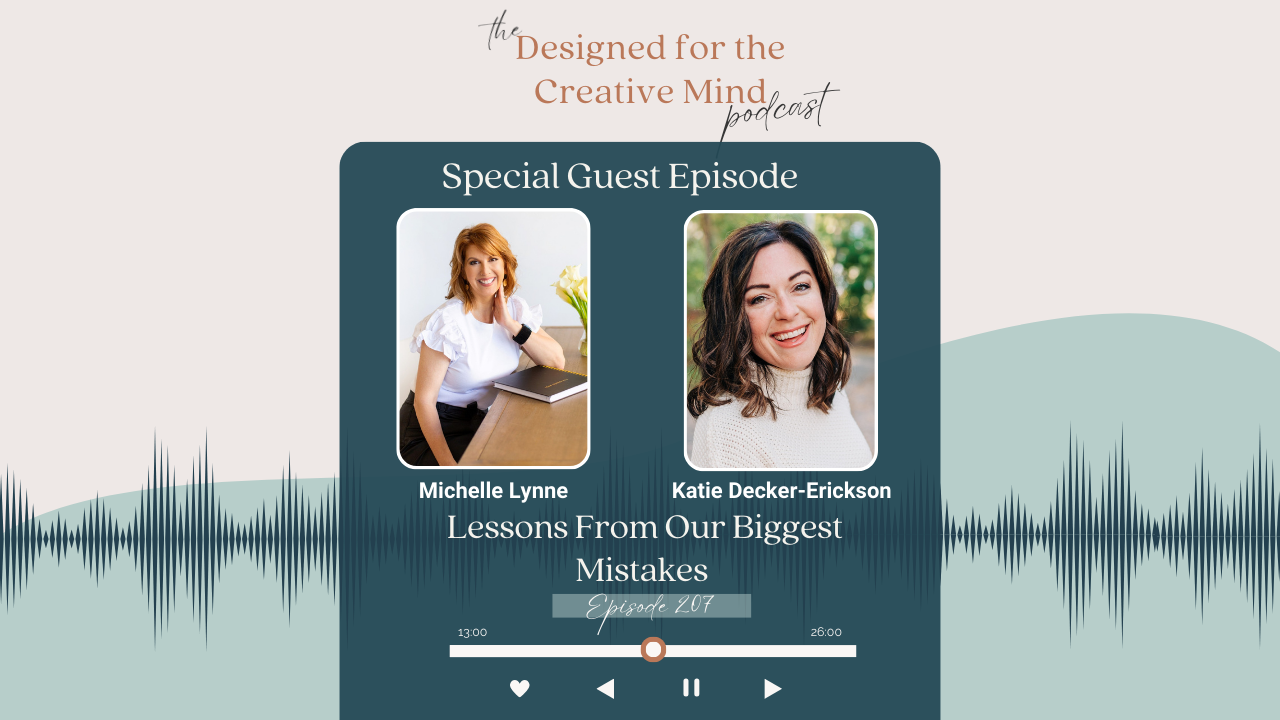 S8 Ep.207 Lessons From Our Biggest Mistakes | As this year comes to a close, I wanted to have a very honest conversation—one rooted in experience, not perfection. In this episode, I'm reflecting alongside another seasoned firm owner, Katie Decker Erickson, on the mistakes we've made, the lessons we learned the hard way, and what actually matters when you're trying to move your business forward with clarity instead of chaos. This isn't about beating yourself up for what didn't work. It's about looking back clearly—without ego or shame—so you can recalibrate your direction, trust yourself again, and make smarter decisions as you head into 2026. In this episode, I talk about: Why you can't change direction in your business without honestly looking in the rearview mirror How growing just for the sake of growth often leads to stress, misalignment, and regret Why busyness, headcount, and "looking successful" can hide deeper operational problems The real cost of ignoring your intuition—and why it always shows up eventually How intuition becomes powerful when it's supported by data, not separated from it Why avoiding your numbers only creates bigger problems down the road What I call the "toll of the soul," and why some profitable work still isn't worth it How letting go sooner—clients, projects, models, or people—can lead to faster alignment Why leadership requires hard conversations, not avoidance How reflection is meant to recalibrate your business, not keep you stuck in regret This episode is for designers who know something needs to change—but don't want to burn everything down to make it happen. My hope is that this conversation helps you look at your business with more honesty, more confidence, and a lot more self-trust as you step into what's next. You don't need to have all the answers for 2026 right now. But you do need to be willing to look clearly at where you've been—so you can choose where you're going on purpose. If you're ready to move forward with clarity instead of guesswork, this episode is for you. | — | ||||||
Showing 25 of 221
Sponsor Intelligence
Sign in to see which brands sponsor this podcast, their ad offers, and promo codes.
Chart Positions
9 placements across 9 markets.
Chart Positions
9 placements across 9 markets.