
Insights from recent episode analysis
Audience Interest
Podcast Focus
Publishing Consistency
Platform Reach
Insights are generated by CastFox AI using publicly available data, episode content, and proprietary models.
Est. Listeners
Based on iTunes & Spotify (publisher stats).
- Per-Episode Audience
Est. listeners per new episode within ~30 days
1 - 1,000 - Monthly Reach
Unique listeners across all episodes (30 days)
1 - 5,000 - Active Followers
Loyal subscribers who consistently listen
1 - 500
Market Insights
Platform Distribution
Reach across major podcast platforms, updated hourly
Total Followers
—
Total Plays
—
Total Reviews
—
* Data sourced directly from platform APIs and aggregated hourly across all major podcast directories.
On the show
Recent episodes
DMA#48: Drawing Sneaky Art in Times Square: AI Slop & the Radical Act of Paying Attention
May 5, 2026
12m 55s
DMA #47: Naked Kickstarters & Bypassing the Print-pocalypse with American Bystander's Michael Gerber
Apr 25, 2026
4m 23s
DMA#40 Recap: The J. Jonah Jameson Editor, Surviving the Tech Deluge, and the Rules of Timeboxing with Jeremy Caplan
Apr 21, 2026
1h 03m 57s
DMA#39: Diagon Alley for Pen Nibs, A Crosshatching Masterclass, and the 5-Line Rule with KAL!
Apr 18, 2026
1h 04m 36s
DMA#44: Funding the Absurdity: How to Pay for Ink Without Selling Your Organs with Mason Currey
Apr 14, 2026
56m 42s
Social Links & Contact
Official channels & resources
Official Website
Login
RSS Feed
Login
| Date | Episode | Description | Length | ||||||
|---|---|---|---|---|---|---|---|---|---|
| 5/5/26 |  DMA#48: Drawing Sneaky Art in Times Square: AI Slop & the Radical Act of Paying Attention DMA#48: Drawing Sneaky Art in Times Square: AI Slop & the Radical Act of Paying Attention | This is a free preview of a paid episode. To hear more, visit www.newyorkcartoons.comAs always, if you want to watch the full replay, please upgrade to Paid. I really appreciate your support.If you want to test the absolute limits of your nervous system, try sitting in the middle of Times Square with a sketchbook, a pen, and an open microphone...It is a sensory assault. It does not smell like inspiration; it smells like roasted nuts, diesel exhaust, and the sweat of ten thousand tourists realising they’ve lost their Marriott room key. The noise is a physical weight. Sirens, pedicabs aggressively looping Alecia Keys, and people dressed as off-brand Spider-Man aggressively demanding five dollars for a photo.“Drawing in New York is combat journalism. You’re trying to capture lightning in a bottle while the bottle is being kicked down Broadway by a guy screaming at his phone.”But this is exactly why I do this. When I started New York Cartoons, the core promise to you, the reader, was that I wasn’t just going to send you polished, sterile drawings from the safety of an air-conditioned studio. The promise was to show you what living, surviving, and creating in New York City actually looks like. The chaos, the invisible labour, and the absurd encounters that fuel the work.So, for this week’s episode of Draw Me Anything, I took the studio to the street!My guest was the brilliant Nishant Jain, better known to his massive audience as The Sneaky Artist. Nishant came down from Canada to sit with me in the blistering epicentre of Manhattan. For an hour, amidst the absolute bedlam of Times Square, we drew the chaos in real-time.Before the stream started, a tall man holding a brown paper bag whipped towards us before locking eyes with me… it was, of course, my neighbour and pal Anthony LeDonne. Because of course it was. (You can see his SYML entry here.) When I introduced him to Nishant, I’d mentioned we were nerding out about Derrida last time we spoke. When he asked who that was, I knew he’d be in for an education… Nishant gave him a primer on the arsehole French philosopher and his musings. I could see the hamster in Anthony’s brain begin to sweat, then die in a mad panic. Derrida: It’s one helluva conversation starter.What started as a live drawing session quickly spiralled into one of the most profound, quotable, and vital conversations I’ve had in years. We talked about everything from French philosophy and the existential threat of tech companies to the mindfulness of observation and the stark contrast between Canadian politeness and New York velocity.Here’s what happens when you put two process-junkies in the loudest intersection on Earth…Part I: Vancouver VS. New YorkThere’s a distinct difference in the way a New Yorker observes the world versus the way a Canadian does, and watching Nishant work was a masterclass in pacing.Nishant possesses a terrifying level of calm. He didn’t fight the chaos. He observed it. “In Canada, the environment gives you the space to think,” Nishant told me, his eyes tracking a guy in a chaotic neon jacket. There is a physical and auditory room to breathe. The silence lets you construct the narrative. But in New York, the noise forces you to react. It’s an entirely different muscle.He’s right. Drawing in New York is combat journalism. You’re trying to capture lightning in a bottle while the bottle is being kicked down Broadway by a guy screaming at his phone.But despite the velocity of the city, Nishant’s process is startlingly deliberate. As we talked, he casually built what would become a beautifully complex drawing of the scene. He wasn’t rushing. He was practising what he calls the radical act of paying attention.“...your body and mind are absorbed in the union of an ask, which is to look to interpret and then to put it down, translate it. And in a lot of ways, you shut out a lot of concerns, you stop thinking about time, you stop thinking about your responsibilities of service, and you're just here for a while.”Part II: The Mindfulness of the Pen, and the Radical Act of Paying AttentionWe spend so much of our time talking about “mindfulness” as this sterile, corporate buzzword. (I’ve written about this before) Tech companies have commodified it. They sell us apps that ding to remind us to breathe, which we check on the same glowing rectangles that are actively destroying our attention spans.Nishant’s approach to drawing is the exact antidote to this. For him, drawing isn’t about producing a piece of “content” for an algorithm. It is a grounding mechanism.“Drawing isn’t about making a pretty picture,” Nishant said, his pen moving carefully across the paper. “It is about forcing yourself to sit still in a world that profits entirely off your distraction. When you draw something, you are forced to actually see it. You aren’t just looking at it. You are understanding its geometry, its weight, and its relationship to the things around it. You are acknowledging its existence in a way that taking a photograph never will.”That hit me like a freight train. In the digital mailstrom, we take thousands of photos we will never look at again. We consume the world in half-second swipes. But when you drag a pen across watercolour paper, you’re making a physical record of time spent. You are saying, I was here, and I paid attention. “The modern world wants us to skim,” he added. “Drawing is the refusal to skim.”If you’re a free reader, now is the time to upgrade.A subscription costs less than a bad bodega sandwich, and it directly funds the real, human, unapologetic art that the tech companies are actively trying to automate out of existence. Support the artists who are actually paying attention.Please upgrade to become a paid subscriber (only $1 per week)Part III: Derrida, Language, and the AI Plagiarism MachineNaturally, sitting in the glowing neon Mecca of American capitalism, the conversation pivoted to the tech overlords and the looming shadow of Generative AI.If you read my essays, you know my stance on the “AI Slop Machine.” I view it as a cultural parasite. But Nishant brought a deeply intellectual, philosophical lens to the conversation that completely reframed the issue for me. He brought up Jacques Derrida.For those who skipped French Philosophy in college, Derrida was the father of “deconstruction.” He famously argued that language isn’t just a tool we use to describe reality; language creates the boundaries of our reality. We can only understand the world through the vocabulary we have to describe it.“Think about what AI actually is,” Nishant explained. “These tech companies aren’t building ‘intelligence.’ They are building predictive language models. They are machines that guess the next word, or the next pixel, based on a massive, stolen dataset of the past.”He paused to add a shadow to the drawing of an awning.“If Derrida is right -if language shapes our reality- then handing our visual and written language over to a machine is incredibly dangerous. An AI cannot create a new vocabulary. It can only recycle the old one. It homogenises human experience into an average. It regresses us to the mean.”This is the exact problem with AI art. It looks perfect at first glance, but it contains absolutely zero humanity. It has no point of view. It doesn’t know what it feels like to sit on a cold metal chair in Times Square while a siren blares in your left ear.“When a human draws a line,” Nishant said, “even if it’s a wobbly, imperfect line, it contains intention. It contains a decision. The AI slop has no intention. It is just statistical probability masquerading as art. And humans are biologically hardwired to eventually reject things that have no soul.”He added something that I really wanted to write down for a discussion later:“...the point of AI is not to make articles; the point of AI is to make an endlessly spinning mill of content to feed their social media algorithms to hypnotise and make you into addicts so that you become a passive consumer instead of a creative.”Part IV: The Finished MasterpieceBy the end of the 50-minute conversation, my own drawings were a frantic, scratchy, high-energy reflection of the anxiety of Times Square. It looked like New York feels.But then Nishant held up his sketchbook.I actually stopped talking for a second. Look at that, I said on the stream. It was incredible. This guy had just casually, while dissecting French deconstructionism and the ethics of tech conglomerates, built the most insanely beautiful drawing of the intersection.It wasn’t just a rendering of buildings and tourists. It had life in it. You could see the deliberate choices he made -what to include, more importantly, what to leave out, what to emphasise. It was the absolute antithesis of an AI-generated image. It was a physical artefact of a human being paying deep, mindful attention to a chaotic world.Watch the Full Replay…Reading these quotes and clips is only half the experience. If you want to actually see the process -if you want to hear the sirens, see the pen hit the paper in real-time, and watch two working artists navigate the muck of New York City while talking about the survival of human art, you need to watch the replay.This is the promise of New York Cartoons. I don’t hide the process. I don’t put a filter on the reality of this job. The full, uncut, 50-minute video replay of our Times Square drawing session is available right now for paid subscribers. | 12m 55s | ||||||
| 4/25/26 |  DMA #47: Naked Kickstarters & Bypassing the Print-pocalypse with American Bystander's Michael Gerber DMA #47: Naked Kickstarters & Bypassing the Print-pocalypse with American Bystander's Michael Gerber | This is a free preview of a paid episode. To hear more, visit www.newyorkcartoons.com“You cannot write a line of code that replaces the invisible labour, the thousands of terrible rough sketches, and the deeply human derangement required to make a truly great cartoon.”If you try to launch a print humor magazine in the 21st century, most financial advisors will tell you to just set your money on fire instead; it’s faster, it requires less paperwork, and it keeps you warmer in the winter.We live in the era of the digital churn. We live in an ecosystem where corporate media conglomerates are continuously gutting their editorial staff, pivoting to video, pivoting away from video, pivoting to AI slop, and generally treating the written word and the drawn cartoon as disposable ephemera. The conventional wisdom is that print is dead…But if you’ve been reading this newsletter for more than five minutes, you know I am obsessed with the messy, unglamorous back-end of making a living as an artist. I love pulling back the curtain on the creatives who look at the “churn,” laugh, and figure out how to keep the lights on without selling their souls to the algorithm.This week on Draw Me Anything, I brought in a guy who looked at a sinking ship and decided to build his own lifeboat.I was thrilled to host the brilliant Michael Gerber. Michael is the publisher, editor, and mastermind behind The American Bystander, a publication that Newsweek literally called “the last great humor magazine.”During the stream, we dug into exactly how you resurrect a print humor magazine in the 21st century without setting mountains of corporate cash on fire. It is a story of grit, absurd luck, and a publishing model that bypasses the corporate overlords entirely. But before we get to the Chinese oligarchs and the naked Kickstarter launch, we have to go back to a very small room in the One World Trade Center.The Everest of Cartooning and the Mouse in the CarMy introduction to The American Bystander didn’t happen on a newsstand. It happened in the absolute epicenter of the New York cartooning world.It was late 2014, maybe early 2015. I was a relatively new immigrant to America, still trying to figure out the brutal mechanics of the New York publishing scene. To my brain, the ultimate peak of the industry -the absolute Everest of cartooning- was getting into MAD Magazine and getting into The New Yorker. Those were the twin pillars of the comedy art world. Everything else was just scenery.Related Reading:I was sitting at The New Yorker in the cartoon lounge. Now, let’s be honest about the cartoon lounge at that time: it wasn’t really a “lounge” anymore. It was just a small room off to the side from where cartoon editor Bob Mankoff’s office was located. But the physical space didn’t matter, because of who was in it.The legendary Sam Gross was sitting in the room. He was positioned right below a giant framed picture of his absolute classic cartoon—the one with the mouse driving the wind-up car. If you’re a cartoonist, sitting in a room with Sam Gross was like a guitarist sitting in a room with Keith Richards.Sam was holding a copy of a magazine I had never seen before. “Kid, have you heard of this magazine?” he asked me.I looked at the cover. The unmistakable, beautiful line work of Arnie Roth stared back at me. It was Issue Number Six. “I’m embarrassed to say that I haven’t heard of it,” I admitted.Sam started explaining what it was, and as he flipped through the pages to show me the cartoons, my jaw hit the floor. I was looking at a murderers’ row of comedy art. “This is everyone I love,” I remember thinking. “These are all my favorite cartoonists in here. What the hell? How long has this thing been around?”Sam saw the absolute shock on my face. “Yeah, right?” he smiled. “You should submit to this.”Naturally, the moment he said that, the impostor syndrome kicked in with the force of a freight train. I looked at the names on the pages. I don’t belong in here, my brain screamed. This is ridiculous. These are giants in here. I don’t belong in here.I was so completely enamored with this magazine, yet I had absolutely no idea it even existed.When I told this story to Michael on the stream, he just laughed. “Well, that’s kind of the story of the business right there,” he said.“Everybody loves it. Very few people know about it. We’re always trying to figure out how to get more people to know about it.”Fast forward to today, and I am deeply proud to not only be a contributor to The Bystander, but to have hosted its “re-founder” to talk about exactly how this impossible publication came to exist.The Trifecta and the PitchTo understand The American Bystander, you have to understand the pedigree of the people who originally conceived it. | 4m 23s | ||||||
| 4/21/26 |  DMA#40 Recap: The J. Jonah Jameson Editor, Surviving the Tech Deluge, and the Rules of Timeboxing with Jeremy Caplan DMA#40 Recap: The J. Jonah Jameson Editor, Surviving the Tech Deluge, and the Rules of Timeboxing with Jeremy Caplan | When I first sat down to chat with Jeremy Caplan about artificial intelligence and digital productivity tools, I genuinely did not think we would end up talking about him playing the violin. I certainly did not expect the conversation to pivot into a deep, philosophical appreciation for the irreplaceable magic of humans sitting in a room together, simply enjoying a live performance.But tha’s the funny thing about talking to someone who spends their life evaluating machines. You inevitably end up talking about what it means to be human.The frictionless technological utopia we were promised feels increasingly like a relentless, exhausting deluge. Every week brings a new platform to master, a new algorithm to appease, and a new artificial intelligence threatening to automate us into oblivion. It’s like drinking from a fire hose while someone yells at you to “pivot to video!”This is exactly why I was so incredibly relieved to sit down with Jeremy on this episode of Draw Me Anything.Jeremy is a rare beacon of sanity in the digital miasma. He is the Director of Teaching and Learning at CUNY’s Newmark Graduate School of Journalism. He is a former journalist for Time Magazine. Before that, he was a classical violinist. But more importantly for my own daily survival, he is the creator of the massively popular Wonder Tools newsletter on Substack. Jeremy spends his days wading into the chaotic, deeply overwhelming waters of the internet. He tests, breaks, and reviews new apps, software, and digital features so the rest of us don’t have to waste our precious human hours doing it.Distilling the ChaosWe kicked off the stream talking about the exhaustion of trying to keep up with tech news. It is not just about discovering new tools anymore. It is about tracking the constant, aggressive updates to existing tools. ChatGPT has a new voice feature. Gemini just launched a massive update. Claude is now doing something entirely new with your phone. And you can’t opt out of it.. It never stops.Jeremy explained that his superpower for distilling this madness down to accessible, bite-sized pieces actually came from his time writing for Time for Kids. When you have to explain complex global news to an eight-year-old in exactly one hundred words, you learn to cut the jargon immediately. You learn to anticipate a human reader’s questions and preemptively answer them.He also cited the legendary tech writer Walt Mossberg as a major mentor and influence. Mossberg succeeded wildly at The Wall Street Journal because he approached technology not as a deeply entrenched engineer, but as an ordinary guy just trying to figure out how a tool could actually be useful in his daily life.“I find writing to be extraordinarily difficult. I read The Elements of Style. I read Anne Lamott’s Bird by Bird. I read David Sedaris constantly to study comedic pacing and essay structure. But actually getting the words out of my head and onto the page feels like passing a kidney stone…”That is exactly what Jeremy does with Wonder Tools. He doesn’t just list fifty new AI tools that launched on Product Hunt this week. He gives you three specific, highly actionable ways to use one feature of NotebookLM to make your Tuesday slightly less miserable. He gives you templates. He shows you what a forty-page deep research report from Gemini actually looks like, so you do not have to spend twenty minutes generating one just to see if it is useful.If you enjoy my work and would like to support, please take out a premium subscription (just $1 per week)Evergreen Processes over Disposable NewsOne of the most fascinating things about Jeremy’s approach is his focus on evergreen content. We’re constantly blasted with disposable news. A tech CEO gets fired, a new app launches and dies in a week, a company changes its name. Jeremy actively avoids the daily churn. He wants to create resources that a reader can save and return to three weeks later, knowing the information will still be fundamentally useful.This really resonated with me. I told him about a post I wrote on Medium over a decade ago. People constantly ask me how I manage to juggle cartooning, stand-up comedy, writing, and running a business without completely losing my mind. The answer is timeboxing. I work strictly from a calendar, not a to-do list. I estimate how long a task will take, block it out in my iCal, and adjust the time block later if it took longer or shorter than expected.I wrote a simple, straightforward piece explaining this exact process. I thought it was old news. Cal Newport had written about it years prior. But the piece went incredibly viral, and I made two thousand dollars from the Medium partner programme purely off that one specific workflow explanation. Sometimes the most valuable tools are not shiny new apps. Sometimes, they are just fundamentally sound ways of organising a chaotic human brain.The Ethical Calculus of AIWe eventually had to talk about the elephant in the room. Artificial intelligence…I frequently get accused of being either a doomer or a total Luddite, but the truth is, I am an early adopter. I was one of the very first cartoonists in my circle to embrace Wacom tablets, Cintiqs, and the iPad Pro. I actively test out tablets for companies like Xencelabs. I do not shy away from folding digital tools into my workflow when they help automate the absolute drudgery of administrative freelance life.However, the rapid acceleration of generative AI requires a lot of mental arithmetic. I told Jeremy about my personal ethical boundaries. I use Grammarly for proofreading. I am currently experimenting with Gemini for deep research. But I absolutely refuse to use Meta AI or Elon Musk’s Grok because I fundamentally distrust the ethics of the people building them. I opt out of the platforms where I find the creators ethically compromised.Putting these streams together, wrangling brilliant guests, manually untangling the spaghetti bowl of a brain to pull out the best insights, and writing these recaps requires a heady cocktail of intense caffeine and sheer willpower. If you value this little digital monastery, please consider upgrading to a paid subscription for just $1 a week. It pays for my time, repays the time and labour of writing these up, and keeps Morris supplied with the unnecessarily expensive dog food he demands…Jeremy had a fascinating, highly pragmatic take on this. He acknowledged the massive macro issues. He is deeply aware of the environmental cost of data centres, the terrifying water usage, and the flawed predictive models being used to evaluate people in hospitals and prisons. But he treats his newsletter strictly as “service journalism.”He used a brilliant restaurant analogy. When we go out to eat, we sometimes evaluate the ethical supply chain of the ingredients, the working conditions of the farmers, and the environmental impact of the transportation. But other times, we just need to eat a sandwich because we are hungry. He doesn’t believe we need to litigate the macro ethics of AI every single time we try to automate a tedious spreadsheet or fix a typo. He leaves the heavy investigative journalism to the experts, specifically citing Karen Hao’s brilliant book Empire of AI, and focuses entirely on practical utility.The J. Jonah Jameson EditorI find writing to be extraordinarily difficult. I read The Elements of Style. I read Anne Lamott’s Bird by Bird. I read David Sedaris constantly to study comedic pacing and essay structure. But actually getting the words out of my head and onto the page feels like passing a kidney stone.Because I no longer work in a physical newsroom, I deeply miss having a ruthless editor. When I was coming up in newspapers at nineteen years old, I had a classic, cantankerous, ink-in-his-veins editor. He was a J. Jonah Jameson type who had absolutely no compunction about telling me my work was complete garbage. It hurt my precious feelings constantly, but I learned faster than I ever would have with a polite sycophant.Since I can’t afford to hire a human to yell at me in my apartment, I built a custom AI editor in Gemini. I programmed it with the specific persona of a grumpy, hard-assed, chain-smoking newspaper editor. Now, when I finish a draft by hand, I feed it to the bot. It yells at me about my weak verbs, my terrible grammar, and my overly long paragraphs. I ignore half of its advice because I know the rules well enough to break them, but it forces me to actively defend my choices.Jeremy agreed completely. He relies heavily on Claude Projects for his micro-editing. He feeds it all of his past writing to establish context, background, and tone, and then uses it as a highly critical sparring partner to catch redundant phrasing and double commas.He pointed out a provocative but entirely true reality. There are incredible human editors out there. But the average human copy editor simply doesn’t have the bandwidth, the time, or the willingness to ruthlessly tear apart paragraph four and analyse your four different verb choices on a Tuesday night. An AI will do it instantly, comprehensively, and without worrying about hurting your feelings.Drawing by Hand Before Hitting UndoThis brings us right back to the violin. We talked about where different artists draw the line with these tools. I brought up a story from a previous stream with Liza Donnelly, the brilliant New Yorker cartoonist. She mentioned using AI purely as a brainstorming partner to bounce ideas around.Our mutual friend, the wonderful British cartoonist Alex Hallatt, heard that and decided to try it. Alex took some scattered, messy notes from a walk, fed them into an LLM, and started riffing on gag premises. It was a great, highly functional workflow. Right up until the bot cheerfully asked, “Do you want me to draw this for you?”That is the exact moment the panic sets in. It is the moment you realise the tool wants to replace the human element entirely.I firmly believe that the wobble in the line, the physical imperfections, and the distinct human voice are the only things keeping us from being completely swallowed by the generic digital void. When young students ask me if they should learn to draw on an iPad, I always tell them absolutely not…Learn to draw by hand first. Learn the absolute fundamentals with ink and paper. If you draw a bad line with a Hunt 101 dip pen, you cannot hit undo. You have to draw that exact line forty-five times until you get it right. You need those neural pathways to form, and you need to understand the physical mechanics of the craft, before you start relying on digital safety nets. You have to learn how to play the instrument before you let a computer tune it for you.I spent the rest of the stream doing exactly what I love to do. Drawing wobbly, imperfect lines while navigating the absurdities of the modern world. I am deeply grateful for guys like Jeremy who do the heavy lifting in the digital trenches so I can safely retreat to my analogue drafting table.Now, if you will excuse me, I need to go figure out why Adobe is demanding another subscription fee.‘til next time!Your pal,PS. Look, if this actually did something for your brain (or at least distracted you from the creeping dread of your own inbox for six minutes), please consider restacking this and sharing it with your people. It’s the only way the word spreads.The Tools We Discussed* Wonder Tools: Jeremy Caplan’s brilliant, incredibly useful Substack newsletter. If you are overwhelmed by tech, start here.* Claude Projects: Jeremy’s preferred tool for maintaining context and generating ruthless micro-editing feedback.* Gemini: The engine behind my custom J. Jonah Jameson editor, and a powerful tool for deep research generation.* NotebookLM: A fascinating tool for organising notes and research that Jeremy frequently writes actionable guides for.* IA Writer: A beautifully simple, distraction-free writing tool Jeremy relies on.* Grammarly: My go-to for catching the embarrassing typos that slip through the cracks at 2:00 AM.* Wacom & Xencelabs: The digital drawing tablets that keep my freelance career afloat.The Processes We Discussed* Timeboxing: The absolute lifesaver of a scheduling method where you work strictly from blocked-out calendar chunks rather than a sprawling to-do list.* Macro vs. Micro Editing: Understanding the difference between fixing a structural narrative flaw (macro) and tightening up a weak verb in paragraph three (micro).* Custom AI Personas: Training an LLM with a specific voice and set of instructions to act as a specialised sparring partner for your writing.Resources and Artists Mentioned* Cartooning in the Age of AI: Alex Hallatt’s incredibly thoughtful Substack documenting her journey and boundaries with digital tools.* Liza Donnelly: Legendary New Yorker cartoonist and previous DMA guest.* Walt Mossberg: The legendary tech journalist who proved that writing for the ordinary user is far more valuable than writing for the engineers.* Cal Newport: The author of Deep Work and a champion of timeboxing.* AI Snake Oil: The book by Arvind Narayanan and Sayash Kapoor that Jeremy’s new Wonder Tools book club is tackling first.* Bird by Bird: Anne Lamott’s absolute bible on the excruciating, beautiful process of writing. This is a public episode. If you'd like to discuss this with other subscribers or get access to bonus episodes, visit www.newyorkcartoons.com/subscribe | 1h 03m 57s | ||||||
| 4/18/26 |  DMA#39: Diagon Alley for Pen Nibs, A Crosshatching Masterclass, and the 5-Line Rule with KAL! DMA#39: Diagon Alley for Pen Nibs, A Crosshatching Masterclass, and the 5-Line Rule with KAL! | If you joined me last time I had the legendary Kevin “KAL” Kallaugher on the stream, you’ll remember we discussed the “Cartoonist’s Paradox”- the absurd reality where cartooning is incredibly easy to start, but absolutely impossible to stop once it gets its hooks into you. This time around, our conversation shifted gears. Instead of talking about how to get into the game, we talked about how to survive it. We dug into how to stay sane in a politically fractured world, how to defend the analogue line against the digital horde, and the sheer mechanical joy of making marks on paper.I frequently have moments during these streams where I completely forget I’m hosting a broadcast. I find myself just sitting there, slack-jawed, realising how profoundly lucky I am to have an hour to pick the brains of my absolute heroes. KAL is a legend of the medium. He is coming up on his 50th year at The Economist and is currently putting together a massive retrospective exhibition of his work. Getting to draw alongside him is a ridiculous privilege.The Outsider’s Advantage: We kicked things off by talking about the absolute circus of modern politics. KAL and I both know what it’s like to be an expat trying to explain American madness to the rest of the world. KAL spent a decade living in the UK, and he noted that being an outsider gives you a unique, clear-eyed view. You aren’t tethered to the deep-rooted tribalism of the country you’re in. You can look at the idiocy on both sides of the aisle and criticise it without feeling like a traitor. It’s a perspective he brings to The Economist, which he praised for its critical thinking and reasoned assessment of global madness.The Human Line vs. The Human Centipede: We eventually touched on the unavoidable elephant in the room: AI and the internet’s right-wing “meme wars”. KAL pointed out a fundamental difference between a viral meme and a great political cartoon: a cartoon is signed. You know a human being sat down, thought about it, and drew it. In an era of increasing detachment and digital takeover, a hand-drawn line stands out because it has life, energy, and personality.Or, as Paul Nesja so poetically put it in the live chat: “AI is to creativity as the human centipede is to fine cuisine”. (We probably could have ended the broadcast right there.)Putting these recaps together requires a unique cocktail of intense caffeine, squinting at my monitor, and manually untangling the spaghetti bowl of my brain to pull out the best insights. If you value this little digital monastery, please consider upgrading to a paid subscription for just $1 a week. It pays for my time, repays the labour of writing these up, and keeps Morris supplied with the good dog food he has foolishly become accustomed to.The Magic of Crosshatching: KAL is an absolute surgeon when it comes to crosshatching. He explained that the technique really evolved out of necessity in the 19th and 20th centuries. Printing in colour or half-tones was prohibitively expensive, and newspapers used terrible, cheap newsprint that made ink bleed. Cartoonists had to use juxtaposed fine lines to denote colour, shading, and texture. KAL even talked about the maddening challenge of using hard black lines to crosshatch something as airy and shapeless as a sky.Diagon Alley for Cartoonists: My favourite story of the stream was KAL explaining where he gets his dip pen nibs. Back when he lived in London, an art director sent him to Philip Poole, a legendary pen dealer on Charing Cross Road. KAL found a tiny, unmarked door squished between two buildings and walked into a dark, heavily wooded room filled with tiny drawers of nibs. He described it as disappearing into Harry Potter’s Diagon Alley.A hunched, cantankerous guy in a white trench coat shuffled out and started handing him nibs to try. KAL eventually settled on the George W. Hughes 1319. Years later, when he tried to order more, the guy informed him they hadn’t been manufactured in 150 years. KAL eventually got a box of 144 of them, and he is still drawing with them today.The 5-Line Rule: We talked about the difficulty of line economy—knowing when to stop drawing and not overwork an image. KAL told a brilliant story (often attributed to Phil May or R.O. Blechman) about a cartoonist getting confronted by editors in a pub.The editors complained that the cartoonist was paid an awful lot of money, yet his latest cartoon only had seven lines in it.The cartoonist replied: “If I could have done it in five lines, I would have charged twice as much”.Thanks for tuning in!‘til next time!Your pal,PS. Look, if this actually did something for your brain (or at least distracted you from the creeping dread of your own inbox for six minutes), please consider restacking this and sharing it with your people. It’s the only way the word spreads.The Tools We Talked About:* George W. Hughes 1319 Nibs: KAL’s unicorn tool of choice. Good luck finding them; they haven’t been made in a century and a half.* Hunt 101 Imperial: My wobbly weapon of choice.* Duo-Shade Board: The chemical-laden drawing board that old-school tabloid guys used to use to pull out different shading tones.The Artists We Discussed:(Warning: Clicking these links will result in a minimum three-hour Wikipedia rabbit hole.)* David Levine: The absolute master of crosshatching and caricature.* James Gillray: The godfather of the political cartoon. His work was so biting that the Royals used to send people to buy out his entire print run just to hide the drawings.* David Low: The brilliant New Zealand cartoonist who ended up on Hitler’s kill list for his work.* Ronald Searle: The man whose inky fingerprints are on the style of almost every modern cartoonist alive.* R.O. Blechman: Legendary graphic designer and illustrator (and possible originator of the 5-line story).* Paul Rigby & Bay Rigby: The Australian father/son duo who dominated the NY Post and Daily News tabloid cartooning wars.* Pat Oliphant: The Aussie who brought the energetic, sprawling tabloid style to America.* Bill Mitchell & Peter Broelman: Absolute masters of Australian editorial line economy.* Catherine Woodman-Maynard: The Minneapolis graphic novelist who launched “Comics for Change” in response to local tragedies.Other Resources:* KAL’s Substack: If you aren’t subscribed to KAL yet, fix that right now. He is generously opening his sketchbooks and sharing a lifetime of process and wisdom.* Comics for Change: The initiative started by Catherine Woodman-Maynard that gathered over a thousand entries worldwide.Now, if you’ll excuse me, I need to go see if I can find a guy in a white trench coat hiding in a London alleyway… This is a public episode. If you'd like to discuss this with other subscribers or get access to bonus episodes, visit www.newyorkcartoons.com/subscribe | 1h 04m 36s | ||||||
| 4/14/26 | 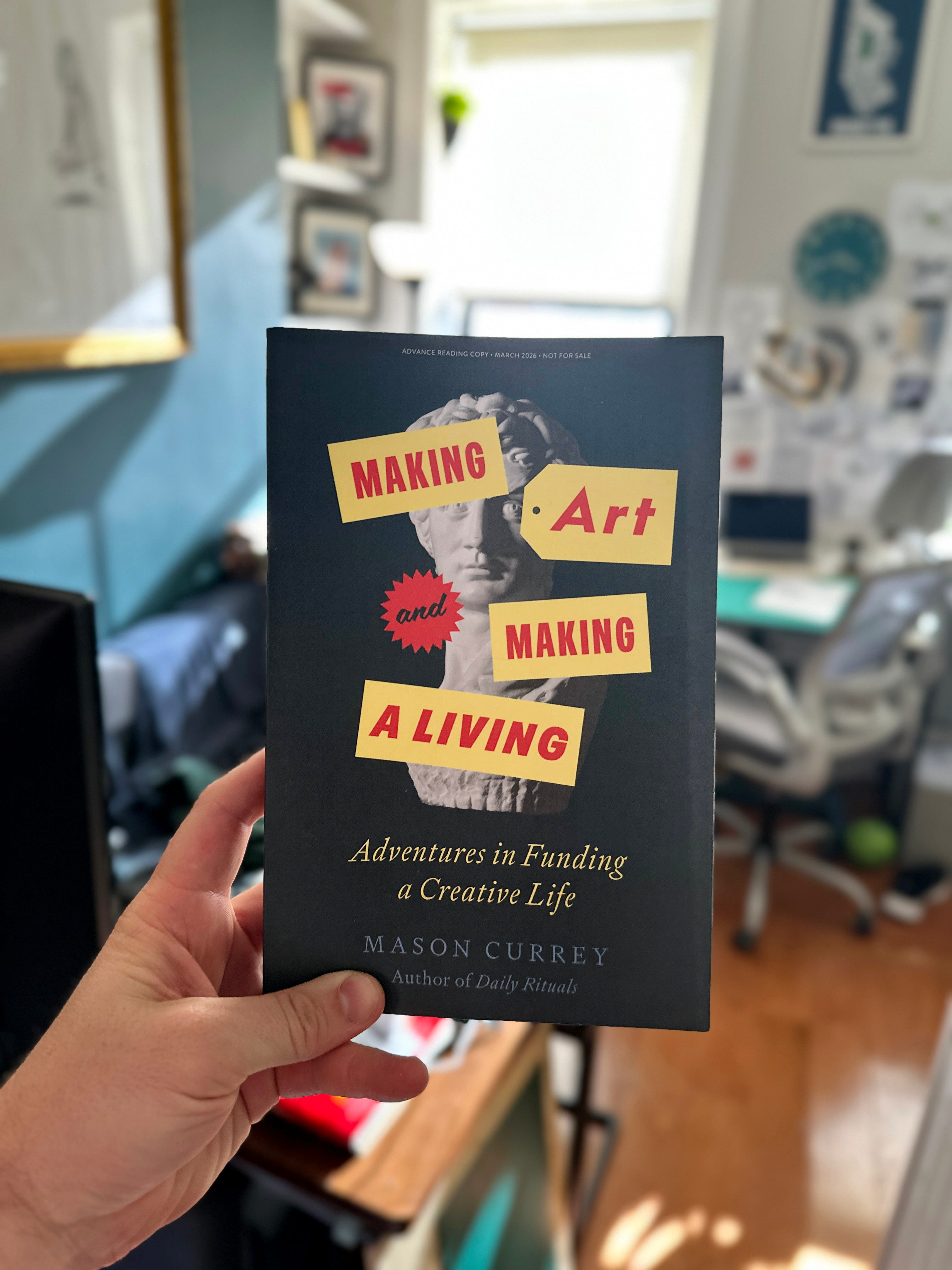 DMA#44: Funding the Absurdity: How to Pay for Ink Without Selling Your Organs with Mason Currey DMA#44: Funding the Absurdity: How to Pay for Ink Without Selling Your Organs with Mason Currey | I live in an ancient little apartment a block from Times Square, because I love cooking dinner in my bedroom.It’s more of a ‘Pre-War Cupboard’ really. I ordered a mini fridge the other day because I needed a guest bedroom. Morris, my French bulldog, is asleep on a pile of discarded drawing paper, completely unbothered by the fact that his gourmet kibble requires legal tender. My radiator clangs with the aggressive rhythm of a stolen Citibike being dragged backwards down a flight of subway stairs.It’s a very particular kind of anxiety. You want to make art, but you also want to occasionally eat a Chipotle burrito (strictly no beans). It’s an impossible Venn diagram. I’ve made my living for twenty-one years as a freelance artist and comedian. I don’t have a day job, I don’t have a side hustle, and I don’t have a wealthy patron bankrolling my Blackwing addiction.Luckily, Mason Currey came on the show this week. He’s the author of Daily Rituals, a book I devoured during the pandemic, and his new hardcover is out right now. It’s called Making Art and Making a Living: Adventures in Funding a Creative Life.When I first saw the title, I told Mason my immediate thought process. “I initially, when I got the book, thought it was finding a creative life,” I said. “And I was like, oh no, it’s way more important. Funding! It’s about money.”We got into the weeds of how historical geniuses paid their bills, and honestly, it’s comforting to realise they were mostly just flailing around like the rest of us. I started by asking about Arthur Schopenhauer, who managed to dodge a soul-crushing life in mercantile finance solely because his father died and left him an inheritance. I spend half my time wandering the concrete canyons of Manhattan, wondering how to pay my rent, so I had to ask Mason: Is the secret to artistic genius really just having a rich dad who dies at the exact right time?“James Joyce, for instance, was an absolute nightmare of a human being…”It turns out, the answer is a complicated ‘yes and no’. We discussed Charles Baudelaire, whose letters to his mother sounded violently familiar. I’ve always carried this quiet, crushing shame that I can’t just sit at a desk at 9:00am and produce brilliance. I struggle with regulating attention on demand and initiating tasks without a heroic amount of friction. When I can’t meet expectations, it feels intensely personal, like a reflection of who I am at my core.I asked Mason if Baudelaire’s legendary financial chaos was a symptom of executive dysfunction. Mason pointed out that Baudelaire would let pressure build up until he was in a mad panic. “He talks about how he can’t make himself do the thing until it’s built up so much pressure that he finally does it in this explosion,” Mason said. “He sort of had run up so much debt that he’s forced to dodge creditors and continually be moving from place to place.”If you enjoy my work and would like to support, please take out a premium subscription (just $1 per week)Leaving things until the absolute last second to manufacture adrenaline is a textbook symptom of ADHD. Baudelaire didn’t have the diagnostic criteria to explain his dopamine dysregulation, but he had the frantic, desperate energy of a man trying to outrun his own brain. He blew his inheritance, dodged his landlords, and begged his mother for loans just to buy firewood.“The odd jobs that used to support young artists have basically evaporated… They’ve been swallowed up by algorithms and artificial intelligence.”We talked about the absolute absurdity of how some artists survived their financial ruin. John Cage funded his avant-garde music by going on an Italian television quiz show as an amateur mushroom expert. (As one does). He won the modern equivalent of ninety grand and bought a Volkswagen van. I asked, "Are we all just one weird reality TV appearance away from funding our next creative project? Do I need to go on a baking programme and pretend I care about fondant just to afford fresh watercolour pans?” (I’m kidding. I did that already…)Then there’s Fernando Pessoa, who inherited a hefty chunk of change. Did he invest it sensibly to live off the interest? Hell No! He blew the entire inheritance in less than a year, having an incredibly expensive printing press shipped from Spain to Portugal, of course…We also spoke about the absurd methods we use to force ourselves into a productive headspace. For sixteen years, the only way I could get my daily newspaper comic strip done was a highly specific, slightly unhinged ritual. I told Mason all about Scotch Bath Sunday. I would get in the bathtub, pour myself a generous glass of peaty Scotch, and sit there with a yellow legal pad. No phones, no iPads, no laptops. Just me, the boiling water, and the looming terror of a deadline.Mason loved it. “I think there is a little bit of superstition there,” he said, “but there’s also something really powerful about the repetition. You train your mind to get into that particular headspace on a somewhat regular basis.” This is a public episode. If you'd like to discuss this with other subscribers or get access to bonus episodes, visit www.newyorkcartoons.com/subscribe | 56m 42s | ||||||
| 4/13/26 | 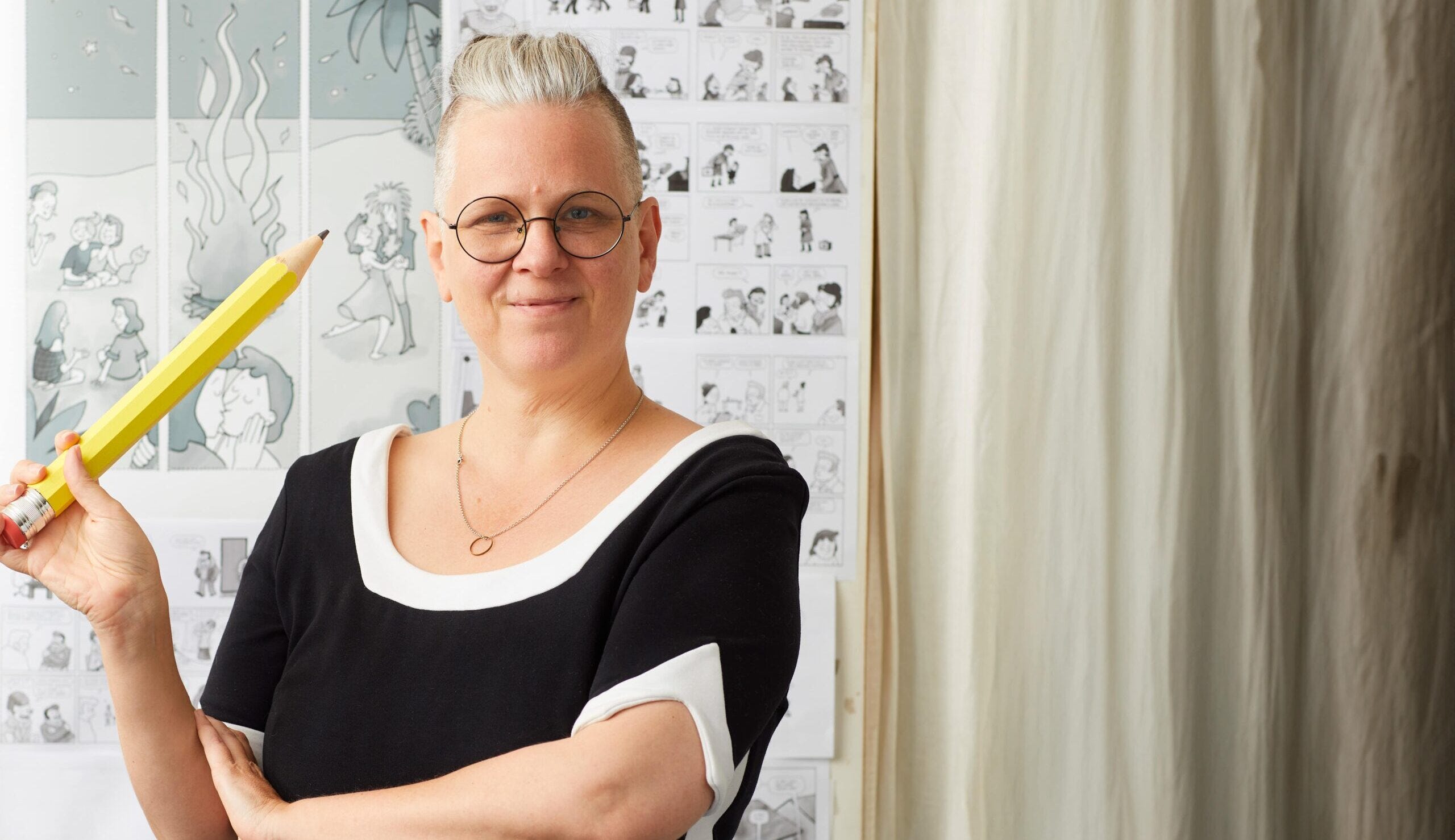 DMA#38: India Ink, Insomnia, and Internet Thieves with Margreet DeHeer DMA#38: India Ink, Insomnia, and Internet Thieves with Margreet DeHeer | Margreet is a brilliant Dutch comic artist and the former Comics Laureate of the Netherlands. She spent three years acting as an ambassador for the medium, literally compiling guides to help teachers get graphic novels onto high school reading lists. She is also someone who intimately understands the frantic reality of a creative life.The Court Jesters & the Freedom FightersMargreet and I talked about the bizarre cultural divide in cartooning. In Australia, people generally look at comic artists like we are overgrown toddlers playing with crayons. It is treated as a silly little hobby. But if you take a train to France or Belgium, comic artists are treated like absolute rock gods.I told her about a cartooning conference I went to in France called RIDEP. I was standing in a room with cartoonists from Tunisia, Sudan, and China. They had been exiled or forced into hiding for drawing anti-propaganda cartoons against dictatorial regimes. They were actual, literal freedom fighters. I draw jokes about talking dogs. I realised very quickly that I am more of a court jester. It was a profoundly humbling reality check.Making a living as an artist requires you to constantly ask people for money, which is something most cartoonists are fundamentally terrible at doing. Margreet is an expert in crowdfunding, having run multiple successful campaigns in Holland to bypass the traditional publishing gatekeepers.The Kickstarter Scam…But she recently got targeted by a very clever, highly sophisticated Kickstarter scam. Scammers will pledge a massive amount of money to your campaign just to get your attention. Then, they send a highly convincing email from a “notification bot,” claiming your account is suspended, and your money is frozen. They provide a link to steal your credentials. Margreet described it as the digital equivalent of being lured away from a busy high street into a dark alley. We are already sweating over our drawing boards; we do not need thieves making it harder.Related viewing:My interview with the Founders of Zoop:Theology and Annoying Mrs LeeMargreet has a fascinating background. She originally flunked out of school because she hated the technology, so she pivoted to studying theology at the University of Amsterdam. Both of her parents are ministers, so it was in her blood. While she was there, she drew a comic for the faculty paper called The Adventures of Jesus. (Which sounds like the working title for The Bible).I completely related to her fascination with religion as a storytelling mechanism. I went to an Anglican high school, and I used to infuriate my Bible study teacher, Mrs Lee. I would sit in the back, drawing cartoons and interrogating the text with the obnoxious persistence of a discount detective. I just wanted to know how the plot holes were resolved. Mrs Lee did not appreciate my feedback. She hated me.The 3:00 AM Eyeball HackThe absolute most valuable thing I took away from our chat was a neurological trick for my broken, sleep-deprived brain. We were talking about meditation and dealing with anxiety, and Margreet told me about an EMDR-style hack she uses when she is trapped in a rumination loop.If you want to read about my annoying high school Bible study questions, a completely bizarre neurological hack to cure insomnia, and the absolute hazard of using a dip pen in bed, consider upgrading to a paid subscription for just $1 a week. It keeps the ink flowing & Morris fed. This is a public episode. If you'd like to discuss this with other subscribers or get access to bonus episodes, visit www.newyorkcartoons.com/subscribe | 1h 03m 52s | ||||||
| 4/10/26 |  DMA#46: "Protect Your Time Like It’s the Last Drop of Water" with Sarah Elizabeth Hill of Bobi Media DMA#46: "Protect Your Time Like It’s the Last Drop of Water" with Sarah Elizabeth Hill of Bobi Media | This is a free preview of a paid episode. To hear more, visit www.newyorkcartoons.comEpisode Links: Book // Socials // Podcast // WebsiteIf you caught this chat live on Thursday, you know my chat with Sarah Elizabeth Hill didn’t bother with small talk. We dove straight into the deep end.Sarah writes, produces, and runs Bobi Media. She took $400 and built it into an agency that works with Oscar winners, Deepak Chopra, and brands you see on billboards. On paper, it looks like she just levitated to the top of New York media. Spoiler: nobody floats in this city. You claw your way up, or you get chewed up.But on Draw Me Anything, we don’t do glossy. We go straight for the mess under the sink. We talked about the invisible sacrifices—the stuff nobody puts on LinkedIn. The reality of trying to keep a business alive in a city that’ll eat you for breakfast if you blink.Here are a few things we unpacked in the first half of the conversation…The Reality of the Creator GrindTurns out, creative brains are actually built for business… if you can keep the lights on, swallow your pride, and remember to actually send the invoice. We talked about those early days, stretching that initial $400 investment, and the sheer, unadulterated panic of realising you are the only safety net you have.But that same tunnel vision required to build something out of nothing? It’ll burn you out faster than a …ugh. I’m too exhausted. I can’t think of a simile. Sarah didn’t sugarcoat the human cost of the hustle. She talked about the time the grind nearly broke her completely:“I was working so much I wasn’t leaving my desk... I hadn’t developed my habits and so was hospitalised, because I couldn’t get my brain to stop spinning.”Building the “Infrastructure” of YouWhen your brain is your business, a breakdown isn’t just a personal crisis; it’s a corporate bankruptcy. We talked about the absolute necessity of building a team. And I don’t just mean hiring a virtual assistant. I mean building the infrastructure of you: Accountants. Therapists. The guy who tells you to stop staring at the screen and breathe. All of it.Sarah made a brilliant point about treating your physical and mental health like non-negotiable client meetings. If you don’t carve out an hour to lift something heavy, walk around the block with the dog, or just stare at the ocean on a Friday afternoon, you’ll crash. The city doesn’t care. The algorithm doesn’t care. You have to work to live, not the other way around.The “Hell Yeah or No” RuleNew York is an all-you-can-eat buffet of opportunities, which means the most dangerous thing you can do is say “yes” to everything. We dug into Derek Sivers’ famous rule: if it’s not a hell yeah, it’s a no.“You have to protect your time like it’s the last glass of water in the desert. If you don’t aggressively filter what comes across your desk, you end up building someone else’s dream while yours slowly starves.”The only way to keep your time from getting mugged by every shiny offer is to know your “Big Why.”The Reframe, the Churn, and the AI Survival GuideIn the second half of the stream, we got into the stuff that actually keeps you up at night. The heavy hitters. The things we usually only talk about at the bar after the gig is over.We cracked open the New York Churn- the endless, exhausting loop of people showing up, burning out, and getting spit back out to the suburbs. Sarah handed me a new way to look at the concept of “personal sacrifice” that completely rattled my brain. It made me rethink what it actually takes to stick around, keep your friends, and build a life here that doesn’t fall apart the second the rent goes up.And then, we finally wrestled with the elephant in the room: Generative AI. Sarah’s new book, Chat Sh!t Crazy, is all about using these tools to sharpen your sense of self, not erase it. Instead of complaining about the robots taking our jobs, we got into the weeds on how to use AI as a mirror for your own blind spots. We talked about how to survive the AI flood without losing your soul (or your rent money.)To my free subscribers: If you want the whole thing -the raw, uncut hour- you’ve got to step inside the studio. The full replay is for the folks who keep the lights on and put dog food in Morris’ tummy.If you care about real art, the messy back-end of the creative process, and actual human connection, I need you in the inbox. Upgrade your subscription. Help keep this thing alive so I can keep bringing you these conversations. | 3m 33s | ||||||
| 4/3/26 |  DMA#45: How Traverse City built a comedy festival that treats comics like actual humans! DMA#45: How Traverse City built a comedy festival that treats comics like actual humans! | This is a free preview of a paid episode. To hear more, visit www.newyorkcartoons.comThe sheer logistical terror of running a comedy festival is not something the average person truly understands. You have to convince nearly a hundred highly neurotic, sleep-deprived stand-up comedians to travel to a single location. You have to make sure they get picked up at the airport. You have to house them. You have to pray they have the personal o… | 2m 04s | ||||||
| 4/1/26 | 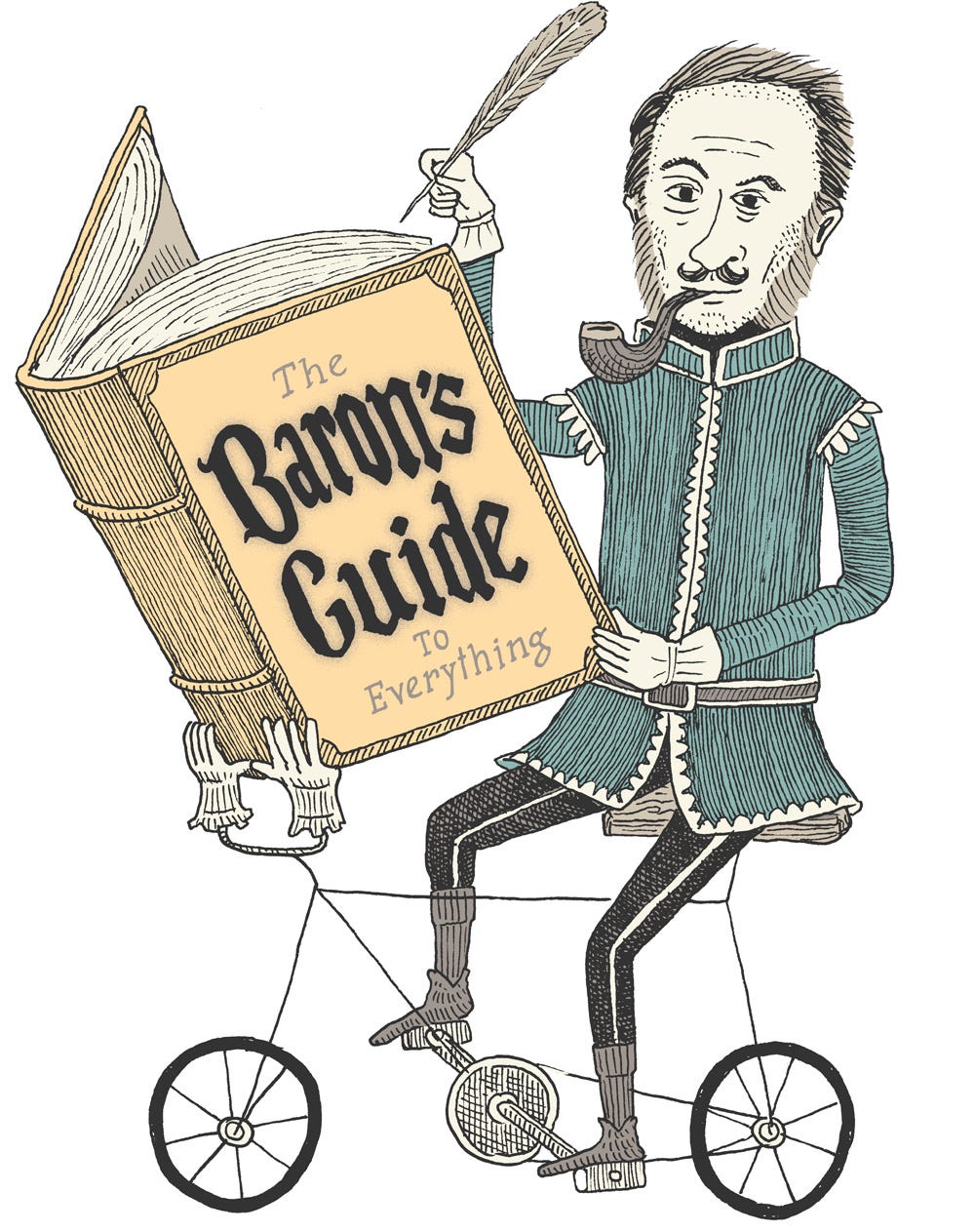 DMA#43: The Nooks & Crannies of New York City with Tom Chitty DMA#43: The Nooks & Crannies of New York City with Tom Chitty | If there’s one thing I’ve been banging on about this week more than anything, it’s that finding a genuinely distinct visual voice in the modern cartooning landscape is brutal.You need to be instantly recognisable. You need to be deeply funny. You need to build a world. (Oh, and try to make a living doing it.) Tom Chitty has built an entire universe. He is a British cartoonist based in Toronto, a regular contributor to the New Yorker, and an absolute master of the absurd and whimsical (okay, ‘silly’). His characters feature blocky bodies, wide stances, and an otherworldly charm. We sat down for Draw Me Anything yesterday to decode the mechanics of his highly specific, deeply funny brain.Here is exactly how he builds his worlds…The Serial Killer SketchbookYoung artists obsess over perfect sketchbooks. They paint immaculate, highly composed spreads and post them online. It is a complete lie. Real sketchbooks look like the manifesto of a deranged serial killer. Look at the horrendous s**t I just found when I flicked open one of mine…Tom learned this the hard way in animation school. A tutor looked at his work, told him to stop designing, and ordered him to just start generating ideas. he dropped the pressure of making a pretty picture. He started treating his drawings like handwriting. He now keeps a sketchbook on hand constantly, capturing raw, unfiltered nonsense. Six months later, he opens the book and finds completely forgotten, bizarre ideas that actually make him laugh.You can’t force inspiration by sitting down and staring at a blank piece of paper. Taking a leaf out of every great artist’s book, he walks to the coffee shop every morning after dropping his son at school. Moving through the world and seeing the horizon literally dislodges ideas from the deep dark recesses of your skull.The Regret of the “Send” ButtonPitching cartoons is an exercise in psychological torture. You curate a batch of ideas. You arrange them like you are sequencing a Radiohead album. (Yes, we’re exactly the same as Thom Yorke. Thank you.) You convince yourself the order matters. Then you hit send on the email.The regret is immediate. You look at the batch two hours later and see nothing but glaring flaws. You wonder why you ever picked up a pen in the first place.Tom survives this weekly cycle by treating it as a boot camp. He gets up, generates ideas, and commits to the sheer volume of the work. Early in his career, veteran cartoonists Matt Diffee and Bob Mankoff gave him ruthless, honest feedback. The ultimate lesson is simple: Do not draw what you think the New Yorker ‘wants’. Draw what makes you completely unique.Ghost League Baseball and Wonky ParsnipsTom is launching a Kickstarter on April 1st for an absolute masterpiece. It is called Nooks and Crannies of New York. It is compiled from the fictional chronicles of an eccentric explorer named Baron von Schoogenheimer.The book is a staggering achievement in world-building. It took him three and a half years to draw. He documents Ghost League Baseball teams, including the Mysterios and their star pitcher Hodge Wang, famous for his penguin-wing throwing action. He documents subterranean trolls making furniture in the interborough tunnels. He draws Roof Mables, who live in disused water towers and help New Yorkers retrieve lost memories.He grounds the absurdity by pulling from his own family history. He turns a childhood memory of eating Dutch Speculaas biscuits into an elaborate drawing of Schneek’s Belgian magic pedal-powered hot dog production cart.He also understands the phonetic rhythm of comedy. Some words are just inherently funny. Tom used to run a website dedicated entirely to words with intrinsic humour value. Balloon. Spoon. Guff. Wonky parsnip. He injects this phonetic absurdity into every character name and fictional contraption he draws.The Caboon and the Fly BallHalfway through the stream, we flipped the cameras and started scribbling. Tom uses a Staedtler 0.3 fineliner to achieve his incredibly detailed, controlled line work. After a suggestion from Hue Walker of a Frog on a Bat, he and I began drawing a Caboon, which is a feline-looking primate from his book that accompanies French Canadian taxi drivers to judge the character of potential passengers.Meanwhile, the live chat was throwing out prompts. Paul Nesja suggested drawing the above-mentioned frog catching a fly ball. I sketched it out, immediately regretting my lack of reference material for amphibian anatomy. Drawing live while trying to conduct a coherent interview is basically an extreme sport, but it forces you to rely entirely on your muscle memory.Wrestling with glitchy streaming software, fighting the algorithm, and writing these detailed process breakdowns requires a heady cocktail of caffeine and sheer willpower. If you value this virtual bullpen and want to watch the full, unedited video replay of Tom and me drawing live, please consider upgrading to a paid subscription for just $1 a week. It keeps the inkwell full, repays the massive labour, and keeps Morris supplied with the treats he demands.We are actively fighting a deluge of generic, machine-generated content. You need to support live, human artists who spend years crafting weird, beautiful things. Go to Kickstarter on April 1st and search for Nooks and Crannies of New York. Back the project. Buy the book, and the folks at The American Bystander's Viral Load. Support the absolute necessity of being silly.Now, if you will excuse me, I need to go burn my sketchbooks before the detectives arrive...‘til next time!Your pal,JasonTools and Resources We Yapped About Today: This is a public episode. If you'd like to discuss this with other subscribers or get access to bonus episodes, visit www.newyorkcartoons.com/subscribe | 1h 02m 59s | ||||||
| 3/25/26 |  DMA#42: Getting Punched in the Face for a Living with Emily Flake DMA#42: Getting Punched in the Face for a Living with Emily Flake | This is a free preview of a paid episode. To hear more, visit www.newyorkcartoons.comTrying to succeed as a cartoonist is stupid. Trying to succeed as a stand-up comedian is masochistic. Trying to do both simultaneously is a clear cry for psychiatric help. Emily Flake does both, and she makes it look infuriatingly easy.My guest on Draw Me Anything this week is a cartooning powerhouse. She just won the 2026 Thurber Prize for American Humour. She is one of the rare artists whose distinct comic voice translates perfectly from the printed page directly to the stage. She also possesses a genuinely terrifying amount of hustle. Here is exactly how you build an absurd, multi-hyphenate career without completely losing your mind.The Alt-Weekly EducationFinding your voice requires failure. You need a low-stakes environment to make mistakes, draw weird things, and test boundaries. For Emily, that was the Baltimore City Paper.She drew a strip called Lulu 8Ball for the alt-weekly. Alt-weeklies are dead now, which is a massive cultural tragedy. They gave artists absolute freedom. Emily figured out a four-beat joke structure, she honed her timing, and she cussed profusely. The traditional papers would never allow that. She is now bringing Lulu 8 Ball back to life on her brand-new Substack. Subscribe to it immediately please and thank you:The Fraud Detector (Joke in a Box)Writing jokes is a terrifying puzzle. I arrogantly assumed I knew exactly how to write one. Then I opened Emily’s physical card deck, Joke in a Box.I read the exercises. I immediately realised I am a total fraud. The prompts are ruthless, practical, and highly effective. Fellow cartoonist Hillary Fitzgerald Campbell actually used the deck to write a joke and ended up selling a cartoon to the New Yorker. You can still buy this box of magic on Bookshop. Do not buy it on Amazon to fund a billionaire’s joyride.St. Nell’s and the Ghost HotelWilliamsport, Pennsylvania is a lumber town. It has haunted hotels and a bizarre vacuum of silence. It is also the home of St. Nell’s…Emily bought a house out there during the pandemic after heading out there and staying in the haunted 100+ year-old hotel, The Genetti, as a little getaway to save her family from murdering each other in their sleep. Her husband told her they had absolutely no money for a second house, so she launched a Kickstarter and raised fifty grand. She turned the property into a free writer’s residency for women and marginalised genders. Three residents stay at a time for two weeks. They write, they sleep, and they create incredible work.She even launched an entire comedy festival out there called Nellsfest. The town actually shows up and supports the artists. It is a brilliant community. (A lot of medical professionals, as it turns out.)Longtime readers will remember our eventful booksigning event there earlier this year:Hell Gigs and Toddler JazzStand-up comedy is an exercise in public humiliation. We brought Hillary Fitzgerald Campbell onto the stream to discuss the absolute worst gigs we’ve ever survived (with emotional scars).Hillary’s hell gig involved abruptly stopping a family jazz festival. The organisers forced three women to tell dirty jokes to a room full of toddlers. It is the textbook definition of a comedy nightmare.Emily performed at a children’s play space in Stroudsburg. The audience consisted of exactly one woman sitting on a couch. The woman only spoke Spanish. She stood in a cavernous echo chamber, speaking English into a microphone taped to a stand with packing tape, essentially making bird noises.My personal hell gig took place in a Williamsport bar. A massive basketball game played on the screens right next to the stage. The bartender connected her phone to the venue’s Bluetooth speakers. She forgot to turn off her keyboard sounds. I tried to tell jokes while the aggressive tap, tap, tap of her text messages blasted through the sound system… more below:Boxing and BombingGetting punched in the face and bombing on stage are the exact same physical sensation.Emily boxes. I box. Will Sylvince at the Comedy Cellar boxes. The overlap between comedians and fighters is massive. When you take a hit in the ring, it is not the pain that ruins you. It is the disorientation. You have to force your brain to stay in the game while you are completely compromised.Comedy is identical. When a joke dies, the room turns hostile. You have to stay entirely in control while you are deeply uncomfortable. You eat dirt, you respect the hustle, and you get back up… I’ve written about this before:Wrestling with glitchy streaming software, cutting through the digital noise, and writing these detailed recaps requires a unique cocktail of intense caffeine and sheer willpower. If you value this virtual bullpen and want to watch the full, unedited video replay of Emily and Hillary drawing live, please consider upgrading to a paid subscription for just $1 a week. | 2m 21s | ||||||
Want analysis for the episodes below?Free for Pro Submit a request, we'll have your selected episodes analyzed within an hour. Free, at no cost to you, for Pro users. | |||||||||
| 3/11/26 | 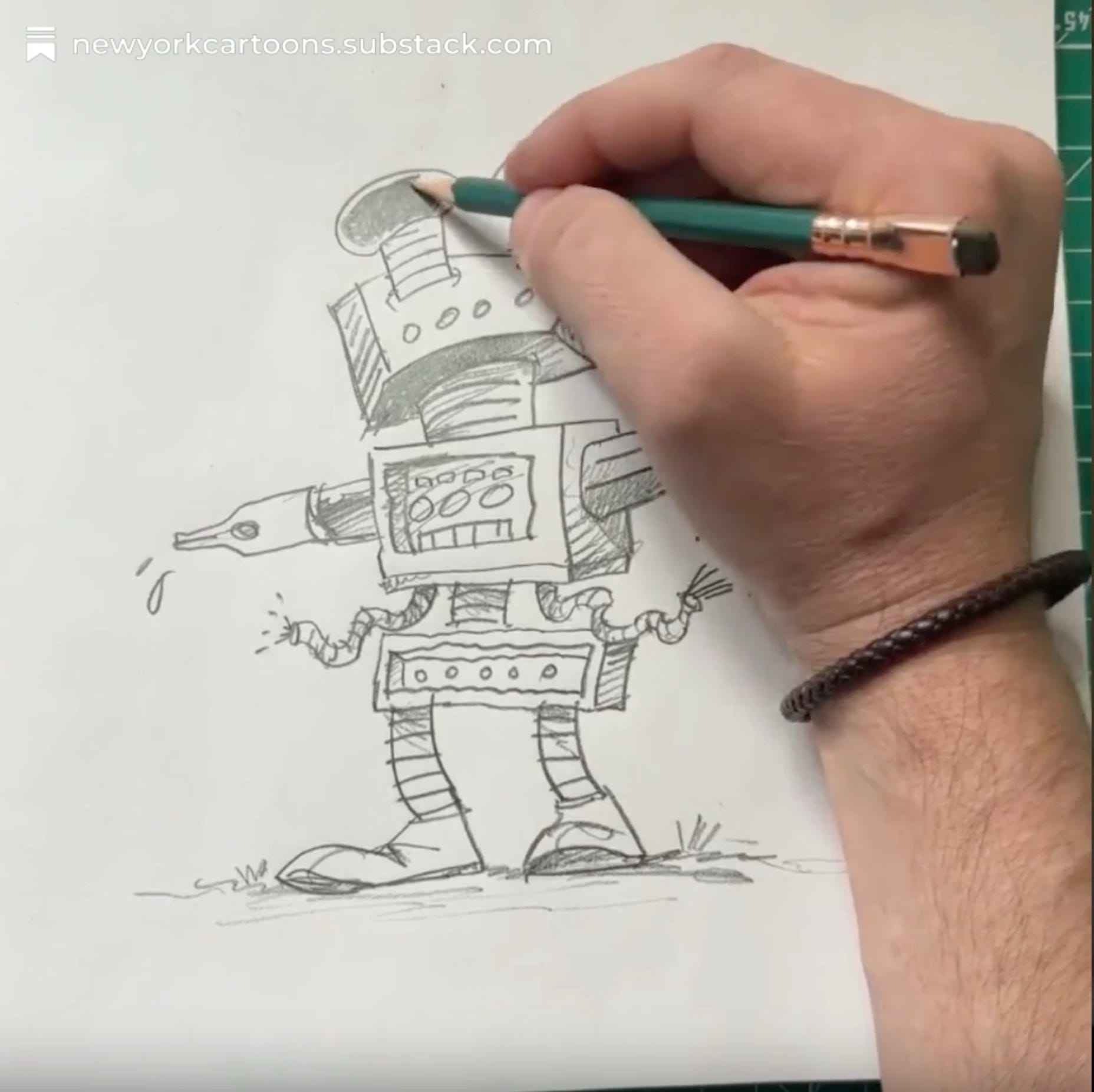 DMA#34: Cartooning for the Apocalypse (and Robo-Vomit) with Alex Hallatt DMA#34: Cartooning for the Apocalypse (and Robo-Vomit) with Alex Hallatt | Thank you Andi Penner, chris eliopoulos, Bear Edwards, Ann Feild, PJ Pierce, and many others for tuning into my live video with Alex Hallatt! Join me for my next live video in the app.Some notable quotes from this week’s episode:* “We can’t just be blinkered and think, ‘Oh my God, as creatives, this is an existential threat, and we have to stop it, because we’re not stopping it. It’s like the internet, but bigger.”* “You can continue doing what you’re doing, the way you’re doing it, but you better be bloody good because you’re going to become an artisan.”* “You don’t pay the plumber for banging on the pipes, you pay him for knowing where to bang.”* “Cartoonists die at the drawing board.”* “AI is coming like the printing press came for monks and illuminated manuscripts. Do you think the monks were pissed off or do you think they were relieved?”Today’s Draw Me Anything featured the return of the brilliant Alex Hallatt, creator of the syndicated strip Arctic Circle and the Substack Cartooning in the Age of AI. Alex joined us from Dorset, UK, where the weather is currently “not very lovely,” which is British for “apocalyptic.”We dove straight into the giant robotic goblin in the room: Artificial Intelligence. Alex approaches this topic with a “scientist brain” (she used to work in clinical research), which makes her perspective refreshingly pragmatic. Instead of just panicking, she’s looking at how to survive. She compared the current AI panic to the early days of digital photography, when old-school photographers insisted it wasn’t “real” photography. Now, shooting on film is an “artisan” pursuit. The lesson? If we want to keep drawing by hand, we’d better be bloody good at it, because we are all becoming artisans now.One of the funniest moments came when Alex described how she uses AI to handle the “tedious” stuff, like finding the secret service menu on her storage heaters, so she didn’t have to pay an engineer £200 to push three buttons. It’s the “plumber analogy”: you’re not paying for the button pressing; you’re paying for knowing which button to press. And right now, AI knows where the buttons are.We also talked about the “enshittification” of platforms like Amazon, where search results are now buried under AI-generated guidebooks and sponsored slop. It’s getting harder for independent creators to be found, which is why building a direct relationship with readers (like on Substack) is the only real lifeboat. As Alex put it, “I want to have a chat... human connection has real value in an AI world.” This is a public episode. If you'd like to discuss this with other subscribers or get access to bonus episodes, visit www.newyorkcartoons.com/subscribe | 1h 11m 25s | ||||||
| 3/9/26 |  DMA#37: How to Survive Farting At The Queen (and Why Hippos are Murder Potatoes) DMA#37: How to Survive Farting At The Queen (and Why Hippos are Murder Potatoes) | This is a free preview of a paid episode. To hear more, visit www.newyorkcartoons.com\While I was going back and re-listening to this episode to write the recap below, I wrote down so many gems that she shared- tips I will honestly keep with me forever. This was a really great conversation. I hope you find it as valuable as I did.I am currently setting a new personal record for the number of times I can wash the same load of laundry without ever putting it in the dryer.I think I’m on wash number five. I put the clothes in, turn the machine on, walk away, immediately forget the machine exists, and then remember three days later when the super tells me the basement has started smelling like a wet golden retriever that has been trapped in a swamp. So, I wash them again. And the cycle continues.This is what having an adult ADHD brain actually looks like. It’s not just being a little “flighty” or getting distracted by shiny objects. It’s a relentless, exhausting daily battle with your own executive function. It’s opening an email, deciding you don’t have the emotional bandwidth to answer it, marking it as “unread,” snoozing it to tomorrow, and then doing that exact same sequence of events 49 more times over a two-week period.This is also why my chat with Jenny Lawson on yesterday’s Draw Me Anything was less of an interview and more of an aggressively validating group therapy session.Jenny Lawson (thebloggess) has been writing online for over 15 years, and she has a new book coming out on March 31st called How to Be Okay When Nothing Is Okay: Tips and Tricks That Kept Me Alive, Happy, and Creative in Spite of Myself.I got an advance copy, and I genuinely could not put it down. Have you ever read a book so good you run out of sticky notes?It is a wildly funny, deeply vulnerable survival guide for anyone whose brain is a slightly hostile work environment. Jenny and I both share a potent daily cocktail of ADHD, anxiety, and an inability to perceive the passage of time. (I currently have nine clocks in my apartment, and I am still late to everything I have ever attended.) Here are a few of the brilliant, sanity-saving things we talked about during the stream, including why you should always strive to be a Murder Potato.2. Humour As a Means of Defanging Hard ThingsJenny and I both use comedy as a coping mechanism. We talked about how, when terrible things happen, humour is the only way to genuinely process the grief.“I think humour is super helpful for me,” Jenny said. “If I can laugh at something, instead of this enormous monster, it becomes like a little bit smaller, a little bit easier to understand.”It’s an on-ramp. If you write about crushing depression, anxiety, or mental illness, people who don’t suffer from those things might immediately put the book down. But if you make them laugh, it invites them in. It tells them that the stakes aren’t going to crush them.“If you make somebody laugh, first of all, you invite them in, and you say, ‘It’s okay. It’s not that serious, even when it’s serious,” Jenny explained. “A lot of people who have either reached out to me and said, ‘I read this because it was funny. And then later, years later, when I found myself in depression for the first time... I could go back and be like, oh, okay, I’m not alone.’”2. Rejection Sensitivity & Farting at the QueenIf you have ADHD, you likely suffer from Rejection Sensitive Dysphoria (RSD). This means you spend a terrifying amount of your day convincing yourself that everyone secretly hates you.“I constantly am sure that I have said something wrong, done something wrong. I overthink, I second-guess,” Jenny confessed. “The amount of work that I do in my head... it is exhausting.”You leave a conversation, and ten seconds later, you are meticulously replaying every word, convinced you offended someone. You assume if a friend hasn’t texted back in four hours, they have legally disowned you. You live in a constant state of wondering, “Are we fighting? Are you mad at me?”Jenny’s friend gave her some advice that completely short-circuits this panic. She asked Jenny to try to remember the last time she saw someone else completely mortify themselves in public.Jenny couldn’t think of a single time.“She was like, ‘No, what it really is, is everyone is constantly doing it. But you’re only paying attention to yourself,” Jenny told me. “Nobody is paying attention to how I fed something up because they’re way more worried about the thing that they fed up.”This led us to my absolute favourite chapter in Jenny’s entire book, brilliantly titled: But Did You Fart at a Queen?It turns out, there is a historical account from the 1600s of the 17th Earl of Oxford. He was bowing to Queen Elizabeth, and while doing so, he let out a massive, echoing fart. He was so intensely mortified by this bodily betrayal that he literally imposed a seven-year exile on himself. He left the country for seven years. When he finally returned, the Queen greeted him and said, “My Lord, I had forgotten the fart.”She didn’t even remember. She had a country to run; she wasn’t thinking about his flatulence.So, the next time you lie awake at 3:00 AM sweating over a slightly awkward joke you made to a barista, just ask yourself: Did I fart at a Queen? No? Then I’m doing fine.3. The Spoon Theory (and Budgeting Your Sanity)Trying to explain executive dysfunction to a neurotypical person is like trying to explain calculus to a golden retriever. They just tilt their head and look at you blankly. “Why don’t you just do the thing?” they ask.If you want to hear about the Spoon Theory (and how to explain your exhaustion to a neurotypical person), Shirley Jackson’s brilliant method for handling internet trolls, and why you should aspire to be a Murder Potato, upgrade your subscription below. It costs less than a bodega coffee, and it ensures I can eventually afford a dryer that actually works. | 32m 38s | ||||||
| 2/28/26 |  The AI Uncanny Valley, the Hunt 101 Nib, and What Stand-Up Taught Me About Substack The AI Uncanny Valley, the Hunt 101 Nib, and What Stand-Up Taught Me About Substack | I spent an hour yesterday talking to Elijah Woolery and Aarron Walter from the Design Better podcast, and by “talking,” I mean I went on several extended, caffeinated tangents about the existential dread of artificial intelligence, my masochistic love for 19th-century stati… This is a public episode. If you'd like to discuss this with other subscribers or get access to bonus episodes, visit www.newyorkcartoons.com/subscribe | 59m 38s | ||||||
| 2/27/26 |  DMA#37: How to Draw Diarrhea and Influence People (A Masterclass with Kyle Beaudette) DMA#37: How to Draw Diarrhea and Influence People (A Masterclass with Kyle Beaudette) | This is a free preview of a paid episode. To hear more, visit www.newyorkcartoons.comThank you Beth Spencer, asher Perlman, Alex Hallatt, Margreet de Heer, chris eliopoulos, and many others for tuning into my live video and asking questions of my guest Kyle Beaudette! Join me for my next live video in the app.I have a confession to make. I keep a secret folder on my computer. It’s not what you think, but it is deeply weird. It’s just labelled “Kyle,” and it is filled with screenshots of drawings by the Canadian artist Kyle Beaudette. Whenever I’m feeling uninspired, creatively blocked, or just generally annoyed by the blank page, I open the Kyle folder. It is full of wobbly lines, strange creatures, and a frankly alarming amount of beautifully rendered bodily fluids.Yesterday, I finally got to open the folder and talk to the man himself on Draw Me Anything. Kyle joined me from the frozen expanses of Canada (a fellow Commonwealth resident) for a conversation about the creative process, the horror of social media and AI Art, and how a tin of brown watercolour paint accidentally ruined his life.Kyle is one of those infuriatingly talented people who didn’t even go to art school. He studied theater, and then spent a decade teaching himself how to sculpt by hanging out on an internet forum run by two brothers from Texas. For years, he was making these incredibly intricate, Tim Burton-esque sculptures. But the pivot to drawing happened in the most unexpected place: a middle school classroom.As a substitute teacher, Kyle realised he needed a way to connect with the kids fast so he wouldn’t just be “the weird man that they don’t respect”. So, he sat down with a black pen and started drawing with them. He made a rule for himself: no pencils. He would only draw in pen, force himself to make mistakes, and then force himself to live with them. It was an exercise in embracing the mess, and it completely forged the “consistently wobbly” style he has today.He achieves this signature wobble, by the way, by holding a tiny 01 Micron pen completely straight up and down while shaking his hand slightly. It’s a technique that his teachers tried to train out of him, which is exactly why it works so well.But my absolute favourite story from the stream was the origin of his most popular subject matter: poop. A few years ago, Kyle’s mother bought him a beautiful Daniel Smith watercolour tin for Christmas. He opened it up and was horrified to find it was a landscape palette, absolutely loaded with different shades of brown. Thinking he had no use for them, he jokingly decided to use the browns to paint a gross picture of a turkey pooping.People loved it. He did it again. Before he knew it, he was the internet’s premier artist of gastrointestinal distress. He also shared a pro-tip for the aspiring scatological artists out there: if you use Quinacridone Burnt Orange, it scans with a reddish tint, leading concerned followers to constantly advise him to see a gastroenterologist. This is the kind of high-level artistic insight you simply cannot get at RISD.We also talked about the heartbreaking reality of having your brilliant, original ideas crushed by history. Kyle recently published a gorgeous book called The Garden Witch. Initially, he planned to build 50 sets and photograph his sculptures for it, like a lost stop-motion film. When that turned out to be a logistical nightmare, he asked the publisher if he could just do it in watercolour and ink instead. They said yes, and asked if he knew how to paint with watercolours. He lied, said yes, and immediately started frantically Googling videos of Quentin Blake.He wanted to combine Blake’s loose, scratchy line work with the sheer narrative insanity of William Steig. He poured his heart and soul into the project. Then, a month before he finished, he discovered that Quentin Blake and William Steig had actually collaborated on a book together years ago. It’s called Wizzil, and it’s about a witch who looks exactly like his character, right down to the frizzy hair. He said he completely “died inside,” which is the only appropriate reaction to finding out two legends already casually dashed off your magnum opus decades ago.While we talked, we drew. I whipped up an “amoeba unicorn” that slowly morphed into a bat because I accidentally gave it a pig nose. We also fielded a request from the chat to draw a pigeon getting chased by one of Kyle’s creatures, which naturally ended with the pigeon pooping itself. | 30m 57s | ||||||
| 2/23/26 | 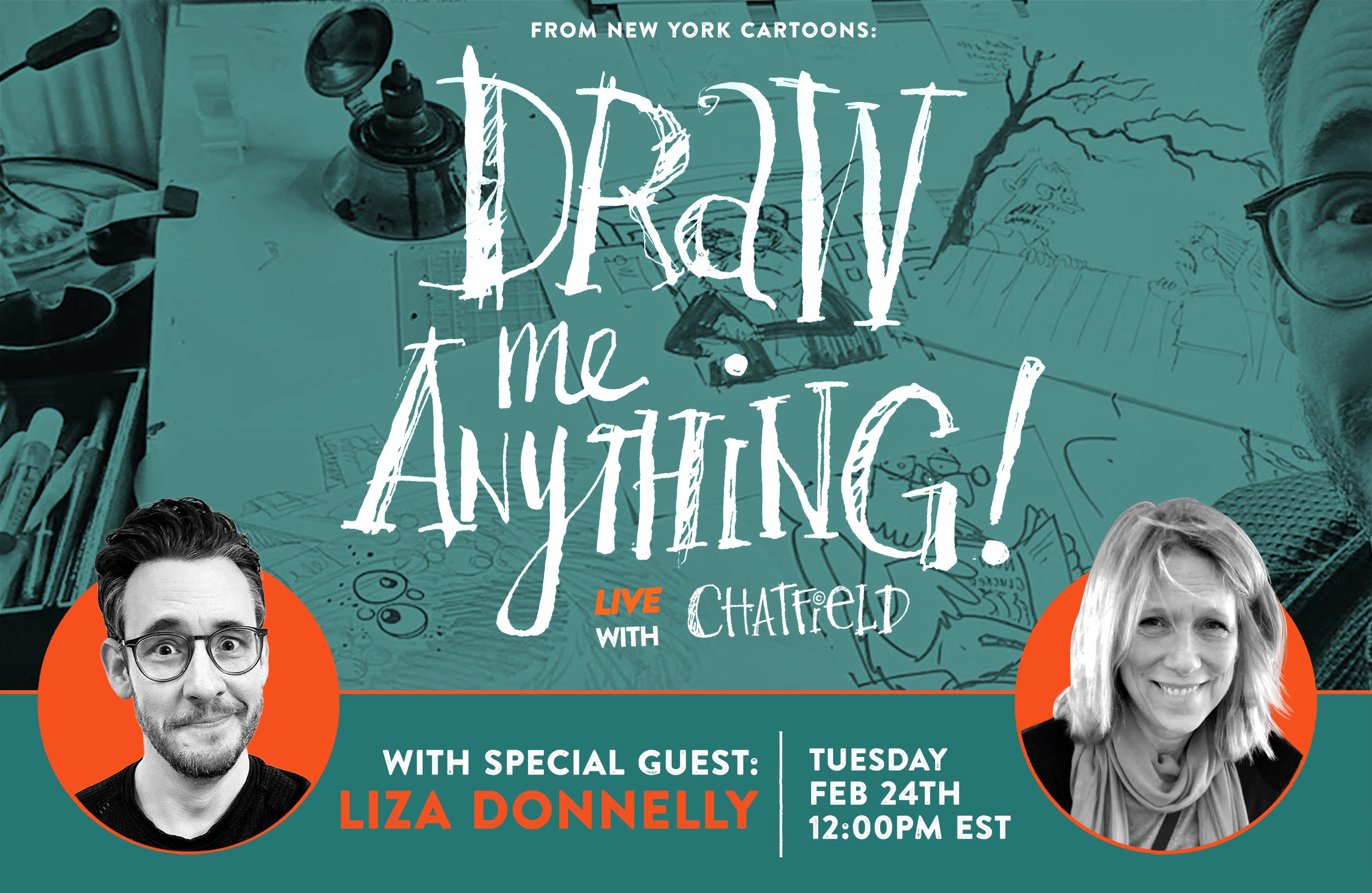 🔓 Unlocked: DMA#35: Drawing on the Edge of the Authoritarian Abyss with Ann Telnaes & Patrick Chappatte 🔓 Unlocked: DMA#35: Drawing on the Edge of the Authoritarian Abyss with Ann Telnaes & Patrick Chappatte | Hi friends,This conversation is so important for people to hear, so I’ve decided to remove the paywall on the replay. Please feel free to share it with anyone you think might find it useful to hear.Your pal,Jason---Join me for my next live video in the app on Wednesday 25th @ 12pm when I speak with fellow New Yorker cartoonist and author, Liza Donnelly.But first, the recap…“In an autocracy, the autocrat never picks up the phone. He doesn’t have to.”That was the line that stuck with me after yesterday’s Draw Me Anything. It was spoken by Patrick Chappatte (Chappatte Cartoons), one of the most respected editorial cartoonists in the world, and it perfectly encapsulates the strange, suffocating atmosphere of 2026.I was joined by Patrick (who joined us from Geneva) and the legendary US-based cartoonist Ann Telnaes for a 45-minute conversation that was less of an artist chat and more like a war room briefing. We had over 600 people tune in live (a record for this show!), which tells me that I am not the only one feeling the need to huddle together for warmth around the glow of a screen.If you missed it, above is the full replay (for paid subscribers) and a breakdown of what we discussed. And we discussed a lot.My GuestsIf you are new here, let me briefly introduce the titans I was sharing a screen with:* Ann Telnaes is a two-time Pulitzer Prize-winning editorial cartoonist. She was a staff cartoonist at The Washington Post until early last year, when she resigned after a cartoon was spiked- a canary in the coal mine for the media landscape we now find ourselves in. She now publishes independently on Substack, where her work remains as sharp, elegant, and devastating as ever. (She also revealed a little secret during the stream: she is still using an old-school metal animation disc from the 1980s to create her work!)* Patrick Chappatte is a globetrotting cartoonist whose work has appeared in The New York Times, Le Canard Enchaîné, Der Spiegel, and countless others. He is also the Chair of the Freedom Cartoonists Foundation in Geneva. He has a unique talent for “comics journalism” -reportage drawn on the ground- including a recent interactive piece for Le Temps about the surreal spectacle of Donald Trump taking Davos “hostage”.The Conversation: “Obeying in Advance”We spent a lot of time talking about their upcoming book, Censorship (or Self-Censorship) in America. The book has already been published in French and is coming out in German, but (tellingly) they are still in negotiations for a U.S. publisher.Why? Because, as Patrick noted, American publishers seem terrified of inviting the wrath of the administration.This led us to the core theme of the chat: “Obeying in Advance.”As Patrick explained:“In an autocracy, the autocrat never picks up the phone. He doesn’t have to... It’s the people in charge, the editors, the publishers, the media owners, all those guys doing the job in advance. You don’t need censorship anymore. Because self-censorship will do the job for you.”We discussed the recent incident involving Stephen Colbert and Texas Representative James Talarico, where a segment was reportedly suppressed—a classic example of corporate cowardice disguised as editorial discretion. Anne pointed out that this isn’t just about media control; it’s about the administration’s fear of losing its religious base. Talarico, a devout Christian who believes in the separation of church and state, represents a threat to the monolithic narrative Trump relies on.The “Gábor Pápai” WarningPatrick shared a chilling story about Gábor Pápai, a Hungarian cartoonist who won the Courage in Cartooning Award. Papay warned them years ago:“If you guys in the United States or in Europe get to elect the populists... you’re going to follow the same path that we are following.”Papay has been sued by his government and called a “cockroach” on national television. Patrick noted that while every country is different, the pattern—using the legal system to harass critics, demonising the press, and slowly eroding norms—is universal.The U.S. has now fallen to #57 on the press freedom index, sandwiched between Sierra Leone and Gambia. As Patrick put it: “I’m not hopeful that the U.S. is going to go up in this context in the foreseeable future.”The Immigrant ExperienceOne of the most moving parts of the conversation was when we touched on our shared status as immigrants. I am an Australian-American; Anne is Norwegian-American; Patrick is Swiss-Lebanese with an American son born in New York…We talked about the dehumanising rhetoric being used against immigrants- the “animals,” the detention centres, the “denaturalisation” task force that is now reportedly targeting naturalised citizens.Anne was visibly angry:“I cannot tell you how angry this makes me... I’m a naturalized citizen just like you... He is definitely running on fear. That’s how he got into office in the first place.”Patrick added a heartbreaking observation about how the world now views America:“It’s a broken love. That’s the feeling in the rest of the world. Because there was so much goodwill toward the United States and its values. And the cruelty... it’s really sad.”Why You Need to Follow ThemWe ended on a note of solidarity. We are all feeling the squeeze—whether it’s the algorithms, the publishers, or just the general atmosphere of dread. But as Anne and Patrick proved, the only way through it is to keep drawing, keep publishing, and keep supporting each other.Please, go subscribe to their Substacks. They are doing the work that the legacy media is too afraid to do.* Ann Telnaes on Substack* Patrick Chappatte on SubstackAnd thank you to everyone who tuned in. It felt important.You can buy their new book here or in the U.S. at these bookstores:Lectures de France Inc (Chicago)Foreign Book Source (Chicago)Bonjour Books (Kensington)French Books OnlineFrench & European Publications (New York)Librairie Albertine - Alliance Française of New York|Pierre International Bookstore (Tamarac)World of Reading (Atlanta)‘til next timeYour pal,Related Viewing:* DMA#25: Ann Telnaes on the Power of the Pen (and Why She Left The Post) – My conversation with Ann from last year, before the election, which now feels like a lifetime ago: This is a public episode. If you'd like to discuss this with other subscribers or get access to bonus episodes, visit www.newyorkcartoons.com/subscribe | 46m 06s | ||||||
| 2/18/26 |  DMA#35: Drawing on the Edge of the Authoritarian Abyss with Ann Telnaes & Patrick Chappatte DMA#35: Drawing on the Edge of the Authoritarian Abyss with Ann Telnaes & Patrick Chappatte | Thank you Kevin KAL Kallaugher, Stan!, Paranormal Cartoons, Christopher Thornock, Cat Wilson RN, and the 600+ others who tuned into my live video with Ann Telnaes and Chappatte Cartoons! Join me for my next live video in the app on Tuesday 24th @ 12pm when I speak with fellow New Yorker cartoonist and author, Liza Donnelly.But first, the recap…“In an autocracy, the autocrat never picks up the phone. He doesn’t have to.”That was the line that stuck with me after yesterday’s Draw Me Anything. It was spoken by Patrick Chappatte (Chappatte Cartoons), one of the most respected editorial cartoonists in the world, and it perfectly encapsulates the strange, suffocating atmosphere of 2026.I was joined by Patrick (who joined us from Geneva) and the legendary US-based cartoonist Ann Telnaes for a 45-minute conversation that was less of an artist chat and more like a war room briefing. We had over 600 people tune in live (a record for this show!), which tells me that I am not the only one feeling the need to huddle together for warmth around the glow of a screen.If you missed it, above is the full replay (for paid subscribers) and a breakdown of what we discussed. And we discussed a lot.My GuestsIf you are new here, let me briefly introduce the titans I was sharing a screen with:* Ann Telnaes is a two-time Pulitzer Prize-winning editorial cartoonist. She was a staff cartoonist at The Washington Post until early last year, when she resigned after a cartoon was spiked- a canary in the coal mine for the media landscape we now find ourselves in. She now publishes independently on Substack, where her work remains as sharp, elegant, and devastating as ever. (She also revealed a little secret during the stream: she is still using an old-school metal animation disc from the 1980s to create her work!)* Patrick Chappatte is a globetrotting cartoonist whose work has appeared in The New York Times, Le Canard Enchaîné, Der Spiegel, and countless others. He is also the Chair of the Freedom Cartoonists Foundation in Geneva. He has a unique talent for “comics journalism” -reportage drawn on the ground- including a recent interactive piece for Le Temps about the surreal spectacle of Donald Trump taking Davos “hostage”.The Conversation: “Obeying in Advance”We spent a lot of time talking about their upcoming book, Censorship (or Self-Censorship) in America. The book has already been published in French and is coming out in German, but (tellingly) they are still in negotiations for a U.S. publisher.Why? Because, as Patrick noted, American publishers seem terrified of inviting the wrath of the administration.This led us to the core theme of the chat: “Obeying in Advance.”As Patrick explained:“In an autocracy, the autocrat never picks up the phone. He doesn’t have to... It’s the people in charge, the editors, the publishers, the media owners, all those guys doing the job in advance. You don’t need censorship anymore. Because self-censorship will do the job for you.”We discussed the recent incident involving Stephen Colbert and Texas Representative James Talarico, where a segment was reportedly suppressed—a classic example of corporate cowardice disguised as editorial discretion. Anne pointed out that this isn’t just about media control; it’s about the administration’s fear of losing its religious base. Talarico, a devout Christian who believes in the separation of church and state, represents a threat to the monolithic narrative Trump relies on.The “Gábor Pápai” WarningPatrick shared a chilling story about Gábor Pápai, a Hungarian cartoonist who won the Courage in Cartooning Award. Papay warned them years ago:“If you guys in the United States or in Europe get to elect the populists... you’re going to follow the same path that we are following.”Papay has been sued by his government and called a “cockroach” on national television. Patrick noted that while every country is different, the pattern—using the legal system to harass critics, demonising the press, and slowly eroding norms—is universal.The U.S. has now fallen to #57 on the press freedom index, sandwiched between Sierra Leone and Gambia. As Patrick put it: “I’m not hopeful that the U.S. is going to go up in this context in the foreseeable future.”The Immigrant ExperienceOne of the most moving parts of the conversation was when we touched on our shared status as immigrants. I am an Australian-American; Anne is Norwegian-American; Patrick is Swiss-Lebanese with an American son born in New York…We talked about the dehumanising rhetoric being used against immigrants- the “animals,” the detention centres, the “denaturalisation” task force that is now reportedly targeting naturalised citizens.Anne was visibly angry:“I cannot tell you how angry this makes me... I’m a naturalized citizen just like you... He is definitely running on fear. That’s how he got into office in the first place.”Patrick added a heartbreaking observation about how the world now views America:“It’s a broken love. That’s the feeling in the rest of the world. Because there was so much goodwill toward the United States and its values. And the cruelty... it’s really sad.”Why You Need to Follow ThemWe ended on a note of solidarity. We are all feeling the squeeze—whether it’s the algorithms, the publishers, or just the general atmosphere of dread. But as Anne and Patrick proved, the only way through it is to keep drawing, keep publishing, and keep supporting each other.Please, go subscribe to their Substacks. They are doing the work that the legacy media is too afraid to do.* Ann Telnaes on Substack* Patrick Chappatte on SubstackAnd thank you to everyone who tuned in. It felt important.You can buy their new book here or in the U.S. at these bookstores:Lectures de France Inc (Chicago)Foreign Book Source (Chicago)Bonjour Books (Kensington)French Books OnlineFrench & European Publications (New York)Librairie Albertine - Alliance Française of New York|Pierre International Bookstore (Tamarac)World of Reading (Atlanta)‘til next timeYour pal,Related Viewing:* DMA#25: Ann Telnaes on the Power of the Pen (and Why She Left The Post) – My conversation with Ann from last year, before the election, which now feels like a lifetime ago: This is a public episode. If you'd like to discuss this with other subscribers or get access to bonus episodes, visit www.newyorkcartoons.com/subscribe | 46m 06s | ||||||
| 10/10/25 | 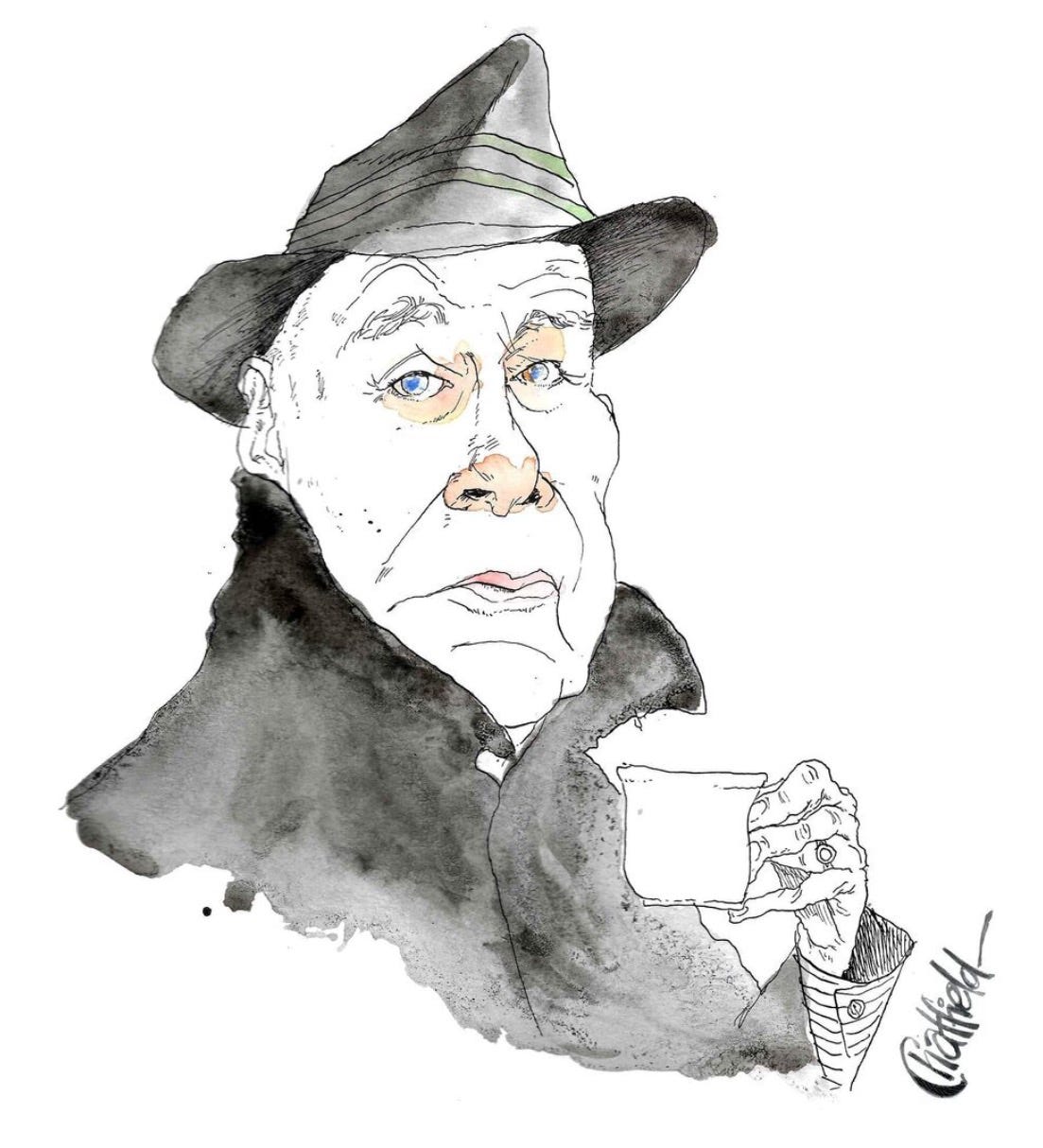 The Watercolour Control Problem with Jessie Kanelos Weiner The Watercolour Control Problem with Jessie Kanelos Weiner | The Watercolour Control Problem with Jessie Kanelos WeinerEarlier this year, I joined Jessie Kanelos Weiner —artist, author, and watercolour wizard—for a live chat about colour, chaos, and why watercolour refuses to obey. She just released Thinking in Watercolour, which made me realise I mostly think in panic, and snacks.This year, for 2026, she’s launching a series: 31 Days of Watercolor! which sounds really fun.In our talk, Jessie asked how I approach colour, and I admitted that I approach it sparingly. I used to think “real artists” painted every shadow like da Vinci. Then I saw the da Vincis at the Met and thought, Yeah… I don’t need to do all that. These days, I use colour the way comedians use silence—strategically. A dab here, a spot there. Enough to make you look where I want you to look.We talked about the Philadelphia Eagles poster I illustrated—a parody of the classic New Yorker cover, except it’s a jacked football player instead of Eustace Tilly. They wanted bold colour. I gave them subtle pastels amid the team’s green hue. They said, “Brighter!” I spent two days repainting and relearned my favourite rule: colour should serve the joke, not the marketing department.Growing up in Perth, I had almost no access to great art—just beach paintings and dial-up internet. So I learned from cartoonists like Roz Chast, Richard Thompson, and Ronald Searle, whose trauma and humour somehow coexisted in ink. My grandfather gave me Searle’s book after surviving a POW camp, so I guess drawing as coping runs in the family.Jessie and I agreed: restriction is, in fact, a form of freedom. Fewer colours, fewer brushes, fewer excuses. Watercolour is chaos in liquid form, and the sooner you stop trying to control it, the more alive it becomes.I’m still working on that part—the unclenching. But at least now, when my washes go rogue, I can say: It’s philosophy.‘til next time, your pal,✏️ Thanks for reading New York Cartoons. To support more mess disguised as art, consider becoming a paid subscriber. This is a public episode. If you'd like to discuss this with other subscribers or get access to bonus episodes, visit www.newyorkcartoons.com/subscribe | 33m 55s | ||||||
| 10/8/25 | 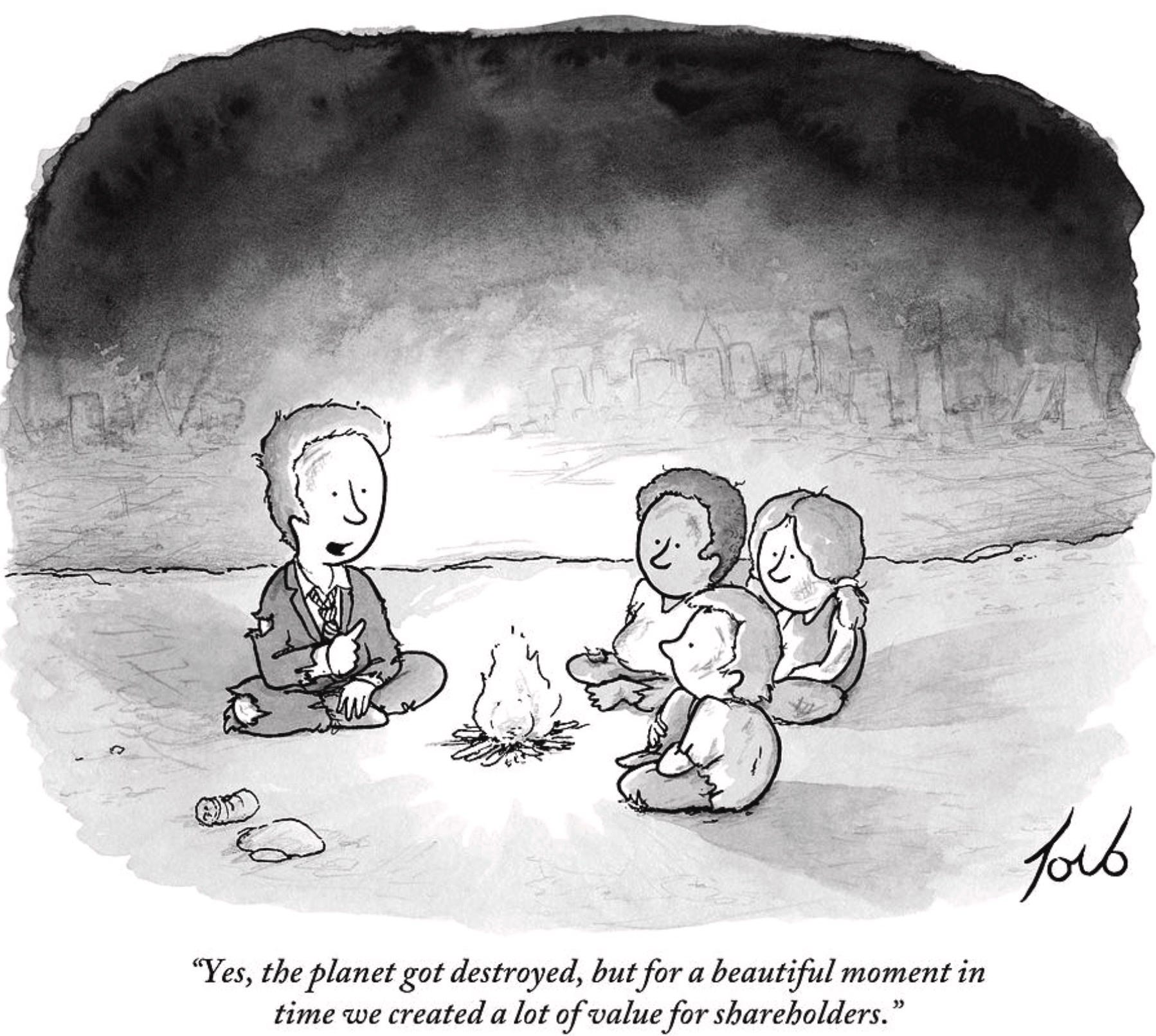 The Art of Drawing Worse with Tom Toro The Art of Drawing Worse with Tom Toro | Thank you Kevin KAL Kallaugher, asher, Margreet de Heer, Dan Collins, Pat Coakley, and many others for tuning into my live video with Tom Toro (and his cat, Pumpkin!) Tom is a New Yorker cartoonist, author, and the rare person who can make me feel simultaneously inspired and completely inadequate about my cartooning skills.His new book, And to Think We Started as a Book Club, just dropped, and it’s already Andy Borowitz’s October Book Club pick. The title itself is a gag from one of his cartoons—bank robbers mid-heist, one holding a crowbar (originally a shotgun, but weapons get flagged by algorithms, apparently). It’s the kind of unwieldy-but-funny title that works because the joke sustains it.The Art of Drawing WorseOne of the best moments came when Tom shared Bob Mankoff’s advice to Paul Noth: “Draw worse.”Not as an insult, but as a direction. Noth’s early work was so detailed—cross-hatching, filigree, the whole nine—that Mankoff told him the jokes were strong enough to carry simpler art. The delivery needed to be cleaner. Tom admitted he sometimes overdoes drawings when he’s insecure about a joke, like he’s compensating. I felt seen. Very seen.“The best thing about your work is the worst thing about your work,” Mankoff once told me. “You draw too well sometimes.” I’m still not sure if it was a compliment. Probably not.Fact-Checking V*ginas & Left-Handed CatchersThe New Yorker fact-checks cartoons. Tom once got a note asking if he could make a drawing “less vaginal.” (Three lion manes forming an unfortunate composition.) “I had a baseball cartoon flagged because I’d drawn a left-handed catcher—apparently, there hasn’t been one in the majors since 1972. They let me keep it, but wanted me to know.”These notes are rare, which makes them oddly precious. “It’s nice to know there are eyes on it,” Tom said. Most of the time, cartooning is just the Roman Coliseum—thumbs up, thumbs down, see you in twelve years.AI Can’t Make Good MistakesWe talked about AI creeping into cartoon spaces, and Tom’s theory hit hard: AI can’t make good mistakes. It can mimic, reproduce, even generate six-fingered hands by accident—but it can’t make the artful mistakes that lead you somewhere unexpected. The kind that gives a drawing its heartbeat.“Maybe it’s incumbent upon artists to keep pushing ourselves to realms of discomfort,” he said, “where we just make more beautiful mistakes.”That’s the hope. That’s the work.Tom’s on tour all month—Powell’s in Portland this Friday, then Connecticut, New York, Boston. If you’re near any of those spots, go hear him talk and get your book signed. Support cartoon collections. Raise all boats.‘til next timeYour pal,Referenced in the conversation:* Tom Toro’s website* And to Think We Started as a Book Club (Tom Toro)* The Borowitz Report (Andy Borowitz)* Well, This Is Me (Asher Perlman)* The Joy of Snacking (Hillary Fitzgerald Campbell)* Understanding Comics (Scott McCloud)* Matt Inman / The Oatmeal on AI* Civics 101 Podcast* Powell’s Books, Portland* St. Nell’s Writer’s Residency (Emily Flake) This is a public episode. If you'd like to discuss this with other subscribers or get access to bonus episodes, visit www.newyorkcartoons.com/subscribe | 58m 01s | ||||||
| 10/6/25 |  Asher Perlman & The Art of Eugene Asher Perlman & The Art of Eugene | I went into this episode of DMA expecting the usual blend of cartooning shop talk and digital doodling. What I got was a deep dive into creative authenticity, delivered by someone who's figured out that being yourself is both the hardest and most obvious solution to every artistic problem.The Eugene EmpireAsher's Hi It's Me Again had just dropped, and our conversation naturally gravitated towards his most famous creation: Eugene. For the uninitiated, Eugene is that wide-eyed, innocent character who looks like he just materialised in the world ten minutes ago and is still figuring out the rules (and nervously figuring out how to ask the barista for the bathroom code).An unexpected moment came when Asher produced an actual cardboard cutout of Eugene—because of course he has one within arm’s reach. But the real insight was his theory about Eugene's existence: having come up through Chicago improv and sketch, Asher needed a creative collaborator for the inherently solo act of cartooning. Eugene became that collaborator, a subconscious way of recreating the writer's room dynamic on paper.When a live stream viewer requested drawings of "Eugene and his dog, who looks like Eugene," the chat collectively decided the dog should also be named Eugene. Asher immediately declared this "canon." Watching creative mythology form in real time was unexpectedly moving.The Mankoff Hair DoctrineI recounted Bob Mankoff's bizarre but apt advice about finding your artistic voice. Mankoff stumped with an analogy about hair styling: "You decide to wear your hair that way... why is your drawing not as distinct as your hairstyle?"At the time, I admitted, I was too dense to understand. But eventually it sank in: stop drawing what you think a New Yorker cartoon should look like, and start drawing like myself. Asher also sold his first cartoon a month after Ellis gave him similar advice: "Don’t draw a ‘New Yorker Cartoon’, draw an Asher Perlman cartoon that could be in the New Yorker."This feels like the kind of obvious wisdom that's only obvious after you've bashed your head against the wall for years trying to be someone else.The Comedy Economics of HackBoth Asher and I shared war stories about the delicate economy of comedy crowds. His Second City experience taught him that audiences of comedy people versus regular people laugh at completely different things. The example that stuck: during the Cubs' historically bad years, any joke that simply acknowledged their terribleness would reliably kill with regular audiences, while comedy vets groaned at the predictability.I confessed to deploying hack MC material at tourist-heavy shows, earning eye-rolls from grizzled road comics. The unspoken rules of what's permissible comedy form our intricate ecosystem—one where Ellis serves as our "encyclopedia of cartoons," helping determine what's been done before.Digital vs. Analogue RomanticismBoth of us admitted to fetishising paper and pen while acknowledging the seductive convenience of digital tools. Asher confessed to tapping his page to try to undo lines when working on paper. I noted how the digital safety net makes me more confident but less skilled—a creative paradox worth pondering.By some miracle, our technical discussion revealed practical wisdom: 80-pound paper works well with iPad light boxes, draw faces first to avoid redoing entire backgrounds, and always have a brutal filing system that you'll inevitably hate.From Hackery to SubstackeryAsher had just joined Substack a month ago, and his description of the platform was refreshingly honest: "It feels like what I wanted Instagram to be, but it never was." My strategy mirrored my cartooning breakthrough—stop trying to copy what successful newsletters do, write for your own people, and celebrate the unsubscribes.The platform discussion highlighted a broader shift away from algorithmic manipulation towards intentional consumption. As Asher put it: "I prefer things that exist outside of the algorithm now because I don't like being catered to my worst instincts."The Bell House LaunchWe wrapped with excitement about Asher's book launch at Bell House, featuring Gary Gulman, temporary Eugene tattoos, and what sounds like half the New Yorker cartooning community.Related Reading:Asher's journey from frustrated imitator to distinctive voice serves as both a cautionary tale and an inspiration—a reminder that the path to originality runs directly through the abject horror of just being yourself.Thanks to everyone who tuned in to the live stream!‘til next timeYour pal,Next week: Tuesday at 12pm, I'm chasing down Kevin “KAL” Kallagher to talk to him about his 50+ years as a working cartoonist for the Economist and —until recently— The Baltimore Sun. Add it to your calendar now! This is a public episode. If you'd like to discuss this with other subscribers or get access to bonus episodes, visit www.newyorkcartoons.com/subscribe | 56m 30s | ||||||
| 9/27/25 |  Liza Donnelly on Breaking Barriers, Drawing Aliens, and Why Everything is Political (Including Pigs) Liza Donnelly on Breaking Barriers, Drawing Aliens, and Why Everything is Political (Including Pigs) | Thank you Stan!, E. Sjule, Margreet de Heer, Loitt, Michael Maslin's Ink Spill, and the nearly 500 others for tuning into my live video with Liza Donnelly yesterday! Join me for my next live video in the app next Thursday, Sept 4th at 12pm EST when I speak with political cartoonist Kevin KAL Kallaugher. You can follow his new Substack here:Nearly 500 people tuned in yesterday for Drawing Me Anything #25, and honestly, I'm not sure if they came for the cartoons or just to watch me fumble with my drawing setup like a broken octopus. Either way, I had Liza Donnelly on—the first person I ever subscribed to on Substack, and a cartoonist who's been breaking barriers since before breaking barriers was trendy.From Watergate Kid to New Yorker PioneerLiza grew up in Washington D.C. during Watergate, which explains a lot about her political sensibilities. She wanted to be Herblock—the political cartoonist's political cartoonist—but felt like she couldn't find her voice in that arena."I looked at the political cartoonists that I admired, Gary Trudeau and Herblock. I just didn't feel like I could fit in. I didn't think that I had a strong enough opinion about things, which was not true, but I couldn't find my opinions, I guess. I was afraid to share them."So she turned to the New Yorker, which she initially thought was "stodgy" until she realised it was actually full of "subtle but subversive" cartoons. This led to her becoming one of the first women to regularly publish cartoons in the magazine since after the period in the 1920s. She came up alongside Roz Chast and a few others.The old system was beautifully archaic: Tuesdays for the seasoned cartoonists, Wednesdays for the "young upstarts" like Liza, Roz, Jack Ziegler, Mick Stevens, Bob Mankoff, and Sam Gross. After submissions, they'd go to lunch at places like The Quiet Man (an Irish bar) or The Century, sometimes hit a Mets game, and occasionally go down to Tin Pan Alley to shoot pool."Before we went to lunch, we would go to the other magazines, take your little envelopes of your rejects from the New Yorker, and you'd go to other places," she explained. The rejection tour included National Lampoon (where she sold her first cartoon), Good Housekeeping, Cosmopolitan—places that actually paid cartoonists, unlike today's one-shop reality.The Live Drawing RevolutionLiza's been doing live drawing on streaming since way before it was cool. She started during the 2016 State of the Union, using an iPad with Paper 53 and one of those chunky styluses that Apple doesn't make anymore (she had to stockpile them like they were cartoon gold)."I drew these quick drawings of what I was watching and put them on Twitter immediately because the app connects to Twitter. And nothing was like that yet on that platform at all, really. So it took off, and that's when my live drawing career sort of happened."This led to everything from drawing the Oscars red carpet to being the first cartoonist credentialed for that gig, to courthouse sketching during Trump trials (where electronics weren't allowed, forcing her back to paper and pen like some kind of analogue warrior).The CBS Morning Show Years and the ImplosionFor about four years, Liza worked for CBS This Morning, live drawing guests and hosts, connecting their social media with the actual broadcast. They sent her to the White House, the DNC, debates—until CBS imploded with the Les Moonves and Charlie Rose scandals."CBS imploded, you know, Les Moonves and Charlie Rose and all that sort of—CBS imploded. And I was no longer," she said, with the casual tone of someone who's watched media empires crumble before breakfast."Women Laughing" DocumentaryThe big news is Liza's documentary "Women Laughing," which is finished and premiering in New York this fall. The New Yorker will publish it on their site, and Katie Couric (who once commissioned me to draw a deliberately bad caricature of Larry David for Sardi's) is executive producer.The documentary features drawing sessions with contemporary women cartoonists at the Society of Illustrators, because, as Liza noted, "cartoonists are relaxed when they're drawing." It's a 35-minute short that traces the arc from the magazine's early women cartoonists through today, when about half the contributors identify as female or non-binary."We talked and drew at the same time because it's something that I've done with my children. And I know it's a way people are relaxed, at least cartoonists are relaxed when they're drawing," she explained.The Rejection Game and ReinventionWe talked about The New Yorker's brutal rejection rate—drawing eight to ten ideas a week, maybe selling one if you're lucky. It's almost masochistic, but as Liza pointed out, "without that rejection, the ability to tolerate rejection, you're not going to really last long in cartooning.""You and I, we have to really start reinventing ourselves because there's no... Magazines are dying, are almost dead, and there are no outlets for what we do, really, much. So that's why we do the live drawing, that's why we do the Substacks."The Competition ProblemThe conversation took an interesting turn when we discussed how editorial cartoonists are now competing with everyone from late-night TV shows to memes. Jon Stewart's Daily Show was one of the first to clip segments and put them online as short, opinionated, humorous pieces."I thought, well, that's, that's like, they're taking our job, but with video," Liza observed. "We've been in competition with memes, you know, also memes and clips of comedians doing what we do."But there's something cartoons can do that video can't: work without language barriers, distil complex ideas into simple images, and translate across cultures in ways that English-language comedy can't.Freedom Fighters vs. Court JestersI mentioned attending the RIDEP cartooning conference in France with political cartoonists from around the world—people from Tunisia, China, Sudan who had been exiled for their work."I kept thinking, I was talking to the American and British people... and I was saying, you know, I feel like we're so lucky, you know, we're court jesters, it feels like, whereas these people feel like freedom fighters."It hits differently now, especially considering the current political climate and the increasing pressure on editorial cartoonists in the US.The Herblock StoryThe session ended with Liza sharing her story of meeting Herblock—her childhood hero—at a gallery opening of New Yorker cartoons in Washington in the early 80s. He came to support the younger cartoonists, pointed to her first published cartoon (a dog cartoon), and said he liked the simplicity."I was so scared," she admitted. Which is perfect, because meeting your heroes should be terrifying. It means they still matter.The Three-Eyed Alien Asking a Pig for the TimeDan McConnell in the chat requested "a three-eyed alien asking a pig for the time," which sounds apolitical until you remember that everything can be political if you squint hard enough. Or if you're drawing pigs, which, as someone pointed out, could be very Orwellian."Everything can be political if you think about it," Liza said, while drawing in seven lines what I couldn’t draw in seventy. I drew what was supposed to be a friendly alien, but looked more like it had strong opinions about municipal parking regulations.The Technical StuffFor the gear nerds: Liza uses a thick mechanical pencil (she forgot the brand), Hunt 107 nibs, and various dip pens. I'm still wrestling with my Blackwing pencils, trying to make live drawing look less like performance art and more like actual cartooning. I’m using the Hunt 101 Imperial dip pen nib.What's NextYou can find more about the documentary at womenlaughingfilm.com and follow @womenlaughingfilm on Instagram. They're still raising money for publicity and marketing, because finishing a documentary is only half the battle.Liza's Substack, "Seeing Things," is great reading for anyone interested in how cartoons can cut through political noise with humour. She posts daily, which is both admirable and slightly terrifying.Next Thursday at 12 PM, Kevin KAL Kallaugher joins us for DMA #26. Kal's got this ability to distil complex political ideas into powerful images without captions, and he draws with traditional tools on a proper wooden drafting board like a civilised human being.If you missed the live session, you can catch the replay above by becoming a paid subscriber. This is a public episode. If you'd like to discuss this with other subscribers or get access to bonus episodes, visit www.newyorkcartoons.com/subscribe | 1h 00m 00s | ||||||
| 7/1/25 | 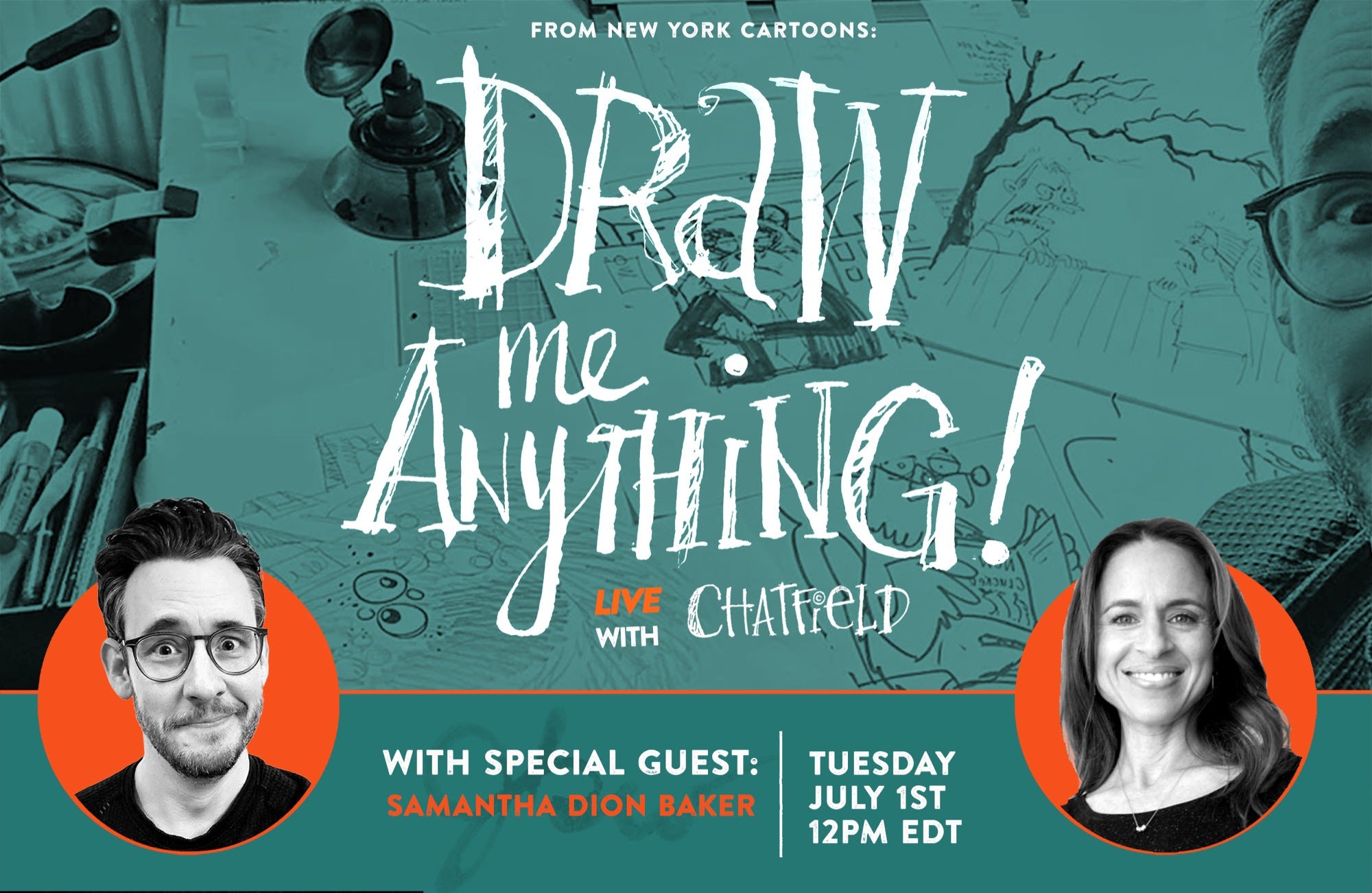 Adventure Sketching, Pickleball, & Bus Rides with Samantha Dion Baker Adventure Sketching, Pickleball, & Bus Rides with Samantha Dion Baker | I spent an hour yesterday drawing with Samantha Dion Baker —artist, author, and one the best Substackers on drawing—and came away feeling like I'd just had the best kind of therapy session. Which, as it turns out, is exactly what Sam's work is all about.Sam joined me from her studio in Dumbo, and what started as a casual chat about pickleball evolved into a masterclass on using art as a tool for presence, sense memory, and genuine human connection. It’s crazy I get to speak to people like this every week (it’s even crazier that they speak back.)The Accidental ArtistSam's artistic journey is one of those creative pivots that make you believe in second acts. She spent years as a graphic designer (same!), creating pristine designs—all clean typography and careful spacing. Then life happened: kids arrived, screens became suffocating, and she found herself reaching for a sketchbook just to remember things."I was drawing things so well or comfortable drawing things," she told me, flipping through pages of her early work. "I was just doodling like letters and arranging things. It was very designy."But here's the thing about doodling when you're not trying to be an artist: it becomes honest. Sam started documenting daily moments—not because she planned to publish them, but because drawing made her more present. The practice was meditative, almost inadvertent therapy.When she published her first collection, Draw Your Day, Amazon classified it in the art therapy section. "I didn't really think about it when I was writing it," she said, "but I was like, oh, yeah. That makes sense."The Art of Paying AttentionWhat I love about Sam's approach is how unforced it feels. She's not precious about her sketchbooks—they're repositories for whatever catches her attention, regardless of artistic merit. We talked about the tyranny of the "perfect sketchbook," those Instagram accounts full of museum-quality watercolours masquerading as casual sketches."I'm not happy with 90% of my pages”, she admitted. But that's the point. The sketchbook isn't a performance; it's a practice.Her upcoming book, Draw Your Adventures (out July 15th—pre-order it now!), explores this idea of documentation versus decoration. It's not about capturing the Sistine Chapel; it's about noticing the "Call Your Mum" mural near your son's new apartment, or the woman across from you on the bus."Sometimes it's completely unrelated," Sam explained, "but it will still bring you back if you're present and you're taking it in."The Technical Bits (For the Process Junkies)Mid-conversation, we naturally gravitated toward tools—because what are two artists without strong opinions about pencils? Sam's a devotee of Blackwing pencils and has worked with them for years (she even illustrated their iconic poster of all the limited editions). But her real secret weapon is Derwent Inktense paints."I always describe them as like a cross between acrylic wash because they dry flat and watercolour," she said, layering colours on a portrait of her friend's dog, Wayne. "They're more forgiving than watercolour." (Watch the video above to see her drawing Wayne!)I confessed my own tool obsession whilst wielding a Wren fountain pen I'd discovered the night before at a comedy show (thanks Lauren Layne and Anthony LeDonne). We compared notes on everything from mechanical pencils (neither of us likes them) to date stamps (both obsessed) to that magical Faber-Castell 14B pencil that somehow exists despite breaking all the rules of graphite grading.(This is probably where I should mention that Sam's giving away 50 copies of her book at her launch party on July 15th in Dumbo. RSVP required—don't just show up like you're crashing a wedding.)The Interrupted ArtistOne of the most honest parts of our conversation was when Sam talked about working around constant interruptions. Her artistic practice developed not in some pristine studio, but in the margins of motherhood—quick sketches between playground emergencies, continuous line drawings because she might have to stop mid-pencil stroke."I was constantly being interrupted," she said. "So my process, I've learned to work in stages."This resonated deeply. How I often wait for the "perfect" time to create—the uninterrupted afternoon, the ideal lighting, the moment when inspiration strikes like lightning? Sam's work is proof that creativity thrives on constraint, that the most meaningful art often happens in the spaces between other obligations.Adventure as a State of MindAs we wrapped up (Wayne the Cairn Terrier now immortalised in both our sketchbooks), Sam explained the philosophy behind her new book. Adventure isn't necessarily about passport stamps or mountain peaks—it's about approaching the world with the curiosity of someone who might want to draw it.When you're carrying a sketchbook, you notice differently. You see the baroque curve of a fire escape, the precise way someone holds their coffee, the particular quality of light filtering through a bodega window. The tool changes the observation, which changes the experience, which changes the memory."It's choosing the choices of what to draw when you're on an adventure," she said. Whether that adventure is crossing Brooklyn on a bus or crossing continents on a plane.Sam's book launches in two weeks, and honestly, it arrives at exactly the right moment. Summer in New York means everyone's moving, travelling, or at least pretending they have plans more interesting than sitting in air conditioning. But as Sam's work reminds us, the most profound adventures often happen within walking distance of home.Just bring a pencil.‘til next timeYour palPre-order Draw Your Adventures here. Pre-orders genuinely matter for authors—they determine everything from print runs to bookstore placement. If you're planning to get a copy anyway, ordering now is the best way to support Sam and ensure the book finds its way to the people who need it.Subscribe to Sam's Substack for a regular dose of artistic wisdom. If you're in New York, join us at her book launch on July 15th in Dumbo!Coming soon… I'm doing something very special with Blackwing pencils and Amy Kurzweil. Can't say more yet, but it's going to be pretty epic! Stay tuned. This is a public episode. If you'd like to discuss this with other subscribers or get access to bonus episodes, visit www.newyorkcartoons.com/subscribe | 1h 01m 45s | ||||||
| 6/25/25 |  The Dollar Tree Revolutionary: From Introvert Drawing Club to Global Art Movement with Beth Spencer. The Dollar Tree Revolutionary: From Introvert Drawing Club to Global Art Movement with Beth Spencer. | How Beth Spencer Started an Art Movement with a Five-Minute SketchI need to tell you about Beth Spencer —not because she asked me to (she didn't), but because watching her work on Substack these past few years has been like watching someone perfect the art of making strangers feel less alone with a pencil and a really good attitude about being terrible at things.Beth runs the Introvert Drawing Club, which might be the most honest newsletter title in the history of newsletters. No grandiose promises about unlocking your creative genius in thirty days, no affiliate links to expensive art supplies that will supposedly transform your stick figures into Sistine Chapel material. Just: "Hey, you want to draw badly together? Great. Let's be bad at this thing we love."I've been a subscriber since practically day one—her newsletter was among the first I ever signed up for when I stumbled into this Substack world with a dangerous amount of confidence in my own artistic abilities.RELATED:What Beth does shouldn't work. In a world where everyone's selling courses and productivity hacks and systems for optimising your creative output, she's over there saying, "Actually, what if we just... drew some goats? What if we were gentle with ourselves? What if we got off our phones and made terrible art with dollar store supplies and loved every minute of it?"The Badge That Broke the InternetBut here's the thing that makes Beth more than just another encouraging voice in the creative wilderness: she accidentally started a revolution with a five-minute sketch.In June 2024, Beth Spencer picked up an iPad and sketched a red hand jotting the words "Created with human intelligence." She was procrastinating on her actual work—a children's book illustration—and had been seeing "a lot of concerned chatter about AI among fellow artists on Instagram." So she figured she'd post this little badge to her website to make it clear that everything there came from, you know, an actual human being."I thought maybe two or three people would say, 'Thanks, I'll take one,' because people love free stuff, right?" Instead, what happened was this: nearly 1,200 artists, illustrators and designers have contributed their own versions of her drawing to a growing gallery of unique images. The hashtag #hibadge2024 exploded across Instagram. Fast Company featured the movement, calling it exactly what it was: a small revolution.Artists from the US, UK, Spain, Germany, Brazil, and Colombia started recreating Beth's scrappy little sketch in their own styles—watercolour, clay sculpture, minimalist doodles, bold hand lettering. Each one a tiny act of defiance against the algorithmic tide.The Accidental RevolutionaryWhat makes this story so perfectly Beth Spencer is that she never set out to be the face of artistic resistance. "I didn't intend it as anti-tech, but as pro-human," she explained in a later interview. It wasn't about burning the machines—it was about celebrating the messy, imperfect, beautifully human process of making things with your hands."No software has lived life the way you have," she wrote, which might be the most succinct argument for human creativity I've ever heard. While AI churns through datasets looking for patterns, we're out here stubbing our toes and falling in love and watching our pets do ridiculous things and somehow turning all of that into art.The badge caught fire because it crystallised something artists had been feeling but couldn't quite articulate: that there's value in the struggle, in the years of patient labour, in the way your hand shakes just slightly when you're drawing something that matters to you.Why Beth Spencer Matters (Especially to Weirdos Like Us)I started following Beth's work long before the badge went viral, back when she was just this thoughtful voice encouraging people to make bad drawings and be okay with it. What struck me wasn't just her art—though her loose, playful style has this wonderful "I'm having fun and you can too" energy—but her approach to the whole enterprise of being creative.In her Zoom drawing sessions (yes, she runs fantastic live drawing sessions), people ask what supplies she's using, and half the time the answer is something from Dollar Tree. "My favourite things are these," she'll say, holding up a 75-cent brush pen that she swears works better than the fancy $11 ones.This is revolutionary stuff, people. While the rest of us are bankrupting ourselves at art supply stores, convincing ourselves we need the right tools to make good art, Beth's over there making beautiful work with discount store markers and having an absolute blast doing it.The Goat WhispererBeth has this thing with goats. (So do I.) It started after what she calls a "crushing career blow"—a book deal that fell through after she'd already told everyone about it. (Anyone who's had a creative project implode knows this particular circle of hell.) Instead of wallowing, she found a community garden in Memphis with goats and started drawing them."They're symbols of good in the world," she told me. And watching her capture these ridiculous, stubborn, oddly expressive creatures in her sketchbooks, you start to see what she means. There's something about the way goats exist in the world—unapologetically themselves, slightly chaotic, always ready to try climbing something they probably shouldn't—that feels like a metaphor for the creative life.The goats led to other animals, which led to a broader philosophy about drawing from life instead of photos, about getting off your phone and actually looking at the world around you. It's David Sedaris's advice about living the "head-up life" translated into artistic practice.The Introvert's Guide to Making ArtWhat I love most about Beth's approach is how it flies in the face of everything we're told about building a creative practice. No morning pages. No elaborate studio setups. No complex systems for tracking progress or measuring improvement.Instead, it's: show up, make marks, be kind to yourself about the results. Draw the goat even if the goat looks like a potato with legs. Use the cheap markers. Take breaks to watch your cat knock over the paint water. Post the terrible stuff alongside the good stuff because the terrible stuff teaches you something, too.Her drawing challenges aren't about competition—they're about community. People sharing their wobbly self-portraits and their wrong-colored flowers and their attempts at human hands (the Everest of artistic endeavours, as any cartoonist will tell you). Each submission is a tiny victory against the voice that says you're not good enough, not qualified enough, not artist enough to make things.The Bigger PictureThe "Created with Human Intelligence" badge became a phenomenon because it gave artists something they desperately needed: a way to claim their space in an increasingly algorithmized world. But Beth's real contribution goes deeper than any single viral moment:She's created a corner of the internet where it's safe to be a beginner, where process matters more than product, where the goal isn't perfection but connection. Her Substack feels like having a conversation with that friend who somehow makes you feel better about everything just by being themselves. In a time when everyone's trying to scale and optimise and hustle their creativity into submission, Beth's out there saying, "What if we just drew some animals and felt good about it?"And somehow, that quiet revolution—one terrible drawing at a time—might be exactly what we need.If this made you want to pick up a pencil (even a Dollar Tree one), that's Beth Spencer's magic working exactly as intended. Check out Beth's work at Introvert Drawing Club and follow her drawing adventures @bethspencerart. Fair warning: you will end up buying art supplies you don't need and feeling optimistic about your artistic abilities. Consider yourself warned.Forward this to that friend who still thinks they "can't draw." Everyone can draw badly, and that's the point. This is a public episode. If you'd like to discuss this with other subscribers or get access to bonus episodes, visit www.newyorkcartoons.com/subscribe | 55m 34s | ||||||
| 6/10/25 |  Matt Ruby on Comedy, Mindfulness, and Why Algorithms Are Ruining Everything Matt Ruby on Comedy, Mindfulness, and Why Algorithms Are Ruining Everything | Yesterday, I sat down with Matt Ruby, a comedian who's somehow managed to turn drug experimentation into art, philosophical wisdom into punchlines, and crowdwork critique into a manifesto. What started as a chat about joke writing quickly devolved into an exploration of why we're all slaves to Chinese algorithms, how meditation is the antidote to everything, and why tension might just be comedy's secret weapon.Matt's an inventive comic. He once did a special called Substance where he performs the same material drunk, high, on mushrooms, and sober – not because he's reckless, but because he's genuinely curious about consciousness. His Substack, Funny How: Letters to a Young Comedian reads as if Marcus Aurelius decided to become a stand-up comic, and his latest special Bolo proves he's not just thinking about comedy deeply – he's executing it at the highest level in the trenches of NYC comedy clubs.The Worst Sin You Can Commit"I think the worst sin that you can do is to be dull," Matt told me early in our conversation. "Just don't be boring." It's a philosophy that extends beyond the stage into his entire approach to art and life. When everyone else is zigging, he’s looking for what he can break to make his comedy zag. Or zog. Or something.This isn't contrarianism for its own sake – it's strategic differentiation based on supply and demand. "If there's something that everyone else is saying, it's probably not going to be great fodder for stand-up." The result of doing the opposite is comedy that feels like watching someone dig a hole for themselves just to see if they can climb out. As Matt puts it, "Sometimes digging a hole for yourself... if you can get out of it, it's almost like a magic trick element to it."The Philosophy of Getting UncomfortableMatt's approach to tension might be the most illuminating thing about his comedy philosophy. When I mentioned how audiences sometimes seize up at the topic of a joke rather than waiting for the target, he lit up: "To me, that's a golden opportunity. Tension is opportunity."His analogy is perfect: "Tension to a comedian is what waves are to a surfer." You don't paddle away from waves – you learn to ride them. "Laughter is tension released, so if you've got them feeling tense, that's not necessarily something to run away from."This isn't just theory. Matt's 2020 special tackled cancel culture not by taking cheap shots, but by genuinely exploring the discomfort around what we can and can't say. The audience doesn't know where he's going, which creates that crucial tension that great comedy requires.The Substance Experiment: Malcolm Gladwell Meets Morgan SpurlockMatt's most audacious project remains Substance, where he performed stand-up under the influence of alcohol, weed, mushrooms, and completely sober. As his friend Gina noted, "It makes sense because you have your 10,000 hours in all of those things."The results were revelatory. Alcohol, he discovered, is "the worst possible drug there is" for performing. "I felt like I had broken a contract with the audience... as soon as the audience hears you slur, all bets are off."The drunk set was all ego: "I'm doing great, they love this." The mushroom set was complete ego loss: "This is about us, what can we do together?" One drug builds walls, the other tears them down – a perfect window into what these substances actually do to human consciousness.The Chris Rock Rule and the Death of The HangOne of the most practical pieces of advice Matt shared came from Chris Rock: "If there's anything that you've talked about three times in your life with someone else, try talking about it on stage." The logic is bulletproof – if you've brought it up three times, you clearly care about it, and that authentic investment is what audiences crave.But here's the problem: The Hang is disappearing. Matt came up in the era of Rififi, "this video store that had a bar," where comedians would stick around after shows and actually talk to each other. "After the show, everyone would just hang out and there'd be like this great hang of comedians who were on the show, newer comedians, people who just wanted to be in the scene."Now? "Everyone's just sort of in their silos. Even when you go to a comedy show, people do their spot and then they leave afterwards." The green room that used to be full of ball-busting and zinging is now just "comics huddled over their phones."This matters because Matt's best material comes from real conversations: "A lot of my favourite jokes or ideas for jokes don't come from sitting down at a laptop... It comes from having conversations with cool, interesting, smart, funny people." When a joke originates from genuine conversation, "the audience can perceive on stage... that's who you really are."Meditation, Mushrooms, & the Pursuit of PresenceMatt's been meditating since childhood – his mom had a meditation room. His joke: "The first time I ever smoked weed, I was like, wow, this smells a lot like my mom's meditation room."But his approach to mindfulness goes deeper than nostalgia. He sees meditation as "the antidote to being online and on screens all the time." We've eliminated daydreaming because we have "this IV drip of content available to us at all times," and meditation might be the only way to access that generative, wandering state our brains need.The connection to comedy is profound. Both meditation and the Chris Rock rule operate on the same principle: "What keeps arising?" In meditation, you notice what thoughts keep coming up. In comedy, you notice what topics you keep returning to. Both are revealing something essential about who you really are.The Crowdwork ApocalypseMatt has thoughts about the algorithmic dominance of crowd work clips, and they're not pleasant. "It's weird to me that it did pivot into being like a dominant version of the art craft... as perceived online by people who just see it on social media."The problem isn't crowdwork itself – it's that the algorithm loves it because it provides instant context and the voyeuristic thrill of strangers interacting. "So many people online are just alone and on a screen all day. And it is like, Oh my God, look, look at these two people who don't know each other interacting."But here's our real shared grievance: "We're all just being slaves to the algorithms and I feel not great about having my entire art form pivot because it's what helps out Mark Zuckerberg and the Chinese government. I don't want those people determining what makes good art."His solution? "Burn it away. Burn it" regarding material protection. "Most of the world's never even going to see it in the first place. So spread it out there. Put it out again."The Loud-Soft-Loud DynamicMatt's musical background in Chicago rock informed more than just his rhythm – it gave him a framework for understanding comedy dynamics. "I love Led Zeppelin or the Pixies or that sort of loud, soft, loud dynamic and how one buys you the other."In comedy, this translates to using silly material to buy bandwidth for deeper content. "Being silly and dumb can buy you being deep and melancholy." You can see this in Louis C.K.'s work, where "you might have something like the deepest philosophical bits and then you're gonna have like a fart joke."The principle extends beyond individual sets to entire careers and even political discourse. "Maybe there's not one right answer. Maybe there are two poles... swinging like a pendulum instead of just trying to bully your way through like a battering ram."Surfers, Gardeners, and Universal WisdomMatt's got theories about who understands the universe best, and they're surprisingly specific: surfers and gardeners. "I think surfers and gardeners sort of understand the universe in some really deep ways that the rest of us can learn from."Gardeners understand "seasons and having a fallow period and blossoming and planting seeds and nurturing things." Surfers understand "the rhythm of the universe and waves... using the energy of the universe and enjoying when you're on the wave and also realising the wave's going to end."Both activities force presence and acceptance of natural cycles; exactly what our screen-addicted culture has forgotten.The Shamanic Art of Energy ManagementWatching Chappelle work a small room gave Matt a revelation about comedy's deeper purpose: "I remember watching him do a set at Comedy Cellar... really feeling like, oh, this is very shamanic in how he's using the energy and playing with it."Chappelle would push the audience away with challenging material, "making them recoil, making them be like, I don't know about this at all. And then masterfully pulling them back in via laughter." It's a push-pull technique that takes decades to master.This connects to something profound about grief and laughter that Matt's explored: "During the process of death and grieving, how much is hilarious... because we just can't exist in that realm of tension all the time, 24 seven for weeks on end." The biggest laughs often come at funerals because "your body's craving it."The Antidote to EverythingFor Matt, live comedy represents something essential we're losing: "I get to be in a room with a room full of people who are not on their screens, who are aligned with a bunch of strangers and who are experiencing joy. And it's like, Oh, thank God... this is how we're supposed to be."The communal experience of comedy – like going to church, AA meetings, or book clubs – offers "synchronised nervous systems" and connection to something larger than ourselves. "There's something innately that we know inside that makes us feel like the world is okay and that we're connected."Meanwhile, screens are "pressing this button in our head where they can frack our brain stems and make us angry because it's a great way to monetise us."Robot or Animal: Choose Your FutureMatt's vision of the future is stark but oddly hopeful: "I think there's probably some path where you choose between robot or animal in the future." You can have your Neuralink and AI girlfriend and live in virtual reality, "or you'll be an animal who has to deal with human emotions and not knowing stuff and getting lost."His choice? "I'll choose to get lost."The Holy Grail of Stand-UpThroughout our conversation, Matt kept returning to what he calls "the holy grail of a good stand-up comedy joke" – material that comes from who you really are, discovered through genuine conversation and real caring. "That's who you are. You're offstage just having some drinks with a friend of yours, and it's what's coming out of you."When material originates from this authentic place, "there's some harmony that goes on when a joke arises that way that the audience can perceive." It's not about pandering or trend-chasing – it's about finding what you actually care about and trusting that your genuine investment will translate.(My text with a comedian today about how I accidentally ordered too many bananas resulted in them telling me ‘that’s a bit’ and then me spending this afternoon building it out into a bit I will try tonight. You should come. West Side Comedy Club, 8pm.)The Rebellion of PresenceDespite his concerns about our algorithmic future, he maintains faith in human rebellion: "I think if people are miserable, eventually that bubbles up in a way that they're like, I don't want to do this anymore."His work – both on stage and on Substack – feels like part of that rebellion. By examining comedy with philosophical rigour, by treating consciousness as worthy of artistic exploration, by insisting that attention and presence are the real currencies of art, he's making a case for choosing the human over the algorithmic.In a world increasingly designed to fragment our attention and monetise our outrage, Matt Ruby is doing something quietly radical: He's asking us to sit with ourselves, notice what keeps arising, and trust that our authentic obsessions might just be the thing the world needs to hear.And if that's not wisdom worth paying attention to, I don't know what is.Things we talked about:* Matt Ruby's Comedy Substack: Funny How - Deep dives into comedy philosophy and craft* Matt Ruby's Personal Substack: The Rubes Letter - Essays on tech, mindfulness, and culture* Working Methods - Matt's newsletter on creative process* Matt Ruby Comedy - All his stand-up specials and tour dates* Bolo on YouTube - His latest and best special* Substance on YouTube - The experimental four-part series* Mike Birbiglia's Working It Out podcast - The Ira Glass episode Matt referenced* Waking Up App - Sam Harris's meditation app (mentioned in our chat about meditation)* How to Change Your Mind by Michael Pollan - The psychedelics book that influenced Matt's thinking This is a public episode. If you'd like to discuss this with other subscribers or get access to bonus episodes, visit www.newyorkcartoons.com/subscribe | 54m 33s | ||||||
| 6/6/25 | 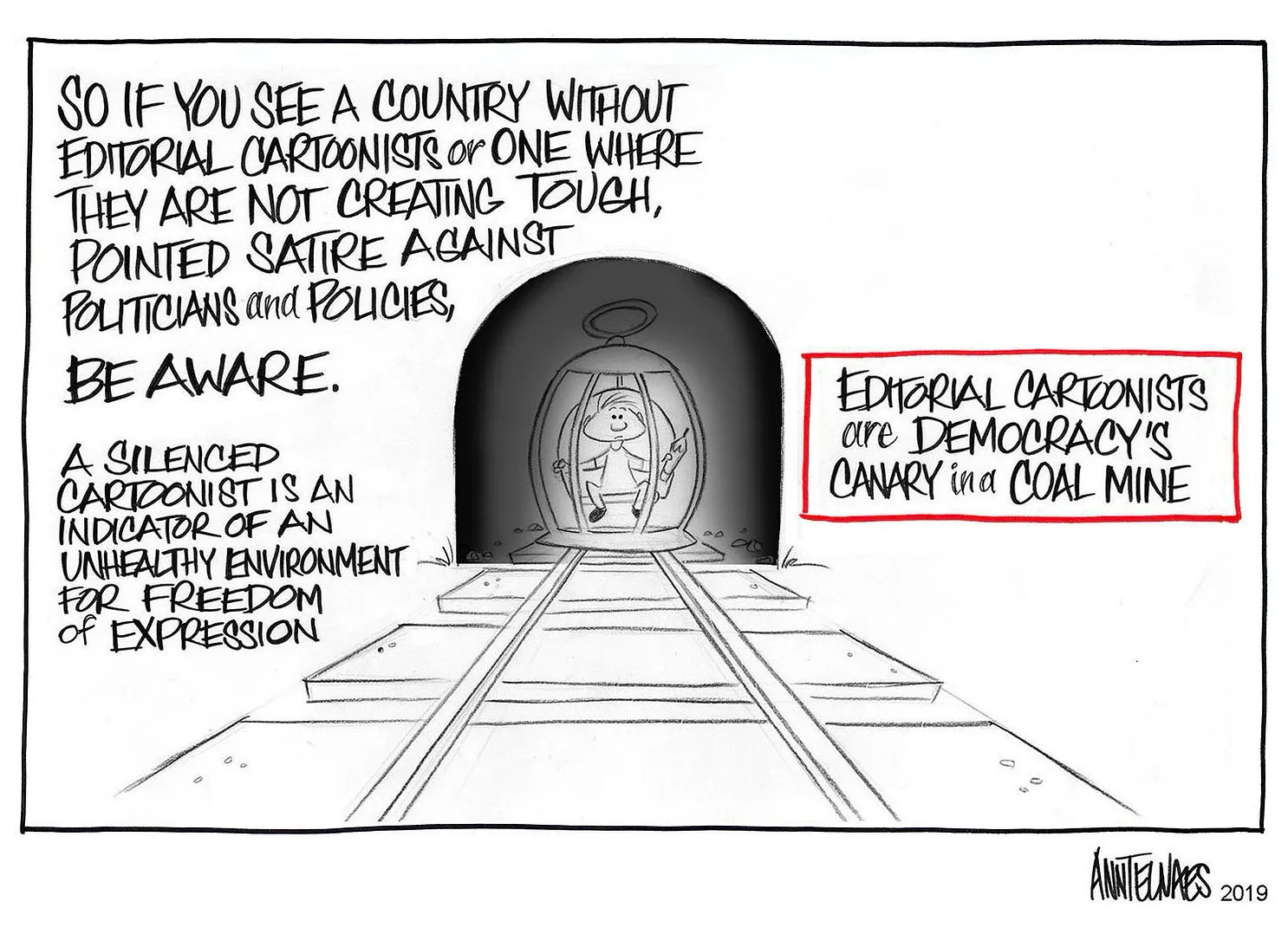 Ann Telnaes: Talking Musk VS Trump & Freedom of Expression! Ann Telnaes: Talking Musk VS Trump & Freedom of Expression! | Two Megalomaniacs Walk Into a Democracy: Ann Telnaes on Cartoons, Chaos, and Why We Can't Look AwayEarlier today, I got to speak with Ann Telnaes, 2025 Pulitzer Prize winner and one of the most fearless voices in political cartooning. (Also, one of my favourite people in the world.) We discussed the urgent question: “How do you document democracy's slow-motion car crash when two unhinged maniacs are fighting over the steering wheel?”New York Cartoons is a reader-supported publication. To receive new posts and support my work, consider becoming a free or paid subscriber.Ann doesn't mince words. She never has. When I described Trump and Musk as "a petulant toddler and a drug-addled lunatic lobbing bombs," she laughed and countered with her more accurate assessment: "Male adolescents who have too many toys."We're not dealing with political disagreements here. We're watching what happens when unlimited power meets unlimited ego, and spoiler alert: it's not that funny.Cartoonists: The Canaries in Democracy's Coal MineAnn has a theory that cartoonists are "the canary in the coal mine of democracies," and honestly, after our conversation, I'm starting to think we might already have one lung full of coal dust. The documentary she's featured in, Democracy Under Siege, was made before everything currently happening actually started happening, yet it predicted pretty much everything we're watching unfold.As Ann put it, there was urgency during Trump's first presidency, "but nobody noticed because he was so entertaining for the media to cover, because it got eyeballs." The cartoonists, however, "did a fairly good job showing who Trump was in the first one." We had a running start this time, but somehow we're still acting surprised that the leopard is eating faces.When Free Speech Gets ComplicatedOur conversation took a serious turn when we talked about Charlie Hebdo. Ann and I were both in the States when the 2015 murders happened, and like me, she felt that gut punch of "sadness and fear and fury." But here's where it gets interesting – and uncomfortable."At first, everybody was all... ‘Je Suis Charlie!’, Free speech! —and everybody was together," Ann recalled. "Then, all of a sudden, at least in this country, there started to be a divide." She strained friendships over defending those cartoons. So did I. "I discovered that I definitely am a free speech absolutist because I don't think you go down that path where you start talking about what you can and cannot draw or say."Her line in the sand is crystal clear: "You're just not allowed to kill people because you disagree with them." The moment someone justifies murder with "Yeah, but the cartoons…" they've lost the argument immediately.RELATED:The Kitchen Counter RevolutionHere's something that blew my mind: Ann still works at her kitchen counter. This absolute legend, who's been skewering politicians for decades, is creating her masterpieces at the same place most of us eat cereal.Her style evolved out of pure practicality. When she started, she tried to copy the McNally crosshatching approach that everyone was doing. "I realised I couldn't do those cartoons very fast. And in business, you have to work fast." So she just started doing them in her own style fast, using the brush and ink techniques from her animation background.Sometimes the best artistic breakthroughs come from just figuring out how to pay the bills.The Art of Evolving EvilOne thing that fascinates me about Ann's work is how her caricatures evolve. She doesn't just create one version of Dick Cheney and repeat it forever. "For me, a caricature is more about who a person is inside rather than how they look outside," she explained. "I wouldn't say that my Cheney looks like Cheney, but it certainly feels like Cheney."This is particularly evident in her Musk cartoons. As I told her, "Your Musk evolved as he devolved." If you did a retrospective of her Musk drawings, it would show this terrifying de-evolution from celebrated businessman to... whatever the hell this is. Her recent cartoon of Musk strung out in an alley with needles around him perfectly captured not just his downfall, but the Greek tragedy of watching it happen in real time on our collective screens.The Pat Oliphant RevelationAnn shared an incredible story about how Pat Oliphant transformed his art. In the '60s, his style was much more cartoon-y. But when he went to speak at the Corcoran School of Art, he noticed they were teaching life drawing and decided to sit in. That's when his incredible draftsmanship really developed.Ann's advice? "If you want to learn to draw, go take life drawing classes. I still take them." She goes to open sessions to draw the figure because "the best way to really understand foundation, to understand shapes and make your cartoon solid" is to master the fundamentals.It's a reminder that even legends are still learning.The Panic That Powers CreationWhat drove Ann to political cartooning? Two specific moments: watching the Tiananmen Square massacre in 1989 while working on a freelance gag cartoon project, and then the Anita Hill/Clarence Thomas hearings.The Anita Hill hearings particularly enraged her because "I was a young woman who had worked, and I had dealt with sexual harassment, and I knew all this crap that these senators were arguing about... They knew absolutely nothing about the reality of sexual harassment for women."These moments awakened something in her: "I finally took my love of art and drawing and combined it with something, and it really clicked for me." Sometimes you need to get angry enough to find your voice.The Mission-Driven Gender GapAnn has a fascinating theory about women cartoonists. There were maybe 17 or 18 working women cartoonists during the suffrage movement. "But once they got the vote, they all quit." The pattern suggests women cartoonists are driven by a mission: "We have a mission, right? We have other things, but we have to do this."It's a different relationship to the work, less about career, more about necessity. When there's injustice to fight, women pick up their pens. When the immediate battle is won, they move on to other ways of making change.The Real Housewives AdministrationOur conversation kept coming back to the Trump-Musk fallout, and Ann captured it perfectly: "It's like watching Real Housewives except there are real-world consequences." These aren't just personality conflicts – they're affecting international relations, democracy, society, and the entire government.The fact that two of the most powerful people on the planet are conducting their beef online makes it even more surreal. As I pointed out, "It's also performative. It's not like they're doing this in person." The online disinhibition effect is amplifying everything to a level that's "affecting our international reputation."Why We Can't Check Out NowDespite the exhaustion, Ann's message is clear: this isn't the time to tune out. "I had a lot of friends who just basically checked out of the news because they're tired... But I don't think now is the time to do that."Her practical advice: "You can listen to the radio news while you're getting ready in the morning. Just keep updated on things because this administration is throwing things faster than anyone can even process them."And then do something about it: "Call your representatives, go join a protest, make some noise because that's the only thing that's going to help us."The Historical Echo ChamberOur conversation got darkest when Ann talked about her German relatives and how she's always wondered how educated, normal people got "sucked into something like a Nazi government, a Hitler regime." Her conclusion is chilling: "I see it now." "We have a guy in office right now who is definitely playing... to people's fears. Autocrats do that in order to get power and keep it." It's not hyperbole when you're watching the playbook get executed in real time.Cartoonists’ Response to ChaosWhat struck me most about talking to Ann is how cartoonists process chaos differently. We don't just report on it – we distil it, exaggerate it, make it impossible to ignore. When democracy is under siege, political cartoonists become war correspondents armed with brushes instead of cameras.Her work during the Bush administration, particularly her devastating takedowns of Dick Cheney, remains some of the most prescient political commentary of that era. But as she noted, "now is a more frantic time with Trump and more urgent."The question is: how do you capture the surreal when reality itself has become a cartoon?Drawing Through the ApocalypseAs we wrapped up our chat, I was struck by Ann's combination of clear-eyed realism and stubborn optimism. Yes, we're watching democracy get stress-tested by megalomaniacs. Yes, it's terrifying. But we're also watching artists, journalists, and citizens refuse to normalise the abnormal.Ann's still at her kitchen counter, still going to life drawing classes. She's documenting the decline while fighting against it, one cartoon at a time.In times like these, maybe that's exactly what heroism looks like: showing up every day and drawing the truth, even when –especially when– it's too absurd to believe.Follow Ann’s Substack below:Thanks for tuning in!‘til next time,Your pal,Key Resources Discussed:* Democracy Under Siege - The prescient documentary featuring Ann* Columbia Journalism Review article on Pat Oliphant - Ann's piece on the legendary cartoonist's drawing process* "Curtis Yarvin's Plot Against America" in New York Magazine - Essential reading on the neo-reactionary movement* The New Yorker piece on Jeff Bezos and the Washington Post - Required reading on media ownership and democracy This is a public episode. If you'd like to discuss this with other subscribers or get access to bonus episodes, visit www.newyorkcartoons.com/subscribe | 36m 03s | ||||||
| 6/4/25 | 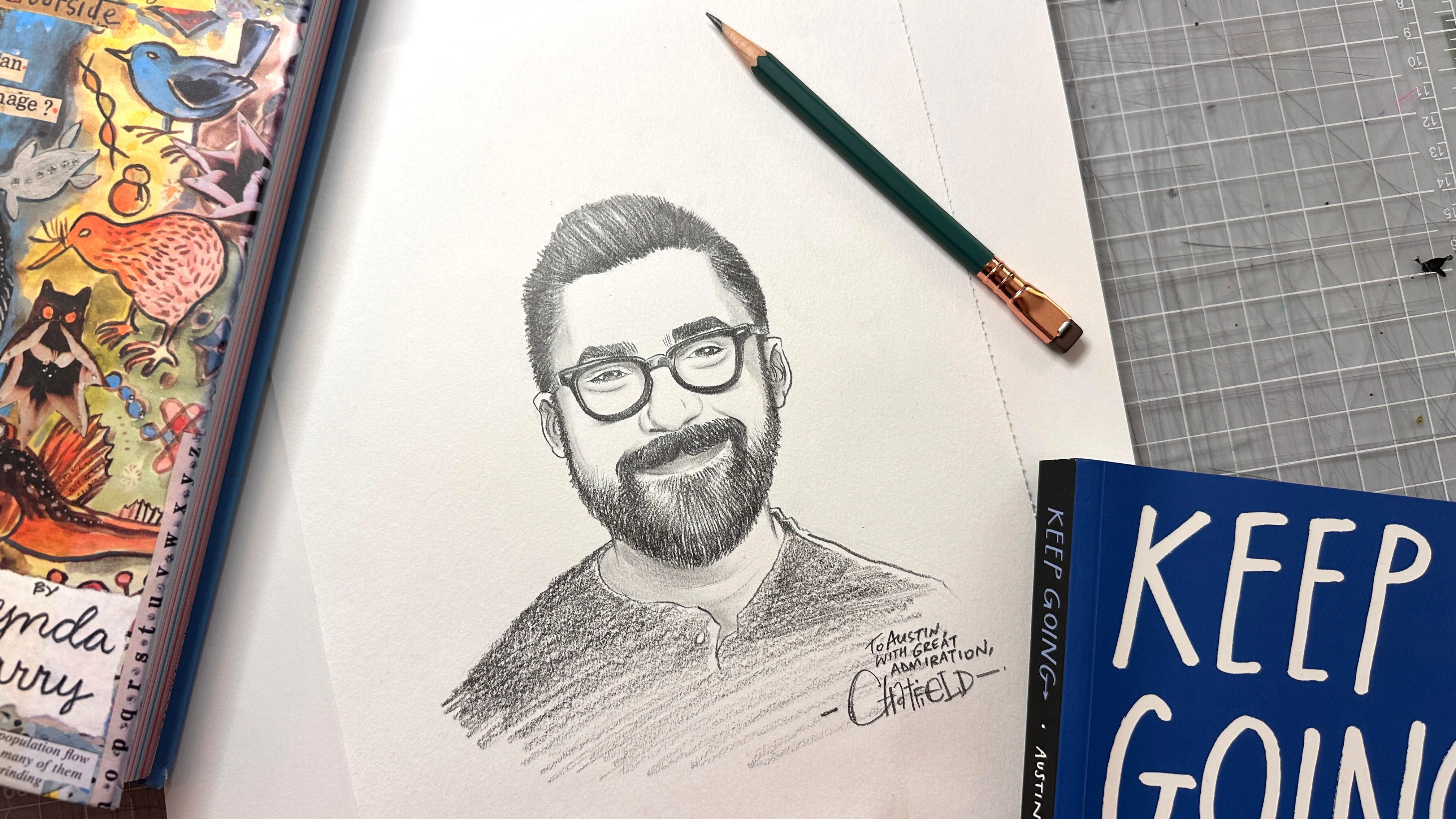 Comedy Over Tragedy: Austin Kleon's Masterclass On Creative Survival Comedy Over Tragedy: Austin Kleon's Masterclass On Creative Survival | Thank you The Bob, Brendan Leonard, Tammy Evans, Bill Cusano, Mariana Marques, and the 500 others who tuned into my live video with Austin Kleon yesterday! New York Cartoons is a reader-supported publication. To receive new posts and support my work, consider becoming a free or paid subscriber.Join me for the next one on Friday at 11am EDT — I’ll be talking & drawing with special guest, Two-Time Pulitzer Prize-winning Cartoonist, Ann Telnaes!About The Guest:Austin is the New York Times bestselling author of a trilogy of illustrated books about creativity in the digital age: Steal Like An Artist, Show Your Work!, and Keep Going. His books have sold nearly two million copies. Two million. That's even more than the 27 of mine that sold this month! They've been translated into over 30 languages (including Australian.) New York Magazine called his work "brilliant." The Atlantic called him "one of the most interesting people on the Internet," and The New Yorker said his poems "resurrect the newspaper when everybody else is declaring it dead."He also does talks for organizations such as Pixar, Google, Netflix, SXSW, TEDx, Dropbox, Adobe, and The Economist. This is the kind of client list that makes freelancers weep into their instant noodles.With that intro out of the way, here is the recap of our conversation. At the bottom, I’ve also included a full list of books recommended or discussed during our one-hour talk.Comedy Over Tragedy: What Austin Kleon Taught Me About Creative SurvivalYesterday, I had the pleasure of chatting with the brilliant mind behind Steal Like an Artist, Show Your Work, and my personal favorite, Keep Going. What started as a conversation about creative routines turned into a masterclass on attention management, the importance of play, and why treating your art like a comedy might be the secret to actually surviving as a creative person.The Magic of Knowing What You LikeAustin started by dropping one of those deceptively simple truths: "Knowing what you like is this kind of magic tonic for your attention." It sounds almost embarrassingly basic, but as he pointed out, "we live in this world where everyone else is trying to tell you what to like constantly."The problem? If you don't know what you actually like, "how are you going to know what you're supposed to make? Because really, what we make is more stuff like we like. We take all the things that we like and we put them together and that's our work."This hit me hard because in previous years, I've been guilty of the exact opposite: creating things that get likes rather than things I actually like. Austin's approach is refreshingly honest: "Only I actually know what I like, right? And so my reading life, for example, is so much richer when I just focus on what I really, really like to read."The Brian Eno Prescription for FocusAustin's been studying Brian Eno for over a decade, and shared Eno's current obsession with attention management. The key insight: When you truly know what you like, “you can tune in to what you're supposed to be paying attention to. It gives you focus."This connects to something profound he observed about kids: "Kids know what they like, especially know what they don't like." They're naturally discerning in a way we somehow unlearn as adults. As Austin put it, his kids were "almost like an executive... they were very, I like that. I don’t like that—and I loved it." (He has a book coming out soon called “Don’t Call It Art” expanding on the value of this insight.The Artist's Survival GuideHere's where things got real. Austin shared a quote from art coach Beth Pickens that completely reframed my thinking about creative work: "Artists are people for whom their life is less when they don't work." Not that they can't do anything else, but that "my life suffers when I'm not making stuff."The guilt around "selfish" creative time dissolves when you realize you're not just indulging yourself – you're showing up to your work, so that you can feel more alive inside, so that then you can show up for other people.The Tragedy vs. Comedy Framework That Changes EverythingThis might have been the most brilliant part of our conversation. Austin breaks down how most people think about art through the lens of tragedy: "a very special person with a gift who struggles and fights against the world... and then you know, it takes a great toll on them. So they have to shoot up heroin or whatever. And then when they get success, they get rich and they drink themselves to death."But there's another way —the comedy approach. In comedy, you have "an ordinary person, just a regular person, maybe even a lowly person... And what they do is they bumble, they fumble, they improvise... but their fatal flaw, they don't really have a fatal flaw. What they have is their wits."The beautiful thing about a comedy? "There is no success in a comedy. There's just failure after failure, basically. But what happens at the end of a comedy is... celebration, a wedding... People coming together at the end."Austin's thesis: "To take a comedic approach to art and creativity is to accept yourself as an ordinary person that gets into trouble, gets in over their heads, but relies on improvisation and their wit... and play."The Survival Mechanism of HumorThis isn't just feel-good philosophy – it's a practical survival strategy. Austin referenced Survive the Savage Sea, about a family adrift at sea for 40 days. When asked what helped them survive, the father said, "a well-developed sense of the absurd."As Austin put it: "Comedy is not just for fun, happy times. Comedy is a survival mechanism." Mel Brooks echoes this: "If you have a sense of humor, you can get through things."The Mathematics of Showing UpWhen we talked about routine and consistency, Austin brought it down to simple math: "One day doesn't feel like much, but... if you can do one page a day, at the end of one year, you have 365 pages. That's enough for a book."But here's the kicker —it's not just cumulative, it's exponential. Using a prickly pear cactus as an example, Austin showed how creative work compounds: "Every day isn't worth the same. If you show up every day for 365 days, the 366th day is actually going to have more power than the first day."The Time Timer RevolutionOne of the most practical tools Austin shared was his beloved timer. The paradox of creative time management: "If you want to disappear, set a timer... if you want to make time disappear, you need to work with time."Here’s the one I have on my desk:His process is beautifully simple: "You block off an hour tomorrow. You block it off on your calendar where no one can get to you... Then you sit down at your desk, and you set a timer for 60 minutes. Then you see what happens."The Hobby Resistance TheoryIn a fascinating tangent, Austin shared George Orwell's theory that the British "penchant for hobbies helped them resist fascism" because "people with hobbies were able to resist fascism more because they were able to spend time alone... they didn't need some sort of demagogue to tell them what to do."His conclusion? "I think something that's happening in American culture is nobody has any hobbies anymore. And so they're just looking around for someone to tell them what to do." The solution might be as simple as more people getting into woodworking.Finding Your Creative ComedyWhat struck me most about his approach is how it removes the pressure to be a tortured genius and gives you permission to just be a regular person who makes stuff. As he said, "I think almost 99% of people shouldn't try to make their creative work their job. I think almost 100% of people should have some sort of creative practice."The goal isn't to become the next tragic artist hero; it's to show up, play, bumble through, and maybe bring people together in the process. As he beautifully put it: "The arts have traditionally been a place for people that weren't super great at life... because they struggle with life, they give us this great art."So maybe the secret isn't learning to suffer for your art – maybe it's learning to laugh with it instead.I’m grateful to Austin for his time and insights— this was one of the best conversations I’ve had, and I’m lucky I got to have it.Recommended ReadingBooks mentioned in our conversation:* Steal Like an Artist by Austin Kleon - The creativity classic that started it all* Show Your Work by Austin Kleon - How to share your creativity and get discovered* Keep Going by Austin Kleon - 10 ways to stay creative in good times and bad* Newspaper Blackout by Austin Kleon - Austin's first book of found poetry* What It Is by Lynda Barry - One of the best books on creativity ever written* Making Comics by Lynda Barry - Essential reading for visual storytellers* Daily Rituals by Mason Currey - How great creators structure their days* Daily Rituals: Women at Work by Mason Currey - The essential sequel focusing on women creators* Survive the Savage Sea by Dougal Robertson - A survival story with lessons for creative resilience* The Comedy of Survival by Joseph Meeker - An alternative framework for thinking about creative work This is a public episode. If you'd like to discuss this with other subscribers or get access to bonus episodes, visit www.newyorkcartoons.com/subscribe | 1h 02m 52s | ||||||
Showing 25 of 26
Sponsor Intelligence
Sign in to see which brands sponsor this podcast, their ad offers, and promo codes.
Chart Positions
2 placements across 2 markets.
Chart Positions
2 placements across 2 markets.