
Insights from recent episode analysis
Audience Interest
Podcast Focus
Publishing Consistency
Platform Reach
Insights are generated by CastFox AI using publicly available data, episode content, and proprietary models.
Total monthly reach
Estimated from 2 chart positions in 2 markets.
By chart position
- 🇦🇺AU · Courses#1105K to 30K
- 🇳🇴NO · Courses#4100K to 300K
- Per-Episode Audience
Est. listeners per new episode within ~30 days
74K to 231K🎙 Biweekly cadence·29 episodes·Long inactive - Monthly Reach
Unique listeners across all episodes (30 days)
105K to 330K🇳🇴91%🇦🇺9% - Active Followers
Loyal subscribers who consistently listen
32K to 99K
Market Insights
Platform Distribution
Reach across major podcast platforms, updated hourly
Total Followers
—
Total Plays
—
Total Reviews
—
* Data sourced directly from platform APIs and aggregated hourly across all major podcast directories.
On the show
Recent episodes
Consequences of Ivan the Terrible
Feb 27, 2014
Unknown duration
Ivan the Terrible, Part III
Feb 27, 2014
Unknown duration
Ivan the Terrible, Part II
Feb 27, 2014
Unknown duration
Ivan the Terrible, Part I
Feb 27, 2014
Unknown duration
Emergence of the Aristocracy
Feb 27, 2014
Unknown duration
Social Links & Contact
Official channels & resources
Official Website
Login
RSS Feed
Login
| Date | Episode | Description | Length | ||||||
|---|---|---|---|---|---|---|---|---|---|
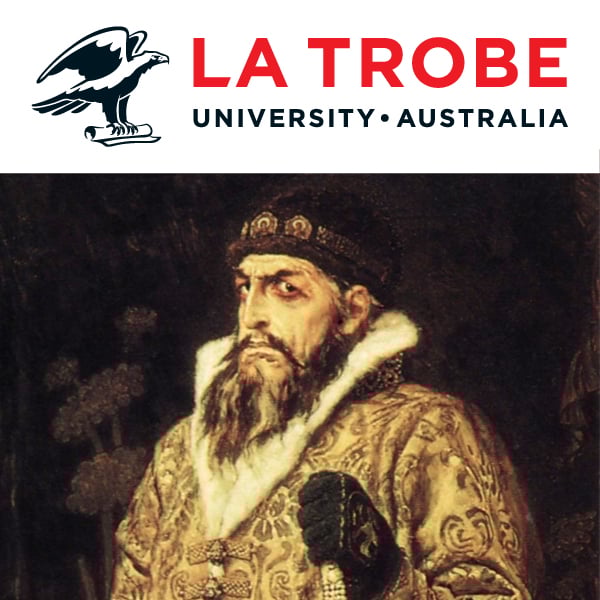
| 2/27/14 | Consequences of Ivan the Terrible | Adrian concludes his lecture series by discussing the Time of Troubles in Russia which followed the death of Ivan IV in 1584: the periods of Tsars Fedor Ivanovich and Boris Godunov, and the ensuing civil war. He tries to set these events in a wider European context. Copyright 2014 Adrian Jones / La Trobe University, all rights reserved. Contact for permissions. | — | ||||||
| 2/27/14 | Ivan the Terrible, Part III | Adrian now begins to discuss the reign of Ivan IV "The Terrible" or more accurately Ivan "The Awesome" in detail. He discusses Ivan IV's reign in four two-hour lectures. Copyright 2014 Adrian Jones / La Trobe University, all rights reserved. Contact for permissions. | — | ||||||
| 2/27/14 | Ivan the Terrible, Part II | Adrian now begins to discuss the reign of Ivan IV "The Terrible" or more accurately Ivan "The Awesome" in detail. He discusses Ivan IV's reign in four two-hour lectures. Copyright 2014 Adrian Jones / La Trobe University, all rights reserved. Contact for permissions. | — | ||||||
| 2/27/14 | Ivan the Terrible, Part I | Adrian now begins to discuss the reign of Ivan IV "The Terrible" or more accurately Ivan "The Awesome" in detail. He discusses Ivan IV's reign in four two-hour lectures. Copyright 2014 Adrian Jones / La Trobe University, all rights reserved. Contact for permissions. | — | ||||||
| 2/27/14 | Emergence of the Aristocracy | Adrian Jones discusses the retinue of the Grand Prince, the group that gradually evolved into an aristocracy. He questions some of the stereotypes about autocracy in Russia, emphasising oligarchical aspects of the Russian polity. Copyright 2014 Adrian Jones / La Trobe University, all rights reserved. Contact for permissions. | — | ||||||
| 11/8/13 | Muscovite Society | Adrian Jones discusses Muscovite rural society and then moves on to discuss the late onset (in Muscovy!) of serfdom, the system of land tenure, and the implications for the distinct lack of a legal culture in Russia. Adrian then turns to discussing the boyars and their chancery clerks, their way of life and their role in the administration of state. Copyright 2013 Adrian Jones / La Trobe University, all rights reserved. Contact for permissions. | — | ||||||
| 9/13/13 | The Russian Orthodox Church | Adrian Jones explores the political and social implications of the Orthodox faith in the lands of the Rus’. Copyright 2013 Adrian Jones / La Trobe University, all rights reserved. Contact for permissions. | — | ||||||
| 8/21/13 | The Rise of Muscovy | Adrian Jones introduces Andrei Tarkovsky's great film Andrei Rublëv (1964, 1966-69), sometimes spelt as "Roublev" or "Rublyov". The film traces episodes in the fourteenth-century life of one of the greatest of Russian icon painters. Copyright 2013 Adrian Jones / La Trobe University, all rights reserved. Contact for permissions. | — | ||||||
| 8/21/13 | The Rise of Muscovy (handout) | Adrian Jones introduces Andrei Tarkovsky's great film Andrei Rublëv (1964, 1966-69), sometimes spelt as "Roublev" or "Rublyov". The film traces episodes in the fourteenth-century life of one of the greatest of Russian icon painters. Copyright 2013 Adrian Jones / La Trobe University, all rights reserved. Contact for permissions. | — | ||||||
| 8/13/13 | Tarkovsky's Film 'Andrei Rublëv' | Adrian Jones introduces Andrei Tarkovsky's great film Andrei Rublëv (1964, 1966-69), sometimes spelt as "Roublev" or "Rublyov". The film traces episodes in the fourteenth-century life of one of the greatest of Russian icon painters. Copyright 2013 Adrian Jones / La Trobe University, all rights reserved. Contact for permissions. | — | ||||||
Want analysis for the episodes below?Free for Pro Submit a request, we'll have your selected episodes analyzed within an hour. Free, at no cost to you, for Pro users. | |||||||||
| 8/4/13 | Kiev Russia and Tatar-Mongols | Adrian Jones contrasts the different Kievan (C10th-C13th) and Tatar-Mongol (C13th to C15th) eras, tracing their different influences on medieval Russian history. Adrian refers wherever possible to illustrations from the period. He places events and polities in Russia in the wider context of Eurasian history. Copyright 2013 Adrian Jones / La Trobe University, all rights reserved. Contact for permissions. | — | ||||||
| 7/31/13 | The Origin of Russia and Russians II | The lecture opens with a response to Adrian's previous lecture by Adrian's teaching assistant, a Russo-Ukrainian scholar, Dmytro Ostapenko. History is all about argument and evidence. Dmytro critiques Adrian's "Normanist" point of view about the C9th-C10th origins of the Russian state (i.e., that the Rusi’an state was Varangian-Viking inspired). Dr Dmytro Ostapenko offers a stricter view of what is meant by “statehood”. Dr Ostapenko cites evidence discussing how bands had already evolved into Slavic tribes and kings (and hence a state) and he discusses a wider range of what he believes are indigenous Slavic cultural and economic influences on state formation. Adrian then replies and as he does he discusses more of the Viking and Slav evidence, focussing on the Russian Primary Chronicle (circa 1115) and relations between forest and steppe, as viewed in the light of Arab-Persian (Ibn Fadhlan, Ibn Khurdadbeh), Carolingian (Bertinian Annals 832), Byzantine (C10th Constantine VII Porphyrogenitas on the Administration of the Empire) and Khazar sources. Copyright 2013 Adrian Jones / La Trobe University, all rights reserved. Contact for permissions. | — | ||||||
| 7/26/13 | The Origin of Russia and Russians I | This lecture considers the question of the origins of Russia and Russians. A wide range of comparisons are explored: both in terms of key concepts, and in terms of contrasting episodes in history, modern and classical. Students that week were reading Ibn Fadlan’s account (922 CE) of an encounter with the Rus’ at the mouth of the Volga Rr on the Caspian Sea, and those parts of the [Kievan] Russian Primary chronicle (written ca 1110 CE) about the origins of the creation of the “Rus’ian” state at the end of the C10th. Copyright 2013 Adrian Jones / La Trobe University, all rights reserved. Contact for permissions. | — | ||||||
Showing 13 of 13
Sponsor Intelligence
Sign in to see which brands sponsor this podcast, their ad offers, and promo codes.
Chart Positions
3 placements across 2 markets.
Chart Positions
3 placements across 2 markets.