

Insights from recent episode analysis
Audience Interest
Podcast Focus
Publishing Consistency
Platform Reach
Insights are generated by CastFox AI using publicly available data, episode content, and proprietary models.
Most discussed topics
Brands & references
Total monthly reach
Estimated from 10 chart positions in 10 markets.
By chart position
- 🇨🇦CA · Courses#1495K to 30K
- 🇯🇵JP · Courses#8710K to 30K
- 🇳🇱NL · Courses#9610K to 30K
- 🇳🇿NZ · Courses#2710K to 30K
- 🇨🇿CZ · Courses#713K to 10K
- Per-Episode Audience
Est. listeners per new episode within ~30 days
23K to 80K🎙 Weekly cadence·208 episodes·Last published 2mo ago - Monthly Reach
Unique listeners across all episodes (30 days)
46K to 159K🇨🇦19%🇯🇵19%🇳🇱19%+7 more - Active Followers
Loyal subscribers who consistently listen
18K to 64K
Market Insights
Platform Distribution
Reach across major podcast platforms, updated hourly
Total Followers
—
Total Plays
—
Total Reviews
—
* Data sourced directly from platform APIs and aggregated hourly across all major podcast directories.
On the show
From 10 epsHosts
Not detected.
Recent guests
Recent episodes
Announcing Panglot World Languages
Apr 2, 2026
4m 33s
Goodbye :)
Dec 31, 2024
48m 29s
156. Entrepreneurial expertise
Jan 25, 2024
43m 23s
155. How experts see
Dec 18, 2023
41m 49s
154. Mindsets everywhere
Dec 11, 2023
29m 47s
Social Links & Contact
Official channels & resources
Official Website
Login
RSS Feed
Login
| Date | Episode | Topics | Guests | Brands | Places | Keywords | Sponsor | Length | |
|---|---|---|---|---|---|---|---|---|---|
| 4/2/26 | Announcing Panglot World Languages✨ | languageslinguistics+1 | — | Panglot World Languages | — | Panglot World Languageslanguage exploration+2 | — | 4m 33s | |
| 12/31/24 | Goodbye :)✨ | language learningendangered languages+1 | — | language learning appsPanglot Labs Ltd+4 | Taiwan | Panglot Labscognitive science+1 | — | 48m 29s | |
| 1/25/24 | 156. Entrepreneurial expertise✨ | entrepreneurshipexpertise+2 | — | The Cambridge Handbook of Expertise and Expert PerformanceToward Deliberate Practice in the Development of Entrepreneurial Expertise: The Anatomy of the Effectual Ask+1 | — | Effectual FramePredictive Frame+1 | — | 43m 23s | |
| 12/18/23 | 155. How experts see✨ | expertisevisual perception+1 | — | — | — | researchvisual patterns+1 | — | 41m 49s | |
| 12/11/23 | 154. Mindsets everywhere✨ | mindsetself-motivation+1 | — | Self-Regulation of Motivation: A Renewable Resource for LearningThe Upside of Stress+2 | — | Carol DweckKelly McGonigal+2 | — | 29m 47s | |
| 11/26/23 | 153. Comparing learning different dance styles: Argentine Tango vs. Ballroom & Latin (Dancesport)✨ | danceArgentine Tango+3 | — | DancesportUno | — | learningphilosophies+3 | — | 1h 17m 14s | |
| 11/19/23 | 152. [VIDEO] Education and generative AI: conference video for STEM MAD Melbourne, October 23✨ | generative AIeducation+1 | — | — | Melbourne | video podcastconference+1 | — | 8m 09s | |
| 11/13/23 | 151. 8 years, 150 episodes✨ | podcast reviewmilestone | — | Buy Me a CoffeeEducation Bookcast | — | supportreview+1 | — | 36m 03s | |
| 10/26/23 | 150. A Wizard of Earthsea by Ursula Le Guin✨ | fictionfantasy+2 | — | A Wizard of Earthsea | Roke | Ursula Le GuinA Wizard of Earthsea+3 | — | 58m 51s | |
| 10/23/23 | 149. How Popular Musicians Learn by Lucy Green✨ | popular musiclearning+2 | Lucy Green | How Popular Musicians Learnthe Berlin Conservatory+7 | England | expertise research10,000 hour rule+3 | — | 47m 07s | |
Want analysis for the episodes below?Free for Pro Submit a request, we'll have your selected episodes analyzed within an hour. Free, at no cost to you, for Pro users. | |||||||||
| 8/18/23 | 148. You Know the Fair Rule by Bill Rogers | Any teacher in a Western cultural context knows that classroom behaviour is the most challenging part of the job. A lot of the time, it seems like crowd control is the main issue, and "teaching" is secondary. Unfortunately, teacher training courses don't do a good job of preparing teachers for this reality, with behaviour management rarely instructed at all. Bill Rogers has been helping teachers develop their classroom behaviour management and discipline skills for decades. He has brought his calm and relationship-focused approach to innumerable schools, often including those with very challenging behaviour, or those in "special measures". His practical insights into what to do in the classroom, and the principles behind his approach, offer a valuable guide for teachers struggling with this aspect of their jobs. I intend this to be one of several behaviour management books that I will cover on the podcast. Hopefully, in this way I can direct some teachers and school leaders to some useful resources, share some practical advice, and draw some general conclusions about school discipline and learning. Enjoy the episode. *** SUPPORT You can support Education Bookcast and join the community forum via Buy Me a Coffee using the following link: https://www.buymeacoffee.com/edubookcast . | — | ||||||
| 7/24/23 | 147. Large language models (LLMs) - interview with Dr Guy Emerson | Dr Guy Emerson (a.k.a Guy Karavengleman) is a computational linguist working at the Cambridge University Computer Laboratory. In this episode, we discuss issues surrounding LLMs such as ChatGPT, GPT-3, GPT-4, and Google Bard. Guy is concerned about misinterpretations of what the technology does and is capable of. As a computational linguist, he works on language models with a focus on semantics and human language acquisition, and thus questions of linguistic meaning and understanding are particularly relevant to his work. While LLMs are an impressive technology with startling capabilities, we need to be aware of when we may be fooling ourselves about their potential. In this episode, we discuss what LLMs are; ways in which they have been misrepresented and misinterpreted; ethical questions about the companies developing this technology; and what they might be used for. Enjoy the episode. *** SUPPORT You can support the podcast and join the community forum by visiting https://www.buymeacoffee.com/edubookcast . | — | ||||||
| 5/7/23 | 146b. Lessons from EdTech - The 90% Rule | In the second part of this two-part episode about lessons learned from my time working in the education technology sector, I wanted to share a very significant quantitative finding to improve learning: what I call the "90% rule". Desirable difficulties is a concept that many know about and try to apply to teaching situations, but there is a question of how difficult one should make things. Surely there is a level at which things are too difficult? In which case, what is the perfect level of difficulty that we should aim for? The secret is this 90% number. Enjoy the episode. *** REFERENCES Eglington, L.G., Pavlik Jr, P.I. Optimizing practice scheduling requires quantitative tracking of individual item performance. npj Sci. Learn. 5, 15 (2020). https://doi.org/10.1038/s41539-020-00074-4 See also the SuperMemo Guru wiki: https://supermemo.guru/wiki/Optimum_interval. SUPPORT If you would like to support Education Bookcast and join the community forum, you can do so at https://www.buymeacoffee.com/edubookcast. | — | ||||||
| 4/30/23 | 146a. Lessons from EdTech - the Fundamental Duality of Educational Materials | I've now been working as a data scientist in educational technology for over four years. In that time I've thought a lot about various educational concepts within edtech, and I want to share some of what I've learnt. In the first part of this two-part episode, I want to talk about what I call the Fundamental Duality of Educational Materials. The Fundamental Duality is that we use our content to measure our students / users (e.g. what they know), but we also use our users to measure our content (e.g. how difficult it is). This leads to a sort of chicken-and-egg problem, where all we see is the interaction of the users with the content, but from that single fact we have to somehow extract information about the two different interacting entities. For example, suppose that a user gets a question wrong. This could mean one of a number of things: Is the question difficult? Does the user not know this area very well? There is also a third possibility: Is this question faulty? i.e. did the user actually answer the question correctly, but it was marked as incorrect due to a bug in the system, or in the way the content was created? Answering these questions is difficult because they are apparently all possible in this situation. This is an illustration of the Fundamental Duality. In the episode, I make some mention of Item Response Theory (IRT), which is a method used in computerised adaptive testing (CAT) to handle this very issue. But IRT is quite difficult to explain to a lay audience, especially without the use of images, so I will focus on Elo and Glicko rating systems as examples of handling this duality. Enjoy the episode. *** You can support Education Bookcast and join the community forum by visiting https://www.buymeacoffee.com/edubookcast. | — | ||||||
| 4/22/23 | 145b. How to be a better lecturer (practice) - a message for Guy | This is the second part of the message for my friend Guy about becoming a better lecturer. In this part, I go over 27 practical techniques and tips for improving lecturing (as well as improving the way homework exercises are designed), referring to the principles and theory outlined in the previous part to explain how and why these work. To be completely honest some of the suggestions are more general pedagogical suggestions rather than being specific to lecturing, but I decided to throw them in as well for completeness. Enjoy the episode. *** You can support Education Bookcast and join the community forum by visiting https://www.buymeacoffee.com/edubookcast. | — | ||||||
| 4/22/23 | 145a. How to be a better lecturer (theory) - a message for Guy | Another in the series of "really long voice notes from Staś". My friend Guy is a lecturer in natural language processing. He asked me if I could give him some tips about how to lecture better, so I told him I would record a podcast episode about it. I've divided the episode into two parts. In this first part, before we speak about practical things to do, I will discuss what the basic aims are, and some important preliminary framing questions - what are we trying to achieve? How does learning work? And when can I stop punching the ground with my fist? There is some extra pressure when talking about how to be a good lecturer, as in effect I might ironically give a bad lecture about how to lecture well. I think I did ok. Enjoy the episode. *** You can support Education Bookcast and join the community forum by going to https://www.buymeacoffee.com/edubookcast. | — | ||||||
| 4/15/23 | 144. Developing Talent in Young People by Benjamin Bloom | Benjamin Bloom is best known for Bloom's Taxonomy, a scheme for categorising ways of thinking about or interacting with learning content on a scale from less to more sophisticated. However, the project he led investigating the lifelong development of expertise should be much more famous. The book's full title makes it feel as though it was published in 1685 rather than 1985: The dramatic findings of a ground-breaking study of 120 immensely talented individuals reveal astonishing new information on Developing Talent in Young People. Bloom's team looked at extraordinary achievers in six domains: pianists, sculptors, swimmers, tennis players, mathematicians, and neurologists, so that he had two each from artistic, athletic, and academic pursuits. He was trying to understand the life circumstances during childhood and adolescense - particularly the practice routines and social milieu - which led to the development of the subjects' expertise. Their research methods were unusual. Rather than using a large sample and taking quantitative data (which would have been difficult anyway due to the lack of a large number of exceptional people, by definition) or presenting qualitative interviews of individual case studies, Bloom's team interviewed around 20-30 people from each domain and then summarised the findings of these interviews. It leaves us with a sense of the qualitative experience of going through their learning processes, while also reducing the chances of over-generalising from a single case. Pianists were the main focus of discussion where Bloom and his colleauges tried to generalised the findings, although all six categories had a full exposition as to the findings for their domain in particular. The pianists followed an especially clear pattern which is worth starting from, and subsequently comparing with the others. In the context of an abundance of information about how people think and learn on shorter timescales (from seconds to weeks), having information about how people develop over the lifespan is invaluable. I will definitely be referring to this book a lot in future. Enjoy the episode. *** RELATED EPISODES This book is related to the development of expertise, which I talk about on a lot of episodes, but the one specific one I mentioned in the recording was: 22. The Talent Code by Daniel Coyle SUPPORT You can support Education Bookcast and join the community forum via Buy Me a Coffee using the following link: https://www.buymeacoffee.com/edubookcast. | — | ||||||
| 3/19/23 | 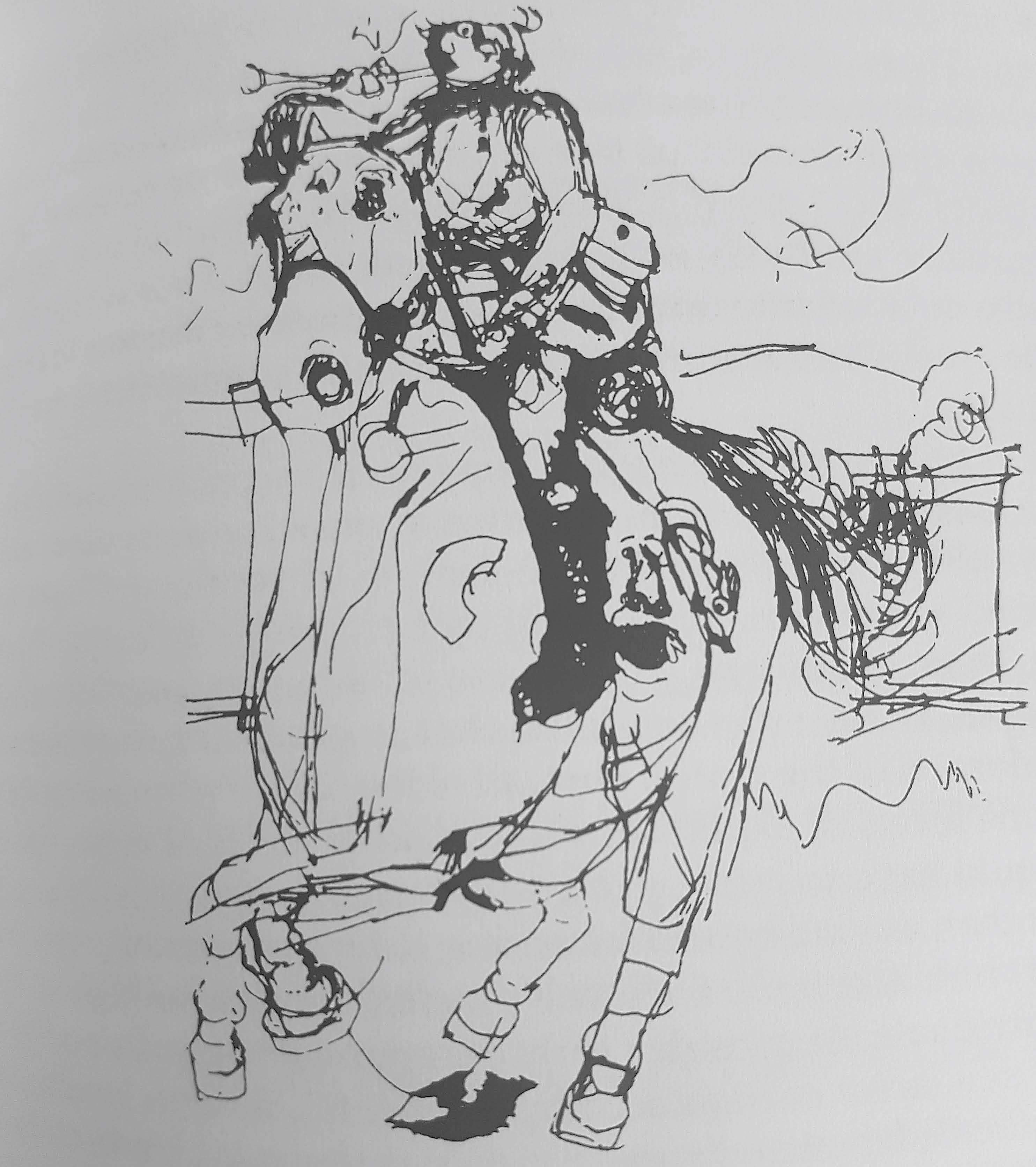 143. Talent, revisited | Cover image: horse and rider by Nadia, age 5. The nature of talent is something that I dealt with near the beginning of the existence of Education Bookcast, reviewing books like Genius Explained, Outliers, The Talent Code, and Bounce. The general consensus was that talent is an illusion - people simply get better at things through exposure and practice. My confidence in this assertion was shaken when reading the IQ literature, but now, in the book The Road to Excellence edited by K. Anders Ericsson, the article The Rage to Master: the Decisive Role of Talent in the Visual Arts by Ellen Winner. She points out how some exceptional children are obsessed with drawing, and draw in a way that is qualitatively different to ordinary children. She argues that the aforementioned orthodoxy of talent apparently not really existing is in fact incorrect, in light of these prodigies and their extraordinary output. In the recording, I discuss these findings and try to find a way to put it all together. Benjamin Bloom's book Developing Talent in Young People also comes in handy, as not only does Ellen Winner cite it (incorrectly, in my view), but he also provides a valuable insight into his forty years of research into learning in schools which helps us make sense of the conundrum of talent's apparent non-existence while we have well-documented examples of extraordinarily talented individuals, in the visual arts at least. Enjoy the episode. *** RELATED EPISODES 18. Bounce by Matthew Syed 20. Genius Explained by Michael Howe 22. The Talent Code by Daniel Coyle 24. Outliers by Malcolm Gladwell SUPPORT You can support the podcast and join the community forum by visiting https://buymeacoffee.com/edubookcast. | — | ||||||
| 3/11/23 | 142. Season 2 of the Pedagogue-Cast is out now! Taster: Music and Learning | Season 2 of the Pedagogue-Cast is here! The Pedagogue-Cast is a separate podcast project I share with Justin Matthys, founder of Maths Pathway. We discuss the kinds of questions that teachers might have about good practice which touch on cognitive science, making sure both to make the most of the research findings while also making it practical for use in the classroom. In this new season, Justin and I are going to discuss music, flow, focus, student choice, social & emotional learning interventions, and how motivation develops over time. Some places where you can find the Pedagogue-Cast: https://podcasts.apple.com/us/podcast/the-pedagogue-cast/id1637019084 - Apple podcasts https://open.spotify.com/show/437GYDF4jkkFxfkGR4cknc - Spotify https://podcasts.google.com/feed/aHR0cHM6Ly9mZWVkcy5idXp6c3Byb3V0LmNvbS8xOTg0NDY3LnJzcw?hl=en - Google podcasts You can also try searching for the Pedagogue-Cast in your favourite podcast app. Enjoy! | — | ||||||
| 3/10/23 | 141+. Feedback on constructivism | After my last episode on behaviourism, cognitivism, and constructivism ("A Message for Zoë"), I heard back from Zoë herself, and also heard from Malin Tväråna, an education researcher in Sweden. I decided that it was worth recording an episode relating what I heard from them, and my thoughts about it. Enjoy the episode. ### REFERENCES Miłosz, Czesław (1953): The Captive Mind. Radford, Luis (2016): The Theory of Objectification and its Place among Sociocultural Research in Mathematics Education. Radford, Luis (2018): Teaching and learning (algebra or something else): Working together to make sense of similarities and differences between theories (and understanding oneself). | — | ||||||
| 2/25/23 | 141. Behaviourism, Cognitivism, Constructivism - a message for Zoë | My friend Zoë (hi Zoë!) is taking a course on learning design. In it, she heard about Behaviourism, Cognitivism, and Constructivism, and while she said that she found it confusing, her main takeaway is that "you need a bit of each". I recorded this episode to help her have a clearer sense of what these three words really mean, and that "a bit of each" is emphatically not the right message. I thought that others might benefit from the same summary. This is a frequent topic in education courses, and I think it generally gets a pretty poor treatment. Hopefully this will clear things up for a lot of people. Enjoy the episode. *** RELATED EPISODES Note how the distribution of episodes reflects the importance of topics. Behaviourism is important to know about but it really isn't current as a way of thinking about learning, it's more of a historical relic with some lasting applicability to animal training. Constructivism is a mistaken and misleading theory that keeps negatively affecting educational practice and never seems to go away, so I keep having to talk about it. Cognitivism is a really effective approach which deserves to be known more widely - it took me a long time to find out about it, hence why the episodes about it tend to be more recent. Behaviourism: 3. Don't Shoot the Dog! The New Art of Teaching and Training by Karen Pryor Constructivism: 42. Do Schools Kill Creativity? by Ken Robinson; 65. Beyond the Hole in the Wall by Sugata Mitra; 87. Experiential Learning by Colin Beard and John Wilson; 88. The Failure of Constructivist, Discovery, Problem-based, Experiential, and Inquiry-based Teaching; 90. Discovery learning: the idea that won't die; 124. The Cambridge Handbook of the Learning Sciences Cognitivism: 79. What learning is; 80. The Chimp Paradox by Prof Steve Peters; 82. Memorable Teaching by Pepps McCrea; 85. Why Don't Students Like School? by Daniel Willingham; 95. The Reading Mind by Dan Willingham; 132a. Direct Instruction and Project Follow Through; 132b. Direct Instruction: the evidence; 135. Professional writing expertise; 136. Congitive architecture and ACT-R; 136+. Interview with Prof. Christian Lebiere on ACT-R and Cognitive Architecture REFERENCES I mention the following article as one where the authors (eminent figures in cognitive architecture, one of whom is a Nobel Prize winner) ask Constructivists to stop misrepresenting their work and saying things in direct contradiction to the evidence. Anderson, Reder, & Simon (1999). Applications and Misapplacations of Cognitive Psychology to Mathematics Education. SUPPORT You can support the podcast and join the community forum by visiting https://www.buymeacoffee.com/edubookcast. | — | ||||||
| 1/30/23 | 140b. Political economy pt. II: The Invisible Hook | In the previous recording, I was speaking about political economy using the example of prison gangs, taken from David Skarbek's book Social Order of the Underworld. In this recording, I give the example of 18th-century Atlantic pirates, as discussed in Peter Leeson's The Invisible Hook. (It's a pun on Adam Smith's "invisible hand of the market".) We may have an image of pirates as fearsome, but this is at least somewhat deliberately manufactured by the pirates themselves. They wanted to have such a reputation so that their victims wouldn't resist as they looted their ships. There are parts of the pirate lifestyle, such as democracy and voluntarism, that we don't tend to discuss because they were part of life on a pirate ship but not something that they felt the need to advertise widely. What is most notable is that pirates' way of life seemed to be significantly preferable, and their governance significantly more "progressive", than that on merchant ships, which tended to be highly autocratic and abusive. It also provides a different perspective when we realise that sailors went into piracy at a time of labour market oversupply due to the ending of the War of Spanish Succession, when the British Navy didn't have the funds to keep on so many sailors, and yet this was the career of tens of thousands of young men who now had to find a job elsewhere. Overall, in these two recordings, I hope to have shown you that thinking about people's motivations and situations from the perspective of political economy makes a lot more sense, and builds a much richer picture, than merely psychological or sociological explanations (such as childhood trauma, psychopathy, or people's fundamental evil or violent nature). With this in mind, I hope that in future we can use more of this thinking when considering education, so that we can understand better how it works and how to improve it. Enjoy the episode. | — | ||||||
| 1/29/23 | 140a. Political economy pt. I: The Social Order of the Underworld | Please be advised that this episode contains mentions of violence and may be unsuitable for some listeners. I'd like to flesh out what I've been saying before about the power of economic analysis in explaining people's actions. Whereas when we normally think about motivation we think in terms of psychology, economists naturally think in terms of incentives. This kind of thinking is generally missing in educational discourse. There are two books that I found particularly fascinating and instructive on this point: The Social Order of the Underworld: How Prison Gangs Govern the American Penal System by David Skarbek; and The Invisible Hook by Peter Leeson. This recording focuses on the former. David Skarbek's book is fascinating and rich in both detail and theoretical explanation, so I focus on what I find most compelling and most relevant to transfer over to thinking about other contexts. First of all, he introduces existing criminological theories that aim to account for the rise in prison gangs, namely Deprivation theory and Importation theory. The former suggests that inmate behaviour is a result of the pain of imprisonment, and the latter focuses on pre-prison beliefs and experiences that are brought into prison. Skarbek departs from both of these theories, grounding his own analysis in political economy. He introduces us to the basic assumptions of economics - that people are self-interested and respond rationally to incentives - and goes on to describe the role of governance in society. His fundamental thesis is that prison gangs provide governance, meaning that they provide a form of public good which enhances personal safety and opportunities for trade (mostly in drugs). While I'm yet to fully apply the ideas of political economy to education (except for reading about it inThe Beautiful Tree, China's Examination Hell, and Education and the State), I feel that digging in to some examples like this can help us appreciate the reasons why people do things. Crucially, they are not all psychological. Enjoy the episode. | — | ||||||
| 1/1/23 | 139. Reflections after 7 years | Education Bookcast released its first episode on the 1st of January 2016. I'd like to take this opportunity to talk about some of the big things that I think I've learned in that time. I speak about: Psychology is overrated - the replication crisis and the bias in cultural sampling, and therefore the importance of anthropological evidence; Psychology is underrated - how amazing the field of cognitive architecture is, and how little known it appears to be as a field; apparent resistance to scientific findings from some people in the field of education; understanding expertise as a key to knowing how to improve education; the power of economic thinking in understanding motivation and behaviour; the failure of behaviourism, and the incorrect conclusions some people have drawn from it; and how school seems to be good for society, but the mechanisms of how this happens aren't completely clear, and I remain neutral on this point as I gather further evidence. Enjoy the episode. ### SUPPORT You can support the podcast and join the community forum by visiting https://www.buymeacoffee.com/edubookcast. | — | ||||||
| 11/14/22 | 138. The science of self-belief, part II: self-efficacy | This is the second episode concerning self-related beliefs taken from chapters of The Cambridge Handbook of Motivation and Learning. Here I talk about self-efficacy, which concerns how much you believe that you can do something specific, e.g. solve a particular kind of maths problem. Self-esteem, self-concept, self-efficacy - it's easy to get confused with so many "self-words" flying around. There are even other words which aren't used by academics but are in common parlance, such as self-belief. I go into more detail and give more examples of the difference in the recording, but basically, whereas self-concept concerns your attitude to an entire domain (e.g. how good you think you are at sports), self-efficacy refers to how likely you think you would be to succeed in a specific class of activity (e.g. do you think you could run a marathon). Like self-concept, self-efficacy has been found to be strongly correlated with a bunch of positive behaviours, such as perseverance, but also outcomes, such as academic interest and academic performance. Unfortunately causality doesn't seem to have been established (as far as I can tell from the article), which blunts my enthusiasm about it somewhat. Nevertheless, this is definitely something to keep an eye on. The article also explains the sources of self-efficacy beliefs, which are four: mastery experiences (succeeding or failing); vicarious experiences (watching another person suceed or fail); social persuasion (including encouragement); and physiological state (e.g. anxiety). This list suggests interventions that can be used to increase self-efficacy, namely encouragement and the presentation of models (i.e. peers who can also succeed, possibly after some struggle). One thing I forgot to mention in the recording: in Chinese culture, it is common to tell children stories of famous successful people both from China and from around the world who struggled through great difficulties to achieve their life goals. Marie Curie seems to figure particularly prominently in these biographies, being somebody who had to move to a foreign country (France) to study, breaking the mould as a woman in science, being famed for her extraordinary work ethic, and going on to be the first person to ever achieve a Nobel Prize in two different disciplines (Physics and Chemistry). While there are many ways to interpret the details of how such stories would affect people, it might in part have a self-efficacy effect, by showing young people that it is possible to succeed even in difficult circumstances. Enjoy the episodes. *** RELATED EPISODES 13. The Psychology of Self-Defense: Self-Affirmation Theory by David Sherman & Geoffrey Cohen 45. The problem with self-esteem 46. Self Compassion by Kristin Neff SUPPORT If you would like to support the podcast and join the community forum, you can visit https://www.buymeacoffee.com/edubookcast. | — | ||||||
Showing 25 of 207
Sponsor Intelligence
Sign in to see which brands sponsor this podcast, their ad offers, and promo codes.
Chart Positions
10 placements across 10 markets.
Chart Positions
10 placements across 10 markets.