
Insights from recent episode analysis
Audience Interest
Podcast Focus
Publishing Consistency
Platform Reach
Insights are generated by CastFox AI using publicly available data, episode content, and proprietary models.
Total monthly reach
Estimated from 3 chart positions in 3 markets.
By chart position
- 🇦🇺AU · Technology#1925K to 30K
- 🇰🇪KE · Technology#136500 to 3K
- 🇲🇾MY · Technology#138500 to 3K
- Per-Episode Audience
Est. listeners per new episode within ~30 days
3K to 18K🎙 Weekly cadence·199 episodes·Last published 4d ago - Monthly Reach
Unique listeners across all episodes (30 days)
6K to 36K🇦🇺83%🇰🇪8%🇲🇾8% - Active Followers
Loyal subscribers who consistently listen
1.8K to 11K
Market Insights
Platform Distribution
Reach across major podcast platforms, updated hourly
Total Followers
—
Total Plays
—
Total Reviews
—
* Data sourced directly from platform APIs and aggregated hourly across all major podcast directories.
On the show
Recent episodes
The State of Code Quality with Saša Jurić
May 28, 2026
Unknown duration
Cloud Fragility & Distributed Systems with Somtochi Onyekwere
May 21, 2026
Unknown duration
The State of Hiring and Jobs in Elixir with Greg Medland
May 14, 2026
Unknown duration
Supervised State Replication in Elixir with Micah Cooper
May 7, 2026
Unknown duration
The State of Security in Elixir with Holden Oullette
Apr 30, 2026
Unknown duration
Social Links & Contact
Official channels & resources
Official Website
Login
RSS Feed
Login
| Date | Episode | Description | Length | ||||||
|---|---|---|---|---|---|---|---|---|---|
| 5/28/26 |  The State of Code Quality with Saša Jurić | In this episode of Elixir Wizards, hosts Charles Suggs and Emma Whamond sit down with Saša Jurić, Elixir mentor and author of Elixir in Action, to discuss software craftsmanship in the age of AI. As AI coding tools become increasingly capable, Saša argues that the real challenge isn't generating code, it's maintaining quality, clarity, and shared understanding within a codebase. We explore the difference between correct code and good code, and why code is more than a set of instructions for a machine to execute. Code is also documentation, communication, and a long-term investment that future developers must be able to understand and maintain. Saša shares his concerns about the growing "theater of pull requests," where teams go through the motions of code review without creating meaningful opportunities for learning, feedback, or knowledge sharing. The hosts and Saša talk about practical ways to work effectively with AI, including taking smaller steps, carefully reviewing AI-generated code, and using AI as a collaborative tool rather than an autonomous developer. Throughout the discussion, Saša challenges the industry's obsession with speed and makes the case that the principles of good software development (incremental progress, clear communication, and human judgment) remain important in the age of AI. Key Topics Discussed The difference between correct code and good code Code as communication, documentation, and shared understanding The "theater of pull requests" and ineffective review practices How AI is changing software development workflows Using AI as a collaborator rather than a replacement Why smaller, incremental changes lead to better outcomes Human oversight in AI-assisted development Balancing development speed with maintainability Pull request size and review effectiveness Commit history as a tool for storytelling and context The risks of accumulating technical debt faster with AI Testing and validating AI-generated code Refactoring AI-generated solutions for clarity Applying agile principles to AI-assisted workflows The role of experience and judgment in software design Why software craftsmanship still matters in the age of AI Links mentioned Code Complete by Steve McConnell https://khmerbamboo.wordpress.com/wp-content/uploads/2014/09/code-complete-2nd-edition-v413hav.pdf Harness AI for DevOps, Testing, and AppSec https://www.harness.io/ Claude Code https://claude.com/product/claude-code Claude Code GitHub https://github.com/anthropics/claude-code Pull Request for Oban https://github.com/oban-bg/oban/pull/331 SMPP https://en.wikipedia.org/wiki/Short_Message_Peer-to-Peer OpenAI Codex https://chatgpt.com/codex/ Opus AI https://opus.ai/ Tidewave https://tidewave.ai/ Credo Static Code Analysis https://github.com/rrrene/credo https://smartlogic.io/podcast/elixir-wizards/s11-e09-static-code-analyzer-elixir-credo-ruby-rubocop/ Link to Sasa’s X post https://x.com/sasajuric/status/2029522378196238503 Saša Jurić “Tell Me A Story” at Goatmire https://www.youtube.com/watch?v=GOrKfCs-mr0 https://meks.quest/blogs/the-theatre-of-pull-requests-and-code-review Looks Good to Me: Constructive Code Reviews by Adrienne Braganza https://www.manning.com/books/looks-good-to-me Towards Maintainable Elixir: Testing https://medium.com/very-big-things/towards-maintainable-elixir-testing-b32ac0604b99 TDD, Where Did It All Go Wrong (Ian Cooper) https://youtu.be/EZ05e7EMOLMSpecial Guest: Saša Jurić. | — | ||||||
| 5/21/26 |  Cloud Fragility & Distributed Systems with Somtochi Onyekwere | In Elixir Wizards S15E04, Charles Suggs and Emma Whamond are joined by Somtochi Onyekwere, a software engineer at Fly.io and contributor to the Corrosion distributed database project, to talk about distributed systems, infrastructure resilience, and the growing fragility of centralized cloud platforms. We discuss what recent outages across major providers reveal about modern infrastructure and why more teams are starting to rethink assumptions around reliability, failover, and system design. Somtochi explains how Fly.io approaches geographic distribution, eventual consistency, and replication across nodes, along with the trade-offs that come with building systems this way. The conversation explores CRDTs (Conflict-free Replicated Data Types), consensus, split-brain prevention, and what actually happens when distributed systems fail in production. We also talk about testing strategies, rollback planning, property-based testing tools, and how teams can reduce blast radius when things inevitably go wrong. Along the way, we discuss AI infrastructure, sandboxing AI agents, and how newer workloads may add pressure to already centralized systems. The episode closes with practical advice for developers who want to build more resilient applications without over-complicating their architecture. Topics Discussed in this Episode: Corrosion and distributed database replication Centralized cloud fragility and recent outage patterns Distributed systems versus traditional cloud architectures Multi-region deployment strategies for Phoenix applications CRDTs and conflict resolution in distributed systems Eventual consistency versus strict consistency tradeoffs Consensus, leader election, and split-brain prevention Testing failover and recovery scenarios Property-based testing and Antithesis Rollback planning for database schema migrations Reducing blast radius through system isolation Health checks and blue-green deployment strategies Fly Proxy request routing and replay behavior Cross-region synchronization and replication challenges Single points of failure inside “redundant” systems Backup restoration testing and disaster recovery planning Network partitions and failure handling in production Infrastructure monitoring and operational visibility AI infrastructure workloads and operational strain Sandboxing and securing AI agents Sprites and AI workflows at Fly.io Latency improvements from geographic distribution Distributed systems tradeoffs in real-world environments Transitive dependency failures across cloud providers Practical resilience strategies for modern engineering teams Links Mentioned: https://fly.io https://github.com/superfly/corrosion https://docs.gitops.weaveworks.org/ FluxCD https://fluxcd.io/ Fly.io Stateful Sandbox Environments https://sprites.dev/ Cloudflare Workers AI Inference Platform https://www.cloudflare.com/products/workers-ai/ “An AI Agent Just Destroyed Our Production Data. It Confessed in Writing” Twitter post from PocketOS founder: https://x.com/lifeof_jer/status/2048103471019434248 Oct 2025 AWS Outage https://www.theguardian.com/technology/2025/oct/24/amazon-reveals-cause-of-aws-outage Dec 2025 Cloudflare Outage https://www.theguardian.com/technology/2025/dec/05/another-cloudflare-outage-takes-down-websites-linkedin-zoom July 2025 Crowdstrike Outage https://www.ibm.com/think/news/recent-crowdstrike-outage-what-you-should-know March 2026 Stryker Cyber Attack https://www.stryker.com/us/en/about/news/2026/a-message-to-our-customers-03-2026.html https://aws.amazon.com/ https://cloud.google.com/ https://azure.microsoft.com/en-us https://fly.io/docs/elixir/ CRDTs!! https://smartlogic.io/podcast/elixir-wizards/s13-e03-local-first-liveview-svelte-pwa/ https://antithesis.com/docs/resources/property_based_testing/ https://hex.pm/packages/proper | — | ||||||
| 5/14/26 |  The State of Hiring and Jobs in Elixir with Greg Medland | In Season 15 episode 3, Charles Suggs sits down with Greg Medland, aka “The Elixir Fixer,” to talk about the current state of hiring and the software jobs market in 2026. Greg shares what he’s seeing from both sides of the hiring process as an Elixir-focused recruiter, from shifting company expectations to the growing importance of specialization, communication skills, and real-world product thinking. We discuss how the market has changed since the 2021–2022 hiring boom, why things feel more uncertain today, and how developers are adapting to a slower, more competitive landscape. The conversation also explores how AI is affecting hiring workflows, résumé quality, technical interviews, and even the rise of fraudulent candidates. Greg explains why human relationships and reputation still matter more than ever, especially in smaller ecosystems like Elixir where community connections carry real weight. Along the way, we talk about what junior developers are up against, why senior engineers with domain expertise continue to stand out, and what developers can do to position themselves more effectively in today’s market. Greg shares practical advice for building a sustainable career, developing a clear professional identity, and navigating a rapidly changing industry. Topics discussed in this episode: The current state of the Elixir job market Hiring trends and market shifts since 2021–2022 How AI is changing hiring and recruiting workflows Fraudulent candidates and AI-generated résumés Domain expertise vs. generalist engineering skills Product thinking and customer-focused development What companies are looking for in 2026 Junior developer challenges in the current market Why senior specialists remain in demand Networking and relationship-building in tech Open source contributions and visibility in the Elixir community Standing out in a crowded hiring environment Résumé quality and application strategies The role of personal branding for developers Remote work trends and geographic hiring patterns Technical interview expectations and evaluation changes Startup vs. enterprise hiring differences Human connection in an increasingly automated industry Career resilience and long-term positioning Building a sustainable software engineering career Links mentioned: Socially Responsible Recruitment https://sr2rec.com/en/ Greg’s LinkedIn https://www.linkedin.com/in/elixirfixer/ Greg's email address: greg@sr2rec.com | — | ||||||
| 5/7/26 |  Supervised State Replication in Elixir with Micah Cooper | In Season 15 episode 2, Elixir Wizards Sundi Myint and Charles Suggs chat with Micah Cooper to talk about distributed systems, data replication, and what it actually looks like to build these ideas in Elixir. Micah shares his journey from Ruby to Elixir and walks us through Visor, a library he’s building based on the Viewstamps replication algorithm. Inspired by systems like TigerBeetle, Visor explores how you can replicate state across nodes using GenServers, giving you fault tolerance and recovery without relying entirely on traditional database patterns. We talk about the difference between distributed systems and data replication, where things tend to get misunderstood, and what changes when you start thinking about state this way. The conversation also touches on event sourcing, tradeoffs in system design, and how Elixir’s distributed model makes some of these concepts more approachable than you might expect. Along the way, we talk about building for curiosity, experimenting with new ideas, and how projects like this push the ecosystem forward. Topics discussed in this episode: Building Visor and working with the Viewstamps replication model Replicating GenServer state across nodes Distributed systems vs. data replication Lessons from TigerBeetle and financial system design Event sourcing challenges and tradeoffs Rethinking database-first architectures Snapshotting, recovery, and fault tolerance The role of Elixir’s distributed model Experimentation, learning, and building for curiosity Links mentioned: Micah’s GitHub https://github.com/mrmicahcooper Micah’s GitLab https://gitlab.com/mrmicahcooper The Visor repository: https://gitlab.com/mrmicahcooper/visor Visor Hex Package https://hex.pm/packages/visor Ruby on Rails https://rubyonrails.org/ Phoenix LiveView Framework https://www.phoenixframework.org/ Zig Programming Language https://ziglang.org/ TigerBeetle https://tigerbeetle.com/ TigerBeetle internal docs https://github.com/tigerbeetle/tigerbeetle/tree/main/docs/internals The BEAM https://www.erlang-solutions.com/blog/the-beam-erlangs-virtual-machine/ GenServer https://hexdocs.pm/elixir/GenServer.html Apache Kafka https://github.com/apache/kafka RabbitMQ https://www.rabbitmq.com/ Redpanda https://www.redpanda.com/ SQL https://www.ibm.com/think/topics/structured-query-language Kubernetes https://kubernetes.io/ YAML https://yaml.org/ Nomad Workload Orchestrator https://developer.hashicorp.com/nomad Flutter https://flutter.dev/ Commanded https://hexdocs.pm/commanded/Commanded.html Go Programming Language https://go.dev/ Clojure Programming Language https://clojure.org/ Nebulex https://hexdocs.pm/nebulex/Nebulex.html Mnesia https://www.erlang.org/doc/apps/mnesia/mnesia.html Cachex https://hexdocs.pm/cachex/Cachex.html libgraph https://hexdocs.pm/libgraph/Graph.html Horde https://hexdocs.pm/horde/Horde.Registry.html NocFree split keyboard https://www.nocfree.com/ Micah’s LinkedIn https://www.linkedin.com/in/micah-cooper-4a737560/ | — | ||||||
| 4/30/26 |  The State of Security in Elixir with Holden Oullette | In the Elixir Wizards season 15 premiere, host Charles Suggs is joined by Holden Oullette, Senior Security Software Engineer at Netflix and maintainer of Sobelow, to talk about how security is evolving in the Elixir ecosystem. We discuss how certain features of the Elixir programming language (like functional patterns and server-side rendering) provide natural immunity against some common vulnerabilities, and what that means as the language continues to grow. Holden shares how tools like Sobelow are adapting and how new technologies like LLMs and Elixir's type system may help to strengthen security practices. We cover supply chain risks, ecosystem-level responsibility and reputation management, and how initiatives like AEGIS are prepping the community for more widespread adoption. We wrap with practical tips for teams to be more security-minded throughout the software development lifecycle without slowing everything down. Key topics discussed in this episode: How Elixir’s design influences secure-by-default development Security tradeoffs between server-side and client-heavy architecture Supply chain risks and what the ecosystem is doing to prepare Static analysis with tools like Sobelow and AST-based pattern matching Where LLMs fit into modern security workflows The role of Elixir’s upcoming type system in improving tooling Securing CI/CD pipelines and production environments Balancing development speed with security requirements Dependency management and vulnerability monitoring The AEGIS Initiative and ecosystem-wide security efforts Links mentioned: Holden’s GitHub https://github.com/houllette Elixir Programming Language https://elixir-lang.org/ Security-focused static analysis for the Phoenix Framework https://github.com/nccgroup/sobelow Code Security for Builders https://semgrep.dev/ Erlang Ecosystems Foundation https://erlef.org/ Phoenix Framework https://www.phoenixframework.org/ WebSockets https://hexdocs.pm/phoenix_live_view/Phoenix.LiveView.Socket.html https://developer.mozilla.org/en-US/docs/Web/API/WebSockets_API Open Worldwide Application Security Project https://owasp.org/ https://github.com/elixir-ecto/ecto Log4j Vulnerability https://www.ncsc.gov.uk/information/log4j-vulnerability-what-everyone-needs-to-know React2Shell Vulnerability https://www.finra.org/guidance/guidance/cybersecurity-advisory-react2shell The Heartbleed Bug https://www.heartbleed.com/ Elixir Type System https://hexdocs.pm/elixir/main/gradual-set-theoretic-types.html Holden Oullette “Securing the Future: A Roadmap to Making Elixir the Safest Language” ElixirConf 2024 https://youtu.be/gpvKxS6sY8Y Aegis Initiative: Supply Chain Security & Compliance Initiative https://security.erlef.org/aegis/ OIDC Tokens https://openid.net/ Anthropic’s Claude Mythos & Cybersecurity https://red.anthropic.com/2026/mythos-preview/ Igniter Code Generation Framework https://github.com/ash-project/igniter https://smartlogic.io/podcast/elixir-wizards/s13-e01-igniter-code-generation-zach-daniel/ Secure-by-default open source software https://www.chainguard.dev/ https://www.docker.com/ https://github.com/dependabot https://docs.aws.amazon.com/apigatewayv2/latest/api-reference/apis-apiid-models.html https://nixos.org/ https://smartlogic.io/podcast/elixir-wizards/s14-e08-nix-for-elixir-apps/ https://fedoraproject.org/ https://kubernetes.io/ https://netflix.github.io/chaosmonkey/ https://netflixtechblog.com/all?topic=chaos-monkeySpecial Guest: Holden Oullette. | — | ||||||
| 8/28/25 | 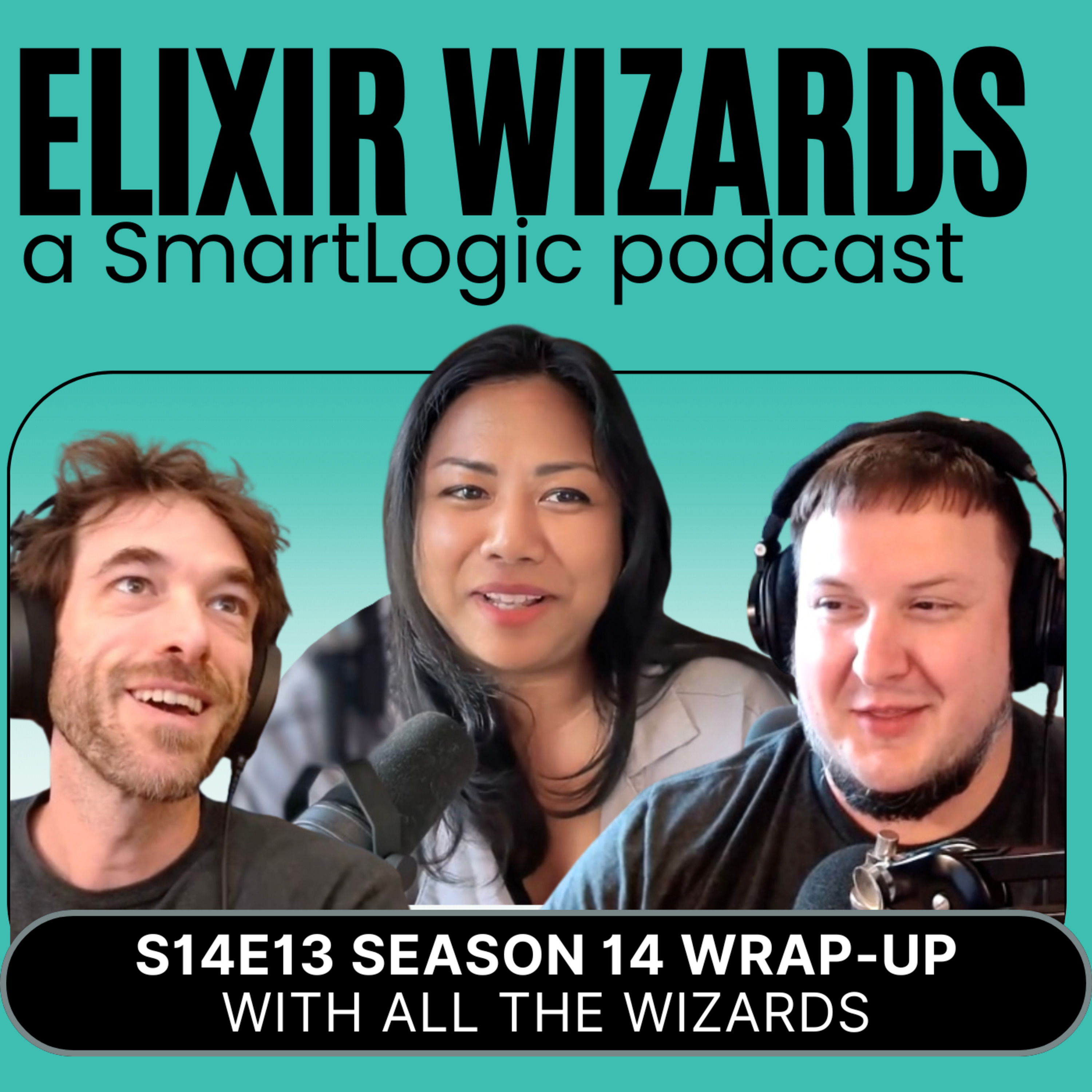 Enter the Elixirverse: Season 14 Wrap-Up | Today, the Elixir Wizards wrap up Season 14 “Enter the Elixirverse.” Dan, Charles, and Sundi look back at some common themes: Elixir plays well with others, bridges easily to access languages and tools, and remains a powerful technology for data flow, concurrency, and developer experience. We revisit the popular topics of the year, from types and tooling to AI orchestration and reproducible dev environments, and share what we’re excited to explore next. We also invite your questions and takeaways to help shape future seasons and conference conversations. Season 14 doubles as a handy primer for anyone curious about how Elixir integrates across the stack. Key topics discussed in this episode: Lessons from a season of interoperability Set-theoretic types and what new compiler warnings unlock AI in practice: LLM orchestration, fallbacks, and real-world use SDUI and GraphQL patterns for shipping UI across web/iOS/Android Dataframes in Elixir with Explorer for analytics workflows Python interoperability (ErlPort, PythonX) and when to reach for it Reproducible dev environments with Nix and friends Performance paths: Rustler and Zig for native extensions Bluetooth & Nerves: Blue Heron and hardware integrations DevEx upgrades: LiveView, build pipelines, and standard project setup Observability and ops: Prometheus/Grafana and sensible deployments Community feedback, conferences, and what’s on deck for next season ### Links mentioned in this episode: Cars.com S14E06 SDUI at Scale with Elixir https://youtu.be/nloRcgngT_k?si=g4Zd4N1s56Ronrtw https://hexdocs.pm/phoenix_live_view/Phoenix.LiveView.html https://wordpress.com/ https://elixir-lang.org/ S14E01 Zigler: Zig NIFs for Elixir https://youtu.be/hSAvWxh26TU?si=d5_5tVuZbNw0KCfT https://ziglang.org/ https://hexdocs.pm/zigler/Zig.html https://github.com/blue-heron/blue_heron https://github.com/elixir-explorer/explorer S14E08 Nix for Elixir Apps https://youtu.be/yymUcgy4OAk?si=BRgTlc2VK5bsIhIf https://nixos.org/ https://nix.dev/ S14E07 Set Theoretic Types in Elixir https://youtu.be/qMmEnXcHxL4?si=Ux2lebiwEp3mc_0e S14E10 Python in Elixir Apps https://youtu.be/SpVLrrWkRqE?si=ld3oQVXVlWHpo7eV https://www.python.org/ https://hexdocs.pm/pythonx/ https://github.com/Pyrlang/Pyrlang https://github.com/erlport/erlport S14E03 LangChain: LLM Integration for Elixir https://youtu.be/OwFaljL3Ptc?si=A0sDs2dzJ0UoE2PY https://github.com/brainlid/langchain S14E04 Nx & Machine Learning in Elixir https://youtu.be/Ju64kAMLlkw?si=zdVnkBTTLHvIZNBm S14E05 Rustler: Bridging Elixir and Rust https://youtu.be/2RBw7B9OfwE?si=aRVYOyxxW8fTmoRA https://github.com/rusterlium/rustler Season 3: Working with Elixir https://youtube.com/playlist?list=PLTDLmInI9YaDbhMRpGuYpboVNbp1Fl9PD&si=hbe7qt4gRUfrMtpj S14E11 Vibe Coding the LoopedIn Crochet App https://youtu.be/DX0SjmPE92g?si=zCBPjS1huRDIeVeP Season 5: Adopting Elixir YouTubeLaunchisode and Outlaws Takeover with Chris Keathley, Amos King, and Anna Neyzberg S13E01 Igniter: Elixir Code Generation https://youtu.be/WM9iQlQSF_g?si=e0CAiML2qC2SxmdL Season 8: Elixir in a Polyglot Environment https://youtube.com/playlist?list=PLTDLmInI9YaAPlvMd-RDp6LWFjI67wOGN&si=YCI7WLA8qozD57iw !! We Want to Hear Your Thoughts *!!* Have questions, comments, or topics you'd like us to discuss on the podcast? Share your thoughts with us here: https://forms.gle/Vm7mcYRFDgsqqpDC9 | — | ||||||
| 8/14/25 | 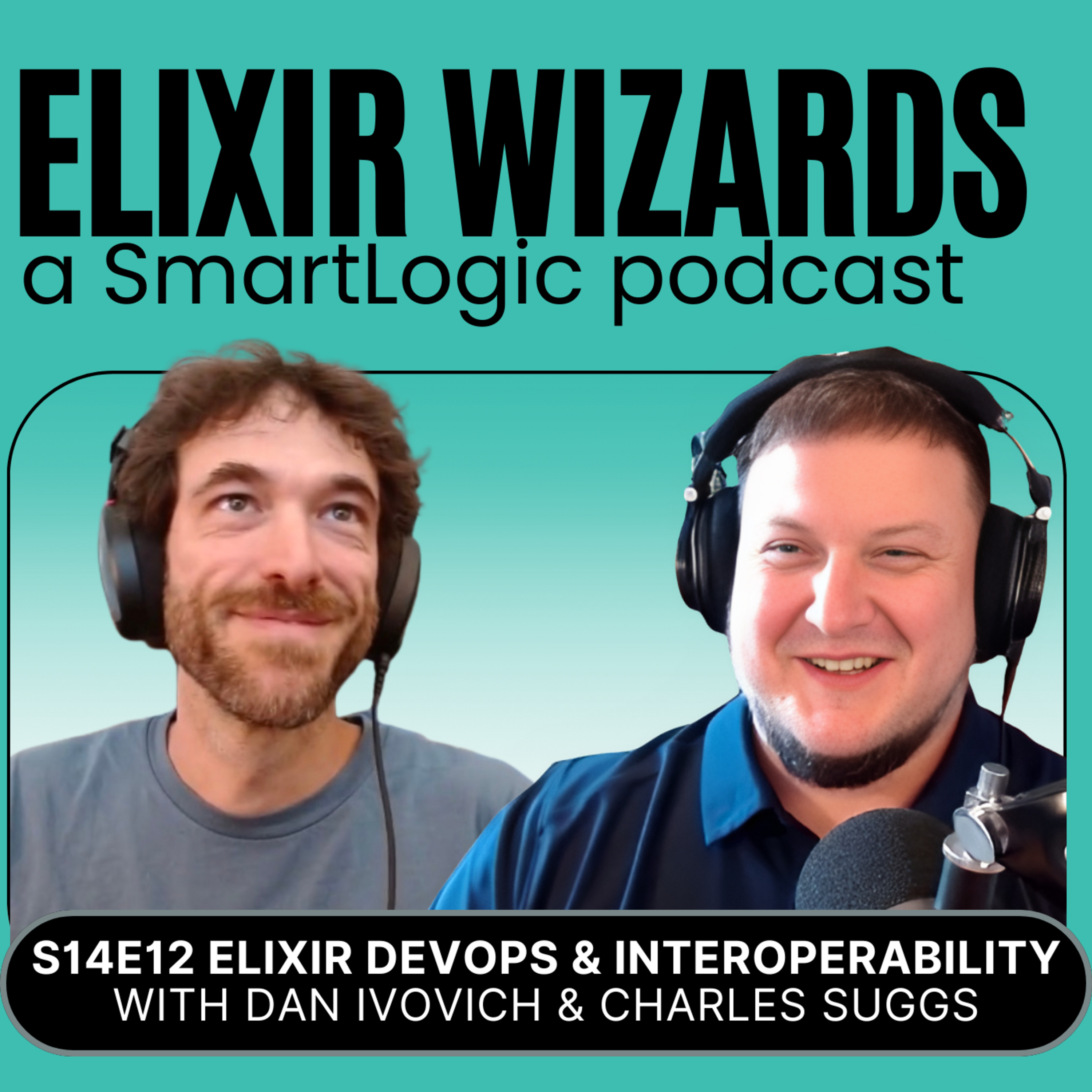 Elixir DevOps & Interoperability with Dan Ivovich and Charles Suggs | In this episode of Elixir Wizards, host Sundi Myint chats with SmartLogic engineers and fellow Wizards Dan Ivovich and Charles Suggs about the practical tooling that surrounds Elixir in a consultancy setting. We dig into how standardized dev environments, sensible scaffolding, and clear observability help teams ship quickly across many client projects without turning every app into a snowflake. Join us for a grounded tour of what’s working for us today (and what we’ve retired), plus how we evaluate new tech (including AI) through a pragmatic, Elixir-first lens. Key topics discussed in this episode: Standardizing across projects: why consistent environments matter in consultancy work Nix (and flakes) for reproducible dev setups and faster onboarding Igniter to scaffold common patterns (auth, config, workflows) without boilerplate drift Deployment approaches: OTP releases, runtime config, and Ansible playbooks Frontend pipeline evolution: from Brunch/Webpack to esbuild + Tailwind Observability in practice: Prometheus metrics and Grafana dashboards Handling time-series and sensor data When Explorer can be the database Picking the right tool: Elixir where it shines, integrations where it counts Using AI with intention: code exploration, prototypes, and guardrails for IP/security Keeping quality high across multiple codebases: tests, telemetry, and sensible conventions Reducing context-switching costs with shared patterns and playbooks Links mentioned: http://smartlogic.io https://nix.dev/ https://github.com/ash-project/igniter Elixir Wizards S13E01 Igniter with Zach Daniel https://youtu.be/WM9iQlQSF_g https://github.com/elixir-explorer/explorer Elixir Wizards S14E09 Explorer with Chris Grainger https://youtu.be/OqJDsCF0El0 Elixir Wizards S14E08 Nix with Norbert (Nobbz) Melzer https://youtu.be/yymUcgy4OAk https://jqlang.org/ https://github.com/BurntSushi/ripgrep https://github.com/resources/articles/devops/ci-cd https://prometheus.io/ https://capistranorb.com/ https://ansible.com/ https://hexdocs.pm/phoenix/releases.html https://brunch.io/ https://webpack.js.org/loaders/css-loader/ https://tailwindcss.com/ https://sass-lang.com/dart-sass/ https://grafana.com/ https://pragprog.com/titles/passweather/build-a-weather-station-with-elixir-and-nerves/ https://www.datadoghq.com/ https://sqlite.org/ Elixir Wizards S14E06 SDUI at Cars.com with Zack Kayser https://youtu.be/nloRcgngT_k https://github.com/features/copilot https://openai.com/codex/ https://www.anthropic.com/claude-code YouTube Video: Vibe Coding TEDCO's RFP https://youtu.be/i1ncgXZJHZs Blog: https://smartlogic.io/blog/how-i-used-ai-to-vibe-code-a-website-called-for-in-tedco-rfp/ Blog: https://smartlogic.io/blog/from-vibe-to-viable-turning-ai-built-prototypes-into-market-ready-mvps/ https://www.thriftbooks.com/w/eragon-by-christopher-paolini/246801 https://tidewave.ai/ !! We Want to Hear Your Thoughts *!!* Have questions, comments, or topics you'd like us to discuss in our season recap episode? Share your thoughts with us here: https://forms.gle/Vm7mcYRFDgsqqpDC9 | — | ||||||
| 8/7/25 |  Vibe Coding the LoopedIn Crochet App with Kimberly Erni & Pei Pei Wang | Today, co-founders Kimberly Erni and Pei Pei Wang join the Elixir Wizards to discuss their crochet app, LoopedIn. Recognizing a gap in the market for a more user-friendly and interactive crochet pattern experience, they're building an app that makes following patterns easier and more enjoyable for crocheters of all skill levels. They're building features such as step-by-step guidance, video tutorials, and the ability to upload and convert PDF patterns into an interactive format. Kimberly explains how she's leveraging AI tools to vibe code in Elixir and LiveView. They highlight the challenges and successes they encountered while creating a Progressive Web App (PWA) that integrates AI-powered features. They also discuss their user research and testing process, which involved gathering feedback from the crochet community to prioritize features and improve the app's UX. Kimberly and Pei Pei share their thoughts on the potential of AI in the tech industry and how it has assisted them in the development and iteration process. They emphasize the importance of understanding the code generated by AI and the need for proper testing and verification. They offer advice to others looking to create passion projects, stressing the value of finding a partner with complementary skills and shared enthusiasm for the project. Topics discussed in this episode: Discovering a niche: why crochet patterns need a digital makeover Core LoopedIn features: interactive steps, video help, PDF conversion Building a PWA with Elixir & Phoenix LiveView for cross-platform reach Offline support and caching strategies for on-the-go crafting AI-driven pattern parsing: benefits and pitfalls of generated code User research: gathering feedback from beginner to expert crocheters Agile iterations: testing, prioritizing features, and shipping quickly Balancing “vibe coding” with quality assurance and proper test coverage Partnership dynamics: complementary skills and shared passion Monetization approaches for a niche, community-driven app Roadmap highlights: expanded social features, advanced AI tooling, and more Lessons learned: documentation gaps, performance tuning, and UX trade-offs Advice for side projects: start small, validate with users, and iterate Links mentioned: Amigurumis https://www.amigurumi.com/ https://pragmaticstudio.com/phoenix-liveview https://grox.io/about-product/liveview Creating a Local First LiveView App https://www.youtube.com/watch?v=kcafwf14SDo https://capacitorjs.com/docs https://flutter.dev/ https://passion.place/ https://cursor.com/ https://claude.ai/ https://nerves-project.org/ https://crochetapp.web.app/ https://www.figma.com/ Little Red Book App https://www.xiaohongshu.com/ !! Try the LoopedIn app here 👉 https://looped-in.gigalixirapp.com *!!* Add it to your phone like an app: Open the link in Safari Tap the Share button (square with arrow) Tap Add to Home Screen Tap Add Then you can open it like a regular app! 🎉 Leave a comment if you try it! !! We Want to Hear Your Thoughts *!!* Have questions, comments, or topics you'd like us to discuss in our season recap episode? Share your thoughts with us here: https://forms.gle/Vm7mcYRFDgsqqpDC9 | — | ||||||
| 7/31/25 |  Python in Elixir Apps with Victor Björklund | In this episode, Elixir Wizard Charles Suggs sits down with Victor Björklund to map out the landscape of Python integration in Elixir applications. From HTTP APIs and external services to embedded runtimes like ErlPort, PythonX, and the Venomous library, we evaluate each approach’s impact on performance, coupling, and developer experience. Victor draws on real-world examples like Scrapy-based web scraping and the Swedish BankID authentication to illustrate best practices for error handling, process pooling, and effective telemetry across the BEAM boundary. We also tackle the practical side of deployment: packaging Python dependencies in Mix releases, mocking Python calls in tests, and deploying multi-language apps with confidence. Wrapping up, Victor shares his wishlist for even tighter interop (think multiple Python interpreter instances per VM) and offers low-risk entry points, like automating monthly reports, for teams ready to explore the power of Python’s ecosystem within Elixir. Key topics discussed in this episode: Integration methods: HTTP APIs, ports, ErlPort, PythonX, Venomous Performance vs. coupling trade-offs across interop patterns Managing the Global Interpreter Lock (GIL) with process pools Leveraging mature Python libraries (Scrapy, BankID, etc.) Error handling strategies across BEAM↔Python boundaries Testing mixed-language systems: mocks and integration tests Packaging and deploying Python alongside Elixir releases Monitoring and telemetry for multi-language pipelines Functional programming advantages in Elixir workflows Tool selection guidance by project requirements Future possibilities: multiple Python interpreters in one VM Community resources for Python–Elixir interop help Links mentioned: jawdropping.io https://cplusplus.com/ https://www.python.org/ https://react.dev/ https://nodejs.org/en https://erlport.org/ https://hexdocs.pm/pythonx/Pythonx.html https://pyrlang.github.io/Pyrlang/ Python GIL (Global Interpreter Lock): https://realpython.com/python-gil/ https://github.com/devinus/poolboy https://hexdocs.pm/venomous/Venomous.html Try-catch https://syntaxdb.com/ref/python/try-catch https://www.scrapy.org/ https://www.bankid.com/en/ https://www.phoenixframework.org/ https://www.tzeyiing.com/posts/using-a-hunky-poolboy-to-manage-your-python-erlport-processes-in-elixir/ https://medium.com/stuart-engineering/how-we-use-python-within-elixir-486eb4d266f9 https://x.com/bjorklundvictor https://victorbjorklund.com/ https://www.linkedin.com/in/victorbjorklund/ hello@victorbjorklund.com | — | ||||||
| 7/24/25 |  Explorer: Data Frames in Elixir with Chris Grainger | In this episode of Elixir Wizards, Charles Suggs sits down with Chris Grainger, co-founder and CTO of Amplified and creator of the Explorer library. Chris explains how Explorer brings the familiar data-frame workflows of R’s dplyr and Python’s pandas into the Elixir world. We explore (pun intended!) how Explorer integrates with Ecto, Nx, and LiveView to build end-to-end data pipelines without leaving the BEAM, and how features like lazy evaluation and distributed frames let you tackle large datasets. Whether you’re generating reports or driving interactive charts in LiveView, Explorer makes tabular data accessible to every Elixir developer. We wrap up by looking ahead to SQL-style backends, ADBC connectivity, and other features on the Explorer roadmap. Key topics discussed in this episode: dplyr- and pandas-inspired data manipulation in Elixir Polars integration via Rust NIFs for blazing performance Immutable data frames and BEAM-friendly concurrency Lazy evaluation to work with arbitrarily large tables Distributed data-frame support for multi-node processing Seamless integration with Ecto schemas and queries Zero-copy interoperability between Explorer and Nx tensors Apache Arrow and ADBC protocols for cross-language I/O Exploring SQL-style backends for remote query execution Building interactive dashboards and charts in LiveView Consolidating ETL workflows into a single Elixir API Streaming data pipelines for memory-efficient processing Tidy data principles and behavior-based API design Real-world use cases: report generation, patent analysis, and more Future roadmap: new backends, query optimizations, and community plugins Links mentioned: https://hexdocs.pm/explorer/Explorer.html https://www.amplified.ai/ https://www.r-project.org/ https://vita.had.co.nz/papers/tidy-data.pdf https://www.tidyverse.org/ https://www.python.org/ https://dplyr.tidyverse.org/ https://go.dev/ https://hexdocs.pm/nx/Nx.html https://github.com/pola-rs/polars https://github.com/rusterlium/rustler https://www.rust-lang.org/ https://www.postgresql.org/ https://hexdocs.pm/ecto/Ecto.html https://www.elastic.co/elasticsearch https://arrow.apache.org/ Chris Grainger & Chris McCord Keynote ElixirConf 2024: https://youtu.be/4qoHPh0obv0 https://dbplyr.tidyverse.org/ https://spark.posit.co/ https://hexdocs.pm/pythonx/Pythonx.html https://hexdocs.pm/vega_lite/VegaLite.html 10 Minutes to Explorer: https://hexdocs.pm/explorer/exploring_explorer.html https://github.com/elixir-nx/scholar https://scikit-learn.org/stable/ https://github.com/cigrainger https://erlef.org/slack-invite/erlef https://bsky.app/profile/cigrainger.bsky.social https://github.com/cigrainger | — | ||||||
Want analysis for the episodes below?Free for Pro Submit a request, we'll have your selected episodes analyzed within an hour. Free, at no cost to you, for Pro users. | |||||||||
| 7/17/25 | 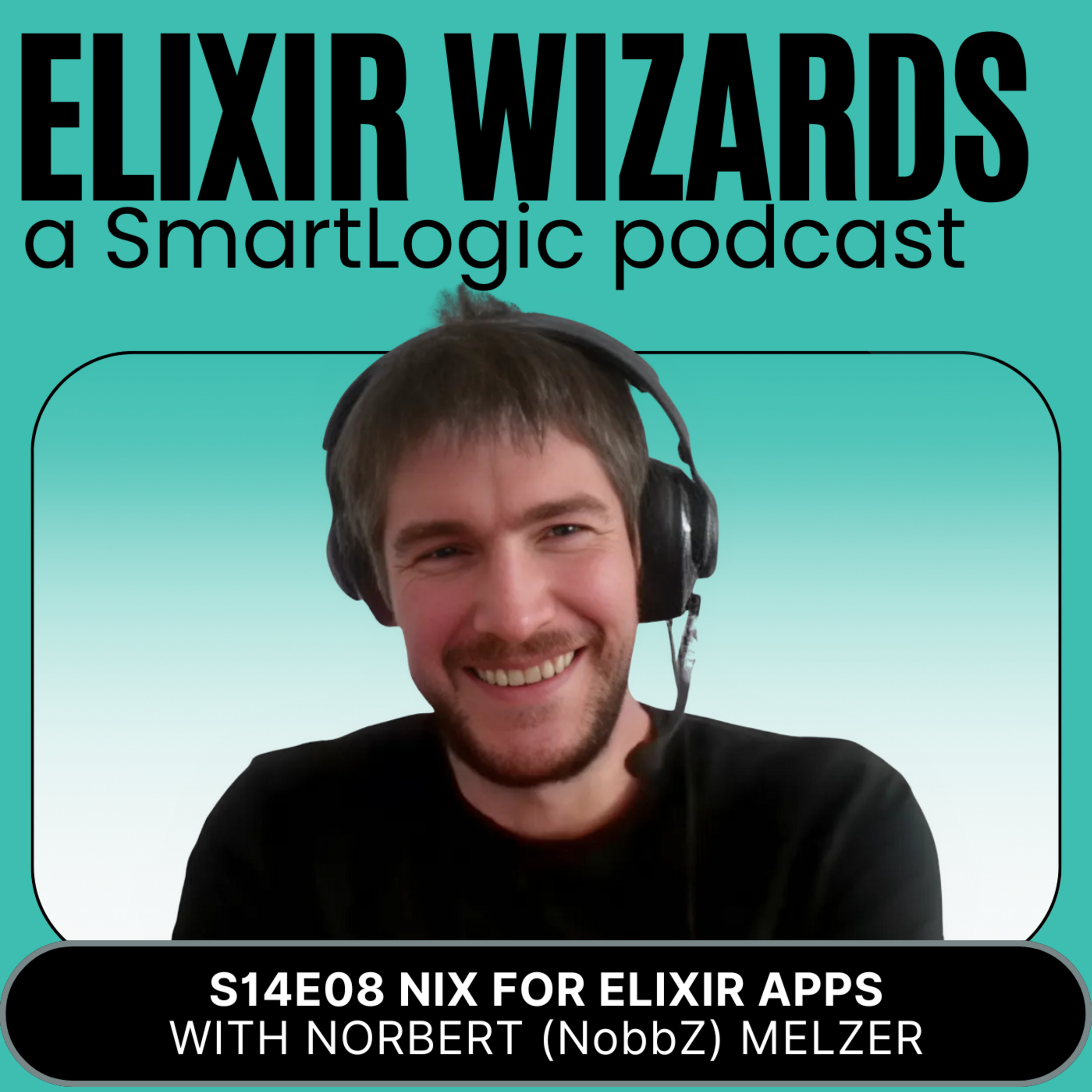 Nix for Elixir Apps with Norbert (NobbZ) Melzer | In this episode of Elixir Wizards, Dan Ivovich and Charles Suggs sit down with Norbert “NobbZ” Melzer to discuss how Nix enables reproducible builds, consistent development environments, and reliable deployments for Elixir projects. Norbert shares his journey from Ruby to Elixir, contrasts Nix with NixOS, and walks us through flakes, nix-shell workflows, sandboxed builds, and rollback capabilities. Along the way, we cover real-world tips for managing Hex authentication, integrating Nix into CI/CD, wrapping Mix releases in Docker, and avoiding common pitfalls, such as flake performance traps. Whether you’re spinning up your first dev shell or rolling out a production release on NixOS, you’ll come away with a clear, gradual adoption path and pointers to the community mentors and resources that can help you succeed. Key topics discussed in this episode: Reproducible, sandboxed builds vs. traditional package managers Nix flakes for locked dependency graphs and version pinning nix-shell: creating consistent development environments across teams Rollback and immutable deployment strategies with Nix/NixOS Integrating Nix with the Elixir toolchain: Hex, Mix, and CI/CD pipelines Flakes vs. standard shells: when and how to transition Handling private Hex repositories and authentication in Nix Cross-platform support (macOS/Darwin, Linux variants) Channels, overlays, and overrides for customizing builds Dockerizing Elixir releases using Nix-based images Home Manager for personal environment configuration Security patching workflows in a Nix-managed infrastructure Common pitfalls: flake performance, sandbox workarounds, and symlink behavior Community resources and the importance of human mentorship Links mentioned: https://jobrad-loop.com/ https://nixos.org/ https://nix.dev/ https://nix.dev/manual/nix/2.18/command-ref/nix-shell https://github.com/nix-darwin/nix-darwin https://asdf-vm.com/ https://go.dev/ https://docs.redhat.com/en/documentation/red_hat_enterprise_linux/8/html/packaging_and_distributing_software/introduction-to-rpm_packaging-and-distributing-software Nix Flake templates for Elixir https://github.com/jurraca/elixir-templates https://www.docker.com/ https://www.sudo.ws/ https://ubuntu.com/ https://archlinux.org/ Nobbz’s blog https://blog.nobbz.dev/blog/ https://ayats.org/blog/nix-workflow @nobbz.dev on BlueSky @NobbZ1981 on Twitter https://www.linkedin.com/in/norbert-melzer/ https://youtu.be/HbtbdLolHeM?si=6M7fulTQZmuWGGCM (talk on CodeBEAM) | — | ||||||
| 7/10/25 |  Set Theoretic Types in Elixir with José Valim | Elixir creator José Valim returns to the podcast to unpack the latest developments in Elixir’s set-theoretic type system and how it is slotting into existing code without requiring annotations. We discuss familiar compiler warnings, new warnings based on inferred types, a phased rollout in v1.19/v1.20 that preserves backward compatibility, performance profiling the type checks across large codebases, and precise typing for maps as both records and dictionaries. José also touches on CNRS academic collaborations, upcoming LSP/tooling enhancements, and future possibilities like optional annotations and guard-clause typing, all while keeping Elixir’s dynamic, developer-friendly experience front and center. Key topics discussed in this episode: Set-theoretic typing (union, intersection, difference) Compiler-driven inference with zero annotations Phased rollout strategy in 1.19 and 1.20 Performance profiling for large codebases Map typing as records and dictionaries Exhaustivity checks and behavioral typing in GenServers Language Server Protocol & tooling updates Future optional annotations and guard-clause typing CNRS collaboration for theoretical foundations Clear error messages and false-positive reduction Community-driven feedback and iterative improvements Links mentioned: https://github.com/elixir-nx https://livebook.dev/ https://hexdocs.pm/phoenix_live_view/Phoenix.LiveView.html https://hexdocs.pm/elixir/main/gradual-set-theoretic-types.html https://hexdocs.pm/dialyxir/0.4.0/readme.html https://remote.com/ Draw the Owl meme: https://i.imgur.com/rCr9A.png https://dashbit.co/blog/data-evolution-with-set-theoretic-types https://hexdocs.pm/ecto/Ecto.html https://github.com/elixir-lsp/elixir-lsSpecial Guest: José Valim. | — | ||||||
| 7/3/25 | 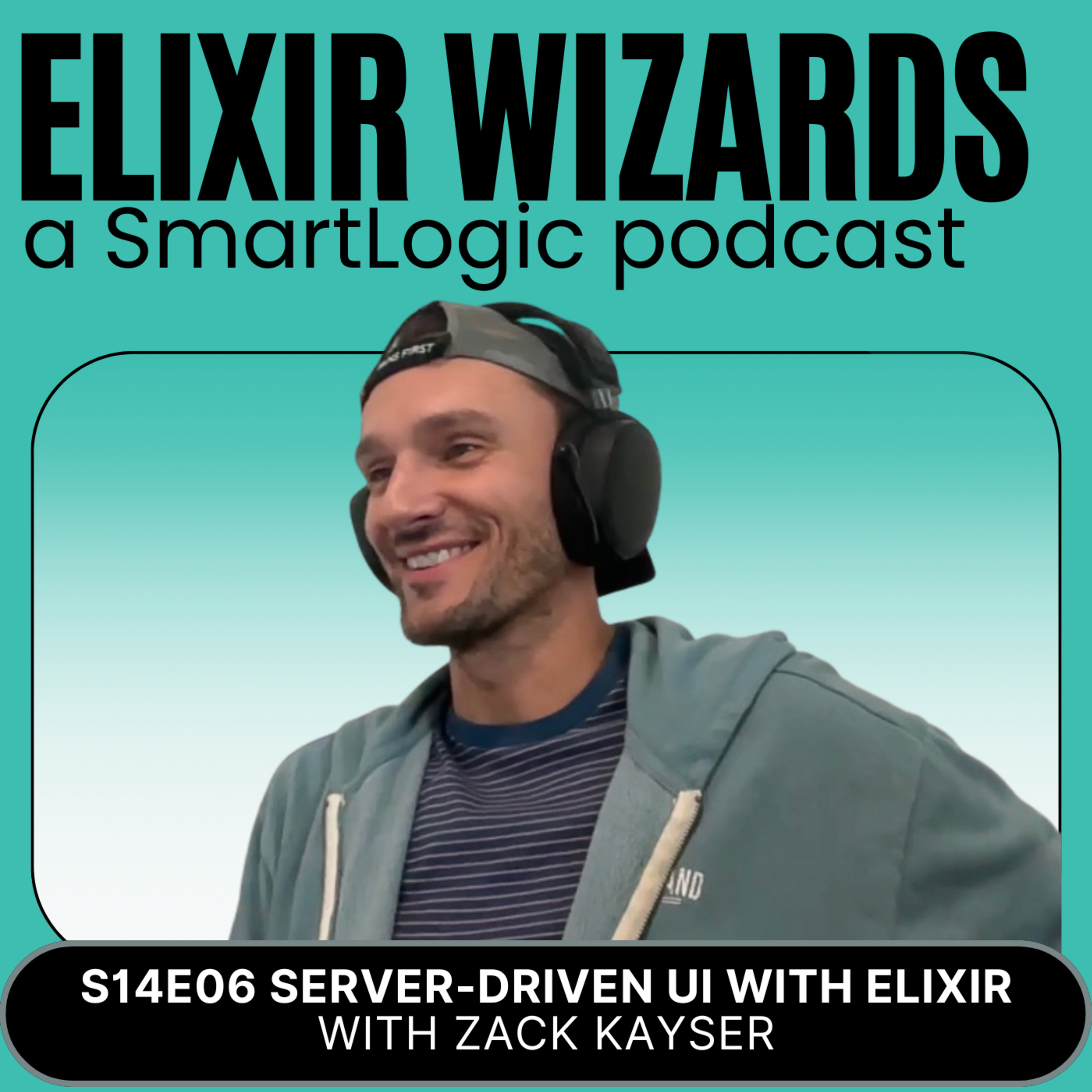 SDUI at Scale: GraphQL & Elixir at Cars.com with Zack Kayser | Zack Kayser, Staff Software Engineer at cars.com, joins Elixir Wizards Sundi Myint and Charles Suggs to discuss how Cars.com adopted a server-driven UI (SDUI) architecture powered by Elixir and GraphQL to deliver consistent, updatable interfaces across web, iOS, and Android. We explore why SDUI matters for feature velocity, how a mature design system and schema planning make it feasible, and what it takes, culturally and technically, to move UI logic from client code into a unified backend. Key topics discussed in this episode: SDUI fundamentals and how it differs from traditional server-side rendering GraphQL as the single source of truth for UI components and layouts Defining abstract UI components on the server to eliminate duplicate logic Leveraging a robust design system as the foundation for SDUI success API-first development and cross-team coordination for schema changes Mock data strategies for early UI feedback without breaking clients Handling breaking changes and hot-fix deployments via server-side updates Enabling flexible layouts and A/B testing through server-controlled ordering Balancing server-driven vs. client-managed UI Iterative SDUI rollout versus “big-bang” migrations in large codebases Using type specs and Dialyxir for clear cross-team communication Integration testing at the GraphQL layer to catch UI regressions early Quality engineering’s role in validating server-driven interfaces Production rollback strategies across web and native platforms Considerations for greenfield projects adopting SDUI from day one Zack and Ethan's upcoming Instrumenting Elixir Apps book Links mentioned: https://cars.com https://github.com/absinthe-graphql/absinthe Telemetry & Observability for Elixir Apps Ep: https://youtu.be/1V2xEPqqCso https://www.phoenixframework.org/blog/phoenix-liveview-1.0-released https://hexdocs.pm/phoenix_live_view/assigns-eex.html https://graphql.org/ https://tailwindcss.com/ https://github.com/jeremyjh/dialyxir https://github.com/rrrene/credo GraphQL Schema https://graphql.org/learn/schema/ SwiftUI https://developer.apple.com/documentation/swiftui/ Kotlin https://kotlinlang.org/ https://medium.com/airbnb-engineering/a-deep-dive-into-airbnbs-server-driven-ui-system-842244c5f5 Zack’s Twitter: https://x.com/kayserzl/ Zack’s LinkedIn: https://www.linkedin.com/in/zack-kayser-93b96b88 Special Guest: Zack Kayser. | — | ||||||
| 6/26/25 |  Rustler: Bridging Elixir and Rust with Sonny Scroggin | Rustler Core Team Member Sonny Scroggin joins Elixir Wizards Sundi Myint and Charles Suggs. Rustler serves as a bridge to write Native Implemented Functions (NIFs) in Rust that can be called from Elixir code. This combo leverages Rust's performance and memory safety while maintaining Elixir's fault tolerance and concurrency model, creating a powerful solution for CPU-intensive operations within Elixir applications. Sonny provides guidance on when developers should consider using NIFs versus other approaches like ports or external services and highlights the considerations needed when stepping outside Elixir's standard execution model into native code. Looking toward the future, Sonny discusses exciting developments for Rustler, including an improved asynchronous NIF interface, API modernization efforts, and better tooling. While Rust offers tremendous performance benefits for specific use cases, Sonny emphasizes that Elixir's dynamic nature and the BEAM's capabilities for distributed systems remain unmatched for many applications. Rustler simply provides another powerful tool that expands what developers can accomplish within the Elixir ecosystem. Key topics discussed in this episode: Rust as a "high-level low-level language" with memory safety NIFs (Native Implemented Functions) in the BEAM virtual machine Rustler's role simplifying Rust-Elixir integration with macros CPU-intensive operations as primary NIF use cases Beam scheduler interaction considerations with native code Dirty schedulers for longer-running NIFs in OTP 20+ Memory safety advantages of Rust for NIFs Development workflow using Mix tasks for Rustler Common pitfalls when first working with Rust Error handling improvements possible with Rustler NIFs Differences between ports, NIFs, and external services Asynchronous programming approaches in Rust versus Elixir Tokyo runtime integration for asynchronous operations Static NIFs for mobile device compatibility Upcoming CLI tooling to simplify Rustler development Rustler's API modernization efforts for better ergonomics Thread pool sharing across multiple NIFs Wasm integration possibilities for the BEAM Compile-time safety versus dynamic runtime capabilities Performance considerations when implementing NIFs Compiler-assisted memory management in Rust Automatic encoding/decoding between Rust and Elixir types The importance of proper error handling Real-world application in high-traffic authentication servers Community resources for learning Rustler Links mentioned: https://github.com/rusterlium/rustler https://github.com/rust-lang/rust https://www.angelfire.lycos.com/ https://www.webdesignmuseum.org/flash-websites https://www.php.net/ https://xmpp.org/ https://jabberd2.org/ Geocities: https://cybercultural.com/p/geocities-1995/ (fun fact: when you search Geocities on Google, the results page is in Comic Sans font.) https://bleacherreport.com/ https://hexdocs.pm/jose/readme.html https://github.com/rust-lang/rust-bindgen Erlang Ports: https://www.erlang.org/doc/system/c_port.html Erlang ETFs (External Term Format): https://www.erlang.org/doc/apps/erts/erl_ext_dist.html Elixir gRPC https://github.com/elixir-grpc/grpc gRPC (“Remote Proceduce Call”): https://grpc.io/ dirty_cpu.ex https://github.com/E-xyza/zigler/blob/main/lib/zig/nif/dirty_cpu.ex ets https://www.erlang.org/doc/apps/stdlib/ets.html Mnesia https://www.erlang.org/doc/apps/mnesia/mnesia.html VPPs (Virtual Power Plants): https://www.energy.gov/lpo/virtual-power-plants https://nixos.org/ WASM WebAssembly with Elixir: https://github.com/RoyalIcing/Orb Rust Tokio https://tokio.rs/ Getting Started: https://hexdocs.pm/rustler/0.17.0/Mix.Tasks.Rustler.New.html https://rustup.rs/Special Guest: Sonny Scroggin. | — | ||||||
| 6/19/25 |  Nx and Machine Learning in Elixir with Sean Moriarity | Today on Elixir Wizards, hosts Sundi Myint and Charles Suggs catch up with Sean Moriarity, co-creator of the Nx project and author of Machine Learning in Elixir. Sean reflects on his transition from the military to a civilian job building large language models (LLMs) for software. He explains how the Elixir ML landscape has evolved since the rise of ChatGPT, shifting from building native model implementations toward orchestrating best-in-class tools. We discuss the pragmatics of adding ML to Elixir apps: when to start with out-of-the-box LLMs vs. rolling your own, how to hook into Python-based libraries, and how to tap Elixir’s distributed computing for scalable workloads. Sean closes with advice for developers embarking on Elixir ML projects, from picking motivating use cases to experimenting with domain-specific languages for AI-driven workflows. Key topics discussed in this episode: The evolution of the Nx (Numerical Elixir) project and what's new with ML in Elixir Treating Elixir as an orchestration layer for external ML tools When to rely on off-the-shelf LLMs vs. custom models Strategies for integrating Elixir with Python-based ML libraries Leveraging Elixir’s distributed computing strengths for ML tasks Starting ML projects with existing data considerations Synthetic data generation using large language models Exploring DSLs to streamline AI-powered business logic Balancing custom frameworks and service-based approaches in production Pragmatic advice for getting started with ML in Elixir Links mentioned: https://hexdocs.pm/nx/intro-to-nx.html https://pragprog.com/titles/smelixir/machine-learning-in-elixir/ https://magic.dev/ https://smartlogic.io/podcast/elixir-wizards/s10-e10-sean-moriarity-machine-learning-elixir/ Pragmatic Bookshelf: https://pragprog.com/ ONNX Runtime Bindings for Elixir: https://github.com/elixir-nx/ortex https://github.com/elixir-nx/bumblebee Silero Voice Activity Detector: https://github.com/snakers4/silero-vad Paulo Valente Graph Splitting Article: https://dockyard.com/blog/2024/11/06/2024/nx-sharding-update-part-1 Thomas Millar's Twitter https://x.com/thmsmlr https://github.com/thmsmlr/instructor_ex https://phoenix.new/ https://tidewave.ai/ https://en.wikipedia.org/wiki/BERT_(language_model) Talk: PyTorch: Fast Differentiable Dynamic Graphs in Python by Soumith Chintala https://hexdocs.pm/axon/Axon.html https://hexdocs.pm/exla/EXLA.html VLM (Vision Language Models Explained): https://huggingface.co/blog/vlms https://github.com/ggml-org/llama.cpp Vector Search in Elixir: https://github.com/elixir-nx/hnswlib https://www.amplified.ai/ Llama 4 https://mistral.ai/ Mistral Open-Source LLMs: https://mistral.ai/ https://github.com/openai/whisper Elixir Wizards Season 5: Adopting Elixir https://smartlogic.io/podcast/elixir-wizards/season-five https://docs.ray.io/en/latest/ray-overview/index.html https://hexdocs.pm/flame/FLAME.html https://firecracker-microvm.github.io/ https://fly.io/ https://kubernetes.io/ WireGuard VPNs https://www.wireguard.com/ https://hexdocs.pm/phoenixpubsub/Phoenix.PubSub.html https://www.manning.com/books/deep-learning-with-python Code BEAM 2025 Keynote: Designing LLM Native Systems - Sean Moriarity Ash Framework https://ash-hq.org/ Sean’s Twitter: https://x.com/seanmoriarity Sean’s Personal Blog: https://seanmoriarity.com/ Erlang Ecosystems Foundation Slack: https://erlef.org/slack-invite/erlef Elixir Forum https://elixirforum.com/ Sean’s LinkedIn: https://www.linkedin.com/in/sean-m-ba231a149/Special Guest: Sean Moriarity. | — | ||||||
| 6/12/25 |  LangChain: LLM Integration for Elixir Apps with Mark Ericksen | Mark Ericksen, creator of the Elixir LangChain framework, joins the Elixir Wizards to talk about LLM integration in Elixir apps. He explains how LangChain abstracts away the quirks of different AI providers (OpenAI, Anthropic’s Claude, Google’s Gemini) so you can work with any LLM in one more consistent API. We dig into core features like conversation chaining, tool execution, automatic retries, and production-grade fallback strategies. Mark shares his experiences maintaining LangChain in a fast-moving AI world: how it shields developers from API drift, manages token budgets, and handles rate limits and outages. He also reveals testing tactics for non-deterministic AI outputs, configuration tips for custom authentication, and the highlights of the new v0.4 release, including “content parts” support for thinking-style models. Key topics discussed in this episode: • Abstracting LLM APIs behind a unified Elixir interface • Building and managing conversation chains across multiple models • Exposing application functionality to LLMs through tool integrations • Automatic retries and fallback chains for production resilience • Supporting a variety of LLM providers • Tracking and optimizing token usage for cost control • Configuring API keys, authentication, and provider-specific settings • Handling rate limits and service outages with degradation • Processing multimodal inputs (text, images) in Langchain workflows • Extracting structured data from unstructured LLM responses • Leveraging “content parts” in v0.4 for advanced thinking-model support • Debugging LLM interactions using verbose logging and telemetry • Kickstarting experiments in LiveBook notebooks and demos • Comparing Elixir LangChain to the original Python implementation • Crafting human-in-the-loop workflows for interactive AI features • Integrating Langchain with the Ash framework for chat-driven interfaces • Contributing to open-source LLM adapters and staying ahead of API changes • Building fallback chains (e.g., OpenAI → Azure) for seamless continuity • Embedding business logic decisions directly into AI-powered tools • Summarization techniques for token efficiency in ongoing conversations • Batch processing tactics to leverage lower-cost API rate tiers • Real-world lessons on maintaining uptime amid LLM service disruptions Links mentioned: https://rubyonrails.org/ https://fly.io/ https://zionnationalpark.com/ https://podcast.thinkingelixir.com/ https://github.com/brainlid/langchain https://openai.com/ https://claude.ai/ https://gemini.google.com/ https://www.anthropic.com/ Vertex AI Studio https://cloud.google.com/generative-ai-studio https://www.perplexity.ai/ https://azure.microsoft.com/ https://hexdocs.pm/ecto/Ecto.html https://oban.pro/ Chris McCord’s ElixirConf EU 2025 Talk https://www.youtube.com/watch?v=ojL_VHc4gLk Getting started: https://hexdocs.pm/langchain/getting_started.html https://ash-hq.org/ https://hex.pm/packages/langchain https://hexdocs.pm/igniter/readme.html https://www.youtube.com/watch?v=WM9iQlQSF_g @brainlid on Twitter and BlueSkySpecial Guest: Mark Ericksen. | — | ||||||
| 6/5/25 |  Blue Heron: Bluetooth Low Energy (BLE) for Elixir & Nerves with Connor Rigby | Connor Rigby joins the Elixir Wizards to talk about Blue Heron BLE (Bluetooth Low Energy) support for Elixir apps. Blue Heron implements the BLE specs in pure Elixir, leveraging binary pattern matching and concurrent message processing to handle Bluetooth protocols. Unlike most solutions that require C ports or NIFs, Blue Heron runs entirely in user space, so it works seamlessly in both Nerves-based embedded projects and (eventually) desktop Elixir applications. We discuss how Nerves development differs from building Phoenix apps. Connor shares challenges he's experienced with hardware compatibility, where some chips only partially implement the spec, and he discusses the surprisingly deep (but sometimes incomplete) world of BLE device profiles. His tip for anyone entering the BLE space: read the official spec instead of trusting secondhand blog posts. Tools like Nerves LiveBook give you hands-on examples, so you can get a BLE prototype running on a Raspberry Pi and your phone in no time. Key topics discussed in this episode: Blue Heron origins and “bird” naming convention BLE vs. Bluetooth Classic: core differences Pure Elixir implementation—no C dependencies Binary pattern matching for packet parsing Hardware transport options: UART, SPI, USB, SDIO GenServer patterns in Nerves vs. Phoenix Linux requirement and power-consumption trade-offs GATT (Generic Attribute Table) implementation patterns SQLite integration for Nerves apps Hardware chip quirks and spec compliance Manufacturer-specific commands and workarounds BLE device profiles and spec gaps Security Management Profile (SMP) for encryption Device connection and pairing workflows Web vs. embedded development differences Where to get started: hardware recommendations and docs Links mentioned: https://github.com/ConnorRigby/ https://github.com/blue-heron/ https://nerves-project.org/ BLE (Bluetooth Low Energy) https://en.wikipedia.org/wiki/Bluetooth_Low_Energy https://developer.apple.com/ibeacon/ https://learnyousomeerlang.com/building-otp-applications Linux https://www.linux.org/ HCI (Host Controller Interface) https://en.wikipedia.org/wiki/Host_controller_interface Circuits UART Library https://hexdocs.pm/circuits_uart/readme.html SPI (Serial Peripheral Interface) https://github.com/elixir-circuits/circuits_spi SDIO (Secure Digital Input Output https://en.wikipedia.org/wiki/SDIO Raspberry Pi https://www.raspberrypi.com/ Coral SoM Dev Board https://coral.ai/products/dev-board/ BeagleBone Single-Board Linux Computer https://www.beagleboard.org/boards/beaglebone-black https://www.bluetooth.com/bluetooth-resources/intro-to-bluetooth-gap-gatt/ Genservers https://hexdocs.pm/elixir/1.12/GenServer.html https://hexdocs.pm/ecto/Ecto.html https://github.com/elixir-sqlite/ecto_sqlite3 https://github.com/nerves-livebook/nerves_livebookSpecial Guest: Connor Rigby. | — | ||||||
| 5/29/25 |  Zigler: Zig NIFs for Elixir with Isaac Yonemoto | In the Season 14 premiere, hosts Dan Ivovich and Sundi Myint chat with Isaac Yonemoto, creator of the Zigler library, to explore how Zigler brings Zig’s performance and safety to Elixir through Native Implemented Functions (NIFs). Isaac walks through the core design of Zigler and how it auto-generates the Elixir-to-Zig bridge, enforces type safety, and exposes multiple execution modes (normal, dirty, threaded). The conversation covers real-world applications, from SIMD-powered token selection for LLM hardware acceleration to OTP-style fault tolerance in low-level code. Isaac shares his own journey: stepping back from professional software work to launch a biotech startup focused on reducing drug manufacturing costs while continuing to maintain Zigler and even leveraging Elixir for bioinformatics pipelines. Topics discussed in this episode: What is the Zigler library and what does it do? What does it mean to run a "dirty NIF"? Async mode is temporarily removed from Zig (therefore, yielding NIFs is temporarily deprecated in Zigler) Zigler’s three execution modes (normal, dirty, and threaded) and how you switch modes with a single config change Isaac’s journey from professional software work to launching a biotech startup How Isaac leverages Elixir in bioinformatics pipelines at his startup LLM hardware acceleration using Zigler NIFs and SIMD-powered token picking Fault-tolerant load balancing of NIF workloads via OTP principles Transparent handling and recovery from hardware failures through monitoring Potential future memory-safety features in Zig and their implications The Elixir-based borrow-checker prototype: purpose and design Unit-checking for scientific computations to enforce correctness New OS support in Zigler 0.14: macOS, Windows, and FreeBSD Inline Zig code authoring directly within Elixir modules Isaac's commitment to maintain Zigler through its 1.0 release (...and beyond?) Links mentioned: https://github.com/E-xyza/zigler https://github.com/ziglang/zig https://vidalalabs.com/ Zig Programming Language: https://ziglang.org/ https://obsidian.md/ https://hexdocs.pm/elixir/macros.html https://erlang.org/documentation/doc-4.7.3/doc/extensions/macros.html A Deep Dive Into the Elixir AST: https://dorgan.ar/posts/2021/04/the_elixir_ast/ https://www.erlang.org/doc/system/nif.html https://nodejs.org/en Llama Open-Source LLM: https://www.llama.com/ Mixtral Open-Source LLM: https://mistral.ai/news/mixtral-of-experts https://Fly.io SIMD: https://en.wikipedia.org/wiki/Single_instruction,_multiple_data https://opentrons.com/ CI/CD: https://en.wikipedia.org/wiki/CI/CD https://hexdocs.pm/zigler/Zig.html http://www.x.com/DNAutics https://bsky.app/profile/dnautics.bsky.social | — | ||||||
| 12/26/24 | 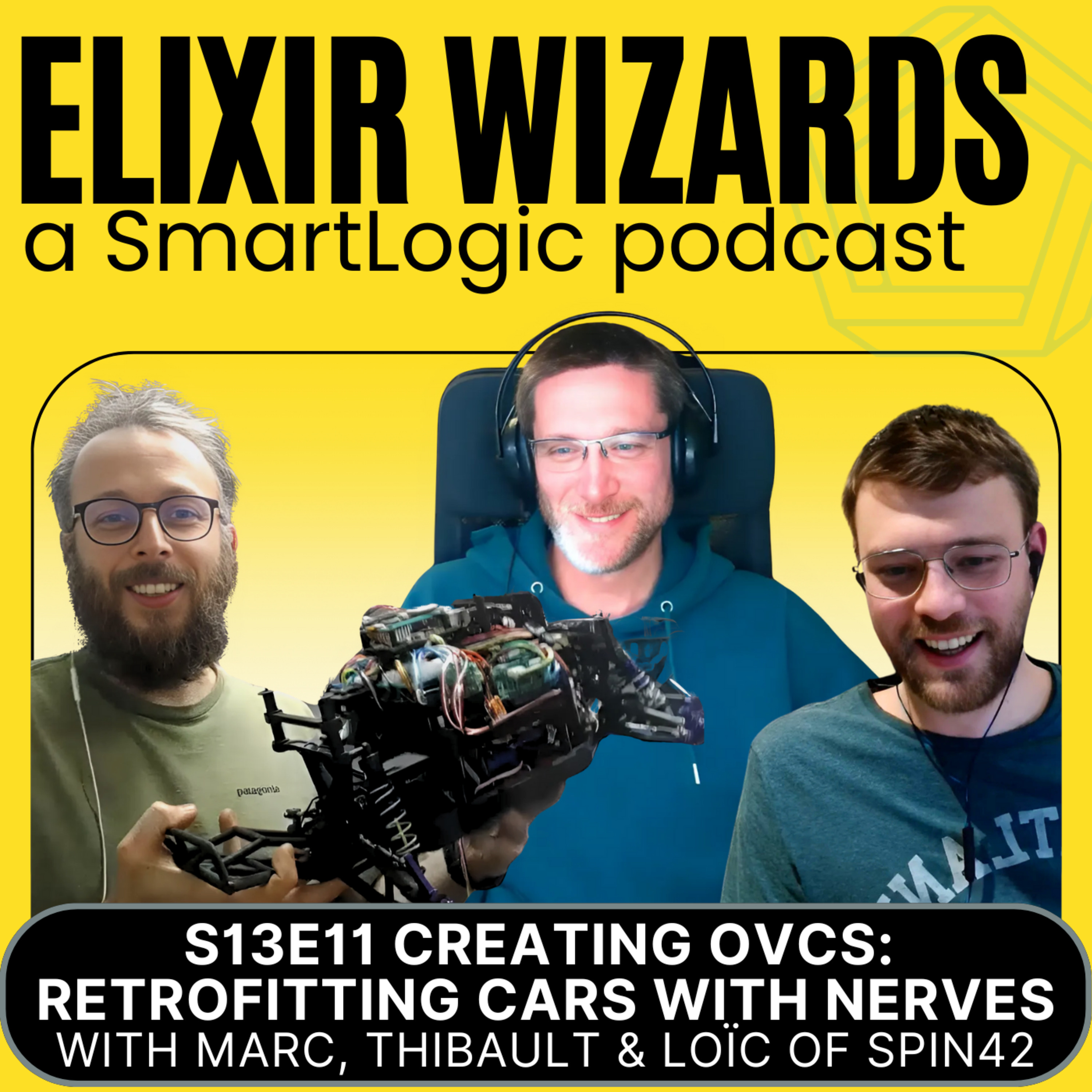 Building an Open Vehicle Control System using Elixir and Nerves with Marc, Thibault, and Loïc | For the Season 13 finale, Elixir Wizards Dan and Charles are joined by Spin42 Engineers Marc Lainez, Thibault Poncelet, and Loïc Vigneron to discuss their work retrofitting a 2007 VW Polo and creating an Open Vehicle Control System (OVCS). Using Elixir, Nerves, and Raspberry Pis, the team is reimagining vehicle technology to extend the lifespan of older cars and reduce waste—all while making the process approachable and open source. The Spin42 team shares the technical details behind OVCS and how they use Elixir and Nerves to interact with the CAN bus and build a Vehicle Management System (VMS) to coordinate various vehicle components. They dive into the challenges of reverse engineering CAN messages, designing a distributed architecture with Elixir processes, and ensuring safety with fail-safe modes and emergency shutoffs. Beyond the technical, the team discusses their motivation for the project—upgrading older vehicles with modern features to keep them on the road, building an open-source platform to share their findings with others, and above all-- to just have fun. They explore potential applications for OVCS in boats, construction equipment, and other vehicles, while reflecting on the hurdles of certifying the system for road use. If you’ve ever wondered how Elixir and Nerves can drive innovation beyond software, this episode is packed with insights into automotive computing, hardware development, and the collaborative potential of open-source projects. Topics Discussed in this Episode: Retrofitting a 2007 VW Polo with electric engines and modern tech Building an open-source Vehicle Control System (OVCS) using Elixir and Nerves Leveraging Elixir to interact with the CAN bus and parse proprietary messages Designing a Vehicle Management System (VMS) to coordinate vehicle components Developing custom hardware for CAN communication Creating a YAML-based DSL for CAN message and frame descriptions Building a distributed architecture using Elixir processes Ensuring safety with fail-safe modes and emergency shutoffs Using Flutter and Nerves to build a custom infotainment system Exploring autonomous driving features with a ROS2 bridge Developing remote control functionality with a Mavlink transmitter Testing OVCS features at scale with a Traxxas RC car (OVCS Mini) Challenges of certifying OVCS for road use and meeting regulatory requirements Encouraging community contributions to expand OVCS functionality Balancing open-source projects with contract work to sustain development The fun and fulfillment of experimenting with Elixir beyond traditional applications Links mentioned: https://www.spin42.com/ https://nerves-project.org/ Quadcopter https://github.com/Spin42/elicopter https://github.com/linux-can/can-utils https://docs.kernel.org/networking/can.html https://github.com/open-vehicle-control-system/cantastic https://github.com/commaai/opendbc https://en.wikipedia.org/wiki/CAN_bus#CAN_FD https://comma.ai/ https://en.wikipedia.org/wiki/CAN_FD https://webkit.org/wpe/ https://docs.nvidia.com/jetson/archives/r35.4.1/DeveloperGuide/text/SD/WindowingSystems/WestonWayland.html https://buildroot.org/ https://vuejs.org/ https://flutter.dev/ https://github.com/smartrent/elixir_flutter_embedder https://www.raspberrypi.com/products/raspberry-pi-5/ The Rabbit Pickup https://www.hemmings.com/stories/value-guide-1980-83-volkswagen-pickup https://www.expresslrs.org/software/mavlink https://industrial-training-master.readthedocs.io/en/melodic/_source/session7/ROS1-ROS2-bridge.html https://github.com/ros2/rcl https://github.com/open-vehicle-control-system/traxxas Contact Marc, Thibault, and Loïc: info@spin42.comSpecial Guests: Loïc Vigneron, Marc Lainez, and Thibault Poncelet. | — | ||||||
| 12/19/24 |  Creating Horizon: Deploy Elixir Phoenix Apps on FreeBSD with Jim Freeze | The Elixir Wizards welcome Jim Freeze, organizer of ElixirConf and creator of the Horizon library. Jim shares his journey from organizing Ruby conferences to founding and growing ElixirConf into the community cornerstone it is today. He reflects on the challenges of running a major conference, how COVID-19 shaped the event, and why the talks remain an evergreen resource for the Elixir ecosystem. We discuss Horizon, Jim’s deployment library for Elixir and Phoenix applications with Postgres on FreeBSD. Driven by a need for simplicity and cost-effectiveness, Jim explains how Horizon minimizes external dependencies while delivering fault-tolerant and streamlined setups. He compares it to tools like Fly, Terraform, and Ansible, highlighting its low cognitive load and flexibility—key benefits for developers seeking more control over their deployment environments. Jim also unpacks the broader value of understanding and customizing your deployment stack rather than relying solely on managed services. He discusses the benefits of using FreeBSD, including its stability, security, and performance advantages, as well as its robust ZFS file system. Jim emphasizes the importance of coherent deployment workflows, community collaboration, and contributions to open-source projects like Horizon. He invites listeners to explore Horizon, share feedback, and own their deployments. Topics discussed in this episode: Jim Freeze’s background organizing RubyConf and founding ElixirConf Reducing reliance on managed services and external dependencies Simplifying deployments with minimal tools and lower cognitive overhead The trade-offs of cutting-edge tools vs. stable, well-documented solutions The importance of customizing deployment tools to meet specific needs Addressing challenges with Tailwind compatibility Streamlining the FreeBSD installation process for Horizon users Community collaboration: contributing to open-source tools Jim’s vision for Horizon: PKI support, hot standby features, and serverless potential Links mentioned Nine Minutes of Elixir https://www.youtube.com/@ElixirConf https://github.com/liveview-native https://github.com/elixir-nx/nx https://2024.elixirconf.com/ https://github.com/jfreeze/horizon https://hexdocs.pm/horizon/deploying-with-horizon.html#web-cluster-topology https://kamal-deploy.org/ https://fly.io/ https://aws.amazon.com/console/ https://www.digitalocean.com/ https://cloud.google.com/ https://www.cloudflare.com/ https://www.hetzner.com/ https://www.proxmox.com/en/ https://nginx.org/ https://github.com/openzfs/zfs Zettabyte File System https://en.wikipedia.org/wiki/ZFS https://www.postgresql.org/ https://www.terraform.io/ https://www.ansible.com/ https://docs.freebsd.org/ https://www.redhat.com/ https://ubuntu.com/ https://esbuild.github.io/ Listener's Survey: https://smr.tl/EWS13 Special Guest: Jim Freeze. | — | ||||||
| 12/12/24 |  Telemetry & Observability for Elixir Apps at Cars.com with Zack Kayser & Ethan Gunderson | Zack Kayser and Ethan Gunderson, Software Engineers at Cars Commerce, join the Elixir Wizards to share their expertise on telemetry and observability in large-scale systems. Drawing from their experience at Cars.com—a platform handling high traffic and concurrent users—they discuss the technical and organizational challenges of scaling applications, managing microservices, and implementing effective observability practices. The conversation highlights the pivotal role observability plays in diagnosing incidents, anticipating system behavior, and asking unplanned questions of a system. Zack and Ethan explore tracing, spans, and the unique challenges introduced by LiveView deployments and WebSocket connections. They also discuss the benefits of OpenTelemetry as a vendor-agnostic instrumentation tool, the significance of Elixir’s telemetry library, and practical steps for developers starting their observability journey. Additionally, Zack and Ethan introduce their upcoming book, Instrumenting Elixir Applications, which will offer guidance on integrating telemetry and tracing into Elixir projects. Topics Discussed: Cars.com’s transition to Elixir and scaling solutions The role of observability in large-scale systems Uncovering insights by asking unplanned system questions Managing high-traffic and concurrent users with Elixir Diagnosing incidents and preventing recurrence using telemetry Balancing data collection with storage constraints Sampling strategies for large data volumes Tracing and spans in observability LiveView’s influence on deployments and WebSocket behavior Mitigating downstream effects of socket reconnections Contextual debugging for system behavior insights Observability strategies for small vs. large-scale apps OpenTelemetry for vendor-agnostic instrumentation Leveraging OpenTelemetry contrib libraries for easy setup Elixir’s telemetry library as an ecosystem cornerstone Tracing as the first step in observability Differentiating observability from business analytics Profiling with OpenTelemetry Erlang project tools The value of profiling for performance insights Making observability tools accessible and impactful for developers Links Mentioned https://www.carscommerce.inc/ https://www.cars.com/ https://hexdocs.pm/telemetry/readme.html https://kubernetes.io/ https://github.com/ninenines/cowboy https://hexdocs.pm/bandit/Bandit.html https://hexdocs.pm/broadway/Broadway.html https://hexdocs.pm/oban/Oban.html https://www.dynatrace.com/ https://www.jaegertracing.io/ https://newrelic.com/ https://www.datadoghq.com/ https://www.honeycomb.io/ https://fly.io/phoenix-files/how-phoenix-liveview-form-auto-recovery-works/ https://www.elastic.co/ https://opentelemetry.io/ https://opentelemetry.io/docs/languages/erlang/ https://opentelemetry.io/docs/concepts/signals/traces/ https://opentelemetry.io/docs/specs/otel/logs/ https://github.com/runfinch/finch https://hexdocs.pm/telemetry_metrics/Telemetry.Metrics.html https://opentelemetry.io/blog/2024/state-profiling https://www.instrumentingelixir.com/ https://prometheus.io/ https://www.datadoghq.com/dg/monitor/ts/statsd/ https://x.com/kayserzl https://github.com/zkayser https://bsky.app/profile/ethangunderson.com https://github.com/open-telemetry/opentelemetry-collector-contribSpecial Guests: Ethan Gunderson and Zack Kayser. | — | ||||||
| 12/5/24 |  Scaling the Daylite Apple-Native CRM Using Elixir with AJ | AJ (Alykhan Jetha), CEO and CTO of Marketcircle, joins the Elixir Wizards to share his experience building and evolving Daylite, their award-winning CRM and business productivity app for Apple users. He details his experiences as a self-taught programmer and how Marketcircle has navigated pivots, challenges, and opportunities since its founding in 1999. AJ explains why they migrated Daylite’s backend to Elixir, focusing on their sync engine, which demands high concurrency and fault tolerance. He highlights how Elixir has improved performance, reduced cloud costs, and simplified development with its approachable syntax and productive workflows. The conversation also touches on the technical hurdles of deploying native apps for Apple devices and the potential for integrating new technologies like LiveView Native to streamline cross-platform development. For technical founders, AJ emphasizes the importance of leveraging your strengths (“superpowers”), staying deeply connected to the development process, and finding stability in tools like Elixir amidst a rapidly evolving tech ecosystem. He also shares Marketcircle’s roadmap for migrating more customers to Elixir-powered systems and explores the potential for new features in their native apps. Tune in for insights on building resilient systems, navigating technical and business challenges, and how Elixir is shaping Marketcircle’s future. Topics discussed in this episode: AJ’s journey as a self-taught programmer and entrepreneur Marketcircle’s evolution since 1999 and lessons from their pivots Daylite’s growth as a flagship product for Apple users Migrating to Elixir for high concurrency and fault tolerance How Elixir improved performance and reduced cloud costs The simplicity of Elixir and its impact on developer onboarding Challenges in managing a growing microservices architecture Insights into deploying native apps for the Apple ecosystem Exploring LiveView Native for future cross-platform development Advice for technical founders: leveraging your superpowers Staying connected to development to maintain system understanding The role of Elixir in improving development efficiency and stability Planning gradual customer migrations to an Elixir-powered backend Potential new features for Daylite’s native apps Benefits of collaboration with the Elixir community #ElixirMullet -- native app in the front, Elixir in the back Navigating a rapidly evolving tech ecosystem as a founder Leveraging Elixir to future-proof Marketcircle’s systems Balancing technical and business priorities in a startup environment AJ’s thoughts on the future of Elixir in powering business tools Links mentioned: https://www.marketcircle.com/ Daylite.app https://www.nextcomputers.org/ https://www.digitalocean.com/ Python Async https://docs.python.org/3/library/asyncio.html https://github.com/sinatra/sinatra https://github.com/dependabot https://kafka.apache.org/ https://www.djangoproject.com/ https://github.com/socketry/falcon https://github.com/puma/puma https://www.swift.org/blog/announcing-swift-6/ https://en.wikipedia.org/wiki/Async/await https://www.ffmpeg.org/ https://www.sqlite.org/ https://github.com/commanded/commanded https://pragprog.com/titles/khpes/real-world-event-sourcing/ https://en.wikipedia.org/wiki/Ship_of_Theseus https://reactnative.dev/ https://www.electronjs.org/ https://en.wikipedia.org/wiki/WebOS https://www.linkedin.com/in/alykhanjetha/ https://bsky.app/profile/ajetha.bsky.socialSpecial Guest: Alykhan Jetha. | — | ||||||
| 11/28/24 |  Creating the Castmagic AI-Powered Content Workflow Platform with Justin Tormey | Justin Tormey, co-founder of Castmagic, joins the Elixir Wizards to discuss building an AI-powered content creation app. Castmagic repurposes audio and video into social media posts, blog articles, newsletters, and more. The tech stack leverages OpenAI and Anthropic LLMs with Elixir as the coordination layer and Phoenix LiveView powering the front end. Justin dives into the technical details of Castmagic, including the integration of JavaScript libraries like ProseMirror and TipTap through LiveSvelte, as well as enabling real-time collaboration with CRDTs and YDoc. He shares the benefits and challenges of using Elixir for rapid development, as well as the trade-offs between custom code and off-the-shelf solutions. The conversation also covers Justin’s entrepreneurial journey, highlighting the advantages of bootstrapping over venture capital, the importance of acquiring early customers, and creative marketing strategies like affiliate programs and software marketplaces. Whether you're an Elixirist exploring machine learning or an aspiring tech founder, tune in to learn more about AI with Elixir, navigating startup challenges, and turning ideas into impactful software. Topics discussed in this episode: Building Castmagic to generate content from audio and video for creators Using AI services like OpenAI and Anthropic for transcription and workflows Elixir as the coordination layer for complex processes Rapid UI development with Phoenix LiveView Integrating rich text editing libraries through LiveSvelte Enabling collaborative editing with CRDTs and YDoc Balancing offline functionality with cloud-based AI tools Challenges of working with external AI services Exploring the future of multimodal AI in product development Bootstrapping vs. venture capital: benefits and challenges Strategies for finding distribution channels and early adopters Creative approaches to marketing, including affiliates and marketplaces Balancing engineering efforts with customer and business needs Practical advice for navigating the early stages of a startup Links mentioned: https://www.castmagic.io/ https://pragprog.com/titles/jaerlang2/programming-erlang-2nd-edition/ https://www.blockchain.com/ https://fly.io/ https://hexdocs.pm/live_svelte/readme.html https://github.com/woutdp/live_svelte https://prosemirror.net/ https://tiptap.dev/ https://docs.yjs.dev/api/y.doc https://hexdocs.pm/polymorphic_embed/readme.html https://github.com/elixir-nx/nx https://github.com/elixir-nx/tokenizers https://github.com/thmsmlr/instructor_ex https://openai.com/ https://www.anthropic.com/ https://getoban.pro/ https://github.com/wojtekmach/req https://ollama.com/ https://x.com/j_tormeySpecial Guest: Justin Tormey. | — | ||||||
| 11/21/24 |  Creating the Standd AI-Native Due Diligence Platform with Stephen Solka | Stephen Solka, CTO and co-founder of Standd.io, joins Elixir Wizards Owen and Charles to share the journey of building an AI-native deal intelligence and due diligence platform. Designed to streamline document analysis and text generation for venture capital firms, Standd.io leverages large language models and AI tools to address key customer pain points in document workflows. Stephen explains how Elixir and Phoenix LiveView enabled rapid UI iteration and seamless integration between the front-end and back-end. The conversation also explores the human side of startup life. Stephen reflects on balancing tech debt with customer demands, the value of accelerators in building networks and securing funding, and the challenges of pricing in early-stage startups. He emphasizes the importance of validating ideas with potential customers and learning from the hurdles of growing a business. Tune in for insights on leveraging AI in Elixir, solving real-world problems, and navigating the journey from concept to company. Topics discussed in this episode: The journey from self-taught programmer to CTO The perks of Phoenix LiveView for rapid UI development Integrating front-end and back-end technologies AI tools for code generation How early adopters balance functionality with product polish Validating ideas and understanding customer needs The impact of accelerators on networking and fundraising Approaches to managing pricing strategies for startups Balancing technical debt with feature development The role of telemetry and error reporting in product development Creating collaborative and supportive tech communities Educating users on AI’s capabilities and limitations The broader implications of AI tools across industries Links Mentioned Contact Stephen & Julie at Standd: founders@standd.io https://www.standd.io/ https://www.digitalocean.com/community/tutorials/gangs-of-four-gof-design-patterns https://www.thriftbooks.com/w/code-complete_steve-mcconnell/248753/item/15057346/ https://aws.amazon.com/sagemaker/ https://www.anthropic.com/ https://getoban.pro/ https://kubernetes.io/ https://www.apollographql.com/ https://aws.amazon.com/startups/accelerators https://accelerate.techstars.com/ https://aider.chat/ https://github.com/Aider-AI/aider https://neovim.io/ https://ui.shadcn.com/ https://tailwindui.com/ https://www.ycombinator.com/ https://www.thriftbooks.com/w/close-to-the-machine-technophilia-and-its-discontents_ellen-ullman/392556Special Guest: Stephen Solka. | — | ||||||
| 11/14/24 |  Creating the WebAuthn Components Library for Phoenix LiveView Apps with Owen Bickford | Today on Elixir Wizards, Owen Bickford, fellow Wizard and creator of the WebauthnComponents library, joins us to talk about building passwordless authentication for Phoenix LiveView applications. Owen walks us through the evolution of authentication—touching on everything from plain text passwords to multi-factor setups—and explains the security flaws and user experience issues each method presents. He describes passkeys, a solution based on the WebAuthn API, which improves security and ease of use. The conversation covers cross-device support for passkeys, the role of password managers in keeping credentials synced, and ideas for enhancing WebauthnComponents, like supporting multiple passkeys per account. Owen invites listeners to contribute to the library’s development on GitHub and emphasizes the role passkeys play in improving app security and user experience. Topics discussed in this episode: Passkeys and the shift toward passwordless authentication WebAuthn API and its role in secure login systems Creating the WebauthnComponents library for Phoenix LiveView History of authentication from basic passwords to multi-factor approaches Security gaps and user experience challenges with traditional methods Asymmetric cryptography’s impact on secure logins Hardware-based credential storage and generation with Trusted Platform Modules Structure and components of the WebAuthn library: dependencies, LiveViews, and Ecto schemas Live components for real-time server-browser interactions Passkeys as a primary or secondary authentication method Key business considerations when choosing authentication methods Cross-device support for passkeys and credential syncing Strategies for passkey recovery if devices are lost Ensuring secure access in unattended environments Elixir’s ecosystem advantages for building authentication systems Simplifying JavaScript complexity within Elixir projects Future-proofing WebAuthn Components for seamless updates Using Igniter to enhance customization and refactoring Developer-friendly tools for secure authentication Inviting community contributions on GitHub and the Elixir forum Plans for telemetry and performance tracking Why adopting passkeys is a win for app security and user experience Links mentioned: https://github.com/liveshowy/webauthn_components https://en.wikipedia.org/wiki/Salt_(cryptography) https://en.wikipedia.org/wiki/Rainbow_table https://en.wikipedia.org/wiki/Multi-factor_authentication https://oauth.net/2/ https://developer.mozilla.org/en-US/docs/Web/API/Web_Authentication_API https://www.w3.org/TR/webauthn-3/ https://www.microsoft.com/en-us/windows/tips/windows-hello https://trustedcomputinggroup.org/resource/trusted-platform-module-tpm-summary/ https://hexdocs.pm/phoenix/mix_phx_gen_auth.html https://en.wikipedia.org/wiki/Public-key_cryptography SSH Protocol (Secure Shell) https://en.wikipedia.org/wiki/Secure_Shell https://www.yubico.com/products/yubikey-5-overview/ https://fidoalliance.org/how-fido-works/ https://1password.com/ https://keepassxc.org/ https://hexdocs.pm/ecto_ulid/Ecto.ULID.html https://en.wikipedia.org/wiki/Universally_unique_identifier https://hexdocs.pm/ecto/Ecto.Schema.html https://hexdocs.pm/sourceror/ https://github.com/ash-project/igniter Forum thread: https://elixirforum.com/t/webauthnlivecomponent-passwordless-auth-for-liveview-apps/49941 | — | ||||||
Showing 25 of 198
Sponsor Intelligence
Sign in to see which brands sponsor this podcast, their ad offers, and promo codes.
Chart Positions
3 placements across 3 markets.
Chart Positions
3 placements across 3 markets.