
Insights from recent episode analysis
Audience Interest
Podcast Focus
Publishing Consistency
Platform Reach
Insights are generated by CastFox AI using publicly available data, episode content, and proprietary models.
Total monthly reach
Estimated from 26 chart positions in 26 markets.
By chart position
- 🇩🇪DE · Automotive#1205K to 30K
- 🇬🇧GB · Automotive#1565K to 30K
- 🇦🇺AU · Automotive#1905K to 30K
- 🇫🇷FR · Automotive#2830K to 100K
- 🇮🇹IT · Automotive#4830K to 100K
- Per-Episode Audience
Est. listeners per new episode within ~30 days
54K to 194K🎙 Daily cadence·783 episodes·Last published today - Monthly Reach
Unique listeners across all episodes (30 days)
181K to 648K🇫🇷15%🇮🇹15%🇮🇳15%+23 more - Active Followers
Loyal subscribers who consistently listen
72K to 259K
Market Insights
Platform Distribution
Reach across major podcast platforms, updated hourly
Total Followers
—
Total Plays
—
Total Reviews
—
* Data sourced directly from platform APIs and aggregated hourly across all major podcast directories.
On the show
Recent episodes
Surviving EV Heat
Jun 25, 2026
Unknown duration
Thermal Resilience in Modern Electric Vehicles
Jun 25, 2026
Unknown duration
Vietnam's EV Empire
Jun 24, 2026
Unknown duration
The Electric Ascent: Why VinFast Dominates Vietnam's EV Market
Jun 24, 2026
Unknown duration
Eletre vs Q8 e-tron
Jun 24, 2026
Unknown duration
Social Links & Contact
Official channels & resources
Official Website
Login
RSS Feed
Login
| Date | Episode | Description | Length | ||||||
|---|---|---|---|---|---|---|---|---|---|
| 6/25/26 | Surviving EV Heat | This article provides a comprehensive look at the engineering and technology that allow modern electric vehicles (EVs) to thrive in extreme temperatures. While no car is built exclusively for the heat, modern EVs are equipped with sophisticated thermal management systems designed to protect the battery—the vehicle's most sensitive component—from degradation and performance loss.Key topics covered include:The Cooling Divide: An exploration of why active liquid cooling has become the industry standard for long-range vehicles, offering significantly better efficiency and stability than older, passive air-cooled systems.The "Intelligent Loop" Revolution: How manufacturers like Tesla, with its Octovalve, and the Hyundai/Kia group have integrated battery, motor, and cabin cooling into a single, smart ecosystem that scavenges and expels heat with maximum efficiency.Advanced Electrical Architectures: An analysis of how 800V platforms (found in models like the Porsche Taycan and Ioniq 5) inherently generate less heat during ultra-fast charging compared to traditional 400V systems.Software as a Shield: The role of battery pre-conditioning, a predictive feature that uses navigation data to cool the battery in advance of a high-power charging session.Buyer’s Guide for Hot Climates: A practical checklist for identifying heat-resistant EVs, debunking the myth that city cars are inherently less resilient than luxury sedans, provided they utilize modern liquid-cooling architectures.Whether you are an automotive enthusiast or a potential EV buyer, this article explains the critical features—from heat pumps to liquid circuits—that ensure an electric vehicle remains reliable and efficient even under the blistering summer sun. | — | ||||||
| 6/25/26 | 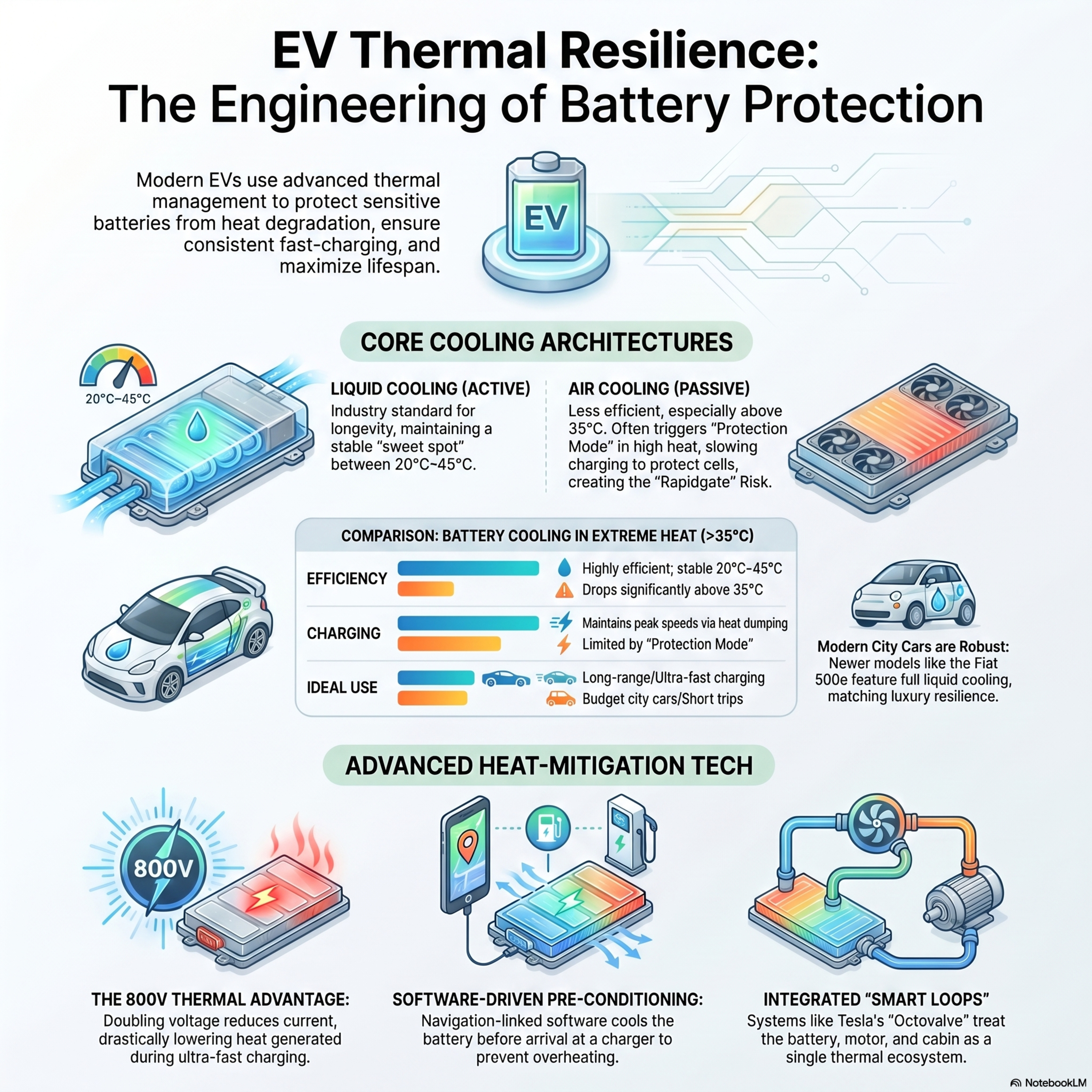 Thermal Resilience in Modern Electric Vehicles | Modern electric vehicles are not built solely for extreme heat, but they utilize advanced thermal management systems to safeguard battery health and maintain performance. Key technologies such as liquid cooling and high-efficiency heat pumps are essential for regulating temperatures more effectively than outdated air-cooled methods. Sophisticated pre-conditioning software and 800-volt architectures further enhance heat dissipation, particularly during high-speed charging sessions. When evaluating a vehicle's climate resilience, consumers should prioritize integrated cooling loops that manage heat across the motors and electronics. Ultimately, newer models released since 2023 generally offer the most robust thermal engineering to handle rising temperatures. These innovations ensure that electric cars remain reliable and efficient even in challenging summer conditions. | — | ||||||
| 6/24/26 | Vietnam's EV Empire | Witness the extraordinary transformation of Vietnam into a regional leader in green mobility. By 2026, Vietnam has achieved a staggering 42.8% market share for electric vehicles, positioning itself as the ASEAN frontrunner. This video explores the multi-layered strategy behind this "electric empire" and how it is successfully dismantling the era of internal combustion engines.Inside the Empire:The VinFast Monopoly: Discover how the national champion maintains a near-total 99% grip on the domestic EV sector. We look at the vehicles driving this success, from the rugged, urban-focused VF 3 mini-SUV to the mass-market VF 5 crossover.A Market in Transition: While traditional gasoline vehicles face stagnation and heavy price wars, electrified vehicle sales are surging at rates exceeding 80% annually. Today, over 70% of Vietnamese consumers say their next car will be electric.The Math of the Revolution: We break down the massive economic advantage of going electric in Vietnam. With gasoline prices around 21,420 VND per liter, charging a vehicle at home for as little as $0.08/kWh makes EVs an unbeatable financial choice for the local population.Strategic Protectionism: Learn how the EVFTA (EU-Vietnam Free Trade Agreement) has been leveraged to protect the nascent domestic industry. Unlike other markets, Vietnam has maintained targeted protections for VinFast, allowing it to build scale before facing full global competition.Powered by the Sun: The empire isn't just about cars; it’s about the grid. With a capacity of 21.76 GW, Vietnam is now a solar energy leader in Southeast Asia, providing the renewable backbone necessary to sustain millions of new electric vehicles.From the $404 million investment in the V-Green charging network to the "cannibalization" of legacy auto brands, this is the story of how a nation decided to skip the tailpipe and leap directly into an electrified future.EnjoyCoffee:https://buymeacoffee.com/emotorselectricrevolution | — | ||||||
| 6/24/26 | 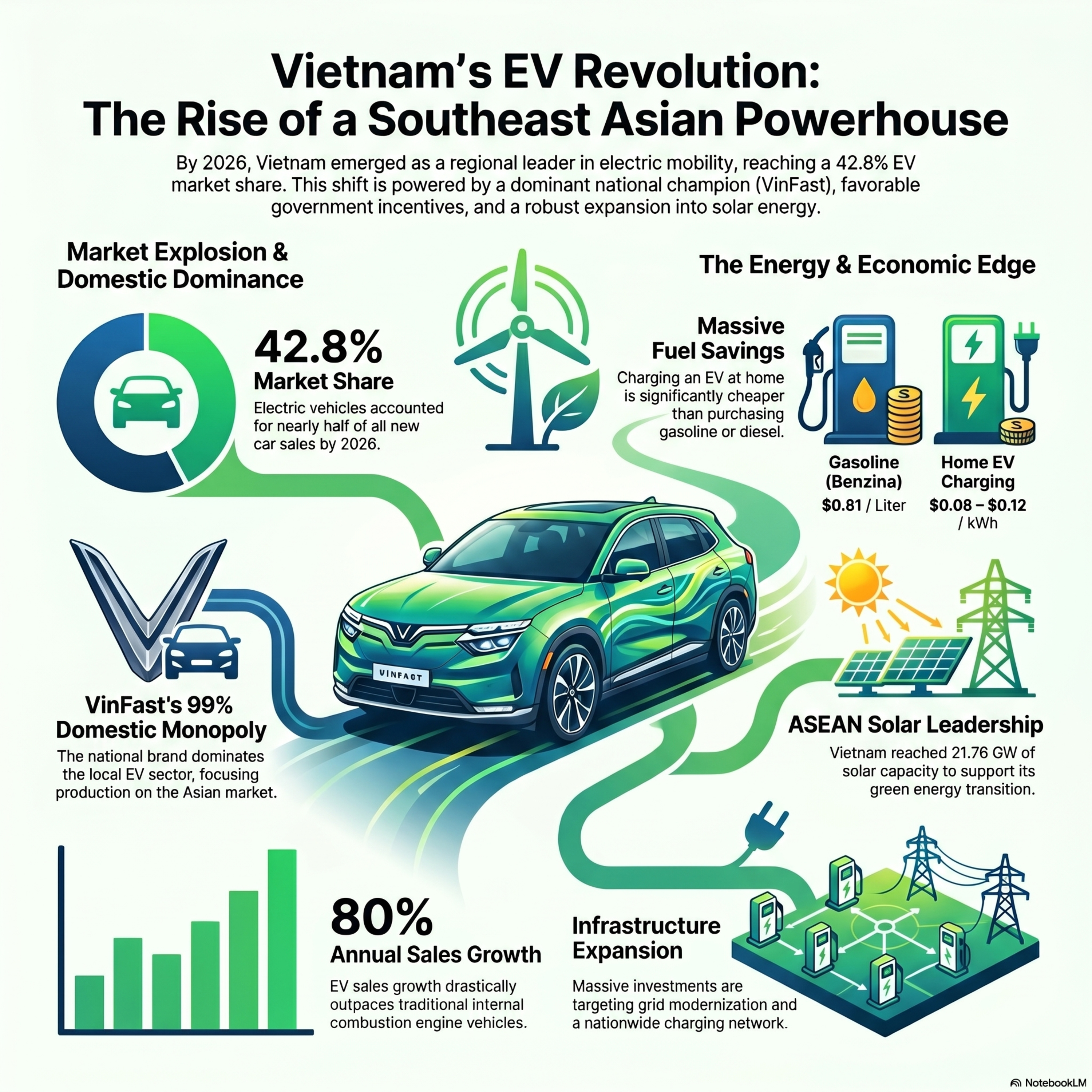 The Electric Ascent: Why VinFast Dominates Vietnam's EV Market | Discover how a single domestic brand has managed to capture an astounding 99% of the electric vehicle market in one of Asia’s fastest-growing economies. As of 2026, Vietnam has emerged as the ASEAN leader in EV adoption, with electric cars accounting for 42.8% of all vehicle sales.This deep dive explores the perfect storm of factors fueling VinFast’s undisputed leadership:Aggressive Local Strategy: Learn how VinFast has "cannibalized" the market share of traditional global giants by focusing on a versatile lineup—from the ultra-compact VF 3 designed for urban mobility to the mass-market VF 5 crossover.The Economic Edge: We break down the math of the "electric advantage" in Vietnam. With rising gasoline prices and a public charging network (V-Green) that offers highly competitive rates, driving a VinFast has become significantly more affordable than traditional internal combustion vehicles.Governmental Wind in the Sails: Understand the role of state policy, including crucial registration tax exemptions and strategic trade protections under the EVFTA, which have allowed VinFast to build economies of scale while shielding it from premature foreign competition.Infrastructure as a Moat: While other manufacturers struggle with "range anxiety," VinFast and V-Green have committed over $404 million to expand charging infrastructure across the country, turning a potential bottleneck into a massive competitive advantage.VinFast isn't just selling cars; it’s leading a national transition where over 70% of consumers now prefer electrified transport for their next purchase. It is a story of national pride, strategic protectionism, and a rapid shift in consumer behavior that is reshaping the future of transport in Southeast Asia. | — | ||||||
| 6/24/26 | Eletre vs Q8 e-tron | This article explores the high-stakes confrontation between the Lotus Eletre and the Audi Q8 e-tron, two vehicles that represent distinct philosophies within the luxury electric SUV segment. While the Lotus is positioned as a tech-forward "hyper-SUV" prioritizing extreme performance, the Audi is celebrated for its traditional luxury, refinement, and accessibility.The Performance Powerhouse: Lotus EletreThe Lotus Eletre dominates the technical comparison with raw power and cutting-edge engineering.Extreme Power: It offers up to 918 HP, allowing it to sprint from 0 to 100 km/h in as little as 2.95 to 3 seconds.Advanced Charging: Unlike the Audi's 400V system, the Eletre utilizes an 800V architecture, enabling ultra-rapid charging.Avant-Garde Interior: Reviewers describe the cabin as "off the scale good" and materially innovative, moving away from traditional design to create a futuristic, high-quality environment.Handling: Despite weighing over 2.5 tons, it is praised for a compliant ride and superior body control compared to the Audi.Value and Efficiency: It is markedly cheaper, with a starting price roughly £20,000 lower than the Lotus. It is also "somewhat more efficient," with a lower average energy consumption of 19.7 kWh/100km.Classic Luxury: The interior follows the "classically Audi" playbook, emphasizing ergonomic soundness, high perceived quality, and a serene, quiet ride.Daily Practicality: While it has less initial boot space than the Lotus, it offers a slightly higher maximum load capacity (up to 1,637 L) and a higher payload capacity.The Refined Veteran: Audi Q8 e-tronThe Audi Q8 e-tron appeals to drivers seeking a quiet, reliable, and understated premium experience.Conclusion: Which Titan to Choose?The choice between these two models ultimately depends on the buyer's priorities. The Lotus Eletre is the choice for enthusiasts of "pure performance" and bold design who want a vehicle that feels like a "new chapter" in automotive technology. Conversely, the Audi Q8 e-tron is the ideal choice for those prioritizing comfort, status, and reliability in a technically solid and refined package for daily use or long-distance travel. | — | ||||||
| 6/24/26 | 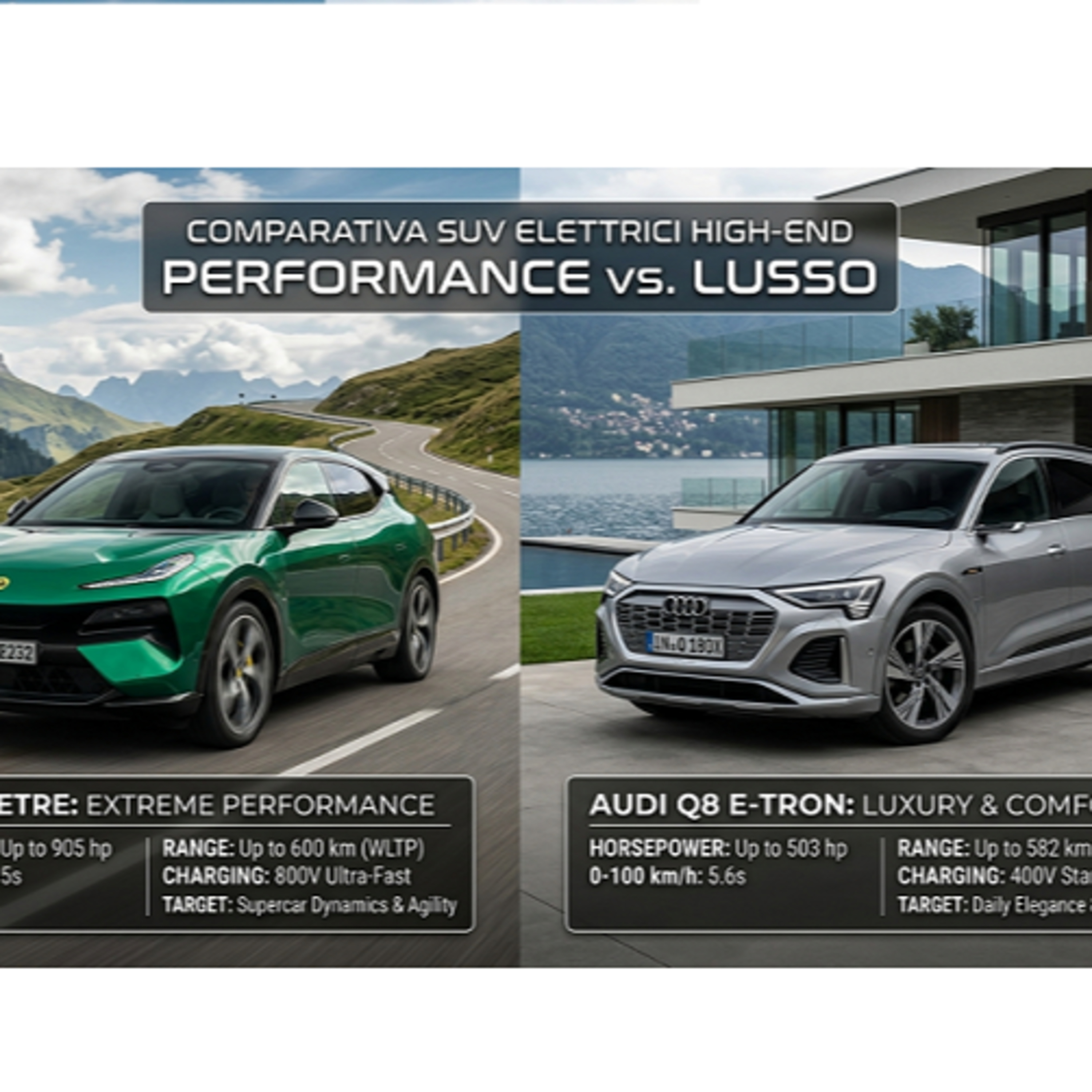 Titan Clash: Lotus Eletre vs. Audi Q8 e-tron | This episode provides a comprehensive comparison between two high-end electric SUVs, the Lotus Eletre and the Audi Q8 e-tron. The analysis highlights that the Lotus focuses on extreme performance and rapid charging, offering significantly higher horsepower and acceleration. In contrast, the Audi is positioned as a vehicle centered on luxury, comfort, and refinement for daily use. Detailed technical specifications illustrate differences in battery architecture and range, while the pricing section notes that the Lotus carries a higher cost. Ultimately, the source distinguishes between the two by their target audiences, contrasting those seeking supercar dynamics with those prioritizing reliable elegance. | — | ||||||
| 6/23/26 | The Mobility Revolution | This article provides a comprehensive analysis of the profound sociological shift currently redefining the automotive market: the transition from "owning a thing" to "buying a service". It explores how the car has lost its status as the ultimate gateway to freedom for younger generations, having been largely usurped by smartphones and digital connectivity as the primary means of social independence.Key themes covered in the article include:The Urban Intermodal Ecosystem: In modern cities, the density of public transport, car-sharing, and micro-mobility makes traditional ownership a "redundant expense". The sources highlight a critical "math of inefficiency": private vehicles remain stationary for 22 out of 24 hours, making fixed costs like insurance and taxes financially unjustified for an asset that is idle 90% of the time.Managing Technological Obsolescence: The article examines the specific risks of Electric Vehicles (EVs). It recommends Long-Term Rental (NLT) as a "serenity strategy" to protect users from the rapid evolution of battery technology, allowing them to upgrade every 3–4 years without the burden of reselling an obsolete asset.Income-Based Financial Blueprints: The text outlines specific strategies tailored to different financial tiers, from the "Strategy of Substance" for €30k incomes (prioritizing bank loans for used cars) to the "Strategy of Efficiency" for those earning over €50k (prioritizing the convenience and time-saving benefits of NLT).The "Dual Vehicle" Rationality: Perhaps the most impactful insight is the rejection of the "total car" myth—the habit of buying an expensive, oversized SUV for occasional holiday needs. Instead, the article advocates for a "Dual Strategy": using a compact EV for daily commutes and renting a premium vehicle for long trips, a move that can save over €4,000 annually.Ultimately, "The Mobility Revolution" serves as a strategic guide for navigating the end of possession and the birth of conscious, efficient mobility.EnjoyCoffee:https://buymeacoffee.com/emotorselectricrevolution | — | ||||||
| 6/23/26 | 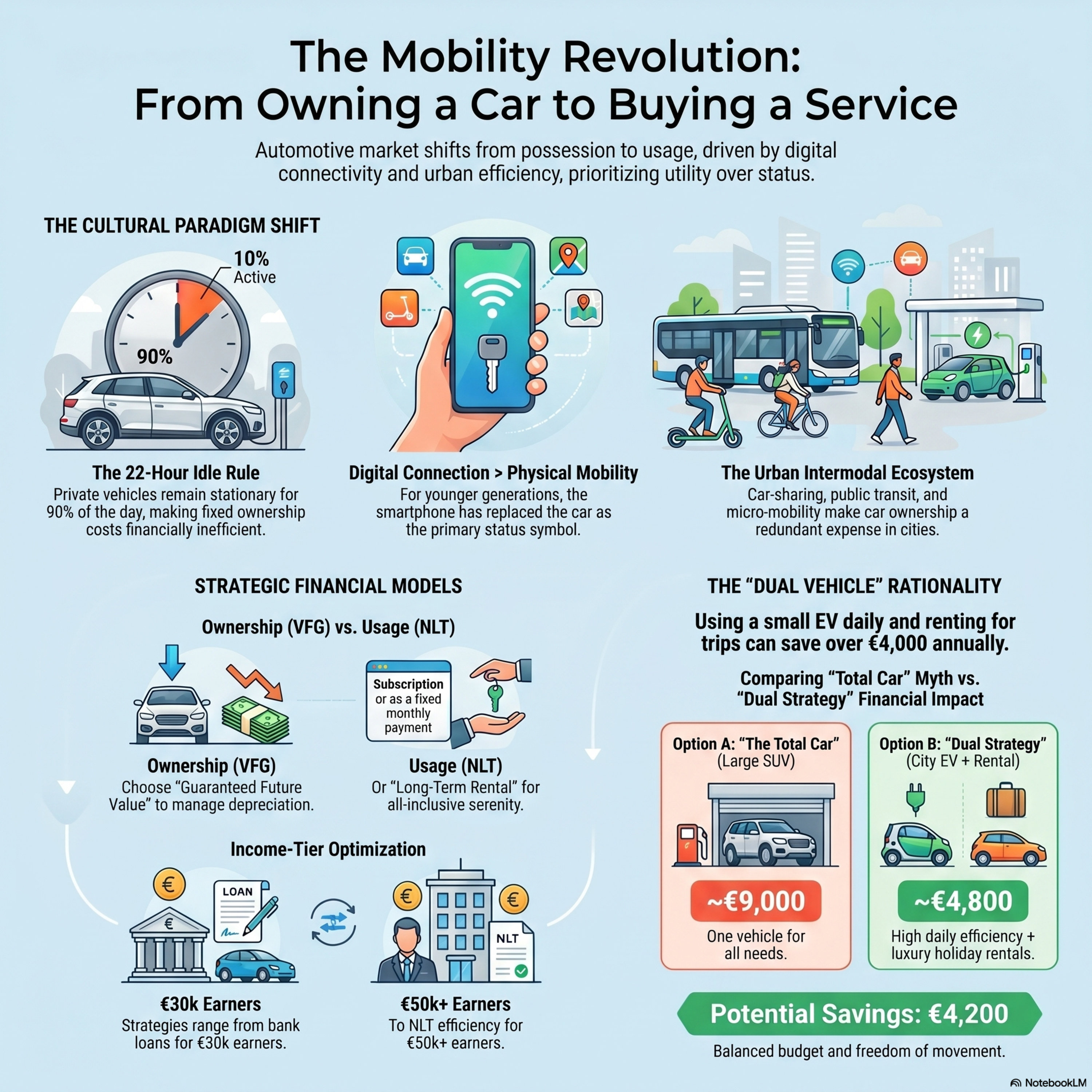 Why your car is a financial trap | This article explores why traditional car ownership has become a significant financial drain in the modern era. Drawing on a profound sociological shift, the sources explain that the car is no longer the ultimate status symbol of the 20th century; that role has been largely usurped by smartphones and digital connectivity.The core of the "financial trap" lies in operational inefficiency: private vehicles remain stationary for approximately 22 out of 24 hours, meaning owners pay high fixed costs—such as insurance, road tax, and parking—for an asset that sits idle 90% of the time.To help readers escape this trap, the article outlines tailored financial strategies based on income tiers:The Strategy of Substance (€30k income): Focus on avoiding the "enemy" of debt by choosing personal bank loans for budget-friendly or used cars, which offers more transparent costs than dealer financing.The Strategy of Equilibrium (€40k income): Use Guaranteed Future Value (VFG) to "rent depreciation," allowing you to upgrade technology every three years without the risk of owning an obsolete asset.The Strategy of Efficiency (€50k+ income): Prioritize "operational serenity" through Long-Term Rental (NLT), an all-inclusive service that removes the burden of maintenance, insurance, and resale.Finally, the article challenges the "myth of the total car"—the habit of buying an expensive, oversized SUV for a few days of holiday travel. Instead, it advocates for a "Dual Strategy": using a small electric city car for daily commutes and renting a larger vehicle only when needed, a move that can save over €4,000 annually. This guide is essential for anyone looking to transition from the burden of possession to the freedom of mobility as a service. | — | ||||||
| 6/23/26 | The Great EV Tire Myth | Many drivers mistakenly believe that "rubber is rubber," but electric vehicles (EVs) operate under physics that turn standard tires into a liability.This article debunks the myth that specialized tires are merely marketing fluff, revealing why EV-specific engineering is essential for survival, efficiency, and comfort.The Brutal Impact of Weight and Torque: EVs are significantly heavier—often by 400 to 600 kg—due to their battery packs.Standard tires struggle under this mass, with sidewalls that can overheat and deform, leading to tires needing replacement after only 28,944 kilometers on average, compared to 40,000 km for combustion vehicles.Furthermore, the instant torque of electric motors can shred regular treads, necessitating specialized high-silica compounds like "Green Chili" to slash slip and ensure traction.Range and Efficiency: Efficiency is the lifeblood of an EV. Installing the wrong tires can drain up to 15% of a battery's range.Specialized EV tires utilize low-rolling-resistance designs and 3D siping to preserve battery life, effectively reclaiming dozens of kilometers per charge without turning wet roads into "ice rinks".The Sound of Silence: Because EVs lack engine noise, tire hum becomes audibly apparent and can reach levels louder than a vacuum cleaner.Technologies like ContiSilent use an internal polyurethane foam layer to reduce cabin noise by up to 9 dB(A)—a difference akin to moving from a busy street to a quiet room.Ultimately, specialized tires are not just "better"—they are purpose-built to solve equations regular tires ignore, balancing raw torque, extreme weight, and the demand for silence.EnjoyCoffee:https://buymeacoffee.com/emotorselectricrevolution | — | ||||||
| 6/23/26 | 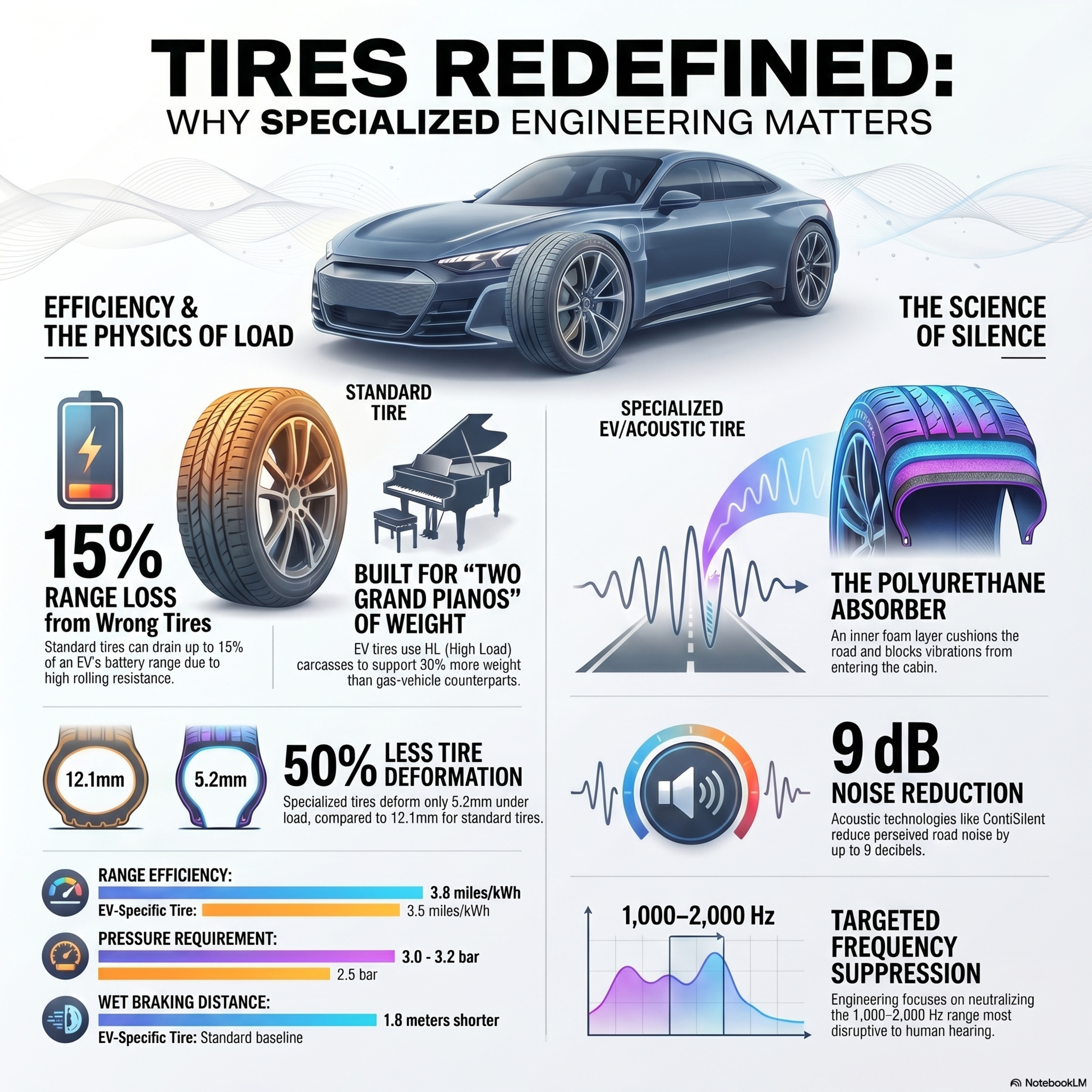 The Engineering and Benefits of Electric Vehicle Tires | The provided source explains the specialized engineering behind tires designed for electric vehicles, which must address different requirements than traditional combustion cars. Because electric models are significantly heavier due to their batteries, these tires feature reinforced structures to handle the added load. They prioritize low rolling resistance to maximize battery efficiency and extend the vehicle's driving range. Furthermore, specific rubber compounds are utilized to manage the instantaneous torque of electric motors, preventing premature wear while maintaining grip. To enhance the driving experience, these tires often include sound-absorbing technology to minimize cabin noise in the absence of engine sounds. Ultimately, these components are essential for optimizing the performance and durability of modern eco-friendly transportation. | — | ||||||
Want analysis for the episodes below?Free for Pro Submit a request, we'll have your selected episodes analyzed within an hour. Free, at no cost to you, for Pro users. | |||||||||
| 6/22/26 | DriveDuel: T03 vs. Fiat 500e | The video examines the significant price variations between markets—ranging from a narrow gap in the UK to a substantial €5,000 difference in Italy—and breaks down the technical trade-offs between the Fiat’s high-energy NMC battery and the Leapmotor’s cost-effective, durable LFP battery.Viewers will discover why the Fiat is likened to a "tailored Italian suit" focused on performance, efficiency, and high-quality finishes, while the T03 is presented as a "Swiss Army knife" that prioritizes interior space (210 L boot) and affordability through its integrated "Intelligent Power" platform. The episode also explores clever engineering solutions, such as the T03's use of sealed drum brakes to prevent common EV rust issues, contrasted with the Fiat's superior driving dynamics and acceleration. Ultimately, this deep dive helps you decide if your next city car should be a practical, budget-friendly tool or a fashion statement that "puts a smile on your face". | — | ||||||
| 6/22/26 | 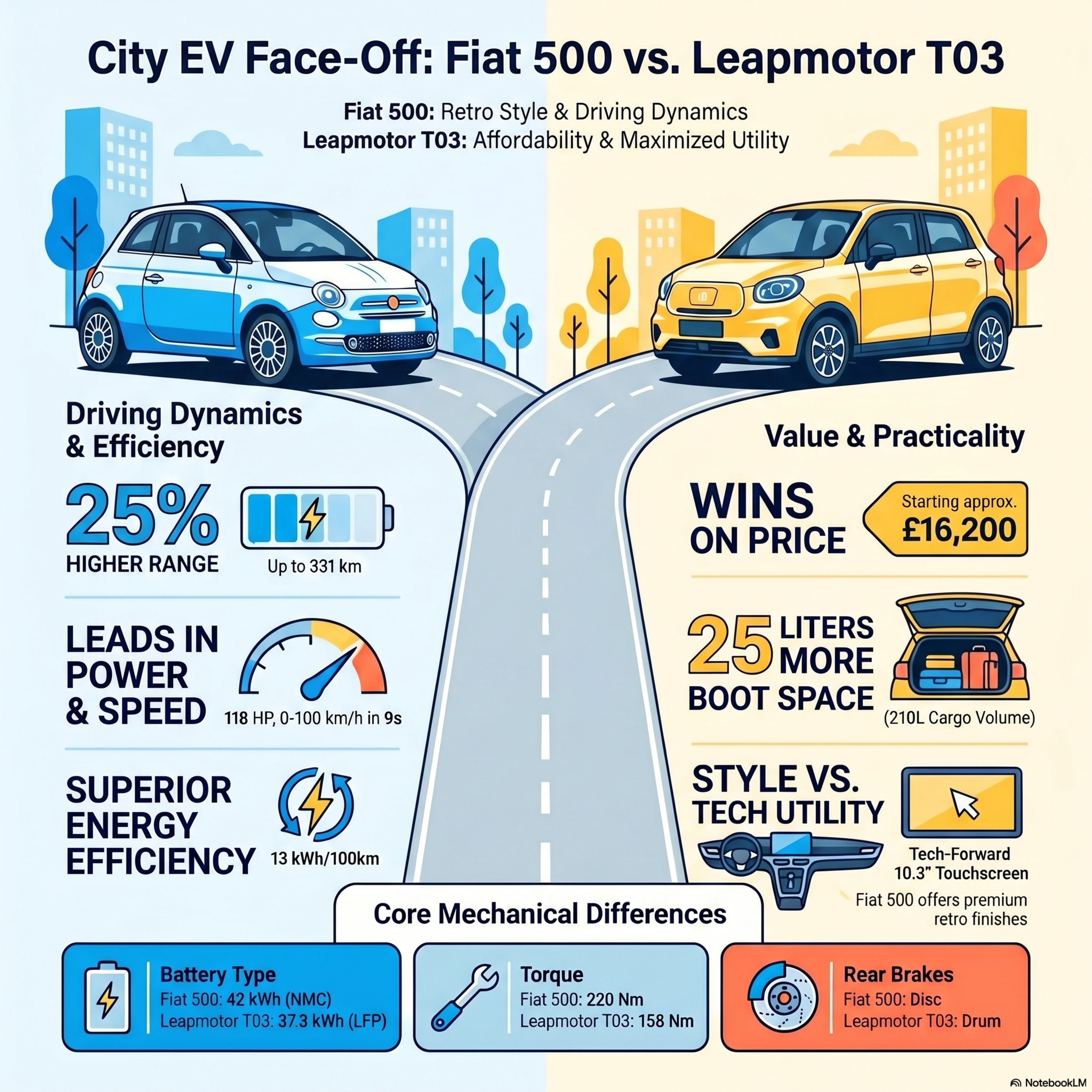 Electric City Cars: Fiat 500e vs Leapmotor T03 | This source provides a technical and economic comparison between two electric city cars: the Fiat 500e and the Leapmotor T03. While both vehicles utilize similar suspension setups, the Fiat 500e justifies a higher price tag through its premium interior materials, superior braking hardware, and a larger, high-performance battery. In contrast, the Leapmotor T03 is positioned as a budget-friendly alternative that prioritizes internal space and integrated electronic efficiency over luxury finishes. The documentation highlights that the Fiat focuses on driving dynamics and style, whereas the Leapmotor leverages a proprietary platform to deliver a cost-effective technological package. Ultimately, the comparison illustrates a 5,000 Euro price gap that separates a high-end European icon from a modern, utility-focused competitor. | — | ||||||
| 6/21/26 | The Frugal Revolution: Engineering the Future of Mass Mobility | The Frugal Revolution explores how India is rewriting the global electric vehicle (EV) blueprint through the lens of Frugal Engineering—a philosophy that prioritizes essential value, extreme durability, and cost-efficiency over luxury. While many Western markets focus on high-end software and premium finishes, the Indian approach optimizes EVs for a uniquely challenging ecosystem. This includes advanced thermal management systems designed for extreme heat and moisture, and reinforced, high-clearance suspensions built to handle irregular road conditions.The content delves into how Indian manufacturers like Tata and Mahindra have perfected simplicity and modularity, creating vehicles that are robust, easy to repair, and highly affordable. This shift is so significant that major European carmakers are now looking to India as a global "hub," adopting these "low-cost" design principles to bring mass-market electric cars to Europe. Finally, it highlights the strategic synergy between Italy and India, where Italian precision engineering and Battery Management Systems (BMS) meet India’s massive production scale and "frugal" innovation. It is a story of co-creation, showing how these two nations are partnering to make the transition to sustainable energy accessible for everyone, not just the elite | — | ||||||
| 6/21/26 | 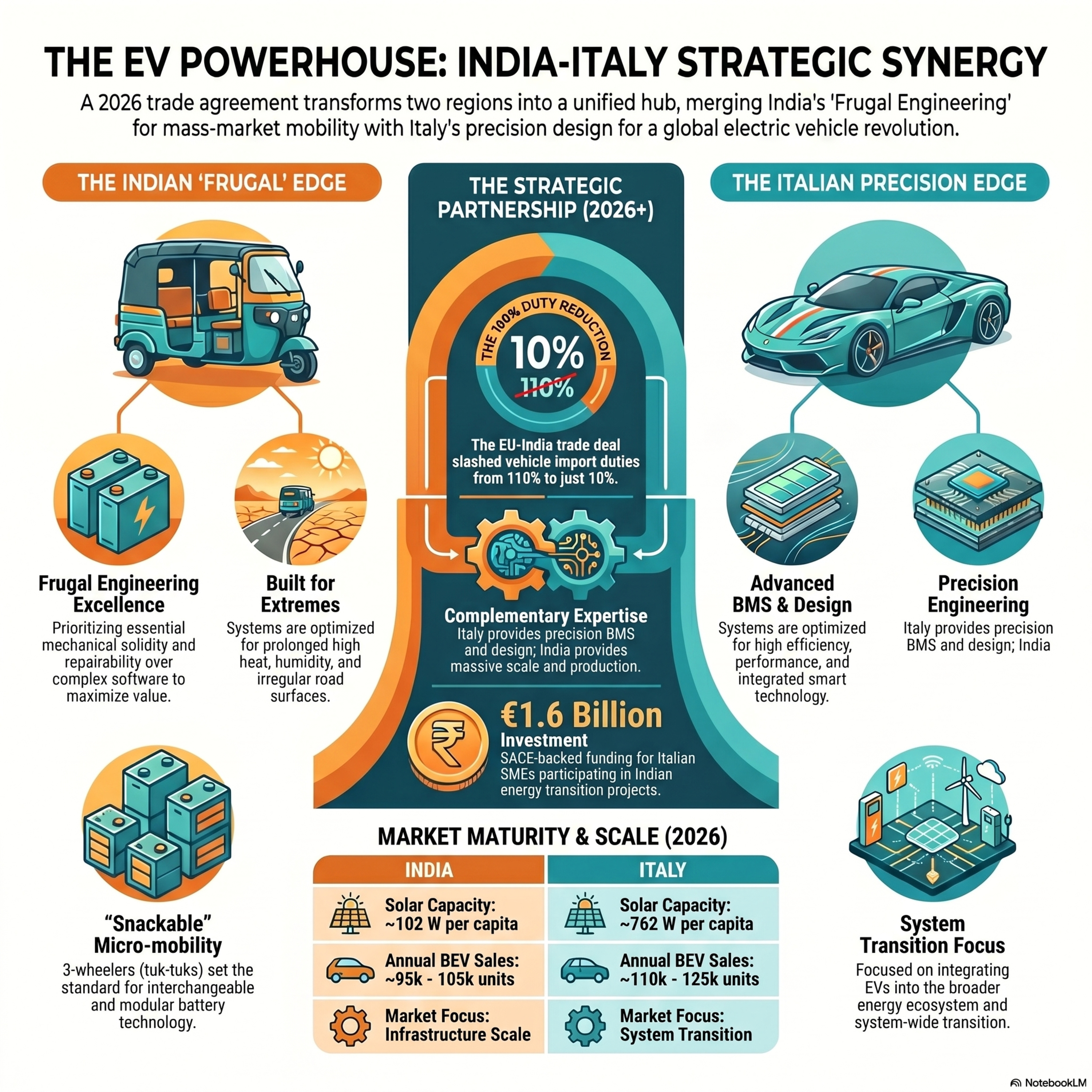 Electrified Synergy: The Italy-India EV Partnership Strategy | The provided source outlines a strategic partnership between Italy and India centered on the rapidly evolving electric vehicle (EV) sector and renewable energy infrastructure. While Italy provides advanced engineering, precision design, and battery management systems, India offers an expansive market and massive manufacturing scale for testing new solutions. A landmark 2026 trade agreement has significantly reduced import duties, facilitating the exchange of technology and the integration of Italian software into the Indian ecosystem. Financial backing from organizations like SACE further promotes cross-border investment, allowing small and medium-sized Italian firms to collaborate with major Indian industrial groups. Beyond vehicle sales, the cooperation focuses on circular economy initiatives, specifically regarding battery recycling and global sustainability standards. Ultimately, this alliance aims to foster industrial independence from other major Asian markets through the co-creation of sustainable energy value. | — | ||||||
| 6/20/26 | Hidden Tech Powering EVs | The article "Hidden Tech Powering EVs" explores the high-tech ecosystem behind modern electric vehicles, focusing on the sophisticated energy management systems that act as the "directors" of the car's performance.The core of this technology revolves around three critical components:1. The Inverter: The Muscle and MindThe inverter converts direct current (DC) from the battery into alternating current (AC) to power the motor.The Excellence Factor: Top-tier manufacturers like Tesla, Lucid, and Porsche have transitioned from traditional silicon to Silicon Carbide (SiC) semiconductors. These advanced chips reduce energy loss by up to 70%, are more compact, and can increase a vehicle's range by 5% to 10%. High-quality inverters now achieve energy efficiency levels exceeding 98-99%.2. The DC-DC Converter: The Voltage TransformerSince vehicle electronics (lights, infotainment, ADAS) run on 12V while the traction battery operates at 400V or 800V, this component bridges the gap.The Excellence Factor: Modern, high-quality converters are bidirectional, meaning they can also use the 12V battery to "wake up" the high-voltage systems. Leading designs integrate the converter into "3-in-1" units (with the inverter and charger) to save weight and improve cooling.3. The Battery Management System (BMS): The Guardian BrainThe BMS monitors every single battery cell to track health, charge levels, and temperature.The Excellence Factor: The "Gold Standard" in BMS includes Wireless BMS (wBMS), which removes heavy cabling to save weight and space, and Active Balancing. Unlike cheaper "passive" systems that waste excess energy as heat, active systems transfer energy from more charged cells to less charged ones, extending battery life. Advanced software also uses AI to predict chemical degradation and prevent fires hours before they occur.The "Gold Standard" and Industry LeadersAccording to the sources, true technical excellence in the current market is defined by the combination of an 800V architecture, SiC inverters, and active balancing BMS.Key examples of this technology in action include:Hyundai-Kia (E-GMP Platform): The first to democratize this tech, allowing cars like the Ioniq 5 and EV6 to charge from 10% to 80% in just 18 minutes.Porsche and Audi: Pioneers of 800V systems with the Taycan and the new PPE platform used for the Macan Electric and Q6 e-tron.Lucid Motors: Renowned for the highest power density, using ultra-miniaturized SiC inverters and 900V+ systems to achieve over 800 km of range.Tesla: While a pioneer in SiC and BMS software, it currently reserves the full "triple threat" (SiC, advanced BMS, and 800V architecture) for the Cybertruck.Enjoy | — | ||||||
| 6/20/26 | Eccellenza Elettrica | L'articolo "Eccellenza Elettrica" analizza l'ecosistema ad alta tecnologia che governa la gestione dell'energia nei veicoli elettrici moderni, definendo quali componenti e architetture rappresentino oggi lo stato dell'arte nel settore.Il testo si articola attorno a tre componenti fondamentali, definiti i "registi" della propulsione:L'Inverter (Il Muscolo e la Mente): È il componente che trasforma la corrente della batteria per far girare il motore. L'eccellenza in questo campo è dettata dall'uso di semiconduttori al Carburo di Silicio (SiC), che riducono le perdite di calore del 70% e aumentano l'autonomia del 5-10% rispetto ai vecchi sistemi in silicio.Il Convertitore DC-DC (Il Trasformatore): Gestisce il passaggio dai flussi ad alta tensione (400V/800V) alla rete di bordo a 12V. I sistemi di massima qualità si distinguono per la bidirezionalità e l'integrazione con altri componenti per ridurre peso e ingombro.Il BMS (Battery Management System - Il Cervello): Monitora la salute della batteria a livello di singola cella. Le tecnologie più avanzate includono il BMS Wireless (wBMS), che elimina i cablaggi fisici, e il bilanciamento attivo, che trasferisce l'energia tra le celle invece di dissiparla come calore, allungando la vita del pacco batteria.Secondo le fonti, il cosiddetto "gold standard" dell'efficienza elettrica attuale è dato dalla combinazione di tre fattori: architettura a 800 Volt, inverter SiC e BMS con bilanciamento attivo.L'articolo cita diversi produttori e modelli che incarnano questa eccellenza:Hyundai e Kia: Con la piattaforma E-GMP (es. Ioniq 5, EV6), hanno reso accessibile la tecnologia a 800V, permettendo ricariche ultra-rapide in 18 minuti.Lucid Motors: Considerata la "regina dell'efficienza", utilizza sistemi a oltre 900V e inverter miniaturizzati per superare gli 800 km di autonomia.Porsche e Audi: Pionieri degli 800V con la Taycan e la nuova piattaforma PPE (Macan Electric, Q6 e-tron).Tesla: Pur essendo stata la prima a usare inverter SiC, riserva l'architettura a 800V esclusivamente al Cybertruck.L'articolo descrive il passaggio tecnologico dai prototipi milionari alle auto di serie, dove l'ottimizzazione di ogni singolo elettrone tramite software predittivi e materiali innovativi definisce il nuovo concetto di performance.EnjoyCoffee:https://buymeacoffee.com/emotorselectricrevolution | — | ||||||
| 6/20/26 | 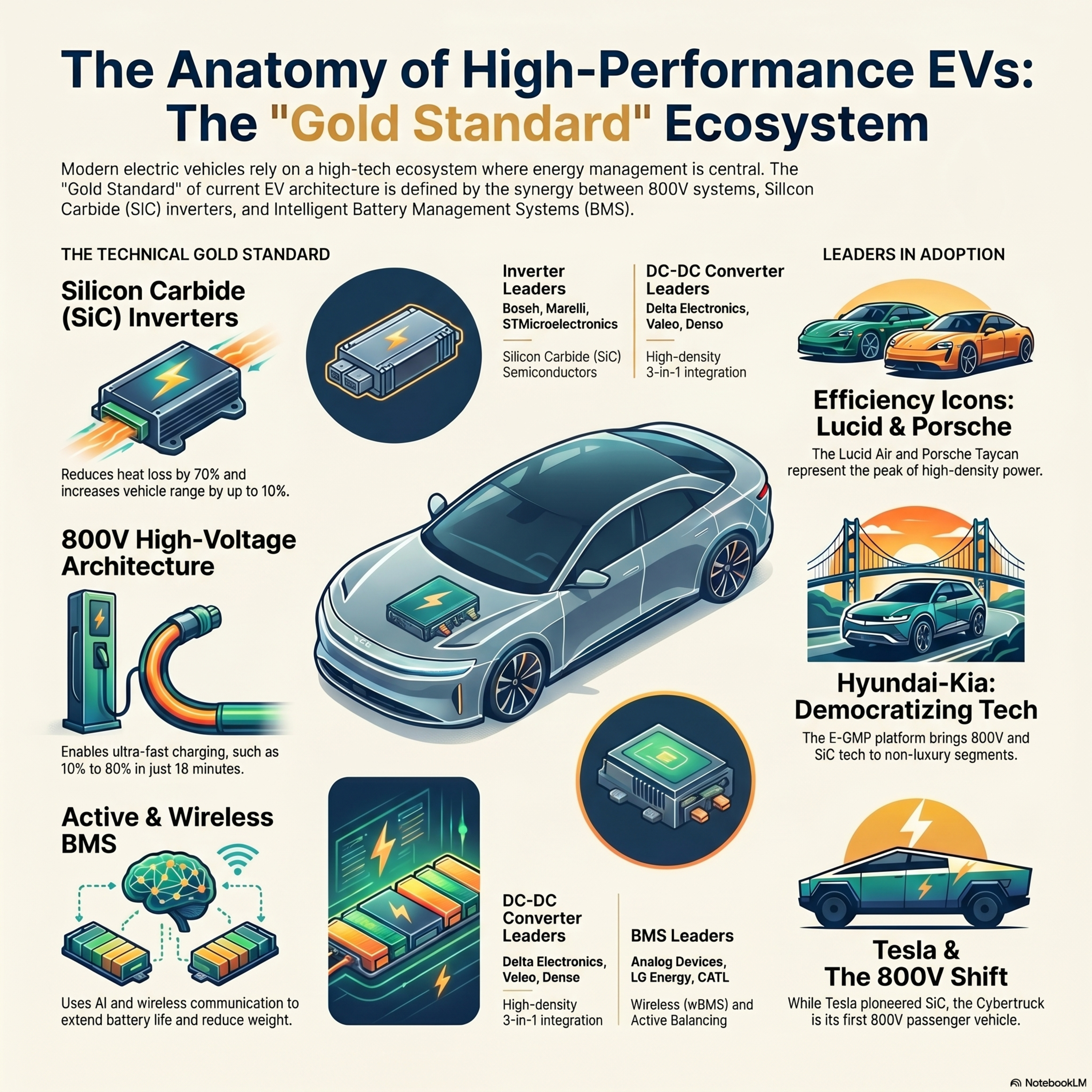 The Architecture of Electric Vehicle Energy Management | Modern electric vehicles rely on an intricate technological ecosystem where the inverter, DC-DC converter, and Battery Management System (BMS) serve as critical internal controllers. High-end efficiency is increasingly defined by the use of Silicon Carbide (SiC) semiconductors in inverters, which significantly minimize energy loss and extend driving range. Advanced power management also involves bidirectional converters that bridge high-voltage batteries with 12V onboard electronics while maintaining safety through galvanic isolation. To ensure longevity, superior BMS technology utilizes wireless communication and active balancing to distribute energy between battery cells intelligently. Leading industry suppliers now integrate artificial intelligence and 800-volt architectures to predict hardware degradation and optimize thermal safety. Ultimately, these sophisticated components distinguish premium electric powertrains through their ability to maximize power density and computational oversight. | — | ||||||
| 6/19/26 | Anatomy of Grandland Electric | Offers a comprehensive deep dive into the technical and design evolution of Opel's flagship SUV. Built on the cutting-edge STLA Medium platform, the new Grandland represents a milestone in electrification, offering a range of up to 694 km (WLTP) with its massive 97 kWh battery.The article dissects the vehicle's structure and innovative features, highlighting:Technical Mastery: An exploration of the powertrain options, including the first-ever all-electric AWD variant with a system output of 239 kW (325 hp) and a 0-100 km/h acceleration in just 6.1 seconds.Aero-Design & "Greenovation": A look at the most aerodynamically efficient Grandland yet, with a drag coefficient of 0.278. The design focuses on sustainability, replacing chrome with embossed lettering and featuring the striking 3D Vizor with an illuminated Blitz emblem.Cutting-Edge Lighting: A breakdown of the industry-leading Intelli-Lux HD headlamps, which utilize over 50,000 individual elements to provide high-definition, glare-free illumination.Interior Comfort & Tech: Inside the "anatomy" is a driver-centric cockpit featuring AGR-certified Intelli-Seats for superior ergonomics and the innovative Pixel Box, which offers wireless charging and edge-light technology.Dynamic Chassis: Detailed insights into the Frequency Selective Damping (FSD) technology, a standard feature that mechanically adapts damping force to balance high-frequency comfort with low-frequency sportiness.From its efficient thermal management to its sophisticated driver assistance systems (ADAS), "Anatomy of Grandland Electric" reveals how Opel has combined German engineering with the "Greenovation" philosophy to create a state-of-the-art electric SUV. | — | ||||||
| 6/19/26 |  The All-Electric Opel Grandland: Evolution and Technical Mastery | The provided episode outlines the specifications and features of the 2025/2026 Opel Grandland Electric, a modern SUV built on a dedicated battery-electric platform. This vehicle offers two battery configurations, with the long-range model delivering up to 700 km of travel on a single charge. Beyond technical performance, the source highlights enhanced interior comfort through specialized seating and the inclusion of physical controls for better usability. Potential buyers are given a clear financial overview, including pricing tiers for the Italian market and eligibility for government incentives. Additionally, the source emphasizes the car's long-term durability, noting extensive battery warranties and the capability for over-the-air software updates to maintain the vehicle's value. In essence, the source presents the Grandland as a spacious and practical solution for those transitioning to electric mobility. | — | ||||||
| 6/18/26 | Retro-Futurist Icons: The Battle of Driving Soul and Digital Flow | This deep dive explores how the MINI Cooper SE and Renault 5 E-Tech redefine the electric era through two distinct "retrofuturist" lenses. We analyze the MINI’s commitment to its legendary "Go-kart feeling" and high-tier construction against the Renault 5’s focus on digital fluidity and urban practicality.Discover how the market is splitting between "hardware-as-luxury" and "software-as-utility," helping you decide if you value a proprietary driving dynamic or a cutting-edge Google Automotive ecosystem.We break down the technical trade-offs between the MINI’s rigid, performance-oriented chassis and the Renault 5’s optimized energy management and intuitive multimedia interface. Whether you are looking for the residual value stability of a luxury asset or the seamless connectivity of a modern urban tool, this analysis synthesizes the two most influential philosophies in the current EV landscape.EnjoyCoffee:https://buymeacoffee.com/emotorselectricrevolution | — | ||||||
| 6/18/26 | 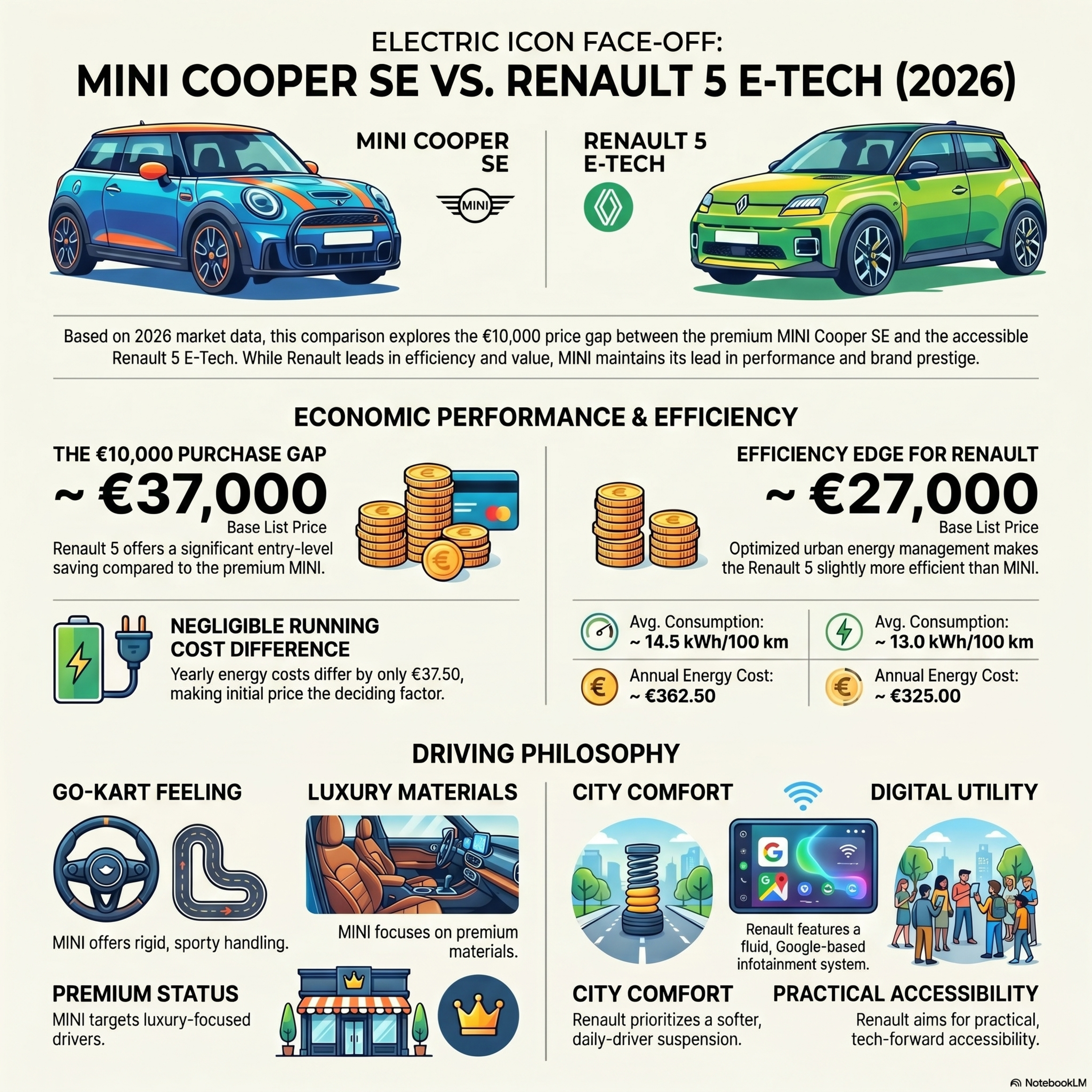 Electric Icons: MINI Cooper SE vs. Renault 5 E-Tech | The provided sources analyze the 2026 electric vehicle market by contrasting the MINI Cooper SE and the Renault 5 E-Tech, highlighting a significant divide between luxury and utility. While the MINI is positioned as a premium asset that justifies a 10,000 € surcharge through superior materials and specialized driving dynamics, the Renault 5 serves as a rational, mass-market tool prioritizing digital connectivity and affordability. Data indicates that while the Renault 5 is more energy-efficient, the actual annual savings on electricity are statistically negligible, shifting the focus toward the initial purchase price and long-term residual value. Strategically, the MINI targets those seeking prestige and performance, whereas the Renault 5 appeals to pragmatic consumers who value modern infotainment and urban comfort. Ultimately, the comparison illustrates how the automotive industry has bifurcated into distinct emotional and functional tiers, where brand identity often outweighs operational costs. | — | ||||||
| 6/17/26 | Ecosystem vs. Hardware: Who Dominates the Premium Electric SUV Segment? | Welcome to the ultimate most influential electric SUV coupés: the Tesla Model Y, the XPeng G6, and the Polestar 4. This isn't just a comparison of cars; it’s a battle between two different visions of the future: one defined by seamless software ecosystems and the other by cutting-edge performance hardware.In this analysis, we break down the contenders:Tesla Model Y – The Ecosystem Powerhouse: Often called the "iPhone of cars," the Model Y's greatest strength is its closed-loop ecosystem. While others focus on specs, Tesla focuses on the experience, offering unmatched integration with the Supercharger network and industry-leading software stability. It remains the efficiency king, consuming just 16 kWh/100 km, making it the most rational choice for those who want a car that "just works."XPeng G6 – The Hardware Disruptor: If Tesla is the ecosystem play, the XPeng G6 is the hardware flex. Built on a next-generation 800V architecture, it can "inhale" energy, charging from 10% to 80% in just 20 minutes—more than twice as fast as the Tesla. With features like V2L (Vehicle-to-Load), it acts as a giant mobile power bank, offering high-spec technology (usually reserved for $150,000 super-sedans) at a much more competitive price point.Polestar 4 – Premium Engineering & Design: Representing the pinnacle of Scandinavian hardware and performance, the Polestar 4 delivers a "visceral emotion" that gadgets can't match. With a staggering 544 HP and a 0-100 km/h sprint in 3.8 seconds, it is the fastest and most luxurious driver’s car in this triad. Its boldest hardware move? Removing the rear window entirely in favor of high-definition digital cameras to achieve a sleek, aerodynamic silhouette.The Verdict: The choice comes down to your priority: Do you want the perfectly polished ecosystem of the Tesla, the future-proofed hardware of the XPeng, or the premium design and performance of the Polestar?EnjoyCoffee:https://buymeacoffee.com/emotorselectricrevolution | — | ||||||
| 6/17/26 | 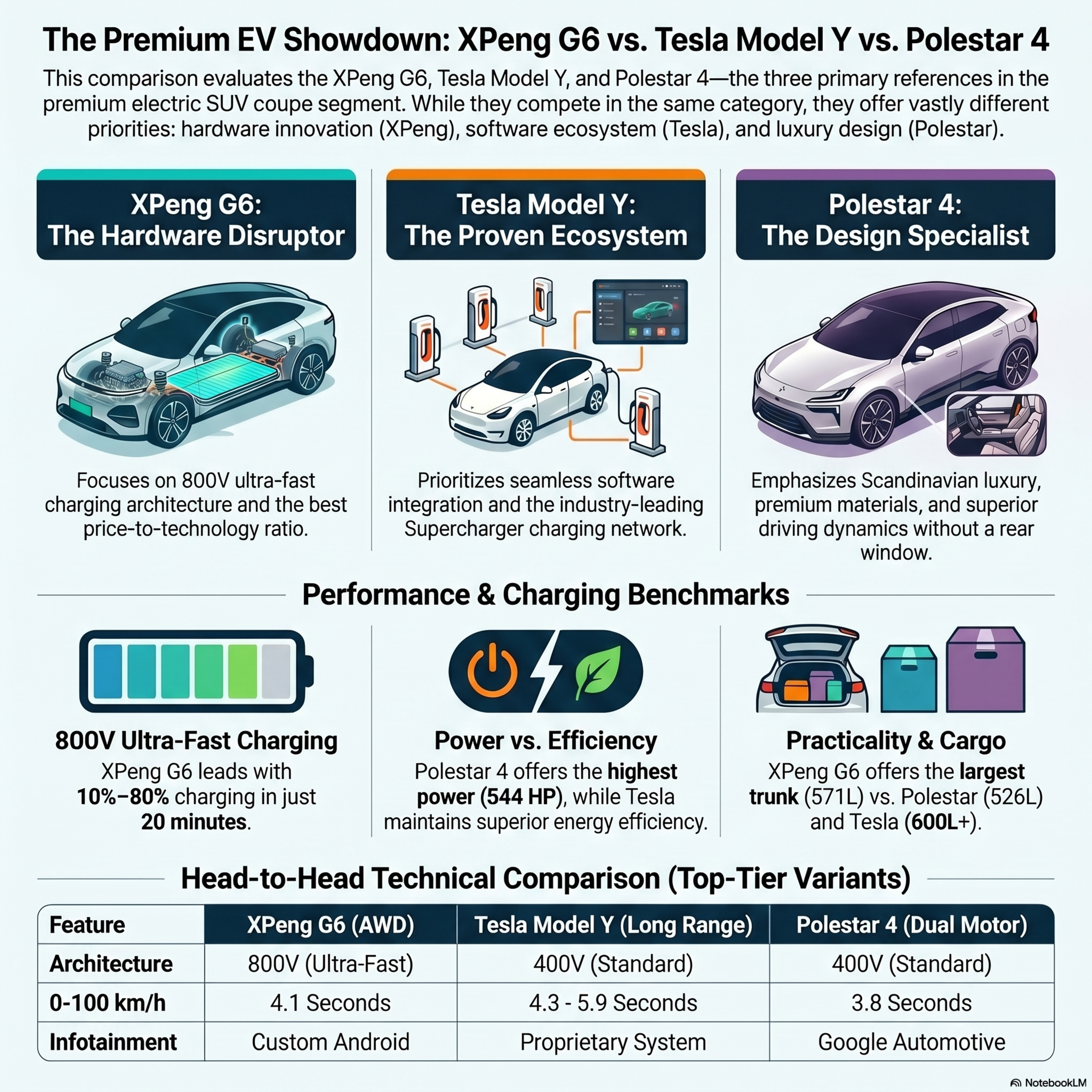 Electric SUV Coupé Triad: XPeng, Tesla, and Polestar Compared | The provided episode offers a detailed comparative analysis of three leading premium electric SUV coupes: the XPeng G6, Tesla Model Y, and Polestar 4. It evaluates these vehicles based on their charging architecture, software ecosystems, and overall design philosophies. The XPeng G6 is highlighted for its superior 800V ultra-fast charging and overall value, while the Tesla Model Y remains the industry standard for software integration and charging infrastructure. Meanwhile, the Polestar 4 is positioned as the luxury choice, focusing on Scandinavian aesthetics, high-end materials, and driving dynamics. Ultimately, the source serves as a guide to help buyers choose a vehicle based on whether they prioritize technological hardware, digital ecosystems, or premium craftsmanship. | — | ||||||
| 6/16/26 | The Biomechanics of Driving | "The Biomechanics of Driving" explores the vehicle as a controlled environment that dictates the operator’s homeostatic state, framing the transition from manual internal combustion engines to electric propulsion as a fundamental biological intervention,. The article examines how modern automotive design actively alters a driver's muscle tension, hormonal secretion, and neurological equilibrium.Key areas of focus in the article include:Musculoskeletal Optimization: Manual driving is characterized by asymmetrical biomechanical loads, such as chronic tension in the left leg from clutch engagement and upper body rigidity from gear shifting,. Electric vehicles (EVs) promote symmetrical postural alignment and utilize "One-Pedal" driving to mitigate repetitive strain on the Achilles tendon and subtalar joint,,.Neurological Stress Reduction: The article details a shift from Sympathetic Nervous System dominance (high cortisol and adrenaline) to Parasympathetic Activation,,. By removing the "cognitive friction" of mechanical synchronization, EVs allow the driver to maintain a state of "cognitive ease",.Vibration and Auditory Impact: The absence of high-frequency motor vibrations and acoustic stressors in EVs prevents involuntary muscle micro-contractions and stabilizes the heart rate,,. This synergy effectively eliminates "heavy head" syndrome—the cognitive fog and lethargy often experienced after long trips in traditional vehicles,.Biological Challenges: The episode identifies a "double-edged sword" where the extreme fluidity of EVs can lead to reduced alertness (highway hypnosis) due to a drop in Beta waves,,. Additionally, instant torque can trigger motion sickness (kinetosis) in passengers through sensory mismatch,.Ultimately, the article describes the evolution of the driver from a manual laborer into a high-level cognitive monitor. This transition is presented as a "productivity dividend" for professional drivers, ensuring they arrive at their destinations in a state of superior physiological preservation, | — | ||||||
| 6/16/26 | 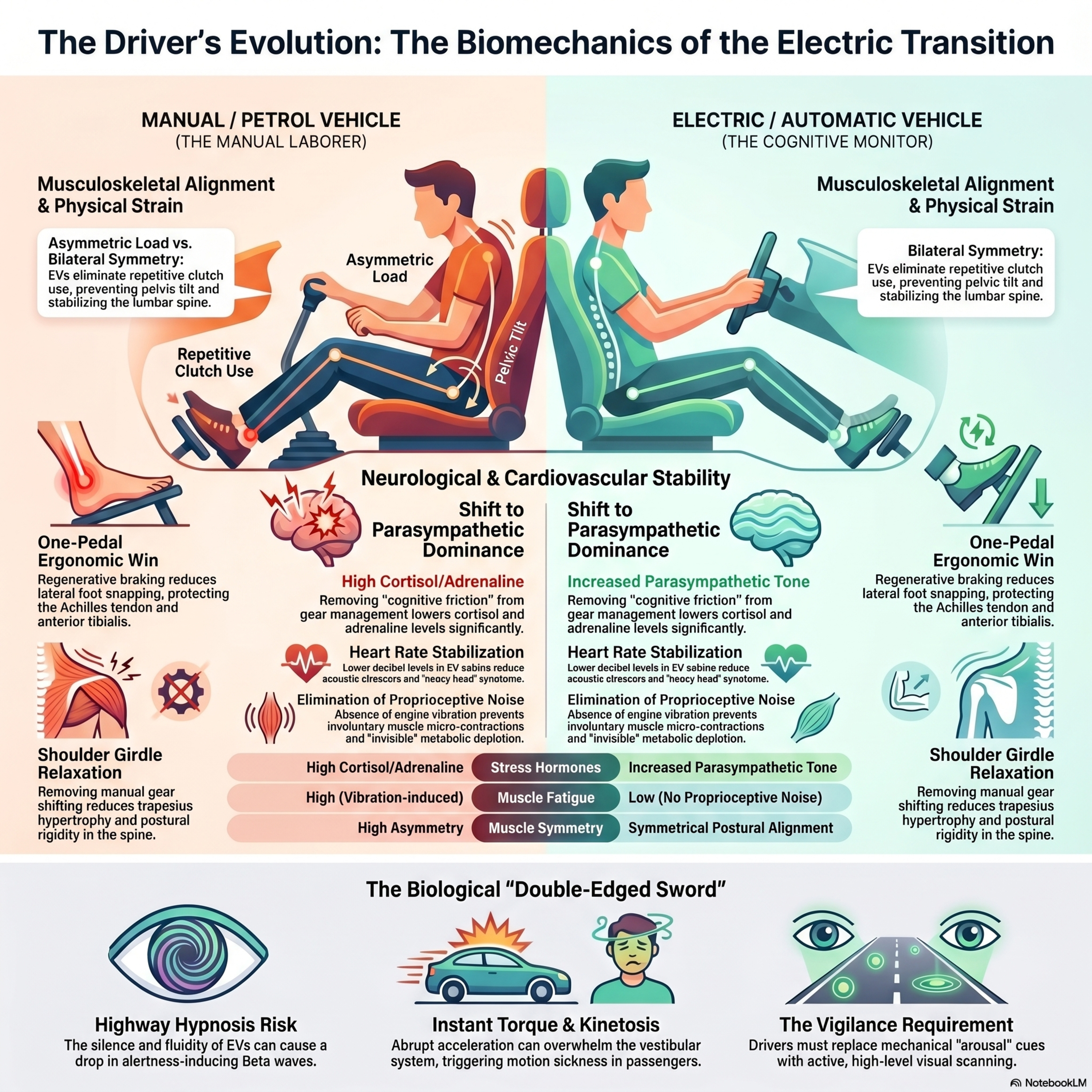 The Biological Impact of Electric Vehicle Operation | The provided episode examines the biophysical advantages of operating an electric vehicle compared to a traditional manual gasoline car. By eliminating the need for gear shifts and clutch engagement, electric cars significantly reduce physical strain on the musculoskeletal system and lower the cognitive load on the brain. The removal of engine vibrations and noise further promotes a relaxed nervous system, leading to decreased stress hormones and a steadier heart rate. However, the source also warns of potential safety risks, such as increased driver drowsiness due to extreme quiet and passenger motion sickness from sudden torque. Ultimately, the source highlights how modern vehicle technology conserves human energy, provided that drivers remain vigilant against the pitfalls of decreased sensory stimulation. | — | ||||||
Showing 25 of 638
Pitch Fit is a Pro feature
See how bookable this show is for guests, which brands already advertise, the per-episode ad value, and the best-fit guest and sponsor profile. The numbers are blurred on the free plan.
How readily this show books outside guests like you.
How proven this show is for host-read sponsorships.
For Guests
ProFor Advertisers
ProUpgrade to Pro to unlock guest cadence, sponsor categories, fit scores, and per-episode ad value for this show.
Chart Positions
27 placements across 26 markets.
Chart Positions
27 placements across 26 markets.