

ENGLISH POCAST | STEP BY STEP | Learn by Listening and Speaking without effort.
by YOUR ENGLISH TOOLBOX
Is this your podcast?Insights from recent episode analysis
Audience Interest
Podcast Focus
Publishing Consistency
Platform Reach
Insights are generated by CastFox AI using publicly available data, episode content, and proprietary models.
Total monthly reach
Estimated from 2 chart positions in 2 markets.
By chart position
- 🇨🇦CA · Language Learning#1965K to 30K
- 🇬🇷GR · Language Learning#783K to 10K
- Per-Episode Audience
Est. listeners per new episode within ~30 days
4K to 20K🎙 ~2x weekly·66 episodes·Last published today - Monthly Reach
Unique listeners across all episodes (30 days)
8K to 40K🇨🇦75%🇬🇷25% - Active Followers
Loyal subscribers who consistently listen
3.2K to 16K
Market Insights
Platform Distribution
Reach across major podcast platforms, updated hourly
Total Followers
—
Total Plays
—
Total Reviews
—
* Data sourced directly from platform APIs and aggregated hourly across all major podcast directories.
On the show
Recent episodes
A Second Date with a Lithuanian Woman, a November Forest, and the Conversation That Changed Everything
May 20, 2026
Unknown duration
Is AI Lying to you ? Artificial Inteligence Chatbots. An honest review.
May 17, 2026
Unknown duration
Mics Off 2: Work Isn’t Everything…
May 13, 2026
Unknown duration
Mics Off: The Date Martin Couldn’t Stop Thinking About
May 10, 2026
Unknown duration
Learn English with Music: The Hidden Meaning Behind "Flowers" by Miley Cyrus
May 3, 2026
Unknown duration
Social Links & Contact
Official channels & resources
Official Website
Login
RSS Feed
Login
| Date | Episode | Description | Length | ||||||
|---|---|---|---|---|---|---|---|---|---|
| 5/20/26 |  A Second Date with a Lithuanian Woman, a November Forest, and the Conversation That Changed Everything | This podcast is narrated using advanced AI voice technology (powered by ElevenLabs) to ensure consistent clarity, natural pacing, and an easy-to-follow listening experience — especially helpful for language learners. All scripts are written and carefully edited by real humans, combining expert content creation with voice technology to bring you the best of both worlds: ✅ Human intelligence and creativity ✅ AI precision and clarity We use slow, natural pronunciation and carefully chosen vocabulary to support learners at every level.Martin left his voice recorder running. He did not mean to. What it captured was a second date, a forest in November, and a conversation that went somewhere nobody planned.In Part 1, you listen to Martin and Helena walking through the trees. She is from Lithuania. She speaks four languages. She values silence more than most people value words. Martin coaches people on momentum and forward movement for a living — and yet, standing next to her, he stops completely still. This first part is rich, slow, natural English: the language of honesty, observation, and real human connection. You will hear vocabulary for describing emotion, atmosphere, and the kind of conversation that actually matters.In Part 2, the conversation turns to something Martin and his colleague Julia have been thinking about deeply: AI chatbots, and the trap they set for all of us. Helena calls it immediately — a beautiful lie is still a lie. The episode explores what Martin and Julia call the pleasing trap: the tendency of AI systems to tell you what you want to hear rather than what is true. And then it teaches you the single most important skill for using AI well — how to ask a real question. Not a vague one. A precise one. One that requires you to look at something without flinching.Key learning points in this episode include natural conversational English at a slow, clear pace, advanced vocabulary for describing feelings, places, and abstract ideas, the difference between language that means something and language that merely sounds like it does, how to think critically about AI and the answers it gives you, and how precision in language — in prompts, in conversation, in life — produces better outcomes than comfort-seeking.This episode is directly relevant for IELTS Speaking Parts 1, 2 and 3, where examiners reward the kind of rich, reflective, natural English you will hear throughout. It is excellent preparation for TOEFL Speaking Tasks and Cambridge B2 First and C1 Advanced, which test exactly the descriptive, analytical, and conversational vocabulary that Martin and Helena model here. The language of this episode — nuanced, unhurried, emotionally precise — is the language that separates good exam candidates from outstanding ones.The quality of the answer is always a reflection of the courage in the question. Press play. Walk into the forest. Listen carefully.slow english podcast, english comprehension, english listening practice, learn english, your english toolbox, english shadowing, english mindset, vocabulary practice, conversational english advanced, descriptive english vocabulary, english for real conversations, emotional vocabulary english, english dialogue listening, AI english lesson, how to use AI to learn english, english prompting skills, critical thinking english, nature vocabulary english, intermediate advanced english podcast, authentic english conversation, IELTS speaking practice, IELTS vocabulary, IELTS part 2 describe a place, IELTS part 3 abstract discussion, TOEFL speaking, Cambridge B2 First, C1 Advanced, exam english, academic english listening, exam strategies💬 We’d love to hear from you!If you enjoyed this episode, leave a comment, share your thoughts, or tell us how you’re using these tips to improve your English. Your feedback helps us grow and create even better content for you. Hosted on Acast. See acast.com/privacy for more information. | — | ||||||
| 5/17/26 |  Is AI Lying to you ? Artificial Inteligence Chatbots. An honest review. | This podcast is narrated using advanced AI voice technology (powered by ElevenLabs) to ensure consistent clarity, natural pacing, and an easy-to-follow listening experience — especially helpful for language learners. All scripts are written and carefully edited by real humans, combining expert content creation with voice technology to bring you the best of both worlds:✅ Human intelligence and creativity✅ AI precision and clarity We use slow, natural pronunciation and carefully chosen vocabulary to support learners at every level.⚠️ The AI told Martin exactly what he wanted to hear. He ended up in hospital.He had a fever. He asked an AI chatbot instead of his doctor. The machine gave him stretches, herbal teas, and reassurance. Two days later he was in the emergency room. The doctor was shocked he had waited so long.This is not a technology review. This is a conversation about human judgment in the age of intelligent machines — in slow, clear, natural English you can actually follow and learn from.🎙️ "The Yes Machine" — Can You Really Trust Artificial Intelligence?Martin and Julia open the black box of AI — ChatGPT, Claude, Gemini, DeepSeek — and examine what really happens when you press send.✦ Why AI is built to please you first — and tell the truth second ✦ What hallucinations really are — and why AI invents facts with total confidence ✦ How Martin received three fake medical citations from journals that don't exist ✦ Julia's "supercar strategy" — the smarter way most people never discover ✦ Why your prompt quality matters more than the AI itself ✦ The one line that forces AI to stop agreeing with your bad ideas ✦ Why the best AI users are the clearest thinkers — not the fastest typers"The machine doesn't give you clarity. It only reflects the clarity you already have."📚 Perfect for exam preparation: 🎯 IELTS Speaking • TOEFL • Cambridge B2 & C1 ✅ Opinion & debate language • Critical thinking expressions • Technology vocabulary • Natural conversational pacing💬 Have you ever received a wrong or strangely confident answer from an AI? Tell us your story in the comments — the best ones will be featured in our next episode.🔑 slow english podcast, your english toolbox, learn english, AI hallucinations, ChatGPT dangers, can you trust AI, critical thinking english, technology english, IELTS speaking practice, TOEFL speaking, Cambridge B2 C1, english listening practice, english fluency 2025, advanced english podcast🎧 Slow down. Think clearly. Stay human.💬 We’d love to hear from you!If you enjoyed this episode, leave a comment, share your thoughts, or tell us how you’re using these tips to improve your English. Your feedback helps us grow and create even better content for you. Hosted on Acast. See acast.com/privacy for more information. | — | ||||||
| 5/13/26 |  Mics Off 2: Work Isn’t Everything… | This podcast is narrated using advanced AI voice technology (powered by ElevenLabs) to ensure consistent clarity, natural pacing, and an easy-to-follow listening experience — especially helpful for language learners.All scripts are written and carefully edited by real humans, combining expert content creation with voice technology to bring you the best of both worlds:✅ Human intelligence and creativity✅ AI precision and clarityWe use slow, natural pronunciation and carefully chosen vocabulary to support learners at every level.🎙️ Welcome back to Mics Off, the more personal and reflective series from Your English Toolbox, where Martin and Julia step away from structured lessons and talk honestly about work, stress, relationships, technology, and modern life.In this second episode, Julia opens up about a toxic situation at work that slowly turns into something much darker than simple office politics. What starts with interruptions and passive-aggressive behaviour begins to look like a calculated attempt to replace her professionally. As the emotional tension grows, Martin helps Julia reflect on an important question:What happens when your job becomes your entire identity?At the same time, Martin prepares for his second date with Elena and struggles with something many people secretly fear: being emotionally “too much” for another person. Together, they explore silence, vulnerability, emotional balance, and the difficulty of slowing down in a world obsessed with productivity.Later in the episode, the conversation shifts toward AI chatbots, emotional dependency on technology, and the danger of confusing artificial empathy with real human wisdom. Martin and Julia disagree respectfully about whether AI can genuinely help lonely people or whether it risks becoming a comforting but dangerous “yes-man.”This episode includes:• Natural conversational English at intermediate level• Real-life vocabulary about work stress, anxiety, emotions, and technology• Expressions like “walking on eggshells,” “yes-man,” “good books,” and “sink your ship”• Listening practice with authentic emotional rhythm and modern spoken English• Cultural discussion about office dynamics and digital relationships• Useful pronunciation patterns and conversational pacing🎓 EXAM-ORIENTED LEARNINGThis episode is especially useful for learners preparing for:• IELTS Speaking Parts 1–3• TOEFL Speaking Tasks• Cambridge B1 Preliminary, B2 First, and C1 Advanced• Listening comprehension exams• Real-world conversational fluencyYou will hear:• Opinion language• Agreement and disagreement structures• Emotional vocabulary• Workplace English• Functional language for discussion and debate• Natural pronunciation features used by native speakersKeywordsslow english podcast, english listening practice, english comprehension, learn english naturally, your english toolbox, conversational english, workplace english, office vocabulary, emotional english vocabulary, anxiety vocabulary, AI chatbot discussion, modern life english, listening fluency, english mindset, spoken english practice, intermediate english podcast, natural english conversation, english expressions, english shadowing, relationship vocabulary, IELTS speaking practice, IELTS vocabulary, TOEFL speaking, Cambridge B2 First, C1 Advanced, exam English, academic English listening, exam strategies💬 We’d love to hear from you!If you enjoyed this episode, leave a comment, share your thoughts, or tell us how you’re using these tips to improve your English. Your feedback helps us grow and create even better content for you. Hosted on Acast. See acast.com/privacy for more information. | — | ||||||
| 5/10/26 |  Mics Off: The Date Martin Couldn’t Stop Thinking About | This podcast is narrated using advanced AI voice technology (powered by ElevenLabs) to ensure consistent clarity, natural pacing, and an easy-to-follow listening experience — especially helpful for language learners.All scripts are written and carefully edited by real humans, combining expert content creation with voice technology to bring you the best of both worlds:✅ Human intelligence and creativity✅ AI precision and clarityWe use slow, natural pronunciation and carefully chosen vocabulary to support learners at every level.In this special new format called Mics Off, we invite you into something more intimate and personal.For the first time, you will hear Martin and Julia talking before the official recording begins — relaxed, vulnerable, and completely off-air.Martin opens up about his first date after 18 months alone.Why did such a simple evening make him feel nervous again?Why did he immediately start imagining a future with someone he had just met?Meanwhile, Julia reveals the emotional exhaustion of working in corporate HR, dealing with burnout, pressure, and difficult personalities every single day.This episode slowly transforms from a conversation about dating into a deeper reflection on loneliness, emotional masks, vulnerability, anxiety, and human connection.In this episode, you’ll learn:• Natural English used in emotional conversations• Vocabulary about relationships, stress, work pressure, and feelings• Real conversational pacing and authentic dialogue• Expressions connected to vulnerability and emotional honesty• Everyday phrases native speakers use when talking privatelyThis episode is especially useful for:✅ IELTS Speaking Parts 1–3✅ TOEFL Speaking Tasks✅ Cambridge B1/B2/C1 Listening & Speaking✅ Learners who want authentic conversational English✅ Students improving emotional vocabulary and listening comprehensionYou’ll also hear advanced but natural expressions like:• “energy vampire”• “pressure cooker”• “holding space for others”• “breaking my peace”• “comfortably alone”• “projecting your future”This is not a traditional lesson.It’s a human conversation designed to help you feel English emotionally, not only intellectually.And maybe, while listening to Martin and Julia speak honestly about their fears and hopes, you’ll also reflect on your own life a little more deeply.Leave a comment telling us:Have you ever felt nervous before a first date?Or emotionally exhausted from work?Your comments help platforms recommend the podcast to more English learners around the world.Special thanks to everyone supporting our growing Slow English community.KEYWORDSslow english podcast, english listening practice, english comprehension, learn english naturally, authentic english conversation, your english toolbox, emotional english vocabulary, dating vocabulary in english, workplace english, burnout vocabulary, relationships english expressions, stress and anxiety english, real english dialogue, conversational english practice, vulnerability vocabulary, advanced listening practice, english for emotional communication, jazz club conversation, human connection english, IELTS speaking practice, IELTS vocabulary, TOEFL speaking tasks, Cambridge B2 First, C1 Advanced, exam English, academic English listening, english fluency training, english shadowing, natural spoken english, english podcast for learners💬 We’d love to hear from you!If you enjoyed this episode, leave a comment, share your thoughts, or tell us how you’re using these tips to improve your English. Your feedback helps us grow and create even better content for you. Hosted on Acast. See acast.com/privacy for more information. | — | ||||||
| 5/3/26 |  Learn English with Music: The Hidden Meaning Behind "Flowers" by Miley Cyrus | This podcast is narrated using advanced AI voice technology (powered by ElevenLabs) to ensure consistent clarity, natural pacing, and an easy-to-follow listening experience — especially helpful for language learners. All scripts are written and carefully edited by real humans, combining expert content creation with voice technology to bring you the best of both worlds: ✅ Human intelligence and creativity ✅ AI precision and clarity We use slow, natural pronunciation and carefully chosen vocabulary to support learners at every level.Welcome to a very special episode of Your English Toolbox. SLOW ENGLISH PODCAST . Today, Martin and Julia guide you through one of the most powerful learning tools in language acquisition: music. Using Flowers by Miley Cyrus, you will explore how English expresses emotion, identity, and transformation.This is not just about understanding lyrics — it’s about feeling the language.In this episode, you will:Learn how grammar (past vs present, “we” vs “I”) shapes meaningDiscover powerful verbs and expressions about growth and resilienceUnderstand metaphors like gold, fire, and flowers in real EnglishImprove listening through slow, spoken, and natural-speed EnglishBuild confidence using “I can…” structures for self-expression🎯 EXAM FOCUS This episode supports:IELTS Speaking (Parts 1–3: expressing feelings, opinions, personal stories)TOEFL Speaking (independent speaking + narrative coherence)Cambridge B1/B2/C1 (Listening & Speaking fluency, vocabulary range)Key areas: emotional vocabulary, narrative structure, pronunciation, connected speechBy the end, you won’t just understand the song — you’ll understand yourself in English.💬 Tell us: Did this format help you learn better? What song should we analyze next? Your comment helps this podcast grow and reach more learners.⏱️ TIME STAMPS 00:00 – Intro & New Learning Method (Music + English) 01:30 – Why Music Is a Powerful Learning Tool 03:00 – The Hidden Story Behind Flowers 05:00 – From Sadness to Empowerment (Song Transformation) 07:00 – Verse 1 Deep Dive (Past, “We”, Loss) 09:30 – Vocabulary Focus: Gold, Dream, Burn 12:00 – Pre-Chorus: Emotional Shift (“I didn’t want…”) 14:00 – Grammar Insight: From “We” to “I” 16:00 – Chorus Breakdown: “I can…” Power Structure 18:30 – Reflexive Pronouns Explained (myself, your own) 20:30 – Self-Love Vocabulary Toolkit 22:00 – Final Verse: Present Tense & Reclaiming Identity 24:00 – Forgiveness, Closure & Emotional Language 26:00 – Full Song Recap: From Fire to Flowers 28:00 – Listening Again with New Understanding 29:30 – Final Message & Call to Action🔑 KEYWORDSflowers by miley cyrus, slow english podcast, english comprehension, english listening practice, learn english, your english toolbox, english shadowing, english mindset, vocabulary practice, learn english with music, miley cyrus flowers meaning, english through songs, emotional vocabulary english, self love expressions english, grammar through music, IELTS speaking practice, IELTS vocabulary, TOEFL speaking, Cambridge B2 First, C1 Advanced, exam English, academic English listening, exam strategies💬 We’d love to hear from you!If you enjoyed this episode, leave a comment, share your thoughts, or tell us how you’re using these tips to improve your English. Your feedback helps us grow and create even better content for you. Hosted on Acast. See acast.com/privacy for more information. | — | ||||||
| 4/26/26 | 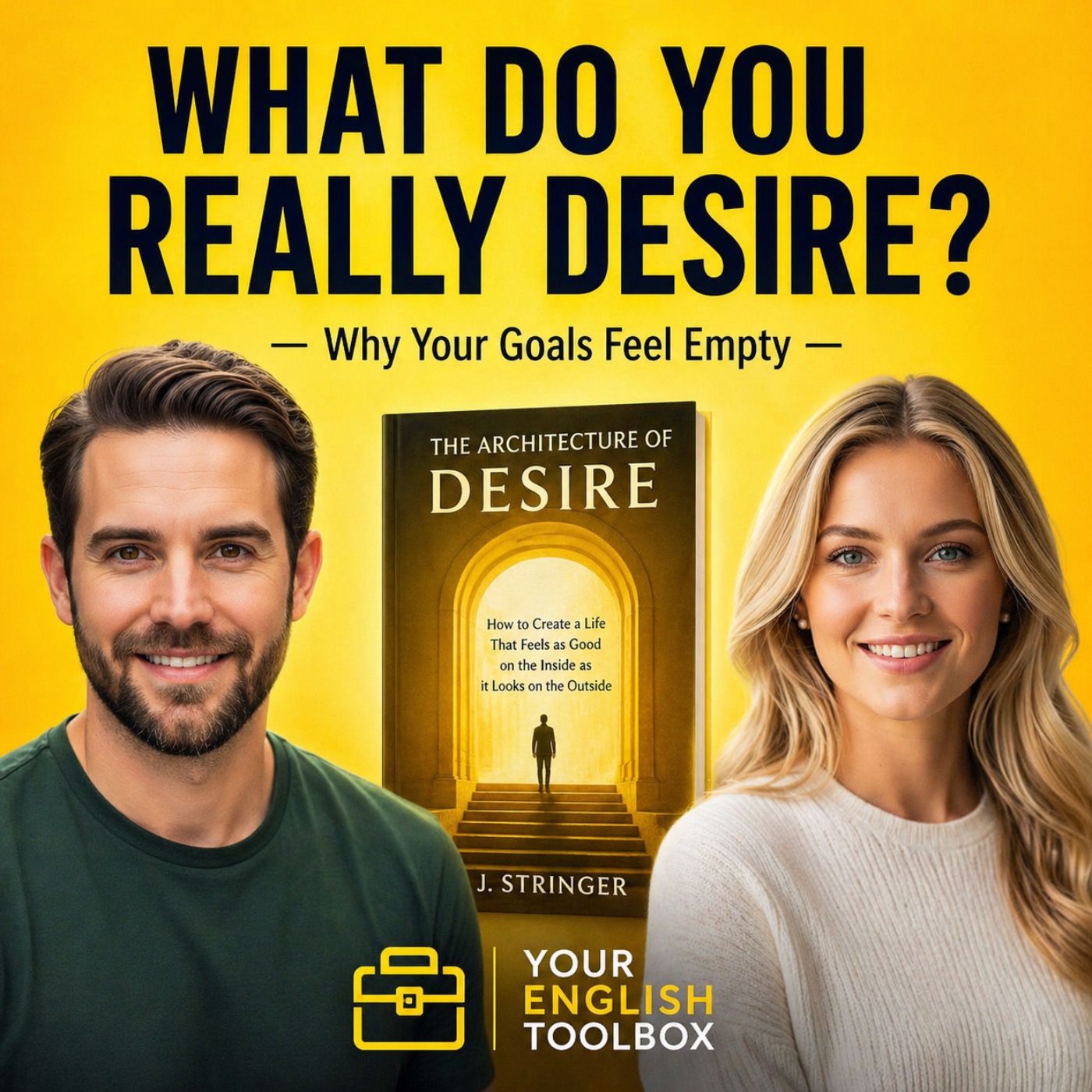 Do You Really Understand What You DESIRE? | This podcast is narrated using advanced AI voice technology (powered by ElevenLabs) to ensure consistent clarity, natural pacing, and an easy-to-follow listening experience — especially helpful for language learners.All scripts are written and carefully edited by real humans, combining expert content creation with voice technology to bring you the best of both worlds:✅ Human intelligence and creativity✅ AI precision and clarityWe use slow, natural pronunciation and carefully chosen vocabulary to support learners at every level.In this episode you will learn about business English, learn English, speaking practice, els listening, slow English.Have you ever achieved something you worked hard for… and felt strangely empty the next day?In this episode, Martin and Julia explore one of the most powerful and misunderstood forces in your life: desire.Through deep storytelling and clear English, you’ll discover why your goals sometimes feel like a “false horizon,” how social pressure shapes what you think you want, and how to reconnect with your authentic voice.This episode is not just about English — it’s about understanding yourself while improving your listening skills.🧠 What you’ll learn in this episode:• The “success hangover” and why goals don’t fix deeper problems• The 3 voices of desire: impulsive, social, and authentic• How inherited beliefs from your past influence your decisions• Why numbing emotions also kills motivation and creativity• How to use your body as a guide to detect real desire• The hidden meaning behind envy (and why it’s useful)• Why failure can be the most honest moment of your life• A practical “Desire Audit” you can apply today🎯 EXAM FOCUS (IMPORTANT):This episode helps you practice:• IELTS Speaking (Parts 1–3): expressing opinions, emotions, abstract ideas• TOEFL Speaking: structured reasoning and personal reflection• Cambridge B1/B2/C1: listening comprehension, vocabulary depth, fluency• Advanced vocabulary: yearning, avoidance, authenticity, emotional awareness• Natural pronunciation, rhythm, and connected speechYour goals are not the problem — your hidden desires are.When you understand them, everything changes.And English becomes the tool to express your real self.⏱️ TIME STAMPS 00:00 – Intro & The Question That Changes Everything01:20 – The “Success Hangover” Explained03:00 – Why Goals Don’t Fix Your Life04:40 – The False Horizon Effect06:20 – The 3 Voices of Desire08:10 – Impulsive vs Social vs Authentic Voice10:00 – The Trap of Fantasy11:40 – Inherited Desires (The “Ghosts”)13:20 – Shame and Hidden Identity15:00 – The Numbing Paradox16:30 – Why High Achievers Feel Empty18:00 – Listening to Your Body19:40 – Vocabulary of Desire (Yearning vs Wanting)21:00 – Envy as a Hidden Map22:30 – The Sacredness of Failure24:00 – The Final Desire Audit25:30 – Final Reflection & Call to Action🔑 KEYWORDSslow english podcast, english comprehension, english listening practice, learn english, your english toolbox, english shadowing, english mindset, vocabulary practice, personal development english, psychology vocabulary, emotional intelligence english, desire meaning, motivation english, self awareness english, IELTS speaking practice, IELTS vocabulary, TOEFL speaking, Cambridge B2 First, C1 Advanced, exam English, academic English listening, exam strategies🏷️ HASHTAGS#SlowEnglishPodcast #YourEnglishToolbox #LearnEnglish #EnglishListeningPractice #IELTS #TOEFL #CambridgeEnglish #PersonalDevelopment #EmotionalIntelligence #EnglishVocabulary #Mindset #SelfAwareness💬 We’d love to hear from you!If you enjoyed this episode, leave a comment, share your thoughts, or tell us how you’re using these tips to improve your English. Your feedback helps us grow and create even better content for you. Hosted on Acast. See acast.com/privacy for more information. | — | ||||||
| 4/19/26 |  Ancient Japanese Techniques to Learn English Faster (Kata, Kaizen, Shoshin Explained) | his podcast is narrated using advanced AI voice technology (powered by ElevenLabs) to ensure consistent clarity, natural pacing, and an easy-to-follow listening experience — especially helpful for language learners.All scripts are written and carefully edited by real humans, combining expert content creation with voice technology to bring you the best of both worlds:✅ Human intelligence and creativity✅ AI precision and clarityWe use slow, natural pronunciation and carefully chosen vocabulary to support learners at every level.In this episode you will learn about business English, learn English, speaking practice, els listening, slow English.Welcome to a powerful episode where ancient Japanese philosophy meets modern language learning.In this slow English experience, Martin, Julia, and Peter guide you through five timeless techniques that will completely transform how you learn English — from muscle memory to mindset.If you feel stuck, overwhelmed, or unable to speak fluently despite understanding English, this episode is designed for you.🧠 In this episode, you will learn:• How to stop translating and start speaking automatically (Kata)• Why reading silently is damaging your speaking ability (Ondoku)• How to build consistency without burnout (Kaizen)• The mindset shift that breaks the intermediate plateau (Shoshin)• How to improve your reading and vocabulary effortlessly (Tadoku)🎯 This episode is especially useful for:• business English learners who need fluency in meetings• learners focused on speaking practice and real communication• students improving els listening and comprehension• anyone using slow English methods to build confidence📚 EXAM FOCUS (VERY IMPORTANT)This episode supports:• IELTS Speaking (Parts 1, 2, 3) – fluency, coherence, natural phrasing• TOEFL Speaking – automatic response and structured answers• Cambridge B1/B2/C1 – real communication, listening accuracy, pronunciationYou will also learn exam-relevant vocabulary, functional language, and pronunciation patterns naturally through storytelling.💬 Call to ActionTell us: Which technique will you try first — Kata, Kaizen, or Tadoku?Your comments help more learners discover this podcast and build a real learning community.🔁 Quick RecapSpeak in chunks.Train your voice, not just your eyes.Improve a little every day.Stay open.Read more, stress less.⏱️ TIME STAMPS 00:00 – Intro & Episode Overview01:30 – Why Ancient Japanese Methods Work for English03:20 – Technique 1: Kata (The Power of Patterns)07:30 – How to Apply Kata to Speaking Practice10:20 – Technique 2: Ondoku (Reading Out Loud)14:10 – Why Silent Reading Hurts Your Speaking17:00 – Technique 3: Kaizen (Small Daily Improvements)21:00 – Building a Sustainable Learning Habit24:00 – Technique 4: Shoshin (Beginner’s Mind)27:30 – Breaking the Intermediate Plateau30:00 – Technique 5: Tadoku (Extensive Reading)33:30 – How to Read Without a Dictionary35:30 – Final Recap & Key Takeaways37:00 – Closing Message & Call to Action🔍 KEYWORDS slow english podcast, slow english, slow English learning, english listening practice, els listening, learn English, speaking practice, business English, your english toolbox, english shadowing, english mindset, vocabulary acquisition, fluency training, Japanese learning techniques, kata method English, kaizen learning English, ondoku reading aloud, shoshin mindset, tadoku reading method, IELTS speaking practice, IELTS vocabulary, TOEFL speaking, Cambridge B2 First, C1 Advanced, exam English, academic English listening, exam strategies💬 We’d love to hear from you!If you enjoyed this episode, leave a comment, share your thoughts, or tell us how you’re using these tips to improve your English. Your feedback helps us grow and create even better content for you. Hosted on Acast. See acast.com/privacy for more information. | — | ||||||
| 4/16/26 | 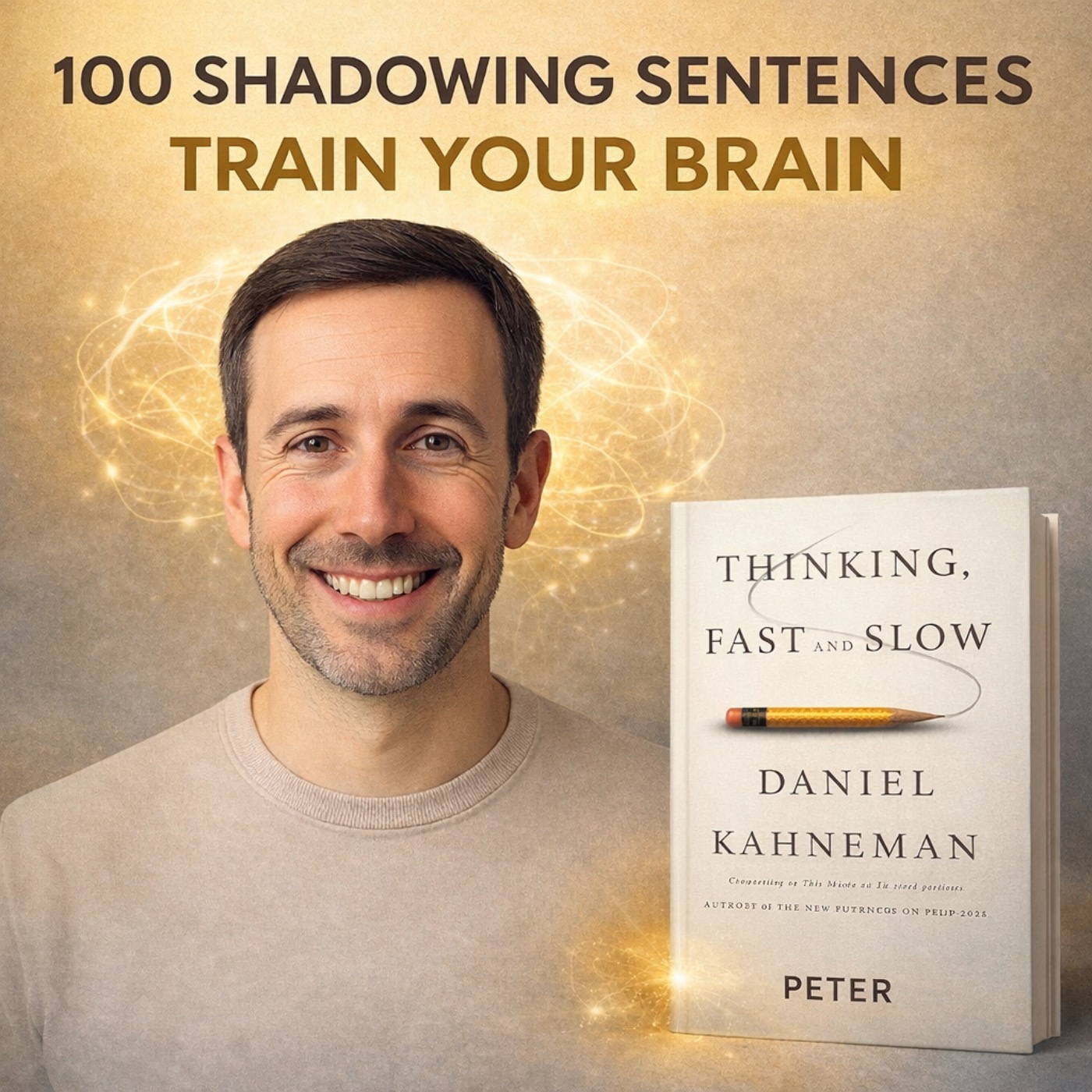 100 Shadowing Sentences to Rewire Your Brain (Think Fast & Slow Training) | This podcast is narrated using advanced AI voice technology (powered by ElevenLabs) to ensure consistent clarity, natural pacing, and an easy-to-follow listening experience — especially helpful for language learners.All scripts are written and carefully edited by real humans, combining expert content creation with voice technology to bring you the best of both worlds:✅ Human intelligence and creativity✅ AI precision and clarityWe use slow, natural pronunciation and carefully chosen vocabulary to support learners at every level.Welcome to a special shadowing episode of Your English Toolbox. In today’s session, Peter guides you through 100 powerful sentences inspired by the ideas of Thinking Fast and Slow, designed to train your brain while improving your English naturally.This is not just listening — this is deep training. You will work with rhythm, pronunciation, emotional delivery, and cognitive awareness, activating both your fast and slow thinking systems while speaking English out loud.In this episode, you will:• Practice 100 carefully structured shadowing sentences• Understand key concepts like System 1 vs System 2, the Halo Effect, and loss aversion• Build fluency through repetition, rhythm, and emotional engagement• Train your focus, memory, and speaking confidence simultaneously🎯 This episode is especially useful for:IELTS Speaking (Parts 1–3), TOEFL Speaking tasks, and Cambridge B1–C1 exams, helping you develop fluency, pronunciation control, and exam-relevant vocabulary in a natural and structured way.💬 Call to action:After listening, write one sentence from the episode in the comments and tell us how it made you feel.Your comments help this podcast grow and reach more learners like you.🔁 Quick recap:You trained your English through shadowing, explored how your brain works, and built both fluency and mental clarity — at the same time.⏱️ TIME STAMPS 00:00 – Intro & Episode Purpose01:40 – How to Shadow Correctly03:05 – System 1 vs System 2 Explanation04:00 – Shadowing Block 1 (Sentences 1–20)07:10 – The Storyteller & Halo Effect08:30 – Shadowing Block 2 (Sentences 21–40)11:30 – Overconfidence & Planning Fallacy12:45 – Shadowing Block 3 (Sentences 41–60)15:40 – Loss Aversion & Fear of Mistakes16:50 – Shadowing Block 4 (Sentences 61–80)19:50 – The Two Selves Explained21:00 – Shadowing Block 5 (Sentences 81–100)23:30 – Final Reflection & Closing Message24:00 – End🔍 KEYWORDSslow english podcast, english comprehension, english listening practice, learn english, your english toolbox, english shadowing, shadowing technique english, thinking fast and slow english, cognitive bias english, fluency practice, pronunciation training, speaking confidence, mental clarity, brain training english, intermediate english practice, IELTS speaking practice, IELTS vocabulary, TOEFL speaking, Cambridge B2 First, C1 Advanced, exam English, academic English listening, exam strategies🔖 HASHTAGS#SlowEnglishPodcast #YourEnglishToolbox #LearnEnglish #EnglishListeningPractice #EnglishShadowing #FluencyTraining #ThinkFastAndSlow #BrainTraining #IELTS #TOEFL #CambridgeEnglish #SpeakEnglish #EnglishPractice💬 We’d love to hear from you!If you enjoyed this episode, leave a comment, share your thoughts, or tell us how you’re using these tips to improve your English. Your feedback helps us grow and create even better content for you. Hosted on Acast. See acast.com/privacy for more information. | — | ||||||
| 4/6/26 | 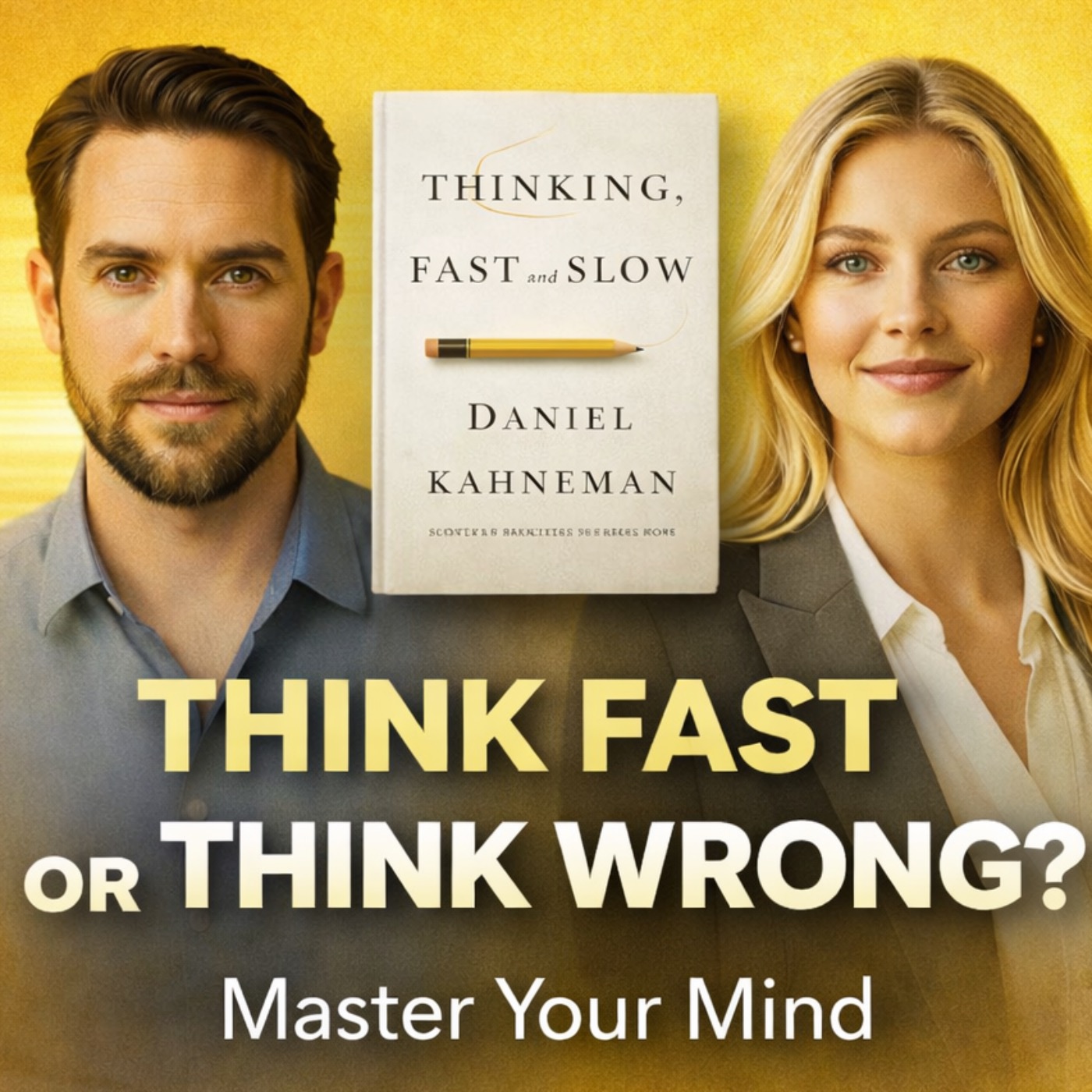 Think Fast… or Think Wrong? Learn How Your Mind Really Works (in English) | This podcast is narrated using advanced AI voice technology (powered by ElevenLabs) to ensure consistent clarity, natural pacing, and an easy-to-follow listening experience — especially helpful for language learners.All scripts are written and carefully edited by real humans, combining expert content creation with voice technology to bring you the best of both worlds:✅ Human intelligence and creativity✅ AI precision and clarityWe use slow, natural pronunciation and carefully chosen vocabulary to support learners at every level.Welcome to a new episode of Slow English Podcast – Your English Toolbox, where we learn English through powerful ideas that change the way you think.In this episode, Martin and Julia explore one of the most influential psychology books ever written: Thinking, Fast and Slow by Daniel Kahneman. You will discover how your brain actually works through two systems: one fast, emotional, and automatic… and one slow, logical, and often lazy.Through relatable stories, real-life examples, and simple explanations, you’ll learn how your mind creates shortcuts, why you make irrational decisions, and how to take control of your thinking — especially when learning English.🧩 In this episode, you will learn:What System 1 and System 2 are and how they affect your decisionsWhy your intuition is not always reliableThe meaning of WYSIATI (What You See Is All There Is)How anchoring influences your perception of valueWhy loss aversion keeps you stuck in your comfort zoneThe difference between your experiencing self and remembering selfHow the availability heuristic distorts your realityWhy we underestimate time (planning fallacy)Practical strategies to slow down your thinking and make better decisions🎯 EXAM FOCUSThis episode is packed with exam-relevant vocabulary and concepts useful for:IELTS Speaking (Parts 1–3: opinions, abstract thinking, decision-making)TOEFL Speaking (expressing reasoning and examples)Cambridge B1/B2/C1 (Listening comprehension & discussion topics)You’ll improve your ability to explain ideas, describe psychological concepts, and speak more confidently about abstract topics — essential for high scores.💬 Call to ActionTell us: have you ever made a decision too quickly and regretted it later?Write your answer using today’s vocabulary.Your comments help our podcast grow and reach more learners around the world.🔁 RecapThinking fast is natural — but thinking slow is powerful.The more aware you are of your mental habits, the better your English… and your life decisions will become.⏱️ TIME STAMPS 00:00 – Intro & Hook: Are you really in control of your thoughts?01:10 – The Two Systems Explained (System 1 vs System 2)02:40 – Why Your Brain Is Lazy04:00 – WYSIATI: The Dangerous Shortcut05:30 – The Halo Effect & First Impressions06:40 – Anchoring: How Your Mind Gets Manipulated08:00 – Creating Your English Environment09:20 – Loss Aversion: Why You Fear Mistakes10:50 – The Experiencing vs Remembering Self12:20 – The Peak-End Rule Explained13:40 – The Availability Heuristic15:00 – The Planning Fallacy & Overconfidence16:20 – Sunk Cost Fallacy17:10 – How to Slow Down Your Thinking18:00 – Final Message & Call to Action🔍 KEYWORDS (SEO + EXAM)slow english podcast, english listening practice, learn english naturally, english comprehension, your english toolbox, english mindset, english vocabulary practice, thinking fast and slow summary, daniel kahneman explained, cognitive biases, decision making psychology, mental models, loss aversion explained, anchoring bias examples, availability heuristic, planning fallacy, improve thinking skills, IELTS speaking practice, IELTS vocabulary, TOEFL speaking, Cambridge B2 First, C1 Advanced, exam English, academic English listening, exam strategies📢 HASHTAGS#SlowEnglishPodcast #YourEnglishToolbox #LearnEnglish #EnglishListeningPractice #IELTS #TOEFL #CambridgeEnglish #ThinkingFastAndSlow #Psychology #DecisionMaking #EnglishVocabulary #CognitiveBias #Mindset #LearnEnglishDaily💬 We’d love to hear from you!If you enjoyed this episode, leave a comment, share your thoughts, or tell us how you’re using these tips to improve your English. Your feedback helps us grow and create even better content for you. Hosted on Acast. See acast.com/privacy for more information. | — | ||||||
| 3/19/26 |  All You Need Is a Lover | This podcast is narrated using advanced AI voice technology (powered by ElevenLabs) to ensure consistent clarity, natural pacing, and an easy-to-follow listening experience — especially helpful for language learners.All scripts are written and carefully edited by real humans, combining expert content creation with voice technology to bring you the best of both worlds:✅ Human intelligence and creativity✅ AI precision and clarityWe use slow, natural pronunciation and carefully chosen vocabulary to support learners at every level.What if the real problem isn’t stress, work, or even depression… but the absence of passion in your life?In this powerful episode, Martin and Julia explore a provocative idea inspired by therapist Jorge Bucay: “What you need is a lover.” But not in the romantic sense — a lover as something that ignites your mind, gives meaning to your days, and pulls you out of monotony.Through deep reflection and relatable examples, you’ll discover why so many people today are not truly living… but simply enduring. And more importantly, how you can change that.🎙️ In this episode, you will learn:• The true meaning of “a lover” beyond romance• The difference between living and enduring• How monotony silently destroys motivation and energy• Why passion can be more powerful than medication in some cases• How to find your “flow state” and reconnect with life• Why English itself can become your “lover” and transformation tool🎯 EXAM FOCUS (IMPORTANT FOR LEARNERS)This episode helps you develop:• IELTS Speaking (Parts 1–3): expressing opinions, abstract ideas, and emotions• TOEFL Speaking: building structured arguments and personal reflections• Cambridge B1/B2/C1: fluency, coherence, and natural vocabulary use• Key vocabulary for emotional expression, motivation, and personal development• Pronunciation and listening skills through clear, slow, natural speech💬 Now it’s your turn:What is YOUR “lover”?What makes you lose track of time?Leave a comment and share it with us — your answer might inspire someone else.📌 Final thought:Don’t wait for the perfect moment to start living.Start today. Start small. But start.⏱️ TIME STAMPS 00:00 – Powerful hook: “What you really need is a lover”01:10 – Who is Jorge Bucay and why this idea shocks people02:30 – The hidden symptoms: insomnia, pessimism, monotony03:50 – Living vs surviving: what does “subsist” really mean?05:10 – Why modern life creates emotional emptiness06:20 – The real definition of a “lover”07:40 – Passion vs routine: where life starts to fade08:30 – English as your “lover” (learning as passion)09:50 – The danger of comfort and the “fine” life11:00 – The intermediate plateau in life and language12:10 – Why passion requires risk and vulnerability13:10 – Flow state: when time disappears14:10 – How to rediscover your passion15:10 – Final reflection: don’t endure, live16:30 – Closing message & call to action🔑 KEYWORDS slow english podcast, english listening practice, learn english naturally, your english toolbox, english comprehension, english vocabulary, emotional vocabulary english, personal development english, mindset english learning, passion and motivation english, flow state english, lifestyle english vocabulary, IELTS speaking practice, IELTS vocabulary, TOEFL speaking, Cambridge B2 First, C1 Advanced, exam English, academic English listening, exam strategies📱 HASHTAGS#SlowEnglishPodcast #YourEnglishToolbox #LearnEnglish #EnglishListeningPractice #IELTS #TOEFL #CambridgeEnglish #PersonalDevelopment #Mindset #EmotionalIntelligence #EnglishVocabulary #SelfGrowth #FlowState #Motivation #LearnEnglishDaily💬 We’d love to hear from you!If you enjoyed this episode, leave a comment, share your thoughts, or tell us how you’re using these tips to improve your English. Your feedback helps us grow and create even better content for you. Hosted on Acast. See acast.com/privacy for more information. | — | ||||||
Want analysis for the episodes below?Free for Pro Submit a request, we'll have your selected episodes analyzed within an hour. Free, at no cost to you, for Pro users. | |||||||||
| 3/11/26 |  Master 100 Essential Sentences like a Native | This podcast is narrated using advanced AI voice technology (powered by ElevenLabs) to ensure consistent clarity, natural pacing, and an easy-to-follow listening experience — especially helpful for language learners.All scripts are written and carefully edited by real humans, combining expert content creation with voice technology to bring you the best of both worlds: ✅ Human intelligence and creativity ✅ AI precision and clarityWe use slow, natural pronunciation and carefully chosen vocabulary to support learners at every level.Think about a master pianist for a moment. They do not start a masterpiece by playing at full speed; they begin by playing so slowly that every note and movement is intentional. They go back to the basics to build a foundation that eventually allows them to play with effortless amazement.In this episode of Your English Toolbox, Martin and Peter lead you through the A2 level, the skyscraper foundation of your language journey. Using our scientifically effective Fast-Slow-Fast workout , you will train your nervous system to mimic the natural rhythm of a native speaker.We bridge the gap between Colloquial English—the real, raw way people speak —and Foundation English—the clear, standard version.What you will master in this session:Health & Mindfulness: Phrases for hydration, stress reduction, and daily routines.Career & Motivation: How to discuss projects, deadlines, and learning new skills.Digital Life & Focus: Navigating software, security, and digital habits.Resilience & Mindset: The language of staying positive and learning from mistakes.The "Ear Map": Understanding how native speakers reduce "trying to" into "tryna" and "going to" into "gonna" to create flow.In This Episode, You’ll Discover:[00:00] The Pianist’s Secret: Why intentional slowness leads to mastery.[01:27] Health & Mindfulness: Phrases 1–10 for a balanced life.[04:20] Career & Motivation: Phrases 11–20 to fuel your professional growth.[07:01] Travel & Exploration: Phrases 21–30 for navigating new environments.[09:55] Educational Interlude: Building muscle memory and two mental maps for English.[11:23] Home Life & Routines: Phrases 31–40 for daily organization.[14:00] Digital Life & Focus: Phrases 41–50 for the modern learner.[16:53] Personal Growth: Phrases 51–60 for celebrating small wins[19:27] Human Relationships: Phrases 61–70 for better communication.[22:12] Resilience & Mindset: Phrases 71–80 for staying ready for the future.[25:04] Environment & Daily Focus: Phrases 81–90 for protecting our world.[27:51] Practical Life & Spending: Phrases 91–100 for smart daily choices.[30:33] The Workout Wrap-up: How consistency matters more than intensity.Which of these phrases was the most challenging to catch at colloquial speed? Leave a comment after listening—your voice helps our community grow and reach more learners.Keywords: English Learning, A2 English, Fast-Slow-Fast Method, English Fluency, Mindfulness, Personal Growth, ESL Podcast, English Foundation, A2 Level Foundation, Fast-Slow-Fast Method, Colloquial English Reductions, Foundation English, Muscle Memory Training, Auditory Processing, Personal Development Path, Mindfulness Vocabulary, Career Motivation English, Digital Life Vocabulary, Resilience Mindset, Environmental English, Practical Spending Phrases, Emotional Intelligence, Neuroplasticity for Learning, Deliberate Language Practice, Reduced Speech Patterns, Nervous System Training, Listening Comprehension, Language Identity Change.💬 We’d love to hear from you!If you enjoyed this episode, leave a comment, share your thoughts, or tell us how you’re using these tips to improve your English. Your feedback helps us grow and create even better content for you. Hosted on Acast. See acast.com/privacy for more information. | — | ||||||
| 2/28/26 | 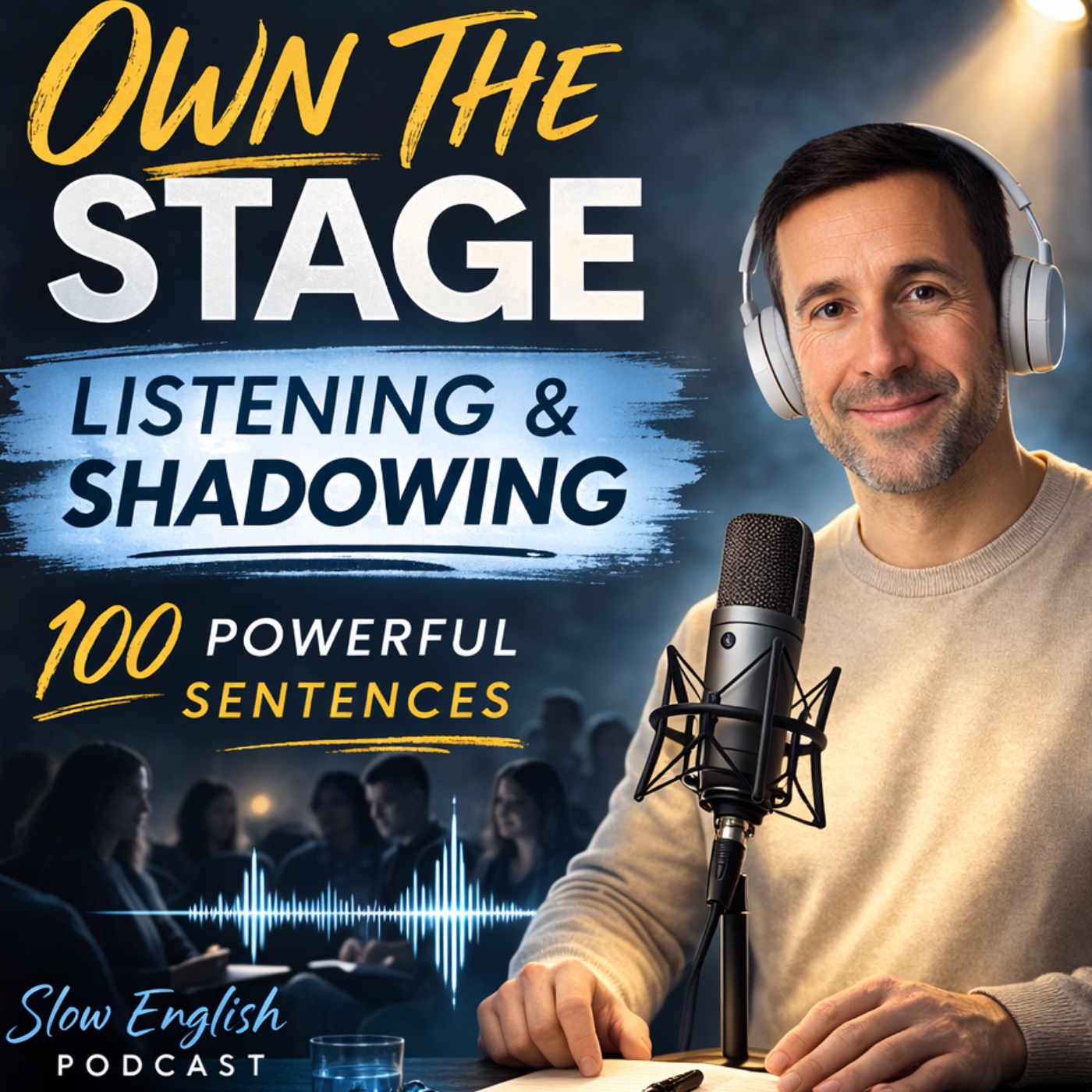 Calm English. 100 Powerful Sentences to Own the Stage (Public Speaking Series Ep. 4) | This podcast is narrated using advanced AI voice technology (powered by ElevenLabs) to ensure consistent clarity, natural pacing, and an easy-to-follow listening experience — especially helpful for language learners.All scripts are written and carefully edited by real humans, combining expert content creation with voice technology to bring you the best of both worlds:✅ Human intelligence and creativity✅ AI precision and clarityWe use slow, natural pronunciation and carefully chosen vocabulary to support learners at every level.In this fourth episode of our Public Speaking Series, Martin and Peter guide you through 100 essential sentences designed to help you speak English with calm authority and professional confidence.This is not theory.This is training.Through structured shadowing practice, you will learn how to:• Build a confident speaker mindset• Calm your nerves before starting• Open a presentation professionally• Use smooth transitions and linking phrases• Give strong examples and explanations• Deliver powerful conclusions• Close your speech with impactThis episode is especially useful for learners preparing for:🎯 IELTS Speaking (Parts 1, 2, and 3)🎯 TOEFL Speaking Tasks🎯 Cambridge B1 Preliminary, B2 First, C1 Advanced🎯 Academic presentations and professional communicationYou will practice exam-relevant vocabulary, functional language, linking devices, structured transitions, persuasive conclusions, and pronunciation features that examiners look for in high-level speaking performance.Public speaking is not about being perfect.It is about being prepared.If you practice these 100 sentences regularly, your fluency, rhythm, and confidence will improve dramatically.Leave a comment telling us which sentence felt the most powerful for you.Your comments help platforms understand that our community is active and growing — and that helps us continue creating new episodes every week.📌 Quick recap:In this episode, you trained your mindset, your openings, your transitions, your examples, and your conclusions — exactly the structure examiners expect in strong speaking performances.🔍 KEYWORDSslow english podcast, english listening practice, learn english, english shadowing practice, your english toolbox, public speaking in english, presentation skills english, confidence speaking english, linking words for speaking, transition phrases english, professional english communication, IELTS speaking practice, IELTS vocabulary, TOEFL speaking, Cambridge B2 First, C1 Advanced, exam English, academic English listening, exam strategies📱 HASHTAGS#SlowEnglishPodcast #YourEnglishToolbox #LearnEnglish #EnglishListeningPractice #PublicSpeaking #EnglishPresentation #IELTS #TOEFL #CambridgeEnglish #ExamEnglish #ShadowingPractice #ConfidenceInEnglish #EnglishFluency #SpeakEnglishConfidently⏱️ TIME STAMPS (Adjusted for 21 minutes)00:00 – Introduction & How Shadowing Works01:50 – Why Shadowing Builds Fluency03:20 – Mindset Sentences: Confidence on Stage05:40 – Emotional Reset: Becoming Calm Before Speaking07:20 – Grounding Techniques & Breath Control08:40 – Professional Greetings & Opening Lines10:30 – Structuring Your Presentation Clearly11:40 – Patreon Reminder & Study Materials12:20 – Powerful Transitions & Linking Phrases14:20 – Adding Logic: Cause, Contrast & Consequence15:40 – Using Examples to Support Ideas17:00 – Recap & Strong Conclusions18:10 – Professional Closing Sentences19:10 – Final Motivational Boost20:10 – Community Invitation & Final Message21:00 – End💬 We’d love to hear from you!If you enjoyed this episode, leave a comment, share your thoughts, or tell us how you’re using these tips to improve your English. Your feedback helps us grow and create even better content for you. Hosted on Acast. See acast.com/privacy for more information. | — | ||||||
| 2/24/26 |  Control Your Voice Under Pressure (Public Speaking & Oral Exams – Ep 3) | This podcast is narrated using advanced AI voice technology (powered by ElevenLabs) to ensure consistent clarity, natural pacing, and an easy-to-follow listening experience — especially helpful for language learners.All scripts are written and carefully edited by real humans, combining expert content creation with voice technology to bring you the best of both worlds:✅ Human intelligence and creativity✅ AI precision and clarityWe use slow, natural pronunciation and carefully chosen vocabulary to support learners at every level.Have you ever been asked a question in English… and suddenly your mind goes completely blank?In this powerful episode of Slow English Podcast, Martin and Julia explore why intelligent professionals freeze in meetings, interviews, and speaking exams — and why the problem is almost never vocabulary.Through the story of Ravi, a brilliant software engineer who panicked in a high-stakes meeting, we break down what really happens in your brain under pressure — and how to fix it using one simple, unforgettable structure.In this episode, you will learn:• Why “cognitive overload” causes your blank mind• The 3-Part Rule: Point – Example – Conclusion• How native speakers secretly rely on structure• Professional fillers to buy time confidently• Linking phrases that boost coherence instantly• How to improve IELTS Speaking Parts 2 and 3• How to sound structured in TOEFL Speaking Tasks• How to score higher in Cambridge B2 First and C1 Advanced• Exam-relevant vocabulary, functional language, and pronunciation clarityThis episode is especially helpful if you struggle with:public speaking anxiety, spontaneous questions, job interviews in English, exam speaking pressure, or professional meetings.You’ll discover that fluency is not about knowing more words.It’s about having a safe structure when your brain feels chaotic.🎯 Recap:When you freeze, it’s not your vocabulary failing.It’s your structure missing.And today, you learn the map.Leave a comment and tell us: what phrase do you use to buy time in English?⏱️ TIME STAMPS 00:00 – Welcome & The Fear of Going Blank01:20 – Why Freezing Is Not a Vocabulary Problem02:40 – Ravi’s Story: The Meeting That Went Wrong04:30 – What Really Happened in His Brain06:00 – Understanding Cognitive Overload07:30 – Why Native Speakers Don’t Panic09:00 – The 3-Part Rule: Point10:00 – Step 2: Example11:00 – Step 3: Conclusion12:00 – How to Buy Time Professionally13:30 – Powerful Linking Expressions14:40 – Live Practice: Remote Work Question16:30 – Why Structure Beats Vocabulary17:20 – Final Recap & Community Question18:00 – Closing Message🔎 KEYWORDS slow english podcast, english comprehension, english listening practice, learn english, your english toolbox, english shadowing, english mindset, vocabulary practice, public speaking english, blank mind english, cognitive overload speaking, professional english communication, speaking confidence, business english meetings, IELTS speaking practice, IELTS vocabulary, TOEFL speaking, Cambridge B2 First, C1 Advanced, exam English, academic English listening, exam strategies📢 HASHTAGS#SlowEnglishPodcast #YourEnglishToolbox #LearnEnglish #EnglishListeningPractice #PublicSpeaking #SpeakingConfidence #BusinessEnglish #IELTS #TOEFL #CambridgeEnglish #ExamPreparation #FluentEnglish💬 We’d love to hear from you!If you enjoyed this episode, leave a comment, share your thoughts, or tell us how you’re using these tips to improve your English. Your feedback helps us grow and create even better content for you. Hosted on Acast. See acast.com/privacy for more information. | — | ||||||
| 2/21/26 |  Control Your Nerves. ( Public Speaking and Oral Exams Ep2 ) | his podcast is narrated using advanced AI voice technology (powered by ElevenLabs) to ensure consistent clarity, natural pacing, and an easy-to-follow listening experience — especially helpful for language learners.All scripts are written and carefully edited by real humans, combining expert content creation with voice technology to bring you the best of both worlds:✅ Human intelligence and creativity✅ AI precision and clarityWe use slow, natural pronunciation and carefully chosen vocabulary to support learners at every level.Have you ever stood outside an exam room and felt your heart racing before you even said a word?In this powerful episode of Your English Toolbox – Slow English Podcast, Martin and Julia explore the real reason you panic before speaking English — and it’s not weakness. It’s physiology.Today we break down the famous 90-second adrenaline rule and show you how to manage your body before an English speaking exam.You will learn:• Why fear before speaking is biological, not personal• What really happens during an adrenaline rush• The 90-second chemical wave explained simply• A powerful breathing reset technique• Grounding strategies that calm your nervous system• How to memorize your “security sentence”• Why delaying your first words shows confidence• How to read the room and connect with examinersThis episode is especially useful for learners preparing for:✔ IELTS Speaking Parts 1–3✔ TOEFL Speaking Tasks✔ Cambridge B1 Preliminary, B2 First, C1 Advanced speaking exams✔ Academic English listening and pronunciation development✔ Functional language for high-pressure communicationYou will practice exam-relevant vocabulary such as:physiological responseadrenaline rushgrounding techniquedeliberate pauseauthority in speechnervous system regulationWe also focus on pronunciation clarity, sentence rhythm, and confidence under pressure — all essential for exam performance.Remember: unstoppable does not mean fearless. It means you know how to handle the wave.If you’ve ever felt your mind go blank in English, this episode is for you.Listen slowly. Train your nervous system. Speak with control.⏱️ TIME STAMPS 00:00 – Opening & Episode Promise01:10 – Why We Panic Before Speaking02:30 – Martin’s London Conference Story04:10 – What Is a Physiological Response?05:40 – The 90-Second Adrenaline Rule Explained07:00 – Why Panic About Panic Makes It Worse08:20 – The Breathing Reset Technique09:40 – Grounding Strategy & Physical Stability10:50 – The Security Sentence Strategy12:00 – The Delayed Start Technique13:10 – Final Recap & Confidence Shift14:21 – Closing Message & Call to ActionKEYWORDSslow english podcast, public speaking, english comprehension, english listening practice, learn english, your english toolbox, english shadowing, english mindset, vocabulary practice, speaking anxiety, fear of speaking english, adrenaline rush, breathing techniques for exams, public speaking confidence, grounding technique, delayed start technique, physiological response, nervous system control, IELTS speaking practice, IELTS vocabulary, TOEFL speaking, Cambridge B2 First, C1 Advanced, exam English, academic English listening, exam strategiesHASHTAGS#SlowEnglishPodcast #YourEnglishToolbox #LearnEnglish #EnglishListeningPractice #IELTS #TOEFL #CambridgeEnglish #SpeakingAnxiety #PublicSpeakingSkills #ExamPreparation #EnglishConfidence #IELTSSpeaking #AcademicEnglish #EnglishMindset💬 We’d love to hear from you!If you enjoyed this episode, leave a comment, share your thoughts, or tell us how you’re using these tips to improve your English. Your feedback helps us grow and create even better content for you. Hosted on Acast. See acast.com/privacy for more information. | — | ||||||
| 2/20/26 |  The Spotlight Effect That Is Holding You Back (Public Speaking Tips. Ep 1 / Oral English Exams) | This podcast is narrated using advanced AI voice technology (powered by ElevenLabs) to ensure consistent clarity, natural pacing, and an easy-to-follow listening experience — especially helpful for language learners.All scripts are written and carefully edited by real humans, combining expert content creation with voice technology to bring you the best of both worlds:✅ Human intelligence and creativity✅ AI precision and clarityWe use slow, natural pronunciation and carefully chosen vocabulary to support learners at every level.Have you ever made a small mistake in English and suddenly felt like the entire room was watching you?In this episode of the Slow English Podcast, Martin and Julia explore one of the most powerful psychological biases affecting language learners: The Spotlight Effect.You’ll discover why your brain exaggerates how much people notice your mistakes — and how this illusion secretly destroys your public speaking confidence.Through a real-life story from London, powerful vocabulary explanations, and a practical mindset shift, this episode will help you speak more freely in meetings, presentations, and daily conversations.🎯 In this episode, you will learn:• The psychology behind the Spotlight Effect• Why we overestimate how much others judge us• The meaning of self-conscious, center of attention, scrutiny, egocentric, and invisible• A C1-level vocabulary word explained clearly in context• A mental technique to reduce social anxiety when speaking English• How to use cognitive bias to your advantage📚 EXAM-ORIENTED BENEFITSThis episode helps you build:• IELTS Speaking confidence (Parts 1–3)• TOEFL Speaking clarity under pressure• Cambridge B2 First and C1 Advanced vocabulary for describing emotions and psychological states• Advanced exam-relevant vocabulary such as “scrutiny” and “cognitive bias”• Academic listening comprehension skills• Functional language for presentations and professional contextsIf you are preparing for an exam, struggling with public speaking anxiety, or trying to sound more natural and confident in English — this episode is for you.💬 Before you go, tell us:When was the last time you felt the spotlight effect?Your comments help platforms recommend our podcast to more learners around the world.Listen slowly. Think deeply. Speak confidently.⏱️ TIME STAMPS 00:00 – Opening Hook: The Panic of Making a Mistake00:40 – Introducing the Spotlight Effect01:20 – The London Presentation Story02:10 – The “Money Box” Moment02:50 – Feeling Self-Conscious Explained03:30 – Center of Attention & Scrutiny04:20 – Why the Brain Is Egocentric05:00 – Why Your Mistakes Are Invisible05:40 – The Mental Shift for Public Speaking06:20 – Vocabulary Recap07:00 – Final Message & Call to Action🔎 KEYWORDSslow english podcast, english comprehension, english listening practice, learn english, your english toolbox, english shadowing, english mindset, vocabulary practice, public speaking anxiety, spotlight effect psychology, social anxiety vocabulary, confidence in english, presentation skills english, fear of speaking english, psychological bias, self conscious meaning, scrutiny vocabulary, IELTS speaking practice, IELTS vocabulary, TOEFL speaking, Cambridge B2 First, C1 Advanced, exam English, academic English listening, exam strategies🏷️ HASHTAGS#SlowEnglishPodcast #YourEnglishToolbox #LearnEnglish #EnglishListeningPractice #IELTS #TOEFL #CambridgeEnglish #PublicSpeaking #ConfidenceInEnglish #EnglishVocabulary #ExamEnglish #SocialAnxiety #SpeakWithConfidence💬 We’d love to hear from you!If you enjoyed this episode, leave a comment, share your thoughts, or tell us how you’re using these tips to improve your English. Your feedback helps us grow and create even better content for you. Hosted on Acast. See acast.com/privacy for more information. | — | ||||||
| 2/19/26 |  Add ONE Word and Your English Changes: YET (Fixed vs Growth Mindset) | This podcast is narrated using advanced AI voice technology (powered by ElevenLabs) to ensure consistent clarity, natural pacing, and an easy-to-follow listening experience — especially helpful for language learners.All scripts are written and carefully edited by real humans, combining expert content creation with voice technology to bring you the best of both worlds:✅ Human intelligence and creativity✅ AI precision and clarityWe use slow, natural pronunciation and carefully chosen vocabulary to support learners at every level.In today’s short, powerful episode, Martin and Julia show you how one tiny word can completely change the way you learn English: “yet.”Have you ever thought: “I can’t do this”… and felt like your brain hit a wall? In just a few minutes, we break down the mindset behind that feeling, using a real story (the infamous guitar F chord) and a simple language “hack” you can start using today.What you’ll learn (fast + practical):The difference between a fixed mindset and a growth mindset (in simple, real English).3 advanced C1 adjectives to describe learning barriers: static, insurmountable, malleable.The “identity trap”: why “I’m not musical” / “I’m bad at English” blocks progress.The one-word upgrade: “I can’t… yet.”A weekly challenge to re-train your self-talk and sound more natural in English.Exam-oriented bonus (IELTS / TOEFL / Cambridge):This episode builds high-value speaking material for IELTS Speaking Parts 1–3, TOEFL Speaking tasks, and Cambridge B1/B2/C1—especially for:Talking about learning experiences, challenges, personal growth, and goals.Using precise adjectives and clear explanations (a key scoring feature in speaking bands).Sounding confident when you describe problems and solutions.✅ Your mission: Leave a comment with ONE thing you “can’t do… yet” in English (listening, phrasal verbs, pronunciation, fast movies, speaking under pressure).Comments help platforms recommend the show, and they help our learning community grow.Quick recap: Your brain is not static. Your problem is not insurmountable. You are more malleable than you think—so add “yet” and keep going.⏱️ TIME STAMPS 00:00 – The “brick wall” feeling (hook)00:22 – Welcome + meet Martin & Julia00:45 – The tiny word that changes everything: “yet”01:10 – Story: learning the guitar and the F chord01:52 – The identity trap: “I’m not musical” / “I can’t do this”02:20 – Fixed mindset explained (simple + clear)02:55 – C1 word #1: static (meaning + use)03:25 – C1 word #2: insurmountable (meaning + image)03:55 – C1 word #3: malleable (meaning + science angle)04:35 – The one-word upgrade: “I can’t… yet”05:10 – Weekly challenge: catch yourself and add “yet”05:50 – Listener question: what can’t you do yet?06:23 – Final message + goodbye🔎 KEYWORDSslow english podcast, your english toolbox, learn english, english listening practice, english mindset, growth mindset, fixed mindset, carol dweck, english self confidence, speak english clearly, english speaking practice, advanced english vocabulary, c1 adjectives, static meaning, insurmountable meaning, malleable meaning, use yet in english, identity statements in english, i can’t yet, real spoken english, ielts speaking vocabulary, ielts speaking part 2 ideas, ielts band 7 vocabulary, toefl speaking practice, cambridge b1 speaking, cambridge b2 speaking, cambridge c1 speaking, pronunciation and fluency, natural english expressions, english motivation, learn faster by mindset💬 We’d love to hear from you!If you enjoyed this episode, leave a comment, share your thoughts, or tell us how you’re using these tips to improve your English. Your feedback helps us grow and create even better content for you. Hosted on Acast. See acast.com/privacy for more information. | — | ||||||
| 2/18/26 |  Six Minutes of Words in Action — Do Not Kill the Party | his podcast is narrated using advanced AI voice technology (powered by ElevenLabs) to ensure consistent clarity, natural pacing, and an easy-to-follow listening experience — especially helpful for language learners.All scripts are written and carefully edited by real humans, combining expert content creation with voice technology to bring you the best of both worlds:✅ Human intelligence and creativity✅ AI precision and clarityWe use slow, natural pronunciation and carefully chosen vocabulary to support learners at every level.What happens when English moves from the textbook into real life?In this fast but focused episode, we bring you six minutes of vocabulary in action. No theory. No long explanations. Just real spoken English that you can immediately recognize, understand, and use.Today’s episode explores everyday conversational language around social situations, energy, confidence, and expression — including phrases like “don’t kill the party” and other dynamic expressions used in real interaction.You will practice:• Natural rhythm and connected speech• Functional expressions for social situations• Tone and emotional vocabulary• Conversational reactions and spontaneous phrasing• Vocabulary that sounds natural, not translatedThis episode is especially useful for learners preparing for:IELTS Speaking Parts 1–3TOEFL Speaking TasksCambridge B1/B2 First & C1 Advanced SpeakingListening comprehension examsReal-life conversational fluencyYou’ll hear exam-relevant vocabulary, functional language, pronunciation features, and emotional nuance that help you sound more natural and confident.By the end of these six minutes, you will not only understand the expressions — you will feel them.Leave a comment using one of today’s phrases.Tell us where you are listening from.Your comments help platforms recommend this podcast to more learners around the world.Small episodes. Real English. Immediate progress.⏱️ TIME STAMPS 00:00 – Intro & Episode Concept00:35 – Why Words in Action Matter01:05 – Social Energy & Expression Vocabulary01:45 – “Do Not Kill the Party” Explained02:25 – Tone & Emotional Context03:05 – Real-Life Scenario Practice03:50 – Listening Focus: Intonation & Rhythm04:30 – Quick Reaction Phrases05:10 – Natural Conversation Flow05:50 – Exam Application & Speaking Strategy06:30 – Final Recap & Call to Action06:55 – End🔎 KEYWORDSslow english podcast, english comprehension, english listening practice, learn english, your english toolbox, english shadowing, english mindset, vocabulary practice, real spoken english, conversational english, natural expressions, social english vocabulary, functional phrases, fluency training, spoken interaction, emotional vocabulary, IELTS speaking practice, IELTS vocabulary, TOEFL speaking, Cambridge B2 First, C1 Advanced, exam English, academic English listening, exam strategies#️⃣ HASHTAGS#SlowEnglishPodcast #YourEnglishToolbox #LearnEnglish #EnglishListeningPractice #IELTS #TOEFL #CambridgeEnglish #RealEnglish #ConversationalEnglish #EnglishVocabulary #FluencyPractice #SpokenEnglish #ExamEnglish💬 We’d love to hear from you!If you enjoyed this episode, leave a comment, share your thoughts, or tell us how you’re using these tips to improve your English. Your feedback helps us grow and create even better content for you. Hosted on Acast. See acast.com/privacy for more information. | — | ||||||
| 2/17/26 |  Calm Shadowing Practice: Think for Yourself (100 Sentences) | This podcast is narrated using advanced AI voice technology (powered by ElevenLabs) to ensure consistent clarity, natural pacing, and an easy-to-follow listening experience — especially helpful for language learners.All scripts are written and carefully edited by real humans, combining expert content creation with voice technology to bring you the best of both worlds:✅ Human intelligence and creativity✅ AI precision and clarityWe use slow, natural pronunciation and carefully chosen vocabulary to support learners at every level.Welcome to a Calm English shadowing episode with Peter — a deep listening and pronunciation workout designed to help you speak more clearly, think more calmly, and build real confidence in English. In this slow English session, you will shadow 100 carefully written sentences based on Think for Yourself (Thibaut Maurice), focusing on rhythm, stress, clarity, and mental focus. This is perfect for shadowing practice, listening comprehension, slow listening, accent training, fluency building, and daily speaking routines.Inside this episode you will practice:• Shadowing and repetition with clean, calm pacing• Strong B1–B2 sentence structure you can reuse in real conversations• Powerful ideas about groupthink, cognitive bias, first principles, and personal values• Vocabulary for describing independent thinking, social pressure, manipulation, and freedom• A calm “mental reset” style that improves focus while you improve EnglishIf you learn one new sentence today, leave a short comment with it. Tell us where you’re listening from and which idea hit you the most. Your comments help platforms recommend the podcast, grow our Slow English community, and keep these calm listening and shadowing episodes coming.Quick recap: This is a calm shadowing session with 100 sentences that trains your listening, pronunciation, and speaking confidence — while you explore the mindset of thinking for yourself.⏱️ TIME STAMPS 00:00 – Calm intro + how to use this shadowing episode01:10 – Shadowing Set 1: Autopilot and awareness03:05 – Shadowing Set 2: The trap of groupthink05:05 – Shadowing Set 3: Social pressure and pluralistic ignorance07:00 – Shadowing Set 4: Cognitive filters and confirmation bias09:05 – Shadowing Set 5: Availability heuristic and emotional thinking11:00 – Shadowing Set 6: First principles and independent logic13:05 – Shadowing Set 7: Information diet and protecting focus15:10 – Shadowing Set 8: Humility and the expert trap17:10 – Shadowing Set 9: Values and designing your operating system19:10 – Final recap + goodbye from PeterKEYWORDS slow english podcast, calm english, shadowing practice, shadowing english, listening practice, deep listening, english comprehension, learn english, english pronunciation practice, accent training, english fluency practice, spoken english practice, slow listening method, daily english routine, english speaking confidence, focus and mindfulness listening, think for yourself, critical thinking in english, groupthink, social pressure vocabulary, cognitive bias, confirmation bias, availability heuristic, first principles thinking, intellectual humility, values and identity, IELTS speaking practice, IELTS vocabulary, TOEFL speaking, Cambridge B1 speaking, Cambridge B2 First, C1 Advanced, exam English, academic English listening, exam strategiesHASHTAGS OK #SlowEnglishPodcast #YourEnglishToolbox #CalmEnglish #Shadowing #ShadowingPractice #EnglishListeningPractice #EnglishPronunciation #LearnEnglish #IELTS #TOEFL #CambridgeEnglish #CriticalThinking #EnglishVocabulary #Fluency💬 We’d love to hear from you!If you enjoyed this episode, leave a comment, share your thoughts, or tell us how you’re using these tips to improve your English. Your feedback helps us grow and create even better content for you. Hosted on Acast. See acast.com/privacy for more information. | — | ||||||
| 2/15/26 |  THINK FOR YOURSELF: A challenge. | This podcast is narrated using advanced AI voice technology (powered by ElevenLabs) to ensure consistent clarity, natural pacing, and an easy-to-follow listening experience — especially helpful for language learners.All scripts are written and carefully edited by real humans, combining expert content creation with voice technology to bring you the best of both worlds:✅ Human intelligence and creativity✅ AI precision and clarityWe use slow, natural pronunciation and carefully chosen vocabulary to support learners at every level.Are your thoughts truly yours?Or are they shaped by social media, culture, algorithms, and invisible mental habits?In this powerful 17-minute deep dive, Martin and Julia explore what it really means to think independently in a world designed to influence you. This episode is both a personal development conversation and a high-value English listening practice session built around critical thinking, cognitive bias awareness, and intellectual independence.You will learn:• Why most of our opinions are inherited rather than examined• How confirmation bias quietly controls decision-making• What the availability heuristic is — and how it distorts reality• Why social conformity feels safe but limits growth• How to apply first-principles thinking in daily life• How to design your own “mental operating system”• Practical vocabulary for discussing freedom, manipulation, identity, and autonomyThis episode is ideal for learners preparing for:IELTS Speaking Parts 1–3 (topics: society, media influence, personal beliefs, education, independence)TOEFL Speaking Tasks (expressing and defending complex opinions clearly)Cambridge B2 First & C1 Advanced (argumentation, abstract discussion, listening comprehension)You’ll hear exam-relevant vocabulary such as cognitive bias, intellectual independence, conformity pressure, first principles, critical reasoning, information overload, attention economy, and identity formation — all presented in clear, structured, slow English to strengthen academic listening and high-band speaking performance.If this episode challenges you, write one idea you are now questioning.Tell us where you are listening from.Your comment helps platforms recognise active communities and recommend the Slow English Podcast to more learners worldwide.Freedom begins in the mind.And strong English begins with strong thinking.⏱️ TIME STAMPS00:00 – Introduction & The Core Question01:20 – Why Independent Thinking Feels Uncomfortable02:50 – The Invisible Script We All Follow04:20 – Social Survival and Conformity Pressure05:40 – Confirmation Bias Explained Clearly07:00 – The Availability Heuristic in Daily Life08:20 – Changing Your Mental Window09:30 – First-Principles Thinking10:50 – The Attention Economy & Information Diet12:10 – Pluralistic Ignorance and Social Fear13:30 – Designing Your Mental Operating System14:40 – Intellectual Courage15:50 – Final Reflection16:40 – Closing Message & Call to ActionKEYWORDSslow english podcast, english comprehension, english listening practice, learn english, your english toolbox, english shadowing, english mindset, vocabulary practice, critical thinking in english, cognitive bias explained, confirmation bias, availability heuristic, independent thinking, mental programming, intellectual freedom, first principles thinking, social conformity psychology, attention economy, academic vocabulary practice, IELTS speaking practice, IELTS vocabulary, TOEFL speaking, Cambridge B2 First, C1 Advanced, exam English, academic English listening, exam strategiesHASHTAGS#SlowEnglishPodcast #YourEnglishToolbox #LearnEnglish #EnglishListeningPractice #IELTS #TOEFL #CambridgeEnglish #CriticalThinking #CognitiveBias #IndependentMind #AcademicEnglish #EnglishVocabulary #ExamPreparation💬 We’d love to hear from you!If you enjoyed this episode, leave a comment, share your thoughts, or tell us how you’re using these tips to improve your English. Your feedback helps us grow and create even better content for you. Hosted on Acast. See acast.com/privacy for more information. | — | ||||||
| 2/14/26 | 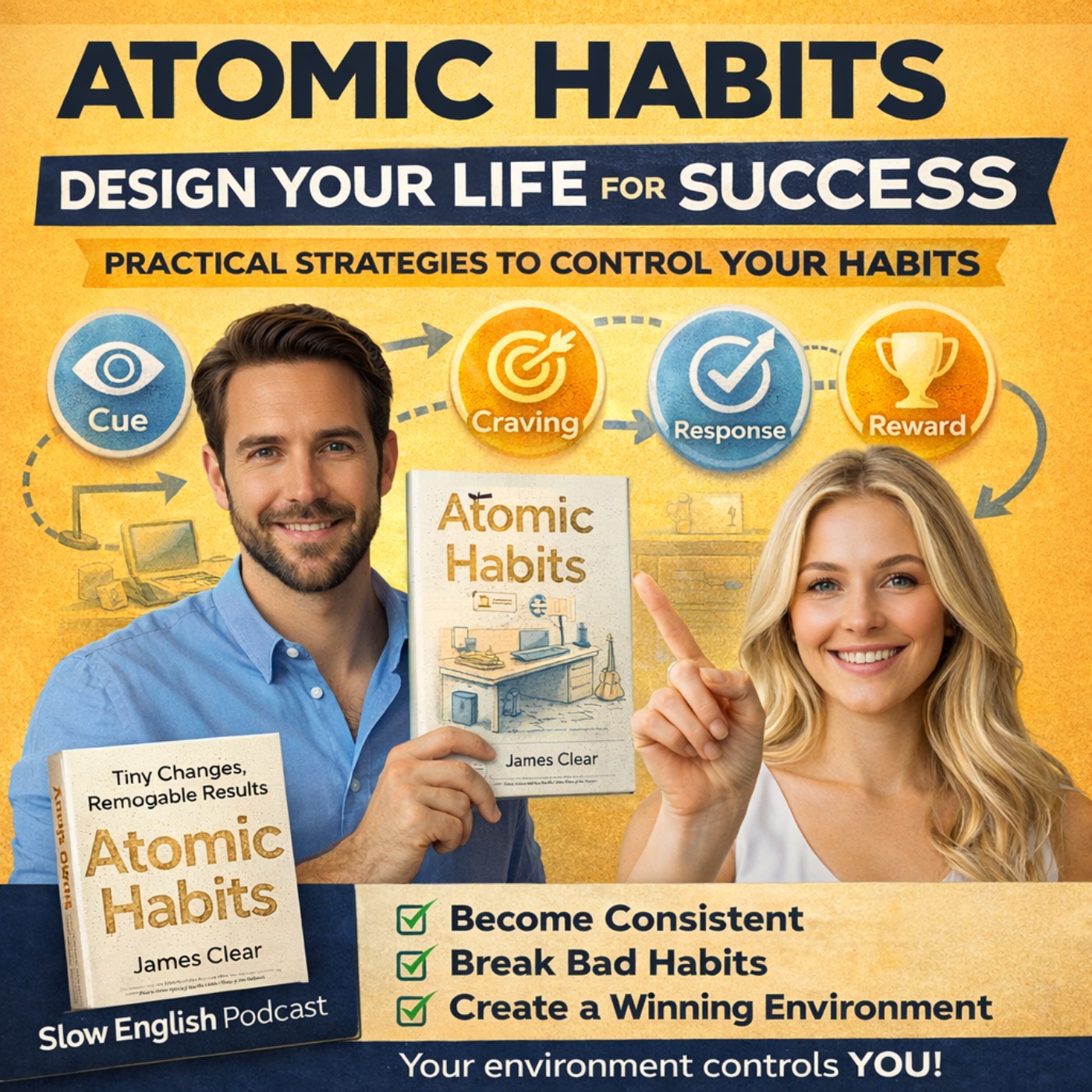 Atomic Habits Deep Dive (Part 2): Design Your Environment, Control Your Life | This podcast is narrated using advanced AI voice technology (powered by ElevenLabs) to ensure consistent clarity, natural pacing, and an easy-to-follow listening experience — especially helpful for language learners.All scripts are written and carefully edited by real humans, combining expert content creation with voice technology to bring you the best of both worlds:✅ Human intelligence and creativity✅ AI precision and clarityWe use slow, natural pronunciation and carefully chosen vocabulary to support learners at every level.In this second deep dive into Atomic Habits, Martin and Julia guide you through five powerful chapters in just 25 minutes. Instead of reading for hours, you’ll understand the science of habit loops, environment design, and the hidden forces that shape your daily behaviour — all explained in clear, intermediate-level English.Today we explore:• The 4-step habit loop: cue, craving, response, reward• Why Japanese train conductors “point and call” to prevent mistakes• The Freedom Paradox — how habits actually create freedom• The Diderot Effect and habit stacking• Why motivation is overrated and environment is everything• How to redesign your physical and digital spaces for successThis episode is especially useful for IELTS Speaking Part 3, TOEFL Speaking tasks, and Cambridge B2/C1 discussions about psychology, self-improvement, behaviour, and productivity. You’ll learn exam-relevant vocabulary such as context association, subconscious processing, decision fatigue, choice architecture, friction, cue-induced craving, and identity-based habits. These concepts are ideal for higher-level speaking answers and academic listening development.Martin and Julia don’t just explain theory — they show you how to apply it immediately. You’ll reflect on your own room, your phone, your routines, and your invisible triggers.By the end of this episode, you’ll understand one key idea: disciplined people are not superheroes — they are architects of their environment.If you enjoyed this episode, leave a comment telling us one small environmental change you will make today. Your comments help platforms recommend our podcast and help more learners discover Slow English Podcast.Slow listening. Deep thinking. Practical English.⏱️ TIME STAMPS00:00 – Introduction & What You’ll Learn01:30 – The Puzzle Box Experiment (How Habits Are Born)04:00 – The Freedom Paradox06:30 – The 4-Step Habit Loop Explained09:30 – The First Law: Make It Obvious11:00 – Japanese “Pointing and Calling” Technique13:00 – The Habit Scorecard Exercise15:00 – Implementation Intention Formula17:00 – The Diderot Effect & Habit Stacking19:00 – Why Motivation Is Overrated21:00 – Environment Design & Context Association23:00 – Self-Control Is Environment Control24:00 – Final Recap & Action StepKEYWORDS slow english podcast, english comprehension, english listening practice, learn english, your english toolbox, english shadowing, english mindset, vocabulary practice, atomic habits deep dive, habit loop explained, environment design psychology, habit stacking, self improvement habits, decision fatigue, subconscious behaviour, cue craving response reward, IELTS speaking practice, IELTS vocabulary, TOEFL speaking, Cambridge B2 First, C1 Advanced, exam English, academic English listening, exam strategiesHASHTAGS#SlowEnglishPodcast #YourEnglishToolbox #LearnEnglish #EnglishListeningPractice #IELTS #TOEFL #CambridgeEnglish #AtomicHabits #HabitLoop #SelfImprovement #ProductivityMindset #EnglishVocabulary #AcademicEnglish #MindsetTraining💬 We’d love to hear from you!If you enjoyed this episode, leave a comment, share your thoughts, or tell us how you’re using these tips to improve your English. Your feedback helps us grow and create even better content for you. Hosted on Acast. See acast.com/privacy for more information. | — | ||||||
| 2/11/26 |  The J Sound Workout: Stop Saying “Yoke” Instead of “Joke” | This podcast is narrated using advanced AI voice technology (powered by ElevenLabs) to ensure consistent clarity, natural pacing, and an easy-to-follow listening experience — especially helpful for language learners.All scripts are written and carefully edited by real humans, combining expert content creation with voice technology to bring you the best of both worlds:✅ Human intelligence and creativity✅ AI precision and clarityWe use slow, natural pronunciation and carefully chosen vocabulary to support learners at every level.In this episode of The Sound Lab, Martin and Julia guide you through one of the most powerful and misunderstood sounds in English: the J sound.Why is this sound so important?Because without it, your English can suddenly sound uncertain, soft, or even confusing. “Joke” becomes “yoke.” “Just” becomes “yust.” And your confidence drops.Today’s episode is a full pronunciation workout. You’ll train your tongue, your ears, and your confidence through:• Clear articulation drills• Listening challenges• Common mistakes by language group• Minimal pairs (J vs Y, CH, Z, etc.)• Spelling patterns (soft G, DGE endings)• Natural collocations and micro-sentences• A final pronunciation trap storyThis episode is especially helpful if your first language is Spanish, French, Italian, German, Russian, Arabic, Japanese, or any language where the J sound behaves differently.🎯 EXAM FOCUSThis training directly supports:IELTS Speaking Parts 1–3 (clear pronunciation & confidence)TOEFL Speaking Tasks (intelligibility under pressure)Cambridge B1/B2/C1 (pronunciation clarity & listening discrimination)Academic English listening and articulation precisionYou will improve:✔ Consonant articulation✔ Voiced vs unvoiced sound awareness✔ Minimal pair discrimination✔ Listening under cognitive load✔ Exam-relevant pronunciation controlBy the end, you won’t just understand the J sound — you’ll own it.Tell us in the comments:Is your J more like a Y, a CH, or something else?Your comments help platforms recommend this podcast to more English learners around the world.Let’s build strong, confident English — one sound at a time.⏱️ TIME STAMPS00:00 – Welcome to The Sound Lab01:10 – Why the J Sound Changes Everything02:30 – How to Physically Produce the J Sound04:00 – Listening Challenge 1 (Jerry Story)05:30 – Why Your Native Language Tricks You07:20 – Listening Challenge 2 (Lazy J Test)09:00 – The Spelling Code (J, Soft G, DGE)10:30 – Listening Challenge 3 (Hidden G Sounds)12:00 – Collocation Workout (Gym Practice)14:30 – Riddle Challenge (Double J Sound)15:40 – Minimal Pairs Training (J vs Y / CH / Z)18:30 – Final Trap Story19:30 – Recap & Confidence Boost20:00 – Final Message & Call to Action🔎 KEYWORDSslow english podcast, english pronunciation practice, english listening practice, learn english, your english toolbox, english shadowing, articulation training, pronunciation drills, J sound English, soft G pronunciation, minimal pairs English, voiced consonants, IELTS speaking practice, IELTS vocabulary, TOEFL speaking, Cambridge B2 First, C1 Advanced, exam English, academic English listening, exam strategies🔖 HASHTAGS#SlowEnglishPodcast #YourEnglishToolbox #LearnEnglish #EnglishListeningPractice #IELTS #TOEFL #CambridgeEnglish #EnglishPronunciation #Jsound #SpeakConfidently #ExamEnglish #EnglishFluency #MinimalPairs #ArticulationTraining💬 We’d love to hear from you!If you enjoyed this episode, leave a comment, share your thoughts, or tell us how you’re using these tips to improve your English. Your feedback helps us grow and create even better content for you. Hosted on Acast. See acast.com/privacy for more information. | — | ||||||
| 2/8/26 |  100 Essential English Phrases That Actually Make You Fluent (A2 Foundation Training) | https://www.patreon.com/posts/100-essential-a2-150231656?utm_medium=clipboard_copy&utm_source=copyLink&utm_campaign=postshare_creator&utm_content=join_link100 SENTENCES TRANSCRIPTION IN PATREON . FOR FREE. CHECK THE LINKThis podcast is narrated using advanced AI voice technology (powered by ElevenLabs) to ensure consistent clarity, natural pacing, and an easy-to-follow listening experience — especially helpful for language learners.All scripts are written and carefully edited by real humans, combining expert content creation with voice technology to bring you the best of both worlds:✅ Human intelligence and creativity✅ AI precision and clarityWe use slow, natural pronunciation and carefully chosen vocabulary to support learners at every level.In this episode of Slow English Podcast — Your English Toolbox, Martin guides you through one of the most powerful listening workouts you can do to rebuild your English from the ground up.You’ll train with 100 essential A2-level English phrases using a scientifically effective fast–slow–fast listening method, designed to improve comprehension, pronunciation, and real-world fluency.You’ll hear everyday English in its natural colloquial form, then the clear foundation version, and then natural English again — exactly how your brain needs to process language to build automatic understanding.What you’ll practice in this episode:• Introductions and personal life• Shopping and everyday services• Eating out and ordering food• Directions, travel, and transport• Hotel situations• Health and emergencies• Daily life and social conversations• Polite phrases and opinionsThis episode is especially useful for learners preparing for IELTS Speaking (Parts 1–3), TOEFL Speaking tasks, and Cambridge B1–B2 exams, as it focuses on functional language, natural rhythm, connected speech, and pronunciation under real conditions.🎯 Exam-focused benefits:• Speak with more natural rhythm and confidence• Understand fast native speech without translating• Improve listening accuracy for exam recordings• Build automatic responses for speaking testsBy the end of this episode, you won’t just know these phrases — your brain will expect them, recognize them instantly, and reproduce them more naturally.🎧 Listen slowly.🧠 Train your ear.🗣️ Speak with confidence.👉 Leave us a comment and tell us: Which phrase was hardest to catch at full speed?Your comments help platforms recommend this podcast and allow us to keep creating new episodes every week.⏱️ TIME STAMPS 00:00 – Welcome & philosophy of slow listening02:10 – How the fast–slow–fast method rewires your brain04:30 – Part 1: Introductions & personal life08:10 – Part 2: Shopping & services11:30 – Part 3: Eating & drinking15:00 – The power of basics and pronunciation reset17:00 – Part 4: Directions & getting around21:10 – Part 5: At the hotel24:30 – Rebuilding confidence through repetition26:20 – Part 6: Health & emergencies29:00 – Part 7: Daily life & socializing31:40 – Part 8: Polite phrases & communication33:40 – Final reflection, next levels & call to action35:20 – End of episode🔍 KEYWORDSslow english podcast, english listening practice, english comprehension, learn english naturally, english shadowing, your english toolbox, spoken english practice, real life english phrases, colloquial english, fast english listening, slow listening method, pronunciation training, everyday english vocabulary, A2 english practice, IELTS speaking practice, IELTS vocabulary, TOEFL speaking, Cambridge B1 listening, Cambridge B2 speaking, exam english, academic english listening, exam strategies💬 We’d love to hear from you!If you enjoyed this episode, leave a comment, share your thoughts, or tell us how you’re using these tips to improve your English. Your feedback helps us grow and create even better content for you. Hosted on Acast. See acast.com/privacy for more information. | — | ||||||
| 2/7/26 |  The Superpower You Didn’t Know You Still Have | This podcast is narrated using advanced AI voice technology (powered by ElevenLabs) to ensure consistent clarity, natural pacing, and an easy-to-follow listening experience — especially helpful for language learners.All scripts are written and carefully edited by real humans, combining expert content creation with voice technology to bring you the best of both worlds:✅ Human intelligence and creativity✅ AI precision and clarityWe use slow, natural pronunciation and carefully chosen vocabulary to support learners at every level.What if one of the most powerful tools for mental health and language learning is something you already had as a child?In this episode, Martin and Julia explore a forgotten human superpower: the ability to feel amazement in ordinary moments.Through a powerful story, real psychology, and practical examples, you’ll discover how curiosity and presence can reduce anxiety, quiet negative self-talk, and completely change the way you experience English.In this episode, you will learn how to:• Understand why amazement calms the anxious brain and brings you into the present moment• Use curiosity instead of pressure when learning English• Replace stress and self-criticism with attention and enjoyment• Learn English more naturally by slowing down and observing language like a child• Build gratitude, focus, and emotional balance through everyday momentsThis episode is especially useful for learners preparing for exams such as IELTS Speaking, TOEFL Speaking, and Cambridge B1, B2, and C1, as it trains presence, listening focus, pronunciation awareness, and exam-relevant functional language.You’ll also develop exam-ready skills like staying calm under pressure, thinking clearly while speaking, and responding more naturally in real conversations.At the end of the episode, you’re invited to try a simple daily challenge that can change both your English practice and your mindset — and to share your experience with our growing Slow English community.Listen slowly. Learn deeply. Stay amazed.⏱️ TIME STAMPS 00:00 – Welcome & opening reflection01:05 – The idea of a forgotten superpower02:20 – The dark restaurant story begins04:10 – Two couples, same situation, opposite experiences05:50 – Why amazement changes everything07:15 – The science of awe and the anxious brain08:55 – Anxiety, depression, and the present moment10:30 – Finding amazement in ordinary daily life12:10 – Gratitude as a natural result of attention13:30 – What this means for learning English15:05 – Slow learning vs rushed learning16:10 – Weekly challenge & final message🔎 KEYWORDS slow english podcast, english listening practice, learn english naturally, your english toolbox, english mindset, english comprehension, english shadowing, vocabulary practice, emotional intelligence in english, curiosity and learning, learning english without stress, mindfulness and language learning, present moment awareness, IELTS speaking practice, IELTS vocabulary, TOEFL speaking, Cambridge B2 First, C1 Advanced, exam English, academic English listening, exam strategies💬 We’d love to hear from you!If you enjoyed this episode, leave a comment, share your thoughts, or tell us how you’re using these tips to improve your English. Your feedback helps us grow and create even better content for you. Hosted on Acast. See acast.com/privacy for more information. | — | ||||||
| 2/5/26 |  Atomic Habits Deep Dive: The 1% Rule, Goals, and Identity (Chapters 1 & 2) | This podcast is narrated using advanced AI voice technology (powered by ElevenLabs) to ensure consistent clarity, natural pacing, and an easy-to-follow listening experience — especially helpful for language learners.All scripts are written and carefully edited by real humans, combining expert content creation with voice technology to bring you the best of both worlds:✅ Human intelligence and creativity✅ AI precision and clarityWe use slow, natural pronunciation and carefully chosen vocabulary to support learners at every level.In this episode, Martin and Julia kick off our Atomic Habits for English deep dive with the two foundations that change everything: the 1% rule and identity-based habits.You’ll learn why progress often feels invisible at the start (the Valley of Disappointment), how tiny improvements compound, and how to stop saying “I’m trying to learn English” and start becoming the kind of person who learns English naturally.✅ What you’ll get in 16 minutes:The truth about “instant success” (and why it’s a trap)The 1% improvement method you can apply todayWhy systems beat goals (especially for language learning)The identity shift: “What would an English speaker do?”A simple weekly plan you can repeat all year🎓 Exam boost (IELTS / TOEFL / Cambridge):This episode trains the mindset that improves consistency — the hidden skill behind higher scores. Use it to build a weekly routine for Listening (Part 1 / Part 3), Speaking fluency, and vocabulary retention, plus better “task endurance” (staying calm and focused under time pressure).💬 Your mini-challenge:Comment one sentence starting with: “This year, I’m the kind of person who…”Example: “This year, I’m the kind of person who listens to English every day.”3) Chapters / Time stamps 00:00 Welcome + what this series will do for your English01:02 The 1% rule: tiny improvements that compound01:59 Fundamentals: why habits work (and why they don’t at first)02:06 Destroying the myth of instant success03:20 The compounding effect (the simple math that changes motivation)06:41 The Valley of Disappointment + the “ice cube” idea08:40 Goals vs systems: why goals fail for language learners10:50 Identity habits: become the person who learns English13:43 “Votes for your identity” + how to lock the habit in15:00 Recap + what’s coming next4) Keywords atomic habits, english habits, learn english consistently, 1 percent better, identity based habits, systems vs goals, valley of disappointment, motivation myth, language learning routine, slow listening, english listening practice, daily english habit, build discipline, habit tracker, micro habits, compound growth, english fluency plan, confidence in english, improve pronunciation, shadowing routine, vocabulary retention, ielts listening strategy, toefl preparation mindset, cambridge b2 routine, exam endurance, productivity for language learners, stop procrastinating, habit stacking, environment design, consistency over intensity, new year english plan5) Hashtags#LearnEnglish #AtomicHabits #EnglishHabits #SlowListening #EnglishListening #EnglishRoutine #Fluency #StudyMotivation #LanguageLearning #IELTS #TOEFL #CambridgeEnglish #B2English #Shadowing #Vocabulary #Pronunciation #EnglishPodcast #SelfImprovement #DailyHabits #Consistency6) “Call to Action” Audio CTA (natural, short):“If you want real progress this year, don’t chase motivation—build identity. Comment: This year, I’m the kind of person who… and I’ll reply to you.”💬 We’d love to hear from you!If you enjoyed this episode, leave a comment, share your thoughts, or tell us how you’re using these tips to improve your English. Your feedback helps us grow and create even better content for you. Hosted on Acast. See acast.com/privacy for more information. | — | ||||||
| 2/1/26 |  The Obstacle Is the Way / How to Face Any Problem in Your Life and Grow Through It | This podcast is narrated using advanced AI voice technology (powered by ElevenLabs) to ensure consistent clarity, natural pacing, and an easy-to-follow listening experience — especially helpful for language learners.All scripts are written and carefully edited by real humans, combining expert content creation with voice technology to bring you the best of both worlds:✅ Human intelligence and creativity✅ AI precision and clarityWe use slow, natural pronunciation and carefully chosen vocabulary to support learners at every level.In this episode, we explore a powerful idea that can change the way you face problems in life and in learning: the obstacle is not the enemy — it is the path forward.Together with Martin and Julia, and supported by calm reflection and clear language, we look at how challenges can become tools for growth instead of sources of fear or frustration.You will hear practical reflections, simple examples, and calm explanations designed to help you think differently when things feel difficult — whether you are learning English, preparing for an exam, or facing a personal challenge.In this episode, you will learn how to:• Reframe problems as opportunities for learning and progress• Use calm thinking instead of panic when things go wrong• Build resilience through language and mindset• Understand key abstract vocabulary related to difficulty, effort, and growth• Follow complex ideas in slow, clear EnglishThis episode is especially useful for learners preparing for IELTS Speaking (Parts 2–3), TOEFL Speaking tasks, and Cambridge B1, B2, and C1 exams, as it includes exam-relevant vocabulary, reflective language, and listening strategies often required in higher-level speaking and comprehension tasks.Before you leave, we invite you to reflect with us.Leave a comment using one idea or expression you learned today, tell us where you are listening from, or share one obstacle you are currently facing.Your comments help platforms recommend our podcast and allow this learning community to grow.Short recap:Obstacles do not block the path — they are the path.Calm thinking creates clarity.And every difficulty can become a step forward.⏱️ TIME STAMPS 00:00 – Welcome and opening reflection02:10 – Why we fear obstacles04:30 – The meaning behind “The Obstacle Is the Way”06:40 – Problems as teachers, not enemies09:00 – Language, mindset, and emotional control11:20 – How this idea applies to learning English13:40 – Real-life examples of reframing difficulties16:00 – Staying calm when things go wrong18:20 – Mid-episode reflection and learning pause20:10 – Exam relevance: speaking about challenges22:30 – Key vocabulary and expressions for exams25:00 – Final reflections and mindset shift27:30 – Final message and call to action🔑 KEYWORDS slow english podcast, english listening practice, learn english naturally, your english toolbox, english mindset, calm english learning, personal growth in english, motivation vocabulary, emotional intelligence english, problem solving vocabulary, resilience in english, mindset learning english, IELTS speaking practice, IELTS vocabulary, TOEFL speaking, Cambridge B1 speaking, Cambridge B2 First, C1 Advanced, exam english listening, academic english comprehension, exam strategies for speaking#️⃣ HASHTAGS #SlowEnglishPodcast #YourEnglishToolbox #LearnEnglish #EnglishListeningPractice #EnglishMindset #PersonalGrowth #EmotionalIntelligence #IELTS #TOEFL #CambridgeEnglish #EnglishVocabulary #CalmLearning💬 We’d love to hear from you!If you enjoyed this episode, leave a comment, share your thoughts, or tell us how you’re using these tips to improve your English. Your feedback helps us grow and create even better content for you. Hosted on Acast. See acast.com/privacy for more information. | — | ||||||
Showing 25 of 73
Sponsor Intelligence
Sign in to see which brands sponsor this podcast, their ad offers, and promo codes.
Chart Positions
2 placements across 2 markets.
Chart Positions
2 placements across 2 markets.