
Insights from recent episode analysis
Audience Interest
Podcast Focus
Publishing Consistency
Platform Reach
Insights are generated by CastFox AI using publicly available data, episode content, and proprietary models.
Est. Listeners
Based on iTunes & Spotify (publisher stats).
- Per-Episode Audience
Est. listeners per new episode within ~30 days
10,001 - 25,000 - Monthly Reach
Unique listeners across all episodes (30 days)
25,001 - 75,000 - Active Followers
Loyal subscribers who consistently listen
15,001 - 40,000
Market Insights
Platform Distribution
Reach across major podcast platforms, updated hourly
Total Followers
—
Total Plays
—
Total Reviews
—
* Data sourced directly from platform APIs and aggregated hourly across all major podcast directories.
On the show
Recent episodes
The Many Challenges of AI Safety
May 1, 2026
38m 56s
Who Owns Presidential Records?
Apr 17, 2026
55m 00s
The Last Branch Standing
Apr 14, 2026
30m 01s
Can Trump Pull Out of NATO?
Apr 3, 2026
31m 10s
It's the President's War
Mar 27, 2026
27m 17s
Social Links & Contact
Official channels & resources
Official Website
Login
RSS Feed
Login
| Date | Episode | Description | Length | ||||||
|---|---|---|---|---|---|---|---|---|---|
| 5/1/26 |  The Many Challenges of AI Safety The Many Challenges of AI Safety | Jack chats with Sebastian Mallaby, senior fellow at the Council on Foreign Relations, about his new book The Infinity Machine: Demis Hassabis, DeepMind, and the Quest for Superintelligence. They discuss current challenges in AI safety, the U.S.-China race and prospects for cooperation, and the emerging risks posed by powerful new models like Anthropic’s Mythos. They also talk about tensions between frontier labs and the U.S. government, and the trajectory toward greater government control.Mentioned:* Sebastian Mallaby, The Infinity Machine: Demis Hassabis, DeepMind, and the Quest for Superintelligence (2026)Thumbnail: President Trump delivers remarks at the White House AI Summit in Washington, D.C., Wednesday, July 23, 2025. (Official White House Photo by Joyce N. Boghosian)Consider becoming a free or paid subscriber to Executive Functions.This is an edited transcript of an episode of “Executive Functions Chat.” You can listen to the full conversation by following or subscribing to the show on Substack, Apple, Spotify, or wherever you get your podcasts.Jack Goldsmith: Today I’m chatting with Sebastian Mallaby, who’s a senior fellow at the Council on Foreign Relations and an acclaimed biographer and writer. And we’re going to be talking about his newest book, which is called The Infinity Machine. Sebastian, thanks for talking with me.Sebastian Mallaby: Thank you, Jack. Nice to be with you. So tell us what the book is about. Who is Demis Hassabis, and why did you write a book about him?So the book is about artificial intelligence, and it’s centered on this character, Demis Hassabis, who is, in a way, the OG sort of AI lab leader, right? He starts DeepMind, this startup in London, back in 2010, before AI could even recognize the photograph of a cat—like nothing worked. It was full AI winter.So this is five years before Sam Altman and Elon Musk start OpenAI. It’s fully 11 years before Anthropic gets started. So he was extremely early.So if you wanted to tell the story of the making of modern AI through a personality, you know, Demis’s career and intellectual development maps perfectly onto that story.So the thing that’s most interesting to me about him is that, as you emphasize in the book, his real interest in this, I think it’s fair to say, is scientific and not profit-making. And he, at least at the outset, and I think even today, has a rather idealistic—to me anyway, idealistic or optimistic—conception of the technology and how it can be used.But the story I also see is someone who—and I don’t mean this uncharitably—but who has basically engaged in a series of compromises or fudges with regard to those values as he’s gotten deeper and deeper into the AI competition.So is that fair? And can you talk about that arc?Yes. I mean, he started DeepMind in 2010 with an absolute focus on AI safety. In fact, he met his scientific co-founder, Shane Legg, at a safety lecture in which Shane projected that by 2030 or so, AIs would be sophisticated enough—cleverer than humans—have their own sort of objective functions, and would maybe start to threaten humans.And this was the lecture over which they bonded. And then in 2014, Demis Hassabis sells his company DeepMind to Google. And part of the sale condition was that AI would not be used for military purposes, that it would be safeguarded by a sort of ethics oversight committee that would be separate from the corporate leadership of Google.So he took it very seriously. And then this continues for a while. Between 2016 and 2019, he wages a secret battle, a thing called Project Mario, where he’s trying to put pressure on Google’s leadership to have this independent safety oversight board, because Google kind of reneged on the deal at the point of sale in 2014.And then after 2019, it kind of fades away. And, you know, by now you have Google being willing to provide AI to the national security establishment. In the US, there is no safety and ethics oversight board.And Demis is left explaining to me, well, you know, I feel as if, you know, if I lean into Google and I’m part of the team there, and I, you know, understand the different pressures that a corporation is under, then I have a seat at the table. And so when push comes to shove, I can chime in in favor of safety. And so I’m a good person—trust me—is kind of the bottom line, which is a sort of flimsy scaffolding of reassurance for an alarmed world.Especially since—I mean, this was also a time—a lot of this is happening at a time before ChatGPT amazes the world a few years ago with whatever model it was, I can’t remember. And suddenly there’s this massive competition among several frontier models that has been extremely fierce.And now we’re in a massive competition among those labs and with Chinese firms, and the countries are in fierce competition. And he’s now leading—you talk in the book about how they combined, how Google combined its AI efforts—and he’s leading it.So he’s really leading, in some sense, this fiercely competitive charge, which isn’t taking—doesn’t appear to be taking—safety all that seriously. Is that fair?Yeah, it’s fair. And, you know, I think there’s a slight caveat in that his style is to pursue safety ideas secretly. I mean, he doesn’t talk about them.And Dario Amodei, the leader of Anthropic, is extremely public when he picks a fight with the Pentagon, when he releases this new model called Mythos, where he’s publicly said, you know, this is too dangerous to release generally, so I’m going to release it to a sort of restricted list of people. He likes to be very out there in public with it.Demis Hassabis, on the other hand, did two important things, to my knowledge, about safety. One was this secret battle I described before, which he was so unkeen to have sort of move into the public sphere that when I discovered it through leaks from other people, you know, I had to talk to his general counsel, who was trying to tell me I wasn’t allowed to publish that. So he really didn’t want that to be public.And then secondly, he told Rishi Sunak in 2023, after ChatGPT came out, “Mr. Prime Minister, you know, I have an idea for you, which is you could have an international discussion on AI safety—invite the Chinese, invite everybody—start a process that might lead to some kind of understanding internationally on AI safety.”Demis never told me that he told the Prime Minister that. I only know this because other people, like the Prime Minister’s advisers, told me. So he didn’t advertise what he was doing.So I think he’s trying to do things now, but they’re not in the public view. So that’s a slight caveat. But basically, you’re right. I mean, he’s leading one of the major labs, Google DeepMind, in frontier AI, racing as fast as he can, even releasing, by the way, open-weight models, which by his own analysis are dangerous because you can’t control them once they’re out there.And so there is this contradiction—you could call it even hypocrisy—between his stated beliefs about AI safety and what he’s actually doing. And so then the question is, well, how harshly does one judge him? And I’ve just floated the word hypocrisy.But on the other hand, were he to quit his job and go off and become a professor somewhere and pursue research, which I think is the alternative path for him, it wouldn’t make the world safer, right? There’d still be this race dynamic.To be clear, I wasn’t judging him. And he seems—I’m trying to understand—he seems like a thoroughly decent, honorable, brilliant guy. I’m just trying to understand the mindset of someone who, from a very young age, had these extraordinary scientific ambitions, which he’s been as important as anyone in making possible.And—but safety and this kind of benign vision has always been part of it, and it just seems to have been overtaken by reality—mostly competitive, financial, and global competition reality. And I’m just wondering how he processes that. That’s what I’m getting at.Absolutely. I mean, I was exactly trying to do the same thing—to kind of figure out how you process it and sort of portray that. And, you know, at the end of the book, he tells me, you know, I’m in a paradoxical situation.On the one hand, Shane Legg and I projected back in 2009, 2010 that by around 2030, AI would be very powerful. And that’s kind of what’s going to happen. And we’ve been central to building it. So, you know, I’ve delivered on this vision in an amazingly gratifying way.On the other hand, I had this hope that I could control the technology somehow and make it safe, and that hasn’t worked.And, you know, when you want to ask, you know, why did it turn out so contrary to his expectations? You know, it’s the Oppenheimer syndrome. Oppenheimer led the Manhattan Project, built the amazing technology, and was an incredible scientific leader as well as a scientist, and thought he could sort of go and sell Truman not to use the bomb or to give the technology to the UN or whatever.Truman just kicks him out of his office and says, “Don’t bring that guy in here again.” So scientists think that they can control their inventions, but often the inventions have their own will.Okay, you’ve written a lot of interesting essays closer to the topics of this Substack in connection with the publication of the book. And I just want to talk about some of these policy and governance themes that are implicated—that are talked about in the book—but that you’ve talked about, I think, more in connection with the publication of the book.First of all—and you’re, you know, the keenest of observers of these various relationships and where we are in these AI races—so I just want to get your temperature on, first, what is the state of the relations between the U.S. government and the frontier labs?I mean, we know about the DOD confrontation with Anthropic and then with Mythos, the government trying to apparently get its hands on that technology, or at least try to reach some kind of accommodation with Anthropic.How do you see—I want to go through different pieces of the relationships and the competitions at stake here—how do you see the relationship right now between the US government and the frontier labs?Well, I think it’s just worth saying at the beginning that, you know, the background—if one goes back to 2023, 2024, the two years after ChatGPT came out, it made all this feel urgent—the background was that there was a lot of collaboration.And if you talk to people, I think, you know, Ben Buchanan, who was at the National Security Council doing AI policy, is on the record about this. He says, you know, whenever I talked to the labs, there was no resistance to the idea of regulation. It was more the opposite—that they were telling me, “Hey, this is serious. This is powerful. This is scary. This is coming. You need to do something.”And so when he wanted to, you know, set up the AI Safety Institute, which happened in the Biden years or so on, there wasn’t much pushback, contrary to sort of what one might suspect. There wasn’t much pushback from the objects of the regulatory impetus.Now, the regulation at that point was extremely, you know, emergent. It wasn’t really biting very much. But still, it’s worth noting that the baseline here is collaboration.Then you move into 2025. President Trump is in office. He essentially doesn’t want to talk about regulation. He’s more keen on competition, acceleration—just make sure the U.S. has the most powerful AI. And so that kind of goes off the agenda.Now, in 2026, it comes back, both because of this fight over Anthropic’s models and how they are used by the national security establishment, and because of Mythos, the cybersecurity model.And I’d say that right now you have this sort of, you know, weird and sort of unstable contradiction of impetuses, where on the one hand, you know, the administration has deemed Anthropic to be a supply chain risk, which is an extraordinary name to attach to a U.S. company. I think it’s the first time that’s ever happened.And so it’s extremely antagonistic. And you had this Slack message that Dario Amodei, the head of Anthropic, wrote, and which got leaked. It was a Slack message to his own staff. And what he said was something like, you know, “The Trump administration wants dictator-level obeisance from me, and I’m not going to give it.” So that shows you the temperature of the relationship there.But on the other hand, they are talking together about Mythos, and, you know, Amodei went to the White House to speak to people about it a couple of weeks ago.So I think it’s a mixture of suspicion and sort of a distant relationship, but then at the same time, a need created by Mythos that—wow, you know, we have no choice but to talk to each other, and we’re going to have to do that.So two questions following up. One is, I could never really tell how serious—I think some more serious than others, maybe Anthropic—how serious the labs were when they said, “Please regulate us.” Sam Altman testified to that: “Please regulate me.”I don’t believe he really thought that. It’s clearly—but it’s a good thing to say when you’re developing this massively dangerous, consequential technology in the private sector. In case something goes wrong or, you know, it’s always nice to have said we asked to be regulated and you didn’t do it.I’m just wondering how serious that request is, especially given in the last presidential election, a lot of the big money behind—or at least in connection with—the AI labs, the kind of Silicon Valley big money, went all in for Trump. And, you know, David Sacks gets installed in the White House and implements this kind of libertarian policy, hands-off policy.So first question: how serious is that request to be regulated?Well, I think when we talk about Silicon Valley in broad-brush terms, we need to actually break that down a bit. And you’ve got someone like Marc Andreessen, whose commercial interests as a venture capitalist are that he wants to back, you know, upstart challenger AI labs. He’s not going to back, you know, the big hyperscalers because they don’t need his money, right?So he wants to back essentially startups that are probably going to use open-weight models. And so open-weight, by definition—you cannot be in favor of regulation and be in favor of open weight. You know, open weight is the least regulated type of AI distribution mechanism.And so, yes, when you’re talking about Marc Andreessen, he’s extremely pro-Trump and extremely deregulatory and laissez-faire. And so there’s no seriousness whatsoever in any comment to the fact that you need more safety if it’s coming out of his mouth. I think, to be fair, it’s not coming out of his mouth.True, correct.So then you move to other people who are saying that they want to be regulated. And I think in some cases, someone like Sam Altman probably is straightforwardly, you know, insincere.But I’d say that, you know, all of these characters who are running the frontier labs have said things at different times, and they’ve both wanted safety. And when Sam Altman created OpenAI in 2015, the rationale for creating it was safety and for the AI to be used for the public good. And who knows? I think he might even have meant it in 2015.But as time has gone on and the race dynamic has become so white-hot, any instinct he might have had to be sincere about wanting to be slowed down has been overwhelmed by his desire to win the race.But I think there’s both sides of that. Inside one human being, there could be two personalities. And I think, you know, there’s just a different balance in these different people.So, you know, probably Sam Altman is the most prone to going for acceleration rather than regulation kind of when a stress point comes. I’d say Dario Amodei is the most prone to be safe when a stress point comes. Demis is somewhere in between. Elon—I don’t think he’s really been tested.So last question in this vein—it just, how likely is it—let me put it this way—it seems inevitable, given the rapid changes in these technologies and the growing perceived dangers in the technology—Mythos being one example, but there are lots of examples.And given the stakes of these technologies in private hands in the United States, so given the dangers they’re spewing and the stakes vis-à-vis the competition with China and national security more generally, it seems inevitable to me that—set aside legality for a second—it seems inevitable to me that the United States gets its hands on this.And I don’t know what the mechanism looks like or what the institution looks like, but that the U.S. government cannot afford not to, in some sense, own this technology, both for its own purposes and for safety purposes. True or false?Broadly true. I mean, by “own,” you would include, I think, control. I mean, it could be a regulatory model.Yeah, let me be clear: I don’t mean technically own. I mean control. That’s a better word. So then I think true, yes. I think, in fact, we’ve just run that experiment in the last few weeks, because you had a deregulatory, pro-accelerationist administration in power. And all of a sudden, an actual case of an AI that threatens stability emerges in the form of Mythos.And it looks as if it could unravel all kinds of building blocks of the internet and cyberspace. Banks would have their bank accounts emptied, et cetera, et cetera. And they turn on a dime.And all of a sudden, the Treasury Secretary is saying to the Fed chairman, “We need to call the heads of the banks and tell them to take this seriously. And, you know, we need to get our hands on this.” He’s—you know, Scott Bessent, the Treasury Secretary, reportedly has floated the idea of, you know, sort of—I forget what the term is—but you’ll know—essentially requisitioning or having power over the technology.And Bessent just said, okay, this is so important in terms of statecraft that we’ve got to mention it, bring it up in the summit with Xi Jinping in the middle of May.So they’ve flipped. They’ve done a 180, exactly as you predict. So I think you’re correct.And—okay—and one reason they’re doing that is because of the larger China competition. So talk about the U.S.–China competition in AI, please. Where do you see it today? I know that’s a big question.Well, maybe—I mean, I think actually that it’s—maybe I want to push back on your premise. I think that the reason they flipped is less about China and more about domestic chaos, right? They don’t want the internet to be hacked and, you know, the banking system to crash. It’s not—that’s not necessarily about China. That’s about domestic security.Don’t you think it’s about both? I mean, if these technologies are—so fair enough, it’s about domestic security, but it’s also about China being able to defeat government systems, China threatening both to steal and to disrupt things in the cyber realm. I mean, I think technology has an advantage as a national security advantage.Yes, but I think—okay, we’re going to—I think this conversation is going to go in a direction where we need to clarify one thing right now, which is that there are two kinds of worry about powerful AI in terms like—the big worries, I would say.One is that—and essentially this is about bad guys getting it and doing bad stuff with it. And there’s two kinds of bad guy, right? There’s China. And in 2022, when the Biden team—before ChatGPT, by the way—saw this coming, they put the semiconductor export controls in place because they didn’t want China to have cutting-edge AI, because in their view, the bad guy to worry about was China.And there’s a whole second category of bad guys, which is sort of rogue states, terrorists, criminals, et cetera, et cetera. And I think it’s just very important to clarify that there are two kinds of threat.And I think it’s important to distinguish two ways of dealing with these threats, because in the Cold War analogy, the way to control the danger of nuclear war between the Soviet Union and the United States was mutual destruction and the balance of deterrence.The way to control nukes from being loose and falling into the hands of terrorists and rogue states was a totally different mechanism, which was the Non-Proliferation Treaty, which wasn’t perfect, but it worked kind of for a while.So, you know, that’s an important distinction because of, I think, where we’re going to go.And so, going back to Mythos—Mythos is in the category of both, right? It could be that the Chinese government gets it, but more immediately, it could be just the criminals get it.And the criminal threat or the terrorist threat is posed not merely by the prospect that China gets this technology and releases it on an open-weight basis, but also that Meta does, right? Or Mistral in France, or Cohere in Canada. There’s a bunch of other labs that could open-weight this stuff, or even just not open-weight—just release it on a proprietary basis, but much more expansively than Anthropic did.Or have it stolen.Yeah, right. And there was a hack of Anthropic’s Mythos.Okay, fair—perfectly fair distinction. I want to come back to it, but can we talk about—you wrote a piece in The New York Times about U.S. policy toward China, chip restrictions, and why you thought that was a bad idea. And then I wanted to get to the nonproliferation treaty idea that you just mentioned.So can you just tell us why you think that the Biden approach may not have been optimal?Sure. So at the time I supported it because I thought it had a chance of actually preventing China from getting cutting-edge AI. It turns out it didn’t stop China from getting cutting-edge AI.And the proponents of semiconductor export controls will say, well, it’s because the controls were not tight enough. But we’ve run this experiment since 2022, so it’s four years now. And we’ve done it under two different administrations.And in neither case, if you look at the chart of the performance gap between the top model in America and the top model in China, that gap—America’s lead—has shrunk. And it shrunk under Biden, and it shrunk under Trump.So I’m just skeptical of any regime in which we impose semiconductor export controls or some expanded version thereof that actually works in stopping China from getting powerful AI. They may be like two months behind us, six months behind us, something like that, but that’s not very long.But just before we go further, I always understood the goal not to stop them but to slow them. And even with workarounds, the United States maintains its edge.And are you saying that it would be better in maintaining that edge to get rid of the chip controls? That argument, I don’t understand.Fair. Okay, that’s very fair. So yes, I agree that the controls slow them down. My point is simply that it’s not very much—it’s six months. Does six months really make us feel a lot more secure?I’m open to—you know, this is a finely balanced argument, which is why I’m excited to have it with you. You could argue that a six-month lead is a lot, and that, you know, if you get Mythos six months before the Chinese do, that’s enough to harden your systems such that when they have it, they can’t use it to any devastating effect.And also enough to compromise all of their systems.Yeah, true.Sorry, keep going. So I guess my view—my view has been subject to revision—my view has been that a six-month lead over China isn’t enough to feel that’s a big geopolitical win, because, you know, I was thinking, I guess, more of, you know, the conventional integration of the AI into weapon systems, drone swarms, this kind of stuff.And whether you’re six months ahead of the adversary in that case, you know, they just pick a time to invade Taiwan when they do have—they have caught up.Now—and, you know, if you think about the Mythos example again—wouldn’t they wait until a moment of near parity? Because these things sort of—you know, you have a jump that the U.S. does, and then the Chinese are fast followers, and then they jump up so that the gap is reduced or minimized. And then they would have a strategic parity that they could use.So I just observe that it’s not a very big lead. And then you have to ask, what was the cost of the policy? Because if there was zero cost to imposing the semiconductor equipment ban, and there was a marginal gain, then you’d probably take it.But I contend that there is a cost, in the sense that if we go back to my distinction between two kinds of rogue—China is a rogue, but also terrorists and criminals are rogues—we need to keep our eye on that second category of risk.And that involves getting China involved, because if they produce open-weight models, which is what they do at the moment, then we know that terrorists will get it.So the deal is: We give you chips, and you shut down your open-weight models. And what does the form of cooperation look like? Because I’m not so sure that the third-party rogues aren’t going to get the bad stuff, even in the absence of open-weight models. That’s a large assumption.Yeah.And I’m skeptical—and I’ll get to this in a second—I’m skeptical that any agreement between the United States and China, about which I’m skeptical, can have powerful effects on third-party countries and private actors.So what does the cooperation between the United States and China look like? And what is the virtuous story about what the deal is and what cooperation looks like?I think the best analogy is the Cold War and nuclear nonproliferation. And so in that story, you have both the International Atomic Energy Agency, which kind of keeps track of nuclear material and tries to, you know, by accounting for it, prevent it from being used in secret nuclear weapons.And then you have later—in fact, 12 years later—the negotiation of the Non-Proliferation Treaty in 1968, which kind of makes compliance with the IAEA mandatory for countries that want to have access to civilian nuclear power.And I think that’s the sort of model where, in AI, you keep track of big clusters of compute, which can be used to train powerful AI models. And that’s one kind of safety provision, so that you know what’s being trained.And then secondly, you don’t have open-weight models, which, once they are released, anyone can do anything with them. And that’s just too dangerous. You wouldn’t do that with nuclear material. I don’t think you should do that with AI.And the deal is that, you know, countries which are going to want what they call sovereign AI—that’s already a bit of a catchword—if you’re France or you’re Germany or, you know, Kenya or whoever, yes, you want to be able to train your domestic AI models on, you know, the Swahili texts or whatever—the Swahili oral tradition—that, you know, you want to make it kind of culturally friendly to your own culture. And that’s all good.But in return for getting access to models, which you can then post-train in a way that, you know, fits your sovereign AI objectives, you agree to these safety standards: no open weight, you know, we’re going to know where you’re training it, we know what the cluster is, we keep an eye on that so that if you’re trying to make cyber weapons, we’re going to see it.And so I think it’s something like that.So, I’m going to state why I’m skeptical and give you the last word on this, and then I have a final question.So the nuclear Non-Proliferation Treaty—some people think—wasn’t a terribly wonderful success. Not every country joined it. The countries that didn’t join it developed nuclear weapons. It hasn’t prevented some countries from appearing to develop nuclear weapons.But it’s a relatively simple treaty. It basically says no development of nuclear weapons. I mean, it’s a little more complicated than that, but—and we have a sense of what nuclear weapons are. There’s a problem about pre-development and how do you control that—that’s always been a problem with the treaty.But let’s imagine that that treaty is a success, despite the adverse evidence. It just seems massively more complicated here because there are so many things you might regulate—chips, data, data centers, know-how, the models themselves.So you’re going to be regulating all of these things. It’s much, much more difficult to have a verification regime in this context. Dual use is prevalent everywhere. It’s very hard—it seems to me, correct me if I’m wrong—to hide bad uses, bad developments, new models, and the like.Verification regime in this context, which involves not just government-to-government, but deeply into the private sector of both countries, to private companies of both countries, and so on and so forth. Enforcement seems to me—not clear how that’s going to work.Let’s just imagine that it works bilaterally between China—that we somehow work this out where there’s this virtuous regime where we’re both doing safety and none of us—or none of them—are doing bad uses or acceptable bad uses within the competition.But I don’t understand, you talk about all the dangers from these third parties, both private and public actors, how this regime is going to handcuff them and all the verification and enforcement problems there, and then on top of that, there’s a massive need for speed. This stuff is getting very, very dangerous very quickly. And it’s inconceivable that such a treaty or such an international organization would happen in the foreseeable future. So that’s why I’m skeptical, in a nutshell.That’s quite a long list. You don’t have to go through the whole list, but is there a reason not to be skeptical?Well, I think the first reason not to be too skeptical is that it’s kind of massively defeatist in the face of a serious threat, right? You know, the Mythos vision, where you have random criminals who can steal everybody’s money from their bank accounts, is not a good one.And so I think trying to lean into the possibility of some sort of regulation that avoids that is important. And if you’re going to do that, it’s got to be international, because obviously you can commit those crimes from some offshore base on a Chinese model. And so if the Chinese have been excluded from any such deal, it’s pointless.So I think, you know, “don’t give up” is the first message.And then secondly, I think there are more kind of choke points on which the US, in particular, can get a grip. And if it had China with it, it could definitely get a grip.And the choke points essentially are the making of the chips and the operation of the chips in clusters. I mean, at the moment, overwhelmingly, the majority of compute clusters are in the United States, and the ones which are not in the United States are using U.S. chips and U.S. equipment—or the equipment of, you know—even in the case of ASML, the Dutch company that builds the lithography machines to engrave the chips—that’s a Dutch company, but they have operations in the United States. They are fully going to comply with U.S. coercion.So I think essentially the whole of the Western camp—and you and I have talked about this in the past in the context of other things, like the regulation of the internet—all of the Western AI, including—and I would include the Middle East and stuff like that—have touch points in America, which they care about, like the customers they want to serve, the way they’re going to raise money, the chips they’re going to use, other technology around the chips, the cooling material and all that.If you brought the full might of the United States down on them, they don’t have an independent ecosystem, and they couldn’t do anything.So I believe the U.S. has a lot of control. The only place it doesn’t control is China. That’s the only credible technological possibility of a totally separate ecosystem that rises up and, you know, provides an alternative source of AI compute power.So if you had two countries on board—China and the US—I believe that some form of nonproliferation is possible.Of course, I accept that in the past, nonproliferation for nuclear stuff was not perfect, and there would be people who didn’t sign and all that stuff—but better than nothing.Fair. Okay, that’s a fair answer. Let me ask you one last question. And I haven’t heard you speak about this, so I don’t know if you have views on this.At least in the United States, a lot of people are—we’ve been focused on—our earlier conversation was about the danger of these technologies being in private hands and the need, perhaps, since the federal government is the guarantor of the public interest and the supplier of public goods that we can’t rely on the private sector for, there’s a natural assumption that the government should perhaps, at least for dangerous uses—as for negative externalities and the like—have some access to and control over these technologies. That’s the basic argument.But there’s another worry, which is the worry of the government possessing these technologies and the bad things the government could do with these technologies. And there’s an endless list. You know, it supercharges surveillance. One can imagine perfect control.You know, we’re talking a lot in this country about the unitary executive. Well, you can imagine everyone being plugged into the presidential AI and taking immediate directions, and you can also imagine that taking nefarious uses.There’s a real worry about government having these things. And so that’s just another worry in this whole horrible calculus of trade-offs that one has to think about. And I wonder if you have any thoughts about that.Yeah, I mean, probably fewer thoughts than you do. But I would say that, first of all, I agree that AI is a centralizing technology. So the internet was a decentralizing technology in the sense that it became easier for less powerful actors with fewer resources to have as much information as the powerful ones.And so the state, which might have had a good monopoly on some forms of important data, suddenly those data were democratized, and lots of people in the private sector could get them. You know, satellite surveillance of what’s going on on the ground, you know, was—I mean, it’s maybe not just the internet—but you have companies like Planet, which provide excellent images of what’s going on on the ground. That’s a private company, a startup in Northern California, which makes its data available to lots of customers.And so you get the kind of democratization, privatization, diffusion of knowledge.But with AI, you need to have as much data as you can. And then when you train on all that data, you sort of have this ability to centrally control, centrally understand things. And if the AI is held closely and not distributed, that’s an extremely centralizing phenomenon.So, I mean, at the moment, you know, the way AI is being built is sort of in the hands of, you know, 10 or something companies. But they release it fairly openly, and so it’s pretty democratic.But were that to change in the future—as we’ve been discussing—in a more closed way, it’s maybe government basically controlling domestic producers to the point where they could demand that they get one of the most powerful models only for the government or something like that.Yes, that’s very centralizing and very disturbing in terms of civil liberties. And indeed, we’ve seen that argument come up explicitly in the fight between Anthropic and the Pentagon—not the Mythos one, the one before—where Dario Amodei made two objections. One was about autonomous lethal weapons. The other one was about the use of his AI for domestic mass surveillance.And his point specifically was, you know, the law has not caught up to deal with the prospect of this very powerful AI in the hands of the government. And until it catches up, I don’t want my system to be used for this, because democracy lags behind where the tech is.So I do think there’s a sort of whole set of concerns there, which you’re correct to raise. I’m not sure I’m pushing the argument beyond what you said in your question.No, that’s great. I say I share his concern. The law has not caught up to the possible uses. And I think we’re going to be learning that over the next months and years.Sebastian, thank you very much. It’s truly an extraordinary book. It’s not just about one person—it’s really a history of artificial intelligence and an exploration of all sorts of related issues. It’s a touching personal story, and it’s told accessibly and vividly and brilliantly, as usual. Thanks very much.Thank you, Jack. It’s been a great pleasure. Get full access to Executive Functions at www.execfunctions.org/subscribe | 38m 56s | ||||||
| 4/17/26 |  Who Owns Presidential Records? Who Owns Presidential Records? | Jack chats with Marty Lederman, professor at Georgetown University Law Center and former deputy assistant attorney general in the Office of Legal Counsel, about a recent OLC opinion declaring the Presidential Records Act unconstitutional. They examine what is at stake, the statute’s history, and the constitutional arguments behind the claim. They also discuss a lawsuit challenging the opinion and the hurdles it faces in getting to the merits. Get full access to Executive Functions at www.execfunctions.org/subscribe | 55m 00s | ||||||
| 4/14/26 |  The Last Branch Standing The Last Branch Standing | Jack chats with Sarah Isgur about her new book, Last Branch Standing: A Potentially Surprising, Occasionally Witty Journey Inside Today’s Supreme Court. They unpack her theory of the Court’s decisional dynamics and explore the Court’s approach to executive power in the Trump era, which can be seen as both empowering and constraining the presidency on different dimensions.Mentioned:- Sarah Isgur, Last Branch Standing: A Potentially Surprising, Occasionally Witty Journey Inside Today’s Supreme Court (2026) Get full access to Executive Functions at www.execfunctions.org/subscribe | 30m 01s | ||||||
| 4/3/26 |  Can Trump Pull Out of NATO? Can Trump Pull Out of NATO? | In light of President Trump’s recent threats to withdraw the United States from the North Atlantic Treaty, Jack chats with Professor Curtis Bradley of the University of Chicago Law School about whether Trump has the authority to do so. They discuss the constitutional foundations of treaty termination and the validity of Congress’s 2023 statute that restricts withdrawal absent congressional or senatorial consent. They also examine whether a suit to challenge presidential withdrawal from the treaty could be brought in federal court.Mentioned:Curtis A. Bradley, Historical Gloss and Foreign Affairs: Constitutional Authority in Practice (2024) Get full access to Executive Functions at www.execfunctions.org/subscribe | 31m 10s | ||||||
| 3/27/26 |  It's the President's War It's the President's War | Bob and Jack chat about the war with Iran and Congress’s response. They discuss Congress’s failed efforts to halt the conflict, an emerging proposal for a constrained authorization of force, and the Trump administration’s limited engagement with lawmakers. They examine the politics of the conflict, the role of funding and appropriations, the status of the War Powers Resolution, and contemporary legal debates over military operations without congressional authorization, including the scope of Office of Legal Counsel opinions and the broader shift toward a one-man-decides model of war powers. Get full access to Executive Functions at www.execfunctions.org/subscribe | 27m 17s | ||||||
| 3/20/26 |  The Most Dangerous Branch The Most Dangerous Branch | Jack speaks with Cass Sunstein, the Robert Walmsley University Professor at Harvard Law School, about his new book, Separation of Powers: How to Preserve Liberty in Troubled Times. They discuss why the executive is the most dangerous branch of government, the importance of responsible executive branch lawyers, and contemporary debates over the administrative state, including unitary executive theory in light of the Trump v. Slaughter oral argument and the major questions doctrine after the tariffs case, Learning Resources, Inc. v. Trump. Get full access to Executive Functions at www.execfunctions.org/subscribe | 41m 56s | ||||||
| 3/3/26 |  Homeland Security in a Time of War with Iran Homeland Security in a Time of War with Iran | In light of the U.S. attacks on Iran over the weekend, Jack speaks with Elizabeth Sherwood-Randall, former White House Homeland Security Advisor, about how the U.S. government would normally prepare for domestic threats during periods of heightened risk. They discuss how the federal homeland security enterprise activates in response to elevated threat levels, including coordination across the Department of Homeland Security, the FBI, the intelligence community, and state and local law enforcement. They also explore concerns about federal capacity, including a DHS funding lapse, resource diversion away from counterterrorism and toward immigration enforcement, and leadership turnover across key agencies.Thumbnail: FBI Joint Terrorism Task Force photo. (U.S. Government Work.) Get full access to Executive Functions at www.execfunctions.org/subscribe | 28m 27s | ||||||
| 2/24/26 |  The Tariff Refund Problem The Tariff Refund Problem | Jack speaks with Matthew Seligman, a fellow at the Stanford Constitutional Law Center, about the remedial consequences of the Supreme Court’s decision invalidating tariffs imposed under the International Emergency Economic Powers Act. They walk through how tariff collection works, why repayment is not automatic, and the procedural hurdles importers face in trying to recover what they paid, including major barriers to class-wide or aggregate relief. They also examine the practical and political constraints shaping the process, including institutional capacity, litigation costs, and why many smaller importers may never recover their losses. Get full access to Executive Functions at www.execfunctions.org/subscribe | 29m 23s | ||||||
| 2/13/26 | 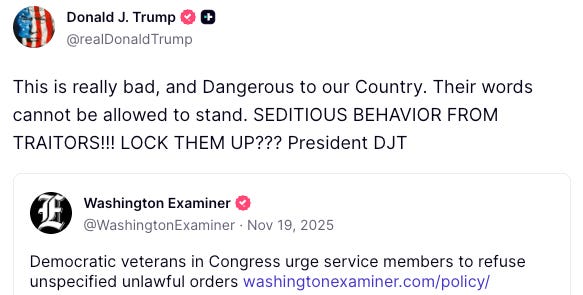 Prosecuting Members of Congress Prosecuting Members of Congress | Bob and Jack chat about a federal court’s preliminary injunction blocking the Defense Department’s attempt to reduce Senator Mark Kelly’s military retirement benefits, along with a grand jury’s refusal to indict six Democratic members of Congress, including Kelly, who in a video reminded service members of their duty to refuse unlawful orders. They discuss how Trump administration weaponization can be effective even with court losses, and debate possible reforms to limit politically motivated prosecutions of members of Congress, including Bob’s proposal for a court-appointed special counsel and an alternative that focuses on revising the substance of criminal statutes.Mentioned:“The Bad News in the D.C. Grand Jury’s Refusal to Indict Six Members of Congress” by Bob Bauer (Executive Functions, Feb. 12, 2026) Get full access to Executive Functions at www.execfunctions.org/subscribe | 24m 37s | ||||||
| 2/5/26 |  Richard Ekins on Diego Garcia and the Chagos Islands Dispute Richard Ekins on Diego Garcia and the Chagos Islands Dispute | Jack speaks with Richard Ekins, professor of law and constitutional government at Oxford University, about the United Kingdom’s plan to transfer sovereignty over the Chagos Islands to Mauritius while leasing back the Diego Garcia naval base for continued U.S.–U.K. military use—an issue that has drawn renewed attention in recent weeks after President Trump publicly criticized the proposed agreement. They discuss the historical background of the Chagos Islands dispute, the role of international courts, treaty obligations between the United States and the United Kingdom, and the strategic importance of Diego Garcia. They also examine the legal and security risks of the proposed transfer, including constraints on the use of force, nuclear nonproliferation obligations, and the question of why the United States might consent to the agreement.Since this chat was recorded, President Trump today signaled support for the Chagos sovereignty transfer, or at least a rollback of his criticism. He also said: “If the lease deal, sometime in the future, ever falls apart, or anyone threatens or endangers US operations and forces at our Base, I retain the right to Militarily secure and reinforce the American presence in Diego Garcia.”Mentioned:“Britain’s Chagos Deal Can’t Go Forward Without U.S. Consent” by Richard Ekin (National Review, Jan. 30, 2026.) Get full access to Executive Functions at www.execfunctions.org/subscribe | 22m 39s | ||||||
Want analysis for the episodes below?Free for Pro Submit a request, we'll have your selected episodes analyzed within an hour. Free, at no cost to you, for Pro users. | |||||||||
| 1/30/26 |  Donald Trump is Settling Old Scores—and Making New Plans? Donald Trump is Settling Old Scores—and Making New Plans? | Bob and Jack talk about grievances from President Trump’s first term that continue to shape his second-term conduct. They examine the federal search warrant recently executed at a Fulton County election facility seeking 2020 ballots, including the structure and purpose of the investigation and the president’s asserted authority to use federal law enforcement in election matters. They also discuss Trump’s $10 billion lawsuit against the IRS and the Treasury Department over the disclosure of his tax information, unpacking the basis of the claims and the institutional questions raised by a sitting president suing the executive branch he oversees.Mentioned:“Is the Administration Prepared to Deploy ICE to Police This Fall’s Elections?” by Bob Bauer (Executive Functions, Jan. 27, 2026) Get full access to Executive Functions at www.execfunctions.org/subscribe | 29m 53s | ||||||
| 1/20/26 |  Sai Prakash on the Pardon Power from the Founding to Trump Sai Prakash on the Pardon Power from the Founding to Trump | Jack speaks with University of Virginia School of Law Professor Saikrishna Prakash about his new book, The Presidential Pardon: The Short Clause with a Long, Troubled History. They discuss the origins of the pardon power, the framers’ anxieties about its breadth, controversies about its early use, how modern presidents have increasingly used clemency to advance ideological, political, and personal goals, and the challenges of reform.Mentioned:Saikrishna Bangalore Prakash, The Presidential Pardon: The Short Clause with a Long, Troubled History (2026)“Trump’s Circumvention of the Justice Department Clemency Process” by Jack Goldsmith and Matt Gluck (Lawfare, Dec. 29, 2020) Get full access to Executive Functions at www.execfunctions.org/subscribe | 36m 13s | ||||||
| 1/16/26 |  What Happens if Trump Invokes the Insurrection Act? What Happens if Trump Invokes the Insurrection Act? | Jack and Bob examine President Trump’s threat to invoke the Insurrection Act in response to ICE-related unrest in Minneapolis. They discuss the Act’s broad language, the uncertain scope of presidential discretion, the many unresolved constitutional questions that the Supreme Court might consider, and the political and legal risks of deploying troops domestically—particularly against the backdrop of upcoming elections.Further reading:“Trump Threatens to Invoke the Insurrection Act” by Bob Bauer and Jack Goldsmith (Executive Functions, Jan. 15, 2026)“Thoughts on the Interim Order in Trump v. Illinois” by Jack Goldsmith (Executive Functions, Dec. 24, 2025)“Trolling About Habeas Corpus” by Jack Goldsmith (Executive Functions, May 12, 2025) Get full access to Executive Functions at www.execfunctions.org/subscribe | 34m 30s | ||||||
| 1/12/26 |  The Criminal Investigation of the Fed Chair The Criminal Investigation of the Fed Chair | Jack and Bob discuss the subpoena targeting Federal Reserve Chair Jerome Powell, the legal limits on presidential control of the Fed, Senate resistance, and the potential consequences for markets and the administration heading into the midterms. Get full access to Executive Functions at www.execfunctions.org/subscribe | 23m 21s | ||||||
| 1/5/26 |  Law and the Venezuela Invasion Law and the Venezuela Invasion | Bob and Jack discuss the legality of the U.S. invasion of Venezuela leading to the capture President Nicolás Maduro, how law matters to presidential uses of force, and what legal issues to expect at Maduro’s trial.Mentioned:“On the Legality of the Venezuela Invasion” by Jack Goldsmith (Executive Functions, Jan. 3, 2026)Curtis A. Bradley, Historical Gloss and Foreign Affairs: Constitutional Authority in Practice (2024) Get full access to Executive Functions at www.execfunctions.org/subscribe | 25m 56s | ||||||
| 12/29/25 |  The President's Protective Power The President's Protective Power | Jack spoke with Chris Mirasola of the University of Houston Law Center about the President’s “protective power” to use the regular armed forces or the National Guard (if properly federalized) in the domestic sphere for the protection of federal property and functions. They discussed the origins and scope of the protective power, its relationship to the Posse Comitatus Act, why it was relevant in Trump v. Illinois, and the president’s prominent options for domestic deployment of the military (including using regular armed forces for a protective function) after Trump v. Illinois.Further reading:Chris Mirasola, Sovereignty, Article II, and the Military During Domestic Unrest, 15 Harv. Nat’l Sec. J. 199 (2023)Jack Goldsmith, Thoughts on the Interim Order in Trump v. Illinois, Executive Functions (December 24, 2025)Chris Mirasola, Unpacking the Protective Power, Lawfare (June 12, 2025)Consider becoming a free or paid subscriber. Get full access to Executive Functions at www.execfunctions.org/subscribe | 31m 31s | ||||||
| 12/12/25 |  Catching Up, Keeping Track Catching Up, Keeping Track | Bob and Jack discuss the latest developments across three ongoing issues in Trump’s second term: use of the pardon power, unresolved transparency disputes, and the administration’s campaign against major law firms. They examine the political dynamics at play behind a recent series of pardons, promised disclosures related to the Epstein files and the Sept. 2 boat strikes, and how executive orders targeting major law firms, though repeatedly struck down, continue to create uncertainty and pressure within the legal profession. Get full access to Executive Functions at www.execfunctions.org/subscribe | 20m 26s | ||||||
| 12/9/25 |  Executive Power in the Age of Artificial Intelligence Executive Power in the Age of Artificial Intelligence | Jack talks with University of Minnesota Law School professor Alan Z. Rozenshtein about how artificial intelligence could reshape the modern presidency by easing bureaucratic limits that have traditionally constrained presidential control. Building on Rozenshtein’s lecture, The Unitary Artificial Executive, they discuss how automated decision systems might function as a presidential “oracle” across the administrative state. The conversation examines how, and to what extent, AI could centralize power throughout agencies, reduce the role of human deliberation, and alter traditional principal–agent relationships inside government.Mentioned:“The Unitary Artificial Executive” by Alan Z. Rozenshtein (Lawfare, Oct. 30, 2025) Get full access to Executive Functions at www.execfunctions.org/subscribe | 32m 28s | ||||||
| 11/19/25 |  A President Who Advocated for Limits on Executive Authority A President Who Advocated for Limits on Executive Authority | Bob talks with historian Walter Stahr about William Howard Taft’s model of the presidency. The conversation covers Taft’s remarkably varied career across the executive and judicial branches, his differences with Theodore Roosevelt over the scope of executive power, his stance on war powers, and the significance of his post-presidential writing on executive authority and responsibility. Mentioned:Walter Stahr, Stanton: Lincoln’s War Secretary (2017)William Howard Taft, Our Chief Magistrate and Its Powers (1916)Theodore Roosevelt, An Autobiography (1913) Get full access to Executive Functions at www.execfunctions.org/subscribe | 32m 24s | ||||||
| 11/11/25 |  What Are We Living Through? What Are We Living Through? | Jack talks with Columbia Law professor David Pozen about Pozen's recent Boston Review essay with Jedediah Britton-Purdy, “What Are We Living Through?” They discuss three competing ways of understanding the Trump administration—authoritarian rupture, continuity with long-running dysfunction, and a transition to a new constitutional regime. The conversation explores whether all three can be true, what kind of damage may be irreversible, and what rebuilding might look like after Trump.Mentioned:“What Are We Living Through?” by David Pozen & Jedediah Britton-Purdy (Boston Review, Oct. 15, 2025)“Hardball and/as Anti-Hardball” by David Pozen (Lawfare, Oct. 11, 2018) Get full access to Executive Functions at www.execfunctions.org/subscribe | 31m 34s | ||||||
| 10/14/25 |  Decision-making Disarray at the DOJ Decision-making Disarray at the DOJ | Bob and Jack discuss recent reports of internal rifts at the Department of Justice, the loyalty pressures shaping the Trump administration, and whether constitutional reform is needed to curb the spiral of politicized prosecutions. Mentioned:The Imperial Presidency by Arthur M. Schlesinger Jr“Part Enabler, Part Bluffer: The Bind of the Justice Department’s No. 2” by Glenn Thrush and Alan Feuer (NYT)“How Should a DOJ Political Appointee Think About a Trump-Weaponized DOJ?” by Jack Goldsmith (Executive Functions) Get full access to Executive Functions at www.execfunctions.org/subscribe | 21m 34s | ||||||
| 10/7/25 |  The Oregon National Guard Ruling The Oregon National Guard Ruling | Bob and Jack discuss (and disagree about) the Oregon National Guard ruling, the deference owed to the president, the relevance of the president’s Truth Social comments, and the ultimate limits on the president’s power to use the military in the domestic sphere. Get full access to Executive Functions at www.execfunctions.org/subscribe | 27m 42s | ||||||
| 9/29/25 |  The Comey Indictment The Comey Indictment | Bob and Jack discuss the Trump administration’s indictment of former FBI Director James Comey, the lawfulness of the Lindsey Halligan appointment as interim U.S. Attorney, the implications of Trump’s full takeover and weaponization of DOJ, and how to think about reform in this context. Get full access to Executive Functions at www.execfunctions.org/subscribe | 25m 19s | ||||||
| 9/25/25 |  Is Donald Trump a Reconstructive President? Is Donald Trump a Reconstructive President? | Keith Whittington, David Boies Professor of Law at Yale Law School and author of The Political Foundations of Judicial Supremacy, joins Jack Goldsmith for a conversation about reconstructive presidents (Jefferson, Jackson, Lincoln, and FDR), and whether Donald Trump fits that mold. They discuss Trump’s constitutional ambitions, judicial supremacy versus departmentalism, and whether Trump will defy the Court. Get full access to Executive Functions at www.execfunctions.org/subscribe | 43m 19s | ||||||
| 9/8/25 |  Fateful Lawyering in the Trump Administration Fateful Lawyering in the Trump Administration | Bob and Jack discuss the performance of White House Counsel David Warrington and examine last week’s lethal strike on alleged Venezuelan terrorists—including its possible implications for domestic presidential military strikes.Consider becoming a free or paid subscriber to Executive Functions.This is an edited transcript of an episode of “Executive Functions Chat.” You can listen to the full conversation by following or subscribing to the show on Substack, Apple, Spotify, or wherever you get your podcasts.Jack Goldsmith: Good morning, Bob.Bob Bauer: Good morning, Jack.There’s been so much in the news since we last chatted, which was quite a while ago, actually. Today, we’re going to focus on some topics that we know a little bit about. We’re going to discuss two stories from last week about Trump administration lawyering: the long New York Times profile on your successor in the White House Counsel’s Office, David Warrington, and the administration’s lethal strike on a speedboat in the southern Caribbean that allegedly contained members of the designated Venezuela terrorist organization Tren de Aragua, allegedly transporting drugs to the United States. These connect insofar as they involve executive-branch legal decision-making. Why don’t you begin by summarizing and commenting on the New York Times story about Warrington?A number of things struck me about the story about Warrington. Of course, it was published against the background of a lot of debate about the role of the White House counsel—the extent to which the White House counsel has supplanted the Department of Justice (DOJ) as the principal channel for legal advice to the president. What that means if presidents pick White House counsels who are particularly friendly to them, have personal or political backgrounds with them, and can be expected to be, if you will, loyal and pliant.Some of that debate has been, in this administration, overtaken by events, because once there was a thought that presidents would nominate somebody relatively uncontroversial—down the middle, if you will—as attorney general, and then have a White House counsel who is much more in that world of friendliness and political background. Now, of course, this particular president has chosen from his own personal legal team the senior officials in the DOJ. So that particular concern about the White House counsel may have been overtaken by events. But it’s still a very powerful legal office right there in the West Wing, one floor above the Oval Office, and probably the last word on any critical legal question that the president has to address.What I found striking, in that article, was that David Warrington gave the interview to the New York Times, understanding perfectly well that that’s a locus of criticism of the president’s legal stances. He said two things that were somewhat in tension. One was that he didn’t feel he should be giving his personal views: He gave the advice he gave, and unless asked, he didn’t say more. But later on, he said he gave the advice that he gave and there was some inclination or some suggestion that he spoke his mind… it wasn’t entirely clear.I have to say, in an administration like this, I’m skeptical about a White House counsel who says, “I’ll keep my thoughts to myself; I’ll just give him my reading of the law. And if I have any concerns about the direction we’re going, I’m just not going to express them.” I have real concerns about that, in any presidency, but particularly in this one. Second, he said his role was to advise with a view toward finding “defensible” positions for the administration to take—e.g., strategies courts have criticized for deporting and trying to avoid court jurisdiction. He was looking for defensible positions and to reduce risk. That raises two questions: What is a defensible position? What’s the standard for determining what a defensible position is? And secondly, what does it mean to reduce risk—what kind of risk are you talking about? The risk that the courts will overturn it? The risk that it will provoke congressional opposition or complaint, particularly from your own side of the aisle? It wasn’t clear how he was, as a professional, defining the way he would approach his job in this very challenging administration where the president has displayed so little regard for the rule of law.I want to press you on a bunch of those points. My reaction to the story was that it was kind of anodyne, actually. I thought a profile of Warrington would show him in the tank for the president, and it wasn’t quite that. Can you briefly explain, to the extent that there is a traditional explanation, the traditional role of the White House counsel as opposed to the traditional role of the attorney general?The White House counsel is a member of the president’s senior staff—end of story. No authority to bind agencies with legal interpretations; a counselor picked by the president, not subject to Senate confirmation. The attorney general of the United States is the second most-senior (to the president) law enforcement officer in the constitutional system, nominated to the Congress, to the Senate, confirmed or rejected by the Senate. And there's been a view, particularly after the Nixon debacle in the Watergate era, that an attorney general has to stand for a department that is like any other department. It's not independent of the president in a formal sense, certainly needs to be attentive to the president's policy priorities. But at the same time, in law enforcement activities in particular, has to avoid any suggestion of political favoritism or impartiality and therefore establishes independence in that sense.There are no criteria like that for the White House counsel. There's no criteria at all prescribed anywhere for the White House counsel. It's really a position that's governed by expectations and by norms—that as influential as a White House counsel can be with such close proximity to the president, the White House counsel will be guided by a concern for representing the presidency as an institution and not merely operating, which he or she shouldn't, as a personal or political lawyer to the president. But isn't it also true (I think we wrote in our book together) that the White House counsel is at the heart of political decision-making inside the White House? Is it fair to say that in a normal administration, the White House counsel is more of a political/legal counselor as opposed to providing the account of the law that should guide the executive branch? Is that—can you just get at that a little bit? Because that'll lead me to my questions about how Warrington was presented. There is always the possibility that that's how the White House counsel sees his or her job as a lawyer—member, loyal member—of the senior legal team. In my time, and I know there are other White House counsels who have shared this view, I thought it was I thought it was very important for the office to distinguish itself from other senior staff members and retain its credibility as legal advisers by not seeming to be full-throated members of the president's political or communications team. The risk of the White House counsel being both a political adviser and a legal adviser is that other members of the senior staff—or the president himself—might wonder, when getting a piece of advice: Is this advice shaped by the law, or is it shaped by the political or communications judgment of the White House counsel? And for a White House counsel, in my view, to have credibility, there has to be no question that their advice is shaped by the law. Now, if they have some view about the political consequences of taking a particular legal position—Congress will object, the press will rise up in fury, allied ideological groups will be unhappy… Then the White House counsel could bring that into the conversation if somebody else doesn't, but can say—and should say, by the way—separately and apart from the legal advice just given, that these other political consequences could follow. But I think it's very important for the White House counsel's office to be a legal operation and not an adjunct of the political and policy operation of the president.Right. Now, I didn’t mean to suggest that it should be an adjunct, and he didn’t even present himself as one. He presented himself as providing legal advice about legal risk. One of the interesting things about the story is that it described a White House counsel’s office that was more law-heavy, doing more DOJ-type legal analysis. I think that’s what I read between the lines of the story.And that he, in some sense, had a more enhanced—arguably more enhanced—legal role than the average White House counsel, because they have not wanted to go to OLC and other elements of DOJ.Can I just mention one think quickly, Jack? He referred to it as more of a litigation shop than any of his predecessors. Right. And so what about that? I mean, you asked the question—he said he was assessing risk. My understanding of the White House counsel's office has been that the law is vetted and presented, including various possible interpretations of the law. Then the president faces legal risk and political risk. And I think it’s important to mention that the president of the United States under Article II is the legal decider for the executive branch.So ultimately, the president—whether a lawyer or not—gets to decide. Part of what I understood the White House counsel to be doing was assessing and advising the president about all of these risks. Is that right or wrong?No, that’s right. It goes to the point I made earlier about distinguishing legal risk from other kinds of risks like political risk, and being very clear. The White House counsel should be explicit when there is a political risk in addition to a clearly presented legal risk. A legal risk is: you’re breaking the law. You are breaking the law. You are doing something that, as the president takes care that the law is faithfully executed in accordance with constitutional responsibilities, you shouldn’t do. Then there’s also legal risk in the sense that a president could be sued. The administration could be sued over an action and could find that action successfully challenged in court. There’s also legal risk of a constitutional dimension if they take an action that could lead to the institution of impeachment proceedings. Those are all legal risks.Other risks are political uproar, bad reaction among allied ideological groups, or loss of support among independents as measured by constant White House polling. Those kinds of risks exist as well. But first and foremost, the question has to be: Are you taking the risk of violating the law, of exceeding legal and constitutional boundaries in the decision you’ve taken?And it just wasn’t clear to me—and granted, Warrington in the article doesn’t go on at great length about it—what it meant when he said, “We want to reduce the risk.” Because if you look at precedent—take the executive orders that involve law firms, for example—those are clearly unlawful. Was the judgment there: “Yes, you’re taking the risk of breaking the law, the risk of being reversed by a court… But those are acceptable risks because nothing else is going to happen to you, and it’s going to have an interim effect on the legal community. So your desire to spook the legal community will be successful.” To me, that wouldn’t be responsible lawyering.Why? And let me give you another example to flesh it out—and I tend to agree with you, I just want to flesh out the point. They gave the example of the deportations before Judge Boasberg. Very early in the administration, it looked like DOJ was defying Judge Boasberg and deporting certain Venezuelans outside the United States. There was a question whether Boasberg ordered the planes to turn around at some point, and whether they had to comply with that.And Warrington and the deputy attorney general came up with the theory that they had a good legal argument: if the deportees were outside the United States, then they were outside the scope of the judge’s order, and the planes didn’t have to turn around.I thought that argument was a stretch at the time, but it ultimately prevailed—not necessarily because it was the right call on the law, but because when Judge Boasberg held a contempt proceeding, the D.C. Circuit, by a 2–1 vote, held that contempt was not appropriate for that ostensible disobedience of the order. So the administration prevailed on that, based on what sounds like the Warrington legal theory. How do you assess that? Is that an okay role for the White House counsel to be playing?There’ll be a debate about that. I’m sure. I’m very troubled by what I infer from the article’s reference to a “defensible position.” Again, this was the reporter’s characterization of their conclusion. To be fair, I wasn’t in the room and didn’t hear how strong or weak they thought that legal argument was.But when I was in the White House, I would hear various lawyers speak about different standards for determining legal risk that ranged from whether a legal argument was “plausible” to even “available”—meaning really, really weak, but technically could be made. What troubles me about the word “defensible” is that it could mean, “We can put it on paper and maybe avoid sanctions,” but in truth, it’s a terrible legal argument with serious implications for the presidency.That’s the point I want to stress. The White House counsel—though appointed by and serving a particular president—represents the institution of the presidency, not President Trump in his personal or political capacity. Therefore, it is extremely important in these conversations that the White House counsel is very clear about what constitutes a legitimate, strong, good-faith legal argument, and what is one the president can simply get away with making.So ultimately, for me, this is a very tricky question because it’s the president’s call. My baseline assumption was that Warrington would take the stance of, “Whatever you want to do, sir, we can do.” But that’s not how the story presented him. The story showed him offering legal views, with the president interested in various perspectives, and then the president deciding. In some sense, that’s a normal process—although we know here that President Trump holds a maximal view of executive power and that this administration is in many contexts indifferent to law.So what do you do as White House counsel, other than not take the job, when there is a president exercising his authority to interpret the law for the executive branch with such an expansive view of executive power as to not be constrained at all? How does one even think about that as White House counsel?Granted, it’s a very difficult question when someone decides to become the White House counsel to a President whose views on executive authority and on the law are as well known as Donald Trump’s were when David Warrington took the job. But I think there has to be some suggestion—and again, the story was not complete about this, though it may be taking place—that the White House counsel is digging in and making an issue of legal compliance within the administration.Defensible positions, and also the suggestion that he gives the answer he gives but doesn’t express “personal views,” alarms me. It suggests a tilt toward: “Well, whatever you say—listen, this is completely inconsistent with the law, but I’ll come up with the best argument I can to protect it or cover for it.” That’s not the way you want the best White House counsels to perform.And again, Warrington gave an interview, but he didn’t say much. The people in the background who provided additional reporting for Charlie Savage in the New York Times didn’t provide much detail either. But given the kind of administration this is, you would have liked to see a little more robust defense of the professional and ethical responsibilities of the White House counsel.OK, let’s move on to the speedboat—the legal force against the speedboat. I’ll quickly run through the relevant background, because I think it’s important. This was a boat allegedly containing members of Tren de Aragua, which the Trump administration designated as a terrorist organization, and whose alleged members it is also trying to deport under the Alien Enemies Act in the United States.There’s a longstanding conflict between the United States and the Maduro regime in Venezuela. In Trump’s first term, President Nicolás Maduro of Venezuela was indicted on drug trafficking charges as a cartel head, back in 2020. As I said, Tren de Aragua was deemed a terrorist organization, and the president determined that they were undertaking hostile actions and conducting irregular warfare against the U.S. through unlawful immigration and narcotics trafficking.In July, according to the New York Times, the president signed a directive to the Pentagon authorizing military force against Latin American drug cartels deemed terrorist organizations. That would include this one, and presumably that was the directive relied on here.There’s been a big U.S. military buildup in the Southern Caribbean. And then finally, the strike took place on September 3.The president sent a War Powers Resolution letter to Congress and essentially said, “I can do this under my Article II powers.” He did not rely on any statutory authorization from Congress. Instead, he cited his responsibilities to protect Americans and U.S. interests abroad, and to further U.S. national security and foreign policy interests.He also hinted in the letter that other nations were “unwilling and unable” to stop this threat—an allusion to a standard in international law. So that’s the basic legal architecture we know here.Domestically, the question is whether the president is authorized under Article II; internationally, whether the strike is consistent with international law or stretches it. I would say the international-law argument is a large stretch.From one perspective, this represents a new assertion of presidential power: And the key thing is using force against terrorist-designated organizations that are part of a nation or group not otherwise in armed conflict with the United States, though the president claimed they were engaged in irregular warfare. It’s extending it. We extended presidential power to use force against terrorists beginning after 9/11, and that expanded in various ways. But this is another expansion—under Article II power.Now, I will say that while it’s an expansion, it’s not necessarily out of line with the evolution of the president’s Article II power. This is how presidential power expands: they build on precedents, point to those precedents, pick up on language in them, and extend it to a new factual situation. That’s essentially what’s happened here.The OLC opinions on Article II power are so open-ended and permissive that it’s not a crazy interpretation to say the president has this authority under Article II. It is, however, a fateful step for a president to use Article II power to go after drug criminals deemed terrorist organizations. That’s the situation as I see it. On the international-law side, I don’t think any serious lawyer would say this constitutes self-defense under customary international law or the U.N. Charter, because we’re not in an armed conflict. There’s just not the adequate level of violence between either this group or Venezuela and the United States.The last thing I’ll say, however, is that it’s clear the United States is building up a military presence vis-à-vis Venezuela. It’s clear they are trying to raise the military stakes and bring this into the level of warfare under international and domestic law. That strike was the first exemplar of that.On that argument, the president has extraordinary unilateral power to do it. It’s one of those facts of life: the president controls the military and can invite or initiate hostilities with other nations. He gets to determine and characterize the conflict.And the point I wanted to make is, as others have, this has relevance to the Alien Enemies Act argument in the United States about whether the president has properly invoked the Alien Enemies Act. The more this conflict with Tren de Aragua looks like real war—looks like lawful warfare—the stronger the president’s arguments are under the Alien Enemies Act to deport.So that’s my take on it. Do you have any reactions?I have a couple of questions. First, I want to bring up one legal question. In the president’s War Powers letter, he says that he assessed that Tren de Aragua was a foreign terrorist organization. He acknowledged that it was because it is, and that it was engaged in drug trafficking.What is the legal significance, for purposes of the boat attack, of their having been designated a foreign terrorist organization?The designation as a foreign terrorist organization by itself does not automatically trigger the president’s Article II powers. It has to be tied to a national interest. And again, we’re moving in a direction that DOJ opinions have never quite gone to. But the national interests identified in OLC opinions are so expansive that it’s not hard to frame this as a national interest sufficient to warrant the use of force under domestic law.But the designation as a terrorist organization by itself does not trigger Article II powers to use force. It takes extra steps, though I’m not sure how hard it would be to meet those steps here.That brings me to another question, and then one about consequences or the broader framework in which presidential power is repeatedly expanded in this fashion, step by step. If the president can say, for example, that there are dangerous forces at work—conceivably fed by foreign enemies, making payments for it, encouraging them, whatever—but they’re active in our major cities, and he may be required to deploy forces to those cities, what is it in this claim of Article II authority that would prevent him from authorizing an attack on the headquarters of a domestic organization he believes may be encouraged by foreign sources, but is engaging in the kind of activity that, most recently in a meme he posted, justifies intervention by the Department of War in the city of Chicago, for example? What is the limiting principle in this claim of Article II authority to protect the national interest in this way?Yeah. So you’re asking whether he could use this justification to use force inside the United States.That’s correct.So—wow. OK, that’s too hard a question for me to answer. I’ll just say a few things. This came up during the Bush administration with José Padilla, when he was captured inside the United States and deemed to fall under the post-9/11 Authorization for Use of Military Force. The question arose whether the president could have used military forces as Padilla was coming off the plane, rather than simply capturing him.Frankly, there was a lot of debate about that. And it’s actually a much harder question than you would think. I mean, I think the answer has to almost certainly be no—that the president would need to use police forces and other domestic authorities, and that his essentially self-defined Article II powers to go after these groups couldn’t be used inside the United States.But it was always a hard argument to explain why, if you really accept the premise that we’re in a conflict with this group and that group happens to be inside the U.S. The parallel, of course, is the Civil War—and obviously that’s not a close parallel in terms of scale or what was going on. But if the president’s war powers are triggered, why can’t he use it? Again, I would—and could—write the memo saying it was unlawful, but you could also write the memo the other way, as horrible as that sounds, arguing that the president could be empowered to use military force domestically. That’s my shorthand answer. It’s more complicated than that, and some people will disagree with me, but that’s the way I see it.But domestically, to be clear—and I just have one wrap-up question here—what I’m focusing on is his determination that the terrorist activity is in no way authorized under any of the authorizations to use military force dating back to the Iraq invasion. This would be a current threat to U.S. national security by a domestic group, perhaps supported by foreign funding or encouragement, but conducting what he called, in the case of Tren de Aragua, “irregular warfare” within the United States.And you’re suggesting there may be administration lawyers who would be open to that argument. I mean, I can imagine them making the argument, yes. This is one of those issues—like so many raised by the Trump administration—where theoretical arguments take you in a certain direction, and people say, “Well, no one would ever do that, so we don’t need to worry about that issue”And, you know, there are very powerful arguments that the president couldn’t do that. But it’s not as though there’s a Supreme Court decision forbidding it. And it’s not as though you couldn’t cobble together an argument to justify it. So it’s a very scary prospect: the president using the same rationale, against the same so-called terrorists, inside the United States. Why not?Again, the law probably requires the president to use law-enforcement authorities domestically, and not use his Article II military powers. But you could make the argument the other way.What I want to emphasize is that we are taking an extreme argument used in territorial waters outside the United States and asking how that extreme argument would play out in the domestic realm. And it’s already on weak ground outside the United States. But here’s the issue: who is going to stop him from doing it? The courts are not going to get involved in the use of force outside the United States. Congress never has—and Congress is the institution that is supposed to police and control this, but it’s out of commission.The courts would definitely get involved if military force were used inside the United States, whether they wanted to or not, and whether or not they treated it as a political question. There would be efforts at judicial accountability in that scenario.But the idea that courts are going to save us from this—as I’ve been emphasizing recently—is just not the right focus. It’s really a question of what the politics will hold, and how extreme they want to be in using these authorities. And I guess my concern is that they’ve been using these military authorities in a whole variety of contexts, kind of at a relatively low level inside the United States so far, with the National Guard deployments in various ways. But slowly and surely, these are building up into what are going to be more powerful arguments. They have more powerful authorities under the Insurrection Act that they haven't yet used. I'm not talking about your hypothetical now, but for quelling domestic violence and the like. And I think that the administration thinks that these arguments are good for it. I think that they think that the American people are on board—or at least their supporters are on board, for really going hard after criminals, for really going hard after drug dealers, for really going hard after illegal immigrants, for really going hard after terrorists. The Vice President’s comment about the use of force against the boat, when it was claimed that it was murder and possibly a war crime, was that he “didn’t give a [bleep].” This was basically the vice president of the United States expressing utter indifference to the law and, again, kind of glorifying the use of military force in this controversial context. So the worry is that they're building up confidence in the use of these military authorities domestically. And I don't know. I don't know how far it will go. I don't know where the politics will stop it.Yes, and so let me just very quickly respond to that in a kind of wrapping-up point. One is that I don’t have the Vance comment in front of me, but there’s nothing in what he said about the ‘highest and best use of the military’ that suggests it would be confined to the same threats he sees operating inside the United States—number one.Number two, what you described goes back to the Warrington article. The White House counsel, making an argument for my hypothetical, for the administration’s actions in my hypothetical, could characterize it as a “defensible position.” If “defensible” is stretched that far—if an argument can simply be made—then the administration can claim a legal justification for itNumber two, what you described is something that, going back to the Warrington article, the White House counsel, an argument for my hypothetical, for the administration's actions in my hypothetical, what was described in the Warrington article as a defensible position. If defensible is stretched that far, an argument could be made, then the administration can claim a legal justification for it. And that brings me to my wrap-up question. When we use the term stretch, we suggest that it’s still within the realm of reasonable argument, because something’s been done before that could be pulled a little bit in that direction—so it’s “kind of a stretch.”But at the end of the day, where do the stretches end? If every step leads to the next—step A leads to step B, which is characterized as a stretch, but step B is taken, then step C is taken, which is characterized as a stretch on step B—where does it end?It ends—and I don’t mean this to be glib—it ends only when the American people say it ends. And by that, I mean Congress through political pressure, or the people through elections or through other means. Because the president will, it seems, do what he thinks he can get away with politically and/or legally. o I don’t know where it ends, but to the extent that the administration perceives it gains an advantage, I think it will continue moving slowly along these lines, testing how far it can go.I don’t disagree, but I want to return to the responsibility of lawyers within the government. At the end of the day, no, they don’t have the final say—and you can always pick the lawyer you think will give you the advice you need.There are lawyers out there prepared to sell—whether for free or for a dear price—the advice that their clients want. But you would hope, and expect, that the legal profession inside the government would put up a fight in these circumstances.But I don’t disagree with you. At the end of the day—and here’s my final expression of naïveté—I don’t disagree that the ultimate answer lies in the public standing up, in the Congress standing up, and in the electorate standing up for a vision of the rule of law in this country that does not permit the hypothetical to become a reality.I’ll make a wrap-up point. The American people are, for better or worse—though I think worse—kind of indifferent to the use of military force abroad. When the casualties are non-U.S. citizens and Americans are disengaged, we’ve seen over the last 20 years that as war has grown quieter in terms of American casualties, the public cares less and less.But I do believe that at some point the tolerance for the militarization of the domestic sphere will break down. I think it won’t be tolerated in some quarters of the Republican Party, as weak and deferential as it is to the president. So I do think there are special political dangers here. We’ve talked about this: the importance of reforming the Insurrection Act, and why that reform might have more bite than the analogous War Powers Resolution—precisely because of the political dangers of militarizing the domestic sphere. I don’t want to be naïve about that, but I think it is politically more challenging for a president.The last thing I’ll say is about the role of lawyers. This is an administration where everybody knows what President Trump’s view of his legal authority is, and how he wants to be listened to. There are executive orders and memoranda to that effect. There are interim threats throughout the administration that if you don’t follow the president, you’re out.So to the extent that people are asked to give candid legal views, it’s only with the understanding that “we’re going to make the decision,” as is their prerogative in the White House. I just don’t think there’s a culture in this administration—or a context, or even permissiveness—for the kind of candid lawyerly pushback you’re contemplating. There’s always been a tension on this, but here I think they’ve successfully organized themselves to prevent that kind of legal advice.I don't disagree.It's a good place to stop. Thanks, Bob.Thank you. Get full access to Executive Functions at www.execfunctions.org/subscribe | 36m 28s | ||||||
Showing 25 of 51
Sponsor Intelligence
Sign in to see which brands sponsor this podcast, their ad offers, and promo codes.
Chart Positions
2 placements across 2 markets.
Chart Positions
2 placements across 2 markets.