

Insights from recent episode analysis
Audience Interest
Podcast Focus
Publishing Consistency
Platform Reach
Insights are generated by CastFox AI using publicly available data, episode content, and proprietary models.
Most discussed topics
Brands & references
Est. Listeners
Insufficient chart data. Estimates will improve as the show charts.
- Per-Episode Audience
Est. listeners per new episode within ~30 days
N/A🎙 ~2x weekly·88 episodes·Last published 3mo ago - Monthly Reach
Unique listeners across all episodes (30 days)
N/A - Active Followers
Loyal subscribers who consistently listen
N/A
Market Insights
Platform Distribution
Reach across major podcast platforms, updated hourly
Total Followers
—
Total Plays
—
Total Reviews
—
* Data sourced directly from platform APIs and aggregated hourly across all major podcast directories.
On the show
From 10 epsHost
Recent guests
Recent episodes
Closing the FarmHouse Door
Mar 26, 2026
23m 59s
Lard, Livestock and Learning to Farm With Julie Schroeder
Mar 19, 2026
23m 53s
Meet the 2026 PA Fair Queen With Olivia Morrissey
Mar 12, 2026
18m 39s
Betting the Farm With Beth Hoffman
Mar 5, 2026
30m 28s
Shining a Light on 'Women's Work' With Audra Mulkern
Feb 26, 2026
34m 58s
Social Links & Contact
Official channels & resources
Official Website
Login
RSS Feed
Login
| Date | Episode | Topics | Guests | Brands | Places | Keywords | Sponsor | Length | |
|---|---|---|---|---|---|---|---|---|---|
| 3/26/26 |  Closing the FarmHouse Door✨ | women in agricultureempowerment+3 | — | — | — | women in agagriculture+4 | — | 23m 59s | |
| 3/19/26 |  Lard, Livestock and Learning to Farm With Julie Schroeder✨ | farminglivestock+3 | Julie Schroeder | pork lard productsskin balm+4 | Greenbush, Wisconsin | farminglivestock+5 | — | 23m 53s | |
| 3/12/26 |  Meet the 2026 PA Fair Queen With Olivia Morrissey✨ | fair queen4-H+4 | Olivia Morrissey | Lebanon Area FairSavannah College of Art and Design+1 | PennsylvaniaGeorgia | Pennsylvania Fair QueenOlivia Morrissey+5 | — | 18m 39s | |
| 3/5/26 |  Betting the Farm With Beth Hoffman✨ | farmingagriculture+4 | Beth Hoffman | University of San FranciscoBet the Farm | Iowa | farmingagriculture+5 | — | 30m 28s | |
| 2/26/26 |  Shining a Light on 'Women's Work' With Audra Mulkern✨ | women in agriculturehistory of farming+3 | Audra Mulkern | Lancaster FarmingWomen's Work | — | women in agriculturefarming history+3 | — | 34m 58s | |
| 2/19/26 |  Finding Your True North With Megan Bogle✨ | sheep farmingdairy products+3 | Megan Bogle | dairy productsmeat+2 | Downingtown, PennsylvaniaPhiladelphia+5 | True North FarmsteadEast Friesian+5 | — | 23m 09s | |
| 2/12/26 |  Thousands of Bees and Unique Honey Flavors With Lauren Sattazahn✨ | beekeepinghoney production+3 | Lauren Sattazahn | blueberry honeyspring honey+4 | Lebanon County, PennsylvaniaMaine | beekeepinghoney flavors+3 | — | 32m 00s | |
| 2/5/26 |  From Birth to Butchering With Lulu Redder✨ | agriculturebutchery+3 | Lulu Redder | Feral Woman Farm | North Bend, Washingtonhistoric farm park | butcherysustainable farming+3 | — | 24m 45s | |
| 1/29/26 |  A Love for All Plants and All-Purpose Sheep With Annie Hasz✨ | herbalismfarming+3 | Annie Hasz | Broadwing FarmRooted Home Herbalism+1 | Berks County, Pennsylvania | herbalismBroadwing Farm+3 | — | 25m 02s | |
| 1/22/26 |  Merging Farm Life and City Life With Lindsay Eshelman✨ | farm lifecity life+3 | Lindsay Eshelman | Plow Farms | Plowville, PennsylvaniaNew York City | Lindsay EshelmanPlow Farms+3 | — | 28m 01s | |
Want analysis for the episodes below?Free for Pro Submit a request, we'll have your selected episodes analyzed within an hour. Free, at no cost to you, for Pro users. | |||||||||
| 1/15/26 |  It's Time to Get Excited About Sheep's Milk Cheese With Julia Inslee | This week on the FarmHouse, a podcast by Lancaster Farming, we're talking to Julia Inslee, owner of Locust Hollow Farm in Coatesville, Pennsylvania. Inslee has lived on the farm since her parents purchased the property in the late 1970s. At the time, it was home to a farmhouse, a few rundown barns and several acres of untended land. Over the next few decades, Inslee's family transformed the property. In 2010, Inslee started a dairy sheep operation and now raises East Friesians for milk and fiber. "One of the major misconceptions about sheep is that they're all the same," Inslee said. "Every single ewe has a very different personality, and when you're with them on a daily basis, that really comes out." Though Locust Hollow sells fiber from its sheep, Inslee's main focus is dairy: sheep's milk, yogurt and cheese. Inspired by childhood trips to cheese shops in Philadelphia, Inslee taught herself how to make cheese with her sheep's milk, which she saw as an opportunity for additional income. "I started experimenting and those first batches of cheese, they were terrible," Inslee said of the learning curve. "I think it took about five years to really get a good routine down and really figure out which cheeses worked for me." Inslee now makes and sells a variety of sheep's milk cheeses, including feta and a Manchego-style cheese rubbed with rosemary grown on the farm and named "Rosy Morning." Inslee sells her products at several local markets and enjoys the opportunity to educate the public about sheep's milk products. "I think we're on the cusp of the general public being a little bit more aware of sheep's milk products," she said. "People in general, customers now are looking for something other than cheddar." | — | ||||||
| 1/8/26 | 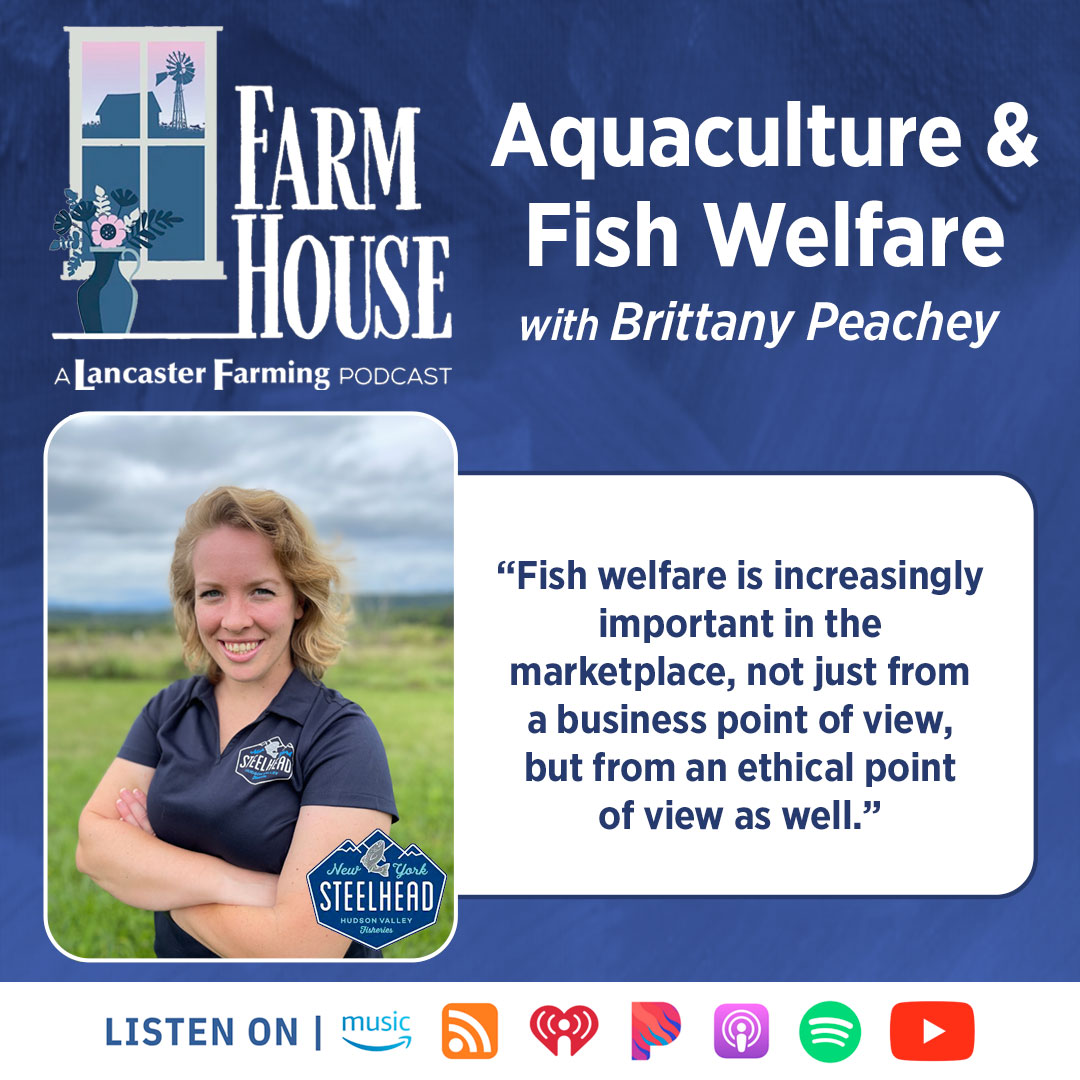 Farming Fish Sustainably and Ethically With Brittany Peachey | This week on the FarmHouse, a podcast by Lancaster Farming, we're talking to Brittany Peachey, the aquaculture operations manager at Hudson Valley Fisheries in Hudson, New York. Peachey's interest in aquaculture was born from an aquatic biology class in college. After earning her master's degree in aquaculture nutrition, she came to work at Hudson Valley Fisheries, a fish farm that specializes in sustainably raised steelhead trout. Peachey was recently awarded the New York State Fair Golden Hoof Award, which is given in recognition of outstanding animal care and husbandry. She acknowledges it's unusual for a fish farm to be considered for such an award and is grateful not only for the honor but for the opportunity for fish to be included in animal welfare discussions. "Fish welfare is increasingly important in the marketplace, not just from a business point of view but from an ethical point of view as well," Peachey said. "People will argue, do fish feel pain? And to be honest, I don't think from a producer standpoint we need to think that way. Let's assume that they do and then grow them in the best way possible." Peachey works in many aspects of Hudson Valley's operations, including its recirculating aquaculture system, or RAS, which allows the facility to reuse 95% of its water. "RAS farms tend to be more efficient with water resources as compared to more traditional forms of fish farming. So, we're producing more fish with less water," said Peachey. In addition to using an RAS, Hudson Valley sends fish waste to a composting facility to be used for fertilizer, continuing its emphasis on sustainability while catering to a growing market. Peachey argues that the comparison between farmed and wild-caught fish should be put to rest, particularly given sustainable aquaculture practices and the risks of overfishing. "With fish being such a healthy protein source, we want people to eat more fish. Where's that going to come from without the price skyrocketing? It's going to be aquaculture," said Peachey. | — | ||||||
| 12/18/25 | 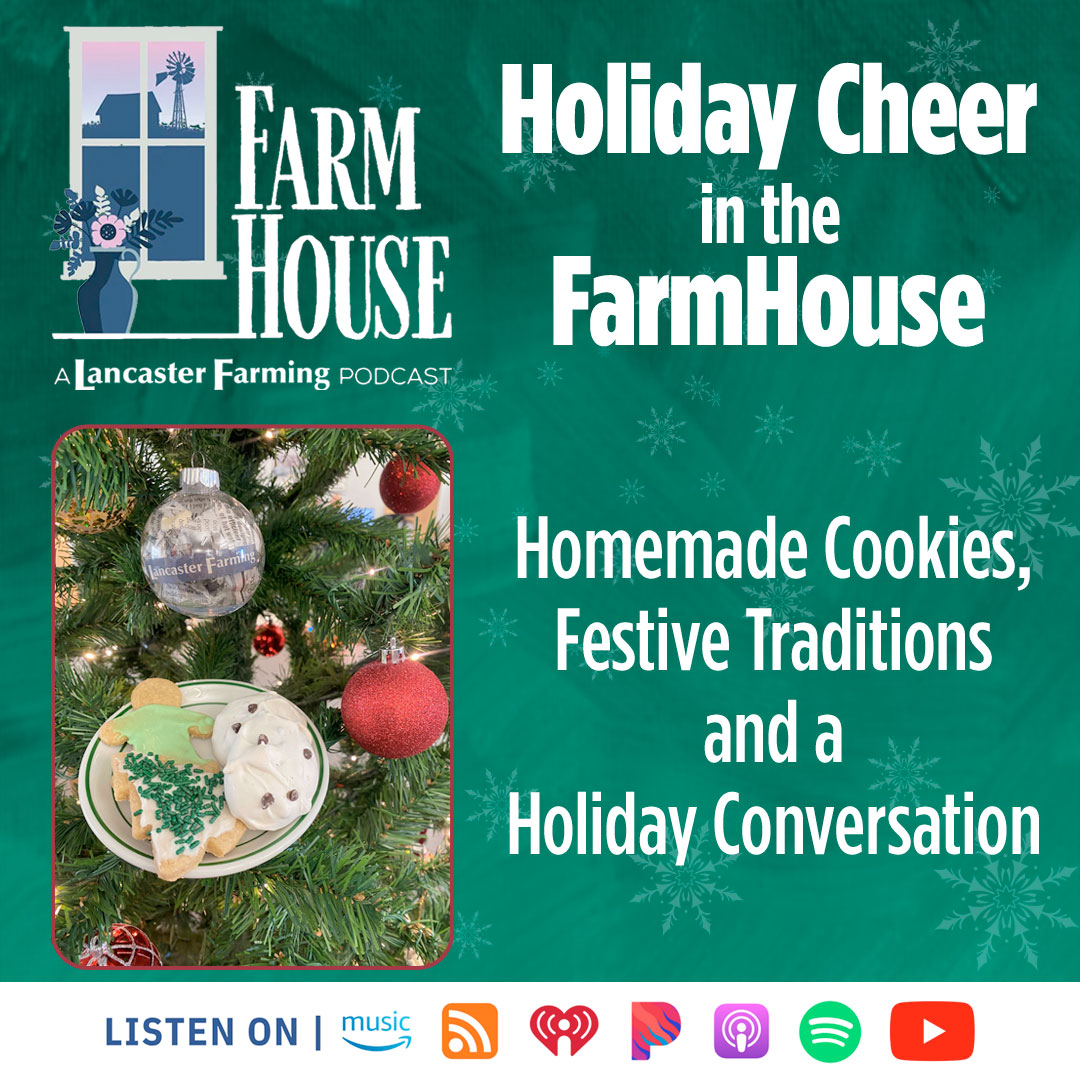 Celebrating Christmas Trees and Cookies in the Festive FarmHouse | This week on the FarmHouse, a podcast by Lancaster Farming, we're ushering in the holiday season with a special seasonal episode featuring an interview with Kelly Piccioni, Penn State's Christmas tree-focused Extension educator. Piccioni comes from a family with roots in selling Christmas trees. Her great-grandfather began selling trees he bought off the Orange Car—a railway-side produce stand that opened in Reading, Pennsylvania, in the 1930s. Her grandparents continued the tradition when they bought what is now the family's Christmas tree farm, Geissler Tree Farms. "Christmas trees is pretty much where our family story really began," Piccioni said. As Pennsylvania's sole Extension educator who specializes in Christmas trees, Piccioni's work takes her all over the state as she works with growers to overcome challenges like recent droughts. "I've been out in Christmas tree fields more than I've really been in an office," Piccioni said, adding that she enjoys knowing her work contributes toward people's holiday traditions. "People are excited this year to find that joy in Christmas," she said. "And Christmas tree growers think so hard all year long about what they can add to their farm or the customer experience to make it magical." In addition to talking with Piccioni, we discuss family cookie-baking traditions, including German-inspired chocolate chip meringues and a debate over the correct thickness for sugar cookies. We'll also touch on a couple holiday traditions from around the world, so join us for the tales of the Belsnickel and St. Lucia. | — | ||||||
| 12/11/25 | 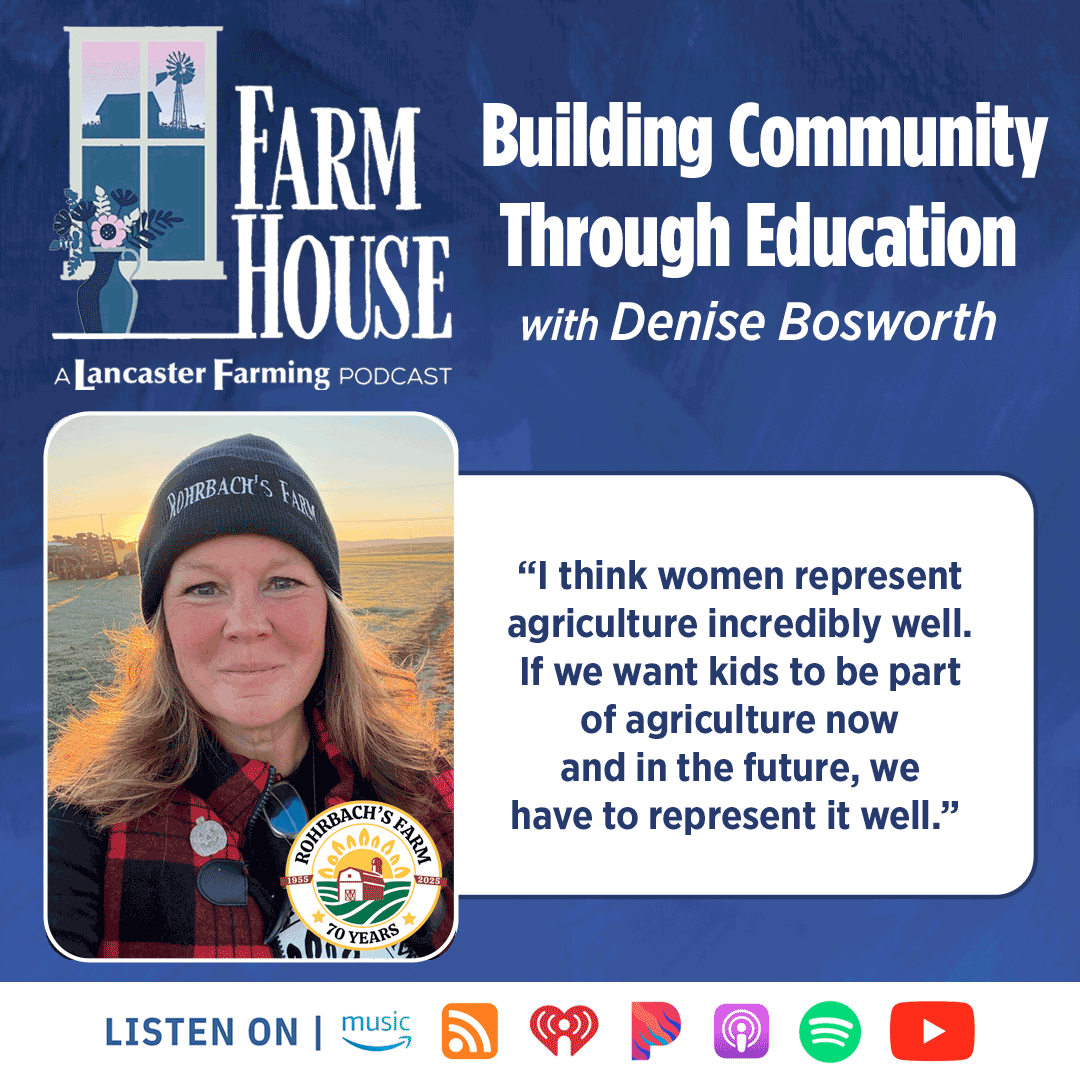 Building Community Through Education With Denise Bosworth | This week on the FarmHouse, a podcast by Lancaster Farming, we're speaking with Denise Bosworth of Rohrbach's Farm. Bosworth is part of the farm's fourth generation and runs the farm market in Columbia County, Pennsylvania. Bosworth and her husband, Dan, returned to the farm in 2013 to begin a new culinary venture, Big Dan's BBQ. In 2015, Bosworth officially took over the farm market portion of the business and her brother, Mark Rohrbach, took over the farming operation. "I like to say my brother grows the food, Dan cooks the food and I throw the party," Bosworth said. "We all definitely bring our own strengths to the table but then work together to bring it all together." Bosworth gives a lot of credit to the farm's third generation — her parents, aunt and uncle. While the transition wasn't necessarily planned and executed perfectly, she said mutual respect and conversation led to the farm's current success. In addition to running the farm market, Bosworth also does community and educational outreach. She has written two agricultural-themed children's books, "Penelope Pumpkin" and "Are They Ready Yet: A Strawberry Story From a Pennsylvania Farm." "I always say, if I could only grow two things, it would be pumpkins and strawberries," Bosworth said. Additionally, she launched a nonprofit called Seeds of the Future to provide agriculture education and farm experiences that are accessible, affordable and relevant. The organization focuses on students and people with special needs with a goal of helping the community. "I think women represent agriculture incredibly well," Bosworth said. "If we want kids to be part of agriculture now and in the future, we have to represent it well." On Nov. 1, Rohrbach's Farm was announced as one of seven recipients of Lancaster Farming's The Farmer's Choice Award. Recipients were nominated and voted on by Lancaster Farming readers. "To be acknowledged on this platform with these other people is extremely humbling to me," Bosworth said. | — | ||||||
| 12/4/25 | 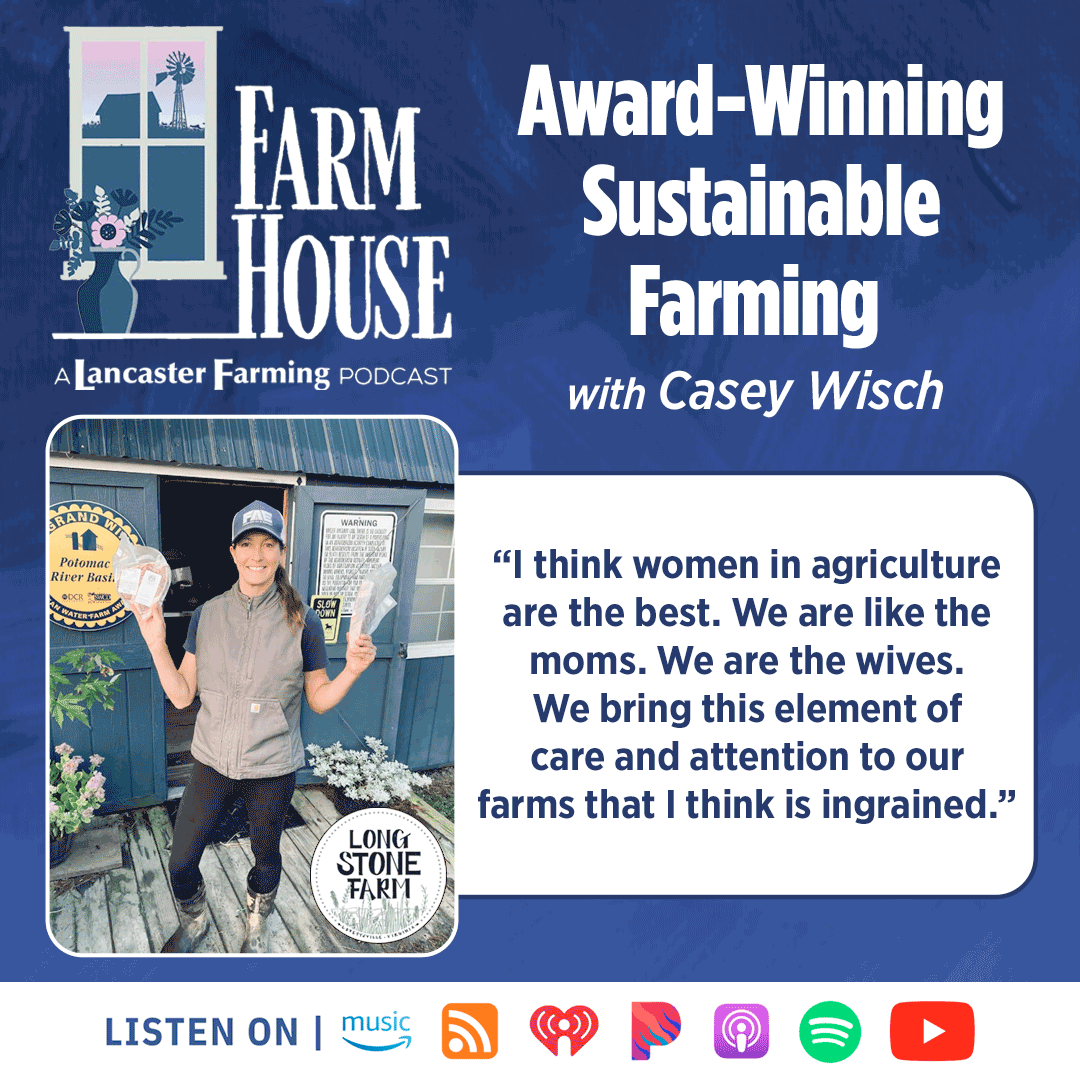 Award-Winning Sustainable Farming With Casey Wisch | This week on the FarmHouse, a podcast by Lancaster Farming, we're talking to Casey Wisch, co-owner of Long Stone Farm in Lovettsville, Virginia. Wisch's interest in farming began in college. After graduating, she spent time in New Zealand and Australia where she first encountered permaculture and experienced being part of an agricultural community. When she returned to the U.S., she and her now husband began working toward founding Long Stone Farm. "We wanted to start this grazing operation and we wanted to produce good clean meat for our community, and we wanted to pursue a better path forward for our own farm," said Wisch. "And so it was kind of those values and ideas that drove us to start Long Stone Farm." At Long Stone Farm, Wisch and her husband raise pastured beef, pork, poultry and eggs with a focus on sustainability. They were recently honored for their hard work with a Grand Basin Clean Water Farm Award. The award is given to Virginia farmers who have implemented conservation practices to protect water quality. "This is a lifetime achievement award for me," said Wisch. A meeting with the Chesapeake Bay Foundation further inspired Wisch to continue sustainable farming efforts. "They showed the different watersheds and we got a really clear understanding of exactly where our runoff goes and what that day-to-day work really means in terms of watershed health," Wisch said. "And it was really amazing to know that those day-to-day decisions are really impacting our overall region." When she's not focused on keeping her farm sustainable, Wisch is busy marketing the operation and raising the family's four children. She wears many hats but knows she's doing what she was meant to do. "There's multitasking happening all the time. There's things that need care and attention and details. And I think women are set up for this. We were made to do this," Wisch said. | — | ||||||
| 10/30/25 |  For the Love of Farming: A 70th Anniversary Special | This week on the FarmHouse, a podcast by Lancaster Farming, we're honoring the voices of farmers as we celebrate our 70th anniversary. This special podcast episode will feature a variety of voices from farmers and ag industry members who stopped by our pop-up recording studio at this year's Ag Progress Days. You'll hear voices of all ages — from a recent college graduate working her first job in the ag industry to a 92-year-old retired farmer who recalls exactly how his farm community came to his aid when he lost a leg in a farm accident. You'll even hear from Pennsylvania Ag Secretary Russell Redding about how farming has changed over the last seven decades and where the industry is headed. The audio essay was inspired by a Wendell Berry quote. He says, "Why do farmers farm, given their economic adversities on top of the many frustrations and difficulties normal to farming? And always the answer is: 'Love. They must do it for love.'" For 70 years, Lancaster Farming has worked to tell farmers' stories. In our special anniversary podcast, you can hear some of those stories from the farmers themselves. | — | ||||||
| 10/23/25 |  Dare to Return to the Haunted FarmHouse | This week on the FarmHouse, a podcast by Lancaster Farming, we're returning to the haunted farmhouse for some seasonal fun and spine-tingling tales from the farm. In this episode, we'll be sharing four spooky stories that take place on farms or in rural communities because, let's face it, scary stories from the city just don't have quite the same chilling effect as those set out in the country. For our first tale, we'll travel to Robertson County, Tennessee, where the Bell family came to farm in the early 1800s. Unfortunately for the Bells, a spirit that would become known as the Bell Witch wasn't happy with them and wasn't afraid to let them — and anyone else who visited the farm — know about it, including a future president. Next, we're stopping by the Brinton Lodge in Douglassville, Pennsylvania. The lodge is currently home to the Hidden River Brewing Co., but the building has been a host to plenty of spirits long before beer. Then we'll hear a spooky parable about a stingy farmer who refuses to rebuild his dilapidated barn, despite his wife's requests. When a stranger appears and offers the farmer a deal that seems to good to be true, it's up to his wife to save the day — and potentially his soul. Finally, we're headed to Lebanon County, Pennsylvania, to hear the legend of the hounds of Colebrook Furnace. Mistreated by their cruel ironmaster owner, the hounds allegedly pursue their revenge in the afterlife. According to local lore, you can still hear them howling around the area at night. | — | ||||||
| 10/16/25 | 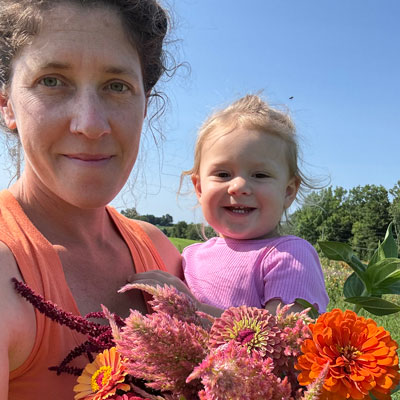 Blending Herbs and Making Tea With Katelyn Melvin | This week on the FarmHouse, a podcast by Lancaster Farming, we're talking to Katelyn Melvin, owner of Katydid Hill Farm. Melvin grows herbs and makes her own herbal tea blends in Sinking Spring, Pennsylvania. Her journey into herb farming started by growing herbs in high school. She later worked on a few vegetable farms and decided to take on farming full time. The farm grows multiple acres of herbs including chamomile, peppermint, lemon balm, anise hyssop and more. The teas are made only with herbs grown on the farm. "All the tea blends come from my love of the fresh herbs," Melvin said. She has three points of focus that she tries to incorporate into the farm: soil health, farmer health and supporting the community. Melvin enjoys talking to customers about the tea blends and how they make people feel. Drinking tea can often be a calming and stress-relieving experience, which is something Melvin tries to translate into the farm work. "Are we getting the benefits that I'm hoping that our customers get from the tea? Are we getting that from farming?" Melvin said. Not only is she hoping to find benefit in farming for herself and her family, she also wants all of her farm workers to get something positive out of working at Katydid Hill Farm. "I really owe it all to the farmers who I worked for who were so generous and sharing with their knowledge," Melvin said. "That has always been important to me to give back to the people who are working for us." | — | ||||||
| 10/9/25 | 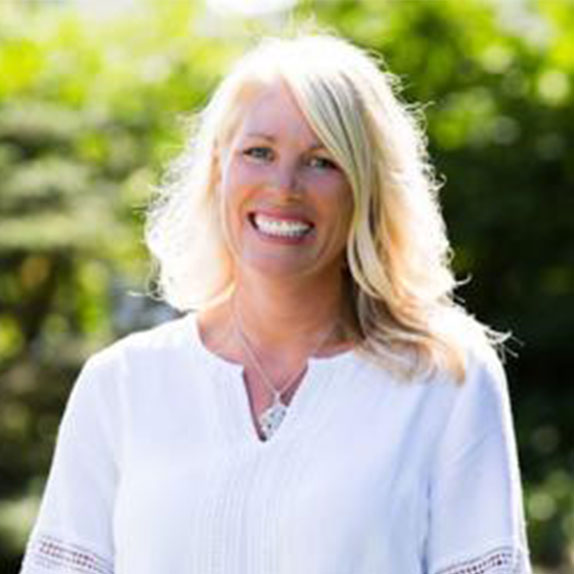 Empowering People, Empowering Ag With Tonya Van Slyke | This week on the FarmHouse, a podcast by Lancaster Farming, we're talking with Tonya Van Slyke, the longtime executive director of the Northeast Dairy Producers Association. Van Slyke grew up on her family's 250-cow dairy farm in New York. "I think my quest to be a leader in the industry came from my involvement in both 4-H and FFA," she said. "That's really where my desire to utilize my voice and be an advocate for the industry came from." After working at Cornell University's College of Veterinary Medicine as a project manager, Van Slyke joined the Northeast Dairy Producers Association as its first full-time executive director. During her tenure at NEDPA, Van Slyke helped launch the Ag Workforce Development Council and a labor roadshow, initiatives designed to strengthen farm labor education and communication. Van Slyke's work has also involved advocacy and making sure farmers have a seat at the table. A memorable event from her time partnering with the Grow New York Farms coalition involved parking a tractor on the front lawn of the New York State Capitol and welcoming hundreds of farmers to talk about the future of agriculture in the state. "Empowering people to have a seat at the table and to use their voice and be solutions-based," she said. "That's really what the success of NEDPA has been founded on." Recently, Van Slyke received the Leaving It Better Award from the New York State Fair, recognizing her lasting impact on the agricultural community. "What that award means to me is that it was a recognition of the partnerships that I've been part of throughout the last 13 years," she said. "And that is more meaningful to me than I can express in words because so many of my colleagues have become friends and we've done some really good work together, and it hasn't all been easy, but it's been meaningful." | — | ||||||
| 9/30/25 |  The Many Uses of Native Plants With Cathryn Pugh | This week on the FarmHouse, we're talking to Cathryn Pugh, a forestry educator with Penn State Extension. Pugh specializes in agroforestry, nontimber forest products and native plants. She is also the president of the Pennsylvania Native Plant Society. There are five main aspects of agroforestry: silvopasture, alley cropping, windbreaks, riparian buffers and forest farming. "Agroforestry can fit into a lot of different places," Pugh said. "It's essentially thinking about how to incorporate trees into agricultural spaces." While Pugh works with farmers to help them learn how to best incorporate trees and native plants into their land, she also works a lot with homeowners both through Extension and the Native Plant Society. "People want native plants," she said. Pugh has found that a lot of people want to add more natives to help provide for birds and pollinators. "Native plants are the foundation of your ecosystem," Pugh said. "Native plants have been here for so long, they have co-evolved with all of the native insects and birds." Another big pull for natives is that they are often easier to take care of. "Native plants are lower maintenance overall. They have evolved to be in this place," Pugh said. "It's going to save you a lot of time and energy in the long run to have native plants in your space." But while interest in natives is growing, not everyone can easily identify these plants and know which ones would work best in their landscapes. The Pennsylvania Native Plant Society is working to make finding native plants easier. "We have a program we're really proud of called the Green Seal Pledge," Pugh said. "This program encourages nurseries to sign and pledge that they will sell 50% or more of their nursery stock as native plants." Pugh also works with farmers to add nontimber forests products to their land, such as maple, ramps or ginseng. There are also native plants that can be used creatively, such as woody florals, willow for weaving and black walnut for dyes. "I'm trying to think about ways that we can really make things like riparian buffers enticing to farmers that have products that are easy enough to get into, that have markets that exist," Pugh said. "If we can make it accessible, maybe we can make a shift in this where it's a win-win situation for the environment and for the farmer." Learn More: Penn State Extension extension.psu.edu Pennsylvania Native Plant Society panativeplantsociety.org Forest Snapshot — September 2025 extension.psu.edu/forest-snapshot-september-2025 Forest Snapshot — July 2025 extension.psu.edu/forest-snapshot-july-2025 The Green Illusion extension.psu.edu/the-green-illusion Ramps (Allium tricoccum) extension.psu.edu/ramps-allium-tricoccum | — | ||||||
| 9/25/25 |  Turning Food Waste Into Compost With 'Fly Lady' Aubrey Fornwalt | This week on the FarmHouse, a podcast by Lancaster Farming, we're talking with Aubrey Fornwalt, the founder and owner of Full Circle Bioconversion in Williamsport, Pennsylvania. Full Circle uses black soldier flies to convert food waste from the surrounding community into manure and compost. Fornwalt also sells the black soldier fly larvae as feed to poultry operations. It's the first bioconversion operation of its kind in the state. Fornwalt didn't always want to be in the decomposition business. She began her career as a graphic designer, and although she was composting her own food waste, she felt she could be doing more. Fornwalt began researching permaculture and soon bought her first fly larvae. "I just looked up where to buy larvae online and the first batch came from eBay. That was in 2017, I think. And I just didn't stop. I didn't get grossed out. I thought it was pretty cool," she said. Fornwalt now collects food waste from several local restaurants and over 20 households and has become locally known for her bioconversion operation. "I do have the nickname 'The Fly Lady' around town," she joked. "And I wear that as a badge of honor." Once collected, the food waste is processed through a grinder and then fed to the fly larvae. The operation can manage between 250-300 pounds of food waste each day. While the larvae will eat any kind of food waste, Fornwalt noticed they have a preference for junk food. "The larvae themselves eat everything. They eat meat and cheese and bread, like the great American carby diet. They're not picky," Fornwalt said. "But they're more excited about the fat and the protein and the carbs. Definitely the higher fat content, they like that." Since its founding, Full Circle has successfully diverted over 200,000 pounds of food waste from landfills. While that waste would have eventually decomposed on its own, Fornwalt argues bioconversion is the better option. "I think the return on investment with the insects versus mechanical utilization, nature is so much more efficient than we are," she said. "And if we take the time to watch how it works and take cues from it and not necessarily try to outsmart it, I think we could do a lot of really cool things." You can watch the video about Full Circle Bioconversion mentioned in the interview here. | — | ||||||
| 9/18/25 |  Merging Science and People With Heidi Reed | This week on the FarmHouse, a podcast by Lancaster Farming, we're talking to Heidi Reed, an agronomy educator with Penn State Extension. Reed was recently part of a crop conditions tour across the state, and this year's corn and soybean yields are looking average to below average, mainly due the dry conditions. "Unless somebody has an irrigated field, I don't think any yield records are going to be broken this year," Reed said. The dry summer came on the heels of a very wet spring, making it a tough weather year for Pennsylvania farmers. Prolonged stretches of weather are becoming more common in the state. "When I talk to farmers who have been doing this for a long time, they're seeing less predictable seasons and more extreme weather events," Reed said. "When there's a drought, it's a very bad drought. And then when we get rain, it's 6 inches all at once." One thing Reed suggests to help mitigate the weather extremes is soil conservation. "Focusing on soil health is not necessarily something that you're going to see reflected in the checkbook," she said. "But every time we increase the percent of soil organic matter, our soil is able to hold onto more of that water when we do get it and store that water so it's available to the crop when we have a drought and stay intact instead of washing away when we get extreme, pounding rainfall." Reed has recently been doing some work on seeding cover crops using drones. She said drone use has become more commonplace and affordable in agriculture over the past few years. "It's a tool in the toolbox, right?" she said. "There's a time and a place where it can really effectively be used and other times where it just doesn't make sense." Reed is incorporating some of her Extension research into Lancaster Farming's Now Is the Time column that she recently took over after longtime columnist Leon Ressler retired. "I am enjoying carrying on the tradition," Reed said. While she plans on keeping the structure of the column the same, she does hope to add some of her own narrative and personality each week. | — | ||||||
| 9/11/25 |  Woodlands Don't Manage Themselves: Foresty Planning With Kathy Smith | This week on the FarmHouse, a podcast by Lancaster Farming, we're talking with Kathy Smith, the program director for the Ohio Woodland Stewards Program at Ohio State University. Smith knew early on that she wanted to work outside and was interested in natural resource management. Forestry felt like a natural fit. "I appreciate being able to understand the trees and how we can utilize trees to solve problems, make things better, and also help landowners to deal with the issues that they have," Smith said. Smith spent the first 11 years of her career working as a watershed forester with the Ohio Division of Forestry before coming to Ohio State in 2001. As the program director, Smith works closely with farmers on how they can integrate trees into their operations. "A lot of times you're looking at things like windbreaks that would, if placed properly, increase crop production. Or riparian buffers where we can filter out nutrients and pesticides before they hit the body of water," Smith said. She also advises landowners, particularly farmers, on how to use trees to strike a balance between protecting wild animals and limiting their damage to crops. "Different tree species provide different things for wildlife. So you kind of have to think about is this something that is going to be highly desirable by certain species? Maybe that's not what I want to put in this location," Smith said. "You do have to pay attention to what the tree species are and what those benefits are." The key, according to Smith, is appreciating that woodlands are a living ecosystem. Living systems change over time, and property owners need to be prepared to tackle new challenges that may come up, like invasive species. She advises farmers to think of their long-term goals for their land and use those to direct their decisions. "I always tell landowners, whether it's on a napkin or a piece of paper or just in your head, you kind of need to think about what you want from the woods," Smith said. | — | ||||||
| 9/4/25 |  Helping Students Find Their Ag Paths With Wendy Powers | This week on the FarmHouse, a podcast by Lancaster Farming, we're talking with Wendy Powers, dean of the College of Agriculture and Natural Resources at the University of Maryland. Powers is the first woman to serve in the role, effective July 1. She didn't grow up in agriculture, but her undergrad experience at Cornell University made her interested in the field. Since then, Powers has studied and worked in agriculture at land grant universities, coming to Maryland from Washington State University. "I am tremendously loyal to the land grant mission," Powers said. "When I look at the work we are doing in the land grant colleges, we are making a difference every day." Powers has worked in ag education all throughout the U.S. She's spent her first few months in Maryland getting to know both the university's ag college and the state's ag industry as a whole. "With agriculture being the largest economic driver for the state, it is highly diverse across the state," Powers said. "While the scale may be different than California and other states, the importance of agriculture and natural resources to the state of Maryland is really unparalleled compared to other states." Maryland's fall semester began Sept. 2, and Powers said she is looking forward to welcoming the largest class in the College of Agriculture to date. "The youth today are committed to solving some of the biggest problems," Powers said. "I'm just impressed every time I meet our students by how much they've accomplished, how much they've overcome, and where they want to be going forward." One of her goals as dean is to help students find their way into the ag industry — whether that be animal science, aquaponics or even fermentation. "I'm really committed to helping others who maybe didn't grow up in agriculture, don't have that background, figure out their path to an amazing career in agriculture and natural resources," Powers said. | — | ||||||
| 8/28/25 | 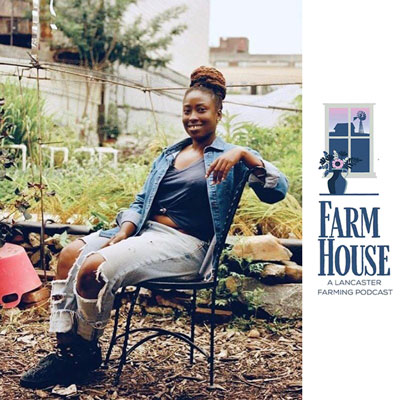 Aquaponics and Giving Back to the Community With Yemi Amu | This week on the FarmHouse, a podcast by Lancaster Farming, we're talking with Yemi Amu, the founder and director of Oko Farms, an outdoor aquaponics farm and education center in Brooklyn, New York. Amu is originally from Nigeria and belongs to the Yoruba ethnic group. Her Yoruba roots have influenced much of her work in the U.S., from the name of her operation to the style of farming. Oko is a Yoruba word that loosely translates to farm, but in fact has a deeper tie to agriculture. "The true meaning is a place where agriculture is the center of life and activity," Amu said. "And that's sort of what we're trying to to build at Oko Farms." Amu was drawn to aquaponics in part because water conservation, which is a pressing issue in Nigeria, is inherently integrated into its farming methods. "I was born and raised in Lagos, Nigeria, and water conservation was huge for us," Amu said. "So type of aquaculture that centered as a type of agriculture, food production that centered water conservation, was a big deal for me." Oko Farms grows a variety of vegetables, fruits and herbs, which are sold at farmers markets. It also grows fiber-producing plants like flax, which, along with indigo and dye plants, has drawn people interested in textile and fiber arts to the farm. The other side of the aquaponics operation is the fish. Oko Farms features a variety, including carp, catfish and tilapia. Some of the fish are used solely for farming while other are used for food, sometimes at farm-to-table meals or given away to community fridges. Community is at the heart of Oko Farms, which strives in its mission to educate the public. The farm offers classes on wellness, culinary education, textile arts and, of course, aquaponics. Amu and her team welcome visitors to the farm for tours and classes on how they can use aquaponics to grow food for themselves — even if it's on their windowsills or countertops. It's all about sustainability and addressing food justice. "Anyone, anywhere in the world should be able to grow food for themselves if they choose to," said Amu. | — | ||||||
Showing 25 of 88
Pitch Fit is a Pro feature
See how bookable this show is for guests, which brands already advertise, the per-episode ad value, and the best-fit guest and sponsor profile. The numbers are blurred on the free plan.
How readily this show books outside guests like you.
How proven this show is for host-read sponsorships.
For Guests
ProFor Advertisers
ProUpgrade to Pro to unlock guest cadence, sponsor categories, fit scores, and per-episode ad value for this show.