
Insights from recent episode analysis
Audience Interest
Podcast Focus
Publishing Consistency
Platform Reach
Insights are generated by CastFox AI using publicly available data, episode content, and proprietary models.
Most discussed topics
Brands & references
Est. Listeners
Insufficient chart data. Estimates will improve as the show charts.
- Per-Episode Audience
Est. listeners per new episode within ~30 days
N/A🎙 Weekly cadence·47 episodes·Last published 5mo ago - Monthly Reach
Unique listeners across all episodes (30 days)
N/A - Active Followers
Loyal subscribers who consistently listen
N/A
Market Insights
Platform Distribution
Reach across major podcast platforms, updated hourly
Total Followers
—
Total Plays
—
Total Reviews
—
* Data sourced directly from platform APIs and aggregated hourly across all major podcast directories.
On the show
From 1 epsHost
Recent guests
No guests detected in recent episodes.
Recent episodes
What do Dutch auditors think about research findings on going concern opinions?
Jan 13, 2026
25m 11s
Suggestions further research on sustainability assurance
Sep 22, 2025
Unknown duration
FARview Ulrike Thuerheimer: ‘Research shows that assurance on sustainability reporting adds value’
Jul 17, 2025
Unknown duration
FAR masterclass by Joe Brazel: How can we improve the application of professional skepticism?
Apr 29, 2025
Unknown duration
FARview Jasmijn Bol: can culture controls improve audit quality?
Jan 25, 2025
Unknown duration
Social Links & Contact
Official channels & resources
Official Website
Login
RSS Feed
Login
| Date | Episode | Topics | Guests | Brands | Places | Keywords | Sponsor | Length | |
|---|---|---|---|---|---|---|---|---|---|
| 1/13/26 | What do Dutch auditors think about research findings on going concern opinions?✨ | going concern opinionsaudit practices+3 | — | University of RichmondAccounting Horizons | — | going concernaudit+3 | — | 25m 11s | |
| 9/22/25 | Suggestions further research on sustainability assurance | Sustainability assurance research is still in its early stages and many important questions remain unanswered. According to Ulrike Thuerheimer (assistant professor in accounting at the University of Amsterdam) directions for future research include: • How do financial statement and sustainability audits interact? • What team characteristics matter? • How do materiality concepts differ between the financial statement and sustainability audits? • How does limited assurance differ from reasonable assurance concerning sustainability? • How to measure the quality of sustainability reporting (and assurance), possibly with the help of AI? • What is the impact of (changes in) European regulation? • What are cross-country differences in what parties are allowed to provide sustainability assurance? • How will the market and auditors react to future enforcement cases? Ulrike underlines the importance of FAR in helping to get access to relevant data. This video is an addition to Ulrike’s FARview podcast that was published last July: https://www.youtube.com/watch?v=gsTz2AFlpSc FAR also recently published a booklet with 5 summaries of interesting articles on sustainability assurance. Here’s a link to the pdf of the publication: https://lnkd.in/eUCQnv6c There is also a Dutch version available: https://lnkd.in/eMc64NVK | — | ||||||
| 7/17/25 | FARview Ulrike Thuerheimer: ‘Research shows that assurance on sustainability reporting adds value’ | Ulrike Thuerheimer is an assistant professor in accounting at the University of Amsterdam. Her research focuses on financial auditing and sustainability assurance. In this podcast, she covers several topics. She takes a closer look at the current state of sustainability assurance regulation in Europe and in the United States. She then discusses how research in sustainability assurance compares to research in financial auditing, highlighting both the similarities and the differences. She also outlines the main categories of research in sustainability assurance and wraps up with key findings and practical take-aways. Youtube version: https://www.youtube.com/watch?v=gsTz2AFlpSc FAR also recently published a booklet with 5 summaries of interesting articles on sustainability assurance. Here’s a link to the pdf of the publication: https://foundationforauditingresearch.org/wp-content/uploads/2025/06/Far-boekje-EN-0366.pdf There is also a Dutch version available: https://foundationforauditingresearch.org/wp-content/uploads/2025/06/Far-boekje-NL-0359.pdf More about Ulrike Thuerheimer: She got her PhD-degree at the University of Maastricht. She’s broadly interested in studying auditing and ESG assurance. Her research interests are mainly driven by regulation and standard setting, for example concerning group audits and the economics and value of auditing. She’s also participating in several FAR projects, which can be found on the FAR website (www.foundationforauditingresearch.org). | — | ||||||
| 4/29/25 | FAR masterclass by Joe Brazel: How can we improve the application of professional skepticism? | On April 2 2025, Joe Brazel (North Carolina State University) gave a FAR-masterclass on this important question at Nyenrode University During this highly interactive meeting he presented the findings from several of his research studies on the evaluation and support of professional skepticism in audit teams. Audit professionals are expected to apply professional skepticism, especially when signs point to potential fraud. But how is that skepticism evaluated by supervisors? Is it judged more by the outcome of the investigation than by the quality of the process? And what changes when supervisors begin to reward skepticism based on how it's applied, rather than what it uncovers? And does the active support by the audit committee increase auditors’ skepticism? If you want to get a taste of what happened, please check out this 15-minute summary of the event. Version on Youtube : https://youtu.be/SVV27XpJvsY Two of the papers that Joe Brazel presented have also been previously summarized in the FAR booklet ‘What can we learn from auditing research?’, which can be found on the FAR-website: https://foundationforauditingresearch.org/wp-content/uploads/2024/12/far-artikelen-boekje-juni23-02w.pdf More information on Joe Brazel’s FAR-projects can be found on the FAR website: https://foundationforauditingresearch.org | — | ||||||
| 1/25/25 | FARview Jasmijn Bol: can culture controls improve audit quality? | Can culture controls improve audit quality? Well, according to Jasmijn Bol and her co-authors they can! In this FARview, Professor Jasmijn Bol (Tulane University) talks about her paper ‘Can culture controls improve audit quality’. This is joint work together with Isabella Grabner (WU Vienna), Katlijn Haesebrouck (Maastricht University) and Mark E. Peecher (University of Illinois at Urbana-Champaign). They investigated how cultural controls can improve audit quality. It is key to build in the internalization of audit quality as a core value. First, that requires socialization. There should be a focus on supportive leadership, by building an audit voice culture. That means that there's open communication, that people are tolerant of making mistakes and that there's a lot of appreciation for learning. Another part of supportive leadership is resource facilitation: make sure that there is a budget that allows for action-oriented skepticism. Second, selection is important. When hiring, retaining, and promoting auditors, the personal values of these people should be closely aligned to the values that you're trying to socialize and internalize. The personal values of importance are care about societal interests (wanting to contribute to society) and ‘being a true seeker’ (wanting to get to the bottom of things). Full version on Youtube : https://www.youtube.com/watch?v=SKINm9L0VA4 Pitch-version on Youtube: https://www.youtube.com/watch?v=tcatd-wDJNg | — | ||||||
| 11/11/24 |  Thinking outside of the box | In this FAR podcast Sara Bibler (Vrije Universiteit Amsterdam) talks about the purpose, findings and takeaways of the study ‘Thinking Outside of the Box: Engaging Auditors’ Innovation Mindset to Improve Auditors’ Fraud Procedures’ (co-authored by Margaret Christ, Tina Carpenter, and Anna Gold). Auditors face complex challenges, for example in fraud detection, where creative thinking is essential. Building on the creativity literature, the research team studied whether an ‘innovation mindset’ leads to more effective fraud procedures. Furthermore, because regulatory bodies have expressed concerns that focusing on client insights might detract from audit quality, this study also examined whether these concerns are justified. Key findings: Auditors prompted to adopt an innovative mindset identified more effective fraud detection procedures, improving audit quality without any reduction in efficiency. Importantly, the goal of providing client insights did not diminish audit quality and could coexist with fraud detection goals without negative effects. The video can also be found on Youtube: https://www.youtube.com/watch?v=rS0BsOX4rps More information about the FAR research of the team can be found on the FAR website: https://foundationforauditingresearch.org/en/research-publications/projects/2019b02-engaging-auditorsa-innovation-mindset-to-improve-fraud-detection-with-data-analytics-prof-dr-gold/ | — | ||||||
| 4/16/24 | What are the main drivers of auditors' skeptical actions? | What are the main drivers of auditors' skeptical actions? This pitch provides a quick feel for the answers to this important question, provided by a recent study by Kris Hardies, Sanne Janssen, Ann Vanstraelen and Maastricht University and Karla M. Zehms. The title of the paper is ‘Using Field-Based Evidence to Understand the Antecedents to Auditors’ Skeptical Actions’. It has been accepted for publication in Auditing: A Journal of Practice & Theory. In this pitch Kris Hardies (University of Antwerp) answers 7 questions: 1. Who are you? 2. What did you study in the paper? 3. Why is it relevant? 4. What’s new? 5. What did you find? 6. What can auditors and stakeholders learn from the findings? 7. What would be the best way to read the paper? Sneak preview: the top factors driving the skeptical actions of auditors are: feelings of accountability, trait skepticism, the intention to behave skeptically and the professional orientation of the firm. The paper is available here: https://papers.ssrn.com/sol3/papers.cfm?abstract_id=3717615 More information on the FAR-project regarding professional skepticism can be found here (e.g. FAR conference summaries, podcasts, masterclass report and working paper): https://foundationforauditingresearch.org/en/research-publications/projects/2016b05-professional-skepticism-profiles-effects-on-audit-processes-and-outcomes-and-the-moderating-role-of-audit-firm-culture-dr-hardies/ This pitch is also available via Youtube: https://youtu.be/OKLL29_a-GE | — | ||||||
| 4/16/24 |  How can auditing practice and academia fruitfully work together? | In this short podcast/video, Therese Grohnert (Maastricht University) and Petra Tijmstra (NBA and PwC) talk about how they have experienced their joint FAR research project. The project can be viewed as a best practice of a symbiotic cooperation between practice and academia with mutual benefits. Therese and Petra discuss the conditions, yields, success factors and take-aways of their collaboration. Bottom line: ‘Don’t be afraid, just give it a try!’ The related video can also be viewed here: https://youtu.be/LTzqTJKxINE Do you want to see more? Petra and Therese also presented their work at the 2023 FAR annual conference. Their presentation can be viewed here: https://www.youtube.com/live/-8qMiz3W4Xs?feature=share&t=6225 | — | ||||||
| 2/13/24 | FARview Pitch: Hoe ervaart de accountant steun vanuit de auditcommissie? | Hoe kan een auditcommissie het accountantscontroleteam ondersteunen? Waardoor voelen accountants zich het meest gesteund? Wat zijn de gevolgen van die steun op het gebied van professional skepticism? En maakt het iets uit wie de steun vanuit de auditcommissie communiceert? Op die vragen geeft het onderzoek van Joe Brazel, Anna Gold, Justin Leiby en Tammie Schaefer een antwoord. Anna Gold (hoogleraar Vrije Universiteit Amsterdam) belicht in deze pitch twee onderzoeken die samen de basis vormen van het FAR-project ‘How do audit committees support audit engagement teams and encourage professional skepticism’. Het gaat om een survey en een experiment. In de survey is onderzocht in welke mate en op welke manieren auditcommissies support bieden aan auditteams. In het experiment is onderzocht of support van de auditcommissie de professioneel-kritische houding van de accountant vergroot en of het verschil maakt wie (de voorzitter van de auditcommissie of de partner) de support richting het controleteam communiceert. De bevindingen van de survey laten onder andere zien dat in ongeveer de helft van de controleopdrachten het controleteam ondersteuning ervaart vanuit de auditcommissie. Die ondersteuning wordt vooral gecommuniceerd door de partner of manager van het team. Veel respondenten geven overigens aan nooit informatie te ontvangen over steun van de auditcommissie. Bijna 70 procent van de deelnemers zegt in het geval van support vooral ‘emotionele steun’ te hebben ervaren (waarbij de auditcommissie bijvoorbeeld interesse toont in de bevindingen, beschikbaar is voor vergaderingen en begrip toont voor moeilijkheden). Andere vormen van steun worden in mindere mate gevoeld (bijvoorbeeld het mogelijk maken van samenwerking met het bestuur en het delen van inzichten over de klant). De resultaten van het experiment suggereren dat het communiceren van steun vanuit de auditcommissie de accountant kan helpen om professioneel-kritisch te handelen bij een cliënt met een onvriendelijke houding ten opzichte van de accountant. Het maakt daarbij niet uit wie de support vanuit de auditcommissie communiceert. Het communiceren van steun vanuit de auditcommissie helpt dus de accountant! Een up-to-date versie van het artikel kan hier worden gedownload: https://papers.ssrn.com/sol3/papers.cfm?abstract_id=4003607 Voor meer informatie over het FAR-project, zie: https://foundationforauditingresearch.org/en/research-publications/projects/2018b04-how-can-audit-committee-support-improve-auditorsa-application-of-professional-skepticism-prof-dr-gold/ Deze pitch is ook te beluisteren/bekijken via Youtube: https://youtu.be/avoaUh4RRwg | — | ||||||
| 2/7/24 | FARview Pitch: Gaan lange werkweken ten koste van controlekwaliteit? | Gaan lange werkweken ten koste van de kwaliteit van de accountantscontrole? Het antwoord is helaas: ‘ja’. Tjibbe Bosman (promovendus Universiteit van Amsterdam en verbonden aan de Foundation for Auditing Research) bespreekt in deze pitch een artikel van Christensen, Newton en Wilkins: ‘How do team workloads and team staffing affect the audit? Archival evidence from U.S. audits.’ De onderzoekers vinden dat werkweken van 55 uur en langer schadelijk zijn voor de kwaliteit van de accountantscontrole. Zij vinden, onder andere, ook dat continuïteit binnen het controleteam in opeenvolgende jaren kwaliteitsverhogend werkt. Deze effecten gelden met name voor assistenten en seniors. Het is dus belangrijk voor accountants, toezichthouders en andere belanghebbenden om oog te hebben voor de werkdruk van accountants en de continuïteit binnen de teams. Het artikel is gepubliceerd in Accounting, Organizations and Society (Volume 92, July 2021) Link naar het artikel: https://doi.org/10.1016/j.aos.2021.101225 Ook beschikbaar via SSRN: https://papers.ssrn.com/sol3/papers.cfm?abstract_id=3418533 Deze pitch is ook te beluisteren/bekijken via Youtube: https://youtu.be/IoKw1kuq7VY | — | ||||||
Want analysis for the episodes below?Free for Pro Submit a request, we'll have your selected episodes analyzed within an hour. Free, at no cost to you, for Pro users. | |||||||||
| 1/30/24 | FARview #31: Christian Peters over leren in het accountantsberoep | Wat weten we al over leren in het accountantsberoep? Als antwoord op deze vraag analyseerde Christian Peters ruim 100 academische artikelen, samen met Bart Dierynck en Kathryn Kadous. De resultaten daarvan zijn opgenomen in hun artikel ‘Learning in the auditing profession: A framework and future directions’ dat recent is verschenen in Accounting, Organizations and Society. In deze korte podcast vertelt Christian Peters (Nanyang Technological University) over de opzet van het artikel en schetst hij de belangrijkste take-aways. Het raamwerk voor de analyse is gebaseerd op twee dimensies: (1) de locatie van het leren (tijdens de controleopdracht of buiten de controleopdracht); en (2) de rol van anderen in het leerproces (actief of passief). Een van de take-aways is dat mentor en protegee het best op informele wijze met elkaar in contact kunnen staan, waarbij de mentor helpt bij de ontwikkeling van de protegee, een rolmodel vormt en sociale steun biedt. De mentor-relatie tussen beiden moet echter niet te lang duren. Christian bespreekt ook nog resultaten op het gebied van prestatiebeoordeling, ‘overconfidence’, socialisatie en het proces van ‘ervaring-reflectie-conceptualisatie-experimenteren’. Link naar het artikel: https://www.sciencedirect.com/science/article/abs/pii/S0361368223001058 De podcast is ook te beluisteren/bekijken via Youtube: https://www.youtube.com/watch?v=jAF9HT93dI8 | — | ||||||
| 1/22/24 | FARview #30: Christian Peters over sociale mismatch & e-mail- versus face-to-face contact | Vragen van de controlerend accountant wekken soms wrevel op bij de cliënt. Vooral jongere accountants kunnen zich dan geïntimideerd voelen door controllers met meer ervaring. Het gebruik van e-mails kan deze negatieve effecten verminderen, maar heeft ook nadelen: de accountant mist mogelijk signalen van misleiding, zal minder doorvragen en bouwt minder aan de persoonlijke relatie met de cliënt. Gebruik van e-mail blijkt wel een betere manier voor het opvragen van documentatie. In deze korte podcast vertelt Christian Peters (Nanyang Technological University) over twee aan elkaar verwante artikelen van Bennett en Hatfield waarin deze onderzoeken worden beschreven. Een artikel gaat over het effect van een sociale mismatch tussen controlerend accountants en de controller bij de cliënt. Het tweede artikel gaat over het verschil tussen het gebruik van e-mail-communicatie versus face-to-face-communicatie op het professioneel-kritische gedrag van de accountant. Peters vindt deze onderzoeken zeer relevant voor de accountantspraktijk. Links naar de artikelen: Bennett, G. B., & Hatfield, R. (2013). The effect of the social mismatch between staff auditors and client management on the collection of audit evidence. The Accounting Review, 88(1), 31-50. https://doi.org/10.2308/accr-50286 Bennett, G. B., & Hatfield, R. (2018). Staff auditors' proclivity for computer-mediated communication with clients and its effect on skeptical behavior. Accounting, Organizations and Society 68-69, 42-57 https://doi.org/10.1016/j.aos.2018.05.003 Ook te zien/te beluisteren via Youtube (https://youtu.be/L_h1Bmkcdhs) | — | ||||||
| 6/2/23 | 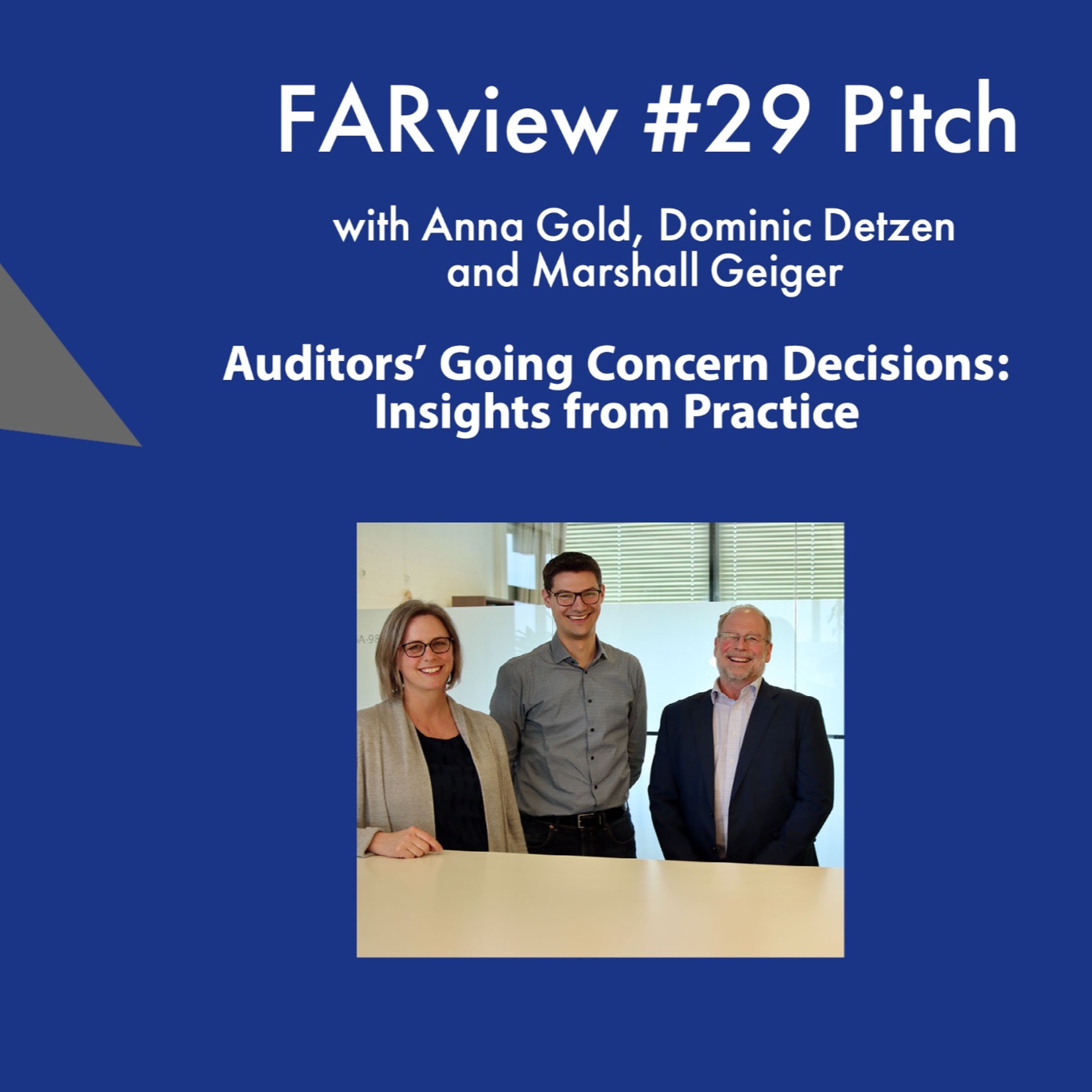 Pitch FARview #29: Auditors' Going Concern Decisions: Insights from Practice | In FARview #29, Anna Gold (Vrije Universiteit Amsterdam), Dominic Detzen (Vrije Universiteit Amsterdam) and Marshall Geiger (University of Richmond) present the first results of their FAR-interview-study on auditors’ going concern decisions. Philip Wallage (Vrije Universiteit Amsterdam and Universiteit van Amsterdam) is also part of the research team, but was not present during the podcast. In this pitch, Dominic Detzen sketches the most important take-aways from the study so far. | — | ||||||
| 6/2/23 | 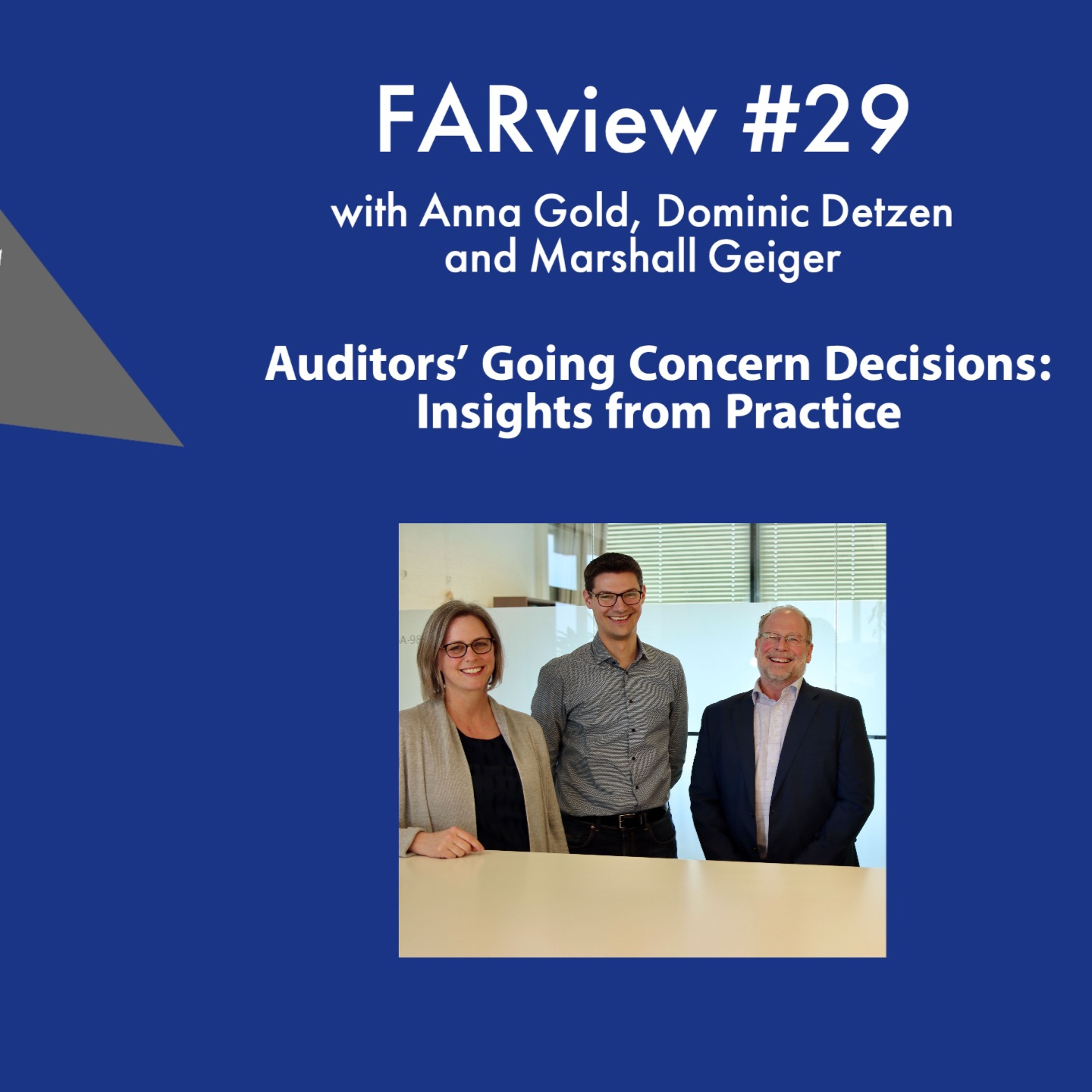 FARview #29: Auditors' Going Concern Decisions: Insights from Practice | In FARview #29, Anna Gold (Vrije Universiteit Amsterdam), Dominic Detzen (Vrije Universiteit Amsterdam) and Marshall Geiger (University of Richmond) present the first results of their FAR-interview-study on auditors’ going concern decisions. Philip Wallage (Vrije Universiteit Amsterdam and Universiteit van Amsterdam) is also part of the research team, but was not present during the podcast. The findings provide some initial insights from practice, on how audit professionals assess an auditee’s ability to continue as a going concern. The study follows the idea that engagement partners first need to recognize that the going concern is a critical issue at a client, before they set up and mobilize a network of internal and external actors that are involved in the going concern assessment. The engagement partner coordinates this network to negotiate both adequate management disclosures and the inclusion, or not, of an emphasis of matter paragraph in the audit opinion. This work sheds some more light on the ‘black box’ of going concern assessments, both to reveal the complex decision-making process by auditors as well as to inform future studies on further research opportunities. | — | ||||||
| 3/22/23 |  FARview #28: Iver Wiertz over virtual audit team work | In deze FARview-podcast vertelt Iver Wiertz (Maastricht University) over de voortgang van zijn promotieonderzoek naar ‘virtual audit team work’. Hij benadert het onderzoek vanuit twee invalshoeken: vanuit de afdeling Educational Research and Development en vanuit de afdeling Accounting & Information Management, beide onderdeel van Maastricht University. Onder andere de volgende vragen komen aan bod: • Waarom is het belangrijk om virtual team work te onderzoeken? • Wat waren de uitdagingen van virtueel teamwerk binnen de audit (pre-COVID-19 en tijdens COVID-19)? • Hoe worden deze uitdagingen nu ervaren? • Wat zijn de plus- en minpunten van virtueel werken? • Bestaan op dit gebied verschillen tussen kantoren en tussen functieniveaus? • Wat zijn de belangrijkste ‘take-aways’ van het onderzoek? • Hoe koppelen jullie de bevindingen terug naar de kantoren? Het onderzoeksteam waarvan Iver deel uitmaakt bestaat verder uit Wim Gijselaers, Therese Grohnert, Roger Meuwissen en Ann Vanstraelen. | — | ||||||
| 3/22/23 |  Pitch (Nederlands) FARview #28: Iver Wiertz over virtual audit team work | Deze pitch bevat de take-aways van FARview podcast #28, waarin Iver Wiertz zijn onderzoek naar virtual audit team work bespreekt. | — | ||||||
| 3/22/23 |  Pitch (English) FARview #28: Iver Wiertz on virtual audit team work | This pitch contains the take-aways from FARview podcast #28 (in Dutch), in which Iver Wiertz talks about his research on virtual audit team work. | — | ||||||
| 2/8/23 |  Pitch (English) FARview #27: Tjibbe Bosman on the consequences of audit partner clawback provisions | This pitch contains a short English summary of FARview podcast #27 (recorded in Dutch), in which Tjibbe Bosman talks about his paper on the consequences of audit partner clawback provisions. | — | ||||||
| 2/8/23 |  Pitch (Nederlands) bij FARview #27: Tjibbe Bosman over de consequenties van auditor clawbacks | Deze pitch bevat een korte samenvatting van de FARview podcast #27, waarin Tjibbe Bosman spreekt over de consequenties van auditor-clawback-clausules. | — | ||||||
| 2/8/23 |  FARview #27: Tjibbe Bosman over de effecten van clawback-clausules voor controlerend accountants | In deze FARview-podcast vertelt UvA-promovendus Tjibbe Bosman over zijn paper ‘Skin in the Game: The Consequences of Audit Partner Clawback Provisions’. Een van de maatregelen uit het rapport ‘In het publiek belang: maatregelen ter verbetering van de kwaliteit en onafhankelijkheid van de accountantscontrole’ van de Werkgroep Toekomst Accountantsberoep was het invoeren van een clawback-regeling voor partners bij OOB-accountantsorganisaties (maatregel 3.5). De meeste accountantsorganisaties die OOB’s controleren hebben inmiddels zo’n regeling ingevoerd voor hun equity partners. De aanname is dat dit leidt tot hogere controlekwaliteit. Bosman vertelt in deze podcast over de achtergrond van de clawback-maatregel en wat de consequenties zijn van die maatregel. Uit de onderzoeksresultaten, gebaseerd op 77 procent van de wettelijke Nederlandse controles tussen 2010 en 2019, blijkt dat partner-clawback-clausules ertoe leiden dat partners minder (risicovolle) controlecliënten accepteren. Ook stijgt het inkomen van de partners, ter compensatie van het clawback-risico. Bovendien verstrekken partners minder goedkeurende controleverklaringen. Echter, de clawback-maatregel leidt niet tot het verminderen van de kans op fundamenteel foutherstel (het intrekken van de controleverklaring), tot het verminderen van winststuring of tot betere rapportage op het gebied van continuïteit. De bevindingen stemmen tot nadenken over de vraag of clawbacks een efficiënte oplossing zijn voor het verbeteren van controlekwaliteit. | — | ||||||
| 12/23/22 |  FARview #26: Christian Peters over accountant, automatisering en professional skepticism | In deze podcast vertelt Christian Peters over zijn paper ‘Auditor Automation Usage and Professional Skepticism’. Deze paper is onderdeel van zijn promotieonderzoek. Accountantskantoren investeren miljarden in het implementeren van technologie in de accountantscontrole. In zijn onderzoek bestudeert Christian de gedragsmatige aspecten die een rol kunnen spelen bij het gebruik van deze technologie. Een van de risico’s is dat accountants technologie in sommige situaties meer vertrouwen dan gerechtvaardigd is. Met een experiment op het gebied van het reviewen van een voorraadtelling toont Christian aan dat accountants minder professioneel-kritisch handelen (ze besteden onder andere minder tijd) als zij controleinformatie krijgen vanuit een algoritme dan wanneer de informatie afkomstig is van een persoon. Deze accountants ontdekken ook minder fouten. Het gebruik van technologie kan dus een negatief effect hebben op het controlegedrag van accountants. Het gesignaleerde negatieve effect van technologie kan worden verminderd door het toepassen van een interventie in de vorm van een counterarguing mindset. Deze mindset wordt gestimuleerd door accountants enkele minuten lang argumenten te laten bedenken waarom voorgelegde stellingen niet zouden kloppen. Het vooraf activeren van een counterarguing mindset bij de accountants zorgt er inderdaad voor dat de negatieve gedragingen als gevolg van het algoritmegebruik afnemen. Kantoren die technologie gebruiken kunnen dus gebruikmaken van het activeren van een counterarguing mindset. Maar ook als dat niet actief gebeurt kan bewustwording bijdragen aan het verlagen van de risico’s. Christian laat ook zien dat verminderde oplettendheid (als gevolg van het steunen op een algoritme) bij het uitvoeren van een taak niet negatief doorwerkt in vervolgwerkzaamheden (getest aan de hand van een additionele goodwill impairment test). Christian biedt ook nog een interessant inkijkje in de job market van aanstaande PhD’s. | — | ||||||
| 11/11/22 |  FARview #25 Lena Pieper on “What makes audit partners and their teams successful?” | In this 25th FARview podcast, PhD student Lena Pieper (Maastricht University) presents the basic ideas underlying her dissertation, which will be defended in 2023. The broad research question of het PhD-study is ‘what makes audit partners and their teams successful?’ In the podcast, Lena clarifies the importance of the audit team and zooms in on the essential role that the audit partner plays (also in combination, or ‘dyad’, with the audit manager). Of course, there is ample attention for the contribution of research in this area. Lena draws on insights from the fields of psychology and organizational behavior. Her dissertation encompasses three different levels. First, she examines audit partners’ and managers’ personality characteristics and how these characteristics affect their individual job performance. Second, she investigates the partner-manager ‘dyad’ and its functioning. At the third level, she investigates different aspects of audit team functioning and how the team is influenced by the partner-manager dyad. Her research contributes to the academic literature in several ways. With the comprehensive data set from practicing audit teams and their leaders, the studies advance the understanding of the factors that influence the functioning of an engagement team. This is important because the audit is ultimately conducted by a team rather than by one individual and a well-functioning engagement team is crucial for audit quality. The studies also have practical implications for the audit firms. The findings can help the firms to manage and compose their audit teams in a more scientific way to improve the performance of the audit teams, and ultimately audit quality. With her research, Lena hopes to contribute to the vision ‘accounting as a learned profession’, where research helps auditors to enhance audit quality. | — | ||||||
| 9/7/22 |  FARview #24 Xiaoxing Li's PHD-project over false positives vs. hit rates | In episode 24 of FARview, PhD student Xiaoxing Li (Vrije Universiteit Amsterdam) talks about her FAR PhD-project, which concentrates around data analytics. Auditors' data analytics potentially has many benefits for auditing, but may also challenge the application of professional skepticsm. The main focus of the podcast is on a recent article by Xiaoxing in Maandblad voor Accountancy en Bedrijfseconomie (MAB): Behavioral challenges to professional skepticism in auditors’ data analytics journey. Next to defining auditors’ data analytics and explaining its importance, Xiaoxing discusses potential behavioral challenges to professional skepticism from five perspectives that she derived from the data analytics literature. The behavioral challenges are: o Auditors’ attitudes toward auditors' data analytics (e.g. algorithm aversion). o Data characteristics (data reliability and data relevance). o Anomalies identified by auditors' data analytics (false positives and false negatives). o Auditors’ mindsets when using auditors' data analytics (e.g. fixed mindsets versus growth mindsets). o Social contexts and interactions involved in auditors' data analytics practice (e.g. tone at the top, audit committee’s attitude and regulation). Being aware of and prepared for these potential behavioral challenges to professional skepticism can be important for increasing the benefits of auditors' data analytics and for improving audit quality. In addition, Xiaoxing also provides a brief overview of the planned contents of her dissertation. The discussed MAB-publication can be found here: https://mab-online.nl/article/78525/ | — | ||||||
| 7/6/22 |  FARview #23: Sander Tiggelaars PhD-project over management control in audit firms | In deze FARview-podcast is Sander Tiggelaar te gast. Sander is PhD candidate aan de Rijksuniversiteit Groningen. Sander gaat in de podcast in op zijn PhD-project ‘Management control in auditing firms and its implications for managing coexisting objectives’, waarvoor op de FAR-website reeds een literatuurreview beschikbaar is (zie link beneden). Inmiddels is de eerste ronde interviews voor het onderzoek achter de rug. Accountantskantoren gebruiken meerdere beheersingsmechanismen tegelijkertijd. Hierbij worden zijn zowel op resultaat gebaseerde (zoals omzet) als op waarden gebaseerde (zoals cultuur) mechanismen van belang. Sander onderzoekt in hoeverre deze verschillende beheersingssystemen samenhangen met het gedrag van accountants, en vooral ook hoe deze systemen onderling kunnen samenwerken in het sturen van (gewenst) gedrag. Uit de interviews blijkt onder andere dat de cultuur binnen een bepaalde vestiging van een kantoor grotere invloed heeft op gedrag dan de landelijk uitgedragen cultuur van de accountantsorganisatie. Dat is belangrijk om te weten. Een wezenlijk onderdeel van het proefschrift zal gaan over het beheersen van het exploiteren van bestaande technieken versus het innoveren aan de hand van nieuwe technieken binnen de accountantscontrole Het doel van het promotieonderzoek is om een duidelijk beeld te schetsen van welke controlemechanismen belangrijk zijn om accountants te helpen bij het maken van keuzes in hun werk. Voor meer informatie over het project, zie: https://foundationforauditingresearch.org/en/research-publications/projects/2020b02-management-control-in-auditing-firms-and-its-implications-for-managing-competing-objectives-phd-project-s-tiggelaar/ | — | ||||||
| 6/14/22 |  FARview #22 met Frank Moers over 'The loss of talent' | In deze FARview-podcast bespreekt Frank Moers (hoogleraar Management Accounting & Control, Maastricht University) de paper ‘Tacit Knowledge, Audit Quality, and Talent Identification’. Deze paper is een product van het FAR-project ‘The Loss of Talent’ dat Moers uitvoert samen met Isabella Grabner en Judith Künneke. Volgens hen wordt te weinig aandacht besteed aan de waarde van -en waardering voor- ‘tacit knowledge’ tijdens het carrièrepad van accountants binnen kantoor. Dat zou best een van de oorzaken kunnen zijn waarom talentvolle accountants een accountantskantoor verlaten. Dat is jammer, want tacit knowledge hangt positief samen met controlekwaliteit. Onder tacit knowledge wordt verstaan: alle relevante kennis die niet formeel kan worden getraind. Die kennis staat dus los van de technische kennis die accountants veelal in hun opleiding en aan de basis van hun carrière opdoen. Het belang van tacit knowledge neemt toe naarmate een accountant hoger ‘in de boom’ komt te zitten. Het speelt een belangrijke rol in de kennis van het hogere leidinggevende echelon van een accountantskantoor. Eerder onderzoek toont aan dat meer ervaren accountants (met meer tacit knowledge) betere prestatiebeoordelingen krijgen. Uit het onderzoek van Moers blijkt dat de mate van tacit knowledge bij de engagement partner samenhangt met de kwaliteit van de accountantscontrole (gemeten aan de hand van interne kwaliteitsreviews uit de dossiers). Op basis van deze bevinding zou je verwachten dat tacit knowledge ook een wezenlijk onderdeel is van het talent-identificatie-proces en de prestatiebeoordeling van accountants. Dat is echter niet het geval. De hoofdmoot van de beoordeling ligt op het gebied van technische kennis en vaardigheden. Moers noemt dat zorgwekkend. Het vormt volgens hem namelijk een mogelijke verklaring voor het verlies van talent door accountantskantoren. Moers: ‘Als je identificatie en behoud van potentie serieus neemt, dan moet je ook kijken naar welke karakteristieken en vaardigheden hoog in de organisatie nodig zijn en die expliciet meenemen in de beoordeling laag in de organisatie. Tacit knowledge vormt daarvan een belangrijk onderdeel.’ Voor meer informatie over het project, zie: - https://foundationforauditingresearch.org/en/research-publications/projects/2016b01-the-loss-of-talent-a-a-threat-for-audit-quality-prof-dr-moers/ - https://foundationforauditingresearch.org/en/news/foundation-for-auditing-research-masterclass-may-2018-the-loss-of-talent/ | — | ||||||
Showing 25 of 47
Sponsor Intelligence
Sign in to see which brands sponsor this podcast, their ad offers, and promo codes.