
For the Innocent
by Legal Talk Network
Is this your podcast?Insights from recent episode analysis
Audience Interest
Podcast Focus
Publishing Consistency
Platform Reach
Insights are generated by CastFox AI using publicly available data, episode content, and proprietary models.
Total monthly reach
Estimated from 1 chart position in 1 market.
By chart position
- 🇦🇷AR · True Crime#743K to 10K
- Per-Episode Audience
Est. listeners per new episode within ~30 days
1.5K to 5K🎙 Weekly cadence·37 episodes·Last published 5mo ago - Monthly Reach
Unique listeners across all episodes (30 days)
3K to 10K🇦🇷100% - Active Followers
Loyal subscribers who consistently listen
900 to 3K
Market Insights
Platform Distribution
Reach across major podcast platforms, updated hourly
Total Followers
—
Total Plays
—
Total Reviews
—
* Data sourced directly from platform APIs and aggregated hourly across all major podcast directories.
On the show
Recent episodes
The Exoneree Band – Finding Purpose and Healing After Wrongful Incarceration
Apr 2, 2026
40m 17s
Why Being Right Won’t Set You Free — Hard Knox with Amanda Knox
Jan 27, 2026
1h 13m 44s
Presumed Guilty: The Framing of William Michael Dillon
Jan 13, 2026
57m 42s
Survivors Guide to Prison: Examining a Broken System with Matthew Cooke
Dec 17, 2025
1h 01m 15s
From Prison to the Oscars: The True Story Behind Sing Sing and Rehabilitation Through the Arts
Nov 18, 2025
59m 20s
Social Links & Contact
Official channels & resources
Official Website
Login
RSS Feed
Login
| Date | Episode | Description | Length | ||||||
|---|---|---|---|---|---|---|---|---|---|
| 4/2/26 |  The Exoneree Band – Finding Purpose and Healing After Wrongful Incarceration | How do you rebuild a life after it was taken from you? A wrongful conviction strips a person of their agency, leaving pain and loss where there once was freedom and purpose. Healing from such a profound injustice is no easy task, and even after exoneration, the ache of what was lost remains. In this episode, Michael Semanchik sits down with Antoine Day, Eddie Lowery, and William Michael Dillon—all members of The Exoneree Band. Together, they share how music became a powerful outlet for processing their experiences, reclaiming their voices, and transforming pain into purpose. Through their performances, The Exoneree Band spreads awareness about wrongful incarceration, tells their personal stories, and educates communities about the human cost of injustice. Their message is clear: freedom is everything. Learn more and book the band at ExonereeBand.com. Listen to William Michael Dillons Story. | 40m 17s | ||||||
| 1/27/26 |  Why Being Right Won’t Set You Free — Hard Knox with Amanda Knox | In this episode of Hard Knox, now airing on For the Innocent, Amanda Knox sits down with Michael Semanchik and exoneree Scott McMahon. Scott is an American who endured more than five years of imprisonment in the Philippines for a crime he did not commit. Together, Amanda, Mike, and Scott confront the deep flaws of the Philippine justice system, examining how delay and corruption turned an unfounded accusation into a years-long, life-altering ordeal for Scott and his family. Listen to more of Amanda’s episodes: Hard Knox with Amanda Knox Learn more about Scott's case: Scott McMahon - The Innocence Center | 1h 13m 44s | ||||||
| 1/13/26 |  Presumed Guilty: The Framing of William Michael Dillon | We trust the justice system to protect the innocent and prosecute the guilty, but what happens when it gets things catastrophically wrong? In 1981, 21-year-old William Michael Dillon became the focus of a murder investigation in Canova Beach, Florida. Though Dillon maintained his innocence, police coercion and unreliable witnesses rapidly steered the case toward what appeared to be a predetermined outcome. Dillon was arrested, convicted, and sent to prison for a crime he did not commit. More than 27 years later, DNA testing finally proved his innocence and set him free. In this episode, Dillon explains how he was swept into the murder investigation, how coercive interrogations and untrustworthy testimony shaped the verdict—and how his love of music helped him survive the darkest years of his incarceration. Be sure to read the full account of Dillon’s story in FRAMED, written by his wife, Ellen Moscovitz. And, listen to his album on YouTube: Black Robes and Lawyers. | 57m 42s | ||||||
| 12/17/25 | 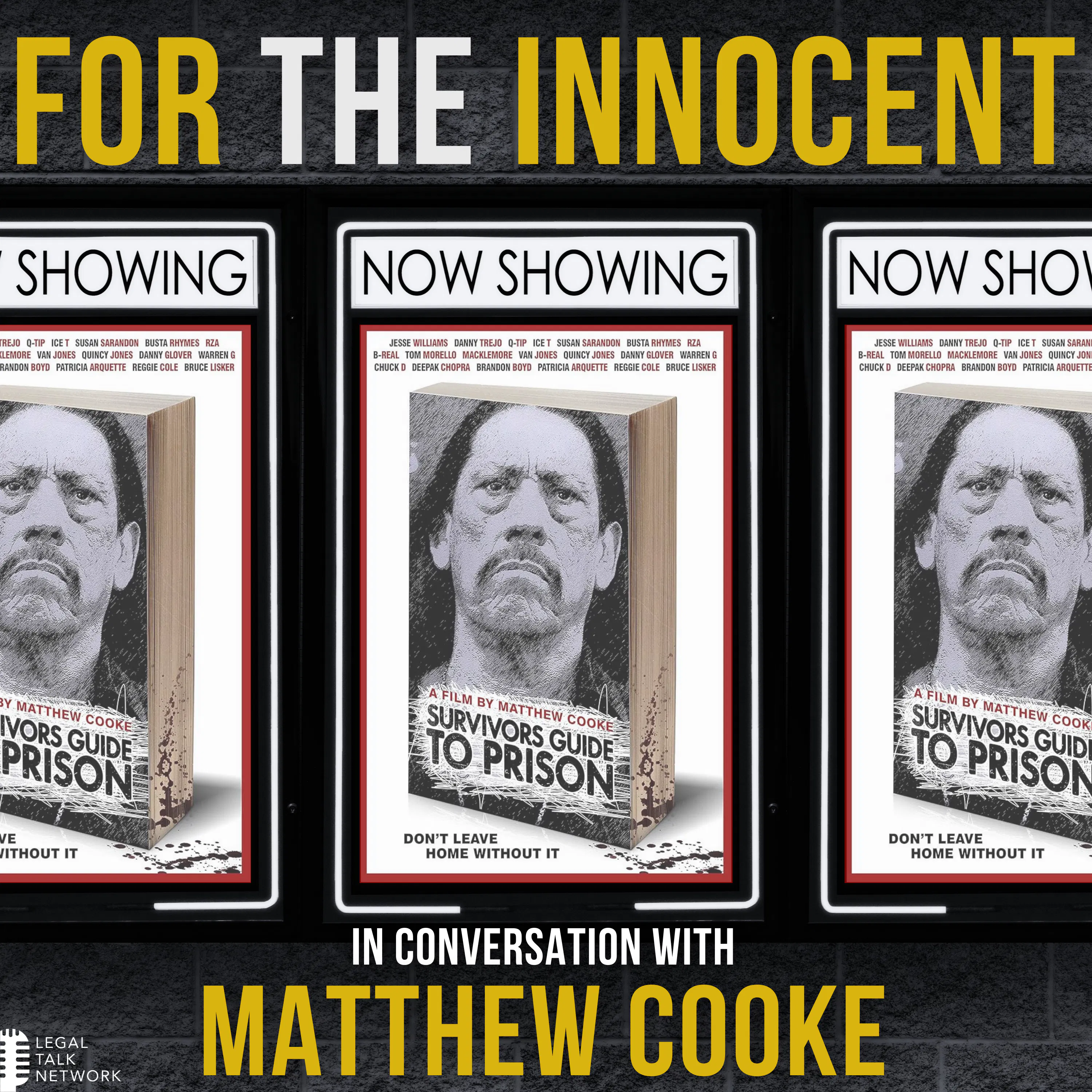 Survivors Guide to Prison: Examining a Broken System with Matthew Cooke | The failure rate of our prison systems is staggering, with recidivism exceeding 70% in nearly every state. What should this tell us about the success—or lack thereof—of our criminal justice system? And, how can those who are incarcerated survive the harshness of prison and avoid becoming part of the large percentage who seem to inevitably return? This time on For the Innocent, Michael Semanchik welcomes Matthew Cooke, writer and director of Survivors Guide to Prison, a documentary exploring life in United States prisons from the perspectives of two wrongfully convicted men, Bruce Lisker and Reggie Cole. Drawing from his extensive research, Matthew reveals a system plagued with fundamentally misaligned incentives that do little to create pathways for inmates to succeed on the outside. Michael and Matthew discuss new shifts in criminal justice reform and offer their thoughts on how to continue to bring this issue to the forefront of public discourse. The system is broken, but change is possible. Listen to our episode about Bruce Lisker’s story: A Deceitful Detective & Manipulated Evidence – The Wrongful Conviction of Bruce Lisker. Learn more about Matthew Cooke and his film projects on IMDB: Matthew Cooke - IMDb | 1h 01m 15s | ||||||
| 11/18/25 |  From Prison to the Oscars: The True Story Behind Sing Sing and Rehabilitation Through the Arts | A maximum-security prison may not seem like the natural setting for a homegrown theater program. But at Sing Sing Prison in New York, just such a project has inspired scores of incarcerated men to learn and grow through the stories they step into—offering them the chance to be part of a supportive community and equipping them with life skills to carry home when they return to the world outside. People in prison are more than just prisoners, and the Rehabilitation Through the Arts (RTA) program continues to help participants discover new strengths through creative expression. In today’s episode, Michael Semanchik welcomes John “Divine G” Whitfield and Clarence “Divine Eye” Maclin—both former inmates, RTA members, and actors in the Oscar-nominated film Sing Sing—to talk about their experiences on the inside. They discuss the film project and its ability to teach the outside world about the transformative power of community, art, vulnerability, and purpose. Creativity and storytelling can restore dignity, bridge divides, and reveal the humanity that is too often overlooked within the prison system. Please visit www.FreeDivineG.org to learn the details of John “Divine G" Whitfield’s fight for exoneration. John “Divine G" Whitfield is an Oscar-nominated adapted screenplay writer, executive producer, and the compelling inspiration behind the critically acclaimed, multiple Oscar-nominated film, Sing Sing. Oscar Nominee Clarence Maclin starred in the feature film Sing Sing, inspired by his life story as a graduate of Sing Sing’s Rehabilitation Through the Arts program. Divine G and Clarence are friends to another former Sing Sing and RTA-involved inmate, Jon-Adrian “JJ” Velazquez, whose long and arduous exoneration was shared in our last episode. Listen to JJ’s story here: A Murdered Cop and a Mishandled Mugshot – JJ Velazquez’s Wrongful Conviction | 59m 20s | ||||||
| 11/4/25 |  A Murdered Cop and a Mishandled Mugshot – JJ Velazquez’s Wrongful Conviction | In 1998, a retired NYPD officer was shot and killed inside an illegal gambling parlor. Angry cops wanted speedy justice for one of their own, and an overzealous, incautious investigation ensued. A witness to the shooting with a criminal past was put under intense pressure to deliver a suspect. After hours of questioning and over 1800 mugshots, he picked one at random—one that should never have been on the table in front of him. The man in the photo, Jon-Adrian “JJ” Velazquez, was accused, arrested, and labeled a cop killer—despite the fact that there was a complete lack of physical evidence linking him to this terrible incident. JJ was convicted of murder and sentenced to life in prison for a crime of which he had no knowledge or connection. JJ, along with friend and investigative journalist Dan Slepian, tells the story of his 27-year fight to gain his freedom and clear his name. They dig into the failures of the system that led to JJ’s conviction and how his tenacious advocacy finally led to his exoneration. Jon-Adrian “JJ” Velazquez is an American actor and activist who exemplifies resilience and dedication to legal reform. JJ is the founder of MONUMENTAL MEDIA based in NYC, a mission-driven creative agency and talent incubator dedicated to reshaping the narrative around incarceration and social justice issues. JJ now serves his community locally as the Co-founder and Executive Director of Voices from Within based in New York, and nationally as the Program Director at the Frederick Douglass Project for Justice. Dan Slepian is a Pulitzer Prize finalist and Emmy winning investigative journalist at NBC News whose reporting has helped solve cold cases, exonerate the innocent, and spark legal reform. | 49m 41s | ||||||
| 10/21/25 |  The Collapse of a Conviction: How an LAPD Cop and Two Journalists Unraveled the Case Against Bruce Lisker | At just 17 years old, Bruce Lisker was branded a murderer after being accused and convicted of the violent killing of his mother. He would go on to spend the next 26 years of his life in prison, until a federal judge finally overturned his conviction in 2009. Bruce’s exoneration might never have happened without the investigative efforts of LA Times journalists Scott Glover and Matt Lait and LAPD officer Jim Gavin. In this episode, Michael Semanchik speaks with this trio of truth-seekers about their involvement in the Lisker case. Initially skeptical, each of them set out to poke holes in Bruce’s claims, but as their investigations progressed, the evidence increasingly pointed to his innocence. They share details of their research, explaining how discoveries of both ignored and manipulated evidence in the decades-old case raised red flags in the original investigation, ultimately bringing the truth to light. Matt Lait is Vice President of CNN’s investigative team. Previously, he worked at the Los Angeles Times where he was an investigative reporter, city editor and ran the local investigations team. Scott Glover is a reporter on the CNN Investigates team. Glover came to CNN with 20 years of experience at the Los Angeles Times where he covered the LAPD, federal courts and law enforcement agencies. Jim Gavin retired from the Los Angeles Police Department in August 2020, as the head of Operations Valley Bureau Homicide. He served 32 years with the LAPD in a wide variety of assignments. | 1h 00m 00s | ||||||
| 10/7/25 |  A Deceitful Detective & Manipulated Evidence – The Wrongful Conviction of Bruce Lisker | In 1983, Bruce Lisker’s mother was violently attacked in their family home. After responding to his frantic 911 call, police quickly drew assumptions from the chaotic crime scene. Dorka Lisker was bludgeoned, stabbed several times, and near death in her Sherman Oaks home. Seventeen year-old Bruce embodied the era’s “stoner” look, he was highly agitated, and his hands were covered in his mother’s blood. The distraught teen, rather than being allowed to accompany his mother to the hospital where she died, was arrested and interrogated as the prime suspect in her murder. Bruce Lisker tells the story of how presumptions, the actions of a dishonest detective, and failures to examine critical evidence led to his wrongful conviction. After years seeking justice through every conceivable avenue, Bruce was finally exonerated through the determined efforts of LAPD Sgt. Jim Gavin and LA Times articles by Matt Lait and Scott Glover that shed light on the mistakes and manipulations that led to his false conviction. | 52m 49s | ||||||
| 9/23/25 |  Breaking Down the Amanda Knox Case: Facts vs. Frenzy | To this day, some still believe Amanda Knox is guilty of the horrific murder of Meredith Kercher in 2007. However, this belief appears to stem entirely from the wildly sensational media coverage surrounding her supposed involvement. Thorough examination of the facts of the case have clearly shown that Amanda was wrongfully convicted of this terrible crime. This time on For the Innocent, Michael Semanchik welcomes a panel of experts to explore how Amanda Knox’s case gained such incredible notoriety and how the truth was obscured by a series of mistakes, assumptions, and media distortion. Michael is joined by Martina Cagossi, Justin Brooks, and Mark Olshaker to walk listeners through the facts of the case, explain the prevalence of false confessions in high-stress situations, and discuss how Amanda’s “trial by media” ultimately overshadowed clear evidence that should have set her free. Martina Cagossi is a criminal lawyer based in Milan, Italy. She is the co-founder and Program Manager of the Italy Innocence Project. Justin Brooks is a Professor at University of San Diego School of Law. He is a board member of The Innocence Center and co-founder of the California Innocence Project. Mark Olshaker is a writer and Emmy-award winning filmmaker. He authored the international bestseller MINDHUNTER, the basis for the acclaimed Netflix series. 🎧 Listen Amanda’s Story on Apple, Spotify, Youtube, or your favorite podcast app. | 57m 06s | ||||||
| 9/9/25 |  The Amanda Knox Story: Her Fight for Justice on the Global Stage | Suffering is part of the human experience, but most of us are granted the dignity of processing our pain and healing in private. For Amanda Knox, that has never been an option. As she herself puts it, “The worst experience of my life is the thing that most people know about me.” Amanda recounts the harrowing story of her wrongful conviction for the murder of her roommate while studying abroad in Perugia, Italy. The 2007 crime sparked a global media frenzy that vilified Amanda at an international scale, branding her as guilty despite the absence of evidence connecting her to the crime. A combination of her own naiveté, coercive police interrogations, language barriers, and critical errors in the investigation process led to Amanda’s wrongful imprisonment. And yet, since her eventual acquittal, Amanda has found a way to live in hope and transform her painful experience into a force for good. She now focuses on finding meaning in the aftermath, using her story to expose the realities of wrongful convictions and to advocate for others who have been falsely accused. Learn more about Amanda through her books, “Waiting to Be Heard” and “Free", and her podcast, “Hard Knox”. Watch the Twisted Tale of Amanda Knox on Hulu. | 45m 48s | ||||||
Want analysis for the episodes below?Free for Pro Submit a request, we'll have your selected episodes analyzed within an hour. Free, at no cost to you, for Pro users. | |||||||||
| 9/2/25 | Amanda Knox, JJ Velasquez, and More | For The Innocent Season 3 Trailer | Hosted by Michael Semanchik, For the Innocent exposes the shocking reality of wrongful convictions through raw, first-person stories from the exonerated. Season 3 returns September 9th featuring powerful accounts from Amanda Knox, JJ Velasquez, Bruce Lisker— three exonerees whose names have become synonymous with injustice— and more. Through their voices, uncover how the justice system failed them, what it took to win back their freedom, and the lifelong impact of being branded guilty while innocent. Plus, hear legal and criminal experts break down the systemic flaws from false confessions and eyewitness misidentifications to flawed forensic science and corrupt police officers. This season uncovers the truth behind America’s most haunting wrongful convictions. Season One and Two are now available. | 4m 05s | ||||||
| 9/26/24 | Evidence Preservation: Who’s Responsible and What Happens When It’s Lost or Destroyed | At the moment of conviction, the incentive to safeguard evidence diminishes in the eyes of the Criminal Justice System. That’s why it is critically important to act quickly to ensure evidence remains available for future appeals. Without it, your fight for freedom could be over before it even begins. In this episode, host Michael Semanchik is joined by Raquel Barilla, former Staff Attorney and Volunteer Coordinator at the California Innocence Project; Alissa Bjerkhoel, former Litigation Coordinator at the California Innocence Project; and Alex Simpson, former Associate Director and Resident Expert for Evidence Preservation at the California Innocence Project. Together, they discuss methods for preserving evidence. Tune in to learn what to do if the unthinkable happens. | 40m 03s | ||||||
| 9/12/24 | The Luis Vargas Story: Misidentified as the “Teardrop Rapist” | Luis Vargas was wrongfully convicted after three separate witnesses misidentified him as the “Teardrop Rapist.” Sixteen years later, DNA linked to the uncaught serial sex offender was found in one of the victim’s clothing from the crime. But for that evidence being preserved, Luis Vargas would have spent the rest of his life behind bars. This is his story. | 32m 16s | ||||||
| 8/29/24 | Eyewitness Misidentifications | In the first 325 DNA exonerations, false identification accounted for 72% of the wrongful convictions. But how is that possible? The simplest explanation is that we are not as good at identifying each other as we think. Add to that a frightening encounter with someone of a different race with no time for the mind to process and you have the perfect formula for getting it all wrong. Host Michael Semanchik sits down with retired Los Angeles Detective Greg McKnight, Distinguished Professor of Psychology John Wixted, and California Innocence Project Founder Justin Books to discuss the science of misidentifications and why so many people who were so sure got it so wrong. | 39m 34s | ||||||
| 8/15/24 | The Guy Miles Story: How Flawed Eyewitness Identification Led to 18 Years in Prison | Guy Miles was wrongfully convicted after being misidentified by an eyewitness during a robbery investigation in Orange County, California. Although he had once been involved in gangs during his youth, he left that life behind and moved to Nevada for a fresh start. Unfortunately, his past followed him when his photo was included in a “six-pack lineup.” An eyewitness mistakenly identified him as one of the perpetrators, which ultimately led to a life sentence. It would take a random speeding ticket, admissions from the true criminals, DNA evidence, a recanting investigator, 18 years in prison, and a “Dark Plea” deal to finally set him free. Tune in to hear this harrowing real-life account of wrongful incarceration from the man who lived through it. Episode Chapters: 00:00 Introduction 01:42 Guy Miles Sets the Scene 05:16 Why Police Use a Photo Lineup 07:27 The Trial 09:53 His Family's Response 11:15 Finding an Innocence Group 12:18 Meeting the Real Perpetrator in Prison 13:17 Six Alibis Testified 14:32 The Speeding Ticket 16:25 "The California 12" 17:33 The Court of Appeal 19:22 From Rejection to Rejection to Plea Deal 25:14 Guy's Release from Prison 28:48 Life After Prison | 30m 47s | ||||||
| 8/1/24 | Dark Pleas: Trading Innocence for Freedom in Post Conviction Deals | Imagine being in prison for decades. You’ve been fighting your appeal for many years. Your lawyer believes you’ll get a new trial but there is no guarantee that you’ll win your freedom. Suddenly, the prosecution offers a plea deal. You can go free but there’s a catch... You have to admit you’re guilty. | 30m 56s | ||||||
| 7/18/24 | Angela’s Story: A Dark Plea in Exchange for Freedom | On November 20th 1999, Angela Garcia’s home caught on fire. Surprised and crawling in the dark, she was not able to find her children before the blaze forced her to jump out of a 2nd floor window. She ran to get help but tragically her children would die before anyone could reach them. The State wrongfully accused and convicted her of arson and murdering her family. After nearly 20 years in prison, the prosecution’s case began to fall apart for lack of evidence. A “dark plea” was offered to Angela in May of 2016. If she accepted, she would be released from incarceration in 5 years. But there was a catch, she would have to admit to guilt. What would you do? This is her story. | 29m 01s | ||||||
| 6/20/24 | Plea Deals: Why Innocent People Give Up and Go to Prison | Believe it or not, there are many reasons to plead guilty when you’re not. ----- Plea deals are necessary to fight crime. Without them, our criminal justice system would grind to a halt, and the bad guys would run free. The downside is that plea deals can ensnare innocent people. Even more scary, once you admit to a crime you didn’t commit, it can take decades to get you out of prison. So why would anyone plead guilty to something they didn’t do? Tune in to hear why with host Michael Semanchik and special guests Justin Brooks, founder of the California Innocence Project, and former Los Angeles County Prosecutor Wayne Little. | 48m 13s | ||||||
| 6/6/24 | Marilyn’s Story: A Plea Deal Turned Deadly | Marilyn Mulero was wrongfully suspected of a Chicago gang murder in 1992. Naive to the criminal justice system, she was frightened into signing a statement by threats of the death penalty from law enforcement. Failing to adequately investigate the case, her attorney pressured Marilyn into making a risky blind plea deal with the court. That gamble turned into the death penalty. This is her story. | 29m 48s | ||||||
| 5/23/24 | Junk Science - Undoing the Damage | When forensic evidence gets it wrong, how do we free the innocent? ----- In our history of criminal prosecutions, some types of evidence ended up being unreliable. Forensic sciences like bite-mark identification, arson investigations, and shaken baby syndrome sent many innocent people to prison. So where does that leave us? How do we make it right? Lindsay Herf, executive director for the Arizona Justice Project joins host Michael Semanchik to discuss junk science and ways to protect innocent people. Special thanks to our sponsor Clio. | 19m 08s | ||||||
| 5/9/24 | Junk Science - Shaken Baby Syndrome | In the 1980s and 1990s, Shaken Baby Syndrome (SBS) was a popular medical theory used to arrest and convict innocent parents of fatally abusing their children. Unknown at the time, this theory was severely scientifically flawed. Unfortunately, erroneous data collection led experts to believe certain brain injuries in children could only be the result of abusive shaking. What they didn’t realize was that those “signature” injuries could also be caused by short-falls and disease. It would take decades to unravel their blind faith in this junk science. It is unknown how many innocent parents remain behind bars for a crime they didn’t commit. Host Michael Semanchik is joined by Katherine Bonaguidi. She is nationally recognized for her expertise in Shaken Baby Syndrome. Formerly a staff attorney with the California Innocence Project, today she works as a San Diego County Public Defender. Special thanks to our sponsor Clio. | 46m 53s | ||||||
| 4/25/24 | Junk Science - Bloodstains & Bite Marks | What happens when forensic science is later found to be false? ----- Forensic science is a cornerstone of our criminal justice system. Unfortunately, not all sciences used to prosecute people are reliable. So what happens when forensic science is later debunked? Does that mean everyone convicted by it goes free? The short answer is no. Tune in to hear why. | 24m 59s | ||||||
| 4/11/24 | Zavion’s Story | A Minor Accident Turns Fatal ----- Zavion Johnson was bathing his four month old daughter when she slipped from his grasp and hit her head on the tub. He immediately checked her for injuries but found nothing. Tragically, she harbored unseen internal injuries that Zavion was unaware of. Later in the day, his daughter suddenly turned color. Zavion rushed her to the hospital but it was too late. She died shortly after. Moments after his daughter’s funeral, Zavion Johnson was arrested for murder under a medical theory called “Shaken Baby Syndrome”. It would take 17 years for the criminal justice system to realize its mistake. This is his story... | 34m 46s | ||||||
| 4/8/24 | Season 2 Begins | The Lives and Stories of the Wrongfully Convicted ----- Welcome back listeners. There is so much left to cover. In upcoming episodes, we will explore topics like Junk Science, Plea deals, Eyewitness Misidentifications, and Evidence Preservation. There is an amazing lineup of guests. We will hear from real-life exoneree Amanda Knox, Oscar nominated filmmaker Matthew Cook, Hollywood producer Scott Budnick, and famed attorney David Rudolph from The Staircase, a Netflix documentary. So stay tuned... The first episode of season 2, ‘Zavion’s Story’ drops April 11th. | 2m 29s | ||||||
| 5/24/23 | False Confessions (Part 2) | Despite best intentions, parents can be their child’s worst enemy during an investigation. And innocent people can know the same facts that only guilty criminals do. But how are these things possible? In this part two of two, we talk all about it with Making a Murderer’s Laura Nirider, Certified Forensic Interviewer David Thompson, and former Washington D.C. Police Detective James Trainum. | 31m 13s | ||||||
Showing 25 of 37
Pitch Fit is a Pro feature
See how bookable this show is for guests, which brands already advertise, the per-episode ad value, and the best-fit guest and sponsor profile. The numbers are blurred on the free plan.
How readily this show books outside guests like you.
How proven this show is for host-read sponsorships.
For Guests
ProFor Advertisers
ProUpgrade to Pro to unlock guest cadence, sponsor categories, fit scores, and per-episode ad value for this show.
Chart history for For the Innocent
Peaked at #74 in AR, currently #74 in AR.
| Market | Genre | Peak | Current | Trend |
|---|---|---|---|---|
| AR | — | #74 | #74 | — |
Chart Positions
1 placement across 1 market.
Chart Positions
1 placement across 1 market.