

Insights from recent episode analysis
Audience Interest
Podcast Focus
Publishing Consistency
Platform Reach
Insights are generated by CastFox AI using publicly available data, episode content, and proprietary models.
Est. Listeners
Based on iTunes & Spotify (publisher stats).
- Per-Episode Audience
Est. listeners per new episode within ~30 days
1,001 - 10,000 - Monthly Reach
Unique listeners across all episodes (30 days)
5,001 - 25,000 - Active Followers
Loyal subscribers who consistently listen
501 - 5,000
Market Insights
Platform Distribution
Reach across major podcast platforms, updated hourly
Total Followers
—
Total Plays
—
Total Reviews
—
* Data sourced directly from platform APIs and aggregated hourly across all major podcast directories.
On the show
Recent episodes
The Hidden History of Leprechauns | St. Patrick’s Day Myth vs Reality
Mar 15, 2026
Unknown duration
Every Choice Plants a Seed (Gnomean Proverb 3)
Mar 11, 2026
Unknown duration
Why Smart People Stay in Bad Religions
Mar 8, 2026
Unknown duration
The Real Reason We Judge So Fast (Gnomean Proverb 2)
Feb 18, 2026
Unknown duration
In a World Obsessed With Hustle.. Dudeism Brings the Calm
Feb 15, 2026
Unknown duration
Social Links & Contact
Official channels & resources
Official Website
Login
RSS Feed
Login
| Date | Episode | Description | Length | ||||||
|---|---|---|---|---|---|---|---|---|---|
| 3/15/26 | The Hidden History of Leprechauns | St. Patrick’s Day Myth vs Reality | What were leprechauns really like in Irish folklore? Most people know the St. Patrick’s Day version—tiny men in green guarding pots of gold at the end of rainbows. But the original legends tell a much stranger story.In this episode of Gnome Talk, we explore the hidden history of leprechauns, separating St. Patrick’s Day myths from the real folklore. The older Irish traditions describe leprechauns as solitary fairy craftsmen, tricksters connected to hidden treasure, and mysterious beings of the fairy world.We’ll explore: • The real origins of leprechauns in Irish mythology • Why they were always described as shoemakers • Strange and lesser-known leprechaun encounter stories • The connection between leprechauns, fae beings, and gnome folklore • Why modern St. Patrick’s Day imagery changed the legendWhether you’re celebrating St. Patrick’s Day, researching Irish folklore, or just curious about the real stories behind leprechauns, this episode dives into the strange history behind one of Ireland’s most famous mythical beings.Join the Church of GnomeBecome a member or get ordained for free: https://churchofgnome.org | — | ||||||
| 3/11/26 | Every Choice Plants a Seed (Gnomean Proverb 3) | If someone traced your footsteps a year from now, what would they find?In this episode of Gnome Talk, Brett Larsen explores the deeper meaning of Gnomean Proverb 3 from the Gnomean Book of Proverbs. This proverb asks a powerful question about legacy, responsibility, and the long-term impact of everyday choices.The proverb teaches that:“A gnome lives not for the moment, but for the soil it becomes.”This episode explores what that idea means in real life.Topics discussed in this episode include:The difference between living for the moment and living for the futureHow everyday decisions shape the “soil” of our livesWhy legacy is cultivated, not carved in stoneHow small actions become seeds for tomorrowThe psychology of immediacy and modern culture’s addiction to instant resultsWhy responsibility and joy can coexistHow communities and families inherit the emotional soil we leave behindThis episode is part of the Gnomean Proverbs series, where each proverb from the Gnomean Book of Proverbs is explored in greater depth than what appears in the book itself.These Wednesday episodes take a slower, reflective approach to the symbolic wisdom of gnomes and the Gnomean Principles.The Church of Gnome is a spiritual community built around curiosity, humility, and personal exploration rather than doctrine. Members from more than 100 countries gather around the idea that wisdom can come from unexpected places.You can join the Church of Gnome and get ordained for free at:🌱 https://www.churchofgnome.org🎧 Listen to Gnome Talk on all podcast platforms.The moment matters. But the ground it leaves behind matters more. | — | ||||||
| 3/8/26 | Why Smart People Stay in Bad Religions | Why do intelligent people sometimes follow harmful leaders or defend unhealthy belief systems? In this episode of Gnome Talk, Brett Larsen explores the psychology behind blind faith, authority bias, and group identity, and why even thoughtful, intelligent people can override their own critical thinking when belonging, belief, and leadership become intertwined. This episode is not an attack on religion. Faith can bring community, meaning, compassion, and purpose to millions of people around the world. Instead, this conversation explores a deeper question: How do we make sure the communities we follow remain healthy, safe, and accountable? Topics covered in this episode include: Why smart people can still fall into unhealthy belief systems Authority bias and the psychology of leadership Why belonging can override critical thinking The difference between faith and blind loyalty Warning signs of manipulative leaders Discernment vs contempt How to stay awake and self-aware inside faith communities How healthy spiritual communities encourage questioning The goal of this episode is not cynicism. The goal is awareness, humility, and freedom. Healthy belief systems should make you more thoughtful, more compassionate, and more free — not more fearful or dependent. 🌱 Learn more about the Church of Gnome https://www.churchofgnome.org 🎧 Listen to Gnome Talk on all major podcast platforms. | — | ||||||
| 2/18/26 | The Real Reason We Judge So Fast (Gnomean Proverb 2) | The Real Reason We Judge So Fast | Gnome Talk 43: Gnomean Proverb 2 Why do we judge people so quickly? In this episode of Gnome Talk (Episode 43), we explore the real reason we judge so fast and how snap judgments shape the way we see others — and ourselves. This deep dive focuses on Gnomean Proverb 2, which reminds us: “Beneath every hat, gnome or not, is just a person doing their best.” This episode examines: Why humans make snap judgments in seconds The psychology behind judging people instantly Why first impressions are often wrong The difference between discernment and contempt How judgment affects relationships and community Compassion vs quick assumptions Scarcity thinking and identity-based reactions How to stop judging people so fast Why we reduce others to labels The meaning of Gnomean Proverb 2 Modern culture trains us to categorize people quickly. We make decisions based on appearance, tone, clothing, beliefs, or social signals. But quick judgments often become full narratives about who someone is — without knowing their story. In this Gnome Talk episode, Brett Larsen explores how snap judgment works, why it feels satisfying, and why compassion requires looking deeper. This episode also discusses: How judgment makes us feel safe Why compassion is harder but stronger How to respond instead of react Recognizing yourself in the person you dismiss Gnome Talk is a podcast exploring spirituality, psychology, personal growth, and the Gnomean Principles through the symbolic wisdom of gnomes. The Church of Gnome is a spiritual community where people of many beliefs can belong without enforced doctrine. 🌱 Join and get ordained for free at https://www.churchofgnome.org 🎧 Listen on all podcast platforms 📺 Watch full episodes on YouTube Judgment is easy. Compassion takes depth. The hat is real — but it is not the whole story. | — | ||||||
| 2/15/26 | In a World Obsessed With Hustle.. Dudeism Brings the Calm | Dudeism Explained | The Church of the Latter-Day Dude, Beliefs, History & Meaning Dudeism, also known as the Church of the Latter-Day Dude, is a modern religion and philosophy inspired by The Big Lebowski and the character Jeffrey “The Dude” Lebowski. But Dudeism is more than a joke religion — it presents a modern interpretation of Taoism, Zen philosophy, and the practice of “taking it easy” in a high-stress world. In this episode of Gnome Talk, we explore the full history of Dudeism, from its founding in 2005 to its growth as a global spiritual movement. We discuss the beliefs of Dudeism, its philosophy of “abiding,” ordination, religious identity, and why so many people resonate with its relaxed approach to life. In this episode: What Dudeism is and how it started Who founded the Church of the Latter-Day Dude The philosophy behind Dudeism How Dudeism connects to Taoism and Zen Why “abide” is more than a movie quote Dudeism ordination and why people become Dudeist priests Why Dudeism continues to resonate in modern culture Why many Church of Gnome members also identify as Dudeists Dudeism offers an alternative to rigid, dogmatic religion by emphasizing calm, simplicity, humor, and non-reactivity. In a culture built around stress, outrage, and comparison, Dudeism presents “taking it easy” as a practical spiritual practice. This episode also explores how Dudeism and the Church of Gnome overlap in spirit — both welcoming curiosity, autonomy, and community without enforcing belief systems. 🎧 Listen to Gnome Talk Podcast on all major platforms 📺 Watch on YouTube 🌱 Learn more at https://www.churchofgnome.org Spirituality doesn’t always have to be serious. Sometimes it just needs to help you relax. | — | ||||||
| 2/11/26 |  Ever Root for Someone to Fail? Why Sharing Light Makes Us Stronger (Gnomean Proverb 1) Ever Root for Someone to Fail? Why Sharing Light Makes Us Stronger (Gnomean Proverb 1) | Ever Root for Someone to Fail? Why Sharing Light Makes Us Stronger | Gnome Talk Episode 41Have you ever rooted for someone else to fail? Have you ever felt jealousy, comparison, resentment, or guilt around success?In this episode of Gnome Talk, we explore scarcity mindset, jealousy, comparison, and why humans compete for attention, love, and success, even when we don’t want to.This episode is a deep dive into Gnomean Proverb 1, also known as The Lantern Proverb, which teaches that:“The light of one lantern does not diminish another; it only makes the path brighter.”This video discusses:Why people root for others to failScarcity mindset vs abundance mindsetJealousy, comparison, and competitionWhy success feels threateningWhy we feel guilty celebrating our own winsEmotional scarcity and social comparisonCommunity vs competitionThe psychology of resentmentHow shared success creates stronger communitiesGnomean Proverb 1 explainedThe meaning of the Lantern ProverbThe philosophy behind the Church of GnomeThe Church of Gnome is a spiritual community built around the Gnomean Principles, symbolic wisdom, and non-dogmatic exploration. It welcomes people of all beliefs without enforcing doctrine or belief systems.In this episode, Brett Larsen explains how sharing light, celebrating others, and allowing ourselves to shine without guilt creates healthier relationships, stronger communities, and personal peace.This episode is not about toxic positivity. It is about recognizing subconscious competition and choosing connection instead.About Gnome TalkGnome Talk is a podcast about spirituality, psychology, symbolism, community, and personal growth, blending the profound and the absurd.🎧 Listen to Gnome Talk on all major podcast platforms 📺 Watch on YouTube 🌱 Join the Church of Gnome and get ordained for free at https://www.churchofgnome.org | — | ||||||
| 2/8/26 |  Pastafarianism Explained: The Joke Religion That Changed Religious Freedom Pastafarianism Explained: The Joke Religion That Changed Religious Freedom | Pastafarianism Explained | The Flying Spaghetti Monster, Colanders & Religious Freedom Pastafarianism, also known as the Church of the Flying Spaghetti Monster, began as a satirical response to the teaching of Intelligent Design in public schools — and became one of the most influential modern movements in discussions of religious freedom, equal treatment, and satire as social critique. In this episode of Gnome Talk, we explore the full history of Pastafarianism, from its 2005 origin as an open letter to the Kansas State Board of Education, to its global impact today — including colander headwear being approved for driver’s license photos in multiple countries and U.S. states. This is not an episode mocking belief. It’s an episode explaining why the joke mattered. In this episode, we cover: What Pastafarianism is and why it was created The origin of the Flying Spaghetti Monster How satire exposed religious double standards Why pirates, pasta, and absurd specificity were intentional The legal and cultural significance of colander headwear cases How Pastafarianism challenged how governments define “real” religion Why humor can be a serious tool for protecting religious freedom Why many Pastafarians also resonate with the Church of Gnome Pastafarianism demonstrated that religious freedom must apply evenly, even when beliefs are unconventional or humorous. The movement forced governments and institutions to confront whether they protect freedom itself — or only beliefs that look familiar. This episode also reflects on how those cultural shifts helped widen the space for newer, non-dogmatic spiritual communities like the Church of Gnome, without claiming equivalence or hierarchy between them. 🎧 Listen to Gnome Talk on all major podcast platforms 📺 Watch the full episode on YouTube 🌱 Learn more about the Church of Gnome at https://www.churchofgnome.org Religious freedom isn’t tested by what’s familiar. It’s tested by what isn’t. | — | ||||||
| 1/18/26 |  The Many Hells of Buddhism The Many Hells of Buddhism | When most people hear the word hell, they imagine one place, one judgment, and one eternal punishment. Buddhism tells a very different story. In this episode of Gnome Talk, we explore the many hells of Buddhism, not as threats or divine punishments, but as states of suffering shaped by cause and effect. In Buddhist thought, hells are not eternal, not ruled by a god, and not places you are sentenced to forever. They are conditions that arise when certain patterns of anger, obsession, cruelty, despair, or confusion take hold. This is not a dark episode for shock value. It’s a compassionate one. We look at how Buddhist hells function as maps of suffering, created long before modern psychology existed, to help people understand why pain repeats and how it can eventually loosen its grip. We explore hot and cold hells, not as literal geography, but as symbolic and experiential descriptions of inner states many of us recognize immediately. In this episode, we talk about: What “hell” actually means in Buddhism Why Buddhist hells are not eternal or judgment-based How karma functions as momentum rather than punishment Hells as inner psychological and emotional states Why impermanence is central to compassion and change How awareness interrupts suffering before it deepens Why humans across cultures keep creating hell cosmologies This conversation is reflective, grounded, and intentionally non-dogmatic. You don’t need to believe in Buddhist cosmology to recognize what these teachings are pointing toward. They speak to experiences many of us have already lived through, moments when suffering felt endless, and moments when awareness created a way out. Maybe hell isn’t something to fear. Maybe it’s something to understand. 🎧 Whether you approach this topic spiritually, symbolically, philosophically, or with healthy skepticism, you’re welcome here. | — | ||||||
| 1/11/26 | Why the Book of Enoch Was Banned: Nephilim, Fallen Angels & Forbidden Knowledge | Why was the Book of Enoch banned from the Bible? Dive into the forbidden stories of the Nephilim giants, fallen Watchers, and ancient knowledge that challenged institutions, and why it still feels profoundly relevant today. In this episode of Gnome Talk, we explore the mysterious Book of Enoch without dogma or fear, just open curiosity. From Enoch's encounters with otherworldly beings to the Watchers' descent, the origins of the Nephilim, and warnings about knowledge arriving too early, we unpack why this ancient text was set aside... and why it's resurfacing now in our age of rapid technology and unanswered questions. Whether you're into ancient mysteries, forbidden books, fallen angels, or layered realities, this mini-documentary breaks it down thoughtfully. | — | ||||||
| 1/4/26 | Animism: Was It the First Religion? | Before temples. Before scriptures. Before gods with names, faces, and rules.How did humans understand the world they were standing in?In this episode of Gnome Talk, we explore animism and ask a simple but far-reaching question: Was animism the first religion, or something even older than religion itself?This conversation steps back into deep human history, before organized belief systems took shape, and explores how early humans may have related to the world as alive, responsive, and relational. We talk about animism not as superstition or doctrine, but as a posture toward life. A way of paying attention. A way of behaving in relationship with land, animals, seasons, and place.This is not an episode about proving animism is “true,” nor about replacing one belief system with another. It’s an exploration of patterns, instincts, and ways of seeing that may have existed long before religion needed structure, hierarchy, or control.In this episode, we explore:What animism actually is (and what it’s often misunderstood to be)How spirituality may have existed before religion had institutions or doctrineWhether animism functioned more as relationship than beliefWhy animism resisted being centralized or scaledHow animistic ways of seeing never really disappearedWhy animism still shows up in modern life, even among people who don’t consider themselves spiritualHow these ideas naturally align with gnome folklore and Gnomean valuesThis episode is reflective, curious, and intentionally open-ended. It’s meant to begin the year by asking older questions again, without pressure to arrive at firm conclusions.Maybe the oldest spiritual act wasn’t worship. Maybe it wasn’t belief. Maybe it was listening. | — | ||||||
Want analysis for the episodes below?Free for Pro Submit a request, we'll have your selected episodes analyzed within an hour. Free, at no cost to you, for Pro users. | |||||||||
| 12/28/25 | The Church of Gnome’s 2025 Year in Review | A Year-End Reflection, Gratitude, and Looking AheadThis is the final episode of Gnome Talk for the year, and it’s a different kind of conversation.In this episode, I take you behind the scenes of the Church of Gnome and walk through what this year actually looked like. Not just the growth and milestones, but the reality of building something meaningful while balancing responsibility, family, work, stress, and care.We talk about the quiet early months, the moment everything suddenly took off, the pressure that followed, and the lessons that came with growth arriving faster than infrastructure. I share honestly about the highs and the lows, the joy and the anxiety, and what it’s been like to steward a community that has grown into something far bigger than an idea on the internet.This episode also reflects on:The rapid growth of the Church of Gnome and what that responsibility really meansThe joy of seeing weddings officiated by Gnomean ministers around the worldMeeting members in person and witnessing the community come to life beyond screensThe challenges of moderation, emails, and care at scaleReal-world charitable impact and why moving slowly and intentionally mattersChoosing sustainability over speedEmbracing both the profound and the absurd without losing integrityThis year has felt like the moment when the roots truly took hold. And this episode is a living record of that season. A pause before turning the page.Whether you’re a long-time member, newly ordained, or just discovering the Church of Gnome, my hope is that this reflection helps you look at your own year with a little more compassion, patience, and perspective.Thank you for being part of this strange, sincere, growing community.🌱 Gnome Blessings. | — | ||||||
| 12/21/25 | The Gnomean Winter Solstice: Tending What Cannot Yet Be Seen | The Winter Solstice arrives quietly. The longest night. The stillest moment. The point where darkness stops growing and the direction of the year begins to change.In this special Gnome Talk episode, we explore the Winter Solstice through a Gnomean lens—not as a rush toward light, but as a season of unseen work. Across ancient Pagan, Druidic, and Northern European traditions, humans honored this night not because it was dramatic, but because it was true. Fires were kept low. Evergreens were brought indoors. Seeds were counted and protected. Quiet guardians were remembered.This episode weaves together:The ancient meaning of the Winter Solstice and why humans always noticed itGnome and Tomte folklore as symbols of stewardship, guardianship, and unseen laborThe deeper purpose of solstice rituals like vigils, offerings, seeds, soil, fire, and evergreensHow winter mirrors the seasons of our own lives when nothing looks like it’s growing, yet everything is being preparedWhy endurance, rest, and tending foundations are not failures—but wisdomWhether you are deeply spiritual, quietly secular, or somewhere in between, this episode is an invitation to slow down, notice the turning, and trust the work beneath the surface.The solstice does not ask us to rush toward hope. It asks us to tend the roots.🌲 Gnome Blessings, and Happy Winter Solstice. | — | ||||||
| 12/14/25 | 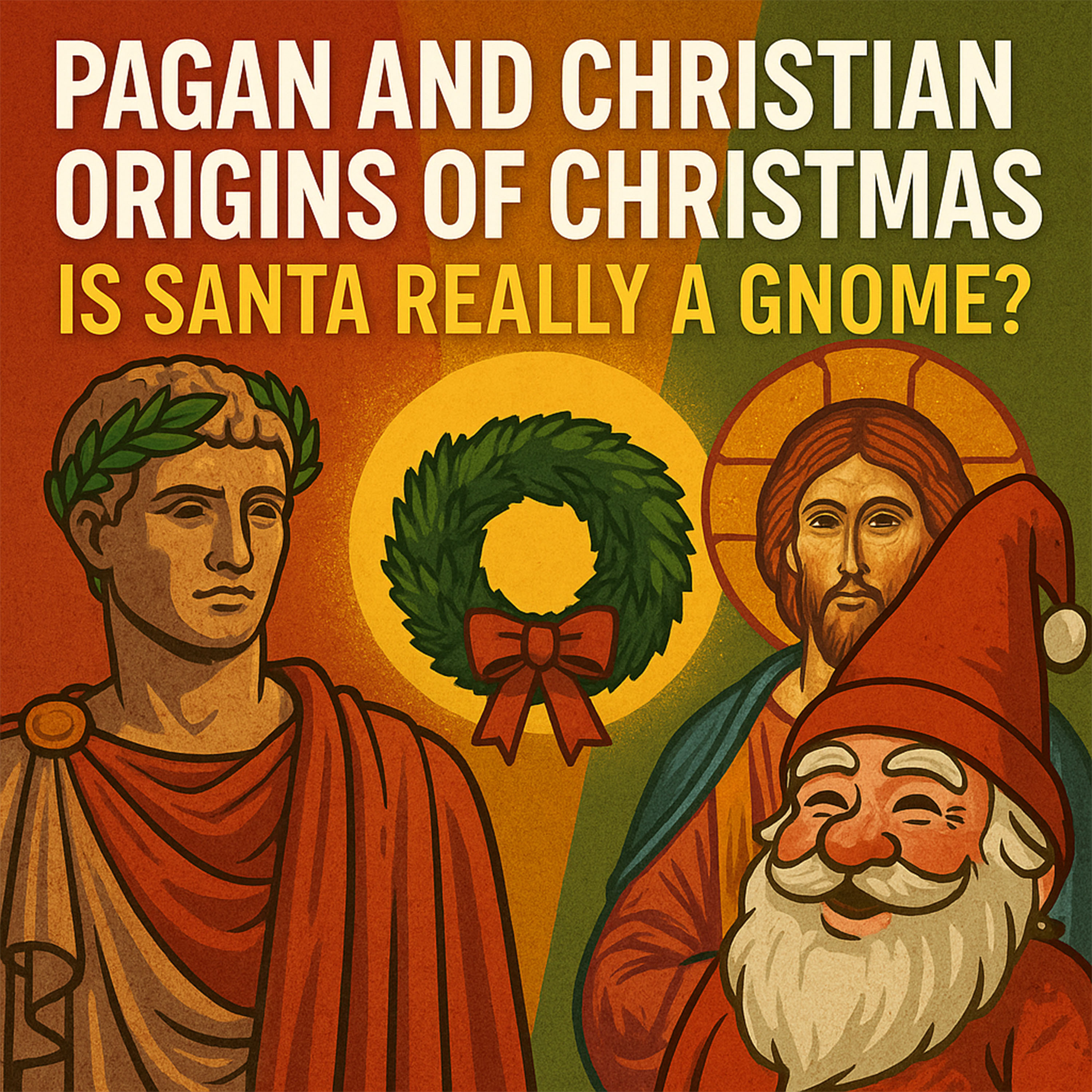 Pagan and Christian Origins of Christmas: Is Santa Really a Gnome? Pagan and Christian Origins of Christmas: Is Santa Really a Gnome? | 🎄 Pagan and Christian Origins of Christmas: Is Santa Really a Gnome? | Gnome Talk PodcastEvery December, we decorate evergreen trees, exchange gifts, light candles, and tell stories of a red-clad gift-giver who watches from the shadows of winter. But where did these traditions really come from?In this episode of Gnome Talk, we explore the true origins of Christmas—long before shopping malls and holiday playlists—and trace how ancient Pagan midwinter festivals, early Christian theology, and European folklore blended together to create the holiday we celebrate today.We’ll journey through:Yule and the winter solstice, where fire, evergreens, and feasting pushed back the longest nightsSaturnalia and Sol Invictus, Roman festivals of light, reversal, and renewalWhy December 25 became associated with the birth of Jesus—and why it wasn’t as simple as “stealing a Pagan holiday”The many ancestors of Santa Claus, from St. Nicholas to Odin, Father Christmas, and the Scandinavian Tomte and Nisse—literal household gnomes of Yule folkloreThe Pagan roots of Christmas trees, lights, wreaths, and ornamentsGift-giving as survival, ritual, and sacred responsibilityThe darker side of midwinter—Krampus, the Wild Hunt, and why winter myths always carried both warmth and warningThis episode isn’t about debunking or arguing belief. It’s about understanding how humans have always responded to darkness with story, ritual, generosity, and light—and how Christmas became a living patchwork of ancient traditions, faith, folklore, and joy.Whether you celebrate Christmas, Yule, both, or neither, this episode offers a deeper way to see the season—and maybe a new answer to an old question:Is Santa really a gnome? | — | ||||||
| 12/9/25 | Beyond Us vs. Them: Facing Our Bias | We like to believe we’re rational. Clear-eyed. Objective.But what if the biggest threat to our clarity isn’t misinformation… it’s our own minds?In this episode of Gnome Talk, we explore the invisible force that shapes every belief, every argument, every community, and every relationship we enter: bias.Not political bias… not ideological bias… but the fundamental tilt in how our brains build reality.✨ In this episode you’ll discover:Why even smart, kind people can fall into cults, manipulative relationships, and high-control groupsHow the brain quietly edits our memories and perceptions to keep us feeling “right”Why doctors, therapists, and pilots create entire systems to catch their own blind spotsHow social media amplifies certainty, outrage, and divisionWhy we’re so good at spotting bias in others and so terrible at seeing it in ourselvesHow belonging, identity, and emotion override logic far more than we admitPractical ways to protect yourself from manipulation—without becoming cynical or closed-offThis isn’t an episode about shaming anyone.It’s about understanding the human mind, so we can walk through the world with more humility, more clarity, and more compassion—for ourselves and others.Because the truth is simple and unsettling:None of us see the world as it is. | — | ||||||
| 10/26/25 | Alien Abductions: Inside the UFO Phenomenon | Across decades and continents, ordinary people tell the same extraordinary story: bright lights, missing time, strange marks, and memories of being taken.Are alien abductions real, or are they something deeper, hidden in the folds of mind, myth, and mystery?In this episode of Gnome Talk, we travel through the modern mythology of UFO abductions, from Betty and Barney Hill’s 1961 encounter to the chilling theories of Extraordinary: The Seeding, and the science that tries to explain it all. We’ll hear how experiencers describe their moments under the lights, what hypnosis and psychology reveal about memory and trauma, and why these stories refuse to fade no matter how many explanations we invent.✨ In this episode you’ll learn:The origins of the alien abduction phenomenon; from early contactees to modern casesThe most famous abduction accounts: Betty and Barney Hill, Travis Walton, Whitley StrieberThe hybridization theory explored in Extraordinary: The SeedingThe science behind abduction memories: sleep paralysis, temporal lobe phenomena, and hypnosisPhysical evidence, multiple-witness reports, and government studies that still puzzle researchersWhy abduction experiences can transform lives, turning fear into purposeWhat these stories might reveal about consciousness, trauma, and humanity’s longing for connectionWe’re not here to preach or debunk. We’re here to listen to the data, the disbelief, and the mystery that lies between.🎧 Listen now and decide for yourself.Because whether these encounters are psychological, spiritual, or truly extraterrestrial, they tell us something profound about being human beneath a sky that still refuses to be empty. | — | ||||||
| 10/19/25 | Ghosts & Hauntings: Evidence, Science, and the Afterlife | Are ghosts real—or are we just very good at feeling what memory leaves behind?In this episode, we walk straight into one of humanity’s oldest conversations: ghosts. From clay tablets and cathedral walls to deathbed visions and midnight hallways, we explore why so many people across eras and cultures have said, “Someone is here.”We’re not here to stage a courtroom. We’re here to look—carefully and kindly—at the experiences, the science, and the meaning:Why every culture has language for the lingering dead (ancestors, hungry ghosts, yūrei, shades).Evidence & testimony: the “presence,” footsteps, scents, apparitions, EVPs, and multi-witness moments.The science of ghosts: sleep paralysis, infrasound, pareidolia, EMF, carbon monoxide—and what remains after the drafts are sealed.Theories: earthbound spirits, residual hauntings (recordings), ancestor visits, purgatory/bardo, and modern ideas (consciousness as energy, layered time).The two faces of ghosts: tender visitations that comfort—and hauntings that demand boundaries.What ghosts may say about life after death: continuity, responsibility, and the possibility that the veil is a hinge, not a wall.✨ You’ll hear about:Visitation dreams vs. fear-weather dreamsResidual hauntings and “place memory” (why some rooms won’t become ordinary)How to hold mystery with reverence without credulity and curiosity without contempt | — | ||||||
| 10/12/25 | The Dark Lore of Gnomes, Fae and Forest Spirits | Not all gnomes are garden guardians. Not all fairies bring blessings.In this episode of Gnome Talk, we step into the shadowed corners of folklore—the stories most people skip.For generations, tales of the hidden folk have carried two faces: one kind, one cruel. Tonight, we uncover the darker side of gnomes, fae, and forest spirits—the duendes of Latin America who lure travelers astray, the changelings of Celtic myth who replace human children, and the wild beings who guard the world’s forests with teeth as much as tenderness.Join us as we explore how these unsettling legends grew, why ancient people told them, and what they still whisper about respect, boundaries, and wonder. From European ruins haunted by redcaps to the shadowed timberlines where Sasquatch still walks, this is folklore at its deepest—part caution, part reverence, and part reminder that the world has edges that remember. | — | ||||||
| 10/6/25 | Are Demons Real? Inside the World’s Oldest Fear | From ancient Mesopotamian amulets to modern exorcisms and haunted houses, humanity has always asked the same chilling question — Are demons real?In this in-depth episode of Gnome Talk, we travel through thousands of years of lore, faith, and fear to uncover how the idea of demonic forces shaped our world. Explore how every culture—from the deserts of Babylon to the cathedrals of Europe and the forests of the Americas—has named, battled, and tried to understand the unseen.We’ll revisit infamous possession cases like Anneliese Michel, The St. Louis Exorcism, and The Conjuring House, and see how religion, psychology, and human experience collide when the air turns wrong. From Catholic exorcisms to Islamic ruqyah, Jewish dybbuk rites to shamanic extractions, discover how people across the globe still fight the dark—and what that reveals about the human spirit. | — | ||||||
| 9/16/25 | You Are Weird and Thats Beautiful | Gnome Talk Ep. 28 — Everyone Is Weird (and That’s Beautiful)Your oddities aren’t a problem to fix. They’re gifts. In this episode we explore how difference can be sacred, why peace doesn’t require sameness, and how to hold strong convictions without losing basic human decency. | — | ||||||
| 8/17/25 | Can We Contact Gnomes?: Nature Consciousness Encounters (Like CE5 for Earth) | What if gnomes, fae, Sasquatch, and nature spirits are more than folklore—what if they’re neighbors waiting just beyond the veil? 🌿🧙♂️In this episode of Gnome Talk, we explore a bold idea: if CE5 (Close Encounters of the Fifth Kind) can invite UFO contact through consciousness, could similar practices help us connect with the intelligences of Earth—gnomes, elementals, land spirits, and more?We’ll journey through:✨ Real-life claims of gnome and fae encounters (both physical and spiritual)✨ The surprising overlap between Sasquatch sightings and fairy lore✨ Consciousness as the bridge—how visualization and intention create contact✨ The Nature Consciousness Encounters (NCE) scale—our framework for meeting unseen neighbors✨ The Gnomean Contact Compass: Place, Posture, Participation, and The Unseen✨ How ancient practices, modern CE5 groups, and new Gnomean spirituality all point to the same truth: the world is alive, and it might be listening.You don’t have to believe to listen. In the Church of Gnome we hold fast to the Sacredness of Maybe—an open door where wonder and possibility live. | — | ||||||
| 8/10/25 | Do Nature Spirits Really Exist? The Mystery of Elementals and the Fae | Gnome Blessings, fellow Gnomeans.What if the world is full of neighbors we rarely notice? Not just birds and foxes, but the ones folklore whispers about—the sylphs who ride the breeze, the gnomes who tend the roots, the undines who swirl in the tide, and the salamanders who dance in the flame.In this episode of Gnome Talk, we take a backpacking trip through the Sacredness of Maybe—exploring the ancient origins of the four elements, Paracelsus’s Renaissance classification of nature spirits, the tangled web of fair folk in global folklore, and the modern mystics and scientists who keep this conversation alive.Whether you take it literally or symbolically, we’ll explore how personifying nature can change the way we treat it—and why “acting as if” might be one of the most magical things we can do. Along the way you’ll hear:Ancient Greek, Chinese, and Renaissance visions of Earth, Air, Fire, and Water 🌍💨🔥💧How folklore fairies and elementals overlap (and where they don’t)The story of Findhorn’s giant cabbages and the idea of “partnering” with plantsModern science on forests as living networks and Earth as a self-regulating systemEveryday ways to work with the unseen—rituals, offerings, and relationship with placeYou don’t have to believe in gnomes, elementals, or fae folk to join the journey. You only have to step into the maybe, light your candle, and see if the path looks brighter. | — | ||||||
| 7/23/25 | Heavy Lies the Gnome Hat: What No One Tells You About Starting Your Own Religion | What happens when a joke becomes a movement?In this behind-the-scenes video, I share the wild, honest story of launching the Church of Gnome—from slow beginnings to explosive growth, the joy of community, the chaos of scaling, and everything in between. Whether you’re thinking of starting your own spiritual group, nonprofit, or mission-driven brand, this is the real story of what it takes. | — | ||||||
| 6/29/25 | The Hidden Folk of Iceland: Elves, Fairies, and Folklore in Real Life | The Hidden Folk of Iceland: Elves, Fairies, and Folklore in Real Life🧝♀️✨ A new Gnome Talk episode exploring the magic, mystery, and real-world impact of Iceland’s hidden people.What if elves were more than myth?What if fairy folklore could shape modern law, pause construction projects, and influence how an entire country treats the land?In this episode, Gnomean Elder Brett Larsen takes you on a journey through Iceland—where belief in Huldufólk (the hidden folk) still lives on. These aren’t just bedtime stories. They’re active forces in Icelandic life, influencing everything from politics to parking lots.You’ll hear about:🌋 Elf churches that halted government infrastructure🛑 Roads rerouted around sacred boulders🏠 Houses and towns built around fairy dwellings📜 Legal protections for enchanted sites🕯️ Modern rituals—like lighting candles for elves on New Year’s Eve🌿 And the deeper message behind these stories: how belief in the unseen can cultivate reverence, respect, and a more conscious way of living.This isn’t just about Iceland—it’s about what we lose when we stop making space for wonder. | — | ||||||
| 6/22/25 | Forgiveness and Reconciliation: Reclaiming Peace Without Losing Yourself | What if forgiveness isn’t about excusing what happened…but about setting your heart free from carrying it any longer?In this episode of Gnome Talk, we explore the sixth Gnomean Principle:Forgiveness and Reconciliation“To release another from the chains of the past is to unburden your own heart and set both souls free.”But we don’t treat forgiveness like a buzzword.We talk about it honestly—acknowledging the pain, the boundaries, and the complexity that comes with trying to forgive when you’ve been hurt.This episode is for anyone who’s trying to make peace without compromising their self-respect.For those wondering whether to let someone back in—or whether letting go is the only way forward.For those carrying anger, guilt, or grief over something they can’t quite forget.We talk about:– The difference between forgiveness and reconciliation– Why forgiveness doesn’t always mean reconnection– The role of accountability in an era where every mistake is public and permanent– Releasing resentment without losing your boundaries– A gentle, grounded way to move toward healing—without pressureYou are allowed to forgive without forgetting.You are allowed to walk away without hate.You are allowed to heal on your terms. | — | ||||||
| 6/15/25 | Leaving Religion, Deconstructing Belief, Fear and Finding the Sacred Again | What happens when you walk away from the religion you were raised in…but still carry a deep hunger for something sacred?This episode is for anyone who has left a spiritual path—whether it was strict, controlling, shame-based, or just no longer fit—but still finds themselves holding quiet questions, spiritual longing, or grief for what was lost.Since starting the Church of Gnome, one of the most unexpected and powerful things that’s happened is how many people have reached out saying:“I grew up in something intense…and I didn’t realize how much I needed a space like this until I found it.”In this episode, we talk about:– Why people leave religion (and why that takes courage)– What gets lost, what might be worth keeping, and what you’re allowed to reclaim– The grief, fear, and silence that often follow deconstruction– How the sacred still lives in the everyday—quiet, unrushed, and fully yours– What makes the Church of Gnome different, and how it’s become a gentle home for so many spiritually wounded wanderersYou don’t need to believe in gnomes.You just need to believe that your story isn’t over—and that you’re allowed to keep what still feels real. | — | ||||||
Showing 25 of 46
Sponsor Intelligence
Sign in to see which brands sponsor this podcast, their ad offers, and promo codes.
Chart Positions
1 placement across 1 market.
Chart Positions
1 placement across 1 market.