
Insights from recent episode analysis
Audience Interest
Podcast Focus
Publishing Consistency
Platform Reach
Insights are generated by CastFox AI using publicly available data, episode content, and proprietary models.
Most discussed topics
Brands & references
Total monthly reach
Estimated from 1 chart position in 1 market.
By chart position
- 🇷🇴RO · Christianity#183500 to 3K
- Per-Episode Audience
Est. listeners per new episode within ~30 days
250 to 1.5K🎙 ~2x weekly·214 episodes·Last published 3w ago - Monthly Reach
Unique listeners across all episodes (30 days)
500 to 3K🇷🇴100% - Active Followers
Loyal subscribers who consistently listen
150 to 900
Market Insights
Platform Distribution
Reach across major podcast platforms, updated hourly
Total Followers
—
Total Plays
—
Total Reviews
—
* Data sourced directly from platform APIs and aggregated hourly across all major podcast directories.
On the show
From 10 epsHosts
Not detected.
Recent guests
Recent episodes
Do we need a new theory of sin?
Jun 3, 2026
1h 04m 06s
Do Christians withdraw or engage??
Apr 20, 2026
1h 05m 01s
John Behr on Maximus
Mar 24, 2026
1h 06m 30s
Maximus - the Mt Everest of Patristic Theology
Mar 9, 2026
32m 22s
The Creation Gospel - So What & What Next?
Feb 11, 2026
32m 08s
Social Links & Contact
Official channels & resources
Official Website
Login
RSS Feed
Login
| Date | Episode | Topics | Guests | Brands | Places | Keywords | Sponsor | Length | |
|---|---|---|---|---|---|---|---|---|---|
| 6/3/26 |  Do we need a new theory of sin? | Nothing is more foundational to the traditional gospel than a ‘theory of sin’. But for most of us, it is a messy topic that we have not thought about enough. Hence Christianity has all too often suggested a dark anthropology that defines humanity as ‘totally depraved’ or incapable of ‘any good thing’. This is not exactly a good place to start an evangelistic conversation! So we need a better model of what we mean by ‘sin’. In this interview with Rob, Tony develops a different ‘theory of sin and evil’ - one that emerged years ago mainly in conversations with Mark Strom. Mark and Tony both were deeply dissatisfied with traditional models - but felt that the ball was in our court to develop and explain an ALTERNATIVE model of sin, not just critique the old evangelical models. This talk is based on a paper that I (Tony) wrote years ago which we upload here. The first 20 minutes seem to be a slow start. You could skip them - but the point I make there is quite helpful. The Gospel is an argument and the critical foundation of any argument is to find the deep structures of the problem. That is what I am doing in this talk, and the opening explains why that is so important. Get full access to Gospel Conversations at gospelconversations.substack.com/subscribe | 1h 04m 06s | ||||||
| 4/20/26 |  Do Christians withdraw or engage?? | This is the third in Ben Myer’s wonderful series on the thinking of the early church fathers. This talk examines their view on the burning question of discipleship - what does it mean to follow Christ in how we live particularly in the public square? Ben’s first talk covered their view of salvation - and how they did not have a ‘penal substitution’ model of redemption. His second talk covered their view of the inner life - how we live righteously in our souls and thoughts. So this talk moves to the vexed place of the public square - how do Christians participate in the ‘world’ (or not). This talk is in a sense ‘unfinished’ - as Ben says, they never got to a simple clear position and there were conflicting positions on this question. What I found illuminating and relevant to us, is that how they confronted this question varied according to the changing circumstances in which they found themselves. So our lesson would be that we have the same task - understand our circumstances and then work out how our faith should work out in today’s world. Ben finishes with St Augustine’s ‘City of God’ where Augustine developed the theory of our ‘double citizenship’ in two very different kingdoms. And Ben laments how later centuries turned some of this thinking into forms of ‘Christian nationalism’. Finding God or the echoes of the divine in the public square is a vital concern for us all - and particularly relevant as we realise the Christ is Lord of the cosmos not just individual lives. In fact, his Lordship was expressed in very political terms for the first century church - something that Edwin Judge and Mark Strom have stressed in previous talks. So this is challenging topic and one for which there are probably no easy answers. But Ben’s talk gives us a great perspective to think it through. This year we will be following a ‘so what’ theme in Gospel Conversations - ie what are the ‘so what's for the Creation Gospel so this talk is a great door opener for our year. Our next talk will address the question of evangelism and how we frame the ‘creation gospel’. I will give this talk and it will focus on our ‘theory of sin’ - a vital topic. I will critique the dominant mental model of sin (or at least the one I grew up with as an evangelical) and offer what I think is a much richer and more biblical model of what this critical thing called ‘sin’ means. Get full access to Gospel Conversations at gospelconversations.substack.com/subscribe | 1h 05m 01s | ||||||
| 3/24/26 |  John Behr on Maximus✨ | religionspirituality+3 | John Behr | MaximusGospel Conversations | — | Maximuspatristic+3 | — | 1h 06m 30s | |
| 3/9/26 |  Maximus - the Mt Everest of Patristic Theology✨ | Patristic TheologyChurch Fathers+3 | John Behr | the Church FathersAmbiguum | — | MaximusJohn Behr+3 | — | 32m 22s | |
| 2/11/26 | 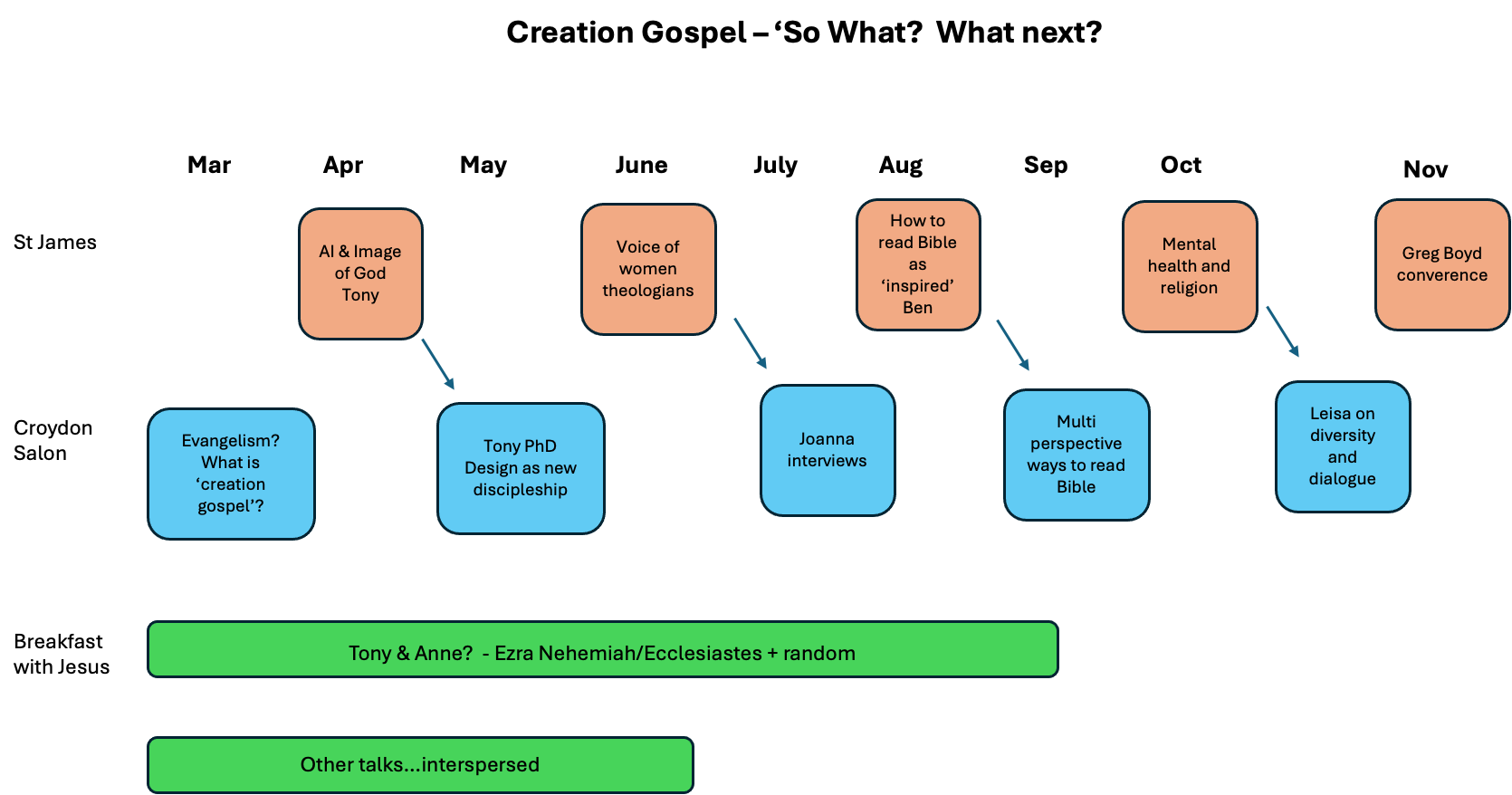 The Creation Gospel - So What & What Next?✨ | Creation gospelAI and the image of God+3 | — | the St James InstituteTony Gospel Conversations+2 | Sydney | new evangelismhuman being+7 | — | 32m 08s | |
| 1/13/26 |  John Behr on Gregory's Stunning Vision of Humanity and the Divine✨ | theologyhumanity+3 | John BehrDavid Bentley Hart | Gregory's Stunning Vision of Humanity and the DivineEcclesiastes | — | Gregory of Nyssahumanity+3 | — | 1h 28m 57s | |
| 12/8/25 |  A New Conception of Humanity: Introducing Gregory of Nyssa✨ | humanityphilosophy+3 | — | Gospel ConversationsActs+1 | NyssaMars Hill | Gregory of Nyssaimago dei+3 | — | 42m 20s | |
| 11/5/25 |  John Behr - Why didn't God create us perfect?✨ | theologyChristianity+3 | John Behr | the Church FathersGospel Conversations | LyonLyons+1 | Irenaeus of Lyonuncreated life of God+3 | — | 53m 24s | |
| 10/20/25 |  John Behr - Was Adam created 'perfect'?✨ | salvationChurch Fathers+3 | John Behr | Gospel ConversationsScriptures+3 | — | perfect state of AdamFall+3 | — | 1h 06m 32s | |
| 9/24/25 |  David Bentley Hart on his Revolutionary Translation of Romans 5:12✨ | theologybiblical interpretation+3 | David Bentley Hart | Revolutionary Translation of Romans 5:12 | — | Romans 5:12original sin+3 | — | 44m 53s | |
Want analysis for the episodes below?Free for Pro Submit a request, we'll have your selected episodes analyzed within an hour. Free, at no cost to you, for Pro users. | |||||||||
| 9/4/25 | 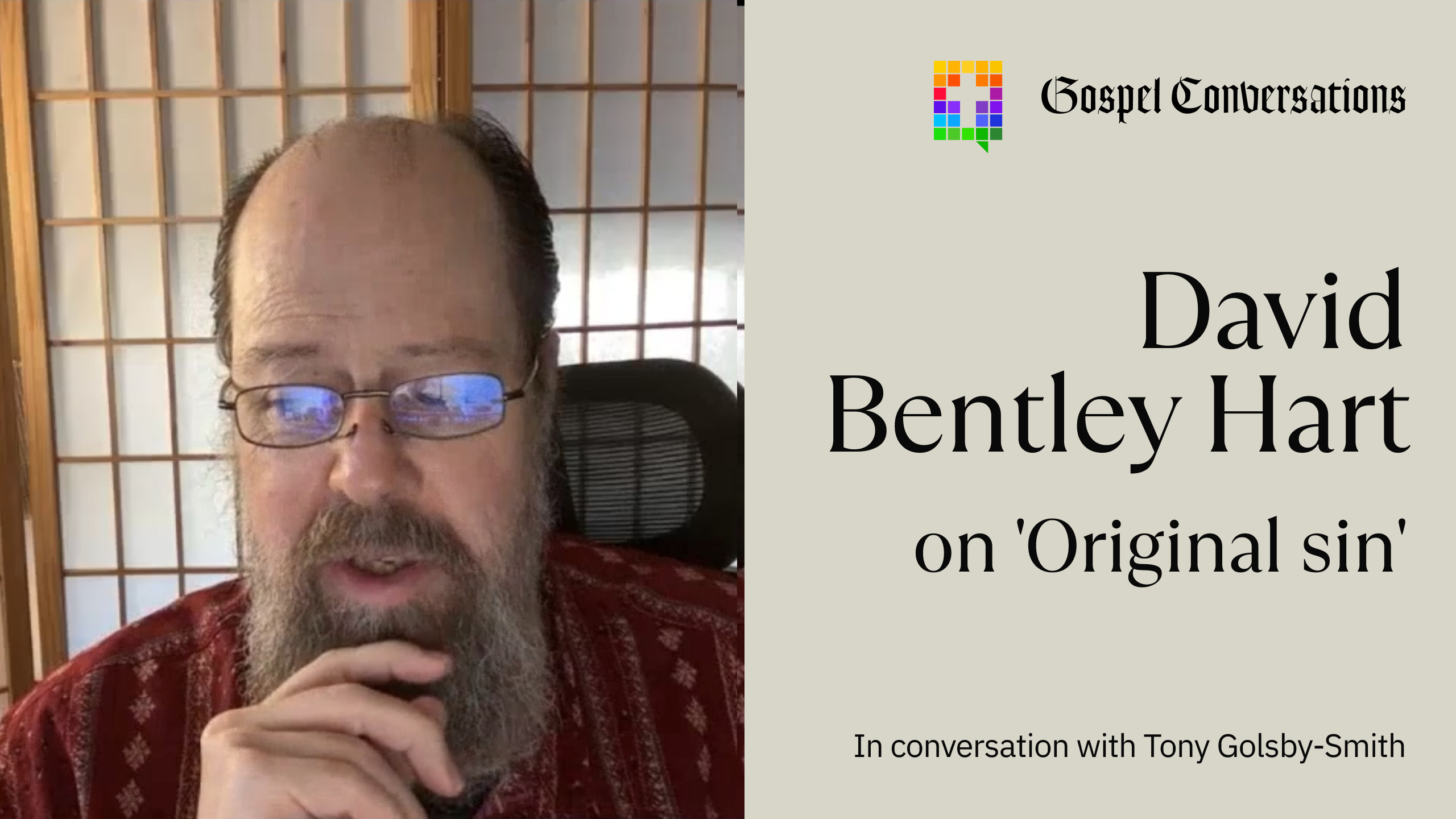 David Bentley Hart on 'Original sin' Part 1✨ | original sinChristian doctrine+3 | David Bentley Hart | ChristianityGospel Conversations+2 | — | Romans 5verse 12+3 | — | 28m 48s | |
| 8/4/25 |  Macrina: The Forgotten Woman Who Helped Shape Early Christian Theology✨ | Christian theologyWomen in Christianity+3 | — | On the Soul and the Resurrection | Nyssa | Cappadocian Fatherscelibacy+3 | — | 35m 20s | |
| 7/14/25 | 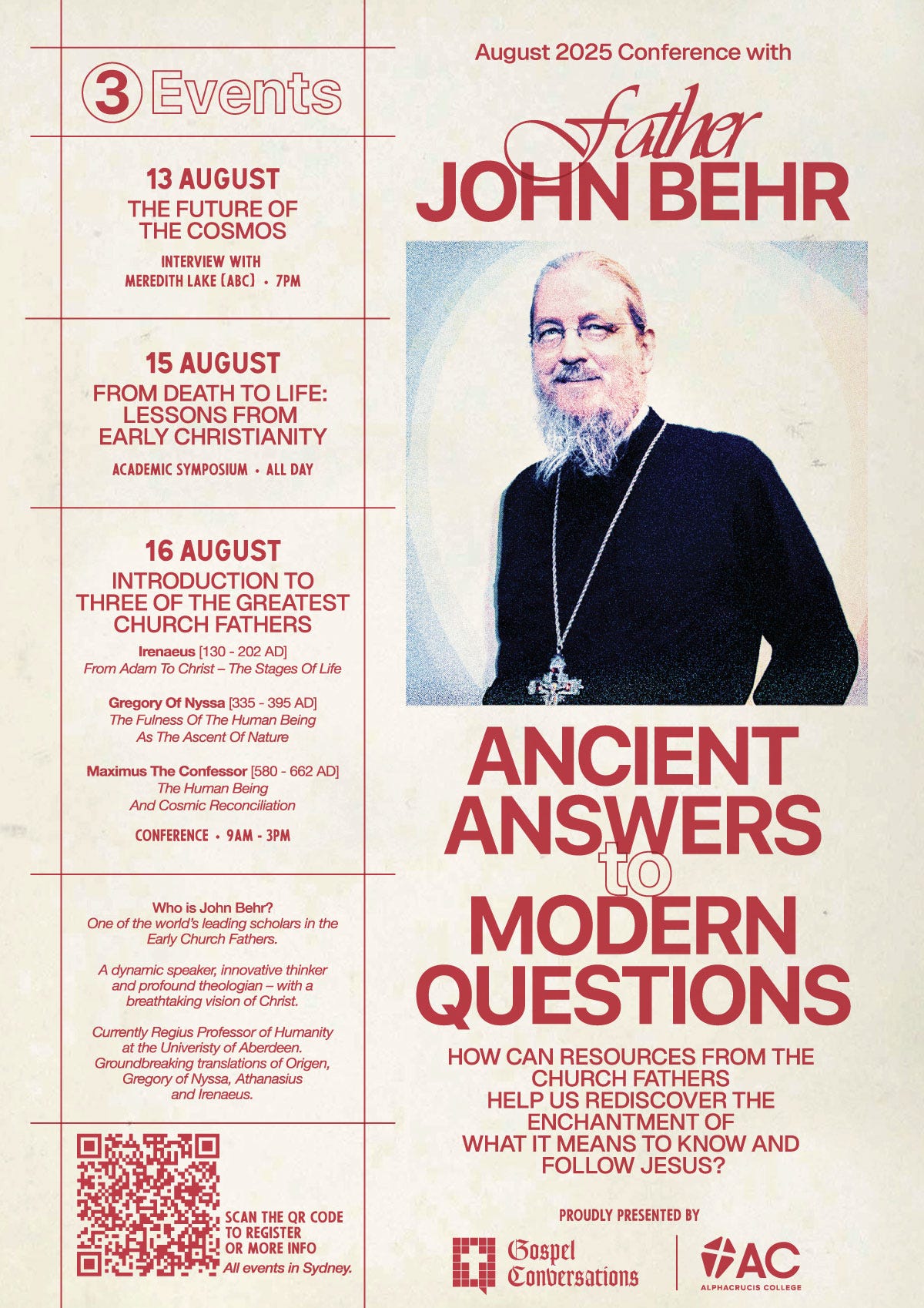 John Behr on the 'mind blowing' theology of the Church Fathers | Fr John Behr’s visit to Australia is just over a month away. I interviewed him recently to get a foretaste of what he will be talking to us about. John is clearly a major thought leader in modern theology. I got a taste of this recently from a post I read by Brad Jersak. Brad had just been to a retreat on the remote Scottish island of Iona led by Rowan Williams and John Behr (made me jealous!!). He recounts how a conversation with John (and Chris Green) was very significant for him - and helped him unravel some questions that had blocked him for years. This just confirms what a treasure John is. This interview is a foretaste - it gives us the overall sweep of John’s ‘image of God’ theology and his wondrous vision of Christ as the ultimate ‘human being’. So if you have not registered for the conference, get onto it now. The Saturday conference is one of three events we are hosting (together with Alpha Crucis and the St James Institute). What I liked most about my chat with John was how excited he is by this vision. It is not merely academic for him but as he says ‘it blows your mind’. PS here is a link to Brad’s post. Register here: Get full access to Gospel Conversations at gospelconversations.substack.com/subscribe | 38m 32s | ||||||
| 6/23/25 |  David Bentley Hart on the real meaning of 'sin' | What exactly does the word ‘harmatia’ (usually translated as ‘sin’) mean in the New Testament? This is where my conversation with David begins in this podcast. I asked him this question because when he was in Australia, David told me that he was uncomfortable using the modern word ‘sin’ to translate ‘harmatia’. This is obviously pretty important as the idea of ‘sin’ is at the foundation of the. gospel. What was going to be a limited conversation about translation soon developed into a fascinating tour through the thinking of the early church about the ‘gospel’ and what it means - all built on a very different understanding of the what ‘sin’ means. This conversation with David charts out a radical landscape for the word ‘sin’ as it is used in the New Testament and the early church. In the modern world we have a view of sin as a kind of transgression of a moral code. And the corollary of this is ‘original sin’ - the view that we are somehow infected by the Fall with a natural propensity for doing evil not good. So like a lot of ‘big’ concepts words, the word ‘sin’ sits in a large mental landscape for us - and David explains how far this modern landscape for ‘sin’ differs from the world of the early church. That is where we began, but it turned into a launching pad for a far ranging coverage of the conceptual landscape behind ‘sin’ and redemption in the early church. This is clearly very significant for us Christians to understand well because our gospel is framed as a redemption and ‘sin’ is normally presented as the ‘problem’ that the gospel solves. So we need to be clear and scriptural about exactly what that ‘problem’ space is. And this is the landscape that David maps out for us. As I look back on this conversation, it reminded me of my talks about a year ago, on the Exodus story as a framework for the gospel. My Exodus talks followed the series that Andrew Baartz led for us on the weaknesses of the Penal Substitution model of atonement. In essence, I explained how the Exodus story positions the ‘problem space’ the gospel confronts as slavery not judicial guilt. So David’s talk confirms this ‘Exodus’ orientation for the gospel. I will repost one of these talks soon. Get full access to Gospel Conversations at gospelconversations.substack.com/subscribe | 52m 57s | ||||||
| 5/29/25 |  The Patristic model of growth; we are 'mini Christs'... | Ben’s talks on the Patristic model of atonement led to the obvious question - what about their views on growth? This is the first of two talks by Ben on this topic. In this talk he focuses on the individual and morality and in the next talk he focuses on society and politics and how they viewed Christian contributions there. Patristic views on growth are built on their views of atonement; and that is where Ben begins - with a reminder of the ground he covered in his early talks. Unlike us, they did not struggle with a model of ‘penal substitution’ and its associated picture of an angry God. Instead they viewed atonement as ‘participation’ in the Godhead. So if ‘atonement’ qualifies humanity to ‘participate’ with God - then growth is all about making that participation real by our decisions and character development. That means that the Church Fathers did NOT have a moral code as their model - with lists of behaviours and do’s and don’ts. For them ‘growth’ is defined entirely by Christ. He is the model and thus all growth is growing into the PERSON of Christ. In the most amazing and memorable part of the talk for me, Ben made this real by explaining the term ‘Christian’ literally means ‘little Christs’ - and that is what we are. So for the Patristics we are to be as Christ on the earth - in miniature for sure but still following the same pattern our Lord has set. To make this tangible, he centres on an essay by Gregory of Nyssa where he lays out this pathway of development in concrete examples. This is very liberating stuff. It leaps over our typical concepts of morality and virtue and instead declares that all ‘virtue’ is shaped and defined by a Person - THE human being who defined in flesh and blood what it means to be human. As always Ben is so lucid on these complex topics - and he is helping us make a paradigm shift from a concept of growth as behaviour defined, to a concept of growth as Christ defined - so the we may be ‘as Christ’ in the world. Get full access to Gospel Conversations at gospelconversations.substack.com/subscribe | 53m 33s | ||||||
| 5/12/25 |  Power, patriarchy and the cross | Well … this interview was unexpected. David Artman runs a podcast (Grace Saves All) dedicated to the topic of universal salvation. But he is very disturbed by the rise of Trump and what he sees as the ‘first stage of facism’ taking root in his country. So he wanted to interview me - to get an international comment and also a ‘systems’ perspective on what is going on. I am not an expert in US politics but like all of us I am fascinated (horrified) by what is going on - and in particular the role of white evangelicals in supporting Trump. (David Hart has stressed that it is white evangelicals not African American evangelicals). So my perspective - one that has occupied my mind - is how did Christians get sucked in to this demagogue and is there anything intrinsic in the way evangelicals frame the gospel that made them susceptible to a manipulator like Trump. Frankly what has happened has made me question evangelicalism (whatever that means) deeply. As you might imagine this interview was quite a journey. It became a discussion about power, patriarchy and the cross. And I framed it within the overarching theme of ‘rule’ - which I see as the divine mandate for humanity on the earth - a mandate confirmed and affirmed in Christ and the cross/new creation. If you are interested in other views on this same topic, David interviewed Douglas Campbell the episode before me and Brian Zanhd the week after me. Both were really good according to my wife Anne who listened to them all. Get full access to Gospel Conversations at gospelconversations.substack.com/subscribe | 1h 08m 38s | ||||||
| 4/23/25 |  Hope and Hell; how I came to a larger vision of redemption | As promised here is the talk that I gave last Sunday at the St James Institute in Sydney. It was well received, and I was surprised by the audience and their reaction. Most were older people - not young radicals - and they were clearly bothered by this doctrine of hell but had no alternative ways to think about it. So for many the talk was a relief that there was a viable alternative to having to believe that eternal conscious torment is an essential part of the gospel. People also appreciated the journey idea. They liked me sharing about my experience, and the situations that provoked me to challenge my beliefs on hell. Let me quickly explain what I mean by a ‘journey’ and by ‘experience’ as it frames the talk. I don’t mean merely a chronicle of events. I mean instead a meaning making narrative. I see life in some ways as an interaction between situations we encounter and the mental models that we use to make meaning out of those situations. We are ‘meaning making’ creatures not merely sensate ones and this makes the narratives we tell ourselves vital and crucial. I see growth therefore as the ‘amplification’ or ‘enlargement’ of those narratives - an enlargement that in my experience keeps going on. This enlargement however is not alway easy. More often than not it requires a cycle of ‘unlearning’ and ‘disordering’ before we can move to a new ordering. In Second Road we captured this learning cycle in the ‘Frames’ model - we begin wth ‘freeze frames’ that we are comfortable with, then for some reason we are challenged and go through a time of ‘unframing’ which can be tough. But grace - and reflection - takes us through this phase to a ‘reframing’ which results in a new frame.That is what happened in this journey to me. I think that is the work of the Holy Spirit not merely an autonomous human faculty. My experiences stretched me outside my theological models and I had to let them be challenged and reframed. The talk finishes with a couple of great questions. Can I also give St James Institute a plug. Go to their website as they have some great talks coming up on their monthly Sunday afternoons. Get full access to Gospel Conversations at gospelconversations.substack.com/subscribe | 1h 14m 24s | ||||||
| 3/31/25 |  Beyond 'easy grace': Universalism and the Call to Discipleship | One of the main objections to universalism is that it opens the door for spiritual laziness. It is the easy way out. Why bother with the hard work of discipleship if everybody gets saved and there are no consequences for bad behaviour? Ilaria confronts this challenge in her final interview with Robin Parry. Of course this is the tip of a big iceberg - what do we mean by growth? How are human beings motivated to grow? As I have done before I bookend Ilaria’s talk with an introduction to give you the coat hanger to absorb her rather dense material, and then I add a postscript that builds on what she has said. Warning: There is an ‘R rated’ part of this talk - and that is my description of exactly what kind of torture Origen was subjected to as an old man - tortured on the rack ‘to four spaces’. Stomach churning. But what is more sickening is the comparison with the Emperor Justinian who eventually ‘condemned’ him in the anathemas. How on earth did the church prefer a dictatorial tyrant to an old man who defied torture for his faith??We are going to build on the topic of growth in upcoming interviews/talks with Ben Myers. He will explore the model of growth in Patristic theology: his first series was pretty exciting on the Patristic model of the Atonement. This next one will be the natural extension - the Patristic model of growth. Juicy stuff and likely to open up new perspectives on what ‘discipleship’ can mean today. Get full access to Gospel Conversations at gospelconversations.substack.com/subscribe | 35m 14s | ||||||
| 3/12/25 |  Is hell a pagan concept? | The answer is ‘yes’ - hell was a concept deeply ingrained in the pagan mind. And that is the surprising landscape that Ilaria opens up for us in this next episode in Robin Parry’s interviews with her on apokatastasis. In this interview, Robin asks her about a recent accusation that belief in '‘apokatastasis” was actually a pagan idea that crept into Christianity. Of course, that kind of accusation works well to stigmatise apokatastasis and condemn it to the heresy corner! This critique assumes that such a benevolent view of destiny must have its origins in human optimism not in any revelation. Ilaria dismisses this out of hand - and says that the idea of apokatastasis originated in the scriptures. But in so doing, she makes a brief but intriguing point - that Plato did NOT believe in apokatastasis but in fact believed in hell as ‘eternal conscious torment’. This clip is very short - so I decided to expand Ilaria’s comments. (Plato’s views on hell are found in his Socratic dialogue “Gorgias” which I analysed as a source text in my doctoral thesis some years ago). It turns out that Plato’s views on hell - and divine judgment - are remarkably similar to lots of traditional Christian views. The implications of this are significant: lots of our so-called “Christian” views on heaven and hell are not unique to Christianity but are shared with the pagan world. This is not to say that they are wrong - or right - but it does say that they are common sense ideas that spring from human reasoning not revelation. So in my comments I compare and contrast the shared landscape between Plato’s ‘pagan’ views on hell (and heaven) and typical Christian views. The results are illuminating because they shine the light on what is really unique about the Christian view of human destiny and what seems to be just human reasoning. As Ilaria declares apokatastasis was one of those features that was unique to early Christianity. For the pagan mind, it was just too good to be true, and too wondrous for unaided common sense to apprehend. Get full access to Gospel Conversations at gospelconversations.substack.com/subscribe | 35m 34s | ||||||
| 2/20/25 |  The breathtaking Patristic vision of resurrection in 1 Corinthians 15 | If the scripture is like a land of hills and valleys, then 1 Corinthians 15: 22-28 was the Mount Everest of the terrain. Or so thought Origen and Gregory of Nyssa, according to Ilaria Ramelli. In this short nugget of a talk Ilaria explains with her typically profound mix of big picture and detail, just why the claim that in the end “God will be all and in all” was treated so seriously by Patristic theologians. It is no ordinary claim. By this I mean that it simply does not fit into our normal conceptual landscape of reality - it redraws the whole map of reality. That is how the great minds of the early church treated it - they allowed it to chart out a vision of the end of all things that draws a new map of reality - a map of reality forged and pioneered in the death and resurrection of Christ. Since Ilaria’s talk is so condensed, I have attached a beginning and end bookend to the talk. In the beginning I introduce and expand a couple of the new conceptual frameworks that Ilaria assumes and works with. One is what ‘submission’ means and the second is what she means by extending the term “logos” to the adjectival term '“logikon” - both of which are describing not just the qualities of the Son of God but also of his relationship with creation generally and humanity in particular. At the back end, I append a ten minute discussion of how a typical ‘evangelical’ reading tries to explain away the pretty obvious universalism in this text. I use the commentary notes in my English Standard Version as examples of the ‘yes-but- it doesn’t mean what it looks like’ interpretation of this passage that is quite typical of the struggles that traditional hell doctrines have with the persistent use of the word ‘all’. Get full access to Gospel Conversations at gospelconversations.substack.com/subscribe | 32m 22s | ||||||
| 1/29/25 |  Robin Parry's journey to universal salvation | After a slow start we are ready to get going in Gospel Conversations for 2026. We will kick off with this fascinating interview I did with Robin Parry about his personal journal to universal salvation. Robin has led the vanguard for universal salvation since the publication of his landmark book in 2006 “The Evangelical Universalist” which probably did what no other book had quite done in the modern era - it put universalism on the table as a genuine option in the gospel not as a heresy. So it is really intriguing to get the story behind the book, and his journey. I have always been fascinated by seeing how poets or writers actually crafted their works, and developed their ideas. In Robin’s case we get the story - including his early years as an agnostic and his conversion to a pretty fundamentalist form of Christianity. But then he shares the doubts that led to his changing mind. But we get more than that. We also get his feelings about the book and his position - did he feel precarious being out on a limb so far? And in a fascinating section, he explains why the book was so well received in the end - including by its critics. We also get a feel for Robin the person - his lovely combination of measured thought, synthetic thinking and very irenic disposition which has commended him to many including his opponents. So all this makes his journey one for our times, I believe. In the course of this interview, he mentions a couple of key texts - here are the details of you want to get hold of them. Firstly, Eric Reitan whose book “Troubled Paradise” was recently published by Wipf and Stock. It addresses one big issue around hell - how can anyone be happy in paradise if they know others, including their beloveds, are in hell. Secondly he mentioned Al Kimel’s book “Destined for Joy” and in particular the chapter on whether the Fifth Ecumenical council really did condemn Origen and universal salvation as heresies. This book is a profound defence of universal salvation but you need to read the last bit first to grasp its power: the 2012 funeral oration that Kimel delivered on the death (by suicide) of his adult, unbelieving, son. This event made him ‘come out’ as a universalist. Soon we will post the last of the talks by Ilaria Ramelli, and then I will repost a short talk I gave on my personal journey towards cosmic restoration. Get full access to Gospel Conversations at gospelconversations.substack.com/subscribe | 1h 07m 40s | ||||||
| 12/24/24 |  A Christmas gift from Sarah on teaching and the incarnation | This is our last podcast for the year and it is almost Christmas. It is a short piece by our daughter Sarah which has just been published on the ABC website - in the Religion and Ethics section. Here is the link https://www.abc.net.au/religion/sarah-golsby-smith-teaching-incarnation-christmas-end-of-school/104758846In this piece, Sarah reflects on her year of teaching and finds in that experience a touch of wonder - wonder at the privilege of helping young human beings flourish. She sees these young students as vessels of grace, made in God’s image and at Christmas, as echoes of the ultimate image of God - Christ. Sarah’s experience is a great example for us all - to find the wonder in quotidian moments as we walk the earth. I call these ‘burning bush’ experiences where we see the inner light of some part of creation burst forth and reveal itself. And of course, where greater to see that than in the experience of watching a child learn and grow. Of course, Sarah is hinting at a far broader concept of ‘incarnation’ than just Christ’s brief sojourn on earth - begun at his birth and concluded at his resurrection. She is working with a bigger view that sees Christ’s incarnation as a synecdoche or crystallisation for all the created order. In this view, all of creation is templated after the image of God, and continues to be ‘created’ in that image. And as we see, like Moses, the inner glory of burning bushes, we participate in this living ongoing touch of God in the creation. The great 7th-century mystic, Isaac of Nineveh, saw this as the pinnacle of spiritual growth - he called it a ‘state of wonder’ at the mysteries of God’s involvement, his incarnation, in the created order. Enjoy this talk, look it up and read it on the ABC website. In the New Year we will resume our series on Ilaria Ramelli and Robin Parry with an interview I did recently with Robin on his journey to a belief in cosmic redemption. Of course, Christmas means the incarnation, the core of the Christian faith and the stunning message of God’s participation in our world. But just what does the incarnation mean? Typically it means the 33 year episode of Christ’s life on earth as a discreet event: it has an entry point at his birth and an exit at his resurrection. But great theologians see it more broadly than that. They see the incarnation as beginning with creation, and they see the divine imprint holding all the creation together like gravity might be holding all of our mobility and earthly experience together. So in a sense, this latent divinity in creation was always ready to erupt - and this it did notably in the Burning Bush experience of Moses. But finally, climactically it erupted in the only way possible - by God himself presencing himself with us. This wider view Get full access to Gospel Conversations at gospelconversations.substack.com/subscribe | 13m 09s | ||||||
| 12/10/24 |  Different journeys to universal salvation | Welcome to our next Gospel Conversations podcast and apologies that there has been a bit of a lag. We try to keep up a regular feed but life intervenes as I am sure you all would know… grandparenting and sickness etc. Anyway here we are. This is a little unplanned diversion from our Ilaria Ramelli series - but a pretty connected one. On our last episode Ilaria explained her half of the twin books on A Larger Hope which was the early church. Robin Parry wrote the other half which was about more recent history. Fortuitously we found a great video Robin did highlighting some of these experiences of how prominent theologians and pastors ‘changed their minds’ and embraced the doctrine that God in the end will be ‘all and in all’. Here it is - Robin at his gentle, intelligent best. What I like about this talk is that it focuses on journeys not just systematic arguments. Journeys or experiences are a great way to explain points of view and intellectual histories. They give us the human face of knowledge - and are more true to life than systematic arguments in some ways. All of us develop and change our minds, and the circumstances by which we do shine a light on where we end up. As I say in my introduction, Robin’s work as an editor for Wipfandstock has sharpened his ability to evaluate and present succinct arguments - and given him an unusually broad grasp of theological trends. So enjoy this talk. And a taste of what comes next …. I will interview Robin next about HIS journey to a belief in cosmic redemption which will be a nice postscript to this episode. I might ask him which of these earlier journeys he most identifies with in his theological journey. Get full access to Gospel Conversations at gospelconversations.substack.com/subscribe | 52m 18s | ||||||
| 11/13/24 |  Ilaria tapes #2 | This is the second of our tapes of Robin Parry’s interviews with Ilaria Ramelli in 2019 on behalf of Gospel Conversations. It focuses on the book that she had just then published, “A Larger Hope;Universal Salvation from Christian Beginnings to Julian of Norwich.” She does not summarise the book in a blow by blow way but rather gives us the big themes, which is really interesting. One of her stunning themes is that the whole Patristic theology was built on the foundation of Origen - without him, she says, Patristic thought would have collapsed. This does not mean they agreed with him wholeheartedly, anymore than great philosophers agreed with everything Aristotle said - but it does mean that Origen did for theology what Aristotle did for philosophy; he built a coherent foundation for it on which others could build. I have appended an introduction to help digest her arguments, and I also did something else in the intro - I read out some of the opening comments in the Foreword by Richard Bauckham. I think that this Foreword is pretty significant and a sign of the times because Bauckham, as far as I know is not a Universalist, but he is one of the most notable Biblical scholars in the world. Clearly he admires Ilaria a lot for her academic and intellectual credibility, and clearly he does not consider universal salvation a heresy, but rather a topic deserving of inquiry and one that is growing in interest rapidly. That is one of my major contentions - not so much that ‘universal salvation’ is ‘right’ (which I think it is) but rather that the Christian church has become increasingly dogmatic on too many topics that are consequences of our core beliefs not intrinsic to them. As a result a lot of Christian cultures are not very attractive to seeking people - or doubting and inquiring Christians. Dogmatism paints everything into black and white categories, so it does not leave any grey space for ambiguity and discussion. Actually let me go further - the ‘grey’ space is where we grow. Dogma gives us the landscape and the borders of our inquiry, but inquiry into grey space is where we go deeper into the forest of our faith and start to see the depth, texture and nuances. So I applaud the open mindedness of Bauckham and really sense that people like him are opening up the grey space for us all. I also finish off Ilaria’s talk with a postscript in which I announce that - quite concidentally - I have stumbled across a great talk by Robin recently which he has give us permission to post on Gospel Conversations. We will post it next. Robin’s talk is really instructive on the topic of grey space because he traces the different pathways that led some significant evangelical thought leaders of the last few centuries to embrace Universal Salvation. Like all of Robin’s material, it is a delightful mix of erudition and calm intellect all expressed in accessible language. Get full access to Gospel Conversations at gospelconversations.substack.com/subscribe | 22m 06s | ||||||
| 10/22/24 | 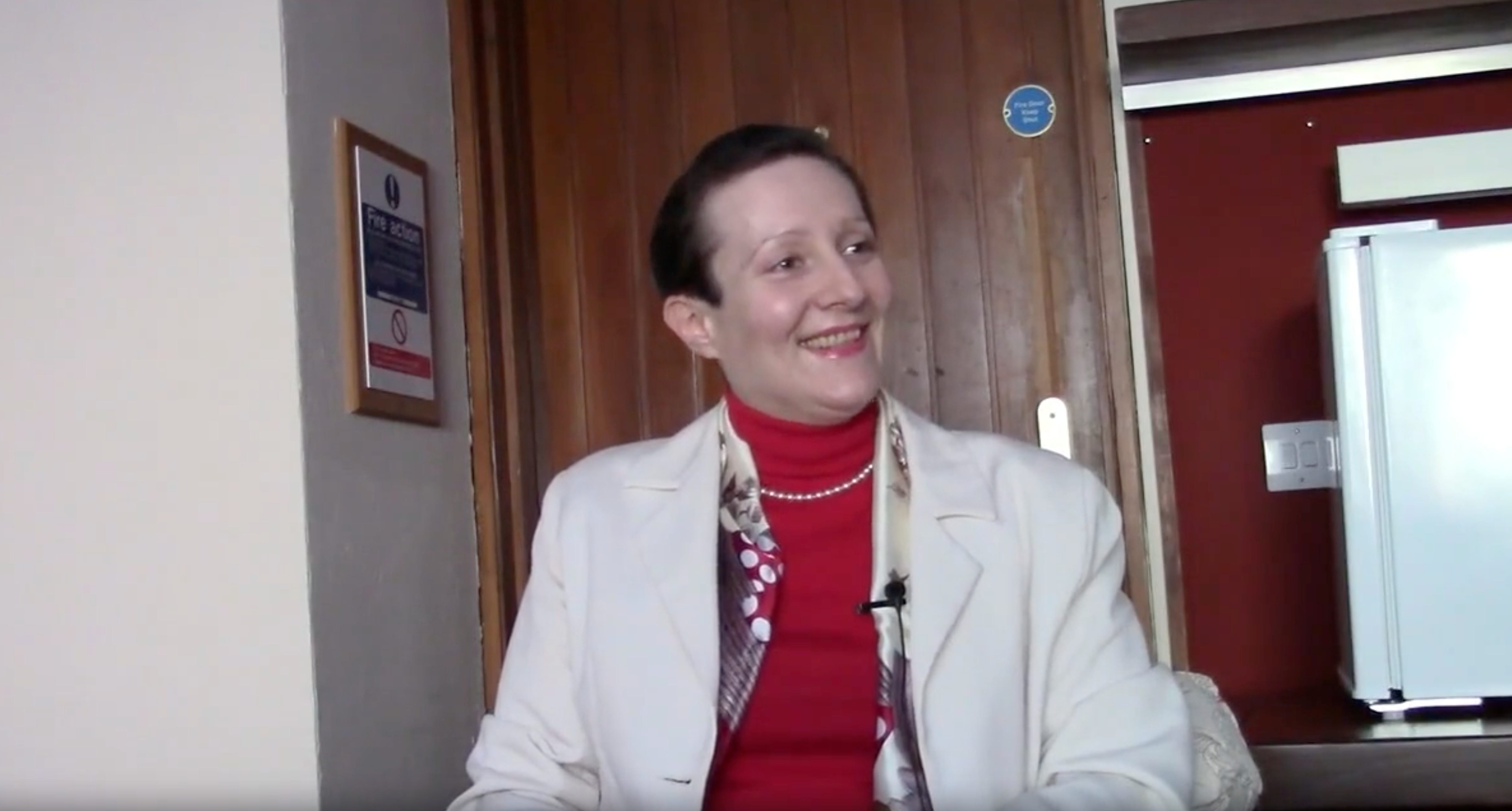 The Ilaria Ramelli tapes | Ilaria Ramelli is a formidable pocket rocket of a thinker. She famously wrote the breakthrough defence of the doctrine of ‘apokatastasis’ or universal salvation in her massive 900 page tome ‘The Christian Doctrine of Apokatastasis’. Her book was a breakthrough because she exploded the myth that most of us grew up with - that the belief in universal salvation (I prefer ‘cosmic redemption’) was always a minority position, and a heretical one in the early church. Ilaria could do this largely because she is a scholar of vast erudition - and in particular in the expansive world of classical thinking not just biblical theology. These tapes are short clips of Robin Parry interviewing her in 2019 before his visit to Australia. Robin intended to use them but we never got around to it. So I thought it was a good time to offer them up now. They are gold because they are short and punchy, and give you a good overview of some big ideas. I introduce the talks with an overview that shows (graphically) how the six talks connect to each other - so you can view them as a coherent structure not just fragments. We attach the first talk at the end of my introduction and will publish the following talks in relatively quick succession. PS - I am afraid I cannot resist adding a somewhat humorous note to this talk. As we all have found, it is difficult to pronounce the word ‘apokatastasis’. It is a multi-syllable tongue twister, and most of us stumble over it. Well, take heart - so does the voice recognition of Descript, the program we use to edit and upload all our talks. It made several vain attempts to get it, and finally gave up, but not before some noble efforts. My favourite one was ‘apple catastrophes’! Get full access to Gospel Conversations at gospelconversations.substack.com/subscribe | 21m 41s | ||||||
Showing 25 of 216
Pitch Fit is a Pro feature
See how bookable this show is for guests, which brands already advertise, the per-episode ad value, and the best-fit guest and sponsor profile. The numbers are blurred on the free plan.
How readily this show books outside guests like you.
How proven this show is for host-read sponsorships.
For Guests
ProFor Advertisers
ProUpgrade to Pro to unlock guest cadence, sponsor categories, fit scores, and per-episode ad value for this show.
Chart Positions
1 placement across 1 market.
Chart Positions
1 placement across 1 market.