
Great News | Inspiring Stories, Positive Developments and Good News
by Andrew McGivern | Good News Podcast Host - Positive News and Inspiration
Is this your podcast?Insights from recent episode analysis
Audience Interest
Podcast Focus
Publishing Consistency
Platform Reach
Insights are generated by CastFox AI using publicly available data, episode content, and proprietary models.
Most discussed topics
Brands & references
Est. Listeners
Insufficient chart data. Estimates will improve as the show charts.
- Per-Episode Audience
Est. listeners per new episode within ~30 days
N/A🎙 Daily cadence·40 episodes·Last published 1mo ago - Monthly Reach
Unique listeners across all episodes (30 days)
N/A - Active Followers
Loyal subscribers who consistently listen
N/A
Market Insights
Platform Distribution
Reach across major podcast platforms, updated hourly
Total Followers
—
Total Plays
—
Total Reviews
—
* Data sourced directly from platform APIs and aggregated hourly across all major podcast directories.
On the show
From 13 epsHost
Recent guests
No guests detected in recent episodes.
Recent episodes
Great News - Coffee Edition
Aug 4, 2026
Unknown duration
De-Extinction Regrowing Cartilage and Safer Batteries
Jul 8, 2026
8m 31s
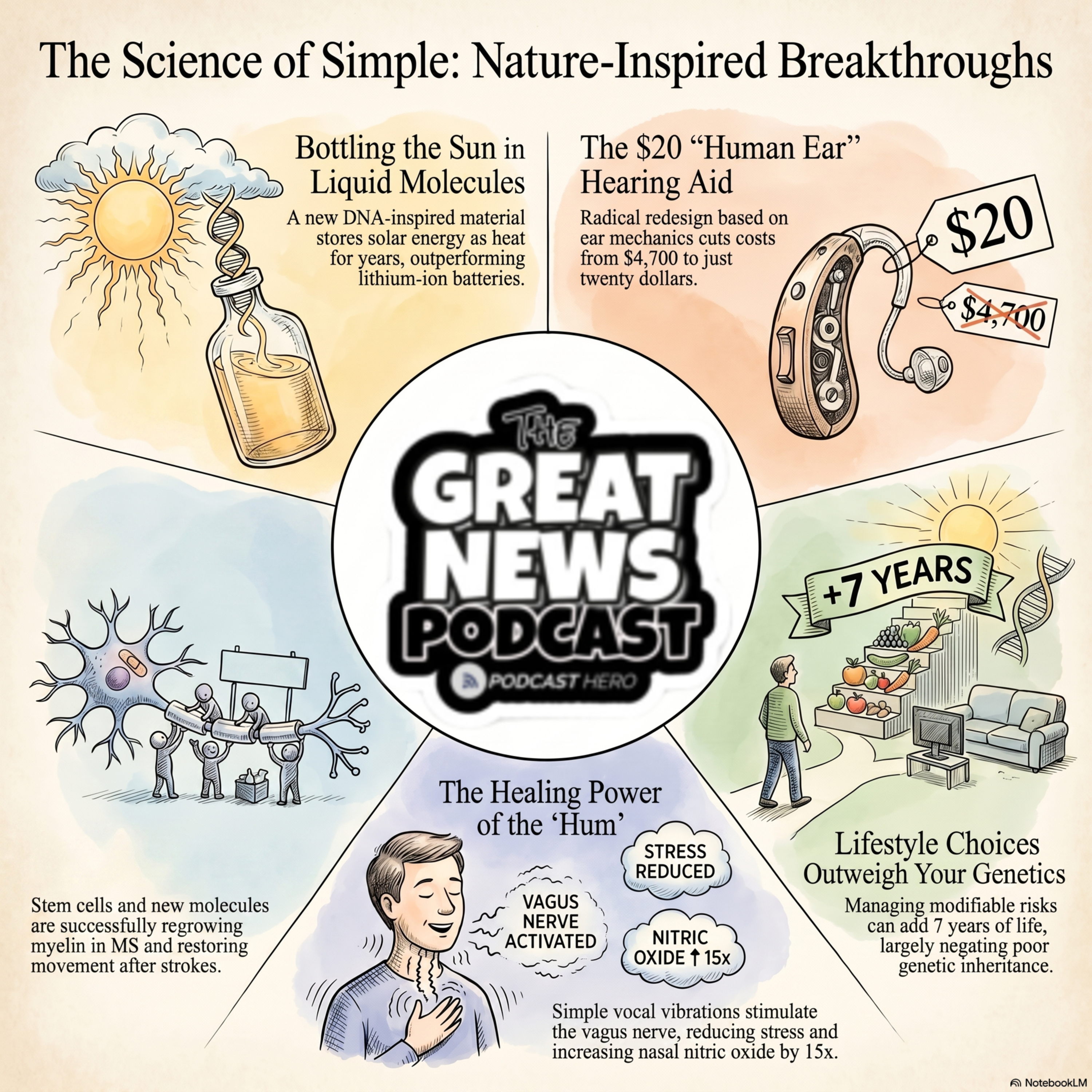
Repairing the Brain, $20 Hearing Aids, and Turning Parking Lots into Power Plants
Jun 25, 2026
7m 17s
Smart Living Drugs and Turning Tumors into Vaccines
Jun 12, 2026
9m 10s
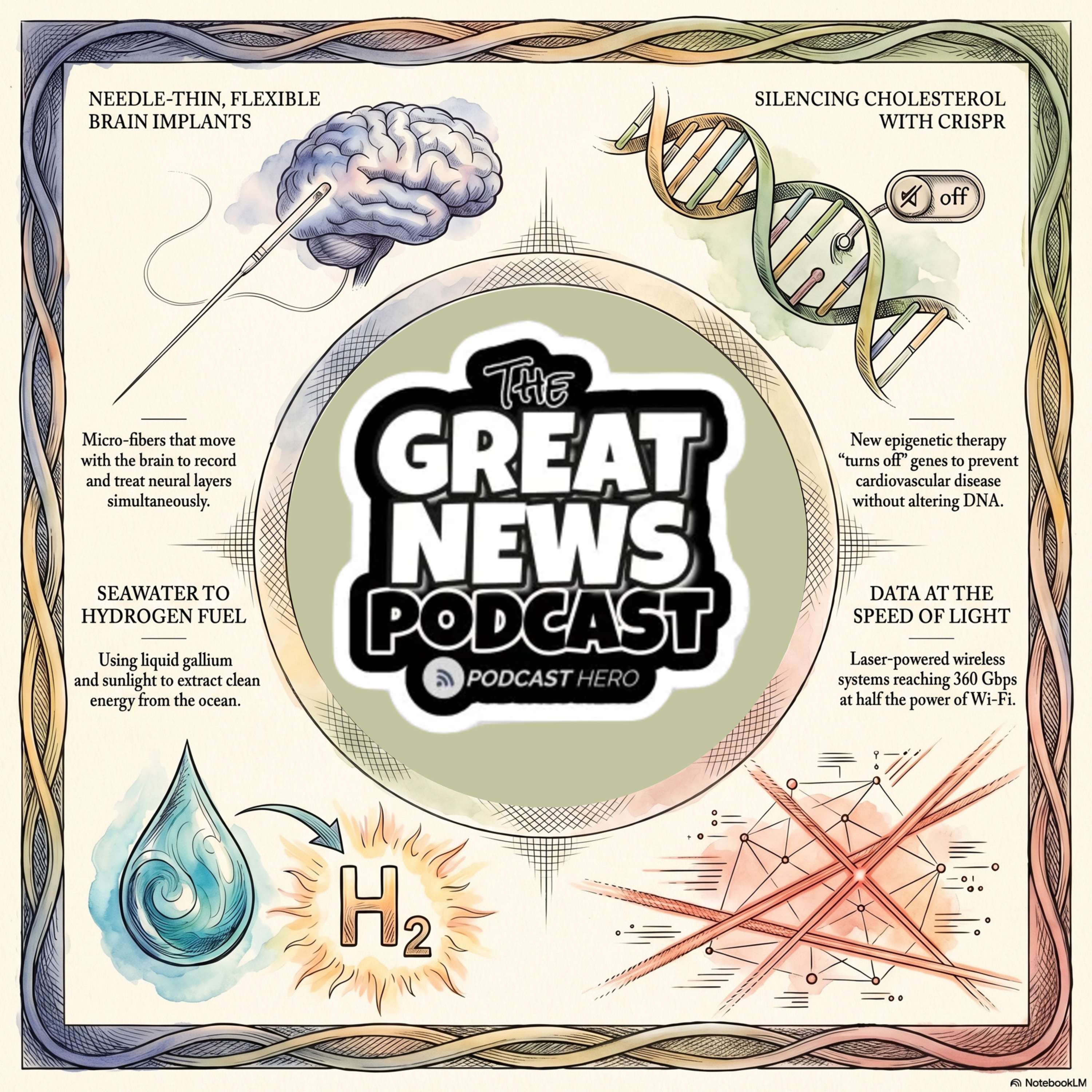
Laser-Fast Internet and Epigenetic Health
Apr 14, 2026
10m 33s
Social Links & Contact
Official channels & resources
Official Website
Login
RSS Feed
Login
Resolving iTunes ID\u2026 if this persists, the podcast may not be indexed on Apple Podcasts.
| Date | Episode | Topics | Guests | Brands | Places | Keywords | Sponsor | Length | |
|---|---|---|---|---|---|---|---|---|---|
| 8/4/26 | 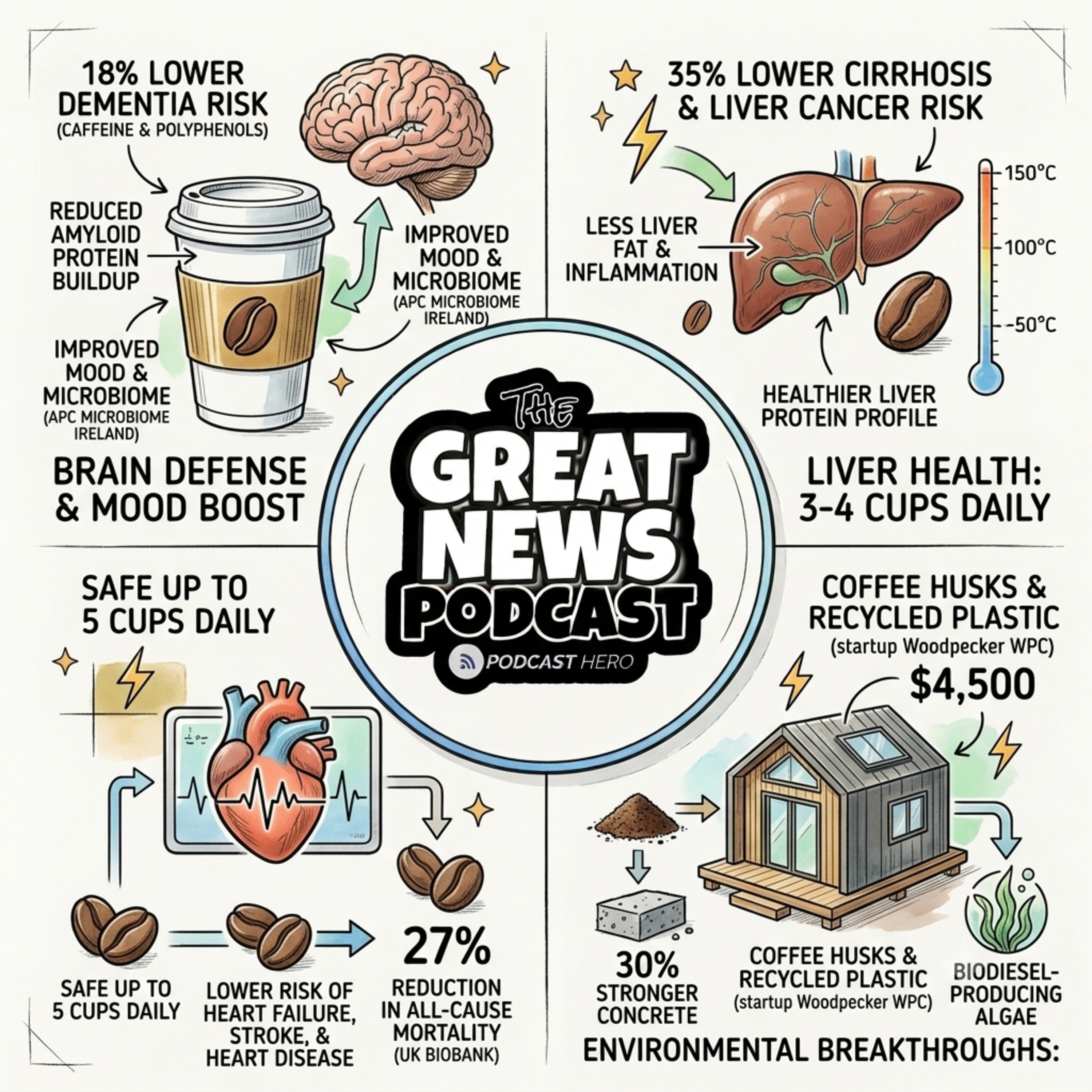 Great News - Coffee Edition | Today, we are celebrating everyone’s favourite bean with a special "Coffee Edition."First up, our lead story: a scientific discovery that explains exactly why coffee is such a powerhouse for your health. Researchers at Texas A&M University have finally uncovered a hidden cellular switch that helps protect your cells from stress, inflammation, and damage. This finding provides a long-awaited biological mechanism for why coffee drinkers tend to live longer. New research from APC Microbiome Ireland has revealed that coffee reshapes your microbiome in ways that significantly improve mood and lower perceived stress, regardless of whether you drink caffeinated or decaf.Evidence from a massive study of more than 130,000 people, led by investigators from Harvard and Mass General Brigham, suggests that drinking two to three cups of coffee a day can reduce dementia risk and slow cognitive decline. A large-scale study involving over 350,000 participants in the U.K. Biobank has linked regular coffee consumption to significantly lower rates of liver disease and cancer. While coffee was once viewed as a cardiovascular risk, the American Heart Association now states that consuming up to five cups a day is generally safe for most adults and may actually lower the risk of heart failure, stroke, and heart disease. Furthermore, data from the UK Biobank shows that drinkers of ground coffee see a 27% reduction in all-cause mortality. Now, if you like the Great News Podcast, you’ll love the Great News Letter, because the Great News Podcast is great, but the Great News Letter is greater. The link is in the show notes.All right, let’s race through the latest improvements in coffee’s environmental impact:Colombian startup Woodpecker WPC is turning coffee husks and recycled plastic into sustainable housing kits that cost just $4,500 and can be built in a week.Researchers in Australia found that replacing 15% of sand in concrete with waste coffee grounds makes the material 30% stronger.A study from Aston University shows that spent coffee grounds can be used to grow biodiesel-producing algae, offering a sustainable alternative to palm oil.Ford and McDonald’s are teaming up to turn coffee "chaff" into car parts like headlamp housings that are 20% lighter.Swiss company CoffeeB has launched compostable "Coffee Balls" encased in a seaweed layer that breaks down in just four weeks.Designer Uyen Tran is recycling coffee grounds and shellfish waste into a biodegradable leather alternative called Tômtex. Seven Cafe is now using hydrogen roasting to cut CO2 emissions while creating a smoother, less bitter flavour. Czech platform Coffee!Up is turning office waste into a "cascade" of products including premium skincare oil and carbon-negative biochar.The International Center for Circular Economy in Coffee (C4CEC) launched in Italy to eliminate waste across the entire industry, reminding us that coffee is a fruit and we currently waste 95% of it.The upcycled coffee fruit extract market is projected to reach $865 million by 2036, as brands like KonaRed turn cherry pulp into high-value antioxidants.Nescafé has already surpassed its 2025 goal, sourcing 32% of its coffee from farmers practicing regenerative methods to improve soil health. As of 2026, the industry is moving toward "de-aluminumization," with traditional foil bags being replaced by recyclable mono-materials and nano-barrier paper.2026 Coffee Barometer: This milestone 20th-anniversary report is pushing the industry for unified collective action to ensure coffee remains a thriving, sustainable sector.And finally, my favourite quote of the day from the Daily Quote podcast this week comes from punk legend and coffee enthusiast Henry Rollins, who once said: “What goes best with a cup of coffee? Another cup.”Now we know that advice isn’t just rock and roll, it’s backed by life-saving science! | — | ||||||
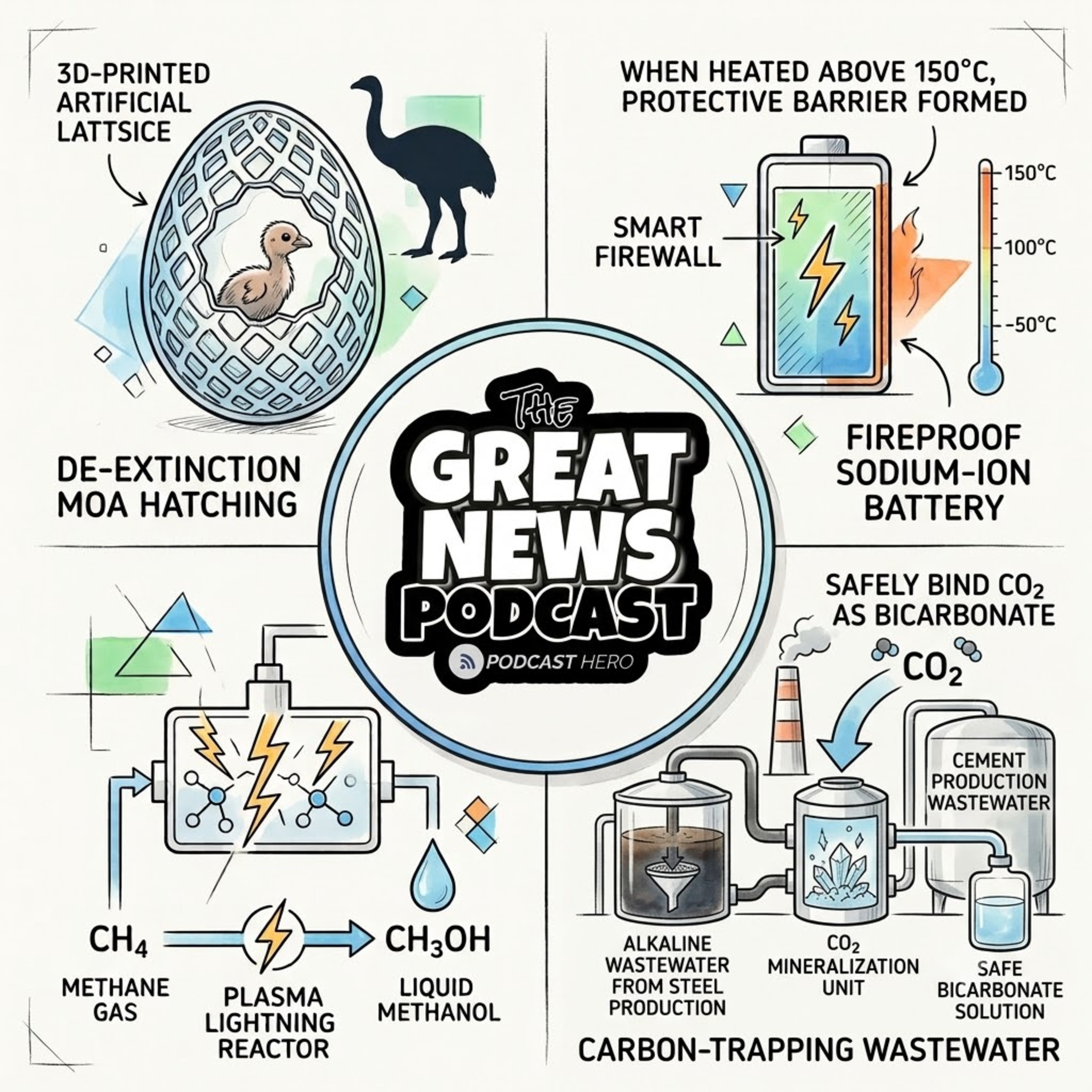
| 7/8/26 | de-extinctionbiotechnology+3 | — | sodium-ion batterieslithium ion batteries+3 | New ZealandSouth Island | de-extinctionColossal Biosciences+3 | — | 8m 31s | ||
| 6/25/26 | clean energyneurological repair+3 | — | — | South KoreaFrance+1 | clean energysolar canopies+3 | Daily Quote | 7m 17s | ||
| 6/12/26 | smart living drugscancer therapy+4 | — | University of OxfordUNSW | Czech Republic | smart living drugscancer vaccine+4 | Daily Quote | 9m 10s | ||
| 4/14/26 | clean energycancer treatment+4 | — | CAR T TherapyDaily Quote+2 | — | laser-fast internetepigenetic health+7 | — | 10m 33s | ||
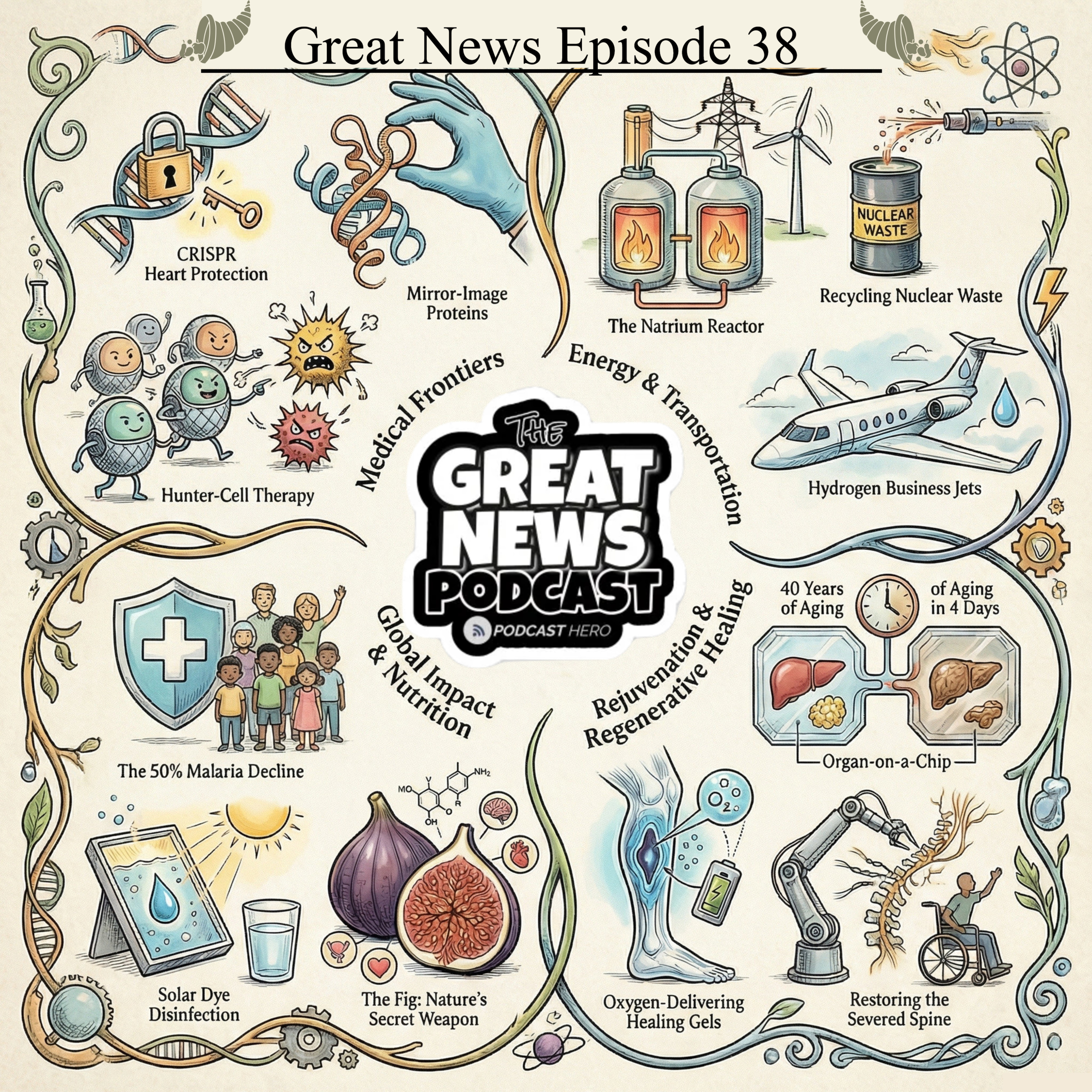
| 4/9/26 | aginghealthcare+4 | — | Organ-on-a-Chiphydrogen-powered business jet+3 | — | longevitynuclear waste+5 | Daily Quote | 8m 52s | ||
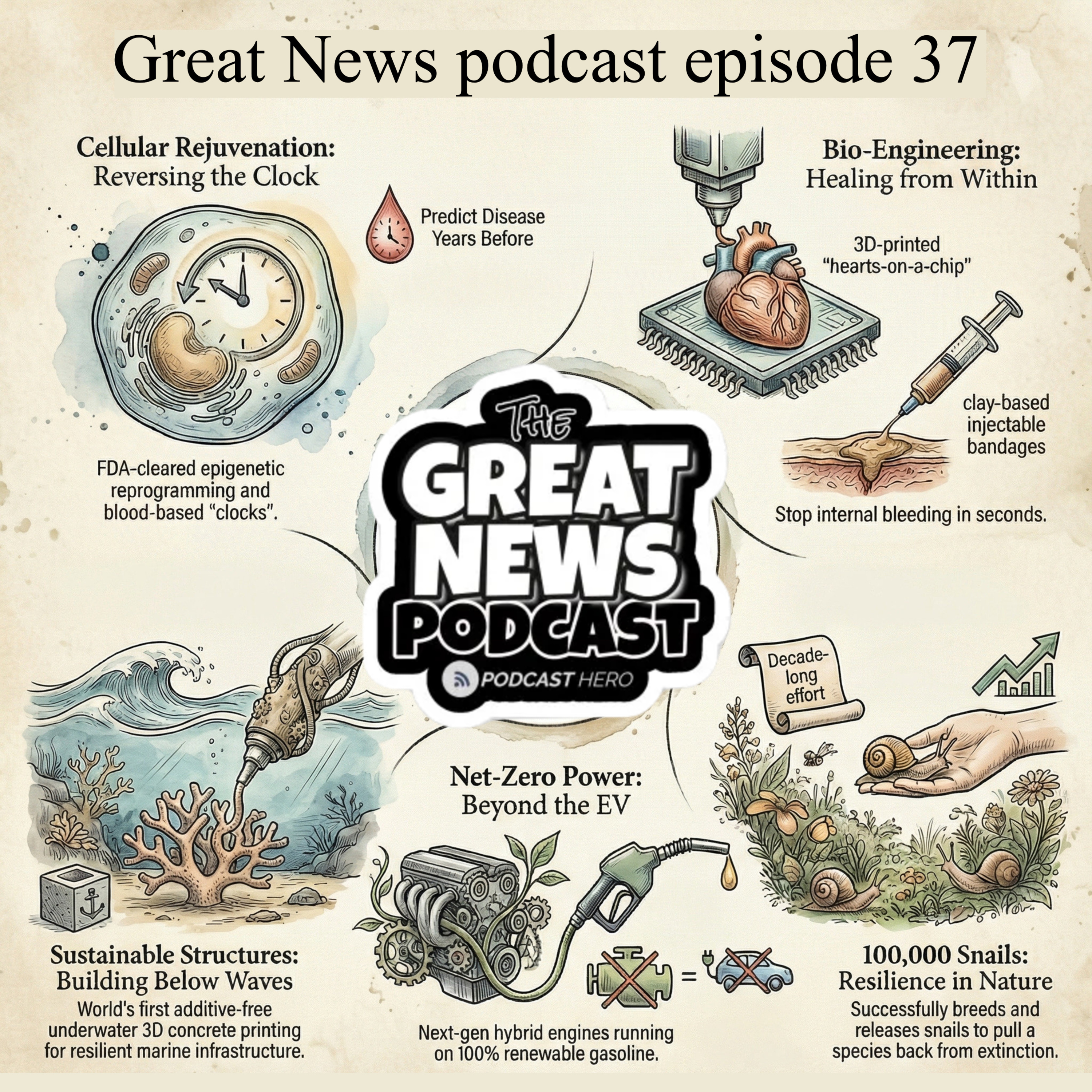
| 4/1/26 | cellular rejuvenationmedical innovation+4 | — | CAR T cell therapyepigenetic reprogramming therapy+4 | Bermuda | blindnesscellular rejuvenation+5 | the Daily Quote | 7m 10s | ||
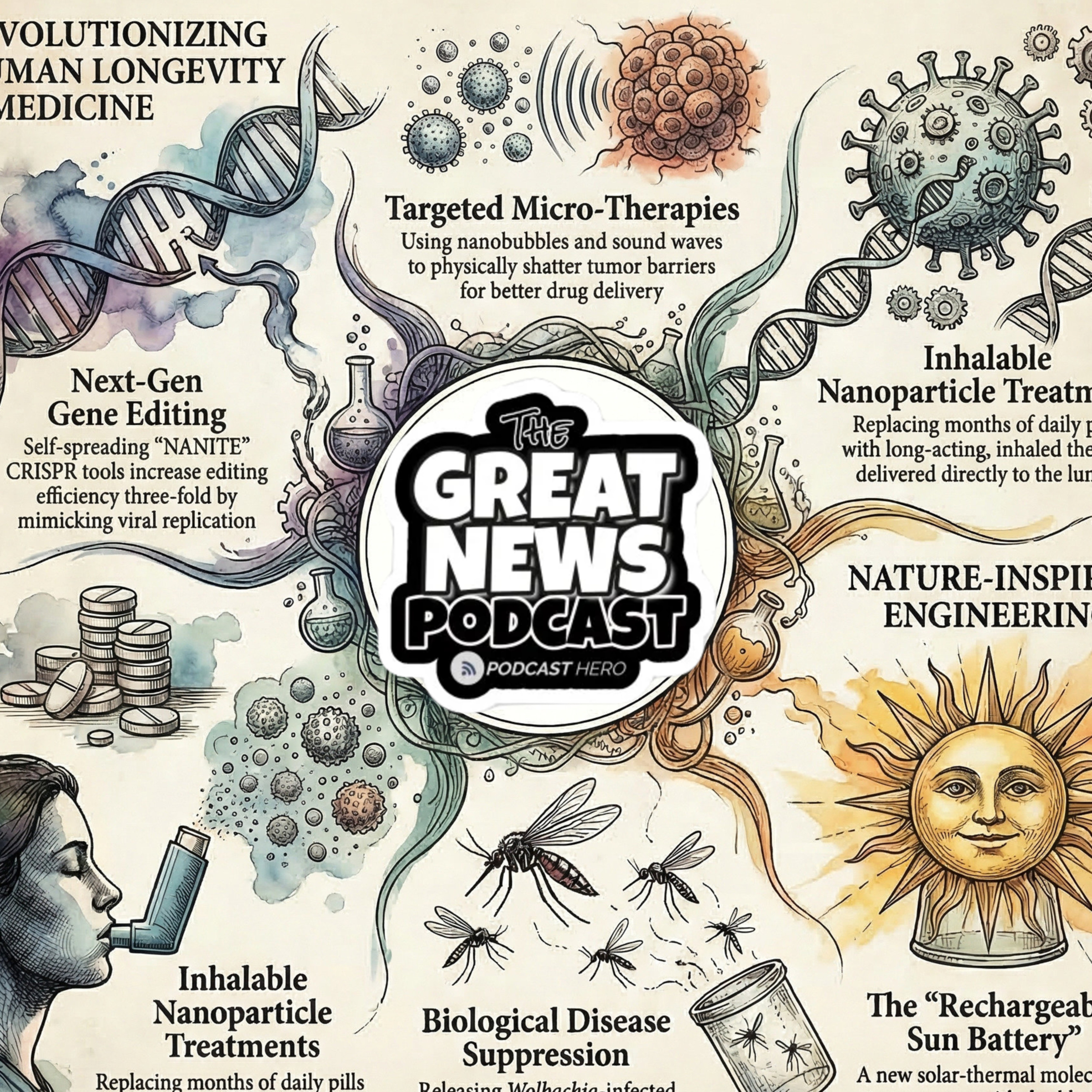
| 3/18/26 | biotechnologysustainable energy+3 | — | CRISPRsun battery+5 | Dengue fever | CRISPRsun battery+6 | Daily Quote | 8m 52s | ||
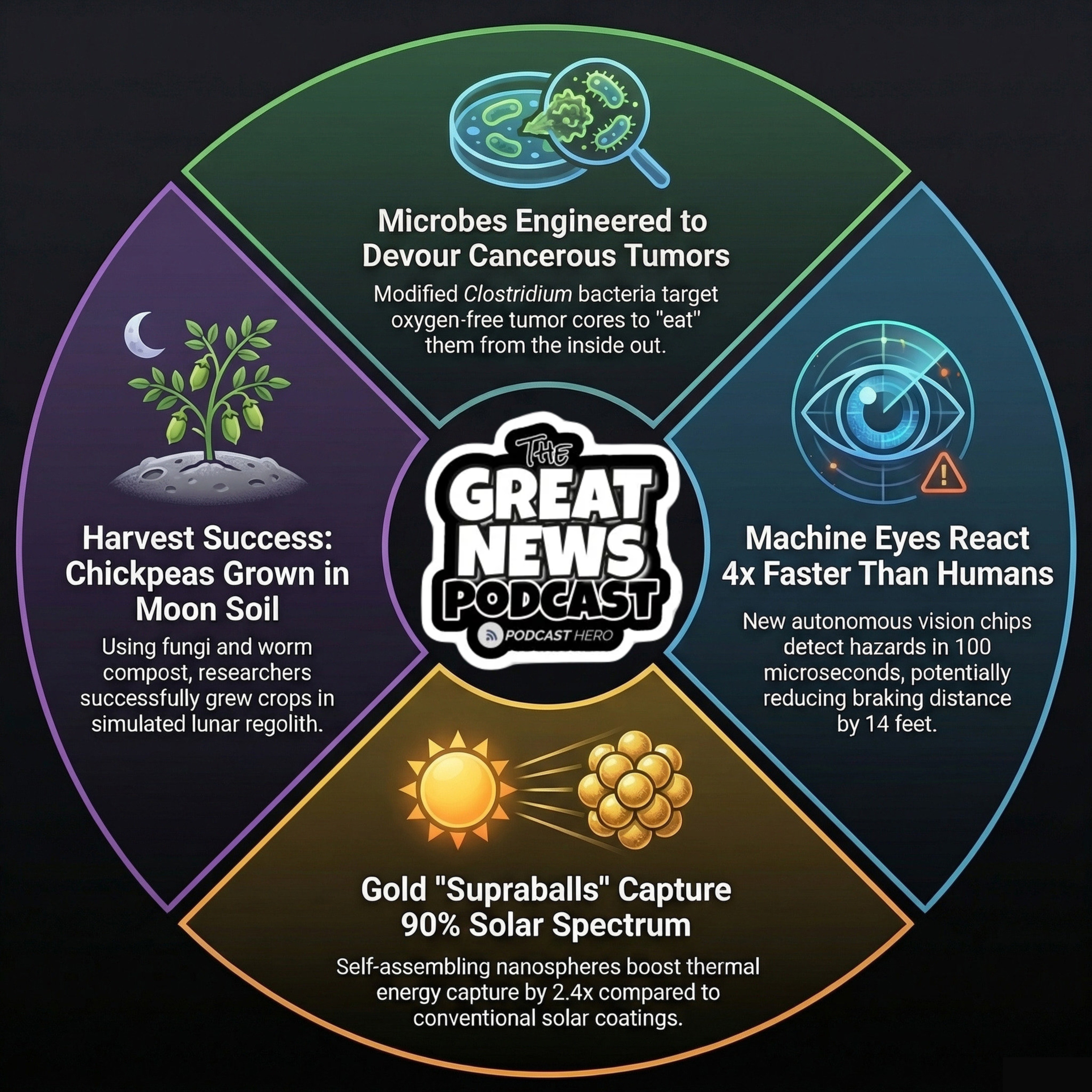
| 3/9/26 | medical breakthroughflying taxis+4 | — | Flying Busrobot cars | ChinaUS | cancer-eating bacteriaflying taxis+4 | Daily Quote | 8m 41s | ||
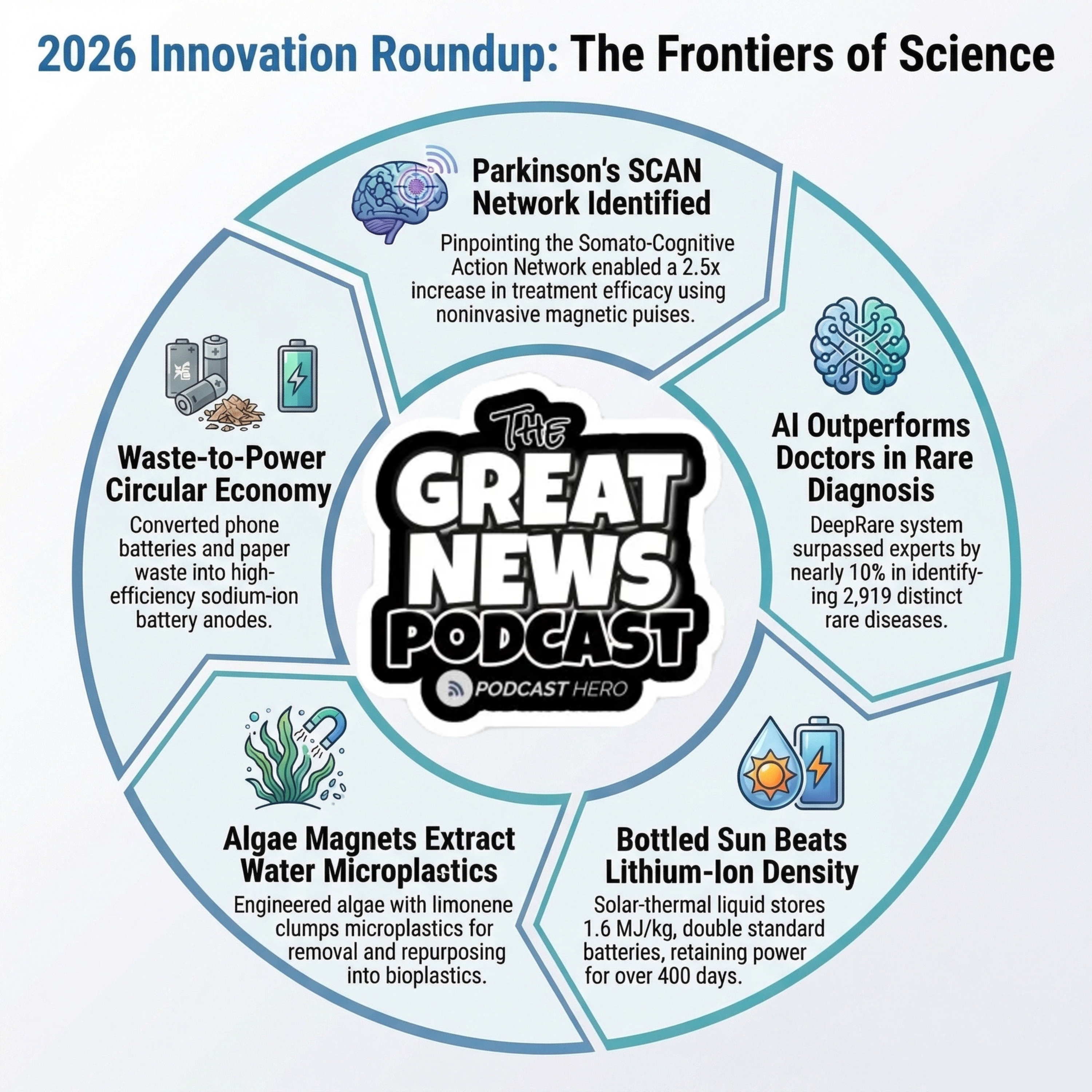
| 3/7/26 | solar energyAI in healthcare+4 | — | electric semi-trucksLiquid That Could Change Solar Energy Forever+1 | — | solar energyAI diagnosis+4 | Daily Quote | 9m 07s | ||
Want analysis for the episodes below?Free for Pro Submit a request, we'll have your selected episodes analyzed within an hour. Free, at no cost to you, for Pro users. | |||||||||
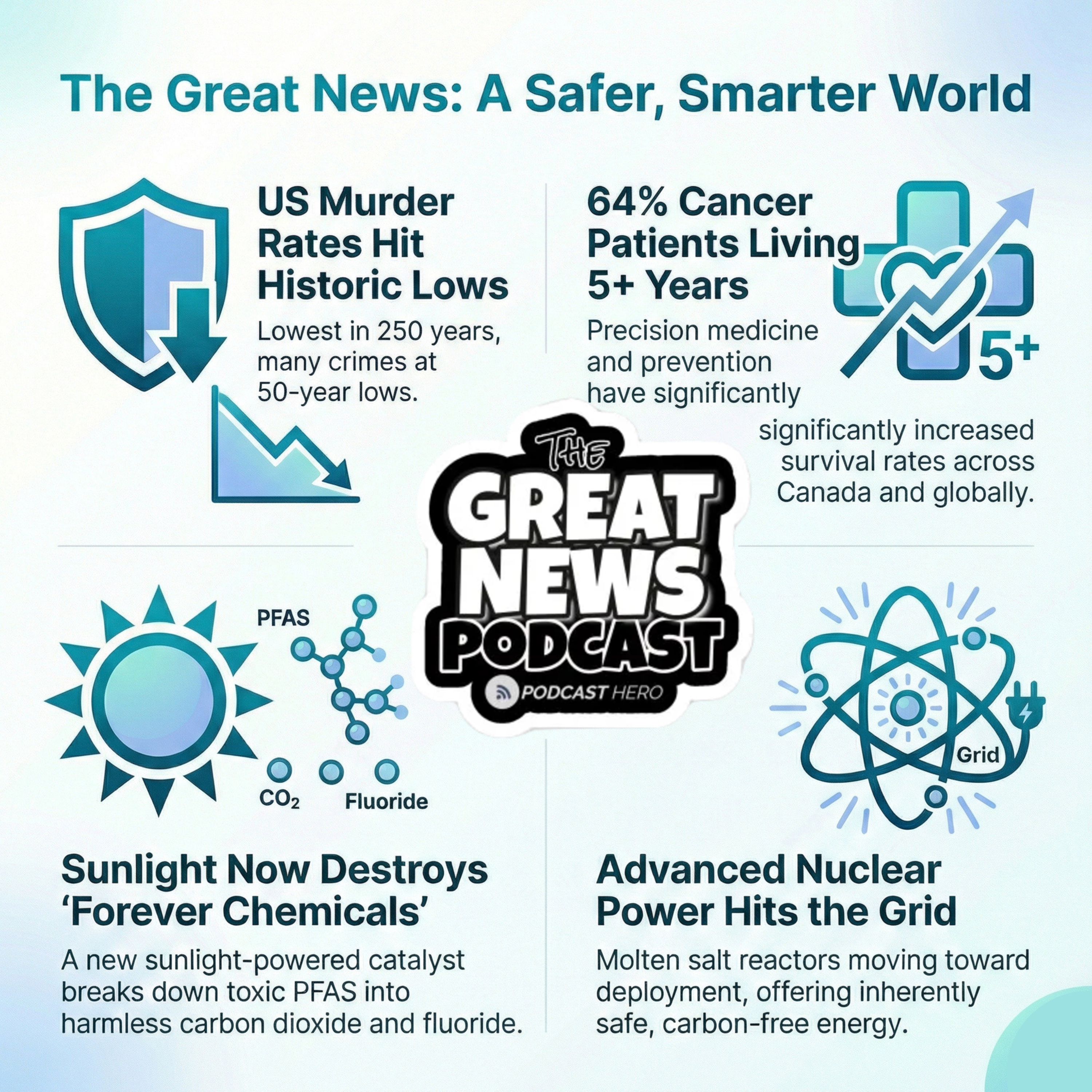
| 3/3/26 | public safetymedicine+4 | — | WaymoAmerica+2 | — | crime dropcancer survival rate+4 | — | 9m 24s | ||
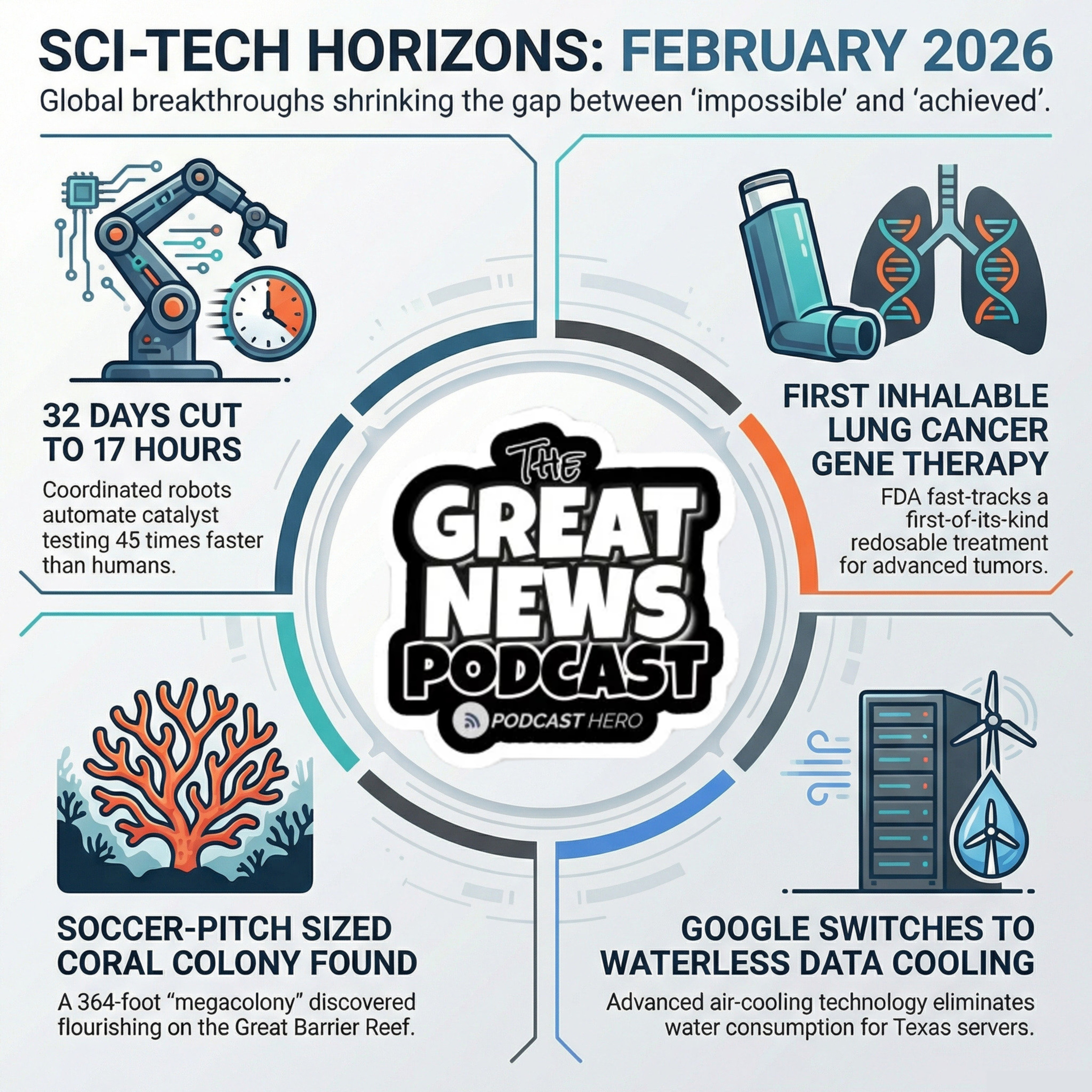
| 2/28/26 | brain healthenvironmental discovery+4 | — | inhalable gene therapyFecal Transplant+1 | Coral | brain agingcoral discovery+5 | — | 8m 38s | ||
| 2/25/26 | biotechnologysustainable energy+4 | — | ChinaAI | Utah | biotechnologysustainable energy+7 | — | 7m 55s | ||
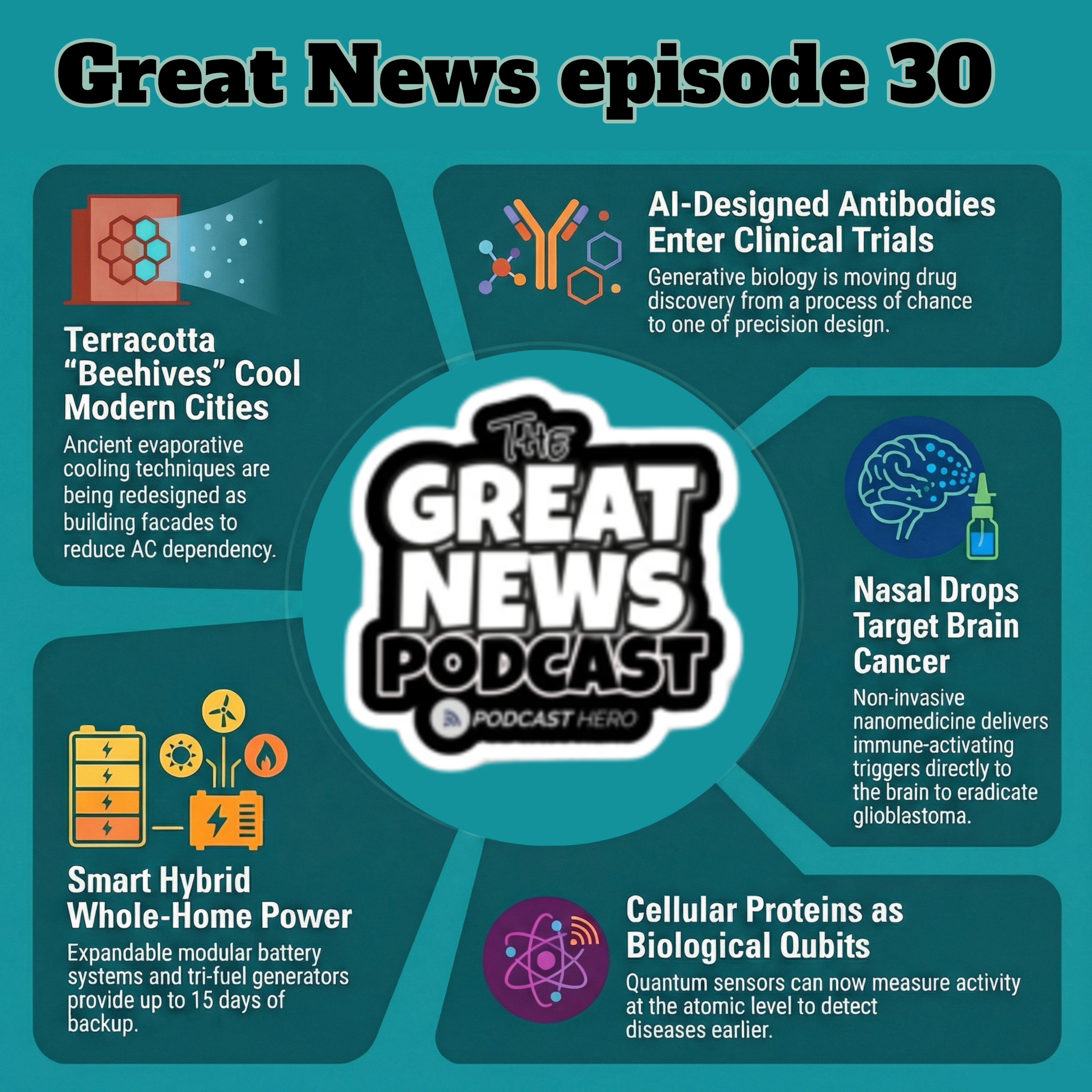
| 2/21/26 | artificial intelligencemedicine+4 | — | AINasal Nanodrops+5 | — | AIcustom antibodies+7 | — | 8m 00s | ||
| 2/17/26 | 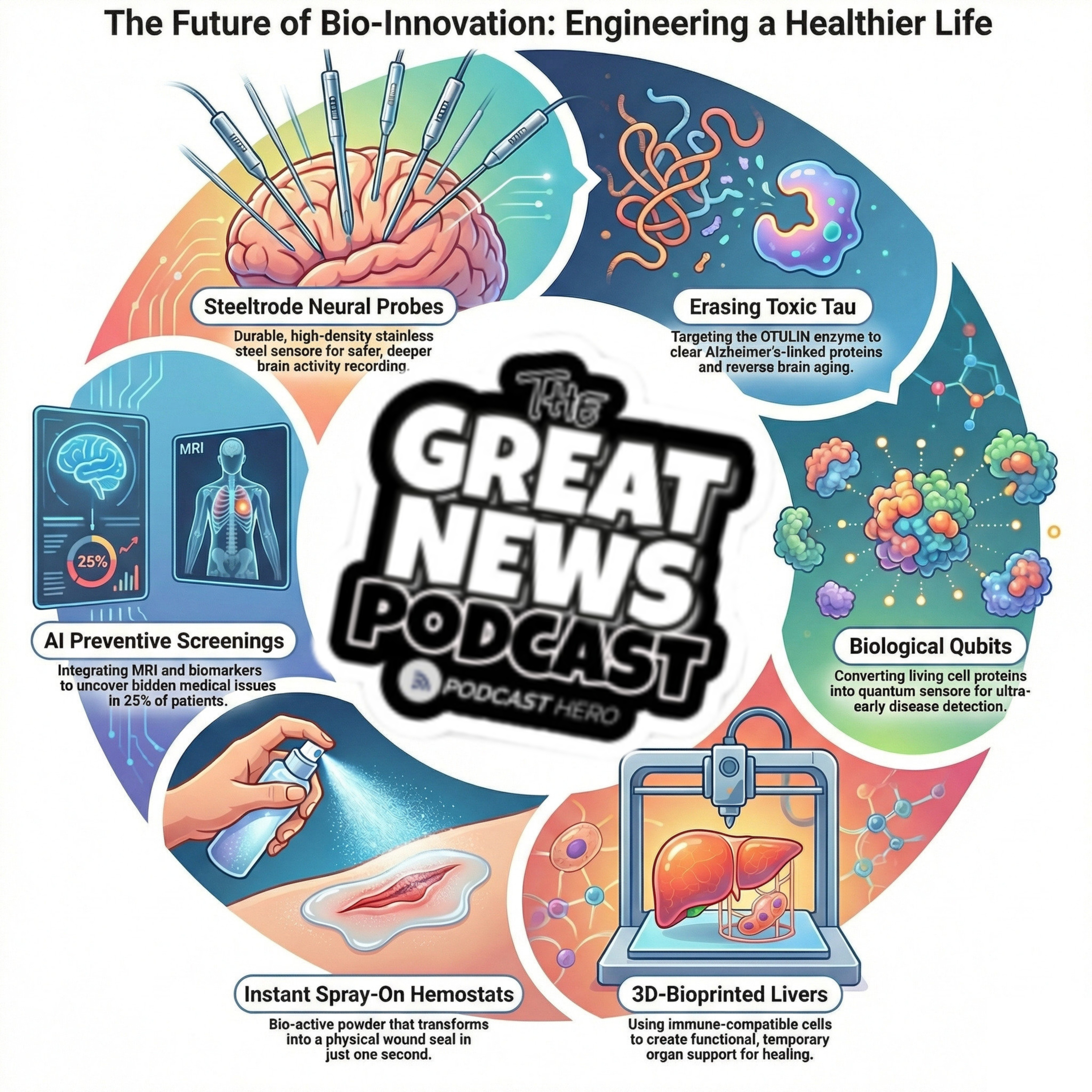 3D-Printed Organs & Steel Brain Probes: The Next Frontier of Medical Tech | Today, we are diving into some truly groundbreaking advancements in medicine and brain health. One Second to Save a LifeA New Brain Probe Could Transform NeurosurgeryMove More, Age LessRemoving Tau from the BrainWhat if we could 3D-bioprint a functioning human liver to buy a patient enough time to heal without a full transplant? That is our lead story today.Plus, we have a spray-on powder that can seal life-threatening wounds in just one second, a new type of stainless steel probe that makes brain sensing safer and cheaper than ever before. And don't forget to stick around for the speed round, where we’ll dive into even more great news.LINKS:the Daily Quote | — | ||||||
| 2/13/26 | 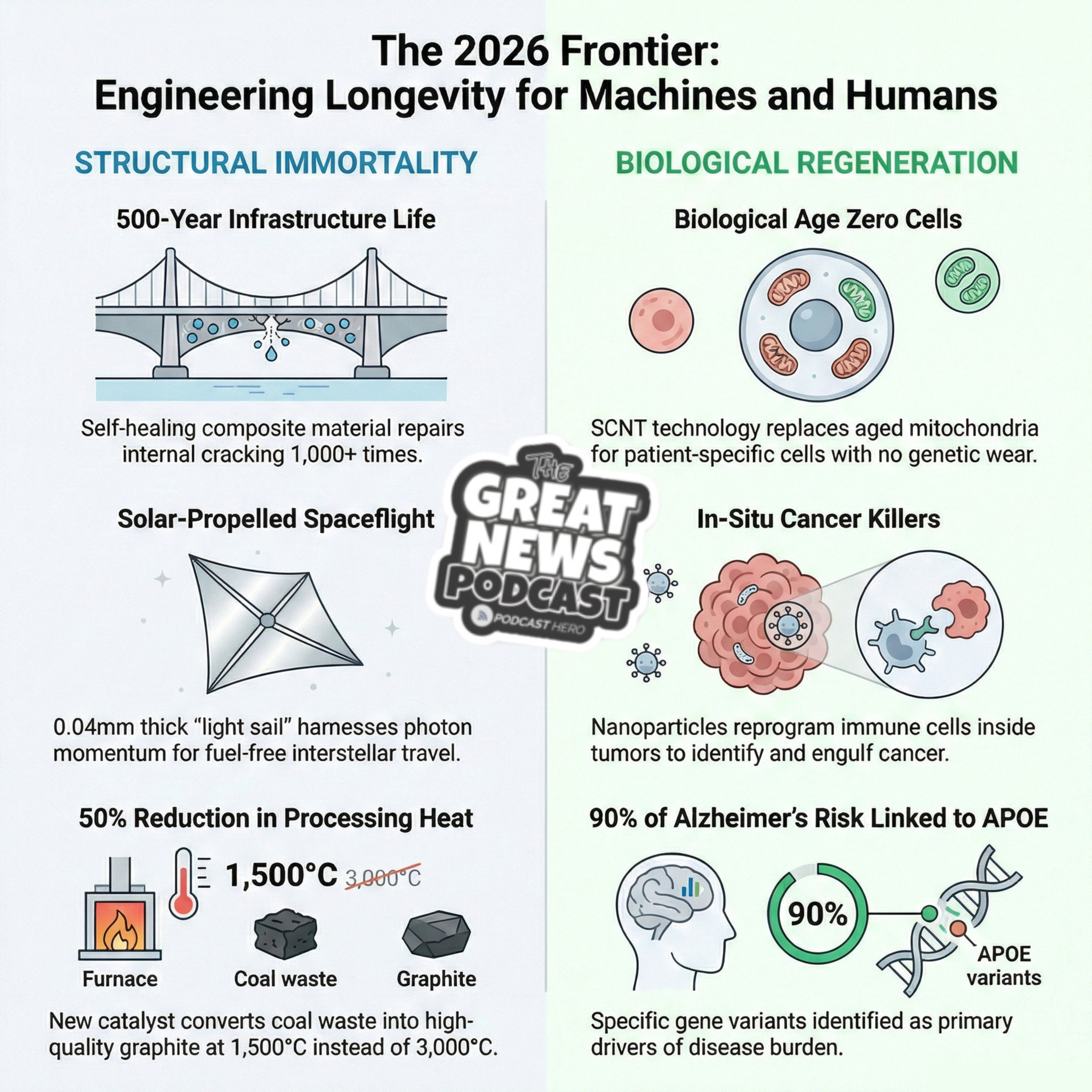 Resetting Cells to "Age Zero" and Turning Tumors Against Themselves | Today we're diving into some truly groundbreaking advancements in medicine, space technology, and sustainable engineering. What if we could reset the human body's cells to a "biological age of zero" to cure incurable diseases? Plus, we have a student-led team that just deployed the world’s first free-flying light sail, a new cancer therapy that turns tumor-protecting cells into killers, and a self-healing material that could make aircraft last for five centuries. Turning Tumors' Own Defenses Against ThemCould "Biological Age Zero" Cells Cure the Incurable?Surfing the Solar WindSelf Healing Wind Turbines, Plane Wings and SpacecraftFirst up, our lead story: a radical shift in regenerative medicine. South Korea-based biotech Clonell Therapeutics has launched a platform that aims to rewind cellular aging to treat diseases like Alzheimer’s, ALS, and heart failure. While previous methods often used "old" or stressed cells, Clonell uses Somatic Cell Nuclear Transfer (SCNT) to transfer a patient’s DNA into a donor egg. This creates stem cells that carry none of the accumulated wear of age, effectively replacing aged mitochondria and organelles. By rebuilding cells before disease has even left a mark, this technology seeks functional restoration rather than just symptom relief. Restoring youth to your cells.If you like the great news podcast you'll love the great news letter because the great news podcast is great but the great news letter is greater. https://greatnewspodcast.com/dailyquoteMoving on to the stars! A student-led group at Cornell University has successfully deployed the world’s first free-flying light sail. This tiny spacecraft, called Alpha CubeSat, weighs only 0.2 pounds and is just 0.04 millimeters thick. Instead of using fuel, it is propelled by the momentum of photons—particles of light—bouncing off its super-reflective surface. This successful mission proves that small, low-cost probes could eventually use sunlight to travel far beyond our solar system.Next, a breakthrough in oncology from researchers at KAIST. They have developed a way to turn immune cells trapped inside tumors into active cancer fighters using a direct injection. Solid tumors are often dense and hard to penetrate, but this new method uses lipid nanoparticles to deliver mRNA instructions directly to the cells already present at the tumor site. These cells are converted into "CAR-macrophages" that can engulf cancer cells and stimulate the rest of the body’s immune system to join the fight. In animal studies, this approach significantly reduced tumor growth and even provided body-wide immune protection.Finally, let’s talk about building things to last. Researchers at North Carolina State University have developed a self-healing composite material that can repair itself over 1,000 times. By 3D-printing a thermoplastic healing agent into fiber-reinforced polymers, they’ve created a material that can melt and rebond its own cracks when an electrical current is applied. This innovation could extend the lifespan of aircraft wings, wind turbines, and spacecraft from decades to 500 years, drastically reducing industrial waste and energy consumption.Speed Round:• Graphite from Coal Waste• Poverty on the Decline• A Paradigm Shift in Alzheimer's• Vitamin C for FertilityAnd my favorite quote of the day from the Daily Quote podcast this week comes from Elbert Hubbard, who once said, "Do not take life too seriously. You will never get out of it alive."Listen to an inspiring quote every single day by following The Daily Quote in your podcast app of choice. https://greatnewspodcast.com/dailyquoteThat’s it for today’s episode of Great News. From resetting cells to "age zero" and sailing through space on beams of light to turning tumors against themselves, the future is looking brighter than ever. And the great news is that these aren't distant possibilities these developments are happening right now. | — | ||||||
| 2/10/26 | Psychedelics Without the "Trip": New Drugs for Depression and PTSD | Today, we are looking at a future where diseases like Alzheimer’s can be spotted years before they start and how a simple headset might help paralyzed patients walk again. That’s our lead story today. Plus, we have news on a brand-new class of medicine that provides the benefits of psychedelics without the hallucinations, a way to turn whisky waste into essential nutrients, and a battery with a "heart of wood." And don’t forget to stick around for the speed round, where we’ll dive into even more great news. | — | ||||||
| 2/5/26 | Moving Up: ChatGPT Health, Africa’s Surge, and the Truth About the Shrinking Middle Clas | Today, we're diving into some truly groundbreaking advancements in medical technology, global health, and international trade. What if you had a dedicated AI health partner that understood your entire medical history to help you navigate your wellness? That’s our lead story today. Plus, we have a massive milestone in the fight against blindness, a historic economic shift for the African continent, and a trade deal connecting over 700 million people. And don't forget to stick around for the speed round, where we'll dive into even more great news | — | ||||||
| 2/2/26 | Medical Miracles: Brazil’s HIV Milestone and Hearing Loss Breakthroughs | Today, we’re diving into some truly groundbreaking advancements in medicine, environmental protection, and global justice. What if we could ensure every child is born free of a life-altering virus? That is our lead story today. Plus, we have a gene therapy that restores hearing, internet cables that can sense earthquakes, and a new way to store energy using a fluid that looks like a giant protein shake. And don’t forget to stick around for the speed round, where we’ll dive into even more great news | — | ||||||
| 1/29/26 | Can mRNA Stop Aging? New Breakthroughs in Immune System Longevity | Today we are exploring how mRNA technology is being used to reverse the aging of our immune systems, which is our lead story. Plus, we have stories on robots hitching rides on helicopters to fix wind turbines, a new way to watch plants "breathe" in high definition, and a breakthrough that recovers gold from old mobile phones in just 20 minutes.And don’t forget to stick around for the speed round, where we’ll cover even more great news. | — | ||||||
| 1/26/26 | Flying Cars and Robot Surgeons | Today, we’ve got a packed episode: flying cars you can actually afford, a humanoid robot entering the operating room, and a breakthrough eye drop that might let you toss your reading glasses for good.And don't forget to stick around to the end for the speed round for even more great news! | — | ||||||
| 1/23/26 | AI vs Medical Doctors, Hurricanes and more... | I’m Andrew McGyvern, and this is the Great News Podcast. Tired of all the doom and gloom news from mainstream media? You’ll get none of that here. Instead, you'll find inspiring stories and developments making the world a better place. Today we are diving into some truly groundbreaking advancements in artificial intelligence and robotics that are transforming how we treat disease, predict the weather, and even move the goods we use every day.What if an AI could diagnose a complex medical case four times more accurately than an experienced human doctor? That is our lead story today. Plus, we have a new AI tool that can spot a hurricane before it even forms, the first fully robotic heart transplant in US history, and the new robotic workforce moving into warehouses. And don't forget to stick around for the speed round where we’ll dive into even more great news. | — | ||||||
| 1/19/26 | Smart Cartilage and Tomb Fungus fights Cancer | Reporting from my secret underground lair. Here are the latest great news stories from greatnewspodcast.com brought to you by The Daily Quote, a podcast designed to kickstart your day in a positive way. Tired of all the doom and gloom news from mainstream media? You'll get none of that here. Instead, you'll find inspiring stories and developments making the world a better place. I'm Andrew McGyvern, and this is the Great News Podcast. Today we're diving into some truly groundbreaking advancements in medicine, energy, and aerospace. What if we could beam high-speed internet across thousands of miles of space using a tiny laser? That's our lead story today. Plus, we have "smart" cartilage that delivers its own medicine, a tomb fungus that might cure cancer, and a nuclear reactor that generates clean hydrogen fuel. And don't forget to stick around for the speed round, where we'll dive into even more great news. | — | ||||||
| 1/15/26 | Mushrooms vs Pain and Depression | Good News | Today, we are exploring a medical breakthrough that uses a single dose of a mushroom compound to potentially cure chronic pain and depression simultaneously. Plus, we have an AI system mapping the heart to find new uses for old drugs, a massive genetic map of how the human brain builds itself, and a way to refresh the brain’s immune cells to fight off Alzheimer's. And don't forget to stick around for the speed round, where we'll dive into even more great news. | — | ||||||
| 1/12/26 | Good News - A simple injection regrows cartilage and more... | Our lead story today is a potential game-changer for the millions of people living with joint pain. Researchers at Stanford Medicine have identified an anti-aging injection that can actually regrow knee cartilage.In studies, this treatment not only rebuilt lost cartilage in older mice but also prevented arthritis from developing after serious injuries like ACL tears. Even more exciting, human joint tissue collected during surgeries responded to the treatment by forming new, functional cartilage. We are looking at a future where a simple localized injection could eliminate the need for bionic knees and hips altogetherNext, we’re heading to the coast of Norway, where a startup called Flocean is preparing to launch the world’s first subsea desalination plant in 2026.As global freshwater demand is projected to outstrip supply by 40% by 2030, we desperately need better ways to make seawater drinkable. Traditional land-based plants are noisy, expensive, and massive energy hogs. Flocean’s solution? Placing desalination "pods" 300 to 600 metres deep on the ocean floor. At that depth, the sheer weight of the ocean provides the "free" hydrostatic pressure needed to push water through filtering membranes, slashing energy use and greenhouse emissions by up to 50%. These modular pods are quiet, chemical-free, and each one could provide fresh water for over 37,000 people every single day.In the world of oncology, researchers at KAIST have developed a way to make the body attack cancer from within using nanoparticles. Because this happens directly inside the patient’s body, it bypasses the expensive and time-consuming process of extracting and modifying cells in a lab.[Featured Story 3: China’s Fusion Milestone]Looking toward the future of clean energy, China’s EAST reactor has just broken a fundamental limit in nuclear fusion.Scientists have reached a state called the "density-free regime," allowing fusion plasma to remain stable at much higher densities than previously thought possible. Why does this matter? Because in fusion, more density equals more power. By overcoming these traditional barriers, we are moving significantly closer to "ignition"—the point where a fusion reaction produces more energy than it consumes, potentially providing the world with limitless, carbon-free power.Now, let’s fly through even more incredible developments in the Speed Round:• Rare Earth Recycling: A new 1,800-acre facility in Missouri is set to convert "dead" magnets from old electronics into high-purity rare earth oxides, reducing carbon emissions by 61% compared to traditional mining.• AI Heart Mapping: A new tool called CardioKG uses AI and heart scans to map the relationships between genes and diseases, allowing researchers to repurpose existing drugs (like arthritis meds) to treat heart failure.• 24/7 Solar Windows: Researchers in South Korea have designed transparent windows that generate power day and night—using sunlight during the day and indoor lighting like LEDs at night—all while maintaining 93.8% color accuracy.• Non-Toxic Receipts: Scientists at EPFL have developed a non-toxic thermal paper using lignin from wood and plant sugars, potentially replacing the hormone-disrupting BPA and BPS found in almost all current grocery receipts.[Closing]That’s a wrap for Episode 19. It’s easy to feel overwhelmed by the world, but as these stories show, we are living in an era of unprecedented problem-solving. We’ll leave you with our favorite quote of the week from Robert Louis Stevenson: "Don't judge each day by the harvest you reap but by the seeds that you plant."Keep looking for the good in the world—it’s everywhere if you know where to look. Until next time! | — | ||||||
Showing 25 of 44
Pitch Fit is a Pro feature
See how bookable this show is for guests, which brands already advertise, the per-episode ad value, and the best-fit guest and sponsor profile. The numbers are blurred on the free plan.
How readily this show books outside guests like you.
How proven this show is for host-read sponsorships.
For Guests
ProFor Advertisers
ProUpgrade to Pro to unlock guest cadence, sponsor categories, fit scores, and per-episode ad value for this show.